

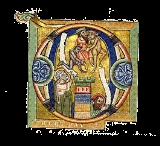
Simon Magus

Encyclopedia
Simon the Sorcerer or Simon the Magician, in Latin Simon Magus, (Greek
Σίμων ὁ μάγος) was a Samaritan magus or religious figure and a convert to Christianity, baptised by Philip the Apostle
, whose later confrontation with Peter is recorded in . The sin of simony
, or paying for position and influence in the church, is named for Simon. The Apostolic Constitutions
also accuses him of lawlessness
. According to Recognitions, Simon's parents were named Antonius and Rachel.
Surviving traditions about Simon appear in anti-heretical texts, such as those of Irenaeus
, Justin Martyr
, Hippolytus, and Epiphanius
, where he is often regarded as the source of all heresies
. Justin
wrote that nearly all the Samaritans in his time were adherents of a certain Simon of Gitta, a village not far from Flavia Neapolis. Irenaeus held him as being one of the founders of Gnosticism
and the sect of the Simonians
. Hippolytus quotes from a work he attributes to Simon or his followers the Simonians, Apophasis Megale, or Great Declaration. According to the early church heresiologists Simon is also supposed to have written several lost treatises, two of which bear the titles The Four Quarters of the World and The Sermons of the Refuter.
In apocrypha
l works including the Acts of Peter
, Pseudo-Clementines, and the Epistle of the Apostles, Simon also appears as a formidable sorcerer with the ability to levitate and fly at will.
did, the earliest reference to him is the canonical
Acts of the Apostles
, this is his only appearance in the New Testament.
Acts tells of a person named Simōn practicing magic in the city of Sebaste in Samaria
, meeting with Philip the Evangelist
, and then trying to offer money to the Apostles in exchange for miraculous abilities, specifically the power of laying on of hands
. In , Peter
denounces Simon's attitude, and declares, "May your money perish with you!"
mentions a magician named Simon as being involved with the procurator Felix, King Agrippa II
and his sister Drusilla, where Felix has Simon convince Drusilla to marry him instead of the man she was engaged to. Some scholars have considered the two to be identical, although this is not generally accepted, as the Simon of Josephus is a Jew rather than a Samaritan.
) record that after being cast out by the Apostles he came to Rome
where, having joined to himself a profligate woman of the name of Helen, he gave out that it was he who appeared among the Jews as the Son, in Samaria as the Father and among other nations as the Holy Spirit. He performed such miracles by magic acts during the reign of Claudius
that he was regarded as a god and honored with a statue on the island in the Tiber which the two bridges cross, with the inscription Simoni Deo Sancto, "To Simon the Holy God". However, in the 16th century, a statue was unearthed on the island in question, inscribed to Semo Sancus, a Sabine
deity, leading most scholars to believe that Justin Martyr confused Semoni Sancus with Simon.
also makes Simon speak in the first person in several places in his Panarion
, and the inference is that he is quoting from a version of it, though perhaps not verbatim.
In the beginning God had his first thought, his Ennoia, which was female, and that thought was to create the angels. The First Thought then descended into the lower regions and created the angels. But the angels rebelled against her out of jealousy and created the world as her prison, imprisoning her in a female body. Thereafter, she was reincarnated many times, each time being shamed. Her many reincarnations included Helen of Troy; among others, and she finally was reincarnated as Helen, a slave and prostitute in the Phoenicia
n city of Tyre. God then descended in the form of Simon Magus, to rescue his Ennoia, and to confer salvation upon men through knowledge of himself.
For as the angels were mismanaging the world, owing to their individual lust for rule, he had come to set things straight, and had descended under a changed form, likening himself to the Principalities and Powers through whom he passed, so that among men he appeared as a man, though he was not a man, and was thought to have suffered in Judaea, though he had not suffered.
But the prophets had delivered their prophecies under the inspiration of the world-creating angels: wherefore those who had their hope in him and in Helen minded them no more, and, as being free, did what they pleased; for men were saved according to his grace, but not according to just works. For works were not just by nature, but only by convention, in accordance with the enactments of the world-creating angels, who by precepts of this kind sought to bring men into slavery. Wherefore he promised that the world should be dissolved, and that those who were his should be freed from the dominion of the world-creators.
In this account of Simon there is a large portion common to almost all forms of Gnostic myths, together with something special to this form. They have in common the place in the work of creation assigned to the female principle, the conception of the Deity; the ignorance of the rulers of this lower world with regard to the Supreme Power; the descent of the female (Sophia) into the lower regions, and her inability to return. Special to the Simonian tale is the identification of Simon himself with the Supreme, and of his consort Helena with the female principle.
Reduced to despair, he says, by the curse laid upon him by Peter, Simon embarked on the career that has been described:
, with extensive quotations from the Apophasis Megale. Some believe that Hippolytus' account is of a later, more developed form of Simonianism, and that the original doctrines of the group were simpler, close to the account given by Justin Martyr and Irenaeus (this account however is also included in Hippolytus' work).
Hippolytus says the free love
doctrine was held by them in its purest form, and speaks in language similar to that of Irenaeus about the variety of magic arts practiced by the Simonians, and also of their having images of Simon and Helen under the forms of Zeus
and Athena
. But he also adds, "if any one, on seeing the images either of Simon or Helen, shall call them by those names, he is cast out, as showing ignorance of the mysteries."
.
 Cyril of Jerusalem
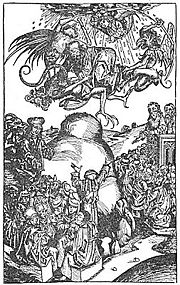
(346 AD) in the sixth of his Catechetical Lectures prefaces his history of the Manichaeans by a brief account of earlier heresies: Simon Magus, he says, had given out that he was going to be translated to heaven, and was actually careening through the air in a chariot drawn by demons when Peter and Paul knelt down and prayed, and their prayers brought him to earth a mangled corpse.
l Acts of Peter
gives a more elaborate tale of Simon Magus' death. Simon is performing magic
in the Forum
, and in order to prove himself to be a god, he levitates up into the air above the Forum. The apostle Peter
prays to God to stop his flying, and he stops mid-air and falls into a place called the Sacra Via (meaning, Holy Way), breaking his legs "in three parts". The previously non-hostile crowd then stones
him. Now gravely injured, he had some people carry him on a bed at night from Rome to Ariccia
, and was brought from there to Terracina
to a person named Castor, who on accusations of sorcery was banished from Rome. The Acts then continue to say that he died "while being sorely cut by two physicians".
gives a slightly different version of the above incident, which was shown in the context of a debate in front of the Emperor Nero
. In this version, Paul the Apostle is present along with Peter, Simon levitates from a high wooden tower made upon his request, and dies "divided into four parts" due to the fall. Peter and Paul were then put in prison by Nero while ordering Simon's body be kept carefully for three days (thinking he would rise again
).
give an account of Simon Magus and some of his teachings in regards to the Simonians. They are of uncertain date and authorship, and seem to have been worked over by several hands in the interest of diverse forms of belief.
Simon was a Samaritan, and a native of Gitta. The name of his father was Antonius, that of his mother Rachel. He studied Greek literature
in Alexandria
, and, having in addition to this great power in magic, became so ambitious that he wished to be considered a highest power, higher even than the God who created the world. And sometimes he "darkly hinted" that he himself was Christ
, calling himself the Standing One. Which name he used to indicate that he would stand for ever, and had no cause in him for bodily decay. He did not believe that the God who created the world was the highest, nor that the dead would rise. He denied Jerusalem, and introduced Mount Gerizim
in its stead. In place of the Christ of the Christians he proclaimed himself; and the Law he allegorized in accordance with his own preconceptions. He did indeed preach righteousness and judgment to come: but this was merely a bait for the unwary.
There was one John the Baptist
, who was the forerunner of Jesus
in accordance with the law of parity; and as Jesus had twelve Apostles, bearing the number of the twelve solar months, so had he thirty leading men, making up the monthly tale of the moon. One of these thirty leading men was a woman called Helen, and the first and most esteemed by John was Simon. But on the death of John
he was away in Egypt
for the practice of magic, and one Dositheus, by spreading a false report of Simon's death, succeeded in installing himself as head of the sect. Simon on coming back thought it better to dissemble, and, pretending friendship for Dositheus, accepted the second place. Soon, however, he began to hint to the thirty that Dositheus was not as well acquainted as he might be with the doctrines of the school.
The encounter between both Dositheus and Simon Magus was the beginnings of the sect of Simonians. The narrative goes on to say that Simon, having fallen in love with Helen, took her about with him, saying that she had come down into the world from the highest heavens, and was his mistress, inasmuch as she was Sophia, the Mother of All. It was for her sake, he said, that the Greeks and Barbarians fought the Trojan War
, deluding themselves with an image of truth, for the real being was then present with the First God. By such specious allegories and Greek myths Simon deceived many, while at the same time he astounded them by his magic. A description is given of how he made a familiar spirit
for himself by conjuring the soul out of a boy and keeping his image in his bedroom, and many instances of his feats of magic are given.
The Pseudo-Clementine writings were used in the 4th century by members of the Ebionite sect, one characteristic of which was hostility to Paul, whom they refused to recognize as an apostle. Ferdinand Christian Baur
(1792–1860), founder of the Tübingen School, drew attention to the anti-Pauline characteristic in the Pseudo-Clementines, and pointed out that in the disputations between Simon and Peter, some of the claims Simon is represented as making (e.g. that of having seen the Lord, though not in his lifetime, yet subsequently in vision) were really the claims of Paul; and urged that Peter's refutation of Simon was in some places intended as a polemic against Paul. The enmity between Peter and Simon is clearly shown. Simon's magical powers are juxtaposed with Peter's powers in order to express Peter's authority over Simon through the power of prayer, and in the 17th Homily, the identification of Paul with Simon Magus is effected. Simon is there made to maintain that he has a better knowledge of the mind of Jesus than the disciples, who had seen and conversed with Him in person. His reason for this strange assertion is that visions are superior to waking reality, as divine is superior to human. Peter has much to say in reply to this, but the passage which mainly concerns us is as follows:
The anti-Pauline context of the Pseudo-Clementines is recognised, but the association with Simon Magus is surprising since they have little in common. However the majority of scholars accept Baur's identification, though others, including Lightfoot
, argued extensively that the "Simon Magus" of the Pseudo-Clementines was not meant to stand for Paul. Recently, Berlin pastor Hermann Detering
(1995) has made the case that the veiled anti-Pauline stance of the Pseudo-Clementines has historical roots, that the Acts 8 encounter between Simon the magician and Peter is itself based on the conflict between Peter and Paul, though his view has not found support among scholars.
There are other features in the portrait which remind us strongly of Marcion. For the first thing which we learn from the Homilies about Simon's opinions is that he denied that God was just. By "God" he meant the Creator. But he undertakes to prove from Scripture that there is a higher God, who really possesses the perfections which are falsely ascribed to the lower. On these grounds Peter complains that, when he was setting out for the Gentiles to convert them from their worship of many gods upon earth, the Evil Power had sent Simon before him to make them believe that there were many gods in heaven.
claims to have been built on the spot where Simon fell (thus claiming that he could indeed fly). Within the Church is a dented slab of marble that purports to bear the imprints of the knees of Peter and Paul during their prayer. The fantastic stories of Simon the Sorcerer persisted into the later Middle Ages
, becoming a possible inspiration for the Faustbuch and Goethe's Faust
.
Greek language
Greek is an independent branch of the Indo-European family of languages. Native to the southern Balkans, it has the longest documented history of any Indo-European language, spanning 34 centuries of written records. Its writing system has been the Greek alphabet for the majority of its history;...
Σίμων ὁ μάγος) was a Samaritan magus or religious figure and a convert to Christianity, baptised by Philip the Apostle
Philip the Apostle
Philip the Apostle was one of the Twelve Apostles of Jesus. Later Christian traditions describe Philip as the apostle who preached in Greece, Syria, and Phrygia....
, whose later confrontation with Peter is recorded in . The sin of simony
Simony
Simony is the act of paying for sacraments and consequently for holy offices or for positions in the hierarchy of a church, named after Simon Magus , who appears in the Acts of the Apostles 8:9-24...
, or paying for position and influence in the church, is named for Simon. The Apostolic Constitutions
Apostolic Constitutions
The Apostolic Constitutions is a Christian collection of eight treatises which belongs to genre of the Church Orders. The work can be dated from 375 to 380 AD. The provenience is usually regarded as Syria, probably Antioch...
also accuses him of lawlessness
Antinomianism
Antinomianism is defined as holding that, under the gospel dispensation of grace, moral law is of no use or obligation because faith alone is necessary to salvation....
. According to Recognitions, Simon's parents were named Antonius and Rachel.
Surviving traditions about Simon appear in anti-heretical texts, such as those of Irenaeus
Irenaeus
Saint Irenaeus , was Bishop of Lugdunum in Gaul, then a part of the Roman Empire . He was an early church father and apologist, and his writings were formative in the early development of Christian theology...
, Justin Martyr
Justin Martyr
Justin Martyr, also known as just Saint Justin , was an early Christian apologist. Most of his works are lost, but two apologies and a dialogue survive. He is considered a saint by the Roman Catholic Church and the Eastern Orthodox Church....
, Hippolytus, and Epiphanius
Epiphanius of Salamis
Epiphanius of Salamis was bishop of Salamis at the end of the 4th century. He is considered a saint and a Church Father by both the Eastern Orthodox and Catholic Churches. He gained a reputation as a strong defender of orthodoxy...
, where he is often regarded as the source of all heresies
Christian heresy
Christian heresy refers to non-orthodox practices and beliefs that were deemed to be heretical by one or more of the Christian churches. In Western Christianity, the term "heresy" most commonly refers to those beliefs which were declared to be anathema by the Catholic Church prior to the schism of...
. Justin
Justin Martyr
Justin Martyr, also known as just Saint Justin , was an early Christian apologist. Most of his works are lost, but two apologies and a dialogue survive. He is considered a saint by the Roman Catholic Church and the Eastern Orthodox Church....
wrote that nearly all the Samaritans in his time were adherents of a certain Simon of Gitta, a village not far from Flavia Neapolis. Irenaeus held him as being one of the founders of Gnosticism
Gnosticism
Gnosticism is a scholarly term for a set of religious beliefs and spiritual practices common to early Christianity, Hellenistic Judaism, Greco-Roman mystery religions, Zoroastrianism , and Neoplatonism.A common characteristic of some of these groups was the teaching that the realisation of Gnosis...
and the sect of the Simonians
Simonians
The Simonians were a Gnostic sect of the 2nd century which regarded Simon Magus as its founder and traced its doctrines, known as Simonianism, back to him. The sect flourished in Syria, in various districts of Asia Minor and at Rome...
. Hippolytus quotes from a work he attributes to Simon or his followers the Simonians, Apophasis Megale, or Great Declaration. According to the early church heresiologists Simon is also supposed to have written several lost treatises, two of which bear the titles The Four Quarters of the World and The Sermons of the Refuter.
In apocrypha
Apocrypha
The term apocrypha is used with various meanings, including "hidden", "esoteric", "spurious", "of questionable authenticity", ancient Chinese "revealed texts and objects" and "Christian texts that are not canonical"....
l works including the Acts of Peter
Acts of Peter
The Acts of Peter is one of the earliest of the apocryphal Acts of the Apostles. The majority of the text has survived only in the Latin translation of the Vercelli manuscript. It is mainly notable for a description of a miracle contest between Saint Peter and Simon Magus, and as the first record...
, Pseudo-Clementines, and the Epistle of the Apostles, Simon also appears as a formidable sorcerer with the ability to levitate and fly at will.
Acts of the Apostles
The different sources for information on Simon contain quite different pictures of him, so much so that it has been questioned whether they all refer to the same person. Assuming all references are to the same person, as some (but by no means all) of the Church fathersChurch Fathers
The Church Fathers, Early Church Fathers, Christian Fathers, or Fathers of the Church were early and influential theologians, eminent Christian teachers and great bishops. Their scholarly works were used as a precedent for centuries to come...
did, the earliest reference to him is the canonical
Biblical canon
A biblical canon, or canon of scripture, is a list of books considered to be authoritative as scripture by a particular religious community. The term itself was first coined by Christians, but the idea is found in Jewish sources. The internal wording of the text can also be specified, for example...
Acts of the Apostles
Acts of the Apostles
The Acts of the Apostles , usually referred to simply as Acts, is the fifth book of the New Testament; Acts outlines the history of the Apostolic Age...
, this is his only appearance in the New Testament.
Acts tells of a person named Simōn practicing magic in the city of Sebaste in Samaria
Samaria
Samaria, or the Shomron is a term used for a mountainous region roughly corresponding to the northern part of the West Bank.- Etymology :...
, meeting with Philip the Evangelist
Philip the Evangelist
Saint Philip the Evangelist appears several times in the Acts of the Apostles. He was one of the Seven Deacons chosen to care for the poor of the Christian community in Jerusalem . He preached and performed miracles in Samaria, converted Simon Magus, and met and baptised an Ethiopian man, an...
, and then trying to offer money to the Apostles in exchange for miraculous abilities, specifically the power of laying on of hands
Laying on of hands
The laying on of hands is a religious ritual that accompanies certain religious practices, which are found throughout the world in varying forms....
. In , Peter
Saint Peter
Saint Peter or Simon Peter was an early Christian leader, who is featured prominently in the New Testament Gospels and the Acts of the Apostles. The son of John or of Jonah and from the village of Bethsaida in the province of Galilee, his brother Andrew was also an apostle...
denounces Simon's attitude, and declares, "May your money perish with you!"
Josephus
JosephusJosephus
Titus Flavius Josephus , also called Joseph ben Matityahu , was a 1st-century Romano-Jewish historian and hagiographer of priestly and royal ancestry who recorded Jewish history, with special emphasis on the 1st century AD and the First Jewish–Roman War, which resulted in the Destruction of...
mentions a magician named Simon as being involved with the procurator Felix, King Agrippa II
Agrippa II
Agrippa II , son of Agrippa I, and like him originally named Marcus Julius Agrippa, was the seventh and last king of the family of Herod the Great, thus last of the Herodians. He was the brother of Berenice, Mariamne, and Drusilla...
and his sister Drusilla, where Felix has Simon convince Drusilla to marry him instead of the man she was engaged to. Some scholars have considered the two to be identical, although this is not generally accepted, as the Simon of Josephus is a Jew rather than a Samaritan.
Justin Martyr and Irenaeus
Justin Martyr (in his Apologies, and in a lost work against heresies, which Irenaeus used as his main source) and Irenaeus (Adversus HaeresesOn the Detection and Overthrow of the So-Called Gnosis
On the Detection and Overthrow of the So-Called Gnosis, today also called On the Detection and Overthrow of Knowledge Falsely So Called , commonly called Against Heresies , is a five-volume work written by St. Irenaeus in the 2nd century...
) record that after being cast out by the Apostles he came to Rome
Rome
Rome is the capital of Italy and the country's largest and most populated city and comune, with over 2.7 million residents in . The city is located in the central-western portion of the Italian Peninsula, on the Tiber River within the Lazio region of Italy.Rome's history spans two and a half...
where, having joined to himself a profligate woman of the name of Helen, he gave out that it was he who appeared among the Jews as the Son, in Samaria as the Father and among other nations as the Holy Spirit. He performed such miracles by magic acts during the reign of Claudius
Claudius
Claudius , was Roman Emperor from 41 to 54. A member of the Julio-Claudian dynasty, he was the son of Drusus and Antonia Minor. He was born at Lugdunum in Gaul and was the first Roman Emperor to be born outside Italy...
that he was regarded as a god and honored with a statue on the island in the Tiber which the two bridges cross, with the inscription Simoni Deo Sancto, "To Simon the Holy God". However, in the 16th century, a statue was unearthed on the island in question, inscribed to Semo Sancus, a Sabine
Sabine
The Sabines were an Italic tribe that lived in the central Appennines of ancient Italy, also inhabiting Latium north of the Anio before the founding of Rome...
deity, leading most scholars to believe that Justin Martyr confused Semoni Sancus with Simon.
Myth of Simon and Helen
Justin and Irenaeus are the first to recount the myth of Simon and Helen, which became the center of Simonian doctrine. Epiphanius of SalamisEpiphanius of Salamis
Epiphanius of Salamis was bishop of Salamis at the end of the 4th century. He is considered a saint and a Church Father by both the Eastern Orthodox and Catholic Churches. He gained a reputation as a strong defender of orthodoxy...
also makes Simon speak in the first person in several places in his Panarion
Panarion
In early Christian heresiology, the Panarion , to which 16th-century Latin translations gave the name Adversus Haereses , is the most important of the works of Epiphanius of Salamis...
, and the inference is that he is quoting from a version of it, though perhaps not verbatim.
In the beginning God had his first thought, his Ennoia, which was female, and that thought was to create the angels. The First Thought then descended into the lower regions and created the angels. But the angels rebelled against her out of jealousy and created the world as her prison, imprisoning her in a female body. Thereafter, she was reincarnated many times, each time being shamed. Her many reincarnations included Helen of Troy; among others, and she finally was reincarnated as Helen, a slave and prostitute in the Phoenicia
Phoenicia
Phoenicia , was an ancient civilization in Canaan which covered most of the western, coastal part of the Fertile Crescent. Several major Phoenician cities were built on the coastline of the Mediterranean. It was an enterprising maritime trading culture that spread across the Mediterranean from 1550...
n city of Tyre. God then descended in the form of Simon Magus, to rescue his Ennoia, and to confer salvation upon men through knowledge of himself.
For as the angels were mismanaging the world, owing to their individual lust for rule, he had come to set things straight, and had descended under a changed form, likening himself to the Principalities and Powers through whom he passed, so that among men he appeared as a man, though he was not a man, and was thought to have suffered in Judaea, though he had not suffered.
But the prophets had delivered their prophecies under the inspiration of the world-creating angels: wherefore those who had their hope in him and in Helen minded them no more, and, as being free, did what they pleased; for men were saved according to his grace, but not according to just works. For works were not just by nature, but only by convention, in accordance with the enactments of the world-creating angels, who by precepts of this kind sought to bring men into slavery. Wherefore he promised that the world should be dissolved, and that those who were his should be freed from the dominion of the world-creators.
In this account of Simon there is a large portion common to almost all forms of Gnostic myths, together with something special to this form. They have in common the place in the work of creation assigned to the female principle, the conception of the Deity; the ignorance of the rulers of this lower world with regard to the Supreme Power; the descent of the female (Sophia) into the lower regions, and her inability to return. Special to the Simonian tale is the identification of Simon himself with the Supreme, and of his consort Helena with the female principle.
Hippolytus
Upon the story of "the lost sheep," Hippolytus (in his Philosophumena) comments as follows.Reduced to despair, he says, by the curse laid upon him by Peter, Simon embarked on the career that has been described:
Simonians
Hippolytus gives a much more doctrinally detailed account of Simonianism, including a system of divine emanations and interpretations of the Old TestamentOld Testament
The Old Testament, of which Christians hold different views, is a Christian term for the religious writings of ancient Israel held sacred and inspired by Christians which overlaps with the 24-book canon of the Masoretic Text of Judaism...
, with extensive quotations from the Apophasis Megale. Some believe that Hippolytus' account is of a later, more developed form of Simonianism, and that the original doctrines of the group were simpler, close to the account given by Justin Martyr and Irenaeus (this account however is also included in Hippolytus' work).
Hippolytus says the free love
Free love
The term free love has been used to describe a social movement that rejects marriage, which is seen as a form of social bondage. The Free Love movement’s initial goal was to separate the state from sexual matters such as marriage, birth control, and adultery...
doctrine was held by them in its purest form, and speaks in language similar to that of Irenaeus about the variety of magic arts practiced by the Simonians, and also of their having images of Simon and Helen under the forms of Zeus
Zeus
In the ancient Greek religion, Zeus was the "Father of Gods and men" who ruled the Olympians of Mount Olympus as a father ruled the family. He was the god of sky and thunder in Greek mythology. His Roman counterpart is Jupiter and his Etruscan counterpart is Tinia.Zeus was the child of Cronus...
and Athena
Athena
In Greek mythology, Athena, Athenê, or Athene , also referred to as Pallas Athena/Athene , is the goddess of wisdom, courage, inspiration, civilization, warfare, strength, strategy, the arts, crafts, justice, and skill. Minerva, Athena's Roman incarnation, embodies similar attributes. Athena is...
. But he also adds, "if any one, on seeing the images either of Simon or Helen, shall call them by those names, he is cast out, as showing ignorance of the mysteries."
Epiphanius
Epiphanius writes that there were some Simonians still in existence in his day (c. AD 367), but he speaks of them as almost extinct. Gitta, he says, had sunk from a town into a village. Epiphanius further charges Simon with having tried to wrest the words of St. Paul about the armour of God (Ephesians 6:14-16) into agreement with his own identification of the Ennoia with Athena. He tells us also that he gave barbaric names to the "principalities and powers," and that he was the beginning of the Gnostics. The Law, according to him, was not of God, but of "the sinister power." The same was the case with the prophets, and it was death to believe in the Old TestamentOld Testament
The Old Testament, of which Christians hold different views, is a Christian term for the religious writings of ancient Israel held sacred and inspired by Christians which overlaps with the 24-book canon of the Masoretic Text of Judaism...
.
Cyril of Jerusalem
Cyril of Jerusalem
Cyril of Jerusalem was a distinguished theologian of the early Church . He is venerated as a saint by the Roman Catholic Church, the Eastern Orthodox Church, and the Anglican Communion. In 1883, Cyril was declared a Doctor of the Church by Pope Leo XIII...
(346 AD) in the sixth of his Catechetical Lectures prefaces his history of the Manichaeans by a brief account of earlier heresies: Simon Magus, he says, had given out that he was going to be translated to heaven, and was actually careening through the air in a chariot drawn by demons when Peter and Paul knelt down and prayed, and their prayers brought him to earth a mangled corpse.
Acts of Peter
The apocryphaApocrypha
The term apocrypha is used with various meanings, including "hidden", "esoteric", "spurious", "of questionable authenticity", ancient Chinese "revealed texts and objects" and "Christian texts that are not canonical"....
l Acts of Peter
Acts of Peter
The Acts of Peter is one of the earliest of the apocryphal Acts of the Apostles. The majority of the text has survived only in the Latin translation of the Vercelli manuscript. It is mainly notable for a description of a miracle contest between Saint Peter and Simon Magus, and as the first record...
gives a more elaborate tale of Simon Magus' death. Simon is performing magic
Magic (paranormal)
Magic is the claimed art of manipulating aspects of reality either by supernatural means or through knowledge of occult laws unknown to science. It is in contrast to science, in that science does not accept anything not subject to either direct or indirect observation, and subject to logical...
in the Forum
Roman Forum
The Roman Forum is a rectangular forum surrounded by the ruins of several important ancient government buildings at the center of the city of Rome. Citizens of the ancient city referred to this space, originally a marketplace, as the Forum Magnum, or simply the Forum...
, and in order to prove himself to be a god, he levitates up into the air above the Forum. The apostle Peter
Saint Peter
Saint Peter or Simon Peter was an early Christian leader, who is featured prominently in the New Testament Gospels and the Acts of the Apostles. The son of John or of Jonah and from the village of Bethsaida in the province of Galilee, his brother Andrew was also an apostle...
prays to God to stop his flying, and he stops mid-air and falls into a place called the Sacra Via (meaning, Holy Way), breaking his legs "in three parts". The previously non-hostile crowd then stones
Stoning
Stoning, or lapidation, is a form of capital punishment whereby a group throws stones at a person until the person dies. No individual among the group can be identified as the one who kills the subject, yet everyone involved plainly bears some degree of moral culpability. This is in contrast to the...
him. Now gravely injured, he had some people carry him on a bed at night from Rome to Ariccia
Ariccia
Ariccia is a town and comune in the Province of Rome, central Italy. It is in the Alban Hills of the Lazio region and could be considered an extension of Rome's southeastern suburbs...
, and was brought from there to Terracina
Terracina
Terracina is a town and comune of the province of Latina - , Italy, 76 km SE of Rome by rail .-Ancient times:...
to a person named Castor, who on accusations of sorcery was banished from Rome. The Acts then continue to say that he died "while being sorely cut by two physicians".
Acts of Peter and Paul
Another apocryphal document, the Acts of Peter and PaulActs of Peter and Paul
The Acts of Peter and Paul is a late text from the New Testament apocrypha, thought to date from after the 4th century. An alternate version exists, known as the Passion of Peter and Paul, with variances in the introductory part of the text.-Synopsis:...
gives a slightly different version of the above incident, which was shown in the context of a debate in front of the Emperor Nero
Nero
Nero , was Roman Emperor from 54 to 68, and the last in the Julio-Claudian dynasty. Nero was adopted by his great-uncle Claudius to become his heir and successor, and succeeded to the throne in 54 following Claudius' death....
. In this version, Paul the Apostle is present along with Peter, Simon levitates from a high wooden tower made upon his request, and dies "divided into four parts" due to the fall. Peter and Paul were then put in prison by Nero while ordering Simon's body be kept carefully for three days (thinking he would rise again
Resurrection
Resurrection refers to the literal coming back to life of the biologically dead. It is used both with respect to particular individuals or the belief in a General Resurrection of the dead at the end of the world. The General Resurrection is featured prominently in Jewish, Christian, and Muslim...
).
Pseudo-Clementine literature
The Pseudo-Clementine Recognitions and HomiliesClementine literature
Clementine literature is the name given to the religious romance which purports to contain a record made by one Clement of discourses...
give an account of Simon Magus and some of his teachings in regards to the Simonians. They are of uncertain date and authorship, and seem to have been worked over by several hands in the interest of diverse forms of belief.
Simon was a Samaritan, and a native of Gitta. The name of his father was Antonius, that of his mother Rachel. He studied Greek literature
Greek literature
Greek literature refers to writings composed in areas of Greek influence, typically though not necessarily in one of the Greek dialects, throughout the whole period in which the Greek-speaking people have existed.-Ancient Greek literature :...
in Alexandria
Alexandria
Alexandria is the second-largest city of Egypt, with a population of 4.1 million, extending about along the coast of the Mediterranean Sea in the north central part of the country; it is also the largest city lying directly on the Mediterranean coast. It is Egypt's largest seaport, serving...
, and, having in addition to this great power in magic, became so ambitious that he wished to be considered a highest power, higher even than the God who created the world. And sometimes he "darkly hinted" that he himself was Christ
Christ
Christ is the English term for the Greek meaning "the anointed one". It is a translation of the Hebrew , usually transliterated into English as Messiah or Mashiach...
, calling himself the Standing One. Which name he used to indicate that he would stand for ever, and had no cause in him for bodily decay. He did not believe that the God who created the world was the highest, nor that the dead would rise. He denied Jerusalem, and introduced Mount Gerizim
Mount Gerizim
Mount Gerizim is one of the two mountains in the immediate vicinity of the West Bank city of Nablus , and forms the southern side of the valley in which Nablus is situated,...
in its stead. In place of the Christ of the Christians he proclaimed himself; and the Law he allegorized in accordance with his own preconceptions. He did indeed preach righteousness and judgment to come: but this was merely a bait for the unwary.
There was one John the Baptist
John the Baptist
John the Baptist was an itinerant preacher and a major religious figure mentioned in the Canonical gospels. He is described in the Gospel of Luke as a relative of Jesus, who led a movement of baptism at the Jordan River...
, who was the forerunner of Jesus
Jesus
Jesus of Nazareth , commonly referred to as Jesus Christ or simply as Jesus or Christ, is the central figure of Christianity...
in accordance with the law of parity; and as Jesus had twelve Apostles, bearing the number of the twelve solar months, so had he thirty leading men, making up the monthly tale of the moon. One of these thirty leading men was a woman called Helen, and the first and most esteemed by John was Simon. But on the death of John
Beheading of St. John the Baptist
The Beheading of Saint John the Baptist is a holy day observed by various Christian churches which follow liturgical traditions...
he was away in Egypt
Egypt
Egypt , officially the Arab Republic of Egypt, Arabic: , is a country mainly in North Africa, with the Sinai Peninsula forming a land bridge in Southwest Asia. Egypt is thus a transcontinental country, and a major power in Africa, the Mediterranean Basin, the Middle East and the Muslim world...
for the practice of magic, and one Dositheus, by spreading a false report of Simon's death, succeeded in installing himself as head of the sect. Simon on coming back thought it better to dissemble, and, pretending friendship for Dositheus, accepted the second place. Soon, however, he began to hint to the thirty that Dositheus was not as well acquainted as he might be with the doctrines of the school.
The encounter between both Dositheus and Simon Magus was the beginnings of the sect of Simonians. The narrative goes on to say that Simon, having fallen in love with Helen, took her about with him, saying that she had come down into the world from the highest heavens, and was his mistress, inasmuch as she was Sophia, the Mother of All. It was for her sake, he said, that the Greeks and Barbarians fought the Trojan War
Trojan War
In Greek mythology, the Trojan War was waged against the city of Troy by the Achaeans after Paris of Troy took Helen from her husband Menelaus, the king of Sparta. The war is among the most important events in Greek mythology and was narrated in many works of Greek literature, including the Iliad...
, deluding themselves with an image of truth, for the real being was then present with the First God. By such specious allegories and Greek myths Simon deceived many, while at the same time he astounded them by his magic. A description is given of how he made a familiar spirit
Familiar spirit
In European folklore and folk-belief of the Medieval and Early Modern periods, familiar spirits were supernatural entities believed to assist witches and cunning folk in their practice of magic...
for himself by conjuring the soul out of a boy and keeping his image in his bedroom, and many instances of his feats of magic are given.
Anti-Paulinism
The Pseudo-Clementine writings were used in the 4th century by members of the Ebionite sect, one characteristic of which was hostility to Paul, whom they refused to recognize as an apostle. Ferdinand Christian Baur
Ferdinand Christian Baur
Ferdinand Christian Baur was a German theologian and leader of the Tübingen school of theology...
(1792–1860), founder of the Tübingen School, drew attention to the anti-Pauline characteristic in the Pseudo-Clementines, and pointed out that in the disputations between Simon and Peter, some of the claims Simon is represented as making (e.g. that of having seen the Lord, though not in his lifetime, yet subsequently in vision) were really the claims of Paul; and urged that Peter's refutation of Simon was in some places intended as a polemic against Paul. The enmity between Peter and Simon is clearly shown. Simon's magical powers are juxtaposed with Peter's powers in order to express Peter's authority over Simon through the power of prayer, and in the 17th Homily, the identification of Paul with Simon Magus is effected. Simon is there made to maintain that he has a better knowledge of the mind of Jesus than the disciples, who had seen and conversed with Him in person. His reason for this strange assertion is that visions are superior to waking reality, as divine is superior to human. Peter has much to say in reply to this, but the passage which mainly concerns us is as follows:
The anti-Pauline context of the Pseudo-Clementines is recognised, but the association with Simon Magus is surprising since they have little in common. However the majority of scholars accept Baur's identification, though others, including Lightfoot
Joseph Barber Lightfoot
Joseph Barber Lightfoot was an English theologian and Bishop of Durham, usually known as J.B. Lightfoot....
, argued extensively that the "Simon Magus" of the Pseudo-Clementines was not meant to stand for Paul. Recently, Berlin pastor Hermann Detering
Hermann Detering
Hermann Detering is a Berlin pastor, and critic of Paul's authorship of the Pauline epistles. He also identifies Paul with Simon Magus, the Samaritan sorcerer who opposed Peter.-Simon Magus as Paul:...
(1995) has made the case that the veiled anti-Pauline stance of the Pseudo-Clementines has historical roots, that the Acts 8 encounter between Simon the magician and Peter is itself based on the conflict between Peter and Paul, though his view has not found support among scholars.
Anti-Marcionism
There are other features in the portrait which remind us strongly of Marcion. For the first thing which we learn from the Homilies about Simon's opinions is that he denied that God was just. By "God" he meant the Creator. But he undertakes to prove from Scripture that there is a higher God, who really possesses the perfections which are falsely ascribed to the lower. On these grounds Peter complains that, when he was setting out for the Gentiles to convert them from their worship of many gods upon earth, the Evil Power had sent Simon before him to make them believe that there were many gods in heaven.
Medieval legends
The church of Santa Francesca RomanaSanta Francesca Romana
Santa Francesca Romana, previously known as Santa Maria Nova, is a church in Rome, Italy, situated next to the Roman Forum.- History :...
claims to have been built on the spot where Simon fell (thus claiming that he could indeed fly). Within the Church is a dented slab of marble that purports to bear the imprints of the knees of Peter and Paul during their prayer. The fantastic stories of Simon the Sorcerer persisted into the later Middle Ages
Middle Ages
The Middle Ages is a periodization of European history from the 5th century to the 15th century. The Middle Ages follows the fall of the Western Roman Empire in 476 and precedes the Early Modern Era. It is the middle period of a three-period division of Western history: Classic, Medieval and Modern...
, becoming a possible inspiration for the Faustbuch and Goethe's Faust
Goethe's Faust
Johann Wolfgang von Goethe's Faust is a tragic play in two parts: and . Although written as a closet drama, it is the play with the largest audience numbers on German-language stages...
.
See also
- List of messiah claimants
- List of people who have claimed to be Jesus
- Saints and levitationSaints and levitationThere are numerous saints to whom the ability to fly or levitate has been attributed. Most of these "flying saints" are mentioned as such in literature and sources associated with them....
- Simon Magus in popular cultureSimon Magus in popular cultureThe stories of the rogue sorcerer Simon Magus and his consort Helen, which showcased the early battles between religion and magic, have often captured the imagination of artists and writers.-Folklore:...