
|
|
|
|
Antichrist
|
| |
|
| |
In Christian eschatology, the Antichrist or anti-Christ means a person, office, or group recognized as fulfilling the Biblical prophecies about one who will oppose Christ and substitute himself in Christ's place.
'Antichrist' is translated from the combination of two ancient Greek words a?t? + ???st??. In Greek, ???st?? means “anointed one” and Christians apply it to Jesus of Nazareth. a?t? means not only anti in the sense of “against” and “opposite of”, but also “in place of". Therefore, an antichrist opposes Christ by substituting himself for Christ.
The term itself appears 5 times in 1 John and 2 John of the New Testament — once in plural form and four times in the singular - and is popularly associated with the belief of a competing and assumed evil entity opposed to Jesus of Nazareth.
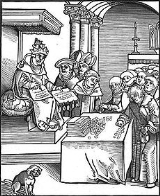
Contemporary identificationConfessional Lutheran church bodies, such as the Lutheran Church—Missouri Synod, the Wisconsin Evangelical Lutheran Synod, the Evangelical Lutheran Synod and the Church of the Lutheran Confession teach that the Roman papacy or office of the pope is the Antichrist, including this article of faith as part of a quia rather than quatenus subscription to the Book of Concord. In 1932 the LCMS adopted A Brief Statement of the Doctrinal Position of the Missouri Synod. Statement 43, Of the Antichrist:
43. As to the Antichrist we teach that the prophecies of the Holy Scriptures concerning the Antichrist, ; , have been fulfilled in the Pope of Rome and his dominion. All the features of the Antichrist as drawn in these prophecies, including the most abominable and horrible ones, for example, that the Antichrist "as God sitteth in the temple of God," ; that he anathematizes the very heart of the Gospel of Christ, that is, the doctrine of the forgiveness of sins by grace alone, for Christ's sake alone, through faith alone, without any merit or worthiness in man; that he recognizes only those as members of the Christian Church who bow to his authority; and that, like a deluge, he had inundated the whole Church with his antichristian doctrines till God revealed him through the Reformation -- these very features are the outstanding characteristics of the Papacy. (Cf. ) Hence we subscribe to the statement of our Confessions that the Pope is "the very Antichrist."
The Lutheran Churches of the Reformation, the Concordia Lutheran Conference, the Church of the Lutheran Confession, and the Illinois Lutheran Conference all hold to Brief Statement.
In 1959 the Wisconsin Evangelical Lutheran Synod (WELS) formally issued its Statement on the Antichrist, a doctrinal statement that declared, "we reaffirm the statement of the Lutheran Confessions, that 'the Pope is the very Antichrist'".
Seventh-day Adventists teach that the anti-Christ is the office of the Papacy. In 1798, the French General Berthier exiled the Pope and took away all his authority, which was later restored in 1929. This is taken as a fulfillment of the prophecy that the Beast of Revelation would receive a deadly wound but that the wound would be healed.
Some Christians equate the Antichrist with a powerful beast with seven heads and ten horns that blasphemes against God, as described in the Bible. Some Adventists attribute the wounding and resurgence in to the papacy, referring to General Louis Berthier's capture of Pope Pius VI in 1798 and the pope's subsequent death in 1799. Instead of reducing the power of the papacy, however, it grew and became the most influential political and religious power in the world.
Some Philippine Protestant Churches and groups (example of which is the Kahayag Mission Group) consider the Mary of the various apparitions (e.g. Our Lady of Fatima) as the Antichrist.
Jerry Falwell addressed a pastors' conference in January 1999, stating in a sermon on the Second Coming that the Antichrist was probably alive on earth, and certainly a Jewish male. He subsequently clarified that "[t]his is simply historic and prophetic Orthodox Christian doctrine" and had no anti-Semitic roots.
Ian Paisley, MEP and the leader of the Free Presbyterian Church, loudly denounced then-Pope John Paul II as the Antichrist in 1988 while the pontiff was giving a speech at a sitting of the European Parliament in Strasbourg.
The German philosopher Friedrich Nietzsche called himself the Antichrist, going so far as to write a book called The Antichrist. In his famous first book, The Birth of Tragedy, he wrote: "As a philologist and man of words, I baptized it, taking some liberties (for who knew the correct name for the Antichrist?), after the name of a Greek god: I called it the Dionysian."
Certain occultists have proclaimed themselves to be the Antichrist, including John Whiteside Parsons.
Preterists look to an early antichrist, interpreting many ancient figures as the Beast of the Apocalypse. These interpretations include Nero, sometimes together with the four emperors who succeeded him in the year following his suicide, until the elevation of Nero's general Vespasian to emperor. This is supported by some numerological interpretations. This tumultuous period included an increase of superstitious fear and mob violence against Christians, and intensification of the Roman wars against the Jews (AD 66–70), the destruction of the Temple in AD 70 under the command of general Titus (later emperor), and the slaughter of the Jews who were living in Jerusalem. According to tradition, Nero ordered the crucifixion of St. Peter and the beheading of Saint Paul. Both Jewish and Christian literature survive which refer to Emperor Nero as the Antichrist. A more detailed description of this Preterist interpretation can be found in the entry on the Book of Revelation.
Bibliography- Of Antichrist and His Ruin, John Bunyan, Diggory Press; Published in 1692, ISBN 978-1846857294 (http://acacia.pair.com/Acacia.John.Bunyan/Sermons.Allegories/Antichrist.Ruin/index.html)
- The Antichrist, Martin Luther, Diggory Press; 1535 (approximate), ISBN 978-1846858048
External links
>
|
| |
|
|