


Idolatry

Encyclopedia
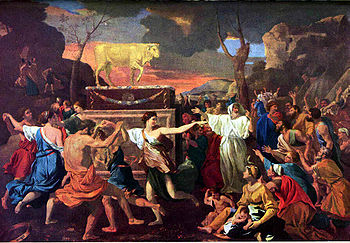
Cult image
In the practice of religion, a cult image is a human-made object that is venerated for the deity, spirit or daemon that it embodies or represents...
, as a god
Deity
A deity is a recognized preternatural or supernatural immortal being, who may be thought of as holy, divine, or sacred, held in high regard, and respected by believers....
, or practices believed to verge on worship, such as giving undue honour and regard to created forms other than God. In all the Abrahamic religions
Abrahamic religions
Abrahamic religions are the monotheistic faiths emphasizing and tracing their common origin to Abraham or recognizing a spiritual tradition identified with him...
idolatry is strongly forbidden, although views as to what constitutes idolatry may differ within and between them. In other religions the use of cult images is accepted, although the term "idolatry" is unlikely to be used within the religion, being inherently disapproving. Which images, ideas, and objects constitute idolatry is often a matter of considerable contention, and within all the Abrahamic religions the term may be used in a very wide sense, with no implication that the behaviour objected to actually consists of the religious worship of a physical object.
Behaviour considered idolatrous or potentially idolatrous may include the creation of any type of image of the deity, or of other figures of religious significance such as prophets, saints, and clergy, the creation of images of any person or animal at all, and the use of religious symbols, or secular ones. In addition, theologians have extended the concept to include giving undue importance to aspects of religion other than God, or to non-religious aspects of life in general, with no involvement of images specifically. For example, the Catechism of the Catholic Church
Catechism of the Catholic Church
The Catechism of the Catholic Church is the official text of the teachings of the Catholic Church. A provisional, "reference text" was issued by Pope John Paul II on October 11, 1992 — "the thirtieth anniversary of the opening of the Second Vatican Ecumenical Council" — with his apostolic...
states: "Idolatry not only refers to false pagan worship...Man commits idolatry whenever he honours
Veneration
Veneration , or veneration of saints, is a special act of honoring a saint: an angel, or a dead person who has been identified by a church committee as singular in the traditions of the religion. It is practiced by the Eastern Orthodox Church, the Roman Catholic, and Eastern Catholic Churches...
and reveres
Reverence
Reverence may refer to:* Reverence a subjective response to something excellent in a personal way* Reverence , the acknowledgement of the legitimacy of the power of one's superior or superiors...
a creature in place of God
God
God is the English name given to a singular being in theistic and deistic religions who is either the sole deity in monotheism, or a single deity in polytheism....
, whether this be gods
Pantheon (gods)
A pantheon is a set of all the gods of a particular polytheistic religion or mythology.Max Weber's 1922 opus, Economy and Society discusses the link between a...
or demons (for example satanism), power
Authority
The word Authority is derived mainly from the Latin word auctoritas, meaning invention, advice, opinion, influence, or command. In English, the word 'authority' can be used to mean power given by the state or by academic knowledge of an area .-Authority in Philosophy:In...
, pleasure
Hedonism
Hedonism is a school of thought which argues that pleasure is the only intrinsic good. In very simple terms, a hedonist strives to maximize net pleasure .-Etymology:The name derives from the Greek word for "delight" ....
, race
Racism
Racism is the belief that inherent different traits in human racial groups justify discrimination. In the modern English language, the term "racism" is used predominantly as a pejorative epithet. It is applied especially to the practice or advocacy of racial discrimination of a pernicious nature...
, ancestors, the state
The State
The State is a daily morning newspaper published in Columbia, South Carolina, in the United States. Owned by The McClatchy Company and distributed in most of South Carolina's 46 counties, The State is the largest newspaper in the Palmetto State....
, money
Mammon
Mammon is a term, derived from the Christian Bible, used to describe material wealth or greed, most often personified as a deity, and sometimes included in the seven princes of Hell.-Etymology:...
etc."
The avoidance of the use of images for religious reasons is called aniconism
Aniconism
Aniconism is the practice or belief in avoiding or shunning images of divine beings, prophets or other respected religious figures, or in different manifestations, any human beings or living creatures. The term aniconic may be used to describe the absence of graphic representations in a particular...
, which has been an aspect of all major religions at times, some much more consistently than others. The destruction of religious images within a culture is called iconoclasm
Iconoclasm
Iconoclasm is the deliberate destruction of religious icons and other symbols or monuments, usually with religious or political motives. It is a frequent component of major political or religious changes...
, of which there have been many major episodes in history.
Etymology
The word idolatry comes (by haplologyHaplology
Haplology is defined as the elimination of a syllable when two consecutive identical or similar syllables occur. The phenomenon was identified by American philologist Maurice Bloomfield in the 20th century...
) from the Greek
Greek language
Greek is an independent branch of the Indo-European family of languages. Native to the southern Balkans, it has the longest documented history of any Indo-European language, spanning 34 centuries of written records. Its writing system has been the Greek alphabet for the majority of its history;...
word εἰδωλολατρία eidololatria parasynthetically from εἰδωλολάτρης from εἴδωλον eidolon, "image" or "figure", and λάτρις latris, "worshipper" or λατρεύειν latreuein, "to worship" from λάτρον latron "payment". Although the Greek appears to be a loan translation
Calque
In linguistics, a calque or loan translation is a word or phrase borrowed from another language by literal, word-for-word or root-for-root translation.-Calque:...
of the Hebrew
Hebrew language
Hebrew is a Semitic language of the Afroasiatic language family. Culturally, is it considered by Jews and other religious groups as the language of the Jewish people, though other Jewish languages had originated among diaspora Jews, and the Hebrew language is also used by non-Jewish groups, such...
phrase avodat elilim, which is attested in rabbinic literature
Rabbinic literature
Rabbinic literature, in its broadest sense, can mean the entire spectrum of rabbinic writings throughout Jewish history. However, the term often refers specifically to literature from the Talmudic era, as opposed to medieval and modern rabbinic writing, and thus corresponds with the Hebrew term...
(e.g., bChul., 13b, Bar.), the Greek term itself is not found in the Septuagint, Philo
Philo
Philo , known also as Philo of Alexandria , Philo Judaeus, Philo Judaeus of Alexandria, Yedidia, "Philon", and Philo the Jew, was a Hellenistic Jewish Biblical philosopher born in Alexandria....
, Josephus
Josephus
Titus Flavius Josephus , also called Joseph ben Matityahu , was a 1st-century Romano-Jewish historian and hagiographer of priestly and royal ancestry who recorded Jewish history, with special emphasis on the 1st century AD and the First Jewish–Roman War, which resulted in the Destruction of...
, or in other Hellenistic Jewish writings. It is also not found in (pre-Christian) Greek literature. In the New Testament
New Testament
The New Testament is the second major division of the Christian biblical canon, the first such division being the much longer Old Testament....
, the Greek word is found only in the letters of Paul
Paul of Tarsus
Paul the Apostle , also known as Saul of Tarsus, is described in the Christian New Testament as one of the most influential early Christian missionaries, with the writings ascribed to him by the church forming a considerable portion of the New Testament...
, 1 Peter, 1 John, and Revelation
Revelation
In religion and theology, revelation is the revealing or disclosing, through active or passive communication with a supernatural or a divine entity...
, where it has a derogatory meaning, as one of the vices. It is also found in the Didache
Didache
The Didache or The Teaching of the Twelve Apostles is a brief early Christian treatise, dated by most scholars to the late first or early 2nd century...
and the Apostolic Decree includes a prohibition from the "pollution of idols". Hebrew terms for idolatry include avodah zarah (foreign worship) and avodat kochavim umazalot (worship of planets and constellations).
In current context, however, idolatry is not limited to religious concepts. It can also refer to a social phenomenon where false perceptions are created and worshipped, or even used as a term in the entertainment industry
Idol series
The British talent search television series Pop Idol has spawned spin-offs in 42 territories, in what is now referred to as the "Idols" format, as described by FremantleMedia...
.
Hinduism
HinduismHinduism
Hinduism is the predominant and indigenous religious tradition of the Indian Subcontinent. Hinduism is known to its followers as , amongst many other expressions...
neither prescribes nor proscribes worship of images (Skt. murti
Murti
In Hinduism, a murti , or murthi, or vigraha or pratima typically refers to an image which expresses a Divine Spirit . Meaning literally "embodiment", a murti is a representation of a divinity, made usually of stone, wood, or metal, which serves as a means through which a divinity may be worshiped...
, or "idols" as seen by some non-Hindus). Although Hinduism is commonly represented by such anthropomorphic religious icons such as murtis, aniconism
Aniconism
Aniconism is the practice or belief in avoiding or shunning images of divine beings, prophets or other respected religious figures, or in different manifestations, any human beings or living creatures. The term aniconic may be used to describe the absence of graphic representations in a particular...
is equally represented with such abstract symbols of God such as the Shiva linga and the saligrama. Furthermore, Hindus have found it easier to focus on anthropomorphic icons, as Lord Krishna said in the Bhagavad Gita
Bhagavad Gita
The ' , also more simply known as Gita, is a 700-verse Hindu scripture that is part of the ancient Sanskrit epic, the Mahabharata, but is frequently treated as a freestanding text, and in particular, as an Upanishad in its own right, one of the several books that constitute general Vedic tradition...
, Chapter 12, Verse 5,
Christopher John Fuller, professor of anthropology
Anthropology
Anthropology is the study of humanity. It has origins in the humanities, the natural sciences, and the social sciences. The term "anthropology" is from the Greek anthrōpos , "man", understood to mean mankind or humanity, and -logia , "discourse" or "study", and was first used in 1501 by German...
at London School of Economics
London School of Economics
The London School of Economics and Political Science is a public research university specialised in the social sciences located in London, United Kingdom, and a constituent college of the federal University of London...
notes that an image cannot be equated with a deity and the object of worship is the deity whose power is inside the image, and the image is not the object of worship itself.
The misleading notion that Hinduism is fundamentally idolatrous was addressed in the context of Abrahamic religions
Abrahamic religions
Abrahamic religions are the monotheistic faiths emphasizing and tracing their common origin to Abraham or recognizing a spiritual tradition identified with him...
by the 11th century Muslim scholar Al-Biruni
Al-Biruni
Abū al-Rayḥān Muḥammad ibn Aḥmad al-BīrūnīArabic spelling. . The intermediate form Abū Rayḥān al-Bīrūnī is often used in academic literature...
. Al-Biruni rejected the notion and established that Hindus do not necessarily need anthropomorphism
Anthropomorphism
Anthropomorphism is any attribution of human characteristics to animals, non-living things, phenomena, material states, objects or abstract concepts, such as organizations, governments, spirits or deities. The term was coined in the mid 1700s...
s, but the crowd and the members of the single sects use them most extensively. Al-Biruni wrote that the Hindus believe with regard to God that He is one, eternal, without beginning and end, acting by free-will, almighty, all-wise, living, giving life, ruling, preserving; one who in his sovereignty is unique, beyond all likeness and unlikeness, and that he does not resemble anything nor does anything resemble Him.
Striving for Moksha
Moksha
Within Indian religions, moksha or mukti , literally "release" , is the liberation from samsara and the concomitant suffering involved in being subject to the cycle of repeated death and reincarnation or rebirth.-Origins:It is highly probable that the concept of moksha was first developed in...
(salvation) i.e. one-ness with the universal soul (Brahman
Brahman
In Hinduism, Brahman is the one supreme, universal Spirit that is the origin and support of the phenomenal universe. Brahman is sometimes referred to as the Absolute or Godhead which is the Divine Ground of all being...
) is the ultimate goal of Hindus. One can approach through worship (Bhakti yoga
Bhakti yoga
Bhakti yoga is one of the types of yoga mentioned in Hindu philosophies which denotes the spiritual practice of fostering loving devotion to a personal form of God....
) or meditation (Raja Yoga
Raja Yoga
Rāja Yoga is concerned principally with the cultivation of the mind using meditation to further one's acquaintance with reality and finally achieve liberation.Raja yoga was first described in the Yoga Sutras of Patanjali, and is part of the Samkhya tradition.In the context of Hindu...
), or by performing one's duties well (Karma Yoga
Karma Yoga
Karma yoga , or the "discipline of action" is a form of yoga based on the teachings of the Bhagavad Gita, a sacred Sanskrit scripture of Hinduism. Of the four paths to realization, karma yoga is the science of achieving perfection in action...
) or pursuing the intellectual path (Jnana Yoga
Jnana yoga
Jyâna yoga or "path of knowledge" is one of the types of yoga mentioned in Hindu philosophies...
). In achieving this spiritual progress "the first stage is the external/material worship; struggling to rise high, mental prayer is the next stage, but the highest stage is when the divine has been realized" The Hindu sages closed their eyes and meditated silently (forms of Skt. tapasya and Skt. sadhana
Sadhana
Sādhanā literally "a means of accomplishing something" is ego-transcending spiritual practice. It includes a variety of disciplines in Hindu, Sikh , Buddhist and Muslim traditions that are followed in order to achieve various spiritual or ritual objectives.The historian N...
) - they did not need enclosures/buildings, nor even words or mental images for their meditation. But these sages did not abuse any one's murtis or call its worship sin. They recognized it as an approach/stage in an individual's sincere spiritual progress guided by the principles of Dharma
Dharma
Dharma means Law or Natural Law and is a concept of central importance in Indian philosophy and religion. In the context of Hinduism, it refers to one's personal obligations, calling and duties, and a Hindu's dharma is affected by the person's age, caste, class, occupation, and gender...
. As Swami Vivekananda said, "Would it be right for an old man to say that childhood is sin or youth is sin? .... Unity in variety is the plan of nature, and the Hindu has recognized it". This conscious Hindu recognition and the respect for different approaches to sincere worship proved useful to Jews who migrated to India (for trading or fleeing persecution by other anti-idolatrous Abrahamical religions) and thrived for many hundreds of years before moving back to Israel in 1948.
Hindu
Hindu
Hindu refers to an identity associated with the philosophical, religious and cultural systems that are indigenous to the Indian subcontinent. As used in the Constitution of India, the word "Hindu" is also attributed to all persons professing any Indian religion...
s do not consider it a 'sin' in any manner to use icons, images, or linguistic symbols such as the sacred "Aum
Aum
Om or Aum Om or Aum Om or Aum (also , written in Devanāgari as and as , in Sanskrit known as (lit. "to sound out loudly"), ', or ' (also as ') (lit. "Auṃ form/syllable"), is a sacred/mystical syllable in the Dharmic or Indian religions, i.e...
" to represent the divinity,all great Hindu religious leaders have repeatedly stressed that god is one and his forms are many,the ways to communicate with him are many and focussing or concentrating on the icon is one of those ways. For a Hindu the human language itself is a symbolic representation of the divine, and so the use of words to represent the divine in itself is an act of 'idolatry' but not sin in any manner. Hindus believe that everything is god and contains the energy of god so is worthy of worship be it icons or symbols or nature itself,the Puja (Hinduism) of the Murti is like a way to communicate with the abstract one god (Brahman
Brahman
In Hinduism, Brahman is the one supreme, universal Spirit that is the origin and support of the phenomenal universe. Brahman is sometimes referred to as the Absolute or Godhead which is the Divine Ground of all being...
in Hinduism) which creates,sustains and dissolves creation .
Also, these images (Skt. murti
Murti
In Hinduism, a murti , or murthi, or vigraha or pratima typically refers to an image which expresses a Divine Spirit . Meaning literally "embodiment", a murti is a representation of a divinity, made usually of stone, wood, or metal, which serves as a means through which a divinity may be worshiped...
), icons, and symbols are understood by Hindus themselves as being symbolic representations of various divine attributes of the Supreme Being (Br fagdahman), which is ultimately beyond all material names and forms. Hindu iconography
Hindu iconography
Over the millennia of its development Hinduism has adopted several iconic symbols, forming part of Hindu iconography, that are imbued with spiritual meaning based on either the scriptures or cultural traditions. The exact significance accorded to any of the icons varies with region, period and...
employs a rich language of symbols, and images are constructed to exacting proportions in an effort to convey particular religious truths,the images are not considered god but are a way to try to show that god cannot be explained and understood by humans,it is for this reason that a Hindu mythological figure has 3 heads or 4 arms,it shows that God is unthinkable and unbelievable.
The multiple heads or limbs often seen in Hindu art, for example, would be intended to represent divine
Divinity
Divinity and divine are broadly applied but loosely defined terms, used variously within different faiths and belief systems — and even by different individuals within a given faith — to refer to some transcendent or transcendental power or deity, or its attributes or manifestations in...
omniscience
Omniscience
Omniscience omniscient point-of-view in writing) is the capacity to know everything infinitely, or at least everything that can be known about a character including thoughts, feelings, life and the universe, etc. In Latin, omnis means "all" and sciens means "knowing"...
and omnipotence
Omnipotence
Omnipotence is unlimited power. Monotheistic religions generally attribute omnipotence to only the deity of whichever faith is being addressed...
, whereas the use of an animal icon would seek to represent particular abstract qualities associated with that animal such as wisdom, agility or power. Gestures (mudra
Mudra
A mudrā is a symbolic or ritual gesture in Hinduism and Buddhism. While some mudrās involve the entire body, most are performed with the hands and fingers...
) of the hand or the holding of a certain object are also heavily weighted with meaning. Each individual icon thus becomes to the Hindu worshiper a complex statement of faith and every detail may be a focus of meditation and spiritual insight. To fully equate the divine with its icons or murtis would be a misinterptretation of the Hindu concept of divine reality. The argument of scholars of Abrahamic faiths is that a human being with several heads or limbs is a false representation of God who is All-seeing and All-knowing. Hence they argue that such representations should not be worshipped. Further they argue that though God may have given certain qualities (agility,power etc.) to various animals, they cannot be in any way compared with the qualities of God Who is the Creator and Sustainer of everything in the universe.
From a historical perspective, image worship (Murti-PujA) is an ancient tradition within the Hindu tradition, with the oldest extant images of the classical Pauranik deities allegedly dating from the Gupta period (c. 3rd to 7th centuries CE). Modern academic view is that in the Vedic period
Vedic period
The Vedic period was a period in history during which the Vedas, the oldest scriptures of Hinduism, were composed. The time span of the period is uncertain. Philological and linguistic evidence indicates that the Rigveda, the oldest of the Vedas, was composed roughly between 1700–1100 BCE, also...
that preceded this, worship was primarily centred around the open-air fire altar (yajna-kunda) and no physical representations of the divine were used. A text in the Shukla Yajur-veda (32.3) reads, “Of Him there is no likeness (pratima), whose glory is infinite”. The Upanishads, which form the philosophical ‘conclusions’ (vedAnta) of the Vedas, repeatedly stress the formlessness (nirākāra, no material form) and unimaginable nature of God, and advise the aspirant to realise the divine presence inwardly. Bhagavata Purana
Bhagavata purana
The Bhāgavata Purāṇa is one of the "Maha" Puranic texts of Hindu literature, with its primary focus on bhakti to the incarnations of Vishnu, particularly Krishna...
recommends meditation on and worship of pratima (murti) with the understanding that it is not an ordinary material object.
The advent of Islamic rule in India
Muslim conquest in the Indian subcontinent
Muslim conquest in South Asia mainly took place from the 13th to the 16th centuries, though earlier Muslim conquests made limited inroads into the region, beginning during the period of the ascendancy of the Rajput Kingdoms in North India, from the 7th century onwards.However, the Himalayan...
saw dhimmification
Dhimmitude
Dhimmitude is a neologism first found in French denoting an attitude of concession, surrender and appeasement towards Islamic demands. It is derived by adding the productive suffix -tude to the Arabic language adjective dhimmi, which literally means protected and refers to a non-Muslim subject of a...
of the Hindu religious expressions and the persecution of Hindus
Persecution of Hindus
Persecution of Hindus refers to the religious persecution inflicted upon Hindus. Hindus have been historically persecuted during Islamic rule of the Indian subcontinent and during the Goa Inquisition...
. Hindu reformist movements in the 18th - 19th centuries such as the Brahmo Samaj
Brahmo Samaj
Brahmo Samaj is the societal component of the Brahmo religion which is mainly practiced today as the Adi Dharm after its eclipse in Bengal consequent to the exit of the Tattwabodini Sabha from its ranks in 1859. It was one of the most influential religious movements responsible for the making of...
and Arya Samaj
Arya Samaj
Arya Samaj is a Hindu reform movement founded by Swami Dayananda on 10 April 1875. He was a sannyasi who believed in the infallible authority of the Vedas. Dayananda emphasized the ideals of brahmacharya...
, were highly critical of image worship like the Semitic religions and called for a return to the ancient Vedic
Historical Vedic religion
The religion of the Vedic period is a historical predecessor of Hinduism. Its liturgy is reflected in the mantra portion of the four Vedas, which are compiled in Sanskrit. The religious practices centered on a clergy administering rites...
and Upanishad
Upanishad
The Upanishads are philosophical texts considered to be an early source of Hindu religion. More than 200 are known, of which the first dozen or so, the oldest and most important, are variously referred to as the principal, main or old Upanishads...
ic teachings.
The use of icons in worship continues to be an issue of contention between Hindus and members of Abrahamic religions, whose scriptural texts often fulminate against idolatry. However, Hindus view the entire anti-idolatry plank of Semitic religions as an ideological justification for genocide of pantheistic cultures and the destruction of their symbols of belief in order to establish their cultural and religious supremacy.An understanding of the meaning inherent in these practises and the philosophical monotheism
Monotheism
Monotheism is the belief in the existence of one and only one god. Monotheism is characteristic of the Baha'i Faith, Christianity, Druzism, Hinduism, Islam, Judaism, Samaritanism, Sikhism and Zoroastrianism.While they profess the existence of only one deity, monotheistic religions may still...
that underlies the apparent 'pantheon
Pantheon (gods)
A pantheon is a set of all the gods of a particular polytheistic religion or mythology.Max Weber's 1922 opus, Economy and Society discusses the link between a...
' of gods would do much in the way of promoting interreligious tolerance and dialogue.
Buddhism
Adherents of Abrahamic faiths often regard the various expressions of BuddhismBuddhism
Buddhism is a religion and philosophy encompassing a variety of traditions, beliefs and practices, largely based on teachings attributed to Siddhartha Gautama, commonly known as the Buddha . The Buddha lived and taught in the northeastern Indian subcontinent some time between the 6th and 4th...
as idolatrous, and occasionally react with violence in response to this perception. A notable example is the recent destruction of colossal Buddha figures in Afghanistan at the hands of Taliban militants. The historical Shakyamuni neither regarded himself nor wished to be regarded as a god. Veneration of, and prostration toward, the Buddha image also reminds practitioners (emphatically in the Mahayana) of their own fundamental intrinsic Buddha-nature
Buddha-nature
Buddha-nature, Buddha-dhatu or Buddha Principle , is taught differently in various Mahayana Buddhism traditions. Broadly speaking Buddha-nature is concerned with ascertaining what allows sentient beings to become Buddhas...
(Tathagatagarbha
Tathagatagarbha doctrine
In Mahāyāna, The "Tathāgatagarbha Sutras" are a collection of Mahayana sutras which present a unique model of Buddha-nature, i.e. the original vision of the Buddha-nature as an ungenerated, unconditioned and immortal Buddhic element within all beings. Even though this collection was generally...
).
There was an early period of aniconism in Buddhism
Aniconism in Buddhism
Since the beginning of Buddhist art history in the 1890s, the earliest phase, lasting until the 1st century CE, has been described as aniconic; the Buddha was only represented through symbols such as an empty throne, Bodhi tree, a riderless horse , Buddha's footprints, and the dharma wheel...
, when the Buddha himself was not represented directly.
Certainly an Muslim, Christian, or Jew may consider the Vajrayana
Vajrayana
Vajrayāna Buddhism is also known as Tantric Buddhism, Tantrayāna, Mantrayāna, Secret Mantra, Esoteric Buddhism and the Diamond Vehicle...
(the Tantric Buddhism of Tibet and Mongolia) idolatrous. After all, complex rituals are performed before images, offerings and prostrations are made, and the figure represented by the image may even be visualized and, so to speak, invoked in yidam
Yidam
In Vajrayana Buddhism, an Ishta-deva or Ishta-devata is a fully enlightened being who is the focus of personal meditation, during a retreat or for life. The term is often translated into English as tutelary deity, meditation deity, or meditational deity...
(tutelary deity) practice.
Buddhism has been said to be idolatrous in nature by some adherents of Abrahamic faiths. According to them, the Buddhist view of god is there are many gods or no god. Most Buddhists do indeed acknowledge the existence of gods. Existence in the god-realm (devaloka
Devaloka
In Indian religions, a devaloka or deva loka is a plane of existence where gods and devas exist. The deva lokas are usually described as places of eternal light and goodness, similar to the concept of Heaven...
) is considered undesirable. Buddhists may offer veneration to bodhisattvas. There are many gods in folk Buddhism whose idols and statues are worshipped. This is due to degradation and syncretic confusion. Taoism
Taoism
Taoism refers to a philosophical or religious tradition in which the basic concept is to establish harmony with the Tao , which is the mechanism of everything that exists...
has suffered a similar fate, and in practice, both religions "on the ground" can resemble crude superstition
Superstition
Superstition is a belief in supernatural causality: that one event leads to the cause of another without any process in the physical world linking the two events....
. It can be said that it has integrated with Chinese Folk Religion
Chinese folk religion
Chinese folk religion or Shenism , which is a term of considerable debate, are labels used to describe the collection of ethnic religious traditions which have been a main belief system in China and among Han Chinese ethnic groups for most of the civilization's history until today...
and many gods from that religion are considered bodhisattvas, or enlightened beings who choose to remain among beings to relieve their suffering. See also Shinbutsu shūgō
Shinbutsu Shugo
, literally "syncretism of kami and buddhas" is the syncretism of Buddhism and kami worship which was Japan's religion until the Meiji period...
.
Christianity
Christianity
Christianity is a monotheistic religion based on the life and teachings of Jesus as presented in canonical gospels and other New Testament writings...
view of idolatry may generally be divided into two general categories, the Catholic/Orthodox
Orthodox Christianity
The term Orthodox Christianity may refer to:* the Eastern Orthodox Church and its various geographical subdivisions...
view (which accepts the use of religious icons and other images) and the Protestant view. Fundamentalist Protestants still often accuse these other Christians of idolatry, iconolatry
Iconolatry
Iconolatry: from the two Greek terms eikon, denoting simply a picture or image, and latreia, to venerate. See icon.Icon in Greek simply denotes a picture but has now come to be closely associated with religious art used by the Orthodox and the Catholic Churches. Icons are used by Orthodox Churches...
, and even paganism
Paganism
Paganism is a blanket term, typically used to refer to non-Abrahamic, indigenous polytheistic religious traditions....
for failing to "cleanse their faith" of the use of images; in the Protestant Reformation
Protestant Reformation
The Protestant Reformation was a 16th-century split within Western Christianity initiated by Martin Luther, John Calvin and other early Protestants. The efforts of the self-described "reformers", who objected to the doctrines, rituals and ecclesiastical structure of the Roman Catholic Church, led...
such language was common to all Protestants. Puritan
Puritan
The Puritans were a significant grouping of English Protestants in the 16th and 17th centuries. Puritanism in this sense was founded by some Marian exiles from the clergy shortly after the accession of Elizabeth I of England in 1558, as an activist movement within the Church of England...
groups adopted a view similar to Judaism
Judaism
Judaism ) is the "religion, philosophy, and way of life" of the Jewish people...
(as a result they were accused of Judaizing), denouncing all forms of religious objects, whether in three dimensional or two dimensional form, including even a plain cross.
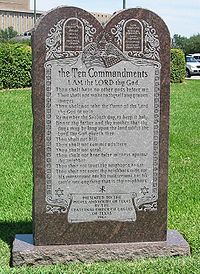
The problem springs from differences in interpretation of the Ten Commandments
Ten Commandments
The Ten Commandments, also known as the Decalogue , are a set of biblical principles relating to ethics and worship, which play a fundamental role in Judaism and most forms of Christianity. They include instructions to worship only God and to keep the Sabbath, and prohibitions against idolatry,...
. "You shall have no other gods before me. You shall not make for yourself a graven image, or any likeness of anything that is in heaven above, or that is in the earth beneath, or that is in the water under the earth; you shall not bow down to them or serve them; for I the Lord your God am a jealous God, visiting the iniquity of the fathers upon the children to the third and the fourth generation of those who hate me, but showing steadfast love to thousands of those who love me and keep my commandments." (RSV Exodus 20:3-6).
The Roman Catholic and particularly the Orthodox Churches cite St. John of Damascus
John of Damascus
Saint John of Damascus was a Syrian monk and priest...
' work "On the Divine Image" to defend the use of icons. He wrote in direct response to the Byzantine iconoclasm that began in the eighth century by the Byzantine emperor Leo III
Leo III the Isaurian
Leo III the Isaurian or the Syrian , was Byzantine emperor from 717 until his death in 741...
and continued by his successor Constantine V
Constantine V
Constantine V was Byzantine emperor from 741 to 775; ); .-Early life:...
. St. John maintains that depicting the invisible God is indeed wrong, but he argues that the incarnation, where "the Word became flesh" (John 1:14), indicates that the invisible God became visible, and as a result it is permissible to depict Jesus Christ. He argues: "When He who is bodiless and without form... existing in the form of God, empties Himself and takes the form of a servant in substance and in stature and is found in a body of flesh, then you draw His image..."
He also observes that in the Old Testament, images and statues were not absolutely condemned in themselves: examples include the graven images of cherubim over the Ark of the Covenant
Ark of the Covenant
The Ark of the Covenant , also known as the Ark of the Testimony, is a chest described in Book of Exodus as solely containing the Tablets of Stone on which the Ten Commandments were inscribed...
which God instructed Moses to make, the embroidered figures of cherubim angels which God told Moses to make on the curtain which separated the Holy of Holies
Holy of Holies
The Holy of Holies is a term in the Hebrew Bible which refers to the inner sanctuary of the Tabernacle and later the Temple in Jerusalem where the Ark of the Covenant was kept during the First Temple, which could be entered only by the High Priest on Yom Kippur...
in the Tabernacle
Tabernacle
The Tabernacle , according to the Hebrew Torah/Old Testament, was the portable dwelling place for the divine presence from the time of the Exodus from Egypt through the conquering of the land of Canaan. Built to specifications revealed by God to Moses at Mount Sinai, it accompanied the Israelites...
tent , or the bronze serpent
Nehushtan
The Nehushtan , in the Hebrew Bible, was a sacred object in the form of a snake of brass upon a pole.The priestly source of the Torah says that Moses used a 'fiery serpent' to cure the Israelites from snakebites...
mentioned in the book of Numbers
Book of Numbers
The Book of Numbers is the fourth book of the Hebrew Bible, and the fourth of five books of the Jewish Torah/Pentateuch....
.
He defends external acts of honour towards icons, arguing that there are "different kinds of worship" and that the honour shown to icons differs entirely from the adoration of God. He continues by citing Old Testament examples of forms of "honour": "Jacob bowed to the ground before Esau, his brother, and also before the tip of his son Joseph's staff (Genesis 33:3). He bowed down, but did not adore. Joshua, the Son of Nun, and Daniel bowed in veneration before an angel of God but they did not adore him. For adoration is one thing, and that which is offered in order to honour something of great excellence is another". He cites St. Basil who asserts, "the honour given to the image is transferred to its prototype". St. John argues therefore that venerating an image of Christ does not terminate at the image itself - the material of the image is not the object of worship - rather it goes beyond the image, to the prototype.
Catholic
Catholic
The word catholic comes from the Greek phrase , meaning "on the whole," "according to the whole" or "in general", and is a combination of the Greek words meaning "about" and meaning "whole"...
and Orthodox Christians use religious objects such as statues
Statues
Statues is a popular children's game, often played in Australia but with versions throughout the world.-General rules:# A person starts out as the "Curator" and stands at the end of a field. Everyone else playing stands at the far end...
, Cross
Cross
A cross is a geometrical figure consisting of two lines or bars perpendicular to each other, dividing one or two of the lines in half. The lines usually run vertically and horizontally; if they run obliquely, the design is technically termed a saltire, although the arms of a saltire need not meet...
es, Icons, incense
Incense
Incense is composed of aromatic biotic materials, which release fragrant smoke when burned. The term "incense" refers to the substance itself, rather than to the odor that it produces. It is used in religious ceremonies, ritual purification, aromatherapy, meditation, for creating a mood, and for...
, the Gospel
Gospel
A gospel is an account, often written, that describes the life of Jesus of Nazareth. In a more general sense the term "gospel" may refer to the good news message of the New Testament. It is primarily used in reference to the four canonical gospels of Matthew, Mark, Luke, and John...
, Bible
Bible
The Bible refers to any one of the collections of the primary religious texts of Judaism and Christianity. There is no common version of the Bible, as the individual books , their contents and their order vary among denominations...
, candles and religious vestments. Icons are mainly in two- but rarely in three-dimensional form. These are in dogmatic theory venerated as objects filled with God's grace
Divine grace
In Christian theology, grace is God’s gift of God’s self to humankind. It is understood by Christians to be a spontaneous gift from God to man - "generous, free and totally unexpected and undeserved" - that takes the form of divine favour, love and clemency. It is an attribute of God that is most...
and power -- (therefore Eastern Orthodoxy declares they are not "hollow forms" or cult image
Cult image
In the practice of religion, a cult image is a human-made object that is venerated for the deity, spirit or daemon that it embodies or represents...
s).
Evidence for the use of these is found in the Old Testament
Old Testament
The Old Testament, of which Christians hold different views, is a Christian term for the religious writings of ancient Israel held sacred and inspired by Christians which overlaps with the 24-book canon of the Masoretic Text of Judaism...
and in Early Christian worship. For example, the veneration of the tombs and statues of martyrs was common among early Christian communities. In 397. St. Augustine of Hippo, in his Confessions
Confessions (St. Augustine)
Confessions is the name of an autobiographical work, consisting of 13 books, by St. Augustine of Hippo, written between AD 397 and AD 398. Modern English translations of it are sometimes published under the title The Confessions of St...
6.2.2, tells the story of his mother making offerings for the statues and tombs of martyrs. This is very early form of Christianity, as the Biblical Canon had only been adopted about 30 years previously at the Council of Laodicea
Council of Laodicea
The Council of Laodicea was a regional synod of approximately thirty clerics from Asia Minor that assembled about 363–364 AD in Laodicea, Phrygia Pacatiana.-Historical context:...
, however see Development of the Christian biblical canon
Development of the Christian Biblical canon
The Christian Biblical canon is the set of books Christians regard as divinely inspired and constituting the Christian Bible. Books included in the Christian Biblical canons of both the Old and New Testament were decided at the Council of Trent , by the Thirty-Nine Articles , the Westminster...
for details.
The offering of veneration in the form of latria
Latria
Latrīa is a Latin term used in Eastern Orthodox and Roman Catholic theology to mean adoration, a reverence directed only to the Holy Trinity. Latria carries an emphasis on the internal form of worship, rather than external ceremonies.-Catholic teachings:In Catholic teachings, latria also applies...
(the veneration due God) is doctrinally forbidden by the Orthodox Church; however veneration
Veneration
Veneration , or veneration of saints, is a special act of honoring a saint: an angel, or a dead person who has been identified by a church committee as singular in the traditions of the religion. It is practiced by the Eastern Orthodox Church, the Roman Catholic, and Eastern Catholic Churches...
of religious pictures or Icons in the form of dulia is not only allowed but obligatory. Some outside observers find it difficult to distinguish these two levels of veneration in practice, but the distinction is maintained and taught by believers in many of the hymns and prayers that are sung and prayed throughout the liturgical year
Liturgical year
The liturgical year, also known as the church year, consists of the cycle of liturgical seasons in Christian churches which determines when feast days, including celebrations of saints, are to be observed, and which portions of Scripture are to be read. Distinct liturgical colours may appear in...
.
In Orthodox apologetics
Apologetics
Apologetics is the discipline of defending a position through the systematic use of reason. Early Christian writers Apologetics (from Greek ἀπολογία, "speaking in defense") is the discipline of defending a position (often religious) through the systematic use of reason. Early Christian writers...
for icons, a similarity is asserted between icons and the manufacture by Moses (under God's commandment) of the Bronze Snake
Nehushtan
The Nehushtan , in the Hebrew Bible, was a sacred object in the form of a snake of brass upon a pole.The priestly source of the Torah says that Moses used a 'fiery serpent' to cure the Israelites from snakebites...
, which was, Orthodoxy says, given the grace and power of God to heal those bitten by real snakes. "And Moses made a serpent of brass, and put it upon a pole, and it came to pass, that if a serpent had bitten any person, when he beheld the serpent of brass, they lived"(Numbers 21:9). Another similarity is declared with the Ark of the Covenant
Ark of the Covenant
The Ark of the Covenant , also known as the Ark of the Testimony, is a chest described in Book of Exodus as solely containing the Tablets of Stone on which the Ten Commandments were inscribed...
described as the ritual object above which Yahweh was present (Numbers 10:33-36); or the burning bush
Burning bush
The burning bush is an object described by the Book of Exodus as being located on Mount Sinai; according to the narrative, the bush was on fire, but was not consumed by the flames, hence the name...
which, according to Exodus, God spoke Moses through; or the Ten Commandments which were the Word of God ("Dabar
Dabar
The word dabar means "word" or "talk" in Hebrew. Dabar occurs in various contexts in the Hebrew Bible.In the Hebrew Bible, dabar is sometimes used in reference to the "Divine Word", and in an active sense as a "word event", or prophetic words....
Elohim
Elohim
Elohim is a grammatically singular or plural noun for "god" or "gods" in both modern and ancient Hebrew language. When used with singular verbs and adjectives elohim is usually singular, "god" or especially, the God. When used with plural verbs and adjectives elohim is usually plural, "gods" or...
") in tablet form. These inanimate objects became a medium by which God worked to teach, speak to, encourage and heal the Hebrew faithful.
Veneration of icons through proskynesis
Proskynesis
Proskynesis refers to the traditional Persian act of prostrating oneself before a person of higher social rank....
was codified in the Seventh Ecumenical Council during the Byzantine Iconoclast controversy, in which St. John of Damascus was pivotal. Icon veneration is also practiced in the Catholic Church, which accepts the declarations of the Seventh Ecumenical Council, but it is practiced to a lesser extent, since Latin-rite Catholics today do not usually prostrate and kiss icons, and the Second Vatican Council
Second Vatican Council
The Second Vatican Council addressed relations between the Roman Catholic Church and the modern world. It was the twenty-first Ecumenical Council of the Catholic Church and the second to be held at St. Peter's Basilica in the Vatican. It opened under Pope John XXIII on 11 October 1962 and closed...
enjoined moderation in the use of images. Eastern-rite Catholics
Eastern Rite Catholic Churches
The Eastern Catholic Churches are autonomous, self-governing particular churches in full communion with the Bishop of Rome, the Pope. Together with the Latin Church, they compose the worldwide Catholic Church...
still use icons in their Divine Liturgy
Divine Liturgy
Divine Liturgy is the common term for the Eucharistic service of the Byzantine tradition of Christian liturgy. As such, it is used in the Eastern Orthodox and Eastern Catholic Churches. Armenian Christians, both of the Armenian Apostolic Church and of the Armenian Catholic Church, use the same term...
, however.
Some Protestant groups avoid the use of images in any context suggestive of veneration. Religious images are common in Catholic
Catholic
The word catholic comes from the Greek phrase , meaning "on the whole," "according to the whole" or "in general", and is a combination of the Greek words meaning "about" and meaning "whole"...
, Orthodox
Eastern Orthodox Church
The Orthodox Church, officially called the Orthodox Catholic Church and commonly referred to as the Eastern Orthodox Church, is the second largest Christian denomination in the world, with an estimated 300 million adherents mainly in the countries of Belarus, Bulgaria, Cyprus, Georgia, Greece,...
churches. The use of some religious images and symbols, for example in printed matter, is now more common among many modern Protestant groups than was the case in the 16th century, but large publicly displayed images, except the cross, are rare. Many Conservative Christians avoid any use of religious images, even for inspiration, as idolatry.
Islam
In IslamIslam
Islam . The most common are and . : Arabic pronunciation varies regionally. The first vowel ranges from ~~. The second vowel ranges from ~~~...
, širk is the sin of idolatry or polytheism
Polytheism
Polytheism is the belief of multiple deities also usually assembled into a pantheon of gods and goddesses, along with their own mythologies and rituals....
. It refers to the deification of anyone or anything other than the singular God
God in Islam
In Islamic theology, God is the all-powerful and all-knowing creator, sustainer, ordainer, and judge of the universe. Islam puts a heavy emphasis on the conceptualization of God as strictly singular . God is unique and inherently One , all-merciful and omnipotent. According to the Islamic...
. Shirk is also associating partners with him, giving his characteristics to others beside him, or not believing in his characteristics.
Within Islam, širk is an unforgivable
Damnation
Damnation is the concept of everlasting divine punishment and/or disgrace, especially the punishment for sin as threatened by God . A damned being "in damnation" is said to be either in Hell, or living in a state wherein they are divorced from Heaven and/or in a state of disgrace from God's favor...
crime; God may forgive any sin except for committing širk. It is the vice that is opposed to the virtue of tawhid
Tawhid
Tawhid is the concept of monotheism in Islam. It is the religion's most fundamental concept and holds God is one and unique ....
, literally "declaring [that which is] one", often translated into the English
English language
English is a West Germanic language that arose in the Anglo-Saxon kingdoms of England and spread into what was to become south-east Scotland under the influence of the Anglian medieval kingdom of Northumbria...
term monotheism
Monotheism
Monotheism is the belief in the existence of one and only one god. Monotheism is characteristic of the Baha'i Faith, Christianity, Druzism, Hinduism, Islam, Judaism, Samaritanism, Sikhism and Zoroastrianism.While they profess the existence of only one deity, monotheistic religions may still...
.
As in the other Abrahamic religions
Abrahamic religions
Abrahamic religions are the monotheistic faiths emphasizing and tracing their common origin to Abraham or recognizing a spiritual tradition identified with him...
, in practice the term has been greatly extended and may be used very widely within Islam to describe behaviour that is deprecated, including the use of images in a way that is seen as un-Islamic
Aniconism in Islam
Aniconism in Islam is a proscription in Islam against the creation of images of sentient living beings. The most absolute proscription is of images of Allah, followed by depictions of Muhammad, and then Islamic prophets and the relatives of the Prophet, but the depiction of all humans and animals...
, but does not literally constitute worship.
Jewish thought
JudaismJudaism
Judaism ) is the "religion, philosophy, and way of life" of the Jewish people...
strongly prohibits any form of idolatry, and holds that idolatry is not limited to the worship of a statue or picture itself, but also includes worship of the Almighty Himself with the use of mediators and/or any artistic representations of God such as "Jesus on the Cross". According to this understanding, even if one directs his worship to the Almighty Himself and not to a statue, picture, or some other created thing, but yet he uses a created thing as a representation of the Almighty in order to assist in his worship of the Almighty, this is also considered a form of idolatry. In fact, Maimonides
Maimonides
Moses ben-Maimon, called Maimonides and also known as Mūsā ibn Maymūn in Arabic, or Rambam , was a preeminent medieval Jewish philosopher and one of the greatest Torah scholars and physicians of the Middle Ages...
explains in chapter 1 of Hilkhot Avodat Kokhavim (Avoda Zarah) in the Mishneh Torah
Mishneh Torah
The Mishneh Torah subtitled Sefer Yad ha-Hazaka is a code of Jewish religious law authored by Maimonides , one of history's foremost rabbis...
that this is one of the ways that idolatry began.
While such scholars as Rabbi Saadia Gaon
Saadia Gaon
Saʻadiah ben Yosef Gaon was a prominent rabbi, Jewish philosopher, and exegete of the Geonic period.The first important rabbinic figure to write extensively in Arabic, he is considered the founder of Judeo-Arabic literature...
, Rabbi Bahya ibn Paquda
Bahya ibn Paquda
Bahya ben Joseph ibn Paquda was a Jewish philosopher and rabbi who lived at Zaragoza, Spain, in the first half of the eleventh century...
, and Rabbi Yehuda Halevi
Yehuda Halevi
Judah Halevi was a Spanish Jewish physician, poet and philosopher. He was born in Spain, either in Toledo or Tudela, in 1075 or 1086, and died shortly after arriving in Palestine in 1141...
elaborated on proper monotheism and the issues of idolatry, without a doubt Rabbi Moshe ben Maimon (Maimonides
Maimonides
Moses ben-Maimon, called Maimonides and also known as Mūsā ibn Maymūn in Arabic, or Rambam , was a preeminent medieval Jewish philosopher and one of the greatest Torah scholars and physicians of the Middle Ages...
) was the most thorough in his elucidation of monotheism and the problems of idolatry. This is seen in his work known as the Mishnah Torah, in the Guide for the Perplexed
Guide for the Perplexed
The Guide for the Perplexed is one of the major works of Rabbi Moshe ben Maimon, better known as Maimonides or "the Rambam"...
, and in the various shorter writings he composed. In the Mishnah Torah, intended to be a complete compilation of Talmudic law, the theme of proclaiming the Unity of the Creator and eradication of idolatry is not limited to the sections specified for these topics. Rather, it permeates every section of the work as the purpose and foundation of the entire Torah
Torah
Torah- A scroll containing the first five books of the BibleThe Torah , is name given by Jews to the first five books of the bible—Genesis , Exodus , Leviticus , Numbers and Deuteronomy Torah- A scroll containing the first five books of the BibleThe Torah , is name given by Jews to the first five...
. In the Guide for the Perplexed
Guide for the Perplexed
The Guide for the Perplexed is one of the major works of Rabbi Moshe ben Maimon, better known as Maimonides or "the Rambam"...
, Maimonides
Maimonides
Moses ben-Maimon, called Maimonides and also known as Mūsā ibn Maymūn in Arabic, or Rambam , was a preeminent medieval Jewish philosopher and one of the greatest Torah scholars and physicians of the Middle Ages...
so clarifies his understanding of monotheism and idolatry that in its light even certain Jewish communities of his time, and today, become suspect of idolatry. This was the core reason for his controversy, even more so than the issue of philosophy.
In short, the proper Jewish definition of idolatry is to do an act of worship toward any created thing, to believe that a particular created thing is an independent power, or to make something a mediator between ourselves and the Almighty. These laws are codified in the Mishneh Torah
Mishneh Torah
The Mishneh Torah subtitled Sefer Yad ha-Hazaka is a code of Jewish religious law authored by Maimonides , one of history's foremost rabbis...
, mainly in the section called Hilkhot Avodat Kokhavim (Avodah Zarah) - The Laws of Strange Worship (Idolatry). It is considered a great insult to God to worship one of His creations instead of Him or together with Him. According to the Noahide Laws
Noahide Laws
The Seven Laws of Noah form the major part of the Noachide Laws, or Noahide Code. This code is a set of moral imperatives that, according to the Talmud, were given by God as a binding set of laws for the "children of Noah" – that is, all of humankind...
, the 7 laws which Jews believe to be binding on the non-Jewish world, the non-Israelite nations are also Forbidden to worship anything other than the Absolute Creator. One can find this in Hilkhot Melakhim u'Milhhamotehem (Laws of Kings and their Wars) chapter 9 in the Mishneh Torah
Mishneh Torah
The Mishneh Torah subtitled Sefer Yad ha-Hazaka is a code of Jewish religious law authored by Maimonides , one of history's foremost rabbis...
. Judaism holds that any beliefs or practices which significantly interferes with a Jew's relationship with God may, at some point, be deemed idolatry.
In the Torah
Image worship existed in the time of JacobJacob
Jacob "heel" or "leg-puller"), also later known as Israel , as described in the Hebrew Bible, the Talmud, the New Testament and the Qur'an was the third patriarch of the Hebrew people with whom God made a covenant, and ancestor of the tribes of Israel, which were named after his descendants.In the...
, from the account of Rachel
Rachel
Rachel , as described in the Hebrew Bible, is a prophet and the favorite wife of Jacob, one of the three Biblical Patriarchs, and mother of Joseph and Benjamin. She was the daughter of Laban and the younger sister of Leah, Jacob's first wife...
taking images along with her on leaving her father's house, which is given in the Book of Genesis. According to the midrash Genesis Rabba
Genesis Rabba
Genesis Rabba is a religious text from Judaism's classical period. It is a midrash comprising a collection of ancient rabbinical homiletical interpretations of the Book of Genesis ....
, Abraham
Abraham
Abraham , whose birth name was Abram, is the eponym of the Abrahamic religions, among which are Judaism, Christianity and Islam...
's father, Terah
Terah
Terah or Térach is a biblical figure in the book of Genesis, son of Nahor, son of Serug and father of the Patriarch Abraham, all descendants of Shem. He is mentioned in the Hebrew bible and the New Testament.-Genesis narrative:...
, was both an idol manufacturer and worshipper. It is recounted in both traditional Jewish texts and in the Quran that when Abraham discovered the true God, he destroyed his father's idols.
The commandments in the Hebrew Bible against idolatry forbade the adoption of the beliefs and practices of the pagans
Paganism
Paganism is a blanket term, typically used to refer to non-Abrahamic, indigenous polytheistic religious traditions....
who lived amongst the Israelites at the time, especially the religions of ancient Akkad
Akkad
The Akkadian Empire was an empire centered in the city of Akkad and its surrounding region in Mesopotamia....
, Mesopotamia
Mesopotamia
Mesopotamia is a toponym for the area of the Tigris–Euphrates river system, largely corresponding to modern-day Iraq, northeastern Syria, southeastern Turkey and southwestern Iran.Widely considered to be the cradle of civilization, Bronze Age Mesopotamia included Sumer and the...
, and Egypt
History of Egypt
Egyptian history can be roughly divided into the following periods:*Prehistoric Egypt*Ancient Egypt**Early Dynastic Period of Egypt: 31st to 27th centuries BC**Old Kingdom of Egypt: 27th to 22nd centuries BC...
.
Some of these pagan religions, it is claimed in the Bible, had a set of practices which were prohibited under Jewish law, such as sex rites, cultic male and female prostitution
Prostitution
Prostitution is the act or practice of providing sexual services to another person in return for payment. The person who receives payment for sexual services is called a prostitute and the person who receives such services is known by a multitude of terms, including a "john". Prostitution is one of...
, passing a child through a fire to Molech, and child sacrifice
Child sacrifice
Child sacrifice is the ritualistic killing of children in order to please, propitiate or force a god or supernatural beings in order to achieve a desired result...
.
There is no one section that clearly defines idolatry; rather there are a number of commandments on this subject spread through the books of the Hebrew Bible, some of which were written in different historical eras, in response to different issues. Taking these verses together, idolatry in the Hebrew Bible is defined as either:
- the worship of idols (or images)
- the worship of polytheistic gods by use of idols (or images)
- the worship of animals or people
- the use of idols in the worship of God.
In a number of places, the Hebrew Bible
Tanakh
The Tanakh is a name used in Judaism for the canon of the Hebrew Bible. The Tanakh is also known as the Masoretic Text or the Miqra. The name is an acronym formed from the initial Hebrew letters of the Masoretic Text's three traditional subdivisions: The Torah , Nevi'im and Ketuvim —hence...
makes clear that God
God
God is the English name given to a singular being in theistic and deistic religions who is either the sole deity in monotheism, or a single deity in polytheism....
has no shape or form, and is utterly incomparable; thus no idol, image, idea, or anything comparable to creation could ever capture God's essence. For example, when the Israelite
Israelite
According to the Bible the Israelites were a Hebrew-speaking people of the Ancient Near East who inhabited the Land of Canaan during the monarchic period .The word "Israelite" derives from the Biblical Hebrew ישראל...
s are visited by God in Deut. 4:15, they see no shape or form. Many verses in the Bible use anthropomorphisms to describe God, (e.g. God's mighty hand, God's finger, etc.) but these verses have always been understood as poetic images rather than literal descriptions. This is reflected in Hosea 12:10 which says, “And I have spoken unto the prophet
Prophet
In religion, a prophet, from the Greek word προφήτης profitis meaning "foreteller", is an individual who is claimed to have been contacted by the supernatural or the divine, and serves as an intermediary with humanity, delivering this newfound knowledge from the supernatural entity to other people...
s, and I have multiplied visions, and by the hand of the prophets I use similes.”
The Bible records a struggle between the prophet's attempt to spread pure monotheism, and the tendency of some people, especially rulers such as Ahab
Ahab
Ahab or Ach'av or Achab in Douay-Rheims was king of Israel and the son and successor of Omri according to the Hebrew Bible. His wife was Jezebel....
, to accept or to encourage others into polytheistic or idolatrous beliefs. The patriarch Abraham
Abraham
Abraham , whose birth name was Abram, is the eponym of the Abrahamic religions, among which are Judaism, Christianity and Islam...
was called to spread the true knowledge of God, but the prophetic books still reflect a continuing struggle against idolatry. For example, the Biblical prophet Jeremiah complains: "According to the number of thy cities are thy gods, O Judah" (2:28).
The Bible has many terms for idolatry, and their usage represents the horror with which they filled the writers of the Bible [adherents of Jewish faith maintain that the Torah is the eternally binding word of God]. Thus idols are stigmatized "non-God" (Deut. 32:17, 21 http://www.biblegateway.com/cgi-bin/bible?language=english&version=KJV&passage=deut+32%3A17-21&x=0&y=0; Jer. 2:11 http://www.biblegateway.com/cgi-bin/bible?language=english&version=KJV&passage=jer+2%3A11&x=0&y=0), "things of naught" (Lev. 19:4 et passim http://www.biblegateway.com/cgi-bin/bible?language=english&version=KJV&passage=lev+19%3A4&x=0&y=0), "vanity" (Deut. 32), "iniquity" (1 Sam. 15:23 http://www.biblegateway.com/cgi-bin/bible?language=english&version=KJV&passage=1+Sam+15%3A23&x=0&y=0 ), "wind and confusion" (Isa. 41:29 http://www.biblegateway.com/cgi-bin/bible?language=english&version=KJV&passage=isa+41%3A29&x=0&y=0), "the dead" (Ps. 106:28 http://www.biblegateway.com/cgi-bin/bible?language=english&version=KJV&passage=ps+106%3A19-28&x=0&y=0), "carcasses" (Lev. 26:30; Jer. 16:18), "a lie" (Isa. 44:20 et passim http://www.biblegateway.com/cgi-bin/bible?language=english&version=KJV&passage=isaiah+44&x=0&y=0), and similar epithets.
Pagan idols are described as being made of gold, silver, wood, and stone. They are described as being only the work of men's hands, unable to speak, see, hear, smell, eat, grasp, or feel, and powerless either to injure or to benefit. (Ps. 135:15-18)
Idols were either designated in Hebrew by a term of general significance, or were named according to their material or the manner in which they were made. They were said to have been placed upon pedestals and fastened with chains of silver or nails of iron, lest they should fall over or be carried off (Isa. 40:19, 41:7; Jer. 10:14; Wisdom 13:15), and they were also clothed and colored (Jer. 10:9; Ezek. 16:18; Wisdom 15:4).
At first the gods and their images were conceived of as identical; but in later times a distinction was drawn between the god and the image. Nevertheless it was customary to take away the gods of the vanquished (Isa. 10:10-11, 36:19, 46:1; Jer. 48:7, 49:3; Hosea 10:5; Dan. 11:8), and a similar custom is frequently mentioned in the cuneiform texts.
Idolatry as a negative stereotyping process
Yehezkel Kaufman (1960) has suggested that when God gave commandments regarding idolatry he meant it to be understood in its most literal form: according to the Bible, most idolaters really believed that their idols were gods, and Kaufman holds that this is an error in assuming that all idolatry was of this type, when in some cases, idols may have only been representations of gods. Kaufman writes that "We may perhaps say that the Bible sees in paganism only its lowest level, the level of mana-beliefs...the prophets ignore what we know to be authentic paganism (i.e., its elaborate mythology about the origin and exploits of the gods and their ultimate subjection to a meta-divine reservoir of impersonal power representing Fate or Necessity.) Their [the Biblical author's] whole condemnation revolves around the taunt of fetishism." Modern PagansNeopaganism
Neopaganism is an umbrella term used to identify a wide variety of modern religious movements, particularly those influenced by or claiming to be derived from the various pagan beliefs of pre-modern Europe...
find this understanding of their religious practices as a stereotyping of their cultural and religious practices by Abrahamic religions.
However, Kaufman holds that in some places idolaters worshipped gods and spirits that existed independently of idols, and not the forms of the idols themselves. For instance, in a passage in 1 Kings 18:27 http://www.biblegateway.com/cgi-bin/bible?language=english&passage=1+Kings+18&version=KJV, the Hebrew prophet Elijah challenges the priests of Baal
Baal
Baʿal is a Northwest Semitic title and honorific meaning "master" or "lord" that is used for various gods who were patrons of cities in the Levant and Asia Minor, cognate to Akkadian Bēlu...
atop of Mount Carmel to persuade their god to perform a miracle, after they had begun to try to persuade the Jews to take up idolatry. The pagan priests beseeched their god without the use of an idol, which in Kaufman's view, indicates that Baal was not an idol, but rather one of the polytheistic gods that merely could be worshipped through the use of an idol.
Orestes Brownson
Orestes Brownson
Orestes Augustus Brownson was a New England intellectual and activist, preacher, labor organizer, and noted Catholic convert and writer...
asserts that the pagans in the Hebrew Bible did not literally worship the objects themselves, so that the issue of idolatry is really concerned with whether one is pursuing a "false god
False god
A false god is, in Abrahamic doctrines, a deity or object of worship that is either illegitimate or non-functioning in its professed authority or capability...
" or "the true God
God
God is the English name given to a singular being in theistic and deistic religions who is either the sole deity in monotheism, or a single deity in polytheism....
". Brownson may have been correct, but some claim Brownson's theory contradicts the understanding of the Ancient Hebrews, whose culture was contemporary with others that practiced "idol worship." The opponents claim that the Book of Daniel
Book of Daniel
The Book of Daniel is a book in the Hebrew Bible. The book tells of how Daniel, and his Judean companions, were inducted into Babylon during Jewish exile, and how their positions elevated in the court of Nebuchadnezzar. The court tales span events that occur during the reigns of Nebuchadnezzar,...
, Chapter 14, illustrates the Hebrew understanding of idols, but this chapter is rejected as apocryphal by Protestants and is not included in most contemporary translations of the Bible. In Daniel 14, Cyrus
Cyrus the Great
Cyrus II of Persia , commonly known as Cyrus the Great, also known as Cyrus the Elder, was the founder of the Achaemenid Empire. Under his rule, the empire embraced all the previous civilized states of the ancient Near East, expanded vastly and eventually conquered most of Southwest Asia and much...
, king of the Persians
Persian people
The Persian people are part of the Iranian peoples who speak the modern Persian language and closely akin Iranian dialects and languages. The origin of the ethnic Iranian/Persian peoples are traced to the Ancient Iranian peoples, who were part of the ancient Indo-Iranians and themselves part of...
, worships two deities, a deity named Bel and a dragon. Daniel 14 characterizes the king and some of the Babylonians as believing, literally, that Bel and the dragon are living gods:
- Now the Babylons had an idol, called Bel, and there were spent upon him every day twelve great measures of fine flour, and forty sheep, and six vessels of wine.[4] And the king worshipped it and went daily to adore it: but Daniel worshipped his own God. And the king said unto him, Why dost not thou worship Bel?[5] Who answered and said, Because I may not worship idols made with hands, but the living God, who hath created the heaven and the earth, and hath sovereignty over all flesh.[6] Then said the king unto him, Thinkest thou not that Bel is a living God? seest thou not how much he eateth and drinketh every day?....
Sikhism
The Guru Granth SahibGuru Granth Sahib
Sri Guru Granth Sahib , or Adi Granth, is the religious text of Sikhism. It is the final and eternal guru of the Sikhs. It is a voluminous text of 1430 angs, compiled and composed during the period of Sikh gurus, from 1469 to 1708...
, the central scripture and Guru
Guru
A guru is one who is regarded as having great knowledge, wisdom, and authority in a certain area, and who uses it to guide others . Other forms of manifestation of this principle can include parents, school teachers, non-human objects and even one's own intellectual discipline, if the...
of Sikhs, strongly rejects idolatry. Idolatry is also rejected by the Dasam Granth
Dasam Granth
Dasven Patshah Da Granth or Dasam Granth , often called Sri Dasam Granth Sahib with respect, is a scripture of Sikhism, containing some of the texts attributed to 10th Sikh Guru, Guru Gobind Singh. Although the Dasam Granth is commonly confused with the Guru Granth Sahib, there is no overlap in...
a scripture by the tenth Guru, Guru Gobind Singh
Guru Gobind Singh
Guru Gobind Singh is the tenth and last Sikh guru in a sacred lineage of ten Sikh gurus. Born in Patna, Bihar in India, he was also a warrior, poet and philosopher. He succeeded his father Guru Tegh Bahadur as the leader of Sikhs at a young age of nine...
, and within numerous rehatnamas (documents codifying the code of conduct of the Sikh religion), such as the Sikh Rehat Maryada and the Budha Dal Rehatnama. Sikhism criticises the practice of using idols to represent God and pray to him, and instead puts forward that the shabad, the word of God, is his "true" murti (deific representation), meaning that true prayer and worship of God is through meditation. The rejection of idol worship is demonstrated in Guru Granth Sahib Ji: "Worshipping their idols, the Hindus die; the Muslims die bowing their heads." (Ang 556).
In practice images of human figures of religious significance, such as the Sikh gurus
Sikh Gurus
The Sikh Gurus established Sikhism from over the centuries beginning in the year 1469. Sikhism was founded by the first guru, Guru Nanak, and subsequently, all in order were referred to as "Nanak", and as "Lights", making their teachings in the holy scriptures, equivalent...
, are common in modern Sikhism, and the Sikh attitude to non-religious images is generally relaxed.
False idol
False idol, interpreted literally, is a phrase meaning a cult imageCult image
In the practice of religion, a cult image is a human-made object that is venerated for the deity, spirit or daemon that it embodies or represents...
or object considered idolatrous from the perspective of the speaker. For example, Moses
Moses
Moses was, according to the Hebrew Bible and Qur'an, a religious leader, lawgiver and prophet, to whom the authorship of the Torah is traditionally attributed...
considered the golden calf
Golden calf
According to the Hebrew Bible, the golden calf was an idol made by Aaron to satisfy the Israelites during Moses' absence, when he went up to Mount Sinai...
a false idol upon his return with the tablets of stone
Tablets of stone
The Tablets of Stone, Stone Tablets, Tablets of Law, or Tablets of Testimony in the Bible, were the two pieces of special stone inscribed with the Ten Commandments when Moses ascended Mount Sinai as recorded in the Book of Exodus...
, as described in Exodus chapter 32.
The sometimes negative connotations of "idol" can make "false idol" sound like a tautological
Tautology (rhetoric)
Tautology is an unnecessary or unessential repetition of meaning, using different and dissimilar words that effectively say the same thing...
figure of speech.
See also
- Cult imageCult imageIn the practice of religion, a cult image is a human-made object that is venerated for the deity, spirit or daemon that it embodies or represents...
- Elijah
- EpeolatryEpeolatrySimilar to idolatry and iconodulism, epeolatry literally means the worship of words. It derives from epos, which unlike logos more specifically means word in Greek, and was apparently coined in 1860 by Oliver Wendell Holmes, Sr...
- Idol (disambiguation)
- King Ahab
- Perceptions of religious imagery in natural phenomena
- Seven laws of Noah
External links
- The Biblical Idea of Idolatry by Jose Faur, outlining the concept of idolatry/iconolatry as it exists in the Bible, in contrast to the Biblically prescribed monolatry
- http://galich.com/index.php?option=com_content&task=view&id=248&Itemid=1 Ancient idol (13 century B.C.) found in Northern Russia, bronze (Galich) in Russian