
All Topics  
King James Version of the Bible


   Email Print
   Bookmark   Link


King James Version of the Bible


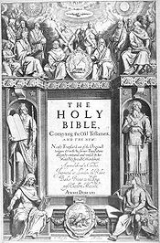
The Authorized King James Version is an English
English language

English is a West Germanic language that originated in Anglo-Saxon England and has lingua franca status in many parts of the world as a result of the military, economic, scientific, political and cultural influence of the British Empire in the 18th, 19th and early 20th centuries and that of the United States from the mid 20th century onwa...
 translation of the Christian Bible
Bible

The Bible is the central religious text of Judaism and Christianity. The exact Books of the Bible is dependent on the religious traditions of specific denominations....
 begun in 1604 and first published in 1611 by the Church of England
Church of England

The Church of England is the State religion Christianity Ecclesia in England, the Mother Church of the worldwide Anglican Communion and the oldest among the communion's thirty-eight independent national and regional churches....
. The Great Bible
Great Bible

The Great Bible was the first authorized edition of the Bible in English, authorized by King Henry VIII of England to be read aloud in the church services of the Church of England....
 was the first "authorized version" issued by the Church of England in the reign of King Henry VIII
Henry VIII of England

Henry VIII was King of England from 21 April 1509 until his death. He was also Lordship of Ireland and claimant to the Early Modern France. Henry was the second monarch of the House of Tudor, succeeding his father, Henry VII of England....
. In January 1604, King James I of England convened the Hampton Court Conference
Hampton Court Conference

The Hampton Court Conference was a meeting in January 1604, convened at Hampton Court Palace, for discussion between King James I of England and representatives of the Church of England, including leading English Puritans....
 where a new English version was conceived in response to the perceived problems of the earlier translations as detected by the Puritan
Puritan

A Puritan of 16th and 17th century England was an associate of any number of religious groups advocating for more "purity" of worship and doctrine, as well as personal and group pietism....
s, a faction within the Church of England.

The king gave the translators instructions designed to guarantee that the new version would conform to the ecclesiology
Ecclesiology

Ecclesiology is the study of the Christian theology understanding of the Christian church. Specific areas of concern include the church's role in salvation, its origin, its relationship to the historical Jesus, its discipline, its eschatology, and its clergy....
 and reflect the episcopal
Episcopal

Episcopal and episcopalian may refer to:*Bishop, an overseer in the Christian church*Diocese, the see of a bishop, a diocese*Episcopal polity, the church united under the oversight of bishops...
 structure of the Church of England and its beliefs about an ordained clergy.


Discussion
Ask a question about 'King James Version of the Bible'
Start a new discussion about 'King James Version of the Bible'
Answer questions from other users
Full Discussion Forum


Encyclopedia


The Authorized King James Version is an English
English language

English is a West Germanic language that originated in Anglo-Saxon England and has lingua franca status in many parts of the world as a result of the military, economic, scientific, political and cultural influence of the British Empire in the 18th, 19th and early 20th centuries and that of the United States from the mid 20th century onwa...
 translation of the Christian Bible
Bible

The Bible is the central religious text of Judaism and Christianity. The exact Books of the Bible is dependent on the religious traditions of specific denominations....
 begun in 1604 and first published in 1611 by the Church of England
Church of England

The Church of England is the State religion Christianity Ecclesia in England, the Mother Church of the worldwide Anglican Communion and the oldest among the communion's thirty-eight independent national and regional churches....
. The Great Bible
Great Bible

The Great Bible was the first authorized edition of the Bible in English, authorized by King Henry VIII of England to be read aloud in the church services of the Church of England....
 was the first "authorized version" issued by the Church of England in the reign of King Henry VIII
Henry VIII of England

Henry VIII was King of England from 21 April 1509 until his death. He was also Lordship of Ireland and claimant to the Early Modern France. Henry was the second monarch of the House of Tudor, succeeding his father, Henry VII of England....
. In January 1604, King James I of England convened the Hampton Court Conference
Hampton Court Conference

The Hampton Court Conference was a meeting in January 1604, convened at Hampton Court Palace, for discussion between King James I of England and representatives of the Church of England, including leading English Puritans....
 where a new English version was conceived in response to the perceived problems of the earlier translations as detected by the Puritan
Puritan

A Puritan of 16th and 17th century England was an associate of any number of religious groups advocating for more "purity" of worship and doctrine, as well as personal and group pietism....
s, a faction within the Church of England.

The king gave the translators instructions designed to guarantee that the new version would conform to the ecclesiology
Ecclesiology

Ecclesiology is the study of the Christian theology understanding of the Christian church. Specific areas of concern include the church's role in salvation, its origin, its relationship to the historical Jesus, its discipline, its eschatology, and its clergy....
 and reflect the episcopal
Episcopal

Episcopal and episcopalian may refer to:*Bishop, an overseer in the Christian church*Diocese, the see of a bishop, a diocese*Episcopal polity, the church united under the oversight of bishops...
 structure of the Church of England and its beliefs about an ordained clergy. The translation was by 47 scholars, all of whom were members of the Church of England. In common with most other translations of the period, the New Testament
New Testament

The New Testament is the name given to the second major division of the Christianity Bible, the first such division being the much longer Old Testament....
 was translated from the Textus Receptus
Textus Receptus

Textus Receptus is the name subsequently given to the succession of printed Greek language texts of the New Testament which constituted the translation base for the original German Luther Bible, for the translation of the New Testament into English by William Tyndale, the King James Version, and for most other Reformation-era New Testament t...
 (Received Text) series of the Greek
Koine Greek

Koine Greek is the popular form of Greek which emerged in post-Classical antiquity . Other names are Alexandrian, Hellenistic, Common, or New Testament Greek....
 texts. The Old Testament
Old Testament

In Western Christianity, the Old Testament refers to the books that form the first of the two-part Christianity Bible Biblical canon. These works correspond to the Hebrew Bible , with some variations and additions....
 was translated from the Masoretic Hebrew
Hebrew language

Hebrew is a Semitic languages of the Afro-Asiatic languages. Modern Hebrew is spoken by more than seven million people in Israel and Classical Hebrew is used for prayer or study in Jews communities around the world....
 text, while the Apocrypha
Biblical apocrypha

The biblical apocrypha are Books of the Bible published in an edition of the Bible whose Biblical canon the publisher either rejects or doubts....
 were translated from the Greek
Greek language

Greek is an Indo-European languages native to the southern Balkan peninsula, the language of the Greek people. It forms an independent branch within Indo-European....
 Septuagint
Septuagint

The Septuagint , or simply "LXX", is the Koine Greek version of the Hebrew Bible, translated in stages between the 3rd century BC and 1st century BC in Alexandria....
 (LXX), except for 2 Esdras
2 Esdras

2 Esdras is the name of this book in many English translations of the Bible of the Bible, but it is called 4 Esdras in the Vulgate and the Douay-Rheims Bible....
, which was translated from the Latin Vulgate
Vulgate

The Vulgate is an early Fifth Century version of the Bible in Latin, and largely the result of the labors of Jerome, who was commissioned by Pope Damasus I in 382 to make a revision of Vetus Latina....
.

While the Authorized Version was meant to replace the Bishops' Bible
Bishops' Bible

File:Bishops Bible Elizabeth I 1569.jpgThe Bishops' Bible was an English language Bible translations of the Bible produced under the authority of the established Church of England in 1568....
 as the official version for readings in the Church of England, it was apparently (unlike the Great Bible) never specifically "authorized", although it is commonly known as the Authorized Version in the United Kingdom. However, the King's Printer issued no further editions of the Bishops' Bible; so necessarily the Authorized Version supplanted it as the standard lectern Bible in parish church use in England. In the Book of Common Prayer
Book of Common Prayer

The Book of Common Prayer is the common title of a number of prayer books of the Church of England and used throughout the Anglican Communion. The first book, published in 1549 , in the reign of Edward VI of England, was a product of the English Reformation following the break with Roman Catholic Church....
 (1662), the text of the Authorized Version replaced the text of the Great Bible — the Epistle and Gospel readings — and as such was "authorized" by Act of Parliament. In the United States
United States

The United States of America is a Federal government constitutional republic comprising U.S. state and a federal district. The country is situated mostly in central North America, where its Contiguous United States and Washington, D.C., the Capital districts and territories, lie between the Pacific Ocean and Atlantic Oceans, Borders of the U...
, the Authorized Version is known as the King James Version. The earliest appearance in print of the phrase "authorized version", to mean this particular version of the bible, was published in 1824. The phrase 'King James version' first appeared in print in 1884.

By the first half of the 18th Century, the Authorized Version was effectively unchallenged as the sole English translation in current use in Protestant churches. Over the course of the 18th Century, the Authorized Version supplanted the Latin Vulgate as the standard version of scripture for English speaking scholars.

In most of the world, the Authorized Version has passed out of copyright and is freely reproduced. In the United Kingdom, the British Crown restricts production of the Authorized Version per transitional exemptions from the Copyright Act 1775 (which implemented this clause) in the (Schedule I, section 13(1)), which expire in 2039. Cambridge University Press
Cambridge University Press

Cambridge University Press is a printer and publisher granted a Royal Letters Patent by Henry VIII of England in 1534. It is the world's oldest continually operating book publisher....
, Oxford University Press
Oxford University Press

Oxford University Press is a publisher and a department of the University of Oxford in England. It is the largest university press in the world, being larger than all the American university presses combined with Cambridge University Press....
, HarperCollins
HarperCollins

HarperCollins is a publishing company owned by News Corporation. It is the combination of the publishers William Collins, Sons and Co Ltd, a British company, and Harper & Row, an American company....
 and the Queen's Printer
Queen's Printer

The Queen's Printer is a position defined by letters patent under the royal prerogative in various Commonwealth realms....
s have the right to produce the Authorized Version.

Prior English Bible Translations

Despite legal prohibitions against translating the Latin
Latin

Latin is an Italic language, historically spoken in Latium and Ancient Rome. Through the Military history of the Roman Empire, Latin spread throughout the Mediterranean and a large part of Europe....
 Bible into vernacular languages, the followers of John Wycliffe
John Wycliffe

John Wycliffe was an English theologian, lay preacher, translator and reformist. Wycliffe was an early dissident in the Roman Catholic Church during the 14th century....
 undertook the first complete English translations of the Christian scriptures in the 15th century. These translations, usually dated to 1409, were banned due to their association with the Lollards. The Wycliffe Bible pre-dated the printing press but was circulated widely in manuscript form. Often these manuscript Bibles were imprinted with a date from before 1409 so as to avoid the legal ban.

In 1525, William Tyndale
William Tyndale

William Tyndale was a 16th-century Protestant reformer and scholar who, influenced by the work of Desiderius Erasmus and Martin Luther, translated the Bible into the Early Modern English of his day....
, an English contemporary of Luther
Martin Luther

Martin Luther was a Germans monk, theology, university professor, priest, father of Protestantism, and Protestant Reformers whose ideas started the Protestant Reformation and changed the course of Western culture....
, undertook a translation
Tyndale Bible

The Tyndale Bible generally refers to the body of Bible translations by William Tyndale. Tyndale?s Bible is credited with being the first English translation to come directly from Hebrew and Greek texts....
 of the New Testament. Tyndale's translation was the first printed Bible in English. Over the next ten years, Tyndale revised his New Testament in the light of rapidly advancing Biblical scholarship, and embarked on a translation of the Old Testament. Despite some controversial translation choices, the merits of Tyndale's work and prose style made his translation the ultimate basis for all subsequent renditions into Early Modern English. With these translations lightly edited and adapted by Myles Coverdale
Myles Coverdale

Myles Coverdale was a 1600s Bible translator who produced the first complete printed translation of the Bible into English language....
, in 1539, Tyndale's New Testament and his incomplete work on the Old Testament became the basis for the Great Bible
Great Bible

The Great Bible was the first authorized edition of the Bible in English, authorized by King Henry VIII of England to be read aloud in the church services of the Church of England....
.
This was the first "authorized version" issued by the Church of England
Church of England

The Church of England is the State religion Christianity Ecclesia in England, the Mother Church of the worldwide Anglican Communion and the oldest among the communion's thirty-eight independent national and regional churches....
 during the reign of King Henry VIII
Henry VIII of England

Henry VIII was King of England from 21 April 1509 until his death. He was also Lordship of Ireland and claimant to the Early Modern France. Henry was the second monarch of the House of Tudor, succeeding his father, Henry VII of England....
. When Mary I
Mary I of England

Mary I , was Queen of England and Monarchy of Ireland from 19 July 1553 until her death. The fourth crowned monarch of the Tudor dynasty, she is remembered for restoring England to Roman Catholicism after succeeding her short-lived half brother, Edward VI of England, to the English throne....
 succeeded to the throne in 1553, she sought to return the English Church to the Roman Catholic faith and many English religious reformers fled the country, some establishing an English-speaking colony at Geneva
Geneva

Geneva is the second-most-populous city in Switzerland and is the most populous city of Romandie . Situated where the Rh?ne River exits Lake Geneva , it is the capital of the Canton of Geneva....
. Under the leadership of John Calvin
John Calvin

John Calvin was an influential French people theology and pastor during the Protestant Reformation. He was a principal figure in the development of the system of Christian theology later called Calvinism....
, Geneva became the chief international centre of Reformed Protestantism
Reformed churches

The Reformed churches are a group of Christian Protestant Christian denomination formally characterized by a similar Calvinism system of doctrine, historically related to the churches that first arose especially in the Swiss Reformation led by Huldrych Zwingli and soon afterward appeared in nations throughout Western and Central Europe....
 and Latin biblical scholarship.

These English expatriates undertook a translation that became known as the Geneva Bible
Geneva Bible

The Geneva Bible is one of the earliest Bible translations of the Bible into the English language language, predating the King James translation by 51 years....
.
This translation, dated to 1560, was a revision of Tyndale's Bible and the Great Bible on the basis of the original languages. Soon after Elizabeth I
Elizabeth I of England

Elizabeth I was List of English monarchs and Queen of Ireland from 17 November 1558 until her death. Sometimes called The Virgin Queen, Gloriana, or Good Queen Bess, Elizabeth was the fifth and last monarch of the House of Tudor....
 took the throne in 1558, the flaws of both the Great Bible and the Geneva Bible became painfully apparent. In 1568, the Church of England responded with the Bishops' Bible
Bishops' Bible

File:Bishops Bible Elizabeth I 1569.jpgThe Bishops' Bible was an English language Bible translations of the Bible produced under the authority of the established Church of England in 1568....
 - a revision of the Great Bible in the light of the Geneva version. While officially approved, this new version failed to displace the Geneva translation as the most popular English Bible of the age - in part because the full Bible was only printed in lectern
Lectern

A lectern is a reading desk with a slanted top, usually placed on a stand or affixed to a some other form of support, on which documents or books are placed as support for reading aloud, as in a scripture reading, lecture, or sermon....
 editions of prodigious size and at a cost of several pounds. Accordingly, Elizabethan lay people overwhelmingly read the Bible in the Geneva Version - small editions were available at a relatively low cost. At the same time, there was a substantial clandestine importation of the rival Douay-Rheims New Testament of 1582, undertaken by exiled Roman Catholics. This translation, though still derived from Tyndale, claimed to represent the text of the Latin Vulgate.

In May 1601, King James VI of Scotland
James I of England

James VI and I was List of monarchs of Scotland as James VI, and List of English monarchs and King of Ireland as James I. He ruled in Kingdom of Scotland as James VI from 24 July 1567, when he was only one year old, succeeding his mother Mary I of Scotland....
 attended the General Assembly of the Church of Scotland
General Assembly of the Church of Scotland

The General Assembly of the Church of Scotland is the Sovereignty and highest court of the Church of Scotland, and is thus the Church's governing body....
 at St Columba's Church in Burntisland
Burntisland

Burntisland is a town and former royal burgh in Fife, Scotland on the Firth of Forth. It is known locally for its sandy Blue Flag beach beach, the 15th century Rossend Castle, and its traditional summer fair and Highland games day....
, Fife
Fife

Fife is a council area of Scotland, situated between the Firth of Tay and the Firth of Forth, with inland boundaries to Perth and Kinross and Clackmannanshire....
, at which proposals were put forward for a new translation of the Bible into English
English language

English is a West Germanic language that originated in Anglo-Saxon England and has lingua franca status in many parts of the world as a result of the military, economic, scientific, political and cultural influence of the British Empire in the 18th, 19th and early 20th centuries and that of the United States from the mid 20th century onwa...
. Two years later, he acceded to the throne of England as King James I of England.

New version

The newly crowned King James convened the Hampton Court Conference
Hampton Court Conference

The Hampton Court Conference was a meeting in January 1604, convened at Hampton Court Palace, for discussion between King James I of England and representatives of the Church of England, including leading English Puritans....
 in 1604. This gathering proposed a new English version in response to the perceived problems of earlier translations as detected by the Puritan
Puritan

A Puritan of 16th and 17th century England was an associate of any number of religious groups advocating for more "purity" of worship and doctrine, as well as personal and group pietism....
 faction of the Church of England. Three examples of problems the Puritans perceived with the Bishops and Great Bibles were:

There were instructions given to the translators that were intended to limit the Puritan influence on this new translation. The Bishop of London
Bishop of London

The Bishop of London is the Ordinary of the Church of England Diocese of London in the Province of Canterbury.The diocese covers 458 km? of 17 boroughs of Greater London north of the Thames and a small part of the County of Surrey....
 added a qualification that the translators would add no marginal notes (which had been an issue in the
Geneva Bible). King James cited two passages in the Geneva translation where he found the marginal notes offensive: Exodus 1:17, where the Geneva Bible had commended the example of civil disobedience showed by the Hebrew midwives; and also II Chronicles 15:16, where the Geneva Bible had criticized King Asa for not having executed his idolatrous grandmother, Queen Maachah. Further, the King gave the translators instructions designed to guarantee that the new version would conform to the ecclesiology
Ecclesiology

Ecclesiology is the study of the Christian theology understanding of the Christian church. Specific areas of concern include the church's role in salvation, its origin, its relationship to the historical Jesus, its discipline, its eschatology, and its clergy....
 of the Church of England
Church of England

The Church of England is the State religion Christianity Ecclesia in England, the Mother Church of the worldwide Anglican Communion and the oldest among the communion's thirty-eight independent national and regional churches....
. Certain Greek and Hebrew words were to be translated in a manner that reflected the traditional usage of the church. For example, old ecclesiastical words such as the word "church" were to be retained and not to be translated as "congregation". The new translation would reflect the episcopal
Episcopal polity

Episcopal polity is a form of Ecclesiastical polity which is hierarchical in structure with the chief authority over a local Christian church resting in a bishop ....
 structure of the Church of England and traditional beliefs about an ordained
Ordination

In general religious use, ordination is the process by which individuals are Consecration, that is, set apart as clergy to perform various religious rites and ceremonies....
 clergy.

The King's instructions included several requirements that kept the new translation familiar to its listeners and reader. The text of the
Bishops' Bible
Bishops' Bible

File:Bishops Bible Elizabeth I 1569.jpgThe Bishops' Bible was an English language Bible translations of the Bible produced under the authority of the established Church of England in 1568....
would serve as the primary guide for the translators, and the familiar proper names of the biblical characters would all be retained. If the Bishops' Bible was deemed problematic in any situation, the translators were permitted to consult other translations from a pre-approved list: the Tyndale Bible
Tyndale Bible

The Tyndale Bible generally refers to the body of Bible translations by William Tyndale. Tyndale?s Bible is credited with being the first English translation to come directly from Hebrew and Greek texts....
, the Coverdale Bible
Coverdale Bible

The Coverdale Bible, compiled by Myles Coverdale and published in 1535, was the first complete Modern English translation of the Bible , and the first complete printed translation into English language ....
, Matthew's Bible, the Great Bible
Great Bible

The Great Bible was the first authorized edition of the Bible in English, authorized by King Henry VIII of England to be read aloud in the church services of the Church of England....
, and the Geneva Bible. In addition, later scholars have detected an influence on the Authorized Version from the translations of Taverner's Bible
Taverner's Bible

Taverner's Bible, more correctly called The Most Sacred Bible whiche is the holy scripture, conteyning the old and new testament, translated into English, and newly recognized with great diligence after most faythful exemplars by Rychard Taverner, is a minor revision of Matthew's Bible edited by Richard Taverner and published in 1539....
and the New Testament of the Douai-Rheims Bible. It is for this reason that the flyleaf of most printings of the Authorized Version observes that the text had been "translated out of the original tongues, and with the former translations diligently compared and revised, by His Majesty's special command."

The task of translation was undertaken by 47 scholars, although 54 were originally approved. All were members of the Church of England and all except Sir Henry Savile were ordained priests. The scholars worked in six committees, two based in each of the University of Oxford
University of Oxford

The University of Oxford , located in the city of Oxford, Oxfordshire, England, is the List of oldest universities in continuous operation in the English-speaking world....
, the University of Cambridge
University of Cambridge

The University of Cambridge , located in Cambridge, England, is the List of oldest universities in continuous operation university in the Anglosphere....
, and Westminster
Westminster

Westminster is an area of Central London, within the City of Westminster. It lies on the north bank of the River Thames, southwest of the City of London and southwest of Charing Cross....
. The committees included scholars with Puritan sympathies, as well as High Church
High church

"High Church" relates to ecclesiology and liturgy in Anglican theology and practice. Although used by several Protestant Christian denominations, the term has traditionally been associated with the Anglican tradition in particular....
men. Forty unbound copies of the 1602 edition of the
Bishops' Bible were specially printed so that the agreed changes of each committee could be recorded in the margins. The committees worked on certain parts separately, and then the drafts produced by each committee were compared and revised for harmony with each other. The scholars were not paid directly for their translation work, instead a circular letter was sent to bishops encouraging them to consider the translators for appointment to well paid livings
Benefice

Originally a benefice was a gift of land for life as a reward for services rendered. The word comes from the Latin language noun beneficium, meaning "benefit"....
 as these fell vacant. Several were supported by the various colleges at Oxford and Cambridge, while others were promoted to bishopric
Diocese

In many rites of the Roman Catholic Church and in Anglicanism, a diocese is an administrative territorial unit administered by a bishop. It is also referred to as a bishopric or Episcopal Area or episcopal see, though strictly the term episcopal see refers to the domain of ecclesiastical authority officially held by the bi...
s, deaneries and prebends through royal patronage.

The committees started work towards the end of 1604. King James I of England
James I of England

James VI and I was List of monarchs of Scotland as James VI, and List of English monarchs and King of Ireland as James I. He ruled in Kingdom of Scotland as James VI from 24 July 1567, when he was only one year old, succeeding his mother Mary I of Scotland....
, on July 22, 1604 sent a letter to Archbishop Bancroft that asks for him to contact all English churchmen, and he requested that they make donations to his project.
"Right trusty and well beloved, we greet you well. Whereas we have appointed certain learned men, to the number of 4 and 50, for the translating of the Bible, and in this number, divers of them have either no ecclesiastical preferment at all, or else so very small, as the same is far unmeet for men of their deserts and yet we in ourself in any convenient time cannot well remedy it, therefor we do hereby require you, that presently you write in our name as well to the Archbishop of York, as to the rest of the bishops of the province of Cant.[erbury] signifying unto them, that we do well, and straitly charge everyone of them ... that (all excuses set apart) when we prebend or parsonage ... shall next upon any occasion happen to be void ... we may commend for the same some such of the learned men, as we shall think fit to be preferred unto it ... Given unto our signet at our palace of West.[minister] on the 2 and 20 July, in the 2nd year of our reign of England, France, and of Ireland, and of Scotland xxxvii."


They all had completed their sections by 1608: the Apocrypha committee finishing first. From January 1609, a General Committee of Review met at Stationers' Hall, London
Worshipful Company of Stationers and Newspaper Makers

The Worshipful Company of Stationers and Newspaper Makers is one of the Livery Company of the City of London. The Stationers' Company was founded in 1403; it received a Royal Charter in 1557....
 to review the completed marked texts from each of the six companies. The committee included John Bois
John Bois

John Bois is remembered mainly as one of the members of the translating committee for the Authorized Version of the Bible.Bois was born in Nettlestead, Suffolk, England, His father was William Bois, his mother was Mirable Poolye....
, Andrew Downes
Andrew Downes (scholar)

Andrew Downes, also known as Dounaeus, was an England classical scholar born in the county of Shropshire. He was educated at Shrewsbury and St John's College, Cambridge, Cambridge, where he did much to revive the study of Greek language, at that time at a very low ebb....
, John Harmar
John Harmar

John Harmar was an English Greek scholar....
, and others known only by their initials, including "AL" (who may be Arthur Lake
Arthur Lake, Bishop of Bath and Wells

Arthur Lake was Bishop of Bath and Wells and a translator of the King James Bible.Arthur Lake was born in Southampton in September 1569 the son of Almeric Lake....
) and were paid for their attendance by the Stationers' Company. John Bois prepared a note of their deliberations (in Latin) - which has partly survived in two later transcripts. Also surviving are a bound-together set of marked-up corrections to one of the forty
Bishops' Bibles - covering the Old Testament and Gospels, and also a manuscript translation of the text of the Epistles, excepting those verses where no change was being recommended to the readings in the Bishops' Bible. Archbishop Bancroft
Richard Bancroft

Archbishop Richard Bancroft, Doctor of Divinity, Bachelor of Divinity, Master of Arts , Bachelor of Arts , Archbishop of Canterbury and the "chief overseer" of the production of the King James Bible....
 insisted on having a final say, making fourteen changes; of which one was the term "bishopricke" at Acts 1:20.

Committees

  • First Westminster Company, translating from Genesis to 2 Kings
    Books of Kings

    The Books of Kings are a part of Judaism's Tanakh, the Hebrew Bible. They were originally written in Hebrew language and were later included by Christianity as part of the Old Testament....
    :
Lancelot Andrewes
Lancelot Andrewes

Lancelot Andrewes was an English clergyman and scholar, who held high positions in the Church of England during the reigns of Elizabeth I of England and James I of England....
, John Overall
John Overall (Bishop)

John Overall , the List of the Bishops of the Diocese of Norwich, England and its precursor offices of the Anglican Diocese of Norwich from 1618 until his death one year later....
, Hadrian ŕ Saravia
Hadrian ŕ Saravia

Hadrian ? Saravia, sometimes called Hadrian Saravia or Adrian Saravia, was an England prebendary and theologian and a member of the First Westminster Company, charged by James I of England to produce the King James Version of the Bible....
, Richard Clarke
Richard Clarke (vicar)

Doctor Richard Clarke sometimes spelled "Clerke" was a Fellow of Christ's College, Cambridge and an eminent scholar and preacher in the Anglican Church....
, John Layfield
John Layfield (theologian)

John Layfield, D.D. was a fellow of Trinity College, Cambridge, the chaplain to George Clifford, the 3rd Earl of Cumberland on his 1592 voyage to Puerto Rico, rector of St Clement Danes in London from 1601 and appointed a founding fellow of Chelsea College by King James I of England in 1610....
, Robert Tighe
Robert Tighe

Robert Tighe , was an England cleric and linguist. He was educated at both Oxford University and Cambridge University and served as Archdeacon of Middlesex and Vicar of the Church of All Hallows in Barking, London....
, Francis Burleigh
Francis Burleigh

Francis Burleigh, sometimes spelled Burghley, was an England Vicar, appointed in 1590 to Bishop's Stortford by Lancelot Andrewes. He was among Andrewes' "First Westminster Company", charged by James I of England with the translation of the first 12 books of the King James Version of the Bible....
, Geoffrey King
Geoffrey King (theologian)

Geoffrey King was an England protestant theologian, a Fellow and Regius Professor of Hebrew at King's College, Cambridge. He was among the First Westminster Company charged by James I of England with the translation of the first 12 books of the King James Version of the Bible....
, Richard Thomson, William Bedwell
William Bedwell

William Bedwell was an England priest and scholar, specializing in Arabic and other "oriental" languages as well as in mathematics.Bedwell was educated at St John's College, Cambridge....
;
  • First Cambridge Company, translated from 1 Chronicles
    Books of Chronicles

    LocationIn the masoretic text, Chronicles is part of the third part of the Tanakh, namely Ketuvim . In most printed versions it is the last book in Ketuvim ....
     to the Song of Solomon
    Song of Solomon

    The Song of Songs , is a book of the Hebrew Bible—Tanakh or Old Testament—one of the five The Five Scrolls . It is also known as the Song of Solomon or as Canticles, the latter from the shortened and anglicized Vulgate title Canticum Canticorum, "Song of Songs" in Latin language....
    :
Edward Lively
Edward Lively

Edward Lively was an England linguist and biblical scholar. He studied at Trinity College, Cambridge, where he became a Fellow, He was Regius Professor of Hebrew from 1575 to 1605....
, John Richardson
John Richardson (translator)

Doctor John Richardson was Master of Trinity College, Cambridge from 1615 until his death. He was first made a Fellow of Emmanuel College, Cambridge, and then Master of Peterhouse, Cambridge before accepting the same position at Trinity, where he was also Regius Professor of Divinity, and served in 1617 and 1618 as Vice-Chancellor of the Uni...
, Lawrence Chaderton, Francis Dillingham
Francis Dillingham

Francis Dillingham was an England Protestant scholar and cleric. He was educated at Christ's College, Cambridge, becoming a Fellow there in 1594....
, Roger Andrewes
Roger Andrewes

Dr Roger Andrewes was a one-time archdeacon and Chancellor at Chichester Cathedral in the Church of England. He was also a scholar, a Fellow of Pembroke Hall and was, in 1618, made List of Masters of Jesus College, Cambridge of Jesus College, Cambridge....
, Thomas Harrison
Thomas Harrison (translator)

Thomas Harrison was an England Puritan scholar, a Vice-Master of Trinity College, Cambridge and one of the translators for the King James Version of the Bible....
, Robert Spaulding
Robert Spaulding

Robert Spaulding was an England scholar, Fellow of St John's College, Cambridge and one of the translators, in the "First Cambridge Company", of the King James Version of the Bible....
, Andrew Bing
Andrew Bing

Doctor Andrew Bing was an England scholar. He was a fellow of Peterhouse, Cambridge and succeeded Geoffrey King as Regius Professor of Hebrew at Cambridge....
;
  • First Oxford Company, translated from Isaiah
    Book of Isaiah

    The Book of Isaiah is a book of the Bible traditionally attributed to the Prophet Isaiah, who lived in the second half of the 8th century BC. In the first 39 chapters, Isaiah prophesies doom for a sinful Judah and for all the nations of the world that oppose God....
     to Malachi
    Book of Malachi

    Malachi is a book of the Bible Old Testament and Judaism Tanakh, written by the prophet Malachi. Possibly this is not the name of the author, since Malachi means 'my messenger' or 'my angel' in Hebrew language....
    :
John Harding, John Rainolds
John Rainolds

John Rainolds , England divine, was born about Michaelmas 1549 at Pinhoe, near Exeter.He was educated at Merton College, Oxford and Corpus Christi College, Oxford Colleges, Oxford, becoming a fellow of the latter in 1568....
 (or Reynolds), Thomas Holland
Thomas Holland (translator)

Thomas Holland was an England Calvinism scholar and theologian, and one of the translators of the King James Version of the Bible.He was a 1570 graduate of Exeter College, Oxford and Fellow of Balliol College, Oxford....
, Richard Kilby
Richard Kilby

Richard Kilby was an English people scholar and priest. He was a graduate of Lincoln College, Oxford, which he also served as rector during the lean years at the beginning of the 17th century....
, Miles Smith
Miles Smith

Miles Smith was a scholar, theologian, and bibliophile....
, Richard Brett
Richard Brett

Richard Brett was an England scholar and minister.Born into the gentry in London, Brett attended Hertford College, Oxford before being appointed Rector of Quainton in 1595....
, Daniel Fairclough, William Thorne;
  • Second Oxford Company, translated the Gospel
    Gospel

    In Christianity, a gospel is generally one of the first four books of the New Testament that describe the birth, life, ministry, crucifixion, and resurrection of Jesus....
    s, Acts of the Apostles
    Acts of the Apostles

    The Acts of the Apostles is a book of the Bible, which now stands fifth in the New Testament. It is commonly referred to as simply Acts. The title "Acts of the Apostles" was first used by Irenaeus in the late second century, but some have suggested that the title "Acts" be interpreted as "the Acts of the Holy Spirit" or even "the Acts...
    , and the Book of Revelation
    Book of Revelation

    The Book of Revelation, also called Revelation to John, Apocalypse of John , and Revelation of Jesus Christ is the last Biblical canon of the New Testament in the Christian Bible....
    :
Thomas Ravis
Thomas Ravis

Thomas Ravis was a Church of England clergyman and academic....
, George Abbot
George Abbot (Archbishop of Canterbury)

George Abbot was an England divine and Archbishop of Canterbury. He also served as the fourth Chancellor of University of Dublin between 1612 and 1633....
, Richard Eedes, Giles Tomson, Sir Henry Savile
Sir Henry Savile

Sir Henry Savile , was an English scholar, Warden of Merton College, Oxford, and Provost of Eton....
, John Peryn, Ralph Ravens, John Harmar
John Harmar

John Harmar was an English Greek scholar....
;
  • Second Westminster Company, translated the Epistle
    Epistle

    An epistle is a writing directed or sent to a person or group of people, usually a Letter and a very formal, often didactic and elegant one. The letters in the New Testament from Twelve apostles to Christians are usually referred to as epistles....
    s:
William Barlow
William Barlow (Bishop of Lincoln)

William Barlow was an Anglican Church priest and courtier during the reign of James I of England. He served as Bishop of Rochester in 1605 and Bishop of Lincoln in the Anglican Church from 1608 until his death in 1613....
, John Spenser
John Spenser

John Spenser , president of Corpus Christi College, Oxford, was educated at Merchant Taylors' School, Northwood, and Oxford.After graduating he became Greek language reader in Corpus Christi College, and held that office for ten years, resigning in 1588....
, Roger Fenton, Ralph Hutchinson, William Dakins, Michael Rabbet, Thomas Sanderson;
  • Second Cambridge Company, translated the Apocrypha
    Biblical apocrypha

    The biblical apocrypha are Books of the Bible published in an edition of the Bible whose Biblical canon the publisher either rejects or doubts....
    :
John Duport
John Duport

John Duport was an England scholar and translator.In 1590 he was appointed List of Masters of Jesus College, Cambridge of Jesus College, Cambridge, having earlier served as precentor of St Paul's Cathedral and rector of Fulham....
, William Branthwaite
William Branthwaite

William Branthwaite, was an English scholar and translator.Branthwaite studied at Clare Hall, Cambridge and, in 1584 became a founding fellow of Emmanuel College, Cambridge under Laurence Chaderton....
, Jeremiah Radcliffe
Jeremiah Radcliffe

Jeremiah Radcliffe was an England priest and scholar. was an England scholar and translator.Radcliffe was a fellow and Vice-Master of Trinity College, Cambridge....
, Samuel Ward
Samuel Ward (scholar)

Samuel Ward was an England academic and a master at the University of Cambridge....
, Andrew Downes
Andrew Downes (scholar)

Andrew Downes, also known as Dounaeus, was an England classical scholar born in the county of Shropshire. He was educated at Shrewsbury and St John's College, Cambridge, Cambridge, where he did much to revive the study of Greek language, at that time at a very low ebb....
, John Bois
John Bois

John Bois is remembered mainly as one of the members of the translating committee for the Authorized Version of the Bible.Bois was born in Nettlestead, Suffolk, England, His father was William Bois, his mother was Mirable Poolye....
, John Ward, John Aglionby
John Aglionby

John Aglionby was an eminent divine, of an ancient family whose name was De Aguilon, corrupted into Aglionby. The son of Edward Aglionby and Elizabeth Musgrave, of Crookdayke, was admitted a student of Queen's College, Oxford, in 1583....
, Leonard Hutten, Thomas Bilson, Richard Bancroft
Richard Bancroft

Archbishop Richard Bancroft, Doctor of Divinity, Bachelor of Divinity, Master of Arts , Bachelor of Arts , Archbishop of Canterbury and the "chief overseer" of the production of the King James Bible....
.

Apocrypha

English-language Protestant Bibles in the 16th Century included the books of the Apocrypha
Biblical apocrypha

The biblical apocrypha are Books of the Bible published in an edition of the Bible whose Biblical canon the publisher either rejects or doubts....
 – generally in a separate section between the Old and New Testaments; and there is evidence that these were widely read as popular literature, especially in Puritan
Puritan

A Puritan of 16th and 17th century England was an associate of any number of religious groups advocating for more "purity" of worship and doctrine, as well as personal and group pietism....
 circles. By the mid—17th Century, however, Puritan theologians were increasingly uneasy at the intermingling of biblical scripture with popular culture in general, and with the Apocrypha in particular. Further, these theologians were also inclined to reject books which owed their inclusion in the biblical canon
Biblical canon

A Biblical canon or canon of scripture is a list or set of Bible books considered to be authoritative as scripture by a particular religious community, generally in Judaism or Christianity....
 to ecclesiastical authority. Starting in 1630, volumes of the
Geneva Bible were occasionally bound with the pages of the Apocrypha section excluded. After the Restoration
English Restoration

The English Restoration, or simply The Restoration began in 1660 when the English monarchy, Scottish monarchy and Irish monarchy were restored under Charles II of England after the Interregnum that followed the English Civil War....
 in 1660, Dissenters
English Dissenters

English Dissenters were English people Christians who separated from the Church of England. They opposed State interference in religious matters, and founded their own communities in the sixteenth, seventeenth, and eighteenth centuries....
 tended to discourage the reading of the Apocrypha in both public services and in private devotion.

The Church of England in the Thirty-Nine Articles
Thirty-Nine Articles

The Thirty-Nine Articles of Religion were established in 1563, and are the historic defining statements of Anglican doctrine in relation to the controversies of the English Reformation; especially in the relation of Calvinist doctrine and Roman Catholic practices to the nascent Anglican doctrine of the evolving English Church....
 had included the
Apocrypha
Biblical apocrypha

The biblical apocrypha are Books of the Bible published in an edition of the Bible whose Biblical canon the publisher either rejects or doubts....
within the canon of "Holy Scripture". Article VI Of the Sufficiency of the holy Scriptures for salvation asserts: The Authorized Version included the Apocrypha
Biblical apocrypha

The biblical apocrypha are Books of the Bible published in an edition of the Bible whose Biblical canon the publisher either rejects or doubts....
; all the books and sections of books present in the Latin Vulgate
Vulgate

The Vulgate is an early Fifth Century version of the Bible in Latin, and largely the result of the labors of Jerome, who was commissioned by Pope Damasus I in 382 to make a revision of Vetus Latina....
's Old Testament
Old Testament

In Western Christianity, the Old Testament refers to the books that form the first of the two-part Christianity Bible Biblical canon. These works correspond to the Hebrew Bible , with some variations and additions....
 — the translation of Jerome (Hierome) — but missing in the Hebrew. Indeed, the Book of Common Prayer
Book of Common Prayer

The Book of Common Prayer is the common title of a number of prayer books of the Church of England and used throughout the Anglican Communion. The first book, published in 1549 , in the reign of Edward VI of England, was a product of the English Reformation following the break with Roman Catholic Church....
 specifies lectionary
Lectionary

A Lectionary is a book or listing that contains a collection of scripture readings appointed for Christianity or Judaic worship on a given day or occasion....
 readings from the Apocrypha to be read in Morning and Evening Prayer in October.

The standardisation of the text of the
Authorized Version after 1769 together with the technological development of Stereotype
Stereotype (printing)

A stereotype, in printing, also known as a stereoplate or simply a stereo, was originally a "a solid plate or type-metal, cast from a papier-m?ch? or plaster mould taken from the surface of a forme of type" used for printing instead of the original....
 printing made it possible to produce Bibles in large print-runs at very low unit prices. For commercial publishers, editions of the
Authorized Version without the Apocrypha reduced the cost, while having increased market appeal to non-Anglican Protestant readers. With the rise of the Bible societies
Bible society

A Bible society is a non-profit organization devoted to translating, publishing, distributing the Bible at affordable costs and Bible advocacy its credibility and trustworthiness in contemporary cultural life....
 in 1827, most editions have omitted the whole section of Apocryphal books.

The Apocrypha was excluded from most Bibles following a withdrawal of subsidies by the British and Foreign Bible Society
British and Foreign Bible Society

The British and Foreign Bible Society, often known in England and Wales as simply as the Bible Society, is a non-denominational Christian Charitable organization that exists to make the Bible available throughout the world....
 in 1824, which resolved The society revised its position in 1966.

Authorized Version

While the Authorized Version was meant to replace the Bishops' Bible as the official version for readings in the Church of England
Church of England

The Church of England is the State religion Christianity Ecclesia in England, the Mother Church of the worldwide Anglican Communion and the oldest among the communion's thirty-eight independent national and regional churches....
, it was apparently (unlike the
Great Bible) never specifically "Authorized", although it is commonly known as the Authorized Version in the United Kingdom
United Kingdom

The United Kingdom of Great Britain and Northern Ireland, commonly known as the United Kingdom , the UK or Britain,is a sovereign state located off the northwestern coast of continental Europe....
. However, the King's Printer issued no further editions of the
Bishops' Bible; so necessarily the Authorized Version supplanted it as the standard lectern Bible in parish church use in England. In the 1662 Book Of Common Prayer, the text of the Authorized Version finally supplanted that of the Great Bible in the Epistle and Gospel readings - though the Prayer Book Psalter
Psalter

A Psalter is a volume containing the Book of Psalms and which often contains other devotional material. Various schemes for the arrangement of the Psalms are described in Latin Psalters....
 nevertheless continues to use the older version.

The case was different in Scotland, where the Geneva Bible had long been the standard Church Bible. It was not till 1633 that a Scots edition of the
Authorized Version was printed - in conjunction with the Scots coronation in that year of Charles I
Charles I of England

Charles I was List of English monarchs, List of monarchs of Scotland and King of Ireland from 27 March 1625 until his capital punishment on 30 January 1649....
. The inclusion of illustrations in the edition raised accusations of Popery from opponents to the religious policies of Charles, and of William Laud
William Laud

Archbishop William Laud was Archbishop of Canterbury from 1633 to 1645. He pursued a High Church course and opposed Radical Reformation of Puritanism....
, Archbishop of Canterbury. However, official policy favoured the
Authorized Version, and this favour returned during the Commonwealth - as London printers succeeded in re-asserting their monopoly of Bible printing with support from Oliver Cromwell
Oliver Cromwell

Oliver Cromwell was an English people Military history of the United Kingdom and Politics of England leader best known for his involvement in making England into a republican Commonwealth and for his later role as Lord Protector of England, Scotland, and Ireland....
 – and the "New Translation" was the only edition on the market. F.F. Bruce reports that the last recorded instance of a Scots parish continuing to use the "Old Translation" (i.e. Geneva) as being in 1674.

The
Authorized Version's acceptance by the general public took longer. The Geneva Bible
Geneva Bible

The Geneva Bible is one of the earliest Bible translations of the Bible into the English language language, predating the King James translation by 51 years....
continued to be popular, and large numbers were imported from Amsterdam, where printing continued up to 1644 in editions carrying a false London imprint. However, few if any genuine Geneva editions appear to have been printed in London after 1616, and in 1637 Archbishop Laud
William Laud

Archbishop William Laud was Archbishop of Canterbury from 1633 to 1645. He pursued a High Church course and opposed Radical Reformation of Puritanism....
 prohibited their printing or importation. In the period of the English Civil War
English Civil War

The English Civil War was a series of armed conflicts and political machinations between Roundhead and Cavalier. The First English Civil War and Second English Civil War civil wars pitted the supporters of Charles I of England against the supporters of the Long Parliament, while the Third English Civil War saw fighting between supporters...
, soldiers of the New Model Army
New Model Army

The New Model Army was formed in 1645 by the roundhead in the English Civil War. It differed from other armies in the same conflict in that it was intended as an army liable for service anywhere in the country, rather than being tied to a single area or garrison....
 were issued a book of Geneva selections called
"The Soldiers' Bible" (1643, Herbert #577). In the first half of the 17th Century the Authorized Version is most commonly referred to as "The Bible without notes"; thereby distinguishing it from the Geneva "Bible with notes". There were several printings of the Authorized Version in Amsterdam - one as late as 1715 (Herbert #936) - which combined the Authorized Version translation text with the Geneva marginal notes; and one such edition was printed in London in 1649. During the Commonwealth
Commonwealth of England

The Commonwealth of England was the republic which ruled first Kingdom of England and Wales, and then Kingdom of Ireland and Kingdom of Scotland from 1649 to 1660....
 a commission was established by Parliament to recommend a revision of the
Authorized Version with acceptably Protestant explanatory notes; but the project was abandoned when it became clear that these would be nearly double the bulk of the bible text. After the English Restoration
English Restoration

The English Restoration, or simply The Restoration began in 1660 when the English monarchy, Scottish monarchy and Irish monarchy were restored under Charles II of England after the Interregnum that followed the English Civil War....
, the
Geneva Bible
Geneva Bible

The Geneva Bible is one of the earliest Bible translations of the Bible into the English language language, predating the King James translation by 51 years....
was held to be politically suspect, and a reminder of the repudiated Puritan
Puritan

A Puritan of 16th and 17th century England was an associate of any number of religious groups advocating for more "purity" of worship and doctrine, as well as personal and group pietism....
 era. Furthermore, as disputes over the lucrative rights to print the
Authorized Version dragged on through the 17th Century, so none of the printers involved saw any commercial advantage in marketing a rival translation. The Authorized Version became the only current version circulating among English speaking people.

Slowest of all was acceptance of the text by Biblical Scholars. Hugh Broughton
Hugh Broughton

Hugh Broughton was an England scholar and theologian....
, who was the most highly regarded English Hebraist of his time (but who had been excluded from the panel of translators, due to his utterly uncongenial temperament), issued in 1611 a total condemnation of the new version; criticising especially the translators' rejection of word-for-word equivalence. Walton's London Polyglot of 1657 disregards the
Authorized Version (and indeed the English Language) entirely. Walton's reference text throughout is the Vulgate. The Vulgate Latin is also found as the standard text of scripture in Thomas Hobbes
Thomas Hobbes

Thomas Hobbes was an English philosophy, remembered today for his work on political philosophy. His 1651 book Leviathan established the foundation for most of Western political philosophy from the perspective of social contract theory....
 
Leviathan
Leviathan (book)

Leviathan, The Matter, Forme and Power of a Common Wealth Ecclesiasticall and Civil, commonly called Leviathan, is a book written by Thomas Hobbes which was published in 1651....
of 1651, indeed Hobbes gives Vulgate chapter and verse numbers (i.e. Job 41:24; not Job 41:33) for his head text. In Chapter 35: 'The Signification in Scripture of Kingdom of God' , Hobbes discusses Exodus 19:5, first in his own translation of the 'Vulgar Latin' , and then subsequently as found in the versions he terms "...the English translation made in the beginning of the reign of King James" , and "The Geneva French" (i.e. Olivetan). Hobbes advances detailed critical arguments why the Vulgate rendering is to be preferred. For most of the 17th Century the assumption remained that, while it had been of vital importance to provide the scriptures in the vernacular for ordinary people; nevertheless for those with sufficient education to do so, Biblical study was best undertaken within the international common medium of Latin. It is only in 1700, that modern bilingual Bibles appear in which the Authorized Version is compared to counterpart Dutch and French Protestant vernacular Bibles.

In consequence of the continual disputes over printing privileges, successive printings of the
Authorized Version were notably less careful than the 1611 edition had been – compositors freely varying spelling, capitalisation and punctuation; and also, over the years, introducing about 1,500 misprints (some of which, like the omission of "not" from the commandment "Thou shalt not commit adultery" in the "Wicked Bible"
Bible errata

Throughout history, printers' errors and peculiar translations have appeared in Bibles published throughout the world....
 (1631, Herbert #444)), became notorious. The two Cambridge editions of 1629 and 1638 attempted to restore the proper text – while introducing over 200 revisions of the original translators' work, chiefly by incorporating into the main text a more literal reading originally presented as a marginal note. A more thoroughly corrected edition was proposed following the Restoration
English Restoration

The English Restoration, or simply The Restoration began in 1660 when the English monarchy, Scottish monarchy and Irish monarchy were restored under Charles II of England after the Interregnum that followed the English Civil War....
, in conjunction with the revised 1662 Book of Common Prayer, but Parliament then decided against it.

By the first half of the 18th Century, the
Authorized Version was effectively unchallenged as the sole English translation in current use in Protestant churches; and was so dominant that the Roman Catholic church in England issued in 1752 a revision of the 1610 Douay-Rheims Bible by Richard Challoner
Richard Challoner

Richard Challoner , was an England Roman Catholic Church bishop, a leading figure of English Catholicism during the greater part of the eighteenth century....
 that was, in actuality, very much closer to the
Authorized Version than to the original. However, general standards of spelling, punctuation, typesetting, capitalisation and grammar had changed radically in the 100 years since the first edition of the Authorized Version was produced; and all printers in the market were introducing continual piecemeal changes to their bible texts, to bring them into line with current practice - and with public expectations of standardised spelling and grammatical construction.

Over the course the 18th Century, the
Authorized Version supplanted the Latin Vulgate as the standard version of scripture for English speaking scholars and divines, and indeed came to be regarded by some as an inspired text in itself; so much so that any challenge to its readings or textual base came to be regarded by many as an assault on Holy Scripture. A key milestone in this process was the publication in 1737 of Alexander Cruden
Alexander Cruden

Alexander Cruden , was the author of an early concordance to the Bible, and also served as Alexander the Corrector, a self-styled national corrector of signs, books and morals....
's
Complete Concordance to the Holy Scriptures
Cruden's Concordance

A Complete Concordance to the Holy Scriptures, generally known as Cruden's Concordance, is a concordance of the King James Bible that was singlehandedly created by Alexander Cruden ....
, in which the English words of the Authorized Version were analysed with no regard to the original tongues.

Copyright status

In most of the world the
Authorized Version has passed out of copyright and is freely reproduced. This is not the case in the United Kingdom
United Kingdom

The United Kingdom of Great Britain and Northern Ireland, commonly known as the United Kingdom , the UK or Britain,is a sovereign state located off the northwestern coast of continental Europe....
 where the rights to the
Authorized Version are held by the British Crown under perpetual Crown copyright
Crown copyright

Crown copyright is a form of copyright claim used by the governments of a number of Commonwealth realms. It provides special copyright rules for the Crown ....
. Publishers are licensed to reproduce the
Authorized Version under letters patent
Letters patent

Letters patent are a type of legal instrument in the form of an open letter issued by a monarch or government, granting an office, right, government-granted monopoly, title, or status to a person or to some entity such as a corporation....
. In England
England

native_name =|conventional_long_name = England|common_name = England|image_flag = Flag of England.svg|image_coat = England COA.svg|symbol_type = Royal Coat of Arms...
, Wales
Wales

native_name = Cymru|conventional_long_name = Wales|common_name = Wales|image_flag = Flag of Wales 2.svg|national_motto = ...
 and Northern Ireland
Northern Ireland

conventional_long_name = Northern Ireland|native_name= Tuaisceart ?ireannNorlin Airlann|motto =|image_map = Europe location N-IRL2.png...
 the letters patent are held by the Queen's Printer
Queen's Printer

The Queen's Printer is a position defined by letters patent under the royal prerogative in various Commonwealth realms....
, and in Scotland
Scotland

conventional_long_name = ScotlandAlba|common_name= Scotland|image_flag = Flag of Scotland.svg|flag_width = 130px...
 by the Scottish Bible Board. The office of Queen's Printer has been associated with the right to reproduce the Bible for many centuries, with the earliest known reference coming in 1577. In the 18th century all the surviving interests in the monopoly were bought out by John Baskett. The Baskett rights descended through a number of printers and, in England, Wales and Northern Ireland, the Queen's Printer is now Cambridge University Press
Cambridge University Press

Cambridge University Press is a printer and publisher granted a Royal Letters Patent by Henry VIII of England in 1534. It is the world's oldest continually operating book publisher....
, who inherited the right when they took over the firm of Eyre & Spottiswoode in 1990.

Other royal charters of similar antiquity grant Cambridge University Press
Cambridge University Press

Cambridge University Press is a printer and publisher granted a Royal Letters Patent by Henry VIII of England in 1534. It is the world's oldest continually operating book publisher....
 and Oxford University Press
Oxford University Press

Oxford University Press is a publisher and a department of the University of Oxford in England. It is the largest university press in the world, being larger than all the American university presses combined with Cambridge University Press....
 the right to produce the
Authorized Version independently of the Queen's Printer. In Scotland the Authorized Version is published by Collins
HarperCollins

HarperCollins is a publishing company owned by News Corporation. It is the combination of the publishers William Collins, Sons and Co Ltd, a British company, and Harper & Row, an American company....
 under license from the Scottish Bible Board. The terms of the letters patent prohibit those other than the holders, or those authorized by the holders from printing, publishing or importing the
Authorized Version into the United Kingdom. The protection that the Authorized Version, and also the Book of Common Prayer
Book of Common Prayer

The Book of Common Prayer is the common title of a number of prayer books of the Church of England and used throughout the Anglican Communion. The first book, published in 1549 , in the reign of Edward VI of England, was a product of the English Reformation following the break with Roman Catholic Church....
, enjoy is the last remnant of the time when the Crown held a monopoly over all printing and publishing in the United Kingdom.

Printing

The original printing of the
Authorized Version was published by Robert Barker, the King's Printer, in 1611 as a complete folio Bible. It was sold looseleaf for ten shilling
Shilling

The shilling is a unit of currency used in current and former Commonwealth of Nations countries, and continued to be used in countries that left the commonwealth, such as Republic of Ireland and Tanzania....
s, or bound for twelve. Robert Barker's father, Christopher, had, in 1589, been granted by Elizabeth I the title of royal Printer, with the perpetual Royal Privilege to print Bibles in England. Robert Barker invested very large sums in printing the new edition, and consequently ran into serious debt, such that he was compelled to sub-lease the privilege to two rival London printers, Bonham Norton and John Bill. It appears that it was initially intended that each printer would print a proportion of the text, share printed sheets with the others, and split the proceeds. Bitter financial disputes broke out, as Barker accused Norton and Bill of concealing their profits, while Norton and Bill accused Barker of selling sheets properly due to them as partial bibles for ready money. There followed decades of continual litigation, and consequent imprisonment for debt for members of the Barker and Norton printing dynasties, while each issued rival editions of the whole Bible. In 1629 the Universities of Oxford and Cambridge managed successfully to assert separate and prior royal licences for bible printing, for their own university presses – and Cambridge University took the opportunity to print revised editions of the
Authorized Version in 1629, and 1638. The editors of these editions included John Bois and John Ward from the original translators. This did not, however, impede the commercial rivalries of the London printers, especially as the Barker family refused to allow any other printers access to the authoritative manuscript of the Authorized Version.

Kjv Hebrews
Two editions of the whole bible are recognized as having been produced in 1611, which may be distinguished by their rendering of Ruth 3:15; the first edition reading "he went into the city", where the second reads "she went into the city." However, bibles in all the early editions were made up using sheets originating from several printers, and consequently there is very considerable variation within any one edition. It is only in 1613 that an edition is found, all of whose surviving representatives have substantially the same text.

The original printing was made before English spelling was standardised; and when printers, as a matter of course, expanded and contracted the spelling of the same words in different places, so as to achieve an even column of text. They set "v" invariably for lower-case initial "u" and "v", and "u" for "u" and "v" everywhere else. They used long "?
Long s

The long, medial or descending s is a form of the Lower case letter 's' formerly used where 's' occurred in the middle or at the beginning of a word, for example ?infulne?s ....
" for non-final "s". The letter "j" occurs only after "i" or as the final letter in a Roman numeral. Punctuation
Punctuation

Punctuation is everything in written language other than the actual letters or numbers, including punctuation marks , Interword separation and indentation....
 was relatively heavy, and differed from current practice. When space needed to be saved, the printers sometimes used
ye for the, (replacing the Middle English
Middle English

Middle English is the name given by historical linguistics to the diverse forms of the English language spoken between the Norman conquest of England of 1066 and about 1470, when the #Chancery Standard, a form of London-based English, began to become widespread, a process aided by the introduction of the printing press into England by William...
 thorn
Thorn (letter)

Thorn, or ?orn , is a letter in the Old English language and Icelandic alphabet alphabets. It was also used in medieval Scandinavia, but was later replaced with the digraph th. The letter originated from the runic alphabet in the Elder Fu?ark, called thorn in the Anglo-Saxon and thorn or thurs in the Scandinavian rune...
 with the continental
y), set ă for an or am (in the style of scribe's shorthand
Shorthand

Shorthand is an abbreviated symbolic writing method that increases speed or brevity of writing as compared to a normal method of writing a language....
), and set "&" for "and". On the contrary, on a few occasions, they appear to have inserted these words when they thought a line needed to be padded. Current printings remove most, but not all, of the variant spellings; the punctuation has also been changed, but still varies from current usage norms.

The first printing used a black letter typeface
Typeface

In typography, a typeface is a set of one or more fonts, in one or more sizes, designed with stylistic unity, each comprising a coordinated set of glyphs....
 instead of a Roman typeface, which itself made a political and a religious statement. Like the Great Bible
Great Bible

The Great Bible was the first authorized edition of the Bible in English, authorized by King Henry VIII of England to be read aloud in the church services of the Church of England....
 and the Bishops' Bible
Bishops' Bible

File:Bishops Bible Elizabeth I 1569.jpgThe Bishops' Bible was an English language Bible translations of the Bible produced under the authority of the established Church of England in 1568....
, the
Authorized Version was "appointed to be read in churches". It was a large folio
Book size

The size of a specific book is measured from the head to tail of the spine, and from edge to edge across the covers.However, in bookbinding, printing, and publishing, a series of terms are used to indicate the approximate size of a book....
 volume meant for public use, not private devotion; the weight of the type mirrored the weight of establishment authority behind it. However, smaller editions and Roman-type editions followed rapidly; e.g. quarto Roman-type editions of the Bible in 1612 (Herbert #313/314). This contrasted with the Geneva Bible
Geneva Bible

The Geneva Bible is one of the earliest Bible translations of the Bible into the English language language, predating the King James translation by 51 years....
, which was the first English Bible printed in a Roman typeface (although black-letter editions, particularly in folio format, were issued later).

In contrast to the
Geneva Bible and the Bishops' Bible, which had both been extensively illustrated, there were no illustrations at all in the 1611 edition of the Authorized Version; the main form of decoration being the historiated initial letters provided for books and chapters - together with the decorative title pages to the Bible itself, and to the New Testament.

The
Authorized Version also used Roman type instead of italics
Italic type

In typography, italic type refers to cursive typefaces based on a stylized form of calligraphic handwriting. The influence from calligraphy can be seen in their usual slight slanting to the right....
to indicate text that had been supplied by the translators, or thought needful for English grammar
Grammar

Grammar is the field of linguistics that covers the conventions governing the use of any given natural language. It includes morphology and syntax, often complemented by phonetics, phonology, semantics, and pragmatics....
 but which was not present in the Greek or Hebrew. In the first printing, the device of having different type faces to show supplied words was used sparsely and inconsistently. This is perhaps the most significant difference between the original text and the current text.

The original printing contained two prefatory texts; the first was a rather fulsome
Epistle Dedicatory to "the most high and mighty Prince" King James. Many British printings reproduce this, while a few cheaper or smaller American printings fail to include it.

The second, and more interesting preface was called
The Translators to the Reader, a long and learned essay that defends the undertaking of the new version. It observes that their goal was not to make a bad translation good, but a good translation better, and says that "we do not deny, nay we affirm and avow, that the very meanest translation of the Bible in English, set forth by men of our profession... containeth the word of God, nay, is the word of God". Few editions anywhere include this text.

The first printing contained a number of other apparatus
Apparatus

Apparatus, is a mass noun used to describe equipment designed or assembled for a particular purpose. Examples include:* Fire apparatus* Equipment used in gymnastics...
, including a table for the reading of the Psalms at matins
Matins

Matins is the early morning or night prayer service in the Roman Catholic Church, Anglicanism, Lutheran and Eastern Orthodoxy liturgy of the canonical hours....
 and evensong
Evening Prayer (Anglican)

Evening Prayer is a liturgy in use in the Anglican Communion and celebrated in the late afternoon or evening. It is also commonly known as Evensong, especially when the office is rendered choir ....
, and a calendar
Calendar

A calendar is a system of organize days for a social, religious, commercial or administrative purpose. This organization is done by giving names to periods of time ? typically days, weeks, months and years....
, an almanac
Almanac

An almanac is an annual publication containing tabular information in a particular field or fields often arranged according to the calendar. Astronomy data and various statistics are also found in almanacs, such as the times of the rising and setting of the sun and moon, eclipses, hours of full tide, stated festivals of church es, terms of...
, and a table of holy days and observances. Much of this material has become obsolete with the adoption of the Gregorian Calendar
Gregorian calendar

The Gregorian calendar is the internationally accepted civil calendar. It was first proposed by the Calabrian doctor Aloysius Lilius, and decreed by Pope Gregory XIII, after whom it was named, on 24 February 1582 by the papal bull Inter gravissimas....
 by the UK and its colonies in 1752 and thus modern editions invariably omit it.

So as to make it easier to locate a particular passage, each chapter was headed by a brief precis of its contents with verse numbers. Later editors freely substituted their own chapter summaries, or omit such material entirely.

Literary attributes


Translation

Like Tyndale's translation and the Geneva Bible, the
Authorized Version was translated primarily from Greek, Hebrew and Aramaic texts, although with secondary reference both to the Latin Vulgate
Vulgate

The Vulgate is an early Fifth Century version of the Bible in Latin, and largely the result of the labors of Jerome, who was commissioned by Pope Damasus I in 382 to make a revision of Vetus Latina....
, and to more recent scholarly Latin versions; while two books of the Apocrypha were translated from a Latin source. Following the example of the
Geneva Bible, words implied but not actually in the original source were distinguished by being printed in distinct type (albeit inconsistently); but otherwise the translators explicitly rejected word-for-word equivalence. F.F Bruce gives an example from Romans Chapter 5:

2 By whom also wee haue accesse by faith, into this grace wherein wee stand, and reioyce in hope of the glory of God. 3 And not onely so, but we glory in tribulations also, knowing that tribulation worketh patience:


The English terms "rejoice" and "glory" stand for the same word in the Greek original. In Tyndale,
Geneva and the Bishops' Bibles, both instances are translated "rejoice". In the Douay-Rheims New Testament, both are translated "glory". Only in the Authorized Version does the translation vary between the two verses.

In obedience to their instructions, the translators provided no marginal interpretation of the text; but in some 8,500 places a marginal note offers an alternative English wording. The majority of these notes offer a more literal rendering of the original (introduced as "Heb", "Chal", "Gr" or "Lat"), but others indicate a variant reading of the source text (introduced by "or"). Some of the annotated variants derive from alternative editions in the original languages, or from variant forms quoted in the fathers
Patristics

Patristics or Patrology is the study of early Christian writers, known as the Church Fathers. The names derive from the Latin pater . The period is generally considered to run from the end of New Testament times until around the 8th century....
; but more commonly they indicate a difference between the original language reading, and that in the translators' preferred recent Latin versions; Tremellius
Immanuel Tremellius

Immanuel Tremellius , was an Italian Jewish convert to Christianity. He was known as a Bible translator....
 for the Old Testament, Junius
Franciscus Junius (the elder)

Franciscus Junius , also known as Francis Junius, Franz Junius, and Fran?ois du Jon, was a Huguenot scholar and theologian, and the father of Franciscus Junius ....
 for the Apocrypha, and Beza
Theodore Beza

Theodore Beza was a French people Protestant Christian theologian and scholar who played an important role in the early Protestant Reformation....
 for the New Testament. A few more extensive notes clarify Biblical names, units of measurement or currency; and in a very few places (e.g. Luke 17:36) record that a verse is absent from most Greek manuscripts. Modern reprintings rarely reproduce these annotated variants - although they are to be found in the New Cambridge Paragraph Bible
New Cambridge Paragraph Bible

The New Cambridge Paragraph Bible with the Apocrypha is a newly-edited edition of the King James Version of the Bible published by Cambridge University Press in 2005....
. In addition, there were originally some 9,000 scriptural cross-references, in which one text was related to another. Such cross-references had long been common in Latin bibles, and most of those in the
Authorized Version were copied unaltered from this Latin tradition; and consequently the early editions of the KJV retain many Vulgate verse references - e.g. in the numbering of the Psalms
Psalms

Psalms is a book of the Hebrew Bible , included in the collected works known as the "Writings" or Ketuvim....
. At the head of each chapter, the translators provided a short précis of its contents, with verse numbers; these are rarely included in complete form in modern editions.

The translators render the Tetragrammaton
Tetragrammaton

Tetragrammaton The letters, properly read from right to left , are:|-! Hebrew !! Letter name !! Pronunciation|-valign=top| ?'...
 YHWH or the name Yahweh
Yahweh

Image:Tetragrammaton scripts.svg[Aramaic alphabet|Aramaic]] and Hebrew alphabet Yahweh is the English rendering of , a vocalization of the Tetragrammaton that was proposed by the Hebrew scholar Gesenius in the 19th century....
 by the use of small capitals as , or Lord (for
Adonai YHWH, "Lord YHWH"), denoting the divine name, Jesus is referred to as Lord with a capital "L" and lower case "ord" as the example of the scripture in Psalm 110:1 "The said unto my Lord, sit thou at my right hand, until I make thine enemies thy footstool".

For their Old Testament, the translators worked from editions of the Hebrew Rabbinic Bible by Daniel Bomberg
Daniel Bomberg

Daniel Bomberg was an early printer of Hebrew language books. Christian, born in Antwerp, he was primarily active in Venice between 1516 and 1549....
 (1524/5); but adjusted the text in a few places to conform to the Greek LXX or Latin Vulgate
Vulgate

The Vulgate is an early Fifth Century version of the Bible in Latin, and largely the result of the labors of Jerome, who was commissioned by Pope Damasus I in 382 to make a revision of Vetus Latina....
 in passages to which Christian tradition had tended to attach a Christological
Christology

Christology is a field of study within Christian theology which is concerned with the nature of Jesus the Christ, particularly with how the divine and human are related in his person....
 interpretation; as, for example, the reading "they pierced my hands and my feet" in Psalm 22:16. Otherwise, however, the
Authorized Version is closer to the Hebrew tradition than any previous English translation – especially in making use of the rabbinic commentaries, such as Kimhi
David Kimhi

David Kimhi , also known by the Hebrew language acronym as the RaDaK , was a medieval rabbi, Jewish commentaries on the Bible, philosopher, and grammarian....
, in elucidating obscure passages in the Masoretic Text
Masoretic Text

The Masoretic Text is the Hebrew language text of the Jewish Bible . It defines not just the Development of the Jewish Bible canon, but also the precise letter-text of the biblical books in Judaism, as well as their niqqud and cantillation for both public reading and private study....
; by contrast with earlier versions, which had been more likely to adopt LXX or Vulgate readings in such places.

For their New Testament, the translators chiefly used the 1598 and 1588/89 Greek editions of Theodore Beza; which also present Beza's Latin version of the Greek and Stephanus
Robert Estienne

Robert I Estienne , also known as Robert Stephens , was a 16th century printer in Paris. He was a former Roman Catholic who became an Evangelical late in his life and the first to print the Bible divided into standard numbered verses....
's edition of the Latin Vulgate; both of which versions were extensively referred to - as the translators conducted all discussions amongst themselves in Latin. F.H.A. Scrivener identifies 190 readings where the
Authorized Version translators depart from Beza's Greek text, generally in maintaining the wording of the Bishop's Bible and other earlier English translations. In about half of these instances, the Authorized Version translators appear to follow the earlier 1550 Greek Textus Receptus
Textus Receptus

Textus Receptus is the name subsequently given to the succession of printed Greek language texts of the New Testament which constituted the translation base for the original German Luther Bible, for the translation of the New Testament into English by William Tyndale, the King James Version, and for most other Reformation-era New Testament t...
 of Stephanus
Robert Estienne

Robert I Estienne , also known as Robert Stephens , was a 16th century printer in Paris. He was a former Roman Catholic who became an Evangelical late in his life and the first to print the Bible divided into standard numbered verses....
. For the other half, Scrivener was usually able to find corresponding Greek readings in the editions of Erasmus, or in the Complutensian Polyglot; but in several dozen readings he notes that no printed Greek text corresponds to the English of the
Authorized Version – which in these readings derives directly from the Vulgate. For example, at John 10:16, the Authorized Version reads "one fold" (as did the Bishops' Bible, and the 16th century vernacular versions produced in Geneva), following the Latin Vulgate "unum ovile"; whereas Tyndale had agreed more closely with the Greek, "one flocke" (µ?a p??µ??). The Authorized Version New Testament owes much more to the Vulgate than does the Old Testament; but still, at least 80% of the text is unaltered from Tyndale's translation.

Unlike the rest of the Bible, the translators of the Apocrypha identified their source texts in their marginal notes. From these it can determined that the books of the Apocrypha were translated from the Septuagint – primarily, from the Greek Old Testament column in the
Antwerp Polyglot
Polyglot (book)

A polyglot is a book that contains Parallel text in several different languages. Some editions of the Bible or its parts are polyglots, in which the Hebrew language and Greek language originals are exhibited along with historical translations....
– but with extensive reference to the counterpart Latin Vulgate text, and to Junius's Latin translation. The translators record references to the Sixtine Septuagint of 1587, which is substantially a printing of the Old Testament text from the Codex Vaticanus
Codex Vaticanus

The Codex Vaticanus, , is one of the oldest and most valuable extant Biblical manuscript of the Greek Bible. The codex is named for its place of housing in the Vatican Library....
; and also to the 1518 Greek Septuagint edition of Aldus Manutius
Aldus Manutius

Aldus Pius Manutius , the Latinized name of Teobaldo Mannucci, sometimes called Aldus Manutius, the Elder to distinguish him from his grandson, Aldus Manutius the Younger) was an Italian Renaissance humanism who became a printer and publisher when he founded the Aldine Press at Venice....
. They had, however, no Greek texts for 2 Esdras
2 Esdras

2 Esdras is the name of this book in many English translations of the Bible of the Bible, but it is called 4 Esdras in the Vulgate and the Douay-Rheims Bible....
, or for the Prayer of Manasses, and Scrivener found that they here used an unidentified Latin manuscript.

The translators appear to have otherwise made no first-hand study of ancient manuscript sources, even those which – like the Codex Bezae
Codex Bezae

The Codex Bezae Cantabrigensis, designed by Dea or 05 , d 5 , is an important codex of the New Testament dating from the fifth-century....
 – would have been readily available to them. In addition to all previous English versions - including the
Douay-Rheims Bible, they also consulted contemporary vernacular translations in Spanish, French, Italian and German. They also made wide and eclectic use of all printed editions in the original languages then available, including the ancient Syriac New Testament
Peshitta

The Peshitta is the standard version of the Christian Bible in the Syriac language.The Old Testament of the Peshitta was translated from the Hebrew , probably in the second century....
 printed with an interlinear Latin gloss in the Antwerp Polyglot of 1573.

Style and criticism

A primary concern of the translators was to produce a Bible that would be appropriate, dignified and resonant in public reading. Hence, in a period of rapid linguistic change, they avoided contemporary idioms; tending instead towards forms that were already slightly archaic, like
verily and it came to pass. They also tended to enliven their text with stylistic variation, finding multiple English words or verbal forms, in places where the original language employed repetition.

The
Authorized Version is notably more Latinate than previous English versions, especially the Geneva Bible
Geneva Bible

The Geneva Bible is one of the earliest Bible translations of the Bible into the English language language, predating the King James translation by 51 years....
. This results in part from the academic stylistic preferences of a number of the translators – several of whom admitted to being more comfortable writing in Latin than in English – but was also, in part, a consequence of the royal proscription against explanatory notes. Hence, where the Geneva Bible might use a common English word - and gloss its particular application in a marginal note; the
Authorized Version tends rather to prefer a technical term, frequently in Anglicised Latin. Consequently, although the King had instructed the translators to use the Bishops' Bible as a base text, the New Testament in particular, stylistically owes much to the Catholic Rheims New Testament, whose translators had also been concerned to find English equivalents for Latin terminology. In addition, the translators of the New Testament books habitually quote Old Testament names in the renderings familiar from the Vulgate Latin, rather than in their Hebrew forms (e.g. Elias, Jeremias; for Elijah, Jeremiah).

While the
Authorized Version remains among the most widely sold, modern critical New Testament translations differ substantially from the Authorized Version in a number of passages, primarily because they rely on source manuscripts not then accessible to (or not then highly regarded by) early 17th Century Biblical Scholarship. In the Old Testament, there are also many differences from modern translations that are based not on manuscript differences, but on a different understanding of Ancient Hebrew vocabulary
Vocabulary

A person's vocabulary is the set of words they are familiar with in a language. A vocabulary usually grows and evolves with age, and serves as a useful and fundamental tool for communication and learning....
 or grammar
Grammar

Grammar is the field of linguistics that covers the conventions governing the use of any given natural language. It includes morphology and syntax, often complemented by phonetics, phonology, semantics, and pragmatics....
 by the translators. For example, in modern translations it is clear that Job 28 1-11 is referring throughout to mining operations, which is not at all apparent from the text of the
Authorized Version.

Standard text of 1769


By the mid-18th Century the wide variation in the various modernized printed texts of the
Authorized Version, combined with the notorious accumulation of misprints, had reached the proportion of a scandal; and the Universities of Oxford
University of Oxford

The University of Oxford , located in the city of Oxford, Oxfordshire, England, is the List of oldest universities in continuous operation in the English-speaking world....
 and Cambridge
University of Cambridge

The University of Cambridge , located in Cambridge, England, is the List of oldest universities in continuous operation university in the Anglosphere....
 both sought to produce an updated standard text. First of the two was the Cambridge edition of 1762 (Herbert #1142), edited by F.S. Parris ; but this was effectively superseded by the 1769 Oxford edition, edited by Benjamin Blayney (Herbert #1196), which became the Oxford standard text, and is the text which is reproduced almost unchanged in most current printings . Parris and Blayney sought consistently to remove those elements of the 1611 and successive subsequent editions, that they believed were due to the vagaries of printers; while incorporating most of the revised readings of the Cambridge editions of 1629 and 1638, and each also introducing a few improved readings of their own. They undertook the mammoth task of standardizing the wide variation in punctuation and spelling of the original, making many thousands of minor changes to the text; although some of these updates do alter the ostensible sense - as when the original text of Genesis 2:21 "in stead" (in that place) was updated to read "instead" (as an alternative). In addition, Blayney and Parris thoroughly revised and greatly extended the italicization of "supplied" words not found in the original languages by cross-checking against the presumed source texts. Unfortunately, Blayney assumed that the translators of the 1611 New Testament had worked from the 1550 Stephanus edition of the Textus Receptus
Textus Receptus

Textus Receptus is the name subsequently given to the succession of printed Greek language texts of the New Testament which constituted the translation base for the original German Luther Bible, for the translation of the New Testament into English by William Tyndale, the King James Version, and for most other Reformation-era New Testament t...
, rather than from the later editions of Beza; and accordingly the current standard text mistakenly "corrects" around a dozen readings where Beza and Stephanus differ . Like the 1611 edition, the 1769 Oxford edition included the Apocrypha; although Blayney consistently removed marginal cross-references to the Books of the Apocrypha, wherever these had been provided by the original translators. Altogether, Blayney's 1769 text differed from the 1611 text in around 24,000 places ; but since that date, only six further changes have been introduced to the standard text - although 30 of Blayney's proposed changes have subsequently been reverted . The Oxford University Press
Oxford University Press

Oxford University Press is a publisher and a department of the University of Oxford in England. It is the largest university press in the world, being larger than all the American university presses combined with Cambridge University Press....
 paperback edition of the
"Authorized King James Version" provides the current standard text; and also includes the prefatory section "The Translators to the Reader".

The 1611 and 1769 texts of the first three verses from
I Corinthians 13 are given below.

1. Though I speake with the tongues of men & of Angels, and haue not charity, I am become as sounding brasse or a tinkling cymbal. 2 And though I haue the gift of prophesie, and vnderstand all mysteries and all knowledge: and though I haue all faith, so that I could remooue mountaines, and haue no charitie, I am nothing. 3 And though I bestowe all my goods to feede the poore, and though I giue my body to bee burned, and haue not charitie, it profiteth me nothing.


1. Though I speak with the tongues of men and of angels, and have not charity, I am become as sounding brass, or a tinkling cymbal. 2 And though I have the gift of prophecy, and understand all mysteries, and all knowledge; and though I have all faith, so that I could remove mountains, and have not charity, I am nothing. 3 And though I bestow all my goods to feed the poor, and though I give my body to be burned, and have not charity, it profiteth me nothing.


In these three verses, there are eleven changes of spelling, nine changes of typesetting, three changes of punctuation, and one variant text - where "not charity" is substituted for "no charity" in verse two, in the erroneous belief that the original reading was a misprint.

For a period, Cambridge continued to issue Bibles using the Parris text, but the market demand for absolute standardisation was now such that they eventually fell into line. Since the beginning of the 19th Century, almost all printings of the
Authorized Version have derived from the 1769 Oxford text - generally without Blayney's variant notes and cross references, and commonly excluding the Apocrypha. One exception to this was a scrupulous original-spelling, page-for-page, and line-for-line reprint of the 1611 edition (including all chapter headings, marginalia, and original italicization, but with Roman type substituted for the black letter of the original), published by Oxford in 1833. Another important exception to this was the 1873 Cambridge Paragraph Bible, thoroughly revised, modernised and re-edited by F. H. Scrivener, who for the first time, consistently identified the source texts underlying the 1611 translation and its marginal notes. Scrivener, however - as Blayney had done - did adopt revised readings where he considered the judgement of the 1611 translators had been faulty. In 2005, Cambridge University Press
Cambridge University Press

Cambridge University Press is a printer and publisher granted a Royal Letters Patent by Henry VIII of England in 1534. It is the world's oldest continually operating book publisher....
 released its New Cambridge Paragraph Bible
New Cambridge Paragraph Bible

The New Cambridge Paragraph Bible with the Apocrypha is a newly-edited edition of the King James Version of the Bible published by Cambridge University Press in 2005....
 with Apocrypha, edited by David Norton, which modernized Scrivener's spelling again to present-day standards, and introduced quotation marks; while restoring the 1611 text, so far as possible, to the wording intended by its translators, especially in the light of the rediscovery of some of their working documents. This text has been issued in paperback by Penguin books
Penguin Books

Penguin Books is a United Kingdom publisher founded in 1935 by Allen Lane. Lane's idea was to provide quality writing cheaply, for the same price as a pack of cigarettes....
.

From 1769, the text of the
Authorized Version remained unchanged - and since, due to advances in printing technology, it could now be produced in very large editions for mass sale, it established complete dominance in public and ecclesiastical use in the English-speaking Protestant world. Academic debate over the next hundred years, however, increasingly reflected concerns about the Authorized Version shared by some scholars that: (a) that subsequent study in oriental languages suggested a need to revise the translation of the Hebrew bible - both in terms of specific vocabulary, and also in distinguishing descriptive terms from proper names; (b) that the Authorized Version was unsatisfactory in translating the same Greek words and phrases into different English, especially where parallel passages are found in the synoptic gospels
Synoptic Gospels

The synoptic gospels are three gospels in the New Testament the Gospel of Matthew, the Gospel of Mark, and the Gospel of Luke, that display a high degree of similarity in content, narrative arrangement, language, and sentence and paragraph structures....
; and, (c) in the light of subsequent ancient manuscript discoveries, the New Testament translation base of the Greek Textus Receptus
Textus Receptus

Textus Receptus is the name subsequently given to the succession of printed Greek language texts of the New Testament which constituted the translation base for the original German Luther Bible, for the translation of the New Testament into English by William Tyndale, the King James Version, and for most other Reformation-era New Testament t...
 could no longer be considered to be the best representation of the original text

The
Authorized Version maintained its effective dominance throughout the first half of the 20th Century. New translations in the second half of the 20th Century appeared, which displaced its 250 years of dominance (roughly 1700 to 1950) Some groups do exist - sometimes termed the King-James-Only Movement
King-James-Only Movement

The King James Only movement is a label applied to a wide variety of beliefs concerning the superiority of the Authorized King James Version of the Bible, and often to the Textus Receptus version of the New Testament and the Masoretic Text of the Old Testament, from which the KJV was translated....
 - that mistrust all changes to the
Authorized Version.

See also

  • 21st Century King James Version
    21st Century King James Version

    The 21st Century King James Version is a minor update of the King James Version. However, unlike the New King James Version, it does not alter the language significantly from the 1611 version, retaining Jacobean English grammar , but it does attempt to replace some of the vocabulary which no longer would make sense to a modern reader....
  • Bible errata
    Bible errata

    Throughout history, printers' errors and peculiar translations have appeared in Bibles published throughout the world....
  • List of books of the Authorized King James Version
  • Pocket Canons
    Pocket Canons

    The Pocket Canons is the name of a series of small books featuring the text of individual Books of the Bible along with introductions by various well-known authors....
  • New King James Version
    New King James Version

    The New King James Version is a modern translation of the Bible published by Thomas Nelson, Inc. . The anglicized edition was originally known as the Revised Authorized Version, but the NKJV title is now used universally....
  • King-James-Only Movement
    King-James-Only Movement

    The King James Only movement is a label applied to a wide variety of beliefs concerning the superiority of the Authorized King James Version of the Bible, and often to the Textus Receptus version of the New Testament and the Masoretic Text of the Old Testament, from which the KJV was translated....


  • Modern editions of the KJV text which provide aids for modern readers to understand the text:
    • Defined King James Bible
      Defined King James Bible

      The Defined King James Bible is an edition of the King James Bible with extensive glosses added to help readers.The Bible was privately published in 1998, by the ministry of D.A....
    • Dynamic and formal equivalence
      Dynamic and formal equivalence

      Dynamic equivalence and formal equivalence are two approaches to translation. The dynamic attempts to convey the thought expressed in a source text , while formal attempts to render the text word-for-word ....
    • The King James Study Bible
      The King James Study Bible

      The King James Study Bible is an edition of the King James Bible originally produced by Liberty University. It has undergone several name changes, and is now sold by Christian publishing house Thomas Nelson in a mass-market edition....
    • The Subject Bible
      The Subject Bible

      The Subject Bible is an edition of the King James Bible which combines a traditional Bible text with a topical Bible in a single volume.This Bible was prepared by Dr....


Further reading

Chronological order of publication (oldest first)*
US edition:
  • UK edition:


External links

On-Line database of the 1611 text with Apocrypha. Also accesses the Geneva Bible, Bishops' Bible and other Reformation-era versions. On-line image of a page (beginning of St John's gospel) with a written description by the British Library. . On-line facsimile (page images) of the 1611 printing of the King James Bible.
  • Online Dictionary of Words from the King James Bible