


Windsor Castle

Encyclopedia
Windsor Castle is a medieval castle
and royal residence in Windsor
in the English county of Berkshire
, notable for its long association with the British royal family
and its architecture. The original castle was built after the Norman invasion by William the Conqueror. Since the time of Henry I
it has been used by a succession of monarchs and is the longest-occupied palace in Europe. The castle's lavish, early 19th-century State Apartments are architecturally significant, described by art historian Hugh Roberts
as "a superb and unrivalled sequence of rooms widely regarded as the finest and most complete expression of later Georgian taste". The castle includes the 15th-century St George's Chapel, considered by historian John Robinson
to be "one of the supreme achievements of English Perpendicular Gothic" design. More than five hundred people live and work in Windsor, making it the largest inhabited castle in the world.
Originally designed to protect Norman dominance around the outskirts of London, and to oversee a strategically important part of the River Thames
, Windsor Castle was built as a motte and bailey, with three wards surrounding a central mound. Gradually replaced with stone fortifications, the castle withstood a prolonged siege during the First Barons' War
at the start of the 13th century. Henry III
built a luxurious royal palace within the castle during the middle of the century, and Edward III
went further, rebuilding the palace to produce an even grander set of buildings in what would become "the most expensive secular building project of the entire Middle Ages in England". Edward's core design lasted through the Tudor period, during which Henry VIII
and Elizabeth I
made increasing use of the castle as a royal court and centre for diplomatic entertainment.
Windsor Castle survived a tumultuous period during the English Civil War
, in which the castle was used as a military headquarters for Parliamentary
forces and a prison for Charles I
. During the Restoration, Charles II
rebuilt much of Windsor Castle with the help of architect Hugh May
, creating a set of extravagant, Baroque
interiors, still praised today. After a period of neglect during the 18th century, George III and George IV renovated and rebuilt Charles II's palace at colossal expense, producing the current design of the State Apartments, full of Rococo, Gothic
and Baroque furnishings. Queen Victoria made minor changes to the castle, which became the centre for royal entertainment for much of her reign. Windsor Castle was used as a refuge for the royal family during the bombing campaigns of the Second World War and survived a fire in 1992. It is a popular tourist attraction, a venue for hosting state visits, and the Queen's preferred weekend home.
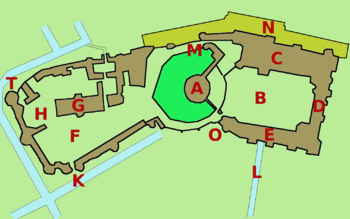 Windsor Castle occupies a large site of more than thirteen acres (five hectares), and combines the features of a fortification, a palace, and a small town. The present-day castle was created during a sequence of phased building projects, culminating in the reconstruction work after a fire in 1992. It is in essence a Georgian
and Victorian
design based on a medieval structure, with Gothic
features reinvented in a modern style. Since the 14th century, architecture at the castle has attempted to produce a contemporary reinterpretation of older fashions and traditions, repeatedly imitating outmoded or even antiquated styles. As a result, architect Sir William Whitfield has pointed to Windsor Castle's architecture as having "a certain fictive quality", the Picturesque
and Gothic design generating "a sense that a theatrical performance is being put on here", despite late 20th century efforts to expose more of the older structures to increase the sense of authenticity. Although there has been some criticism, the castle's architecture and history lends it a "place amongst the greatest European palaces".
or artificial hill in the centre of the ward. The motte is 50 ft (15 m) high and is made from chalk
originally excavated from the surrounding ditch. The keep, called the Round Tower, on the top of the motte is based on an original 12th-century building, extended upwards in the early 19th century under architect Jeffry Wyattville
by 30 ft (9 m) to produce a more imposing height and silhouette. The interior of the Round Tower was further redesigned in 1991–3 to provide additional space for the Royal Archives
, an additional room being built in the space left by Wyattville's originally hollow extension. The Round Tower is in reality far from cylindrical
, due to the shape and structure of the motte beneath it. The current height of the tower has been criticised as being disproportionate to its width; archaeologist Tim Tatton-Brown, for example, has described it as a mutilation of the earlier medieval structure.
The western entrance to the Middle Ward is now open, and a gateway leads north from the ward onto the North Terrace. The eastern exit from the ward is guarded by the Norman Gatehouse. This gatehouse
, which in fact dates from the 14th century, is heavily vaulted and decorated with carvings, including surviving medieval lion mask
s, traditional symbols of majesty, to form an impressive entrance to the Upper Ward. Wyattville redesigned the exterior of the gatehouse, and the interior was later heavily converted in the 19th century for residential use.
 The Upper Ward of Windsor Castle comprises a number of major buildings enclosed by the upper bailey wall, forming a central quadrangle. The State Apartments run along the north of the ward, with a range of buildings along the east wall, and the private royal apartments and the King George IV Gate to the south, with the Edward III Tower in the south-west corner. The motte and the Round Tower form the west edge of the ward. A bronze statue of Charles II on horseback sits beneath the Round Tower. Inspired by Hubert Le Sueur
's statue of Charles I in London, the statue was cast by Josias Ibach in 1679, with the marble plinth featuring carvings by Grinling Gibbons
. The Upper Ward adjoins the North Terrace, which overlooks the River Thames
, and the East Terrace, which overlooks the gardens; both of the current terraces were constructed by Hugh May
in the 17th century.
Traditionally the Upper Ward was judged to be "to all intents and purposes a nineteenth-century creation ... the image of what the early nineteenth-century thought a castle should be", as a result of the extensive redesign of the castle by Wyattville under George IV. The walls of the Upper Ward are built of Bagshot Heath
stone faced on the inside with regular bricks, the gothic details in yellow Bath stone
. The buildings in the Upper Ward are characterised by the use of small bits of flint in the mortar for galletting, originally started at the castle in the 17th century to give stonework from disparate periods a similar appearance. The skyline of the Upper Ward is designed to be dramatic when seen from a distance or silhouetted against the horizon, an image of tall towers and battlements influenced by the picturesque
movement of the late 18th century. Archaeological and restoration work following the 1992 fire has shown the extent to which the current structure represents a survival of elements from the original 12th-century stone walls onwards, presented within the context of Wyattville's final remodelling.
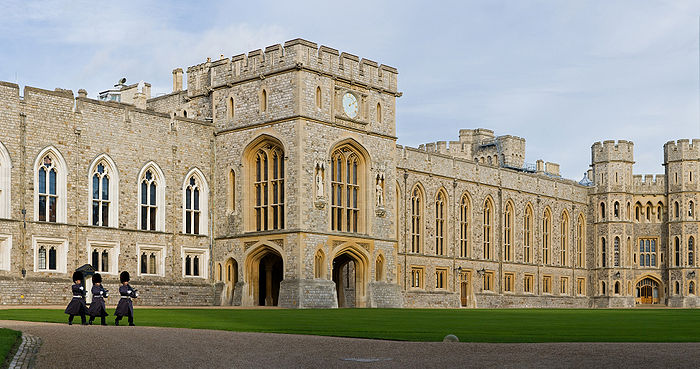 The State Apartments form the major part of the Upper Ward and lie along the north side of the quadrangle. The modern building follows the medieval foundations laid down by Edward III, with the ground floor comprising service chambers and cellars, and the much grander first floor forming the main part of the palace. On the first floor, the layout of the western end of the State Apartments is primarily the work of architect Hugh May, whereas the structure on the eastern side represents Jeffry Wyattville's plans.The Queen's Drawing Room, Queen's Ballroom, Queen's Audience Chamber, Queen's Presence Chamber, Queen's Guard Chamber, King's Presence Chamber, King's Audience Room, King's Drawing Chamber and King's Dining Chamber residing in May's 17th-century structure; Wyattville transformed the layout of the eastern end of the State Apartments, forming the Grand Reception Room, White Drawing Room, Green Drawing Room, Crimson Drawing Room, the Waterloo Chamber, State Dining Room and Octagonal Dining Room.
The interior of the State Apartments was mostly designed by Wyattville in the early 19th century. Wyattville intended each room to illustrate a particular architectural style and to display the matching furnishings and fine arts of the period. With some alterations over the years, this concept continues to dominate the apartments. Different rooms follow the Classical
, Gothic and Rococo
styles, together with an element of Jacobethan
in places. Many of the rooms on the eastern end of the castle had to be restored following the 1992 fire, using "equivalent restoration" methods – the rooms were restored so as to appear similar to their original appearance, but using modern materials and concealing modern structural improvements. These rooms were also partially redesigned at the same time to more closely match modern tastes. Art historian Hugh Roberts
has praised the State Apartments as "a superb and unrivalled sequence of rooms widely regarded as the finest and most complete expression of later Georgian taste." Others, such as architect Robin Nicolson and critic Hugh Pearman
, have described them as "bland" and "distinctly dull".
Wyattville's most famous work are those rooms designed in a Rococo style. These rooms take the fluid, playful aspects of this mid-18th-century artistic movement, including many original pieces of Louis XV
decoration, but project them on a "vastly inflated" scale. Investigations after the 1992 fire have shown though that many Rococo features of the modern castle, originally thought to have been 18th-century fittings transferred from Carlton House or France, are in fact 19th-century imitations in plasterwork and wood, designed to blend with original elements. The Grand Reception Room is the most prominent of these Rococo designs, 100 ft (30 m) long and 40 ft (12 m) tall and occupying the site of Edward III's great hall. This room, restored after the fire, includes a huge French Rococo ceiling, characterised by Ian Constantinides, the lead restorer, as possessing a "coarseness of form and crudeness of hand ... completely overshadowed by the sheer spectacular effect when you are at a distance". The room is set off by a set of restored Gobelins French tapestries
. Although decorated with less gold leaf than in the 1820s, the result remains "one of the greatest set-pieces of Regency decoration". The White, Green and Crimson Drawing Rooms include a total of sixty-two trophies
: carved, gilded wooden panels illustrating weapons and the spoils of war, many with Masonic
meanings. Restored or replaced after the fire, these trophies are famous for their "vitality, precision and three-dimensional quality", and were originally brought from Carlton House in 1826, some being originally imported from France and others carved by Edward Wyatt. The soft furnishings of these rooms, although luxurious, are more modest than the 1820s originals, both on the grounds of modern taste and cost.
Wyattville's design retains three rooms originally built by Hugh May
in the 17th century in partnership with the painter Antonio Verrio
and carver Grinling Gibbons
. The Queen's Presence Chamber, the Queen's Audience Chamber and the King's Dining Room are designed in a Baroque, Franco-Italian style, characterised by "gilded interiors enriched with florid murals", first introduced to England between 1648–50 at Wilton House
. Verrio's paintings are "drenched in medievalist allusion" and classical images. These rooms were intended to show an innovative English "baroque fusion" of the hitherto separate arts of architecture, painting and carving.
A handful of rooms in the modern State Apartments reflect either 18th-century or Victorian Gothic design. The State Dining Room, for example, whose current design originates from the 1850s but which was badly damaged during the 1992 fire, is restored to its appearance in the 1920s, before the removal of some of the gilded features on the pilasters. Anthony Salvin
's Grand Staircase is also of mid-Victorian design in the Gothic style, rising to a double-height hall lit by an older 18th-century Gothic vaulted
lantern tower called the Grand Vestibule, designed by James Wyatt
and executed by Francis Bernasconi
. The staircase has been criticised by historian John Robinson
as being a distinctly inferior design to the earlier staircases built on the same site by both Wyatt and May.
Some parts of the State Apartments were completely destroyed in the 1992 fire and this area was rebuilt in a style called "Downesian Gothic", named after the architect, Giles Downes
.The rooms completely or largely destroyed in the fire were St George's Hall, the Lantern Lobby, the Octagonal Dining Room, the Private Chapel, and the Great Kitchen. The style comprises "the rather stripped, cool and systematic coherence of modernism sewn into a reinterpretation of the Gothic tradition". Downes argues that the style avoids "florid decoration", emphasising an organic, flowing Gothic structure. Three new rooms were built or remodelled by Downes at Windsor. Downes' new roof of St George's Hall is the largest green-oak structure built since the Middle Ages, and is decorated with brightly coloured shields celebrating the heraldic element of the Order of the Garter
; the design attempts to create an illusion of additional height through the gothic woodwork along the ceiling. The Lantern Lobby features flowing oak columns forming a vaulted ceiling, imitating an arum lily. The new Private Chapel is relatively small, only able to fit thirty worshippers, but combines architectural elements of the St George's Hall roof with the Lantern Lobby and the stepped arch structure of the Henry VIII chapel vaulting at Hampton Court. The result is an "extraordinary, continuous and closely moulded net of tracery", complementing the new stained glass windows commemorating the fire, designed by Joseph Nuttgen. The Great Kitchen, with its newly exposed 14th-century roof lantern sitting alongside Wyattville's fireplaces, chimneys and Gothic tables, is also a product of the reconstruction after the fire.
The ground floor of the State Apartments retains various famous medieval features. The 14th-century Great Undercroft still survives, some 193 ft (60 m) long by 31 ft (9 m) wide, divided into thirteen bays. At the time of the 1992 fire, the Undercroft had been divided into smaller rooms; the area is now opened up to form a single space in an effort to echo the undercrofts at Fountains
and Rievaulx Abbey
s, although the floor remains artificially raised for convenience of use. The "beautifully vaulted" 14th-century Larderie passage runs alongside the Kitchen Courtyard and is decorated with carved royal roses, marking its construction by Edward III."Larderie" means "meat passage".
and Edward Blore
, to form a "consistently Gothic composition". The Lower Ward holds St George's Chapel
and most of the buildings associated with the Order of the Garter.
On the north side of the Lower Ward is St George's Chapel. This huge building is the spiritual home of the Order of the Knights of the Garter
and dates from the late 15th and early 16th century, designed in the Perpendicular Gothic
style. The ornate wooden choir stalls
are of 15th-century design, having been restored and extended by Henry Emlyn
at the end of the 18th century, and are decorated with a unique set of brass plates showing the arms of the Knights of the Garter over the last six centuries. On the west side, the chapel has a grand Victorian door and staircase, used on ceremonial occasions. The east stained glass window is Victorian, and the oriel window
to the north side of it was built by Henry VIII
for Catherine of Aragon
. The vault in front of the altar houses the remains of Henry VIII, Jane Seymour
and Charles I
, with Edward IV
buried nearby. The chapel is considered by historian John Robinson to be "one of the supreme achievements of English Perpendicular Gothic" design.
At the east end of St George's Chapel is the Lady Chapel, originally built by Henry III
in the 13th century and converted into the Albert Memorial Chapel between 1863–73 by George Gilbert Scott
. Built to commemorate the life of Prince Albert, the ornate chapel features lavish decoration and works in marble, glass mosaic and bronze by Henri de Triqueti, Susan Durant, Alfred Gilbert
and Antonio Salviati
. The east door of the chapel, covered in ornamental ironwork, is the original door from 1246.
At the west end of the Lower Ward is the Horseshoe Cloister, originally built in 1480, near to the chapel to house its clergy. It houses the vicars-choral, or lay clerk
s of the chapel. This curved brick and timber building is said to have been designed to resemble the shape of a fetlock
, one of the badges used by Edward IV. George Gilbert Scott
heavily restored the building in 1871 and little of the original structure remains. Other ranges originally built by Edward III sit alongside the Horseshoe, featuring stone perpendicular tracery
. As of 2011, they are used as offices, a library and as the houses for the Dean and Canons
.
Behind the Horseshoe Cloister is the Curfew Tower, one of the oldest surviving parts of the Lower Ward and dating from the 13th century. The interior of the tower contains a former dungeon, and the remnants of a sally port
, a secret exit for the occupants in a time of siege. The upper storey contains the castle bells placed there in 1478, and the castle clock of 1689. The French-style conical
roof is a 19th-century attempt by Anthony Salvin to remodel the tower in the fashion of Eugène Viollet-le-Duc
's recreation of Carcassonne
.
On the opposite side of the chapel is a range of buildings including the lodgings of the Military Knights
, and the residence of the Governor of the Military Knights
. These buildings originate from the 16th century and are still used by the Knights, who represent the Order of the Garter each Sunday. On the south side of the Ward is King Henry VIII's gateway, which bears the coat of arms of Catherine of Aragon
and forms the secondary entrance to the castle.
. The Home Park includes parkland and two working farms, along with many estate cottages mainly occupied by employees and the Frogmore
estate. The Long Walk, a double lined avenue of trees, runs for 3 miles (5 km) south of the castle, and is 240 ft (75 m) wide. The original 17th-century elms have since been replaced with alternating chestnut
and plane
trees, large scale replanting having occurred after 1945 due to the impact of Dutch elm disease
.
The Home Park adjoins the northern edge of the more extensive Windsor Great Park
, occupying some 4800 acres (1,942.5 ha) and including some of the oldest broadleaved woodlands
in Europe. In the Home Park, to the north of the castle, stands a private school, St George's
, which provides choristers
to the chapel. Eton College
is located within about half a mile of the castle, across the River Thames
.
in the decade after the Norman conquest
of 1066. William established a defensive ring of motte and bailey castles around London; each was a day's march – about 20 miles (32.2 km) – from the city and from the next castle, allowing for easy reinforcements in a crisis. Windsor Castle, one of this ring of fortifications, was strategically important because of its proximity to both the River Thames
, a key medieval route into London, and Windsor Forest
, a royal hunting preserve previously used by the Saxon kings. The nearby settlement of Clivore, or Clewer
, was an old Saxon
residence. The initial wooden castle consisted of a keep
on the top of a man-made motte, or mound, protected by a small bailey
wall, occupying a chalk inlier
, or bluff, rising 100 ft (30 m) above the river. A second wooden bailey was constructed to the east of the keep, forming the later Upper Ward. By the end of the century, another bailey had been constructed to the west, creating the basic shape of the modern castle. In design, Windsor most closely resembled Arundel Castle
, another powerful early Norman fortification, but the double bailey design was also found at Rockingham
and Alnwick Castle
.
Windsor was not initially used as a royal residence; the early Norman kings preferred to use the former palace of Edward the Confessor
in the village of Old Windsor
. The first king to use Windsor Castle as a residence was Henry I
, who celebrated Whitsuntide
at the castle in 1110 during a period of heightened insecurity. Henry's marriage to Adela
, the daughter of Godfrey of Louvain, took place in the castle in 1121. During this period the keep suffered a substantial collapse – archaeological evidence shows that the southern side of the motte subsided
by over 6 ft (2 m). Timber piles were driven in to support the motte and the old wooden keep was replaced with a new stone shell keep
, with a probable gateway to the north-east and a new stone well. A chemise
, or low protective wall, was subsequently added to the keep.
Henry II
came to the throne in 1154 and built extensively at Windsor between 1165 and 1179. Henry replaced the wooden palisade surrounding the upper ward with a stone wall interspersed with square towers and built the first King's Gate. The first stone keep was suffering from subsidence, and cracks were beginning to appear in the stonework of the south side. Henry replaced the keep with another stone, shell keep and chemise wall, but moved the walls in from the edge of the motte to relieve the pressure on the mound, and added massive foundations along the south side to provide additional support. Inside the castle Henry remodelled the royal accommodation. Bagshot Heath stone was used for most of the work, and stone from Bedfordshire
for the internal buildings.
: the castle was besieged in 1214, and John used the castle as his base during the negotiations before the signing of the Magna Carta
at nearby Runnymede
in 1215. In 1216 the castle was besieged again by baronial and French troops under the command of the Count of Nevers
, but John's constable, Engelard de Cigogné
, successfully defended it.
The damage done to the castle during the second siege was immediately repaired in 1216 and 1221 by Cigogne on behalf of John's successor Henry III
, who further strengthened the defences. The walls of the Lower Ward were rebuilt in stone, complete with a gatehouse in the location of the future Henry VIII Gate, between 1224 and 1230. Three new towers, the Curfew, Garter and the Salisbury towers, were constructed. The Middle Ward was heavily reinforced with a southern stone wall, protected by the new Edward III and Henry III towers at each end.
Windsor Castle was one of Henry's three favourite residences and he invested heavily in the royal accommodation, spending more money at Windsor than in any other of his properties. Following his marriage to Eleanor of Provence
, Henry built a luxurious palace in 1240–63, based around a court along the north side of the Upper Ward. This was intended primarily for the queen and Henry's children. In the Lower Ward, the king ordered the construction of a range of buildings for his own use along the south wall, including a 70 ft (21 m) long chapel, later called the Lady Chapel
. This was the grandest of the numerous chapels built for his own use, and comparable to the Sainte-Chapelle
in Paris in size and quality. Henry repaired the Great Hall that lay along the north side of the Lower Ward, and enlarged it with a new kitchen and built a covered walkway between the Hall and the kitchen. Henry's work was characterised by the religious overtones of the rich decorations, which formed "one of the high-water marks of English medieval art". The conversion cost more than £10,000. The result was to create a division in the castle between a more private Upper Ward and a Lower Ward devoted to the public face of the monarchy. Little further building was carried out at the castle during the 13th century; the Great Hall in the Lower Ward was destroyed by fire in 1296, but it was not rebuilt.
was born at Windsor Castle and used it extensively throughout his reign. In 1344 the king announced the foundation of the new Order of the Round Table at the castle. Edward began to construct a new building in the castle to host this order, but it was never finished. Chroniclers described it as a round building, 200 ft (61 m) across, and it was probably in the centre of the Upper Ward. Shortly afterwards, Edward abandoned the new order for reasons that remain unclear, and instead established the Order of the Garter
, again with Windsor Castle as its headquarters, complete with the attendant Poor Knights of Windsor
. As part of this process Edward decided to rebuild Windsor Castle, in particular Henry III's palace, in an attempt to construct a castle that would be symbolic of royal power and chivalry. Edward was influenced both by the military successes of his grandfather, Edward I, and by the decline of royal authority under his father, Edward II, and aimed to produce an innovative, "self-consciously aesthetic, muscled, martial architecture".
Edward placed William of Wykeham
in overall charge of the rebuilding and design of the new castle and whilst work was ongoing Edward stayed in temporary accommodation in the Round Tower. Between 1350 and 1377 Edward spent £51,000 on renovating Windsor Castle; this was the largest amount spent by any English medieval monarch on a single building operation, and over one and a half times Edward's typical annual income of £30,000. Some of the costs of the castle were paid from the results of ransoms following Edward's victories at the battles of Crécy
, Calais and Poitiers
. Windsor Castle was already a substantial building before Edward began expanding it, making the investment all the more impressive, and much of the expenditure was lavished on rich furnishings. The castle was "the most expensive secular building project of the entire Middle Ages in England".
Edward's new palace consisted of three courts along the north side of the Upper Ward, called Little Cloister, King's Cloister and the Kitchen Court. At the front of the palace lay the St George's Hall range, which combined a new hall and a new chapel. This range had two symmetrical gatehouses, the Spicerie Gatehouse and the Kitchen Gatehouse. The Spicerie Gatehouse was the main entrance into the palace, whilst the Kitchen Gatehouse simply led into the kitchen courtyard. The great hall had numerous large windows looking out across the ward. The range had a unusual, unified roof-line and, with a taller roof than the rest of the palace, would have been highly distinctive. The Rose Tower, designed for the king's private use, set off the west corner of the range. The result was a "great and apparently architecturally unified palace ... uniform in all sorts of ways, as to roof line, window heights, cornice line, floor and ceiling heights". With the exception of the Hall, Chapel and the Great Chamber, the new interiors all shared a similar height and width. The defensive features, however, were primarily for show, possibly to provide a backdrop for jousting between the two halves of the Order of the Garter.
Edward built further luxurious, self-contained lodgings for his court around the east and south edges of the Upper Ward, creating the modern shape of the quadrangle. The Norman gate was built to secure the west entrance to the Ward. In the Lower Ward, the chapel was enlarged and remodelled with grand buildings for the canons built alongside. The earliest weight-driven mechanical clock in England was installed by Edward III in the Round Tower in 1354. William of Wykeham went on to build New College, Oxford
and Winchester College
, where the influence of Windsor Castle can easily be seen.
The new castle was used to hold French prisoners taken in at Poitiers in 1357, including John II
, who was held for a considerable ransom. Later in the century, the castle also found favour with Richard II
. Richard conducted restoration work on St George's Chapel, the work being carried out by Geoffrey Chaucer
, who served as a diplomat and Clerk of The King's Works.
seized the castle during his coup in 1399, although failing to catch Richard II
, who had escaped to London. Under Henry V
, the castle hosted a visit from the Holy Roman Emperor
in 1417, a massive diplomatic event that stretched the accommodation of the castle to its limits.
By the middle of the 15th century England was increasingly divided between the rival royal factions of the Lancastrians
and the Yorkists
. Castles such as Windsor did not play a decisive role during the resulting Wars of the Roses
(1455–85), which were fought primarily in the form of pitched battles between the rival factions. Henry VI
, born at Windsor Castle and known as Henry of Windsor, became king at the young age of nine months. His long period of minority, coupled with the increasing tensions between Henry's Lancastrian supporters and the Yorkists, distracted attention from Windsor. The Garter Feasts and other ceremonial activities at the castle became more infrequent and less well attended.
Edward IV
seized power in 1461. When Edward captured Henry's wife, Margaret of Anjou
, she was brought back to be detained at the castle. Edward began to revive the Order of the Garter, and held a particularly lavish feast in 1472. Edward began the construction of the present St. George's Chapel in 1475, resulting in the dismantling of several of the older buildings in the Lower Ward. By building the grand chapel Edward was seeking to show that his new dynasty were the permanent rulers of England, and may also have been attempting to deliberately rival the similar chapel that Henry VI had ordered to be constructed at nearby Eton College
. Richard III
made only a brief use of Windsor Castle before his defeat at the Battle of Bosworth Field
in 1485, but had the body of Henry VI moved from Chertsey Abbey
in Surrey to the castle to allow it to be visited by pilgrims more easily.
Henry VII made more use of Windsor. In 1488, shortly after succeeding to the throne, he held a massive feast for the Order of the Garter at the castle. He completed the roof of St George's Chapel, and set about converting the older eastern Lady Chapel
into a proposed shrine to Henry VI, whose canonisation was then considered imminent. In the event, Henry VI was not canonised and the project was abandoned, although the shrine continued to attract a flood of pilgrims. Henry VII appears to have remodelled the King's Chamber in the palace, and had the roof of the Great Kitchen rebuilt in 1489. He also built a three-storied tower on the west end of the palace, which he used for his personal apartments. Windsor began to be used for international diplomatic events, including the grand visit of the future Philip I of Castile
in 1506. William de la Pole
, one of the surviving Yorkist claimants to the throne, was imprisoned at Windsor Castle during Henry's reign, before his execution in 1513.
enjoyed Windsor Castle, as a young man "exercising himself daily in shooting, singing, dancing, wrestling, casting of the bar, playing at the recorders, flute, virginals, in setting of songs and making of ballads". The tradition of the Garter Feasts was maintained and became more extravagant; the size of the royal retinue visiting Windsor had to be restricted because of the growing numbers. During the Pilgrimage of Grace
, a huge uprising in the north of England against Henry's rule in 1536, the king used Windsor as a secure base in the south from which to manage his military response. Throughout the Tudor period, Windsor was also used as a safe retreat in the event of plagues occurring in London.
Henry rebuilt the principal castle gateway in about 1510 and constructed a tennis court at the base of the motte in the Upper Ward. He also built a long terrace, called the North Wharf, along the outside wall of the Upper Ward; constructed of wood, it was designed to provide a commanding view of the River Thames
below. The design included an outside staircase into the king's apartments, which made the monarch's life more comfortable at the expense of considerably weakening the castle's defences. Early in his reign, Henry had given the eastern Lady Chapel
to Cardinal Wolsey for Wolsey's future mausoleum. Benedetto Grazzini
converted much of this into an Italian Renaissance design, before Wolsey's fall from power brought an end to the project, with contemporaries estimating that around £60,000 (£295 million in 2008 terms) had been spent on the work. Henry continued the project, but it remained unfinished when he himself was buried in the chapel, in an elaborate funeral in 1547.
By contrast, the young Edward VI
disliked Windsor Castle. Edward's Protestant beliefs led him to simplify the Garter ceremonies, to discontinue the annual Feast of the Garter at Windsor and to remove any signs of Catholic practices with the Order. During the rebellions and political strife of 1549, Windsor was again used as a safe-haven for the king and the Duke of Somerset
. Edward famously commented whilst staying at Windsor Castle during this period that "Methink I am in a prison, here are no galleries, nor no gardens to walk in". Under both Edward and his sister, Mary I
, some limited building work continued at the castle, in many cases using resources recovered from the English abbeys. Water was piped into the Upper Ward to create a fountain. Mary also expanded the buildings used by the Knights of Windsor in the Lower Ward, using stone from Reading Abbey
.
Elizabeth I
spent much of her time at Windsor Castle and used it a safe haven in crises, "knowing it could stand a siege if need be". Ten new brass
cannons were purchased for the castle's defence. It became one of her favourite locations and she spent more money on the property than on any of her other palaces. She conducted some modest building works at Windsor, including a wide range of repairs to the existing structures. She converted the North Wharf into a permanent, huge stone terrace, complete with statues, carvings and an octagonal, outdoor banqueting house, raising the western end of the terrace to provide more privacy. The chapel was refitted with stalls, a gallery and a new ceiling. A bridge was built over the ditch to the south of the castle to enable easier access to the park. Elizabeth built a gallery range of buildings on the west end of the Upper Ward, alongside Henry VII's tower. Elizabeth increasingly used the castle for diplomatic engagements, but space continued to prove a challenge as the property was simply not as large as the more modern royal palaces. This flow of foreign visitors was captured for the queen's entertainment in William Shakespeare
's play, The Merry Wives of Windsor
.
used Windsor Castle primarily as a base for hunting, one of his favourite pursuits, and for socialising with his friends. Many of these occasions involved extensive drinking sessions, including one with the King of Denmark
in 1606 that became infamous across Europe for the resulting drunken behaviour of the two kings. The absence of space at Windsor continued to prove problematic, with James' English and Scottish retinues often quarrelling over rooms.
Charles I
was a connoisseur of art, and paid greater attention to the aesthetic aspects of Windsor Castle than his predecessors. Charles had the castle completely surveyed by a team including Inigo Jones
in 1629, but little of the recommended work was carried out. Nonetheless, Charles employed Nicholas Stone
to improve the chapel gallery in the Mannerist
style and to construct a gateway in the North Terrace. Christian van Vianen, a noted Dutch goldsmith, was employed to produce a baroque
gold service for the St George's Chapel altar. In the final years of peace, Charles demolished the fountain in the Upper Ward, intending to replace it with a classical statue.
In 1642 the English Civil War
broke out, dividing the country into the Royalist
supporters of Charles, and the Parliamentarians. In the aftermath of the battle of Edgehill
in October, Parliament became concerned that Charles might advance on London. John Venn
took control of Windsor Castle with twelve companies of foot soldiers to protect the route along the Thames river, becoming the governor of the castle for the duration of the war. The contents of St George's Chapel were both valuable and, to many Parliamentary forces, inappropriately high church
in style. Looting began immediately: Edward IV's bejewelled coat of mail was stolen; the chapel's organs, windows and books destroyed; the Lady Chapel was emptied of valuables, including the component parts of Henry VIII's unfinished tomb. By the end of the war, some 3580 oz (101 kg) of gold and silver plate
had been looted.
Prince Rupert
, a prominent Royalist general, attempted to relieve Windsor Castle that November. Rupert's small force of cavalry was able to take the town of Windsor, but was unable to overcome the walls at Windsor Castle – in due course, Rupert was forced to retreat. Over the winter of 1642–3, Windsor Castle was converted into the headquarters for the Earl of Essex
, a senior Parliamentary general. The Horseshoe Cloister was taken over as a prison for captured Royalists, and the resident canons
were expelled from the castle. The Lady Chapel was turned into a magazine
. Looting by the underpaid garrison continued to be a problem; 500 royal deer were killed across the Windsor Great Park during the winter, and fences were burned as firewood.
In 1647 Charles, then a prisoner of Parliament, was brought to the castle for a period under arrest, before being moved to Hampton Court. In 1648 there was a Royalist plan, never enacted, to seize Windsor Castle. The Parliamentary Army Council moved into Windsor in November and decided to try Charles for treason. Charles was held at Windsor again for the last three weeks of his reign; after his execution in January 1649, his body was taken back to Windsor that night through a snowstorm, to be interred without ceremony in the vault
beneath St George's Chapel
.
The Restoration of the monarchy in 1660 saw the first period of significant change to Windsor Castle for many years. The civil war and the years of the Interregnum had caused extensive damage to the royal palaces in England. At the same time the shifting "functional requirements, patterns of movement, modes of transport, aesthetic taste and standards of comfort" amongst royal circles was changing the qualities being sought in a successful palace. Windsor was the only royal palace to be successfully fully modernised by Charles II in the Restoration years.
During the Interregnum, however, squatters had occupied Windsor Castle. As a result, the "King's house was a wreck; the fanatic, the pilferer, and the squatter, having been at work ... Paupers had squatted in many of the towers and cabinets". Shortly after returning to England, Charles appointed Prince Rupert
, one of his few surviving close relatives, to be the Constable of Windsor Castle in 1668. Rupert immediately began to reorder the castle's defences, repairing the Round Tower and reconstructing the real tennis
court. Charles attempted to restock Windsor Great Park with deer brought over from Germany, but the herds never recovered their pre-war size. Rupert created apartments for himself in the Round Tower, decorated with an "extraordinary" number of weapons and armour, with his inner chambers "hung with tapisserie, curious and effeminate pictures".
Charles was heavily influenced by the works of Louis XIV of France
, imitating French design at his palace at Winchester and the Royal Hospital
at Chelsea
. At Windsor, Charles created "the most extravagantly Baroque interiors ever executed in England". Much of the building work was paid for out of increased royal revenues from Ireland during the 1670s. French court etiquette at the time required a substantial number of enfiladed
rooms in order to satisfy court protocol; the demand for space forced May to expand out into the North Terrace, rebuilding and widening it in the process. This new building was called the Star Building, because Charles II placed a huge gilt Garter star on the side of it. May took down and rebuilt the walls of Edward III's hall and chapel, incorporating larger windows but retaining the height and dimensions of the medieval building. Although Windsor Castle was now big enough to hold the entire court, it was not built with chambers for the King's Council, as would be found in Whitehall
. Instead Charles took advantage of the good road links emerging around Windsor to hold his council meetings at Hampton Court
when he was staying at the castle. The result became an "exemplar" for royal buildings for the next twenty-five years. The result of May's work showed a medievalist leaning; although sometimes criticised for its "dullness", May's reconstruction was both sympathetic to the existing castle and a deliberate attempt to create a slightly austere 17th-century version of a "neo-Norman" castle.
William III
commissioned Nicholas Hawksmoor
and Sir Christopher Wren
to conduct a large, final classical remodelling of the Upper Ward, but the king's early death caused the plan to be cancelled. Queen Anne was fond of the castle, and attempted to address the lack of a formal garden by instructing Henry Wise to begin work on the Maestricht Garden beneath the North Terrace, which was never completed. Anne also created the racecourse at Ascot
and began the tradition of the annual Royal Ascot procession from the castle.
took little interest in Windsor Castle, preferring his other palaces at St James's, Hampton Court
and Kensington
. George II
rarely used Windsor either, preferring Hampton Court. Many of the apartments in the Upper Ward were given out as "grace and favour
" privileges for the use of prominent widows or other friends of the Crown. The Duke of Cumberland made the most use of the property in his role as the Ranger of Windsor Great Park
. By the 1740s, Windsor Castle had become an early tourist attraction; wealthier visitors who could afford to pay the castle keeper could enter, see curiosities such as the castle's narwhal
horn, and by the 1750s buy the first guidebooks to Windsor, produced by George Bickham
in 1753 and Joseph Pote in 1755. As the condition of the State Apartments continued to deteriorate, even the general public were able to regularly visit the property.
George III
reversed this trend when he came to the throne in 1760. George disliked Hampton Court, and was attracted by the park at Windsor Castle. George wanted to move into the Ranger's House by the castle, but his brother, Henry was already living in it and refused to move out. Instead, George had to move into the Upper Lodge, later called the Queen's Lodge, and started the long process of renovating the castle and the surrounding parks. Initially the atmosphere at the castle remained very informal, with local children playing games inside the Upper and Lower Wards, and the royal family frequently seen as they walked around the grounds. As time went by, however, access for visitors became more limited.
George's architectural taste shifted over the years. As a young man, he favoured Classical, in particular Palladian
styles, but the king came to favour a more Gothic style, both as a consequence of the Palladian style becoming overused and poorly implemented, and because the Gothic form had come to be seen as a more honest, national style of English design in the light of the French revolution
. Working with the architect James Wyatt
, George attempted to "transform the exterior of the buildings in the Upper Ward into a Gothic palace, while retaining the character of the Hugh May state rooms". The outside of the building was restyled with Gothic features, including new battlements and turrets. Inside, conservation work was undertaken, and several new rooms constructed, including a new Gothic staircase to replace May's 17th-century version, complete with the Grand Vestibule ceiling above it. New paintings were purchased for the castle, and collections from other royal palaces moved there by the king. The cost of the work came to over £150,000 (£100 million in 2008 terms). The king undertook extensive work in the castle's Great Park as well, laying out the new Norfolk and Flemish farms, creating two dairies and restoring the Virginia Water
lake, grotto
and follies
.
At the end of this period Windsor Castle became a place of royal confinement. In 1788 the king first became ill during a dinner at Windsor Castle; diagnosed as suffering from madness, he was removed for a period to Kew
, where he temporarily recovered. After relapses in 1801 and 1804, his condition became enduring from 1810 onwards and he was confined in the State Apartments of Windsor Castle, with building work on the castle ceasing the following year.
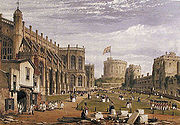 George IV
came to the throne in 1820 intending to create a set of royal palaces that reflected his wealth and influence as the ruler of an increasingly powerful Britain. George's previous houses, Carlton House and the Brighton Pavilion were too small for grand court events, even after expensive extensions. George expanded the Royal Lodge
in the castle park whilst he was Prince Regent, and then began a programme of work to modernise the castle itself once he became king.
George persuaded Parliament
to vote him £300,000 for restoration (£245 million in 2008 terms). Under the guidance of George's advisor, Charles Long
, the architect Jeffry Wyattville
was selected, and work commenced in 1824.Jeffry Wyattville was the nephew of James Wyatt
who had worked for George III; he changed his name to distinguish himself from his other relatives working in architecture.
Wyattville's own preference ran to Gothic architecture, but George, who had led the reintroduction of the French Rococo
style to England at Carlton House, preferred a blend of periods and styles, and applied this taste to Windsor. The terraces were closed off to visitors for greater privacy and the exterior of the Upper Ward was completely remodelled into its current appearance. The Round Tower was raised in height to create a more dramatic appearance; many of the rooms in the State Apartments were rebuilt or remodelled; numerous new towers were created, much higher than the older versions. The south range of the ward was rebuilt to provide private accommodation for the king, away from the state rooms. The statue of Charles II
was moved from the centre of the Upper Ward to the base of the motte. Sir Walter Scott
captured contemporary views when he noted that the work showed "a great deal of taste and feeling for the Gothic architecture"; many modern commentators, including Prince Charles
, have criticised Wyattville's work as representing an act of vandalism of May's earlier designs. The work was unfinished at the time of George IV's death in 1830, but was broadly completed by Wyattville's death in 1840. The total expenditure on the castle had soared to the colossal sum of over one million pounds (£817 million in 2008 terms) by the end of the project.
Queen Victoria and Prince Albert made Windsor Castle their principal royal residence, despite Victoria complaining early in her reign that the castle was "dull and tiresome" and "prison-like", and preferring Osborne
and Balmoral
as holiday residences. The growth of the British Empire
and Victoria's close dynastic ties to Europe made Windsor the hub for many diplomatic and state visits, assisted by the new railways and steamships
of the period. Indeed, it has been argued that Windsor reached its social peak during the Victorian era, seeing the introduction of invitations to numerous prominent figures to "dine and sleep" at the castle. Victoria took a close interest in the details of how Windsor Castle was run, including the minutiae of the social events. Few visitors found these occasions comfortable, both due to the design of the castle and the excessive royal formality. Prince Albert died in the Blue Room at Windsor Castle in 1861 and was buried in the Royal Mausoleum built at nearby Frogmore
, within the Home Park
. The prince's rooms were maintained exactly as they had been at the moment of his death and Victoria kept the castle in a state of mourning for many years, becoming known as the "Widow of Windsor
", a phrase popularised in the famous poem by Rudyard Kipling
. The Queen shunned the use of Buckingham Palace
after Albert's death and instead used Windsor Castle as her residence when conducting official business near London. Towards the end of her reign plays, operas and other entertainments slowly began to be held at the castle again, accommodating both the Queen's desire for entertainment and her reluctance to be seen in public.
Several minor alterations were made to the Upper Ward under Victoria. Anthony Salvin
rebuilt Wyattville's grand staircase, with Edward Blore
constructing a new private chapel within the State Apartments. Salvin also rebuilt the State Dining Room following a serious fire in 1853. Ludwig Gruner assisted in the design of the Queen's Private Audience Chamber in the south range. Blore and Salvin also did extensive work in the Lower Ward, under the direction of Prince Albert, including the Hundred Steps leading down into Windsor town, rebuilding the Garter, Curfew and Salisbury towers, the houses of the Military Knights and creating a new Guardhouse. George Gilbert Scott
rebuilt the Horseshoe Cloister in the 1870s. The Norman Gatehouse was turned into a private dwelling for Sir Henry Ponsonby
. Windsor Castle did not benefit from many of the minor improvements of the era, however, as Victoria disliked gaslight
, preferring candles; electric lighting was only installed in limited parts of the castle at the end of her reign. Indeed, the castle was famously cold and draughty in Victoria's reign, but it was connected to a nearby reservoir, with water reliably piped into the interior for the first time.
Many of the changes under Victoria were to the surrounding parklands and buildings. The Royal Dairy at Frogmore was rebuilt in a Tudorbethan
style in 1853; George III's Dairy rebuilt in a Renaissance
style in 1859; the Georgian Flemish Farm rebuilt, and the Norfolk Farm renovated. The Long Walk was planted with fresh trees to replace the diseased stock. The Windsor Castle and Town Approaches Act
, passed by Parliament in 1848, permitted the closing and re-routing of the old roads which previously ran through the park from Windsor to Datchet
and Old Windsor
. These changes allowed the Royal Family to undertake the enclosure of a large area of parkland to form the private "Home Park" with no public roads passing through it. The Queen granted additional rights for public access to the remainder of the park as part of this arrangement.
came to the throne in 1901 and immediately set about modernising Windsor Castle with "enthusiasm and zest". Many of the rooms in the Upper Ward were de-cluttered and redecorated for the first time in many years, with Edward "peering into cabinets; ransacking drawers; clearing rooms formerly used by the Prince Consort and not touched since his death; dispatching case-loads of relics and ornaments to a special room in the Round Tower ... destroying statues and busts of John Brown
... throwing out hundreds of 'rubbishy old coloured photographs' ... [and] rearranging pictures". Electric lighting was added to more rooms, along with central heating
; telephone lines were installed, along with garages for the newly invented automobiles. The marathon
was run from Windsor Castle at the 1908 Olympics
, and in 1911 the pioneering aviator Thomas Sopwith
landed an aircraft at the castle for the first time.This resulted in a change to the official distance to the race; the previous length of a marathon had been around 24 miles; since 1908, the distance has been set at 26 miles and 385 yards, the distance between Windsor Castle and the main stadium.
George V continued a process of more gradual modernisation, assisted by Queen Mary
, who had a strong interest in furniture and decoration. Mary sought out and re-acquired items of furniture that had been lost or sold from the castle, including many dispersed by Edward VII, and also acquired many new works of art to furnish the state rooms. Queen Mary was also a lover of all things miniature, and a famous dolls' house
was created for her at Windsor Castle, designed by the architect Edwin Lutyens
and furnished by leading craftsmen and designers of the 1930s. George V was committed to maintaining a high standard of court life at Windsor Castle, adopting the motto that everything was to be "of the best". A large staff was still kept at the castle, with around 660 servants working in the property during the period. Meanwhile, during the First World War, anti-German feeling led the members of the Royal Family
to change their dynastic name from the German House of Saxe-Coburg and Gotha
; George decided to take their new name from the castle, becoming the House of Windsor
in 1917.
Edward VIII
did not spend much of his reign at Windsor Castle. He continued to spend most of his time at Fort Belvedere in the Great Park
, where he had lived whilst Prince of Wales. Edward created a small aerodrome
at the castle on Smith's Lawn, now used as a golf-course. Edward's reign was short-lived and he broadcast his abdication speech to the British Empire
from the castle in December 1936, adopting the title of Duke of Windsor
. His successor, George VI
also preferred his own original home, the Royal Lodge
in the Great Park, but moved into Windsor Castle with his wife Elizabeth
. As king, George revived the annual Garter Service at Windsor, drawing on the accounts of the 17th-century ceremonies recorded by Elias Ashmole
, but moving the event to Ascot Week
in June.
On the outbreak of the Second World War in 1939 the castle was readied for war-time conditions. Many of the staff from Buckingham Palace were moved to Windsor for safety, security was tightened and windows were blacked-out. There was significant concern that the castle might be damaged or destroyed during the war; the more important art works were removed from the castle for safe-keeping, the valuable chandeliers were lowered to the floor in case of bomb damage and a sequence of paintings by John Piper
were commissioned from 1942–4 to record the castle's appearance. The king and queen and their children Princesses Elizabeth and Margaret
lived for safety in the castle, with the roof above their rooms specially strengthened in case of attack. The king and queen drove daily to London, returning to Windsor to sleep, although at the time this was a well-kept secret, as for propaganda and morale purposes it was reported that the king was still residing full-time at Buckingham Palace. After the war the king revived the "dine and sleep" events at Windsor, following comments that the castle had become "almost like a vast, empty museum"; nonetheless, it took many years to restore Windsor Castle to its pre-war condition.
In February 1952, Elizabeth II came to the throne and decided to make Windsor her principal weekend retreat. The private apartments which had not been properly occupied since the era of Queen Mary
were renovated and further modernised, and the Queen, Prince Philip
and their two children took up residence. By the early 1990s, however, there had been a marked deterioration in the quality of the Upper Ward, in particular the State Apartments. Generations of repairs and replacements had resulted in a "diminution of the richness with which they had first been decorated", a "gradual attrition of the original vibrancy of effect, as each change repeated a more faded version of the last". A programme of repair work to replace the heating and the wiring of the Upper Ward began in 1988. Work was also undertaken to underpin the motte of the Round Tower after fresh subsidence was detected in 1988, threatening the collapse of the tower.
 On 20 November 1992, a major fire occurred at Windsor Castle, lasting for fifteen hours and causing widespread damage to the Upper Ward. The Private Chapel in the north-east corner of the State Apartments was being renovated as part of a long term programme of work within the castle, and it is believed that one of the spotlights being used in the work set fire to a curtain by the altar during the morning. The fire spread quickly and destroyed nine of the principal state rooms, and severely damaged over a hundred more. Fire-fighters applied water to contain the blaze, whilst castle staff attempted to rescue the precious artworks from the castle. Many of the rooms closest to the fire had been emptied as part of the renovation work, and this contributed to the successful evacuation of most of the collection. The fire spread through the roof voids and efforts continued through the night to contain the blaze, at great risk to the 200 fire-fighters involved. It was not until late afternoon that the blaze began to come under control, although the fire continued during the night before being officially declared over the next morning. Along with the fire and smoke damage, one of the unintended effects of the fire-fighting was the considerable water damage to the castle, which in many ways caused more complex restoration problems than the fire.
Two major issues for Windsor Castle emerged following the fire. The first was a political debate in Britain as to who should pay for the repairs. Traditionally, as the property of the Crown
, Windsor Castle was maintained, and if necessary repaired, by the British government; furthermore, like other state buildings, it was not insured
. At the time of the fire, however, the British press strongly argued in favour of the queen herself being required to pay for the repairs from her private income. A solution was found in which the restoration work would be paid for by opening Buckingham Palace
to the public at selected times of the year, and by introducing new charges for public access to the parkland surrounding Windsor. The second major issue concerned how to repair the castle. Some suggested that the damaged rooms should be restored to their original appearance, but others favoured repairing the castle so as to incorporate modern designs. The decision was taken to largely follow the pre-fire architecture with some changes to reflect modern tastes and cost, but fresh questions emerged over whether the restoration should be undertaken to "authentic" or "equivalent" restoration standards. Modern methods were used at Windsor to reproduce the equivalent pre-fire appearance, partially due to the cost. The restoration programme was not completed until 1997, at a total cost of £37 million (£50.2 million in 2009 terms).
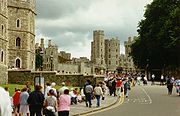 Windsor Castle is owned by the Occupied Royal Palaces Estate on behalf of the nation but day to day management is by the Royal Household
. Windsor Castle is the largest inhabited castle in the world and the longest-occupied palace in Europe, but it also remains a functioning royal home. As of 2006, around five hundred people were living and working in the castle. The Queen has increasingly used the castle as a royal palace as well as her weekend home and it is now as often used for state banquets and official entertaining as Buckingham Palace. In recent years, Windsor Castle has hosted visits from President Mbeki
of South Africa, King Abdullah II
of Jordan and President Chirac
of France. The castle remains an important ceremonial location. The Waterloo ceremony
is carried out in the presence of the Queen each year, and the annual ceremony of the Order of the Garter takes place in St George's Chapel. Whilst the queen is in residence, the Guard Mounting ceremony occurs on a daily basis. The Royal Ascot procession leaves the castle each year during the annual meeting.
During the queen's tenure much has been done, not only to restore and maintain the fabric of the building, but also to transform it into a major British tourist
attraction, containing a significant portion of the Royal Collection
of art, which is managed from Windsor. Archaeological work has continued at the castle
, following on from limited investigations in the 1970s, the work on the Round Tower from 1988–92 and the investigations following the 1992 fire. During 2007, 993,000 tourists visited the castle. This has had to be achieved in co-ordination with security issues
and the castle's role as a working royal palace.
Castle
A castle is a type of fortified structure built in Europe and the Middle East during the Middle Ages by European nobility. Scholars debate the scope of the word castle, but usually consider it to be the private fortified residence of a lord or noble...
and royal residence in Windsor
Windsor, Berkshire
Windsor is an affluent suburban town and unparished area in the Royal Borough of Windsor and Maidenhead in Berkshire, England. It is widely known as the site of Windsor Castle, one of the official residences of the British Royal Family....
in the English county of Berkshire
Berkshire
Berkshire is a historic county in the South of England. It is also often referred to as the Royal County of Berkshire because of the presence of the royal residence of Windsor Castle in the county; this usage, which dates to the 19th century at least, was recognised by the Queen in 1957, and...
, notable for its long association with the British royal family
British Royal Family
The British Royal Family is the group of close relatives of the monarch of the United Kingdom. The term is also commonly applied to the same group of people as the relations of the monarch in her or his role as sovereign of any of the other Commonwealth realms, thus sometimes at variance with...
and its architecture. The original castle was built after the Norman invasion by William the Conqueror. Since the time of Henry I
Henry I of England
Henry I was the fourth son of William I of England. He succeeded his elder brother William II as King of England in 1100 and defeated his eldest brother, Robert Curthose, to become Duke of Normandy in 1106...
it has been used by a succession of monarchs and is the longest-occupied palace in Europe. The castle's lavish, early 19th-century State Apartments are architecturally significant, described by art historian Hugh Roberts
Hugh Roberts
Sir Hugh Ashley Roberts, GCVO, FSA, is an art historian and curator.He was a director of the Royal Collection, the art collection of the British Royal Family, and is a Surveyor of the Queen's Works of Art, whose office is responsible for the care and maintenance of the royal collection of works of...
as "a superb and unrivalled sequence of rooms widely regarded as the finest and most complete expression of later Georgian taste". The castle includes the 15th-century St George's Chapel, considered by historian John Robinson
John Martin Robinson
John Martin Robinson, FSA is a British architectural historian and officer of arms.He was born in Preston, Lancashire and educated at the Benedictine school at Fort Augustus, the University of St Andrews and matriculated to Oriel College, Oxford University for his DPhil in 1970...
to be "one of the supreme achievements of English Perpendicular Gothic" design. More than five hundred people live and work in Windsor, making it the largest inhabited castle in the world.
Originally designed to protect Norman dominance around the outskirts of London, and to oversee a strategically important part of the River Thames
River Thames
The River Thames flows through southern England. It is the longest river entirely in England and the second longest in the United Kingdom. While it is best known because its lower reaches flow through central London, the river flows alongside several other towns and cities, including Oxford,...
, Windsor Castle was built as a motte and bailey, with three wards surrounding a central mound. Gradually replaced with stone fortifications, the castle withstood a prolonged siege during the First Barons' War
First Barons' War
The First Barons' War was a civil war in the Kingdom of England, between a group of rebellious barons—led by Robert Fitzwalter and supported by a French army under the future Louis VIII of France—and King John of England...
at the start of the 13th century. Henry III
Henry III of England
Henry III was the son and successor of John as King of England, reigning for 56 years from 1216 until his death. His contemporaries knew him as Henry of Winchester. He was the first child king in England since the reign of Æthelred the Unready...
built a luxurious royal palace within the castle during the middle of the century, and Edward III
Edward III of England
Edward III was King of England from 1327 until his death and is noted for his military success. Restoring royal authority after the disastrous reign of his father, Edward II, Edward III went on to transform the Kingdom of England into one of the most formidable military powers in Europe...
went further, rebuilding the palace to produce an even grander set of buildings in what would become "the most expensive secular building project of the entire Middle Ages in England". Edward's core design lasted through the Tudor period, during which Henry VIII
Henry VIII of England
Henry VIII was King of England from 21 April 1509 until his death. He was Lord, and later King, of Ireland, as well as continuing the nominal claim by the English monarchs to the Kingdom of France...
and Elizabeth I
Elizabeth I of England
Elizabeth I was queen regnant of England and Ireland from 17 November 1558 until her death. Sometimes called The Virgin Queen, Gloriana, or Good Queen Bess, Elizabeth was the fifth and last monarch of the Tudor dynasty...
made increasing use of the castle as a royal court and centre for diplomatic entertainment.
Windsor Castle survived a tumultuous period during the English Civil War
English Civil War
The English Civil War was a series of armed conflicts and political machinations between Parliamentarians and Royalists...
, in which the castle was used as a military headquarters for Parliamentary
Roundhead
"Roundhead" was the nickname given to the supporters of the Parliament during the English Civil War. Also known as Parliamentarians, they fought against King Charles I and his supporters, the Cavaliers , who claimed absolute power and the divine right of kings...
forces and a prison for Charles I
Charles I of England
Charles I was King of England, King of Scotland, and King of Ireland from 27 March 1625 until his execution in 1649. Charles engaged in a struggle for power with the Parliament of England, attempting to obtain royal revenue whilst Parliament sought to curb his Royal prerogative which Charles...
. During the Restoration, Charles II
Charles II of England
Charles II was monarch of the three kingdoms of England, Scotland, and Ireland.Charles II's father, King Charles I, was executed at Whitehall on 30 January 1649, at the climax of the English Civil War...
rebuilt much of Windsor Castle with the help of architect Hugh May
Hugh May
Hugh May was an English architect in the period after the Restoration of King Charles II. He worked in the era which fell between the first introduction of Palladianism into England by Inigo Jones, and the full flowering of English Baroque under John Vanbrugh and Nicholas Hawksmoor. His own work...
, creating a set of extravagant, Baroque
Baroque
The Baroque is a period and the style that used exaggerated motion and clear, easily interpreted detail to produce drama, tension, exuberance, and grandeur in sculpture, painting, literature, dance, and music...
interiors, still praised today. After a period of neglect during the 18th century, George III and George IV renovated and rebuilt Charles II's palace at colossal expense, producing the current design of the State Apartments, full of Rococo, Gothic
Gothic architecture
Gothic architecture is a style of architecture that flourished during the high and late medieval period. It evolved from Romanesque architecture and was succeeded by Renaissance architecture....
and Baroque furnishings. Queen Victoria made minor changes to the castle, which became the centre for royal entertainment for much of her reign. Windsor Castle was used as a refuge for the royal family during the bombing campaigns of the Second World War and survived a fire in 1992. It is a popular tourist attraction, a venue for hosting state visits, and the Queen's preferred weekend home.
Architecture
Georgian architecture
Georgian architecture is the name given in most English-speaking countries to the set of architectural styles current between 1720 and 1840. It is eponymous for the first four British monarchs of the House of Hanover—George I of Great Britain, George II of Great Britain, George III of the United...
and Victorian
Victorian architecture
The term Victorian architecture refers collectively to several architectural styles employed predominantly during the middle and late 19th century. The period that it indicates may slightly overlap the actual reign, 20 June 1837 – 22 January 1901, of Queen Victoria. This represents the British and...
design based on a medieval structure, with Gothic
Gothic architecture
Gothic architecture is a style of architecture that flourished during the high and late medieval period. It evolved from Romanesque architecture and was succeeded by Renaissance architecture....
features reinvented in a modern style. Since the 14th century, architecture at the castle has attempted to produce a contemporary reinterpretation of older fashions and traditions, repeatedly imitating outmoded or even antiquated styles. As a result, architect Sir William Whitfield has pointed to Windsor Castle's architecture as having "a certain fictive quality", the Picturesque
Picturesque
Picturesque is an aesthetic ideal introduced into English cultural debate in 1782 by William Gilpin in Observations on the River Wye, and Several Parts of South Wales, etc. Relative Chiefly to Picturesque Beauty; made in the Summer of the Year 1770, a practical book which instructed England's...
and Gothic design generating "a sense that a theatrical performance is being put on here", despite late 20th century efforts to expose more of the older structures to increase the sense of authenticity. Although there has been some criticism, the castle's architecture and history lends it a "place amongst the greatest European palaces".
Middle Ward
At the heart of Windsor Castle is the Middle Ward, a bailey formed around the motteMotte-and-bailey
A motte-and-bailey is a form of castle, with a wooden or stone keep situated on a raised earthwork called a motte, accompanied by an enclosed courtyard, or bailey, surrounded by a protective ditch and palisade...
or artificial hill in the centre of the ward. The motte is 50 ft (15 m) high and is made from chalk
Chalk
Chalk is a soft, white, porous sedimentary rock, a form of limestone composed of the mineral calcite. Calcite is calcium carbonate or CaCO3. It forms under reasonably deep marine conditions from the gradual accumulation of minute calcite plates shed from micro-organisms called coccolithophores....
originally excavated from the surrounding ditch. The keep, called the Round Tower, on the top of the motte is based on an original 12th-century building, extended upwards in the early 19th century under architect Jeffry Wyattville
Jeffry Wyattville
Sir Jeffry Wyattville was an English architect and garden designer. His original surname was Wyatt, and his name is sometimes also written as Jeffrey and his surname as Wyatville; he changed his name in 1824.He was trained by his uncles Samuel Wyatt and James Wyatt, who were both leading architects...
by 30 ft (9 m) to produce a more imposing height and silhouette. The interior of the Round Tower was further redesigned in 1991–3 to provide additional space for the Royal Archives
Royal Archives
The Royal Archives, also known as the Queen's Archives, are a division of the Royal Household of the Sovereign of the United Kingdom. It is operationally under the control of the Keeper of the Royal Archives, who is customarily the Private Secretary to the Sovereign.Although Sovereigns have kept...
, an additional room being built in the space left by Wyattville's originally hollow extension. The Round Tower is in reality far from cylindrical
Epitrochoid
An epitrochoid is a roulette traced by a point attached to a circle of radius r rolling around the outside of a fixed circle of radius R, where the point is a distance d from the center of the exterior circle....
, due to the shape and structure of the motte beneath it. The current height of the tower has been criticised as being disproportionate to its width; archaeologist Tim Tatton-Brown, for example, has described it as a mutilation of the earlier medieval structure.
The western entrance to the Middle Ward is now open, and a gateway leads north from the ward onto the North Terrace. The eastern exit from the ward is guarded by the Norman Gatehouse. This gatehouse
Gatehouse
A gatehouse, in architectural terminology, is a building enclosing or accompanying a gateway for a castle, manor house, fort, town or similar buildings of importance.-History:...
, which in fact dates from the 14th century, is heavily vaulted and decorated with carvings, including surviving medieval lion mask
Lion mask
Lion mask is a motif used from antiquity as an emblem of strength, courage, and majesty.The lion mask holding a ring in its mouth for a handle derives from ancient Rome furniture and it continues to be popular as doorknocker. Both Venetian and Façon de Venise goblets feature decorative prunts...
s, traditional symbols of majesty, to form an impressive entrance to the Upper Ward. Wyattville redesigned the exterior of the gatehouse, and the interior was later heavily converted in the 19th century for residential use.
Upper Ward
Hubert Le Sueur
Hubert Le Sueur was a French sculptor with the contemporaneous reputation of having trained in Giambologna's Florentine workshop, who assisted Giambologna's foreman, Pietro Tacca, in Paris, finishing and erecting the equestrian statue of Henri IV on the Pont Neuf...
's statue of Charles I in London, the statue was cast by Josias Ibach in 1679, with the marble plinth featuring carvings by Grinling Gibbons
Grinling Gibbons
Grinling Gibbons was an English sculptor and wood carver known for his work in England, including St Paul's Cathedral, Blenheim Palace and Hampton Court Palace. He was born and educated in Holland where his father was a merchant...
. The Upper Ward adjoins the North Terrace, which overlooks the River Thames
River Thames
The River Thames flows through southern England. It is the longest river entirely in England and the second longest in the United Kingdom. While it is best known because its lower reaches flow through central London, the river flows alongside several other towns and cities, including Oxford,...
, and the East Terrace, which overlooks the gardens; both of the current terraces were constructed by Hugh May
Hugh May
Hugh May was an English architect in the period after the Restoration of King Charles II. He worked in the era which fell between the first introduction of Palladianism into England by Inigo Jones, and the full flowering of English Baroque under John Vanbrugh and Nicholas Hawksmoor. His own work...
in the 17th century.
Traditionally the Upper Ward was judged to be "to all intents and purposes a nineteenth-century creation ... the image of what the early nineteenth-century thought a castle should be", as a result of the extensive redesign of the castle by Wyattville under George IV. The walls of the Upper Ward are built of Bagshot Heath
Swinley Forest
Swinley Forest is a large expanse of English Crown Estate woodland mainly within the civil parishes of Windlesham in Surrey and Winkfield and Crowthorne in Berkshire.-Coverage:...
stone faced on the inside with regular bricks, the gothic details in yellow Bath stone
Bath Stone
Bath Stone is an Oolitic Limestone comprising granular fragments of calcium carbonate. Originally obtained from the Combe Down and Bathampton Down Mines under Combe Down, Somerset, England, its warm, honey colouring gives the World Heritage City of Bath, England its distinctive appearance...
. The buildings in the Upper Ward are characterised by the use of small bits of flint in the mortar for galletting, originally started at the castle in the 17th century to give stonework from disparate periods a similar appearance. The skyline of the Upper Ward is designed to be dramatic when seen from a distance or silhouetted against the horizon, an image of tall towers and battlements influenced by the picturesque
Picturesque
Picturesque is an aesthetic ideal introduced into English cultural debate in 1782 by William Gilpin in Observations on the River Wye, and Several Parts of South Wales, etc. Relative Chiefly to Picturesque Beauty; made in the Summer of the Year 1770, a practical book which instructed England's...
movement of the late 18th century. Archaeological and restoration work following the 1992 fire has shown the extent to which the current structure represents a survival of elements from the original 12th-century stone walls onwards, presented within the context of Wyattville's final remodelling.
State Apartments
The interior of the State Apartments was mostly designed by Wyattville in the early 19th century. Wyattville intended each room to illustrate a particular architectural style and to display the matching furnishings and fine arts of the period. With some alterations over the years, this concept continues to dominate the apartments. Different rooms follow the Classical
Neoclassical architecture
Neoclassical architecture was an architectural style produced by the neoclassical movement that began in the mid-18th century, manifested both in its details as a reaction against the Rococo style of naturalistic ornament, and in its architectural formulas as an outgrowth of some classicizing...
, Gothic and Rococo
Rococo
Rococo , also referred to as "Late Baroque", is an 18th-century style which developed as Baroque artists gave up their symmetry and became increasingly ornate, florid, and playful...
styles, together with an element of Jacobethan
Jacobethan
Jacobethan is the style designation coined in 1933 by John Betjeman to describe the mixed national Renaissance revival style that was made popular in England from the late 1820s, which derived most of its inspiration and its repertory from the English Renaissance , with elements of Elizabethan and...
in places. Many of the rooms on the eastern end of the castle had to be restored following the 1992 fire, using "equivalent restoration" methods – the rooms were restored so as to appear similar to their original appearance, but using modern materials and concealing modern structural improvements. These rooms were also partially redesigned at the same time to more closely match modern tastes. Art historian Hugh Roberts
Hugh Roberts
Sir Hugh Ashley Roberts, GCVO, FSA, is an art historian and curator.He was a director of the Royal Collection, the art collection of the British Royal Family, and is a Surveyor of the Queen's Works of Art, whose office is responsible for the care and maintenance of the royal collection of works of...
has praised the State Apartments as "a superb and unrivalled sequence of rooms widely regarded as the finest and most complete expression of later Georgian taste." Others, such as architect Robin Nicolson and critic Hugh Pearman
Hugh Pearman (architecture critic)
Hugh Pearman is the architecture critic of The Sunday Times and editor of The RIBA Journal, the magazine of the Royal Institute of British Architects...
, have described them as "bland" and "distinctly dull".
Wyattville's most famous work are those rooms designed in a Rococo style. These rooms take the fluid, playful aspects of this mid-18th-century artistic movement, including many original pieces of Louis XV
Louis XV of France
Louis XV was a Bourbon monarch who ruled as King of France and of Navarre from 1 September 1715 until his death. He succeeded his great-grandfather at the age of five, his first cousin Philippe II, Duke of Orléans, served as Regent of the kingdom until Louis's majority in 1723...
decoration, but project them on a "vastly inflated" scale. Investigations after the 1992 fire have shown though that many Rococo features of the modern castle, originally thought to have been 18th-century fittings transferred from Carlton House or France, are in fact 19th-century imitations in plasterwork and wood, designed to blend with original elements. The Grand Reception Room is the most prominent of these Rococo designs, 100 ft (30 m) long and 40 ft (12 m) tall and occupying the site of Edward III's great hall. This room, restored after the fire, includes a huge French Rococo ceiling, characterised by Ian Constantinides, the lead restorer, as possessing a "coarseness of form and crudeness of hand ... completely overshadowed by the sheer spectacular effect when you are at a distance". The room is set off by a set of restored Gobelins French tapestries
Gobelins manufactory
The Manufacture des Gobelins is a tapestry factory located in Paris, France, at 42 avenue des Gobelins, near the Les Gobelins métro station in the XIIIe arrondissement...
. Although decorated with less gold leaf than in the 1820s, the result remains "one of the greatest set-pieces of Regency decoration". The White, Green and Crimson Drawing Rooms include a total of sixty-two trophies
Trophy (architectural)
A trophy is an architectural ornament representing a group of weapons, banners and armour. Similar decorative vertical arrangements of hunting accessories, musical instruments or other objects are also commonly referred to as trophies....
: carved, gilded wooden panels illustrating weapons and the spoils of war, many with Masonic
Freemasonry
Freemasonry is a fraternal organisation that arose from obscure origins in the late 16th to early 17th century. Freemasonry now exists in various forms all over the world, with a membership estimated at around six million, including approximately 150,000 under the jurisdictions of the Grand Lodge...
meanings. Restored or replaced after the fire, these trophies are famous for their "vitality, precision and three-dimensional quality", and were originally brought from Carlton House in 1826, some being originally imported from France and others carved by Edward Wyatt. The soft furnishings of these rooms, although luxurious, are more modest than the 1820s originals, both on the grounds of modern taste and cost.
Wyattville's design retains three rooms originally built by Hugh May
Hugh May
Hugh May was an English architect in the period after the Restoration of King Charles II. He worked in the era which fell between the first introduction of Palladianism into England by Inigo Jones, and the full flowering of English Baroque under John Vanbrugh and Nicholas Hawksmoor. His own work...
in the 17th century in partnership with the painter Antonio Verrio
Antonio Verrio
The Italian-born Antonio Verrio was responsible for introducing Baroque mural painting into England and served the Crown over a thirty year period.-Career:...
and carver Grinling Gibbons
Grinling Gibbons
Grinling Gibbons was an English sculptor and wood carver known for his work in England, including St Paul's Cathedral, Blenheim Palace and Hampton Court Palace. He was born and educated in Holland where his father was a merchant...
. The Queen's Presence Chamber, the Queen's Audience Chamber and the King's Dining Room are designed in a Baroque, Franco-Italian style, characterised by "gilded interiors enriched with florid murals", first introduced to England between 1648–50 at Wilton House
Wilton House
Wilton House is an English country house situated at Wilton near Salisbury in Wiltshire. It has been the country seat of the Earls of Pembroke for over 400 years....
. Verrio's paintings are "drenched in medievalist allusion" and classical images. These rooms were intended to show an innovative English "baroque fusion" of the hitherto separate arts of architecture, painting and carving.
A handful of rooms in the modern State Apartments reflect either 18th-century or Victorian Gothic design. The State Dining Room, for example, whose current design originates from the 1850s but which was badly damaged during the 1992 fire, is restored to its appearance in the 1920s, before the removal of some of the gilded features on the pilasters. Anthony Salvin
Anthony Salvin
Anthony Salvin was an English architect. He gained a reputation as an expert on medieval buildings and applied this expertise to his new buildings and his restorations...
's Grand Staircase is also of mid-Victorian design in the Gothic style, rising to a double-height hall lit by an older 18th-century Gothic vaulted
Vault (architecture)
A Vault is an architectural term for an arched form used to provide a space with a ceiling or roof. The parts of a vault exert lateral thrust that require a counter resistance. When vaults are built underground, the ground gives all the resistance required...
lantern tower called the Grand Vestibule, designed by James Wyatt
James Wyatt
James Wyatt RA , was an English architect, a rival of Robert Adam in the neoclassical style, who far outdid Adam in his work in the neo-Gothic style.-Early classical career:...
and executed by Francis Bernasconi
Francis Bernasconi
Francis Bernasconi , aka Francisco Bernasconi, was an English ornamental carver and plasterer of Italian descent...
. The staircase has been criticised by historian John Robinson
John Martin Robinson
John Martin Robinson, FSA is a British architectural historian and officer of arms.He was born in Preston, Lancashire and educated at the Benedictine school at Fort Augustus, the University of St Andrews and matriculated to Oriel College, Oxford University for his DPhil in 1970...
as being a distinctly inferior design to the earlier staircases built on the same site by both Wyatt and May.
Some parts of the State Apartments were completely destroyed in the 1992 fire and this area was rebuilt in a style called "Downesian Gothic", named after the architect, Giles Downes
Giles Downes
Giles Downes is a British architect most notable for his work at Windsor Castle following the fire in 1992.-Design work at Windsor Castle:On 20 November 1992, a major fire occurred at Windsor Castle, lasting for fifteen hours and causing wide-spread damage to the Upper Ward...
.The rooms completely or largely destroyed in the fire were St George's Hall, the Lantern Lobby, the Octagonal Dining Room, the Private Chapel, and the Great Kitchen. The style comprises "the rather stripped, cool and systematic coherence of modernism sewn into a reinterpretation of the Gothic tradition". Downes argues that the style avoids "florid decoration", emphasising an organic, flowing Gothic structure. Three new rooms were built or remodelled by Downes at Windsor. Downes' new roof of St George's Hall is the largest green-oak structure built since the Middle Ages, and is decorated with brightly coloured shields celebrating the heraldic element of the Order of the Garter
Order of the Garter
The Most Noble Order of the Garter, founded in 1348, is the highest order of chivalry, or knighthood, existing in England. The order is dedicated to the image and arms of St...
; the design attempts to create an illusion of additional height through the gothic woodwork along the ceiling. The Lantern Lobby features flowing oak columns forming a vaulted ceiling, imitating an arum lily. The new Private Chapel is relatively small, only able to fit thirty worshippers, but combines architectural elements of the St George's Hall roof with the Lantern Lobby and the stepped arch structure of the Henry VIII chapel vaulting at Hampton Court. The result is an "extraordinary, continuous and closely moulded net of tracery", complementing the new stained glass windows commemorating the fire, designed by Joseph Nuttgen. The Great Kitchen, with its newly exposed 14th-century roof lantern sitting alongside Wyattville's fireplaces, chimneys and Gothic tables, is also a product of the reconstruction after the fire.
The ground floor of the State Apartments retains various famous medieval features. The 14th-century Great Undercroft still survives, some 193 ft (60 m) long by 31 ft (9 m) wide, divided into thirteen bays. At the time of the 1992 fire, the Undercroft had been divided into smaller rooms; the area is now opened up to form a single space in an effort to echo the undercrofts at Fountains
Fountains Abbey
Fountains Abbey is near to Aldfield, approximately two miles southwest of Ripon in North Yorkshire, England. It is a ruined Cistercian monastery, founded in 1132. Fountains Abbey is one of the largest and best preserved Cistercian houses in England. It is a Grade I listed building and owned by the...
and Rievaulx Abbey
Rievaulx Abbey
Rievaulx Abbey is a former Cistercian abbey headed by the Abbot of Rievaulx. It is located in Rievaulx , near Helmsley in North Yorkshire, England.It was one of the wealthiest abbeys in England and was dissolved by Henry VIII of England in 1538...
s, although the floor remains artificially raised for convenience of use. The "beautifully vaulted" 14th-century Larderie passage runs alongside the Kitchen Courtyard and is decorated with carved royal roses, marking its construction by Edward III."Larderie" means "meat passage".
Lower Ward
The Lower Ward lies below and to the west of the Round Tower, reached through the Norman Gate. Originally largely of medieval design, most of the Lower Ward was renovated or reconstructed during the mid-Victorian period by Anthony SalvinAnthony Salvin
Anthony Salvin was an English architect. He gained a reputation as an expert on medieval buildings and applied this expertise to his new buildings and his restorations...
and Edward Blore
Edward Blore
Edward Blore was a 19th century British landscape and architectural artist, architect and antiquary. He was born in Edinburgh, Scotland ....
, to form a "consistently Gothic composition". The Lower Ward holds St George's Chapel
St. George's Chapel, Windsor Castle
St George's Chapel is the place of worship at Windsor Castle in England, United Kingdom. It is both a royal peculiar and the chapel of the Order of the Garter...
and most of the buildings associated with the Order of the Garter.
On the north side of the Lower Ward is St George's Chapel. This huge building is the spiritual home of the Order of the Knights of the Garter
Order of the Garter
The Most Noble Order of the Garter, founded in 1348, is the highest order of chivalry, or knighthood, existing in England. The order is dedicated to the image and arms of St...
and dates from the late 15th and early 16th century, designed in the Perpendicular Gothic
Gothic architecture
Gothic architecture is a style of architecture that flourished during the high and late medieval period. It evolved from Romanesque architecture and was succeeded by Renaissance architecture....
style. The ornate wooden choir stalls
Choir of St George's Chapel, Windsor Castle
The Choir of St George's Chapel at Windsor Castle exists to sing services in St George's Chapel at Windsor Castle.It has been in existence since 1348 and, with the exception of the Commonwealth period , has sung services in the Chapel continuously ever since.- The choir today :The choir comprises...
are of 15th-century design, having been restored and extended by Henry Emlyn
Henry Emlyn
Henry Emlyn was an English architect.Emlyn resided at Windsor. He published A Proposition for a new Order in Architecture, with rules for drawing the several parts, fol...
at the end of the 18th century, and are decorated with a unique set of brass plates showing the arms of the Knights of the Garter over the last six centuries. On the west side, the chapel has a grand Victorian door and staircase, used on ceremonial occasions. The east stained glass window is Victorian, and the oriel window
Oriel window
Oriel windows are a form of bay window commonly found in Gothic architecture, which project from the main wall of the building but do not reach to the ground. Corbels or brackets are often used to support this kind of window. They are seen in combination with the Tudor arch. This type of window was...
to the north side of it was built by Henry VIII
Henry VIII of England
Henry VIII was King of England from 21 April 1509 until his death. He was Lord, and later King, of Ireland, as well as continuing the nominal claim by the English monarchs to the Kingdom of France...
for Catherine of Aragon
Catherine of Aragon
Catherine of Aragon , also known as Katherine or Katharine, was Queen consort of England as the first wife of King Henry VIII of England and Princess of Wales as the wife to Arthur, Prince of Wales...
. The vault in front of the altar houses the remains of Henry VIII, Jane Seymour
Jane Seymour
Jane Seymour was Queen of England as the third wife of King Henry VIII. She succeeded Anne Boleyn as queen consort following the latter's execution for trumped up charges of high treason, incest and adultery in May 1536. She died of postnatal complications less than two weeks after the birth of...
and Charles I
Charles I of England
Charles I was King of England, King of Scotland, and King of Ireland from 27 March 1625 until his execution in 1649. Charles engaged in a struggle for power with the Parliament of England, attempting to obtain royal revenue whilst Parliament sought to curb his Royal prerogative which Charles...
, with Edward IV
Edward IV of England
Edward IV was King of England from 4 March 1461 until 3 October 1470, and again from 11 April 1471 until his death. He was the first Yorkist King of England...
buried nearby. The chapel is considered by historian John Robinson to be "one of the supreme achievements of English Perpendicular Gothic" design.
At the east end of St George's Chapel is the Lady Chapel, originally built by Henry III
Henry III of England
Henry III was the son and successor of John as King of England, reigning for 56 years from 1216 until his death. His contemporaries knew him as Henry of Winchester. He was the first child king in England since the reign of Æthelred the Unready...
in the 13th century and converted into the Albert Memorial Chapel between 1863–73 by George Gilbert Scott
George Gilbert Scott
Sir George Gilbert Scott was an English architect of the Victorian Age, chiefly associated with the design, building and renovation of churches, cathedrals and workhouses...
. Built to commemorate the life of Prince Albert, the ornate chapel features lavish decoration and works in marble, glass mosaic and bronze by Henri de Triqueti, Susan Durant, Alfred Gilbert
Alfred Gilbert
Sir Alfred Gilbert was an English sculptor and goldsmith who enthusiastically experimented with metallurgical innovations...
and Antonio Salviati
Antonio Salviati
Antonio Salviati was an Italian glass manufacturer and founder of the Salviati family firm.A native of Vicenza, Salviati was a lawyer who got interested in glasswork after becoming involved in restorations being done on the mosaics of Saint Mark's Cathedral in Venice...
. The east door of the chapel, covered in ornamental ironwork, is the original door from 1246.
At the west end of the Lower Ward is the Horseshoe Cloister, originally built in 1480, near to the chapel to house its clergy. It houses the vicars-choral, or lay clerk
Lay clerk
A lay clerk, also known as a lay vicar, song man or a vicar choral, is a professional adult singer in a Cathedral or collegiate choir in the United Kingdom. The Vicars Choral were substitutes for the Canons...
s of the chapel. This curved brick and timber building is said to have been designed to resemble the shape of a fetlock
Fetlock
Fetlock is the common name for the metacarpophalangeal and metatarsophalangeal joints of horses, large animals, and sometimes dogs. It is formed by the junction of the third metacarpal or metatarsal bones proximad and the proximal phalanx distad...
, one of the badges used by Edward IV. George Gilbert Scott
George Gilbert Scott
Sir George Gilbert Scott was an English architect of the Victorian Age, chiefly associated with the design, building and renovation of churches, cathedrals and workhouses...
heavily restored the building in 1871 and little of the original structure remains. Other ranges originally built by Edward III sit alongside the Horseshoe, featuring stone perpendicular tracery
Tracery
In architecture, Tracery is the stonework elements that support the glass in a Gothic window. The term probably derives from the 'tracing floors' on which the complex patterns of late Gothic windows were laid out.-Plate tracery:...
. As of 2011, they are used as offices, a library and as the houses for the Dean and Canons
Canon (priest)
A canon is a priest or minister who is a member of certain bodies of the Christian clergy subject to an ecclesiastical rule ....
.
Behind the Horseshoe Cloister is the Curfew Tower, one of the oldest surviving parts of the Lower Ward and dating from the 13th century. The interior of the tower contains a former dungeon, and the remnants of a sally port
Sally port
The primary modern meaning for sally port is a secure, controlled entryway, as at a fortification or a prison. The entrance is usually protected in some way, such as with a fixed wall blocking the door which must be circumvented before entering, but which prevents direct enemy fire from a distance...
, a secret exit for the occupants in a time of siege. The upper storey contains the castle bells placed there in 1478, and the castle clock of 1689. The French-style conical
Cone (geometry)
A cone is an n-dimensional geometric shape that tapers smoothly from a base to a point called the apex or vertex. Formally, it is the solid figure formed by the locus of all straight line segments that join the apex to the base...
roof is a 19th-century attempt by Anthony Salvin to remodel the tower in the fashion of Eugène Viollet-le-Duc
Eugène Viollet-le-Duc
Eugène Emmanuel Viollet-le-Duc was a French architect and theorist, famous for his interpretive "restorations" of medieval buildings. Born in Paris, he was a major Gothic Revival architect.-Early years:...
's recreation of Carcassonne
Carcassonne
Carcassonne is a fortified French town in the Aude department, of which it is the prefecture, in the former province of Languedoc.It is divided into the fortified Cité de Carcassonne and the more expansive lower city, the ville basse. Carcassone was founded by the Visigoths in the fifth century,...
.
On the opposite side of the chapel is a range of buildings including the lodgings of the Military Knights
Military Knights of Windsor
The Military Knights of Windsor are retired military officers who receive a pension and accommodation at Windsor Castle, and who provide support for the Order of the Garter and for the services of St. George's Chapel, Windsor Castle...
, and the residence of the Governor of the Military Knights
Governor of the Military Knights of Windsor
Governor of the Military Knights of Windsor is an office of the Royal Household of the Sovereign of the United Kingdom which dates from the mid-sixteenth century. From 1905 he has been controlled by the Constable of Windsor Castle, having formerly been responsible to the Dean of Windsor...
. These buildings originate from the 16th century and are still used by the Knights, who represent the Order of the Garter each Sunday. On the south side of the Ward is King Henry VIII's gateway, which bears the coat of arms of Catherine of Aragon
Catherine of Aragon
Catherine of Aragon , also known as Katherine or Katharine, was Queen consort of England as the first wife of King Henry VIII of England and Princess of Wales as the wife to Arthur, Prince of Wales...
and forms the secondary entrance to the castle.
Park and landscape
Windsor Castle's position on top of steep ground has meant that the castle's gardens are limited in scale. The castle gardens stretch east from the Upper Ward across a 20th-century terrace. Windsor Castle is surrounded by extensive parkland. The immediate area stretching to the east of the castle is a 19th-century creation known as the Home ParkHome Park, Windsor
The Home Park, previously known as the Little Park , is a private Royal park, administered by the Crown Estate. It lies on the eastern side of Windsor Castle in the town and civil parish of Windsor, Berkshire....
. The Home Park includes parkland and two working farms, along with many estate cottages mainly occupied by employees and the Frogmore
Frogmore
The Frogmore Estate or Gardens comprise of private gardens within the grounds of the Home Park, adjoining Windsor Castle, in the English county of Berkshire. The name derives from the preponderance of frogs which have always lived in this low-lying and marshy area.It is the location of Frogmore...
estate. The Long Walk, a double lined avenue of trees, runs for 3 miles (5 km) south of the castle, and is 240 ft (75 m) wide. The original 17th-century elms have since been replaced with alternating chestnut
Chestnut
Chestnut , some species called chinkapin or chinquapin, is a genus of eight or nine species of deciduous trees and shrubs in the beech family Fagaceae, native to temperate regions of the Northern Hemisphere. The name also refers to the edible nuts they produce.-Species:The chestnut belongs to the...
and plane
Platanus
Platanus is a small genus of trees native to the Northern Hemisphere. They are the sole living members of the family Platanaceae....
trees, large scale replanting having occurred after 1945 due to the impact of Dutch elm disease
Dutch elm disease
Dutch elm disease is a disease caused by a member of the sac fungi category, affecting elm trees which is spread by the elm bark beetle. Although believed to be originally native to Asia, the disease has been accidentally introduced into America and Europe, where it has devastated native...
.
The Home Park adjoins the northern edge of the more extensive Windsor Great Park
Windsor Great Park
Windsor Great Park is a large deer park of , to the south of the town of Windsor on the border of Berkshire and Surrey in England. The park was, for many centuries, the private hunting ground of Windsor Castle and dates primarily from the mid-13th century...
, occupying some 4800 acres (1,942.5 ha) and including some of the oldest broadleaved woodlands
Temperate broadleaf and mixed forests
Mixed forests are a temperate and humid biome. The typical structure of these forests includes four layers. The uppermost layer is the canopy composed of tall mature trees ranging from 33 to 66 m high. Below the canopy is the three-layered, shade-tolerant understory that is roughly 9 to...
in Europe. In the Home Park, to the north of the castle, stands a private school, St George's
St George's School, Windsor Castle
St George's School, Windsor Castle is a coeducational independent Preparatory School of some 410 children, aged from 3 to 13, in Windsor, near London....
, which provides choristers
Choir
A choir, chorale or chorus is a musical ensemble of singers. Choral music, in turn, is the music written specifically for such an ensemble to perform.A body of singers who perform together as a group is called a choir or chorus...
to the chapel. Eton College
Eton College
Eton College, often referred to simply as Eton, is a British independent school for boys aged 13 to 18. It was founded in 1440 by King Henry VI as "The King's College of Our Lady of Eton besides Wyndsor"....
is located within about half a mile of the castle, across the River Thames
River Thames
The River Thames flows through southern England. It is the longest river entirely in England and the second longest in the United Kingdom. While it is best known because its lower reaches flow through central London, the river flows alongside several other towns and cities, including Oxford,...
.
11th and 12th century
Windsor Castle was originally built by William the ConquerorWilliam I of England
William I , also known as William the Conqueror , was the first Norman King of England from Christmas 1066 until his death. He was also Duke of Normandy from 3 July 1035 until his death, under the name William II...
in the decade after the Norman conquest
Norman conquest of England
The Norman conquest of England began on 28 September 1066 with the invasion of England by William, Duke of Normandy. William became known as William the Conqueror after his victory at the Battle of Hastings on 14 October 1066, defeating King Harold II of England...
of 1066. William established a defensive ring of motte and bailey castles around London; each was a day's march – about 20 miles (32.2 km) – from the city and from the next castle, allowing for easy reinforcements in a crisis. Windsor Castle, one of this ring of fortifications, was strategically important because of its proximity to both the River Thames
River Thames
The River Thames flows through southern England. It is the longest river entirely in England and the second longest in the United Kingdom. While it is best known because its lower reaches flow through central London, the river flows alongside several other towns and cities, including Oxford,...
, a key medieval route into London, and Windsor Forest
Windsor Great Park
Windsor Great Park is a large deer park of , to the south of the town of Windsor on the border of Berkshire and Surrey in England. The park was, for many centuries, the private hunting ground of Windsor Castle and dates primarily from the mid-13th century...
, a royal hunting preserve previously used by the Saxon kings. The nearby settlement of Clivore, or Clewer
Clewer
Clewer is an ecclesiastical parish and region of Windsor making up three wards of the Royal Borough of Windsor and Maidenhead in the English county of Berkshire.-History:...
, was an old Saxon
Anglo-Saxons
Anglo-Saxon is a term used by historians to designate the Germanic tribes who invaded and settled the south and east of Great Britain beginning in the early 5th century AD, and the period from their creation of the English nation to the Norman conquest. The Anglo-Saxon Era denotes the period of...
residence. The initial wooden castle consisted of a keep
Keep
A keep is a type of fortified tower built within castles during the Middle Ages by European nobility. Scholars have debated the scope of the word keep, but usually consider it to refer to large towers in castles that were fortified residences, used as a refuge of last resort should the rest of the...
on the top of a man-made motte, or mound, protected by a small bailey
Ward (fortification)
In fortifications, a bailey or ward refers to a courtyard enclosed by a curtain wall. In particular, an early type of European castle was known as a Motte-and-bailey. Castles can have more than one ward. Their layout depends both on the local topography and the level of fortification technology...
wall, occupying a chalk inlier
Inliers and outliers (geology)
An inlier is an area of older rocks surrounded by younger rocks. Inliers are typically formed by the erosion of overlying younger rocks to reveal a limited exposure of the older underlying rocks. Faulting or folding may also contribute to the observed outcrop pattern...
, or bluff, rising 100 ft (30 m) above the river. A second wooden bailey was constructed to the east of the keep, forming the later Upper Ward. By the end of the century, another bailey had been constructed to the west, creating the basic shape of the modern castle. In design, Windsor most closely resembled Arundel Castle
Arundel Castle
Arundel Castle in Arundel, West Sussex, England is a restored medieval castle. It was founded by Roger de Montgomery on Christmas Day 1067. Roger became the first to hold the earldom of Arundel by the graces of William the Conqueror...
, another powerful early Norman fortification, but the double bailey design was also found at Rockingham
Rockingham Castle
Rockingham Castle is a former royal castle and hunting lodge in Rockingham Forest a mile to the north of Corby, Northamptonshire.-History:The site on which the castle stands has been used in the Iron Age, Roman period and by the invading Saxons also used by the Normans, Tudors and also used in the...
and Alnwick Castle
Alnwick Castle
Alnwick Castle is a castle and stately home in the town of the same name in the English county of Northumberland. It is the residence of the Duke of Northumberland, built following the Norman conquest, and renovated and remodelled a number of times. It is a Grade I listed building.-History:Alnwick...
.
Windsor was not initially used as a royal residence; the early Norman kings preferred to use the former palace of Edward the Confessor
Edward the Confessor
Edward the Confessor also known as St. Edward the Confessor , son of Æthelred the Unready and Emma of Normandy, was one of the last Anglo-Saxon kings of England and is usually regarded as the last king of the House of Wessex, ruling from 1042 to 1066....
in the village of Old Windsor
Old Windsor
Old Windsor is a large village and civil parish in the Royal Borough of Windsor and Maidenhead in the English county of Berkshire.-Location:...
. The first king to use Windsor Castle as a residence was Henry I
Henry I of England
Henry I was the fourth son of William I of England. He succeeded his elder brother William II as King of England in 1100 and defeated his eldest brother, Robert Curthose, to become Duke of Normandy in 1106...
, who celebrated Whitsuntide
Pentecost
Pentecost is a prominent feast in the calendar of Ancient Israel celebrating the giving of the Law on Sinai, and also later in the Christian liturgical year commemorating the descent of the Holy Spirit upon the disciples of Christ after the Resurrection of Jesus...
at the castle in 1110 during a period of heightened insecurity. Henry's marriage to Adela
Adeliza of Louvain
Adeliza of Louvain, sometimes known in England as Adelicia of Louvain, also called Adela and Aleidis; was queen consort of the Kingdom of England from 1121 to 1135, the second wife of Henry I...
, the daughter of Godfrey of Louvain, took place in the castle in 1121. During this period the keep suffered a substantial collapse – archaeological evidence shows that the southern side of the motte subsided
Subsidence
Subsidence is the motion of a surface as it shifts downward relative to a datum such as sea-level. The opposite of subsidence is uplift, which results in an increase in elevation...
by over 6 ft (2 m). Timber piles were driven in to support the motte and the old wooden keep was replaced with a new stone shell keep
Shell keep
A shell keep is a style of medieval fortification, best described as a stone structure circling the top of a motte.In English castle morphology, shell keeps are perceived as the successors to motte-and-bailey castles, with the wooden fence around the top of the motte replaced by a stone wall...
, with a probable gateway to the north-east and a new stone well. A chemise
Chemise (wall)
In medieval castles the chemise was typically a low wall encircling the keep, protecting the base of the tower. An alternative term, more commonly used in English is mantlet wall....
, or low protective wall, was subsequently added to the keep.
Henry II
Henry II of England
Henry II ruled as King of England , Count of Anjou, Count of Maine, Duke of Normandy, Duke of Aquitaine, Duke of Gascony, Count of Nantes, Lord of Ireland and, at various times, controlled parts of Wales, Scotland and western France. Henry, the great-grandson of William the Conqueror, was the...
came to the throne in 1154 and built extensively at Windsor between 1165 and 1179. Henry replaced the wooden palisade surrounding the upper ward with a stone wall interspersed with square towers and built the first King's Gate. The first stone keep was suffering from subsidence, and cracks were beginning to appear in the stonework of the south side. Henry replaced the keep with another stone, shell keep and chemise wall, but moved the walls in from the edge of the motte to relieve the pressure on the mound, and added massive foundations along the south side to provide additional support. Inside the castle Henry remodelled the royal accommodation. Bagshot Heath stone was used for most of the work, and stone from Bedfordshire
Bedfordshire
Bedfordshire is a ceremonial county of historic origin in England that forms part of the East of England region.It borders Cambridgeshire to the north-east, Northamptonshire to the north, Buckinghamshire to the west and Hertfordshire to the south-east....
for the internal buildings.
13th century
King John undertook some building works at Windsor, but primarily to the accommodation rather than the defences. The castle played a role during the revolt of the English baronsFirst Barons' War
The First Barons' War was a civil war in the Kingdom of England, between a group of rebellious barons—led by Robert Fitzwalter and supported by a French army under the future Louis VIII of France—and King John of England...
: the castle was besieged in 1214, and John used the castle as his base during the negotiations before the signing of the Magna Carta
Magna Carta
Magna Carta is an English charter, originally issued in the year 1215 and reissued later in the 13th century in modified versions, which included the most direct challenges to the monarch's authority to date. The charter first passed into law in 1225...
at nearby Runnymede
Runnymede
Runnymede is a water-meadow alongside the River Thames in the English county of Berkshire, and just over west of central London. It is notable for its association with the sealing of Magna Carta, and as a consequence is the site of a collection of memorials...
in 1215. In 1216 the castle was besieged again by baronial and French troops under the command of the Count of Nevers
Hervé IV of Donzy
Hervé IV of Donzy was a French nobleman and participant in the Fifth Crusade. By marriage in 1200 to Mahaut de Courtenay , daughter of Peter II of Courtenay, he became Count of Nevers....
, but John's constable, Engelard de Cigogné
Engelard de Cigogné
Engelard de Cigogné was a 13th century Norman French-born administrator serving King John of England.He was born in France, a relative of Gérard d'Athée, a trusted lieutenant of King John. John arranged for Gerard and his relatives to follow him to England in 1207. Engelard was appointed High...
, successfully defended it.
The damage done to the castle during the second siege was immediately repaired in 1216 and 1221 by Cigogne on behalf of John's successor Henry III
Henry III of England
Henry III was the son and successor of John as King of England, reigning for 56 years from 1216 until his death. His contemporaries knew him as Henry of Winchester. He was the first child king in England since the reign of Æthelred the Unready...
, who further strengthened the defences. The walls of the Lower Ward were rebuilt in stone, complete with a gatehouse in the location of the future Henry VIII Gate, between 1224 and 1230. Three new towers, the Curfew, Garter and the Salisbury towers, were constructed. The Middle Ward was heavily reinforced with a southern stone wall, protected by the new Edward III and Henry III towers at each end.
Windsor Castle was one of Henry's three favourite residences and he invested heavily in the royal accommodation, spending more money at Windsor than in any other of his properties. Following his marriage to Eleanor of Provence
Eleanor of Provence
Eleanor of Provence was Queen consort of England as the spouse of King Henry III of England from 1236 until his death in 1272....
, Henry built a luxurious palace in 1240–63, based around a court along the north side of the Upper Ward. This was intended primarily for the queen and Henry's children. In the Lower Ward, the king ordered the construction of a range of buildings for his own use along the south wall, including a 70 ft (21 m) long chapel, later called the Lady Chapel
Lady chapel
A Lady chapel, also called Mary chapel or Marian chapel, is a traditional English term for a chapel inside a cathedral, basilica, or large church dedicated to the Blessed Virgin Mary...
. This was the grandest of the numerous chapels built for his own use, and comparable to the Sainte-Chapelle
Sainte-Chapelle
La Sainte-Chapelle is the only surviving building of the Capetian royal palace on the Île de la Cité in the heart of Paris, France. It was commissioned by King Louis IX of France to house his collection of Passion Relics, including the Crown of Thorns - one of the most important relics in medieval...
in Paris in size and quality. Henry repaired the Great Hall that lay along the north side of the Lower Ward, and enlarged it with a new kitchen and built a covered walkway between the Hall and the kitchen. Henry's work was characterised by the religious overtones of the rich decorations, which formed "one of the high-water marks of English medieval art". The conversion cost more than £10,000. The result was to create a division in the castle between a more private Upper Ward and a Lower Ward devoted to the public face of the monarchy. Little further building was carried out at the castle during the 13th century; the Great Hall in the Lower Ward was destroyed by fire in 1296, but it was not rebuilt.
14th century
Edward IIIEdward III of England
Edward III was King of England from 1327 until his death and is noted for his military success. Restoring royal authority after the disastrous reign of his father, Edward II, Edward III went on to transform the Kingdom of England into one of the most formidable military powers in Europe...
was born at Windsor Castle and used it extensively throughout his reign. In 1344 the king announced the foundation of the new Order of the Round Table at the castle. Edward began to construct a new building in the castle to host this order, but it was never finished. Chroniclers described it as a round building, 200 ft (61 m) across, and it was probably in the centre of the Upper Ward. Shortly afterwards, Edward abandoned the new order for reasons that remain unclear, and instead established the Order of the Garter
Order of the Garter
The Most Noble Order of the Garter, founded in 1348, is the highest order of chivalry, or knighthood, existing in England. The order is dedicated to the image and arms of St...
, again with Windsor Castle as its headquarters, complete with the attendant Poor Knights of Windsor
Military Knights of Windsor
The Military Knights of Windsor are retired military officers who receive a pension and accommodation at Windsor Castle, and who provide support for the Order of the Garter and for the services of St. George's Chapel, Windsor Castle...
. As part of this process Edward decided to rebuild Windsor Castle, in particular Henry III's palace, in an attempt to construct a castle that would be symbolic of royal power and chivalry. Edward was influenced both by the military successes of his grandfather, Edward I, and by the decline of royal authority under his father, Edward II, and aimed to produce an innovative, "self-consciously aesthetic, muscled, martial architecture".
Edward placed William of Wykeham
William of Wykeham
William of Wykeham was Bishop of Winchester, Chancellor of England, founder of Winchester College, New College, Oxford, New College School, Oxford, and builder of a large part of Windsor Castle.-Life:...
in overall charge of the rebuilding and design of the new castle and whilst work was ongoing Edward stayed in temporary accommodation in the Round Tower. Between 1350 and 1377 Edward spent £51,000 on renovating Windsor Castle; this was the largest amount spent by any English medieval monarch on a single building operation, and over one and a half times Edward's typical annual income of £30,000. Some of the costs of the castle were paid from the results of ransoms following Edward's victories at the battles of Crécy
Battle of Crécy
The Battle of Crécy took place on 26 August 1346 near Crécy in northern France, and was one of the most important battles of the Hundred Years' War...
, Calais and Poitiers
Battle of Poitiers (1356)
The Battle of Poitiers was fought between the Kingdoms of England and France on 19 September 1356 near Poitiers, resulting in the second of the three great English victories of the Hundred Years' War: Crécy, Poitiers, and Agincourt....
. Windsor Castle was already a substantial building before Edward began expanding it, making the investment all the more impressive, and much of the expenditure was lavished on rich furnishings. The castle was "the most expensive secular building project of the entire Middle Ages in England".
Edward's new palace consisted of three courts along the north side of the Upper Ward, called Little Cloister, King's Cloister and the Kitchen Court. At the front of the palace lay the St George's Hall range, which combined a new hall and a new chapel. This range had two symmetrical gatehouses, the Spicerie Gatehouse and the Kitchen Gatehouse. The Spicerie Gatehouse was the main entrance into the palace, whilst the Kitchen Gatehouse simply led into the kitchen courtyard. The great hall had numerous large windows looking out across the ward. The range had a unusual, unified roof-line and, with a taller roof than the rest of the palace, would have been highly distinctive. The Rose Tower, designed for the king's private use, set off the west corner of the range. The result was a "great and apparently architecturally unified palace ... uniform in all sorts of ways, as to roof line, window heights, cornice line, floor and ceiling heights". With the exception of the Hall, Chapel and the Great Chamber, the new interiors all shared a similar height and width. The defensive features, however, were primarily for show, possibly to provide a backdrop for jousting between the two halves of the Order of the Garter.
Edward built further luxurious, self-contained lodgings for his court around the east and south edges of the Upper Ward, creating the modern shape of the quadrangle. The Norman gate was built to secure the west entrance to the Ward. In the Lower Ward, the chapel was enlarged and remodelled with grand buildings for the canons built alongside. The earliest weight-driven mechanical clock in England was installed by Edward III in the Round Tower in 1354. William of Wykeham went on to build New College, Oxford
New College, Oxford
New College is one of the constituent colleges of the University of Oxford in the United Kingdom.- Overview :The College's official name, College of St Mary, is the same as that of the older Oriel College; hence, it has been referred to as the "New College of St Mary", and is now almost always...
and Winchester College
Winchester College
Winchester College is an independent school for boys in the British public school tradition, situated in Winchester, Hampshire, the former capital of England. It has existed in its present location for over 600 years and claims the longest unbroken history of any school in England...
, where the influence of Windsor Castle can easily be seen.
The new castle was used to hold French prisoners taken in at Poitiers in 1357, including John II
John II of France
John II , called John the Good , was the King of France from 1350 until his death. He was the second sovereign of the House of Valois and is perhaps best remembered as the king who was vanquished at the Battle of Poitiers and taken as a captive to England.The son of Philip VI and Joan the Lame,...
, who was held for a considerable ransom. Later in the century, the castle also found favour with Richard II
Richard II of England
Richard II was King of England, a member of the House of Plantagenet and the last of its main-line kings. He ruled from 1377 until he was deposed in 1399. Richard was a son of Edward, the Black Prince, and was born during the reign of his grandfather, Edward III...
. Richard conducted restoration work on St George's Chapel, the work being carried out by Geoffrey Chaucer
Geoffrey Chaucer
Geoffrey Chaucer , known as the Father of English literature, is widely considered the greatest English poet of the Middle Ages and was the first poet to have been buried in Poet's Corner of Westminster Abbey...
, who served as a diplomat and Clerk of The King's Works.
15th century
Windsor Castle continued to be favoured by monarchs in the 15th century, despite England beginning to slip into increasing political violence. Henry IVHenry IV of England
Henry IV was King of England and Lord of Ireland . He was the ninth King of England of the House of Plantagenet and also asserted his grandfather's claim to the title King of France. He was born at Bolingbroke Castle in Lincolnshire, hence his other name, Henry Bolingbroke...
seized the castle during his coup in 1399, although failing to catch Richard II
Richard II of England
Richard II was King of England, a member of the House of Plantagenet and the last of its main-line kings. He ruled from 1377 until he was deposed in 1399. Richard was a son of Edward, the Black Prince, and was born during the reign of his grandfather, Edward III...
, who had escaped to London. Under Henry V
Henry V of England
Henry V was King of England from 1413 until his death at the age of 35 in 1422. He was the second monarch belonging to the House of Lancaster....
, the castle hosted a visit from the Holy Roman Emperor
Sigismund, Holy Roman Emperor
Sigismund of Luxemburg KG was King of Hungary, of Croatia from 1387 to 1437, of Bohemia from 1419, and Holy Roman Emperor for four years from 1433 until 1437, the last Emperor of the House of Luxemburg. He was also King of Italy from 1431, and of Germany from 1411...
in 1417, a massive diplomatic event that stretched the accommodation of the castle to its limits.
By the middle of the 15th century England was increasingly divided between the rival royal factions of the Lancastrians
House of Lancaster
The House of Lancaster was a branch of the royal House of Plantagenet. It was one of the opposing factions involved in the Wars of the Roses, an intermittent civil war which affected England and Wales during the 15th century...
and the Yorkists
House of York
The House of York was a branch of the English royal House of Plantagenet, three members of which became English kings in the late 15th century. The House of York was descended in the paternal line from Edmund of Langley, 1st Duke of York, the fourth surviving son of Edward III, but also represented...
. Castles such as Windsor did not play a decisive role during the resulting Wars of the Roses
Wars of the Roses
The Wars of the Roses were a series of dynastic civil wars for the throne of England fought between supporters of two rival branches of the royal House of Plantagenet: the houses of Lancaster and York...
(1455–85), which were fought primarily in the form of pitched battles between the rival factions. Henry VI
Henry VI of England
Henry VI was King of England from 1422 to 1461 and again from 1470 to 1471, and disputed King of France from 1422 to 1453. Until 1437, his realm was governed by regents. Contemporaneous accounts described him as peaceful and pious, not suited for the violent dynastic civil wars, known as the Wars...
, born at Windsor Castle and known as Henry of Windsor, became king at the young age of nine months. His long period of minority, coupled with the increasing tensions between Henry's Lancastrian supporters and the Yorkists, distracted attention from Windsor. The Garter Feasts and other ceremonial activities at the castle became more infrequent and less well attended.
Edward IV
Edward IV of England
Edward IV was King of England from 4 March 1461 until 3 October 1470, and again from 11 April 1471 until his death. He was the first Yorkist King of England...
seized power in 1461. When Edward captured Henry's wife, Margaret of Anjou
Margaret of Anjou
Margaret of Anjou was the wife of King Henry VI of England. As such, she was Queen consort of England from 1445 to 1461 and again from 1470 to 1471; and Queen consort of France from 1445 to 1453...
, she was brought back to be detained at the castle. Edward began to revive the Order of the Garter, and held a particularly lavish feast in 1472. Edward began the construction of the present St. George's Chapel in 1475, resulting in the dismantling of several of the older buildings in the Lower Ward. By building the grand chapel Edward was seeking to show that his new dynasty were the permanent rulers of England, and may also have been attempting to deliberately rival the similar chapel that Henry VI had ordered to be constructed at nearby Eton College
Eton College
Eton College, often referred to simply as Eton, is a British independent school for boys aged 13 to 18. It was founded in 1440 by King Henry VI as "The King's College of Our Lady of Eton besides Wyndsor"....
. Richard III
Richard III of England
Richard III was King of England for two years, from 1483 until his death in 1485 during the Battle of Bosworth Field. He was the last king of the House of York and the last of the Plantagenet dynasty...
made only a brief use of Windsor Castle before his defeat at the Battle of Bosworth Field
Battle of Bosworth Field
The Battle of Bosworth Field was the penultimate battle of the Wars of the Roses, the civil war between the House of Lancaster and the House of York that raged across England in the latter half of the 15th century. Fought on 22 August 1485, the battle was won by the Lancastrians...
in 1485, but had the body of Henry VI moved from Chertsey Abbey
Chertsey Abbey
Chertsey Abbey, dedicated to St Peter, was a Benedictine monastery located at Chertsey in the English county of Surrey.It was founded by Saint Erkenwald, later Bishop of London, in 666 AD and he became the first abbot. In the 9th century it was sacked by the Danes and refounded from Abingdon Abbey...
in Surrey to the castle to allow it to be visited by pilgrims more easily.
Henry VII made more use of Windsor. In 1488, shortly after succeeding to the throne, he held a massive feast for the Order of the Garter at the castle. He completed the roof of St George's Chapel, and set about converting the older eastern Lady Chapel
Lady chapel
A Lady chapel, also called Mary chapel or Marian chapel, is a traditional English term for a chapel inside a cathedral, basilica, or large church dedicated to the Blessed Virgin Mary...
into a proposed shrine to Henry VI, whose canonisation was then considered imminent. In the event, Henry VI was not canonised and the project was abandoned, although the shrine continued to attract a flood of pilgrims. Henry VII appears to have remodelled the King's Chamber in the palace, and had the roof of the Great Kitchen rebuilt in 1489. He also built a three-storied tower on the west end of the palace, which he used for his personal apartments. Windsor began to be used for international diplomatic events, including the grand visit of the future Philip I of Castile
Philip I of Castile
Philip I , known as Philip the Handsome or the Fair, was the first Habsburg King of Castile...
in 1506. William de la Pole
Edmund de la Pole, 3rd Duke of Suffolk
Edmund de la Pole, 3rd Duke of Suffolk, 6th Earl of Suffolk , Duke of Suffolk, was a son of John de la Pole, 2nd Duke of Suffolk and his wife Elizabeth of York.-Family:...
, one of the surviving Yorkist claimants to the throne, was imprisoned at Windsor Castle during Henry's reign, before his execution in 1513.
16th century
Henry VIIIHenry VIII of England
Henry VIII was King of England from 21 April 1509 until his death. He was Lord, and later King, of Ireland, as well as continuing the nominal claim by the English monarchs to the Kingdom of France...
enjoyed Windsor Castle, as a young man "exercising himself daily in shooting, singing, dancing, wrestling, casting of the bar, playing at the recorders, flute, virginals, in setting of songs and making of ballads". The tradition of the Garter Feasts was maintained and became more extravagant; the size of the royal retinue visiting Windsor had to be restricted because of the growing numbers. During the Pilgrimage of Grace
Pilgrimage of Grace
The Pilgrimage of Grace was a popular rising in York, Yorkshire during 1536, in protest against Henry VIII's break with the Roman Catholic Church and the Dissolution of the Monasteries, as well as other specific political, social and economic grievances. It was done in action against Thomas Cromwell...
, a huge uprising in the north of England against Henry's rule in 1536, the king used Windsor as a secure base in the south from which to manage his military response. Throughout the Tudor period, Windsor was also used as a safe retreat in the event of plagues occurring in London.
Henry rebuilt the principal castle gateway in about 1510 and constructed a tennis court at the base of the motte in the Upper Ward. He also built a long terrace, called the North Wharf, along the outside wall of the Upper Ward; constructed of wood, it was designed to provide a commanding view of the River Thames
River Thames
The River Thames flows through southern England. It is the longest river entirely in England and the second longest in the United Kingdom. While it is best known because its lower reaches flow through central London, the river flows alongside several other towns and cities, including Oxford,...
below. The design included an outside staircase into the king's apartments, which made the monarch's life more comfortable at the expense of considerably weakening the castle's defences. Early in his reign, Henry had given the eastern Lady Chapel
Lady chapel
A Lady chapel, also called Mary chapel or Marian chapel, is a traditional English term for a chapel inside a cathedral, basilica, or large church dedicated to the Blessed Virgin Mary...
to Cardinal Wolsey for Wolsey's future mausoleum. Benedetto Grazzini
Benedetto Grazzini
Benedetto Grazzini, best known as Benedetto da Rovezzano was an Italian architect and sculptor who worked mainly in Florence....
converted much of this into an Italian Renaissance design, before Wolsey's fall from power brought an end to the project, with contemporaries estimating that around £60,000 (£295 million in 2008 terms) had been spent on the work. Henry continued the project, but it remained unfinished when he himself was buried in the chapel, in an elaborate funeral in 1547.
By contrast, the young Edward VI
Edward VI of England
Edward VI was the King of England and Ireland from 28 January 1547 until his death. He was crowned on 20 February at the age of nine. The son of Henry VIII and Jane Seymour, Edward was the third monarch of the Tudor dynasty and England's first monarch who was raised as a Protestant...
disliked Windsor Castle. Edward's Protestant beliefs led him to simplify the Garter ceremonies, to discontinue the annual Feast of the Garter at Windsor and to remove any signs of Catholic practices with the Order. During the rebellions and political strife of 1549, Windsor was again used as a safe-haven for the king and the Duke of Somerset
Edward Seymour, 1st Duke of Somerset
Edward Seymour, 1st Duke of Somerset, 1st Earl of Hertford, 1st Viscount Beauchamp of Hache, KG, Earl Marshal was Lord Protector of England in the period between the death of Henry VIII in 1547 and his own indictment in 1549....
. Edward famously commented whilst staying at Windsor Castle during this period that "Methink I am in a prison, here are no galleries, nor no gardens to walk in". Under both Edward and his sister, Mary I
Mary I of England
Mary I was queen regnant of England and Ireland from July 1553 until her death.She was the only surviving child born of the ill-fated marriage of Henry VIII and his first wife Catherine of Aragon. Her younger half-brother, Edward VI, succeeded Henry in 1547...
, some limited building work continued at the castle, in many cases using resources recovered from the English abbeys. Water was piped into the Upper Ward to create a fountain. Mary also expanded the buildings used by the Knights of Windsor in the Lower Ward, using stone from Reading Abbey
Reading Abbey
Reading Abbey is a large, ruined abbey in the centre of the town of Reading, in the English county of Berkshire. It was founded by Henry I in 1121 "for the salvation of my soul, and the souls of King William, my father, and of King William, my brother, and Queen Maud, my wife, and all my ancestors...
.
Elizabeth I
Elizabeth I of England
Elizabeth I was queen regnant of England and Ireland from 17 November 1558 until her death. Sometimes called The Virgin Queen, Gloriana, or Good Queen Bess, Elizabeth was the fifth and last monarch of the Tudor dynasty...
spent much of her time at Windsor Castle and used it a safe haven in crises, "knowing it could stand a siege if need be". Ten new brass
Brass
Brass is an alloy of copper and zinc; the proportions of zinc and copper can be varied to create a range of brasses with varying properties.In comparison, bronze is principally an alloy of copper and tin...
cannons were purchased for the castle's defence. It became one of her favourite locations and she spent more money on the property than on any of her other palaces. She conducted some modest building works at Windsor, including a wide range of repairs to the existing structures. She converted the North Wharf into a permanent, huge stone terrace, complete with statues, carvings and an octagonal, outdoor banqueting house, raising the western end of the terrace to provide more privacy. The chapel was refitted with stalls, a gallery and a new ceiling. A bridge was built over the ditch to the south of the castle to enable easier access to the park. Elizabeth built a gallery range of buildings on the west end of the Upper Ward, alongside Henry VII's tower. Elizabeth increasingly used the castle for diplomatic engagements, but space continued to prove a challenge as the property was simply not as large as the more modern royal palaces. This flow of foreign visitors was captured for the queen's entertainment in William Shakespeare
William Shakespeare
William Shakespeare was an English poet and playwright, widely regarded as the greatest writer in the English language and the world's pre-eminent dramatist. He is often called England's national poet and the "Bard of Avon"...
's play, The Merry Wives of Windsor
The Merry Wives of Windsor
The Merry Wives of Windsor is a comedy by William Shakespeare, first published in 1602, though believed to have been written prior to 1597. It features the fat knight Sir John Falstaff, and is Shakespeare's only play to deal exclusively with contemporary Elizabethan era English middle class life...
.
17th century
James IJames I of England
James VI and I was King of Scots as James VI from 24 July 1567 and King of England and Ireland as James I from the union of the English and Scottish crowns on 24 March 1603...
used Windsor Castle primarily as a base for hunting, one of his favourite pursuits, and for socialising with his friends. Many of these occasions involved extensive drinking sessions, including one with the King of Denmark
Christian IV of Denmark
Christian IV was the king of Denmark-Norway from 1588 until his death. With a reign of more than 59 years, he is the longest-reigning monarch of Denmark, and he is frequently remembered as one of the most popular, ambitious and proactive Danish kings, having initiated many reforms and projects...
in 1606 that became infamous across Europe for the resulting drunken behaviour of the two kings. The absence of space at Windsor continued to prove problematic, with James' English and Scottish retinues often quarrelling over rooms.
Charles I
Charles I of England
Charles I was King of England, King of Scotland, and King of Ireland from 27 March 1625 until his execution in 1649. Charles engaged in a struggle for power with the Parliament of England, attempting to obtain royal revenue whilst Parliament sought to curb his Royal prerogative which Charles...
was a connoisseur of art, and paid greater attention to the aesthetic aspects of Windsor Castle than his predecessors. Charles had the castle completely surveyed by a team including Inigo Jones
Inigo Jones
Inigo Jones is the first significant British architect of the modern period, and the first to bring Italianate Renaissance architecture to England...
in 1629, but little of the recommended work was carried out. Nonetheless, Charles employed Nicholas Stone
Nicholas Stone
Nicholas Stone was an English sculptor and architect. In 1619 he was appointed master-mason to James I, and in 1626 to Charles I....
to improve the chapel gallery in the Mannerist
Northern Mannerism
Northern Mannerism is the term in European art history for the versions of Mannerism practiced in the visual arts north of the Alps in the 16th and early 17th century...
style and to construct a gateway in the North Terrace. Christian van Vianen, a noted Dutch goldsmith, was employed to produce a baroque
Baroque
The Baroque is a period and the style that used exaggerated motion and clear, easily interpreted detail to produce drama, tension, exuberance, and grandeur in sculpture, painting, literature, dance, and music...
gold service for the St George's Chapel altar. In the final years of peace, Charles demolished the fountain in the Upper Ward, intending to replace it with a classical statue.
In 1642 the English Civil War
English Civil War
The English Civil War was a series of armed conflicts and political machinations between Parliamentarians and Royalists...
broke out, dividing the country into the Royalist
Cavalier
Cavalier was the name used by Parliamentarians for a Royalist supporter of King Charles I and son Charles II during the English Civil War, the Interregnum, and the Restoration...
supporters of Charles, and the Parliamentarians. In the aftermath of the battle of Edgehill
Battle of Edgehill
The Battle of Edgehill was the first pitched battle of the First English Civil War. It was fought near Edge Hill and Kineton in southern Warwickshire on Sunday, 23 October 1642....
in October, Parliament became concerned that Charles might advance on London. John Venn
John Venn (regicide)
John Venn was an English politician who sat in the House of Commons from 1641 to 1650. He was one of the regicides of King Charles I....
took control of Windsor Castle with twelve companies of foot soldiers to protect the route along the Thames river, becoming the governor of the castle for the duration of the war. The contents of St George's Chapel were both valuable and, to many Parliamentary forces, inappropriately high church
High church
The term "High Church" refers to beliefs and practices of ecclesiology, liturgy and theology, generally with an emphasis on formality, and resistance to "modernization." Although used in connection with various Christian traditions, the term has traditionally been principally associated with the...
in style. Looting began immediately: Edward IV's bejewelled coat of mail was stolen; the chapel's organs, windows and books destroyed; the Lady Chapel was emptied of valuables, including the component parts of Henry VIII's unfinished tomb. By the end of the war, some 3580 oz (101 kg) of gold and silver plate
Silver (household)
Household silver or silverware includes dishware, cutlery and other household items made of sterling, Britannia or Sheffield plate silver. The term is often extended to items made of stainless steel...
had been looted.
Prince Rupert
Prince Rupert of the Rhine
Rupert, Count Palatine of the Rhine, Duke of Bavaria, 1st Duke of Cumberland, 1st Earl of Holderness , commonly called Prince Rupert of the Rhine, KG, FRS was a noted soldier, admiral, scientist, sportsman, colonial governor and amateur artist during the 17th century...
, a prominent Royalist general, attempted to relieve Windsor Castle that November. Rupert's small force of cavalry was able to take the town of Windsor, but was unable to overcome the walls at Windsor Castle – in due course, Rupert was forced to retreat. Over the winter of 1642–3, Windsor Castle was converted into the headquarters for the Earl of Essex
Robert Devereux, 3rd Earl of Essex
Robert Devereux, 3rd Earl of Essex was an English Parliamentarian and soldier during the first half of the seventeenth century. With the start of the English Civil War in 1642 he became the first Captain-General and Chief Commander of the Parliamentarian army, also known as the Roundheads...
, a senior Parliamentary general. The Horseshoe Cloister was taken over as a prison for captured Royalists, and the resident canons
Canon (priest)
A canon is a priest or minister who is a member of certain bodies of the Christian clergy subject to an ecclesiastical rule ....
were expelled from the castle. The Lady Chapel was turned into a magazine
Magazine (artillery)
Magazine is the name for an item or place within which ammunition is stored. It is taken from the Arabic word "makahazin" meaning "warehouse".-Ammunition storage areas:...
. Looting by the underpaid garrison continued to be a problem; 500 royal deer were killed across the Windsor Great Park during the winter, and fences were burned as firewood.
In 1647 Charles, then a prisoner of Parliament, was brought to the castle for a period under arrest, before being moved to Hampton Court. In 1648 there was a Royalist plan, never enacted, to seize Windsor Castle. The Parliamentary Army Council moved into Windsor in November and decided to try Charles for treason. Charles was held at Windsor again for the last three weeks of his reign; after his execution in January 1649, his body was taken back to Windsor that night through a snowstorm, to be interred without ceremony in the vault
Tomb
A tomb is a repository for the remains of the dead. It is generally any structurally enclosed interment space or burial chamber, of varying sizes...
beneath St George's Chapel
St. George's Chapel, Windsor Castle
St George's Chapel is the place of worship at Windsor Castle in England, United Kingdom. It is both a royal peculiar and the chapel of the Order of the Garter...
.
The Restoration of the monarchy in 1660 saw the first period of significant change to Windsor Castle for many years. The civil war and the years of the Interregnum had caused extensive damage to the royal palaces in England. At the same time the shifting "functional requirements, patterns of movement, modes of transport, aesthetic taste and standards of comfort" amongst royal circles was changing the qualities being sought in a successful palace. Windsor was the only royal palace to be successfully fully modernised by Charles II in the Restoration years.
During the Interregnum, however, squatters had occupied Windsor Castle. As a result, the "King's house was a wreck; the fanatic, the pilferer, and the squatter, having been at work ... Paupers had squatted in many of the towers and cabinets". Shortly after returning to England, Charles appointed Prince Rupert
Prince Rupert of the Rhine
Rupert, Count Palatine of the Rhine, Duke of Bavaria, 1st Duke of Cumberland, 1st Earl of Holderness , commonly called Prince Rupert of the Rhine, KG, FRS was a noted soldier, admiral, scientist, sportsman, colonial governor and amateur artist during the 17th century...
, one of his few surviving close relatives, to be the Constable of Windsor Castle in 1668. Rupert immediately began to reorder the castle's defences, repairing the Round Tower and reconstructing the real tennis
Real tennis
Real tennis – one of several games sometimes called "the sport of kings" – is the original indoor racquet sport from which the modern game of lawn tennis , is descended...
court. Charles attempted to restock Windsor Great Park with deer brought over from Germany, but the herds never recovered their pre-war size. Rupert created apartments for himself in the Round Tower, decorated with an "extraordinary" number of weapons and armour, with his inner chambers "hung with tapisserie, curious and effeminate pictures".
Charles was heavily influenced by the works of Louis XIV of France
Louis XIV of France
Louis XIV , known as Louis the Great or the Sun King , was a Bourbon monarch who ruled as King of France and Navarre. His reign, from 1643 to his death in 1715, began at the age of four and lasted seventy-two years, three months, and eighteen days...
, imitating French design at his palace at Winchester and the Royal Hospital
Royal Hospital Chelsea
The Royal Hospital Chelsea is a retirement home and nursing home for British soldiers who are unfit for further duty due to injury or old age, located in the Chelsea region of central London, now the Royal Borough of Kensington and Chelsea. It is a true hospital in the original sense of the word,...
at Chelsea
Chelsea, London
Chelsea is an area of West London, England, bounded to the south by the River Thames, where its frontage runs from Chelsea Bridge along the Chelsea Embankment, Cheyne Walk, Lots Road and Chelsea Harbour. Its eastern boundary was once defined by the River Westbourne, which is now in a pipe above...
. At Windsor, Charles created "the most extravagantly Baroque interiors ever executed in England". Much of the building work was paid for out of increased royal revenues from Ireland during the 1670s. French court etiquette at the time required a substantial number of enfiladed
Enfilade (architecture)
In architecture, an enfilade is a suite of rooms formally aligned with each other. This was a common feature in grand European architecture from the Baroque period onwards, although there are earlier examples, such as the Vatican stanze...
rooms in order to satisfy court protocol; the demand for space forced May to expand out into the North Terrace, rebuilding and widening it in the process. This new building was called the Star Building, because Charles II placed a huge gilt Garter star on the side of it. May took down and rebuilt the walls of Edward III's hall and chapel, incorporating larger windows but retaining the height and dimensions of the medieval building. Although Windsor Castle was now big enough to hold the entire court, it was not built with chambers for the King's Council, as would be found in Whitehall
Whitehall
Whitehall is a road in Westminster, in London, England. It is the main artery running north from Parliament Square, towards Charing Cross at the southern end of Trafalgar Square...
. Instead Charles took advantage of the good road links emerging around Windsor to hold his council meetings at Hampton Court
Hampton Court Palace
Hampton Court Palace is a royal palace in the London Borough of Richmond upon Thames, Greater London; it has not been inhabited by the British royal family since the 18th century. The palace is located south west of Charing Cross and upstream of Central London on the River Thames...
when he was staying at the castle. The result became an "exemplar" for royal buildings for the next twenty-five years. The result of May's work showed a medievalist leaning; although sometimes criticised for its "dullness", May's reconstruction was both sympathetic to the existing castle and a deliberate attempt to create a slightly austere 17th-century version of a "neo-Norman" castle.
William III
William III of England
William III & II was a sovereign Prince of Orange of the House of Orange-Nassau by birth. From 1672 he governed as Stadtholder William III of Orange over Holland, Zeeland, Utrecht, Guelders, and Overijssel of the Dutch Republic. From 1689 he reigned as William III over England and Ireland...
commissioned Nicholas Hawksmoor
Nicholas Hawksmoor
Nicholas Hawksmoor was a British architect born in Nottinghamshire, probably in East Drayton.-Life:Hawksmoor was born in Nottinghamshire in 1661, into a yeoman farming family, almost certainly in East Drayton, Nottinghamshire. On his death he was to leave property at nearby Ragnall, Dunham and a...
and Sir Christopher Wren
Christopher Wren
Sir Christopher Wren FRS is one of the most highly acclaimed English architects in history.He used to be accorded responsibility for rebuilding 51 churches in the City of London after the Great Fire in 1666, including his masterpiece, St. Paul's Cathedral, on Ludgate Hill, completed in 1710...
to conduct a large, final classical remodelling of the Upper Ward, but the king's early death caused the plan to be cancelled. Queen Anne was fond of the castle, and attempted to address the lack of a formal garden by instructing Henry Wise to begin work on the Maestricht Garden beneath the North Terrace, which was never completed. Anne also created the racecourse at Ascot
Ascot Racecourse
Ascot Racecourse is a famous English racecourse, located in the small town of Ascot, Berkshire, used for thoroughbred horse racing. It is one of the leading racecourses in the United Kingdom, hosting 9 of the UK's 32 annual Group 1 races...
and began the tradition of the annual Royal Ascot procession from the castle.
18th century
George IGeorge I of Great Britain
George I was King of Great Britain and Ireland from 1 August 1714 until his death, and ruler of the Duchy and Electorate of Brunswick-Lüneburg in the Holy Roman Empire from 1698....
took little interest in Windsor Castle, preferring his other palaces at St James's, Hampton Court
Hampton Court Palace
Hampton Court Palace is a royal palace in the London Borough of Richmond upon Thames, Greater London; it has not been inhabited by the British royal family since the 18th century. The palace is located south west of Charing Cross and upstream of Central London on the River Thames...
and Kensington
Kensington Palace
Kensington Palace is a royal residence set in Kensington Gardens in the Royal Borough of Kensington and Chelsea in London, England. It has been a residence of the British Royal Family since the 17th century and is the official London residence of the Duke and Duchess of Cambridge, the Duke and...
. George II
George II of Great Britain
George II was King of Great Britain and Ireland, Duke of Brunswick-Lüneburg and Archtreasurer and Prince-elector of the Holy Roman Empire from 11 June 1727 until his death.George was the last British monarch born outside Great Britain. He was born and brought up in Northern Germany...
rarely used Windsor either, preferring Hampton Court. Many of the apartments in the Upper Ward were given out as "grace and favour
Grace and favour
A grace and favour home is a residential property owned by a monarch by virtue of their position as head of state and leased rent-free to persons as part of an employment package or in gratitude for past services rendered....
" privileges for the use of prominent widows or other friends of the Crown. The Duke of Cumberland made the most use of the property in his role as the Ranger of Windsor Great Park
Ranger of Windsor Great Park
The office of Ranger of Windsor Great Park was established to oversee the protection and maintenance of the Great Park at Windsor in the English county of Berkshire. The ranger has always been somebody close to the monarch....
. By the 1740s, Windsor Castle had become an early tourist attraction; wealthier visitors who could afford to pay the castle keeper could enter, see curiosities such as the castle's narwhal
Narwhal
The narwhal, Monodon monoceros, is a medium-sized toothed whale that lives year-round in the Arctic. One of two living species of whale in the Monodontidae family, along with the beluga whale, the narwhal males are distinguished by a characteristic long, straight, helical tusk extending from their...
horn, and by the 1750s buy the first guidebooks to Windsor, produced by George Bickham
George Bickham the Younger
George Bickham the Younger was an English etcher and engraver, a printseller, and one of the first English caricaturists.He produced didactic publications, political caricatures, and pornographical prints. He was the son of the engraver George Bickham the Elder , who published the Universal...
in 1753 and Joseph Pote in 1755. As the condition of the State Apartments continued to deteriorate, even the general public were able to regularly visit the property.
George III
George III of the United Kingdom
George III was King of Great Britain and King of Ireland from 25 October 1760 until the union of these two countries on 1 January 1801, after which he was King of the United Kingdom of Great Britain and Ireland until his death...
reversed this trend when he came to the throne in 1760. George disliked Hampton Court, and was attracted by the park at Windsor Castle. George wanted to move into the Ranger's House by the castle, but his brother, Henry was already living in it and refused to move out. Instead, George had to move into the Upper Lodge, later called the Queen's Lodge, and started the long process of renovating the castle and the surrounding parks. Initially the atmosphere at the castle remained very informal, with local children playing games inside the Upper and Lower Wards, and the royal family frequently seen as they walked around the grounds. As time went by, however, access for visitors became more limited.
George's architectural taste shifted over the years. As a young man, he favoured Classical, in particular Palladian
Palladian architecture
Palladian architecture is a European style of architecture derived from the designs of the Venetian architect Andrea Palladio . The term "Palladian" normally refers to buildings in a style inspired by Palladio's own work; that which is recognised as Palladian architecture today is an evolution of...
styles, but the king came to favour a more Gothic style, both as a consequence of the Palladian style becoming overused and poorly implemented, and because the Gothic form had come to be seen as a more honest, national style of English design in the light of the French revolution
French Revolution
The French Revolution , sometimes distinguished as the 'Great French Revolution' , was a period of radical social and political upheaval in France and Europe. The absolute monarchy that had ruled France for centuries collapsed in three years...
. Working with the architect James Wyatt
James Wyatt
James Wyatt RA , was an English architect, a rival of Robert Adam in the neoclassical style, who far outdid Adam in his work in the neo-Gothic style.-Early classical career:...
, George attempted to "transform the exterior of the buildings in the Upper Ward into a Gothic palace, while retaining the character of the Hugh May state rooms". The outside of the building was restyled with Gothic features, including new battlements and turrets. Inside, conservation work was undertaken, and several new rooms constructed, including a new Gothic staircase to replace May's 17th-century version, complete with the Grand Vestibule ceiling above it. New paintings were purchased for the castle, and collections from other royal palaces moved there by the king. The cost of the work came to over £150,000 (£100 million in 2008 terms). The king undertook extensive work in the castle's Great Park as well, laying out the new Norfolk and Flemish farms, creating two dairies and restoring the Virginia Water
Virginia Water
Virginia Water is an affluent village, a lake and, originally, a stream, the village being in the Runnymede Borough Council in Surrey and the bodies of water stretching over the borders of Runnymede, Old Windsor and Sunninghill and Ascot, England....
lake, grotto
Grotto
A grotto is any type of natural or artificial cave that is associated with modern, historic or prehistoric use by humans. When it is not an artificial garden feature, a grotto is often a small cave near water and often flooded or liable to flood at high tide...
and follies
Folly
In architecture, a folly is a building constructed primarily for decoration, but either suggesting by its appearance some other purpose, or merely so extravagant that it transcends the normal range of garden ornaments or other class of building to which it belongs...
.
At the end of this period Windsor Castle became a place of royal confinement. In 1788 the king first became ill during a dinner at Windsor Castle; diagnosed as suffering from madness, he was removed for a period to Kew
Kew
Kew is a place in the London Borough of Richmond upon Thames in South West London. Kew is best known for being the location of the Royal Botanic Gardens, now a World Heritage Site, which includes Kew Palace...
, where he temporarily recovered. After relapses in 1801 and 1804, his condition became enduring from 1810 onwards and he was confined in the State Apartments of Windsor Castle, with building work on the castle ceasing the following year.
19th century
George IV of the United Kingdom
George IV was the King of the United Kingdom of Great Britain and Ireland and also of Hanover from the death of his father, George III, on 29 January 1820 until his own death ten years later...
came to the throne in 1820 intending to create a set of royal palaces that reflected his wealth and influence as the ruler of an increasingly powerful Britain. George's previous houses, Carlton House and the Brighton Pavilion were too small for grand court events, even after expensive extensions. George expanded the Royal Lodge
Royal Lodge
The Royal Lodge is a house in the civil parish of Old Windsor, located in Windsor Great Park, half a mile north of Cumberland Lodge and south of Windsor Castle. It was the Windsor residence of Queen Elizabeth The Queen Mother from 1952 until her death there in 2002. Since 2004 it has been the...
in the castle park whilst he was Prince Regent, and then began a programme of work to modernise the castle itself once he became king.
George persuaded Parliament
Parliament of the United Kingdom
The Parliament of the United Kingdom of Great Britain and Northern Ireland is the supreme legislative body in the United Kingdom, British Crown dependencies and British overseas territories, located in London...
to vote him £300,000 for restoration (£245 million in 2008 terms). Under the guidance of George's advisor, Charles Long
Charles Long, 1st Baron Farnborough
Charles Long, 1st Baron Farnborough GCB PC PC FRS FSA was an English politician and connoisseur of the arts.-Early life:...
, the architect Jeffry Wyattville
Jeffry Wyattville
Sir Jeffry Wyattville was an English architect and garden designer. His original surname was Wyatt, and his name is sometimes also written as Jeffrey and his surname as Wyatville; he changed his name in 1824.He was trained by his uncles Samuel Wyatt and James Wyatt, who were both leading architects...
was selected, and work commenced in 1824.Jeffry Wyattville was the nephew of James Wyatt
James Wyatt
James Wyatt RA , was an English architect, a rival of Robert Adam in the neoclassical style, who far outdid Adam in his work in the neo-Gothic style.-Early classical career:...
who had worked for George III; he changed his name to distinguish himself from his other relatives working in architecture.
Wyattville's own preference ran to Gothic architecture, but George, who had led the reintroduction of the French Rococo
Rococo
Rococo , also referred to as "Late Baroque", is an 18th-century style which developed as Baroque artists gave up their symmetry and became increasingly ornate, florid, and playful...
style to England at Carlton House, preferred a blend of periods and styles, and applied this taste to Windsor. The terraces were closed off to visitors for greater privacy and the exterior of the Upper Ward was completely remodelled into its current appearance. The Round Tower was raised in height to create a more dramatic appearance; many of the rooms in the State Apartments were rebuilt or remodelled; numerous new towers were created, much higher than the older versions. The south range of the ward was rebuilt to provide private accommodation for the king, away from the state rooms. The statue of Charles II
Charles II of England
Charles II was monarch of the three kingdoms of England, Scotland, and Ireland.Charles II's father, King Charles I, was executed at Whitehall on 30 January 1649, at the climax of the English Civil War...
was moved from the centre of the Upper Ward to the base of the motte. Sir Walter Scott
Walter Scott
Sir Walter Scott, 1st Baronet was a Scottish historical novelist, playwright, and poet, popular throughout much of the world during his time....
captured contemporary views when he noted that the work showed "a great deal of taste and feeling for the Gothic architecture"; many modern commentators, including Prince Charles
Charles, Prince of Wales
Prince Charles, Prince of Wales is the heir apparent and eldest son of Queen Elizabeth II and Prince Philip, Duke of Edinburgh. Since 1958 his major title has been His Royal Highness The Prince of Wales. In Scotland he is additionally known as The Duke of Rothesay...
, have criticised Wyattville's work as representing an act of vandalism of May's earlier designs. The work was unfinished at the time of George IV's death in 1830, but was broadly completed by Wyattville's death in 1840. The total expenditure on the castle had soared to the colossal sum of over one million pounds (£817 million in 2008 terms) by the end of the project.
Queen Victoria and Prince Albert made Windsor Castle their principal royal residence, despite Victoria complaining early in her reign that the castle was "dull and tiresome" and "prison-like", and preferring Osborne
Osborne House
Osborne House is a former royal residence in East Cowes, Isle of Wight, UK. The house was built between 1845 and 1851 for Queen Victoria and Prince Albert as a summer home and rural retreat....
and Balmoral
Balmoral Castle
Balmoral Castle is a large estate house in Royal Deeside, Aberdeenshire, Scotland. It is located near the village of Crathie, west of Ballater and east of Braemar. Balmoral has been one of the residences of the British Royal Family since 1852, when it was purchased by Queen Victoria and her...
as holiday residences. The growth of the British Empire
British Empire
The British Empire comprised the dominions, colonies, protectorates, mandates and other territories ruled or administered by the United Kingdom. It originated with the overseas colonies and trading posts established by England in the late 16th and early 17th centuries. At its height, it was the...
and Victoria's close dynastic ties to Europe made Windsor the hub for many diplomatic and state visits, assisted by the new railways and steamships
Steamboat
A steamboat or steamship, sometimes called a steamer, is a ship in which the primary method of propulsion is steam power, typically driving propellers or paddlewheels...
of the period. Indeed, it has been argued that Windsor reached its social peak during the Victorian era, seeing the introduction of invitations to numerous prominent figures to "dine and sleep" at the castle. Victoria took a close interest in the details of how Windsor Castle was run, including the minutiae of the social events. Few visitors found these occasions comfortable, both due to the design of the castle and the excessive royal formality. Prince Albert died in the Blue Room at Windsor Castle in 1861 and was buried in the Royal Mausoleum built at nearby Frogmore
Frogmore
The Frogmore Estate or Gardens comprise of private gardens within the grounds of the Home Park, adjoining Windsor Castle, in the English county of Berkshire. The name derives from the preponderance of frogs which have always lived in this low-lying and marshy area.It is the location of Frogmore...
, within the Home Park
Home Park, Windsor
The Home Park, previously known as the Little Park , is a private Royal park, administered by the Crown Estate. It lies on the eastern side of Windsor Castle in the town and civil parish of Windsor, Berkshire....
. The prince's rooms were maintained exactly as they had been at the moment of his death and Victoria kept the castle in a state of mourning for many years, becoming known as the "Widow of Windsor
The Widow at Windsor
"The Widow at Windsor" is a poem by Rudyard Kipling, part of the first set of the Barrack-Room Ballads, published in 1892.The eponymous "widow" is Queen Victoria. This poem talks about Queen Victoria and how the Empire she rules is so powerful because of the sacrifices that her soldiers make....
", a phrase popularised in the famous poem by Rudyard Kipling
Rudyard Kipling
Joseph Rudyard Kipling was an English poet, short-story writer, and novelist chiefly remembered for his celebration of British imperialism, tales and poems of British soldiers in India, and his tales for children. Kipling received the 1907 Nobel Prize for Literature...
. The Queen shunned the use of Buckingham Palace
Buckingham Palace
Buckingham Palace, in London, is the principal residence and office of the British monarch. Located in the City of Westminster, the palace is a setting for state occasions and royal hospitality...
after Albert's death and instead used Windsor Castle as her residence when conducting official business near London. Towards the end of her reign plays, operas and other entertainments slowly began to be held at the castle again, accommodating both the Queen's desire for entertainment and her reluctance to be seen in public.
Several minor alterations were made to the Upper Ward under Victoria. Anthony Salvin
Anthony Salvin
Anthony Salvin was an English architect. He gained a reputation as an expert on medieval buildings and applied this expertise to his new buildings and his restorations...
rebuilt Wyattville's grand staircase, with Edward Blore
Edward Blore
Edward Blore was a 19th century British landscape and architectural artist, architect and antiquary. He was born in Edinburgh, Scotland ....
constructing a new private chapel within the State Apartments. Salvin also rebuilt the State Dining Room following a serious fire in 1853. Ludwig Gruner assisted in the design of the Queen's Private Audience Chamber in the south range. Blore and Salvin also did extensive work in the Lower Ward, under the direction of Prince Albert, including the Hundred Steps leading down into Windsor town, rebuilding the Garter, Curfew and Salisbury towers, the houses of the Military Knights and creating a new Guardhouse. George Gilbert Scott
George Gilbert Scott
Sir George Gilbert Scott was an English architect of the Victorian Age, chiefly associated with the design, building and renovation of churches, cathedrals and workhouses...
rebuilt the Horseshoe Cloister in the 1870s. The Norman Gatehouse was turned into a private dwelling for Sir Henry Ponsonby
Henry Ponsonby
Sir Henry Frederick Ponsonby GCB was a British soldier and royal court official who served as Queen Victoria's Private Secretary.-Biography:He was the son of the British Army general, Sir Frederick Cavendish Ponsonby....
. Windsor Castle did not benefit from many of the minor improvements of the era, however, as Victoria disliked gaslight
Gas lighting
Gas lighting is production of artificial light from combustion of a gaseous fuel, including hydrogen, methane, carbon monoxide, propane, butane, acetylene, ethylene, or natural gas. Before electricity became sufficiently widespread and economical to allow for general public use, gas was the most...
, preferring candles; electric lighting was only installed in limited parts of the castle at the end of her reign. Indeed, the castle was famously cold and draughty in Victoria's reign, but it was connected to a nearby reservoir, with water reliably piped into the interior for the first time.
Many of the changes under Victoria were to the surrounding parklands and buildings. The Royal Dairy at Frogmore was rebuilt in a Tudorbethan
Jacobethan
Jacobethan is the style designation coined in 1933 by John Betjeman to describe the mixed national Renaissance revival style that was made popular in England from the late 1820s, which derived most of its inspiration and its repertory from the English Renaissance , with elements of Elizabethan and...
style in 1853; George III's Dairy rebuilt in a Renaissance
Renaissance
The Renaissance was a cultural movement that spanned roughly the 14th to the 17th century, beginning in Italy in the Late Middle Ages and later spreading to the rest of Europe. The term is also used more loosely to refer to the historical era, but since the changes of the Renaissance were not...
style in 1859; the Georgian Flemish Farm rebuilt, and the Norfolk Farm renovated. The Long Walk was planted with fresh trees to replace the diseased stock. The Windsor Castle and Town Approaches Act
Windsor Castle Act 1848
The Windsor Castle Act was a piece of UK legislation that attempted to reform the land use and rights surrounding Windsor Castle, in Berkshire, notable for its role in creating the Home Park around the modern castle.-Details:...
, passed by Parliament in 1848, permitted the closing and re-routing of the old roads which previously ran through the park from Windsor to Datchet
Datchet
Datchet is an English Thameside village and civil parish situated in the unitary authority of Windsor and Maidenhead in the county of Berkshire. It was transferred to Berkshire from Buckinghamshire in 1974....
and Old Windsor
Old Windsor
Old Windsor is a large village and civil parish in the Royal Borough of Windsor and Maidenhead in the English county of Berkshire.-Location:...
. These changes allowed the Royal Family to undertake the enclosure of a large area of parkland to form the private "Home Park" with no public roads passing through it. The Queen granted additional rights for public access to the remainder of the park as part of this arrangement.
20th century
Edward VIIEdward VII of the United Kingdom
Edward VII was King of the United Kingdom and the British Dominions and Emperor of India from 22 January 1901 until his death in 1910...
came to the throne in 1901 and immediately set about modernising Windsor Castle with "enthusiasm and zest". Many of the rooms in the Upper Ward were de-cluttered and redecorated for the first time in many years, with Edward "peering into cabinets; ransacking drawers; clearing rooms formerly used by the Prince Consort and not touched since his death; dispatching case-loads of relics and ornaments to a special room in the Round Tower ... destroying statues and busts of John Brown
John Brown (servant)
John Brown was a Scottish personal servant and favourite of Queen Victoria of the United Kingdom for many years. He was appreciated by many for his competence and companionship, and resented by others for his influence and informal manner...
... throwing out hundreds of 'rubbishy old coloured photographs' ... [and] rearranging pictures". Electric lighting was added to more rooms, along with central heating
Central heating
A central heating system provides warmth to the whole interior of a building from one point to multiple rooms. When combined with other systems in order to control the building climate, the whole system may be a HVAC system.Central heating differs from local heating in that the heat generation...
; telephone lines were installed, along with garages for the newly invented automobiles. The marathon
Marathon
The marathon is a long-distance running event with an official distance of 42.195 kilometres , that is usually run as a road race...
was run from Windsor Castle at the 1908 Olympics
1908 Summer Olympics
The 1908 Summer Olympics, officially the Games of the IV Olympiad, were an international multi-sport event which was held in 1908 in London, England, United Kingdom. These games were originally scheduled to be held in Rome. At the time they were the fifth modern Olympic games...
, and in 1911 the pioneering aviator Thomas Sopwith
Thomas Sopwith
Sir Thomas Octave Murdoch Sopwith, CBE, Hon FRAeS was an English aviation pioneer and yachtsman.-Early life:...
landed an aircraft at the castle for the first time.This resulted in a change to the official distance to the race; the previous length of a marathon had been around 24 miles; since 1908, the distance has been set at 26 miles and 385 yards, the distance between Windsor Castle and the main stadium.
George V continued a process of more gradual modernisation, assisted by Queen Mary
Mary of Teck
Mary of Teck was the queen consort of the United Kingdom and the British Dominions, and Empress of India, as the wife of King-Emperor George V....
, who had a strong interest in furniture and decoration. Mary sought out and re-acquired items of furniture that had been lost or sold from the castle, including many dispersed by Edward VII, and also acquired many new works of art to furnish the state rooms. Queen Mary was also a lover of all things miniature, and a famous dolls' house
Queen Mary's Dolls' House
Queen Mary's Dolls' House is a doll's house built in the early 1920s, completed in 1924, for Queen Mary, the wife of King George V.The idea for building it originally came from the Queen's cousin, Princess Marie Louise, who discussed her idea with one of the top architects of the time, Sir Edwin...
was created for her at Windsor Castle, designed by the architect Edwin Lutyens
Edwin Lutyens
Sir Edwin Landseer Lutyens, OM, KCIE, PRA, FRIBA was a British architect who is known for imaginatively adapting traditional architectural styles to the requirements of his era...
and furnished by leading craftsmen and designers of the 1930s. George V was committed to maintaining a high standard of court life at Windsor Castle, adopting the motto that everything was to be "of the best". A large staff was still kept at the castle, with around 660 servants working in the property during the period. Meanwhile, during the First World War, anti-German feeling led the members of the Royal Family
British Royal Family
The British Royal Family is the group of close relatives of the monarch of the United Kingdom. The term is also commonly applied to the same group of people as the relations of the monarch in her or his role as sovereign of any of the other Commonwealth realms, thus sometimes at variance with...
to change their dynastic name from the German House of Saxe-Coburg and Gotha
House of Saxe-Coburg and Gotha
The House of Saxe-Coburg and Gotha is a German dynasty, the senior line of the Saxon House of Wettin that ruled the Ernestine duchies, including the duchy of Saxe-Coburg and Gotha....
; George decided to take their new name from the castle, becoming the House of Windsor
House of Windsor
The House of Windsor is the royal house of the Commonwealth realms. It was founded by King George V by royal proclamation on the 17 July 1917, when he changed the name of his family from the German Saxe-Coburg and Gotha to the English Windsor, due to the anti-German sentiment in the United Kingdom...
in 1917.
Edward VIII
Edward VIII of the United Kingdom
Edward VIII was King of the United Kingdom and the Dominions of the British Commonwealth, and Emperor of India, from 20 January to 11 December 1936.Before his accession to the throne, Edward was Prince of Wales and Duke of Cornwall and Rothesay...
did not spend much of his reign at Windsor Castle. He continued to spend most of his time at Fort Belvedere in the Great Park
Windsor Great Park
Windsor Great Park is a large deer park of , to the south of the town of Windsor on the border of Berkshire and Surrey in England. The park was, for many centuries, the private hunting ground of Windsor Castle and dates primarily from the mid-13th century...
, where he had lived whilst Prince of Wales. Edward created a small aerodrome
Aerodrome
An aerodrome, airdrome or airfield is a term for any location from which aircraft flight operations take place, regardless of whether they involve cargo, passengers or neither...
at the castle on Smith's Lawn, now used as a golf-course. Edward's reign was short-lived and he broadcast his abdication speech to the British Empire
British Empire
The British Empire comprised the dominions, colonies, protectorates, mandates and other territories ruled or administered by the United Kingdom. It originated with the overseas colonies and trading posts established by England in the late 16th and early 17th centuries. At its height, it was the...
from the castle in December 1936, adopting the title of Duke of Windsor
Duke of Windsor
The title Duke of Windsor was created in the Peerage of the United Kingdom in 1937 for Prince Edward, the former King Edward VIII, following his abdication in December 1936. The dukedom takes its name from the town where Windsor Castle, a residence of English monarchs since the Norman Conquest, is...
. His successor, George VI
George VI of the United Kingdom
George VI was King of the United Kingdom and the Dominions of the British Commonwealth from 11 December 1936 until his death...
also preferred his own original home, the Royal Lodge
Royal Lodge
The Royal Lodge is a house in the civil parish of Old Windsor, located in Windsor Great Park, half a mile north of Cumberland Lodge and south of Windsor Castle. It was the Windsor residence of Queen Elizabeth The Queen Mother from 1952 until her death there in 2002. Since 2004 it has been the...
in the Great Park, but moved into Windsor Castle with his wife Elizabeth
Elizabeth Bowes-Lyon
Elizabeth Angela Marguerite Bowes-Lyon was the queen consort of King George VI from 1936 until her husband's death in 1952, after which she was known as Queen Elizabeth The Queen Mother, to avoid confusion with her daughter, Queen Elizabeth II...
. As king, George revived the annual Garter Service at Windsor, drawing on the accounts of the 17th-century ceremonies recorded by Elias Ashmole
Elias Ashmole
Elias Ashmole was a celebrated English antiquary, politician, officer of arms, astrologer and student of alchemy. Ashmole supported the royalist side during the English Civil War, and at the restoration of Charles II he was rewarded with several lucrative offices.Ashmole was an antiquary with a...
, but moving the event to Ascot Week
Ascot Racecourse
Ascot Racecourse is a famous English racecourse, located in the small town of Ascot, Berkshire, used for thoroughbred horse racing. It is one of the leading racecourses in the United Kingdom, hosting 9 of the UK's 32 annual Group 1 races...
in June.
On the outbreak of the Second World War in 1939 the castle was readied for war-time conditions. Many of the staff from Buckingham Palace were moved to Windsor for safety, security was tightened and windows were blacked-out. There was significant concern that the castle might be damaged or destroyed during the war; the more important art works were removed from the castle for safe-keeping, the valuable chandeliers were lowered to the floor in case of bomb damage and a sequence of paintings by John Piper
John Piper (artist)
John Egerton Christmas Piper, CH was a 20th-century English painter and printmaker. For much of his life he lived at Fawley Bottom in Buckinghamshire, near Henley-on-Thames.-Life:...
were commissioned from 1942–4 to record the castle's appearance. The king and queen and their children Princesses Elizabeth and Margaret
Princess Margaret, Countess of Snowdon
Princess Margaret, Countess of Snowdon was the younger sister of Queen Elizabeth II and the younger daughter of King George VI....
lived for safety in the castle, with the roof above their rooms specially strengthened in case of attack. The king and queen drove daily to London, returning to Windsor to sleep, although at the time this was a well-kept secret, as for propaganda and morale purposes it was reported that the king was still residing full-time at Buckingham Palace. After the war the king revived the "dine and sleep" events at Windsor, following comments that the castle had become "almost like a vast, empty museum"; nonetheless, it took many years to restore Windsor Castle to its pre-war condition.
In February 1952, Elizabeth II came to the throne and decided to make Windsor her principal weekend retreat. The private apartments which had not been properly occupied since the era of Queen Mary
Mary of Teck
Mary of Teck was the queen consort of the United Kingdom and the British Dominions, and Empress of India, as the wife of King-Emperor George V....
were renovated and further modernised, and the Queen, Prince Philip
Prince Philip, Duke of Edinburgh
Prince Philip, Duke of Edinburgh is the husband of Elizabeth II. He is the United Kingdom's longest-serving consort and the oldest serving spouse of a reigning British monarch....
and their two children took up residence. By the early 1990s, however, there had been a marked deterioration in the quality of the Upper Ward, in particular the State Apartments. Generations of repairs and replacements had resulted in a "diminution of the richness with which they had first been decorated", a "gradual attrition of the original vibrancy of effect, as each change repeated a more faded version of the last". A programme of repair work to replace the heating and the wiring of the Upper Ward began in 1988. Work was also undertaken to underpin the motte of the Round Tower after fresh subsidence was detected in 1988, threatening the collapse of the tower.
1992 fire
Two major issues for Windsor Castle emerged following the fire. The first was a political debate in Britain as to who should pay for the repairs. Traditionally, as the property of the Crown
The Crown
The Crown is a corporation sole that in the Commonwealth realms and any provincial or state sub-divisions thereof represents the legal embodiment of governance, whether executive, legislative, or judicial...
, Windsor Castle was maintained, and if necessary repaired, by the British government; furthermore, like other state buildings, it was not insured
Insurance
In law and economics, insurance is a form of risk management primarily used to hedge against the risk of a contingent, uncertain loss. Insurance is defined as the equitable transfer of the risk of a loss, from one entity to another, in exchange for payment. An insurer is a company selling the...
. At the time of the fire, however, the British press strongly argued in favour of the queen herself being required to pay for the repairs from her private income. A solution was found in which the restoration work would be paid for by opening Buckingham Palace
Buckingham Palace
Buckingham Palace, in London, is the principal residence and office of the British monarch. Located in the City of Westminster, the palace is a setting for state occasions and royal hospitality...
to the public at selected times of the year, and by introducing new charges for public access to the parkland surrounding Windsor. The second major issue concerned how to repair the castle. Some suggested that the damaged rooms should be restored to their original appearance, but others favoured repairing the castle so as to incorporate modern designs. The decision was taken to largely follow the pre-fire architecture with some changes to reflect modern tastes and cost, but fresh questions emerged over whether the restoration should be undertaken to "authentic" or "equivalent" restoration standards. Modern methods were used at Windsor to reproduce the equivalent pre-fire appearance, partially due to the cost. The restoration programme was not completed until 1997, at a total cost of £37 million (£50.2 million in 2009 terms).
21st century
Royal Households of the United Kingdom
The Royal Households of the United Kingdom are the organised offices and support systems for the British Royal Family, along with their immediate families...
. Windsor Castle is the largest inhabited castle in the world and the longest-occupied palace in Europe, but it also remains a functioning royal home. As of 2006, around five hundred people were living and working in the castle. The Queen has increasingly used the castle as a royal palace as well as her weekend home and it is now as often used for state banquets and official entertaining as Buckingham Palace. In recent years, Windsor Castle has hosted visits from President Mbeki
Thabo Mbeki
Thabo Mvuyelwa Mbeki is a South African politician who served two terms as the second post-apartheid President of South Africa from 14 June 1999 to 24 September 2008. He is also the brother of Moeletsi Mbeki...
of South Africa, King Abdullah II
Abdullah II of Jordan
Abdullah II ibn al-Hussein is the reigning King of the Hashemite Kingdom of Jordan. He ascended the throne on 7 February 1999 after the death of his father King Hussein. King Abdullah, whose mother is Princess Muna al-Hussein, is a member of the Hashemite family...
of Jordan and President Chirac
Jacques Chirac
Jacques René Chirac is a French politician who served as President of France from 1995 to 2007. He previously served as Prime Minister of France from 1974 to 1976 and from 1986 to 1988 , and as Mayor of Paris from 1977 to 1995.After completing his studies of the DEA's degree at the...
of France. The castle remains an important ceremonial location. The Waterloo ceremony
Waterloo ceremony
The Waterloo Ceremony takes place at Windsor Castle each year on June 18th.-History:Stratfield Saye in Hampshire was bought by the people of the UK for the first Duke of Wellington; a gift for winning the Battle of Waterloo....
is carried out in the presence of the Queen each year, and the annual ceremony of the Order of the Garter takes place in St George's Chapel. Whilst the queen is in residence, the Guard Mounting ceremony occurs on a daily basis. The Royal Ascot procession leaves the castle each year during the annual meeting.
During the queen's tenure much has been done, not only to restore and maintain the fabric of the building, but also to transform it into a major British tourist
Tourism in England
Tourism plays a significant part in the economic life of England.-Cultural and heritage tourism:England's long history and pervasive culture spread worldwide through the English language and colonialism make England a popular tourist destination, particularly in London...
attraction, containing a significant portion of the Royal Collection
Royal Collection
The Royal Collection is the art collection of the British Royal Family. It is property of the monarch as sovereign, but is held in trust for her successors and the nation. It contains over 7,000 paintings, 40,000 watercolours and drawings, and about 150,000 old master prints, as well as historical...
of art, which is managed from Windsor. Archaeological work has continued at the castle
Archaeology of Windsor Castle
The archaeology of Windsor Castle comprises the archaeological investigations at Windsor Castle, Berkshire.-Traditional historiography:Almost no archaeological work was done at Windsor Castle until the 20th century. As a result, most studies of the castle depended upon architectural analysis and...
, following on from limited investigations in the 1970s, the work on the Round Tower from 1988–92 and the investigations following the 1992 fire. During 2007, 993,000 tourists visited the castle. This has had to be achieved in co-ordination with security issues
Security of Windsor Castle
The security of Windsor Castle has been an important issue since Windsor Castle's foundation in the 11th century.-Medieval and Tudor periods:Windsor Castle originally became a royal residence because of the protection it could afford to Henry I...
and the castle's role as a working royal palace.
See also
- Constables and Governors of Windsor CastleConstables and Governors of Windsor CastleThe Constables and Governors of Windsor Castle are in charge of Windsor Castle on behalf of the sovereign. The day-to-day operations are under the Superintendent, who is an officer of the Master of the Household's Department of the Royal Household....
- The Society of the Friends of St George's and Descendants of the Knights of the GarterThe Society of the Friends of St George's and Descendants of the Knights of the GarterThe Society of the Friends of St George's and Descendants of the Knights of the Garter is a constituent group of the Foundation of the College of St George, Windsor Castle which is a national charity in England...
External links
- Windsor Castle, Official website of the British monarchy
- Windsor Castle, The Royal Collection - Visitor Information