
All Topics  
George VI of the United Kingdom

 
George VI of the United Kingdom

   Email Print
   Bookmark   Link


George VI of the United Kingdom


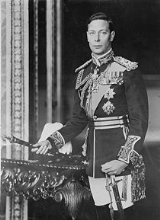
George VI (Albert Frederick Arthur George; 14 December 1895 – 6 February 1952) was King of the United Kingdom
British monarchy

The Monarchy of the United Kingdom is the constitutional monarchy of the United Kingdom and its British overseas territory.The present monarch, Queen Elizabeth II of the United Kingdom, has reigned since 6 February 1952....
 and the British
United Kingdom

The United Kingdom of Great Britain and Northern Ireland, commonly known as the United Kingdom , the UK or Britain,is a sovereign state located off the northwestern coast of continental Europe....
 Dominion
Dominion

A dominion, often Dominion, refers to one of a group of autonomy polity that were nominally under United Kingdom sovereignty, constituting the British Empire and Commonwealth of Nations, from the late 19th century....
s from 11 December 1936 until his death. He was the last Emperor of India
Emperor of India

Emperor/Empress of India was used as a title by the last Mughal Empire emperor Bahadur Shah II, and revived by the colonial Monarchy of the United Kingdom during the British Raj in India....
 (until 1947) and the last King of Ireland
King of Ireland

The designation King of Ireland and Queen of Ireland was used during three periods of History of Ireland....
 (until 1949), and the first Head of the Commonwealth
Head of the Commonwealth

The Head of the Commonwealth is the highest position within the Commonwealth of Nations, an international organisation which currently has List of members of the Commonwealth of Nations....
.

As the second son of King George V
George V of the United Kingdom

George V was the first British monarch belonging to the House of Windsor, which he created from the British branch of the German House of Saxe-Coburg and Gotha....
, he was not expected to inherit the throne and spent his early life in the shadow of his elder brother, Edward
Edward VIII of the United Kingdom

Edward VIII was Monarch of the United Kingdom of Great Britain and Northern Ireland and the dominion, and Emperor of India from 20 January 1936, following the death of his father, George V of the United Kingdom, until his abdication on 11 December 1936....
. He served in the Royal Navy
Royal Navy

The Royal Navy of the United Kingdom is the oldest of the British Armed Forces . From the mid-18th century until well into the 20th century, it was the most powerful navy in the world, playing a key part in establishing the British Empire as the dominant world power from 1815 until the early 1940s....
 during World War I
World War I

World War I, or the First World War , was a global military conflict which involved the Great powers, organized into two opposing military alliances: the Allies of World War I and the Central Powers....
, and after the war took on the usual round of public engagements.


Discussion
Ask a question about 'George VI of the United Kingdom'
Start a new discussion about 'George VI of the United Kingdom'
Answer questions from other users
Full Discussion Forum


Timeline

1895   Born

1923   Wedding of Prince Albert and Lady Elizabeth Bowes-Lyon in Westminster Abbey

1936   Prince Albert, Duke of York, becomes King, ruling as King George VI

1937   Coronation of King George VI and Queen Elizabeth takes place at Westminster Abbey, London.

1937   IRA attempts bombing assassination against King George VI in Belfast.

1939   King George VI and Queen Elizabeth arrive in Quebec City to begin the first-ever visit to Canada by British sovereigns.

1947   The Princess Elizabeth, daughter of King George VI marries the Duke of Edinburgh at Westminster Abbey, London.

1948   Ceylon (later renamed Sri Lanka) becomes independent within the British Commonwealth. King George VI becomes King of Ceylon; Alice Cooper (born Vincent Damon Furnier), hard rock singer and musician born.

1952   Elizabeth II becomes Queen upon the death of her father George VI.

1952   Died


Quotations


We are not a family, we are a firm.

On the Royal family, quoted by A. B. Baxter in Destiny Called to Them (Oxford University Press, 1939)

You've been pretty unlucky with the weather, Mr Piper.

On seeing John Piper's dark views of Windsor Castle painted during the last war. Given in Times Literary Supplement, 7 October 1994, page 25.


Encyclopedia


George VI (Albert Frederick Arthur George; 14 December 1895 – 6 February 1952) was King of the United Kingdom
British monarchy

The Monarchy of the United Kingdom is the constitutional monarchy of the United Kingdom and its British overseas territory.The present monarch, Queen Elizabeth II of the United Kingdom, has reigned since 6 February 1952....
 and the British
United Kingdom

The United Kingdom of Great Britain and Northern Ireland, commonly known as the United Kingdom , the UK or Britain,is a sovereign state located off the northwestern coast of continental Europe....
 Dominion
Dominion

A dominion, often Dominion, refers to one of a group of autonomy polity that were nominally under United Kingdom sovereignty, constituting the British Empire and Commonwealth of Nations, from the late 19th century....
s from 11 December 1936 until his death. He was the last Emperor of India
Emperor of India

Emperor/Empress of India was used as a title by the last Mughal Empire emperor Bahadur Shah II, and revived by the colonial Monarchy of the United Kingdom during the British Raj in India....
 (until 1947) and the last King of Ireland
King of Ireland

The designation King of Ireland and Queen of Ireland was used during three periods of History of Ireland....
 (until 1949), and the first Head of the Commonwealth
Head of the Commonwealth

The Head of the Commonwealth is the highest position within the Commonwealth of Nations, an international organisation which currently has List of members of the Commonwealth of Nations....
.

As the second son of King George V
George V of the United Kingdom

George V was the first British monarch belonging to the House of Windsor, which he created from the British branch of the German House of Saxe-Coburg and Gotha....
, he was not expected to inherit the throne and spent his early life in the shadow of his elder brother, Edward
Edward VIII of the United Kingdom

Edward VIII was Monarch of the United Kingdom of Great Britain and Northern Ireland and the dominion, and Emperor of India from 20 January 1936, following the death of his father, George V of the United Kingdom, until his abdication on 11 December 1936....
. He served in the Royal Navy
Royal Navy

The Royal Navy of the United Kingdom is the oldest of the British Armed Forces . From the mid-18th century until well into the 20th century, it was the most powerful navy in the world, playing a key part in establishing the British Empire as the dominant world power from 1815 until the early 1940s....
 during World War I
World War I

World War I, or the First World War , was a global military conflict which involved the Great powers, organized into two opposing military alliances: the Allies of World War I and the Central Powers....
, and after the war took on the usual round of public engagements. He married Lady Elizabeth Bowes-Lyon
Elizabeth Bowes-Lyon

Elizabeth Bowes-Lyon was the Queen Consort of King George VI of the United Kingdom and the British Empire Dominions from 1936 until his death in 1952....
 in 1923, and they had two daughters, Elizabeth
Elizabeth II of the United Kingdom

Elizabeth II is the queen regnant of sixteen independent states known as the Commonwealth realms: Monarchy of the United Kingdom, Monarchy of Canada, Monarchy of Australia, Monarchy of New Zealand, Monarchy of Jamaica, Monarchy of Barbados, the Bahamas, Grenada, Papua New Guinea, the Monarchy of the Solomon Islands, Tuvalu, Saint Lucia, Sain...
 (who succeeded him as Queen Elizabeth II) and Margaret
Princess Margaret, Countess of Snowdon

The Princess Margaret, Countess of Snowdon was the younger sister of Elizabeth II of the United Kingdom.Margaret spent much of her early life in the company of her elder sister and parents, George VI of the United Kingdom and Elizabeth Bowes-Lyon....
.

At the death of his father in 1936, the future George VI's brother ascended the throne as Edward VIII. However, less than a year later Edward expressed his desire to marry the twice-divorced American socialite
Socialite

A socialite is a person who is known to be a part of fashionable Upper class because of his or her regular participation in social activities and fondness for spending a significant amount of time Entertainment and being entertained....
 Wallis Simpson
Wallis, The Duchess of Windsor

Wallis, Duchess of Windsor was an American socialite who married, as her third husband, Edward VIII of the United Kingdom, formerly King Edward VIII of the United Kingdom....
. For political and religious reasons, the British Prime Minister
Prime Minister of the United Kingdom

The Prime Minister of the United Kingdom of Great Britain and Northern Ireland is the political leader of the United Kingdom and the head of government Her Majesty's Government....
, Stanley Baldwin
Stanley Baldwin

Stanley Baldwin, 1st Earl Baldwin of Bewdley, Order of the Garter, Privy Council of the United Kingdom was a British Conservative Party politician, statesman, and major figure on the political scene in the interwar years....
, advised Edward that he could not marry Mrs. Simpson and remain king. So, Edward abdicated
Edward VIII abdication crisis

The Edward VIII abdication crisis occurred in the British Empire in 1936, when the desire of King-Emperor Edward VIII of the United Kingdom to marry Wallis, The Duchess of Windsor, a twice-divorced United States socialite, caused a constitutional crisis....
 in order to marry. By reason of this abdication, unique in the history of the British Isles (previous abdications were forced by military or political pressures), George VI ascended the throne as the third monarch of the House of Windsor
House of Windsor

The House of Windsor is the current Royal House of the United Kingdom and each of the other Commonwealth realms. The royal house was created from the British branch of the German House of Saxe-Coburg and Gotha by George V by a royal proclamation in 1917....
.

Within twenty-four hours of his accession the Irish parliament, the Oireachtas
Oireachtas

The Oireachtas is the "national parliament" or legislature of Republic of Ireland, sometimes referred to as Oireachtas ?ireann.The Oireachtas consists of:...
, passed the External Relations Act, which essentially removed the power of the monarch in Ireland
Irish Free State

The Irish Free State was the state established as a Dominion on 6 December 1922 under the Anglo-Irish Treaty, signed by the British government and Irish representatives exactly twelve months beforehand....
. Further events greatly altered the position of the monarchy during his reign: three years after his accession, his realms, except Ireland, were at war
World War II

World War II, or the Second World War , was a global military conflict which involved a Participants in World War II, including all of the great powers, organised into two opposing military alliances: the Allies of World War II and the Axis powers....
 with Nazi Germany
Nazi Germany

Nazi Germany and the Third Reich are the colloquial English names for Germany under the regime of Adolf Hitler and the Nazi Party , which established a Totalitarianism dictatorship that existed from 1933 to 1945....
. In the next two years, war with Italy and the Empire of Japan
Empire of Japan

The Empire of Japan was a Japanese political entity that existed during the period from the Meiji Restoration in 1868 until its defeat in World War II in 1945....
 followed. A major consequence of World War II was the decline of the British Empire
British Empire

The British Empire comprised the dominions, Crown colony, protectorates, League of Nations mandate, and other Dependent territory ruled or administered by the United Kingdom , that had originated with the overseas colonies and trading posts established by England in the late 16th and early 17th centuries....
, with the United States and the Soviet Union
Soviet Union

The Union of Soviet Socialist Republics was a Constitution of the Soviet Union socialist state that existed in Eurasia from 1922 to 1991.The name is a translation of the , romanization of Russian Soyuz Sovetskikh Sotsialisticheskikh Respublik, abbreviated ????, SSSR....
 rising as pre-eminent world powers
Superpower

A superpower is a state with a leading position in the international relations and the ability to influence events and its own interests and project Power in international relations to protect those interests; it is traditionally considered to be one step higher than a great power....
. With the independence
Indian independence movement

The term Indian independence movement incorporates various national and regional campaigns, agitations and efforts of both Nonviolent and Revolutionary movement for Indian independence philosophy....
 of India and Pakistan
Pakistan

Pakistan , officially the Islamic Republic of Pakistan, is a country located in South Asia and borders Central Asia and the Middle East. It has a 1,046 kilometre coastline along the Arabian Sea and Gulf of Oman in the south, and is bordered by Afghanistan and Iran in the west, India in the east and People's Republic of China in th...
 in 1947, and the foundation of the Republic of Ireland
Republic of Ireland Act

The Republic of Ireland Act 1948 is an Act of the Oireachtas whose primary provisions were to declare that the state, Republic of Ireland, is a Republic and that the President of Ireland has executive authority of any executive function of the state or in the external relations of the state....
 in 1949, King George's reign saw the acceleration of the break-up of the British Empire and its transition into the Commonwealth of Nations
Commonwealth of Nations

The Commonwealth of Nations, also known as the Commonwealth or the British Commonwealth, is an intergovernmental organization of fifty-three independent member states....
.

Birth and family

The future George VI was formally known as Prince Albert, and informally as "Bertie" to his family. He was born at York Cottage, on the Sandringham Estate
Sandringham House

Sandringham House is a country house on of land near the village of Sandringham, Norfolk in Norfolk, England. The house is privately owned by the British Royal Family and is located on the royal Sandringham Estate, which lies within the Norfolk Coast Area of Outstanding Natural Beauty....
 in Norfolk
Norfolk

Norfolk is a low-lying Counties of England in the East of England. It has borders with Lincolnshire to the west, Cambridgeshire to the west and southwest and with Suffolk to the south....
, during the reign of his great-grandmother Queen Victoria
Victoria of the United Kingdom

Victoria was from 20 June 1837 the Queen regnant of the United Kingdom of Great Britain and Ireland and from 1 May 1876 the first Empress of India of the British Raj until her death....
. His father was Prince George, Duke of York
Duke of York

The title Duke of York is a title of nobility in the British peerage. Since the 15th century, it has, when granted, usually been given to the second son of the British monarch....
 (later King George V
George V of the United Kingdom

George V was the first British monarch belonging to the House of Windsor, which he created from the British branch of the German House of Saxe-Coburg and Gotha....
), the second and eldest-surviving son of the Prince (later Edward VII
Edward VII of the United Kingdom

Edward VII was Monarch of the United Kingdom of Great Britain and Ireland and the British Dominions and Emperor of India from 22 January 1901 until his death on 6 May 1910....
) and Princess of Wales (later Queen Alexandra
Alexandra of Denmark

Alexandra of Denmark was queen consort to Edward VII of the United Kingdom and thus Empress of India during her husband's reign, 1901 to 1910....
). His mother was the Duchess of York (later Queen Mary
Mary of Teck

Mary of Teck was the queen consort of George V of the United Kingdom, Emperor of India. Before her husband's accession, she was successively Duchess of York, Duchess of Cornwall and Princess of Wales....
), the eldest daughter of Prince Francis, Duke of Teck
Francis, Duke of Teck

Francis, Duke of Teck , was a member of the British Royal Family, the father of Mary of Teck. Francis held the titles of Count of Hohenstein and later Duke of Teck ....
 and Princess Mary Adelaide of Cambridge
Princess Mary Adelaide of Cambridge

Princess Mary Adelaide of Cambridge was a member of the British Royal Family, a granddaughter of George III of the United Kingdom. She later held the title of Duke of Teck by marriage....
.

Albert's birthday (14 December 1895) was the anniversary of the death of his great-grandfather, Prince Albert, the Prince Consort. Uncertain of how the Prince Consort's widow Queen Victoria would take the news of the birth, the Prince of Wales
Edward VII of the United Kingdom

Edward VII was Monarch of the United Kingdom of Great Britain and Ireland and the British Dominions and Emperor of India from 22 January 1901 until his death on 6 May 1910....
 wrote to his son, Prince George, Duke of York, that the Queen had been "rather distressed". Two days later, he wrote again: "I really think it would gratify her if you yourself proposed the name Albert to her". This mollified the baby's great-grandmother, who wrote to the baby's mother, the Duchess of York: "I am all impatience to see the new one, born on such a sad day but rather more dear to me, especially as he will be called by that dear name which is a byword for all that is great and good". He was baptised
Baptism

In Christianity, baptism is the ritual act, with the use of water, by which one is admitted as a full member of the Christian Church and, in the view of some, as a member of the particular Church in which the baptism is administered....
 Albert Frederick Arthur George at St Mary Magdalene's Church near Sandringham
Sandringham House

Sandringham House is a country house on of land near the village of Sandringham, Norfolk in Norfolk, England. The house is privately owned by the British Royal Family and is located on the royal Sandringham Estate, which lies within the Norfolk Coast Area of Outstanding Natural Beauty....
 three months later. However, his maternal grandmother Princess Mary Adelaide of Cambridge
Princess Mary Adelaide of Cambridge

Princess Mary Adelaide of Cambridge was a member of the British Royal Family, a granddaughter of George III of the United Kingdom. She later held the title of Duke of Teck by marriage....
 did not like the first name the baby had been given, and she wrote prophetically that she hoped the last name "may supplant the less favoured one". As the second son, Albert was fourth in line for the throne at birth. The third in line to the throne, his older brother Edward
Edward VIII of the United Kingdom

Edward VIII was Monarch of the United Kingdom of Great Britain and Northern Ireland and the dominion, and Emperor of India from 20 January 1936, following the death of his father, George V of the United Kingdom, until his abdication on 11 December 1936....
, was born more than a year earlier, on 23 June 1894.

Early life

Edward Vii Uk and Successors
As a great-grandson of Queen Victoria
Victoria of the United Kingdom

Victoria was from 20 June 1837 the Queen regnant of the United Kingdom of Great Britain and Ireland and from 1 May 1876 the first Empress of India of the British Raj until her death....
, Albert was styled His Highness Prince Albert of York from birth. In 1898, Queen Victoria issued Letters Patent
Letters patent

Letters patent are a type of legal instrument in the form of an open letter issued by a monarch or government, granting an office, right, government-granted monopoly, title, or status to a person or to some entity such as a corporation....
 that granted the children of the eldest son of the Prince of Wales the style Royal Highness
Royal Highness

Royal Highness is a style ; plural Royal Highnesses . It appears in front of the names of some members of some Royal family other than the monarch or Queen regnant....
, and at the age of two, Albert became His Royal Highness Prince Albert of York.

He often suffered from ill health and was described as "easily frightened and somewhat prone to tears". His parents, the Duke and Duchess of York, were generally removed from their children's day-to-day upbringing, as was the norm in aristocratic families of that era. Albert developed a stammer
Stuttering

Stuttering, also known as stammering in the United Kingdom, is a speech disorder in which the flow of Speech communication is disrupted by involuntary repetitions and prolongations of sounds, syllables, words or phrases, and involuntary silent pauses or blocks in which the stutterer is unable to produce sounds....
 that lasted for many years, as well as chronic stomach problems. He suffered from knock knees
Genu valgum

Genu valgum, commonly called "knock-knees", is a condition where the knees angle in and touch one another when the human leg are straightened....
, and to correct this he was forced to wear splints, which were extremely painful. He was also forced to write with his right hand although he was naturally left-handed.

Queen Victoria died on 22 January 1901, and the Prince of Wales succeeded her as King Edward VII. The Duke of York became the new Prince of Wales. Prince Edward was then second in line to the throne, and Prince Albert was third.

Military career and education

From 1909, Albert attended the Royal Naval College, Osborne
Osborne House

Osborne House is a former royal residence in East Cowes, Isle of Wight, England....
 as a naval cadet
Cadet

A cadet may mean a future officer in the military, a junior branch of an important family, or simply a person who is a junior trainee....
. He came bottom of the class in the final examination, but despite this he progressed to the Royal Naval College, Dartmouth
Britannia Royal Naval College

Britannia Royal Naval College is the initial officer training establishment of the Royal Navy, located on a hill overlooking Dartmouth, Devon, Devon, England....
 in 1911. When Edward VII died on 6 May 1910, Albert's father became King George V. Prince Edward was created Prince of Wales on 2 June 1910, and Albert was now second in line to the throne.

Albert was commissioned as a midshipman
Midshipman

A midshipman is a subordinate officer, an officer cadet, or alternatively a commissioned officer of the lowest rank, in the navy of several English-speaking countries....
 on 15 September 1913 and one year later began service in World War I
World War I

World War I, or the First World War , was a global military conflict which involved the Great powers, organized into two opposing military alliances: the Allies of World War I and the Central Powers....
. His fellow officers gave their royal peer the ordinary nickname "Mr. Johnson". He saw action as a turret officer aboard HMS Collingwood
HMS Collingwood (1908)

HMS Collingwood was a St. Vincent class battleship battleship of the Royal Navy.The ship was launched 7 November 1908, and completed in 1910, serving in the 1st Division of the British Home Fleet....
 against the German
German Empire

The German Empire is the name commonly used in English to describe Germany from the unification of Germany and proclamation of William I, German Emperor as German Emperor on 18 January 1871, to 1918, when it became Weimar republic after defeat in World War I and the abdication of William II, German Emperor ....
 navy at the Battle of Jutland
Battle of Jutland

The Battle of Jutland was the largest naval battle of World War I and the only full-scale clash of battleships in that war. It was only the second major fleet action between steel battleships in any war, following the Battle of Tsushima in 1905, but was also the last....
 (31 May – 1 June 1916), an indecisive action which emerged as a strategic victory for the United Kingdom
United Kingdom of Great Britain and Ireland

The United Kingdom of Great Britain and Ireland was the formal name and the state form of the United Kingdom from 1 January 1801 until 12 April 1927....
. Albert did not see further action in the War largely because of ill health caused by a duodenal ulcer
Peptic ulcer

A peptic ulcer, also known as ulcus pepticum, PUD or peptic ulcer disease, is an ulcer of an area of the gastrointestinal tract that is usually acidic and thus extremely painful....
. In February 1918 Prince Albert was appointed Officer in Charge of Boys at the Royal Naval Air Service
Royal Naval Air Service

The Royal Naval Air Service or RNAS was the air arm of the Royal Navy until near the end of World War I, when it merged with the British Army's Royal Flying Corps to form a new service , the Royal Air Force....
's training establishment at Cranwell
RAF Cranwell

RAF Cranwell is a Royal Air Force station in Lincolnshire close to the village of Cranwell, near Sleaford. It is currently commanded by Group Captain N Wharmby....
. With the establishment of the Royal Air Force
Royal Air Force

The Royal Air Force is the United Kingdom's air force, the oldest independent air force in the world. Formed on 1 April 1918, the RAF has taken a significant role in British military history ever since, playing a large part in World War II and in more recent conflicts....
 later that year and the transfer of Cranwell from Navy to Air Force control, Albert transferred from the Royal Navy to the Royal Air Force. He was later appointed Officer Commanding Number 4 Squadron of the Boys' Wing at Cranwell and he remained there until August 1918. During the closing weeks of the War, Albert served on the staff of the Independent Air Force
Independent Air Force

The Independent Air Force , also known as the Independent Force or the Independent Bombing Force and later known as the Inter-Allied Independent Air Force, was a World War I strategic bombing force which was part of the United Kingdom Royal Air Force and used to strike against German railways, aerodromes and industrial centr...
 at its headquarters in Nancy
Nancy

Nancy is a city in the Meurthe-et-Moselle Departments of France in northeastern France.The city is the capital of the department. The metropolitan area of Nancy had a population of 410,509 inhabitants at the 1999 census, 103,602 of whom lived in the city of Nancy proper ....
. Following the disbanding of the Independent Air Force in November 1918, Albert remained on the continent as a staff officer with the Royal Air Force in the Field.

In October 1919 Prince Albert went up to Trinity College, Cambridge
Trinity College, Cambridge

Trinity College is one of the 31 Colleges of the University of Cambridge of the University of Cambridge. Trinity has more members than any other college in Cambridge or University of Oxford, with around 700 undergraduates, 430 graduate students, and over 160 Fellows; however, counting only the student body it has somewhat fewer than Homert...
 where he studied history, economics and civics for a year. On 3 June 1920, Prince Albert was created Duke of York
Duke of York

The title Duke of York is a title of nobility in the British peerage. Since the 15th century, it has, when granted, usually been given to the second son of the British monarch....
, Earl of Inverness
Earl of Inverness

The title of Earl of Inverness was first created in 1718 in the Jacobite Peerage of Peerage of Scotland by James Francis Edward Stuart for the Honourable John Hay of Cromlix, third son of the 7th Earl of Kinnoull, but became extinct upon the death of the grantee in 1740....
 and Baron Killarney. He then began to take on royal duties, representing his father, the King, touring coal mines, factories, and railyards, acquiring the nickname of the "Industrial Prince".

His speech impediment, and his embarrassment over it, together with his tendency to shyness, caused him to appear much less impressive than his older brother the Prince of Wales. However, he was physically active and enjoyed playing tennis.

Marriage

In a time when royals were expected to marry fellow royals, it was unusual that Albert had a great deal of freedom in choosing a prospective wife. In 1920 he met Lady Elizabeth Bowes-Lyon
Elizabeth Bowes-Lyon

Elizabeth Bowes-Lyon was the Queen Consort of King George VI of the United Kingdom and the British Empire Dominions from 1936 until his death in 1952....
, the youngest daughter of Claude Bowes-Lyon, 14th Earl of Strathmore and Kinghorne
Claude Bowes-Lyon, 14th Earl of Strathmore and Kinghorne

Claude George Bowes-Lyon, 14th Earl of Strathmore and Kinghorne Order of the Garter, Order of the Thistle, Royal Victorian Order, Territorial Decoration was a landowner and the maternal grandfather of Elizabeth II of the United Kingdom....
 and Cecilia Cavendish-Bentinck. He became determined to marry her.

Although Lady Elizabeth was a descendant of King Robert I of Scotland
Robert I of Scotland

Robert I, King of the Scots usually known in modern English as Robert the Bruce was King of the Scots from 1306 until his death in 1329....
 and King Henry VII of England
Henry VII of England

Henry VII was the Kingdom of England and Lordship of Ireland from his usurpation of the crown on 22 August 1485 until his death on 21 April 1509, as the first monarch of the Tudor dynasty....
, she was, according to British law, a commoner
Commoner

In British law, a commoner is someone who is neither the British monarchy nor a peerage. Therefore, any member of the British Royal Family who is not a peer, such as Prince William of Wales or Anne, Princess Royal, is a commoner, as is any member of a peer's family, including someone who holds only a courtesy title, such as the Earl of Arund...
. She rejected his proposal twice and hesitated for nearly two years, reportedly because she was reluctant to make the sacrifices necessary to become a member of the royal family. In the words of Lady Elizabeth's mother, Albert would be "made or marred" by his choice of wife, and after a protracted courtship Elizabeth agreed to marry him.

They were married on 26 April 1923 in Westminster Abbey
Westminster Abbey

The Collegiate Church of St Peter at Westminster, which is almost always referred to popularly and informally as Westminster Abbey, is a large, mainly Gothic architecture Church , in Westminster, London, just to the west of the Palace of Westminster....
. The newly-formed British Broadcasting Company
British Broadcasting Company

The British Broadcasting Company Ltd was a United Kingdom commercial company formed on 18 October 1922 by British and American electrical companies doing business in the United Kingdom....
 wished to record and broadcast the event on radio
Radio

Radio is the transmission of signals, by modulation of electromagnetic radiation with frequency below those of visible light.Electromagnetic radiation radio propagation by means of oscillating electromagnetic fields that pass through the air and the vacuum of space....
, but the Chapter
Chapter (religion)

Chapter designates certain corporate ecclesiology bodies in the Catholic Church, Anglicanism and Nordic Lutheranism churches.The word is said to be derived from the Chapter of the rule book: it is a custom under the Rule of Saint Benedict that monks gather daily for a meeting to discuss monastery business, hear a sermon or lecture, or rec...
 vetoed the idea (although the Dean, Herbert Edward Ryle
Herbert Edward Ryle

Right Reverend Doctor of Divinity Herbert Edward Ryle Doctor of Divinity, Royal Victorian Order , was a distinguished Old Testament scholar and the Dean of Westminster....
, was in favour). Lady Elizabeth was styled Her Royal Highness The Duchess of York after their marriage. Albert's marriage to a British commoner was considered a modernising gesture.

The Duke and Duchess of York had two children, Elizabeth
Elizabeth II of the United Kingdom

Elizabeth II is the queen regnant of sixteen independent states known as the Commonwealth realms: Monarchy of the United Kingdom, Monarchy of Canada, Monarchy of Australia, Monarchy of New Zealand, Monarchy of Jamaica, Monarchy of Barbados, the Bahamas, Grenada, Papua New Guinea, the Monarchy of the Solomon Islands, Tuvalu, Saint Lucia, Sain...
 (called "Lilibet" by the family), born 21 April 1926, who would succeed her father as Elizabeth II, and Margaret
Princess Margaret, Countess of Snowdon

The Princess Margaret, Countess of Snowdon was the younger sister of Elizabeth II of the United Kingdom.Margaret spent much of her early life in the company of her elder sister and parents, George VI of the United Kingdom and Elizabeth Bowes-Lyon....
, born 21 August 1930. The Duke and Duchess and their two daughters lived a relatively sheltered life at their London
London

London is the capital of both England and the United Kingdom, and the most populous municipality in the European Union. An important settlement for two millennia, History of London goes back to its founding by the Roman Empire....
 residence, 145 Piccadilly
Piccadilly

Piccadilly is a major London street, running from Hyde Park Corner in the west to Piccadilly Circus in the east. It is completely within the city of Westminster....
. One of the few stirs arose when the Canadian Prime Minister
Prime Minister of Canada

The Prime Minister of Canada is the primary Minister of the Crown, chairman of the Cabinet of Canada, and thus head of government of Canada. The office is not outlined in any of the documents that constitute the written portion of the constitution of Canada; executive authority is formally vested in the Monarchy of Canada and exercised on hi...
, R. B. Bennett, considered the Duke for Governor General of Canada
Governor General of Canada

The Governor General of Canada is the viceroy representative in Canada of the Monarchy of Canada, who is the head of state. Canada is one of sixteen Commonwealth realms, all of which share the same person as their respective sovereign....
 in 1931—a proposal that the King rejected on the advice of his ministers.

The Duchess helped him overcome his dread (due to stammering) of public speaking. He was introduced by her to Lionel Logue, an Australian-born expert on speech. The Duke and Logue practiced breathing exercises, and the Duchess rehearsed with him patiently. As a result of the training, the Duke's opening address at Australia's Federal Parliament at Canberra in 1927 went successfully, and he was able to speak thereafter with only a slight hesitation.

Reluctant king

On 20 January 1936, King George V died and Prince Edward ascended the throne as Edward VIII. As Edward had no children, Albert was the heir presumptive
Heir Presumptive

An heir presumptive is the person provisionally scheduled to inherit a throne, peerage, or other hereditary honor, but whose position can be displaced by the birth of an heir apparent or of a new heir presumptive with a better claim to the throne....
 to the throne until his unmarried brother had any legitimate children, or died. George V had had severe reservations about Edward, saying, "I pray God that my eldest son will never marry and that nothing will come between Bertie and Lilibet and the throne." Less than a year later, on 11 December 1936, Edward VIII abdicated
Edward VIII abdication crisis

The Edward VIII abdication crisis occurred in the British Empire in 1936, when the desire of King-Emperor Edward VIII of the United Kingdom to marry Wallis, The Duchess of Windsor, a twice-divorced United States socialite, caused a constitutional crisis....
 the throne in order to marry his mistress, the twice-divorced Wallis Warfield Simpson
Wallis, The Duchess of Windsor

Wallis, Duchess of Windsor was an American socialite who married, as her third husband, Edward VIII of the United Kingdom, formerly King Edward VIII of the United Kingdom....
. Edward had been advised by Prime Minister Stanley Baldwin
Stanley Baldwin

Stanley Baldwin, 1st Earl Baldwin of Bewdley, Order of the Garter, Privy Council of the United Kingdom was a British Conservative Party politician, statesman, and major figure on the political scene in the interwar years....
 that he could not remain King and marry a divorced woman with two living ex-husbands. Edward chose abdication in preference to abandoning his marriage plans. Thus Prince Albert, Duke of York, was now king, a position he was reluctant to accept. The day before the abdication, he went to London to see his mother, Queen Mary
Mary of Teck

Mary of Teck was the queen consort of George V of the United Kingdom, Emperor of India. Before her husband's accession, she was successively Duchess of York, Duchess of Cornwall and Princess of Wales....
. He wrote in his diary, "When I told her what had happened, I broke down and sobbed like a child."

Courtier and journalist Dermot Morroh alleged that there was brief speculation as to the desirability of bypassing Albert (and his children) and his brother, Prince Henry, Duke of Gloucester
Prince Henry, Duke of Gloucester

The Prince Henry, Duke of Gloucester Privy Council, Order of the Garter, Order of the Thistle, Order of St Patrick, Order of the Bath, Order of St Michael and St George, Royal Victorian Order, Venerable Order of St John was a member of the British Royal Family, the third son of George V of the United Kingdom of the United Kingdom and Mary of...
, in favour of their younger brother Prince George, Duke of Kent
Prince George, Duke of Kent

The Prince George, Duke of Kent was a member of the British Royal Family, the fourth son of George V of the United Kingdom and Mary of Teck. He held the title of Duke of Kent from 1934 until his death in 1942....
. This seems to have been suggested on the grounds that Prince George was at that time the only brother with a son.

Reign

Albert assumed the style and title King George VI to emphasise continuity with his father and restore confidence in the monarchy. The beginning of George VI's reign was taken up by questions surrounding his predecessor and brother, whose titles, style and position were uncertain. He had been introduced as "His Royal Highness Prince Edward" for the Abdication broadcast, but George VI felt that by abdicating and renouncing the succession Edward had lost the right to bear Royal titles, including "Royal Highness". In settling the issue, George's first act as King was to confer upon his brother the title HRH The Duke of Windsor
Duke of Windsor

The peerage title Duke of Windsor was created in the Peerage of the United Kingdom in 1937 for Edward VIII of the United Kingdom, formerly King of the United Kingdom as well as each of the other Commonwealth realms....
, but the Letters Patent
Letters patent

Letters patent are a type of legal instrument in the form of an open letter issued by a monarch or government, granting an office, right, government-granted monopoly, title, or status to a person or to some entity such as a corporation....
 creating the dukedom prevented any wife or children from bearing royal styles. George VI was also forced to buy the royal residences of Balmoral Castle
Balmoral Castle

Balmoral Castle is a large estate house situated in the area of Aberdeenshire, Scotland, known as Royal Deeside. The estate was purchased by Victoria of the United Kingdom Prince Consort Albert, Prince Consort, and remains a favourite summer palace....
 and Sandringham House
Sandringham House

Sandringham House is a country house on of land near the village of Sandringham, Norfolk in Norfolk, England. The house is privately owned by the British Royal Family and is located on the royal Sandringham Estate, which lies within the Norfolk Coast Area of Outstanding Natural Beauty....
 from Prince Edward, as these were private properties and did not pass to George VI on his accession. Three days after his accession, on his 41st birthday, he invested his wife, the new Queen, with the Order of the Garter
Order of the Garter

The Most Noble Order of the Garter is an order of chivalry, or knighthood, originating in medieval England, and presently bestowed on recipients in the United Kingdom and other Commonwealth realms; it is the pinnacle of the Orders, decorations, and medals of the United Kingdom....
.

George VI's coronation
Coronation of the British monarch

The Coronation of the British Monarch is a ceremony in which the monarch of the United Kingdom and of the other Commonwealth realms is formally Crown and invested with regalia....
 took place on 12 May 1937, the previously intended date of Edward's coronation. In a break with tradition, Queen Mary attended the coronation as a show of support for her son. There was no Durbar held in Delhi
Delhi

Delhi , sometimes referred to as Dilli , is the List of most populous cities in India metropolis in India and, with over 11 million residents, the List of metropolitan areas by population....
 for George VI, as had occurred for his father, as the cost would have been a burden to the government of India
British Raj

British Raj primarily refers to the British rule in the Indian subcontinent between 1858 and 1947; it can also refer to the period of dominion, and even the region under the rule....
. Rising Indian nationalism
Indian independence movement

The term Indian independence movement incorporates various national and regional campaigns, agitations and efforts of both Nonviolent and Revolutionary movement for Indian independence philosophy....
 made the welcome that the royal couple would have received likely to be muted at best, and a prolonged absence from Britain would have been undesirable in the tense period before World War II
World War II

World War II, or the Second World War , was a global military conflict which involved a Participants in World War II, including all of the great powers, organised into two opposing military alliances: the Allies of World War II and the Axis powers....
. Two overseas tours were undertaken, to France and North America, both of which promised greater strategic advantages in the event of war.

The growing likelihood of war in Europe dominated the early reign of George VI. The King was constitutionally bound to support Prime Minister Neville Chamberlain
Neville Chamberlain

Arthur Neville Chamberlain was a British Conservative Party politician and Prime Minister of the United Kingdom from 1937 to 1940. Chamberlain is best known for appeasement foreign policy, in particular regarding his signing of the Munich Agreement in 1938, conceding the Sudetenland region of Czechoslovakia to Germany, and for his "containm...
's appeasement stance towards Adolf Hitler
Adolf Hitler

Adolf Hitler was an Austrian-born Germany politician and the leader of the National Socialist German Workers Party , popularly known as the Nazi Party....
. However, when the King and Queen greeted Chamberlain on his return from negotiating the Munich Agreement
Munich Agreement

The Munich Agreement was an agreement regarding the Sudetenland, which were areas along borders of Czechoslovakia, mainly inhabited by Czech Germans....
 in 1938, they invited him to appear on the balcony of Buckingham Palace
Buckingham Palace

Buckingham Palace is the official London residence of the British monarch. Located in the City of Westminster, the palace is a setting for state occasions and royal entertaining, and a major tourist attraction....
 with them. This public association of the monarchy with a politician was exceptional, as balcony appearances were traditionally restricted to the royal family.

In 1939, the King and Queen undertook an extensive tour of Canada, during which they made a brief visit to the United States. From Ottawa
Ottawa

Ottawa is the Capital of Canada. The city has population of 812,000, the List of the 100 largest municipalities in Canada by population municipality in the country and second largest in Ontario....
, the royal couple were accompanied throughout the trip by the Prime Minister of Canada
Prime Minister of Canada

The Prime Minister of Canada is the primary Minister of the Crown, chairman of the Cabinet of Canada, and thus head of government of Canada. The office is not outlined in any of the documents that constitute the written portion of the constitution of Canada; executive authority is formally vested in the Monarchy of Canada and exercised on hi...
, and not a British minister
Cabinet of the United Kingdom

In the politics of the United Kingdom, the Cabinet is a formal body composed of the most senior Her Majesty's Governmentminister chosen by the Prime Minister of the United Kingdom....
, meaning they were present in both Canada and the US as King and Queen of Canada
Monarchy in Canada

The monarchy of Canada, or Canadian monarchy, is a constitutional system of government in which a hereditary monarch is the Sovereignty and head of state of Canada, forming the core of the country's Westminster system Parliamentary system democracy....
. George was the first reigning Monarch of Canada to visit North America, though he had been to his Canadian realm previously as Prince Albert and as Duke of York. The Canadian Prime Minister at the time, William Lyon Mackenzie King
William Lyon Mackenzie King

William Lyon Mackenzie King, Queen's Privy Council for Canada, Order of Merit , Order of St Michael and St George was a Canadian lawyer, economist, university professor, civil servant, journalist, and politician....
, hoped that the King's presence in Canada would allow him to demonstrate in reality the principles of the Statute of Westminster 1931
Statute of Westminster 1931

The Statute of Westminster 1931 is an Act of Parliament of the Parliament of the United Kingdom which established a status of legislative equality between the self-governing dominions of the British Empire and the United Kingdom, with a few residual exceptions....
, which gave full self-government to the Dominion
Dominion

A dominion, often Dominion, refers to one of a group of autonomy polity that were nominally under United Kingdom sovereignty, constituting the British Empire and Commonwealth of Nations, from the late 19th century....
s and recognised each Dominion as having a separate crown. Thus, at his Canadian residence, Rideau Hall
Rideau Hall

Rideau Hall is, since 1867, the official residence of the Governor General of Canada, as well as that of the Monarchy of Canada when he or she is in the city where the hall is located, Ottawa....
, George VI personally accepted and approved the Letter of Credence
Letter of Credence

File:Dmitry Medvedev with Dmitry Medoyev.jpgA letter of credence is a formal Letter sent by one head of state to another head of state that formally grants diplomatic accreditation to a named individual to be their ambassador in the country of the head of state receiving the letter....
 of the newly appointed U.S. Ambassador to Canada, Daniel Calhoun Roper
Daniel Calhoun Roper

Daniel Calhoun Roper was a United States of America Administrator of the Government, particularly under President Franklin Delano Roosevelt, born in Marlboro County, South Carolina....
. The official Royal Tour historian, Gustave Lanctot
Gustave Lanctot

Gustave Lanctot, Order of Canada, Royal Society of Canada, also spelled Gustave Lanct?t, was a Canada historian and archivist.Born in Saint-Constant, Quebec, Quebec, he studied law at Universit? de Montr?al and was called to the Quebec Bar in 1907....
, stated: "When Their Majesties walked into their Canadian residence, the Statute of Westminster had assumed full reality: the King of Canada had come home."

The entire trip was a measure intended to soften the strong isolationist
Isolationism

Isolationism is a foreign policy which combines a non-interventionism military policy and a political policy of economic nationalism . In other words, it asserts both of the following:...
 tendencies among the North American public vis-ŕ-vis the developing tensions in Europe. Although the aim of the tour was mainly political, to shore up Atlantic support for Britain in any upcoming war, the King and Queen were enthusiastically received by the Canadian public. The fear that George would be unfavourably compared to his predecessor, Edward VIII, was dispelled. They were also warmly received by the American people, visiting the 1939 New York World's Fair
1939 New York World's Fair

1939 World's Fair redirects here. The term can also refer to the Golden Gate International Exposition, which was held in San Francisco/Oakland at the same time as the New York fair....
 and staying with President
President of the United States

The President of the United States is the head of state and head of government of the United States and is the highest political official in the United States by influence and recognition....
 Franklin D. Roosevelt
Franklin D. Roosevelt

Franklin Delano Roosevelt , often referred to by his initials FDR, was the List of Presidents of the United States President of the United States....
 at the White House
White House

The White House is the official residence and principal workplace of the President of the United States. Located at 1600 Pennsylvania Avenue in Washington, D.C., it was built between 1792 and 1800 of white-painted Aquia sandstone in the late Georgian architecture and has been the executive residence of every U.S....
 and at his private estate
Home of Franklin D. Roosevelt National Historic Site

The Home of Franklin D. Roosevelt National Historic Site preserves the Springwood estate in Hyde Park, New York, United States of America....
 at Hyde Park
Hyde Park, New York

Hyde Park is a Administrative divisions of New York#Town located in the northwest part of Dutchess County, New York, New York, United States, just north of the city of Poughkeepsie , New York....
, New York
New York

The State of New York is a U.S. state in the Mid-Atlantic States and Northeastern United States regions of the United States and is the nation's List of U.S....
.

When war broke out in 1939, George VI and his wife resolved to stay in London and not flee to Canada, as had been suggested. The King and Queen officially stayed in Buckingham Palace throughout the war, although they usually spent nights at Windsor Castle
Windsor Castle

Windsor Castle, in Windsor, Berkshire in the England county of Berkshire, is the largest inhabited castle in the world and, dating back to the time of William I of England, is the oldest in continuous occupation....
 to avoid bombing raids
The Blitz

The Blitz was the sustained bombing of United Kingdom by Nazi Germany between 7 September 1940 and 10 May 1941, in World War II. While the "Blitz" hit many towns and cities across the country, it began with the bombing of London for 57 consecutive nights ....
. George VI and Queen Elizabeth narrowly avoided death when two German bombs exploded in a courtyard at Buckingham Palace while they were there.

In 1940 Neville Chamberlain was replaced as Prime Minister by Winston Churchill
Winston Churchill

Sir Winston Leonard Spencer-Churchill, Order of the Garter, Order of Merit, Order of the Companions of Honour, Territorial Decoration, Fellow of the Royal Society, Her Majesty's Most Honourable Privy Council, Queen's Privy Council for Canada was a Politics of the United Kingdom known chiefly for his leadership of the United King...
. Throughout the war, the King and Queen provided morale-boosting visits throughout the UK, visiting bomb sites and munitions factories. When bombs landed on the grounds of Buckingham Palace, the Queen famously declared: "I'm glad we have been bombed. Now I can look the East End in the face". The Royal Family adhered to rationing restrictions in the country at the time; indeed, U.S. First Lady
First Lady of the United States

First Lady of the United States is the unofficial title of the hostess of the White House. Because this position is traditionally filled by the wife of the President of the United States, the title is sometimes taken to apply only to the wife of a sitting President....
 Eleanor Roosevelt
Eleanor Roosevelt

Anna Eleanor Roosevelt was First Lady of the United States from 1933 to 1945. She supported the New Deal policies of her husband, President Franklin D....
 during her stay at Buckingham Palace during the war reported expressly on the rationed food served in the Palace and the limited bathwater that was permitted.

Author Will Swift has suggested that a strong bond of friendship was forged between the King and Queen and President and First Lady during the 1939 Royal Tour, which had major significance in the relations between the United States and the United Kingdom through the war years. However, there have never been credible suggestions that the King took any strategic role in the war; his frequent letters to the President were mostly unanswered, and it was Roosevelt's relationship with Churchill that was critical. Eleanor Roosevelt took a wry view of the utility of kings and queens and the substance of George and Elizabeth ("a little self-consciously regal," was her verdict on Elizabeth).

In 1945, in an echo of Chamberlain's appearance, the King invited Churchill to appear with him on the balcony of Buckingham Palace for the VE Day
Victory in Europe Day

Victory in Europe Day was May 7 and May 8, 1945, the dates when the World War II Allies of World War II formally accepted the unconditional surrender of the armed forces of Nazi Germany and the end of Adolf Hitler's Nazi Germany....
 celebrations.

Empire to Commonwealth

George VI's reign saw the acceleration of the dissolution of the British Empire
British Empire

The British Empire comprised the dominions, Crown colony, protectorates, League of Nations mandate, and other Dependent territory ruled or administered by the United Kingdom , that had originated with the overseas colonies and trading posts established by England in the late 16th and early 17th centuries....
, which had begun with the Balfour Declaration at the Imperial Conference
Imperial Conferences

Imperial Conferences were gatherings of British Empire government leaders in London in First Colonial_Conference, 1897 Colonial Conference, 1902_Colonial_Conference, 1907_Colonial_Conference, 1911_Imperial_Conference, 1921_Imperial_Conference, 1923_Imperial_Conference, 1926_Imperial_Conference, 1930_Imperial_Conference and 1937_Imperial_C...
 of 1926, when the Commonwealth
Commonwealth of Nations

The Commonwealth of Nations, also known as the Commonwealth or the British Commonwealth, is an intergovernmental organization of fifty-three independent member states....
 came into being and the Dominions were acknowledged to have evolved into sovereign
Sovereignty

File:Leviathan gr.jpgSovereignty is the exclusive right to control a government, a State, a people, or oneself. A sovereign is a supreme lawmaking authority....
 states over a period of years previous—a declaration which was formalised in the Statute of Westminster 1931
Statute of Westminster 1931

The Statute of Westminster 1931 is an Act of Parliament of the Parliament of the United Kingdom which established a status of legislative equality between the self-governing dominions of the British Empire and the United Kingdom, with a few residual exceptions....
.

Britain's brief League of Nations
League of Nations

The League of Nations was an inter-governmental organization founded as a result of the Treaty of Versailles in 1919?1920. At its greatest extent from 28 September 1934 to 23 February 1935, it had 58 members....
 Mandate over Iraq ended in 1932 with Iraqi independence without membership in the as-yet ill-defined Commonwealth even being considered. This process gathered pace after World War II. Transjordan
Transjordan

The Emirate of Transjordan was a former Ottoman Empire territory incorporated into the British Mandate of Palestine in 1921 as an autonomous political division under Abdullah I of Jordan....
 became independent as the Hashemite Kingdom of Jordan
Jordan

Jordan , officially the Hashemite Kingdom of Jordan, is an Arab country in Southwest Asia spanning the southern part of the Syrian Desert down to the Gulf of Aqaba....
 in 1946, Burma
Myanmar

Burma, officially the Union of Myanmar, is the largest country by geographical area in mainland Southeast Asia, or Indochina. The country is bordered by the People's Republic of China on the northeast, Laos on the east, Thailand on the southeast, Bangladesh on the west, India on the northwest, and the Bay of Bengal to the southwest with...
 in January 1948, and Palestine (although divided between Israel
Israel

Israel officially the State of Israel , is a country in the Middle East located on the eastern shore of the Mediterranean Sea. It borders Lebanon in the north, Syria in the northeast, Jordan in the east, and Egypt on the southwest, and contains geographically diverse features within its relatively small area....
 and the Arab states) that May; all three opted out of the Commonwealth. After declaring itself a Republic, southern Ireland
Republic of Ireland

Ireland is an Island country in north-western Europe. The modern Sovereignty state occupies about five-sixths of the island of Ireland, which was partitioned by the British on 3 May 1921....
 left the Commonwealth the following year. India became the two independent dominions of India and Pakistan
Pakistan

Pakistan , officially the Islamic Republic of Pakistan, is a country located in South Asia and borders Central Asia and the Middle East. It has a 1,046 kilometre coastline along the Arabian Sea and Gulf of Oman in the south, and is bordered by Afghanistan and Iran in the west, India in the east and People's Republic of China in th...
. George relinquished the title of Emperor of India
Emperor of India

Emperor/Empress of India was used as a title by the last Mughal Empire emperor Bahadur Shah II, and revived by the colonial Monarchy of the United Kingdom during the British Raj in India....
, and became King of India and King of Pakistan instead. He remained King of Pakistan until his death, but in 1950 George ceased to be King of India when that country became a republic within the Commonwealth of Nations, recognising George's new title as Head of the Commonwealth
Head of the Commonwealth

The Head of the Commonwealth is the highest position within the Commonwealth of Nations, an international organisation which currently has List of members of the Commonwealth of Nations....
.

Illness and death

The stress of the war had taken its toll on the King's health, exacerbated by his heavy smoking
Tobacco smoking

Tobacco smoking is the inhalation of smoke from burned dried or cured leaves of the tobacco plant, most often in the form of a cigarette. People may smoke casually for pleasure, habitually to satisfy an addiction to the nicotine present in tobacco and to the act of smoking, or in response to social pressure....
 and subsequent development of lung cancer
Lung cancer

Lung cancer is a disease of uncontrolled cell growth in tissue of the lung. This growth may lead to metastasis, which is the invasion of adjacent tissue and infiltration beyond the lungs....
 among other ailments including arteriosclerosis
Arteriosclerosis

Arteriosclerosis refers to a stiffening of arteries.Arteriosclerosis is a general term describing any hardening of medium or large arteries ...
. Increasingly his daughter Princess Elizabeth, the heiress presumptive, took on more royal duties as her father's health deteriorated. In September 1951, George VI underwent a pneumonectomy
Pneumonectomy

A pneumonectomy is a surgery procedure to remove a lung. Removal of just one lobe of the lung is specifically referred to as a lobectomy , and that of a segment of the lung as a wedge resection ....
 where his left lung was removed following the discovery of a malignant tumour.

On 31 January 1952, despite advice from those close to him, he went to the airport to see off Princess Elizabeth, who was going on a tour of Australia via Kenya
Kenya

The Republic of Kenya is a country in East Africa. It is bordered by Ethiopia to the north, Somalia to the northeast, Tanzania to the south, Uganda to the west, and Sudan to the northwest, with the Indian Ocean running along the southeast border....
. Before takeoff he reportedly said to Bobo Macdonald, Elizabeth's nanny in childhood who was accompanying her on the trip, "Take care of Lilibet for me", and she promised she would. On 6 February, George VI died from a coronary thrombosis
Coronary thrombosis

Coronary thrombosis is a form of thrombosis affecting the coronary circulation. It is associated with stenosis subsequent to clotting. The condition is considered as a type of ischaemic heart disease....
 in his sleep at Sandringham House in Norfolk, at the age of 56. His daughter Elizabeth flew back to Britain from Kenya, and succeeded him as Queen Elizabeth II
Elizabeth II of the United Kingdom

Elizabeth II is the queen regnant of sixteen independent states known as the Commonwealth realms: Monarchy of the United Kingdom, Monarchy of Canada, Monarchy of Australia, Monarchy of New Zealand, Monarchy of Jamaica, Monarchy of Barbados, the Bahamas, Grenada, Papua New Guinea, the Monarchy of the Solomon Islands, Tuvalu, Saint Lucia, Sain...
.

After a lying in state
Lying in state

Lying in state is a term used to describe the tradition in which a coffin is placed on view to allow the public at large to pay their respects to the deceased....
 at Westminster Hall, his funeral took place on 15 February, and he was interred in St George's Chapel
St George's Chapel at Windsor Castle

St George's Chapel is the place of worship at Windsor Castle in England. It is both a royal peculiar and the chapel of the Order of the Garter. The chapel is governed by the Dean and Canons of Windsor....
 at Windsor Castle
Windsor Castle

Windsor Castle, in Windsor, Berkshire in the England county of Berkshire, is the largest inhabited castle in the world and, dating back to the time of William I of England, is the oldest in continuous occupation....
. In 2002, the remains of his widow, Queen Elizabeth, The Queen Mother, and the ashes of his daughter, Princess Margaret
Princess Margaret, Countess of Snowdon

The Princess Margaret, Countess of Snowdon was the younger sister of Elizabeth II of the United Kingdom.Margaret spent much of her early life in the company of her elder sister and parents, George VI of the United Kingdom and Elizabeth Bowes-Lyon....
, were interred in the King George VI Memorial Chapel in St George's Chapel alongside him.

Legacy

George Vi   Statue   Carlton House Terrace   London   310504
There are a number of geographical features, roads, and institutions named after George VI. These include King George Hospital
King George Hospital

King George Hospital is an National Health Service hospital in London, England.It is located on Barley Lane, Ilford in the London Borough of Redbridge....
 in London; King George VI Highway and King George Station
King George Station

The King George Station is located on an elevated portion of the Expo Line, a part of Greater Vancouver Regional District's SkyTrain rapid transit system....
 in Surrey, British Columbia
Surrey, British Columbia

Surrey is a Canada city in the province of British Columbia, Canada, that lies within the Metro Vancouver district, and geographically at the centre of the larger region known as the Lower Mainland of BC....
; George VI Sound
George VI Sound

George VI Sound or Canal Jorge VI or Canal Presidente Sarmiento or Canal Seaver or King George VI Sound or King George the Sixth Sound is a major bay/Geologic fault Depression , 300 miles long in the shape of the letter J, which skirts the east and south shores of Alexander Island, separating it from the Antarct...
 in Antarctica
Antarctica

Antarctica is Earth's southernmost continent, overlying the South Pole. It is situated in the Antarctica of the southern hemisphere, almost entirely south of the Antarctic Circle, and is surrounded by the Southern Ocean....
; and the King George VI Chase
King George VI Chase

The King George VI Chase is a Grade 1 National Hunt racing Chase in Great Britain which is open to Horse racing aged four years or older. It is run at Kempton Park Racecourse over a distance of 3 miles , and during its running there are eighteen fences to be jumped....
, a horse race in the United Kingdom.

In 1955, several years after his death, a statue of the king in his Garter robes was erected just off the Mall and Carlton Gardens
Carlton House Terrace

Carlton House Terrace refers to a street in the St. James's district of London, England, and in particular to two terraces of white stucco-faced houses on the south side of the street overlooking St....
. It was announced in 2005 that a statue of his consort Queen Elizabeth
Elizabeth Bowes-Lyon

Elizabeth Bowes-Lyon was the Queen Consort of King George VI of the United Kingdom and the British Empire Dominions from 1936 until his death in 1952....
 would join his at that location towards the end of 2008. Another statue of the king can be found in the Hong Kong Zoological and Botanical Gardens
Hong Kong Zoological and Botanical Gardens

The Hong Kong Zoological and Botanical Gardens is one of the oldest zoological and Botanical garden centres in the world.It is located at Mid-levels, on the northern slope of Victoria Peak in Hong Kong and has been opened to the public since 1871....
.

In popular culture

George has been portrayed on screen by:
  • Lyndon Brook
    Lyndon Brook

    Lyndon Brook was a United Kingdom actor, on film and television.Born in Los Angeles, Brook came from an established acting family. His father, Clive Brook, had been a star of the silent movies and had moved to Hollywood to play quintessential Englishmen in a host of films....
     in the BBC TV drama Churchill and the Generals (1979)
  • Owen Holder in the TV drama series Lord Mountbatten: The Last Viceroy (1986)
  • James Wilby
    James Wilby

    James Jonathon Wilby is an English people actor for film, TV and stage ....
     in the Carlton Television
    Carlton Television

    Carlton Television is the United Kingdom ITV Broadcast license for Greater London and parts of Home counties from 9:25am every Monday to 5.15pm every Friday....
     drama Bertie and Elizabeth
    Bertie and Elizabeth

    Bertie & Elizabeth is a 2002 television film produced by Carlton Television. The film explores the relationship between George VI of the United Kingdom and his wife Lady Elizabeth Bowes-Lyon from their very first meeting to the King's death in the winter of 1952....
     (2002)
  • Anthony Andrews
    Anthony Andrews

    Anthony Andrews is an England actor, best known for his role in Brideshead Revisited playing the doomed Sebastian Flyte, winning an Emmy for his performance....
     in the BBC TV series Cambridge Spies
    Cambridge Spies

    Cambridge Spies was a 2003 four-part BBC television drama concerning the lives of the Cambridge Five from 1934 to the defection of Guy Burgess and Donald Duart Maclean to the Soviet Union....
     (2003)
  • Mike Rose in the TV drama Ike: Countdown to D-Day
    Ike: Countdown to D-Day

    Ike: Countdown to D-Day is a 2004 American television film originally aired on the American television channel A&E Network and was directed by Robert Harmon and written by Lionel Chetwynd....
     (2004)
  • Harry Enfield
    Harry Enfield

    Harry Enfield is an United Kingdom comedian, actor and writer, as well as working small-time as a Television director....
     in the spoof Churchill: The Hollywood Years
    Churchill: The Hollywood Years

    Churchill: The Hollywood Years is a 2004 in film film, directed by Peter Richardson. It stars Christian Slater as Winston Churchill, and Neve Campbell as Elizabeth II of the United Kingdom....
     (2004)
  • Bill Champion in Wallis and Edward
    Wallis and Edward

    Wallis & Edward was a 2005 British made-for-TV movie, dramatising the events of the Edward VIII abdication crisis. It was billed as the first scripted account of the romance between Wallis Simpson and Edward VIII of the United Kingdom to view events from Wallis Simpson's point of view....
     (2005)


Titles, styles, honours and arms


George held a number of titles throughout his life, as successively great-grandchild, grandchild and son of the monarch. As sovereign, he was referred to most often as simply The King or His Majesty; if a distinction was necessary, this was modified to His Britannic Majesty, His Imperial Majesty, His Canadian Majesty, etc. When in conversation with the King, the practice was to address him initially as Your Majesty and thereafter as Sir.

Honours

In his position as sovereign, George automatically held the position of Commander-in-Chief
Commander-in-Chief

A commander-in-chief is the commander of a nation's military forces or significant element of those forces. In the latter case, the force element may be defined as those forces within a particular region or those forces which are associated by function....
 in some of his realms, such as Canada, New Zealand, and the United Kingdom. Since before he ascended to the throne, however, George had also been installed as Colonel-in-Chief
Colonel-in-Chief

In the British Army and other Commonwealth of Nations armies, the Colonel-in-Chief of a regiment is its patron. This position is distinct from that of Colonel ....
, Captain-General, Air-Commodore-in-Chief, Commissioner, Brigadier, Commandant-in-Chief, and Royal Colonel of a number of regiments and formations throughout the British Commonwealth.

Arms

The Duke of York bore the royal arms, differenced with a label argent of three points, the centre bearing an anchor azure—a difference later awarded to his grandson, Prince Andrew, Duke of York
Prince Andrew, Duke of York

The Prince Andrew, Duke of York is the second son and third child of Elizabeth II of the United Kingdom and Prince Philip, Duke of Edinburgh. At the time of his birth, he was second in the History of the British line of succession#George VI to the thrones of Commonwealth realm; however, after additions to the Royal Family, and an evolution o...
. As king, he bore the royal arms undifferenced.

Ancestry


External links


|-