
All Topics  
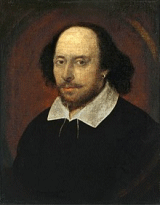
William Shakespeare

 
William Shakespeare

   Email Print
   Bookmark   Link


William Shakespeare


William Shakespeare (baptised
Baptism

In Christianity, baptism is the ritual act, with the use of water, by which one is admitted as a full member of the Christian Church and, in the view of some, as a member of the particular Church in which the baptism is administered....
 26 April 1564 – 23 April 1616) was an English
English people

The English are a nation and ethnic group native to England who speak English language in England. The English identity as a people is of early medieval origin, when they were known in Old English as the Anglecynn....
 poet
Poet

A poet is a person who writes poetry....
 and playwright
Playwright

A playwright, also known as a dramatist, is a person who writes dramatic literature or drama. These works may be written specifically to be performed by actors or they may be closet dramas or literary works written using dramatic forms but not meant for performance....
, widely regarded as the greatest writer in the English language
English language

English is a West Germanic language that originated in Anglo-Saxon England and has lingua franca status in many parts of the world as a result of the military, economic, scientific, political and cultural influence of the British Empire in the 18th, 19th and early 20th centuries and that of the United States from the mid 20th century onwa...
 and the world's preeminent dramatist. He is often called England's national poet and the "Bard
Bard

In Celts society, a bard was a professional poet, paid by a monarch to praise the sovereign's activities.The term acquired generic meanings of an epic author/singer/narrator or any poets, especially famous ones....
 of Avon
River Avon, Warwickshire

The River Avon or Avon is a river in or adjoining the county of Leicestershire, Northamptonshire, Warwickshire, Worcestershire and Gloucestershire in the Midlands of England....
" (or simply "The Bard"). His surviving works consist of 38 plays
Shakespeare's plays

William Shakespeare Play have the reputation of being among the greatest in the English language and in Western literature. Traditionally divided into the genres of Shakespearean tragedy, Shakespearean history, and Shakespearean comedy, they have been translated into every major Modern language language, in addition to being continually per...
, 154 sonnets
Shakespeare's sonnets

Shakespeare's sonnets, or simply The Sonnets, is a collection of poems in sonnet form written by William Shakespeare that deal with such themes as love, beauty, politics, and death....
, two long narrative poems, and several other poems. His plays have been translated into every major living language and are performed more often than those of any other playwright.

Shakespeare was born and raised in Stratford-upon-Avon
Stratford-upon-Avon

Stratford-upon-Avon is a market town and civil parish in south Warwickshire, England. It lies on the River Avon, Warwickshire, south east of Birmingham and south west of the county town, Warwick....
.


Discussion
Ask a question about 'William Shakespeare'
Start a new discussion about 'William Shakespeare'
Answer questions from other users
Full Discussion Forum


Recent Posts


Timeline

44 BC   (the ''Ides of March'') - Julius Caesar, dictator of Rome, is assassinated by a group of Roman senators, amongst them Gaius Cassius Longinus, Marcus Junius Brutus, and Caesar's Massilian naval commander, Decimus Brutus. Caesar's famous last quote - coined by William Shakespeare in his play ''Julius Caesar'' - was most likely ''not'' spoken (see: "''Et tu, Brute?''").

1564   Born

1582   In Stratford-upon-Avon, 18 year-old William Shakespeare and 26 year-old Anne Hathaway pay a 40-pound bond for their marriage license (Shakespeare would later become one of the greatest playwrights in history).

1595   William Shakespeare writes ''A Midsummer Night's Dream''.

1595   William Shakespeare's play ''Romeo and Juliet'' is probably first performed.

1600   William Shakespeare's ''A Midsummer Night's Dream'' is first performed.

1602   William Shakespeare writes ''The Merry Wives of Windsor''

1602   William Shakespeare First performance of ''Twelfth Night'' on Candlemas

1604   At Whitehall Palace in London, the William Shakespeare tragedy ''Othello'' is presented for the first time.

1611   At Whitehall Palace in London, William Shakespeare's romantic comedy ''The Tempest'' is performed for the first time.


Quotations


Antony: Cry 'Havoc!' and let slip the dogs of war.

Julius Caesar Act III, sc. i

Brutus: Caesar, now be still: I kill'd not thee with half so good a will.

Julius Caesar Act V, sc. v

Casca: But, for my own part, it was Greek to me.

Julius Caesar Act I, sc. ii

Feste: Many a good hanging prevents a bad marriage;.

Twelfth Night Act I, sc. v

Hamlet: There are more things in Heaven and Earth, Horatio, than are dreamt of in your philosophy.

Iago: I am one, sir, that comes to tell you your daughter and the Moor are now making the beast with two backs.

Othello, Act I, sc. i


Encyclopedia


William Shakespeare (baptised
Baptism

In Christianity, baptism is the ritual act, with the use of water, by which one is admitted as a full member of the Christian Church and, in the view of some, as a member of the particular Church in which the baptism is administered....
 26 April 1564 – 23 April 1616) was an English
English people

The English are a nation and ethnic group native to England who speak English language in England. The English identity as a people is of early medieval origin, when they were known in Old English as the Anglecynn....
 poet
Poet

A poet is a person who writes poetry....
 and playwright
Playwright

A playwright, also known as a dramatist, is a person who writes dramatic literature or drama. These works may be written specifically to be performed by actors or they may be closet dramas or literary works written using dramatic forms but not meant for performance....
, widely regarded as the greatest writer in the English language
English language

English is a West Germanic language that originated in Anglo-Saxon England and has lingua franca status in many parts of the world as a result of the military, economic, scientific, political and cultural influence of the British Empire in the 18th, 19th and early 20th centuries and that of the United States from the mid 20th century onwa...
 and the world's preeminent dramatist. He is often called England's national poet and the "Bard
Bard

In Celts society, a bard was a professional poet, paid by a monarch to praise the sovereign's activities.The term acquired generic meanings of an epic author/singer/narrator or any poets, especially famous ones....
 of Avon
River Avon, Warwickshire

The River Avon or Avon is a river in or adjoining the county of Leicestershire, Northamptonshire, Warwickshire, Worcestershire and Gloucestershire in the Midlands of England....
" (or simply "The Bard"). His surviving works consist of 38 plays
Shakespeare's plays

William Shakespeare Play have the reputation of being among the greatest in the English language and in Western literature. Traditionally divided into the genres of Shakespearean tragedy, Shakespearean history, and Shakespearean comedy, they have been translated into every major Modern language language, in addition to being continually per...
, 154 sonnets
Shakespeare's sonnets

Shakespeare's sonnets, or simply The Sonnets, is a collection of poems in sonnet form written by William Shakespeare that deal with such themes as love, beauty, politics, and death....
, two long narrative poems, and several other poems. His plays have been translated into every major living language and are performed more often than those of any other playwright.

Shakespeare was born and raised in Stratford-upon-Avon
Stratford-upon-Avon

Stratford-upon-Avon is a market town and civil parish in south Warwickshire, England. It lies on the River Avon, Warwickshire, south east of Birmingham and south west of the county town, Warwick....
. At the age of 18, he married Anne Hathaway
Anne Hathaway (Shakespeare)

Anne Hathaway was the wife of William Shakespeare. They were married in 1582 and Hathaway was widowed on Shakespeare's death in 1616. Very little is known about her, beyond a few references in legal documents, but her personality and relationship to Shakespeare have been the subject of much speculation by historians and creative writers....
, who bore him three children: Susanna
Susanna Hall

Susanna Hall , was the eldest child of William Shakespeare and Anne Hathaway .Susanna was born merely six months after her parents' marriage; Shakespeare was 18, and Hathaway 26....
, and twins Hamnet
Hamnet Shakespeare

Hamnet Shakespeare was the only son of William Shakespeare and Anne Hathaway , and the fraternal twin of Judith Quiney. He died at age eleven of unknown causes....
 and Judith
Judith Quiney

Judith Quiney was the youngest daughter of William Shakespeare and Anne Hathaway . She married Thomas Quiney, a vintner of Stratford-upon-Avon....
. Between 1585 and 1592, he began a successful career in London
London

London is the capital of both England and the United Kingdom, and the most populous municipality in the European Union. An important settlement for two millennia, History of London goes back to its founding by the Roman Empire....
 as an actor, writer, and part owner of a playing company
Playing company

In English Renaissance London, playing company was the usual term for a company of actors. These companies were organized around a group of ten or so shareholders , who performed in the plays but were also responsible for management....
 called the Lord Chamberlain's Men
Lord Chamberlain's Men

The Lord Chamberlain's Men was a playing company that William Shakespeare worked at as an actor and playwright for most of his career. Formed at the end of a period of flux in the theatrical world of London, it had become, by 1603, one of the two leading companies of the city and was subsequently patronized by James I of England....
, later known as the King's Men
King's Men (playing company)

The King's Men was the company of actors to which William Shakespeare belonged through most of his career. Formerly known as The Lord Chamberlain's Men during the reign of Elizabeth I of England, it became The King's Men in 1603 when James I of England ascended the throne and became the company's patron....
. He appears to have retired to Stratford around 1613, where he died three years later. Few records of Shakespeare's private life survive, and there has been considerable speculation about such matters as his physical appearance
Portraits of Shakespeare

There is no firm evidence that William Shakespeare ever commissioned a portrait or pictures, and there is no written description of his physical appearance....
, sexuality
Sexuality of William Shakespeare

The sexual orientation of William Shakespeare has been the subject of recurring debate. It is known that he married Anne Hathaway and they had three children....
, religious beliefs
Shakespeare's religion

Over the years, there have been a number of speculations about the religious beliefs of William Shakespeare. While little direct evidence exists, circumstantial evidence suggests that William Shakespeare's family had Roman Catholic Church sympathies and that he himself was Catholic, though there is disagreement over whether he in fact was....
, and whether the works attributed to him were written by others.

Shakespeare produced most of his known work between 1590 and 1613. His early plays were mainly comedies
Shakespearean comedy

Traditionally, the Play of William Shakespeare have been grouped into three categories: Shakespearean tragedy, Shakespearean comedy, and Shakespearean history....
 and histories
Shakespearean history

Traditionally, the Play of William Shakespeare have been grouped into three categories: Shakespearean tragedy, Shakespearean comedies, and histories....
, genres he raised to the peak of sophistication and artistry by the end of the sixteenth century. He then wrote mainly tragedies
Shakespearean tragedy

Shakespeare wrote tragedies from the beginning of his career. One of his earliest plays was the Roman tragedy Titus Andronicus, which he followed a few years later with Romeo and Juliet....
 until about 1608, including Hamlet
Hamlet

Hamlet is a tragedy by William Shakespeare, believed to have been written between 1599 and 1601. The play, set in Denmark, recounts how Prince Hamlet exacts revenge on his uncle King Claudius, who has murdered King Hamlet, the King, and then taken the throne and married Gertrude ....
, King Lear
King Lear

King Lear is a tragedy by William Shakespeare, believed to have been written between 1603 and 1606, and is considered one of his greatest works....
, and Macbeth
Macbeth

Macbeth is a tragedy by William Shakespeare about a regicide and its aftermath. It is Shakespeare's shortest Shakespearean tragedy and is believed to have been written some time between 1603 and 1606, with 1607 being the very latest possible date....
, considered some of the finest works in the English language. In his last phase, he wrote tragicomedies
Shakespeare's late romances

The late romances, often simply called the romances, are a grouping of what many scholars believe to be William Shakespeare's later plays, including Pericles, Prince of Tyre; Cymbeline; The Winter's Tale; and The Tempest ....
, also known as romances, and collaborated with other playwrights. Many of his plays were published in editions of varying quality and accuracy during his lifetime. In 1623, two of his former theatrical colleagues published the First Folio
First Folio

Mr. William Shakespeares Comedies, Histories, & Tragedies is the 1623 published collection of William Shakespeare's plays. Modern scholars commonly refer to it as the First Folio....
, a collected edition of his dramatic works that included all but two of the plays now recognised as Shakespeare's.

Shakespeare was a respected poet and playwright in his own day, but his reputation did not rise to its present heights until the nineteenth century. The Romantics, in particular, acclaimed Shakespeare's genius, and the Victorians
Victorian era

The Victorian Era of the United Kingdom of Great Britain and Ireland was the period of Victoria of the United Kingdom reign from June 1837 to January 1901....
 hero-worshipped Shakespeare with a reverence that George Bernard Shaw
George Bernard Shaw

George Bernard Shaw, was an Irish people playwright.Although Shaw's first profitable writing was music and literary criticism, his talent was for drama, and he wrote more than 60 plays....
 called "bardolatry
Bardolatry

Bardolatry is a term that refers to the excessive adulation of William Shakespeare, combining the words "bard" and "idolatry". Shakespeare has been known as "the Bard" since the nineteenth century....
". In the twentieth century, his work was repeatedly adopted and rediscovered by new movements in scholarship and performance. His plays remain highly popular today and are constantly studied, performed and reinterpreted in diverse cultural and political contexts throughout the world.

Life


Early life

William Shakespeare was the son of John Shakespeare
John Shakespeare

John Shakespeare was a glover and whittawer , farmer and later an alderman in Stratford-upon-Avon.He was the father of William Shakespeare....
, a successful glove
Glove

A glove is a type of garment which covers the hand of a human. Gloves have separate sheaths or openings for each finger and the thumb; if there is an opening but no covering sheath for each finger they are called "fingerless gloves"....
r and alderman
Alderman

An alderman is a member of a Municipal government assembly or council in many jurisdictions. Historically the term could also refer to local municipal judges in small legal proceedings ....
 originally from Snitterfield
Snitterfield

Snitterfield is a village and civil parish in the Stratford-on-Avon of Warwickshire, England, just off the A46 road, between Coventry and Stratford upon Avon....
, and Mary Arden, the daughter of an affluent landowning farmer. He was born in Stratford-upon-Avon and baptised on 26 April 1564. His unknown birthday is traditionally observed on 23 April, St George's Day
St George's Day

St George's Day is celebrated by several nations, kingdoms, countries, and cities, of which Saint George is the patron saint, including England, the old kingdoms and counties of the Crown of Aragon in Spain - Aragon, Catalonia and Valencian Community; Portugal, Georgia , Serbia, Bulgaria, Bosnia and Herzegovina, the Republic of Macedonia, and...
. This date, which can be traced back to an eighteenth-century scholar's mistake, has proved appealing because Shakespeare died on 23 April 1616. He was the third child of eight and the eldest surviving son.

Although no attendance records for the period survive, most biographers agree that Shakespeare was educated at the King's New School
King Edward VI School Stratford-upon-Avon

King Edward VI School is a single sex grammar school in Stratford-upon-Avon in Warwickshire, England. The poet and playwright William Shakespeare may have attended KES , leading to the label of "Shakespeare's School."...
 in Stratford, a free school chartered in 1553, about a quarter of a mile from his home. Grammar school
Grammar school

A grammar school is one of several different types of school in the history of education in the United Kingdom and other English-speaking countries....
s varied in quality during the Elizabethan era, but the curriculum was dictated by law throughout England, and the school would have provided an intensive education in Latin grammar and the classics.

At the age of 18, Shakespeare married the 26-year-old Anne Hathaway
Anne Hathaway (Shakespeare)

Anne Hathaway was the wife of William Shakespeare. They were married in 1582 and Hathaway was widowed on Shakespeare's death in 1616. Very little is known about her, beyond a few references in legal documents, but her personality and relationship to Shakespeare have been the subject of much speculation by historians and creative writers....
. The consistory court
Consistory court

The consistory court is a type of ecclesiastical court, especially within the Church of England. They were established by a charter of King William I of England, and still exist today, although since about the middle of the 19th century consistory courts have lost much of their subject-matter jurisdiction....
 of the Diocese of Worcester
Anglican Diocese of Worcester

The Diocese of Worcester forms part of the Province of Canterbury in England.The diocese was founded in around 679 by Theodore of Tarsus.Covering an area of it has parishes in:...
 issued a marriage licence on 27 November 1582. Two of Hathaway's neighbours posted bonds the next day as surety that there were no impediments to the marriage. The couple may have arranged the ceremony in some haste, since the Worcester chancellor
Chancellor

Chancellor or chancellour is an official title used in countries whose civilization has arisen directly or indirectly out of the Roman Empire....
 allowed the marriage banns
Banns of marriage

The banns of marriage, commonly known simply as "the banns", are the public announcement in a parish church of a Christian church descended from the Roman Catholic Church that a marriage is going to take place between two specified persons....
 to be read once instead of the usual three times. Anne's pregnancy could have been the reason for this. Six months after the marriage, she gave birth to a daughter, Susanna
Susanna Hall

Susanna Hall , was the eldest child of William Shakespeare and Anne Hathaway .Susanna was born merely six months after her parents' marriage; Shakespeare was 18, and Hathaway 26....
, who was baptised on 26 May 1583. Twins, son Hamnet
Hamnet Shakespeare

Hamnet Shakespeare was the only son of William Shakespeare and Anne Hathaway , and the fraternal twin of Judith Quiney. He died at age eleven of unknown causes....
 and daughter Judith
Judith Quiney

Judith Quiney was the youngest daughter of William Shakespeare and Anne Hathaway . She married Thomas Quiney, a vintner of Stratford-upon-Avon....
, followed almost two years later and were baptised on 2 February 1585. Hamnet died of unknown causes at the age of 11 and was buried on 11 August 1596.

After the birth of the twins, there are few historical traces of Shakespeare until he is mentioned as part of the London theatre scene in 1592. Because of this gap, scholars refer to the years between 1585 and 1592 as Shakespeare's "lost years". Biographers attempting to account for this period have reported many apocryphal stories. Nicholas Rowe
Nicholas Rowe (dramatist)

Nicholas Rowe , England dramatist, poet and miscellaneous writer, was appointed Poet Laureate in 1715....
, Shakespeare’s first biographer, recounted a Stratford legend that Shakespeare fled the town for London to escape prosecution for deer poaching
Poaching

Poaching is the illegal hunting, fishing or eating of wild plants or animals contrary to local and international Conservation and wildlife management laws....
. Another eighteenth-century story has Shakespeare starting his theatrical career minding the horses of theatre patrons in London. John Aubrey
John Aubrey

John Aubrey was an England antiquary and writer, best known as the author of the collection of short biographical pieces usually referred to as Brief Lives and as the discoverer of the Aubrey holes in Stonehenge....
 reported that Shakespeare had been a country schoolmaster. Some twentieth-century scholars have suggested that Shakespeare may have been employed as a schoolmaster by Alexander Hoghton of Lancashire
Lancashire

Lancashire is a Metropolitan and non-metropolitan counties of England of Historic counties of England in the North West England of England, bounded to the west by the Irish Sea....
, a Catholic landowner who named a certain "William Shakeshafte" in his will. No evidence substantiates such stories other than hearsay collected after his death.

London and theatrical career

It is not known exactly when Shakespeare began writing, but contemporary allusions and records of performances show that several of his plays were on the London stage by 1592. He was well enough known in London by then to be attacked in print by the playwright Robert Greene
Robert Greene (16th century)

Robert Greene was an England author best known today for his pamphlet Greene's Groats-Worth of Wit, containing a polemic attack on William Shakespeare....
:

...there is an upstart Crow, beautified with our feathers, that with his Tiger's heart wrapped in a Player's hide, supposes he is as well able to bombast out a blank verse as the best of you: and being an absolute Johannes factotum, is in his own conceit the only Shake-scene in a country.


Scholars differ on the exact meaning of these words, but most agree that Greene is accusing Shakespeare of reaching above his rank in trying to match university-educated writers, such as Christopher Marlowe
Christopher Marlowe

Christopher "Kit" Marlowe was an Kingdom of England Playwright, poet and translator of the Elizabethan era. The foremost English Renaissance theatre tragedy next to William Shakespeare, he is known for his blank verse, his overreaching protagonists, and his own mysterious and untimely death....
, Thomas Nashe
Thomas Nashe

Thomas Nashe was an England Elizabethan pamphleteer, poet and satirist. He was the son of the minister of religion William Nashe and his wife Margaret ....
 and Greene himself. The italicised phrase parodying the line "Oh, tiger's heart wrapped in a woman's hide" from Shakespeare’s Henry VI, part 3
Henry VI, part 3

Henry the Sixth, Part 3, is a history play by William Shakespeare, believed written in approximately 1590, and set during the lifetime of King Henry VI of England....
, along with the pun "Shake-scene", identifies Shakespeare as Greene’s target.

"All the world's a stage,

and all the men and women merely players:

they have their exits and their entrances;

and one man in his time plays many parts..."
As You Like It
As You Like It

As You Like It is a pastoral comedy by William Shakespeare believed to have been written in 1599 or early 1600 and first published in the folio of 1623....
, Act II, Scene 7, 139–42.


Greene’s attack is the first recorded mention of Shakespeare’s career in the theatre. Biographers suggest that his career may have begun any time from the mid-1580s to just before Greene’s remarks. From 1594, Shakespeare's plays were performed only by the Lord Chamberlain's Men
Lord Chamberlain's Men

The Lord Chamberlain's Men was a playing company that William Shakespeare worked at as an actor and playwright for most of his career. Formed at the end of a period of flux in the theatrical world of London, it had become, by 1603, one of the two leading companies of the city and was subsequently patronized by James I of England....
, a company owned by a group of players, including Shakespeare, that soon became the leading playing company
Playing company

In English Renaissance London, playing company was the usual term for a company of actors. These companies were organized around a group of ten or so shareholders , who performed in the plays but were also responsible for management....
 in London. After the death of Queen Elizabeth
Elizabeth I of England

Elizabeth I was List of English monarchs and Queen of Ireland from 17 November 1558 until her death. Sometimes called The Virgin Queen, Gloriana, or Good Queen Bess, Elizabeth was the fifth and last monarch of the House of Tudor....
 in 1603, the company was awarded a royal patent by the new king, James I
James I of England

James VI and I was List of monarchs of Scotland as James VI, and List of English monarchs and King of Ireland as James I. He ruled in Kingdom of Scotland as James VI from 24 July 1567, when he was only one year old, succeeding his mother Mary I of Scotland....
, and changed its name to the King's Men
King's Men (playing company)

The King's Men was the company of actors to which William Shakespeare belonged through most of his career. Formerly known as The Lord Chamberlain's Men during the reign of Elizabeth I of England, it became The King's Men in 1603 when James I of England ascended the throne and became the company's patron....
.

In 1599, a partnership of company members built their own theatre on the south bank of the Thames, which they called the Globe
Globe Theatre

The Globe Theatre was a theatre in London associated with William Shakespeare. It was built in 1599 by Shakespeare's playing company, the Lord Chamberlain's Men, and was destroyed by fire on 29 June 1613....
. In 1608, the partnership also took over the Blackfriars indoor theatre
Blackfriars Theatre

Blackfriars Theatre was the name of a theatre in the Blackfriars, London district of the City of London during the English Renaissance theatre. The theatre began as a venue for boy player associated with the Elizabeth I of England chapel choirs; in this function, the theatre hosted some of the most innovative drama of Elizabeth and James I o...
. Records of Shakespeare's property purchases and investments indicate that the company made him a wealthy man. In 1597, he bought the second-largest house in Stratford, New Place
New Place

New Place is the name given to William Shakespeare's final place of residence in Stratford-upon-Avon during his retirement, and it is where he died in 1616....
, and in 1605, he invested in a share of the parish
Parish

A parish is a local church; it is an administrative unit typically found in Roman Catholic, Anglican, United Methodist, and Presbyterianism churches....
 tithes in Stratford.

Some of Shakespeare's plays were published in quarto
Bookbinding

Bookbinding is the process of physically assembling a book from a number of folded or unfolded sheets of paper or other material. It also usually involves attaching covers to the resulting text-block....
 editions from 1594. By 1598, his name had become a selling point and began to appear on the title page
Title page

The title page of a book, thesis or other written work is the page at or near the front which displays its title, and author, as well as other information....
s. Shakespeare continued to act in his own and other plays after his success as a playwright. The 1616 edition of Ben Jonson
Ben Jonson

Benjamin Jonson was an England English Renaissance dramatist, poet and actor. A contemporary of William Shakespeare, he is best known for his satire plays, particularly Volpone, The Alchemist , and Bartholomew Fair, which are considered his best, and his Lyric poetry poems....
's Works names him on the cast lists for Every Man in His Humour
Every Man in His Humour

Every Man in His Humour is a 1598 play by the England playwright Ben Jonson. The play belongs to the subgenre of the "humours comedy," in which each major character is dominated by an overriding humour or obsession....
 (1598) and Sejanus, His Fall
Sejanus (play)

Sejanus His Fall, a 1603 play by Ben Jonson, is a tragedy about Sejanus, the favorite of the Roman emperor Tiberius. It was possibly an allegory of James I of England and his corrupt court....
 (1603). The absence of his name from the 1605 cast list for Jonson’s Volpone
Volpone

Volpone is a comedy by Ben Jonson first produced in 1606, drawing on elements of city comedy, black comedy and animal fable. A merciless satire of greed and lust, it remains Jonson's most-performed play, and it is among the finest English literature#Jacobean literature comedies....
 is taken by some scholars as a sign that his acting career was nearing its end. The First Folio
First Folio

Mr. William Shakespeares Comedies, Histories, & Tragedies is the 1623 published collection of William Shakespeare's plays. Modern scholars commonly refer to it as the First Folio....
 of 1623, however, lists Shakespeare as one of "the Principal Actors in all these Plays", some of which were first staged after Volpone, although we cannot know for certain what roles he played. In 1610, John Davies of Hereford
John Davies of Hereford

John Davies of Hereford was a writing-master and an Anglo-Welsh literature poet. He is usually known as John Davies of Hereford in order to distinguish him from others of the same name....
 wrote that "good Will" played "kingly" roles. In 1709, Rowe passed down a tradition that Shakespeare played the ghost of Hamlet's father. Later traditions maintain that he also played Adam in As You Like It
As You Like It

As You Like It is a pastoral comedy by William Shakespeare believed to have been written in 1599 or early 1600 and first published in the folio of 1623....
 and the Chorus in Henry V
Henry V (play)

Henry V is a history play by William Shakespeare, believed to be written in 1599. It is based on the life of King Henry V of England, and focuses on events immediately before and after the Battle of Agincourt during the Hundred Years' War....
, though scholars doubt the sources of the information.

Shakespeare divided his time between London and Stratford during his career. In 1596, the year before he bought New Place as his family home in Stratford, Shakespeare was living in the parish
Parish

A parish is a local church; it is an administrative unit typically found in Roman Catholic, Anglican, United Methodist, and Presbyterianism churches....
 of St. Helen's, Bishopsgate
Bishopsgate

Bishopsgate is a road and Wards of the United Kingdom in the east part of the City of London, extending north from Gracechurch Street to Norton Folgate....
, north of the River Thames. He moved across the river to Southwark
Southwark

Southwark, or the Borough, is an area of south-east London in the London Borough of Southwark, situated 1.5 miles east of Charing Cross....
 by 1599, the year his company constructed the Globe Theatre there. By 1604, he had moved north of the river again, to an area north of St Paul's Cathedral
St Paul's Cathedral

St Paul's Cathedral is the Anglicanism cathedral on Ludgate Hill, in the City of London, and the seat of the Bishop of London. The present building dates from the 17th century and is generally reckoned to be London's fifth St Paul's Cathedral, although the number is higher if every major medieval reconstruction is counted as a new cathedr...
 with many fine houses. There he rented rooms from a French Huguenot
Huguenot

The Huguenots were members of the Protestantism Reformed Church of France of France from the sixteenth to the eighteenth centuries....
 called Christopher Mountjoy, a maker of ladies' wigs and other headgear.

Later years and death

After 1606–1607, Shakespeare wrote fewer plays, and none are attributed to him after 1613. His last three plays were collaborations, probably with John Fletcher
John Fletcher (playwright)

John Fletcher was a Jacobean era playwright. Following William Shakespeare as house playwright for the King's Men , he was among the most prolific and influential dramatists of his day; both during his lifetime and in the early Restoration, his fame rivaled Shakespeare's....
, who succeeded him as the house playwright for the King’s Men.

Rowe was the first biographer to pass down the tradition that Shakespeare retired to Stratford some years before his death; but retirement from all work was uncommon at that time, and Shakespeare continued to visit London. In 1612, he was called as a witness in a court case concerning the marriage settlement of Mountjoy's daughter, Mary. In March 1613, he bought a gatehouse
Gatehouse

A gatehouse is a feature of European castles, manor houses and mansions. Originally a gatehouse was a fortified structure built over the gateway to a city or castle....
 in the Blackfriars priory
Priory

A priory is a house of men or women under religious vows headed by a prior or prioress.Priories may be houses of mendicant friars or religious sisters , or monastery of monks or nuns ....
; and from November 1614, he was in London for several weeks with his son-in-law, John Hall
John Hall (physician)

John Hall was a physician and son-in-law of William Shakespeare.He was born at Carlton, Bedfordshire and studied at Queens' College, Cambridge from 1589, receiving a B.A....
.

Shakespeare died on 23 April 1616, and was survived by his wife and two daughters. Susanna had married a physician, John Hall, in 1607, and Judith had married Thomas Quiney
Thomas Quiney

Thomas Quiney was the husband of William Shakespeare's daughter Judith Quiney, and a vintner and tobacconist in Stratford-upon-Avon. Quiney held several municipal offices in the corporation of Stratford-upon-Avon, the highest being chamberlain in 1621 and 1622, but was also fined for various minor offences....
, a vintner, two months before Shakespeare’s death.

In his will, Shakespeare left the bulk of his large estate to his elder daughter Susanna. The terms instructed that she pass it down intact to "the first son of her body". The Quineys had three children, all of whom died without marrying. The Halls had one child, Elizabeth, who married twice but died without children in 1670, ending Shakespeare’s direct line. Shakespeare's will scarcely mentions his wife, Anne, who was probably entitled to one third of his estate automatically. He did make a point, however, of leaving her "my second best bed", a bequest that has led to much speculation. Some scholars see the bequest as an insult to Anne, whereas others believe that the second-best bed would have been the matrimonial bed and therefore rich in significance.

Shakespeare was buried in the chancel
Chancel

"Chancel" is an architectural term for the space around the altar at the liturgical east end of a traditional Christian church building. It may terminate in an apse....
 of the Holy Trinity Church
Holy Trinity Church, Stratford-upon-Avon

The Collegiate Church of the Holy and Undivided Trinity, Stratford-upon-Avon is a parish church in the Church of England....
 two days after his death. The stone slab covering his grave is inscribed with a curse against moving his bones:

Good frend for Iesvs sake forbeare, To digg the dvst encloased heare. Blest be ye man yt spares thes stones, And cvrst be he yt moves my bones.

Sometime before 1623, a monument was erected in his memory on the north wall, with a half-effigy of him in the act of writing. Its plaque compares him to Nestor
Nestor (mythology)

In Greek mythology, Nestor of Ger?nia was the son of Neleus and Chloris, and the King of Pylos. He became king after Heracles killed Neleus and all of Nestor's brothers and sisters....
, Socrates
Socrates

Socrates was a Classical Greece Philosophy. Credited as one of the founders of Western philosophy, he is an enigmatic figure known only through the classical accounts of his students....
, and Virgil
Virgil

Publius Vergilius Maro was a classical Roman poet, best known for three major works?the Bucolics , the Georgics and the Aeneid?although several Appendix Vergiliana are also attributed to him....
. Shakespeare has been commemorated in many statues and memorials
Memorials to William Shakespeare

William Shakespeare has been commemorated in a number of different statues and memorials around the world, notably his Shakespeare's funerary monument in Stratford-upon-Avon ; a statue in Poets' Corner in Westminster Abbey, London, designed by William Kent and executed by Peter Scheemakers ; and a statue in New York's Central Park by John Qui...
 around the world, including funeral monuments in Southwark Cathedral
Southwark Cathedral

Southwark Cathedral or The Cathedral and Collegiate Church of St Saviour and St Mary Overie, Southwark, London, lies on the south bank of the River Thames close to London Bridge....
 and Poet's Corner in Westminster Abbey
Westminster Abbey

The Collegiate Church of St Peter at Westminster, which is almost always referred to popularly and informally as Westminster Abbey, is a large, mainly Gothic architecture Church , in Westminster, London, just to the west of the Palace of Westminster....
.

Plays


Scholars have often noted four periods in Shakespeare's writing career. Until the mid-1590s, he wrote mainly comedies influenced by Roman and Italian models and history plays in the popular chronicle tradition. His second period began in about 1595 with the tragedy Romeo and Juliet
Romeo and Juliet

Romeo and Juliet is a Shakespearean tragedy written early in the career of playwright William Shakespeare about two young "Star-crossed" whose untimely deaths ultimately unite their feuding families....
 and ended with the tragedy of Julius Caesar
Julius Caesar (play)

Julius Caesar is a Shakespearean tragedy by William Shakespeare, believed to have been written in 1599. It portrays the conspiracy against the Roman Empire dictator Julius Caesar, his assassination and its aftermath....
 in 1599. During this time, he wrote what are considered his greatest comedies and histories. From about 1600 to about 1608, his "tragic period", Shakespeare wrote mostly tragedies, and from about 1608 to 1613, mainly tragicomedies
Tragicomedy

Tragicomedy is fictional work that blends aspects of the genres of tragedy and comedy. In English literature, from Shakespeare's time to the nineteenth century, tragicomedy referred to a serious Play with a happy ending....
, also called romances
Shakespeare's late romances

The late romances, often simply called the romances, are a grouping of what many scholars believe to be William Shakespeare's later plays, including Pericles, Prince of Tyre; Cymbeline; The Winter's Tale; and The Tempest ....
.

The first recorded works of Shakespeare are Richard III
Richard III (play)

Richard III is a Shakespearean history play by William Shakespeare, believed to have been written in approximately 1591, depicting the Machiavellian rise to power and subsequent short reign of Richard III of England....
 and the three parts of Henry VI
Henry VI, part 1

The First Part of King Henry the Sixth is a history play by William Shakespeare, believed written in approximately 1588?1590. It is the first in the cycle of four plays often referred to as "The First Tetralogy"....
, written in the early 1590s during a vogue for historical drama. Shakespeare's plays are difficult to date, however, and studies of the texts suggest that Titus Andronicus
Titus Andronicus

Titus Andronicus may be William Shakespeare earliest tragedy; it is believed to have been written sometime between 1584 and the early 1590s....
, The Comedy of Errors
The Comedy of Errors

The Comedy of Errors is one of William Shakespeare's earliest plays, believed to have been written between 1589 and 1594. It is his shortest and one of his most farce, with a major part of the humour coming from slapstick and mistaken identity, in addition to puns and wordplay....
, The Taming of the Shrew
The Taming of the Shrew

The Taming of the Shrew is an early Shakespearean comedy by William Shakespeare believed to have been written between 1590 and 1594. The play begins with a framing device, often referred to as the Induction, in which a drunken tinker named Sly is tricked into thinking he is a nobleman by a mischievous Lord....
 and Two Gentlemen of Verona may also belong to Shakespeare’s earliest period. His first histories
Shakespearean history

Traditionally, the Play of William Shakespeare have been grouped into three categories: Shakespearean tragedy, Shakespearean comedies, and histories....
, which draw heavily on the 1587 edition of Raphael Holinshed's
Raphael Holinshed

Raphael Holinshed was an England chronicler, whose work, commonly known as Holinshed's Chronicles, was one of the major sources used by William Shakespeare for a number of Shakespeare's plays....
 Chronicles of England, Scotland, and Ireland, dramatise the destructive results of weak or corrupt rule and have been interpreted as a justification for the origins of the Tudor dynasty
Tudor dynasty

The House of Tudor was a prominent European royal house that ruled the Kingdom of England and its realms from 1485 until 1603. Founded by Henry VII of England, who, though his paternal family was Welsh people ?his grandfather was Owen Tudor? was himself also a legitimized descendent of the royal House of Lancaster....
. Their composition was influenced by the works of other Elizabethan dramatists, especially Thomas Kyd
Thomas Kyd

Thomas Kyd was an England dramatist, the author of The Spanish Tragedy, and one of the most important figures in the development of Elizabethan drama....
 and Christopher Marlowe
Christopher Marlowe

Christopher "Kit" Marlowe was an Kingdom of England Playwright, poet and translator of the Elizabethan era. The foremost English Renaissance theatre tragedy next to William Shakespeare, he is known for his blank verse, his overreaching protagonists, and his own mysterious and untimely death....
, by the traditions of medieval drama, and by the plays of Seneca
Seneca the Younger

Lucius Annaeus Seneca was a Ancient Rome Stoicism philosopher, statesman, dramatist, and in one work humorist, of the Silver Age of Latin literature....
. The Comedy of Errors was also based on classical models, but no source for the The Taming of the Shrew has been found, though it is related to a separate play of the same name and may have derived from a folk story. Like Two Gentlemen of Verona, in which two friends appear to approve of rape, the Shrew's story of the taming of a woman's independent spirit by a man sometimes troubles modern critics and directors.

Shakespeare's early classical and Italianate comedies, containing tight double plots and precise comic sequences, give way in the mid-1590s to the romantic atmosphere of his greatest comedies. A Midsummer Night's Dream
A Midsummer Night's Dream

A Midsummer Night's Dream is a romantic love Shakespearean comedies by William Shakespeare, suggested by "The Knight's Tale" from Geoffrey Chaucer's The Canterbury Tales, written around 1594 to 1596....
 is a witty mixture of romance, fairy magic, and comic lowlife scenes. Shakespeare's next comedy, the equally romantic The Merchant of Venice
The Merchant of Venice

The Merchant of Venice is a play by William Shakespeare, believed to have been written between 1596 and 1598. Although classified as a Shakespearean comedies in the First Folio, and while it shares certain aspects with Shakespeare's other romantic comedy, the play is perhaps more remembered for its dramatic scenes, and is best known for...
, contains a portrayal of the vengeful Jewish moneylender Shylock
Shylock

Shylock is a fictional character in Shakespeare's The Merchant of Venice....
 which reflected Elizabethan views but may appear prejudiced to modern audiences. The wit and wordplay of Much Ado About Nothing
Much Ado About Nothing

Much Ado About Nothing is a romantic Shakespearean comedy by William Shakespeare set in Messina, Sicily. The story concerns a pair of lovers named Claudio and Hero who are due to be married in a week....
, the charming rural setting of As You Like It
As You Like It

As You Like It is a pastoral comedy by William Shakespeare believed to have been written in 1599 or early 1600 and first published in the folio of 1623....
, and the lively merrymaking of Twelfth Night complete Shakespeare's sequence of great comedies. After the lyrical Richard II
Richard II (play)

'King Richard the Second' is a history play by William Shakespeare believed to be written in approximately 1595. It is based on the life of King Richard II of England and is the first part of a tetralogy, referred to by scholars as the Henriad, followed by three plays concerning Richard's successors: Henry IV, part 1, Henry IV, part...
, written almost entirely in verse, Shakespeare introduced prose comedy into the histories of the late 1590s, Henry IV, parts 1
Henry IV, Part 1

Henry IV, Part 1 is a history play by William Shakespeare, believed to have been written no later than 1597. It is the second of Shakespeare's tetralogy that deals with the successive reigns of Richard II of England, Henry IV of England , and Henry V of England....
 and 2
Henry IV, Part 2

Henry IV, Part 2 is a history play by William Shakespeare, believed written between 1596 and 1599. It is the third part of a tetralogy, preceded by Richard II and Henry IV, Part 1 and succeeded by Henry V ....
, and Henry V
Henry V (play)

Henry V is a history play by William Shakespeare, believed to be written in 1599. It is based on the life of King Henry V of England, and focuses on events immediately before and after the Battle of Agincourt during the Hundred Years' War....
. His characters become more complex and tender as he switches deftly between comic and serious scenes, prose and poetry, and achieves the narrative variety of his mature work. This period begins and ends with two tragedies: Romeo and Juliet
Romeo and Juliet

Romeo and Juliet is a Shakespearean tragedy written early in the career of playwright William Shakespeare about two young "Star-crossed" whose untimely deaths ultimately unite their feuding families....
, the famous romantic tragedy of sexually charged adolescence, love, and death; and Julius Caesar
Julius Caesar (play)

Julius Caesar is a Shakespearean tragedy by William Shakespeare, believed to have been written in 1599. It portrays the conspiracy against the Roman Empire dictator Julius Caesar, his assassination and its aftermath....
—based on Sir Thomas North's
Thomas North

Sir Thomas North was an England translator of Plutarch, second son of the Edward North, 1st Baron North....
 1579 translation of Plutarch's
Plutarch

Lucius Mestrius Plutarchus , c. AD 46 ? 120 ? commonly known in English as Plutarch ? was a Ancient Rome historian , biographer, essayist, and Middle Platonism....
 Parallel Lives
Parallel Lives

File:Plutarchs LIVES.jpgPlutarch's Lives of the Noble Greeks and Romans, commonly called Parallel Lives or Plutarch's Lives, is a series of biography of famous men, arranged in tandem to illuminate their common moral virtues or failings....
—which introduced a new kind of drama. According to Shakespearean scholar James Shapiro, in Julius Caesar "the various strands of politics, character, inwardness, contemporary events, even Shakespeare's own reflections on the act of writing, began to infuse each other".

Shakespeare's so-called "tragic period" lasted from about 1600 to 1608, though he also wrote the so-called "problem plays"
Problem plays (Shakespeare)

In Shakespeare studies, the term problem plays normally refers to three plays that William Shakespeare wrote between the late 1590s and the first years of the seventeenth century: All's Well That Ends Well, ''Measure for Measure and Troilus and Cressida, although some critics would extend the term to other plays, most commonly '...
  Measure for Measure
Measure for Measure

Measure for Measure is a Play by William Shakespeare, believed to have been written in 1603 or 1604. It was originally classified as a comedy, but is now also classified as one of Shakespeare's Problem plays s....
, Troilus and Cressida
Troilus and Cressida

Troilus and Cressida is a tragedy by William Shakespeare, believed to have been written in 1602. The play is not a conventional tragedy, since its protagonist does not die....
, and All's Well That Ends Well
All's Well That Ends Well

All's Well That Ends Well is a play by William Shakespeare. It was probably written between 1601 in literature and 1608 in literature, and it was first published in the First Folio in 1623 in literature....
 during this time and had written tragedies
Shakespearean tragedy

Shakespeare wrote tragedies from the beginning of his career. One of his earliest plays was the Roman tragedy Titus Andronicus, which he followed a few years later with Romeo and Juliet....
 before. Many critics believe that Shakespeare's greatest tragedies represent the peak of his art. The hero of the first, Hamlet
Prince Hamlet

Prince Hamlet is the protagonist in Shakespeare's Shakespearean tragedy Hamlet. He is the Prince of Denmark, nephew to the usurping King Claudius and son of the previous King of Denmark, King Hamlet....
, has probably been more discussed than any other Shakespearean character, especially for his famous soliloquy "To be or not to be; that is the question
To be, or not to be

The phrase "to be, or not to be" comes from William Shakespeare's Hamlet , act three, scene one. It is one of the most famous quotations in world literature and the best-known of this particular play....
." Unlike the introverted Hamlet, whose fatal flaw is hesitation, the heroes of the tragedies that followed, Othello and King Lear, are undone by hasty errors of judgement. The plots of Shakespeare's tragedies often hinge on such fatal errors or flaws, which overturn order and destroy the hero and those he loves. In Othello
Othello

Othello, the Moor of Venice is a tragedy by William Shakespeare, believed to have been written in approximately 1603, and based on the Italian language short story "Un Capitano Moro" by Cinthio first published in 1565....
, the villain Iago
Iago

Iago is a fictional character in Shakespeare's Othello . The character's source is traced to Cinthio's tale "Un Capitano Moro" in Gli Hecatommithi ....
 stokes Othello's sexual jealousy to the point where he murders the innocent wife who loves him. In King Lear
King Lear

King Lear is a tragedy by William Shakespeare, believed to have been written between 1603 and 1606, and is considered one of his greatest works....
, the old king commits the tragic error of giving up his powers, initiating the events which lead to the murder of his daughter and the torture and blinding of the Earl of Gloucester. According to the critic Frank Kermode, "the play offers neither its good characters nor its audience any relief from its cruelty". In Macbeth
Macbeth

Macbeth is a tragedy by William Shakespeare about a regicide and its aftermath. It is Shakespeare's shortest Shakespearean tragedy and is believed to have been written some time between 1603 and 1606, with 1607 being the very latest possible date....
, the shortest and most compressed of Shakespeare's tragedies, uncontrollable ambition incites Macbeth and his wife, Lady Macbeth
Lady Macbeth (Shakespeare)

Lady Macbeth is a character in Shakespeare's Macbeth . She is wife to the play's protagonist, Macbeth, a Scotland nobleman. After goading him into committing regicide, she becomes Queen of Scotland, and later suffers pangs of guilt for her part in the crime....
, to murder the rightful king and usurp the throne, until their own guilt destroys them in turn. In this play, Shakespeare adds a supernatural element to the tragic structure. His last major tragedies, Antony and Cleopatra
Antony and Cleopatra

Antony and Cleopatra is a tragedy by William Shakespeare. It was first printed in the First Folio of 1623.The plot is based on Thomas North's translation of Plutarch's Life of Markus Antonius and follows the relationship between Cleopatra VII of Egypt and Mark Antony from the time of the Roman-Persian Wars to Cleopatra's suicide....
 and Coriolanus
Coriolanus (play)

File:Gavin Hamilton - Coriolanus Act V, Scene III edit2.jpgCoriolanus is a tragedy by William Shakespeare, based on the life of the legendary Roman Republic leader, Coriolanus....
, contain some of Shakespeare's finest poetry and were considered his most successful tragedies by the poet and critic T. S. Eliot
T. S. Eliot

'Thomas Stearns Eliot', Order of Merit , was a poet, dramatist, and literary critic. He received the Nobel Prize in Literature in 1948. Among his most famous writings are the poems The Love Song of J....
.

In his final period, Shakespeare turned to romance
Shakespeare's late romances

The late romances, often simply called the romances, are a grouping of what many scholars believe to be William Shakespeare's later plays, including Pericles, Prince of Tyre; Cymbeline; The Winter's Tale; and The Tempest ....
 or tragicomedy
Tragicomedy

Tragicomedy is fictional work that blends aspects of the genres of tragedy and comedy. In English literature, from Shakespeare's time to the nineteenth century, tragicomedy referred to a serious Play with a happy ending....
 and completed three more major plays: Cymbeline
Cymbeline

Cymbeline is a play by William Shakespeare, based on legends concerning the early Celtic British King Cunobelinus. Although listed as a tragedy in the First Folio, modern critics often classify Cymbeline as a Shakespeare's Late Romances....
, The Winter's Tale
The Winter's Tale

The Winter's Tale is a play by William Shakespeare, first published in the First Folio in 1623. Although it was listed as a comedy when it first appeared, some modern editors have relabeled the play a Romance ....
 and The Tempest
The Tempest

The Tempest is a play by William Shakespeare, probably written in 1610?11, although some researchers have argued for an earlier dating. Its protagonist is the banished sorcerer Prospero, rightful Duke of Milan, who uses his magical powers to punish and forgive his enemies when he raises a tempest that drives them ashore....
, as well as the collaboration, Pericles, Prince of Tyre
Pericles, Prince of Tyre

Pericles, Prince of Tyre is a Play written at least in part by William Shakespeare and included in modern editions of his collected works despite questions over its authorship, as it was not included in the First Folio....
. Less bleak than the tragedies, these four plays are graver in tone than the comedies of the 1590s, but they end with reconciliation and the forgiveness of potentially tragic errors. Some commentators have seen this change in mood as evidence of a more serene view of life on Shakespeare's part, but it may merely reflect the theatrical fashion of the day. Shakespeare collaborated on two further surviving plays, Henry VIII
Henry VIII (play)

The Famous History of the Life of King Henry the Eighth is a history play by William Shakespeare, based on the life of Henry VIII of England....
  and The Two Noble Kinsmen
The Two Noble Kinsmen

The Two Noble Kinsmen is a Literature in English#Jacobean literature comedy, first published in 1634 and attributed to John Fletcher and William Shakespeare, based on "The Knight's Tale" from Geoffrey Chaucer's The Canterbury Tales....
, probably with John Fletcher
John Fletcher (playwright)

John Fletcher was a Jacobean era playwright. Following William Shakespeare as house playwright for the King's Men , he was among the most prolific and influential dramatists of his day; both during his lifetime and in the early Restoration, his fame rivaled Shakespeare's....
.

Performances


It is not clear for which companies Shakespeare wrote his early plays. The title page of the 1594 edition of Titus Andronicus reveals that the play had been acted by three different troupes. After the plagues
Black Death

The Black Death, was one of the deadliest pandemics in human history, widely thought to have been caused by a bacterium named Yersinia pestis , but recently attributed by some factors to other diseases....
 of 1592–3, Shakespeare's plays were performed by his own company at The Theatre
The Theatre

The Theatre was an Elizabethan theatre located in Shoreditch , just outside the City of London. It was the second permanent theatre ever built in England, after the Red Lion , and the first successful one....
 and the Curtain
Curtain Theatre

The Curtain Theatre was an Elizabethan playhouse located in Curtain Close, Shoreditch , just outside the City of London. It opened in 1577, and continued staging plays until 1622....
 in Shoreditch
Shoreditch

Shoreditch is an area of London within the London Borough of Hackney. It is a built-up part of the inner city immediately to the north of the City of London, located north east of Charing Cross....
, north of the Thames. Londoners flocked there to see the first part of Henry IV, Leonard Digges recording, "Let but Falstaff come, Hal, Poins, the rest...and you scarce shall have a room". When the company found themselves in dispute with their landlord, they pulled The Theatre down and used the timbers to construct the Globe Theatre
Globe Theatre

The Globe Theatre was a theatre in London associated with William Shakespeare. It was built in 1599 by Shakespeare's playing company, the Lord Chamberlain's Men, and was destroyed by fire on 29 June 1613....
, the first playhouse built by actors for actors, on the south bank of the Thames at Southwark
Southwark

Southwark, or the Borough, is an area of south-east London in the London Borough of Southwark, situated 1.5 miles east of Charing Cross....
. The Globe opened in autumn 1599, with Julius Caesar one of the first plays staged. Most of Shakespeare's greatest post-1599 plays were written for the Globe, including Hamlet, Othello and King Lear.

Globe Theatre London
After the Lord Chamberlain's Men were renamed the King's Men
King's Men (playing company)

The King's Men was the company of actors to which William Shakespeare belonged through most of his career. Formerly known as The Lord Chamberlain's Men during the reign of Elizabeth I of England, it became The King's Men in 1603 when James I of England ascended the throne and became the company's patron....
 in 1603, they entered a special relationship with the new King James
James I of England

James VI and I was List of monarchs of Scotland as James VI, and List of English monarchs and King of Ireland as James I. He ruled in Kingdom of Scotland as James VI from 24 July 1567, when he was only one year old, succeeding his mother Mary I of Scotland....
. Although the performance records are patchy, the King's Men performed seven of Shakespeare's plays at court between 1 November 1604 and 31 October 1605, including two performances of The Merchant of Venice. After 1608, they performed at the indoor Blackfriars Theatre
Blackfriars Theatre

Blackfriars Theatre was the name of a theatre in the Blackfriars, London district of the City of London during the English Renaissance theatre. The theatre began as a venue for boy player associated with the Elizabeth I of England chapel choirs; in this function, the theatre hosted some of the most innovative drama of Elizabeth and James I o...
 during the winter and the Globe during the summer. The indoor setting, combined with the Jacobean
Jacobean era

The Jacobean era refers to the period in England and Scotland history that coincides with the reign of King James I of England of England, who was also James VI of Scotland....
 fashion for lavishly staged masques, allowed Shakespeare to introduce more elaborate stage devices. In Cymbeline, for example, Jupiter
Jupiter (mythology)

In Roman mythology, Jupiter or Jove was the king of the gods,and the god of sky and thunder. He is the equivalent of Zeus in the Greek pantheon....
 descends "in thunder and lightning, sitting upon an eagle: he throws a thunderbolt. The ghosts fall on their knees."

The actors in Shakespeare's company included the famous Richard Burbage
Richard Burbage

Richard Burbage was an actor and theatre owner. He was the younger brother of Cuthbert Burbage. They were both actors in drama.Burbage came from a poor family and was a popular actor by his early 20s....
, William Kempe
William Kempe

William Kempe , also spelled Kemp, was an England actor and dancer best known for being one of the original actors in William Shakespeare's plays....
, Henry Condell
Henry Condell

Henry Condell was an actor in the King's Men , the playing company for which William Shakespeare wrote. With John Heminges, he was instrumental in preparing the First Folio, the collected plays of Shakespeare, published in 1623....
 and John Heminges
John Heminges

John Heminges was an English Renaissance actor. Most famous now as one of the editors of Shakespeare's 1623 in literature First Folio, Heminges served in his time as an actor and financial manager for the King's Men ....
. Burbage played the leading role in the first performances of many of Shakespeare's plays, including Richard III, Hamlet, Othello, and King Lear. The popular comic actor Will Kempe played the servant Peter in Romeo and Juliet and Dogberry
Dogberry

Dogberry is a self-satisfied night constable in Shakespeare's Much Ado about Nothing.In the play, Dogberry is the chief of the citizen-police in Messina....
 in Much Ado About Nothing, among other characters. He was replaced around the turn of the sixteenth century by Robert Armin
Robert Armin

Robert Armin was an England actor, a member of the Lord Chamberlain's Men. He became the leading comedy actor with the troupe associated with William Shakespeare following the departure of William Kempe around 1600....
, who played roles such as Touchstone
Touchstone (As You Like It)

Touchstone is the name of the court fool or jester character in Shakespeare's play As You Like It.In Shakespeare's Clown, David Wiles suggests that Robert Armin played the part of Touchstone in the first productions of As You Like It ....
 in As You Like It and the fool in King Lear. In 1613, Sir Henry Wotton
Henry Wotton

Sir Henry Wotton was an England author and diplomat.The son of Thomas Wotton , brother of Edward Wotton, 1st Baron Wotton, and grandnephew of the diplomat Nicholas Wotton, he was born at Bocton Hall in the parish of Bocton or Boughton Malherbe, Kent....
 recorded that Henry VIII "was set forth with many extraordinary circumstances of pomp and ceremony". On 29 June, however, a cannon set fire to the thatch of the Globe and burned the theatre to the ground, an event which pinpoints the date of a Shakespeare play with rare precision.

Textual sources

First Folio
In 1623, John Heminges
John Heminges

John Heminges was an English Renaissance actor. Most famous now as one of the editors of Shakespeare's 1623 in literature First Folio, Heminges served in his time as an actor and financial manager for the King's Men ....
 and Henry Condell
Henry Condell

Henry Condell was an actor in the King's Men , the playing company for which William Shakespeare wrote. With John Heminges, he was instrumental in preparing the First Folio, the collected plays of Shakespeare, published in 1623....
, two of Shakespeare's friends from the King's Men, published the First Folio
First Folio

Mr. William Shakespeares Comedies, Histories, & Tragedies is the 1623 published collection of William Shakespeare's plays. Modern scholars commonly refer to it as the First Folio....
, a collected edition of Shakespeare's plays. It contained 36 texts, including 18 printed for the first time. Many of the plays had already appeared in quarto
Book size

The size of a specific book is measured from the head to tail of the spine, and from edge to edge across the covers.However, in bookbinding, printing, and publishing, a series of terms are used to indicate the approximate size of a book....
 versions—flimsy books made from sheets of paper folded twice to make four leaves. No evidence suggests that Shakespeare approved these editions, which the First Folio describes as "stol'n and surreptitious copies". Alfred Pollard
Alfred W. Pollard

Alfred William Pollard was an English bibliography, widely credited for bringing a higher level of scholarly rigor to the study of William Shakespeare texts....
 termed some of them "bad quarto
Bad quarto

Bad quarto is a term and concept developed by twentieth-century William Shakespeare scholarly method to explain some problems in the early transmission of the texts of Shakespearean works....
s" because of their adapted, paraphrased or garbled texts, which may in places have been reconstructed from memory. Where several versions of a play survive, each differs from the other
Shakespeare's plays

William Shakespeare Play have the reputation of being among the greatest in the English language and in Western literature. Traditionally divided into the genres of Shakespearean tragedy, Shakespearean history, and Shakespearean comedy, they have been translated into every major Modern language language, in addition to being continually per...
. The differences may stem from copying or printing
Typesetting

Typesetting involves the presentation of textual material in graphic form on paper or some other Recording medium. Before the advent of desktop publishing, typesetting of printed material was produced in print shops by compositors or typesetters working by hand, and later with machines....
 errors, from notes by actors or audience members, or from Shakespeare's own papers
Foul papers

Foul papers is a term that refers to an author's working drafts, most often applied in the study of the plays of Shakespeare and other dramatists of English Renaissance theatre....
. In some cases, for example Hamlet, Troilus and Cressida
Troilus and Cressida

Troilus and Cressida is a tragedy by William Shakespeare, believed to have been written in 1602. The play is not a conventional tragedy, since its protagonist does not die....
 and Othello, Shakespeare could have revised texts between the quarto and folio editions. The folio version of King Lear is so different from the 1608 quarto that the Oxford Shakespeare prints them both, since they cannot be conflated without confusion.

Poems

In 1593 and 1594, when the theatres were closed because of plague
Bubonic plague

Plague is a deadly infectious disease caused by the Enterobacteriaceae Yersinia pestis . Plague is a zoonotic, primarily carried by rodents and spread to humans via fleas....
, Shakespeare published two narrative poems on erotic themes, Venus and Adonis
Venus and Adonis (Shakespeare poem)

Venus and Adonis is one of Shakespeare's three longer poems....
 and The Rape of Lucrece
The Rape of Lucrece

The Rape of Lucrece is a narrative poem by William Shakespeare about the legendary Lucretia.In his previous narrative poem, Venus and Adonis , Shakespeare had included a dedicatory letter to his patron, the Henry Wriothesley, 3rd Earl of Southampton, in which he promised to write a "graver work"....
. He dedicated them to Henry Wriothesley, earl of Southampton
Henry Wriothesley, 3rd Earl of Southampton

Henry Wriothesley, 3rd Earl of Southampton , one of William Shakespeare's patrons, was the second son of Henry Wriothesley, 2nd Earl of Southampton, and his wife Mary Browne, Countess of Southampton, daughter of the Anthony Browne, 1st Viscount Montagu....
. In Venus and Adonis, an innocent Adonis
Adonis

Adonis is a figure of West Semitic origin, where he is a central cult figure in various mystery religions, who enters Greek mythology in Hellenistic culture....
 rejects the sexual advances of Venus
Venus (mythology)

Venus was a major Roman mythology goddess principally associated with love, beauty and sexual reproduction, the equivalent of the Greek mythology Aphrodite....
; while in The Rape of Lucrece, the virtuous wife Lucrece
Lucretia

Lucretia is a legendary figure in the history of the Roman Republic. Her husband was Lucius Tarquinius Collatinus, her father was Spurius Lucretius Tricipitinus and her brother was Publius Lucretius Tricipitinus, one of the two second Consuls of Rome....
 is raped by the lustful Tarquin
Sextus Tarquinius

Sextus Tarquinius was the son of the last legendary king of Roman Empire, L. Tarquinius Superbus , and a rapist. He is mostly known for his rape of Lucretia, wife of Collatinus and sister of Lucius Junius Brutus....
. Influenced by Ovid's
Ovid

Publius Ovidius Naso was a Roman Empire poet known as Ovid to the English language-speaking world, who wrote about love, seduction, and Roman mythology transformation....
 Metamorphoses, the poems show the guilt and moral confusion that result from uncontrolled lust. Both proved popular and were often reprinted during Shakespeare's lifetime. A third narrative poem, A Lover's Complaint
A Lover's Complaint

A Lover's Complaint is a narrative poem usually attributed to William Shakespeare, although the poem's authorship is a matter of critical debate....
, in which a young woman laments her seduction by a persuasive suitor, was printed in the first edition of the Sonnets in 1609. Most scholars now accept that Shakespeare wrote A Lover's Complaint. Critics consider that its fine qualities are marred by leaden effects. The Phoenix and the Turtle
The Phoenix and the Turtle

The Phoenix and the Turtle is an allegorical poem about the death of ideal love by William Shakespeare. It is widely considered to be one of his most obscure works and has led to many conflicting interpretations....
, printed in Robert Chester's 1601 Love's Martyr, mourns the deaths of the legendary phoenix
Phoenix (mythology)

The phoenix is a Mythologyical sacred fire bird which originated in the Sub-continent of India in ancient mythologies mentioned in the Ancient Egyptian religion and later the Sanchuniathon and the Greek Mythology....
 and his lover, the faithful turtle dove
Turtle Dove

The Turtle Dove is a member of the Aves family Columbidae, which includes the doves and pigeons.It is a bird migration species with a southern Palearctic range, including Turkey and north Africa, though it is rare in northern Scandinavia and Russia; it winters in southern Africa....
. In 1599, two early drafts of sonnets 138 and 144 appeared in The Passionate Pilgrim
The Passionate Pilgrim

The Passionate Pilgrim is an anthology of poems, published in 1599, which according to the title-page were "By William Shakespeare"....
, published under Shakespeare's name but without his permission.

Sonnets


"Shall I compare thee to a summer's day?

Thou art more lovely and more temperate..."
Lines from Shakespeare's Sonnet 18
Sonnet 18

Sonnet 18, often alternately titled Shall I compare thee to a summer's day?, is one of the best-known of Shakespeare's sonnets written by the English playwright and poet William Shakespeare....
.


Published in 1609, the Sonnets
Shakespeare's sonnets

Shakespeare's sonnets, or simply The Sonnets, is a collection of poems in sonnet form written by William Shakespeare that deal with such themes as love, beauty, politics, and death....
 were the last of Shakespeare's non-dramatic works to be printed. Scholars are not certain when each of the 154 sonnets was composed, but evidence suggests that Shakespeare wrote sonnets throughout his career for a private readership. Even before the two unauthorised sonnets appeared in The Passionate Pilgrim in 1599, Francis Meres
Francis Meres

Francis Meres , was an England churchman and author.He was born at Kirton, Lincolnshire in the Holland, Lincolnshire of Lincolnshire in 1565. He was educated at Pembroke College, Cambridge, where he received a B.A....
 had referred in 1598 to Shakespeare's "sugred Sonnets among his private friends". Few analysts believe that the published collection follows Shakespeare's intended sequence. He seems to have planned two contrasting series: one about uncontrollable lust for a married woman of dark complexion (the "dark lady"), and one about conflicted love for a fair young man (the "fair youth"). It remains unclear if these figures represent real individuals, or if the authorial "I" who addresses them represents Shakespeare himself, though Wordsworth believed that with the sonnets "Shakespeare unlocked his heart". The 1609 edition was dedicated to a "Mr. W.H.", credited as "the only begetter" of the poems. It is not known whether this was written by Shakespeare himself or by the publisher, Thomas Thorpe
Thomas Thorpe

Thomas Thorpe was an England publisher, most famous for publishing Shakespeare's sonnets and several works by Christopher Marlowe and Ben Jonson....
, whose initials appear at the foot of the dedication page; nor is it known who Mr. W.H. was, despite numerous theories, or whether Shakespeare even authorised the publication. Critics praise the Sonnets as a profound meditation on the nature of love, sexual passion, procreation, death, and time.

Style


Shakespeare's first plays were written in the conventional style of the day. He wrote them in a stylised language that does not always spring naturally from the needs of the characters or the drama. The poetry depends on extended, sometimes elaborate metaphors and conceits, and the language is often rhetorical—written for actors to declaim rather than speak. The grand speeches in Titus Andronicus
Titus Andronicus

Titus Andronicus may be William Shakespeare earliest tragedy; it is believed to have been written sometime between 1584 and the early 1590s....
, in the view of some critics, often hold up the action, for example; and the verse in Two Gentlemen of Verona has been described as stilted.

Soon, however, Shakespeare began to adapt the traditional styles to his own purposes. The opening soliloquy of Richard III
Richard III (play)

Richard III is a Shakespearean history play by William Shakespeare, believed to have been written in approximately 1591, depicting the Machiavellian rise to power and subsequent short reign of Richard III of England....
 has its roots in the self-declaration of Vice
The Vice

Vice is a stock character of the medieval morality plays. While the main character of these plays was representative of every human being , the other characters were representative of personified virtues or vices who sought to win control of man's soul....
 in medieval drama. At the same time, Richard’s vivid self-awareness looks forward to the soliloquies of Shakespeare's mature plays. No single play marks a change from the traditional to the freer style. Shakespeare combined the two throughout his career, with Romeo and Juliet
Romeo and Juliet

Romeo and Juliet is a Shakespearean tragedy written early in the career of playwright William Shakespeare about two young "Star-crossed" whose untimely deaths ultimately unite their feuding families....
 perhaps the best example of the mixing of the styles. By the time of Romeo and Juliet, Richard II
Richard II (play)

'King Richard the Second' is a history play by William Shakespeare believed to be written in approximately 1595. It is based on the life of King Richard II of England and is the first part of a tetralogy, referred to by scholars as the Henriad, followed by three plays concerning Richard's successors: Henry IV, part 1, Henry IV, part...
, and A Midsummer Night's Dream
A Midsummer Night's Dream

A Midsummer Night's Dream is a romantic love Shakespearean comedies by William Shakespeare, suggested by "The Knight's Tale" from Geoffrey Chaucer's The Canterbury Tales, written around 1594 to 1596....
 in the mid-1590s, Shakespeare had begun to write a more natural poetry. He increasingly tuned his metaphors and images to the needs of the drama itself.

Shakespeare's standard poetic form was blank verse
Blank verse

Blank verse is a type of poetry, distinguished by having a regular meter , but no rhyme. In English, the meter most commonly used with blank verse has been iambic pentameter ....
, composed in iambic pentameter
Iambic pentameter

Iambic pentameter is a type of meter that is used in poetry and drama. It describes a particular rhythm that the words establish in each Line ....
. In practice, this meant that his verse was usually unrhymed and consisted of ten syllables to a line, spoken with a stress on every second syllable. The blank verse of his early plays is quite different from that of his later ones. It is often beautiful, but its sentences tend to start, pause, and finish at the end of lines
End-stopping

End-stopping is a feature in poetry in which the syntactic unit corresponds in length to the line. Its opposite is enjambment, where the sense runs on into the next line....
, with the risk of monotony. Once Shakespeare mastered traditional blank verse, he began to interrupt and vary its flow. This technique releases the new power and flexibility of the poetry in plays such as Julius Caesar
Julius Caesar (play)

Julius Caesar is a Shakespearean tragedy by William Shakespeare, believed to have been written in 1599. It portrays the conspiracy against the Roman Empire dictator Julius Caesar, his assassination and its aftermath....
 and Hamlet
Hamlet

Hamlet is a tragedy by William Shakespeare, believed to have been written between 1599 and 1601. The play, set in Denmark, recounts how Prince Hamlet exacts revenge on his uncle King Claudius, who has murdered King Hamlet, the King, and then taken the throne and married Gertrude ....
. Shakespeare uses it, for example, to convey the turmoil in Hamlet's mind:

Sir, in my heart there was a kind of fighting
That would not let me sleep. Methought I lay
Worse than the mutines in the bilboes. Rashly—
And prais'd be rashness for it—let us know
Our indiscretion sometimes serves us well...


Hamlet, Act 5, Scene 2, 4–8


After Hamlet, Shakespeare varied his poetic style further, particularly in the more emotional passages of the late tragedies. The literary critic A. C. Bradley described this style as "more concentrated, rapid, varied, and, in construction, less regular, not seldom twisted or elliptical". In the last phase of his career, Shakespeare adopted many techniques to achieve these effects. These included run-on lines
Enjambment

Enjambment is the breaking of a syntactic unit by the end of a line or between two Verse . It is to be contrasted with end-stopping, where each Language unit corresponds with a single line, and caesura, in which the linguistic unit ends mid-line....
, irregular pauses and stops, and extreme variations in sentence structure and length. In Macbeth
Macbeth

Macbeth is a tragedy by William Shakespeare about a regicide and its aftermath. It is Shakespeare's shortest Shakespearean tragedy and is believed to have been written some time between 1603 and 1606, with 1607 being the very latest possible date....
, for example, the language darts from one unrelated metaphor or simile to another: "was the hope drunk/ Wherein you dressed yourself?" (1.7.35–38); "...pity, like a naked new-born babe/ Striding the blast, or heaven's cherubim, hors'd/ Upon the sightless couriers of the air..." (1.7.21–25). The listener is challenged to complete the sense. The late romances, with their shifts in time and surprising turns of plot, inspired a last poetic style in which long and short sentences are set against one another, clauses are piled up, subject and object are reversed, and words are omitted, creating an effect of spontaneity.

Shakespeare's poetic genius was allied with a practical sense of the theatre. Like all playwrights of the time, Shakespeare dramatised stories from sources such as Petrarch
Petrarch

Francesco Petrarca , known in English language as Petrarch, was an Italy scholar, poet and one of the earliest Renaissance humanism. Petrarch is often popularly called the "Father of Humanism"....
 and Holinshed. He reshaped each plot to create several centres of interest and show as many sides of a narrative to the audience as possible. This strength of design ensures that a Shakespeare play can survive translation, cutting and wide interpretation without loss to its core drama. As Shakespeare’s mastery grew, he gave his characters clearer and more varied motivations and distinctive patterns of speech. He preserved aspects of his earlier style in the later plays, however. In his late romances
Shakespeare's late romances

The late romances, often simply called the romances, are a grouping of what many scholars believe to be William Shakespeare's later plays, including Pericles, Prince of Tyre; Cymbeline; The Winter's Tale; and The Tempest ....
, he deliberately returned to a more artificial style, which emphasised the illusion of theatre.

Influence


Shakespeare's work has made a lasting impression on later theatre and literature. In particular, he expanded the dramatic potential of characterisation
Characterisation

Characterization is a process of conveying information about fictional character in fiction or conversation. Characters are usually presented by description and through their actions, speech, and thoughts....
, plot, language
Language

A language is a form of symbol communication in which elements are combined to represents something other than themselves. Language can also refer to the use of such systems as a general phenomenon....
, and genre
Genre

A genre is a loose set of criteria for a category of composition; the term is often used to categorize literature and speech, but is also used for any other Art#Art forms or utterance....
. Until Romeo and Juliet
Romeo and Juliet

Romeo and Juliet is a Shakespearean tragedy written early in the career of playwright William Shakespeare about two young "Star-crossed" whose untimely deaths ultimately unite their feuding families....
, for example, romance had not been viewed as a worthy topic for tragedy. Soliloquies had been used mainly to convey information about characters or events; but Shakespeare used them to explore characters' minds. His work heavily influenced later poetry. The Romantic poets
Romanticism

Romanticism is a complex artistic, literary, and intellectual movement that originated in the second half of the 18th century in Western Europe, and gained strength during the Industrial Revolution....
 attempted to revive Shakespearean verse drama, though with little success. Critic George Steiner
George Steiner

Francis George Steiner , is an influential European-born United States literary critic, essayist, philosopher, novelist, Translation, and Education....
 described all English verse dramas from Coleridge
Samuel Taylor Coleridge

Samuel Taylor Coleridge was an England poet, critic and Philosophy who was, along with his friend William Wordsworth, one of the founders of the Romanticism in England and one of the Lake Poets....
 to Tennyson
Alfred Tennyson, 1st Baron Tennyson

Alfred Tennyson, 1st Baron Tennyson was Poet Laureate of the United Kingdom and remains one of the most popular English poets.Tennyson excelled at penning short lyrics, including "In the valley of Cauteretz", "Break, break, break", "The Charge of the Light Brigade ", "Tears, Idle Tears" and "Crossing the Bar"....
 as "feeble variations on Shakespearean themes."

Shakespeare influenced novelists such as Thomas Hardy
Thomas Hardy

Thomas Hardy, Order of Merit was an England author of the naturalism movement, though he regarded himself primarily as a poet and composed novels mainly for financial gain....
, William Faulkner
William Faulkner

William Faulkner was a Nobel Prize in Literature-winning United States author. One of the most influential writers of the 20th century, his reputation is based on his novels, novellas and short story....
, and Charles Dickens
Charles Dickens

Charles John Huffam Dickens, Royal Society of Arts , pen-name "Boz", was the most popular English people novelist of the Victorian era, as well as a vigorous Reform movement....
. Dickens often quoted Shakespeare, drawing 25 of his titles from Shakespeare's works. The American novelist Herman Melville's
Herman Melville

Herman Melville was an American novelist, short story writer, essayist and poet. His first three books gained much attention, the first becoming a bestseller, but after a fast-blooming literary success in the late 1840s, his popularity declined precipitously in the mid-1850s and never recovered during his lifetime....
 soliloquies owe much to Shakespeare; his Captain Ahab in Moby-Dick
Moby-Dick

Moby-Dick is an 1851 novel by Herman Melville. The story tells the adventures of the wandering sailor Ishmael and his voyage on the whaling Pequod , commanded by Captain Ahab....
 is a classic tragic hero
Tragic hero

A tragic hero is the main Character in a tragedy who makes an Hamartia in his or her actions that leads to his or her downfall. Tragic heroes appear in the dramatic works of Aeschylus, Sophocles, Euripides, Seneca, Christopher Marlowe, William Shakespeare, John Webster, John Marston, Pierre Corneille, Jean Racine, Goethe, Friedrich Schiller,...
, inspired by King Lear. Scholars have identified 20,000 pieces of music linked to Shakespeare's works. These include two opera
Opera

Opera is an Performing arts in which singers and musicians perform a dramatic work which combines a text and a musical score. Opera is part of the Western classical music tradition....
s by Giuseppe Verdi
Giuseppe Verdi

Giuseppe Fortunino Francesco Verdi was an Italian Romantic music composer, mainly of opera. He was one of the most influential composers in the 19th century....
, Otello
Otello

Otello is an opera in four acts by Giuseppe Verdi to an Italian libretto by Arrigo Boito, based on William Shakespeare's Play Othello. It was Verdi's second to last opera and is considered by many to be his greatest tragedy....
 and Falstaff
Falstaff (opera)

Falstaff is an operatic commedia lirica in three acts by Giuseppe Verdi, adapted by Arrigo Boito from William Shakespeare's plays The Merry Wives of Windsor and scenes from Henry IV, Part 1....
, whose critical standing compares with that of the source plays. Shakespeare has also inspired many painters, including the Romantics and the Pre-Raphaelites
Pre-Raphaelite Brotherhood

The Pre-Raphaelite Brotherhood was a group of England Paintings, poets, and critics, founded in 1848 by Dante Gabriel Rossetti, William Michael Rossetti, James Collinson, John Everett Millais, Frederic George Stephens, Thomas Woolner and William Holman Hunt....
. The Swiss Romantic artist Henry Fuseli
Henry Fuseli

Henry Fuseli was a United Kingdom Painting, drawing, and writer on art, of German-Swiss origin. |}...
, a friend of William Blake
William Blake

William Blake was an English people English poetry, Painting, and printmaker. Largely unrecognized during his lifetime, Blake is now considered a seminal figure in the history of both poetry and the visual arts of the Romanticism....
, even translated Macbeth into German. The psychoanalyst Sigmund Freud
Sigmund Freud

Sigmund Freud , born Sigismund Schlomo Freud , was an Austrian psychiatrist who founded the psychoanalysis of psychology. Freud is best known for his theories of the unconscious mind and the defense mechanism of Psychological repression and for creating the clinical practice of psychoanalysis for curing psychopathology through dialogue...
 drew on Shakespearean psychology, in particular that of Hamlet, for his theories of human nature.

In Shakespeare's day, English grammar and spelling were less standardised than they are now, and his use of language helped shape modern English. Samuel Johnson
Samuel Johnson

Samuel Johnson was an English author. Beginning as a Grub Street journalist, he made lasting contributions to English literature as a poet, essayist, moralist, novelist, literary critic, biographer, editor and lexicographer....
 quoted him more often than any other author in his A Dictionary of the English Language
A Dictionary of the English Language

Published on 15 April 1755 and written by Samuel Johnson, A Dictionary of the English Language, sometimes published as Johnson's Dictionary, is among the most influential dictionary in the history of the English language....
, the first serious work of its type. Expressions such as "with bated breath" (Merchant of Venice) and "a foregone conclusion" (Othello) have found their way into everyday English speech.

Critical reputation


"He was not of an age, but for all time."
Ben Jonson
Ben Jonson

Benjamin Jonson was an England English Renaissance dramatist, poet and actor. A contemporary of William Shakespeare, he is best known for his satire plays, particularly Volpone, The Alchemist , and Bartholomew Fair, which are considered his best, and his Lyric poetry poems....


Shakespeare was never revered in his lifetime, but he received his share of praise. In 1598, the cleric and author Francis Meres
Francis Meres

Francis Meres , was an England churchman and author.He was born at Kirton, Lincolnshire in the Holland, Lincolnshire of Lincolnshire in 1565. He was educated at Pembroke College, Cambridge, where he received a B.A....
 singled him out from a group of English writers as "the most excellent" in both comedy and tragedy. And the authors of the Parnassus plays at St John's College, Cambridge
St John's College, Cambridge

St John's College, an institution known formally as The Master, Fellows and Scholars of the College of St John the Evangelist in the University of Cambridge is a constituent college of the University of Cambridge founded by Lady Margaret Beaufort in 1511....
, numbered him with Chaucer
Geoffrey Chaucer

Geoffrey Chaucer was an English author, poet, philosopher, Bureaucracy, Noble court and diplomat. Although he wrote many works, he is best remembered for his unfinished frame narrative The Canterbury Tales....
, Gower
John Gower

John Gower was an English poet, a contemporary of William Langland and a personal friend of Geoffrey Chaucer. He is remembered primarily for three major works, the Mirroir de l'Omme, Vox Clamantis, and Confessio Amantis, three long poems written in French, Latin, and English respectively, which are united by common moral and po...
 and Spenser
Edmund Spenser

Edmund Spenser was an important England poet best known for The Faerie Queene, an epic poem celebrating, through fantastical allegory, the Tudor dynasty and Elizabeth I....
. In the First Folio
First Folio

Mr. William Shakespeares Comedies, Histories, & Tragedies is the 1623 published collection of William Shakespeare's plays. Modern scholars commonly refer to it as the First Folio....
, Ben Jonson
Ben Jonson

Benjamin Jonson was an England English Renaissance dramatist, poet and actor. A contemporary of William Shakespeare, he is best known for his satire plays, particularly Volpone, The Alchemist , and Bartholomew Fair, which are considered his best, and his Lyric poetry poems....
 called Shakespeare the "Soul of the age, the applause, delight, the wonder of our stage", though he had remarked elsewhere that "Shakespeare wanted art".

Between the Restoration of the monarchy in 1660 and the end of the seventeenth century, classical ideas were in vogue. As a result, critics of the time mostly rated Shakespeare below John Fletcher
John Fletcher (playwright)

John Fletcher was a Jacobean era playwright. Following William Shakespeare as house playwright for the King's Men , he was among the most prolific and influential dramatists of his day; both during his lifetime and in the early Restoration, his fame rivaled Shakespeare's....
 and Ben Jonson
Ben Jonson

Benjamin Jonson was an England English Renaissance dramatist, poet and actor. A contemporary of William Shakespeare, he is best known for his satire plays, particularly Volpone, The Alchemist , and Bartholomew Fair, which are considered his best, and his Lyric poetry poems....
. Thomas Rymer
Thomas Rymer

Thomas Rymer , England historiographer royal, was the younger son of Ralph Rymer, lord of the manor of Brafferton, North Yorkshire in Yorkshire, described by Clarendon as possessed of a good estate, and executed for his share in the Presbyterianism rising of 1663....
, for example, condemned Shakespeare for mixing the comic with the tragic. Nevertheless, poet and critic John Dryden
John Dryden

John Dryden was an influential English poet, literary critic, translator, and playwright who dominated the literary life of English Restoration to such a point that the period came to be known in literary circles as the Age of Dryden....
 rated Shakespeare highly, saying of Jonson, "I admire him, but I love Shakespeare". For several decades, Rymer's view held sway; but during the eighteenth century, critics began to respond to Shakespeare on his own terms and acclaim what they termed his natural genius. A series of scholarly editions of his work, notably those of Samuel Johnson
Samuel Johnson

Samuel Johnson was an English author. Beginning as a Grub Street journalist, he made lasting contributions to English literature as a poet, essayist, moralist, novelist, literary critic, biographer, editor and lexicographer....
 in 1765 and Edmond Malone
Edmond Malone

Edmond Malone , was an Ireland Shakespearean scholar and editing of the works of William Shakespeare. His first name is sometimes spelled Edmund....
 in 1790, added to his growing reputation. By 1800, he was firmly enshrined as the national poet. In the eighteenth and nineteenth centuries, his reputation also spread abroad. Among those who championed him were the writers Voltaire
Voltaire

Fran?ois-Marie Arouet , better known by the pen name Voltaire, was a French Age of Enlightenment writer, essayist, and philosophy known for his wit, philosophical sport, and defense of civil liberty, including freedom of religion and free trade....
, Goethe
Johann Wolfgang von Goethe

was a Germans writer and according to George Eliot, "Germany's greatest man of letters? and the last true polymath to walk the earth." Goethe's works span the fields of poetry, drama, literature, theology, philosophy, humanism and science....
, Stendhal
Stendhal

Henri-Marie Beyle , better known by his pen name Stendhal, was a 19th-century France writer. Known for his acute analysis of his characters' psychology, he is considered one of the earliest and foremost practitioners of realism in his two novels Le Rouge et le Noir and La Chartreuse de Parme ....
 and Victor Hugo
Victor Hugo

Victor-Marie Hugo was a France poet, playwright, novelist, essayist, visual artist, statesman, human rights activist and exponent of the Romanticism movement in France....
.

During the Romantic era
Romanticism

Romanticism is a complex artistic, literary, and intellectual movement that originated in the second half of the 18th century in Western Europe, and gained strength during the Industrial Revolution....
, Shakespeare was praised by the poet and literary philosopher Samuel Taylor Coleridge
Samuel Taylor Coleridge

Samuel Taylor Coleridge was an England poet, critic and Philosophy who was, along with his friend William Wordsworth, one of the founders of the Romanticism in England and one of the Lake Poets....
; and the critic August Wilhelm Schlegel translated his plays in the spirit of German Romanticism
German Romanticism

For the general context, see Romanticism.In the philosophy, art, and culture of German language-speaking countries, German Romanticism was the dominant movement of the late 18th and early 19th centuries....
. In the nineteenth century, critical admiration for Shakespeare's genius often bordered on adulation. "That King Shakespeare," the essayist Thomas Carlyle
Thomas Carlyle

Thomas Carlyle was a Scotland satire writer, essayist, historian and teacher during the Victorian era.He called economics the "dismal science", wrote articles for the Edinburgh Encyclopedia, and became a controversial social commentator....
 wrote in 1840, "does not he shine, in crowned sovereignty, over us all, as the noblest, gentlest, yet strongest of rallying signs; indestructible". The Victorians
Victorian era

The Victorian Era of the United Kingdom of Great Britain and Ireland was the period of Victoria of the United Kingdom reign from June 1837 to January 1901....
 produced his plays as lavish spectacles on a grand scale. The playwright and critic George Bernard Shaw
George Bernard Shaw

George Bernard Shaw, was an Irish people playwright.Although Shaw's first profitable writing was music and literary criticism, his talent was for drama, and he wrote more than 60 plays....
 mocked the cult of Shakespeare worship as "bardolatry
Bardolatry

Bardolatry is a term that refers to the excessive adulation of William Shakespeare, combining the words "bard" and "idolatry". Shakespeare has been known as "the Bard" since the nineteenth century....
". He claimed that the new naturalism
Naturalism (theatre)

Naturalism is a Literary movement in European drama and theatre that developed in the Nineteenth-century theatre and Twentieth-century theatre centuries....
 of Ibsen's
Henrik Ibsen

Henrik Johan Ibsen was a major Nineteenth-century theatre Norway playwright of realism drama and poet. He is often referred to as the "father of modern drama" and is one of the founders of modernism in the theatre....
 plays had made Shakespeare obsolete.

The modernist revolution in the arts during the early twentieth century, far from discarding Shakespeare, eagerly enlisted his work in the service of the avant garde. The Expressionists
German Expressionism

German Expressionism refers to a number of related creative movements which emerged in Germany before the first world war and reached a peak in 1920s Berlin, during the 1920s....
 in Germany and the Futurists
Futurism (art)

Futurism was an art Art movement that originated in Italy in the early 20th century. It was largely an Italian phenomenon, though there were parallel movements in Russia, England and elsewhere....
 in Moscow mounted productions of his plays. Marxist playwright and director Bertolt Brecht
Bertolt Brecht

was a Germany poet, playwright, and theatre director. An influential theatre practitioner of the Twentieth-century theatre, Brecht made equally significant contributions to dramaturgy and Theatre, the latter particularly through the seismic impact of the tours undertaken by the Berliner Ensemble?the post-war theatre company operated by Brec...
 devised an epic theatre under the influence of Shakespeare. The poet and critic T. S. Eliot
T. S. Eliot

'Thomas Stearns Eliot', Order of Merit , was a poet, dramatist, and literary critic. He received the Nobel Prize in Literature in 1948. Among his most famous writings are the poems The Love Song of J....
 argued against Shaw that Shakespeare's "primitiveness" in fact made him truly modern. Eliot, along with G. Wilson Knight
G. Wilson Knight

George Richard Wilson Knight was an English literary critic and academic, known particularly for his interpretation of mythology content in literature, and his essays The Wheel of Fire on Shakespeare's drama....
 and the school of New Criticism
New Criticism

New Criticism was a dominant trend in England and United States literary criticism of the mid twentieth century, from the 1920s to the early 1960s....
, led a movement towards a closer reading of Shakespeare's imagery. In the 1950s, a wave of new critical approaches replaced modernism and paved the way for "post-modern"
Postmodernism

Postmodernism literally means 'after the modernist movement'. While "modern" itself refers to something "related to the present", the movement of modernism and the following reaction of postmodernism are defined by a set of perspectives....
 studies of Shakespeare. By the eighties, Shakespeare studies were open to movements such as structuralism
Structuralism

Structuralism is an approach to the human sciences that attempts to analyze a specific field as a complex system of interrelated parts. It began in linguistics with the work of Ferdinand de Saussure....
, feminism
Feminism

Feminism is the belief that women should have equal political, social, sexual, intellectual and economic rights to men. It involves various movements, Theory, and philosophies, all concerned with issues of gender difference, that advocate equality for women and that campaign for women's rights and interests....
, African American studies
African American studies

African American studies is a subset of Black studies or Africana studies. It is an interdisciplinary academic field devoted to the study of the history, culture, and politics of African Americans....
, and queer studies
Queer studies

"Queer studies" is the study of issues relating to sexual orientation and gender identity. Universities have also labelled this area of analysis Sexual Diversity Studies, Sexualities Studies or LGBTQ Studies....
.

Speculation about Shakespeare


Authorship


Around 150 years after Shakespeare's death, doubts began to emerge about the authorship of Shakespeare's works. Alternative candidates proposed include Francis Bacon
Francis Bacon

Francis Bacon, 1st Viscount St Alban King's Counsel , son of Nicholas Bacon by his second wife Anne Bacon, was an English philosopher, statesman, scientist, lawyer, jurist, and author....
, Christopher Marlowe
Christopher Marlowe

Christopher "Kit" Marlowe was an Kingdom of England Playwright, poet and translator of the Elizabethan era. The foremost English Renaissance theatre tragedy next to William Shakespeare, he is known for his blank verse, his overreaching protagonists, and his own mysterious and untimely death....
, and Edward de Vere, the Earl of Oxford. Although all alternative candidates are almost universally rejected in academic circles, popular interest in the subject, particularly the Oxfordian theory
Oxfordian theory

The Oxfordian theory of Shakespearean authorship question holds that Edward de Vere, 17th Earl of Oxford , wrote the Play and poems attributed to William Shakespeare of Stratford-upon-Avon....
, has continued into the 21st century.

Religion


Some scholars claim that members of Shakespeare's family were Catholics
Roman Catholic Church

The Roman Catholic Church, officially known as the Catholic Church is the world's largest Christianity Ecclesia , representing over half of all Christians and one-sixth of the world population....
, at a time when Catholic practice was against the law. Shakespeare's mother, Mary Arden, certainly came from a pious Catholic family. The strongest evidence might be a Catholic statement of faith signed by John Shakespeare
John Shakespeare

John Shakespeare was a glover and whittawer , farmer and later an alderman in Stratford-upon-Avon.He was the father of William Shakespeare....
, found in 1757 in the rafters of his former house in Henley Street. The document is now lost, however, and scholars differ on its authenticity. In 1591, the authorities reported that John had missed church "for fear of process for debt", a common Catholic excuse. In 1606, William's daughter Susanna was listed among those who failed to attend Easter communion
Eucharist

The Eucharist, also called Holy Communion or Lord's Supper and other names, is a Christianity sacrament commemorating, by consecrating bread and wine, the Last Supper, the final meal that Jesus Christ shared with his disciples before his arrest, and eventual crucifixion, when he gave them bread saying, "This is my body", and wine...
 in Stratford. Scholars find evidence both for and against Shakespeare's Catholicism in his plays, but the truth may be impossible to prove either way.

Sexuality


Few details of Shakespeare's sexuality are known. At 18, he married the 26-year-old Anne Hathaway, who was pregnant. Susanna, the first of their three children, was born six months later on 26 May 1583. However, over the centuries readers have pointed to Shakespeare's sonnets as evidence of his love for a young man. Others read the same passages as the expression of intense friendship
Friendship

Friendship is a term used to denote co-operative and supportive behavior between two or more people. In this sense, the term connotes a Interpersonal relationship which involves mutual knowledge, esteem, and affection and respect along with a degree of rendering service to friends in times of need or crisis....
 rather than sexual love. At the same time, the twenty-six so-called "Dark Lady"
Shakespeare's sonnets

Shakespeare's sonnets, or simply The Sonnets, is a collection of poems in sonnet form written by William Shakespeare that deal with such themes as love, beauty, politics, and death....
 sonnets, addressed to a married woman, are taken as evidence of heterosexual liaisons.

Physical appearance


There is no firm evidence that a portrait or pictures were ever commissioned by Shakespeare, and there is no any written description of his physical appearance. The Shakespeare Birthplace Trust
Shakespeare Birthplace Trust

The Shakespeare Birthplace Trust is an independent registered educational charity based in Stratford-upon-Avon, Warwickshire, England, that came into existence in 1847 following the purchase of William Shakespeare's birthplace for preservation as a national memorial....
 believes that the Cobbe portrait
Cobbe portrait

File:Cobbe portrait 2009-03-09.jpgThe Cobbe portrait has been claimed to be a portrait of William Shakespeare, Portraits of Shakespeare. The Shakespeare Birthplace Trust announced the claim in March 2009....
, discovered in 2006, is the "only authentic image of the Bard painted during his lifetime," and used as the basis for other well-known depictions such as the Droeshout
Martin Droeshout

Martin Droeshout [] was an English engraver of Flemish people descent, whose fame rests almost entirely on the fact that he made the title portrait for William Shakespeare's collected works, the First Folio of 1623....
 engraving on the cover of the First Folio. Other portraits of various vintages and levels of authenticity exist, such as the Chandos portrait
Chandos portrait

The "Chandos" portrait is one of the most famous of the Portraits of Shakespeare William Shakespeare . Believed to have been painted from life in 1610, it may have served as the basis for the engraved portrait of Shakespeare used in the First Folio in 1623....
.

List of works


Classification of the plays

Shakespeare's works include the 36 plays printed in the First Folio
First Folio

Mr. William Shakespeares Comedies, Histories, & Tragedies is the 1623 published collection of William Shakespeare's plays. Modern scholars commonly refer to it as the First Folio....
 of 1623, listed below according to their folio classification as comedies
Shakespearean comedy

Traditionally, the Play of William Shakespeare have been grouped into three categories: Shakespearean tragedy, Shakespearean comedy, and Shakespearean history....
, histories
Shakespearean history

Traditionally, the Play of William Shakespeare have been grouped into three categories: Shakespearean tragedy, Shakespearean comedies, and histories....
 and tragedies
Shakespearean tragedy

Shakespeare wrote tragedies from the beginning of his career. One of his earliest plays was the Roman tragedy Titus Andronicus, which he followed a few years later with Romeo and Juliet....
. Shakespeare did not write every word of the plays attributed to him; and several show signs of collaboration, a common practice at the time. Two plays not included in the First Folio, The Two Noble Kinsmen
The Two Noble Kinsmen

The Two Noble Kinsmen is a Literature in English#Jacobean literature comedy, first published in 1634 and attributed to John Fletcher and William Shakespeare, based on "The Knight's Tale" from Geoffrey Chaucer's The Canterbury Tales....
 and Pericles, Prince of Tyre
Pericles, Prince of Tyre

Pericles, Prince of Tyre is a Play written at least in part by William Shakespeare and included in modern editions of his collected works despite questions over its authorship, as it was not included in the First Folio....
, are now accepted as part of the canon, with scholars agreed that Shakespeare made a major contribution to their composition. No poems were included in the First Folio.

In the late nineteenth century, Edward Dowden
Edward Dowden

Edward Dowden , was an Ireland critic and poet.He was the son of John Wheeler Dowden, a merchant and landowner, and was born at Cork , three years after his brother John Dowden, who became Bishop of Edinburgh in 1886....
 classified four of the late comedies as romances
Shakespeare's late romances

The late romances, often simply called the romances, are a grouping of what many scholars believe to be William Shakespeare's later plays, including Pericles, Prince of Tyre; Cymbeline; The Winter's Tale; and The Tempest ....
, and though many scholars prefer to call them tragicomedies
Tragicomedy

Tragicomedy is fictional work that blends aspects of the genres of tragedy and comedy. In English literature, from Shakespeare's time to the nineteenth century, tragicomedy referred to a serious Play with a happy ending....
, his term is often used. These plays and the associated Two Noble Kinsmen are marked with an asterisk (*) below. In 1896, Frederick S. Boas
Frederick S. Boas

Frederick Samuel Boas was an English scholar of early modern drama. He was born 24 July 1862, the eldest son of Hermann Boas of Belfast. He attended Clifton College as a scholar and went up to Balliol College, Oxford, in 1881....
 coined the term "problem plays" to describe four plays: All's Well That Ends Well
All's Well That Ends Well

All's Well That Ends Well is a play by William Shakespeare. It was probably written between 1601 in literature and 1608 in literature, and it was first published in the First Folio in 1623 in literature....
, Measure for Measure
Measure for Measure

Measure for Measure is a Play by William Shakespeare, believed to have been written in 1603 or 1604. It was originally classified as a comedy, but is now also classified as one of Shakespeare's Problem plays s....
, Troilus and Cressida
Troilus and Cressida

Troilus and Cressida is a tragedy by William Shakespeare, believed to have been written in 1602. The play is not a conventional tragedy, since its protagonist does not die....
 and Hamlet
Hamlet

Hamlet is a tragedy by William Shakespeare, believed to have been written between 1599 and 1601. The play, set in Denmark, recounts how Prince Hamlet exacts revenge on his uncle King Claudius, who has murdered King Hamlet, the King, and then taken the throne and married Gertrude ....
. "Dramas as singular in theme and temper cannot be strictly called comedies or tragedies", he wrote. "We may therefore borrow a convenient phrase from the theatre of today and class them together as Shakespeare's problem plays." The term, much debated and sometimes applied to other plays, remains in use, though Hamlet is definitively classed as a tragedy. The other problem plays are marked below with a double dagger (‡).

Plays thought to be only partly written by Shakespeare are marked with a dagger (†) below. Other works occasionally attributed to him are listed as lost plays or apocrypha.


Works


Comedies

  • All's Well That Ends Well
    All's Well That Ends Well

    All's Well That Ends Well is a play by William Shakespeare. It was probably written between 1601 in literature and 1608 in literature, and it was first published in the First Folio in 1623 in literature....
  • As You Like It
    As You Like It

    As You Like It is a pastoral comedy by William Shakespeare believed to have been written in 1599 or early 1600 and first published in the folio of 1623....
  • The Comedy of Errors
    The Comedy of Errors

    The Comedy of Errors is one of William Shakespeare's earliest plays, believed to have been written between 1589 and 1594. It is his shortest and one of his most farce, with a major part of the humour coming from slapstick and mistaken identity, in addition to puns and wordplay....
  • Love's Labour's Lost
    Love's Labour's Lost

    Love's Labour's Lost is one of William Shakespeare's early comedies, believed to have been written in the mid-1590s, and first published in 1598....
  • Measure for Measure
    Measure for Measure

    Measure for Measure is a Play by William Shakespeare, believed to have been written in 1603 or 1604. It was originally classified as a comedy, but is now also classified as one of Shakespeare's Problem plays s....
  • The Merchant of Venice
    The Merchant of Venice

    The Merchant of Venice is a play by William Shakespeare, believed to have been written between 1596 and 1598. Although classified as a Shakespearean comedies in the First Folio, and while it shares certain aspects with Shakespeare's other romantic comedy, the play is perhaps more remembered for its dramatic scenes, and is best known for...
  • The Merry Wives of Windsor
    The Merry Wives of Windsor

    The Merry Wives of Windsor is a comedy by William Shakespeare, first published in 1602, though believed to have been written prior to 1597....
  • A Midsummer Night's Dream
    A Midsummer Night's Dream

    A Midsummer Night's Dream is a romantic love Shakespearean comedies by William Shakespeare, suggested by "The Knight's Tale" from Geoffrey Chaucer's The Canterbury Tales, written around 1594 to 1596....
  • Much Ado About Nothing
    Much Ado About Nothing

    Much Ado About Nothing is a romantic Shakespearean comedy by William Shakespeare set in Messina, Sicily. The story concerns a pair of lovers named Claudio and Hero who are due to be married in a week....
  • Pericles, Prince of Tyre
    Pericles, Prince of Tyre

    Pericles, Prince of Tyre is a Play written at least in part by William Shakespeare and included in modern editions of his collected works despite questions over its authorship, as it was not included in the First Folio....
    *†
  • The Taming of the Shrew
    The Taming of the Shrew

    The Taming of the Shrew is an early Shakespearean comedy by William Shakespeare believed to have been written between 1590 and 1594. The play begins with a framing device, often referred to as the Induction, in which a drunken tinker named Sly is tricked into thinking he is a nobleman by a mischievous Lord....
  • The Tempest
    The Tempest

    The Tempest is a play by William Shakespeare, probably written in 1610?11, although some researchers have argued for an earlier dating. Its protagonist is the banished sorcerer Prospero, rightful Duke of Milan, who uses his magical powers to punish and forgive his enemies when he raises a tempest that drives them ashore....
    *
  • Twelfth Night, or What You Will
    Twelfth Night, or What You Will

    Twelfth Night, Or What You Will is a comedy by William Shakespeare, based on the short story "Of Apollonius and Silla" by Barnabe Rich, which in turn was based on a story by Matteo Bandello....
  • The Two Gentlemen of Verona
    The Two Gentlemen of Verona

    The Two Gentlemen of Verona is a comedy by William Shakespeare from early in his career. It has the smallest cast of any of Shakespeare's plays, and is the first of his plays in which a heroine dresses as a boy....
  • The Two Noble Kinsmen
    The Two Noble Kinsmen

    The Two Noble Kinsmen is a Literature in English#Jacobean literature comedy, first published in 1634 and attributed to John Fletcher and William Shakespeare, based on "The Knight's Tale" from Geoffrey Chaucer's The Canterbury Tales....
    *†
  • The Winter's Tale
    The Winter's Tale

    The Winter's Tale is a play by William Shakespeare, first published in the First Folio in 1623. Although it was listed as a comedy when it first appeared, some modern editors have relabeled the play a Romance ....
    *


Histories

  • King John
    King John

    The Life and Death of King John, a history play by William Shakespeare, dramatises the reign of King John of England , son of Henry II of England and Eleanor of Aquitaine and father of Henry III of England....
  • Richard II
    Richard II (play)

    'King Richard the Second' is a history play by William Shakespeare believed to be written in approximately 1595. It is based on the life of King Richard II of England and is the first part of a tetralogy, referred to by scholars as the Henriad, followed by three plays concerning Richard's successors: Henry IV, part 1, Henry IV, part...
  • Henry IV, part 1
    Henry IV, Part 1

    Henry IV, Part 1 is a history play by William Shakespeare, believed to have been written no later than 1597. It is the second of Shakespeare's tetralogy that deals with the successive reigns of Richard II of England, Henry IV of England , and Henry V of England....
  • Henry IV, part 2
    Henry IV, Part 2

    Henry IV, Part 2 is a history play by William Shakespeare, believed written between 1596 and 1599. It is the third part of a tetralogy, preceded by Richard II and Henry IV, Part 1 and succeeded by Henry V ....
  • Henry V
    Henry V (play)

    Henry V is a history play by William Shakespeare, believed to be written in 1599. It is based on the life of King Henry V of England, and focuses on events immediately before and after the Battle of Agincourt during the Hundred Years' War....
  • Henry VI, part 1
    Henry VI, part 1

    The First Part of King Henry the Sixth is a history play by William Shakespeare, believed written in approximately 1588?1590. It is the first in the cycle of four plays often referred to as "The First Tetralogy"....


  • Henry VI, part 2
    Henry VI, part 2

    The Second Part of King Henry the Sixth, or Henry VI, Part 2, is a history play by William Shakespeare believed written in approximately 1590-91....
  • Henry VI, part 3
    Henry VI, part 3

    Henry the Sixth, Part 3, is a history play by William Shakespeare, believed written in approximately 1590, and set during the lifetime of King Henry VI of England....
  • Richard III
    Richard III (play)

    Richard III is a Shakespearean history play by William Shakespeare, believed to have been written in approximately 1591, depicting the Machiavellian rise to power and subsequent short reign of Richard III of England....
  • Henry VIII
    Henry VIII (play)

    The Famous History of the Life of King Henry the Eighth is a history play by William Shakespeare, based on the life of Henry VIII of England....


Tragedies

  • Romeo and Juliet
    Romeo and Juliet

    Romeo and Juliet is a Shakespearean tragedy written early in the career of playwright William Shakespeare about two young "Star-crossed" whose untimely deaths ultimately unite their feuding families....
  • Coriolanus
    Coriolanus (play)

    File:Gavin Hamilton - Coriolanus Act V, Scene III edit2.jpgCoriolanus is a tragedy by William Shakespeare, based on the life of the legendary Roman Republic leader, Coriolanus....
  • Titus Andronicus
    Titus Andronicus

    Titus Andronicus may be William Shakespeare earliest tragedy; it is believed to have been written sometime between 1584 and the early 1590s....


  • Timon of Athens
    Timon of Athens

    The Life of Timon of Athens is a play by William Shakespeare about the legendary Athens misanthropy Timon of Athens , generally regarded as one of his most obscure and difficult works....


  • Julius Caesar
    Julius Caesar (play)

    Julius Caesar is a Shakespearean tragedy by William Shakespeare, believed to have been written in 1599. It portrays the conspiracy against the Roman Empire dictator Julius Caesar, his assassination and its aftermath....
  • Macbeth
    Macbeth

    Macbeth is a tragedy by William Shakespeare about a regicide and its aftermath. It is Shakespeare's shortest Shakespearean tragedy and is believed to have been written some time between 1603 and 1606, with 1607 being the very latest possible date....


  • Hamlet
    Hamlet

    Hamlet is a tragedy by William Shakespeare, believed to have been written between 1599 and 1601. The play, set in Denmark, recounts how Prince Hamlet exacts revenge on his uncle King Claudius, who has murdered King Hamlet, the King, and then taken the throne and married Gertrude ....
  • Troilus and Cressida
    Troilus and Cressida

    Troilus and Cressida is a tragedy by William Shakespeare, believed to have been written in 1602. The play is not a conventional tragedy, since its protagonist does not die....
  • King Lear
    King Lear

    King Lear is a tragedy by William Shakespeare, believed to have been written between 1603 and 1606, and is considered one of his greatest works....
  • Othello
    Othello

    Othello, the Moor of Venice is a tragedy by William Shakespeare, believed to have been written in approximately 1603, and based on the Italian language short story "Un Capitano Moro" by Cinthio first published in 1565....
  • Antony and Cleopatra
    Antony and Cleopatra

    Antony and Cleopatra is a tragedy by William Shakespeare. It was first printed in the First Folio of 1623.The plot is based on Thomas North's translation of Plutarch's Life of Markus Antonius and follows the relationship between Cleopatra VII of Egypt and Mark Antony from the time of the Roman-Persian Wars to Cleopatra's suicide....
  • Cymbeline
    Cymbeline

    Cymbeline is a play by William Shakespeare, based on legends concerning the early Celtic British King Cunobelinus. Although listed as a tragedy in the First Folio, modern critics often classify Cymbeline as a Shakespeare's Late Romances....
    *


Poems
  • Shakespeare's Sonnets
    Shakespeare's sonnets

    Shakespeare's sonnets, or simply The Sonnets, is a collection of poems in sonnet form written by William Shakespeare that deal with such themes as love, beauty, politics, and death....
  • Venus and Adonis
    Venus and Adonis (Shakespeare poem)

    Venus and Adonis is one of Shakespeare's three longer poems....
  • The Rape of Lucrece
    The Rape of Lucrece

    The Rape of Lucrece is a narrative poem by William Shakespeare about the legendary Lucretia.In his previous narrative poem, Venus and Adonis , Shakespeare had included a dedicatory letter to his patron, the Henry Wriothesley, 3rd Earl of Southampton, in which he promised to write a "graver work"....
  • The Passionate Pilgrim
    The Passionate Pilgrim

    The Passionate Pilgrim is an anthology of poems, published in 1599, which according to the title-page were "By William Shakespeare"....
  • The Phoenix and the Turtle
    The Phoenix and the Turtle

    The Phoenix and the Turtle is an allegorical poem about the death of ideal love by William Shakespeare. It is widely considered to be one of his most obscure works and has led to many conflicting interpretations....
  • A Lover's Complaint
    A Lover's Complaint

    A Lover's Complaint is a narrative poem usually attributed to William Shakespeare, although the poem's authorship is a matter of critical debate....


Lost plays
  • Love's Labour's Won
    Love's Labour's Won

    Love's Labour's Won, alternatively written Love's labour's wonne, is the name of a play written by William Shakespeare before 1598....
  • Cardenio
    Cardenio

    The History of Cardenio is a lost work, known to have been performed by King's Men , a London theatre company, in 1613. It was attributed to William Shakespeare and John Fletcher in 1653 in a Stationers' Registry entry by the bookseller Humphrey Moseley, who was known to have falsely used Shakespeare's name in other such entries and, ind...


Apocrypha

  • Arden of Faversham
    Arden of Faversham

    Arden of Faversham is an Elizabethan theatre play, entered into the Register of the Worshipful Company of Stationers and Newspaper Makers on April 3, 1592, and printed later that same year by Edward White....
  • The Birth of Merlin
    The Birth of Merlin

    The Birth of Merlin, or, The Child Hath Found his Father is a Literature_in_English#Jacobean_literature play, first performed in 1622 at the Curtain Theatre in Shoreditch....
  • Locrine
    Locrine

    Locrine is an Elizabethan play depicting the legendary Trojan War founders of the nation of England and of Troynovant . The play presents a cluster of complex and unresolved problems for scholars of English Renaissance theatre....
  • The London Prodigal
    The London Prodigal

    The London Prodigal is a play in English Renaissance theatre, a city comedy set in London, in which a prodigal son learns the error of his ways....
  • The Puritan
    The Puritan

    The Puritan, or the Widow of Watling Street is an anonymous Literature in English#Jacobean literature stage comedy, first published in 1607....
  • The Second Maiden's Tragedy
    The Second Maiden's Tragedy

    The Second Maiden's Tragedy is a Jacobean play that survives only in manuscript. It was written in 1611, and performed in the same year by the King's Men ....
  • Sir John Oldcastle
    Sir John Oldcastle

    Sir John Oldcastle is an Elizabethan play about John Oldcastle, a controversial 14th-15th century rebel and Lollard who was seen by some of Shakespeare's contemporaries as a proto-Protestant martyr....
  • Thomas Lord Cromwell
    Thomas Lord Cromwell

    Thomas Lord Cromwell is an Elizabethan history play, depicting the life of Thomas Cromwell, 1st Earl of Essex, the minister of Henry VIII of England....
  • A Yorkshire Tragedy
    A Yorkshire Tragedy

    A Yorkshire Tragedy is an early Literature in English#Jacobean literature era stage play, a domestic tragedy printed in 1608. The play was originally assigned to William Shakespeare, though the modern critical consensus rejects this attribution, favoring Thomas Middleton....
  • Edward III
    Edward III (play)

    The Reign of King Edward the Third is an Elizabethan theatre Shakespeare Apocrypha William Shakespeare. It was first printed anonymously in 1596....
  • Sir Thomas More
    Sir Thomas More (play)

    Sir Thomas More is an Elizabethan theatre by Anthony Munday and others that depicts the life of Thomas More. It survives only in a single manuscript, now owned by the British Library....


Bibliography


Further reading

  • Bryson, Bill
    Bill Bryson

    William McGuire "Bill" Bryson, Order of the British Empire, is a best-selling United States author of humorous books on travel, as well as books on the English language and on science subjects....
     (2007) Shakespeare: The World as Stage
    Shakespeare: The World as Stage

    Shakespeare: The World as Stage is a biography of William Shakespeare by author Bill Bryson. The 199-page book is part of Harper Collins' series of biographies, "Eminent Lives"....
     (Eminent Lives). Harper Collins. ISBN 000719790X
  • Masefield, John
    John Masefield

    John Edward Masefield, Order of Merit, was an English poet and writer, and Poet Laureate from 1930 until his death in 1967. He is remembered as the author of the classic children's novels The Midnight Folk and The Box of Delights, 19 other novels , and many memorable poems, including "The Everlasting Mercy" and "Sea-Fever", f...
    .
  • Vendler, Helen
    Helen Vendler

    Helen Hennessy Vendler is a leading United States critic of poetry....
     (1997). The Art of Shakespeare's Sonnets. . ISBN 0674637127


External links

  • from the U.K. National Archives, in Latin