

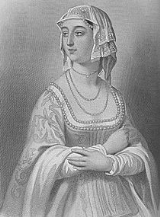
Margaret of Anjou

Encyclopedia
Margaret of Anjou (23 March 1430 – 25 August 1482) was the wife of King Henry VI of England
. As such, she was Queen consort of England from 1445 to 1461 and again from 1470 to 1471; and Queen consort of France from 1445 to 1453. Born in the Duchy of Lorraine, into the House of Valois-Anjou
, Margaret was the second eldest daughter of René I of Naples
and Isabella, Duchess of Lorraine
.
She was one of the principal figures in the series of dynastic civil wars known as the Wars of the Roses
, having led the Lancastrian faction
. Due to Henry's frequent bouts of insanity, Margaret ruled the kingdom in her husband's place. It was she who, in May 1455, called for a Great Council which excluded the Yorkist faction headed by Richard, Duke of York
, and thus provided the spark which ignited the civil conflict that lasted for over thirty years, decimated the old nobility, and caused the deaths of thousands of men, including her only son Edward of Westminster, Prince of Wales at the Battle of Tewkesbury
.
Margaret was taken prisoner by the victorious Yorkists after the Lancastrian defeat at Tewkesbury in May 1471; in 1475, she was ransomed by her cousin, Louis XI of France
. She went to live in France as a poor relation of the French king, and died there at the age of 52.
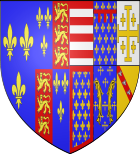 Margaret was born on 23 March 1430, in Pont-à-Mousson
in the Duchy of Lorraine, an Imperial fief east of France that was ruled by the cadet branch
of the French kings, the House of Valois-Anjou
. Margaret was the second eldest daughter of René I of Naples
, Duke of Anjou and Bar
, King of Naples and Sicily and Isabella, Duchess of Lorraine
.
On 23 April 1445, Margaret married King Henry VI of England
, who was eight years her senior, at Titchfield
in Hampshire. Henry at the time also claimed the Kingdom of France and controlled various parts of northern France. Margaret's uncle, Charles VII
, who also claimed the crown of France, agreed to the marriage of his niece to his rival on the condition that he would not have to provide the customary dowry and instead would receive the lands of Maine and Anjou
from the English.
Margaret was fifteen years old, and described as beautiful and "already a woman: passionate and proud and strong-willed", and knew her duty which was to fervently protect the interests of the Crown. She inherited this indomitability from her mother who fought to establish her husband's claim to the Kingdom of Naples
, and her paternal grandmother Yolande of Aragon
, who actually governed Anjou "with a man's hand", putting the province in order and keeping out the English. Thus by family example and her own forceful personality, she was fully capable of becoming the "champion of the Crown".
s. When he married Margaret, his mental condition was already unstable and by the time their only son, Edward of Westminster
, was born on 13 October 1453, he had suffered a complete breakdown. Rumours were rife that he was incapable of fathering a child and that the new Prince of Wales
was the result of an adulterous liaison. Many have speculated that either Edmund Beaufort, 2nd Duke of Somerset
or James Butler, Earl of Wiltshire, both staunch allies of Margaret, were the young prince's actual father. However, it is important to note that the political factions against her were intent on spreading the rumours to discredit Edward's claim to the throne; it is possible that Henry was the father of Edward.
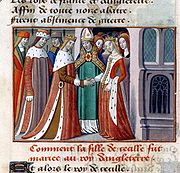 Although Margaret was aggressively partisan, feudal and had a volatile temperament, by dint of her cultured upbringing, she shared her husband's love of learning and gave her patronage to the founding of Queens' College at Cambridge University. Elizabeth Woodville
, future Queen of England, allegedly served as her Maid of Honour.
, Margaret was occupied with the care of her young son and did not display any signs of overt belligerence until she believed her husband was threatened with deposition by the ambitious Richard Plantagenet, 3rd Duke of York
who, to her consternation, had been appointed regent while Henry was mentally incapacitated from 1453 to 1454. The duke was a credible claimant to the English throne and by the end of his regency there were many powerful nobles and relatives prepared to back his claim. There are perhaps few episodes in English history that give so much room for speculation and debate, however, as the origins and the proper place of blame, if any, in the Wars of the Roses. The Duke of York was powerful; Henry's advisors corrupt; Henry himself trusting, pliable, and increasingly unstable; Margaret defiantly unpopular, grimly and gallantly determined to maintain the English crown for her progeny. Yet at least one scholar identifies the source of the eventual Lancastrian downfall not as York's ambitions nearly so much as Margaret's ill-judging enmity toward York and her over-indulgence in unpopular allies. Nevertheless, Queen Margaret was a powerful force in the world of politics. King Henry was putty in her hands when she wanted something done.
Margaret's biographer, Helen Maurer, however, disagrees with earlier historians having dated the much-vaunted enmity between the Queen and York to the time he obtained the office of the regency. She suggests the mutual antagonism came about two years later in 1455 in the wake of the First Battle of St. Albans when she perceived him as a challenge to the King's authority. She bases this on a judicious study of Margaret's pattern of presenting gifts; this revealed that Margaret took a great deal of care to demonstrate that she favoured both York and Somerset equally in the early 1450s. Maurer also claims that Margaret appeared to accept York's regency and asserts there is no substantial evidence to back up the long-standing belief that she was responsible for the Yorkists' exclusion from the Great Council following Henry's recovery. (see below)
Late academic and historian Paul Murray Kendall
, on the other hand, maintained that Margaret's allies, Somerset and William de la Pole
, then Earl of Suffolk, had no difficulty in persuading her that York, until then one of Henry VI's most trusted advisors, was responsible for her unpopularity and already too powerful to be trusted. Margaret not only convinced Henry to recall York from his post as governor in France and banish him instead to Ireland, she repeatedly attempted to have him assassinated during his travels to and from Ireland, once in 1449 and again in 1450. Somerset's and Suffolk's joint responsibility for the secret surrender of Maine in 1448, and then the subsequent disastrous loss of the rest of Normandy in 1449 embroiled Margaret and Henry's court in riots, and uprisings by the magnates, and calls for the impeachment and execution of Margaret's two strongest allies to that point. It also may have made an ultimate battle to the death between Margaret and the House of York inevitable, by making manifest Richard's dangerous popularity with the Commons. Richard of York, safely returned from Ireland in 1450, confronted Henry and was readmitted as a trusted advisor. Soon thereafter, Henry agreed to convene Parliament to address the calls for reform. When Parliament met, the demands could not have been less acceptable to Margaret: not only were both Somerset and Suffolk impeached for criminal mismanagement of French affairs and subverting justice, but it was charged as a crime against Suffolk (now a duke) that he had antagonised the King against the Duke of York. Further, the demands for reform put forward included that the Duke of York be acknowledged as the first councillor to the king, and the Speaker of Commons, perhaps with more fervour than wisdom, even proposed Richard, Duke of York, be recognised as heir to the throne. Within a few months, however, Margaret had regained control of Henry, Parliament was dissolved, the incautious Speaker thrown in prison for his troubles, and Richard of York retired to Wales for the time being.
In 1457, the kingdom was again outraged, when it was discovered that Pierre de Brézé
, a powerful French general and an adherent of Margaret, had landed on the English coast and burnt the town of Sandwich
, as leader of a French force of 4,000 men from Honfleur, aimed at taking advantage of the chaos in England. The mayor, John Drury, was killed in this raid. It thereafter became an established tradition, which survives to this day, that the Mayor of Sandwich wears a black robe mourning this ignoble deed. Margaret, in association with de Brézé, became the object of scurrilous rumours and vulgar ballads. Public indignation was so high that Margaret, with great reluctance, was forced to give the Duke of York's kinsman Richard Neville, 16th Earl of Warwick
a commission to keep the sea for three years. He already held the post of Captain of Calais.
to protect the king "against his enemies." York apparently was prepared for conflict and soon was marching south to meet the Lancastrian army marching north. The Lancastrians suffered a crushing defeat at the First Battle of St Albans
on 22 May 1455. Somerset was killed, Wiltshire fled the battlefield and King Henry was taken prisoner by the victorious Duke of York.
Although the king was captured, Margaret managed to escape and immediately began raising an army in Wales and the north of England, where she was assisted by Henry's half-brother, Jasper Tudor. In 1459, hostilities resumed at the Battle of Blore Heath
, where Margaret is said to have witnessed her commander, James Touchet, Lord Audley, defeated by a Yorkist army under Richard Neville, 5th Earl of Salisbury
.
, gained a major victory for her at the Battle of Wakefield
on 30 December 1460, by defeating the combined armies of Richard Plantagenet, Duke of York, and the Earl of Salisbury. Both men were beheaded and their heads displayed on the gates of the city of York. As Margaret was in Scotland at the time the battle had taken place, it was impossible that she issued the orders for their executions despite popular belief to the contrary. She followed up with a victory at the Second Battle of St Albans
(at which she was present) on 17 February 1461, where she defeated the Yorkist forces of Richard Neville, 16th Earl of Warwick
, and recaptured her husband. It was after this battle that she, in a blatant act of vengeance, ordered the execution of two Yorkist prisoners-of-war, William Bonville, 1st Baron Bonville
and Sir Thomas Kyriel, who had kept watch over King Henry to keep him out of harm's way during the battle. The King had promised the two knights immunity, but Margaret gainsaid him and ordered their executions by decapitation. It is alleged that she put the men on trial at which presided her son. "Fair son", she allegedly asked, "what death shall these knights die?", Prince Edward replied that their heads should be cut off, despite the King's pleas for mercy.
The Lancastrian army was beaten at the Battle of Towton
on 29 March 1461 by the son of the late Duke of York, Edward IV of England
, who deposed King Henry and proclaimed himself king. Margaret was determined to win back her son's inheritance, and fled with him into Wales
and later Scotland
. Finding her way to France, she made an ally of her cousin, King Louis XI of France
, and at his instigation she allowed an approach from Edward's former supporter, Richard Neville, Earl of Warwick, who had fallen out with his former friend, as a result of Edward's marriage to Elizabeth Woodville
and was now seeking revenge for the loss of his political influence. Warwick's daughter, Anne Neville
, was married to Margaret's son, Edward, Prince of Wales, in order to cement the alliance, and Margaret insisted that Warwick return to England to prove himself, before she followed. He did so, restoring Henry VI briefly to the throne on 3 October 1470.
on 14 April 1471. Margaret was forced to lead her own army at the Battle of Tewkesbury
on 4 May 1471, at which they were defeated and her seventeen-year old son was killed. The circumstances of Edward's death have never been made clear; and it is not known whether he was killed in the actual fighting or executed after the battle by the Duke of Clarence. He was the only Prince of Wales to die in battle. Over the previous ten years, Margaret had gained a reputation for aggression and ruthlessness, but following her defeat at Tewkesbury and the death of her only son, she was completely broken in spirit. After she was taken captive by William Stanley
at the end of the battle, Margaret was imprisoned by the order of King Edward. She was sent first to Wallingford Castle
and then was transferred to the more secure Tower of London
; in 1472 she was placed in the custody of her former lady-in-waiting Alice Chaucer
, Duchess of Suffolk, where she remained until ransomed by Louis XI in 1475.
of 1789.
, which comprised part of her dower lands. There is another letter which she wrote to the Archbishop of Canterbury
. The letters are compiled in a book edited by Cecil Monro, which was published for the Camden Society in 1863. Margaret typically headed her letters with the words "By the Quene".
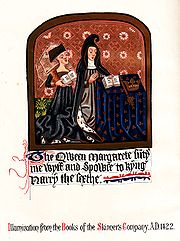
's three-part play Henry VI, Part 1
, Part 2
and Part 3
. She also appears as an old woman in Richard III
. Margaret is the title character of Giacomo Meyerbeer
's 1820 opera Margherita d'Anjou
.
She is also the subject of Betty King's 1974 biographical novel Margaret of Anjou, Alan Savage's 1994 novel Queen of Lions, Anne Powers' historical romance The Royal Consorts, and Susan Higginbotham
's 2011 novel The Queen of Last Hopes. Sharon Kay Penman
's novel The Sunne in Splendour
features her as an important character in the early parts of the book, up until the Battle of Tewkesbury
. Jean Plaidy's The Red Rose of Anjou also features her.
She also is the subject of a fictional biography, "The Royal Tigress" by a fictional character, David Powlett-Jones who is the main subject of R.F.Delderfield's novel of a Welsh schoolmaster at a Devon public school from The 1st world war to the battle of Britain in the 40s. Delderfield, in the person of Powlett-Jones, appears to have a very good grasp of Margaret's life and the wars of the roses and the content and development of the book give us an entertaining sub-plot to the books' main narrative.
Margaret is also a major character in "The Lady of the Rivers: A Novel" (The Cousins' War) by Phillipa Gregory. She is the main force in the life of Jacquetta (of Luxembourg)the Wife of Richard Woodville.
|-
|-
Henry VI of England
Henry VI was King of England from 1422 to 1461 and again from 1470 to 1471, and disputed King of France from 1422 to 1453. Until 1437, his realm was governed by regents. Contemporaneous accounts described him as peaceful and pious, not suited for the violent dynastic civil wars, known as the Wars...
. As such, she was Queen consort of England from 1445 to 1461 and again from 1470 to 1471; and Queen consort of France from 1445 to 1453. Born in the Duchy of Lorraine, into the House of Valois-Anjou
House of Valois-Anjou
The Valois House of Anjou, or the Younger House of Anjou, was a noble French family, deriving from the royal family, the House of Valois. They were monarchs of Naples, as well as various other territories....
, Margaret was the second eldest daughter of René I of Naples
René I of Naples
René of Anjou , also known as René I of Naples and Good King René , was Duke of Anjou, Count of Provence , Count of Piedmont, Duke of Bar , Duke of Lorraine , King of Naples , titular King of Jerusalem...
and Isabella, Duchess of Lorraine
Isabella, Duchess of Lorraine
Isabella was suo jure Duchess of Lorraine, from 25 January 1431 to her death in 1453. She was the first wife of Duke Rene of Anjou, King of Naples, and the mother of his children, which included Margaret of Anjou, Queen consort of England as the wife of Henry VI.From 1435 to 1442, Isabella was...
.
She was one of the principal figures in the series of dynastic civil wars known as the Wars of the Roses
Wars of the Roses
The Wars of the Roses were a series of dynastic civil wars for the throne of England fought between supporters of two rival branches of the royal House of Plantagenet: the houses of Lancaster and York...
, having led the Lancastrian faction
House of Lancaster
The House of Lancaster was a branch of the royal House of Plantagenet. It was one of the opposing factions involved in the Wars of the Roses, an intermittent civil war which affected England and Wales during the 15th century...
. Due to Henry's frequent bouts of insanity, Margaret ruled the kingdom in her husband's place. It was she who, in May 1455, called for a Great Council which excluded the Yorkist faction headed by Richard, Duke of York
Richard, Duke of York
Richard, Duke of York may refer to:*Richard Plantagenet, 3rd Duke of York , father of Edward IV of England and Richard III of England...
, and thus provided the spark which ignited the civil conflict that lasted for over thirty years, decimated the old nobility, and caused the deaths of thousands of men, including her only son Edward of Westminster, Prince of Wales at the Battle of Tewkesbury
Battle of Tewkesbury
The Battle of Tewkesbury, which took place on 4 May 1471, was one of the decisive battles of the Wars of the Roses. The forces loyal to the House of Lancaster were completely defeated by those of the rival House of York under their monarch, King Edward IV...
.
Margaret was taken prisoner by the victorious Yorkists after the Lancastrian defeat at Tewkesbury in May 1471; in 1475, she was ransomed by her cousin, Louis XI of France
Louis XI of France
Louis XI , called the Prudent , was the King of France from 1461 to 1483. He was the son of Charles VII of France and Mary of Anjou, a member of the House of Valois....
. She went to live in France as a poor relation of the French king, and died there at the age of 52.
Early life and marriage
Pont-à-Mousson
Pont-à-Mousson is a commune in the Meurthe-et-Moselle department in north-eastern France.Population : 14,592 . It is an industrial town , situated on the Moselle River...
in the Duchy of Lorraine, an Imperial fief east of France that was ruled by the cadet branch
Cadet branch
Cadet branch is a term in genealogy to describe the lineage of the descendants of the younger sons of a monarch or patriarch. In the ruling dynasties and noble families of much of Europe and Asia, the family's major assets – titles, realms, fiefs, property and income – have...
of the French kings, the House of Valois-Anjou
House of Valois-Anjou
The Valois House of Anjou, or the Younger House of Anjou, was a noble French family, deriving from the royal family, the House of Valois. They were monarchs of Naples, as well as various other territories....
. Margaret was the second eldest daughter of René I of Naples
René I of Naples
René of Anjou , also known as René I of Naples and Good King René , was Duke of Anjou, Count of Provence , Count of Piedmont, Duke of Bar , Duke of Lorraine , King of Naples , titular King of Jerusalem...
, Duke of Anjou and Bar
Counts and dukes of Bar
Bar was a historic duchy of both the Holy Roman Empire and the crown of France, though later totally incorporated with Lorraine into France in 1766. The duchy of Bar includes the "pays" of Barrois.- History :...
, King of Naples and Sicily and Isabella, Duchess of Lorraine
Isabella, Duchess of Lorraine
Isabella was suo jure Duchess of Lorraine, from 25 January 1431 to her death in 1453. She was the first wife of Duke Rene of Anjou, King of Naples, and the mother of his children, which included Margaret of Anjou, Queen consort of England as the wife of Henry VI.From 1435 to 1442, Isabella was...
.
On 23 April 1445, Margaret married King Henry VI of England
Henry VI of England
Henry VI was King of England from 1422 to 1461 and again from 1470 to 1471, and disputed King of France from 1422 to 1453. Until 1437, his realm was governed by regents. Contemporaneous accounts described him as peaceful and pious, not suited for the violent dynastic civil wars, known as the Wars...
, who was eight years her senior, at Titchfield
Titchfield
Titchfield is a village in southern Hampshire, by the River Meon. The village has a history stretching back to the 6th century. During the medieval period, the village operated a small port and market...
in Hampshire. Henry at the time also claimed the Kingdom of France and controlled various parts of northern France. Margaret's uncle, Charles VII
Charles VII of France
Charles VII , called the Victorious or the Well-Served , was King of France from 1422 to his death, though he was initially opposed by Henry VI of England, whose Regent, the Duke of Bedford, ruled much of France including the capital, Paris...
, who also claimed the crown of France, agreed to the marriage of his niece to his rival on the condition that he would not have to provide the customary dowry and instead would receive the lands of Maine and Anjou
Anjou
Anjou is a former county , duchy and province centred on the city of Angers in the lower Loire Valley of western France. It corresponds largely to the present-day département of Maine-et-Loire...
from the English.
Margaret was fifteen years old, and described as beautiful and "already a woman: passionate and proud and strong-willed", and knew her duty which was to fervently protect the interests of the Crown. She inherited this indomitability from her mother who fought to establish her husband's claim to the Kingdom of Naples
Kingdom of Naples
The Kingdom of Naples, comprising the southern part of the Italian peninsula, was the remainder of the old Kingdom of Sicily after secession of the island of Sicily as a result of the Sicilian Vespers rebellion of 1282. Known to contemporaries as the Kingdom of Sicily, it is dubbed Kingdom of...
, and her paternal grandmother Yolande of Aragon
Yolande of Aragon
Yolande of Aragon, , was a throne claimant and titular queen regnant of Aragon, titular queen consort of Naples, Duchess of Anjou, Countess of Provence, and regent of Provence during the minority of her son...
, who actually governed Anjou "with a man's hand", putting the province in order and keeping out the English. Thus by family example and her own forceful personality, she was fully capable of becoming the "champion of the Crown".
Birth of a son
Henry, who was more interested in religion and learning than military matters, was not a successful king. He had reigned since he was only a few months old and his actions had been controlled by regentRegent
A regent, from the Latin regens "one who reigns", is a person selected to act as head of state because the ruler is a minor, not present, or debilitated. Currently there are only two ruling Regencies in the world, sovereign Liechtenstein and the Malaysian constitutive state of Terengganu...
s. When he married Margaret, his mental condition was already unstable and by the time their only son, Edward of Westminster
Edward of Westminster
Edward of Westminster , also known as Edward of Lancaster, was the only son of King Henry VI of England and Margaret of Anjou...
, was born on 13 October 1453, he had suffered a complete breakdown. Rumours were rife that he was incapable of fathering a child and that the new Prince of Wales
Prince of Wales
Prince of Wales is a title traditionally granted to the heir apparent to the reigning monarch of the United Kingdom of Great Britain and Northern Ireland and the 15 other independent Commonwealth realms...
was the result of an adulterous liaison. Many have speculated that either Edmund Beaufort, 2nd Duke of Somerset
Edmund Beaufort, 2nd Duke of Somerset
Edmund Beaufort, 2nd Duke of Somerset, KG , sometimes styled 1st Duke of Somerset, was an English nobleman and an important figure in the Wars of the Roses and in the Hundred Years' War...
or James Butler, Earl of Wiltshire, both staunch allies of Margaret, were the young prince's actual father. However, it is important to note that the political factions against her were intent on spreading the rumours to discredit Edward's claim to the throne; it is possible that Henry was the father of Edward.
Elizabeth Woodville
Elizabeth Woodville was Queen consort of England as the spouse of King Edward IV from 1464 until his death in 1483. Elizabeth was a key figure in the series of dynastic civil wars known as the Wars of the Roses. Her first husband, Sir John Grey of Groby was killed at the Second Battle of St Albans...
, future Queen of England, allegedly served as her Maid of Honour.
Enmity between Margaret and the Duke of York
After retiring from London to live in lavish state at GreenwichGreenwich
Greenwich is a district of south London, England, located in the London Borough of Greenwich.Greenwich is best known for its maritime history and for giving its name to the Greenwich Meridian and Greenwich Mean Time...
, Margaret was occupied with the care of her young son and did not display any signs of overt belligerence until she believed her husband was threatened with deposition by the ambitious Richard Plantagenet, 3rd Duke of York
Richard Plantagenet, 3rd Duke of York
Richard Plantagenêt, 3rd Duke of York, 6th Earl of March, 4th Earl of Cambridge, and 7th Earl of Ulster, conventionally called Richard of York was a leading English magnate, great-grandson of King Edward III...
who, to her consternation, had been appointed regent while Henry was mentally incapacitated from 1453 to 1454. The duke was a credible claimant to the English throne and by the end of his regency there were many powerful nobles and relatives prepared to back his claim. There are perhaps few episodes in English history that give so much room for speculation and debate, however, as the origins and the proper place of blame, if any, in the Wars of the Roses. The Duke of York was powerful; Henry's advisors corrupt; Henry himself trusting, pliable, and increasingly unstable; Margaret defiantly unpopular, grimly and gallantly determined to maintain the English crown for her progeny. Yet at least one scholar identifies the source of the eventual Lancastrian downfall not as York's ambitions nearly so much as Margaret's ill-judging enmity toward York and her over-indulgence in unpopular allies. Nevertheless, Queen Margaret was a powerful force in the world of politics. King Henry was putty in her hands when she wanted something done.
Margaret's biographer, Helen Maurer, however, disagrees with earlier historians having dated the much-vaunted enmity between the Queen and York to the time he obtained the office of the regency. She suggests the mutual antagonism came about two years later in 1455 in the wake of the First Battle of St. Albans when she perceived him as a challenge to the King's authority. She bases this on a judicious study of Margaret's pattern of presenting gifts; this revealed that Margaret took a great deal of care to demonstrate that she favoured both York and Somerset equally in the early 1450s. Maurer also claims that Margaret appeared to accept York's regency and asserts there is no substantial evidence to back up the long-standing belief that she was responsible for the Yorkists' exclusion from the Great Council following Henry's recovery. (see below)
Late academic and historian Paul Murray Kendall
Paul Murray Kendall
Paul Murray Kendall was an American academic and historian. He was born in Philadelphia, Pennsylvania. He graduated from Frankford High School in 1928. In 1932 he received an Bachelor of Arts from the University of Virginia. He received an Master's degree in 1933, also from U of V...
, on the other hand, maintained that Margaret's allies, Somerset and William de la Pole
William de la Pole, 1st Duke of Suffolk
William de la Pole, 1st Duke of Suffolk, KG , nicknamed Jack Napes , was an important English soldier and commander in the Hundred Years' War, and later Lord Chamberlain of England.He also appears prominently in William Shakespeare's Henry VI, part 1 and Henry VI, part 2 and other...
, then Earl of Suffolk, had no difficulty in persuading her that York, until then one of Henry VI's most trusted advisors, was responsible for her unpopularity and already too powerful to be trusted. Margaret not only convinced Henry to recall York from his post as governor in France and banish him instead to Ireland, she repeatedly attempted to have him assassinated during his travels to and from Ireland, once in 1449 and again in 1450. Somerset's and Suffolk's joint responsibility for the secret surrender of Maine in 1448, and then the subsequent disastrous loss of the rest of Normandy in 1449 embroiled Margaret and Henry's court in riots, and uprisings by the magnates, and calls for the impeachment and execution of Margaret's two strongest allies to that point. It also may have made an ultimate battle to the death between Margaret and the House of York inevitable, by making manifest Richard's dangerous popularity with the Commons. Richard of York, safely returned from Ireland in 1450, confronted Henry and was readmitted as a trusted advisor. Soon thereafter, Henry agreed to convene Parliament to address the calls for reform. When Parliament met, the demands could not have been less acceptable to Margaret: not only were both Somerset and Suffolk impeached for criminal mismanagement of French affairs and subverting justice, but it was charged as a crime against Suffolk (now a duke) that he had antagonised the King against the Duke of York. Further, the demands for reform put forward included that the Duke of York be acknowledged as the first councillor to the king, and the Speaker of Commons, perhaps with more fervour than wisdom, even proposed Richard, Duke of York, be recognised as heir to the throne. Within a few months, however, Margaret had regained control of Henry, Parliament was dissolved, the incautious Speaker thrown in prison for his troubles, and Richard of York retired to Wales for the time being.
In 1457, the kingdom was again outraged, when it was discovered that Pierre de Brézé
Pierre de Brézé
Pierre de Brézé was a French soldier and politician in the service of King Charles VII. He had made his name in the English wars when in 1433 he joined with Yolande, queen of Sicily, the constable Richmond and others, in chasing from power Charles VII's minister La Trémoille...
, a powerful French general and an adherent of Margaret, had landed on the English coast and burnt the town of Sandwich
Sandwich, Kent
Sandwich is a historic town and civil parish on the River Stour in the Non-metropolitan district of Dover, within the ceremonial county of Kent, south-east England. It has a population of 6,800....
, as leader of a French force of 4,000 men from Honfleur, aimed at taking advantage of the chaos in England. The mayor, John Drury, was killed in this raid. It thereafter became an established tradition, which survives to this day, that the Mayor of Sandwich wears a black robe mourning this ignoble deed. Margaret, in association with de Brézé, became the object of scurrilous rumours and vulgar ballads. Public indignation was so high that Margaret, with great reluctance, was forced to give the Duke of York's kinsman Richard Neville, 16th Earl of Warwick
Richard Neville, 16th Earl of Warwick
Richard Neville KG, jure uxoris 16th Earl of Warwick and suo jure 6th Earl of Salisbury and 8th and 5th Baron Montacute , known as Warwick the Kingmaker, was an English nobleman, administrator, and military commander...
a commission to keep the sea for three years. He already held the post of Captain of Calais.
Leader of Lancastrian faction
Hostilities between the rival Yorkist and Lancastrian factions soon flared into armed conflict. In May 1455, just over five months after Henry VI recovered from a bout of mental illness and Richard of York's regency had ended, Margaret called for a Great Council from which the Yorkists were excluded. The Council called for an assemblage of the peers at LeicesterLeicester
Leicester is a city and unitary authority in the East Midlands of England, and the county town of Leicestershire. The city lies on the River Soar and at the edge of the National Forest...
to protect the king "against his enemies." York apparently was prepared for conflict and soon was marching south to meet the Lancastrian army marching north. The Lancastrians suffered a crushing defeat at the First Battle of St Albans
First Battle of St Albans
The First Battle of St Albans, fought on 22 May 1455 at St Albans, 22 miles north of London, traditionally marks the beginning of the Wars of the Roses. Richard, Duke of York and his ally, Richard Neville, Earl of Warwick, defeated the Lancastrians under Edmund, Duke of Somerset, who was killed...
on 22 May 1455. Somerset was killed, Wiltshire fled the battlefield and King Henry was taken prisoner by the victorious Duke of York.
Although the king was captured, Margaret managed to escape and immediately began raising an army in Wales and the north of England, where she was assisted by Henry's half-brother, Jasper Tudor. In 1459, hostilities resumed at the Battle of Blore Heath
Battle of Blore Heath
The Battle of Blore Heath was the first major battle in the English Wars of the Roses. It was fought on 23 September 1459, at Blore Heath in Staffordshire, two miles east of the town of Market Drayton in Shropshire, England.- Background :...
, where Margaret is said to have witnessed her commander, James Touchet, Lord Audley, defeated by a Yorkist army under Richard Neville, 5th Earl of Salisbury
Richard Neville, 5th Earl of Salisbury
Richard Neville, jure uxoris 5th Earl of Salisbury and 7th and 4th Baron Montacute, KG, PC was a Yorkist leader during the early parts of the Wars of the Roses.-Background:...
.
Military campaigns
While she was attempting to raise further support for the Lancastrian cause in Scotland, her principal commander, Henry Beaufort, 3rd Duke of SomersetHenry Beaufort, 3rd Duke of Somerset
Henry Beaufort, 3rd Duke of Somerset was an important Lancastrian military commander during the English Wars of the Roses. He is sometimes numbered the 2nd Duke of Somerset, since the title was re-created for his father after his uncle died...
, gained a major victory for her at the Battle of Wakefield
Battle of Wakefield
The Battle of Wakefield took place at Sandal Magna near Wakefield, in West Yorkshire in Northern England, on 30 December 1460. It was a major battle of the Wars of the Roses...
on 30 December 1460, by defeating the combined armies of Richard Plantagenet, Duke of York, and the Earl of Salisbury. Both men were beheaded and their heads displayed on the gates of the city of York. As Margaret was in Scotland at the time the battle had taken place, it was impossible that she issued the orders for their executions despite popular belief to the contrary. She followed up with a victory at the Second Battle of St Albans
Second Battle of St Albans
The Second Battle of St Albans was a battle of the English Wars of the Roses fought on 17 February, 1461, at St Albans. The army of the Yorkist faction under the Earl of Warwick attempted to bar the road to London north of the town. The rival Lancastrian army used a wide outflanking manoeuvre to...
(at which she was present) on 17 February 1461, where she defeated the Yorkist forces of Richard Neville, 16th Earl of Warwick
Richard Neville, 16th Earl of Warwick
Richard Neville KG, jure uxoris 16th Earl of Warwick and suo jure 6th Earl of Salisbury and 8th and 5th Baron Montacute , known as Warwick the Kingmaker, was an English nobleman, administrator, and military commander...
, and recaptured her husband. It was after this battle that she, in a blatant act of vengeance, ordered the execution of two Yorkist prisoners-of-war, William Bonville, 1st Baron Bonville
William Bonville, 1st Baron Bonville
William Bonville, 1st Baron Bonville, KG was an English nobleman, soldier, and administrator. He was a staunch Yorkist supporter during the Wars of the Roses, and he was executed following the Yorkist defeat at the Second Battle of St Albans, by the orders of Queen consort Margaret of Anjou...
and Sir Thomas Kyriel, who had kept watch over King Henry to keep him out of harm's way during the battle. The King had promised the two knights immunity, but Margaret gainsaid him and ordered their executions by decapitation. It is alleged that she put the men on trial at which presided her son. "Fair son", she allegedly asked, "what death shall these knights die?", Prince Edward replied that their heads should be cut off, despite the King's pleas for mercy.
The Lancastrian army was beaten at the Battle of Towton
Battle of Towton
In 1461, England was in the sixth year of the Wars of the Roses, a series of civil wars between the Houses of York and Lancaster over the English throne. The Lancastrians backed the reigning King of England, Henry VI, an indecisive man who suffered bouts of madness...
on 29 March 1461 by the son of the late Duke of York, Edward IV of England
Edward IV of England
Edward IV was King of England from 4 March 1461 until 3 October 1470, and again from 11 April 1471 until his death. He was the first Yorkist King of England...
, who deposed King Henry and proclaimed himself king. Margaret was determined to win back her son's inheritance, and fled with him into Wales
Wales
Wales is a country that is part of the United Kingdom and the island of Great Britain, bordered by England to its east and the Atlantic Ocean and Irish Sea to its west. It has a population of three million, and a total area of 20,779 km²...
and later Scotland
Scotland
Scotland is a country that is part of the United Kingdom. Occupying the northern third of the island of Great Britain, it shares a border with England to the south and is bounded by the North Sea to the east, the Atlantic Ocean to the north and west, and the North Channel and Irish Sea to the...
. Finding her way to France, she made an ally of her cousin, King Louis XI of France
Louis XI of France
Louis XI , called the Prudent , was the King of France from 1461 to 1483. He was the son of Charles VII of France and Mary of Anjou, a member of the House of Valois....
, and at his instigation she allowed an approach from Edward's former supporter, Richard Neville, Earl of Warwick, who had fallen out with his former friend, as a result of Edward's marriage to Elizabeth Woodville
Elizabeth Woodville
Elizabeth Woodville was Queen consort of England as the spouse of King Edward IV from 1464 until his death in 1483. Elizabeth was a key figure in the series of dynastic civil wars known as the Wars of the Roses. Her first husband, Sir John Grey of Groby was killed at the Second Battle of St Albans...
and was now seeking revenge for the loss of his political influence. Warwick's daughter, Anne Neville
Anne Neville
Lady Anne Neville was Princess of Wales as the wife of Edward of Westminster and Queen of England as the consort of King Richard III. She held the latter title for less than two years, from 26 June 1483 until her death in March 1485...
, was married to Margaret's son, Edward, Prince of Wales, in order to cement the alliance, and Margaret insisted that Warwick return to England to prove himself, before she followed. He did so, restoring Henry VI briefly to the throne on 3 October 1470.
Defeat at Tewkesbury
By the time Margaret, her son and daughter-in-law were ready to follow Warwick back to England, the tables had again turned in favour of the Yorkists, and the Earl had been defeated and killed by the returning King Edward IV in the Battle of BarnetBattle of Barnet
The Battle of Barnet was a decisive engagement in the Wars of the Roses, a dynastic conflict of 15th-century England. The military action, along with the subsequent Battle of Tewkesbury, secured the throne for Edward IV...
on 14 April 1471. Margaret was forced to lead her own army at the Battle of Tewkesbury
Battle of Tewkesbury
The Battle of Tewkesbury, which took place on 4 May 1471, was one of the decisive battles of the Wars of the Roses. The forces loyal to the House of Lancaster were completely defeated by those of the rival House of York under their monarch, King Edward IV...
on 4 May 1471, at which they were defeated and her seventeen-year old son was killed. The circumstances of Edward's death have never been made clear; and it is not known whether he was killed in the actual fighting or executed after the battle by the Duke of Clarence. He was the only Prince of Wales to die in battle. Over the previous ten years, Margaret had gained a reputation for aggression and ruthlessness, but following her defeat at Tewkesbury and the death of her only son, she was completely broken in spirit. After she was taken captive by William Stanley
William Stanley (Battle of Bosworth)
Sir William Stanley was an English soldier and the younger brother of Thomas Stanley, 1st Earl of Derby. Stanley fought with his troops in several battles of the Wars of the Roses.-Private life:...
at the end of the battle, Margaret was imprisoned by the order of King Edward. She was sent first to Wallingford Castle
Wallingford Castle
Wallingford Castle was a major medieval castle situated in Wallingford in the English county of Oxfordshire , adjacent to the River Thames...
and then was transferred to the more secure Tower of London
Tower of London
Her Majesty's Royal Palace and Fortress, more commonly known as the Tower of London, is a historic castle on the north bank of the River Thames in central London, England. It lies within the London Borough of Tower Hamlets, separated from the eastern edge of the City of London by the open space...
; in 1472 she was placed in the custody of her former lady-in-waiting Alice Chaucer
Alice de la Pole
Alice de la Pole, Duchess of Suffolk was an English Lady of the Most Noble Order of the Garter.Alice was born Alice Chaucer, daughter to Thomas Chaucer and Matilda Burghersh. Her grandfather was the poet Geoffrey Chaucer. When she was 11 she married Sir John Philip. The couple lived briefly at...
, Duchess of Suffolk, where she remained until ransomed by Louis XI in 1475.
Death
She lived in France for the next seven years as a poor relation of the king. She died on 25 August 1482, at the age of fifty-two, in Anjou. She was entombed next to her parents in the cathedral of Angers. Her remains were removed and scattered by revolutionaries who ransacked the cathedral during the French RevolutionFrench Revolution
The French Revolution , sometimes distinguished as the 'Great French Revolution' , was a period of radical social and political upheaval in France and Europe. The absolute monarchy that had ruled France for centuries collapsed in three years...
of 1789.
Margaret's letters
There are many letters extant written by Margaret during her tenure as queen consort. One was written to the Corporation of London regarding injuries done to her tenants at the manor of EnfieldLondon Borough of Enfield
The London Borough of Enfield is the most northerly London borough and forms part of Outer London. It borders the London Boroughs of Barnet, Haringey and Waltham Forest...
, which comprised part of her dower lands. There is another letter which she wrote to the Archbishop of Canterbury
Archbishop of Canterbury
The Archbishop of Canterbury is the senior bishop and principal leader of the Church of England, the symbolic head of the worldwide Anglican Communion, and the diocesan bishop of the Diocese of Canterbury. In his role as head of the Anglican Communion, the archbishop leads the third largest group...
. The letters are compiled in a book edited by Cecil Monro, which was published for the Camden Society in 1863. Margaret typically headed her letters with the words "By the Quene".
Ancestors
Depictions in fiction
Margaret is a major character in William ShakespeareWilliam Shakespeare
William Shakespeare was an English poet and playwright, widely regarded as the greatest writer in the English language and the world's pre-eminent dramatist. He is often called England's national poet and the "Bard of Avon"...
's three-part play Henry VI, Part 1
Henry VI, part 1
Henry VI, Part 1 or The First Part of Henry the Sixt is a history play by William Shakespeare, and possibly Thomas Nashe, believed to have been written in 1591, and set during the lifetime of King Henry VI of England...
, Part 2
Henry VI, part 2
Henry VI, Part 2 or The Second Part of Henry the Sixt is a history play by William Shakespeare believed to have been written in 1591, and set during the lifetime of King Henry VI of England...
and Part 3
Henry VI, part 3
Henry VI, Part 3 or The Third Part of Henry the Sixt is a history play by William Shakespeare believed to have been written in 1591, and set during the lifetime of King Henry VI of England...
. She also appears as an old woman in Richard III
Richard III (play)
Richard III is a history play by William Shakespeare, believed to have been written in approximately 1591. It depicts the Machiavellian rise to power and subsequent short reign of Richard III of England. The play is grouped among the histories in the First Folio and is most often classified...
. Margaret is the title character of Giacomo Meyerbeer
Giacomo Meyerbeer
Giacomo Meyerbeer was a noted German opera composer, and the first great exponent of "grand opera." At his peak in the 1830s and 1840s, he was the most famous and successful composer of opera in Europe, yet he is rarely performed today.-Early years:He was born to a Jewish family in Tasdorf , near...
's 1820 opera Margherita d'Anjou
Margherita d'Anjou
Margherita d’Anjou is an operatic melodramma semiseria in two acts by Giacomo Meyerbeer. The Italian libretto was by Felice Romani after a text by René Charles Guilbert de Pixérécourt. It is the fourth of Meyerbeer's Italian operas and his first real success.-Performance history:Margherita d’Anjou...
.
She is also the subject of Betty King's 1974 biographical novel Margaret of Anjou, Alan Savage's 1994 novel Queen of Lions, Anne Powers' historical romance The Royal Consorts, and Susan Higginbotham
Susan Higginbotham
Susan Higginbotham is an American historical fiction author. She has written on the Middle Ages and the Wars of the Roses.-Publishing career:...
's 2011 novel The Queen of Last Hopes. Sharon Kay Penman
Sharon Kay Penman
Sharon Kay Penman is an American historical novelist, published in the UK as Sharon Penman. She is best known for the Welsh Princes trilogy and the Plantagenet series. In addition, she has written four medieval mysteries, the first of which, The Queen's Man, was a finalist in 1996 for the Best...
's novel The Sunne in Splendour
The Sunne in Splendour
The Sunne in Splendour is historical novel written by Sharon Kay Penman. Penman became interested in the subject while a student and wrote a manuscript that was stolen from her car. She rewrote the manuscript which was published in 1982.- Background :...
features her as an important character in the early parts of the book, up until the Battle of Tewkesbury
Battle of Tewkesbury
The Battle of Tewkesbury, which took place on 4 May 1471, was one of the decisive battles of the Wars of the Roses. The forces loyal to the House of Lancaster were completely defeated by those of the rival House of York under their monarch, King Edward IV...
. Jean Plaidy's The Red Rose of Anjou also features her.
She also is the subject of a fictional biography, "The Royal Tigress" by a fictional character, David Powlett-Jones who is the main subject of R.F.Delderfield's novel of a Welsh schoolmaster at a Devon public school from The 1st world war to the battle of Britain in the 40s. Delderfield, in the person of Powlett-Jones, appears to have a very good grasp of Margaret's life and the wars of the roses and the content and development of the book give us an entertaining sub-plot to the books' main narrative.
Margaret is also a major character in "The Lady of the Rivers: A Novel" (The Cousins' War) by Phillipa Gregory. She is the main force in the life of Jacquetta (of Luxembourg)the Wife of Richard Woodville.
Further reading
- Maurer, Helen E. Margaret of Anjou: Queenship and Power in Late Medieval England. Boydell Press, 2003.
- Abott, Jacob. History of Margaret of Anjou, Queen of Henry VI of England. Reproduction of 1871 text by Kessinger Press, 2004.
- Bagley, J.J. Margaret of Anjou, Queen of England. Herbert Jenkins, London, 1948.
|-
|-