
In Depth
See Also

Order of the Garter

The Most Noble Order of the Garter is an English England

England is the largest and most populous constituent country [i] of the United Kingdom [i]. ... 

 order of chivalry Chivalry

Chivalry refers to the medieval [i] institution of knighthood [i] and, most especially, the ideals that ... 

 with a history stretching back to medi?val Middle Ages

The Middle Ages formed the middle period in a traditional schematic division of European history [i] ... 

 times; today it is the world's oldest national order of knighthood in continuous existence and the pinnacle of the British honours system. Its membership is extremely limited, consisting of the Sovereign British monarchy

The British monarch or Sovereign is the head of state [i] of the United Kingdom [i] and in the British overseas territories [i] ... 

 and not more than twenty-five full members, or Companions. Male members are known as Knights Companion, whilst female members are known as Ladies Companion . The Order can also include certain extra members , known as "Supernumerary" Knights and Ladies.

Discussions

  Discussion Features

   Ask a question about 'Order of the Garter'

   Start a new discussion about 'Order of the Garter'

   Answer questions about 'Order of the Garter'

   'Order of the Garter' discussion forum

Timeline

1348   Edward III Edward III of England

Edward III was one of the most successful English [i] kings [i] of medieval [i] times. ... 

 of England England

England is the largest and most populous constituent country [i] of the United Kingdom [i]. ... 

 creates the first English order of chivalry, the Order of the Garter

1352   Reginald de Cobham, 1st Baron Cobham becomes a Companion of the Most Noble Order of the Garter Order of the Garter

The Most Noble Order of the Garter is an English [i] order of chivalry [i] with a history stretc ... 

 of England England

England is the largest and most populous constituent country [i] of the United Kingdom [i]. ... 

.

1902   Order of the Garter conferred on Archduke Franz Ferdinand of Austria Archduke Franz Ferdinand of Austria

Franz Ferdinand, Archduke of Austria-Este was an Archduke [i] of Austria [i], Prince Imperial of Austr ... 

.

1987   The Order of the Garter is opened to women.


Encyclopedia


The Most Noble Order of the Garter is an English England

England is the largest and most populous constituent country [i] of the United Kingdom [i]. ... 

 order of chivalry Chivalry

Chivalry refers to the medieval [i] institution of knighthood [i] and, most especially, the ideals that... 

 with a history stretching back to mediæval Middle Ages

The Middle Ages formed the middle period in a traditional schematic division of European history [i] ... 

 times; today it is the world's oldest national order of knighthood in continuous existence and the pinnacle of the British honours system. Its membership is extremely limited, consisting of the Sovereign British monarchy

The British monarch or Sovereign is the head of state [i] of the United Kingdom [i] and in the British overseas territories [i] ... 

 and not more than twenty-five full members, or Companions. Male members are known as Knights Companion, whilst female members are known as Ladies Companion . The Order can also include certain extra members , known as "Supernumerary" Knights and Ladies. The Sovereign alone grants membership to the Order; by convention the Prime Minister does not tender binding advice as to appointments, as he or she does for most other orders. Thus, membership of the order is regarded as being the Sovereign's gift. Except for the grants of supranumerary membership, awards are only made for those with an exceptional record of service to the United Kingdom.

As the name suggests, the Order's primary emblem is a garter bearing the motto Honi soit qui mal y pense in gold letters. The Garter is an actual accessory worn by the members of the Order during ceremonial occasions. It is also depicted on several insignia, including British coins.

Most British orders of chivalry cover the entire kingdom, but the three most exalted ones each pertain to one constituent nation only. The Order of the Garter, which pertains to England England

England is the largest and most populous constituent country [i] of the United Kingdom [i]. ... 

, is most senior in both age and precedence; its equivalent in Scotland Scotland

Scotland is a nation [i] in northwest Europe [i] and one of the constituent [i] countries [i] ... 

 is The Most Ancient and Most Noble Order of the Thistle Order of the Thistle

The Most Ancient and Most Noble Order of the Thistle is an order of chivalry [i] associated with Scotland [i]... 

. While the Order of the Thistle was certainly in existence by the sixteenth century and possibly has mediæval origins , the foundation of the institution in its modern form dates to 1687. In 1783 an Irish equivalent, The Most Illustrious Order of St Patrick Order of St. Patrick

The Most Illustrious Order of Saint Patrick is an order of chivalry [i] associated with Ireland [i]. ... 

, was founded, but since the independence of the greater part of Ireland Ireland

Ireland is the third largest [i] island [i] in Europe [i]. ... 

 the Order has fallen dormant .

History


The Order was founded in 1348 by King Edward III Edward III of England

Edward III was one of the most successful English [i] kings [i] of medieval [i] times. ... 

 as "a society, fellowship and college of knights." Various dates ranging from 1344 to 1351 have also been proposed. The wardrobe account of the king first shows Garter habits issued in the autumn of 1348. Regardless, the Order was probably not constituted before 1346; the original statutes required that each member already be a knight and several initial members of the Order were knighted then.

Various legends have been described to explain the origin of the Order. The most popular legend involves the "Countess of Salisbury" . While she was dancing with or near King Edward at Eltham Palace Eltham Palace

Eltham Palace is an Art Deco [i] house in Eltham, London [i], currently owned by English Heritage [i] an ... 

, her garter is said to have slipped from her leg to the floor. When the surrounding courtiers sniggered, the king supposedly picked it up and tied it to his own leg, exclaiming "Honi soit qui mal y pense" . This phrase has become the motto of the Order. According to another legend, King Richard I Richard I of England

Richard I was King of England [i] from 1189 [i] to 1199 [i].... 

 was inspired in the 12th century by St George the Martyr while fighting in the Crusades Crusades

The Crusades were a series of military campaigns waged in the name of Christendom [i] This term refers t ... 

 to tie garters around the legs of his knights, who subsequently won the battle. King Edward III supposedly recalled the event in the 14th century when he founded the Order.

Soon after the founding of the Order, many women were appointed "Ladies of the Garter," but were not knighted as companions. King Henry VII Henry VII of England

Henry VII , King of England [i], Lord of Ireland [i] , was the fo ... 

 stopped the practice in 1488 and created no more Ladies of the Garter after his mother Margaret Beaufort Margaret Beaufort

Margaret Beaufort was the daughter of John Beaufort, 1st Duke of Somerset [i] and Margaret Beauchamp of Bletso [i] ... 

. The Order was thereafter exclusively male until 1901, when King Edward VII Edward VII of the United Kingdom

Edward VII was King [i] of the United Kingdom of Great Britain and Ireland [i], King of the Commonwealth Realms [i] ... 

 created his wife Queen Alexandra Alexandra of Denmark

Queen Alexandra of the United Kingdom , was Queen Consort [i] to Edward VII of the United Kingdom [i] ... 

 a Lady of the Garter. The same occurred when King George V made his consort Queen Mary Queen Mary

Queen Mary, Queen Marie, or Queen Maria may refer to:
... 

 a Lady of the Garter and subsequently King George VI George VI of the United Kingdom

George VI became the King of the United Kingdom of Great Britain and Northern Ireland [i] ... 

 made his consort Queen Elizabeth Elizabeth Bowes-Lyon

The Lady Elizabeth Bowes-Lyon was the Queen Consort [i] of King George VI [i] ... 

 also a Lady of the Garter. Throughout the 20th century, women continued to be associated with the Order, but except for foreign female monarchs, they were not companions. In 1987, however, it became possible to install "Ladies Companion of the Garter" under a statute of Queen Elizabeth II Elizabeth II of the United Kingdom

}
|-
|
|}
Elizabeth II is the Queen [i] of 16 independent sovereign [i] state [i] ... 

.

The Order


Members

Membership of the Order is extremely limited and includes the monarch British monarchy

The British monarch or Sovereign is the head of state [i] of the United Kingdom [i] and in the British overseas territories [i] ... 

 of the United Kingdom, the Prince of Wales, not more than twenty-four companion members, and various supernumerary members. The monarch of the United Kingdom is known as the "Sovereign of the Garter" and the Prince of Wales is known as a "Knight Companion of the Garter." The monarch alone can grant membership.

Male members of the Order are known as "Knights Companion," while female ones are known as "Ladies Companion." Formerly, vacancies were filled by the Sovereign upon the nomination of the members. Each member would nominate nine candidates . The Sovereign would then choose as many nominees as were necessary to fill any vacancies that developed in the Order; he was not obliged to choose those who received the most nominations. Queen Victoria Victoria of the United Kingdom

Victoria was the Queen [i] of the United Kingdom of Great Britain and Ireland [i] ... 

 dispensed with the procedure in 1862. Appointments have since been made by the Sovereign acting alone, without any prior nominations.

Since the 18th century, the Sovereign made his or her choices upon the advice of the Government. However, King George VI George VI of the United Kingdom

George VI became the King of the United Kingdom of Great Britain and Northern Ireland [i] ... 

 believed in 1946 that the Order of the Garter and the Order of the Thistle had become too linked with political patronage. With the agreement of the Prime Minister and the Leader of the Opposition, membership of these two orders became a personal gift of the Sovereign. Thus, the Sovereign personally selects Knights and Ladies Companion of the Garter, and need not act upon the advice of the Government.

In addition, the Order includes several "supernumerary" members, who do not count towards the limit of twenty-four companions. Several supernumerary members belong to the royal family British Royal Family

Close relatives of the monarch [i] of the United Kingdom [i] are known by the appell ... 

; these members are known as "Royal Knights and Ladies of the Garter." This title was introduced in 1786 by King George III George III of the United Kingdom

George III was King of Great Britain [i] and King of Ireland [i] from 25 October [i] ... 

 so that his many sons would not count towards the limit of twenty-four companions. He created the statute of supernumerary members in 1805 so that any descendant of King George II George II of Great Britain

George II was King of Great Britain [i] and Ireland [i], Duke of Brunswick-Lneburg [i] ... 

 could be created such a member. This statute was extended again in 1831 to all descendants of King George I George I of Great Britain

George I was Elector of Hanover [i] from 23 January [i] 1698 [i], and King of Great Britain [i] ... 

.

Supernumerary membership may also be extended to foreign monarchs, who are known as "Stranger Knights and Ladies of the Garter." Every such installation originally required the enactment of a statute; however, a statute of 1954 authorises the regular admission of Stranger Knights or Ladies without further special enactments. The first such appointment came in 1813, when Emperor Alexander I Alexander I of Russia

Aleksander I Pavlovich , was Emperor [i] of Russia [i] from March 23 [i], 1801 [i]–December 1 [i] ... 

 of Russia Russia

Russia , also the Russian Federation , is a country [i] that stretches over a vast expanse of Eurasia [i] ... 

 was made a Stranger Knight.

The Sovereign may "degrade" members who have committed serious crimes such as treason. During the First World War World War I

World War I, also known as the First World War, the Great War and "The War to End All War... 

, several Stranger Knights who were monarchs of enemy nations were removed by the "annulment" of their installations. Thus, for example, the appointments of Emperor Wilhelm II William II, German Emperor

William II or Wilhelm II , was the last German Emperor [i] and King of Prussia [i] , ruling both ... 

 of Germany and Emperor Franz Joseph I Franz Joseph I of Austria

Francis Joseph I of the Habsburg Dynasty [i] was Emperor of Austria [i], Apostolic King [i] ... 

 of Austria were annulled in 1915. Emperor Hirohito Hirohito

Hirohito was the 124th Emperor of Japan [i] according to the traditional order of succession, reigning ... 

 of Japan similarly had his membership of the order removed after Japan's entry into World War II World War II

World War II, or the Second World War, was a worldwide [i] conflict [i] fought betwe ... 

, he was however re-appointed to the order by Elizabeth II Elizabeth II of the United Kingdom

}
|-
|
|}
Elizabeth II is the Queen [i] of 16 independent sovereign [i] state [i] ... 

 in the post war years. Hirohito Hirohito

Hirohito was the 124th Emperor of Japan [i] according to the traditional order of succession, reigning ... 

 therefore uniquely was made a Knight of the Garter twice by different Sovereigns.

Officers

The Order has six officers: the Prelate, the Chancellor, the Registrar, the Garter Principal King of Arms Garter Principal King of Arms

Garter Principal King of Arms is the senior King of Arms [i], and the senior Officer of Arms [i] of the ... 

, the Usher, and the Secretary. The offices of Prelate, Registrar and Usher were created upon the order's foundation; those of Garter Principal King of Arms Coat of arms

A coat of arms or armorial bearings , in Europe [i]an tradition, is a design belonging to a partic ... 

 and Chancellor, during the 15th century; and that of Secretary, during the 20th century.

The office of Prelate is held by the Bishop of Winchester Bishop of Winchester

The Bishop of Winchester is the head of the Church of England [i] diocese of Winchester [i], with his cathedra [i] ... 

, traditionally one of the senior bishops of the Church of England Church of England

The Church of England is the officially established [i] Christian [i] church [i] ... 

. The office of Chancellor is held by one of the members. It was held formerly by the bishop of the diocese within which Windsor Castle Windsor Castle

Windsor Castle in England [i] is the largest inhabited castle [i] in the world and, dating back to the t ... 

 existed: at one point, the Bishop of Salisbury Bishop of Salisbury

[i] [[Diocese of Salisbury]... 

, but after boundary changes, the Bishop of Oxford Bishop of Oxford

The Bishop [i] of Oxford [i] is the Ordinary [i] of the Church of England [i] Diocese of Oxford [i] in t ... 

. Later, the field of potential appointees was widened so that, for example, the Stuart courtier Sir James Palmer served as Chancellor from 1645 although he was neither a prelate nor even a member of the Order . Since the office ceased to be held by the Bishops of Oxford in 1937, the following members have held the post of Chancellor:

  • The Duke of Portland
  • The Earl of Halifax
  • The Marquess of Salisbury
  • The Viscount Cobham
  • The Marquess of Abergavenny
  • The Lord Carrington Peter Carington, 6th Baron Carrington

    Sir Peter Alexander Rupert Carington, 6th Baron Carrington, KG [i], GCMG [i] ... 


The office of Registrar is held by the Dean of Windsor Castle. The position of Garter Principal King of Arms Garter Principal King of Arms

Garter Principal King of Arms is the senior King of Arms [i], and the senior Officer of Arms [i] of the ... 

 is held by the head of the College of Arms College of Arms

In London [i], the College of Arms, or College of Heralds, is an office regulating heraldry [i] an ... 

 . As the title suggests, the Garter Principal King of Arms has specific duties as the officer of arms Officer of arms

An officer of arms is a person appointed by a sovereign [i] or state [i] with authority to p ... 

 of the Order, attending to the companions' crests and arms which are exhibited in the chapel. The office of Secretary is held by a professional herald, and that of Usher is held by the Gentleman Usher of the Black Rod who is also the Serjeant-at-Arms Serjeant-at-Arms

A Serjeant at Arms is an officer appointed by a deliberative body [i], usually a legislature [i], to kee ... 

 of the United Kingdom House of Lords House of Lords

The House of Lords is the upper house [i] of the Parliament of the United Kingdom [i]. ... 

 .

Military Knights of Windsor

At the founding of the Order of the Garter, twenty-six "poor knights" were appointed and attached to the Order and its chapel. The number was not always maintained, and by the 17th century, there were only thirteen such knights. King Charles II Charles II of England

Charles II was the King of England [i], King of Scots [i], and King of Ireland [i] from 30 January [i] ... 

 increased the number to eighteen after his coronation in 1660. After the knights objected to being termed "poor", King William IV William IV of the United Kingdom

William IV was King of the United Kingdom [i] and of Hanover [i] from 26 June [i] 1830 [i] un ... 

 redesignated them in the 19th century as the Military Knights of Windsor Military Knights of Windsor

The Military Knights of Windsor are retired military officers who receive a pension [i] and accommodatio ... 

.

The poor knights or military knights were originally impoverished military veterans. They were required to pray daily for the Knights Companion. In return, they received a salary and were lodged in Windsor Castle. The knights are no longer necessarily poor, but are still military pensioners. They participate in the Order's processions and escort the members, and in the chapel services. However, they are not considered knights or members of the Order.

Vestments and accoutrements


Members


For ceremonial occasions of the Order such as the annual Garter Day, the members wear elaborate vestments and accoutrements , many of which were designed in 1821 for the coronation of King George IV George IV of the United Kingdom

George IV was king [i] of the United Kingdom of Great Britain and Ireland [i] and Hanover [i] ... 

:

  • The mantle is a vestment or robe which members have worn since the 15th century. Once made of wool, it had come to be made of velvet by the 16th century. The mantle was originally purple, but varied during the 17th and 18th centuries between celestial blue, pale blue, royal blue, dark blue, violet and ultramarine. Mantles are now dark blue in colour and lined with white taffeta. The mantles of the Sovereign, the Prince of Wales, Royal Knights and Ladies end in trains. The heraldic shield Escutcheon

    Escutcheon is often the term used in heraldry [i] for the shield [i] displayed in a coat of arms [i]. ... 

     of St George's Cross St George's Cross

    The St George's Cross is a red cross on a white background.... 

     encircled by the Garter is sewn onto the left shoulder of the mantle, except that the Sovereign's mantle has the star of the Order instead. Attached to the mantle over the right shoulder are a dark-red velvet hood and surcoat which have lost all function over time and appear to the modern observer simply as a splash of colour.


  • The hat is of black velvet with a plume of white ostrich and black heron feathers.


  • The collar Livery collar

    A livery collar or chain of office is a collar [i] or heavy gold chain [i] worn as insignia ... 

     is an accessory which is worn around the neck over the mantle and, like the mantle, was introduced in the 15th and 16th centuries. Made of pure gold, it weighs 30 troy ounces . The collar is composed of gold knots alternating with enamelled medallions showing a rose encircled by the Garter. During King Henry VII Henry VII of England

    Henry VII , King of England [i], Lord of Ireland [i] , was the fo ... 

    's reign, each garter surrounded two roses -- one red and one white -- but he changed the design such that each garter encircled only one red rose.


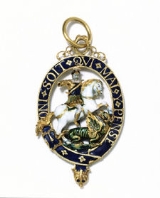
  • The George which is worn suspended from the collar is a colourfully enamelled three-dimensional figurine of St George the Martyr on horseback slaying a dragon.


  • The Garter is worn on ceremonial occasions around the left calf by knights and the left arm by ladies, and is depicted on several insignia. As the name of the Order suggests, its primary symbol is the Garter that is a buckled dark-blue velvet strap and bears the motto in gold letters. The garters of Stranger Knights and Ladies were once set with several jewels.


For other occasions when decorations are worn, the members wear simpler insignia:

  • The collar is worn on designated "collar days" over military uniform or evening wear by members attending formal events. The collar is fastened to the shoulders with silk ribbons. Since the collar signifies the Order of the Garter, members can then wear the riband of any other order to which they belong.


  • The star, which is worn pinned to the left breast, was introduced in the 17th century by King Charles I Charles I of England

    [i] [[1625]... 

     and is a colourfully enamelled depiction of the heraldic shield of St George's Cross, encircled by the Garter, which is itself encircled by an eight-point silver badge. Each point is depicted as a cluster of rays with the four points of the cardinal directions longer than the intermediate ones. The stars of Stranger Knights and Ladies were once set with several jewels. Since the Order of the Garter is the senior order of the United Kingdom, a member will wear its star above others which he holds.


  • The riband is a 4-inch wide sash worn over the left shoulder, or pinned beneath it, to the right hip, and was introduced in the 17th century by King Charles II Charles II of England

    Charles II was the King of England [i], King of Scots [i], and King of Ireland [i] from 30 January [i] ... 

    . The riband's colour has varied over the years: it was originally light blue, but was a dark shade under the Hanoverian monarchs. In 1950, the colour was fixed as "kingfisher blue." A member will wear only one riband, even if he or she belongs to several orders.


  • The badge is worn suspended from a small gold link from the riband at the right hip and is sometimes known as "the Lesser George". Like the George, the badge shows St George the Martyr on horseback slaying a dragon, but is flatter and gold. In the 15th century, the badge was worn attached to a ribbon around the neck. As this was not convenient when riding a horse, the custom of wearing it with a riband under the right arm developed.


On the death of a member, the badge and star are returned personally to the Sovereign by the former member's nearest male relative, and the other insignia to the Central Chancery of the Orders of Knighthood. .

Officers


For ceremonial occasions of the Order, the officers wear the following garments and accessories:

  • The mantles for the prelate and chancellor are dark blue like those of the members , but the mantles for the other officers are dark red. All mantles are embroidered with a heraldic shield of St George's Cross. Garter Principal King of Arms Garter Principal King of Arms

    Garter Principal King of Arms is the senior King of Arms [i], and the senior Officer of Arms [i] of the ... 

     wears his tabard Tabard

    A tabard is a short coat, either sleeveless, or with short sleeves or shoulder pieces, emblazoned on the... 

     also.


  • A distinctive badge is an accessory suspended from a chain which is worn around the neck. The badge for the prelate shows the Lesser George encircled by the Garter which is surmounted by a bishop's mitre. The badge for the chancellor shows a rose encircled by the Garter. The badge for the registrar shows two crossed quills surmounted by a crown and encircled by the Garter. The badge for the Garter Principal King of Arms shows the royal arms impaled with St George's Cross encircled by the Garter. The badge for the usher shows a knot encircled by the Garter. The badge for the secretary shows two crossed quills in front of a rose and encircled by the Garter.


The chancellor carries a purse which is embroidered with the royal arms and contains the seal of the Order. The Garter Principal King of Arms carries the baton of office but doesn't usually wear its crown. The usher carries the staff of office, the Black Rod.

Military knights of Windsor


The poor knights originally wore red mantles, each of which bore St George's Cross, but did not depict the Garter. Queen Elizabeth I Elizabeth I of England

Elizabeth I was Queen of England [i], Queen of France , and Queen of Ireland [i] ... 

 replaced the mantles in the 16th and 17th centuries with blue and purple gowns, but the red mantles returned in the 17th century under King Charles I Charles I of England

[i] [[1625]... 

. When the knights were renamed, the mantles were abandoned. The military knights now wear the old military uniform of an "army officer on the unattached list": black trousers with red stripe, a red double-breasted swallow-tailed coat, gold epaulets and brushes, a cocked hat with a plume, and a sword on a white sash.

Precedence and privileges


Members are assigned positions in the order of precedence coming before all others of knightly rank and above baronets. The wives, sons, daughters and daughters-in-law of Knights Companion are also assigned precedence. Relatives of Ladies Companion are not, however, assigned any special positions. The Chancellor is also assigned precedence, but this is purely academic since the Chancellor is always a member of the Order, and thereby has a higher position in the order of precedence. In fact, it is unclear whether the Chancellor's tabled precedence has ever come into effect, since under the old system the office was filled by a diocesan bishop of the Church of England Church of England

The Church of England is the officially established [i] Christian [i] church [i] ... 

, who again had a higher precedence by virtue of that office than any that the chancellorship could bestow)

Knights Companion prefix "Sir" and Ladies Companion prefix "Lady" to their forenames. Wives of Knights Companion may prefix "Lady" to their surnames, but no such privilege exists for husbands of Ladies Companion. Such forms are not used by princes and peers, except when peers' names are written out in their fullest forms.

Knights and Ladies Companion use the post-nominal letters "KG" and "LG" respectively. When an individual is entitled to use multiple post-nominal letters, those of the Order of the Garter appear before all others except "Bt" , "VC" and "GC" .

The members may encircle their arms with the Garter, and, if they wish, with a depiction of the collar as well. However, the Garter is normally used alone; the more elaborate version is seldom seen. Stranger Knights and Ladies do not, of course, embellish the arms they use in their countries with English decorations.

Knights and Ladies Companion are also entitled to receive heraldic supporters, a privilege granted to few other private individuals. While some families claim supporters by ancient use, and others have been granted them as a special reward, only peers, Knights and Ladies Companion of the Garter, Knights and Ladies of the Thistle, and certain other knights and ladies are automatically entitled to them.

Garter service


The Order of the Garter once held frequent services at St George's Chapel St George's Chapel at Windsor Castle

St George's Chapel is the place of worship at Windsor Castle [i] in England [i].... 

, Windsor Castle Windsor Castle

Windsor Castle in England [i] is the largest inhabited castle [i] in the world and, dating back to the t ... 

, but they became rare in the eighteenth century. Discontinued after 1805, the ceremony was revived by King George VI George VI of the United Kingdom

George VI became the King of the United Kingdom of Great Britain and Northern Ireland [i] ... 

 in 1948 and it has become an annual event. On a certain day each June, the members of the Order meet in the state apartments in the Upper Ward of Windsor Castle, then process on foot down through the castle to St George's Chapel for the service. If there are any new knights, they are installed on this occasion. After the service, the members of the Order return to the Upper Ward by carriage.

Current members and officers


Sovereign


|-
|
|}
Elizabeth II is the Queen [i] of 16 independent sovereign [i] state [i] ... 

 Elizabeth II

Knights and Ladies Companion


  • His Grace The Duke of Grafton KG DL
  • The Rt Hon. The Lord Richardson of Duntisbourne KG MBE TD PC DL
  • The Rt Hon. The Lord Carrington Peter Carington, 6th Baron Carrington

    Sir Peter Alexander Rupert Carington, 6th Baron Carrington, KG [i], GCMG [i] ... 

     KG GCMG CH MC PC JP DL
  • His Grace The Duke of Wellington Arthur Wellesley, 8th Duke of Wellington

    Brigadier [i] Arthur Valerian Wellesley, 8th Duke of Wellington, KG [i], LVO [i] ... 

     KG LVO OBE MC DL
  • Field Marshal The Rt Hon. The Lord Bramall Edwin Bramall, Baron Bramall

    Field Marshal [i] Sir Edwin Noel Westby Bramall, Baron Bramall KG [i] GCB [i] ... 

     KG GCB OBE MC JP
  • The Rt Hon. The Viscount Ridley Matthew Ridley, 4th Viscount Ridley

    [i], [[Royal Victorian Order|GCVO]... 

     KG GCVO TD
  • The Rt Hon. The Lord Sainsbury of Preston Candover John Sainsbury, Baron Sainsbury of Preston Candover

    Sir John Davan Sainsbury, Baron Sainsbury of Preston Candover, KG [i] is a British [i]... 

     KG
  • The Rt Hon. The Lord Ashburton John Baring, 7th Baron Ashburton

    Sir John Francis Harcourt Baring, 7th Baron Ashburton, KG [i], KCVO [i] ... 

     KG KCVO DL
  • The Rt Hon. The Lord Kingsdown Robin Leigh-Pemberton, Baron Kingsdown

    The Right Honourable [i] Sir Robert "Robin" Leigh-Pemberton, Baron Kingsdown, KG [i] ... 

     KG PC
  • The Rt Hon. Sir Ninian Stephen KG AK GCMG GCVO KBE
  • The Rt Hon. The Baroness Thatcher Margaret Thatcher

    Margaret Hilda Thatcher, Baroness Thatcher, LG [i], OM [i], PC [i] ... 

     LG OM PC FRS
  • Sir Edmund Hillary Edmund Hillary

    Sir Edmund Percival Hillary, KG [i], ONZ [i], KBE [i] ... 

     KG ONZ KBE
  • Sir Timothy Colman Timothy Colman

    Sir Timothy James Alan Colman KG [i] is a British [i] multi-milliona... 

     KG JP
  • His Grace The Duke of Abercorn James Hamilton, 5th Duke of Abercorn

    Sir James Hamilton, 5th Duke of Abercorn, KG [i] is a Northern Irish [i] peer [i] ... 

     KG
  • Sir William Gladstone of Fasque and Balfour Bt KG DL
  • The Rt Hon. The Lord Inge Peter Inge, Baron Inge

    Field Marshal [i] Peter Anthony Inge, Baron Inge, KG [i], GCB [i], ... 

     KG GCB DL
  • Sir Antony Acland Antony Arthur Acland

    Sir Antony Arthur Acland, KG [i], GCMG [i], GCVO [i]... 

     KG GCMG GCVO
  • His Grace The Duke of Westminster Gerald Grosvenor, 6th Duke of Westminster

    Gerald Cavendish Grosvenor, 6th Duke of Westminster, KG [i], OBE [i] ... 

     KG OBE TD DL
  • The Rt Hon. The Lord Butler of Brockwell Robin Butler, Baron Butler of Brockwell

    Sir Frederick Edward Robin Butler, Baron Butler of Brockwell, KG [i] , GCB [i] ... 

     KG GCB CVO PC
  • The Rt Hon. The Lord Morris of Aberavon John Morris, Baron Morris of Aberavon

    Sir John Morris, Baron Morris of Aberavon, KG [i], PC [i] ... 

     KG PC QC
  • The Rt Hon. Sir John Major John Major

    Sir John Major, KG [i], CH [i] is an English [i] ... 

     KG CH
  • The Rt Hon. The Lord Bingham of Cornhill Thomas Bingham, Baron Bingham of Cornhill

    Sir Thomas Henry Bingham, Baron Bingham of Cornhill, KG [i], PC [i] ... 

     KG PC
  • The Rt Hon. The Lady Soames Mary Soames, Baroness Soames

    Lady(Mary)Soames, LG [i], DBE [i] is the widow of Christopher Soames [i] ... 

     LG DBE


There is one vacancy.

Royal Knights and Ladies


... 

 KG KT OM GBE AC QSO PC

Stranger Knights and Ladies


Officers


  • Prelate: The Right Reverend Michael Scott-Joynt
  • Chancellor: The Right Honourable The Lord Carrington Peter Carington, 6th Baron Carrington

    Sir Peter Alexander Rupert Carington, 6th Baron Carrington, KG [i], GCMG [i] ... 

     KG GCMG CH MC PC DL
  • Registrar: The Right Reverend David Conner
  • Garter Principal King of Arms Garter Principal King of Arms

    Garter Principal King of Arms is the senior King of Arms [i], and the senior Officer of Arms [i] of the ... 

    : Peter Llewellyn Gwynn-Jones Peter Gwynn-Jones

    Peter Llewellyn Gwynn-Jones, CVO [i] is a long-serving officer of arms [i] ... 

     CVO Royal Victorian Order

    The Royal Victorian Order is an order of chivalry that was established by Queen Victoria [i] ... 

  • Secretary: Patric Laurence Dickinson Esq. LVO
  • Usher: Sir Michael Willcocks KCB

References


External link


See also


  • List of Knights and Ladies of the Garter
  • List of Ladies of the Garter
  • St George's Chapel at Windsor Castle St George's Chapel at Windsor Castle

    St George's Chapel is the place of worship at Windsor Castle [i] in England [i].... 

  • The Society of the Friends of St George's and Descendants of the Knights of the Garter The Society of the Friends of St George's and Descendants of the Knights of the Garter

    The Society of the Friends of St George's and Descendants of the Knights of the Garter is a national charity [i] ... 

  • Windsor Castle Windsor Castle

    Windsor Castle in England [i] is the largest inhabited castle [i] in the world and, dating back to the t ... 

  • Eltham Palace Eltham Palace

    Eltham Palace is an Art Deco [i] house in Eltham, London [i], currently owned by English Heritage [i] an ...