
All Topics  
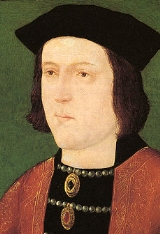
Edward IV of England

 
Edward IV of England

   Email Print
   Bookmark   Link


Edward IV of England


Edward IV (28 April 1442 – 9 April 1483) was King of England
Kingdom of England

The Kingdom of England was, from 927 to 1707, a state in North-West Europe. The Kingdom of England spanned the southern two-thirds of the island of Great Britain and a number of smaller outlying islands?what is today the legal unit of England and Wales....
 from 4 March 1461 until 2 October 1470, and again from 11 April 1471 until his death.

rd of York was born at Rouen
Rouen

Rouen is the historical capital city of Normandy, in northwestern France on the River Seine, and currently the capital of the Haute-Normandie r?gion in France....
 in France
France

France , officially the French Republic , is a country whose Metropolitan France is located in Western Europe and that also comprises various Overseas departments and territories of France....
, the second son of Richard, 3rd Duke of York (who had a strong genealogical claim to the throne of England) and Cecily Neville
Cecily Neville

Cecily Neville, Duchess of York was the mother of two Kings: Edward IV of England and Richard III of England.Cecily Neville was a daughter to Ralph Neville, 1st Earl of Westmorland and Joan Beaufort, Countess of Westmorland....
. He was the eldest of the four sons who survived to adulthood.


Discussion
Ask a question about 'Edward IV of England'
Start a new discussion about 'Edward IV of England'
Answer questions from other users
Full Discussion Forum


Timeline

1442   Born

1460   Battle of Wakefield - A Lancastrian army under Henry Beaufort, Duke of Somerset and Henry Percy, Earl of Northumberland defeats a Yorkist army under the Duke of York and his son, Edmund, Earl of Rutland. Both York and Rutland are killed, the latter murdered after the battle. York's son Edward becomes leader of the Yorkist faction.

1461   Edward, Richard of York's son, crowned as Edward IV, King of England (reigns until 1483)

1461   Battle of Mortimer's Cross - Yorkist troops led by Edward, Duke of York defeat Lancastrians under Owen Tudor and his son Jasper Tudor, Earl of Pembroke in Wales.

1461   The Duke of York seizes London and proclaims himself King Edward IV of England

1464   Edward IV of England secretly marries Elizabeth Woodville. He keeps the marriage a secret for five months afterwards

1470   A rebellion orchestrated by King Edward's former ally, the Earl of Warwick, forces the King to flee England to seek support from his brother-in-law Charles the Bold of Burgundy. Warwick releases Henry VI from the Tower and restores him to the throne on October 30.

1471   The Yorkist King Edward IV returns to England to reclaim his throne.

1471   Henry VI of England is murdered in the Tower of London and Edward IV becomes sole King of England.

1478   George, Duke of Clarence, convicted of treason against his older brother Edward IV of England, is privately executed in the Tower of London.


Encyclopedia


Edward IV (28 April 1442 – 9 April 1483) was King of England
Kingdom of England

The Kingdom of England was, from 927 to 1707, a state in North-West Europe. The Kingdom of England spanned the southern two-thirds of the island of Great Britain and a number of smaller outlying islands?what is today the legal unit of England and Wales....
 from 4 March 1461 until 2 October 1470, and again from 11 April 1471 until his death.

Reign


Accession to the throne

Edward of York was born at Rouen
Rouen

Rouen is the historical capital city of Normandy, in northwestern France on the River Seine, and currently the capital of the Haute-Normandie r?gion in France....
 in France
France

France , officially the French Republic , is a country whose Metropolitan France is located in Western Europe and that also comprises various Overseas departments and territories of France....
, the second son of Richard, 3rd Duke of York (who had a strong genealogical claim to the throne of England) and Cecily Neville
Cecily Neville

Cecily Neville, Duchess of York was the mother of two Kings: Edward IV of England and Richard III of England.Cecily Neville was a daughter to Ralph Neville, 1st Earl of Westmorland and Joan Beaufort, Countess of Westmorland....
. He was the eldest of the four sons who survived to adulthood. The Duke of York's assertion of his claim to the crown in 1460 was the key escalation of the conflict known as the Wars of the Roses
Wars of the Roses

The Wars of the Roses were a series of dynastic civil wars fought in England between supporters of the Houses of House of Lancaster and House of York....
. When his father was killed at the Battle of Wakefield
Battle of Wakefield

The Battle of Wakefield took place at Wakefield, in West Yorkshire, on 30 December 1460, and was one of the major actions of the Wars of the Roses....
, Edward inherited his claim.

With the support of his cousin, Richard Neville, 16th Earl of Warwick
Richard Neville, 16th Earl of Warwick

Richard Neville, 16th Earl of Warwick and 6th Earl of Salisbury , known as Warwick the Kingmaker, was an England nobleman, administrator, and military commander....
 ("The Kingmaker"), Edward defeated the Lancastrians
House of Lancaster

The House of Lancaster was a branch of the royal House of Plantagenet. It was one of the opposing factions involved in the Wars of the Roses, an intermittent civil war which affected England and Wales during the 15th century....
 in a succession of battles. And whilst Henry VI
Henry VI of England

Henry VI was Kingdom of England 1422?1461 and then 1470?1471, and King of France as the de jure monarch from 1422 to 1429....
 and his militaristic queen, Margaret of Anjou
Margaret of Anjou

Margaret of Anjou was the Queen consort of Henry VI of England from 1445 to 1471 and led the House of Lancaster in the Wars of the Roses. Due to the king's frequent bouts of insanity, Margaret virtually ruled the kingdom in lieu of her husband....
, were campaigning in the north of England, Warwick gained control of the capital and had Edward declared king in London
London

London is the capital of both England and the United Kingdom, and the most populous municipality in the European Union. An important settlement for two millennia, History of London goes back to its founding by the Roman Empire....
 in 1461. Edward strengthened his claim with a decisive victory at the Battle of Towton
Battle of Towton

The Battle of Towton in the Wars of the Roses was the largest and bloodiest ever fought on united kingdom soil, with casualties believed to have been about 28,000 men; only the Battle of Watling Street in AD 60 or 61 was reputed to have more casualties, with 80,000 Britons reported killed....
 in the same year, in the course of which the Lancastrian army was virtually wiped out. Even at the age of nineteen, he had remarkable military acumen and a notable physique. His height is estimated at 6'4", making him the tallest British monarch to date.

Overthrow

Warwick, believing that he could continue to rule through Edward, pressed him to enter into a marital alliance with a major European power. Edward then alienated Warwick by secretly marrying Elizabeth Woodville
Elizabeth Woodville

Elizabeth Woodville or Wydeville was the Queen consort of King Edward IV of England from 1464 until his death in 1483....
, who had a large group of relatively poor but very ambitious Lancastrian relations. Although no threat to Warwick's own power, Warwick resented the influence this group had over the King and, with the aid of Edward's disaffected younger brother George, Duke of Clarence, the Earl led an army against Edward.

The main part of the king's army (without Edward) was defeated at the Battle of Edgecote Moor
Battle of Edgecote Moor

The Battle of Edgecote Moor took place 6 miles northeast of Banbury , England on 26 July 1469 during the Wars of the Roses. The site of the battle was actually Danes Moor in Northamptonshire, at a crossing of a tributary of the River Cherwell....
 in 1469, and Edward was subsequently captured at Olney
Olney, Milton Keynes

Olney is a small market town and civil parish in the Milton Keynes , England, with a population of around 6,000 people. For Ceremonial counties of England it is part of the county of Buckinghamshire#Ceremonial county....
. Warwick then attempted to rule in Edward's name, but the nobility, many of whom owed their preferments to the king, were restive and with the emergence of a counter rebellion, Warwick was forced to release Edward. At this point Edward did not seek to destroy either Warwick or Clarence, instead he sought reconciliation with them.

In 1470, Warwick and Clarence rebelled again. This time they were defeated and forced to flee to France
France

France , officially the French Republic , is a country whose Metropolitan France is located in Western Europe and that also comprises various Overseas departments and territories of France....
. There, they made an alliance with Margaret of Anjou, and Warwick agreed to restore Henry VI in return for French support in an invasion which took place in late 1470. This time, Edward was forced to flee when he learned Warwick's brother, John Neville, 1st Marquess of Montagu
John Neville, 1st Marquess of Montagu

John Neville, 1st Marquess of Montagu, alias John Mortimer, called the Captain of Kent was a Yorkist leader in the Wars of the Roses, best-known for eliminating Lancastrian resistance in the north of England during the early part of the reign of Edward IV of England....
, had also switched to the Lancastrian side, making his military position untenable.

Restoration

Henry VI was briefly restored to the throne in 1470, in an act known as the Readeption of Henry VI
Readeption of Henry VI

The Readeption is the technical term given to the restoration of Henry VI of England to the throne of England. Edward, Earl of March had taken the throne in 1461 to become Edward IV of England....
, and Edward took refuge in Burgundy
Duchy of Burgundy

The Duchy of Burgundy was a feudal territory once existing within the France in the Middle Ages. It roughly conforms to the modern Bourgogne. Existing between 843 and 1477, the Duchy was ruled by a succession of Duke of Burgundy, whose extinction with the death of Charles the Bold in 1477 led to the Duchy being absorbed into the French crown...
, accompanied by his younger brother Richard, Duke of Gloucester. The rulers of Burgundy were his brother-in-law Charles, Duke of Burgundy and his sister Margaret of York
Margaret of York

Margaret of York – also by marriage known as Margaret of Burgundy – was a daughter of Richard Plantagenet, 3rd Duke of York and Cecily Neville....
. Despite the fact that Charles was initially unwilling to help Edward, the French declared war on Burgundy and so Charles decided to give his aid to Edward, and from there he raised an army to win back his kingdom.

When he returned to England with a relatively small force he avoided capture by potentially hostile forces by stating his claim, just as Henry Bolingbroke
Henry IV of England

Henry IV was King of England and Lord of Ireland . Like other kings of England, he also claimed the title of King of France. He was born at Bolingbroke Castle in Lincolnshire, hence the other name by which he was known, Henry Bolingbroke....
 had done seventy years earlier, that he merely desired to reclaim his dukedom. The city of York
York

York is a walled city, sited at the confluence of the rivers River Ouse, Yorkshire and River Foss in North Yorkshire, England. The city status in the United Kingdom is noted for its rich heritage and it has played an important role throughout much of its almost 2,000 year existence....
 however closed its gates to him, but as he marched southwards he began to gather support, and Clarence (who had realised that his fortunes would be better off as brother to a king than under Henry VI) reunited with him. Edward and his brothers then defeated Warwick at the Battle of Barnet
Battle of Barnet

The Battle of Barnet, which took place 14 April 1471, was a decisive battle of the Wars of the Roses, near the town of Barnet, at the time ten miles north of London, now a suburb of North London....
 and with Warwick dead, he eliminated the remaining Lancastrian resistance at the Battle of Tewkesbury
Battle of Tewkesbury

The Battle of Tewkesbury in Gloucestershire, which took place on 4 May 1471, completed one phase of the Wars of the Roses.It put a temporary end to House of Lancaster hopes of regaining the throne of England....
 in 1471. The Lancastrian heir, Edward of Westminster
Edward of Westminster

Edward of Westminster, also known as Edward of Lancaster , was the only son of King Henry VI of England and Margaret of Anjou. He was killed at the Battle of Tewkesbury, making him the only Prince of Wales ever to die in battle....
, Prince of Wales
Prince of Wales

Prince of Wales is a title traditionally granted to the Heir Apparent to the reigning monarch of the United Kingdom . The current Prince of Wales is Charles, Prince of Wales, the eldest son of Elizabeth II of the United Kingdom....
, was killed either on the battlefield or shortly afterwards, and a few days later, on the night that Edward re-entered London, Henry VI, who was being held prisoner, was murdered in order to completely remove the Lancastrian opposition.

Edward's two younger brothers, George, Duke of Clarence, and Richard, Duke of Gloucester
Duke of Gloucester

Duke of Gloucester is a British royal title , often conferred on one of the sons of the reigning monarch. The first four creations were in the Peerage of England, the next in the Peerage of Great Britain, and the last in the Peerage of the United Kingdom; this current creation carries with it the subsidiary titles of Earl of Ulster an...
 (later King Richard III of England
Richard III of England

Richard III was List of the monarchs of the Kingdom of England of Kingdom of England from 1483 until his death. He was the last king from the House of York, and his defeat at the Battle of Bosworth Field marked the culmination of the Wars of the Roses and the end of the Plantagenet dynasty....
) were married to Isabella Neville and Anne Neville
Anne Neville

Anne Neville was the Princess of Wales as spouse of Edward of Westminster, Prince of Wales, and the List of English consorts as spouse of King Richard III of England....
. They were both daughters of Warwick by Anne Beauchamp and rival heirs to the considerable inheritance of their still-living mother. Clarence and Gloucester were at loggerheads for much of the rest of his reign. Clarence was eventually found guilty of plotting against Edward and was imprisoned in the Tower of London
Tower of London

Her Majesty's Royal Palace and Fortress, more commonly known as the Tower of London , is a historic monument in central London, England, on the north bank of the River Thames....
. He was "privately executed" (Shakespearean tradition states he was drowned in a butt of Malmsey wine) on February 18, 1478.

Later reign and death

Edward did not face any further rebellions after his restoration, as the Lancastrian line had virtually been extinguished, and the only rival left was Henry Tudor
Henry VII of England

Henry VII was the Kingdom of England and Lordship of Ireland from his usurpation of the crown on 22 August 1485 until his death on 21 April 1509, as the first monarch of the Tudor dynasty....
, who was living in exile.

In 1475, Edward declared war on France and came to terms with the Treaty of Picquigny
Treaty of Picquigny

The Treaty of Picquigny was a peace treaty negotiated on 29 August 1475 between the Kingdom of England and the France in the Middle Ages. Louis XI of France paid Edward IV of England to return to England and not take up arms to pursue his English claims to the French throne....
 which provided him with an immediate payment of 75,000 crowns and a yearly pension thereafter of 50,000 crowns. He also backed an attempt by Alexander Stewart, 1st Duke of Albany
Alexander Stewart, 1st Duke of Albany

Alexander Stewart, Duke of Albany was the second son of King James II of Scotland, and his Queen consort Mary of Gueldres, daughter of Arnold, Duke of Gelderland....
, brother of the Scottish king James III
James III of Scotland

James III was King of Scots from 1460 to 1488. James was an unpopular and ineffective monarch owing to an unwillingness to administer justice fairly, a policy of pursuing alliance with the Kingdom of England, and a disastrous relationship with nearly all his extended family....
 to take the Scottish throne in 1482, and despite the fact that when Gloucester invaded he was able to capture Edinburgh
Edinburgh

Edinburgh ; is the Capital city of Scotland, a position it has held since 1437. It is the seventh largest city in the United Kingdom and the second largest Scottish City status in the United Kingdom after Glasgow....
 and James III, Albany reneged on his agreement with Edward, and Gloucester decided to withdraw from his position of strength in Edinburgh. However, Gloucester did recover Berwick-upon-Tweed
Berwick-upon-Tweed

Berwick-upon-Tweed , situated in the county of Northumberland, is the northernmost town in England, on the east coast at the mouth of the River Tweed....
.

Edward's health began to fail and he became subject to an increasing number of ailments. Edward fell fatally ill at Easter 1483, but lingered on long enough to add some codicils to his will, the most important being his naming of his brother Richard, Duke of Gloucester, as Protector after his death. He died on 9 April 1483 and is buried in St George's Chapel, Windsor Castle
Windsor Castle

Windsor Castle, in Windsor, Berkshire in the England county of Berkshire, is the largest inhabited castle in the world and, dating back to the time of William I of England, is the oldest in continuous occupation....
. He was succeeded by his twelve-year-old son, Edward V of England
Edward V of England

Edward V was King of England from 9 April 1483 until his deposition two months later. His reign was dominated by the influence of his uncle Richard, Duke of Gloucester, who succeeded him as Richard III of England....
.

It is not known what actually caused Edward's death. Pneumonia and typhoid have both been conjectured, as well as poison. Some attributed his death to an unhealthy lifestyle, as he had become stout and inactive in the years before his death.

Overview

An extremely capable and daring military commander, Edward destroyed the House of Lancaster in a series of spectacular military victories; he was never defeated on the field of battle. Despite his occasional (if serious) political setbacks — usually at the hands of his great Machiavellian rival, Louis XI — Edward was a popular and very able king. Whilst he lacked foresight and was at times cursed by bad judgement, he possessed an uncanny understanding of his most useful subjects, and the vast majority of those who served him remained unwaveringly loyal until his death.

Domestically, Edward's reign saw the restoration of law and order in England (indeed, his royal motto was modus et ordo, or method and order). The latter days of Henry VI
Henry VI of England

Henry VI was Kingdom of England 1422?1461 and then 1470?1471, and King of France as the de jure monarch from 1422 to 1429....
's government had been marked by a general breakdown in law and order, as well as a sizable increase in both piracy and banditry. Interestingly, Edward was also a shrewd and successful businessman and merchant, heavily investing in several corporations within the City of London.

Ultimately, despite his military and administrative genius, Edward's dynasty survived him by little more than two years. Edward also holds the tragic accolade of being one of the few male members of his dynasty to die of natural causes. Both Edward's father
Richard Plantagenet, 3rd Duke of York

Richard Plantagenet, 3rd Duke of York was a member of the English royal family, who served in senior positions in France at the end of the Hundred Years' War, and in England during Henry VI of England's madness....
 and brother
Edmund, Earl of Rutland

Edmund, Earl of Rutland was the fifth child and second surviving son of Richard Plantagenet, 3rd Duke of York and Cecily Neville. He was born in Rouen....
 were killed at the Battle of Wakefield
Battle of Wakefield

The Battle of Wakefield took place at Wakefield, in West Yorkshire, on 30 December 1460, and was one of the major actions of the Wars of the Roses....
, whilst his grandfather
Richard of Conisburgh, 3rd Earl of Cambridge

Richard of Conisburgh, 3rd Earl of Cambridge was the younger son of Edmund of Langley, 1st Duke of York and Isabella of Castile, Duchess of York....
 and another brother
George Plantagenet, 1st Duke of Clarence

George Plantagenet, Duke of Clarence was the third son of Richard Plantagenet, 3rd Duke of York, and Cecily Neville, and the brother of kings Edward IV of England and Richard III of England....
 were executed for treason. Edward's two sons
Princes in the Tower

The Princes in the Tower, Edward V of England and his brother, Richard of Shrewsbury, 1st Duke of York , were two sons of Edward IV of England and Elizabeth Woodville....
 were imprisoned and disappeared (presumed killed) within a year of Edward's death. The king's youngest brother, Richard
Richard III of England

Richard III was List of the monarchs of the Kingdom of England of Kingdom of England from 1483 until his death. He was the last king from the House of York, and his defeat at the Battle of Bosworth Field marked the culmination of the Wars of the Roses and the end of the Plantagenet dynasty....
, was famously killed in battle against Henry Tudor
Henry VII of England

Henry VII was the Kingdom of England and Lordship of Ireland from his usurpation of the crown on 22 August 1485 until his death on 21 April 1509, as the first monarch of the Tudor dynasty....
 at Bosworth Field
Battle of Bosworth Field

The Battle of Bosworth or Bosworth Field was House of Lancaster Henry VII of England defeat of House of York Richard III of England, ending the Plantagenet dynasty to begin a new Tudor dynasty....
.

Ancestry


Children

Edward IV had ten legitimate children by Elizabeth Woodville
Elizabeth Woodville

Elizabeth Woodville or Wydeville was the Queen consort of King Edward IV of England from 1464 until his death in 1483....
, though only seven survived him: They were declared illegitimate by Parliament in 1483, clearing the way for Richard III to become King

  • Elizabeth
    Elizabeth of York

    Elizabeth of York was the daughter, sister, niece, wife and mother of Kings of England. She was List of English consorts as spouse of King Henry VII of England, whom she married in 1486....
    , Queen Consort of Henry VII of England
    Henry VII of England

    Henry VII was the Kingdom of England and Lordship of Ireland from his usurpation of the crown on 22 August 1485 until his death on 21 April 1509, as the first monarch of the Tudor dynasty....
     (February 11, 1466 – February 11 1503).
  • Mary
    Mary of York

    Mary of York was the second daughter of Edward IV of England and his Queen consort Elizabeth Woodville.She was a younger sister of Elizabeth of York....
     (August 11, 1467 – May 23, 1482).
  • Cecily of York
    Cecily of York

    Cecily of York , was an English Princess and the third, but eventual second surviving, daughter of King Edward IV of England and his Queen consort, the former Lady Elizabeth Woodville, daughter of Richard Woodville, 1st Earl Rivers....
     (March 20, 1469 – August 24, 1507), married first John Welles, 1st Viscount Welles
    John Welles, 1st Viscount Welles

    John Welles, 1st Viscount Welles Knight of the Garter was an English Lancastrian Nobleman who was made a Knight of the Garter.John was born about 1450 to Lionel de Welles, 6th Baron Welles and...
     and second, Thomas Kymbe.
  • Edward
    Edward V of England

    Edward V was King of England from 9 April 1483 until his deposition two months later. His reign was dominated by the influence of his uncle Richard, Duke of Gloucester, who succeeded him as Richard III of England....
     (November 4, 1470 – 1483?), succeeded as King of England.
  • Margaret
    Margaret of York (1472)

    Margaret of York was a namesake niece of Margaret of York, Duke of Burgundy. She was the fifth child and fourth daughter of Edward IV of England and Elizabeth Woodville....
     (April 10, 1472 – December 11, 1472)
  • Richard
    Richard of Shrewsbury, 1st Duke of York

    Richard of Shrewsbury, 1st Duke of York and 1st Duke of Norfolk was the sixth child and second son of Edward IV of England of England and Elizabeth Woodville....
     (August 17, 1473 – 1483?).
  • Anne (November 2, 1475 – November 23, 1511, married Thomas Howard, 3rd Duke of Norfolk
    Thomas Howard, 3rd Duke of Norfolk

    Thomas Howard, 3rd Duke of Norfolk was a prominent Tudor dynasty politician. He was uncle to two of the wives of Henry VIII, Anne Boleyn and Catherine Howard, as well as the king's mistress Mary Boleyn, and played a major role in the machinations behind these relationships....
    .
  • George
    George Plantagenet, Duke of Bedford

    George Plantagenet, Duke of Bedford was the eighth child and third son of Edward IV of England and Elizabeth Woodville.He was a younger brother of Elizabeth of York, Mary of York, Cecily of York, Edward V of England, Margaret Plantagenet , Richard of Shrewsbury, 1st Duke of York and Anne of York, Countess of Surrey....
     (March, 1477 – March, 1479).
  • Catherine
    Catherine of York

    Catherine of York was the ninth child and sixth daughter of Edward IV of England and Elizabeth Woodville.She was born in Eltham Palace. She was a younger sister of Elizabeth of York, Mary of York, Cecily of York, Edward V of England, Margaret Plantagenet , Richard of Shrewsbury, 1st Duke of York, Anne of York, Countess of Surrey and George...
     (August 14, 1479 – November 15, 1527), married William Courtenay, 1st Earl of Devon
    William Courtenay, 1st Earl of Devon

    William Courtenay, 1st Earl of Devon was the son of Sir Edward Courtenay, 1st Earl of Devon and Elizabeth Courtenay. He married Catherine of York the sixth daughter of Edward IV of England and Elizabeth Woodville....
    .
  • Bridget
    Bridget of York

    Bridget of York was the tenth child and seventh daughter of Edward IV of England and Elizabeth Woodville.She was a younger sister of Elizabeth of York, Mary of York, Cecily of York, Edward V of England, Margaret Plantagenet , Richard of Shrewsbury, 1st Duke of York, Anne of York, Countess of Surrey and George Plantagenet, Duke of Bedford a...
     (November 10, 1480 – 1517), became a nun.


Edward had numerous mistresses, the best known of whom is Jane Shore
Jane Shore

Elizabeth "Jane" Shore was one of the many mistresses of King Edward IV of England, the first of the three whom he described respectively as the merriest, the wiliest, and the holiest harlots in his realm, and later a courtesan to other men of royalty....
 (whose name in actuality was Elizabeth).

He reportedly had several illegitimate children:

  • By Lady Eleanor Talbot
    Lady Eleanor Talbot

    Lady Eleanor Talbot was a daughter of John Talbot, 1st Earl of Shrewsbury. Her alleged pre-contract of marriage with King Edward IV of England was of great significance to the final fate of the Plantagenet dynasty and outcome of the Wars of the Roses....
    :
    • Edward de Wigmore (d. 1468). Reportedly died as an infant along with his mother.
  • By Elizabeth Lucy or Elizabeth Waite.
    • Elizabeth Plantagenet. Born circa 1464, married Sir Thomas Lumley in 1477.
    • Arthur Plantagenet, 1st Viscount Lisle
      Arthur Plantagenet, 1st Viscount Lisle

      Arthur Plantagenet, 1st Viscount Lisle, Order of the Garter was an illegitimate son of King Edward IV of England, and an important figure at the court of Henry VIII of England....
       (1460s/1470s – March 3, 1542).
  • By unknown mother. Recent speculations suggests them as children by Lucy or Waite.
    • Grace Plantagenet. She is known to have been present at the funeral of her stepmother Elizabeth Woodville in 1492.
    • Mary Plantagenet, married Henry Harman of Ellam, son of Thomas and Elizabeth Harman and widower of Agness.
    • A daughter said to have been the first wife of John Tuchet, 6th Baron Audley.


Perkin Warbeck
Perkin Warbeck

Perkin Warbeck was a pretender to the England throne during the reign of King Henry VII of England. Traditional belief claims that he was an impostor, pretending to be Richard of Shrewsbury, 1st Duke of York, the younger son of King Edward IV of England, but was in fact a Flemings born in Tournai around 1474....
, an impostor
Impostor

An impostor or imposter is a person who pretends to be somebody else, often to try to gain financial or social advantages through social engineering, but just as often for purposes of espionage or law enforcement....
 claimant to the English throne, who claimed to be Edward's son Richard of Shrewsbury, reportedly resembled Edward. There is unconfirmed speculation that Warbeck could have been another of Edward's illegitimate sons.

Successors

Edward IV's eldest son was invested with the title of Prince of Wales
Prince of Wales

Prince of Wales is a title traditionally granted to the Heir Apparent to the reigning monarch of the United Kingdom . The current Prince of Wales is Charles, Prince of Wales, the eldest son of Elizabeth II of the United Kingdom....
 at the age of seven months. At the age of three, he was sent by his father to Ludlow Castle
Ludlow Castle

Ludlow Castle is a large, now partly ruined, non-inhabited castle which dominates the town of Ludlow in Shropshire, England. It stands on a high point overlooking the River Teme....
 as nominal head of the Council of Wales and the Marches, a body that had originally been set up to help the future Edward II of England
Edward II of England

Edward II, of Caernarfon, was Kingdom of England from 1307 until he was deposition in January 1327. His tendency to ignore his nobility in favour of low-born favourites led to constant political unrest and his eventual deposition....
 in his duties as Prince of Wales. The prince was accompanied to Ludlow by his mother and by his uncle, Anthony Woodville, 2nd Earl Rivers
Anthony Woodville, 2nd Earl Rivers

Anthony Rivers, 2nd Earl Rivers was an English nobleman, courtier, and writer....
, who carried out many of the administrative duties associated with the presidency of the Council. The king visited his son occasionally at Ludlow, though, as far as is known, he never ventured into Wales itself. It is clear that he intended this experience of government to prepare his son for the throne.

Although his son was quickly barred from the throne
Titulus Regius

Titulus Regius is a statute of the Parliament of England, issued in 1483, by which the title of King of England was given to Richard III of England....
 and replaced by Richard of Gloucester
Richard III of England

Richard III was List of the monarchs of the Kingdom of England of Kingdom of England from 1483 until his death. He was the last king from the House of York, and his defeat at the Battle of Bosworth Field marked the culmination of the Wars of the Roses and the end of the Plantagenet dynasty....
, Edward IV's daughter, Elizabeth of York
Elizabeth of York

Elizabeth of York was the daughter, sister, niece, wife and mother of Kings of England. She was List of English consorts as spouse of King Henry VII of England, whom she married in 1486....
, later became the Queen consort
Queen consort

A queen consort is the title given to the wife of a reigning Monarch. Queens consort usually share their husbands' Royal and noble ranks and hold the feminine equivalent of their husbands' monarchical titles....
 of Henry VII of England
Henry VII of England

Henry VII was the Kingdom of England and Lordship of Ireland from his usurpation of the crown on 22 August 1485 until his death on 21 April 1509, as the first monarch of the Tudor dynasty....
. (Elizabeth's son was Henry VIII of England
Henry VIII of England

Henry VIII was King of England from 21 April 1509 until his death. He was also Lordship of Ireland and claimant to the Early Modern France. Henry was the second monarch of the House of Tudor, succeeding his father, Henry VII of England....
.) The grounds for Titulus Regius, passed to justify the accession of Richard III, were that Edward had been contracted to marry another woman prior to his marriage to Elizabeth Woodville. Lady Eleanor Butler
Lady Eleanor Talbot

Lady Eleanor Talbot was a daughter of John Talbot, 1st Earl of Shrewsbury. Her alleged pre-contract of marriage with King Edward IV of England was of great significance to the final fate of the Plantagenet dynasty and outcome of the Wars of the Roses....
 (a young widow, daughter of John Talbot, 1st Earl of Shrewsbury
John Talbot, 1st Earl of Shrewsbury

John Talbot, 1st Earl of Shrewsbury was an important England military commander during the Hundred Years' War, as well as the only House of Lancaster Constable of France....
) and Edward were alleged to have been precontracted; both parties were dead by this time, but a clergyman (named only by Philippe de Commines
Philippe de Commines

Philippe de Commines was a writer and diplomat in the courts of Duchy of Burgundy and France. He has been called "the first truly modern writer" and "the first critical and philosophical historian since classical times" ....
 as Robert Stillington
Robert Stillington

Robert Stillington was Bishop of Bath and Wells and Lord Chancellor of England. It is alleged by some that it was he who presented evidence that the marriage of Edward IV of England and Elizabeth Woodville was invalid due to Edward's earlier betrothal to Lady Eleanor Talbot....
, Bishop of Bath and Wells
Bishop of Bath and Wells

The Bishop of Bath and Wells heads the Church of England Diocese of Bath and Wells in the Province of Canterbury in England.The present diocese covers the vast majority of the county of Somerset and a small area of Dorset....
), claimed to have carried out the ceremony. The declaration was repealed shortly after Henry VII assumed the throne, because it illegimitized Elizabeth of York, who was to be his queen.

The final fate of Edward IV's legitimate sons, Edward V and Richard, Duke of York, is unknown. Speculation on the subject has given rise to the "Princes in the Tower
Princes in the Tower

The Princes in the Tower, Edward V of England and his brother, Richard of Shrewsbury, 1st Duke of York , were two sons of Edward IV of England and Elizabeth Woodville....
" mystery.

Was Edward illegitimate?


Evidence of Edward's illegitimacy remains subjective and disputed amongst modern historians. Despite some concerns raised by some scholars, it was, and still essentially is, generally accepted that the issue was raised as propaganda to support Richard III.

In his time, it was noted that Edward IV showed little resemblance to his father, especially in terms of his (then) exceptional height of 6 feet 4 inches when compared to the other members of the House of York, who were not well known for their height. Questions about his paternity were raised during Edward's own reign, for example by Richard Neville, 16th Earl of Warwick
Richard Neville, 16th Earl of Warwick

Richard Neville, 16th Earl of Warwick and 6th Earl of Salisbury , known as Warwick the Kingmaker, was an England nobleman, administrator, and military commander....
 in 1469, and repeated by Edward's brother, George
George Plantagenet, 1st Duke of Clarence

George Plantagenet, Duke of Clarence was the third son of Richard Plantagenet, 3rd Duke of York, and Cecily Neville, and the brother of kings Edward IV of England and Richard III of England....
, shortly before his execution in 1478, but with no evidence; it must be noted that in propaganda wars, such as these, many statements were used that perhaps had no basis in truth (for example, Henry VI's heir, Edward of Westminster
Edward of Westminster

Edward of Westminster, also known as Edward of Lancaster , was the only son of King Henry VI of England and Margaret of Anjou. He was killed at the Battle of Tewkesbury, making him the only Prince of Wales ever to die in battle....
, was purported to have been a bastard of Margaret of Anjou and the Duke of Somerset). It was suggested that the real father may have been an archer
Archery

Archery is the art, practice or skill of shooting with Bow and arrow. Archery has historically been used in hunting and combat and has become a precision sport....
 called Blaybourne.

Prior to his succession, on June 22, 1483, Richard III
Richard III of England

Richard III was List of the monarchs of the Kingdom of England of Kingdom of England from 1483 until his death. He was the last king from the House of York, and his defeat at the Battle of Bosworth Field marked the culmination of the Wars of the Roses and the end of the Plantagenet dynasty....
 declared that Edward was illegitimate, and three days later the matter was addressed by parliament. In Titulus Regius
Titulus Regius

Titulus Regius is a statute of the Parliament of England, issued in 1483, by which the title of King of England was given to Richard III of England....
 (the text of which is believed to come word-for-word from the petition presented by Henry Stafford, 2nd Duke of Buckingham
Henry Stafford, 2nd Duke of Buckingham

Henry Stafford, 2nd Duke of Buckingham played a major role in Richard III of England's rise and fall. He is also one of the primary suspects in the disappearance of the Princes in the Tower....
 to the assembly which met on June 25 1483, to decide on the future of the monarchy), Richard III is described as "the undoubted son and heir" of Richard Plantagenet, 3rd Duke of York
Richard Plantagenet, 3rd Duke of York

Richard Plantagenet, 3rd Duke of York was a member of the English royal family, who served in senior positions in France at the end of the Hundred Years' War, and in England during Henry VI of England's madness....
 and "born in this land" — an oblique reference to his brother's birth at Rouen
Rouen

Rouen is the historical capital city of Normandy, in northwestern France on the River Seine, and currently the capital of the Haute-Normandie r?gion in France....
 and baptism in circumstances which could have been considered questionable. Dominic Mancini
Dominic Mancini

Dominic Mancini was an Italy who visited England in 1482, left in 1483 and left behind an account of the events he witnessed. He called it: De Occupatione Regni Anglie per Riccardum Tercium ....
 says that Cecily Neville
Cecily Neville

Cecily Neville, Duchess of York was the mother of two Kings: Edward IV of England and Richard III of England.Cecily Neville was a daughter to Ralph Neville, 1st Earl of Westmorland and Joan Beaufort, Countess of Westmorland....
, mother of both Edward IV and Richard III, was herself the basis for the story: when she found out about Edward's marriage to Elizabeth Woodville
Elizabeth Woodville

Elizabeth Woodville or Wydeville was the Queen consort of King Edward IV of England from 1464 until his death in 1483....
, in 1464, "Proud Cis" flew into a rage. Mancini reported that the Duchess, in her anger, offered to declare him a bastard. However, this is not supported in contemporary sources, but is most likely reflective of contemporary opinion. According to Polydore Vergil, Duchess Cecily, "being falsely accused of adultery, complained afterwards in sundry places to right many noble men, whereof some yet live, of that great injury which her son Richard had done her." If she had indeed complained — as would befit a high-ranking lady of renowned piety, as she had been regarded — these petitions may have had some effect: the allegations were dropped and never again pursued. Richard III's claim to the throne is generally believed to be based upon his claim that Edward IV's children were illegitimate.

The matter is also raised in William Shakespeare
William Shakespeare

William Shakespeare was an English people poet and playwright, widely regarded as the greatest writer in the English language and the world's preeminent dramatist....
's Richard III
Richard III (play)

Richard III is a Shakespearean history play by William Shakespeare, believed to have been written in approximately 1591, depicting the Machiavellian rise to power and subsequent short reign of Richard III of England....
, in the following lines from Act 3 Scene 5:
Tell them, when that my mother went with child
Of that unsatiate Edward, noble York
My princely father then had wars in France
Hundred Years' War

The Hundred Years' War was a prolonged conflict lasting from 1337 to 1453 between two royal houses for the French throne, which was vacant with the extinction of the senior House of Capet line of French kings....
And, by just computation of the time,
Found that the issue was not his begot


It should be remembered that Shakespeare's drama is a work of fiction.

In a 2004 television documentary, it was noted that, from 14 July to 21 August 1441 (the approximate time of conception for Edward, who was born in April 1442), Edward's father was on campaign at Pontoise, several days march from Rouen (where Cecily of York was based). This was taken to suggest that the Duke of York could not have been available to conceive Edward. Furthermore, the christening celebration of Edmund, Earl of Rutland
Edmund, Earl of Rutland

Edmund, Earl of Rutland was the fifth child and second surviving son of Richard Plantagenet, 3rd Duke of York and Cecily Neville. He was born in Rouen....
, the second son of Richard and Cecily, was a lavish and expensive affair, while the christening of the couple's firstborn son Edward was a low key and private affair in a small chapel in Rouen. This could be interpreted as indicating that the couple had more to celebrate together at the birth of Edmund. For more details about this theory, see the TV programme Britain's Real Monarch
Britain's Real Monarch

Britain's Real Monarch was an historical documentary presented by Tony Robinson shown on Channel 4 on 3 January 2004, and again on 20 November, 2004....
.

A counter-arguments to this theory is that the Duke could have returned to Rouen from Pontoise, or Edward could have been premature. It has also been pointed out that:
  1. Edward IV could claim the Crown from Henry VI by right of conquest
    Claims to a crown

    There are five ways in which a person lays claim to a crown, ordered here by their strengths. This ordering is based on possession.#Right of Conquest: If one overthrows the monarch, taking the crown and kingdom by force, and holds them, then one is monarch....
    , whether he was a legitimate child or not.
  2. Edward IV could claim senior line, as Richard, Duke of York never contested his paternity. Under English common law a child born to a married woman is presumed to be her husband's, although the husband may contest the presumption.

Edward IV in fiction


Edward IV features as a character in:
  • The plays Henry VI, Part 2, Henry VI, Part 3, and Richard III
    Richard III (play)

    Richard III is a Shakespearean history play by William Shakespeare, believed to have been written in approximately 1591, depicting the Machiavellian rise to power and subsequent short reign of Richard III of England....
    , by William Shakespeare
    William Shakespeare

    William Shakespeare was an English people poet and playwright, widely regarded as the greatest writer in the English language and the world's preeminent dramatist....
    . In the 1955 film Richard III
    Richard III (1955 film)

    Richard III is a 1955 in film Cinema of the United Kingdom Shakespeare on screen#Richard III of William Shakespeare's Shakespearean history Richard III , including elements of Henry VI, Part 3....
    , Richard directly hastens Edward's death, by informing the already ailing king that one of his brothers, George, Duke of Clarence is dead (Edward had revoked the order for Clarence's exceution, but Richard has had Clarence secretly murdered).
  • The plays King Edward IV, Part 1 and King Edward IV, Part 2, by Thomas Heywood
    Thomas Heywood

    Thomas Heywood was a prominent England playwright, actor, and author whose peak period of activity falls between late Elizabethan theatre and early Jacobean theatre....
    , a contemporary of Shakespeare's.
  • The Rose of York: Love & War by Sandra Worth
    Sandra Worth

    Sandra Worth is a Canada author of historical novel and an United States citizen.For her bachelor's degree from the University of Toronto, she took a double major in Political Science and Economics....
     (noted for its meticulous research by the Richard III Society)
  • The Innocent, The Exiled and The Beloved (released as The Uncrowned Queen) by Australian novelist, Posie Graeme-Evans
    Posie Graeme-Evans

    Posie Graeme-Evans spent her childhood travelling between Europe, Asia and Australia. She is currently working in Australia as a film editor and scriptwriter producing television drama series....
  • The Raven and the Rose by Virginia Henley
    Virginia Henley

    Virginia Henley, ne? Virginia Syddall , is a successful writer of historical-romance novels. She is well-known for her Medieval, Renaissance and other period piece romance novels....
     (a fictional illegitimate child of Edward IV is the main character)
  • The Sunne In Splendour
    The Sunne in Splendour

    The Sunne in Splendour is an historical novel, the first one written by Sharon Kay Penman.The story begins in 1459 with the protagonist, the future Richard III of England, as a young boy, and ends in 1485 with his defeat in battle....
     by Sharon Kay Penman
    Sharon Kay Penman

    Sharon Kay Penman is an United States historical novelist, of Anglo-Irish ancestry. She is well known for her novels and mysteries about England and Wales royalty during the Middle Ages....
     (a historical fiction novel about the life of Richard III)
  • We Speak No Treason by Rosemary Hawley Jarman (a historical fiction novel about Richard III as Duke of Gloucester)
  • The Founding, Volume 1 of The Morland Dynasty
    The Morland Dynasty

    The Morland Dynasty is a series of historical novels by author Cynthia Harrod-Eagles. There are currently thirty books in the series. The first book begins in 1434 and features the Wars of the Roses; the most recent book begins in 1916 and deals with the Battle of the Somme....
    , a series of historical novels by author Cynthia Harrod-Eagles.


External links