
All Topics  
Christopher Wren

 
Christopher Wren

   Email Print
   Bookmark   Link


Christopher Wren


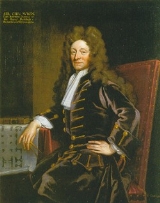
Sir Christopher Wren (20 October 1632 – 25 February 1723) was a 17th century English
England

native_name =|conventional_long_name = England|common_name = England|image_flag = Flag of England.svg|image_coat = England COA.svg|symbol_type = Royal Coat of Arms...
 designer
Designer

A designer is a person who designs something. Perhaps the broadest definition is that provided by psychologist Herbert Simon: 'Everyone designs who devises courses of action aimed at changing existing situations into preferred ones.' ...
, astronomer
Astronomer

An astronomer is a scientist who studies Celestial body such as planets, stars, and Galaxy.Historically, astronomy was more concerned with the classification and description of phenomena in the sky, while astrophysics attempted to explain these phenomena and the differences between them using physical laws....
, geometer, and one of the greatest English architect
Architect

An architect is trained and licenced in planning and designing buildings, and participates in supervising the construction of a building. Etymologically, architect derives from the Latin architectus, itself derived from the Greek arkhitekton , i.e....
s in history. Wren designed 53 London
London

London is the capital of both England and the United Kingdom, and the most populous municipality in the European Union. An important settlement for two millennia, History of London goes back to its founding by the Roman Empire....
 churches, including St Paul's Cathedral
St Paul's Cathedral

St Paul's Cathedral is the Anglicanism cathedral on Ludgate Hill, in the City of London, and the seat of the Bishop of London. The present building dates from the 17th century and is generally reckoned to be London's fifth St Paul's Cathedral, although the number is higher if every major medieval reconstruction is counted as a new cathedr...
, as well as many secular buildings of note. He was a founder of the Royal Society
Royal Society

The Royal Society of London for the Improvement of Natural Knowledge, known simply as the Royal Society, or even the Royal, is a learned society for science that was founded in 1660 and is considered by most to be the oldest such society still in existence....
 (president 1680–82), and his scientific work was highly regarded by Sir Isaac Newton
Isaac Newton

Sir Isaac Newton, Fellow of the Royal Society was an English people physicist, mathematician, Astronomy, Natural philosophy, Alchemy, and Theology and one of the the 100 in human history....
 and Blaise Pascal
Blaise Pascal

Blaise Pascal , was a France mathematician, physicist, and religion philosopher. He was a child prodigy who was educated by his father, a civil servant....
.
was born at East Knoyle
East Knoyle

East Knoyle is a small village and former civil parish in the Salisbury of Wiltshire, in the south west of England.The parish lies on the A350 road about nine miles south of Warminster, fifteen miles west of Salisbury, and two miles south west of Hindon, Wiltshire, at grid reference ST880305....
in Wiltshire
Wiltshire

Wiltshire is a Ceremonial counties of England in the South West England of England. It is landlocked and borders the counties of Dorset, Somerset, Hampshire, Gloucestershire, Oxfordshire and Berkshire....
, the only surviving son of Christopher Wren DD (1589-1658), at that time the rector of East Knoyle and later Dean of Windsor
Dean of Windsor

The Dean of Windsor is the spiritual head of the Canons of St George's Chapel at Windsor Castle. The Dean chairs meetings of the Chapter of Canons as primus inter pares....
.


Discussion
Ask a question about 'Christopher Wren'
Start a new discussion about 'Christopher Wren'
Answer questions from other users
Full Discussion Forum


Encyclopedia


Sir Christopher Wren (20 October 1632 – 25 February 1723) was a 17th century English
England

native_name =|conventional_long_name = England|common_name = England|image_flag = Flag of England.svg|image_coat = England COA.svg|symbol_type = Royal Coat of Arms...
 designer
Designer

A designer is a person who designs something. Perhaps the broadest definition is that provided by psychologist Herbert Simon: 'Everyone designs who devises courses of action aimed at changing existing situations into preferred ones.' ...
, astronomer
Astronomer

An astronomer is a scientist who studies Celestial body such as planets, stars, and Galaxy.Historically, astronomy was more concerned with the classification and description of phenomena in the sky, while astrophysics attempted to explain these phenomena and the differences between them using physical laws....
, geometer, and one of the greatest English architect
Architect

An architect is trained and licenced in planning and designing buildings, and participates in supervising the construction of a building. Etymologically, architect derives from the Latin architectus, itself derived from the Greek arkhitekton , i.e....
s in history. Wren designed 53 London
London

London is the capital of both England and the United Kingdom, and the most populous municipality in the European Union. An important settlement for two millennia, History of London goes back to its founding by the Roman Empire....
 churches, including St Paul's Cathedral
St Paul's Cathedral

St Paul's Cathedral is the Anglicanism cathedral on Ludgate Hill, in the City of London, and the seat of the Bishop of London. The present building dates from the 17th century and is generally reckoned to be London's fifth St Paul's Cathedral, although the number is higher if every major medieval reconstruction is counted as a new cathedr...
, as well as many secular buildings of note. He was a founder of the Royal Society
Royal Society

The Royal Society of London for the Improvement of Natural Knowledge, known simply as the Royal Society, or even the Royal, is a learned society for science that was founded in 1660 and is considered by most to be the oldest such society still in existence....
 (president 1680–82), and his scientific work was highly regarded by Sir Isaac Newton
Isaac Newton

Sir Isaac Newton, Fellow of the Royal Society was an English people physicist, mathematician, Astronomy, Natural philosophy, Alchemy, and Theology and one of the the 100 in human history....
 and Blaise Pascal
Blaise Pascal

Blaise Pascal , was a France mathematician, physicist, and religion philosopher. He was a child prodigy who was educated by his father, a civil servant....
.

Biography


Early life and education

Wren was born at East Knoyle
East Knoyle

East Knoyle is a small village and former civil parish in the Salisbury of Wiltshire, in the south west of England.The parish lies on the A350 road about nine miles south of Warminster, fifteen miles west of Salisbury, and two miles south west of Hindon, Wiltshire, at grid reference ST880305....
in Wiltshire
Wiltshire

Wiltshire is a Ceremonial counties of England in the South West England of England. It is landlocked and borders the counties of Dorset, Somerset, Hampshire, Gloucestershire, Oxfordshire and Berkshire....
, the only surviving son of Christopher Wren DD (1589-1658), at that time the rector of East Knoyle and later Dean of Windsor
Dean of Windsor

The Dean of Windsor is the spiritual head of the Canons of St George's Chapel at Windsor Castle. The Dean chairs meetings of the Chapter of Canons as primus inter pares....
. A previous child of Dr Wren, also named Christopher, was born on 22 November 1631, and had died the same day. John Aubrey
John Aubrey

John Aubrey was an England antiquary and writer, best known as the author of the collection of short biographical pieces usually referred to as Brief Lives and as the discoverer of the Aubrey holes in Stonehenge....
’s confusion of the two persisted occasionally into late twentieth-century literature.

As a child Wren "seem'd consumptive". Although a sickly child, he would survive into robust old age. He was first taught at home by a private tutor and his father. After his father's appointment as Dean of Windsor
Dean of Windsor

The Dean of Windsor is the spiritual head of the Canons of St George's Chapel at Windsor Castle. The Dean chairs meetings of the Chapter of Canons as primus inter pares....
 in March 1635, his family spent part of each year there. Little is known about Wren’s life at Windsor and it is misleading to say that Wren and the son of Charles I
Charles I of England

Charles I was List of English monarchs, List of monarchs of Scotland and King of Ireland from 27 March 1625 until his capital punishment on 30 January 1649....
 became childhood friends there and "often played together".

Little also is known of Wren’s schooling. The story that he was at Westminster School
Westminster School

The Royal College of St. Peter in Westminster, almost always known as Westminster School, is one of Britain's leading independent schools, with the highest Oxbridge acceptance rate of any secondary school or college....
 from 1641 to 1646 is unsubstantiated. Parentalia, the biography compiled by his son, a third Christopher, places him there "for some short time" before going to Oxford (in 1650). Some of his youthful exercises preserved or recorded (though few are datable) showed that he received a thorough grounding in Latin
Latin

Latin is an Italic language, historically spoken in Latium and Ancient Rome. Through the Military history of the Roman Empire, Latin spread throughout the Mediterranean and a large part of Europe....
; he also learned to draw. According to Parentalia, he was "initiated" in the principles of mathematics
Mathematics

Mathematics is the study of quantity, structure, space, change, and related topics of pattern and form. Mathematicians seek out patterns whether found in numbers, space, natural science, computers, imaginary abstractions, or elsewhere....
 by Dr William Holder
William Holder

William Holder was an England clergyman and music theorist of the 17th century. His most notable work was his widely known 1694 publication A Treatise on the Natural Grounds and Principles of Harmony....
, who married Wren’s elder sister Susan (or Susanna) in 1643. During this time period, Wren manifested an interest in the design and construction of mechanical instruments. It was probably through Holder that Wren met Sir Charles Scarburgh whom Wren assisted in his anatomical studies.

On 25 June 1650, Wren entered Wadham College, Oxford
Wadham College, Oxford

Wadham College is one of the Colleges of the University of Oxford of the University of Oxford in the United Kingdom, located at the southern end of Parks Road in central Oxford....
 where he studied Latin
Latin

Latin is an Italic language, historically spoken in Latium and Ancient Rome. Through the Military history of the Roman Empire, Latin spread throughout the Mediterranean and a large part of Europe....
 and the works of Aristotle
Aristotle

Aristotle was a Greeks philosopher, a student of Plato and teacher of Alexander the Great. He wrote on many subjects, including physics, metaphysics, Poetics , theater, music, logic, rhetoric, politics, government, ethics, biology and zoology....
. It is anachronistic to imagine that he received scientific training in the modern sense. However, Wren became closely associated with John Wilkins
John Wilkins

John Wilkins was an Anglican ministry and author. He was founder and first secretary of the Royal Society in 1660 and Bishop of Chester from 1668 until his death....
, who served as warden in Wadham. Wilkins was a member of a group of distinguished scholars. This group, whose activities led to the formation of the Royal Society
Royal Society

The Royal Society of London for the Improvement of Natural Knowledge, known simply as the Royal Society, or even the Royal, is a learned society for science that was founded in 1660 and is considered by most to be the oldest such society still in existence....
, consisted of a number of distinguished mathematicians, original and sometimes brilliant practical workers and experimental philosophers. This connection probably influenced Wren’s studies of science and mathematics at college. He graduated B.A. in 1651, and three years later received M.A.

Middle years

Receiving his M.A.
Master of Arts (postgraduate)

A Master of Arts is a Postgraduate education academic degree master degree awarded by University in many countries. The degree is typically studied for in English language, Fine Arts, History, Humanities, Philosophy, Social Sciences or Theology and can be either fully-taught, research-based, or a combination of the two....
 in 1653, Wren was elected a fellow of All Souls College
All Souls College, Oxford

All Souls College is one of the Colleges of the University of Oxford of the University of Oxford in England.Unique to All Souls, all of its members automatically become Fellows, i.e., full members of the College's governing body....
 in the same year and began an active period of research and experiment in Oxford. His days as a fellow of All Souls ended when Wren was appointed Professor of Astronomy at Gresham College
Gresham College

File:Gresham College, 1740.jpgGresham College is an unusual institution of higher learning off Holborn in central London. It enrolls no students and grants no academic degrees....
, London
London

London is the capital of both England and the United Kingdom, and the most populous municipality in the European Union. An important settlement for two millennia, History of London goes back to its founding by the Roman Empire....
 in 1657. He was provided with a set of rooms and a stipend and was required to give weekly lectures in both Latin
Latin

Latin is an Italic language, historically spoken in Latium and Ancient Rome. Through the Military history of the Roman Empire, Latin spread throughout the Mediterranean and a large part of Europe....
 and English
English language

English is a West Germanic language that originated in Anglo-Saxon England and has lingua franca status in many parts of the world as a result of the military, economic, scientific, political and cultural influence of the British Empire in the 18th, 19th and early 20th centuries and that of the United States from the mid 20th century onwa...
 to all who wished to attend; admission was free. Wren took up this new work with enthusiasm. He continued to meet the men with whom he had frequent discussions in Oxford
Wadham College, Oxford

Wadham College is one of the Colleges of the University of Oxford of the University of Oxford in the United Kingdom, located at the southern end of Parks Road in central Oxford....
. They attended his London lectures and in 1660, initiated formal weekly meetings. It was from these meetings that the Royal Society
Royal Society

The Royal Society of London for the Improvement of Natural Knowledge, known simply as the Royal Society, or even the Royal, is a learned society for science that was founded in 1660 and is considered by most to be the oldest such society still in existence....
, England
England

native_name =|conventional_long_name = England|common_name = England|image_flag = Flag of England.svg|image_coat = England COA.svg|symbol_type = Royal Coat of Arms...
’s premier scientific body, was to develop. He undoubtedly played a major role in the early life of what would become the Royal Society; his great breadth of expertise in so many different subjects helping in the exchange of ideas between the various scientists. In fact, the report on one of these meetings reads:

In 1662, they proposed a society "for the promotion of Physico-Mathematicall Experimental Learning." This body received its Royal Charter from Charles II
Charles II of England

Charles II was the Monarchy of Kingdom of England, Kingdom of Scotland, and Kingdom of Ireland.His father Charles I of England Regicide#The regicide of Charles I of England at Palace of Whitehall on 30 January 1649, at the climax of the English Civil War....
 and "The Royal Society
Royal Society

The Royal Society of London for the Improvement of Natural Knowledge, known simply as the Royal Society, or even the Royal, is a learned society for science that was founded in 1660 and is considered by most to be the oldest such society still in existence....
 of London for the Promotion of Natural Knowledge" was formed. In addition to being a founder member of the Society, Wren was president of the Royal Society from 1680 to 1682.

In 1661, Wren was elected Savilian Professor
Savilian Chair of Astronomy

The Savilian Chair of Astronomy at the University of Oxford in England was founded in 1619 and is named after Sir Henry Savile. The Professor is a Fellow of New College, Oxford....
 of Astronomy
Astronomy

Astronomy is the science of Astronomical object and Phenomenon that originate outside the Earth's atmosphere . It is concerned with the evolution, physics, chemistry, meteorology, and motion of celestial objects, as well as the physical cosmology....
 at Oxford, and in 1669 he was appointed Surveyor of Works to Charles II. From 1661 until 1668 Wren's life was based in Oxford, although the Royal Society meant that he had to make occasional trips to London.

The main sources for Wren's scientific achievements are the records of the Royal Society
Royal Society

The Royal Society of London for the Improvement of Natural Knowledge, known simply as the Royal Society, or even the Royal, is a learned society for science that was founded in 1660 and is considered by most to be the oldest such society still in existence....
. His scientific works ranged from astronomy
Astronomy

Astronomy is the science of Astronomical object and Phenomenon that originate outside the Earth's atmosphere . It is concerned with the evolution, physics, chemistry, meteorology, and motion of celestial objects, as well as the physical cosmology....
, optics
Optics

Optics is the study of the behavior and properties of light including its optical phenomena with matter and its imaging by optical instruments....
, the problem of finding longitude
Longitude

Longitude , symbolized by the Greek character lambda , is the geographic coordinate most commonly used in cartography and global navigation for east-west measurement....
 at sea, cosmology
Cosmology

Cosmology is study of the Universe in its totality, and by extension, humanity's place in it. Though the word cosmology is recent , study of the Universe has a long history involving science, philosophy, esotericism, and religion....
, mechanics
Mechanics

Mechanics is the branch of physics concerned with the behaviour of physical body when subjected to forces or Displacement , and the subsequent effect of the bodies on their environment....
, microscopy
Microscopy

Microscopy is the technical field of using microscopes to view samples or objects. There are three well-known branches of microscopy, optical microscopy, electron microscopy and scanning probe microscopy....
, surveying
Surveying

Surveying or land surveying is the technique and science of accurately determining the terrestrial or three-dimensional space position of points and the distances and angles between them....
, medicine
Medicine

Medicine is the art and science of healing. It encompasses a range of health care practices evolved to maintain and restore health by the prevention and treatment of illness....
 and meteorology
Meteorology

Meteorology is the interdisciplinary scientific study of the Earth's atmosphere that focuses on weather processes and forecasting . Studies in the field stretch back millennia, though significant progress in meteorology did not occur until the eighteenth century....
. He observed, measured, dissected, built models, and employed, invented and improved a variety of instruments. It was also around these times that his attention turned to architecture
Architecture

The term architecture can refer to a process, a profession or documentation.As a process, architecture is the activity of designing and construction buildings and other physical structures by a person or a computer, primarily to provide shelter....
.

The second of Wren's architectural endeavours, the first being the chapel of Pembroke College
Pembroke College, Cambridge

Pembroke College is a college of the University of Cambridge, home to over six hundred students and fellow, and is the third oldest of the colleges....
 in Cambridge, which his uncle
Matthew Wren

Matthew Wren was an influential English clergyman and scholar....
, the Bishop of Ely
Bishop of Ely

The Bishop of Ely is the Ordinary of the Church of England Diocese of Ely in the Province of Canterbury.The diocese roughly covers the county of Cambridgeshire , together with a section of north-west Norfolk and has its Episcopal see in the Ely, Cambridgeshire, where the seat is located at the Ely Cathedral....
, asked him to design in 1663, was the design of the Sheldonian Theatre
Sheldonian Theatre

The Sheldonian Theatre, located in Oxford, England, was built from 1664 to 1668 after a design by Christopher Wren for the University of Oxford....
 in Oxford
Oxford

Oxford is a City status in the United Kingdom, and the county town of Oxfordshire, in South East England. It has a population of 151,000. The rivers River Cherwell and River Thames run through Oxford and meet south of the city centre....
, completed in 1668. This, the gift of Archbishop Sheldon
Gilbert Sheldon

Gilbert Sheldon was an English Archbishop of Canterbury....
 to his old university, was influenced by the classical form of the Theatre of Marcellus
Theatre of Marcellus

The Theatre of Marcellus is an ancient theatre built just before the Roman Empire. Its Roman architecture in the rioni of Rome of Sant'Angelo , Rome, provides one of the city's many popular spectacles or tourist sites....
 in Rome
Rome

Rome is the capital city of Italy and Lazio, and is Italy's largest and most populous city, with 2,724,347 residents in an urban area of some ....
, but was a mixture of this classical design with a modern empirical design. It was probably around this time that Wren was drawn into redesigning a battered St Paul's Cathedral
St Paul's Cathedral

St Paul's Cathedral is the Anglicanism cathedral on Ludgate Hill, in the City of London, and the seat of the Bishop of London. The present building dates from the 17th century and is generally reckoned to be London's fifth St Paul's Cathedral, although the number is higher if every major medieval reconstruction is counted as a new cathedr...
. Making a trip to Paris
Paris

Paris is the Capital of France and the country's largest city. It is situated on the river Seine, in northern France, at the heart of the ?le-de-France Regions of France ....
 in 1665, Wren studied the architecture, which had reached a climax of creativity, and perused the drawings of Bernini
Gian Lorenzo Bernini

Giovanni Lorenzo Bernini was a pre-eminent Baroque sculpture and architect of 17th Century Rome....
, the great Italian
Italy

Italy , officially the Italian Republic , is a country located on the Italian Peninsula in Southern Europe and on the two largest islands in the Mediterranean Sea, Sicily and Sardinia....
 sculptor and architect. Returning from Paris, he made his first design for St Paul’s. A week later, however, the Great Fire destroyed two-thirds of the city. Wren submitted his plans for rebuilding the city to King Charles II, although they were never adopted. With his appointment as King’s Surveyor of Works in 1669, he had a presence in the general process of rebuilding the city, but was not directly involved with the rebuilding of houses or companies' halls. Wren was personally responsible for the rebuilding of 51 churches; however, it is not necessarily true to say that each of them represented his own fully developed design.

Wren was knighted 14 November 1673. He was bestowed after his resignation from the Savilian position in Oxford, by which time he had already begun to make his mark as an architect
Architect

An architect is trained and licenced in planning and designing buildings, and participates in supervising the construction of a building. Etymologically, architect derives from the Latin architectus, itself derived from the Greek arkhitekton , i.e....
, both in services to the Crown and in playing an important part in rebuilding London after the Great Fire
Great Fire of London

The Great Fire of London was a major conflagration that swept through the central parts of London, England, from Sunday, 2 September to Wednesday, 5 September 1666....
.

Additionally, he was sufficiently active in public affairs to be returned as Member of Parliament
Parliament of England

The Parliament of England was the legislature of the Kingdom of England. Its roots can be traced back to the early medieval period. In a series of developments, it came increasingly to constrain the power of the King of England, and went on after the Act of Union 1707 to merge with the Parliament of Scotland and form the main basis of the Pa...
 for Old Windsor in 1680, 1689 and 1690, but did not take his seat.

By 1669 Wren's career was well established and it may have been his appointment as Surveyor-General of the King's Works in early 1669 that persuaded him that he could finally afford to take a wife. In 1669 the thirty-seven year old Wren married his childhood neighbour, the thirty-three year old Faith Coghill, daughter of Sir John Coghill of Bletchingham
Bletchingdon

Bletchingdon is a village and civil parish in the Cherwell of Oxfordshire, England, a couple of miles north of Kidlington. According to the 2001 census it had a population of 872....
. Little is known of Faith's life or demeanour, but a love letter from Wren survives, which reads, in part:

* (Some time earlier, Faith had dropped her wristwatch into a pool of water. It had been sent to Wren in London for it to be repaired. This letter was part of a package.)

This brief marriage produced two children: Gilbert, a sickly child given to convulsions fits, born October 1672; the infant died not quite a year-and-a-half old. The second child, also a son, named Christopher after his father, was born February 1675. The younger Christopher was trained by his father to be an architect. It was this Christopher that supervised the topping out ceremony of St Paul's
St Paul's Cathedral

St Paul's Cathedral is the Anglicanism cathedral on Ludgate Hill, in the City of London, and the seat of the Bishop of London. The present building dates from the 17th century and is generally reckoned to be London's fifth St Paul's Cathedral, although the number is higher if every major medieval reconstruction is counted as a new cathedr...
 in 1710 and wrote the famous Parentalia
Parentalia

Parentalia was a Roman festival for honoring one's dead parents. Families gathered among the tombs of loved ones and made offerings or sacrifices of grain and wine to their souls ....
. Faith Wren died of smallpox
Smallpox

Smallpox is an infectious disease unique to humans, caused by either of two virus variants, Variola major and Variola minor. The disease is also known by the Latin names Variola or Variola vera, which is a derivative of the Latin varius, meaning spotted, or varus, meaning "pimple"....
 on 3 September 1675. She was buried in the chancel
Chancel

"Chancel" is an architectural term for the space around the altar at the liturgical east end of a traditional Christian church building. It may terminate in an apse....
 of St Martin-in-the-Fields
St Martin-in-the-Fields

St Martin-in-the-Fields is an Church of England church at the northeast corner of Trafalgar Square in the City of Westminster, London. Its patron is Saint Martin of Tours....
 beside the infant Gilbert. A few days later Wren's mother-in-law, Lady Coghill, arrived to take the infant Christopher back with her to Oxfordshire to raise.

In 1677, seventeen months after the death of his first wife, Wren married once again. He married Jane Fitzwilliam, a woman even more of a mystery than the first Mrs Wren; especially to Wren's friends and companions. Robert Hooke
Robert Hooke

Robert Hooke, Fellow of the Royal Society was an England natural philosopher and polymath who played an important role in the scientific revolution, through both experimental and theoretical work....
, who often saw Wren two or three times every week, had, as he recorded in his diary, never even heard of her, and was not to meet her till six weeks after the marriage. All that is known about the second Mrs Wren was that she was the daughter of Lord Fitzwilliam of Lifford
Lifford

Lifford is the County Town of County Donegal, Republic of Ireland. It is the administrative capital of the County and the seat of Donegal County Council, The town of Letterkenny is often mistaken for fulfilling this role....
 on the Irish peerage, and that her mother had been the daughter of a prosperous London merchant. As with the first marriage, this too produced two children: a daughter Jane (1677-1702); and a son William, "Poor Billy" born June, 1679, who was developmentally delayed.

Like the first, this second marriage was also brief. Jane Wren died of tuberculosis
Tuberculosis

Tuberculosis is a common and often deadly infectious disease caused by mycobacterium, mainly Mycobacterium tuberculosis . Tuberculosis usually attacks the lungs but can also affect the central nervous system, the lymphatic system, the circulatory system, the genitourinary system, the gastrointestinal system, bones, joints, and even the...
 in September 1680. She was buried alongside Faith and Gilbert in the chancel of St Martin-in-the-Fields. Wren was never to marry again; he lived to be over 90 years old and of those was married only nine.

Bletchingham was the home of Wren's brother-in-law William Holder who was rector of the local church. Holder had been a Fellow of Pembroke College, Oxford
Pembroke College, Oxford

Pembroke College is one of the Colleges of the University of Oxford of the University of Oxford in England, located in Pembroke Square, Oxford. As of 2007, Pembroke had an estimated financial endowment of ?45.5 million....
. An intellectual of considerable ability, he is said to have been the figure who introduced Wren to arithmetic and geometry.

After the death of Charles II in 1685, Wren's attention was directed mainly to Whitehall
Whitehall

Whitehall is a road in Westminster in London, England. It is the main artery running north from Parliament Square, towards traditional Charing Cross, now at the southern end of Trafalgar Square and marked by the statue of Charles I of England, which is often regarded as the heart of London....
. The new king, James II
James II of England

James II and VII was List of English monarchs, List of Scottish monarchs, and King of Ireland from 6 February 1685. He was the last Roman Catholic Church monarch to reign over the Kingdoms of Kingdom of England, Kingdom of Scotland, and Kingdom of Ireland....
, required a new chapel and also ordered a new gallery, council chamber and a riverside apartment for the Queen
Mary of Modena

Mary of Modena was queen consort to James II of England....
. Later, when James II was removed from the throne, Wren took on architectural projects such as Kensington Palace
Kensington Palace

Kensington Palace is a royal residence set in Kensington Gardens in the Royal Borough of Kensington and Chelsea in London, England. It has been a residence of the British Royal Family since the 17th century....
, Hampton Court and Greenwich Hospital, which was his last great work and the only one still in progress after St Paul’s had been completed in 1711.

Late life

Wren's later life was not without criticisms and attacks on his competence and his taste. In 1712, the Letter Concerning Design of Anthony Ashley Cooper
Anthony Ashley-Cooper, 3rd Earl of Shaftesbury

Anthony Ashley Cooper, 3rd Earl of Shaftesbury , was an England politician, philosopher and writer....
, third Earl of Shaftesbury
Earl of Shaftesbury

Earl of Shaftesbury is a title in the Peerage of England. It was created in 1672 for Anthony Ashley-Cooper, 1st Earl of Shaftesbury, a prominent politician in the Cabal Ministry then dominating the policies of King Charles II of England....
, circulated in manuscript. Proposing a new British style of architecture, Shaftesbury censured Wren’s cathedral, his taste and his long-standing control of royal works. Although he was appointed to the Fifty New Churches Commission in 1711, he was left only with nominal charge of a board of works when the surveyorship started in 1715. On 26 April 1718, on the pretext of failing powers, he was dismissed in favour of William Benson
William Benson

William Benson was a talented amateur architect and an ambitious and self-serving British Whig Party place-holder in the government of George I of Great Britain....
.

Contrary to popular belief, Wren did not die at his son’s house. The Wren family estate was in the area of Hampton Court. It had been bought by Wren many years before as part of a legacy for his son Christopher Wren, Jr. For convenience Wren also leased a house on St James's Street in London. According to a nineteenth-century legend, he would often go to London to pay unofficial visits to St Paul's, to check on the progress of "my greatest work". On one of these trips to London he caught a chill. Over the next several days the illness became increasingly worse. On 25 February 1723 a servant tried to awaken Wren from his nap, but found that Wren had died.

Wren was laid to rest on 5 March 1723. His remains were placed in the south-east corner of the crypt beside those of his daughter Jane, his sister Susan Holder, and her husband William. The simple stone marker reads:

Subtus conditur Hujus Ecclesias et Urbis Conditor, CHRISTOPHERUS WREN; Qui vixit annos ultra nonaginta, Non sibi, sed bono publico. Lector, si monumentum requiris, Circumspice. Obiit 25 Feb. MDCCXXIII., aetat. XCI.


The translation of it is: "Underneath lies buried Christopher Wren, the builder of this church and city; who lived beyond the age of ninety years, not for himself, but for the public good.--Reader, if you seek his monument, look around you.--He died on the 25th of February, 1723, aged 91."

The last lines, which were written by Wren's eldest son and heir, Christopher Wren, Jr., are one of the most famous epitaphs of all time.

Scientific and architectural works


One of Wren's friends, another great scientist and architect in his time, Robert Hooke
Robert Hooke

Robert Hooke, Fellow of the Royal Society was an England natural philosopher and polymath who played an important role in the scientific revolution, through both experimental and theoretical work....
 said of him "Since the time of Archimedes
Archimedes

Archimedes of Syracuse was a Greek mathematics, physicist, engineer, inventor, and astronomer. Although few details of his life are known, he is regarded as one of the leading scientists in classical antiquity....
 there scarce ever met in one man in so great perfection such a mechanical hand and so philosophical mind."

Scientific achievements


As a fellow of All Souls
All Souls College, Oxford

All Souls College is one of the Colleges of the University of Oxford of the University of Oxford in England.Unique to All Souls, all of its members automatically become Fellows, i.e., full members of the College's governing body....
, he constructed a transparent beehive for scientific observation; he began observing the moon
Moon

The Moon is Earth's only natural satellite and the List of natural satellites by diameter satellite in the Solar System. The average centre-to-centre distance from the Earth to the Moon is km, about thirty times the diameter of the Earth....
, which was subsequent to the invention of micrometer
Filar micrometer

A filar micrometer is a device used in astronomical telescopes for precision measurements. The word filar derives from Latin filum, a thread....
s for the telescope
Telescope

A telescope is an instrument designed for the observation of remote objects by the collection of electromagnetic radiation. The first known practically functioning telescopes were invented in the Netherlands at the beginning of the 17th century....
. He experimented on terrestrial magnetism
Magnetism

In physics, magnetism is one of the phenomena by which materials exert attractive or repulsive forces on other materials. Some well-known materials that exhibit easily detectable magnetic properties are nickel, iron, cobalt, and their alloys; however, all materials are influenced to greater or lesser degree by the presence of a magnetic fiel...
 and had taken part in medical
Medicine

Medicine is the art and science of healing. It encompasses a range of health care practices evolved to maintain and restore health by the prevention and treatment of illness....
 experiments, performing the first successful injection of a substance into the bloodstream (of a dog).

In Gresham College
Gresham College

File:Gresham College, 1740.jpgGresham College is an unusual institution of higher learning off Holborn in central London. It enrolls no students and grants no academic degrees....
, he did experiments involving determining longitude
Longitude

Longitude , symbolized by the Greek character lambda , is the geographic coordinate most commonly used in cartography and global navigation for east-west measurement....
 through magnetic
Magnetism

In physics, magnetism is one of the phenomena by which materials exert attractive or repulsive forces on other materials. Some well-known materials that exhibit easily detectable magnetic properties are nickel, iron, cobalt, and their alloys; however, all materials are influenced to greater or lesser degree by the presence of a magnetic fiel...
 variation and through lunar observation to help with navigation
Navigation

Navigation is the process of reading, and controlling the movement of a craft or vehicle from one place to another. It is also the term of art used for the specialized knowledge used by navigators to perform navigation tasks....
, and helped construct a telescope with Sir Paul Neile. Wren also studied and improved the microscope
Microscope

A microscope is an Laboratory equipment for viewing objects that are too small to be seen by the naked or unaided eye. The science of investigating small objects using such an instrument is called microscopy....
 and telescope at this time. He had also been making observations of the planet Saturn
Saturn

Saturn is the sixth planet from the Sun and the second largest planet in the Solar System, after Jupiter. Saturn, along with Jupiter, Uranus and Neptune, is classified as a gas giant....
 from around 1652 with the aim of explaining its appearance. His hypothesis was written up in De corpore saturni but before the work was published, Huygens
Christiaan Huygens

Christiaan Huygens was a prominent Netherlands mathematics, astronomer, physics, and horology. His work included early telescopic studies, investigations and inventions related to time keeping, and studies of both optics and centrifugal force....
 presented his theory of the rings of Saturn. Immediately Wren recognized this as a better hypothesis than his own and De corpore saturni was never published. In addition, he constructed an exquisitely detailed lunar model and presented it to the king. Also his contribution to mathematics
Mathematics

Mathematics is the study of quantity, structure, space, change, and related topics of pattern and form. Mathematicians seek out patterns whether found in numbers, space, natural science, computers, imaginary abstractions, or elsewhere....
 should be noted; in 1658, he found the length of an arc of the cycloid
Cycloid

A cycloid is the curve defined by the path of a point on the edge of circular wheel as the wheel rolls along a straight line.It is an example of a roulette , a curve generated by a curve rolling on another curve....
 using an exhaustion proof based on dissections to reduce the problem to summing segments of chords of a circle which are in geometric progression.

A year into Wren's appointment as a Savilian Professor
Savilian Chair of Astronomy

The Savilian Chair of Astronomy at the University of Oxford in England was founded in 1619 and is named after Sir Henry Savile. The Professor is a Fellow of New College, Oxford....
 in Oxford
Oxford

Oxford is a City status in the United Kingdom, and the county town of Oxfordshire, in South East England. It has a population of 151,000. The rivers River Cherwell and River Thames run through Oxford and meet south of the city centre....
, the Royal Society
Royal Society

The Royal Society of London for the Improvement of Natural Knowledge, known simply as the Royal Society, or even the Royal, is a learned society for science that was founded in 1660 and is considered by most to be the oldest such society still in existence....
 was created and Wren became an active member. As a Savilian Professor, Wren studied thoroughly in mechanics
Mechanics

Mechanics is the branch of physics concerned with the behaviour of physical body when subjected to forces or Displacement , and the subsequent effect of the bodies on their environment....
, especially in elastic collision
Elastic collision

An elastic collision is a collision in which the total kinetic energy of the colliding bodies after collision is equal to their total kinetic energy before collision....
s and pendulum
Pendulum

A pendulum is a weight suspended from a pivot so it can swing freely.When a pendulum is displaced from its resting Mechanical equilibrium, it is subject to a restoring force due to gravity that will accelerate it back toward the equilibrium position....
 motions, which he studied extensively. He also directed his far-ranging intelligence to the study of meteorology
Meteorology

Meteorology is the interdisciplinary scientific study of the Earth's atmosphere that focuses on weather processes and forecasting . Studies in the field stretch back millennia, though significant progress in meteorology did not occur until the eighteenth century....
, and fabricated a "weather-clock" that recorded temperature, humidity, rainfall and barometric pressure, which could be used to predict the weather. In addition, Wren experimented on muscle functionality as well, hypothesizing that the swelling and shrinking of muscles might proceed from a fermentative motion arising from the mixture of two heterogeneous fluids. Although this is incorrect, it is at least founded upon observation and may mark a new outlook on medicine: specialization. Another topic to which Wren contributed was optics
Optics

Optics is the study of the behavior and properties of light including its optical phenomena with matter and its imaging by optical instruments....
. He published a description of an engine to create perspective drawings and he discussed the grinding of conical lenses and mirrors. Out of this work came another of Wren's important mathematical results, namely that the hyperboloid
Hyperboloid

In mathematics, a hyperboloid is a quadric, a type of surface in three dimensions, described by the equation  hyperboloid of one sheet,...
 of revolution is a ruled surface. These results were published in 1669. In subsequent years, Wren continued with his work with the Royal Society, although after the 1680s his scientific interests seem to have waned: no doubt his architectural and official duties absorbed all his time.

Mentioned above are only a few of Wren’s scientific works. He also studied in other areas not mentioned, ranging from agriculture
Agriculture

Agriculture refers to the production of food and goods through farming and forestry. Agriculture was the key development that led to the rise of civilization, with the animal husbandry of domestication animals and plants creating food surpluses that enabled the development of more Population density and Social stratification societies....
, ballistics
Ballistics

Ballistics is the science of mechanics that deals with the flight, behavior, and effects of projectiles, especially bullets, gravity bombs, rockets, or the like; the science or art of designing and accelerating projectiles so as to achieve a desired performance....
, water and freezing, to investigating light and refraction only to name a few. Thomas Birch
Thomas Birch

Thomas Birch was an England historian....
's History of the Royal Society is one of the most important sources of our knowledge not only of the origins of the Society, but also the day to day running of the Society. It is in these records that the majority of Wren’s scientific works are recorded.

Architectural career


First steps to architecture

In Wren's age, the profession of architect as understood today did not exist. Since the early years of the 17th century it was not unusual for the well-educated gentleman, (virtuosi), to take up architecture as a gentlemanly activity; a pursuit widely accepted as a branch of applied mathematics. This is implicit in the writings of Vitruvius
Vitruvius

File:Vitruvius.jpgMarcus Vitruvius Pollio was a Ancient Rome writer, architect and engineer , active in the 1st century BC. By his own description Vitruvius served as a Ballista , the third class of arms in the military offices....
 and explicit in such sixteenth-century authors as John Dee
John Dee (mathematician)

John Dee was a noted England mathematics, astronomy, astrology, geography, Occultism, and consultant to Queen Elizabeth I of England. He also devoted much of his life to the study of alchemy, divination, and Hermeticism....
 and Leonard Digges
Leonard Digges

Leonard Digges , father of Thomas Digges, was a well-known mathematician and surveyor, credited with the inventions of the theodolite and telescope, and a great populariser of science through his publications in English....
. When Wren was a student at Oxford, he became familiar with Vitruvius's De architectura and absorbed intuitively the fundamentals of the architectural design there. In the past, buildings had been constructed to the needs of the patron and the suggestions of building professionals, such as master carpenters or master bricklayers.

Through the Royal Society and his use of optics, The King noticed Wren's works. In 1661 he was approached by his cousin Matthew with a royal commission, as "one of the best Geometer in Europe", to direct the refortification of Tangier
Tangier

Tangier or Tangiers [#Notes] is a city of northern Morocco with a population of about 700,000 . It lies on the North African coast at the western entrance to the Strait of Gibraltar where the Mediterranean meets the Atlantic Ocean off Cape Spartel....
. Wren excused himself on grounds of health. Although this invitation may have arisen from Charles II's casual opportunism in matching people to tasks, Wren is believed to have been already on the way to architecture practice. Before the end of 1661 Wren was unofficially advising the repair of Old St Paul's Cathedral
Old St Paul's Cathedral

Old St. Paul's is a name used to refer to the Gothic architecture cathedral in the City of London built between 1087 and 1314. At its peak, the cathedral was the third longest church in Europe and had List of tallest churches in the world....
 after two decades of neglect and distress; his architectural interests were also evident to his associates at the time. Two years after, he set his only foreign journey to Paris
Paris

Paris is the Capital of France and the country's largest city. It is situated on the river Seine, in northern France, at the heart of the ?le-de-France Regions of France ....
 and the Île-de-France
Île-de-France (région)

?le-de-France is one of the twenty-six administrative regions of France of France, composed mostly of the Paris metropolitan area. Created as the "District of the Paris Region" in 1961, it was renamed as the "?le-de-France" r?gion in 1976 when its administrative status was aligned with the other French administrative regions created in 1...
, during which he acquired the firsthand study of modern design and construction. By this time, he had mastered and thoroughly understood architecture. Unlike several of his colleagues who took it up as a set of rules and formulas for design, he possessed, understood, and exploited the combination of reason and intuition, experience and imagination.

Wren and St Paul's
St Paul's
St Paul's Cathedral

St Paul's Cathedral is the Anglicanism cathedral on Ludgate Hill, in the City of London, and the seat of the Bishop of London. The present building dates from the 17th century and is generally reckoned to be London's fifth St Paul's Cathedral, although the number is higher if every major medieval reconstruction is counted as a new cathedr...
 has always been the touchstone of Wren's reputation. His association with it spans his whole architectural career, including the thirty-six years between the start of the new building and the declaration by parliament of its completion in 1711.

Wren had been involved in repairs of the old cathedral since 1661. In the spring of 1666, he made his first design for a dome for St Paul's
St Paul's Cathedral

St Paul's Cathedral is the Anglicanism cathedral on Ludgate Hill, in the City of London, and the seat of the Bishop of London. The present building dates from the 17th century and is generally reckoned to be London's fifth St Paul's Cathedral, although the number is higher if every major medieval reconstruction is counted as a new cathedr...
. It was accepted in principle on August 27, 1666. One week later, however, the Great Fire of London
Great Fire of London

The Great Fire of London was a major conflagration that swept through the central parts of London, England, from Sunday, 2 September to Wednesday, 5 September 1666....
 reduced two-thirds of the City to a smoking desert and old St Paul's to a ruin. Wren was most likely at Oxford at the time, but the news, so fantastically relevant to his future, drew him at once to London. Between 5 and 11 September he ascertained the precise area of devastation, worked out a plan for rebuilding the City and submitted it to Charles II. Others also submitted plans. However, no new plans proceeded any further than the paper on which it was drawn. A rebuilding act which provided rebuilding of some essential buildings was passed in 1667. In 1669, the King's Surveyor of Works died and Wren was promptly installed.
St Paul's   the Warrant Design
? It was not until 1670 that the pace of rebuilding started accelerating. A second rebuilding act was passed that year, raising the tax on coal and thus providing a source of funds for rebuilding of churches destroyed within the City of London
City of London

The City of London is a geographically small city status in the United Kingdom within Greater London, England. It is the historic core of London around which, along with Westminster, the modern conurbation grew....
. Wren presented his initial "First Model" for St Paul's. This plan was accepted, and demolition of the old cathedral began. By 1672, however, this design seemed too modest, and Wren met his critics by producing a design of spectacular grandeur. This modified design, called "Great Model", was accepted by the King and the construction started in November, 1673. However, this design failed to satisfy the chapter
Cathedral chapter

In accordance with canon law, a cathedral chapter is a body of clerics formed to advise a bishop and, in the case of a vacancy in the bishop?s seat, to govern the diocese in his stead....
 and clerical opinion generally; moreover, it had an economic drawback. Wren was confined to a "cathedral form" desired by the clergy. In 1674 he produced the rather meagre Classical-Gothic compromise known as the Warrant Design. However, this design, called so from the royal warrant of 14 May 1675 attached to the drawings, is not the design upon which work had begun a few weeks before.
St Paul's   the Final Design
The cathedral that Wren started to build bears only a slight resemblance to the Warrant Design. In 1697, the first service was held in the cathedral when Wren was 65. There was still, however, no dome. Finally in 1711 the cathedral was declared complete, and Wren was paid half of his salary that, in the hope of accelerating progress, Parliament
Parliament of England

The Parliament of England was the legislature of the Kingdom of England. Its roots can be traced back to the early medieval period. In a series of developments, it came increasingly to constrain the power of the King of England, and went on after the Act of Union 1707 to merge with the Parliament of Scotland and form the main basis of the Pa...
 had withheld for fourteen years since 1697. The cathedral had been built for 36 years under him, and the only disappointment he had about his masterpiece is the dome: against his wishes the commission engaged Thornhill to paint the inner dome in false perspective and finally authorized a balustrade around the proof line. This diluted the hard edge Wren had intended for his cathedral, and elicited the apt parthian comment that "ladies think nothing well without an edging".

Major architectural works in the 1670s and 1680s
During the 1670s Wren received significant secular commissions which manifest both the maturity and the variety of his architecture and the sensitivity of his response to diverse briefs. Among many of his remarkable designs at this time, the monument
Monument to the Great Fire of London

The Monument to the Great Fire of London, more commonly known as The Monument, is a 202 ft tall stone Roman doric column in the City of London, near to the northern end of London Bridge....
 commemorating the Great Fire, the Royal Observatory
Royal Observatory, Greenwich

The Royal Observatory, Greenwich was commissioned in 1675 by Charles II of England, with the foundation stone being laid on 10 August. At this time the king also created the position of Astronomer Royal , to serve as the director of the observatory and to "apply himself with the most exact care and diligence to the rectifying of the tab...
, and the library
Wren Library, Cambridge

The Wren Library is the library of Trinity College, Cambridge in Cambridge. It was designed by Christopher Wren in 1676 and completed in 1684. It is credited as being one of the first libraries to be built with large windows to give comfortable light levels to aid readers....
 at Trinity College, Cambridge
Trinity College, Cambridge

Trinity College is one of the 31 Colleges of the University of Cambridge of the University of Cambridge. Trinity has more members than any other college in Cambridge or University of Oxford, with around 700 undergraduates, 430 graduate students, and over 160 Fellows; however, counting only the student body it has somewhat fewer than Homert...
 were the most important ones. The former two of the three works also involved Robert Hooke
Robert Hooke

Robert Hooke, Fellow of the Royal Society was an England natural philosopher and polymath who played an important role in the scientific revolution, through both experimental and theoretical work....
, but Wren was in control of the final design.

By historical accident, all Wren's large-scale secular commissions dated from after the 1680s. At the age of fifty his personal development, as was that of English architecture, was ready for a monumental but humane architecture, in which the scales of individual parts relates both to the whole and to the people who used them. The first large project Wren designed, the Chelsea Hospital, does not entirely satisfy the eye in this respect, but met its belief with such distinction and success that even in the twentyfirst century it fulfils its original function. The reconstruction of the state room at Windsor Castle
Windsor Castle

Windsor Castle, in Windsor, Berkshire in the England county of Berkshire, is the largest inhabited castle in the world and, dating back to the time of William I of England, is the oldest in continuous occupation....
 was notable for the integration of architecture, sculpture, and painting. This commission was in the hand of Hugh May, who died in February, 1684, before the construction finished; Wren assumed his post and finalized the works.

Wren did not pursue his work on architectural design as actively as he had before the 1690s, although he still played important roles in a number of royal commissions. In 1696 he was appointed Surveyor of Greenwich Naval Hospital, and three years later Surveyor of Westminster Abbey
Westminster Abbey

The Collegiate Church of St Peter at Westminster, which is almost always referred to popularly and informally as Westminster Abbey, is a large, mainly Gothic architecture Church , in Westminster, London, just to the west of the Palace of Westminster....
. He resigned the former role in 1716 but held the latter until his death.

Achievement and reputation


At his death, Wren was 90. Even the men he had trained and who owed much of their success to Wren's original and leadership were no longer young. Newer generations of architects were beginning to look past Wren's style. The Baroque
Baroque

In the the arts, the Baroque was a Western cultural Epoch , starting roughly at the beginning of the 17th century in Rome, Italy. It was exemplified by drama and grandeur in Baroque sculpture, Baroque painting, literature, Baroque dance, and Baroque music....
 school his apprentices had created was already under fire from a new generation that brushed Wren’s reputation aside and looked back beyond him to Inigo Jones
Inigo Jones

Inigo Jones is regarded as the first significant British architecture, and the first to bring Renaissance architecture to England. He also made valuable contributions to stage design....
. Architects of the 18th century could not forget Wren, but they could not forgive some elements in his work they deemed unconventional. The churches left the strongest mark on subsequent architecture. In France, where English architecture rarely made much impression, the influence of St Paul's Cathedral can be seen in the church of Sainte-Geneviève (now the Panthéon
Pantheon

Pantheon may refer to:*Pantheon , a word used to describe the set of gods of a particular religion, mythology, or fictional universe* A temple, dedicated to all gods, or to all the gods of a given religion...
); begun in 1757, it rises to a drum and dome similar to St Paul's, and there are countless versions of it, from St Isaac's
Saint Isaac's Cathedral

Saint Isaac's Cathedral or Isaakievskiy Sobor in Saint Petersburg, Russia is the largest cathedral in the city and was the largest church in Russia when it was built ....
 (1840-42) in St Petersburg to the Capitol
United States Capitol

The United States Capitol serves as the seat of government for the United States Congress, the legislature of the federal government of the United States....
 at Washington, D.C.
Washington, D.C.

Washington, D.C. , formally the District of Columbia and commonly referred to as Washington, the District, or simply D.C., is the Capital of the United States, founded on July 16, 1790....
 (1855-65).

In the twentieth century the potency of the influence of Wren's work on English architecture was reduced. The last major architect who admitted to being dependent on him was Sir Edwin Lutyens, who died in 1944. With the purposeful elimination of historic influences from international architecture in the early 20th century
International style (architecture)

The International style was a major architectural style of the 1920s and 1930s. The term usually refers to the buildings and architects of the formative decades of Modernism, before World War II....
, Wren's work gradually stopped being perceived as a mine of examples applicable to contemporary design.

Sir Christopher Wren was also a Freemason and Master of Lodge Original, No. 1, now the Lodge of Antiquity No. 2 "adopted" May 18, 1691.

Commemorations

Wren's tomb in St Paul's is marked by a plain stone plaque mounted on the wall in quiet corner of the Crypt. The inscription ends: which translates as:

From 1991 until 2001, Wren's picture featured on the reverse of Series D £50 banknotes issued by the Bank of England
Bank of England note issues

The Bank of England is the Central Bank of the United Kingdom and one of Banknotes of the pound sterling legally authorised to issue banknotes in the UK....
. He was shown against a backdrop of the skyline of London as it would have appeared in 1711 with St Paul's towering above the other city buildings. With his left hand, Wren points to an architectural plan of the cathedral. The design of the note incorporates neoclassical details from Wren's work.

The crater Wren on Mercury
Mercury (planet)

Mercury is the innermost and smallest planet in the Solar System, orbiting the Sun once every 88 days. The orbit of Mercury has the highest Orbital eccentricity of all the Solar System planets, and it has the smallest axial tilt....
 was named in his honour.

The house of Wren's at Westminster School
Westminster School

The Royal College of St. Peter in Westminster, almost always known as Westminster School, is one of Britain's leading independent schools, with the highest Oxbridge acceptance rate of any secondary school or college....
 in England was named after him.

Trivia


At one time Wren was credited with the design of the King's House at Newmarket. The attribution gave rise to an apocryphal story in which Charles II, who was over six feet tall, complained about the low ceilings. Wren, who was not so tall, replied that "they were high enough", at which the king crouched down until he was on a level with his Surveyor and strutted about saying, "Ay, Ay, Sir Christopher, I think they are high enough."

Footnotes


See also

Christopher Wren buildings Christopher Wren London churches
  • Gresham Professor of Astronomy
    Gresham Professor of Astronomy

    The Professor of Astronomy at Gresham College, London, gives free educational lectures to the general public. The college was founded for this purpose in 1596 / 7, when it appointed seven professors; this has since increased to eight and in addition the college now has visiting professors....
  • The novel Hawksmoor
    Hawksmoor (novel)

    Hawksmoor is a 1985 novel by the English people writer Peter Ackroyd. It won Best Novel at the 1985 Whitbread Awards....
    , which features a fictionalised Christopher Wren
  • For the character created by Agatha Christie, see The Mousetrap
    The Mousetrap

    The Mousetrap is a Play in the Crime Fiction genre by Agatha Christie. The play is known for having the longest initial run of any play in the world, with over 23,000 performances since beginning its run in the West End of London in 1952....
  • Thomas Gilbert (architect)
    Thomas Gilbert (architect)

    Thomas Gilbert was a British people Architect who lived from 1706-1776. He is most well-known for designing and building St. George's Church, Portland on the Isle of Portland....
    , one of Wren's apprentices and adaptant of his architectural style


External links

  • , lecture by Professor Allan Chapman, Gresham College
    Gresham College

    File:Gresham College, 1740.jpgGresham College is an unusual institution of higher learning off Holborn in central London. It enrolls no students and grants no academic degrees....
    , 23 April 2008 (available in text, audio and video formats).
  • on a Freemasonry
    Freemasonry

    Freemasonry is a fraternal and service organizations that arose from obscure origins in the late 16th to early 17th century. Freemasonry now exists in various forms all over the world, with a membership estimated at around 5 million ....
     website