


Frogmore

Encyclopedia
The Frogmore Estate or Gardens comprise 33 acres (133,546.4 m²) of private gardens within the grounds of the Home Park
, adjoining Windsor Castle
, in the English
county of Berkshire
. The name derives from the preponderance of frogs which have always lived in this low-lying and marshy area.
It is the location of Frogmore House
, a Royal retreat. It is also the site of three burial places of the British Royal Family: the Royal Mausoleum containing the tombs of Queen Victoria and Prince Albert; the Duchess of Kent
's Mausoleum, burial place of the Queen Victoria's mother; and the Royal Burial Ground
.
was built in the 1680s and purchased by King George III as a country retreat for Queen Charlotte
in 1792. In 1900 Earl Mountbatten of Burma
was born there.
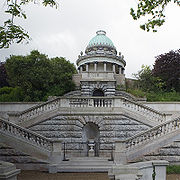 This beautiful mausoleum
within the Frogmore Gardens is the burial place of Queen Victoria's mother, Victoria of Saxe-Coburg-Saalfeld
, the Duchess of Kent. The Mausoleum was designed by the architect A J Humbert, to a concept design by Prince Albert's favourite artist, Professor Ludwig Gruner.
In the latter years of her life, the Duchess lived in Frogmore House and in the 1850s, construction began on a beautiful domed 'temple' in the grounds of the estate. The top portion of the finished building was intended to serve as a summer-house for the Duchess during her lifetime, while the lower level was destined as her final resting place. The Duchess died at Frogmore House on 16 March 1861 before the summer-house was completed so the upper chamber became part of the mausoleum and now contains a statue of the Duchess.
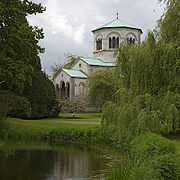
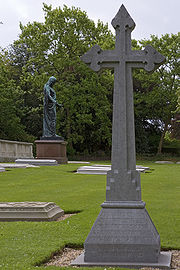 The second mausoleum in the grounds of Frogmore, just a short distance from the Duchess of Kent's Mausoleum is the very much larger Royal Mausoleum, the burial place of Queen Victoria and her consort, Prince Albert.
Queen Victoria and her husband had long intended to construct a special resting place for them both, instead of the two of them being buried in one of the traditional resting places of British Royalty, such as Westminster Abbey
or St. George's Chapel, Windsor. The mausoleum for the Queen's mother was being constructed at Frogmore in 1861 when Prince Albert died in December of the same year. Within a few days of his premature death, proposals for the mausoleum were being drawn up by the same designers involved in the Duchess of Kent's Mausoleum: Professor Gruner and A J Humbert.
Work commenced in March 1862. The dome was made by October and the building was consecrated in December 1862, although the decoration was not finished until August 1871.
The building is in the form of a Greek cross. The exterior was inspired by Italian Romanesque buildings, the walls are of granite and Portland stone
and the roof is covered with Australia
n copper
. The interior decoration is in the style of Albert's favourite painter, the Renaissance genius Raphael, an example of Victoriana
at its most opulent. The interior walls are predominantly in Portuguese red marble, a gift from King Luis I of Portugal
, a cousin of both Victoria and Albert, and are inlaid with other marbles from around the World.
The monumental
tomb
itself was designed by Baron Carlo Marochetti
. It features recumbent marble effigies
of the Queen and Prince Albert. The sarcophagus was made from a single piece of flawless grey Aberdeen
granite
. The Queen's effigy was made at the same time, but was not put in the mausoleum until after her funeral.
Only Victoria and Albert are interred there, but the mausoleum contains other memorials. Among those is a charming monument to Princess Alice, Grand Duchess of Hesse-Darmstadt (1843–1878), Victoria's second daughter, who died of diphtheria shortly after her youngest daughter May (1874–1878). In the centre of the chapel is a monument to Edward, Duke of Kent, Victoria's father. He died in 1820 and is buried in St George's Chapel, Windsor. One of the strangest sculptures is that of the Queen and consort in Anglo-Saxon
costume. Albert is speaking. Victoria looks up at him in adoration.
behind Queen Victoria's mausoleum.
Among those buried there are Prince Arthur, Duke of Connaught
, and Prince Henry, Duke of Gloucester
, as well as Prince George, Duke of Kent
. It is also the resting place of Queen Maria of Yugoslavia, a great-granddaughter of Queen Victoria and wife of King Aleksandar I of Yugoslavia
, the Duke of Windsor
, who reigned as King Edward VIII
before abdication; and his wife Wallis. Many members of the families of Prince Christian of Schleswig-Holstein
and of the Marquess of Cambridge are also buried there.
(1858).
Home Park, Windsor
The Home Park, previously known as the Little Park , is a private Royal park, administered by the Crown Estate. It lies on the eastern side of Windsor Castle in the town and civil parish of Windsor, Berkshire....
, adjoining Windsor Castle
Windsor Castle
Windsor Castle is a medieval castle and royal residence in Windsor in the English county of Berkshire, notable for its long association with the British royal family and its architecture. The original castle was built after the Norman invasion by William the Conqueror. Since the time of Henry I it...
, in the English
England
England is a country that is part of the United Kingdom. It shares land borders with Scotland to the north and Wales to the west; the Irish Sea is to the north west, the Celtic Sea to the south west, with the North Sea to the east and the English Channel to the south separating it from continental...
county of Berkshire
Berkshire
Berkshire is a historic county in the South of England. It is also often referred to as the Royal County of Berkshire because of the presence of the royal residence of Windsor Castle in the county; this usage, which dates to the 19th century at least, was recognised by the Queen in 1957, and...
. The name derives from the preponderance of frogs which have always lived in this low-lying and marshy area.
It is the location of Frogmore House
Frogmore House
Frogmore House is a 17th-century country house standing at the centre of the Frogmore Estate, amongst beautiful gardens, about a half a mile south of Windsor Castle in the Home Park at Windsor in the English county of Berkshire. It is a Grade I listed building.-Early tenants:The original house on...
, a Royal retreat. It is also the site of three burial places of the British Royal Family: the Royal Mausoleum containing the tombs of Queen Victoria and Prince Albert; the Duchess of Kent
Princess Victoria of Saxe-Coburg-Saalfeld
Princess Victoria of Saxe-Coburg-Saalfeld was the mother of Queen Victoria of the United Kingdom.-Early life:...
's Mausoleum, burial place of the Queen Victoria's mother; and the Royal Burial Ground
Royal Burial Ground
The Royal Burial Ground is a cemetery used by the British Royal Family. It surrounds the Royal Mausoleum on the Frogmore Estate in the Home Park at Windsor in the English county of Berkshire. It was consecrated on 23 October 1928....
.
Frogmore House
Frogmore HouseFrogmore House
Frogmore House is a 17th-century country house standing at the centre of the Frogmore Estate, amongst beautiful gardens, about a half a mile south of Windsor Castle in the Home Park at Windsor in the English county of Berkshire. It is a Grade I listed building.-Early tenants:The original house on...
was built in the 1680s and purchased by King George III as a country retreat for Queen Charlotte
Charlotte of Mecklenburg-Strelitz
Charlotte of Mecklenburg-Strelitz was the Queen consort of the United Kingdom as the wife of King George III...
in 1792. In 1900 Earl Mountbatten of Burma
Louis Mountbatten, 1st Earl Mountbatten of Burma
Admiral of the Fleet Louis Francis Albert Victor Nicholas George Mountbatten, 1st Earl Mountbatten of Burma, KG, GCB, OM, GCSI, GCIE, GCVO, DSO, PC, FRS , was a British statesman and naval officer, and an uncle of Prince Philip, Duke of Edinburgh...
was born there.
Duchess of Kent's Mausoleum
Mausoleum
A mausoleum is an external free-standing building constructed as a monument enclosing the interment space or burial chamber of a deceased person or persons. A monument without the interment is a cenotaph. A mausoleum may be considered a type of tomb or the tomb may be considered to be within the...
within the Frogmore Gardens is the burial place of Queen Victoria's mother, Victoria of Saxe-Coburg-Saalfeld
Princess Victoria of Saxe-Coburg-Saalfeld
Princess Victoria of Saxe-Coburg-Saalfeld was the mother of Queen Victoria of the United Kingdom.-Early life:...
, the Duchess of Kent. The Mausoleum was designed by the architect A J Humbert, to a concept design by Prince Albert's favourite artist, Professor Ludwig Gruner.
In the latter years of her life, the Duchess lived in Frogmore House and in the 1850s, construction began on a beautiful domed 'temple' in the grounds of the estate. The top portion of the finished building was intended to serve as a summer-house for the Duchess during her lifetime, while the lower level was destined as her final resting place. The Duchess died at Frogmore House on 16 March 1861 before the summer-house was completed so the upper chamber became part of the mausoleum and now contains a statue of the Duchess.
Royal Mausoleum (or 'Frogmore Mausoleum')
Queen Victoria and her husband had long intended to construct a special resting place for them both, instead of the two of them being buried in one of the traditional resting places of British Royalty, such as Westminster Abbey
Westminster Abbey
The Collegiate Church of St Peter at Westminster, popularly known as Westminster Abbey, is a large, mainly Gothic church, in the City of Westminster, London, United Kingdom, located just to the west of the Palace of Westminster. It is the traditional place of coronation and burial site for English,...
or St. George's Chapel, Windsor. The mausoleum for the Queen's mother was being constructed at Frogmore in 1861 when Prince Albert died in December of the same year. Within a few days of his premature death, proposals for the mausoleum were being drawn up by the same designers involved in the Duchess of Kent's Mausoleum: Professor Gruner and A J Humbert.
Work commenced in March 1862. The dome was made by October and the building was consecrated in December 1862, although the decoration was not finished until August 1871.
The building is in the form of a Greek cross. The exterior was inspired by Italian Romanesque buildings, the walls are of granite and Portland stone
Portland stone
Portland stone is a limestone from the Tithonian stage of the Jurassic period quarried on the Isle of Portland, Dorset. The quarries consist of beds of white-grey limestone separated by chert beds. It has been used extensively as a building stone throughout the British Isles, notably in major...
and the roof is covered with Australia
Australia
Australia , officially the Commonwealth of Australia, is a country in the Southern Hemisphere comprising the mainland of the Australian continent, the island of Tasmania, and numerous smaller islands in the Indian and Pacific Oceans. It is the world's sixth-largest country by total area...
n copper
Copper
Copper is a chemical element with the symbol Cu and atomic number 29. It is a ductile metal with very high thermal and electrical conductivity. Pure copper is soft and malleable; an exposed surface has a reddish-orange tarnish...
. The interior decoration is in the style of Albert's favourite painter, the Renaissance genius Raphael, an example of Victoriana
Victorian era
The Victorian era of British history was the period of Queen Victoria's reign from 20 June 1837 until her death on 22 January 1901. It was a long period of peace, prosperity, refined sensibilities and national self-confidence...
at its most opulent. The interior walls are predominantly in Portuguese red marble, a gift from King Luis I of Portugal
Luís I of Portugal
|-...
, a cousin of both Victoria and Albert, and are inlaid with other marbles from around the World.
The monumental
Church monument
A church monument is an architectural or sculptural memorial to a dead person or persons, located within a Christian church. It can take various forms, from a simple wall tablet to a large and elaborate structure which may include an effigy of the deceased person and other figures of familial or...
tomb
Sarcophagus
A sarcophagus is a funeral receptacle for a corpse, most commonly carved or cut from stone. The word "sarcophagus" comes from the Greek σαρξ sarx meaning "flesh", and φαγειν phagein meaning "to eat", hence sarkophagus means "flesh-eating"; from the phrase lithos sarkophagos...
itself was designed by Baron Carlo Marochetti
Carlo Marochetti
Baron Carlo Marochetti was a sculptor, born in Turin but raised in Paris as a French citizen.-Life:Carlo Marochetti was born on 4 January 1805. His first teachers were François Joseph Bosio and Antoine-Jean Gros in Paris. Here his statue of A Young Girl playing with a Dog won a medal in 1829, and...
. It features recumbent marble effigies
Effigy
An effigy is a representation of a person, especially in the form of sculpture or some other three-dimensional form.The term is usually associated with full-length figures of a deceased person depicted in stone or wood on church monuments. These most often lie supine with hands together in prayer,...
of the Queen and Prince Albert. The sarcophagus was made from a single piece of flawless grey Aberdeen
Aberdeen
Aberdeen is Scotland's third most populous city, one of Scotland's 32 local government council areas and the United Kingdom's 25th most populous city, with an official population estimate of ....
granite
Granite
Granite is a common and widely occurring type of intrusive, felsic, igneous rock. Granite usually has a medium- to coarse-grained texture. Occasionally some individual crystals are larger than the groundmass, in which case the texture is known as porphyritic. A granitic rock with a porphyritic...
. The Queen's effigy was made at the same time, but was not put in the mausoleum until after her funeral.
Only Victoria and Albert are interred there, but the mausoleum contains other memorials. Among those is a charming monument to Princess Alice, Grand Duchess of Hesse-Darmstadt (1843–1878), Victoria's second daughter, who died of diphtheria shortly after her youngest daughter May (1874–1878). In the centre of the chapel is a monument to Edward, Duke of Kent, Victoria's father. He died in 1820 and is buried in St George's Chapel, Windsor. One of the strangest sculptures is that of the Queen and consort in Anglo-Saxon
Anglo-Saxons
Anglo-Saxon is a term used by historians to designate the Germanic tribes who invaded and settled the south and east of Great Britain beginning in the early 5th century AD, and the period from their creation of the English nation to the Norman conquest. The Anglo-Saxon Era denotes the period of...
costume. Albert is speaking. Victoria looks up at him in adoration.
Royal Burial Ground
Since its inauguration in 1928, most members of the royal family, except for Kings and Queens, have been interred in the Royal Burial Ground, a cemeteryCemetery
A cemetery is a place in which dead bodies and cremated remains are buried. The term "cemetery" implies that the land is specifically designated as a burying ground. Cemeteries in the Western world are where the final ceremonies of death are observed...
behind Queen Victoria's mausoleum.
Among those buried there are Prince Arthur, Duke of Connaught
Prince Arthur, Duke of Connaught and Strathearn
Prince Arthur, Duke of Connaught and Strathearn was a member of the shared British and Saxe-Coburg and Gotha royal family who served as the Governor General of Canada, the 10th since Canadian Confederation.Born the seventh child and third son of Queen Victoria and Prince Albert of Saxe-Coburg and...
, and Prince Henry, Duke of Gloucester
Prince Henry, Duke of Gloucester
The Prince Henry, Duke of Gloucester was a soldier and member of the British Royal Family, the third son of George V of the United Kingdom and Queen Mary....
, as well as Prince George, Duke of Kent
Prince George, Duke of Kent
Prince George, Duke of Kent was a member of the British Royal Family, the fourth son of George V and Mary of Teck, and younger brother of Edward VIII and George VI...
. It is also the resting place of Queen Maria of Yugoslavia, a great-granddaughter of Queen Victoria and wife of King Aleksandar I of Yugoslavia
Alexander I of Yugoslavia
Alexander I , also known as Alexander the Unifier was the first king of the Kingdom of Yugoslavia as well as the last king of the Kingdom of Serbs, Croats and Slovenes .-Childhood:...
, the Duke of Windsor
Duke of Windsor
The title Duke of Windsor was created in the Peerage of the United Kingdom in 1937 for Prince Edward, the former King Edward VIII, following his abdication in December 1936. The dukedom takes its name from the town where Windsor Castle, a residence of English monarchs since the Norman Conquest, is...
, who reigned as King Edward VIII
Edward VIII of the United Kingdom
Edward VIII was King of the United Kingdom and the Dominions of the British Commonwealth, and Emperor of India, from 20 January to 11 December 1936.Before his accession to the throne, Edward was Prince of Wales and Duke of Cornwall and Rothesay...
before abdication; and his wife Wallis. Many members of the families of Prince Christian of Schleswig-Holstein
Prince Christian of Schleswig-Holstein
Prince Christian of Schleswig-Holstein was a minor German prince who became a member of the British Royal Family through his marriage to Princess Helena of the United Kingdom , the fifth child and third daughter of Queen Victoria and Prince Albert of...
and of the Marquess of Cambridge are also buried there.
Other garden features
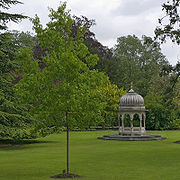
Also within the grounds lie various garden buildings and monuments, including the 'Gothic Ruin' (1793), 'Queen Victoria's Tea House' (a brick pavilion building of 1869) and the 'Indian Kiosk' commemorating the end of the Indian MutinyIndian Rebellion of 1857
The Indian Rebellion of 1857 began as a mutiny of sepoys of the British East India Company's army on 10 May 1857, in the town of Meerut, and soon escalated into other mutinies and civilian rebellions largely in the upper Gangetic plain and central India, with the major hostilities confined to...
(1858).
Public access
The house, gardens and Royal mausoleum are usually open to the public about six individual days each year, usually around Easter and the August Bank Holiday. The mausoleum is also usually open on the Wednesday nearest Queen Victoria's birthday, 24 May. The mausoleum did not open to the public in 2009 or 2010, and will not open in 2011 because of a long-term conservation project. The Royal Burial Ground may be viewed from around its perimeter on the days that the gardens are open to the public. The Duchess of Kent's mausoleum may also be viewed externally, but is never open to the public.See also
- Frogmore HouseFrogmore HouseFrogmore House is a 17th-century country house standing at the centre of the Frogmore Estate, amongst beautiful gardens, about a half a mile south of Windsor Castle in the Home Park at Windsor in the English county of Berkshire. It is a Grade I listed building.-Early tenants:The original house on...
- The Home ParkHome Park, WindsorThe Home Park, previously known as the Little Park , is a private Royal park, administered by the Crown Estate. It lies on the eastern side of Windsor Castle in the town and civil parish of Windsor, Berkshire....
- Windsor CastleWindsor CastleWindsor Castle is a medieval castle and royal residence in Windsor in the English county of Berkshire, notable for its long association with the British royal family and its architecture. The original castle was built after the Norman invasion by William the Conqueror. Since the time of Henry I it...
- Windsor Great ParkWindsor Great ParkWindsor Great Park is a large deer park of , to the south of the town of Windsor on the border of Berkshire and Surrey in England. The park was, for many centuries, the private hunting ground of Windsor Castle and dates primarily from the mid-13th century...
External links
- The Royal Collection - Frogmore House — includes opening dates, directions and contact details.
- Royal Windsor Website: Frogmore House, Gardens & Mausoleum.
- Historical Images of Frogmore Royal Mausoleum dating from 1870 - 1901