
Sir Alfred Gilbert (12 August 1854 – 4 November 1934) was an
EnglishEngland is a country that is part of the United Kingdom. It shares land borders with Scotland to the north and Wales to the west; the Irish Sea is to the north west, the Celtic Sea to the south west and the North Sea to the east, with the English Channel to the south separating it from continental...
sculptorSculpture is three-dimensional artwork created by shaping or combining hard and/or plastic material, sound, and/or text and or light, commonly stone , metal, glass, or wood. Some sculptures are created directly by finding or carving; others are assembled, built together and fired, welded, molded,...
and
goldsmithA goldsmith is a metalworker who specializes in working with gold and other precious metals. Since ancient times the techniques of a Goldsmith have evolved very little in order to produce items of jewelry of quality standards. In modern times actual Goldsmiths are rare...
who enthusiastically experimented with
metallurgicalMetallurgy is a domain of materials science that studies the physical and chemical behavior of metallic elements, their intermetallic compounds, and their mixtures, which are called alloys. It is also the technology of metals: the way in which science is applied to their practical use...
innovations. He was a central — if idiosyncratic — participant in the
New SculptureThe New Sculpture refers to a movement in late nineteenth-century British sculpture.The term "New Sculpture" was coined by the first historian of the movement, the critic Edmund Gosse, who wrote a four-part series for the Art Journal in 1894...
movement that invigorated sculpture in Britain at the end of the nineteenth century.
Alfred Gilbert's parents, Charlotte Cole and Alfred Gilbert, were musicians who lived at 13 Berners Street, London, where Alfred was born.
Sir Alfred Gilbert (12 August 1854 – 4 November 1934) was an
EnglishEngland is a country that is part of the United Kingdom. It shares land borders with Scotland to the north and Wales to the west; the Irish Sea is to the north west, the Celtic Sea to the south west and the North Sea to the east, with the English Channel to the south separating it from continental...
sculptorSculpture is three-dimensional artwork created by shaping or combining hard and/or plastic material, sound, and/or text and or light, commonly stone , metal, glass, or wood. Some sculptures are created directly by finding or carving; others are assembled, built together and fired, welded, molded,...
and
goldsmithA goldsmith is a metalworker who specializes in working with gold and other precious metals. Since ancient times the techniques of a Goldsmith have evolved very little in order to produce items of jewelry of quality standards. In modern times actual Goldsmiths are rare...
who enthusiastically experimented with
metallurgicalMetallurgy is a domain of materials science that studies the physical and chemical behavior of metallic elements, their intermetallic compounds, and their mixtures, which are called alloys. It is also the technology of metals: the way in which science is applied to their practical use...
innovations. He was a central — if idiosyncratic — participant in the
New SculptureThe New Sculpture refers to a movement in late nineteenth-century British sculpture.The term "New Sculpture" was coined by the first historian of the movement, the critic Edmund Gosse, who wrote a four-part series for the Art Journal in 1894...
movement that invigorated sculpture in Britain at the end of the nineteenth century.
Early and later life
Alfred Gilbert's parents, Charlotte Cole and Alfred Gilbert, were musicians who lived at 13 Berners Street, London, where Alfred was born. He received his education mainly in Paris (Ecole des Beaux-Arts, under Jules Cavelier), and studied in
RomeRome is the capital of Italy and the country's largest and most populated municipality , with over 2.7 million residents in , while the population of the urban area is estimated by Eurostat to be 3.46 million. The metropolitan area of Rome is estimated by OECD to have a population of 3.7 million...
and
FlorenceFlorence is the capital city of the Italian region of Tuscany and of the province of Florence...
where the significance of the
RenaissanceThe Renaissance was a cultural movement that spanned roughly the 14th to the 17th century, beginning in Florence in the Late Middle Ages and later spreading to the rest of Europe...
made a lasting impression upon him and his art. He also worked in the studio of Sir
Joseph BoehmSir Joseph Edgar Boehm, Bart. was a sculptor, best known for the head of Queen Victoria on coinage, and the statue of the Duke of Wellington at Hyde Park Corner, born in Vienna, but educated in England....
, R.A.
On 3 January 1876 he married his first cousin, Alice Jane Gilbert (1847-1916), with whom he had eloped to
ParisParis is the capital of France and the country's most populous city. It is situated on the river Seine, in northern France, at the heart of the Île-de-France region...
. They had five children. Bankruptcy made him flee from Britain in 1901 and for the next 25 years he settled in Bruges. His wife left him in 1904. They never divorced, but lived separated, Alice being a patient in a mental hospital.
After Alice's death, of which he received news only after the war, he married on 1 March 1919 his housekeeper Stéphanie Debourgh (
BrugesBruges is the capital and largest city of the province of West Flanders in the Flemish Region of Belgium. It is located in the northwest of the country....
1863-1937), the widow of Alphonse Quaghebeur (
BrugesBruges is the capital and largest city of the province of West Flanders in the Flemish Region of Belgium. It is located in the northwest of the country....
1863-1903), a modest typesetter; she, previously a lacemaker, and six of her seven children had lived with Gilbert since 1907 and throughout the War and the German occupation. As he was living underground, the presence of a large family was a good cover for the quantity of food needed in the household.
Work
His first work of importance was the charming group of the Mother and Child, then The Kiss of Victory, followed by Perseus Arming (1883), produced directly under the influence of the Florentine masterpieces he had studied. Its success was great, and Lord Leighton forthwith commissioned Icarus, which was exhibited at the
Royal AcademyThe Royal Academy of Arts is an art institution based in Burlington House on Piccadilly, London, England. The Royal Academy of Arts has a unique position in being an independent, privately funded institution led by eminent artists and architects whose purpose is to promote the creation, enjoyment...
in 1884, along with a remarkable Study of a Head, and was received with general applause. Then followed The Enchanted Chair, which, along with many other works deemed by the artist incomplete or unworthy of his powers, was ultimately broken by the sculptors own hand. The next year Gilbert was occupied with the Shaftesbury Memorial Fountain, in
Piccadilly CircusPiccadilly Circus is a famous road junction and public space of London's West End in the City of Westminster,built in 1819 to connect Regent Street with the major shopping street of Piccadilly...
, London, a work of great originality and beauty representing
AnterosIn Greek mythology, Anteros was the god of requited love, literally "love returned" or "counter-love" and also the punisher of those who scorn love and the advances of others, or the avenger of unrequited love....
, yet shorn of some of the intended effect through restrictions put upon the artist.
In 1888 was produced the statue of H.M. Queen Victoria, set up at
WinchesterWinchester is the county town of Hampshire, in South East England. It lies at the heart of the wider City of Winchester, a local government district, and is located at the western end of the South Downs, along the course of the River Itchen...
, in its main design and in the details of its ornamentation the most remarkable work of its kind produced in Great Britain, and perhaps, it may be added, in any other country in modern times. Other statues of great beauty, at once novel in treatment and fine in design, are those set up to Lord Reay in Bombay, and John Howard at Bedford (1898), the highly original pedestal of which did much to direct into a better channel what are apt to be the eccentricities of what is called the New Art School. The sculptor rose to the full height of his powers in his Memorial to the Duke of Clarence, and his fast developing fancy and imagination, which are the main characteristics of all his work, are seen in his Memorial Candelabrum to Lord Arthur Russell and Memorial Font to the son of the 4th Marquess of Bath.
Gilbert's sense of decoration was paramount in all he did, and although in addition to the work already cited he produced busts of extraordinary excellence of Cyril Flower, John R. Clayton (since broken up by the artist, the fate of much of his admirable work), G. F. Watts, Sir
Henry TateSir Henry Tate, 1st Baronet was an English sugar merchant from Chorley, noted for establishing the Tate gallery in London.-Life and career:...
, Sir George Birdwood, Sir
Richard OwenSir Richard Owen KCB was an English biologist, comparative anatomist and palaeontologist.Owen is probably best remembered today for coining the word Dinosauria and for his outspoken opposition to Charles Darwin's theory of evolution by natural selection...
, Sir
George GroveSir George Grove was an English writer on music, immortalised in the title of Grove's Dictionary of Music and Musicians....
and various others, it is on his goldsmithery that the artist would rest his reputation; on his mayoral chain for Preston, the
epergneEpergne is a type of table centerpiece, usually made of silver, but may be made of any metal or glass or porcelain.-Design:An epergne generally has a large central "bowl" or basket sitting on three to five feet. From this center "bowl" radiate branches supporting small baskets, dishes, or candle...
for Queen Victoria, the figurines of Victory (a statuette designed for the orb in the hand of the Winchester statue), St Michael , and St George, as well as smaller objects such as seals, keys and the like. Gilbert was chosen associate of the Royal Academy in 1887, full member in 1892 (resigned 1909), and professor of sculpture (afterwards resigned) in 1900. In 1889 he won the Grand Prix at the Paris International Exhibition. He was created a member of the Victorian Order in 1897.
Famous works
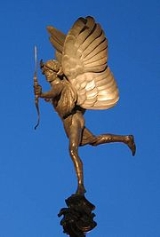
- The Shaftesbury Memorial, commonly known as the statue of Eros in Piccadilly Circus
Piccadilly Circus is a famous road junction and public space of London's West End in the City of Westminster,built in 1819 to connect Regent Street with the major shopping street of Piccadilly...
, London[]London is the capital of England and the United Kingdom. It has been a major settlement for two millennia, and the history of London goes back to its founding by the Romans, when it was named Londinium. London's core, the ancient City of London, the 'square mile', retains its medieval boundaries...
- The tomb of Albert Victor, Duke of Clarence in St. George's Chapel, Windsor
Windsor is a suburban town in the Royal Borough of Windsor and Maidenhead in Berkshire, England. It is best known as the site of Windsor Castle....
- The Queen Alexandra Memorial, Marlborough Gate, London
[]London is the capital of England and the United Kingdom. It has been a major settlement for two millennia, and the history of London goes back to its founding by the Romans, when it was named Londinium. London's core, the ancient City of London, the 'square mile', retains its medieval boundaries...
(a Grade I listed building)
See also