
In Depth
See Also

Parliament of the United Kingdom

The Parliament of the United Kingdom of Great Britain and Northern Ireland is the supreme legislative body Legislature

A legislature is a type of representative deliberative assembly [i] with the power to adopt law [i]s. ... 

 in the United Kingdom United Kingdom

The United Kingdom of Great Britain and Northern Ireland is a country and sovereign state [i] tha ... 

 and British overseas territories British overseas territories

A British overseas territory is one of 14 territories which are under the sovereignty [i] of the United Kingdom [i] ... 

. It alone has parliamentary sovereignty. At its head is the Sovereign British monarchy

The British monarch or Sovereign is the head of state [i] of the United Kingdom [i] and in the British overseas territories [i] ... 

; it is bicameral Bicameralism

In government [i], bicameralism is the practice of having two legislative or parliamentary chamber [i]s. ... 

, with an upper house, the House of Lords House of Lords

The House of Lords is the upper house [i] of the Parliament of the United Kingdom [i]. ... 

, and a lower house, the House of Commons British House of Commons

|align=left| *Parliament [i] ... 

. The House of Lords House of Lords

The House of Lords is the upper house [i] of the Parliament of the United Kingdom [i]. ... 

 includes two different types of members: the Lords Spiritual  and the Lords Temporal ; its members are not elected by the population at large.

Discussions

  Discussion Features

   Ask a question about 'Parliament of the United Kingdom'

   Start a new discussion about 'Parliament of the United Kingdom'

   Answer questions about 'Parliament of the United Kingdom'

   'Parliament of the United Kingdom' discussion forum

Timeline

1782   British parliament Parliament of the United Kingdom

The Parliament of the United Kingdom of Great Britain and Northern Ireland is the supreme legislative body [i] ... 

 extends James Watt James Watt

James Watt was a Scottish [i] inventor [i] and engineer [i] whose improvements to the steam engine [i] ... 

's copyright Copyright

Copyright is a set of exclusive rights [i] regulating the use of a particular expression of an idea or ... 

 for the steam engine Steam engine

A steam engine is an external combustion [i] heat engine [i] that makes use o ... 

 to the year 1800.

1791   The British Parliament Parliament of the United Kingdom

The Parliament of the United Kingdom of Great Britain and Northern Ireland is the supreme legislative body [i] ... 

 passes the Constitutional Act of 1791 Constitutional Act of 1791

The Constitutional Act of 1791 was an Act [i] of the Parliament of Great Britain [i] w ... 

, splitting the old province of Quebec Quebec

Quebec, or Qubec in French [i], In 1898, the Canadian Parliament passed the first ... 

 into Upper Upper Canada

Upper Canada was a British territory in what is now the Canadian [i] province of Ontario [i]. ... 

 and Lower Canada Lower Canada

Lower Canada was a British colony [i] on the lower Saint Lawrence River [i] ... 

.

1940   World War II World War II

World War II, or the Second World War, was a worldwide [i] conflict [i] fought betwe ... 

 - British Parliament Parliament of the United Kingdom

The Parliament of the United Kingdom of Great Britain and Northern Ireland is the supreme legislative body [i] ... 

 passes Emergency Powers Act giving the government full control over all persons and property.

1966   The opening of Parliament of the United Kingdom is televised for the first time.

1967   The Parliament of the United Kingdom decides to nationalize 90% of the British steel Steel

Steel is a metal [i] alloy [i] whose major component is iron [i], with carbon [i] content between 0.02% ... 

 industry.

2003   The Parliament of the United Kingdom votes in favour of a motion understood as giving the government final authority to join the invasion of Iraq.


Encyclopedia

The Parliament of the United Kingdom of Great Britain and Northern Ireland is the supreme legislative body Legislature

A legislature is a type of representative deliberative assembly [i] with the power to adopt law [i]s. ... 

 in the United Kingdom United Kingdom

The United Kingdom of Great Britain and Northern Ireland is a country and sovereign state [i] tha ... 

 and British overseas territories British overseas territories

A British overseas territory is one of 14 territories which are under the sovereignty [i] of the United Kingdom [i] ... 

. It alone has parliamentary sovereignty. At its head is the Sovereign British monarchy

The British monarch or Sovereign is the head of state [i] of the United Kingdom [i] and in the British overseas territories [i] ... 

; it is bicameral Bicameralism

In government [i], bicameralism is the practice of having two legislative or parliamentary chamber [i]s. ... 

, with an upper house, the House of Lords House of Lords

The House of Lords is the upper house [i] of the Parliament of the United Kingdom [i]. ... 

, and a lower house, the House of Commons British House of Commons

|align=left|
  • Parliament [i]

... 

. The House of Lords House of Lords

The House of Lords is the upper house [i] of the Parliament of the United Kingdom [i]. ... 

 includes two different types of members: the Lords Spiritual  and the Lords Temporal ; its members are not elected by the population at large. The House of Commons British House of Commons

|align=left|
  • Parliament [i]

... 

 is a democratically Democracy

Democracy is a form of government [i] for a nation state, or for an organiz ... 

 elected chamber. The two Houses meet in separate chambers in the Palace of Westminster Palace of Westminster

The Palace of Westminster, also known as the Houses of Parliament or Westminster Palace, in ... 

 , in the City of Westminster City of Westminster

The City of Westminster is a London borough [i] with city status [i], ... 

 in the British capital, London London

London is the capital [i] city of England [i] and of the United Kingdom [i]. ... 

. By constitutional convention, all government ministers, including the Prime Minister Prime Minister of the United Kingdom

The Prime Minister of the United Kingdom of Great Britain and Northern Ireland [i] is in... 

, are members of the House of Commons or House of Lords.

Parliament evolved from the ancient council that advised the Sovereign. In theory, power is vested not in Parliament, but in the "Queen-in-Parliament" . The Queen-in-Parliament is often said to be a completely sovereign authority, though such a position is debatable. In modern times, real power is vested in the House of Commons; the Sovereign acts only as a figurehead and the powers of the House of Lords are greatly limited.

The British Parliament is often called the "Mother of Parliaments," as the legislative bodies of many nations, most notably those of the members of the Commonwealth Commonwealth of Nations

The Commonwealth of Nations, usually known as the Commonwealth, is a voluntary association [i] of ... 

; are modelled on it. However, it is a misquotation of John Bright John Bright

This article concerns the British politician.... 

, who had actually remarked on 18 January 1865 that "England is the Mother of Parliaments", in the context of supporting demands for expanded voting rights in a country that had pioneered Parliamentary government.

History

In the medieval Middle Ages

The Middle Ages formed the middle period in a traditional schematic division of European history [i] ... 

 period there were three kingdoms within the British Isles – England England

England is the largest and most populous constituent country [i] of the United Kingdom [i]. ... 

, Scotland Scotland

Scotland is a nation [i] in northwest Europe [i] and one of the constituent [i] countries [i] ... 

 and Ireland Ireland

Ireland is the third largest [i] island [i] in Europe [i]. ... 

 – and these developed separate parliaments. The 1707 Act of Union Acts of Union 1707

The Acts of Union were a pair of Acts of Parliament passed in 1706 [i] and 1707 [i] by, respectively, t ... 

 brought England and Scotland together under the Parliament of Great Britain, and the 1800 Act of Union Act of Union 1800

The Act of Union 1800 merged the Kingdom of Ireland [i] and the Kingdom of Great Britain [i] to create t... 

 included Ireland under the Parliament of the United Kingdom.

Parliament of England


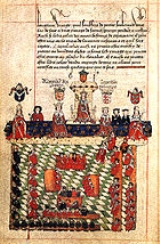
The English Parliament traces its origins to the Anglo-Saxon Anglo-Saxons

Anglo-Saxons is a collective term usually used to describe culturally and linguistically related groups ... 

 Witenagemot Witenagemot

The Witenagemot was a political institution in Anglo-Saxon England [i] which operated between approxima ... 

. In 1066 William of Normandy William I of England

William of Normandy ruled as the Duke of Normandy [i] from 1035 [i] to 1087 [i] and as King of England [i] ... 

 brought a feudal system Feudalism

Feudalism refers to a general set of reciprocal legal [i] and military [i] obligations among the war ... 

, where he sought the advice of a council of tenants-in-chief and ecclesiastics before making laws. In 1215 the tenants-in-chief secured the Magna Carta Magna Carta

[i] [[charter]... 

 from John John of England

John reigned as King of England [i] from April 6 [i], 1199 [i], until his death. ... 

, which established that the king may not levy or collect any taxes , save with the consent of his royal council, which slowly developed into a parliament. In 1265, Simon de Montfort, 6th Earl of Leicester Simon de Montfort, 6th Earl of Leicester

Simon de Montfort, 6th Earl of Leicester was the principal leader of the baron [i]ial opposition to Kin ... 

 summoned the first elected Election

An election is a decision making [i] process where people vote [i] for preferred political candidates [i] ... 

 Parliament. The franchise in parliamentary elections for county Counties of England

The counties of England are territorial divisions of England [i] for the purposes of administrative, pol ... 

 constituencies was uniform throughout the country, extending to all those who owned the freehold of land to an annual rent of 40 shillings . In the boroughs Borough

A borough is an administrative division [i] used in various countries. ... 

, the franchise varied across the country; individual boroughs had varying arrangements. This set the scene for the so-called "Model Parliament" of 1295 adopted by Edward I Edward I of England

Edward I , popularly known as "Longshanks" because of his 6 foot 2 inch frame and the "Hammer ... 

. By the reign of Edward III Edward III of England

Edward III was one of the most successful English [i] kings [i] of medieval [i] times. ... 

, Parliament had been separated into two Houses: one including the nobility and higher clergy, the other including the knights and burgesses, and no law could be made, nor any tax levied, without the consent of both Houses as well as of the Sovereign.

The Laws in Wales Acts 1535-1542 Laws in Wales Acts 1535-1542

The Laws in Wales Acts 15351542 were a series of parliamentary measures by which the legal system of Wales [i] ... 

 treated Wales as part of England and brought Welsh representatives to Parliament.


When Elizabeth I Elizabeth I of England

Elizabeth I was Queen of England [i], Queen of France , and Queen of Ireland [i] ... 

 was succeeded in 1603 by the Scottish King James VI, who became also James I of England James I of England

James VI of Scotland/James I of England and Ireland was King of England [i] ... 

, the countries both came under his rule but each retained its own Parliament. James I's successor, Charles I Charles I of England

[i] [[1625]... 

, quarrelled with Parliament and after he provoked the Wars of the Three Kingdoms Wars of the Three Kingdoms

The Wars of the Three Kingdoms were an intertwined series of conflicts that took place in Scotland [i], ... 

 their dispute developed into the English Civil War English Civil War

The English Civil War was a series of armed conflicts and political machinations which took place betwee... 

. Charles was executed in 1649 and under Oliver Cromwell Oliver Cromwell

Oliver Cromwell was an English [i] military and political leader, best known for making England ... 

's Commonwealth of England Commonwealth of England

The Commonwealth of England was the republic [i]an government which ruled first England [i] and then Ireland [i] ... 

 the House of Lords was abolished, and the House of Commons made subordinate to Cromwell. After Cromwell's death the Restoration English Restoration

The English Restoration or simply Restoration was an episode in the history of England [i] beginni ... 

 of 1660 restored the monarchy and the House of Lords.

Amidst fears of a Roman Catholic Roman Catholic Church

The Roman Catholic Church or Catholic Church is the Christian [i] Church [i] ... 

 succession, the Glorious Revolution Glorious Revolution

The Glorious Revolution was the overthrow of James II of England [i] in 1688 [i] by a union of Parliamentarians [i]... 

 of 1688 deposed James II James II of England

James VII of Scotland and James II of England became King of Scots [i], King of England [i], and King of Ireland [i] ... 

  in favour of the joint rule of Mary II Mary II of England

Mary II reigned as Queen of England [i] and Ireland [i] from 13 February [i] 1689 [i], and as Queen of ... 

 and William III William III of England

William III of England was a Dutch [i] aristocrat and a Protestant [i] Prince of Orange [i] ... 

, whose agreement to the English Bill of Rights Bill of Rights 1689

The Bill of Rights 1689 is an Act [i] of the Parliament of England [i] with the long title [i] ... 

 introduced a constitutional monarchy Constitutional monarchy

A constitutional monarchy is a form of monarchical [i] government [i] established under a constitution [i] ... 

, though the supremacy of the Crown remained. For the third time, a Convention Parliament, i.e. one not summoned by the king, was required to determine the succession.

Parliament of Scotland


From the time of Kenneth mac Alpin Kenneth I of Scotland

[i], first [[king of Scots]... 

 the Scottish kingdom of Alba had been ruled by chieftains and petty kings under the suzerainty of a High King, all offices being filled through election by an assembly under a system known as tanistry Tanistry

Tanistry was a system for passing on titles and lands.... 

, which combined a hereditary element with the consent of those ruled. After Macbeth Macbeth of Scotland

Mac Bethad mac Findlich, known in English [i] as Macbeth c.... 

 was overthrown by Malcolm III Malcolm III of Scotland

Mel Coluim mac Donnchada was King of Scots [i].... 

 in 1057 the feudal system of primogeniture was introduced, as Scotland came under the influence of the Norman Conquest Norman conquest of England

The Norman conquest of England was the invasion [i] of the Kingdom of England [i] by William the Conqueror [i] ... 

 of 1066.

In the Middle Ages Middle Ages

The Middle Ages formed the middle period in a traditional schematic division of European history [i] ... 

 the King's Council of Bishops and Earls evolved into a parliament, becoming the "colloquium" of 1235, which had a political and judicial role. From 1326 the "three estates" had clerics, lay tenants-in-chief and the burgh Burgh

Burgh represents an [i] corporate entity, usually a town [i], and has bee ... 

 commissioners sitting in a single chamber, with powers over taxation and a strong influence over justice, foreign policy, war, and legislation. The three estates chose a committee called the Lords of the Articles to draft legislation, which was then presented to the full assembly to be confirmed.

Following the Reformation Protestant Reformation

The Protestant Reformation, also referred to as the Protestant Revolution, was a movement in the 1... 

 and pressure from the Kirk Church of Scotland

The Church of Scotland is the national church [i] of Scotland [i]. ... 

, Catholic Roman Catholic Church

The Roman Catholic Church or Catholic Church is the Christian [i] Church [i] ... 

 clergy were excluded from 1567, and after Protestant bishops were abolished in 1638 the Scottish Parliament became an entirely lay assembly. During the reign of James VI James I of England

James VI of Scotland/James I of England and Ireland was King of England [i] ... 

, the Lords of the Articles came more under the influence of the crown, and following his accession to the throne of England in 1603 he used them to run Scotland from London. During the Wars of the Three Kingdoms Wars of the Three Kingdoms

The Wars of the Three Kingdoms were an intertwined series of conflicts that took place in Scotland [i], ... 

 in the Covenanting Covenanter

The Covenanters formed an important movement in the religion and politics of Scotland [i] in the seventeenth century [i]... 

 period the Scottish Parliament took control of the executive, effectively wresting sovereignty from King Charles I Charles I of England

[i] [[1625]... 

. After Scotland was invaded by Oliver Cromwell Oliver Cromwell

Oliver Cromwell was an English [i] military and political leader, best known for making England ... 

, his Commonwealth Commonwealth of England

The Commonwealth of England was the republic [i]an government which ruled first England [i] and then Ireland [i] ... 

 government imposed a brief Anglo-Scottish parliamentary union in 1657.

The Scottish Parliament returned after the Restoration of Charles II Charles II of England

Charles II was the King of England [i], King of Scots [i], and King of Ireland [i] from 30 January [i] ... 

 to the throne in 1660. After the Glorious Revolution Glorious Revolution

The Glorious Revolution was the overthrow of James II of England [i] in 1688 [i] by a union of Parliamentarians [i]... 

 formally changed England's monarch in February 1689, William William III of England

William III of England was a Dutch [i] aristocrat and a Protestant [i] Prince of Orange [i] ... 

 summoned a Convention of the Estates, which considered letters from him and from James VII James II of England

James VII of Scotland and James II of England became King of Scots [i], King of England [i], and King of Ireland [i] ... 

 , set out its terms and duly proclaimed William and Mary II Mary II of England

Mary II reigned as Queen of England [i] and Ireland [i] from 13 February [i] 1689 [i], and as Queen of ... 

 at Edinburgh Edinburgh

Edinburgh is the capital [i] of Scotland [i] and its second-largest city [i] ... 

 on 11 April 1689.

Parliament of Ireland


The Irish Parliament was founded to represent the English community in the Lordship of Ireland, while the native or Gaelic Irish were ineligible to vote or stand for office, the first known meeting being in 1264. The English presence shrank to an enclave around Dublin Dublin

Dublin is the capital [i] and the largest city of the Republic of Ireland [i] , located near the midpoi... 

 known as the Pale.

In 1541 Henry VIII Henry VIII of England

Henry VIII was King of England [i] and Lord of Ireland [i] from ... 

 declared the Kingdom of Ireland Kingdom of Ireland

n>Kingdom of Ireland

The Kingdom of Ireland was the name given to the English-ruled Irish state i... 

 and embarked on the Tudor re-conquest of Ireland. The Gaelic Irish lords were now entitled to attend the Irish Parliament as equals of the majority of English descent. Disputes followed the introduction of Protestantism Protestant Reformation

The Protestant Reformation, also referred to as the Protestant Revolution, was a movement in the 1... 

 as the state religion, when most of the population remained Roman Catholic Roman Catholic Church

The Roman Catholic Church or Catholic Church is the Christian [i] Church [i] ... 

, and in 1613–1615 constituencies were fixed so that Protestant settlers held the majority in the Irish Parliament. After the Irish Rebellion of 1641, Catholics were barred from voting or attending the Parliament in the Cromwellian Cromwellian conquest of Ireland

Oliver Cromwell [i] landed in Ireland [i] with his New Model Army [i] on behalf of the English Parliament [i] ... 

 Act of Settlement 1652.

Under James II & VII James II of England

James VII of Scotland and James II of England became King of Scots [i], King of England [i], and King of Ireland [i] ... 

 the Catholics regained ground and during the Jacobite war in Ireland Williamite war in Ireland

The Williamite war in Ireland, also known as the Jacobite war in Ireland and in Ireland [i] as C ... 

 he agreed to the Irish Parliament's demands for autonomy and restitution of lands. After the victory of William III of England William III of England

William III of England was a Dutch [i] aristocrat and a Protestant [i] Prince of Orange [i] ... 

 these gains were reversed, with the Penal Laws making things worse. Poyning's Law of 1494 had made the Irish Parliament subordinate to the Parliament of England, but the Constitution of 1782 removed these restrictions and about a decade later Catholics gained the right to vote, though they were still barred from membership.

Parliament of Great Britain


Following the Treaty of Union Acts of Union 1707

The Acts of Union were a pair of Acts of Parliament passed in 1706 [i] and 1707 [i] by, respectively, t ... 

 in 1707 Acts of Union Acts of Union 1707

The Acts of Union were a pair of Acts of Parliament passed in 1706 [i] and 1707 [i] by, respectively, t ... 

 were passed in both the Parliament of England Parliament of England

The Parliament of England was the legislature [i] of the Kingdom of England [i]. ... 

 and the Parliament of Scotland, which created a new Kingdom of Great Britain Kingdom of Great Britain

Kingdom of Great Britain
... 

. The Acts dissolved both parliaments, replacing them with a new Parliament of the Kingdom of Great Britain based in the former home of the English parliament. While Scots law Scots law

Scots law is a unique legal system [i] with an ancient basis in Roman law [i] ... 

 and Scottish legislation remained separate, the legislation was now dealt with by the new parliament.

After the Hanoverian House of Hanover

The House of Hanover were a German [i] royal [i] dynasty [i] of Lombard [i] descent ... 

 George I George I of Great Britain

George I was Elector of Hanover [i] from 23 January [i] 1698 [i], and King of Great Britain [i] ... 

 ascended the throne in 1714 power began to shift from the Sovereign, and by the end of his reign the position of the ministers—who had to rely on Parliament for support—was cemented. Towards the end of the 18th century the monarch still had considerable influence over Parliament Parliament

A parliament is a legislature [i], especially in those countries whose system of government is based on ... 

, which was dominated by the English aristocracy and by patronage. At general elections the vote was restricted to landed gentry, in constituencies that were out of date, so that in many rotten boroughs seats could be bought while major cities remained unrepresented. Reformers and Radicals sought parliamentary reform, but as the Napoleonic Wars Napoleonic Wars

The Napoleonic Wars, a series of global [i] conflicts [i] fought during Napoleon Bonaparte [i]... 

 developed the government became repressive against dissent and progress toward reform was stalled.

Parliament of the United Kingdom

The United Kingdom of Great Britain and Ireland United Kingdom of Great Britain and Ireland

| align="center" colspan="2"| United Kingdom ofGreat Britain and Ireland
... 

 was created in 1801 by the merger of the Kingdom of Great Britain Kingdom of Great Britain

Kingdom of Great Britain
... 

 and the Kingdom of Ireland Kingdom of Ireland

n>Kingdom of Ireland

The Kingdom of Ireland was the name given to the English-ruled Irish state i... 

.

The principle of ministerial responsibility to the lower House did not develop until the 19th century 19th century

The 19th century lasted from 1801 [i] through 1900 [i] in the Gregorian calendar [i].
... 

 - the House of Lords was superior to the House of Commons both in theory and in practice. Members of the House of Commons were elected in an antiquated electoral system Voting system

A voting system is a means of choosing [i] between a number of options, based on the input of a n... 

, under which constituencies of vastly different sizes existed. Thus, the borough of Old Sarum Old Sarum

Old Sarum is the site of the earliest settlement of Salisbury [i], in England [i]. ... 

, with seven voters, could elect two members, as could the borough of Dunwich Dunwich

Dunwich is a small town in the county of Suffolk [i] in England [i]. ... 

, which had completely disappeared into the sea due to land erosion. In many cases, members of the Upper House controlled tiny constituencies, known as pocket or rotten boroughs, and could ensure the election of their relatives or supporters. Many seats in the House of Commons were "owned" by the Lords. After the reforms of the 19th century, beginning with the Reform Act of 1832, the electoral system in the lower House was much more regularised. No longer dependent on the upper House for their seats, members of the House of Commons began to grow more assertive.

Modern era


The supremacy of the House of Commons was clearly established during the early 20th century 20th century

The 20th century started on 1 January [i] 1901 [i] and ended on 31 December [i] 2000 [i], according to t... 

. In 1909, the Commons passed the so-called "People's Budget," which made numerous changes to the taxation system in a manner detrimental to wealthy landowners. The House of Lords, which consisted mostly of powerful landowners, rejected the Budget. On the basis of the Budget's popularity and the Lords' consequent unpopularity, the Liberal Party won the general election in 1910. Using the result as a mandate, the Liberal Prime Minister, Herbert Henry Asquith H. H. Asquith

Herbert Henry Asquith, 1st Earl of Oxford and Asquith, KG [i], PC [i] ... 

, introduced the Parliament bill, which sought to restrict the powers of the House of Lords. When the Lords refused to pass the bill, Asquith approached the King and requested the creation of several hundred Liberal peers so as to erase the Conservative majority in the House of Lords. In the face of such a threat, the House of Lords reluctantly passed the bill. The Parliament Act 1911 Parliament Act

The Parliament Acts are two Acts [i] of Parliament [i] ... 

, as it became, allowed the Lords to delay a bill for a maximum of three sessions , after which it could become law over their objections.

The Irish Free State Irish Free State

The Irish Free State was the name of the state comprising the 26 of Ireland [i]'s 32 counties that wer ... 

 became independent in 1922 and in 1927 the UK was renamed the United Kingdom of Great Britain and Northern Ireland.

Further reforms to the House of Lords have been made during the 20th century. In 1958, the Life Peerages Act authorised the regular creation of life peerage dignities. By the 1960s, the regular creation of hereditary peerage dignities had ceased; thereafter, almost all new peers were life peers only. More recently, the House of Lords Act 1999 removed the automatic right of hereditary peers to sit in the Upper House . The House of Lords is now a chamber that is subordinate to the House of Commons.

The Scottish Parliament Scottish Parliament

The Scottish Parliament is the national unicameral [i] legislature [i] of Scotland [i], in the capital ... 

 was established as the devolved national unicameral Unicameralism

Unicameralism is the practice of having only one legislative or parliament [i]ary chamber. ... 

 legislature of Scotland by the Scotland Act 1998, and it held its first meeting on 12 May 1999

Composition

At the head of Parliament is the British Sovereign. The Sovereign's role, however, is merely ceremonial; in practice, he or she always acts on the advice of the Prime Minister Prime Minister of the United Kingdom

The Prime Minister of the United Kingdom of Great Britain and Northern Ireland [i] is in... 

 and other ministers, who are in turn accountable to the two Houses of Parliament.

The Upper House is mostly made up of appointed members . The whole House is formally styled The Right Honourable The Lords Spiritual and Temporal in Parliament Assembled, the Lords Spiritual being clergymen of the Church of England Church of England

The Church of England is the officially established [i] Christian [i] church [i] ... 

 and the Lords Temporal being Peers of the Realm Peerage

The Peerage is a system of titles [i] of nobility [i] that exists in the United Kingdom [i] and is one p ... 

. The Lords Spiritual and Lords Temporal are considered separate "estates," but they sit, debate and vote together.

The Lords Spiritual formerly included all of the senior clergymen of the Church of England—archbishops, bishops, abbots and priors. Upon the Dissolution of the Monasteries under Henry VIII the abbots and priors lost their positions in Parliament. All diocesan bishops continued to sit in Parliament, but the Bishopric of Manchester Act 1847 and later acts provide that only the 26 most senior are Lords Spiritual. These always include the incumbents of the "five great sees", namely the Archbishop of Canterbury Archbishop of Canterbury

The Archbishop of Canterbury is the head of the Church of England [i] and of the worldwide Anglican Communion [i] ... 

, the Archbishop of York Archbishop of York

The Archbishop of York, Primate [i] of England, is the metropolitan bishop [i] of the Province of York [i] ... 

, the Bishop of London, the Bishop of Durham and the Bishop of Winchester Bishop of Winchester

The Bishop of Winchester is the head of the Church of England [i] diocese of Winchester [i], with his cathedra [i] ... 

. The remaining 21 Lords Spiritual are the most senior diocesan bishops, ranked in order of consecration.

The Lords Temporal are all members of the Peerage Peerage

The Peerage is a system of titles [i] of nobility [i] that exists in the United Kingdom [i] and is one p ... 

. Formerly, they were hereditary peers. The right of some hereditary peers to sit in Parliament was not automatic: after Scotland and England united into Great Britain in 1707, it was provided that all peers whose dignities had been created by English Kings could sit in Parliament, but those whose dignities had been created by Scottish Kings were to elect a limited number of "representative peers Representative peer

In the United Kingdom [i], representative peers were individuals elected by the members of the Peerage of Scotland [i] ... 

." A similar arrangement was made in respect of Ireland when that nation merged with Great Britain in 1801, but when southern Ireland left the United Kingdom in 1922 the election of Irish representative peers ceased. By the Peerage Act 1963, the election of Scottish representative peers also ended, and all Scottish peers were granted the right to sit in Parliament. Under the House of Lords Act 1999, only life peerage dignities automatically entitle their holders to seats in the House of Lords. Of the hereditary peers, only 92—the Earl Marshal, the Lord Great Chamberlain and the 90 elected by other peers—retain their seats in the House.

The Commons, the last of the "estates" of the Kingdom, are represented in the House of Commons, which is formally styled The Honourable The Commons in Parliament Assembled . The House currently consists of 646 members. Until the 2005 general election, it consisted of 659 members, but the number of Scottish Members was reduced by the Scotland Act 1998. Each "Member of Parliament" or "MP" is chosen by a single constituency according to the First-Past-the-Post Plurality voting system

The plurality voting system is a system used to elect members of a parliament which is based on single m... 

 electoral system. Universal adult suffrage exists for those 18 and over; citizens of the United Kingdom, and those of the Republic of Ireland Republic of Ireland

The Republic of Ireland is the official description of the sovereign state which covers approximately f... 

 and Commonwealth nations Commonwealth of Nations

The Commonwealth of Nations, usually known as the Commonwealth, is a voluntary association [i] of ... 

 resident in the United Kingdom are qualified to vote. The term of members of the House of Commons depends on the term of Parliament; a general election, during which all the seats are contested, occurs after each dissolution .

The three components of Parliament are supposed to be kept separate from each other; no individual may form a part of more than one component of Parliament. Lords of Parliament are legally barred from voting in elections for members of the House of Commons; the Sovereign by convention does not vote, although there is no statutory impediment.

Procedure

Both houses of the British Parliament are presided over by a speaker, the Speaker of the House Speaker of the British House of Commons

In the United Kingdom [i], the Speaker of the House of Commons is the presiding officer of the House of Commons [i]... 

 for the Commons and the Lord Speaker Lord Speaker

The Lord Speaker is the speaker [i] of the House of Lords [i] in the Parliament of the United Kingdom [i] ... 

 in the House of Lords.

The House of Commons has the right to elect its own Speaker Speaker of the British House of Commons

In the United Kingdom [i], the Speaker of the House of Commons is the presiding officer of the House of Commons [i]... 

. Theoretically, the approval of the Sovereign is required before the election becomes valid, but it is, by modern convention, always granted. The Speaker's place may be taken by three deputies, known as the Chairman, First Deputy Chairman and Second Deputy Chairman of Ways and Means.

Prior to July 2006, the House of Lords was presided over by a Lord Chancellor Lord Chancellor

The Lord High Chancellor of Great Britain, or Lord Chancellor and in former times the Chancello... 

 , whose influence as Speaker was very limited . However, as part of the Constitutional Reform Act 2005, the position of Speaker of the House of Lords was separated from the office of Lord Chancellor, though the Lords remain largely self-governing. Decisions on points of order and on the disciplining of unruly members are made by the whole body in the Upper House, but by the Speaker alone in the Lower House. Speeches in the House of Lords are addressed to the House as a whole , but those in the House of Commons are addressed to the Speaker alone .

Both Houses may decide questions with voice voting; members shout out "Aye" and "No" in the Commons or "Content" and "Not-Content" in the Lords, and the presiding officer declares the result. The pronouncement of either Speaker may be challenged, and a recorded vote demanded. In each House, a division requires members to file into one of the two lobbies alongside the Chamber; their names are recorded by clerks, and their votes are counted as they exit the lobbies to re-enter the Chamber. The Speaker of the House of Commons is expected to be non-partisan, and does not cast a vote except in the case of a tie; the Lord Speaker, however, votes along with the other Lords.

Term

Following a general election, a new Parliamentary session begins. Parliament is formally summoned 40 days in advance by the Sovereign, who is the source of parliamentary authority. On the day indicated by the Sovereign's proclamation, the two Houses assemble in their respective chambers. The Commons are then summoned to the House of Lords, where Lords Commissioners  instruct them to elect a Speaker. The Commons perform the election; on the next day, they return to the House of Lords, where the Lords Commissioners confirm the election and grant the new Speaker the royal approval in the Sovereign's name.

The business of Parliament for the next few days of its session involves the taking of the oaths of allegiance. Once a majority of the members has taken the oath in each House, the State Opening of Parliament may occur. The Lords take their seats in the House of Lords Chamber, the Commons appear at the Bar , and the Sovereign takes his or her seat on the throne. The Sovereign then reads the Speech from the Throne Speech from the Throne

The Speech from the Throne is an event in certain monarchies [i] in which the monarch [i] reads a prepar ... 

—the content of which is determined by the Ministers of the Crown—outlining the Government's legislative agenda for the upcoming year. Thereafter, each House proceeds to the transaction of legislative business.

By custom, before considering the Government's legislative agenda, a bill is introduced pro forma in each House—the Select Vestries Bill in the House of Lords and the Outlawries Bill in the House of Commons. These bills do not become laws; they are ceremonial indications of the power of each House to debate independently of the Crown. After the pro forma bill is introduced, each House debates the content of the Speech from the Throne for several days. Once each House formally sends its reply to the Speech, legislative business may commence, appointing committees, electing officers, passing resolutions and considering legislation.

A session of Parliament is brought to an end by a prorogation. There is a ceremony similar to the State Opening, but much less well-known. Normally, the Sovereign does not personally attend the prorogation ceremony in the House of Lords; he or she is represented by Lords Commissioners. The next session of Parliament begins under the procedures described above, but it is not necessary to conduct another election of a Speaker or take the oaths of allegiance afresh at the beginning of such subsequent sessions. Instead, the State Opening of Parliament proceeds directly. To avoid the delay of opening a new session in the event of an emergency during the long summer recess, Parliament is no longer prorogued beforehand, but only after the Houses have reconvened in the autumn; the State Opening follows a few days later.

Each Parliament comes to an end, after a number of sessions, either by the command of the Sovereign or by effluxion of time, the former being more common in modern times. The dissolution of Parliament is effected by the Sovereign, always on the advice of the Prime Minister. The Prime Minister may seek dissolution because the time is politically advantageous to his or her party. If the Prime Minister loses the support of the House of Commons, he must either resign or seek dissolution of Parliament to renew his or her mandate.

Originally there was no fixed limit on the length of a Parliament, but the Triennial Act 1694 set the maximum duration at three years. As the frequent elections were deemed inconvenient, the Septennial Act 1716 extended the maximum to seven years, but the Parliament Act 1911 Parliament Act

The Parliament Acts are two Acts [i] of Parliament [i] ... 

 reduced it to five. During the Second World War World War II

World War II, or the Second World War, was a worldwide [i] conflict [i] fought betwe ... 

, the term was temporarily extended to ten years by Acts of Parliament. Since the end of the war the maximum has remained five years. Modern Parliaments, however, rarely continue for the maximum duration; normally, they are dissolved earlier. For instance, the 52nd, which assembled in 1997, was dissolved after four years.

Formerly, the demise of the Sovereign automatically brought a Parliament to an end, the Crown being seen as the caput, principium, et finis of the body, but this is no longer the case. The first change was during the reign of William III and Mary II, when it was seen to be inconvenient to have no Parliament at a time when succession to the Crown could be disputed, and an act was passed that provided that a Parliament was to continue for six months after the death of a Sovereign, unless dissolved earlier. The Representation of the People Act 1867 brought this arrangement to an end.

After each Parliament concludes, the Crown issues writs to hold a general election and elect new members of the House of Commons. Membership of the House of Lords does not change due to dissolution. Each Parliament that assembles following a general election is deemed to be distinct from the one which just concluded, and is separately numbered, the present Parliament being the Fifty-Fourth Parliament of the United Kingdom MPs elected in the United Kingdom general election, 2005

This is a list of Members of Parliament [i] elected to the House of Commons [i] ... 

 since the formation of the United Kingdom of Great Britain and Ireland in 1801.

Legislative functions


Laws can be made by Acts of the United Kingdom Parliament. While Acts can apply to the whole of the UK including Scotland, due to the continuing separation of Scots law Scots law

Scots law is a unique legal system [i] with an ancient basis in Roman law [i] ... 

 many Acts do not apply to Scotland and are either matched by equivalent Acts that apply to Scotland alone or, since 1999, by legislation set by the Scottish Parliament Scottish Parliament

The Scottish Parliament is the national unicameral [i] legislature [i] of Scotland [i], in the capital ... 

 relating to devolved matters.

This has led to what is known as the West Lothian question: the situation where Westminster MPs for Scottish constituencies may vote on legislation that will have no effect on Scotland. For example, the Higher Education Act  passed only with the votes of Scottish MPs, but the act had no bearing on Scotland.

Laws, in draft form known as bills, may be introduced by any member of either House, but usually a bill is introduced by a Minister of the Crown. A bill introduced by a Minister is known as a "Government Bill"; one introduced by another member is called a "Private Member's Bill". A different way of categorising bills involves the subject. Most bills, involving the general public, are called "Public Bills". A bill that seeks to grant special rights to an individual or small group of individuals is called a "Private Bill." A Private Bill which has broader public implications is called a "Hybrid Bill".

Private Members' Bills make up only about one in eight of bills, and are far less likely to be passed than government bills. There are three methods for an MP to introduce a Private Member's Bill. The Private Members' Ballots put names into a ballot, and those who win are given time to propose a bill. The Ten Minute Rule is another method, where MPs are granted ten minutes to outline the case for a new piece of legislation. Standing Order 58 is the third method, which allows a bill to be introduced without debate if a day's notice is given to the Speaker. Filibustering is a danger, as an opponent to a bill can waste much of the limited time allotted to it. Private Members' Bills have no chance of success if the current government opposes them, but they are used in moral issues: the bills to legalise homosexuality and abortion were Private Members' Bills, for example. Governments can sometimes attempt to use Private Members' Bills to pass things it would rather not be associated with. "Handout bills" are when a government hands proposed bills to MPs who win Private Members' Ballots.

Each Bill goes through several stages in each House. The first stage, called the first reading, is a formality. At the second reading, the general principles of the bill are debated, and the House may vote to reject the bill, by not passing the motion "That the Bill be now read a second time". Defeats of Government Bills are extremely rare, the last being in 2005.

Following the second reading, the bill is sent to a committee. In the House of Lords, the Committee of the Whole House or the Grand Committee are used. Each consists of all members of the House; the latter operates under special procedures, and is used only for uncontroversial bills. In the House of Commons, the bill is usually committed to a Standing Committee, consisting of between 16 and 50 members, but the Committee of the Whole House is used for important legislation. Several other types of committees, including Select Committees, may be used, but rarely. A committee considers the bill clause by clause, and reports its proposed amendments to the entire House, where further detailed consideration occurs. However, the kangaroo allows the Speaker to select which amendments are debated. This device is commonly used under Standing Order 89 by the committee chairman on behalf of the government, to restrict debate in committee.

Once the House has considered the bill, the third reading follows. In the House of Commons, no further amendments may be made, and the passage of the motion "That the Bill be now read a third time" is passage of the whole bill. In the House of Lords further amendments to the bill may be moved. After the passage of the third reading motion, the House of Lords must vote on the motion "That the Bill do now pass." Following its passage in one House, the bill is sent to the other House. If passed in identical form by both Houses, it may be presented for the Sovereign's Assent. If one House passes amendments that the other will not agree to, and the two Houses cannot resolve their disagreements, the bill fails.

However, since the passage of the Parliament Act 1911 the power of the House of Lords to reject bills passed by the House of Commons has been restricted, and further restrictions were placed by the Parliament Act 1949. If the House of Commons passes a public bill in two successive sessions, and the House of Lords rejects them both, the Commons may direct that the bill be presented to the Sovereign for his or her Assent, disregarding the rejection of the Bill in the House of Lords. In each case, the bill must be passed by the House of Commons at least one calendar month before the end of the session. The provision does not apply to bills originated in the House of Lords, to bills seeking to extend the duration of a Parliament beyond five years, or to Private Bills. A special procedure applies in relation to bills classified by the Speaker of the House of Commons as "Money Bills". A Money Bill concerns solely national taxation or public funds; the Speaker's certificate is deemed conclusive under all circumstances. If the House of Lords fails to pass a Money Bill within one month of its passage in the House of Commons, the Lower House may direct that the Bill be submitted for the Sovereign's Assent immediately.

Even before the passage of the Parliament Acts, the Commons possessed pre-eminence in cases of financial matters. By ancient custom, the House of Lords may not introduce a bill relating to taxation or Supply, nor amend a bill so as to insert a provision relating to taxation or Supply, nor amend a Supply Bill in any way. The House of Commons is free to waive this privilege, and sometimes does so to allow the House of Lords to pass amendments with financial implications. The House of Lords remains free to reject bills relating to Supply and taxation, but may be overruled easily if the bills are Money Bills. .

The last stage of a bill involves the granting of the Royal Assent Royal Assent

The granting of Royal Assent is the formal method by which a constitutional monarch [i] ... 

. Theoretically, the Sovereign may either grant the Royal Assent or withhold it . Under modern conventions the Sovereign always grants the Royal Assent, in the Norman French words "La reyne le veult" . The last refusal to grant the Assent was in 1708, when Anne Anne of Great Britain

Anne became Queen of England [i], Scotland [i] and Ireland [i] on 8 March [i] 1702 [i] ... 

 withheld her Assent from a bill "for the settling of Militia in Scotland", in the words "La reyne s'avisera" .

Thus, every bill obtains the assent of all three components of Parliament before it becomes law . The words "BE IT ENACTED by the Queen's [King's] most Excellent Majesty, by and with the advice and consent of the Lords Spiritual and Temporal, and Commons, in this present Parliament assembled, and by the authority of the same, as follows:-", or, where the House of Lords' authority has been overridden by use of the Parliament Acts, the words "BE IT ENACTED by The Queen's [King's] most Excellent Majesty, by and with the advice and consent of the Commons in this present Parliament assembled, in accordance with the provisions of the Parliament Acts 1911 and 1949, and by the authority of the same, as follows:-" appear near the beginning of each Act of Parliament. These words are known as the enacting formula.

Judicial functions

In addition to its legislative functions, Parliament also performs several judicial functions. The Queen-in-Parliament constitutes the highest court in the realm for most purposes, but the Privy Council Privy Council of the United Kingdom

Her Majesty's Most Honourable Privy Council is a body of advisors to the British Sovereign [i] ... 

 has jurisdiction in some cases . The jurisdiction of Parliament arises from the ancient custom of petitioning the Houses to redress grievances and to do justice. The House of Commons ceased considering petitions to reverse the judgements of lower courts in 1399, effectively leaving the House of Lords as the court of last resort. In modern times, the judicial functions of the House of Lords are performed not by the whole House, but by a group of "Lords of Appeal in Ordinary" and by "Lords of Appeal" . The Lords of Appeal in Ordinary and Lords of Appeal are Lords of Parliament, but normally do not vote or speak on political matters.

In the late 19th century, Acts allowed for the appointment of Scottish Lords of Appeal in Ordinary and ended appeal in Scottish criminal matters to the House of Lords, so that the High Court of Justiciary High Court of Justiciary

The High Court of Justiciary is Scotland [i]'s supreme criminal court.
... 

 became the highest criminal court in Scotland Scotland

Scotland is a nation [i] in northwest Europe [i] and one of the constituent [i] countries [i] ... 

. Nowadays the House of Lords legislative committee usually has a minimum of two Scottish Judges to ensure that some experience of Scots law Scots law

Scots law is a unique legal system [i] with an ancient basis in Roman law [i] ... 

 is brought to bear on Scottish appeals in civil cases, from the Court of Session Court of Session

The Court of Session is the supreme civil court in Scotland [i]. ... 

.

Certain other judicial functions have historically been performed by the House of Lords. Until 1948, it was the body in which peers had to be tried for felonies or high treason; now, they are tried by normal juries. When the House of Commons impeaches Impeachment

In the constitution [i]s of several countries, impeachment is the first of two stages in a specific proc ... 

 an individual, the trial takes place in the House of Lords. Impeachments are now rare; the last one occurred in 1806. There are currently a number of MPs attempting to revive the custom, who have signed a motion for the impeachment of the Prime Minister, but this is unlikely to succeed.

Relationship with the Government

The British Government is answerable to the House of Commons. However, neither the Prime Minister nor members of the Government are elected by the House of Commons. Instead, the Queen requests the person most likely to command the support of a majority in the House, normally the leader of the largest party in the House of Commons, to form a government. So that they may be accountable to the Lower House, the Prime Minister and most members of the