

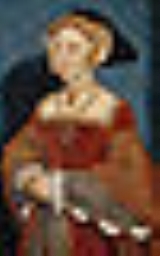
Jane Seymour

Encyclopedia
Jane Seymour was Queen of England as the third wife
of King Henry VIII
. She succeeded Anne Boleyn
as queen consort following the latter's execution for trumped up charges of high treason
, incest and adultery in May 1536. She died of postnatal complications less than two weeks after the birth of her only child, a son who reigned as Edward VI
. She was the only one of Henry's wives to receive a queen's funeral, and his only consort to be buried beside him in St. George's Chapel, Windsor Castle
, as she was the only consort to have a male heir.
, Savernake Forest
, Wiltshire
, the daughter of Sir John Seymour and Margery Wentworth
. Through her maternal grandfather, she was a descendant of King Edward III of England
through Lionel Plantagenet. Because of this, she and King Henry VIII were fifth cousins three times removed
. She was a half-second cousin to her predecessor Anne Boleyn
, sharing a great-grandmother, Elizabeth Cheney. Her date of birth is a matter of debate. It is usually given as 1509 or even 1510, but it has been noted that at her funeral, 29 women walked in succession. Since it was customary for the attendant company to mark every year of the deceased's life in numbers, this implies she was born in 1508, or 1507 and she had not yet celebrated her 30th birthday.
She was not educated as highly as King Henry's previous wives, Catherine of Aragon
and Anne Boleyn. She could read and write a little, but was much better at needlework and household management, which were considered much more necessary for women. Jane's needlework was reported to be beautiful and elaborate; some of her work survived up to 1652, when it is recorded to have been given to the Seymour family. After her death, it was noted that Henry was an "enthusiastic embroiderer".
She became a maid-of-honour in 1532 to Queen Catherine, but Jane may have served Catherine as early as 1527, and went on to serve Queen Anne Boleyn. The first report of Henry VIII's interest in Jane Seymour was in early 1536, sometime before the death of Catherine of Aragon.
Jane was noted to have a child-like face, as well as a modest personality. According to the Imperial Ambassador Eustace Chapuys
, Jane was of middling stature and very pale; he also commented that she was not of much beauty. However, John Russell stated that Jane was "the fairest of all the King's wives." Polydore Vergil commented that she was "a woman of the utmost charm in both character and appearance."
, Whitehall
, London
, on 30 May 1536, just eleven days after Anne Boleyn's execution. She was publicly proclaimed as queen consort on 4 June. She was never crowned, due to a plague
in London where the coronation was to take place. Henry may have been reluctant to crown Jane before she had fulfilled her duty as a queen consort by bearing him a son and a male heir.
As queen, Seymour was said to be strict and formal. She was close to her female relations, Anne Stanhope
(her brother's
wife) and her sister, Elizabeth. Jane was also close to the Lady Lisle along with her sister-in-law the Lady Beauchamp. Jane considered Lisle's daughters as ladies-in-waiting and she left many of her possessions to Beauchamp. Jane would form a very close relationship with Mary Tudor
. The lavish entertainments, gaiety, and extravagance of the Queen's household, which had reached its peak during the time of Anne Boleyn, was replaced by a strict enforcement of decorum. For example, instead of the fashionable French hoods which Anne Boleyn had introduced, Jane preferred her ladies to wear the gabled English hoods that Catherine of Aragon had worn. Politically, Seymour appears to have been conservative. Her only reported involvement in national affairs, in 1536, was when she asked for pardons for participants in the Pilgrimage of Grace
. Henry is said to have rejected this, reminding her of the fate her predecessor met with when she "meddled in his affairs".
Jane was of the Roman Catholic faith, not an Anglican. It is believed, because of this and her loyalty to her former mistress, Catherine of Aragon, Jane put forth much effort to restore Henry's first child, Princess Mary, to court and heir to the throne behind any children that Jane would have with Henry. Jane brought up the issue of Mary's restoration both before and after she became Queen. While Jane was unable to restore Mary to the line of succession, Jane was able to reconcile her with Henry. Eustace Chapuys wrote to Charles V
of Jane's compassion and efforts on behalf of Mary's return to favour. A letter from Mary to Jane shows that Mary was grateful to Jane. While it was Jane who first pushed for the restoration, Mary and Elizabeth were not reinstated in the succession until Henry's sixth wife, Queen Catherine Parr
, convinced him to do so.
In early 1537, Jane became pregnant. During her pregnancy, she developed a craving for quail, which Henry ordered for her from Calais
and Flanders
. She went into confinement in September 1537 and gave birth to the coveted male heir, the future King
Edward VI
on 12 October 1537 at Hampton Court Palace
.
, were present and carried the infant's train during the ceremony. After the christening, it became clear that Jane Seymour was seriously ill.
Jane Seymour's labor had been difficult, lasting two days and three nights, probably because the baby was not well positioned. According to King Edward's biographer, Jennifer Loach, Jane Seymour's death may have been due to an infection from a retained placenta
. According to Alison Weir
, death could have also been caused by puerperal fever
due to a bacterial infection contracted during the birth or a tear in her perineum
which became infected.
Jane Seymour died on 24 October 1537 at Hampton Court Palace at Kingston upon Thames
.
at Windsor Castle
after a funeral in which her stepdaughter, Mary
, acted as chief mourner
. Jane Seymour was the only one of Henry's wives to receive a Queen's funeral.
The following inscription was above her grave for a time:
After her death, Henry wore black for the next three months and did not remarry for three years, although marriage negotiations were tentatively begun soon after her death. She was Henry's favourite wife because, historians have speculated, she gave birth to a male heir. When he died in 1547, Henry was buried beside her in the grave he had made for her, on his request.
and Edward
, used her memory to improve their own fortunes. Thomas was rumoured to have been pursuing Princess Elizabeth, but married Queen Catherine Parr instead after the King's death. In the reign of the young King Edward VI
, Edward Seymour set himself up as Lord Protector and de facto
ruler of the kingdom. Both brothers eventually fell from power, and were executed.
From version 170A:
, is more accessible to the average reader. A third book, William Seymour's Ordeal by Ambition, is in part a biography of Jane.
Jane was widely praised as "the fairest, the most discreet, and the most meritous of all Henry VIII's wives" in the centuries after her passing away. One historian, however, took serious umbrage at this view in the 19th century. Victorian author Agnes Strickland
, who wrote multi-volume anthologies of French, Scottish, and English royal women, said that the story of Anne Boleyn's last agonised hours and Henry VIII's swift remarriage to Jane Seymour "is repulsive enough, but it becomes tenfold more abhorrent when the woman who caused the whole tragedy is loaded with panegyric." Hester W. Chapman and Eric Ives
resurrected Strickland's view of Jane Seymour, and believe she played a crucial and conscious role in the cold-blooded plot to bring Anne Boleyn to the executioner's block. Joanna Denny
, Marie Louise Bruce and Carolly Erickson
have also refrained from giving overly sympathetic accounts of Jane's life and career. It should be noted that Ives, Bruce, and Denny are biographers of Anne Boleyn as opposed to Jane Seymour.
On the other hand, historical writers like Alison Weir
and Antonia Fraser
paint a favourable portrait of a woman of discretion and good sense - "a strong-minded matriarch in the making," says Weir. David Starkey
and Karen Lindsey are relatively dismissive of Jane's importance in comparison to that of Henry's other major queens (Catherine of Aragon, Anne Boleyn and Catherine Parr), though they refrain from claiming that she was the cause of the unfair trial. They further state that it was unlikely Jane could accomplish as much as her predecessors or her successors because her reign had been relatively short and spent mainly pregnant or unwell.
|-
Wives of Henry VIII
The wives of Henry VIII were the six queens consort married to Henry VIII of England between 1509 and 1547. The six women to hold the title 'queens consort' of King Henry VIII were, in order:* Catherine of Aragon ,* Anne Boleyn ,...
of King Henry VIII
Henry VIII of England
Henry VIII was King of England from 21 April 1509 until his death. He was Lord, and later King, of Ireland, as well as continuing the nominal claim by the English monarchs to the Kingdom of France...
. She succeeded Anne Boleyn
Anne Boleyn
Anne Boleyn ;c.1501/1507 – 19 May 1536) was Queen of England from 1533 to 1536 as the second wife of Henry VIII of England and Marquess of Pembroke in her own right. Henry's marriage to Anne, and her subsequent execution, made her a key figure in the political and religious upheaval that was the...
as queen consort following the latter's execution for trumped up charges of high treason
High treason in the United Kingdom
Under the law of the United Kingdom, high treason is the crime of disloyalty to the Crown. Offences constituting high treason include plotting the murder of the sovereign; having sexual intercourse with the sovereign's consort, with his eldest unmarried daughter, or with the wife of the heir to the...
, incest and adultery in May 1536. She died of postnatal complications less than two weeks after the birth of her only child, a son who reigned as Edward VI
Edward VI of England
Edward VI was the King of England and Ireland from 28 January 1547 until his death. He was crowned on 20 February at the age of nine. The son of Henry VIII and Jane Seymour, Edward was the third monarch of the Tudor dynasty and England's first monarch who was raised as a Protestant...
. She was the only one of Henry's wives to receive a queen's funeral, and his only consort to be buried beside him in St. George's Chapel, Windsor Castle
Windsor Castle
Windsor Castle is a medieval castle and royal residence in Windsor in the English county of Berkshire, notable for its long association with the British royal family and its architecture. The original castle was built after the Norman invasion by William the Conqueror. Since the time of Henry I it...
, as she was the only consort to have a male heir.
Early life
Jane Seymour was born at WulfhallWulfhall
Wulfhall or Wolfhall is an early 17th century manor house and the site of a deserted medieval village in the civil parish of Burbage , on the edge of Savernake Forest, in the English county of Wiltshire...
, Savernake Forest
Savernake Forest
Savernake Forest is on a Cretaceous chalk plateau between Marlborough and Great Bedwyn in Wiltshire, England. Its area is approximately .It is privately owned by the Trustees of Savernake Estate, the Earl of Cardigan, and his family solicitor. Since 1939 the running of the forest has been...
, Wiltshire
Wiltshire
Wiltshire is a ceremonial county in South West England. It is landlocked and borders the counties of Dorset, Somerset, Hampshire, Gloucestershire, Oxfordshire and Berkshire. It contains the unitary authority of Swindon and covers...
, the daughter of Sir John Seymour and Margery Wentworth
Margery Wentworth
Margery Wentworth, also known as Margaret Wentworth was the wife of Sir John Seymour and the mother of Queen Jane Seymour, the third wife of Henry VIII of England. She was the grandmother of King Edward VI of England.-Family:...
. Through her maternal grandfather, she was a descendant of King Edward III of England
Edward III of England
Edward III was King of England from 1327 until his death and is noted for his military success. Restoring royal authority after the disastrous reign of his father, Edward II, Edward III went on to transform the Kingdom of England into one of the most formidable military powers in Europe...
through Lionel Plantagenet. Because of this, she and King Henry VIII were fifth cousins three times removed
Cousin chart
In kinship terminology, a cousin is a relative with whom one shares one or more common ancestors. The term is rarely used when referring to a relative in one's immediate family where there is a more specific term . The term "blood relative" can be used synonymously and establishes the existence of...
. She was a half-second cousin to her predecessor Anne Boleyn
Anne Boleyn
Anne Boleyn ;c.1501/1507 – 19 May 1536) was Queen of England from 1533 to 1536 as the second wife of Henry VIII of England and Marquess of Pembroke in her own right. Henry's marriage to Anne, and her subsequent execution, made her a key figure in the political and religious upheaval that was the...
, sharing a great-grandmother, Elizabeth Cheney. Her date of birth is a matter of debate. It is usually given as 1509 or even 1510, but it has been noted that at her funeral, 29 women walked in succession. Since it was customary for the attendant company to mark every year of the deceased's life in numbers, this implies she was born in 1508, or 1507 and she had not yet celebrated her 30th birthday.
She was not educated as highly as King Henry's previous wives, Catherine of Aragon
Catherine of Aragon
Catherine of Aragon , also known as Katherine or Katharine, was Queen consort of England as the first wife of King Henry VIII of England and Princess of Wales as the wife to Arthur, Prince of Wales...
and Anne Boleyn. She could read and write a little, but was much better at needlework and household management, which were considered much more necessary for women. Jane's needlework was reported to be beautiful and elaborate; some of her work survived up to 1652, when it is recorded to have been given to the Seymour family. After her death, it was noted that Henry was an "enthusiastic embroiderer".
She became a maid-of-honour in 1532 to Queen Catherine, but Jane may have served Catherine as early as 1527, and went on to serve Queen Anne Boleyn. The first report of Henry VIII's interest in Jane Seymour was in early 1536, sometime before the death of Catherine of Aragon.
Jane was noted to have a child-like face, as well as a modest personality. According to the Imperial Ambassador Eustace Chapuys
Eustace Chapuys
Eustace Chapuys was a Savoyard diplomat who served as the Imperial ambassador to England from 1529 until 1545 and is best known for his extensive and detailed correspondence.-Life:...
, Jane was of middling stature and very pale; he also commented that she was not of much beauty. However, John Russell stated that Jane was "the fairest of all the King's wives." Polydore Vergil commented that she was "a woman of the utmost charm in both character and appearance."
Marriage
King Henry VIII was married to Jane at the Palace of WhitehallPalace of Whitehall
The Palace of Whitehall was the main residence of the English monarchs in London from 1530 until 1698 when all except Inigo Jones's 1622 Banqueting House was destroyed by fire...
, Whitehall
Whitehall
Whitehall is a road in Westminster, in London, England. It is the main artery running north from Parliament Square, towards Charing Cross at the southern end of Trafalgar Square...
, London
London
London is the capital city of :England and the :United Kingdom, the largest metropolitan area in the United Kingdom, and the largest urban zone in the European Union by most measures. Located on the River Thames, London has been a major settlement for two millennia, its history going back to its...
, on 30 May 1536, just eleven days after Anne Boleyn's execution. She was publicly proclaimed as queen consort on 4 June. She was never crowned, due to a plague
Bubonic plague
Plague is a deadly infectious disease that is caused by the enterobacteria Yersinia pestis, named after the French-Swiss bacteriologist Alexandre Yersin. Primarily carried by rodents and spread to humans via fleas, the disease is notorious throughout history, due to the unrivaled scale of death...
in London where the coronation was to take place. Henry may have been reluctant to crown Jane before she had fulfilled her duty as a queen consort by bearing him a son and a male heir.
As queen, Seymour was said to be strict and formal. She was close to her female relations, Anne Stanhope
Anne Stanhope
Anne Seymour, Duchess of Somerset was the second wife of Edward Seymour, 1st Duke of Somerset, who held the office of Lord Protector during the first part of the reign of his nephew King Edward VI, through whom Anne was briefly the most powerful woman in England...
(her brother's
Edward Seymour, 1st Duke of Somerset
Edward Seymour, 1st Duke of Somerset, 1st Earl of Hertford, 1st Viscount Beauchamp of Hache, KG, Earl Marshal was Lord Protector of England in the period between the death of Henry VIII in 1547 and his own indictment in 1549....
wife) and her sister, Elizabeth. Jane was also close to the Lady Lisle along with her sister-in-law the Lady Beauchamp. Jane considered Lisle's daughters as ladies-in-waiting and she left many of her possessions to Beauchamp. Jane would form a very close relationship with Mary Tudor
Mary I of England
Mary I was queen regnant of England and Ireland from July 1553 until her death.She was the only surviving child born of the ill-fated marriage of Henry VIII and his first wife Catherine of Aragon. Her younger half-brother, Edward VI, succeeded Henry in 1547...
. The lavish entertainments, gaiety, and extravagance of the Queen's household, which had reached its peak during the time of Anne Boleyn, was replaced by a strict enforcement of decorum. For example, instead of the fashionable French hoods which Anne Boleyn had introduced, Jane preferred her ladies to wear the gabled English hoods that Catherine of Aragon had worn. Politically, Seymour appears to have been conservative. Her only reported involvement in national affairs, in 1536, was when she asked for pardons for participants in the Pilgrimage of Grace
Pilgrimage of Grace
The Pilgrimage of Grace was a popular rising in York, Yorkshire during 1536, in protest against Henry VIII's break with the Roman Catholic Church and the Dissolution of the Monasteries, as well as other specific political, social and economic grievances. It was done in action against Thomas Cromwell...
. Henry is said to have rejected this, reminding her of the fate her predecessor met with when she "meddled in his affairs".
Jane was of the Roman Catholic faith, not an Anglican. It is believed, because of this and her loyalty to her former mistress, Catherine of Aragon, Jane put forth much effort to restore Henry's first child, Princess Mary, to court and heir to the throne behind any children that Jane would have with Henry. Jane brought up the issue of Mary's restoration both before and after she became Queen. While Jane was unable to restore Mary to the line of succession, Jane was able to reconcile her with Henry. Eustace Chapuys wrote to Charles V
Charles V, Holy Roman Emperor
Charles V was ruler of the Holy Roman Empire from 1519 and, as Charles I, of the Spanish Empire from 1516 until his voluntary retirement and abdication in favor of his younger brother Ferdinand I and his son Philip II in 1556.As...
of Jane's compassion and efforts on behalf of Mary's return to favour. A letter from Mary to Jane shows that Mary was grateful to Jane. While it was Jane who first pushed for the restoration, Mary and Elizabeth were not reinstated in the succession until Henry's sixth wife, Queen Catherine Parr
Catherine Parr
Catherine Parr ; 1512 – 5 September 1548) was Queen consort of England and Ireland and the last of the six wives of King Henry VIII of England. She married Henry VIII on 12 July 1543. She was the fourth commoner Henry had taken as his consort, and outlived him...
, convinced him to do so.
In early 1537, Jane became pregnant. During her pregnancy, she developed a craving for quail, which Henry ordered for her from Calais
Calais
Calais is a town in Northern France in the department of Pas-de-Calais, of which it is a sub-prefecture. Although Calais is by far the largest city in Pas-de-Calais, the department's capital is its third-largest city of Arras....
and Flanders
Flanders
Flanders is the community of the Flemings but also one of the institutions in Belgium, and a geographical region located in parts of present-day Belgium, France and the Netherlands. "Flanders" can also refer to the northern part of Belgium that contains Brussels, Bruges, Ghent and Antwerp...
. She went into confinement in September 1537 and gave birth to the coveted male heir, the future King
Edward VI
Edward VI of England
Edward VI was the King of England and Ireland from 28 January 1547 until his death. He was crowned on 20 February at the age of nine. The son of Henry VIII and Jane Seymour, Edward was the third monarch of the Tudor dynasty and England's first monarch who was raised as a Protestant...
on 12 October 1537 at Hampton Court Palace
Hampton Court Palace
Hampton Court Palace is a royal palace in the London Borough of Richmond upon Thames, Greater London; it has not been inhabited by the British royal family since the 18th century. The palace is located south west of Charing Cross and upstream of Central London on the River Thames...
.
Death
Custom dictated that the Queen did not participate in her children's christening. Consequently, Edward was christened without his mother in attendance on 15 October 1537. Both of the King's daughters, Mary and ElizabethElizabeth I of England
Elizabeth I was queen regnant of England and Ireland from 17 November 1558 until her death. Sometimes called The Virgin Queen, Gloriana, or Good Queen Bess, Elizabeth was the fifth and last monarch of the Tudor dynasty...
, were present and carried the infant's train during the ceremony. After the christening, it became clear that Jane Seymour was seriously ill.
Jane Seymour's labor had been difficult, lasting two days and three nights, probably because the baby was not well positioned. According to King Edward's biographer, Jennifer Loach, Jane Seymour's death may have been due to an infection from a retained placenta
Retained placenta
Retained placenta is a condition where all or part of the placenta or membranes are left behind in the uterus during the third stage of labour.-In humans:...
. According to Alison Weir
Alison Weir
Alison Weir is a British writer of history books, and latterly historical novels, mostly in the form of biographies about British royalty.-Personal life:...
, death could have also been caused by puerperal fever
Puerperal fever
Puerperal fever or childbed fever, is a bacterial infection contracted by women during childbirth or miscarriage. It can develop into puerperal sepsis, which is a serious form of septicaemia. If untreated, it is often fatal....
due to a bacterial infection contracted during the birth or a tear in her perineum
Perineum
In human anatomy, the perineum is a region of the body including the perineal body and surrounding structures...
which became infected.
Jane Seymour died on 24 October 1537 at Hampton Court Palace at Kingston upon Thames
Kingston upon Thames
Kingston upon Thames is the principal settlement of the Royal Borough of Kingston upon Thames in southwest London. It was the ancient market town where Saxon kings were crowned and is now a suburb situated south west of Charing Cross. It is one of the major metropolitan centres identified in the...
.
Funeral
Jane Seymour was buried on 12 November 1537 in St. George's ChapelSt. George's Chapel, Windsor Castle
St George's Chapel is the place of worship at Windsor Castle in England, United Kingdom. It is both a royal peculiar and the chapel of the Order of the Garter...
at Windsor Castle
Windsor Castle
Windsor Castle is a medieval castle and royal residence in Windsor in the English county of Berkshire, notable for its long association with the British royal family and its architecture. The original castle was built after the Norman invasion by William the Conqueror. Since the time of Henry I it...
after a funeral in which her stepdaughter, Mary
Mary I of England
Mary I was queen regnant of England and Ireland from July 1553 until her death.She was the only surviving child born of the ill-fated marriage of Henry VIII and his first wife Catherine of Aragon. Her younger half-brother, Edward VI, succeeded Henry in 1547...
, acted as chief mourner
Mourner
A mourner is someone who is attending a funeral or who is otherwise recognized as in a period of grief and mourning prescribed either by religious law or by popular custom...
. Jane Seymour was the only one of Henry's wives to receive a Queen's funeral.
The following inscription was above her grave for a time:
- Here lieth a Phoenix, by whose death
- Another Phoenix life gave breath:
- It is to be lamented much
- The world at once ne'er knew two such.
After her death, Henry wore black for the next three months and did not remarry for three years, although marriage negotiations were tentatively begun soon after her death. She was Henry's favourite wife because, historians have speculated, she gave birth to a male heir. When he died in 1547, Henry was buried beside her in the grave he had made for her, on his request.
Legacy
Two of Jane's brothers, ThomasThomas Seymour, 1st Baron Seymour of Sudeley
Thomas Seymour, 1st Baron Seymour of Sudeley, KG was an English politician.Thomas spent his childhood in Wulfhall, outside Savernake Forest, in Wiltshire. Historian David Starkey describes Thomas thus: 'tall, well-built and with a dashing beard and auburn hair, he was irresistible to women'...
and Edward
Edward Seymour, 1st Duke of Somerset
Edward Seymour, 1st Duke of Somerset, 1st Earl of Hertford, 1st Viscount Beauchamp of Hache, KG, Earl Marshal was Lord Protector of England in the period between the death of Henry VIII in 1547 and his own indictment in 1549....
, used her memory to improve their own fortunes. Thomas was rumoured to have been pursuing Princess Elizabeth, but married Queen Catherine Parr instead after the King's death. In the reign of the young King Edward VI
Edward VI of England
Edward VI was the King of England and Ireland from 28 January 1547 until his death. He was crowned on 20 February at the age of nine. The son of Henry VIII and Jane Seymour, Edward was the third monarch of the Tudor dynasty and England's first monarch who was raised as a Protestant...
, Edward Seymour set himself up as Lord Protector and de facto
De facto
De facto is a Latin expression that means "concerning fact." In law, it often means "in practice but not necessarily ordained by law" or "in practice or actuality, but not officially established." It is commonly used in contrast to de jure when referring to matters of law, governance, or...
ruler of the kingdom. Both brothers eventually fell from power, and were executed.
In film
- In 1933, Wendy BarrieWendy BarrieWendy Barrie was a British actress who worked in British and American films.-Early life:Marguerite Wendy Jenkins was born in Hong Kong to British parents...
played Seymour opposite Charles LaughtonCharles LaughtonCharles Laughton was an English-American stage and film actor, screenwriter, producer and director.-Early life and career:...
's Henry VIII in Alexander KordaAlexander KordaSir Alexander Korda was a Hungarian-born British producer and film director. He was a leading figure in the British film industry, the founder of London Films and the owner of British Lion Films, a film distributing company.-Life and career:The elder brother of filmmakers Zoltán Korda and Vincent...
's highly-acclaimed film The Private Life of Henry VIIIThe Private Life of Henry VIIIThe Private Life of Henry VIII is a 1933 film about Henry VIII, King of England. It was written by Lajos Biró and Arthur Wimperis, and directed by Sir Alexander Korda.Charles Laughton won the 1933 Academy Award as Best Actor for his performance as Henry...
. - Seymour is a minor character in Hal B. WallisHal B. WallisHal B. Wallis was an American film producer.-Career:Harold Brent Wallis was born in Chicago in 1898. His family moved in 1922 to Los Angeles, California, where he found work as part of the publicity department at Warner Bros...
' 1969 OscarAcademy AwardsAn Academy Award, also known as an Oscar, is an accolade bestowed by the American Academy of Motion Picture Arts and Sciences to recognize excellence of professionals in the film industry, including directors, actors, and writers...
-winning Anne of the Thousand DaysAnne of the Thousand DaysAnne of the Thousand Days is a 1969 costume drama made by Hal Wallis Productions and distributed by Universal Pictures. It was directed by Charles Jarrott and produced by Hal B. Wallis. The film tells the story of Anne Boleyn...
. She was played by Lesley Paterson, opposite Richard BurtonRichard BurtonRichard Burton, CBE was a Welsh actor. He was nominated seven times for an Academy Award, six of which were for Best Actor in a Leading Role , and was a recipient of BAFTA, Golden Globe and Tony Awards for Best Actor. Although never trained as an actor, Burton was, at one time, the highest-paid...
as Henry VIII. - As part of the 1970 BBCBBCThe British Broadcasting Corporation is a British public service broadcaster. Its headquarters is at Broadcasting House in the City of Westminster, London. It is the largest broadcaster in the world, with about 23,000 staff...
series The Six Wives of Henry VIII, the episode entitled "Jane Seymour" presented her as a shy but honest introvert, devoted to her husband. Henry was played by Keith MichellKeith MichellKeith Michell is an Australian actor, particularly noted for his television and film performances as King Henry VIII of England.- Early life :He was born in Adelaide and brought up in Warnertown, near Port Pirie...
, and Seymour by Anne StallybrassAnne StallybrassAnne Stallybrass is a British actress who trained at the Royal Academy of Music in London.She was born in Westcliff-on-Sea, Essex...
. The previous episode "Anne Boleyn" displayed Jane as fully knowing the damage her relationship with King Henry was doing. - In 1973, this interpretation was repeated in Henry VIII and his Six WivesHenry VIII and His Six WivesHenry VIII and His Six Wives is a 1972 film version of the famous BBC television series The Six Wives of Henry VIII, it was written by Ian Thorne and directed by Waris Hussein.-Description:...
, in which Keith Michell reprised his role from the BBC drama; on this occasion Seymour was played by Jane AsherJane AsherJane Asher is an English actress. She has also developed a second career as a cake decorator and cake shop proprietor.-Early life:...
. - Seymour was played by Charlotte Roach in David StarkeyDavid StarkeyDavid Starkey, CBE, FSA is a British constitutional historian, and a radio and television presenter.He was born the only child of Quaker parents, and attended Kendal Grammar School before entering Cambridge through a scholarship. There he specialised in Tudor history, writing a thesis on King...
's documentary series on Henry's Queens in 2001. - Seymour is a supporting character in the BBC television drama The Other Boleyn GirlThe Other Boleyn Girl (2003 film)The Other Boleyn Girl is a 2003 BBC television film, adapted from Philippa Gregory's novel of the same name.-Production:This was a low production budget of £750,000. The drama was shot using modern camera techniques and the cast spent four weeks in workshops improvising the script with the director...
, played by Naomi Benson opposite Jared HarrisJared HarrisJared Francis Harris is a British character actor, well known for playing the obnoxious Mac McGrath in the Adam Sandler film Mr. Deeds, and for his portrayal of Lane Pryce on the AMC series Mad Men.- Personal life :...
as Henry VIII and Jodhi MayJodhi MayJodhi May is an English actress.-Early life:Born in Camden Town, London, May first acted at the age of 12 in 1988's A World Apart. The role earned her a Best Actress award at the 1988 Cannes Film Festival, shared with her co-stars Barbara Hershey and Linda Mvusi...
as Anne Boleyn. - In October 2003, in the two-part ITVITVITV is the major commercial public service TV network in the United Kingdom. Launched in 1955 under the auspices of the Independent Television Authority to provide competition to the BBC, it is also the oldest commercial network in the UK...
drama Henry VIIIHenry VIII (TV serial)Henry VIII is a two-part British television serial produced principally by Granada Television for ITV. It chronicles the life of Henry VIII of England from the disintegration of his first marriage to an aging Spanish princess until his death following a stroke in 1547, by which time he had married...
, Ray WinstoneRay WinstoneRaymond Andrew "Ray" Winstone is an English film and television actor. He is mostly known for his "tough guy" roles, beginning with that of Carlin in the 1979 film Scum and as Will Scarlet in the cult television adventure series Robin of Sherwood. He has also become well known as a voice over...
starred as the King. Jane Seymour was played by Emilia FoxEmilia FoxEmilia Rose Elizabeth Fox is an award-winning English actress, known for her role as Dr. Nikki Alexander on BBC crime drama Silent Witness, having joined the cast in 2004 following the departure of Amanda Burton. She also appears as Morgause in the BBC's Merlin beginning in the programme's second...
. - In The SimpsonsThe SimpsonsThe Simpsons is an American animated sitcom created by Matt Groening for the Fox Broadcasting Company. The series is a satirical parody of a middle class American lifestyle epitomized by its family of the same name, which consists of Homer, Marge, Bart, Lisa and Maggie...
episode "Margical History TourMargical History Tour"Margical History Tour" is the eleventh episode of The Simpsons fifteenth season. The episode was first broadcast on February 8, 2004. This is one of several Simpsons episodes that features mini-stories.-Plot:...
," Seymour is portrayed by the shrill-tongued Miss Springfield during MargeMarge SimpsonMarjorie "Marge" Simpson is a fictional main character in the animated television series The Simpsons and part of the eponymous family. She is voiced by actress Julie Kavner and first appeared on television in The Tracey Ullman Show short "Good Night" on April 19, 1987...
's retelling of Henry's reign. Henry (portrayed by HomerHomer SimpsonHomer Jay Simpson is a fictional character in the animated television series The Simpsons and the patriarch of the eponymous family. He is voiced by Dan Castellaneta and first appeared on television, along with the rest of his family, in The Tracey Ullman Show short "Good Night" on April 19, 1987...
) quickly orders Seymour's beheading after hearing her annoying voice. - Anita BriemAnita BriemAnita Briem is an Icelandic actress. She is known for her role as Jane Seymour on The Tudors and her role as Hanna in Journey to the Center of the Earth.-Personal life:...
portrays Seymour as lady-in-waiting to Anne Boleyn in the second season of the television series The TudorsThe TudorsThe Tudors is a Canadian produced historical fiction television series filmed in Ireland, created by Michael Hirst and produced for the American premium cable television channel Showtime...
, produced for Showtime. In the third season of the same series, when Jane Seymour becomes Queen and later dies, the part is played by Annabelle Wallis. - Seymour was played by actress Corinne Galloway in the 2008 film The Other Boleyn Girl.
In books
- Is the main character in Carolly EricksonCarolly EricksonCarolly Erickson is an author of historical fiction and non-fiction. She lives in Hawaii.-Novels:* The Hidden Diary of Marie Antoinette * The Last Wife of Henry VIII...
's novel 'The Favoured Queen' which follows her from her appointment as lady-in-waiting to Catherine of Aragon right up to the time she herself becomes Henry's consort. - Appears in a background role in The Dark Rose, Volume 2 of The Morland DynastyThe Morland DynastyThe Morland Dynasty is a series of historical novels by Cynthia Harrod-Eagles, based around the Morland family of York, England and their national and international relatives and associates.There are currently thirty-two books in the series...
, a series of historical novels by author Cynthia Harrod-EaglesCynthia Harrod-EaglesCynthia Harrod-Eagles is a prolific and successful British novelist, best known for her Morland Dynasty series.Cynthia Harrod-Eagles was born in Shepherd's Bush, London and educated at Burlington School. Her first successful novel was The Waiting Game , and she became a full-time writer in...
. - A minor character in Philippa GregoryPhilippa GregoryPhilippa Gregory is an English novelist.-Early life and academic career:Philippa Gregory was born in Kenya. When she was two years old, her family moved to England. She was a "rebel" at school, but managed to attend the University of Sussex...
's popular novel The Other Boleyn Girl. Jane is a devout girl seen by the Boleyns as their rival family at court. - Appears in Alison WeirAlison WeirAlison Weir is a British writer of history books, and latterly historical novels, mostly in the form of biographies about British royalty.-Personal life:...
's debut novel Innocent Traitor and her second The Lady Elizabeth. - Is the subject of the novel Plain Jane: A Novel of Jane Seymour (Tudor Women Series) by Laurien GardnerLaurien GardnerLaurien Gardner is the collective pseudonym of a group of female authors writing a series of Tudor era novels about the wives of Henry VIII. All books published by Jove Books, part of Penguin Books.-Published works:...
(Sarah HoytSarah HoytSarah de Almeida Hoyt is an award-winning fiction author.-Biography:Hoyt was born on November 18, 1962 in the village of Granja, Águas Santas, Maia near Porto, Portugal, a major port city on the Atlantic coast...
). - Appears as a lady serving both Catherine of Aragon and Anne Boleyn in Wolf HallWolf HallWolf Hall is a multi-award winning historical novel by English author Hilary Mantel, published by Fourth Estate. Set in the period from 1500 to 1535, Wolf Hall is a fictionalized biography documenting the rapid rise to power of Thomas Cromwell, 1st Earl of Essex in the court of Henry VIII of...
by Hilary MantelHilary MantelHilary Mary Mantel CBE , née Thompson, is an English novelist, short story writer and critic. Her work, ranging in subject from personal memoir to historical fiction, has been short-listed for major literary awards...
, which ends with hints of her coming prominence. A planned sequel, The Mirror and the Light, is expected to tell her story.
In music
- As Giovanna Seymour, she appears in Gaetano DonizettiGaetano DonizettiDomenico Gaetano Maria Donizetti was an Italian composer from Bergamo, Lombardy. His best-known works are the operas L'elisir d'amore , Lucia di Lammermoor , and Don Pasquale , all in Italian, and the French operas La favorite and La fille du régiment...
's opera Anna BolenaAnna BolenaAnna Bolena is a tragedia lirica, or opera, in two acts by Gaetano Donizetti. Felice Romani wrote the Italian libretto after Ippolito Pindemonte's Enrico VIII ossia Anna Bolena and Alessandro Pepoli's Anna Bolena, both telling of the life of Anne Boleyn...
. - Rick WakemanRick WakemanRichard Christopher Wakeman is an English keyboard player, composer and songwriter best known for being the former keyboardist in the progressive rock band Yes...
recorded the piece "Jane Seymour" for his 1973 album The Six Wives of Henry VIIIThe Six Wives of Henry VIII (album)The Six Wives of Henry VIII is the debut studio album from the English keyboardist and composer Rick Wakeman, released in January 1973 on A&M Records. It is an instrumental progressive rock album with its concept based on his interpretations of the musical characteristics of the six wives of Henry...
. - The English ballad "The Death of Queen JaneThe Death of Queen Jane"The Death of Queen Jane" is an English ballad that describes the events surrounding the death of a Queen Jane. Many now believe that the Queen is Jane Seymour, the third wife of Henry VIII of England. However there is no evidence to support this assumption. Historically, Jane Seymour gave birth...
" (ChildChild BalladsThe Child Ballads are a collection of 305 ballads from England and Scotland, and their American variants, collected by Francis James Child in the late nineteenth century...
#170) is about the death of Jane Seymour following the birth of Prince Edward. The story as related in the ballad is historically inaccurate, but apparently reflects the popular view at the time of the events surrounding her death. The historical fact is that Prince Edward was born naturally, and that his mother succumbed to infection and died 12 days later. Most versions of the song end with the contrast between the joy of the birth of the Prince and the grief of the death of the Queen.
From version 170A:
- The baby was christened with joy and much mirth,
- Whilst poor Queen Jane's body lay cold under earth:
- There was ringing and singing and mourning all day,
- The Princess Elizabeth went weeping away
- The ballad is included in Loreena McKennittLoreena McKennittLoreena Isabel Irene McKennitt, CM, OM, is a Canadian singer, composer, harpist, accordionist and pianist who writes, records and performs world music with Celtic and Middle Eastern themes. McKennitt is known for her refined, clear soprano vocals...
's BarleyThe Wind That Shakes the Barley (album)-Track listing:# "As I Roved Out" # "On a Bright May Morning" # "Brian Boru’s March" # "Down by the Sally Gardens" # "The Star of the County Down" # "The Wind that Shakes the Barley" # "The Death of Queen Jane"...
album. - The song "Lady JaneLady Jane"Lady Jane" is a Rolling Stones' song written by Mick Jagger and Keith Richards featured on their 1966 album Aftermath.In America Lady Jane was the B-side to "Mother's Little Helper", but "Lady Jane" reached #24 on Billboard's Hot 100 singles chart...
by The Rolling StonesThe Rolling StonesThe Rolling Stones are an English rock band, formed in London in April 1962 by Brian Jones , Ian Stewart , Mick Jagger , and Keith Richards . Bassist Bill Wyman and drummer Charlie Watts completed the early line-up...
is rumoured to be about Jane Seymour and her relationship with Henry VIII.
Historiography
Books solely on Jane Seymour are scarce, but two biographies of the Queen have recently been published. The first is a scholarly biography by Pamela Gross, while the second, by Elizabeth NortonElizabeth Norton
Elizabeth Norton is a British historian specialising in the queens of England and the Tudor period. She obtained an Master of Arts in Archaeology and Anthropology from the University of Cambridge in 2003 and a masters degree in European Archaeology from the University of Oxford in 2004.She is the...
, is more accessible to the average reader. A third book, William Seymour's Ordeal by Ambition, is in part a biography of Jane.
Jane was widely praised as "the fairest, the most discreet, and the most meritous of all Henry VIII's wives" in the centuries after her passing away. One historian, however, took serious umbrage at this view in the 19th century. Victorian author Agnes Strickland
Agnes Strickland
Agnes Strickland was an English historical writer and poet.-Biography:The daughter of Thomas Strickland of Reydon Hall, Suffolk, Agnes was educated by her father, and began her literary career with a poem, Worcester Field, followed by The Seven Ages of Woman and Demetrius...
, who wrote multi-volume anthologies of French, Scottish, and English royal women, said that the story of Anne Boleyn's last agonised hours and Henry VIII's swift remarriage to Jane Seymour "is repulsive enough, but it becomes tenfold more abhorrent when the woman who caused the whole tragedy is loaded with panegyric." Hester W. Chapman and Eric Ives
Eric Ives
Eric William Ives, OBE is a British historian and an expert on the Tudor period. He is Emeritus Professor of English History at the University of Birmingham...
resurrected Strickland's view of Jane Seymour, and believe she played a crucial and conscious role in the cold-blooded plot to bring Anne Boleyn to the executioner's block. Joanna Denny
Joanna Denny
Joanna Denny was a historian and author specialising in the court of Henry VIII of England. Her books include Katherine Howard: A Tudor Conspiracy and Anne Boleyn. Her books are usually considered to be sympathetic towards these women. She was published by Portrait Books, an imprint of Piatkus....
, Marie Louise Bruce and Carolly Erickson
Carolly Erickson
Carolly Erickson is an author of historical fiction and non-fiction. She lives in Hawaii.-Novels:* The Hidden Diary of Marie Antoinette * The Last Wife of Henry VIII...
have also refrained from giving overly sympathetic accounts of Jane's life and career. It should be noted that Ives, Bruce, and Denny are biographers of Anne Boleyn as opposed to Jane Seymour.
On the other hand, historical writers like Alison Weir
Alison Weir
Alison Weir is a British writer of history books, and latterly historical novels, mostly in the form of biographies about British royalty.-Personal life:...
and Antonia Fraser
Antonia Fraser
Lady Antonia Margaret Caroline Fraser, DBE , née Pakenham, is an Anglo-Irish author of history, novels, biographies and detective fiction, best known as Antonia Fraser...
paint a favourable portrait of a woman of discretion and good sense - "a strong-minded matriarch in the making," says Weir. David Starkey
David Starkey
David Starkey, CBE, FSA is a British constitutional historian, and a radio and television presenter.He was born the only child of Quaker parents, and attended Kendal Grammar School before entering Cambridge through a scholarship. There he specialised in Tudor history, writing a thesis on King...
and Karen Lindsey are relatively dismissive of Jane's importance in comparison to that of Henry's other major queens (Catherine of Aragon, Anne Boleyn and Catherine Parr), though they refrain from claiming that she was the cause of the unfair trial. They further state that it was unlikely Jane could accomplish as much as her predecessors or her successors because her reign had been relatively short and spent mainly pregnant or unwell.
Lineage
External links
- http://www.findagrave.com/cgi-bin/fg.cgi?page=gr&GRid=1966 - Find A Grave
- A quick over-view of Jane's life, with a good portrait gallery as well
- A more in-depth historical look at Jane's life and times
- A geo-biography tour of the Six Wives of Henry VIII on Google Earth
- The text of the ballad The Death of Queen Jane
- Photo of Seymour waxwork Flickr
- A 1996 interview with Anne Boleyn's most respected academic biographer, E.W. Ives in which he offers his interpretations of Anne BoleynAnne BoleynAnne Boleyn ;c.1501/1507 – 19 May 1536) was Queen of England from 1533 to 1536 as the second wife of Henry VIII of England and Marquess of Pembroke in her own right. Henry's marriage to Anne, and her subsequent execution, made her a key figure in the political and religious upheaval that was the...
but also speculates on the role Jane played in Anne's downfall
|-