
All Topics  
Inigo Jones

 
Inigo Jones

   Email Print
   Bookmark   Link


Inigo Jones


Inigo Jones (July 15, 1573 – June 21, 1652) is regarded as the first significant British architect, and the first to bring Renaissance architecture
Renaissance architecture

Renaissance architecture is the architecture of the period between the early 15th and early 17th centuries in different regions of Europe, in which there was a conscious revival and development of certain elements of Ancient Greece and Ancient Rome thought and material culture....
 to England. He also made valuable contributions to stage design.

Beyond the fact that he was born in the vicinity of Smithfield
Smithfield, London

Smithfield is an area in the north-west part of the City of London, mostly known for its centuries-old meat market and its bloody history of executions of heretics and political opponents....
 in central London
London

London is the capital of both England and the United Kingdom, and the most populous municipality in the European Union. An important settlement for two millennia, History of London goes back to its founding by the Roman Empire....
, the son of a Welsh Catholic cloth worker, and christened at the church of St Bartholomew the Less, little is known about Jones' early years.


Discussion
Ask a question about 'Inigo Jones'
Start a new discussion about 'Inigo Jones'
Answer questions from other users
Full Discussion Forum


Encyclopedia


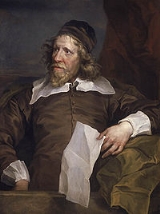
Portraitinigojones
Inigo Jones (July 15, 1573 – June 21, 1652) is regarded as the first significant British architect, and the first to bring Renaissance architecture
Renaissance architecture

Renaissance architecture is the architecture of the period between the early 15th and early 17th centuries in different regions of Europe, in which there was a conscious revival and development of certain elements of Ancient Greece and Ancient Rome thought and material culture....
 to England. He also made valuable contributions to stage design.

Beyond the fact that he was born in the vicinity of Smithfield
Smithfield, London

Smithfield is an area in the north-west part of the City of London, mostly known for its centuries-old meat market and its bloody history of executions of heretics and political opponents....
 in central London
London

London is the capital of both England and the United Kingdom, and the most populous municipality in the European Union. An important settlement for two millennia, History of London goes back to its founding by the Roman Empire....
, the son of a Welsh Catholic cloth worker, and christened at the church of St Bartholomew the Less, little is known about Jones' early years. But towards the end of the 16th century, he became one of the first Englishmen to study architecture in Italy
Italy

Italy , officially the Italian Republic , is a country located on the Italian Peninsula in Southern Europe and on the two largest islands in the Mediterranean Sea, Sicily and Sardinia....
, making two visits to that country. The first (c.1598-1603) was possibly funded by Roger Manners, 5th Earl of Rutland
Roger Manners, 5th Earl of Rutland

Roger Manners, 5th Earl of Rutland was the son of John Manners, 4th Earl of Rutland.He married Elizabeth Sidney , on 5 March 1599.He died in 1612, aged 35 and his titles passed to his brother, Francis Manners, 6th Earl of Rutland....
. The second, from 1613 to 1614, found Inigo in the company of the Earl of Arundel
Thomas Howard, 21st Earl of Arundel

Thomas Howard, 21st Earl of Arundel, 4th Earl of Surrey and 1st Earl of Norfolk was a prominent England courtier during the reigns of James I of England and Charles I of England, but he made his name as a Grand Tourist and art collector rather than as a politician....
. He may also have been in Italy in 1606 and was influenced by the ambassador Henry Wotton
Henry Wotton

Sir Henry Wotton was an England author and diplomat.The son of Thomas Wotton , brother of Edward Wotton, 1st Baron Wotton, and grandnephew of the diplomat Nicholas Wotton, he was born at Bocton Hall in the parish of Bocton or Boughton Malherbe, Kent....
 and owned a copy of Andrea Palladio
Andrea Palladio

Andrea Palladio , was a Republic of Venice architect, widely considered the most influential architect in the Architectural history. He was influenced by Roman and Greek architecture....
's works with marginalia
Marginalia

Marginalia is the general term for notes, scribbles, and editorial comments made in the margin of a book. The term is also used to describe drawings and flourishes in medieval illuminated manuscripts....
 that refer to Wotton. See by Gerald Curzon. His work became particularly influenced by Palladio. To a lesser extent, he also held that the setting out of buildings should be guided by principles first described by ancient Roman writer Vitruvius
Vitruvius

File:Vitruvius.jpgMarcus Vitruvius Pollio was a Ancient Rome writer, architect and engineer , active in the 1st century BC. By his own description Vitruvius served as a Ballista , the third class of arms in the military offices....
.
Queens House Greenwich
Jones' best known buildings are the Queen's House
Queen's House

The Queen's House, Greenwich, built 1614-1617 was designed by architect Inigo Jones, early in his architectural career, for Anne of Denmark, the queen of King James I of England....
 at Greenwich, London (started in 1616, his earliest surviving work) and the Banqueting House at Whitehall (1619) – part of a major modernisation by him of the Palace of Whitehall
Palace of Whitehall

File:Ingo Jones drawing.jpgThe Palace of Whitehall was the main residence of the English List of British monarchs in London from 1530 until 1698 when all except Inigo Jones's 1622 Banqueting House was destroyed by fire....
 – which also has a ceiling painted by Peter Paul Rubens
Peter Paul Rubens

Peter Paul Rubens was a prolific seventeenth-century Flemish Baroque painter, and a proponent of an exuberant Baroque style that emphasized movement, color, and sensuality....
.

The Banqueting House was one of several projects where Jones worked with his personal assistant and nephew by marriage John Webb.

The other project in which Jones was involved was the design of Covent Garden
Covent Garden

Covent Garden is a district in London, England, located on the easternmost parts of the City of Westminster and the southwest corner of the London Borough of Camden....
. He was commissioned by the Earl of Bedford
Francis Russell, 4th Earl of Bedford

Francis Russell, 4th Earl of Bedford Privy Council of England was an England politician. He was the only son of William Russell, 1st Baron Russell of Thornhaugh, to which barony he succeeded in August 1613....
 to build a residential square along the lines of an Italian piazza. The Earl felt obliged to provide a church and he warned Jones that he wanted to economise. He told him to simply erect a "barn" and Jones' oft-quoted response was that his lordship would have "the finest barn in Europe". Little remains of the original church situated to the west of the piazza.

Ijonesknightmasque
As well as his architectural work, Jones did a great deal of work in the field of stage design. He is credited with introducing movable scenery and the proscenium arch to English theatre. Jones designed costumes, sets, and stage effects for a number of masque
Masque

The masque was a form of festive Noble court entertainment which flourished in sixteenth and early seventeenth century Europe, though it was developed earlier in Italy, in forms including the intermedio....
s by Ben Jonson
Ben Jonson

Benjamin Jonson was an England English Renaissance dramatist, poet and actor. A contemporary of William Shakespeare, he is best known for his satire plays, particularly Volpone, The Alchemist , and Bartholomew Fair, which are considered his best, and his Lyric poetry poems....
, and the two had famous arguments about whether stage design or literature was more important in theatre. (Jonson ridiculed Jones in a series of his works, written over a span of two decades.)

As the Surveyor of Works to King Charles I
Charles I of England

Charles I was List of English monarchs, List of monarchs of Scotland and King of Ireland from 27 March 1625 until his capital punishment on 30 January 1649....
, Jones worked for Queen Henrietta Maria on the design of a Roman Catholic chapel
Chapel

A chapel is a building used as a place for fellowship and of worship for Christians. It may be attached to an institution such as a large Church , a college, a hospital, a palace, a prison or a cemetery, or may be an entirely free-standing building, sometimes with its own grounds....
 at Somerset House
Somerset House

Somerset House is a large building situated on the south side of the Strand, London in central London, overlooking the River Thames, just east of Waterloo Bridge....
 (an act that provoked great suspicion from the Protestants) and his career effectively ended with the outbreak of the English Civil War
English Civil War

The English Civil War was a series of armed conflicts and political machinations between Roundhead and Cavalier. The First English Civil War and Second English Civil War civil wars pitted the supporters of Charles I of England against the supporters of the Long Parliament, while the Third English Civil War saw fighting between supporters...
 in 1642 and the seizure of the King's houses in 1643. His property was later returned to him (c.1646) but Jones ended his days living in Somerset House
Somerset House

Somerset House is a large building situated on the south side of the Strand, London in central London, overlooking the River Thames, just east of Waterloo Bridge....
 and was subsequently buried in the Church of St Benet Paul's Wharf
St Benet Paul's Wharf

The Church of St Benet Paul's Wharf is the Welsh language church of the City of London. Since 1555, it has also been the church of the College of Arms, and many Officer of Arms are buried there....
, in London. John Denham
John Denham (poet)

Sir John Denham , poet, son of the Chief Baron of Exchequer in Ireland, was born in Dublin, and educated at Trinity College, Oxford and at Lincoln's Inn in London....
 and then Christopher Wren
Christopher Wren

Sir Christopher Wren was a 17th century England designer, astronomer, geometer, and one of the greatest English architects in history. Wren designed 53 London churches, including St Paul's Cathedral, as well as many secular buildings of note....
 followed him as King's Surveyor of Works.

It was in his capacity as surveyor that he was asked to conduct some measurements of Stonehenge
Stonehenge

Stonehenge is a prehistoric monument located in the England county of Wiltshire, about west of Amesbury and north of Salisbury. One of the most famous sites in the world, Stonehenge is composed of Earthworks surrounding a circular setting of large standing stones and sits at the centre of the densest complex of Neolithic and Bronze Age mon...
. While some of Jones's observations are questionable, and his interpretations and conclusions can only be regarded as fanciful at best, his was the first serious survey.

He was an influence on a number of 18th century architects, notably Lord Burlington
Richard Boyle, 3rd Earl of Burlington

Richard Boyle, 3rd Earl of Burlington and 4th Earl of Cork Privy Council of Great Britain , born in Yorkshire, England was the son of Charles Boyle, 2nd Earl of Burlington....
 and William Kent
William Kent

William Kent was an eminent England architect, landscape architect and furniture designer of the early 18th century....
.