
All Topics  
Fountains Abbey

 
Fountains Abbey

   Email Print
   Bookmark   Link


Fountains Abbey


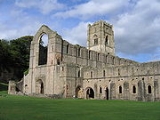
Fountains Abbey in North Yorkshire
North Yorkshire

North Yorkshire is a shire county or shire county, located in the Yorkshire and the Humber region of England, and a ceremonial counties of England in that region and also partly in North East England....
, England
England

native_name =|conventional_long_name = England|common_name = England|image_flag = Flag of England.svg|image_coat = England COA.svg|symbol_type = Royal Coat of Arms...
, is a ruined Cistercian
Cistercians

Image:Cistersian priests in Szczyrzyc monastery.JPGThe keynote of Cistercian life was a return to literal observance of the Rule of St Benedict. Rejecting the developments the Benedictines had undergone, the monks tried to reproduce life exactly as it had been in Benedict of Nursia time; indeed in various points they went beyond it in austerity....
 monastery
Monastery

Monastery , a term derived from the Greek language word ???ast?????, neut. of ???ast????? - monasterios denotes the building, or complex of buildings, that houses a room reserved for prayer as well as the domestic quarters and workplace of Monk, whether monks or nuns, and whether living in Cenobium or alone ....
, founded in 1132. Fountains Abbey is one of the largest and best preserved Cistercian houses in England
England

native_name =|conventional_long_name = England|common_name = England|image_flag = Flag of England.svg|image_coat = England COA.svg|symbol_type = Royal Coat of Arms...
. It is a Grade I listed building
Listed building

A listed building in the United Kingdom is a building or other structure officially designated as being of special architectural, historical or cultural significance....
 and owned by the National Trust
National Trust for Places of Historic Interest or Natural Beauty

The National Trust for Places of Historic Interest or Natural Beauty, usually known as the National Trust, is a conservation organization in England, Wales and Northern Ireland....
. Along with the adjacent Studley Royal Water Garden
Studley Royal Park

Studley Royal Park is a park containing, and developed around, the ruins of the Cistercian Fountains Abbey in North Yorkshire, England. It is a World Heritage Site....
, it is a UNESCO
UNESCO

United Nations Educational, Scientific and Cultural Organization is a specialized agency of the United Nations established on 16 November 1945....
 World Heritage Site
World Heritage Site

A UNESCO World Heritage Site is a site that is on the list maintained by the international World Heritage Programme administered by the UNESCO World Heritage Committee, composed of 21 Sovereign state which are elected by their General Assembly for a four-year term....
.

tains Abbey was founded in 1132 following a dispute and riot at St Mary's Abbey
St Mary's Abbey, York

The Abbey of St Mary in York, England, is a ruined Benedictine abbey that lies in what are now the Museum Gardens, to the west of York Minster. The original abbey on the site was founded in 1055 and dedicated to Saint Olaf II of Norway....
 in York
York

York is a walled city, sited at the confluence of the rivers River Ouse, Yorkshire and River Foss in North Yorkshire, England. The city status in the United Kingdom is noted for its rich heritage and it has played an important role throughout much of its almost 2,000 year existence....
. Following the riot, thirteen monks were exiled and after unsuccessfully attempting to return to the early 6th century Rule of St Benedict
Rule of St Benedict

The Rule of Saint Benedict is a book of precepts written by Benedict of Nursia for monks living communally under the authority of an abbot. Since about the 7th century it has also been adopted by communities of women....
, were taken into the protection of Thurstan
Thurstan

Thurstan, or Turstin was a medieval Archbishop of York. The son of a priest, he served King William II of England and King Henry I of England before his election to the see of York in 1114....
, Archbishop of York
Archbishop of York

File:Williamtemple1.jpgArchbishop of York is a high-ranking cleric in the Church of England, second only to the Archbishop of Canterbury. He is the diocesan bishop of the Diocese of York and metropolitan bishop of the Province of York, which covers the northern portion of England as well as the Isle of Man....
.


Discussion
Ask a question about 'Fountains Abbey'
Start a new discussion about 'Fountains Abbey'
Answer questions from other users
Full Discussion Forum


Encyclopedia


Fountains Abbey in North Yorkshire
North Yorkshire

North Yorkshire is a shire county or shire county, located in the Yorkshire and the Humber region of England, and a ceremonial counties of England in that region and also partly in North East England....
, England
England

native_name =|conventional_long_name = England|common_name = England|image_flag = Flag of England.svg|image_coat = England COA.svg|symbol_type = Royal Coat of Arms...
, is a ruined Cistercian
Cistercians

Image:Cistersian priests in Szczyrzyc monastery.JPGThe keynote of Cistercian life was a return to literal observance of the Rule of St Benedict. Rejecting the developments the Benedictines had undergone, the monks tried to reproduce life exactly as it had been in Benedict of Nursia time; indeed in various points they went beyond it in austerity....
 monastery
Monastery

Monastery , a term derived from the Greek language word ???ast?????, neut. of ???ast????? - monasterios denotes the building, or complex of buildings, that houses a room reserved for prayer as well as the domestic quarters and workplace of Monk, whether monks or nuns, and whether living in Cenobium or alone ....
, founded in 1132. Fountains Abbey is one of the largest and best preserved Cistercian houses in England
England

native_name =|conventional_long_name = England|common_name = England|image_flag = Flag of England.svg|image_coat = England COA.svg|symbol_type = Royal Coat of Arms...
. It is a Grade I listed building
Listed building

A listed building in the United Kingdom is a building or other structure officially designated as being of special architectural, historical or cultural significance....
 and owned by the National Trust
National Trust for Places of Historic Interest or Natural Beauty

The National Trust for Places of Historic Interest or Natural Beauty, usually known as the National Trust, is a conservation organization in England, Wales and Northern Ireland....
. Along with the adjacent Studley Royal Water Garden
Studley Royal Park

Studley Royal Park is a park containing, and developed around, the ruins of the Cistercian Fountains Abbey in North Yorkshire, England. It is a World Heritage Site....
, it is a UNESCO
UNESCO

United Nations Educational, Scientific and Cultural Organization is a specialized agency of the United Nations established on 16 November 1945....
 World Heritage Site
World Heritage Site

A UNESCO World Heritage Site is a site that is on the list maintained by the international World Heritage Programme administered by the UNESCO World Heritage Committee, composed of 21 Sovereign state which are elected by their General Assembly for a four-year term....
.

History

Fountains Abbey was founded in 1132 following a dispute and riot at St Mary's Abbey
St Mary's Abbey, York

The Abbey of St Mary in York, England, is a ruined Benedictine abbey that lies in what are now the Museum Gardens, to the west of York Minster. The original abbey on the site was founded in 1055 and dedicated to Saint Olaf II of Norway....
 in York
York

York is a walled city, sited at the confluence of the rivers River Ouse, Yorkshire and River Foss in North Yorkshire, England. The city status in the United Kingdom is noted for its rich heritage and it has played an important role throughout much of its almost 2,000 year existence....
. Following the riot, thirteen monks were exiled and after unsuccessfully attempting to return to the early 6th century Rule of St Benedict
Rule of St Benedict

The Rule of Saint Benedict is a book of precepts written by Benedict of Nursia for monks living communally under the authority of an abbot. Since about the 7th century it has also been adopted by communities of women....
, were taken into the protection of Thurstan
Thurstan

Thurstan, or Turstin was a medieval Archbishop of York. The son of a priest, he served King William II of England and King Henry I of England before his election to the see of York in 1114....
, Archbishop of York
Archbishop of York

File:Williamtemple1.jpgArchbishop of York is a high-ranking cleric in the Church of England, second only to the Archbishop of Canterbury. He is the diocesan bishop of the Diocese of York and metropolitan bishop of the Province of York, which covers the northern portion of England as well as the Isle of Man....
. He provided them with a site in the valley of the River Skell. The enclosed valley had all the required materials for the creation of a monastery, providing shelter from the weather, stone and timber for building, and a running supply of water. The monks applied to join the Cistercian order in 1132.

The abbey operated for over 400 years, until 1539, when Henry VIII
Henry VIII of England

Henry VIII was King of England from 21 April 1509 until his death. He was also Lordship of Ireland and claimant to the Early Modern France. Henry was the second monarch of the House of Tudor, succeeding his father, Henry VII of England....
 ordered the Dissolution of the Monasteries
Dissolution of the Monasteries

The Dissolution of the Monasteries, sometimes referred to as the Suppression of the Monasteries, denotes the administrative and legal processes between 1536 and 1541 by which Henry VIII of England disbanded all monastery, nunnery and friary in England, Wales and Ireland; appropriated their income, disposed of their assets and provided f...
. The Abbey buildings and over 500 acres (2 km˛) of land were then sold by the Crown, on October 1 1540 , to Sir Richard Gresham
Richard Gresham

Sir Richard Gresham was an England merchant, Lord Mayor of City of London, and member of parliament. He was the father of Thomas Gresham....
, the London merchant, father of the founder of the Royal Exchange
Royal Exchange

Royal Exchange may refer to:* Royal Exchange a major mixed use regeneration scheme in the North East Quarter of Belfast City Centre* Royal Exchange, Manchester, a 19th century classical building...
, Sir Thomas Gresham
Thomas Gresham

File:Thomas Gresham, 1544.jpgSir Thomas Gresham was an English merchant and financier who worked for King Edward VI of England and for Edward's half-sister Queen Elizabeth I of England....
.

Architecture

Studleyabbey1
Construction of the Abbey began in 1132, with rock quarried locally, although the original monastery buildings received considerable additions and alterations in the later period of the order, causing deviations from the strict Cistercian type. The church stands a short distance to the north of the River Skell, the buildings of the abbey
Abbey

An abbey , is a Christianity monastery or convent, under the government of an Abbot or an Abbess, who serves as the spiritual father or mother of the community....
 stretching down to and across the stream. The cloister
Cloister

A cloister is a covered walk with an open colonnade on one side, running along the walls of buildings that face a quadrangle or garth. The attachment of a cloister to a cathedral or church usually indicates that it is part of a monastic foundation....
 is to the south, with the three-aisled chapter-house and calefactory opening from its eastern walk, and the refectory, with the kitchen and buttery attached, at right angles to its southern walk.

Parallel with the western walk is an immense vaulted substructure, incorrectly styled the cloisters, serving as cellars and store-rooms, and supporting the dormitory of the conversi (lay brother
Lay brother

In the most common usage, lay brothers are those members of Catholic religious orders, particularly of monastic orders, occupied primarily with manual labor and with the secular affairs of a monastery or friary, in contrast to the choir monks of the same monastery who are devoted mainly to the Liturgy of the Hours, or Opus Dei as it is c...
s) above. This building extended across the river. At its southwest corner were the necessaries, also built, as usual, above the swiftly flowing stream. The monks' dormitory was in its usual position above the chapter-house, to the south of the transept.

Peculiarities of arrangement include the position of the kitchen, between the refectory and calefactory, and of the infirmary (unless there is some error in its designation) above the river to the west, adjoining the guest-houses. In addition, there is a greatly lengthened choir, commenced by Abbot John of York, 1203–11, and carried on by his successor, terminating, like Durham Cathedral
Durham Cathedral

The Cathedral Church of Christ, Blessed Mary the Virgin and St Cuthbert of Durham, commonly referred to as Durham Cathedral, in the city of Durham, England, is the seat of the Anglican Church Bishop of Durham....
, in an eastern transept, the work of Abbot John of Kent, 1220–47, and to the tower, added not long before the dissolution by Abbot Huby, 1494–1526, in a very unusual position at the northern end of the north transept.

Among other apartments, for the designation of which see the ground-plan, was a domestic oratory or chapel, 46˝ ft by 23 ft, and a kitchen, 50 ft by 38 ft.

St Mary's Church
Studley Royal Park

Studley Royal Park is a park containing, and developed around, the ruins of the Cistercian Fountains Abbey in North Yorkshire, England. It is a World Heritage Site....
 (built c. 1873), designed by William Burges
William Burges (architect)

William Burges was an England architect and designer. The greatest of the Victorian art-architects, Burges sought in his work an escape from 19th century industrial revolution and a return to the values, architectural and social, of an imagined mediaeval England....
 is nearby.

National Trust property

Fountains Abbey is maintained by English Heritage
English Heritage

English Heritage is a non-departmental public body of the United Kingdom government with a broad remit of managing the historic built environment of England....
, and owned by the National Trust. It is immediately adjacent to another National Trust property, Studley Royal Water Garden, with which it is jointly marketed. The Trust also owns Fountains Hall
Fountains Hall

Fountains Hall is a country house near Ripon in North Yorkshire, England, close to the World Heritage Site of Fountains Abbey. It belongs to the National Trust for Places of Historic Interest or Natural Beauty as part of its Studley Royal Park property, and is a Grade I listed building....
, to which there is partial public access.

Gallery


See also

  • Fountains Hall
    Fountains Hall

    Fountains Hall is a country house near Ripon in North Yorkshire, England, close to the World Heritage Site of Fountains Abbey. It belongs to the National Trust for Places of Historic Interest or Natural Beauty as part of its Studley Royal Park property, and is a Grade I listed building....
  • List of monasteries dissolved by Henry VIII of England
    List of monasteries dissolved by Henry VIII of England

    These monastery were dissolved by Henry VIII of England in the Dissolution of the Monasteries. The list is by no means exhaustive, since over 800 religious houses existed before the Reformation, and virtually every town of any size had at least one abbey, priory, convent or friary in it, and often many small houses of monks, nuns, canons or friars....
  • Studley Royal Water Garden
  • Stonemasonry
    Stonemasonry

    The craft of stonemasonry has existed since the dawn of civilization - creating buildings, structures, and sculpture using Rock from the earth....


External links

  • , at Internet Archive
    Internet Archive

    The Internet Archive is a nonprofit organization dedicated to building and maintaining a free and openly accessible online digital library, including an archive site of the World Wide Web....
     (scanned books original editions color illustrated)