


Real tennis

Encyclopedia
Real tennis – one of several games sometimes called "the sport of kings" – is the original indoor racquet sport from which the modern game of lawn tennis (usually simply called tennis
), is descended. It is also known as court tennis in the United States
, formerly royal tennis in Australia
, now real tennis, and courte-paume in France
(a reference to the older, racquetless game of jeu de paume
, the ancestor of modern handball and racquet games; many French real tennis courts are at jeu de paume clubs).
The term "real", was first used by journalists in the middle of the 20th century to distinguish the ancient game from modern "lawn" tennis (even though that sport is seldom contested on lawns these days outside the few social-club-managed estates
such as Wimbledon
). Real tennis players often call the game "tennis", while continuing to refer to its more widely played offshoot as "lawn tennis".
Real tennis is still played by enthusiasts or "realists" on 47 to 49 existing courts in the United Kingdom
, Australia
, the United States
, and France
. Despite a documented history of courts existing in the German states from the 17th century, the sport evidently died out there during or after the World War II
reconstruction. The sport is supported and governed by various organizations around the world.
, which derives from real tennis. Although in both sports game scoring is by fifteens (with the exception of 40, which was shortened from forty-five), in real tennis, six games wins a set, without the need for a 2 game buffer as in lawn tennis although some tournaments play to 9 games per set. A match is typically best of three sets, except for the major open tournaments, in which matches are best of five sets.
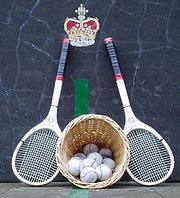
, which is unwoven and not strong enough to last as a ball covering). The balls are traditionally white, but around the end of the 20th century "optic yellow" was introduced for improved visibility, as was done years earlier in lawn tennis. The balls are much less bouncy than lawn tennis balls, and weigh about 2½ ounces (71 grams) (lawn tennis balls typically weigh 2 ounces).
The 27 inch (686 mm) long racquet
s are made of wood and use very tight strings to cope with the heavy balls. The racquet head is bent slightly to make it easier to strike balls close to the floor or in corners, and to facilitate a fast shot with a low trajectory that is difficult for an opponent to return. Currently there are only 2 companies in the world hand-crafting these racquets: Grays of Cambridge (UK) and Harrow Sports (US) based in Denver, Colorado.
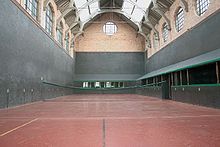
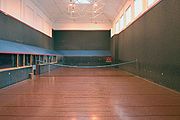
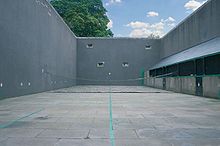 A real tennis court (jeu à dedans) is a very substantial building (encompassing an area wider and longer than a lawn tennis court, with high walls and a ceiling lofty enough to contain all but the highest lob shots). It is enclosed by walls on all four sides, three of which have sloping roofs, known as "penthouses", beneath which are various openings ("galleries", from which spectators may view the game), and a buttress that intrudes into the playing area (tambour
) off which shots may be played. Courts (except for the one at Falkland Palace
, a jeu quarré design) share the same basic layout but have slightly different dimensions. Most are about 110 by 39 ft (33.5 by 11.9 ) above the penthouses, and about 96 by 32 ft (29.3 by 9.8 ) on the playing floor, varying by a foot or two per court. They are doubly asymmetric
: each end of the court differs in shape from the other, and the left and right sides of the court are also different.
The game has many other complexities. For instance, when the ball bounces twice on the floor at the service end, the serving player does not generally lose the point. Instead a "chase" is called where the ball made its second bounce and the server gets the chance, later in the game, to "play off" the chase from the receiving end; but to win the point being played off, his shot's second bounce must be further from the net (closer to the back wall) than the shot he originally failed to reach. A chase can also be called at the receiving ("hazard") end, but only on the half of that end nearest the net; this is called a "hazard" chase. Those areas of the court in which chases can be called are marked with lines running across the floor, parallel to the net, generally about 1 yard (0.9144 m) apart – it is these lines by which the chases are measured. Additionally, a player can gain the advantage of serving only through skillful play (viz. "laying" a "chase", which ensures a change of end). This is in stark contrast to lawn tennis, where players alternately serve and receive entire games. In real tennis the service can only change during a game, and it is not uncommon to see a player serve for several consecutive games till a chase be made. Indeed, in theory, an entire match could be played with no change of service, the same player serving every point.
The heavy, solid balls take a great deal of spin, which often causes them to rebound from the walls at unexpected angles. For the sake of a good chase (close to the back wall), it is desirable to use a cutting stroke, which imparts backspin to the ball, causing it to come sharply down after hitting the back wall.
Another twist to the game comes from the various window-like openings below the penthouse roofs that, in some cases, offer the player a chance to win the point instantly by hitting the ball into the opening (in other cases, these windows create a "chase"). Effectively, these are "goals" to be aimed for. The largest such opening, located behind the server, is called the "dedans" and must often be defended on the volley from hard hit shots, called "forces", coming from the receiving ("hazard") side of the court. The resulting back-court volleys and the possibility of hitting shots off the side walls and the sloping penthouses give many interesting shot choices not available in lawn tennis. Moreover, because of the weight of the balls, the small racquets, and the need to defend the rear of the court, many lawn tennis strategies, such as playing with topspin, and serve and volley, are ineffective.
, fives
, pelota
, or handball
, in that it involved hitting a ball with a bare hand and later with a glove. One theory is that this game was played by monks in monastery
cloisters, based on the construction and appearance of early courts. By the 16th century, the glove had become a racquet, the game had moved to an enclosed playing area, and the rules had stabilized. Real tennis spread across Europe
, with the Papal Legate reporting in 1596 that there were 250 courts in Paris
alone, near the peak of its popularity in France.
Royal interest in England began with Henry V (reigned 1413–22) but it was Henry VIII
(reigned 1509–47) who made the biggest impact as a young monarch, playing the game with gusto at Hampton Court on a court he had built in 1530, when he was in his late thirties (Born 28 June 1491) and on several other courts in his palaces. It is believed that his second wife Anne Boleyn
was watching a game of real tennis when she was arrested and that Henry was playing tennis when news was brought to him of her execution. During the reign of James I (1603–25), there were 14 courts in London.
In France, François I (1515–47) was an enthusiastic player and promoter of real tennis, building courts and encouraging play among both courtiers and commoners. His successor, Henry II (1547–59), was also an excellent player and continued the royal French tradition. The first known book about tennis, Trattato del Giuoco della Palla was written during his reign, in 1555, by an Italian priest, Antonio Scaino da Salo. Two French kings died from tennis-related episodes – Louis X
of a severe chill after playing and Charles VIII
after striking his head on the lintel of a door leading to the court in Amboise. King Charles IX granted a constitution to the Corporation of Tennis Professionals in 1571, creating the first pro tennis 'tour', establishing three levels of professionals—apprentice, associate, and master. The first codification of the rules of real tennis was written by a professional named Forbet and published in 1599.
The game thrived among the 17th-century nobility in France, Spain, Italy, the Netherlands and in the Habsburg Empire, but suffered under English Puritanism. By the Age of Napoleon, the royal families of Europe were besieged and real tennis was largely abandoned. Real tennis played a role in the history of the French Revolution
, through the Tennis Court Oath
, a pledge signed by French deputies in a real tennis court, which formed a decisive early step in starting the revolution
. During the 18th century and early 19th century, as real tennis declined, new racquets sports emerged in England: racquets
and squash racquets.
In Victorian England real tennis had a revival, but broad public interest later shifted to the new, outdoor, game of lawn tennis
, which soon became the more popular sport, played by both sexes (real tennis players were almost exclusively male). Real tennis courts were built in Hobart, Australia (1875) and in the United States, starting in 1876 in Boston, and in New York in 1890, and later at athletic clubs in several other cities. Real tennis greatly influenced the game of stické
, which was invented in the 19th century and combined aspects of real tennis, lawn tennis and racquets
.
Real Tennis has the longest line of consecutive world champions of any sport in the world.
Some particularly noteworthy courts in the UK are:
Noteworthy courts in the United States include:
Other noteworthy courts elsewhere in the World:
from 1539. Erasmus lets two students practice Latin during a game of tennis with a racket in 1522, although the playing ground is not mentioned. A 1581 translation of Ovid's Metamorphoses by Giovanni Andrea dell'Anguillara, printed in Venice in quarto form transforms the fatal discus game between Apollo and Hyacinth into a fatal game of real tennis, or "racchetta."
William Shakespeare
mentions the game in Act I — Scene II of Henry V
; the Dauphin, a French Prince
, sends King Henry a gift of tennis-balls, out of jest, in response to Henry's claim to the French throne. King Henry replies to the French Ambassadors:
"His present and your pains we thank you for: When we have matched our rackets to these balls, we will, in France, by God's grace, play a set [that] shall strike his father's crown into the hazard ... And tell the pleasant Prince this mock of his hath turn'd his balls to gun stones". Michael Drayton
makes a similar reference to the event in his The battaile of Agincourt, published in 1627.
The Penguin book of Sick Verse includes a poem by William Lathum comparing life to a tennis-court:
If in my weak conceit, (for selfe disport),
The world I sample to a Tennis-court,
Where fate and fortune daily meet to play,
I doe conceive, I doe not much misse-say.
All manner chance are Rackets, wherewithall
They bandie men, from wall to wall;
Some over Lyne, to honour and great place,
Some under Lyne, to infame and disgrace;
Some with a cutting stroke they nimbly sent
Into the hazard placed at the end; ...
The Scottish gothic novel The Private Memoirs and Confessions of a Justified Sinner
by James Hogg
(1824) describes a tennis match that degenerates into violence.
The detective story Dead Nick takes place in a tennis milieu. The title alludes to a shot that hits "the nick" (where the wall meets the floor), called "dead" because it then bounces very little and is frequently unreturnable.
Hazard Chase (1964) by Jeremy Potter is a thriller-detective story featuring real tennis on the court at Hampton Court Palace. During the story the game is explained, and the book contains a diagram of a real tennis court. Jeremy Potter wrote historical works (including Tennis and Oxford (1994)), and was himself an accomplished player of the game, winning the World Amateur Over-60s Championship in 1986.
The First Beautiful Game: Stories of Obsession in Real Tennis (2006) by top amateur player Roman Krznaric contains a mixture of real tennis history, memoir and fiction, which focuses on what can be learned from real tennis about the art of living.
, a fictional meeting between Sherlock Holmes
and Sigmund Freud
. One of the film's plot points turns on Freud playing a grudge match with a Prussian nobleman (in lieu of a duel
). The film The French Lieutenant's Woman
includes a sequence featuring a few points being played. Also The Three Musketeers (1973)
and Ever After
briefly feature the game. Although presented with varying degrees of accuracy, these films provide a chance to see the game played, which otherwise may be difficult to observe personally. The Showtime series The Tudors
(2007) portrays Henry the VIII playing the game. In the film version of Tom Stoppard
's Rosencrantz & Guildenstern Are Dead
the two lead characters play the game Questions
in a Real Tennis court, scoring points as if playing the game.
, with Fahey taking the match in four sets, 2-6, 6-3, 6-0, 6-5.
Tennis
Tennis is a sport usually played between two players or between two teams of two players each . Each player uses a racket that is strung to strike a hollow rubber ball covered with felt over a net into the opponent's court. Tennis is an Olympic sport and is played at all levels of society at all...
), is descended. It is also known as court tennis in the United States
United States
The United States of America is a federal constitutional republic comprising fifty states and a federal district...
, formerly royal tennis in Australia
Australia
Australia , officially the Commonwealth of Australia, is a country in the Southern Hemisphere comprising the mainland of the Australian continent, the island of Tasmania, and numerous smaller islands in the Indian and Pacific Oceans. It is the world's sixth-largest country by total area...
, now real tennis, and courte-paume in France
France
The French Republic , The French Republic , The French Republic , (commonly known as France , is a unitary semi-presidential republic in Western Europe with several overseas territories and islands located on other continents and in the Indian, Pacific, and Atlantic oceans. Metropolitan France...
(a reference to the older, racquetless game of jeu de paume
Jeu de paume
Jeu de paume is a ball-and-court game that originated in France. It was an indoor precursor of tennis played without racquets, though these were eventually introduced. It is a former Olympic sport, and has the oldest ongoing annual world championship in sport, first established over 250 years ago...
, the ancestor of modern handball and racquet games; many French real tennis courts are at jeu de paume clubs).
The term "real", was first used by journalists in the middle of the 20th century to distinguish the ancient game from modern "lawn" tennis (even though that sport is seldom contested on lawns these days outside the few social-club-managed estates
All England Lawn Tennis and Croquet Club
The All England Lawn Tennis and Croquet Club , also known as the All-England Club, based at Aorangi Park, Wimbledon, London, England, is a private members club. It is best known as the venue for the Wimbledon Championships, the only Grand Slam tennis event still held on grass...
such as Wimbledon
The Championships, Wimbledon
The Championships, Wimbledon, or simply Wimbledon , is the oldest tennis tournament in the world, considered by many to be the most prestigious. It has been held at the All England Club in Wimbledon, London since 1877. It is one of the four Grand Slam tennis tournaments, the other three Majors...
). Real tennis players often call the game "tennis", while continuing to refer to its more widely played offshoot as "lawn tennis".
Real tennis is still played by enthusiasts or "realists" on 47 to 49 existing courts in the United Kingdom
United Kingdom
The United Kingdom of Great Britain and Northern IrelandIn the United Kingdom and Dependencies, other languages have been officially recognised as legitimate autochthonous languages under the European Charter for Regional or Minority Languages...
, Australia
Australia
Australia , officially the Commonwealth of Australia, is a country in the Southern Hemisphere comprising the mainland of the Australian continent, the island of Tasmania, and numerous smaller islands in the Indian and Pacific Oceans. It is the world's sixth-largest country by total area...
, the United States
United States
The United States of America is a federal constitutional republic comprising fifty states and a federal district...
, and France
France
The French Republic , The French Republic , The French Republic , (commonly known as France , is a unitary semi-presidential republic in Western Europe with several overseas territories and islands located on other continents and in the Indian, Pacific, and Atlantic oceans. Metropolitan France...
. Despite a documented history of courts existing in the German states from the 17th century, the sport evidently died out there during or after the World War II
World War II
World War II, or the Second World War , was a global conflict lasting from 1939 to 1945, involving most of the world's nations—including all of the great powers—eventually forming two opposing military alliances: the Allies and the Axis...
reconstruction. The sport is supported and governed by various organizations around the world.
Game description
The rules and scoring are similar to those of lawn tennisTennis
Tennis is a sport usually played between two players or between two teams of two players each . Each player uses a racket that is strung to strike a hollow rubber ball covered with felt over a net into the opponent's court. Tennis is an Olympic sport and is played at all levels of society at all...
, which derives from real tennis. Although in both sports game scoring is by fifteens (with the exception of 40, which was shortened from forty-five), in real tennis, six games wins a set, without the need for a 2 game buffer as in lawn tennis although some tournaments play to 9 games per set. A match is typically best of three sets, except for the major open tournaments, in which matches are best of five sets.
Equipment
Unlike the latex-based technology underlying the modern lawn-tennis ball, the game still utilizes a cork-based ball very close in design to the original balls used in the game. The 2½ inch (64 mm) diameter balls are hand-made and consist of a core made of cork with fabric tape tightly wound around it and covered with a hand-sewn layer of heavy, woven, woollen cloth, traditionally "Melton" cloth (not feltFelt
Felt is a non-woven cloth that is produced by matting, condensing and pressing woollen fibres. While some types of felt are very soft, some are tough enough to form construction materials. Felt can be of any colour, and made into any shape or size....
, which is unwoven and not strong enough to last as a ball covering). The balls are traditionally white, but around the end of the 20th century "optic yellow" was introduced for improved visibility, as was done years earlier in lawn tennis. The balls are much less bouncy than lawn tennis balls, and weigh about 2½ ounces (71 grams) (lawn tennis balls typically weigh 2 ounces).
The 27 inch (686 mm) long racquet
Racquet
A racquet or racket is a sports implement consisting of a handled frame with an open hoop across which a network of cord is stretched tightly. It is used for striking a ball in such games as squash, tennis, racquetball, and badminton...
s are made of wood and use very tight strings to cope with the heavy balls. The racquet head is bent slightly to make it easier to strike balls close to the floor or in corners, and to facilitate a fast shot with a low trajectory that is difficult for an opponent to return. Currently there are only 2 companies in the world hand-crafting these racquets: Grays of Cambridge (UK) and Harrow Sports (US) based in Denver, Colorado.
Courts
Tambour
In classical architecture, a tambour is the inverted bell of the Corinthian capital around which are carved acanthus leaves for decoration....
) off which shots may be played. Courts (except for the one at Falkland Palace
Falkland Palace Royal Tennis Club
The Falkland Palace Royal Tennis Club organizes play at the real tennis court in the gardens of Falkland Palace, Fife, Scotland....
, a jeu quarré design) share the same basic layout but have slightly different dimensions. Most are about 110 by 39 ft (33.5 by 11.9 ) above the penthouses, and about 96 by 32 ft (29.3 by 9.8 ) on the playing floor, varying by a foot or two per court. They are doubly asymmetric
Symmetry
Symmetry generally conveys two primary meanings. The first is an imprecise sense of harmonious or aesthetically pleasing proportionality and balance; such that it reflects beauty or perfection...
: each end of the court differs in shape from the other, and the left and right sides of the court are also different.
Manner of play
The service is always made from the same end of the court (the "service" end); a good service must touch the side penthouse (above and to the left of the server) on the receiver's ("hazard") side of the court before first touching the floor in a marked area on that side. There are numerous and widely varying styles of service. These are given descriptive names to distinguish them – examples are "railroad", "bobble", "poop", "piqué", "boomerang", and "giraffe".The game has many other complexities. For instance, when the ball bounces twice on the floor at the service end, the serving player does not generally lose the point. Instead a "chase" is called where the ball made its second bounce and the server gets the chance, later in the game, to "play off" the chase from the receiving end; but to win the point being played off, his shot's second bounce must be further from the net (closer to the back wall) than the shot he originally failed to reach. A chase can also be called at the receiving ("hazard") end, but only on the half of that end nearest the net; this is called a "hazard" chase. Those areas of the court in which chases can be called are marked with lines running across the floor, parallel to the net, generally about 1 yard (0.9144 m) apart – it is these lines by which the chases are measured. Additionally, a player can gain the advantage of serving only through skillful play (viz. "laying" a "chase", which ensures a change of end). This is in stark contrast to lawn tennis, where players alternately serve and receive entire games. In real tennis the service can only change during a game, and it is not uncommon to see a player serve for several consecutive games till a chase be made. Indeed, in theory, an entire match could be played with no change of service, the same player serving every point.
The heavy, solid balls take a great deal of spin, which often causes them to rebound from the walls at unexpected angles. For the sake of a good chase (close to the back wall), it is desirable to use a cutting stroke, which imparts backspin to the ball, causing it to come sharply down after hitting the back wall.
Another twist to the game comes from the various window-like openings below the penthouse roofs that, in some cases, offer the player a chance to win the point instantly by hitting the ball into the opening (in other cases, these windows create a "chase"). Effectively, these are "goals" to be aimed for. The largest such opening, located behind the server, is called the "dedans" and must often be defended on the volley from hard hit shots, called "forces", coming from the receiving ("hazard") side of the court. The resulting back-court volleys and the possibility of hitting shots off the side walls and the sloping penthouses give many interesting shot choices not available in lawn tennis. Moreover, because of the weight of the balls, the small racquets, and the need to defend the rear of the court, many lawn tennis strategies, such as playing with topspin, and serve and volley, are ineffective.
History
The term "tennis" is thought to derive from the French word tenez, which means "take heed" — a warning from the server to the receiver. Real tennis evolved, over three centuries, from an earlier ball game played around the 12th century in France. This had some similarities to pallaPalla
thumb|250px|"Palla eh!" game in [[Vetulonia]], 2001Palla is a traditional Tuscan ball game played in towns between Siena and Grosseto. It is also called palla EH! because players call out eh! before serving.Small hand-made balls contain a lead pellet wrapped in rubber and wool with a leather cover...
, fives
Fives
Fives is a British sport believed to derive from the same origins as many racquet sports. In fives, a ball is propelled against the walls of a special court using gloved or bare hands as though they were a racquet.-Background:...
, pelota
Pelota
Pelota can refer to the popular and shortened names for a number of ball games:* Baseball* Basque pelota* Bocce* Jai alai* Valencian pilota...
, or handball
American handball
American handball is a sport in which players hit a small rubber ball against a wall using their hands.- History :...
, in that it involved hitting a ball with a bare hand and later with a glove. One theory is that this game was played by monks in monastery
Monastery
Monastery denotes the building, or complex of buildings, that houses a room reserved for prayer as well as the domestic quarters and workplace of monastics, whether monks or nuns, and whether living in community or alone .Monasteries may vary greatly in size – a small dwelling accommodating only...
cloisters, based on the construction and appearance of early courts. By the 16th century, the glove had become a racquet, the game had moved to an enclosed playing area, and the rules had stabilized. Real tennis spread across Europe
Europe
Europe is, by convention, one of the world's seven continents. Comprising the westernmost peninsula of Eurasia, Europe is generally 'divided' from Asia to its east by the watershed divides of the Ural and Caucasus Mountains, the Ural River, the Caspian and Black Seas, and the waterways connecting...
, with the Papal Legate reporting in 1596 that there were 250 courts in Paris
Paris
Paris is the capital and largest city in France, situated on the river Seine, in northern France, at the heart of the Île-de-France region...
alone, near the peak of its popularity in France.
Royal interest in England began with Henry V (reigned 1413–22) but it was Henry VIII
Henry VIII of England
Henry VIII was King of England from 21 April 1509 until his death. He was Lord, and later King, of Ireland, as well as continuing the nominal claim by the English monarchs to the Kingdom of France...
(reigned 1509–47) who made the biggest impact as a young monarch, playing the game with gusto at Hampton Court on a court he had built in 1530, when he was in his late thirties (Born 28 June 1491) and on several other courts in his palaces. It is believed that his second wife Anne Boleyn
Anne Boleyn
Anne Boleyn ;c.1501/1507 – 19 May 1536) was Queen of England from 1533 to 1536 as the second wife of Henry VIII of England and Marquess of Pembroke in her own right. Henry's marriage to Anne, and her subsequent execution, made her a key figure in the political and religious upheaval that was the...
was watching a game of real tennis when she was arrested and that Henry was playing tennis when news was brought to him of her execution. During the reign of James I (1603–25), there were 14 courts in London.
In France, François I (1515–47) was an enthusiastic player and promoter of real tennis, building courts and encouraging play among both courtiers and commoners. His successor, Henry II (1547–59), was also an excellent player and continued the royal French tradition. The first known book about tennis, Trattato del Giuoco della Palla was written during his reign, in 1555, by an Italian priest, Antonio Scaino da Salo. Two French kings died from tennis-related episodes – Louis X
Louis X of France
Louis X of France, , called the Quarreler, the Headstrong, or the Stubborn was the King of Navarre from 1305 and King of France from 1314 until his death...
of a severe chill after playing and Charles VIII
Charles VIII of France
Charles VIII, called the Affable, , was King of France from 1483 to his death in 1498. Charles was a member of the House of Valois...
after striking his head on the lintel of a door leading to the court in Amboise. King Charles IX granted a constitution to the Corporation of Tennis Professionals in 1571, creating the first pro tennis 'tour', establishing three levels of professionals—apprentice, associate, and master. The first codification of the rules of real tennis was written by a professional named Forbet and published in 1599.
The game thrived among the 17th-century nobility in France, Spain, Italy, the Netherlands and in the Habsburg Empire, but suffered under English Puritanism. By the Age of Napoleon, the royal families of Europe were besieged and real tennis was largely abandoned. Real tennis played a role in the history of the French Revolution
French Revolution
The French Revolution , sometimes distinguished as the 'Great French Revolution' , was a period of radical social and political upheaval in France and Europe. The absolute monarchy that had ruled France for centuries collapsed in three years...
, through the Tennis Court Oath
Tennis Court Oath
The Tennis Court Oath was a pivotal event during the first days of the French Revolution. The Oath was a pledge signed by 576 of the 577 members from the Third Estate who were locked out of a meeting of the Estates-General on 20 June 1789...
, a pledge signed by French deputies in a real tennis court, which formed a decisive early step in starting the revolution
Revolution
A revolution is a fundamental change in power or organizational structures that takes place in a relatively short period of time.Aristotle described two types of political revolution:...
. During the 18th century and early 19th century, as real tennis declined, new racquets sports emerged in England: racquets
Racquets (sport)
Rackets or Racquets is an indoor racket sport played in the United Kingdom, United States, and Canada...
and squash racquets.
In Victorian England real tennis had a revival, but broad public interest later shifted to the new, outdoor, game of lawn tennis
Tennis
Tennis is a sport usually played between two players or between two teams of two players each . Each player uses a racket that is strung to strike a hollow rubber ball covered with felt over a net into the opponent's court. Tennis is an Olympic sport and is played at all levels of society at all...
, which soon became the more popular sport, played by both sexes (real tennis players were almost exclusively male). Real tennis courts were built in Hobart, Australia (1875) and in the United States, starting in 1876 in Boston, and in New York in 1890, and later at athletic clubs in several other cities. Real tennis greatly influenced the game of stické
Stické
Stické is a racquet sport invented in the late 19th century merging aspects of real tennis, racquets, and lawn tennis...
, which was invented in the 19th century and combined aspects of real tennis, lawn tennis and racquets
Racquets (sport)
Rackets or Racquets is an indoor racket sport played in the United Kingdom, United States, and Canada...
.
Real Tennis has the longest line of consecutive world champions of any sport in the world.
Locations
There are only a total of 47 real tennis courts remaining, and over half of those are in Britain. The newest real tennis court was opened in July 2008 at Radley College.Some particularly noteworthy courts in the UK are:
- The Queen's Club, London: Opened in 1886, is the National headquarters of real tennis and hosts the British Open every year.
- Falkland Palace, Fife, Scotland: The oldest court in the world for real tennis, opened in 1539.
- Royal Tennis Court, Hampton CourtRoyal Tennis Court, Hampton CourtThe Royal Tennis Court, Hampton Court Palace is a real tennis court which was built for Henry VIII of England, who played there from 1528, and is still home to an active real tennis club....
Palace: The oldest surviving real tennis court in England, built on the site of an even older (1528) court in the 1620s, where the game can be watched by the general public during British Summer TimeBritish Summer TimeWestern European Summer Time is a summer daylight saving time scheme, 1 hour ahead of Coordinated Universal Time. It is used in the following places:* the Canary Islands* Portugal * Ireland...
. - Jesmond, Newcastle: The court is situated on Matthew Bank near Jesmond DeneJesmond DeneJesmond Dene is a public park in the east end of Newcastle upon Tyne, England. It occupies the narrow steep-sided valley of a small stream known as the Ouseburn: in North-east England, such valleys are commonly known as denes....
park and was built in 1894 for Sir Andrew Noble the then owner of Jesmond Dene House as a private court and is now a listed building. - Canford, Dorset: Lord Wimborne, Sir Ivor Guest, opened the court at Canford in 1879 although there had been an earlier court built in the grounds of the manor house dating back to 1541. It is still in use in a building that belongs to Canford School and also now houses 4 squash courts.
Noteworthy courts in the United States include:
- The Racquet Club of Philadelphia: Founded in 1889, current location constructed in 1907 by noted architech Horace TrumbauerHorace TrumbauerHorace Trumbauer was a prominent American architect of the Gilded Age, known for designing residential manors for the wealthy. Later in his career he also designed hotels, office buildings, and much of the campus of Duke University...
. - The Tennis and Racquet ClubTennis and Racquet ClubThe Tennis and Racquet Club is a private social club and athletic club located at 939 Boylston Street, in the Back Bay neighborhood of Boston, Massachusetts. It is a contributing structure in the National Register Historic District....
, Boston, MA: One of the oldest courts in the USA, opened in 1902. - The Racquet and Tennis ClubRacquet and Tennis ClubThe Racquet and Tennis Club is a private social club and athletic club located at 370 Park Avenue, between East 52nd and 53rd Streets, New York, New York.-Building:...
, NY: New York City's famously exclusive tennis club contains two real tennis courts built in 1918. - Prince's CourtInternational Tennis Club of WashingtonThe International Tennis Club of Washington plays real tennis on Prince's Court at the Regency Sport and Health Club in McLean, Virginia, 6 miles from Washington, D.C. Dedicated on October 11, 1997, Prince's is the only new real tennis venue to be constructed in the United States since the...
, McLean, VA: The newest court in the United States, opened in 1997. - National Tennis ClubNational Tennis ClubThe National Tennis Club is a club for enthusiasts of a branch of tennis called court tennis in Newport, Rhode Island, United States. Its home is the reconstructed Court Tennis Building at the Newport Casino and is perhaps the busiest court in the United States that houses court tennis...
in Newport, RI: Home of Jen Winthrop. Contains one court exclusively referred to as Court Tennis. - The Tuxedo Club in Tuxedo Park, NY: Private member-owned country club. Its many sports facilities include court tennis. The court building was constructed between 1890 and 1900.
- The Aiken Tennis ClubAiken Tennis ClubThe Aiken Tennis Club is a private court tennis club located at 146 Newberry Street, SW in Aiken, South Carolina. It includes the Court Tennis Building. The club was incorporated in 1898 with the sponsorship of financier and founder of the prominent Whitney family, William C. Whitney...
: in Aiken, South CarolinaAiken, South CarolinaAiken is a city in and the county seat of Aiken County, South Carolina, United States. With Augusta, Georgia, it is one of the two largest cities of the Central Savannah River Area. It is part of the Augusta-Richmond County Metropolitan Statistical Area. Aiken is home to the University of South...
founded in 1898 by William C. WhitneyWilliam C. WhitneyWilliam Collins Whitney was an American political leader and financier and founder of the prominent Whitney family. He served as Secretary of the Navy in the first Cleveland administration from 1885 through 1889. A conservative reformer, he was considered a Bourbon Democrat.-Early life:William...
political leader and financier and founder of the prominent Whitney familyWhitney familyThe Whitney family is an American family notable for their social prominence, wealth, business enterprises and philanthropy, founded by John Whitney who came from London, England to Watertown, Massachusetts in 1635.-Rise to prominence:...
. The court building was constructed in 1902.
Other noteworthy courts elsewhere in the World:
- Lambay IslandLambay IslandLambay lies off the coast of Fingal / north County Dublin, Ireland in the Irish Sea. It is located north of Ireland's Eye at and is the easternmost point of the Republic of Ireland...
, Ireland: On the privately owned Lambay Island (approx 5km off the coast near Dublin, Ireland). See http://www.wikimapia.org/#lat=53.4925521&lon=-6.0303247&z=19&l=0&m=b
In literature
Tennis is mentioned in literature from the 16th century on. It is frequently shown in emblem books, such as those of Guillaume de La PerrièreGuillaume de La Perrière
Guillaume de La Perrière, was born in Toulouse in 1499 or 1503, and died in 1565, known for his writings and emblem books. His work is often associated with the French Renaissance. La Perrière chronicled events in his home city of Toulouse...
from 1539. Erasmus lets two students practice Latin during a game of tennis with a racket in 1522, although the playing ground is not mentioned. A 1581 translation of Ovid's Metamorphoses by Giovanni Andrea dell'Anguillara, printed in Venice in quarto form transforms the fatal discus game between Apollo and Hyacinth into a fatal game of real tennis, or "racchetta."
William Shakespeare
William Shakespeare
William Shakespeare was an English poet and playwright, widely regarded as the greatest writer in the English language and the world's pre-eminent dramatist. He is often called England's national poet and the "Bard of Avon"...
mentions the game in Act I — Scene II of Henry V
Henry V (play)
Henry V is a history play by William Shakespeare, believed to be written in approximately 1599. Its full titles are The Cronicle History of Henry the Fifth and The Life of Henry the Fifth...
; the Dauphin, a French Prince
Louis, Dauphin of France (1397-1415)
Louis, Dauphin of France and Duke of Guyenne was a younger son of Charles VI of France and Isabella of Bavaria-Ingolstadt...
, sends King Henry a gift of tennis-balls, out of jest, in response to Henry's claim to the French throne. King Henry replies to the French Ambassadors:
"His present and your pains we thank you for: When we have matched our rackets to these balls, we will, in France, by God's grace, play a set [that] shall strike his father's crown into the hazard ... And tell the pleasant Prince this mock of his hath turn'd his balls to gun stones". Michael Drayton
Michael Drayton
Michael Drayton was an English poet who came to prominence in the Elizabethan era.-Early life:He was born at Hartshill, near Nuneaton, Warwickshire, England. Almost nothing is known about his early life, beyond the fact that in 1580 he was in the service of Thomas Goodere of Collingham,...
makes a similar reference to the event in his The battaile of Agincourt, published in 1627.
The Penguin book of Sick Verse includes a poem by William Lathum comparing life to a tennis-court:
If in my weak conceit, (for selfe disport),
The world I sample to a Tennis-court,
Where fate and fortune daily meet to play,
I doe conceive, I doe not much misse-say.
All manner chance are Rackets, wherewithall
They bandie men, from wall to wall;
Some over Lyne, to honour and great place,
Some under Lyne, to infame and disgrace;
Some with a cutting stroke they nimbly sent
Into the hazard placed at the end; ...
The Scottish gothic novel The Private Memoirs and Confessions of a Justified Sinner
The Private Memoirs and Confessions of a Justified Sinner
The Private Memoirs and Confessions of a Justified Sinner, is a novel that was written by the Scottish author James Hogg and published anonymously in...
by James Hogg
James Hogg
James Hogg was a Scottish poet and novelist who wrote in both Scots and English.-Early life:James Hogg was born in a small farm near Ettrick, Scotland in 1770 and was baptized there on 9 December, his actual date of birth having never been recorded...
(1824) describes a tennis match that degenerates into violence.
The detective story Dead Nick takes place in a tennis milieu. The title alludes to a shot that hits "the nick" (where the wall meets the floor), called "dead" because it then bounces very little and is frequently unreturnable.
Hazard Chase (1964) by Jeremy Potter is a thriller-detective story featuring real tennis on the court at Hampton Court Palace. During the story the game is explained, and the book contains a diagram of a real tennis court. Jeremy Potter wrote historical works (including Tennis and Oxford (1994)), and was himself an accomplished player of the game, winning the World Amateur Over-60s Championship in 1986.
The First Beautiful Game: Stories of Obsession in Real Tennis (2006) by top amateur player Roman Krznaric contains a mixture of real tennis history, memoir and fiction, which focuses on what can be learned from real tennis about the art of living.
In film
Real tennis is featured in the film The Seven-Per-Cent SolutionThe Seven-Per-Cent Solution (film)
The Seven-Per-Cent Solution is a 1976 Universal Studios Sherlock Holmes film, directed by Herbert Ross and written by Nicholas Meyer. It is based on Meyer's 1974 novel of the same name. The film stars Nicol Williamson, Robert Duvall, Alan Arkin, and Laurence Olivier.-Plot synopsis:When Dr...
, a fictional meeting between Sherlock Holmes
Sherlock Holmes
Sherlock Holmes is a fictional detective created by Scottish author and physician Sir Arthur Conan Doyle. The fantastic London-based "consulting detective", Holmes is famous for his astute logical reasoning, his ability to take almost any disguise, and his use of forensic science skills to solve...
and Sigmund Freud
Sigmund Freud
Sigmund Freud , born Sigismund Schlomo Freud , was an Austrian neurologist who founded the discipline of psychoanalysis...
. One of the film's plot points turns on Freud playing a grudge match with a Prussian nobleman (in lieu of a duel
Duel
A duel is an arranged engagement in combat between two individuals, with matched weapons in accordance with agreed-upon rules.Duels in this form were chiefly practised in Early Modern Europe, with precedents in the medieval code of chivalry, and continued into the modern period especially among...
). The film The French Lieutenant's Woman
The French Lieutenant's Woman (film)
The French Lieutenant's Woman is a 1981 film directed by Karel Reisz and adapted by playwright Harold Pinter. It is based on the novel of the same title by John Fowles...
includes a sequence featuring a few points being played. Also The Three Musketeers (1973)
The Three Musketeers (1973 film)
The Three Musketeers is a 1973 film based on the novel by Alexandre Dumas, père. It was directed by Richard Lester and written by George MacDonald Fraser . It was originally proposed in the 1960s as a vehicle for The Beatles, whom Lester had directed in two other films...
and Ever After
Ever After
Ever After: A Cinderella Story is a 1998 film inspired by the fairy tale Cinderella, directed by Andy Tennant and starring Drew Barrymore, Anjelica Huston and Dougray Scott. The screenplay is written by Tennant, Susannah Grant, and Rick Parks. The original music score is composed by George Fenton...
briefly feature the game. Although presented with varying degrees of accuracy, these films provide a chance to see the game played, which otherwise may be difficult to observe personally. The Showtime series The Tudors
The Tudors
The Tudors is a Canadian produced historical fiction television series filmed in Ireland, created by Michael Hirst and produced for the American premium cable television channel Showtime...
(2007) portrays Henry the VIII playing the game. In the film version of Tom Stoppard
Tom Stoppard
Sir Tom Stoppard OM, CBE, FRSL is a British playwright, knighted in 1997. He has written prolifically for TV, radio, film and stage, finding prominence with plays such as Arcadia, The Coast of Utopia, Every Good Boy Deserves Favour, Professional Foul, The Real Thing, and Rosencrantz and...
's Rosencrantz & Guildenstern Are Dead
Rosencrantz & Guildenstern Are Dead (film)
Rosencrantz & Guildenstern Are Dead is a 1990 film written and directed by Tom Stoppard based on his play of the same name. Like the play, the film depicts two minor characters from William Shakespeare's play Hamlet, Rosencrantz and Guildenstern, who find themselves on the road to Elsinore Castle...
the two lead characters play the game Questions
Questions (game)
Questions is a game that is played by participants maintaining a dialogue of asking questions back and forth for as long as possible, without making any declarative statements. Play begins when the first player serves by asking a question . The second player must respond to the question with...
in a Real Tennis court, scoring points as if playing the game.
Televised matches
Real Tennis has struggled to be televised since the court does not lend itself well to the placement of television cameras and all previous attempts to televise have been unsuccessful owing to the speed at which the ball travels. Recently however realtennis.tv was started and broadcast its first tournament, the European Open, from 8th-9 March 2011. There were three 'main events' shown; the two men's semi finals and the men's final. The final was between Bryn Sayers and Robert FaheyRobert Fahey
Robert Fahey is an Australian real tennis player.On 27 April 2006, at the Oratory Tennis Club in Woodcote, South Oxfordshire, he matched the great Pierre Etchebaster's feat of seven consecutive defenses of the real tennis singles World Championship, which he has held since 1994...
, with Fahey taking the match in four sets, 2-6, 6-3, 6-0, 6-5.
Notable players
- Joshua Crane: Champion from 1901 to 1905, Crane's career coincided with that of Jay Gould.
- Tim Emrys-Roberts
- Pierre EtchebasterPierre EtchebasterPierre Etchebaster is widely considered history's greatest player of real tennis , the original racquet sport from which the modern game of lawn tennis , is descended.Born in Saint-Jean-de-Luz, France, a Basque fishing village, he served in the French Army during World War I before...
- Robert FaheyRobert FaheyRobert Fahey is an Australian real tennis player.On 27 April 2006, at the Oratory Tennis Club in Woodcote, South Oxfordshire, he matched the great Pierre Etchebaster's feat of seven consecutive defenses of the real tennis singles World Championship, which he has held since 1994...
: Current world champion (since 1994). Fahey has successfully defended his world championship title more times (9) than any previous champion. - Jay Gould II: Gould learned at the age of 12 at his father's court in Lakewood, NJ. Gould won the American championship from 1906 to 1926, one of the longest streaks in the history of sport. From 1907 to 1925, he lost only one singles match, to English champion E.M. Baerlein. During that period, he never lost even a set to an amateur.
- G.H. Hardy
- John Moyer HeathcoteJohn Moyer HeathcoteJohn Moyer Heathcote was an English barrister and real tennis player. He was one of the committee that devised the original rules of lawn tennis and is credited with devising the cloth covering for the tennis ball....
- King Henry VIIIHenry VIII of EnglandHenry VIII was King of England from 21 April 1509 until his death. He was Lord, and later King, of Ireland, as well as continuing the nominal claim by the English monarchs to the Kingdom of France...
of EnglandEnglandEngland is a country that is part of the United Kingdom. It shares land borders with Scotland to the north and Wales to the west; the Irish Sea is to the north west, the Celtic Sea to the south west, with the North Sea to the east and the English Channel to the south separating it from continental... - King John III of SwedenJohn III of Sweden-Family:John married his first wife, Catherine Jagellonica of Poland , house of Jagiello, in Vilnius on 4 October 1562. In Sweden, she is known as Katarina Jagellonica. She was the sister of king Sigismund II Augustus of Poland...
- George LambertGeorge Lambert (tennis)George Lambert was a British real tennis player.Lambert was the world champion of the sport , succeeded by Tom Pettitt.-See also:* Real tennis world champions...
- King Louis X of FranceLouis X of FranceLouis X of France, , called the Quarreler, the Headstrong, or the Stubborn was the King of Navarre from 1305 and King of France from 1314 until his death...
- Hon. Alfred LytteltonAlfred LytteltonAlfred Lyttelton QC was a British politician and sportsman who excelled at both football and cricket. During his time at university he participated in Varsity Matches in five sports: cricket , football , athletics , rackets and real tennis , displaying an ability that made him...
- Julian MarshallJulian MarshallJulian Marshall was an English amateur musician, music and print collector and tenns player and writer.-Life:Marshall was born in Headingley, Yorkshire to a flax-spinning family. His father, John Marshall had been Member of Parliament for Leeds. His grandfather was industrialist John Marshall,...
- Eustace MilesEustace MilesEustace Hamilton Miles was a British real tennis player who competed in the 1908 Summer Olympics. He was the grandson of Sir William Miles, 1st Baronet by his son Captain William Henry Miles, J.P. and Mary Frances Miles, née Charleton...
: The first foreign winner of the American championship in 1900. Unusually for the period, Miles was a vegetarian, and produced a book on dietetics entitled "Muscle, Brain and Diet." - Tom PettittTom PettittTom Pettitt was the real tennis world champion from 1885 to 1890.-Biography:Born in Beckenham, Kent, England, Pettitt emigrated to Boston, Massachusetts as a penniless teenager. He quickly rose from being the dressing-room boy at a private court on Buckingham Street, to being its head...
- Richard D. Sears: First American amateur champion of court tennis in 1892, and apparent inventor of the overhead "railroad service," currently the most popular serve in the game.
- P.S. Sears
- James Charles Taylor
- Fred Tompkins: Head professional of the Philadelphia court. When the New York Racquet and Tennis club opened, Fred Tompkins was invited to be head professional.However, when Fred went to his brother Alfred to borrow money for his passage, Alfred decided to go over in Fred's place. Fred Tompkins later took over the Philadelphia court instead.
- Prof. Nic James, Head of Performance Analysis at Middlesex University. Formerly of UWIC
See also
- World Champions
- Grand SlamGrand Slam (real tennis)A Grand Slam in the sport of real tennis is earned by a player who holds the following titles in the same calendar year:* Australian Open* U.S. Open* French Open* British Open...
- History of tennisHistory of tennisMost historians believe that tennis originated in France in the 12th century, but the ball was then struck with the palm of the hand. It was not until the 16th century that rackets came into use, and the game began to be called "tennis." It was popular in England and France, although the game was...
External links
- Real tennis in Jesmond, article at BBC Tyne
- Photos of real tennis court in Jesmond, from BBC Tyne
- A History of Tennis
- An interactive map of all 42 remaining courts worldwide
- "It Takes a $100,000 Court like This to Play Court Tennis," Life, March 31, 1937, pp. 28-31. (Text and pictures of the court at Manhattan's Racquet and Tennis Club)