
All Topics  
Edward VIII of the United Kingdom


   Email Print
   Bookmark   Link


Edward VIII of the United Kingdom


Edward VIII (Edward Albert Christian George Andrew Patrick David; later The Duke of Windsor; 23 June 1894 – 28 May 1972) was King of the United Kingdom and the British dominions
Dominion

A dominion, often Dominion, refers to one of a group of autonomy polity that were nominally under United Kingdom sovereignty, constituting the British Empire and Commonwealth of Nations, from the late 19th century....
, and Emperor of India
Emperor of India

Emperor/Empress of India was used as a title by the last Mughal Empire emperor Bahadur Shah II, and revived by the colonial Monarchy of the United Kingdom during the British Raj in India....
 from 20 January 1936, following the death of his father, George V
George V of the United Kingdom

George V was the first British monarch belonging to the House of Windsor, which he created from the British branch of the German House of Saxe-Coburg and Gotha....
, until his abdication
Abdication

Abdication is the act of renouncing and resigning from a formal office, especially from the supreme office of state. In Roman law the term was also applied to the disowning of a family member, as the disinheriting of a son....
 on 11 December 1936. He was the second monarch of the House of Windsor
House of Windsor

The House of Windsor is the current Royal House of the United Kingdom and each of the other Commonwealth realms. The royal house was created from the British branch of the German House of Saxe-Coburg and Gotha by George V by a royal proclamation in 1917....
, his father having changed the name of the royal house from Saxe-Coburg and Gotha
Saxe-Coburg and Gotha

Saxe-Coburg and Gotha or Saxe-Coburg-Gotha served as the name of the two German duchies of Saxe-Coburg and Saxe-Gotha in Germany, in the present-day states of Bavaria and Thuringia, which were in personal union between 1826 and 1918....
 in 1917.

Before his accession to the throne, Edward VIII held the titles of Prince Edward of York, Prince Edward of Cornwall and York, Duke of Cornwall
Duke of Cornwall

The Dukedom of Cornwall was the first dukedom created in the peerage of England.The present Duke of Cornwall is Charles, Prince of Wales, the eldest son of Elizabeth II of the United Kingdom, the reigning British monarch ....
, Duke of Rothesay
Duke of Rothesay

The title Duke of Rothesay was the official title possessed by the heir apparent to the throne of the Kingdom of Scotland. A separate Scottish throne has not existed since the Treaty of Union 1707 in 1707, which saw the joining of the Kingdom of Scotland with the Kingdom of England to form the Kingdom of Great Britain under Anne of Great Brit...
, and Prince of Wales
Prince of Wales

Prince of Wales is a title traditionally granted to the Heir Apparent to the reigning monarch of the United Kingdom . The current Prince of Wales is Charles, Prince of Wales, the eldest son of Elizabeth II of the United Kingdom....
.


Discussion
Ask a question about 'Edward VIII of the United Kingdom'
Start a new discussion about 'Edward VIII of the United Kingdom'
Answer questions from other users
Full Discussion Forum


Quotations


Italy: ...they are indeed a repulsive nation these dagoes, both the men and the women & I'm just longing to quit them for good & all !!! (18 September 1918)

Cologne, Germany: Claud & I had a stroll in the centre of town afterwards & had great fun making the Hun men civilians get off the pavement for us .... It does one worlds of good to know how humiliating it must be for the Huns (9 January 1919)

Quebec City, Canada: A rotten priest-ridden community who are the completest passengers & who won't do their bit in anything & of course not during the war !! (23 Aug 1919)

Qu'Appelle Valley, Saskatchewan, Canadian Indians: I've told you what a foul decadent lazy crowd they are & what I think of them !! But this camp is pitched right inside an Indian reserve ... & we have hundreds of the mouldy local tribe camped around us (6 October 1919)

Barbados: A proper bum island this Barbados....It's a unique sort of scenery, very ugly, & I didn't take much to the coloured population, who are revolting. (26-27 March 1920)

Honolulu, Hawaii: (At a luau) ...a unique native stunt though the Hawaiian food we were made to eat was too revolting for words....One got rather tired of the native songs & longed for some of our tunes (14 April 1920)


Encyclopedia


Edward VIII (Edward Albert Christian George Andrew Patrick David; later The Duke of Windsor; 23 June 1894 – 28 May 1972) was King of the United Kingdom and the British dominions
Dominion

A dominion, often Dominion, refers to one of a group of autonomy polity that were nominally under United Kingdom sovereignty, constituting the British Empire and Commonwealth of Nations, from the late 19th century....
, and Emperor of India
Emperor of India

Emperor/Empress of India was used as a title by the last Mughal Empire emperor Bahadur Shah II, and revived by the colonial Monarchy of the United Kingdom during the British Raj in India....
 from 20 January 1936, following the death of his father, George V
George V of the United Kingdom

George V was the first British monarch belonging to the House of Windsor, which he created from the British branch of the German House of Saxe-Coburg and Gotha....
, until his abdication
Abdication

Abdication is the act of renouncing and resigning from a formal office, especially from the supreme office of state. In Roman law the term was also applied to the disowning of a family member, as the disinheriting of a son....
 on 11 December 1936. He was the second monarch of the House of Windsor
House of Windsor

The House of Windsor is the current Royal House of the United Kingdom and each of the other Commonwealth realms. The royal house was created from the British branch of the German House of Saxe-Coburg and Gotha by George V by a royal proclamation in 1917....
, his father having changed the name of the royal house from Saxe-Coburg and Gotha
Saxe-Coburg and Gotha

Saxe-Coburg and Gotha or Saxe-Coburg-Gotha served as the name of the two German duchies of Saxe-Coburg and Saxe-Gotha in Germany, in the present-day states of Bavaria and Thuringia, which were in personal union between 1826 and 1918....
 in 1917.

Before his accession to the throne, Edward VIII held the titles of Prince Edward of York, Prince Edward of Cornwall and York, Duke of Cornwall
Duke of Cornwall

The Dukedom of Cornwall was the first dukedom created in the peerage of England.The present Duke of Cornwall is Charles, Prince of Wales, the eldest son of Elizabeth II of the United Kingdom, the reigning British monarch ....
, Duke of Rothesay
Duke of Rothesay

The title Duke of Rothesay was the official title possessed by the heir apparent to the throne of the Kingdom of Scotland. A separate Scottish throne has not existed since the Treaty of Union 1707 in 1707, which saw the joining of the Kingdom of Scotland with the Kingdom of England to form the Kingdom of Great Britain under Anne of Great Brit...
, and Prince of Wales
Prince of Wales

Prince of Wales is a title traditionally granted to the Heir Apparent to the reigning monarch of the United Kingdom . The current Prince of Wales is Charles, Prince of Wales, the eldest son of Elizabeth II of the United Kingdom....
. As a young man, he served in World War I
World War I

World War I, or the First World War , was a global military conflict which involved the Great powers, organized into two opposing military alliances: the Allies of World War I and the Central Powers....
, undertook several foreign tours on behalf of his father, and was associated with a succession of older, married women.

Only months into his reign, Edward caused a constitutional crisis by proposing marriage to the American divorcée Wallis Simpson. Although legally Edward could have married Mrs. Simpson and remained king, the prime ministers of his various realms opposed the marriage, arguing that the people would never accept her as queen. Edward knew that the ministry of British Prime Minister Stanley Baldwin
Stanley Baldwin

Stanley Baldwin, 1st Earl Baldwin of Bewdley, Order of the Garter, Privy Council of the United Kingdom was a British Conservative Party politician, statesman, and major figure on the political scene in the interwar years....
 would resign if the marriage went ahead; this could have dragged the King into a general election
General election

A general election is an election in which all or most members of a given political body are up for election. The term is usually used to refer to elections held for a nation's primary legislative body, as distinguished from by-elections and local elections....
, thus ruining irreparably his status as a politically neutral constitutional monarch
Constitutional monarchy

A constitutional monarchy is a form of constitutional government, where in either an elected or hereditary monarch is the head of state, unlike in an absolute monarchy, wherein the king or the queen is the sole source of political power, as he or she is not legally bound by the constitution....
. Rather than give up Mrs. Simpson, Edward chose to abdicate
Edward VIII abdication crisis

The Edward VIII abdication crisis occurred in the British Empire in 1936, when the desire of King-Emperor Edward VIII of the United Kingdom to marry Wallis, The Duchess of Windsor, a twice-divorced United States socialite, caused a constitutional crisis....
, making him the only monarch of Britain, and indeed any Commonwealth realm
Commonwealth Realm

A Commonwealth realm is any one of 16 Sovereignty states within the Commonwealth of Nations that each have Elizabeth II of the United Kingdom as their monarch....
, to have voluntarily relinquished the throne. With a reign of 325 days, he is one of the shortest-reigning monarchs in the history of any of his countries, and was never crowned
Coronation of the British monarch

The Coronation of the British Monarch is a ceremony in which the monarch of the United Kingdom and of the other Commonwealth realms is formally Crown and invested with regalia....
.

After his abdication, he reverted to the style
Style (manner of address)

A style of office, or honorific, is a legal, official, or recognized title, in other words a term which by tradition or law precedes a reference to a person who holds a post, or which is used to refer to the political office itself....
 of a son of the Sovereign, The Prince Edward, and was created Duke of Windsor
Duke of Windsor

The peerage title Duke of Windsor was created in the Peerage of the United Kingdom in 1937 for Edward VIII of the United Kingdom, formerly King of the United Kingdom as well as each of the other Commonwealth realms....
 on 8 March 1937. During World War II
World War II

World War II, or the Second World War , was a global military conflict which involved a Participants in World War II, including all of the great powers, organised into two opposing military alliances: the Allies of World War II and the Axis powers....
, he was at first stationed with the British Military Mission to France, but after private accusations that he held pro-Nazi
Nazism

Nazism, officially National Socialism , refers to the ideology and practices of the National Socialist German Workers? Party under Adolf Hitler, and the policies adopted by the dictatorial government of Nazi Germany from 1933 to 1945....
 sympathies, was moved to the Bahamas as Governor and Commander-in-Chief
Commander-in-Chief

A commander-in-chief is the commander of a nation's military forces or significant element of those forces. In the latter case, the force element may be defined as those forces within a particular region or those forces which are associated by function....
. After the war, he was never given another official appointment, and spent the remainder of his life in retirement.

Early life

Edward VIII was born on 23 June 1894, at White Lodge in Richmond, England. He was the eldest son of The Duke of York
George V of the United Kingdom

George V was the first British monarch belonging to the House of Windsor, which he created from the British branch of the German House of Saxe-Coburg and Gotha....
 (later King George V), and The Duchess of York
Mary of Teck

Mary of Teck was the queen consort of George V of the United Kingdom, Emperor of India. Before her husband's accession, she was successively Duchess of York, Duchess of Cornwall and Princess of Wales....
 (formerly Princess Victoria Mary of Teck). His father was the second son of The Prince of Wales
Edward VII of the United Kingdom

Edward VII was Monarch of the United Kingdom of Great Britain and Ireland and the British Dominions and Emperor of India from 22 January 1901 until his death on 6 May 1910....
 (later King Edward VII) and The Princess of Wales
Alexandra of Denmark

Alexandra of Denmark was queen consort to Edward VII of the United Kingdom and thus Empress of India during her husband's reign, 1901 to 1910....
 (formerly Princess Alexandra of Denmark). His mother was the eldest daughter of The Duke of Teck and The Duchess of Teck
Princess Mary Adelaide of Cambridge

Princess Mary Adelaide of Cambridge was a member of the British Royal Family, a granddaughter of George III of the United Kingdom. She later held the title of Duke of Teck by marriage....
 (formerly Princess Mary Adelaide of Cambridge). As a great-grandson of Queen Victoria
Victoria of the United Kingdom

Victoria was from 20 June 1837 the Queen regnant of the United Kingdom of Great Britain and Ireland and from 1 May 1876 the first Empress of India of the British Raj until her death....
 in the male line, Edward was styled His Highness Prince Edward of York at his birth.

Edward Viii Boy
He was baptised in the Green Drawing Room of White Lodge on 16 July 1894, by Edward White Benson
Edward White Benson

Edward White Benson was Archbishop of Canterbury from 1882 until his death....
, Archbishop of Canterbury
Archbishop of Canterbury

The Archbishop of Canterbury is the chief bishop and principal leader of the Church of England, the symbolic head of the worldwide Anglican Communion and the Diocesan Bishop of the Diocese of Canterbury, the Episcopal see that churches must be in communion with in order to be a part of the Anglican Communion....
. Edward VIII was named after his late uncle, who was known to his family as "Eddy" or Edward, and his great-grandfather King Christian IX of Denmark
Christian IX of Denmark

Christian IX was King of Denmark from November 16, 1863 to January 29, 1906....
. The name Albert was included at the behest of Queen Victoria. His last four names – George
Saint George

Saint George of Lydda was according to tradition, a Roman soldier in the Guard of Emperor Diocletian, venerated as a Christian martyr.In Hagiography Saint George is one of the most venerated saints in the Anglican Church, Eastern Orthodox Church, Oriental Orthodoxy, and the Eastern Catholic Churches....
, Andrew
Saint Andrew

Saint Andrew , called in the Eastern Orthodox Church tradition Protocletos, or the First-called, is a Christian Twelve Apostles and the younger brother of Saint Peter....
, Patrick
Saint Patrick

Saint Patrick , said to have been born Maewyn Succat , was a Roman Britain-born Christianity missionary and is the patron saint of Ireland along with Brigid of Kildare and Columba....
 and David
Saint David

Saint David was a church official; he was later regarded as a saint and as the patron saint of Wales. In contrast with the other national patron saints of the British Isles, Saints Saint George, Saint Andrew and Saint Patrick, David is a native of the country of which he is patron saint, and a relatively large amount of information is known...
 – came from the Patron Saints of England, Scotland, Ireland and Wales. The Prince was nevertheless, for the rest of his life, known to his family and close friends by his last given name, David.

Edward's parents, The Duke and Duchess of York, were often removed from their children's upbringing, like other upper-class English parents of the day. Edward and his younger brother Albert
George VI of the United Kingdom

George VI was British monarchy and the United Kingdom Dominions from 11 December 1936 until his death. He was the last Emperor of India and the last King of Ireland , and the first Head of the Commonwealth....
 were abused by one of the royal nannies. The nanny would pinch Edward before he was due to be presented to his parents. His subsequent crying and wailing would lead the Duke and Duchess to send Edward and the nanny away. His father, though a harsh disciplinarian, was demonstrably affectionate and his mother displayed a frolicksome side when dealing with her children that belies her austere public image. She was amused by the children making tadpoles on toast for their French master, and encouraged them to confide matters in her which it would have provoked their father to know.

Education

Edward was tutored at home from childhood by Helen Bricka. Following the death of Queen Victoria in 1901, his parents travelled the British Empire for almost nine months. Young Edward and his siblings stayed in Britain with their grandparents, Queen Alexandra and Edward VII, who showered their grandchildren with affection. On the return of his parents, Edward was placed under the care of two men, Frederick Finch and Henry Hansell, who virtually brought up Edward and his siblings for their remaining nursery years.

Edward was kept under the strict tutorship of Hansell until nearly the age of 13; Hansell had wanted Edward to enter school earlier, but his father disagreed. Edward took the examination to enter Osborne Naval College, and began there in 1907 but did not enjoy his time there. Following two years at Osborne College, Edward moved on to the Royal Naval College
Royal Naval College

There have been various Royal Naval Colleges throughout United Kingdom and Commonwealth of Nations naval history:* The Royal Naval Academy in Portsmouth - renamed the Royal Naval College in 1806...
 at Dartmouth
Dartmouth, Devon

Dartmouth is a town in Devon in the south-west of England. It is a tourist destination set on the banks of the estuary of the River Dart, which is a long narrow tidal ria that runs inland as far as Totnes....
. A course of two years followed by entry into the Royal Navy
Royal Navy

The Royal Navy of the United Kingdom is the oldest of the British Armed Forces . From the mid-18th century until well into the 20th century, it was the most powerful navy in the world, playing a key part in establishing the British Empire as the dominant world power from 1815 until the early 1940s....
 was planned. However, following the death of Edward VII in 1910, Edward became Prince of Wales, and the preparations began in earnest for his future duties as King. He was withdrawn from his naval course before his formal graduation. He served as midshipman
Midshipman

A midshipman is a subordinate officer, an officer cadet, or alternatively a commissioned officer of the lowest rank, in the navy of several English-speaking countries....
 for three months aboard the battleship Hindustan
HMS Hindustan

Five ships of the Royal Navy have been named HMS Hindustan or Hindostan, after the Hindustan for the Indian subcontinent:*HMS Hindostan was a former East Indiaman, previously named Born....
, then immediately entered Magdalen College, Oxford
Magdalen College, Oxford

Magdalen College redirects here, see also Magdalene College, CambridgeMagdalen College is one of the Colleges of the University of Oxford of the University of Oxford in England....
, for which in the opinion of John Parker
John Parker (author)

John Parker is a United Kingdom author and journalist....
, he was woefully underprepared. He left Oxford after eight terms without any academic credentials.

Prince of Wales


Edward automatically became Duke of Cornwall
Duke of Cornwall

The Dukedom of Cornwall was the first dukedom created in the peerage of England.The present Duke of Cornwall is Charles, Prince of Wales, the eldest son of Elizabeth II of the United Kingdom, the reigning British monarch ....
 and Duke of Rothesay
Duke of Rothesay

The title Duke of Rothesay was the official title possessed by the heir apparent to the throne of the Kingdom of Scotland. A separate Scottish throne has not existed since the Treaty of Union 1707 in 1707, which saw the joining of the Kingdom of Scotland with the Kingdom of England to form the Kingdom of Great Britain under Anne of Great Brit...
 when his father, George V, ascended the throne on 6 May 1910. The new King created him Prince of Wales
Prince of Wales

Prince of Wales is a title traditionally granted to the Heir Apparent to the reigning monarch of the United Kingdom . The current Prince of Wales is Charles, Prince of Wales, the eldest son of Elizabeth II of the United Kingdom....
 and Earl of Chester
Earl of Chester

The Earldom of Chester was one of the most powerful earldoms in medieval England. Since 1301 the title has generally been given to heirs-apparent to the English throne, and from the late 14th century it has been given only in conjunction with that of Prince of Wales....
 on 23 June 1910, and officially invested him as such in a special ceremony at Caernarfon Castle
Caernarfon Castle

Caernarfon Castle was constructed at Caernarfon in Gwynedd, north-west Wales, by King Edward I of England, following his conquest of Gwynedd in 1283....
 on 13 July 1911. For the first time since 1616, and the evidence for that ceremony is thin, the investiture took place in Wales at the instigation of the Welsh politician David Lloyd George
David Lloyd George

David Lloyd George, 1st Earl Lloyd-George of Dwyfor Order of Merit , Privy Council of the United Kingdom was a United Kingdom statesman and the only Wales Prime Minister of the United Kingdom - he is also the only one to have spoken English language as a second language, Welsh language having been his first....
, Constable of the Castle, who at that time held the position of Chancellor of the Exchequer
Chancellor of the Exchequer

The Chancellor of the Exchequer is the title held by the British Cabinet of the United Kingdom Minister who is responsible for all economic and financial matters....
 in the Liberal
Liberal Party (UK)

The Liberal Party was one of the two major British political parties from the early 19th century until the rise of the Labour Party in the 1920s, and a third party of varying strength and importance up to 1988, when it merged with the Social Democratic Party to form a new party which would become known as the Liberal Democrats....
 government. Lloyd George invented a rather fanciful ceremony which took the form of a Welsh pageant, and coached Edward to utter some sentences in Welsh.

Military career

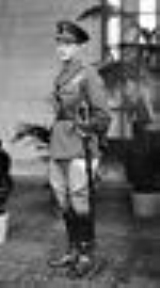
Edward V111 Circa1915
When the First World War
World War I

World War I, or the First World War , was a global military conflict which involved the Great powers, organized into two opposing military alliances: the Allies of World War I and the Central Powers....
 (1914–18) broke out, Edward had reached the minimum age for active service and was keen to participate. He had joined the army, serving with the Grenadier Guards
Grenadier Guards

The Grenadier Guards is the most senior regiment of the Guards Division of the British Army, and, as such, is the most senior regiment of infantry....
, in June 1914, and although Edward was willing to serve on the front lines, the Secretary of State for War
Secretary of State for War

The position of Secretary of State for War, commonly called War Secretary, was a United Kingdom Cabinet -level position, first applied to Henry Dundas ....
, Lord Kitchener
Herbert Kitchener, 1st Earl Kitchener

Field Marshal Horatio Herbert Kitchener, 1st Earl Kitchener, Order of the Garter, Order of St Patrick, Order of the Bath, Order of Merit, Order of the Star of India, Order of St Michael and St George, Order of the Indian Empire, Aid...
, refused to allow it, citing the immense harm that would occur if the heir to the throne were captured.

Despite this, Edward witnessed trench warfare firsthand and attempted to visit the front line as often as he could, for which he was awarded the Military Cross
Military Cross

The Military Cross is the third level military decoration awarded to officers and other ranks of the British Army and formerly also to officers of other Commonwealth of Nations countries....
 in 1916. His role in the war, although limited, led to his great popularity among veterans of the conflict. As of 1911 he was also a Midshipman in the Royal Navy
Royal Navy

The Royal Navy of the United Kingdom is the oldest of the British Armed Forces . From the mid-18th century until well into the 20th century, it was the most powerful navy in the world, playing a key part in establishing the British Empire as the dominant world power from 1815 until the early 1940s....
, making Lieutenant in 1913. Edward undertook his first military flight in 1918 and later gained his pilot's licence. On his succession he became Admiral of the Fleet
Admiral of the Fleet (Royal Navy)

Admiral of the Fleet is a rank of the British Royal Navy and other navies, equating to the NATO rank code OF-10.The rank evolved from the ancient sailing days of the Royal Navy....
 in the Navy, Field Marshal
Field Marshal (UK)

Field Marshal is the highest military rank of the United Kingdom, equivalent to a General of the Army in other countries such as the United States....
 in the Army, and Marshal of the Royal Air Force
Marshal of the Royal Air Force

Marshal of the Royal Air Force is the highest rank in the Royal Air Force. In peacetime it was granted to RAF officers in the appointment of Chief of the Defence Staff , and to retired Chief of the Air Staff , who were promoted to it on their last day of service....
.

Royal duties

Princeofwalescanoeing
Throughout the 1920s Edward, as Prince of Wales, represented his father, King George V, at home and abroad on many occasions. He took a particular interest in visiting the poverty stricken areas of the country, and undertook 16 tours to various parts of the Empire
British Empire

The British Empire comprised the dominions, Crown colony, protectorates, League of Nations mandate, and other Dependent territory ruled or administered by the United Kingdom , that had originated with the overseas colonies and trading posts established by England in the late 16th and early 17th centuries....
 between 1919 and 1935, in the process acquiring the Bedingfield ranch, near Pekisko
Pekisko, Alberta

Pekisko is a Hamlet in southern Alberta, Canada. It is located in the Foothills No. 31, Alberta, west of the junction of Alberta Highway 22 and Alberta Highway 540, south of High River, Alberta and south of Longview, Alberta....
, Canada. In 1924, he donated the Prince of Wales Trophy
Prince of Wales Trophy

The Prince of Wales Trophy, also known as the Wales Trophy, is an award presented by the National Hockey League to the Eastern Conference playoff champions, prior to the final series of games for the Stanley Cup....
 to the National Hockey League
National Hockey League

The National Hockey League is a professional ice hockey league composed of 30 teams in North America. It is considered to be the premier professional ice hockey league in the world, and one of the North American Major professional sports leagues of the United States and Canada....
. The trophy is currently presented to the Eastern Conference
Eastern Conference (NHL)

The Eastern Conference is one of two conferences in the National Hockey League used to divide teams. Its counterpart is the Western Conference ....
 playoff champion, and from 1974 to 1993 the conference was known as the "Prince of Wales Conference".

His attitudes towards many of the Empire's subjects and various foreign peoples, both during his time as Prince of Wales and later as Duke of Windsor, were little commented upon in their time but have soured his reputation subsequently. He said of Indigenous Australians
Indigenous Australians

Indigenous Australians are the first human inhabitants of the Australian continent and its nearby islands and their descendants. Indigenous Australians are distinguished as either Australian Aborigines or Torres Strait Islanders, who currently together make up about 2.6% of Australia's population....
: "they are the most revolting form of living creatures I've ever seen!! They are the lowest known form of human beings & are the nearest thing to monkeys."

His rank, travels, good looks, and unmarried status gained him much attention; he soon became the 1920s version of a latter-day movie star. At the height of his popularity, he became the most photographed celebrity of his time and he set men's fashion.

Romances


In 1930, King George V gave Edward a home, Fort Belvedere, near Sunningdale
Sunningdale

Sunningdale is a large village and civil parish in the Royal Borough of Windsor and Maidenhead in the England county of Berkshire.It is very close to the present border with Surrey, and is not far from Ascot, Berkshire, Sunninghill and Virginia Water....
, England. There, Edward had relationships with a series of married women including half-British, half-American textile heiress Freda Dudley Ward
Freda Dudley Ward

Winifred May, Marquesa de Casa Maury , universally known by her first married name as Freda Dudley Ward, was an England socialite best known for being a mistress of the Prince of Wales, who later became Edward VIII of the United Kingdom....
, American film actress Mildred Harris
Mildred Harris

Mildred Harris was an United States actress of the silent film era....
, and Lady Furness
Thelma Furness, Viscountess Furness

Thelma, Viscountess Furness , born Thelma Morgan, was the woman who preceded Wallis Simpson in the affections of Edward VIII of the United Kingdom....
 (born Thelma Morgan), an American woman of part-Chile
Chile

Chile, officially the Republic of Chile , is a country in South America occupying a long and narrow coastal strip wedged between the Andes mountains and the Pacific Ocean....
an ancestry, who introduced the Prince to fellow American Wallis Simpson (previously Wallis Spencer; born Bessie Wallis Warfield). Mrs. Simpson had divorced her first husband in 1927 and had subsequently married Ernest Simpson, a half-British, half-American businessman. Mrs. Simpson and the Prince of Wales, it is generally accepted, became lovers while Lady Furness travelled abroad, though Edward adamantly insisted to his father, the King, that he was not intimate with her and that it was not appropriate to describe her as his mistress.

King George V was disappointed in Edward's failure to settle down in life and disgusted by his many affairs with married women. The King was reluctant to see Edward inherit the Crown, and was quoted as saying of Edward: "After I am dead, the boy will ruin himself in 12 months". He later said of his second son, Albert
George VI of the United Kingdom

George VI was British monarchy and the United Kingdom Dominions from 11 December 1936 until his death. He was the last Emperor of India and the last King of Ireland , and the first Head of the Commonwealth....
 ("Bertie"), and granddaughter, Elizabeth
Elizabeth II of the United Kingdom

Elizabeth II is the queen regnant of sixteen independent states known as the Commonwealth realms: Monarchy of the United Kingdom, Monarchy of Canada, Monarchy of Australia, Monarchy of New Zealand, Monarchy of Jamaica, Monarchy of Barbados, the Bahamas, Grenada, Papua New Guinea, the Monarchy of the Solomon Islands, Tuvalu, Saint Lucia, Sain...
, ("Lilibet"): "I pray to God that my eldest son [Edward] will never marry and have children, and that nothing will come between Bertie and Lilibet and the throne." Edward's relationship with Mrs. Simpson further weakened his poor relationship with his father. Although the King and Queen met Mrs. Simpson at Buckingham Palace in 1935, they later refused to receive her. But Edward had now fallen in love with Wallis and the couple grew ever closer.

Edward's affair with the American divorcée led to such grave concern that the couple were followed by members of the Metropolitan Police Special Branch, to examine in secret the nature of their relationship. An undated report detailed a visit by the couple to an antique shop, where the proprietor later noted that: "the lady seemed to have POW [Prince of Wales] completely under her thumb." The prospect of having an American divorcée with a questionable past having such sway over the heir apparent
Heir apparent

An heir apparent is an heir who cannot be displaced from inheriting; the term is used in contrast to heir presumptive, the term for a conditional heir who is currently in line to inherit but could be displaced at any time in the future....
 caused some anxiety to government and establishment figures at the time.

Reign


King George V died on 20 January 1936, and Edward ascended the throne as King Edward VIII. The next day, he broke royal protocol by watching the proclamation of his own accession to the throne from a window of St. James's Palace
St. James's Palace

St. James's Palace is one of London's oldest palaces. It is situated on Pall Mall, London in London, just north of St. James's Park....
 in the company of the then still-married Mrs. Simpson. It was also at this time that Edward VIII became the first monarch of the Commonwealth Realms to fly in an aeroplane
Fixed-wing aircraft

A fixed-wing aircraft is an aircraft capable of heavier-than-air flight whose Lift is generated not by wing motion relative to the aircraft, but by forward motion through the air....
, when he flew from Sandringham
Sandringham, Norfolk

Sandringham is a village and civil parish in the north of the England county of Norfolk. The village is situated some 1 E3 m south of the village of Dersingham, 1 E3 m north of the town of King's Lynn and 1 E4 m north-west of the city of Norwich....
 to London for his Accession Council
Accession Council

In the United Kingdom, the Accession Council is a ceremonial body which assembles on the death of a monarch to proclaim his or her successor king or queen and to receive a religious oath from the new monarch....
.

Edward caused unease in government circles with actions that were interpreted as interference in political matters. On visiting the depressed coal mining villages in South Wales
South Wales

South Wales is an area of Wales bordered by England and the Bristol Channel to the east and south, and Mid Wales and West Wales to the north and west....
 the King's observation that "something must be done" for the unemployed coal miners was seen as directly critical of the Government, though it has never been clear whether Edward had anything in particular in mind. Government ministers were also reluctant to send confidential documents and state papers to Fort Belvedere because it was clear that Edward was paying little attention to them and because of the perceived danger that Mrs. Simpson and other house guests might see them.

Edwardviiicoin
Edward's unorthodox approach to his role also extended to the currency which bore his image. He broke with the tradition that on coinage each successive monarch faced in the opposite direction to his or her predecessor. Edward insisted his left side was superior to his right, and that he face left (as his father had done). Only a handful of coins were actually struck before the abdication, and when George VI succeeded he also faced left, to maintain the tradition by suggesting that had any coins been minted featuring Edward's portrait, they would have shown him facing right.

On 16 July 1936 an attempt was made on Edward's life. An Irish malcontent, Jerome Brannigan (otherwise known as George Andrew McMahon), produced a loaded revolver as the King rode on horseback at Constitution Hill
Constitution Hill, London

Constitution Hill is a road in the City of Westminster in London. It connects the western end of The Mall with Hyde Park Corner, and is bordered by Buckingham Palace Gardens and Green Park....
, near Buckingham Palace
Buckingham Palace

Buckingham Palace is the official London residence of the British monarch. Located in the City of Westminster, the palace is a setting for state occasions and royal entertaining, and a major tourist attraction....
. Police spotted the gun and pounced on him; he was quickly arrested. At Brannigan's trial, he alleged that "a foreign power" had approached him to kill Edward, that he had informed MI5
MI5

The Security Service, commonly known as MI5 , is the United Kingdom counter-intelligence and security agency and is part of the intelligence machinery alongside the Secret Intelligence Service , Government Communications Headquarters and the Defence Intelligence Staff ....
 of the plan, and that he was merely seeing the plan through to help MI5 catch the real culprits. The court rejected the claims and sent him to jail for a year. It is now thought that Brannigan had indeed been in contact with MI5 but the veracity of the remainder of his claims remains open.

By October it was becoming clear that the new King planned to marry Mrs. Simpson, especially when divorce proceedings between Mr. and Mrs. Simpson were brought at Ipswich
Ipswich

Ipswich is a non-metropolitan district and the county town of Suffolk, England on the estuary of the River Orwell. Nearby towns are Felixstowe in Suffolk, Harwich in Essex and Colchester also in Essex....
 Crown Court. Preparations for all contingencies were made, including the prospect of the coronation of King Edward and Queen Wallis. Because of the religious implications of any marriage, plans were made to hold a secular coronation ceremony not in the traditional religious location, Westminster Abbey
Westminster Abbey

The Collegiate Church of St Peter at Westminster, which is almost always referred to popularly and informally as Westminster Abbey, is a large, mainly Gothic architecture Church , in Westminster, London, just to the west of the Palace of Westminster....
, but in the Banqueting House
Banqueting House

In Tudor and Early Stuart English architecture a banqueting house is a separate building reached through pleasure gardens from the main residence, whose use is purely for entertaining....
 in Whitehall.

Abdication


On 16 November 1936, Edward invited Prime Minister
Prime Minister of the United Kingdom

The Prime Minister of the United Kingdom of Great Britain and Northern Ireland is the political leader of the United Kingdom and the head of government Her Majesty's Government....
 Stanley Baldwin
Stanley Baldwin

Stanley Baldwin, 1st Earl Baldwin of Bewdley, Order of the Garter, Privy Council of the United Kingdom was a British Conservative Party politician, statesman, and major figure on the political scene in the interwar years....
 to Buckingham Palace
Buckingham Palace

Buckingham Palace is the official London residence of the British monarch. Located in the City of Westminster, the palace is a setting for state occasions and royal entertaining, and a major tourist attraction....
 and expressed his desire to marry Wallis Simpson when she became free to re-marry. Baldwin informed the King that his subjects would deem the marriage morally unacceptable, largely because remarriage after divorce was opposed by the Church of England
Church of England

The Church of England is the State religion Christianity Ecclesia in England, the Mother Church of the worldwide Anglican Communion and the oldest among the communion's thirty-eight independent national and regional churches....
, and the people would not tolerate Wallis as Queen.

As King, Edward held the role of Supreme Governor of the Church of England
Supreme Governor of the Church of England

The Supreme Governor of the Church of England is a title held by the British Monarch which signifies their titular leadership over the Church of England....
, and the clergy expected him to support the Church's teachings.

Edward proposed an alternative solution of a morganatic marriage
Morganatic marriage

A morganatic marriage is a type of marriage which can be contracted in certain countries, usually between people of unequal social rank, which prevents the passage of the husband's titles and privileges to the wife and any children born of the marriage....
, in which Edward would remain King but Wallis would not become Queen. She would enjoy some lesser title instead, and any children they might have would not inherit the throne. This too was rejected by the British Cabinet
Cabinet of the United Kingdom

In the politics of the United Kingdom, the Cabinet is a formal body composed of the most senior Her Majesty's Governmentminister chosen by the Prime Minister of the United Kingdom....
 as well as other Dominion
Dominion

A dominion, often Dominion, refers to one of a group of autonomy polity that were nominally under United Kingdom sovereignty, constituting the British Empire and Commonwealth of Nations, from the late 19th century....
 governments, whose views were sought pursuant to the Statute of Westminster 1931
Statute of Westminster 1931

The Statute of Westminster 1931 is an Act of Parliament of the Parliament of the United Kingdom which established a status of legislative equality between the self-governing dominions of the British Empire and the United Kingdom, with a few residual exceptions....
, which provided in part that "any alteration in the law touching the Succession to the Throne or the Royal Style and Titles shall hereafter require the assent as well of the Parliaments of all the Dominions as of the Parliament of the United Kingdom
Parliament of the United Kingdom

The Parliament of the United Kingdom of Great Britain and Northern Ireland is the supreme legislature in the United Kingdom and British overseas territories....
." The Prime Ministers of Australia, Canada and South Africa
Union of South Africa

The Union of South Africa is the historic predecessor to the present-day state of the Republic of South Africa. It came into being on 31 May 1910, with the previously separate colonies of the Cape Colony, Colony of Natal, Transvaal and the Orange Free State, plus the German South-West Africa colony in 1915, becoming Provinces in the Union of...
 made clear their opposition to the King marrying a divorcée; the Irish
Irish Free State

The Irish Free State was the state established as a Dominion on 6 December 1922 under the Anglo-Irish Treaty, signed by the British government and Irish representatives exactly twelve months beforehand....
 premier expressed indifference and detachment, while the Prime Minister of New Zealand, having never even heard of Mrs. Simpson before, vacillated in disbelief. Faced with this opposition, Edward at first responded that there were "not many people in Australia" and their opinion didn't matter.

The King informed Baldwin that he would abdicate if he could not marry Mrs. Simpson. Baldwin then presented Edward with three choices: give up the idea of marriage; marry against his ministers' wishes; or abdicate. It was clear that Edward was not prepared to give up Mrs. Simpson. If he married against the advice of his ministers, he would cause the government to resign, prompting a constitutional crisis. Edward knew this. He chose to abdicate.

Edward duly signed the instruments of abdication at Fort Belvedere on 10 December 1936, in the presence of his three surviving brothers, The Duke of York
George VI of the United Kingdom

George VI was British monarchy and the United Kingdom Dominions from 11 December 1936 until his death. He was the last Emperor of India and the last King of Ireland , and the first Head of the Commonwealth....
, The Duke of Gloucester
Prince Henry, Duke of Gloucester

The Prince Henry, Duke of Gloucester Privy Council, Order of the Garter, Order of the Thistle, Order of St Patrick, Order of the Bath, Order of St Michael and St George, Royal Victorian Order, Venerable Order of St John was a member of the British Royal Family, the third son of George V of the United Kingdom of the United Kingdom and Mary of...
 and The Duke of Kent
Prince George, Duke of Kent

The Prince George, Duke of Kent was a member of the British Royal Family, the fourth son of George V of the United Kingdom and Mary of Teck. He held the title of Duke of Kent from 1934 until his death in 1942....
 (the youngest brother, Prince John, had died in 1919). The next day, he performed his last act as King when he gave royal assent
Royal Assent

The granting of Royal Assent is the formal method by which a constitutional monarchy completes the legislative process of lawmaking by formally assenting to an Act of Parliament....
 to His Majesty's Declaration of Abdication Act 1936
His Majesty's Declaration of Abdication Act 1936

His Majesty's Declaration of Abdication Act 1936 c. 3 was the Act of Parliament of the British Parliament that allowed Edward VIII of the United Kingdom to abdicate the throne, and passed succession to George VI of the United Kingdom....
. As required by the Statute of Westminster, all the Dominions consented to the King's abdication, though the Irish Free State did not pass the External Relations Act, which included the abdication in its schedule, until 12 December. As a curiosity, legally, for one day Edward was King of the Irish Free State but not the rest of the British Empire
British Empire

The British Empire comprised the dominions, Crown colony, protectorates, League of Nations mandate, and other Dependent territory ruled or administered by the United Kingdom , that had originated with the overseas colonies and trading posts established by England in the late 16th and early 17th centuries....
.

On the night of 11 December 1936, Edward, now reverted to the title of Prince Edward, made a broadcast to the nation and the Empire, explaining his decision to abdicate. He famously said, "I have found it impossible to carry the heavy burden of responsibility and to discharge my duties as king as I would wish to do without the help and support of the woman I love."

After the broadcast, Edward departed the United Kingdom for Austria, though he was unable to join Mrs. Simpson until her divorce became absolute, several months later. His brother, Prince Albert, Duke of York
George VI of the United Kingdom

George VI was British monarchy and the United Kingdom Dominions from 11 December 1936 until his death. He was the last Emperor of India and the last King of Ireland , and the first Head of the Commonwealth....
, succeeded to the throne as George VI, whose elder daughter, The Princess Elizabeth
Elizabeth II of the United Kingdom

Elizabeth II is the queen regnant of sixteen independent states known as the Commonwealth realms: Monarchy of the United Kingdom, Monarchy of Canada, Monarchy of Australia, Monarchy of New Zealand, Monarchy of Jamaica, Monarchy of Barbados, the Bahamas, Grenada, Papua New Guinea, the Monarchy of the Solomon Islands, Tuvalu, Saint Lucia, Sain...
, became first in the line of succession, as the heiress presumptive
Heir Presumptive

An heir presumptive is the person provisionally scheduled to inherit a throne, peerage, or other hereditary honor, but whose position can be displaced by the birth of an heir apparent or of a new heir presumptive with a better claim to the throne....
.

Duke of Windsor

Wallis and Edward
On 12 December 1936, at his Accession Privy Council
Privy Council of the United Kingdom

Her Majesty's Most Honourable Privy Council is a body of advisors to the British monarchy. Its members are largely senior politicians, who were or are members of either the House of Commons of the United Kingdom or House of Lords....
, George VI announced he was to make his brother Duke of Windsor, and also re-admit him to the highest degrees of the various British Orders of Knighthood. He wanted this to be the first act of his reign, although the formal documents were not signed until 8 March of the following year. But during the interim, Edward was universally known as the Duke of Windsor. The King's decision to create Edward a royal duke
Dukes in the United Kingdom

In the United Kingdom, duke is the highest-ranking hereditary title in the British peerage. As such, a duke therefore outranks all other titles in the peerage ....
 ensured that he could neither stand for election to the House of Commons
British House of Commons

The House of Commons is the lower house of the Parliament of the United Kingdom, which also comprises the British monarchy and the House of Lords ....
 nor speak on political subjects in the House of Lords
House of Lords

The House of Lords is the second house of the Parliament of the United Kingdom and is also commonly referred to as "the Lords". The Parliament comprises the British monarchy, the British House of Commons , and the Lords....
.

However, letters patent
Letters patent

Letters patent are a type of legal instrument in the form of an open letter issued by a monarch or government, granting an office, right, government-granted monopoly, title, or status to a person or to some entity such as a corporation....
 dated 27 May 1937, which re-conferred upon the Duke of Windsor the "title, style, or attribute of Royal Highness", specifically stated that "his wife and descendants, if any, shall not hold said title or attribute". Some British ministers advised that Edward had no need of it being conferred because he had not lost it, and further that Mrs. Simpson would automatically obtain the rank of wife of a prince with the style "Her Royal Highness"; others maintained that he had lost all royal rank and should no longer carry any royal title or style as an abdicated King. On 14 April 1937, Attorney General
Attorney General for England and Wales

Her Majesty's Attorney General for England and Wales, usually known simply as the Attorney General, is the chief legal adviser of the the Crown in England and Wales....
 Sir Donald Somervell submitted to Home Secretary
Home Secretary

The Secretary of State for the Home Department, commonly known as the Home Secretary, is the minister in charge of the United Kingdom Home Office and is one of the Great Offices of State....
 Sir John Simon
John Simon, 1st Viscount Simon

John Allsebrook Simon, 1st Viscount Simon Order of the Star of India Royal Victorian Order Order of the British Empire Privy Council of the United Kingdom was a British politician and statesman....
 a memorandum summarising the views of Lord Advocate
Lord Advocate

Her Majesty's Advocate , known as the Lord Advocate , is the chief legal officer of the Scottish Government and the Crown in Scotland for both civil and criminal matters that fall within the devolution powers of the Scottish Parliament....
 T. M. Cooper
Thomas Cooper, 1st Baron Cooper of Culross

Thomas Mackay Cooper, 1st Baron Cooper of Culross, KC was a Scotland politician, Judge and historian.Cooper was admitted a member of the Faculty of Advocates in 1915 and was created a Queen's Counsel in 1927....
, Parliamentary Counsel Sir Granville Ram and himself, to the effect that:
  1. We incline to the view that on his abdication the Duke of Windsor could not have claimed the right to be described as a Royal Highness. In other words, no reasonable objection could have been taken if the King had decided that his exclusion from the lineal succession excluded him from the right to this title as conferred by the existing Letters Patent.
  2. The question however has to be considered on the basis of the fact that, for reasons which are readily understandable, he with the express approval of His Majesty enjoys this title and has been referred to as a Royal Highness on a formal occasion and in formal documents. In the light of precedent it seems clear that the wife of a Royal Highness enjoys the same title unless some appropriate express step can be and is taken to deprive her of it.
  3. We came to the conclusion that the wife could not claim this right on any legal basis. The right to use this style or title, in our view, is within the prerogative of His Majesty and he has the power to regulate it by Letters Patent generally or in particular circumstances.


The Duke of Windsor married Mrs. Simpson, who had changed her name by deed poll
Deed poll

A deed poll is a Law document binding only to a single person or several persons acting jointly to express an active intention. It is, strictly speaking, not a contract because it binds only one party and expresses an intention instead of a promise....
 to Wallis Warfield, in a private ceremony on 3 June 1937, at Château de Candé
Château de Candé

The Ch?teau de Cand? is a castle located in the commune of Monts, Indre-et-Loire, 10 km to the south of Tours on the border of the Indre in France....
, near Tours
Tours

Tours is a city in central France, the capital of the Indre-et-Loire Departments of France.It is located on the lower reaches of the river River Loire, between Orl?ans and the Atlantic Ocean coast....
, France. When the Church of England
Church of England

The Church of England is the State religion Christianity Ecclesia in England, the Mother Church of the worldwide Anglican Communion and the oldest among the communion's thirty-eight independent national and regional churches....
 refused to sanction the union, a County Durham
County Durham

County Durham is a Metropolitan and non-metropolitan counties of England of Historic counties of England in North East England England. The county town is Durham.The largest settlement in the county is the town of Darlington....
 clergyman, the Reverend Robert Anderson Jardine (Vicar of St Paul's, Darlington
Darlington

Darlington is a town in the ceremonial county of County Durham, England, and the main population centre in the Darlington . Darlington has a resident population of 97,838....
), offered to perform the ceremony, and the Duke accepted. The new king, George VI, forbade members of the Royal Family to attend—Edward had particularly wanted Princes Henry and George (the Dukes of Gloucester and Kent) and his second cousin Lord Louis Mountbatten (Earl Mountbatten of Burma after 1947) to be there—and this continued for many years to rankle with the Duke and Duchess of Windsor.

The denial of the style "Her Royal Highness" to the Duchess of Windsor caused conflict, as did the financial settlement—the Government declined to include the Duke or the Duchess on the Civil List
Civil list

A civil list is a list of individuals to whom money is paid by the government....
, and the Duke's allowance was paid personally by the King. But the Duke had compromised his position with the King by concealing the extent of his financial worth when they informally agreed on the amount of the sinecure the King would pay. Edward's wealth had accumulated from the revenues of the Duchy of Cornwall
Duchy of Cornwall

The Duchy of Cornwall is, with the Duchy of Lancaster, one of the two Royal duchy in the United Kingdom. The eldest son of the reigning Monarchy of the United Kingdom inherits the duchy and title of Duke of Cornwall at the time of his birth ....
 paid to him as Prince of Wales
Prince of Wales

Prince of Wales is a title traditionally granted to the Heir Apparent to the reigning monarch of the United Kingdom . The current Prince of Wales is Charles, Prince of Wales, the eldest son of Elizabeth II of the United Kingdom....
 and ordinarily at the disposal of an incoming king. This led to strained relations between the Duke of Windsor and the rest of the Royal Family for decades. Edward became embittered against his mother, writing to her in 1939: "[your last letter] destroy[ed] the last vestige of feeling I had left for you ... [and has] made further normal correspondence between us impossible." In the early days of George VI's reign the Duke telephoned daily, importuning for money and urging that the Duchess be granted the style of HRH, until the harassed King ordered that the calls not be put through.

The Duke had assumed that he would settle in Britain after a year or two of exile in France. However, King George VI (with the support of their mother Queen Mary and his wife Queen Elizabeth
Elizabeth Bowes-Lyon

Elizabeth Bowes-Lyon was the Queen Consort of King George VI of the United Kingdom and the British Empire Dominions from 1936 until his death in 1952....
) threatened to cut off Edward's allowance if he returned to Britain without an invitation. The new King and Queen were also forced to pay Edward for Sandringham House
Sandringham House

Sandringham House is a country house on of land near the village of Sandringham, Norfolk in Norfolk, England. The house is privately owned by the British Royal Family and is located on the royal Sandringham Estate, which lies within the Norfolk Coast Area of Outstanding Natural Beauty....
 and Balmoral Castle
Balmoral Castle

Balmoral Castle is a large estate house situated in the area of Aberdeenshire, Scotland, known as Royal Deeside. The estate was purchased by Victoria of the United Kingdom Prince Consort Albert, Prince Consort, and remains a favourite summer palace....
. These properties were Edward's personal property, inherited from his father, King George V, on his death, and thus did not automatically pass to George VI on abdication.

World War II

Nazi Windsors
In 1937, the Duke and Duchess visited Nazi Germany
Nazi Germany

Nazi Germany and the Third Reich are the colloquial English names for Germany under the regime of Adolf Hitler and the Nazi Party , which established a Totalitarianism dictatorship that existed from 1933 to 1945....
, against the advice of the British government, and met Adolf Hitler
Adolf Hitler

Adolf Hitler was an Austrian-born Germany politician and the leader of the National Socialist German Workers Party , popularly known as the Nazi Party....
 at his Obersalzberg
Obersalzberg

Obersalzberg is a mountainside above the village of Berchtesgaden in Bavaria, Germany. The area is mostly known for being the location of Adolf Hitler's beloved mountain residence, the Berghof , and for housing the bus depot which transports tourists to the nearby Kehlsteinhaus, also known as the Eagle's Nest....
 retreat in Germany. The visit was much publicised by the German media. During the visit the Duke gave full Nazi salutes
Hitler salute

The Hitler salute , also known in Germany during World War II as the Deutscher Gru? , or in English as the Nazi salute, is a variant of the Roman salute, adopted by the Nazi Party as its leader Adolf Hitler....
 as a mark of respect to his hosts. The former Austrian ambassador, Count Albert von Mensdorff-Pouilly-Dietrichstein
Count Albert von Mensdorff-Pouilly-Dietrichstein

Count Albert von Mensdorff-Pouilly-Dietrichstein was an Austria-Hungary diplomat.Born at Lemberg, he was the second son of Alexander von Mensdorff-Pouilly, Prince Dietrichstein von Nicolsburg, and Alexandrine, born Countess Dietrichstein-Proskau and Leslie....
, who was also a second cousin once removed and friend of George V, believed that Edward favoured German fascism
Fascism

Fascism is a Political radicalism, Authoritarianism Nationalism ideology that aims to create a single-party state with a government led by a dictator who seeks national unity and development by requiring individuals to subordinate self-interest to the collective interest of the nation or Race ....
 as a bulwark against communism
Communism

Communism is a socioeconomic structure and political ideology that promotes the establishment of an egalitarianism, classlessness, stateless society based on common ownership and control of the means of production and property in general....
, and even that he initially favoured an alliance with Germany. Edward's experience of "the unending scenes of horror" during World War I
World War I

World War I, or the First World War , was a global military conflict which involved the Great powers, organized into two opposing military alliances: the Allies of World War I and the Central Powers....
 led him to support appeasement
Appeasement

Appeasement is "the policy of settling international quarrels by admitting and satisfying grievances through rational negotiation and compromise, thereby avoiding the resort to an armed conflict which would be expensive, bloody, and possibly dangerous." The term is most often applied to the foreign policy of United Kingdom Prime Minister of t...
. Hitler considered Edward to be friendly towards Nazi Germany and thought his relations with Britain could have been improved through Edward if it were not for the abdication. As Albert Speer
Albert Speer

Albert Speer was a Germany architect who was, for part of World War II, Minister of Armaments and War Production for the Nazi Germany. Speer was Adolf Hitler's chief architect before assuming ministerial office....
 quotes Hitler directly:

The couple settled in France. On the outbreak of World War II
World War II

World War II, or the Second World War , was a global military conflict which involved a Participants in World War II, including all of the great powers, organised into two opposing military alliances: the Allies of World War II and the Axis powers....
 in September 1939, they were brought back to Britain by Lord Mountbatten in HMS Kelly, and the Duke, already an honorary Field Marshal, was gazetted a Major-General attached to the British Military Mission in France. In February 1940, the German Minister in The Hague
The Hague

The Hague is the third largest city in the Netherlands after Amsterdam and Rotterdam, with a population of 475,904 and an area of approximately 100 km?....
, Count Julius von Zech-Burkersroda, claimed that the Duke had leaked the Allied war plans for the defence of Belgium. When Germany invaded
Battle of France

In World War II, the Battle of France, also known as the Fall of France, was the Germany invasion of France and the Low Countries, executed from 10 May 1940, which ended the Phoney War....
 the north of France in May 1940, the Windsors fled south, first to Biarritz
Biarritz

Biarritz is a town and commune in France which lies on the Bay of Biscay, on the Atlantic Ocean coast, in southwestern France. It is a luxurious seaside town and is popular with tourists and surfers....
, then in June to Spain. In July the pair moved to Lisbon
Lisbon

Lisbon is the Capital and largest city of Portugal. It is also the seat of the Lisbon and capital of the Lisbon region. Its municipalities of Portugal, which matches the city proper excluding the larger continuous conurbation, has a municipal population of 564,477 in , while the Lisbon Metropolitan Area in total has around 2.8 million inha...
, Portugal, where they lived at first in the home of Ricardo de Espírito Santo
Banco Espírito Santo

Banco Esp?rito Santo, whose official name is Banco Esp?rito Santo e Comercial de Lisboa, and which is known by the Acronym and initialism BES, is a bank based in Lisbon, Portugal, and was founded in 1920....
, a Portuguese banker with both British and German contacts. During the occupation of France, the Duke asked the German forces to place guards at his Paris and Riviera homes: they did so. A "defeatist" interview with the Duke that was widely distributed may have served as the last straw for the British government: Prime Minister Winston Churchill
Winston Churchill

Sir Winston Leonard Spencer-Churchill, Order of the Garter, Order of Merit, Order of the Companions of Honour, Territorial Decoration, Fellow of the Royal Society, Her Majesty's Most Honourable Privy Council, Queen's Privy Council for Canada was a Politics of the United Kingdom known chiefly for his leadership of the United King...
 threatened the Duke with a court-martial if he did not return to British soil. In August, a British warship dispatched the pair to the Bahamas, where in the view of Churchill the Duke could do the least damage to the British war effort.

The Duke of Windsor was installed as Governor. He did not enjoy the position, and referred to the islands as "a third-class British colony". The British Foreign Office strenuously objected when the pair planned to tour aboard a yacht belonging to a Swedish magnate, Axel Wenner-Gren
Axel Wenner-Gren

Axel Lennart Wenner-Gren was a Swedish people entrepreneur and one of the wealthiest men in the world during the 1930s.The basis of Wenner-Gren's fortune was his early appreciation that the industrial vacuum cleaner could be adapted for domestic use....
, whom American intelligence wrongly believed to be a close friend of Luftwaffe
Luftwaffe

is a generic German term for an air force. It is also the official name for two of the four historic German air forces, the Wehrmacht air arm founded in 1933 and disbanded in 1946; and the current Bundeswehr air arm founded in 1956....
 commander Hermann Göring
Hermann Göring

Hermann Wilhelm G?ring was a Germany politician, military leader and a leading member of the Nazi Party. Among many offices, he was Hitler's designated successor and commander of the Luftwaffe ....
. However, the Duke was praised for his efforts to combat poverty
Poverty

Poverty is the shortage of common things such as food, clothing, shelter and safe drinking water, all of which determine our quality of life. It may also include the lack of access to opportunities such as education and employment which aid the escape from poverty and/or allow one to enjoy the respect of fellow citizens....
 on the island nation, although he was as contemptuous of the Bahamians as he was of most non-white peoples of the Empire. He said of Étienne Dupuch
Étienne Dupuch

Sir ?tienne Dupuch was the editor of the Nassau Tribune from 1919 and served in The Bahamas House of Assembly for 24 years.He was named as "longest serving newspaper editor" by the Guinness Book of World Records....
, the editor of the Nassau Daily Tribune: "It must be remembered that Dupuch is more than half Negro, and due to the peculiar mentality of this Race, they seem unable to rise to prominence without losing their equilibrium." He was praised, even by Dupuch, for his resolution of civil unrest over low wages in Nassau
Nassau, Bahamas

Nassau is the Capital , largest city, and commercial centre of the Commonwealth of the Bahamas. The city has a population of 260,000 , nearly 80 percent of the entire population of The Bahamas ....
 in 1942, even though he blamed the trouble on communist agitators and draft-dodging Jews. He held the post until the end of World War II in 1945.

Many historians have suggested that Hitler was prepared to reinstate Edward as King in the hope of establishing a fascist Britain. It is widely believed that the Duke (and especially the Duchess) sympathised with fascism before and during World War II, and had to remain in the Bahamas to minimise their opportunities to act on those feelings. In 1940 he said: "In the past 10 years Germany has totally reorganized the order of its society ... Countries which were unwilling to accept such a reorganization of society and its concomitant sacrifices should direct their policies accordingly." Lord Caldecote
Thomas Inskip, 1st Viscount Caldecote

Thomas Walker Hobart Inskip, 1st Viscount Caldecote Order of the British Empire , Privy Council of the United Kingdom , King's Counsel was a United Kingdom politician who served in many legal posts, culminating in serving as Lord Chancellor from 1939 until 1940....
 wrote to Winston Churchill just before the couple were sent to the Bahamas, "[the Duke] is well-known to be pro-Nazi and he may become a centre of intrigue." The latter, but not the former, part of this assessment is corroborated by German operations designed to use the Duke
Operation Willi

Operation Willi was the Germany code name for the unsuccessful attempt by the Schutzstaffel to kidnapping Edward VIII of the United Kingdom in July 1940 and induce him to work with German dictator Adolf Hitler for either a peace settlement with United Kingdom, or a restoration to the throne after Operation Sealion....
. The Allies became sufficiently disturbed by the German plots that U.S. President Franklin D. Roosevelt
Franklin D. Roosevelt

Franklin Delano Roosevelt , often referred to by his initials FDR, was the List of Presidents of the United States President of the United States....
 ordered covert surveillance of the Duke and Duchess when they visited Palm Beach, Florida
Palm Beach, Florida

The Town of Palm Beach is an upscale incorporated town in Palm Beach County, Florida, Florida, United States. The Intracoastal Waterway separates it from the neighboring cities of West Palm Beach, Florida and Lake Worth, Florida....
 in April 1941. Duke Carl Alexander of Württemberg (then a monk in an American monastery) had convinced the Federal Bureau of Investigation
Federal Bureau of Investigation

The Federal Bureau of Investigation is the primary unit in the United States United States Department of Justice, serving as both a Law enforcement agency body and a domestic intelligence agency....
 that the Duchess had been sleeping with the German ambassador in London, Joachim von Ribbentrop
Joachim von Ribbentrop

Ulrich Friedrich Wilhelm Joachim von Ribbentrop was Foreign Minister of Germany from 1938 until 1945. He was later hanging for war crimes after the Nuremberg Trials....
, had remained in constant contact with him, and had continued to leak secrets.

Some authors have claimed that Anthony Blunt
Anthony Blunt

Anthony Frederick Blunt , known as Sir Anthony Blunt, Royal Victorian Order between 1956 and 1979, was a British spy, art history, formerly Professor of the History of Art, University of London and director of the Courtauld Institute of Art, London ....
, an MI5
MI5

The Security Service, commonly known as MI5 , is the United Kingdom counter-intelligence and security agency and is part of the intelligence machinery alongside the Secret Intelligence Service , Government Communications Headquarters and the Defence Intelligence Staff ....
 agent, acting on orders from the British Royal Family
British Royal Family

The British Royal Family is the group of close relatives of the Monarchy of the United Kingdom. The term is also commonly applied to the same group of people as the relations of the monarch in his or her Commonwealth realm#The Crown in the Commonwealth realmss, thus sometimes at variance with official national terms for the family....
, made a successful secret trip to defeated Germany as the war was ending in order to retrieve sensitive letters between the Duke of Windsor and Adolf Hitler and other leading Nazis from Schloss Friedrichshof
Schlosshotel Kronberg

Schlosshotel Kronberg in Kronberg im Taunus was built between 1889 and 1894 for the dowager German Empress Victoria, Princess Royal and named in honour of her husband, Frederick III, German Emperor....
, Kronberg im Taunus
Kronberg im Taunus

File:KronbergImTaunusBurg-SichtBuchholzKastanienhain.JPGKronberg im Taunus is a town in the Hochtaunuskreis district, Hesse, Germany. Before the 20th century, it was a Prussian city in the governmental district of Wiesbaden in the old district of Obertaunuskreis in the Taunus and the Kronberg-R?delheim railway....
. What is certain is that George VI sent the Royal Librarian
Royal Librarian

The office of Royal Librarian in the Royal Collection Department of the Royal Household of the Monarch of the United Kingdom is responsible for the care and maintenance of the royal collection of books and manuscripts owned by the Monarch in an official capacity — as distinct from those owned privately and displayed at Sandringham House...
, Owen Morshead, accompanied by Blunt, then working part-time in the Royal library as well as for British intelligence, to Kronberg in March 1945 to secure papers relating to the German Empress Victoria
Victoria, Princess Royal

The Princess Victoria, Princess Royal was the eldest child and daughter of Victoria of the United Kingdom and Albert, Prince Consort. She was created Princess Royal of the United Kingdom in 1841....
, a daughter of Queen Victoria. Part of the castle's archive, including surviving letters between daughter and mother as well as other valuables were stolen by looters, some of which were only later recovered in Chicago after the war. The papers rescued by Morshead and Blunt, and those returned by the American authorities from Chicago, were deposited in the Royal Archives
Royal Archives

The Royal Archives, also known as the Queen's Archives, are a division of the Royal Household of the Monarch of the United Kingdom. It is operationally under the control of the Keeper of the Royal Archives, who is customarily the Private Secretary to the Sovereign....
.

After the war, the Duke admitted in his memoirs that he admired the Germans, but he denied being pro-Nazi. Of Hitler he wrote: "[the] Führer struck me as a somewhat ridiculous figure, with his theatrical posturings and his bombastic pretensions."

Later life

The couple returned to France and spent the remainder of their lives essentially in retirement as the Duke never occupied another official role after his wartime governorship of the Bahamas. The Duke's allowance was supplemented by government favours and illegal currency trading. The City of Paris provided the Duke with a house at 4 rue du Champ d'Entraînement, on the Neuilly-sur-Seine
Neuilly-sur-Seine

Neuilly-sur-Seine is a commune in France bordering the western limit of the city of Paris, France. It is located from the Kilometre Zero. It is one of the most densely populated municipalities in Europe....
 side of the Bois de Boulogne
Bois de Boulogne

The Bois de Boulogne is a park located along the western edge of the 16th arrondissement of Paris of Paris, near the suburb of Boulogne-Billancourt....
, for a nominal rent. The French government exempted him from paying income tax, and the couple were able to buy goods duty-free through the British embassy and the military commissary. In 1951, the Duke produced a ghost-written memoir, A King's Story, in which he makes no secret of his disagreement with liberal politics. The royalties from the book added to their income. Nine years later, he penned a relatively unknown book, A Family Album, chiefly about the fashion and habits of the Royal Family throughout his life, from the time of Queen Victoria through his grandfather and father, and his own tastes.

The Duke and Duchess effectively took on the role of minor celebrities and were regarded as part of café society
Café Society

Caf? society was the collective description for the so-called "beautiful people" and "bright young things" who gathered in fashionable cafes and restaurants in Paris, London, Rome or New York City, beginning in the late 1800s....
 for a time in the 1950s and 1960s. They hosted parties and shuttled between Paris and New York; many of those who met the Windsors socially, including Gore Vidal
Gore Vidal

Gore Vidal is an United States novelist, screenwriter, playwright, essayist, short story writer and politician. Early in his career he wrote the ground-breaking The City and the Pillar , which outraged mainstream critics as one of the first major American novels to feature unambiguous homosexuality....
, reported on the vacuity of the Duke's conversation. The couple doted on the pug
Pug

The Pug is a small dog breed of dog with a wrinkly, short muzzled face . The word "pug" may have come from the Old English pugg or "puge", which were affectionate terms for a playful little devil or monkey....
 dogs they kept.

In June 1953, instead of attending the coronation
Coronation of the British monarch

The Coronation of the British Monarch is a ceremony in which the monarch of the United Kingdom and of the other Commonwealth realms is formally Crown and invested with regalia....
 of Queen Elizabeth II in London, the Duke and Duchess watched the ceremony on television in Paris. The Duke said that it was contrary to precedent for a Sovereign or former Sovereign to attend any coronation of another. The Duke was paid to write articles on the ceremony for the Sunday Express and Women's Home Companion, as well as a short book, The Crown and the People, 1902–1953.

In 1955, they visited President Dwight D. Eisenhower
Dwight D. Eisenhower

Dwight David ?Ike? Eisenhower was the List of Presidents of the United States President of the United States from 1953 until 1961 and a General of the Army in the United States Army....
 at the White House
White House

The White House is the official residence and principal workplace of the President of the United States. Located at 1600 Pennsylvania Avenue in Washington, D.C., it was built between 1792 and 1800 of white-painted Aquia sandstone in the late Georgian architecture and has been the executive residence of every U.S....
. The couple appeared on Edward R. Murrow's
Edward R. Murrow

Edward R. Murrow was an American broadcast journalist. He first came to prominence with a series of radio news broadcasts during World War II, which were followed by millions of listeners in the United States and Canada....
 television interview show Person to Person in 1956, and a 50-minute BBC television interview in 1970. That year, they were invited as guests of honour to a dinner at the White House
White House

The White House is the official residence and principal workplace of the President of the United States. Located at 1600 Pennsylvania Avenue in Washington, D.C., it was built between 1792 and 1800 of white-painted Aquia sandstone in the late Georgian architecture and has been the executive residence of every U.S....
 by President Richard Nixon
Richard Nixon

Richard Milhous Nixon was the List of Presidents of the United States President of the United States and the only president to resign the office....
 in repayment for their having entertained Nixon in Paris during the mid-1960s when his political fortunes were low.

The Royal Family never fully accepted the Duchess; Queen Mary refused to receive her formally. However, the Duke sometimes met with his mother and brother, King George, and attended George's funeral. Queen Mary maintained her anger with Edward and her indignation over his marriage to Wallis: "To give up all this for that," she said. In 1965, the Duke and Duchess returned to London, England. They were visited by the Queen, Princess Marina, Duchess of Kent
Princess Marina, Duchess of Kent

Princess Marina, Duchess of Kent was a member of the British Royal Family; the wife of Prince George, Duke of Kent, the fourth son of George V of the United Kingdom and Mary of Teck....
 and the Princess Royal
Mary, Princess Royal and Countess of Harewood

The Princess Mary, Princess Royal and Countess of Harewood was a member of the British Royal Family the third child and only daughter of George V of the United Kingdom and Mary of Teck....
. A week later, the Princess Royal died, and they attended her memorial service. In 1967, they joined the Royal Family for the centenary of Queen Mary's birth. The last royal ceremony the Duke attended was the funeral of Princess Marina in 1968.

In the late 1960s, the Duke's health deteriorated. Queen Elizabeth visited the Windsors in 1972 while on a state visit to France; however, only the Duchess appeared with the royal party for a photocall. On 28 May of that year the Duke, who was a smoker from an early age, died at his home in Paris from throat cancer
Throat cancer

Throat cancer may refer to:*Head and neck cancer, a group of biologically similar cancers originating from the upper aerodigestive tract, including the lip, oral cavity , nasal cavity, paranasal sinuses, pharynx, and larynx...
. His body was returned to Britain, lying in state at St George's Chapel at Windsor Castle
St George's Chapel at Windsor Castle

St George's Chapel is the place of worship at Windsor Castle in England. It is both a royal peculiar and the chapel of the Order of the Garter. The chapel is governed by the Dean and Canons of Windsor....
. The funeral service was held in the chapel on 5 June in the presence of the Queen, the Royal Family, and the Duchess of Windsor, and the coffin was buried in the Royal Burial Ground
Royal Burial Ground

The Royal Burial Ground is a cemetery used by the British Royal Family and the other Commonwealth Realms. It surrounds the Frogmore on the Frogmore in the Home Park, Windsor at Windsor, Berkshire in the England county of Berkshire....
 behind the Royal Mausoleum of Queen Victoria and Prince Albert at Frogmore
Frogmore

The Frogmore Estate or Gardens comprise of private gardens within the grounds of the Home Park, Windsor, adjoining Windsor Castle, in the England county of Berkshire....
. The Duchess stayed at Buckingham Palace during her visit. Increasingly senile and frail, the Duchess died 14 years later, and was buried alongside her husband simply as "Wallis, Duchess of Windsor".

Titles, styles, honours and arms


Titles and styles


  • 23 June 1894 – 28 May 1898: His Highness Prince Edward of York
  • 28 May 1898 – 22 January 1901: His Royal Highness Prince Edward of York
  • 22 January 1901 – 9 November 1901: His Royal Highness Prince Edward of Cornwall and York
  • 9 November 1901 – 6 May 1910: His Royal Highness Prince Edward of Wales
  • 6 May 1910 – 23 June 1910: His Royal Highness The Duke of Cornwall
  • 23 June 1910 – 20 January 1936: His Royal Highness The Prince of Wales
    • in Scotland: 1910–1936: His Royal Highness The Prince Edward, Duke of Rothesay
  • 20 January 1936 – 11 December 1936: His Majesty The King
    • and, occasionally, outside of the United Kingdom, and with regard to India: His Imperial Majesty The King-Emperor
  • 11 December 1936 – 8 March 1937: His Royal Highness The Prince Edward
  • 8 March 1937 – 28 May 1972: His Royal Highness The Duke of Windsor
    • Edward began use of the title immediately upon abdication, in accordance with George VI's declaration to his Accession Council that his first act as King would be to grant to his brother the said title. However, several months passed before the concession was formalised by Letters Patent.


His full style as king was
His Majesty, Edward the Eighth, by the Grace of God, of Great Britain, Ireland, and of the British Dominions beyond the Seas, King, Defender of the Faith, Emperor of India.

After his abdication, his full style was
His Royal Highness The Prince Edward Albert Christian George Andrew Patrick David, Duke of Windsor.

Honours

British Honours
  • KG: Knight of the Garter
    Order of the Garter

    The Most Noble Order of the Garter is an order of chivalry, or knighthood, originating in medieval England, and presently bestowed on recipients in the United Kingdom and other Commonwealth realms; it is the pinnacle of the Orders, decorations, and medals of the United Kingdom....
    ,
    1910
  • KT: Knight of the Thistle
    Order of the Thistle

    The Most Ancient and Most Noble Order of the Thistle is an order of chivalry associated with Scotland. The current version of the Order was founded in 1687 by King James VII of Scotland who asserted that he was reviving an earlier Order....
    ,
    1922
  • KP: Knight of St Patrick, 1927
  • GCB: Knight Grand Cross of the Bath
    Order of the Bath

    The Most Honourable Order of the Bath is a United Kingdom order of chivalry founded by George I of Great Britain on 18 May 1725. The name derives from the medieval ceremony for creating a knight, which involved bathing as one of its elements....
    ,
    1936
  • GCSI: Knight Grand Commander of the Star of India
    Order of the Star of India

    The Most Exalted Order of the Star of India is an order of chivalry founded by Victoria of the United Kingdom in 1861. The Order includes members of three classes:...
    ,
    1921
  • GCIE: Knight Grand Commander of the Indian Empire
    Order of the Indian Empire

    The Most Eminent Order of the Indian Empire is an order of chivalry founded by Victoria of the United Kingdom in 1878. The Order includes members of three classes:...
    ,
    1921
  • GCVO: Knight Grand Cross of the Royal Victorian Order
    Royal Victorian Order

    The Royal Victorian Order is a dynastic order of knighthood and a House Order of chivalry in the Commonwealth realms. Created by Queen Victoria of the United Kingdom on 21 April 1896, with the motto Victoria and 20 June as the official day, the order was established to recognise those who have served the monarch with distinction, each be...
    ,
    1920
  • KStJ: Knight of Justice of St John, 1917
  • RVC: Royal Victorian Chain
    Royal Victorian Chain

    The Royal Victorian Chain is an award, instituted in 1902 by King Edward VII of the United Kingdom as a personal award of the Monarch . Although it is similar in appearance to the Royal Victorian Order, the two awards are unrelated....
    ,
    1921
  • MC: Military Cross
    Military Cross

    The Military Cross is the third level military decoration awarded to officers and other ranks of the British Army and formerly also to officers of other Commonwealth of Nations countries....
    ,
    1916
  • FRS: Royal Fellow of the Royal Society
    Royal Fellow of the Royal Society

    A Royal Fellow of the Royal Society is elected to the Fellowship and Foreign Membership of the Royal Society. The council of the Royal Society recommends members of the British Royal Family to be elected and then the existing Fellow of the Royal Society vote by a secret ballot whether to accept them....
  • PC: Privy Counsellor, 1920
Edward lost almost all of his British honours upon accession, because he became sovereign of most of them. When he was no longer sovereign, his brother reinstated his pre-accession honours.

Foreign Honours
  • Knight of the Golden Fleece
    Order of the Golden Fleece

    The Order of the Golden Fleece is an order of chivalry founded in 1430 by Duke Philip III, Duke of Burgundy of Duchy of Burgundy to celebrate his marriage to the Portugal princess Isabel, Duchess of Burgundy....
  • Knight Grand Cross of the Royal Norwegian Order of St Olav
  • Order of the Most Holy Annunciation
    Order of the Most Holy Annunciation

    The Supreme Order of the Most Holy Annunciation was the primary dynastic order of the Kingdom of Italy, which ceased to be a national order when the kingdom became a republic in 1946....


Military
  • Mid, 22 June 1911: Midshipman, Royal Navy
  • Lt, 17 March 1913: Lieutenant, Royal Navy
  • Lt, 18 November 1914: Lieutenant, 1st Battalion, Grenadier Guards, British Army. (World War I, Flanders and Italy)
  • Capt, 10 March 1916: Captain, British Army
  • Mjr, 1918: Temporary Major, British Army
  • Col, 15 April 1919: Colonel, British Army
  • Capt, 8 July 1919: Captain, Royal Navy
  • Gp Capt, 1922: Group Captain, Royal Air Force
  • 1 January 1935: Admiral
    Admiral

    Admiral is the military rank, or part of the name of the ranks, of the highest naval officers. It is usually considered a full admiral and above Vice Admiral and below Admiral of the Fleet/Fleet Admiral....
    , Royal Navy; General
    General

    A General officer is an Officer of high military rank. The term or equivalent is used by nearly every country in the world. General can be used as a generic term for all grades of general officer, or it can specifically refer to a single rank that is just called general....
    , British Army; Air Chief Marshal
    Air Chief Marshal

    Air Chief Marshal is a senior air officer rank which originated in and continues to be used by the Royal Air Force . The rank is also used by the air forces of many countries which have historical British influence and it is sometimes used as the English translation of an equivalent rank in countries which have a non-English air force-speci...
    , Royal Air Force
  • 1936: Admiral of the Fleet
    Admiral of the Fleet (Royal Navy)

    Admiral of the Fleet is a rank of the British Royal Navy and other navies, equating to the NATO rank code OF-10.The rank evolved from the ancient sailing days of the Royal Navy....
    , Royal Navy; Field Marshal, British Army; Marshal of the Royal Air Force
    Marshal of the Royal Air Force

    Marshal of the Royal Air Force is the highest rank in the Royal Air Force. In peacetime it was granted to RAF officers in the appointment of Chief of the Defence Staff , and to retired Chief of the Air Staff , who were promoted to it on their last day of service....
  • Major-Gen, 1939: Major-General, British Army


Arms

As Prince of Wales, Edward's arms were the Royal coat of arms of the United Kingdom, differenced with a blank three-point label, with an inescutcheon of the Royal arms of Wales, surmounted by a coronet (identical to those of the current Prince of Wales
Prince of Wales

Prince of Wales is a title traditionally granted to the Heir Apparent to the reigning monarch of the United Kingdom . The current Prince of Wales is Charles, Prince of Wales, the eldest son of Elizabeth II of the United Kingdom....
, Charles, Prince of Wales
Charles, Prince of Wales

The Prince Charles, Prince of Wales is the eldest child of Elizabeth II of the United Kingdom and Prince Philip, Duke of Edinburgh, making him heir apparent, equally and separately, to the thrones of Commonwealth realm....
). As Sovereign, he bore the arms undifferenced, and upon his abdication, he used the arms, again differenced, but this time with the centre point bearing an imperial crown proper.

See also


Ancestors


Primary sources

  • Edward, Duke of Windsor (1951). A King's Story. London: Cassell and Co.
  • Godfrey, Rupert (editor) (1998). Letters From a Prince: Edward to Mrs Freda Dudley Ward 1918–1921. Little, Brown & Co. ISBN 0-7515-2590-1.
  • Wallis, Duchess of Windsor (1956). The Heart has its Reasons: The Memoirs of the Duchess of Windsor. New York: Houghton Mifflin.
  • Williams, Susan (2003). . Public Records Office – New Document Releases – Abdication Papers, London. Public Records Office of the United Kingdom. Retrieved on 2007-02-13.


Secondary sources

  • Bloch, Michael (1982). The Duke of Windsor's War. London: Weidenfeld and Nicolson. ISBN 0-297-77947-8.
  • Bradford, Sarah (1989). King George VI. London: Weidenfeld and Nicolson. ISBN 0-297-79667-4.
  • Donaldson, Frances
    Frances Donaldson, Baroness Donaldson of Kingsbridge

    Frances Annesley , Lady Donaldson of Kingsbridge was a British writer and biographer.Her father, Freddie Lonsdale, was a playwright. She married John George Stuart Donaldson, Baron Donaldson of Kingsbridge in 1935....
     (1974).
    Edward VIII. London: Weidenfeld and Nicolson. ISBN 0-297-76787-9.
  • Roberts, Andrew; edited by Antonia Fraser
    Antonia Fraser

    Lady Antonia Fraser, Order of British Empire , n?e Pakenham, is an English author of history and novels, best known as Antonia Fraser for writing biography and detective fiction....
     (2000).
    The House of Windsor. London: Cassell and Co. ISBN 0-304-35406-6.
  • Ziegler, Philip
    Philip Ziegler

    Philip Sandeman Ziegler is a prominent British biographer and historian.He was educated at St Cyprian's School, Eastbourne, and went with the school when it merged with Summer Fields School Oxford....
     (1991).
    King Edward VIII: The official biography. New York: Alfred A. Knopf. ISBN 0-394-57730-2.


Further reading

  • Bloch, Michael (1988). The Secret File of the Duke of Windsor. London: Bantam Books. ISBN 0-593-01667-X.
  • Bloch, Michael (editor) (1986). Wallis and Edward: Letters 1931–1937. Summit Books. ISBN 0-671-61209-3.
  • Menkes, Suzy
    Suzy Menkes

    Suzy Menkes has been head fashion reporter and Editor for the International Herald Tribune since 1988.In that time she has written over 1.7million words in the paper....
     (1987).
    The Windsor Style. London: Grafton Books. ISBN 0-246-13212-4.


External links

  • Original reports and pictures from The Times
|- |-