

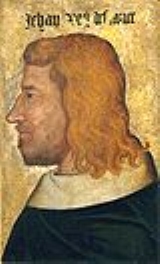
John II of France

Encyclopedia
John II called John the Good , was the King of France from 1350 until his death. He was the second sovereign of the House of Valois and is perhaps best remembered as the king who was vanquished at the Battle of Poitiers
and taken as a captive to England.
The son of Philip VI
and Joan the Lame
, John became the Count of Anjou, Count of Maine, and Duke of Normandy
in 1332. He was created Count of Poitiers
in 1344, Duke of Aquitaine
in 1345, and Duke of Burgundy
(as John I) from 1361 to 1363. By his marriage to Joanna I, Countess of Auvergne and Boulogne, he became jure uxoris
Count of Auvergne and Boulogne
from 1350 to 1360.
John succeeded his father in 1350 and was crowned at Notre-Dame de Reims. As king, John surrounded himself with poor administrators, preferring to enjoy the good life his wealth as king brought. Later in his reign, he took over more of the administration himself.
were passed over, it was also disputed. The new king had to consolidate his power in order to protect his throne from rival claimants. Philip therefore decided to marry off his son John—then thirteen years old—quickly to form a strong matrimonial alliance, at the same time conferring upon him the title of Duke of Normandy
.
Thought was initially given to a marriage with Eleanor
, sister of the King of England, but instead Philip invited John of Luxembourg, King of Bohemia, to Fontainebleau
. Bohemia had aspirations towards Lombardy
and needed French diplomatic support. A treaty was drawn up. The military clauses stipulated that in the event of war Bohemia would support the French army with four hundred infantrymen. The political clauses ensured that the Lombard crown would not be disputed if the King of Bohemia managed to obtain it. Philip selected Bonne of Bohemia
as a wife for his son as she was closer to child-bearing age (16 years), and the dowry was fixed at 120,000 florin
s.
and Maine
. The wedding was celebrated on 28 July at the church of Notre-Dame in Melun
in the presence of six thousand guests. The festivities were prolonged by a further two months when the young groom was finally knighted at the cathedral of Notre-Dame in Paris. Duke John of Normandy was solemnly granted the arms of a knight in front of a prestigious assistance bringing together the kings of Luxembourg and Navarre
, and the dukes of Burgundy
, Lorraine
and the Brabant
.
than it did by river trade on the Seine
. The Duchy had not been English for 150 years but many landowners had possessions across the Channel. Consequently, to line up behind one or other sovereign risked confiscation. Therefore the Norman nobility were governed as interdependent clans which allowed them to obtain and maintain charters guaranteeing the duchy a deal of autonomy. It was split into two key camps, the counts of Tancarville
and the counts of Harcourt
—which had been in conflict for generations.
 Tension arose again in 1341. King Philip, worried about the richest area of the kingdom breaking into bloodshed, ordered the bailiffs of Bayeux
and Cotentin to quell the dispute. Geoffroy d' Harcourt raised troops against the king, rallying a number of nobles protective of their autonomy and against royal interference. The rebels demanded that Geoffroy be made duke, thus guaranteeing the autonomy granted by the charter. Royal troops took the castle at Saint-Sauveur-le-Vicomte
and Geoffroy was exiled to the Brabant
. Three of his companions were decapitated in Paris on 3 April 1344.
By 1345 increasing numbers of Norman rebels had begun to pay homage to Edward III
, constituting a major threat to the legitimacy of the Valois kings. The defeat at Crécy and the rendering of Calais
further damaged royal prestige. Defections by the nobility increased—particularly in the north and west whose land fell within the broad economic influence of England. Consequently King Philip decided to seek a truce. Duke John met Geoffroy d' Harcourt, to whom the king agreed to return all confiscated goods; even appointing him sovereign captain in Normandy. John then approached the Tancarville family, whose loyalty could ultimately ensure his authority in Normandy. The marriage of John, Viscount of Melun
to Jeanne, the only heiress of the county of Tancarville ensured the Melun-Tancarville party remained loyal to John, while Geoffroy d' Harcourt continued to act as defender for Norman freedoms and thus of the reforming party.
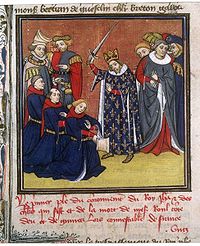 In 1354, John's son-in-law and cousin, Charles II of Navarre
, who, in addition to his small Pyrenean
kingdom, also held extensive lands in Normandy, was implicated in the assassination of the Constable of France
, Charles de la Cerda
. Nevertheless, to have a strategic ally against the English in Gascony
, John signed the Treaty of Mantes
with Charles on 22 February 1354. The peace did not last between the two and Charles eventually struck up an alliance with Henry of Grosmont, the first Duke of Lancaster
. The next year (1355), John signed the Treaty of Valognes
with Charles, but this second peace lasted hardly longer than the first. In 1355, the Hundred Years' War
flared up again.
In July of 1356, the Black Prince
, son of Edward III of England
, took an army on a great chevauchée
through France. John pursued him with an army of his own. In September a few miles southeast of Poitiers
, the two forces met.
John was confident of victory—his army was probably twice the size of his opponent's—but he did not immediately attack. While he waited, the papal legate
went back and forth, trying to negotiate a truce between the leaders. There is some debate over whether the Prince wanted to fight at all. He offered his wagon train, which was heavily loaded with loot. He also promised not to fight against France for seven years. Some sources claim that he even offered to return Calais
to the French crown. John countered by demanding that 100 of the Prince's best knights surrender themselves to him as hostages, along with the Prince himself.
No agreement could be reached. Negotiations broke down, and both sides prepared for combat.
On the day of the Battle of Poitiers
, John and 19 knights from his personal guard dressed identically. This was done to confuse the enemy, who would do everything possible to capture the sovereign on the field. In spite of this precaution John was captured. Though he fought with valor, wielding a large battle-axe, his helmet was knocked off. Surrounded, he fought on until Denis de Morbecque, a French exile who fought for England, approached him.
"Sire," Morbecque said. "I am a knight of Artois. Yield yourself to me and I will lead you to the Prince of Wales."
King John surrendered by handing him his glove. That night King John dined in the red silk tent of his enemy. The Black Prince attended to him personally. He was then taken to Bordeaux
, and from there to England. Although Poitiers is centrally located, it is not known that anyone—noble or peasant—attempted to rescue their king.
While negotiating a peace accord, he was at first held in the Savoy Palace
, then at a variety of locations, including Windsor
, Hertford
, Somerton Castle
in Lincolnshire, Berkhamsted Castle
in Hertfordshire and briefly at King John's Lodge, formerly known as Shortridges, in East Sussex
. A local tradition in St Albans
is that he was held in a house in that town, at the site of the 15th-century Fleur de Lys inn, before he was moved to Hertford. There is a sign on the inn to that effect, but apparently no evidence to confirm the tradition. Eventually, John was taken to the Tower of London
.
 As a prisoner of the English, John was granted royal privileges, permitting him to travel about and to enjoy a regal lifestyle. At a time when law and order was breaking down in France and the government was having a hard time raising money for the defence of the realm, his account books during his captivity show that he was purchasing horses, pets, and clothes while maintaining an astrologer and a court band.
The Treaty of Brétigny
(1360) set his ransom at 3 million crowns. Leaving his son Louis of Anjou in English-held Calais
as a replacement hostage, John was allowed to return to France to raise the funds.
But all did not go according to plan. In July of 1363, King John was informed that Louis had escaped. Troubled by the dishonour of this, and the arrears in his ransom, John did something that shocked and dismayed his people: he announced that he would voluntarily return to captivity in England. His council tried to dissuade him, but he persisted, citing reasons of "good faith and honour." He sailed for England that winter and left the impoverished citizens of France again without a king.
John was greeted in London 1364 with parades and feasts. A few months after his arrival, however, he fell ill with an unknown malady. He died at the Savoy
in April 1364. His body was returned to France, where he was interred in the royal chambers at Saint Denis Basilica
.
 John suffered from fragile health. He engaged little in physical activity, practised jousting rarely, and only occasionally hunted. Contemporaries report that he was quick to get angry and resort to violence, leading to frequent political and diplomatic confrontations. He enjoyed literature, and was patron to painters and musicians.
The image of a "warrior king" probably emerged from the courage in battle he showed at Poitiers
, and the creation of the Order of the Star
. This was guided by political need as John was determined to prove the legitimacy of his crown–particularly as his reign, like that of his father, was marked by continuing disputes over the Valois claim from both Charles II of Navarre
and Edward III of England
. From a young age, John was called to resist the de-centralising forces which impacted upon the cities and the nobility; each attracted either by English economic influence or the reforming party. He grew up amongst intrigue and treason, and in consequence he governed in secrecy only with a close circle of trusted advisers.
He took as wife Bonne of Bohemia
, and fathered 10 children, in eleven years. Some historians also suggest a strong romantic and possibly bisexual attachment to Charles de la Cerda
. La Cerda was given various honours and appointed to the high position of connetable when John became king; he accompanied the king on all his official journeys to the provinces. La Cerda's rise at court excited the jealousy of the French barons, several of whom stabbed him to death in 1354. As such, La Cerda's fate paralleled that of Edward II of England
's Piers Gaveston
in England, and John II of Castile
's Alvaro de Luna
in Spain; the position of a royal favourite was a dangerous one. John's grief on La Cerda's death was overt and public.
(d. 1349), daughter of John I (the Blind) of Bohemia
. Their children were:
On 19 February 1350, at Nanterre
, he married Joanna I of Auvergne (d. 1361), Countess of Auvergne
and Boulogne
. She was the widow of Philip of Burgundy
, the deceased heir of that duchy, and mother of the young Philip I, Duke of Burgundy
(1344–61) who became John's stepson and ward. John and Joanna had two daughters, both of whom died young:
He was succeeded by his son, Charles V
.
|-
Battle of Poitiers (1356)
The Battle of Poitiers was fought between the Kingdoms of England and France on 19 September 1356 near Poitiers, resulting in the second of the three great English victories of the Hundred Years' War: Crécy, Poitiers, and Agincourt....
and taken as a captive to England.
The son of Philip VI
Philip VI of France
Philip VI , known as the Fortunate and of Valois, was the King of France from 1328 to his death. He was also Count of Anjou, Maine, and Valois from 1325 to 1328...
and Joan the Lame
Joan the Lame
Joan of Burgundy , also known as Joan the Lame , was Queen consort of France as the first wife of Philip VI...
, John became the Count of Anjou, Count of Maine, and Duke of Normandy
Duke of Normandy
The Duke of Normandy is the title of the reigning monarch of the British Crown Dependancies of the Bailiwick of Guernsey and the Bailiwick of Jersey. The title traces its roots to the Duchy of Normandy . Whether the reigning sovereign is a male or female, they are always titled as the "Duke of...
in 1332. He was created Count of Poitiers
Count of Poitiers
Among the people who have borne the title of Count of Poitiers are:*Guerin **Hatton **Renaud...
in 1344, Duke of Aquitaine
Duke of Aquitaine
The Duke of Aquitaine ruled the historical region of Aquitaine under the supremacy of Frankish, English and later French kings....
in 1345, and Duke of Burgundy
Duke of Burgundy
Duke of Burgundy was a title borne by the rulers of the Duchy of Burgundy, a small portion of traditional lands of Burgundians west of river Saône which in 843 was allotted to Charles the Bald's kingdom of West Franks...
(as John I) from 1361 to 1363. By his marriage to Joanna I, Countess of Auvergne and Boulogne, he became jure uxoris
Jure uxoris
Jure uxoris is a Latin term that means "by right of his wife" or "in right of a wife". It is commonly used to refer to a title held by a man whose wife holds it in her own right. In other words, he acquired the title simply by being her husband....
Count of Auvergne and Boulogne
Count of Boulogne
The county of Boulogne was a historical region in the Low Countries. It consisted of a part of the present-day French département of the Pas-de-Calais , in parts of which there is still a Dutch-speaking minority....
from 1350 to 1360.
John succeeded his father in 1350 and was crowned at Notre-Dame de Reims. As king, John surrounded himself with poor administrators, preferring to enjoy the good life his wealth as king brought. Later in his reign, he took over more of the administration himself.
Early life
John was nine years old when his father had himself crowned as Philip VI of France. His ascent to the throne was unexpected, and because all female descendants of his uncle Philip the FairPhilip IV of France
Philip the Fair was, as Philip IV, King of France from 1285 until his death. He was the husband of Joan I of Navarre, by virtue of which he was, as Philip I, King of Navarre and Count of Champagne from 1284 to 1305.-Youth:A member of the House of Capet, Philip was born at the Palace of...
were passed over, it was also disputed. The new king had to consolidate his power in order to protect his throne from rival claimants. Philip therefore decided to marry off his son John—then thirteen years old—quickly to form a strong matrimonial alliance, at the same time conferring upon him the title of Duke of Normandy
Normandy
Normandy is a geographical region corresponding to the former Duchy of Normandy. It is in France.The continental territory covers 30,627 km² and forms the preponderant part of Normandy and roughly 5% of the territory of France. It is divided for administrative purposes into two régions:...
.
Thought was initially given to a marriage with Eleanor
Eleanor of Woodstock
Eleanor of Woodstock was an English princess.She was born at Woodstock Palace in Oxfordshire to the king Edward II of England and queen Isabella of France...
, sister of the King of England, but instead Philip invited John of Luxembourg, King of Bohemia, to Fontainebleau
Fontainebleau
Fontainebleau is a commune in the metropolitan area of Paris, France. It is located south-southeast of the centre of Paris. Fontainebleau is a sub-prefecture of the Seine-et-Marne department, and it is the seat of the arrondissement of Fontainebleau...
. Bohemia had aspirations towards Lombardy
Lombardy
Lombardy is one of the 20 regions of Italy. The capital is Milan. One-sixth of Italy's population lives in Lombardy and about one fifth of Italy's GDP is produced in this region, making it the most populous and richest region in the country and one of the richest in the whole of Europe...
and needed French diplomatic support. A treaty was drawn up. The military clauses stipulated that in the event of war Bohemia would support the French army with four hundred infantrymen. The political clauses ensured that the Lombard crown would not be disputed if the King of Bohemia managed to obtain it. Philip selected Bonne of Bohemia
Bonne of Bohemia
Bonne of Luxemburg, Duchess of Normandy, Countess of Anjou and of Maine , was born Jutta , the daughter of John the Blind of Luxemburg, king of Bohemia and his first wife Elisabeth of Bohemia. She was the first wife of King John II of France; however, as her death occurred a year prior to his...
as a wife for his son as she was closer to child-bearing age (16 years), and the dowry was fixed at 120,000 florin
Italian coin florin
The Italian florin was a coin struck from 1252 to 1533 with no significant change in its design or metal content standard. It had 54 grains of nominally pure gold worth approximately 200 modern US Dollars...
s.
Marriage with Bonne of Bohemia
John came of age on 26 April 1332, and received overlordship of the duchy of Normandy, as well as the counties of AnjouAnjou
Anjou is a former county , duchy and province centred on the city of Angers in the lower Loire Valley of western France. It corresponds largely to the present-day département of Maine-et-Loire...
and Maine
Maine
Maine is a state in the New England region of the northeastern United States, bordered by the Atlantic Ocean to the east and south, New Hampshire to the west, and the Canadian provinces of Quebec to the northwest and New Brunswick to the northeast. Maine is both the northernmost and easternmost...
. The wedding was celebrated on 28 July at the church of Notre-Dame in Melun
Melun
Melun is a commune in the Seine-et-Marne department in the Île-de-France region in north-central France. Located in the south-eastern suburbs of Paris, Melun is the capital of the department, as the seat of an arrondissement...
in the presence of six thousand guests. The festivities were prolonged by a further two months when the young groom was finally knighted at the cathedral of Notre-Dame in Paris. Duke John of Normandy was solemnly granted the arms of a knight in front of a prestigious assistance bringing together the kings of Luxembourg and Navarre
Navarre
Navarre , officially the Chartered Community of Navarre is an autonomous community in northern Spain, bordering the Basque Country, La Rioja, and Aragon in Spain and Aquitaine in France...
, and the dukes of Burgundy
Duchy of Burgundy
The Duchy of Burgundy , was heir to an ancient and prestigious reputation and a large division of the lands of the Second Kingdom of Burgundy and in its own right was one of the geographically larger ducal territories in the emergence of Early Modern Europe from Medieval Europe.Even in that...
, Lorraine
Lorraine (province)
The Duchy of Upper Lorraine was an historical duchy roughly corresponding with the present-day northeastern Lorraine region of France, including parts of modern Luxembourg and Germany. The main cities were Metz, Verdun, and the historic capital Nancy....
and the Brabant
Duchy of Brabant
The Duchy of Brabant was a historical region in the Low Countries. Its territory consisted essentially of the three modern-day Belgian provinces of Flemish Brabant, Walloon Brabant and Antwerp, the Brussels-Capital Region and most of the present-day Dutch province of North Brabant.The Flag of...
.
Duke of Normandy
In 1332, John became Duke of Normandy in prerogative, and had to deal with the reality that most of the Norman nobility was already allied with the English camp. Effectively, Normandy depended economically more on maritime trade across the English ChannelEnglish Channel
The English Channel , often referred to simply as the Channel, is an arm of the Atlantic Ocean that separates southern England from northern France, and joins the North Sea to the Atlantic. It is about long and varies in width from at its widest to in the Strait of Dover...
than it did by river trade on the Seine
Seine
The Seine is a -long river and an important commercial waterway within the Paris Basin in the north of France. It rises at Saint-Seine near Dijon in northeastern France in the Langres plateau, flowing through Paris and into the English Channel at Le Havre . It is navigable by ocean-going vessels...
. The Duchy had not been English for 150 years but many landowners had possessions across the Channel. Consequently, to line up behind one or other sovereign risked confiscation. Therefore the Norman nobility were governed as interdependent clans which allowed them to obtain and maintain charters guaranteeing the duchy a deal of autonomy. It was split into two key camps, the counts of Tancarville
Tancarville
Tancarville is a commune in the Seine-Maritime department in the Upper Normandy region of northern France.-Geography:Tancarville is a farming village surrounded by woodland, by the banks of the river Seine in the Pays de Caux, some east of Le Havre and near the junction of the D39, D982 and D910...
and the counts of Harcourt
House of Harcourt
The House of Harcourt is a Norman family, descended from the Viking Bernard the Dane and named after its seigneurie of Harcourt in Normandy. Its mottos were "Gesta verbis praeveniant" , "Gesta verbis praevenient" , and "Le bon temps viendra .....
—which had been in conflict for generations.
Bayeux
Bayeux is a commune in the Calvados department in Normandy in northwestern France.Bayeux is the home of the Bayeux Tapestry, which depicts the events leading up to the Norman conquest of England.-Administration:Bayeux is a sub-prefecture of Calvados...
and Cotentin to quell the dispute. Geoffroy d' Harcourt raised troops against the king, rallying a number of nobles protective of their autonomy and against royal interference. The rebels demanded that Geoffroy be made duke, thus guaranteeing the autonomy granted by the charter. Royal troops took the castle at Saint-Sauveur-le-Vicomte
Saint-Sauveur-le-Vicomte
Saint-Sauveur-le-Vicomte is a commune in the Manche department in Normandy in north-western France.It is situated in the Cotentin Peninsula near Valognes in the Manche département.Population : 2,242 .-History:...
and Geoffroy was exiled to the Brabant
Duchy of Brabant
The Duchy of Brabant was a historical region in the Low Countries. Its territory consisted essentially of the three modern-day Belgian provinces of Flemish Brabant, Walloon Brabant and Antwerp, the Brussels-Capital Region and most of the present-day Dutch province of North Brabant.The Flag of...
. Three of his companions were decapitated in Paris on 3 April 1344.
By 1345 increasing numbers of Norman rebels had begun to pay homage to Edward III
Edward III of England
Edward III was King of England from 1327 until his death and is noted for his military success. Restoring royal authority after the disastrous reign of his father, Edward II, Edward III went on to transform the Kingdom of England into one of the most formidable military powers in Europe...
, constituting a major threat to the legitimacy of the Valois kings. The defeat at Crécy and the rendering of Calais
Calais
Calais is a town in Northern France in the department of Pas-de-Calais, of which it is a sub-prefecture. Although Calais is by far the largest city in Pas-de-Calais, the department's capital is its third-largest city of Arras....
further damaged royal prestige. Defections by the nobility increased—particularly in the north and west whose land fell within the broad economic influence of England. Consequently King Philip decided to seek a truce. Duke John met Geoffroy d' Harcourt, to whom the king agreed to return all confiscated goods; even appointing him sovereign captain in Normandy. John then approached the Tancarville family, whose loyalty could ultimately ensure his authority in Normandy. The marriage of John, Viscount of Melun
Melun
Melun is a commune in the Seine-et-Marne department in the Île-de-France region in north-central France. Located in the south-eastern suburbs of Paris, Melun is the capital of the department, as the seat of an arrondissement...
to Jeanne, the only heiress of the county of Tancarville ensured the Melun-Tancarville party remained loyal to John, while Geoffroy d' Harcourt continued to act as defender for Norman freedoms and thus of the reforming party.
Treaty of Mantes and Battle of Poitiers
Charles II of Navarre
Charles II , called "Charles the Bad", was King of Navarre 1349-1387 and Count of Évreux 1343-1387....
, who, in addition to his small Pyrenean
Pyrenees
The Pyrenees is a range of mountains in southwest Europe that forms a natural border between France and Spain...
kingdom, also held extensive lands in Normandy, was implicated in the assassination of the Constable of France
Constable of France
The Constable of France , as the First Officer of the Crown, was one of the original five Great Officers of the Crown of France and Commander in Chief of the army. He, theoretically, as Lieutenant-general of the King, outranked all the nobles and was second-in-command only to the King...
, Charles de la Cerda
Charles de la Cerda
Charles de La Cerda , Franco-Castilian nobleman and soldier, was the son of Alfonso de la Cerda and Isabelle d'Antoing....
. Nevertheless, to have a strategic ally against the English in Gascony
Gascony
Gascony is an area of southwest France that was part of the "Province of Guyenne and Gascony" prior to the French Revolution. The region is vaguely defined and the distinction between Guyenne and Gascony is unclear; sometimes they are considered to overlap, and sometimes Gascony is considered a...
, John signed the Treaty of Mantes
Treaty of Mantes
The Treaty of Mantes was affirmed between Charles II of Navarre and John II of France on 22 February 1354. After Charles began negotiating with Edward the Black Prince and Henry of Grosmont, John II, in order to secure his alliance against England, sent Robert le Coq to Mantes to negotiate his own...
with Charles on 22 February 1354. The peace did not last between the two and Charles eventually struck up an alliance with Henry of Grosmont, the first Duke of Lancaster
Duke of Lancaster
There were several Dukes of Lancaster in the 14th and early 15th Centuries. See also Duchy of Lancaster.There were three creations of the Dukedom of Lancaster....
. The next year (1355), John signed the Treaty of Valognes
Treaty of Valognes
The Treaty of Valognes was a treaty signed on 10 September 1355 between Charles II of Navarre and John II of France. It was designed to unite the two kings against Edward III of England in preparation for a continuation of the Hundred Years' War...
with Charles, but this second peace lasted hardly longer than the first. In 1355, the Hundred Years' War
Hundred Years' War
The Hundred Years' War was a series of separate wars waged from 1337 to 1453 by the House of Valois and the House of Plantagenet, also known as the House of Anjou, for the French throne, which had become vacant upon the extinction of the senior Capetian line of French kings...
flared up again.
In July of 1356, the Black Prince
Edward, the Black Prince
Edward of Woodstock, Prince of Wales, Duke of Cornwall, Prince of Aquitaine, KG was the eldest son of King Edward III of England and his wife Philippa of Hainault as well as father to King Richard II of England....
, son of Edward III of England
Edward III of England
Edward III was King of England from 1327 until his death and is noted for his military success. Restoring royal authority after the disastrous reign of his father, Edward II, Edward III went on to transform the Kingdom of England into one of the most formidable military powers in Europe...
, took an army on a great chevauchée
Chevauchée
A chevauchée was a raiding method of medieval warfare for weakening the enemy, focusing mainly on wreaking havoc, burning and pillaging enemy territory, in order to reduce the productivity of a region; as opposed to siege warfare or wars of conquest...
through France. John pursued him with an army of his own. In September a few miles southeast of Poitiers
Poitiers
Poitiers is a city on the Clain river in west central France. It is a commune and the capital of the Vienne department and of the Poitou-Charentes region. The centre is picturesque and its streets are interesting for predominant remains of historical architecture, especially from the Romanesque...
, the two forces met.
John was confident of victory—his army was probably twice the size of his opponent's—but he did not immediately attack. While he waited, the papal legate
Papal legate
A papal legate – from the Latin, authentic Roman title Legatus – is a personal representative of the pope to foreign nations, or to some part of the Catholic Church. He is empowered on matters of Catholic Faith and for the settlement of ecclesiastical matters....
went back and forth, trying to negotiate a truce between the leaders. There is some debate over whether the Prince wanted to fight at all. He offered his wagon train, which was heavily loaded with loot. He also promised not to fight against France for seven years. Some sources claim that he even offered to return Calais
Calais
Calais is a town in Northern France in the department of Pas-de-Calais, of which it is a sub-prefecture. Although Calais is by far the largest city in Pas-de-Calais, the department's capital is its third-largest city of Arras....
to the French crown. John countered by demanding that 100 of the Prince's best knights surrender themselves to him as hostages, along with the Prince himself.
No agreement could be reached. Negotiations broke down, and both sides prepared for combat.
On the day of the Battle of Poitiers
Battle of Poitiers (1356)
The Battle of Poitiers was fought between the Kingdoms of England and France on 19 September 1356 near Poitiers, resulting in the second of the three great English victories of the Hundred Years' War: Crécy, Poitiers, and Agincourt....
, John and 19 knights from his personal guard dressed identically. This was done to confuse the enemy, who would do everything possible to capture the sovereign on the field. In spite of this precaution John was captured. Though he fought with valor, wielding a large battle-axe, his helmet was knocked off. Surrounded, he fought on until Denis de Morbecque, a French exile who fought for England, approached him.
"Sire," Morbecque said. "I am a knight of Artois. Yield yourself to me and I will lead you to the Prince of Wales."
King John surrendered by handing him his glove. That night King John dined in the red silk tent of his enemy. The Black Prince attended to him personally. He was then taken to Bordeaux
Bordeaux
Bordeaux is a port city on the Garonne River in the Gironde department in southwestern France.The Bordeaux-Arcachon-Libourne metropolitan area, has a population of 1,010,000 and constitutes the sixth-largest urban area in France. It is the capital of the Aquitaine region, as well as the prefecture...
, and from there to England. Although Poitiers is centrally located, it is not known that anyone—noble or peasant—attempted to rescue their king.
While negotiating a peace accord, he was at first held in the Savoy Palace
Savoy Palace
The Savoy Palace was considered the grandest nobleman's residence of medieval London, until it was destroyed in the Peasants' Revolt of 1381. It fronted the Strand, on the site of the present Savoy Theatre and the Savoy Hotel that memorialise its name...
, then at a variety of locations, including Windsor
Windsor Castle
Windsor Castle is a medieval castle and royal residence in Windsor in the English county of Berkshire, notable for its long association with the British royal family and its architecture. The original castle was built after the Norman invasion by William the Conqueror. Since the time of Henry I it...
, Hertford
Hertford Castle
Hertford Castle was a Norman castle situated by the River Lea in Hertford, the county town of Hertfordshire, England.-Early history:Hertford Castle was built on a site first fortified by Edward the Elder around 911. By the time of the Norman Invasion in 1066, a motte and bailey were on the site...
, Somerton Castle
Somerton Castle
Somerton Castle is located approximately one mile west of the hamlet of Boothby Graffoe in Lincolnshire, England.Inherited from his mother, the castle was rebuilt in the latter part of the 13th century by Antony Bek, then Bishop of Durham, who was granted a licence to crenellate in 1281...
in Lincolnshire, Berkhamsted Castle
Berkhamsted Castle
Berkhamsted Castle is a ruined Norman motte-and-bailey castle at Berkhamsted in Hertfordshire, England.The original fortification dates from Saxon times. Work on the Norman structure was started in 1066 by William the Conqueror who later passed the castle to his half-brother, Robert, Count of...
in Hertfordshire and briefly at King John's Lodge, formerly known as Shortridges, in East Sussex
East Sussex
East Sussex is a county in South East England. It is bordered by the counties of Kent, Surrey and West Sussex, and to the south by the English Channel.-History:...
. A local tradition in St Albans
St Albans
St Albans is a city in southern Hertfordshire, England, around north of central London, which forms the main urban area of the City and District of St Albans. It is a historic market town, and is now a sought-after dormitory town within the London commuter belt...
is that he was held in a house in that town, at the site of the 15th-century Fleur de Lys inn, before he was moved to Hertford. There is a sign on the inn to that effect, but apparently no evidence to confirm the tradition. Eventually, John was taken to the Tower of London
Tower of London
Her Majesty's Royal Palace and Fortress, more commonly known as the Tower of London, is a historic castle on the north bank of the River Thames in central London, England. It lies within the London Borough of Tower Hamlets, separated from the eastern edge of the City of London by the open space...
.
Prisoner of the English
The Treaty of Brétigny
Treaty of Brétigny
The Treaty of Brétigny was a treaty signed on May 9, 1360, between King Edward III of England and King John II of France. In retrospect it is seen as having marked the end of the first phase of the Hundred Years' War —as well as the height of English hegemony on the Continent.It was signed...
(1360) set his ransom at 3 million crowns. Leaving his son Louis of Anjou in English-held Calais
Calais
Calais is a town in Northern France in the department of Pas-de-Calais, of which it is a sub-prefecture. Although Calais is by far the largest city in Pas-de-Calais, the department's capital is its third-largest city of Arras....
as a replacement hostage, John was allowed to return to France to raise the funds.
But all did not go according to plan. In July of 1363, King John was informed that Louis had escaped. Troubled by the dishonour of this, and the arrears in his ransom, John did something that shocked and dismayed his people: he announced that he would voluntarily return to captivity in England. His council tried to dissuade him, but he persisted, citing reasons of "good faith and honour." He sailed for England that winter and left the impoverished citizens of France again without a king.
John was greeted in London 1364 with parades and feasts. A few months after his arrival, however, he fell ill with an unknown malady. He died at the Savoy
Savoy Palace
The Savoy Palace was considered the grandest nobleman's residence of medieval London, until it was destroyed in the Peasants' Revolt of 1381. It fronted the Strand, on the site of the present Savoy Theatre and the Savoy Hotel that memorialise its name...
in April 1364. His body was returned to France, where he was interred in the royal chambers at Saint Denis Basilica
Saint Denis Basilica
The Cathedral Basilica of Saint Denis is a large medieval abbey church in the commune of Saint-Denis, now a northern suburb of Paris. The abbey church was created a cathedral in 1966 and is the seat of the Bishop of Saint-Denis, Pascal Michel Ghislain Delannoy...
.
Personality
The image of a "warrior king" probably emerged from the courage in battle he showed at Poitiers
Battle of Poitiers (1356)
The Battle of Poitiers was fought between the Kingdoms of England and France on 19 September 1356 near Poitiers, resulting in the second of the three great English victories of the Hundred Years' War: Crécy, Poitiers, and Agincourt....
, and the creation of the Order of the Star
Order of the Star (France)
The Order of the Star was an order of chivalry founded on 6 November 1351 by John II of France in imitation of the Order of the Garter recently founded by Edward III of England...
. This was guided by political need as John was determined to prove the legitimacy of his crown–particularly as his reign, like that of his father, was marked by continuing disputes over the Valois claim from both Charles II of Navarre
Charles II of Navarre
Charles II , called "Charles the Bad", was King of Navarre 1349-1387 and Count of Évreux 1343-1387....
and Edward III of England
Edward III of England
Edward III was King of England from 1327 until his death and is noted for his military success. Restoring royal authority after the disastrous reign of his father, Edward II, Edward III went on to transform the Kingdom of England into one of the most formidable military powers in Europe...
. From a young age, John was called to resist the de-centralising forces which impacted upon the cities and the nobility; each attracted either by English economic influence or the reforming party. He grew up amongst intrigue and treason, and in consequence he governed in secrecy only with a close circle of trusted advisers.
He took as wife Bonne of Bohemia
Bonne of Bohemia
Bonne of Luxemburg, Duchess of Normandy, Countess of Anjou and of Maine , was born Jutta , the daughter of John the Blind of Luxemburg, king of Bohemia and his first wife Elisabeth of Bohemia. She was the first wife of King John II of France; however, as her death occurred a year prior to his...
, and fathered 10 children, in eleven years. Some historians also suggest a strong romantic and possibly bisexual attachment to Charles de la Cerda
Charles de la Cerda
Charles de La Cerda , Franco-Castilian nobleman and soldier, was the son of Alfonso de la Cerda and Isabelle d'Antoing....
. La Cerda was given various honours and appointed to the high position of connetable when John became king; he accompanied the king on all his official journeys to the provinces. La Cerda's rise at court excited the jealousy of the French barons, several of whom stabbed him to death in 1354. As such, La Cerda's fate paralleled that of Edward II of England
Edward II of England
Edward II , called Edward of Caernarfon, was King of England from 1307 until he was deposed by his wife Isabella in January 1327. He was the sixth Plantagenet king, in a line that began with the reign of Henry II...
's Piers Gaveston
Piers Gaveston
Piers Gaveston, 1st Earl of Cornwall was an English nobleman of Gascon origin, and the favourite of King Edward II of England. At a young age he made a good impression on King Edward I of England, and was assigned to the household of the King's son, Edward of Carnarvon...
in England, and John II of Castile
John II of Castile
John II was King of Castile from 1406 to 1454.He was the son of Henry III of Castile and his wife Catherine of Lancaster, daughter of John of Gaunt, 1st Duke of Lancaster by Constance of Castile, daughter of King Peter of Castile.-Regency:He succeeded his father on 25 December 1406, at the age of...
's Alvaro de Luna
Álvaro de Luna
Álvaro de Luna y Jarana , Duke of Trujillo, 1st Count of San Esteban de Gormaz, was a Spanish politician...
in Spain; the position of a royal favourite was a dangerous one. John's grief on La Cerda's death was overt and public.
Family and children
On 28 July 1332, at the age of 13, John was married to Bonne of BohemiaBonne of Bohemia
Bonne of Luxemburg, Duchess of Normandy, Countess of Anjou and of Maine , was born Jutta , the daughter of John the Blind of Luxemburg, king of Bohemia and his first wife Elisabeth of Bohemia. She was the first wife of King John II of France; however, as her death occurred a year prior to his...
(d. 1349), daughter of John I (the Blind) of Bohemia
John I of Bohemia
John the Blind was the Count of Luxembourg from 1309 and King of Bohemia from 1310 and titular King of Poland. He was the eldest son of the Holy Roman Emperor Henry VII and his wife Margaret of Brabant...
. Their children were:
- Charles VCharles V of FranceCharles V , called the Wise, was King of France from 1364 to his death in 1380 and a member of the House of Valois...
(21 January 1338 – 16 September 1380) - Louis I, Duke of AnjouLouis I of NaplesLouis I of Anjou , or Louis I of Naples, was the second son of King John II of France and Bonne of Luxembourg...
(23 July 1339 – 20 September 1384) - John, Duke of BerryJohn, Duke of BerryJohn of Valois or John the Magnificent was Duke of Berry and Auvergne and Count of Poitiers and Montpensier. He was the third son of King John II of France and Bonne of Luxemburg; his brothers were King Charles V of France, Duke Louis I of Anjou and Duke Philip the Bold of Burgundy...
(30 November 1340 – 15 June 1416) - Philip II, Duke of BurgundyPhilip II, Duke of BurgundyPhilip the Bold , also Philip II, Duke of Burgundy , was the fourth and youngest son of King John II of France and his wife, Bonne of Luxembourg. By his marriage to Margaret III, Countess of Flanders, he also became Count Philip II of Flanders, Count Philip IV of Artois and Count-Palatine Philip IV...
(17 January 1342–27 April 1404) - Joan (24 June 1343 – 3 November 1373), married Charles II (the Bad) of NavarreCharles II of NavarreCharles II , called "Charles the Bad", was King of Navarre 1349-1387 and Count of Évreux 1343-1387....
- Marie (12 September 1344 – October 1404), married Robert I, Duke of Bar
- Agnes (1345–1349)
- Margaret (1347–1352)
- Isabelle of Valois (1 October 1348 – 11 September 1372), married Gian Galeazzo I, Duke of Milan
On 19 February 1350, at Nanterre
Nanterre
Nanterre is a commune in the western suburbs of Paris, France. It is located west of the center of Paris.Nanterre is the capital of the Hauts-de-Seine department as well as the seat of the Arrondissement of Nanterre....
, he married Joanna I of Auvergne (d. 1361), Countess of Auvergne
Rulers of Auvergne
-History:In the 7th century Auvergne was disputed between the Franks and Aquitanians. It was later conquered by the Carolingians, and was integrated for a time into the kingdom of Aquitaine...
and Boulogne
Count of Boulogne
The county of Boulogne was a historical region in the Low Countries. It consisted of a part of the present-day French département of the Pas-de-Calais , in parts of which there is still a Dutch-speaking minority....
. She was the widow of Philip of Burgundy
Philip of Burgundy, Count of Auvergne
Philip of Burgundy was Count of Auvergne and Boulogne and the only son and heir of Odo IV, Duke of Burgundy, and of Joan III, Countess of Burgundy. His mother was the daughter of King Philip V of France and of Joan II, Countess of Burgundy.He married Joan I, Countess of Auvergne and Boulogne, in c...
, the deceased heir of that duchy, and mother of the young Philip I, Duke of Burgundy
Philip I, Duke of Burgundy
Philip I of Burgundy, also Philip II of Palatine Burgundy, Philip III of Artois, Philip III of Boulogne and Auvergne, nicknamed Philip of Rouvres was Duke of Burgundy from 1350 until his death. Philip was the only son of Philip of Burgundy, heir to the Duchy of Burgundy, and Joanna I, Countess of...
(1344–61) who became John's stepson and ward. John and Joanna had two daughters, both of whom died young:
- Blanche (b. 1350)
- Catherine (b. 1352)
He was succeeded by his son, Charles V
Charles V of France
Charles V , called the Wise, was King of France from 1364 to his death in 1380 and a member of the House of Valois...
.
External links
|-