
All Topics  
The Merry Wives of Windsor

 
The Merry Wives of Windsor

   Email Print
   Bookmark   Link


The Merry Wives of Windsor


The Merry Wives of Windsor is a comedy
Comedy

Comedy as a popular meaning, is any humorous discourse generally intended to amuse, especially in television, film, and stand-up comedy. This must be carefully distinguished from its academic definition, namely the comic theatre, whose Western culture origins are found in Ancient Greece....
 by William Shakespeare
William Shakespeare

William Shakespeare was an English people poet and playwright, widely regarded as the greatest writer in the English language and the world's preeminent dramatist....
, first published in 1602, though believed to have been written prior to 1597. It features the fat knight
Knight

File:Gothic armor 2.jpgKnight is the term for a social position originating in the Middle Ages. In the Commonwealth of Nations, knighthood is a non-heritable form of gentry....
 Sir John Falstaff
Falstaff

Sir John Falstaff is a fictional character who appears in three plays by William Shakespeare as a companion to Prince Hal, the future King Henry V of England....
, and is Shakespeare's only play to deal exclusively with contemporary Elizabethan era
Elizabethan era

The Elizabethan era is associated with Elizabeth I of England's reign and is often considered to be the Golden Age in History of England. It was the height of the English Renaissance and saw the flowering of English poetry and English literature....
 English middle class
Middle class

Middle class is the group of people in contemporary society who are between the working class and nobility. This socioeconomic class includes professionals, highly skilled workers, and lower and middle management....
 life.


Discussion
Ask a question about 'The Merry Wives of Windsor'
Start a new discussion about 'The Merry Wives of Windsor'
Answer questions from other users
Full Discussion Forum


Encyclopedia


Merry Wives Tp
The Merry Wives of Windsor is a comedy
Comedy

Comedy as a popular meaning, is any humorous discourse generally intended to amuse, especially in television, film, and stand-up comedy. This must be carefully distinguished from its academic definition, namely the comic theatre, whose Western culture origins are found in Ancient Greece....
 by William Shakespeare
William Shakespeare

William Shakespeare was an English people poet and playwright, widely regarded as the greatest writer in the English language and the world's preeminent dramatist....
, first published in 1602, though believed to have been written prior to 1597. It features the fat knight
Knight

File:Gothic armor 2.jpgKnight is the term for a social position originating in the Middle Ages. In the Commonwealth of Nations, knighthood is a non-heritable form of gentry....
 Sir John Falstaff
Falstaff

Sir John Falstaff is a fictional character who appears in three plays by William Shakespeare as a companion to Prince Hal, the future King Henry V of England....
, and is Shakespeare's only play to deal exclusively with contemporary Elizabethan era
Elizabethan era

The Elizabethan era is associated with Elizabeth I of England's reign and is often considered to be the Golden Age in History of England. It was the height of the English Renaissance and saw the flowering of English poetry and English literature....
 English middle class
Middle class

Middle class is the group of people in contemporary society who are between the working class and nobility. This socioeconomic class includes professionals, highly skilled workers, and lower and middle management....
 life. It has been adapted for the opera
Opera

Opera is an Performing arts in which singers and musicians perform a dramatic work which combines a text and a musical score. Opera is part of the Western classical music tradition....
 on occasions.

Sources


Some elements of The Merry Wives of Windsor may have been adapted from Il Pecorone, a collection of stories by Ser Giovanni Fiorentino; one of these stories was included in William Painter
William Painter

William Painter , English author, was a native of Kent. He matriculated at St John's College, Cambridge, in 1554. In 1561 he became clerk of the ordnance in the Tower of London, a position in which he appears to have amassed a fortune out of the public funds....
's The Palace of Pleasure.

Date and text

The play's date of composition is unknown; it was registered for publication in 1602, but was probably several years old by that date. Textual allusions to the Order of the Garter
Order of the Garter

The Most Noble Order of the Garter is an order of chivalry, or knighthood, originating in medieval England, and presently bestowed on recipients in the United Kingdom and other Commonwealth realms; it is the pinnacle of the Orders, decorations, and medals of the United Kingdom....
 suggest that the play may have been intended for performance in April 1597, prior to the installation in May of the Knights-Elect of that order at Windsor
Windsor, Berkshire

Windsor is a suburban town and tourist destination in the Royal Borough of Windsor and Maidenhead in Berkshire, England. It is best known as the site of Windsor Castle....
; if so, it was probably performed when Elizabeth I
Elizabeth I of England

Elizabeth I was List of English monarchs and Queen of Ireland from 17 November 1558 until her death. Sometimes called The Virgin Queen, Gloriana, or Good Queen Bess, Elizabeth was the fifth and last monarch of the House of Tudor....
 attended Garter Feast on April 23. This was not necessarily the premiere; presumably, the play was also staged at the public theatre.

The Garter theory is only speculation, but it is corroborated by a story first recorded by John Dennis (dramatist) in 1702: that Shakespeare was commanded to write the play by Queen Elizabeth, who wanted to see 'Falstaff in love' (that such a story was first recorded one hundred years later -- in the same year in which Dennis had made an adaption of Merry Wives -- makes it suspect.)

However, support for this theory is divided. If the Garter theory is correct, it would mean that Shakespeare wrote 'The Merry Wives of Windsor' between King Henry IV part 1 and part 2. Critics have trouble believing this because of all the inconsistencies that appear between the Henry plays and 'The Merry Wives'. For example, there are no references to any of the major events going on at the time such as the rebellion (Henry IV part 1), or the English invasion of France (Henry IV part 2). Also there are many character inconsistencies and loose ends in the play which support the theory that Queen Elizabeth requested Shakespeare to write the play, but seem to indicate it was written after Henry V. The inconsistencies and loose ends include ; Page is referred to as both 'Thomas' and 'George', Ann Page is described as wearing both white and green, there is a build up to her presenting the faeries which then doesn't happen and the verse is of poor quality for Shakespeare.

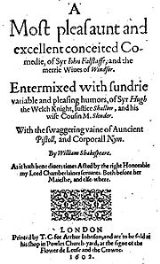
January 18, 1602 was the date the play was entered into the Register
Stationers' Register

The Stationers' Register was a record book maintained by the Worshipful Company of Stationers and Newspaper Makers of London. The company is a trade guild given a royal charter in 1557 to regulate the various professions associated with the publishing industry, including printers, bookbinders, booksellers, and publishers in England....
 of the Stationers Company
Worshipful Company of Stationers and Newspaper Makers

The Worshipful Company of Stationers and Newspaper Makers is one of the Livery Company of the City of London. The Stationers' Company was founded in 1403; it received a Royal Charter in 1557....
. The first quarto
Book size

The size of a specific book is measured from the head to tail of the spine, and from edge to edge across the covers.However, in bookbinding, printing, and publishing, a series of terms are used to indicate the approximate size of a book....
 was published later that year, in an inferior text, by bookseller Arthur Johnson. It was published in a second quarto in 1619, as part of William Jaggard's False Folio
False Folio

False Folio is the term that Shakespeare scholars and bibliography have applied to William Jaggard's printing of ten Shakespearean and Shakespeare Apocrypha plays together in 1619 in literature, the first attempt to collect Shakespeare's work in a single volume....
; the superior First Folio
First Folio

Mr. William Shakespeares Comedies, Histories, & Tragedies is the 1623 published collection of William Shakespeare's plays. Modern scholars commonly refer to it as the First Folio....
 text followed in 1623.

The title page of Q1 states that the play was acted by the Lord Chamberlain's Men
Lord Chamberlain's Men

The Lord Chamberlain's Men was a playing company that William Shakespeare worked at as an actor and playwright for most of his career. Formed at the end of a period of flux in the theatrical world of London, it had become, by 1603, one of the two leading companies of the city and was subsequently patronized by James I of England....
, "Both before Her Majesty, and elsewhere." The earliest performance known with certainty occurred on November 4, 1604, at Whitehall Palace. Another known performance took place on November 15, 1638, at the Cockpit Theatre
Cockpit Theatre

The Cockpit was a theatre in London, operating from 1616 to around 1665. It was the first theatre to be located on Drury Lane. After damage in 1617, it was christened The Phoenix....
.

The play alludes to a German duke, who is generally thought to be Frederick I, Duke of Württemberg
Frederick I, Duke of Württemberg

Friedrich I, Duke of W?rttemberg was the son of Georg of M?mpelgard of Montb?liard and his wife Barbara of Hesse, daughter of Philip I, Landgrave of Hesse....
, who had visited England in 1592 and was elected to the Order of the Garter in 1597 (and who was eventually only installed in Stuttgart
Stuttgart

Stuttgart is the capital of the state of Baden-W?rttemberg in southern Germany. The list of cities in Germany, Stuttgart has a population of 590,429 while the metropolitan area referred to as Stuttgart Region has a population of 2.7 million ....
 on November 6, 1603).

There is an indication that Falstaff in Merry Wives was originally called Sir John Oldcastle, as was true of Falstaff in the Henry IV plays. See: Sir John Oldcastle
Sir John Oldcastle

Sir John Oldcastle is an Elizabethan play about John Oldcastle, a controversial 14th-15th century rebel and Lollard who was seen by some of Shakespeare's contemporaries as a proto-Protestant martyr....
 and Sir John Fastolf
John Fastolf

Sir John Fastolf, Order of the Garter, was an England soldier during the Hundred Years War, who has enjoyed a more lasting reputation as in some part being the prototype of Shakespeare's Sir John Falstaff....
.

Characters


  • Sir John Falstaff
  • Bardolph
    Bardolph

    Bardolph could be:*A minor character in three of William Shakespeare's plays?Henry IV, Part 1, Henry IV, Part 2 and Henry V ?and later brought back in The Merry Wives of Windsor...
    , Pistol
    Pistol (disambiguation)

    A pistol is a small handheld firearm but may also refer to:* Magnetic pistol, on a naval mine or torpedo, for detonation near a target * Squat #Variants, variant of lower body exercise used in strength training...
    , Nym
    Nym

    Nym may refer to:*The New York Mets*New York Minute*IATA code for Nadym Airport*-onym, an English affix*Nym server, a pseudonym server which provides untraceable email addresses...
    , (Followers of Falstaff)
  • Robin, Son/page
    Page

    Page may refer to:...
     to Falstaff.
  • Messrs. Ford & Page, two Gentlemen dwelling at Windsor.
  • William Page, a Boy, Son to Page.
  • Sir Hugh Evans, a Welsh
    Wales

    native_name = Cymru|conventional_long_name = Wales|common_name = Wales|image_flag = Flag of Wales 2.svg|national_motto = ...
     Parson
    Parson

    In the pre-Protestant Reformation church, a parson was the priest of an independent parish church, that is, a parish church not under the control of a larger ecclesiastical or monastic organisation....
  • Doctor Caius, a French Physician.
  • Rugby, a Servant to Doctor Caius.
  • Mistress Quickly
    Mistress Quickly

    Mistress Quickly refers to either of two characters in plays by William Shakespeare:* The Merry Wives of Windsor* Henry IV, Part 1, Henry IV, Part 2, and Henry V ...
    , Servant to Doctor Caius.
  • Shallow, a Country Justice.
  • Slender, Cousin to Shallow.
  • Simple, Servant to Slender.
  • Fenton, a young Gentleman.
  • The Host of the Garter Inn.
  • Mistress Ford
  • Mistress Page
  • Anne Page, her Daughter, in love with Fenton.


Synopsis


The play anachronistically places Sir John Falstaff, who had previously appeared in Shakespeare's plays about the medieval King Henry IV
Henry IV of England

Henry IV was King of England and Lord of Ireland . Like other kings of England, he also claimed the title of King of France. He was born at Bolingbroke Castle in Lincolnshire, hence the other name by which he was known, Henry Bolingbroke....
 and set circa 1400, in the contemporary setting of the Elizabethan era, circa 1600.

Falstaff arrives in Windsor very short on money. He decides, to obtain financial advantage, that he will court two wealthy married women, Mistress Ford and Mistress Page. Falstaff decides to send the women identical love letters, and asks his servants – Pistol and Nym – to deliver them to the wives. When they refuse Falstaff sacks them and in revenge the men tell Ford and Page (the husbands) of Falstaff's intentions. Page is not concerned but the jealous Ford persuades the Host of the Garter to introduce him to Falstaff as a 'Master Brook' so that he can find out Falstaff's plans.

Meanwhile, three different men are trying to win the hand of Page's daughter, Mistress Anne Page. Mistress Page would like her daughter to marry Doctor Caius, a French physician, whereas the girl's father would like her to marry Master Slender. Anne herself is in love with Master Fenton, but Page had previously rejected Fenton as a suitor due to his having squandered his considerable fortune on high-class living. Hugh Evans, a Welsh parson
Parson

In the pre-Protestant Reformation church, a parson was the priest of an independent parish church, that is, a parish church not under the control of a larger ecclesiastical or monastic organisation....
, tries to enlist the help of Mistress Quickly (servant to Doctor Caius) in wooing Anne for Slender, but the doctor discovers this and challenges Evans to a duel. The Host of the Garter prevents this duel by telling both men a different meeting place, causing much amusement for himself, Justice Shallow, Page and others. Evans and Caius decide to work together to be revenged on the Host.

When the women receive the letters, each goes to tell the other and they quickly find that the letters are almost identical. The "merry wives" are not interested in the aging, overweight Falstaff as a suitor; however, for the sake of their own amusement and to gain revenge for his indecent assumptions towards them both, they pretend to respond to his advances.

This all results in great embarrassment for Falstaff. 'Brook' says he is in love with Mistress Ford but cannot woo her as she is too virtuous. He offers to pay Falstaff to court her, saying that once she has lost her honour he will be able to tempt her himself. Falstaff cannot believe his luck, and tells 'Brook' he has already arranged to meet Mistress Ford while her husband is out. Falstaff leaves to keep his appointment and Ford soliloquies that he is right to suspect his wife and that the trusting Page is a fool.

When Falstaff arrives to meet Mistress Ford, the merry wives trick him into hiding in a laundry basket ("buck basket") full of filthy, smelly clothes awaiting laundering. When the jealous Ford returns to try and catch his wife with the knight, the wives have the basket taken away and the contents (including Falstaff) dumped into the river. Although this affects Falstaff's pride, his ego is surprisingly resilient. He is convinced that the wives are just "playing hard to get" with him, so he continues his pursuit of sexual advancement, with its attendant capital and opportunities for blackmail.

Again Falstaff goes to meet the women but Mistress Page comes back and warns Mistress Ford of her husband's approach again. They try to think of ways to hide him other than the laundry basket which he refuses to get into again. They trick him again, this time into disguising himself as Mistress Ford's maid's fat aunt, the fat woman of Brentford. Ford tries once again to catch his wife with the knight but ends up beating the "old woman", whom he despises, and throwing her out of his house. Black and blue, Falstaff laments his bad luck.

Eventually the wives tell their husbands about the series of jokes they have played on Falstaff, and together they devise one last trick which ends up with the Knight being humiliated in front of the whole town. They tell Falstaff to dress as "Herne, the Hunter
Herne the Hunter

In English folklore, Herne the Hunter is an equestrianism ghost associated with Windsor, Berkshire Forest and Windsor Great Park in the England county of Berkshire....
" and meet them by an old oak tree in Windsor Forest (now part of Windsor Great Park
Windsor Great Park

Windsor Great Park is a large deer park of 5,000 acres, to the south of the town of Windsor, Berkshire on the border of Berkshire and Surrey in England....
). They then dress several of the local children, including Anne and William Page, as fairies and get them to pinch and burn Falstaff to punish him. Page plots to dress Anne in white and tells Slender to steal her away and marry her during the revels. Mistress Page and Doctor Caius arrange to do the same, but they arrange Anne shall be dressed in green. Anne tells Fenton this, and he and the Host arrange for Anne and Fenton to be married instead.

The wives meet Falstaff, and almost immediately the "fairies" attack. Slender, Caius, and Fenton steal away their brides-to-be during the chaos, and the rest of the characters reveal their true identities to Falstaff.

Although he is embarrassed, Falstaff takes the joke surprisingly well, as he sees it was what he deserved. Ford says he must pay back the 20 pounds 'Brook' gave him and takes the Knight's horses as recompense. Slender suddenly appears and says he has been deceived – the 'girl' he took away to marry was not Anne but a young boy. Caius arrives with similar news – however, he has actually married his boy! Fenton and Anne arrive and admit that they love each other and have been married. Fenton chides the parents for trying to force Anne to marry men she did not love and the parents accept the marriage and congratulate the young pair. Eventually they all leave together and Mistress Page even invites Falstaff to come with them: "let us every one go home, and laugh at this sport o'er by a country fire; Sir John and all".

Performance


Merry Wives was one of the first Shakespearean plays to be performed once the theatres re-opened in 1660 after the Interregnum
English Interregnum

The English Interregnum was the period of parliamentary and military rule under the Commonwealth of England after the English Civil War. It began with the regicide of Charles I of England in January 1649, and ended with the English Restoration of Charles II of England in 1660....
. Samuel Pepys
Samuel Pepys

Samuel Pepys, Fellow of the Royal Society was an English people Navy Board and Member of Parliament, who is now most famous for his diary. Although Pepys had no maritime experience, he rose by patronage, hard work and his talent for administration, to be the Chief Secretary to the Admiralty under James II of England....
 saw the King's Company
King's Company

The King's Company was one of two enterprises granted the rights to mount theatrical productions in London at the start of the English Restoration....
 act it on Dec. 6, 1660, and again in 1661 and 1667 (though he didn't like it, anytime). In 1702 John Dennis offered an adaptation (it has been called a "perversion") of the play, titled The Comical Gallant, or the Amours of Sir John Falstaff — which flopped. In 1824 Frederick Reynolds included Merry Wives in his series of operatic adaptations, with music by Henry Bishop
Henry Bishop

Sir Henry Rowley Bishop was an English musical composer. He is famous today for the songs Home! Sweet Home! and Lo, Hear the Gentle Lark, but was the composer or arranger of some 120 dramatic works, including 80 operas, light operas, cantatas, and ballets....
. Charles Kean
Charles Kean

Charles John Kean , was born at County Waterford, the son of the actor Edmund Kean.After preparatory education at Worplesdon and at Greenford, near Harrow, London, he was sent to Eton College, where he remained three years....
 returned to Shakespeare's text in an 1851 production.

During the period of anti-German feelings in England during World War I, many German names and titles were changed and given more English-sounding names, including the royal family's from Saxe-Coburg-Gotha to Windsor. Kaiser Wilhelm II countered this by jokingly saying that he was off to see a performance of 'The Merry Wives of Saxe-Coburg-Gotha.'

Themes


Key themes of Merry Wives include love and marriage, jealousy and revenge, social class
Social class

Social class refers to the hierarchy distinctions between individuals or groups in societies or cultures. Usually most societies have some notion of social class , but concretely defined social classes are not found in every known type of human societies....
 and wealth. Explored with irony
Irony

Irony is a Literary technique or rhetorical device, in which there is an wiktionary:incongruous or wiktionary:discordance between what one says or does and what one means or what is generally understood....
, sexual innuendo
Innuendo

An innuendo is, according to the Advanced Oxford Learner's Dictionary an indirect remark about somebody or something, usually suggesting something bad or rude; the use of remarks like this: "innuendoes about her private life" or "The song is full of sexual innuendo." ...
, sarcasm
Sarcasm

Sarcasm is a form of ironic speech or writing which is bitter or cutting, being intended to taunt its target. It is first recorded in English in The Shepheardes Calender in 1579: ...
, and stereotypical views of classes and nationalities, these themes help to give the play something closer to a modern-day view than is often found in Shakespeare's plays.

The play is centered on the class prejudices of middle-class England. The lower class is represented by characters such as Bardolph, Nym, and Pistol (Falstaff's followers), and the upper class
Upper class

The upper class is a concept in sociology that refers to the group of people at the top of a social hierarchy. Members of an upper class often have great power over the allocation of resources and governmental policy in their area....
 is represented by Sir John Falstaff and Master Fenton. Shakespeare uses both Latin
Latin

Latin is an Italic language, historically spoken in Latium and Ancient Rome. Through the Military history of the Roman Empire, Latin spread throughout the Mediterranean and a large part of Europe....
 and misused English to represent the attitudes and differences of the people of this era. Much of the comedic effect of the play is derived from misunderstandings between characters.

Another prominent Elizabethan theme that runs through the play is the idea of the cuckold
Cuckold

A cuckold is a married man with an adulterous wife. Due to the word's original meaning, a man who is unwittingly raising another man's child, it refers to a man who is unaware of his victimization....
. Elizabethans found the idea of a woman cheating on her husband absolutely hilarious and seem to have assumed that if a man was married then his wife was cheating on him. Because a cuckolded husband was said to "wear horns", any reference, no matter how oblique, to horns or a horned animal (for example, the "buck" basket where Falstaff finds himself) probably brought down the house.

Criticism


Most critics consider Merry Wives to be one of Shakespeare's weaker plays, and the Falstaff of Merry Wives to be much inferior to the Falstaff of the two Henry IV plays. That Shakespeare would so stumble with one of his greatest creations is puzzling and a satisfactory reason for this remains to be found. The likeliest explanation, if the Garter Feast theory is accepted, is that the play was written hastily, to order for a special occasion, within severe time constraints and rushed to meet a Royal deadline of possibly as little as only 14 days.

It has also been said that Shakespeare was one of Queen Elizabeth I's favorite playwright
Playwright

A playwright, also known as a dramatist, is a person who writes dramatic literature or drama. These works may be written specifically to be performed by actors or they may be closet dramas or literary works written using dramatic forms but not meant for performance....
s and that she so enjoyed the buffoon Falstaff that she personally requested that Shakespeare write an entire comedy surrounding Falstaff. This would explain the powerful female characters as a bow to the queen and grand slapstick
Slapstick

Slapstick is a type of comedy involving exaggerated extreme physical violence or activities which exceed the boundaries of common sense, such as a character being hit in the face with a heavy frying pan or running into a brick wall....
 comedy surrounding Falstaff's mishaps in the play.

Adaptations and cultural references


  • The play was revised and adapted by John Dennis in 1702 as The Comical Gallant.
  • Giuseppe Verdi
    Giuseppe Verdi

    Giuseppe Fortunino Francesco Verdi was an Italian Romantic music composer, mainly of opera. He was one of the most influential composers in the 19th century....
    's last opera, Falstaff
    Falstaff (opera)

    Falstaff is an operatic commedia lirica in three acts by Giuseppe Verdi, adapted by Arrigo Boito from William Shakespeare's plays The Merry Wives of Windsor and scenes from Henry IV, Part 1....
    , with a libretto by Arrigo Boito
    Arrigo Boito

    Arrigo Boito , aka Enrico Giuseppe Giovanni Boito, pseudonym Tobia Gorrio, was an Italian poet, journalist, novelist and composer, best known today for his opera libretto and his own opera, Mefistofele....
    , is based on the play, although, as with most operas adapted from the theatre, there are significant differences as to characters and plot.
  • The composer Antonio Salieri
    Antonio Salieri

    Antonio Salieri , was a Republic of Venice composer and Conducting. As the Austrian imperial Kapellmeister from 1788 to 1824, he was one of the most important and famous musicians of his time....
     wrote the opera buffa
    Opera buffa

    The term opera buffa was at first used as an informal description of Italy comic operas variously classified by their authors as ?commedia in musica?, ?commedia per musica?, ?dramma bernesco?, ?dramma comico?, ?divertimento giocoso' etc....
     Falstaff
    Falstaff (Salieri)

    Falstaff, ossia Le tre burle is a dramma giocoso in two acts by Antonio Salieri, set to a libretto by Carlo Prospero Defranceschi after William Shakespeare's The Merry Wives of Windsor....
     (1799), with a libretto by Carlo Prospers Defranchesi, which also adapts the main story line of The Merry Wives of Windsor for the operatic stage.
  • The German composer Carl Otto Nicolai
    Carl Otto Nicolai

    Carl Otto Ehrenfried Nicolai was a Germany composer, conducting, and founder of the Vienna Philharmonic. Nicolai is best known for his operatic version of William Shakespeare's comedy The Merry Wives of Windsor ....
     wrote an opera based on the comedy in 1849, Die lustigen Weiber von Windsor
    The Merry Wives of Windsor (opera)

    The Merry Wives of Windsor is an opera in three acts by Carl Otto Nicolai to a German libretto by Hermann Salomon Mosenthal, based on the Play The Merry Wives of Windsor by William Shakespeare....
    .
  • The English composer Ralph Vaughan Williams
    Ralph Vaughan Williams

    Ralph Vaughan Williams Order of Merit was an England composer of symphony, chamber music, opera, choral music, and film Film score. He was also a collector of England folk music and folk song; this also influenced his editorial approach to the English Hymnal, which began in 1904, many folk song arrangements being set as hymn tunes,...
     wrote Sir John in Love
    Sir John in Love

    Sir John in Love is an opera in four acts by the English composer Ralph Vaughan Williams. The libretto, by the composer himself, is based on William Shakespeare's The Merry Wives of Windsor....
    , an opera based on this play in the years 1924-28.


Note


External links

  • - HTML version of this title.
  • - plain vanilla text from Project Gutenberg
    Project Gutenberg

    Project Gutenberg, abbreviated as PG, is a volunteer effort to digitize, archive and distribute cultural works, as founder Michael Hart said "To encourage the creation and distribution of eBooks."....
  • - Searchable, scene-indexed version of the play.