


Hampton Court Palace

Encyclopedia
Hampton Court Palace is a royal palace in the London Borough of Richmond upon Thames
, Greater London
; it has not been inhabited by the British royal family since the 18th century. The palace is located 11.7 miles (18.8 km) south west of Charing Cross
and upstream of Central London
on the River Thames
. It was originally built for Cardinal Wolsey, a favourite
of King Henry VIII
, circa 1514; in 1529, as Wolsey fell from favour, the palace was passed to the King, who enlarged it.
The following century, William III
's massive rebuilding and expansion project intended to rival Versailles
was begun. Work halted in 1694, leaving the palace in two distinct contrasting architectural styles, domestic Tudor
and Baroque
. While the palace's styles are an accident of fate, a unity exists due to the use of pink bricks and a symmetrical, albeit vague, balancing of successive low wings.
Today, the palace is open to the public, and a major tourist attraction. It is cared for by an independent charity, Historic Royal Palaces
which receives no funding from the Government or the Crown.
The palace's Home Park
is the site of the annual Hampton Court Palace Festival
and Hampton Court Palace Flower Show
. Along with St. James's Palace
, it is one of only two surviving palaces out of the many owned by Henry VIII.
 Thomas Wolsey, Archbishop of York
, Chief Minister and favourite of King Henry VIII, took over the site of Hampton Court Palace in 1514. It had previously been a property of the Order of St John of Jerusalem. Over the following seven years, Wolsey spent lavishly to build the finest palace in England at Hampton Court, a figure of 200,000 gold crowns. Wolsey rebuilt the existing manor house to form the nucleus of the present palace. Today, little of Wolsey's building work remains unchanged. The first courtyard, the Base Court, (B on plan), was his creation, as was the second, inner gatehouse (C) which leads to the Clock Court (D) (Wolsey's seal remains visible over the entrance arch of the clock tower) which contained his private rooms (O on plan). The Base Court contained forty-four lodgings reserved for guests, while the second court (today, Clock Court) contained the very best rooms—the state apartments—reserved for the King and his family. Henry VIII stayed in the state apartments as Wolsey's guest immediately after their completion in 1525.
In building his palace, Wolsey was attempting to create a Renaissance
cardinal's palace featuring rectilinear symmetrical planning with grand apartments on a raised piano nobile
, all rendered with classical detailing. Jonathan Foyle has suggested that it is likely that Wolsey had been inspired by Paolo Cortese's De Cardinalatu, a manual for cardinals that included advice on palatial architecture, published in 1510. The architectural historian Sir John Summerson
asserts that the palace shows "the essence of Wolsey—the plain English churchman who nevertheless made his sovereign the arbiter of Europe and who built and furnished Hampton Court to show foreign embassies that Henry VIII's chief minister knew how to live as graciously as any cardinal in Rome." Whatever the concepts were, the architecture is an excellent and rare example of a thirty-year era when English architecture was in a harmonious transition from domestic Tudor, strongly influenced by perpendicular Gothic, to the Italian Renaissance classical style. Perpendicular Gothic owed nothing historically to the Renaissance style, yet harmonised well with it. This blending of styles was realised by a small group of Italian craftsmen working at the English court in the second and third decades of the sixteenth century. They specialised in the adding of Renaissance ornament to otherwise straightforward Tudor buildings. It was one of these, Giovanni da Maiano
who was responsible for the set of eight relief
busts of Roman emperors which were set in the Tudor brickwork.
 Wolsey was only to enjoy his palace for a few years. In 1528, knowing that his enemies and the King were engineering his downfall, he passed the palace to the King as a gift. Wolsey died the following year.
Within six months of coming into ownership, the King began his own rebuilding and expansion. Henry VIII's court consisted of over one thousand people, while the King owned over sixty houses and palaces. Few of these were large enough to hold the assembled court, and thus one of the first of the King's building works (in order to transform Hampton Court to a principal residence) was to build the vast kitchens. These were quadrupled in size in 1529. The architecture of King Henry's new palace followed the design precedent set by Wolsey: perpendicular Gothic-inspired Tudor with restrained Renaissance ornament. This hybrid architecture was to remain almost unchanged for nearly a century, until Inigo Jones
introduced strong classical influences from Italy to the London palaces of the first Stuart kings.
Between 1532 and 1535 Henry added the Great Hall (the last medieval great hall
built for the English monarchy) and the Royal Tennis Court
. The Great Hall features a carved hammer-beam roof. During Tudor times, this was the most important room of the palace; here, the King would dine in state seated at a table upon a raised dais
. The hall took five years to complete, so impatient was the King for completion that the masons were compelled to work throughout the night by candlelight.
The gatehouse to the second, inner court was adorned in 1540 with an early example of a post-Copernican astronomical clock
. Still functioning, the clock shows the time of day, the phases of the moon, the month, the quarter of the year, the date, the sun and star sign, and high water
at London Bridge
. The latter information was of great importance to those visiting this Thames-side palace from London, as the preferred method of transport at the time was by barge, and at low water London Bridge
created dangerous rapids. This gatehouse is also known today as Anne Boleyn
's gate, after Henry's second wife. Work was still underway on Anne Boleyn's apartments above the gate when the King, having tired of her, had her executed.
 During the Tudor period, the palace was the scene of many historic events. In 1537, the King's much desired male heir, the future Edward VI
, was born at the palace and the child's mother, Jane Seymour
, died there two weeks later. Four years afterwards, whilst attending Mass
in the palace's chapel, the King was informed of his fifth wife's adultery. The Queen, Catherine Howard
, was then confined to her room for a few days before being sent to the tower. Legend claims she briefly escaped her guards and ran through The Haunted Gallery to beg Henry for her life but she was recaptured.
King Henry died in January 1547 and was succeeded first by his son Edward VI, and then by both his daughters in turn. It was to Hampton Court that Queen Mary I
(Henry's eldest daughter) retreated with King Philip II of Spain
to spend her honeymoon, after their wedding at Winchester
. The marriage was politically expedient rather than a love match. Mary chose Hampton Court as the place for the birth of her first child, which turned out to be the first of two phantom pregnancies. Mary was succeeded by her half-sister, Elizabeth I and it was Elizabeth who had the Eastern kitchen built; today, this is the palace's public tea room.
 On the death of Elizabeth I in 1603, the Tudor period came to an end. The Queen was succeeded by her first cousin-twice-removed, the Scottish King, James VI, who became known in England as James I
of the House of Stuart
.
In 1604, the palace was the site of King James' meeting with representatives of the English Puritans, known as the Hampton Court Conference
; while agreement with the Puritans was not reached, the meeting led to James's commissioning of the King James Version of the Bible
.
King James was succeeded in 1625 by his son, the ill-fated Charles I
. For this king, Hampton Court was to become both his palace and his prison. It was also the setting for his honeymoon with his fifteen year old bride, Henrietta Maria in 1625. Following King Charles' execution in 1649, the palace became the property of the Commonwealth presided over by Oliver Cromwell
. Unlike some other former royal properties, the palace escaped relatively unscathed. While the government auctioned much of the contents, the building was ignored.
After the Restoration
, King Charles II
and his successor James II
visited Hampton Court but largely preferred to reside elsewhere. By this time, by current French court standards Hampton Court appeared old-fashioned. It was in 1689, shortly after Louis XIV's court had moved permanently to Versailles, that the palace's antiquated state was addressed. England had two new joint monarchs, William of Orange
and his wife, the daughter of James II, Queen Mary II
. Within months of their accession they embarked on a massive rebuilding project at Hampton Court. The intention was to demolish the Tudor palace a section at a time, while replacing it with a huge modern palace in the Baroque style retaining only Henry VIII's Great Hall. The country's most eminent architect, Sir Christopher Wren
, was called upon to draw the plans, while the master of works was to be William Talman
. The plan was for a vast palace constructed around two courtyards at right angles to each other. Wren's design for a domed palace bore resemblances to the work of Jules Hardouin Mansart
and Louis Le Vau
, both architects employed by Louis XIV at Versailles. It has been suggested, though, that the plans were abandoned because the resemblance to Versailles was too subtle and not strong enough; at this time, it was impossible for any sovereign to visualise a palace that did not emulate Versailles' repetitive Baroque form. However, the resemblances are there: while the façades are not so long as those of Versailles, they have similar seemingly unstoppable repetitive rhythms beneath a long flat skyline. The monotony is even repeated as the façade turns the corner from the east to the south fronts. However, Hampton Court, unlike Versailles, is given an extra dimension by the contrast between the pink brick and the pale Portland stone
quoins, frames and banding. Further diversion is added by the circular and decorated windows of the second floor mezzanine. This theme is repeated in the inner Fountain Court, but the rhythm is faster and the windows, unpedimented on the outer façades, are given pointed pediments in the courtyard; this has led the courtyard to be described as "Startling, as of simultaneous exposure to a great many eyes with raised eyebrows."
 During this work, half the Tudor palace was replaced and Henry VIII's state rooms were lost; the new wings around the Fountain Court contained new state apartments and private rooms, one set for the King and one for the Queen. Each suite of state rooms was accessed by a state staircase. The royal suites were of completely equal value in order to reflect William and Mary's unique status as joint sovereigns. The King's Apartments face south over the Privy Garden, the Queen's east over the Fountain Garden. The suites are linked by a gallery running the length of the east façade, another reference to Versailles, where the King and Queen's apartments are linked by the Galerie des Glaces
. However, at Hampton Court the linking gallery is of more modest proportions and decoration. The King's staircase was decorated with fresco
s by Antonio Verrio
and delicate ironwork by Jean Tijou
. Other artists commissioned to decorate the rooms included Grinling Gibbons
, Sir James Thornhill
and Jacques Rousseau
; furnishings were designed by Daniel Marot
.
After the death of Queen Mary, King William lost interest in the renovations, and work ceased. However, it was in Hampton Court Park
in 1702 that he fell from his horse, later dying from his injuries at Kensington Palace
. He was succeeded by his sister-in-law Queen Anne
who continued the decoration and completion of the state apartments. On Queen Anne's death in 1714 the Stuart dynasty came to an end.
Queen Anne's successor was George I; he and his son George II
were the last monarchs to reside at Hampton Court. Under George I six rooms were completed in 1717 to the design of John Vanbrugh
. Under George II
and his Queen, Caroline
, further refurbishment took place, with the architect William Kent
employed to design new furnishings and decor including the Queen's Staircase, (1733) and the Cumberland Suite (1737) for the Duke of Cumberland. Today, the Queen's Private Apartments are open to the public and include her bathroom and bedroom
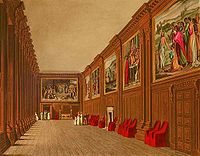 The palace houses many works of art and furnishings from the Royal Collection
, mainly dating from the two principal periods of the palace's construction, the early Tudor (Renaissance) and late Stuart to Early Georgian period. The single most important works are Mantegna
's Triumphs of Caesar
housed in the Lower Orangery. The palace once housed the Raphael Cartoons
now kept at the Victoria and Albert Museum
. Their former home, the Cartoon Gallery on the south side of the Fountain Court, was designed by Christopher Wren; copies painted in the 1690s by a minor artist, Henry Cooke
, are now displayed in their place. Also on display are important collections of ceramics, including numerous pieces of blue and white porcelain collected by Queen Mary II, both Chinese imports and Delftware
.
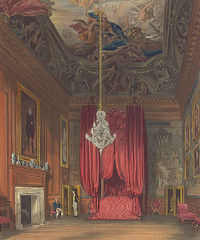 Much of the original furniture from the late 17th and early 18th centuries, including tables by Jean Pelletier, "India back" walnut chairs by Thomas Roberts and clocks and a barometer by Thomas Tompion
. Several state beds are still in their original positions, as is the Throne Canopy in the King's Privy Chamber. This room contains a crystal chandelier of circa 1700, possibly the first such in the country.
The King's Guard Chamber contains a large quantity of arms: muskets, pistols, swords, daggers, powder horn
s and pieces of armour arranged on the walls in decorative patterns. Bills exist for payment to a John Harris dated 1699 for the arrangement, which is believed to be that which can still be seen today.
in Baroque style carved by Grinling Gibbons
during the reign of Queen Anne
. Opposite the altar, at first floor level, is the royal pew where the royal family would attend services apart from the general congregation seated below.
Queen Catherine Howard was painfully dragged down this gallery pleading to Henry not to be executed.
, planted in 1924 which hints at the gardens' 16th century appearance. Today, the dominating feature of the grounds is the great landscaping scheme constructed for Sir Christopher Wren's intended new palace. From a water-bounded semicircular parterre
, the length of the east front, three avenues
radiate in crow's foot
pattern. The central avenue containing not a walk or a drive, but the great canal, known as the Long Water, excavated during the reign of Charles II, in 1662. The design, radical at the time, is another immediately recognizable influence from Versailles, and was indeed laid out by pupils of André Le Nôtre
, Louis XIV's landscape gardener.
On the south side of the palace is the Privy Garden bounded by semi-circular wrought iron gates by Jean Tijou
. This garden, originally William III's private garden, was replanted in 1992 in period style with manicured hollies
and yew
s along a geometric system of paths.
On a raised site overlooking the Thames, is a small pavilion, the Banqueting House. This was built circa 1700, for informal meals and entertainments in the gardens rather than for the larger state dinners which would have taken place inside the palace itself. A nearby conservatory houses the "Great Vine", planted in 1769; by 1968 it had a trunk 81 inches thick and has a length of 100 feet. It still produces an annual crop of grapes.
 A well known curiosity of the palace's grounds is Hampton Court Maze
; planted in the 1690s by George London
and Henry Wise for William III of Orange
. The maze covers a third of an acre and contains half a mile of paths. It is possible that the current design replaced an earlier maze planted for Cardinal Wolsey. It was originally planted with hornbeam
; it has been repaired latterly using many different types of hedge.
Inspired by narrow views of a Tudor garden that can be seen through doorways in a painting, The Family of Henry VIII, hanging in the palace's Haunted Gallery, a new garden in the style of Henry VIII’s 16th century Privy Gardens has been designed to celebrate the anniversary of that King’s accession to the throne. Sited on the former Chapel Court Garden, it has been planted with flowers and herbs from the 16th century, and is complete by gilded heraldic beasts and bold green and white painted fences. The heraldic beasts carved by Ben Harms
and Ray Gonzalez of G&H Studios includes The Golden Lion of England, The White Greyhound of Richmond, The Red Dragon of Wales and the White Hart of Richard II, are all carved from English oak. The garden's architect was Todd Langstaffe-Gowan, who collaborated with James Fox and the Gardens
Team at Historic Royal Palaces.
In 1796, the Great Hall was restored and in 1838, during the reign of Queen Victoria
, the restoration was completed and the palace opened to the public. The heavy-handed restoration plan at this time, reduced the Great Gatehouse (A), the palace's principal entrance, by two stories and removed the lead cupola
s adorning its four towers.
On 2 September 1952, the palace was given statutory protection by being grade I listed. Other buildings and structures within the grounds are separately grade I listed, including the early 16th-century tilt yard tower — the only surviving example of the five original towers; Christopher Wren
's Lion gate built for Queen Anne
and George I
; and the Tudor and 17th-century perimeter walls.
Throughout the 20th century in addition to becoming a major London tourist attraction, the palace housed 50 grace and favour
residences given to esteemed servants and subjects of the crown. It was an elderly recipient of one such grace and favour apartment who caused a major fire, which spread to the King's Apartments in 1986. This led to a new programme of restoration work which was completed in 1990.
It would serve as the location filmed for the 1966 film A Man for All Seasons
, directed by Fred Zinnemann
.
Other ghosts include Henry VIII himself and a woman named Mrs. Sybil Penn, Edward VI's nurse. She died of smallpox in 1562 and her grave was damaged by a storm in the early 19th century.
Staff have heard the sound of a spinning wheel and the muttering of an old woman and found a room containing an old spinning wheel.
London Borough of Richmond upon Thames
The London Borough of Richmond upon Thames is a London borough in South West London, UK, which forms part of Outer London. It is unique because it is the only London borough situated both north and south of the River Thames.-Settlement:...
, Greater London
Greater London
Greater London is the top-level administrative division of England covering London. It was created in 1965 and spans the City of London, including Middle Temple and Inner Temple, and the 32 London boroughs. This territory is coterminate with the London Government Office Region and the London...
; it has not been inhabited by the British royal family since the 18th century. The palace is located 11.7 miles (18.8 km) south west of Charing Cross
Charing Cross
Charing Cross denotes the junction of Strand, Whitehall and Cockspur Street, just south of Trafalgar Square in central London, England. It is named after the now demolished Eleanor cross that stood there, in what was once the hamlet of Charing. The site of the cross is now occupied by an equestrian...
and upstream of Central London
Central London
Central London is the innermost part of London, England. There is no official or commonly accepted definition of its area, but its characteristics are understood to include a high density built environment, high land values, an elevated daytime population and a concentration of regionally,...
on the River Thames
River Thames
The River Thames flows through southern England. It is the longest river entirely in England and the second longest in the United Kingdom. While it is best known because its lower reaches flow through central London, the river flows alongside several other towns and cities, including Oxford,...
. It was originally built for Cardinal Wolsey, a favourite
Favourite
A favourite , or favorite , was the intimate companion of a ruler or other important person. In medieval and Early Modern Europe, among other times and places, the term is used of individuals delegated significant political power by a ruler...
of King Henry VIII
Henry VIII of England
Henry VIII was King of England from 21 April 1509 until his death. He was Lord, and later King, of Ireland, as well as continuing the nominal claim by the English monarchs to the Kingdom of France...
, circa 1514; in 1529, as Wolsey fell from favour, the palace was passed to the King, who enlarged it.
The following century, William III
William III of England
William III & II was a sovereign Prince of Orange of the House of Orange-Nassau by birth. From 1672 he governed as Stadtholder William III of Orange over Holland, Zeeland, Utrecht, Guelders, and Overijssel of the Dutch Republic. From 1689 he reigned as William III over England and Ireland...
's massive rebuilding and expansion project intended to rival Versailles
Palace of Versailles
The Palace of Versailles , or simply Versailles, is a royal château in Versailles in the Île-de-France region of France. In French it is the Château de Versailles....
was begun. Work halted in 1694, leaving the palace in two distinct contrasting architectural styles, domestic Tudor
Tudor style architecture
The Tudor architectural style is the final development of medieval architecture during the Tudor period and even beyond, for conservative college patrons...
and Baroque
Baroque
The Baroque is a period and the style that used exaggerated motion and clear, easily interpreted detail to produce drama, tension, exuberance, and grandeur in sculpture, painting, literature, dance, and music...
. While the palace's styles are an accident of fate, a unity exists due to the use of pink bricks and a symmetrical, albeit vague, balancing of successive low wings.
Today, the palace is open to the public, and a major tourist attraction. It is cared for by an independent charity, Historic Royal Palaces
Historic Royal Palaces
Historic Royal Palaces is an independent charity created in 1998 to manage Britain's unoccupied royal palaces. These are:* The Tower of London* Hampton Court Palace* Kensington Palace - the state rooms only.* Banqueting House* Kew Palace...
which receives no funding from the Government or the Crown.
The palace's Home Park
Hampton Court Park
Hampton Court Park – sometimes called the Home Park – is adjacent to Hampton Court Palace and Gardens in southwest London, United Kingdom....
is the site of the annual Hampton Court Palace Festival
Hampton Court Palace Festival
The Hampton Court Palace Festival is an annual musical event held in June which was established in 1993. The Festival is known for presenting artists across the music genres such as Sir Elton John, Eric Clapton, Tom Jones, Andrea Bocelli, Van Morrison, Jools Holland, the Buena Vista Social Club,...
and Hampton Court Palace Flower Show
Hampton Court Palace Flower Show
The Hampton Court Palace Flower Show is the largest flower show in the world. The Show is held in early July, and run by the Royal Horticultural Society at Hampton Court Palace in southwest London. The show features show gardens, floral marquees and pavilions, talks and demonstrations...
. Along with St. James's Palace
St. James's Palace
St. James's Palace is one of London's oldest palaces. It is situated in Pall Mall, just north of St. James's Park. Although no sovereign has resided there for almost two centuries, it has remained the official residence of the Sovereign and the most senior royal palace in the UK...
, it is one of only two surviving palaces out of the many owned by Henry VIII.
Tudor period
Archbishop of York
The Archbishop of York is a high-ranking cleric in the Church of England, second only to the Archbishop of Canterbury. He is the diocesan bishop of the Diocese of York and metropolitan of the Province of York, which covers the northern portion of England as well as the Isle of Man...
, Chief Minister and favourite of King Henry VIII, took over the site of Hampton Court Palace in 1514. It had previously been a property of the Order of St John of Jerusalem. Over the following seven years, Wolsey spent lavishly to build the finest palace in England at Hampton Court, a figure of 200,000 gold crowns. Wolsey rebuilt the existing manor house to form the nucleus of the present palace. Today, little of Wolsey's building work remains unchanged. The first courtyard, the Base Court, (B on plan), was his creation, as was the second, inner gatehouse (C) which leads to the Clock Court (D) (Wolsey's seal remains visible over the entrance arch of the clock tower) which contained his private rooms (O on plan). The Base Court contained forty-four lodgings reserved for guests, while the second court (today, Clock Court) contained the very best rooms—the state apartments—reserved for the King and his family. Henry VIII stayed in the state apartments as Wolsey's guest immediately after their completion in 1525.
In building his palace, Wolsey was attempting to create a Renaissance
Renaissance
The Renaissance was a cultural movement that spanned roughly the 14th to the 17th century, beginning in Italy in the Late Middle Ages and later spreading to the rest of Europe. The term is also used more loosely to refer to the historical era, but since the changes of the Renaissance were not...
cardinal's palace featuring rectilinear symmetrical planning with grand apartments on a raised piano nobile
Piano nobile
The piano nobile is the principal floor of a large house, usually built in one of the styles of classical renaissance architecture...
, all rendered with classical detailing. Jonathan Foyle has suggested that it is likely that Wolsey had been inspired by Paolo Cortese's De Cardinalatu, a manual for cardinals that included advice on palatial architecture, published in 1510. The architectural historian Sir John Summerson
John Summerson
Sir John Newenham Summerson CH CBE was one of the leading British architectural historians of the 20th century....
asserts that the palace shows "the essence of Wolsey—the plain English churchman who nevertheless made his sovereign the arbiter of Europe and who built and furnished Hampton Court to show foreign embassies that Henry VIII's chief minister knew how to live as graciously as any cardinal in Rome." Whatever the concepts were, the architecture is an excellent and rare example of a thirty-year era when English architecture was in a harmonious transition from domestic Tudor, strongly influenced by perpendicular Gothic, to the Italian Renaissance classical style. Perpendicular Gothic owed nothing historically to the Renaissance style, yet harmonised well with it. This blending of styles was realised by a small group of Italian craftsmen working at the English court in the second and third decades of the sixteenth century. They specialised in the adding of Renaissance ornament to otherwise straightforward Tudor buildings. It was one of these, Giovanni da Maiano
Giovanni da Maiano
Giovanni da Maiano was an Italian sculptor employed by Henry VIII of England and Cardinal Wolsey to decorate their palaces. Maiano, from which village Giovanni took his name, is near Fiesole and Florence.-The Hampton Court medallions and Greenwich Palace:...
who was responsible for the set of eight relief
Relief
Relief is a sculptural technique. The term relief is from the Latin verb levo, to raise. To create a sculpture in relief is thus to give the impression that the sculpted material has been raised above the background plane...
busts of Roman emperors which were set in the Tudor brickwork.
Within six months of coming into ownership, the King began his own rebuilding and expansion. Henry VIII's court consisted of over one thousand people, while the King owned over sixty houses and palaces. Few of these were large enough to hold the assembled court, and thus one of the first of the King's building works (in order to transform Hampton Court to a principal residence) was to build the vast kitchens. These were quadrupled in size in 1529. The architecture of King Henry's new palace followed the design precedent set by Wolsey: perpendicular Gothic-inspired Tudor with restrained Renaissance ornament. This hybrid architecture was to remain almost unchanged for nearly a century, until Inigo Jones
Inigo Jones
Inigo Jones is the first significant British architect of the modern period, and the first to bring Italianate Renaissance architecture to England...
introduced strong classical influences from Italy to the London palaces of the first Stuart kings.
Between 1532 and 1535 Henry added the Great Hall (the last medieval great hall
Great hall
A great hall is the main room of a royal palace, nobleman's castle or a large manor house in the Middle Ages, and in the country houses of the 16th and early 17th centuries. At that time the word great simply meant big, and had not acquired its modern connotations of excellence...
built for the English monarchy) and the Royal Tennis Court
Royal Tennis Court, Hampton Court
The Royal Tennis Court, Hampton Court Palace is a real tennis court which was built for Henry VIII of England, who played there from 1528, and is still home to an active real tennis club....
. The Great Hall features a carved hammer-beam roof. During Tudor times, this was the most important room of the palace; here, the King would dine in state seated at a table upon a raised dais
Dais
Dais is any raised platform located either in or outside of a room or enclosure, often for dignified occupancy, as at the front of a lecture hall or sanctuary....
. The hall took five years to complete, so impatient was the King for completion that the masons were compelled to work throughout the night by candlelight.
The gatehouse to the second, inner court was adorned in 1540 with an early example of a post-Copernican astronomical clock
Astronomical clock
An astronomical clock is a clock with special mechanisms and dials to display astronomical information, such as the relative positions of the sun, moon, zodiacal constellations, and sometimes major planets.-Definition:...
. Still functioning, the clock shows the time of day, the phases of the moon, the month, the quarter of the year, the date, the sun and star sign, and high water
High Water
High Water is an album by hip hop artist El-P, released on March 9, 2004 through Thirsty Ear Recordings.Made in conjunction with jazz pianist Matthew Shipp and the group for which he is artistic director, The Blue Series Continuum, the album is a striking departure from El-P's usual style, almost...
at London Bridge
London Bridge
London Bridge is a bridge over the River Thames, connecting the City of London and Southwark, in central London. Situated between Cannon Street Railway Bridge and Tower Bridge, it forms the western end of the Pool of London...
. The latter information was of great importance to those visiting this Thames-side palace from London, as the preferred method of transport at the time was by barge, and at low water London Bridge
London Bridge
London Bridge is a bridge over the River Thames, connecting the City of London and Southwark, in central London. Situated between Cannon Street Railway Bridge and Tower Bridge, it forms the western end of the Pool of London...
created dangerous rapids. This gatehouse is also known today as Anne Boleyn
Anne Boleyn
Anne Boleyn ;c.1501/1507 – 19 May 1536) was Queen of England from 1533 to 1536 as the second wife of Henry VIII of England and Marquess of Pembroke in her own right. Henry's marriage to Anne, and her subsequent execution, made her a key figure in the political and religious upheaval that was the...
's gate, after Henry's second wife. Work was still underway on Anne Boleyn's apartments above the gate when the King, having tired of her, had her executed.
Edward VI of England
Edward VI was the King of England and Ireland from 28 January 1547 until his death. He was crowned on 20 February at the age of nine. The son of Henry VIII and Jane Seymour, Edward was the third monarch of the Tudor dynasty and England's first monarch who was raised as a Protestant...
, was born at the palace and the child's mother, Jane Seymour
Jane Seymour
Jane Seymour was Queen of England as the third wife of King Henry VIII. She succeeded Anne Boleyn as queen consort following the latter's execution for trumped up charges of high treason, incest and adultery in May 1536. She died of postnatal complications less than two weeks after the birth of...
, died there two weeks later. Four years afterwards, whilst attending Mass
Mass (liturgy)
"Mass" is one of the names by which the sacrament of the Eucharist is called in the Roman Catholic Church: others are "Eucharist", the "Lord's Supper", the "Breaking of Bread", the "Eucharistic assembly ", the "memorial of the Lord's Passion and Resurrection", the "Holy Sacrifice", the "Holy and...
in the palace's chapel, the King was informed of his fifth wife's adultery. The Queen, Catherine Howard
Catherine Howard
Catherine Howard , also spelled Katherine, Katheryn or Kathryn, was the fifth wife of Henry VIII of England, and sometimes known by his reference to her as his "rose without a thorn"....
, was then confined to her room for a few days before being sent to the tower. Legend claims she briefly escaped her guards and ran through The Haunted Gallery to beg Henry for her life but she was recaptured.
King Henry died in January 1547 and was succeeded first by his son Edward VI, and then by both his daughters in turn. It was to Hampton Court that Queen Mary I
Mary I of England
Mary I was queen regnant of England and Ireland from July 1553 until her death.She was the only surviving child born of the ill-fated marriage of Henry VIII and his first wife Catherine of Aragon. Her younger half-brother, Edward VI, succeeded Henry in 1547...
(Henry's eldest daughter) retreated with King Philip II of Spain
Philip II of Spain
Philip II was King of Spain, Portugal, Naples, Sicily, and, while married to Mary I, King of England and Ireland. He was lord of the Seventeen Provinces from 1556 until 1581, holding various titles for the individual territories such as duke or count....
to spend her honeymoon, after their wedding at Winchester
Winchester
Winchester is a historic cathedral city and former capital city of England. It is the county town of Hampshire, in South East England. The city lies at the heart of the wider City of Winchester, a local government district, and is located at the western end of the South Downs, along the course of...
. The marriage was politically expedient rather than a love match. Mary chose Hampton Court as the place for the birth of her first child, which turned out to be the first of two phantom pregnancies. Mary was succeeded by her half-sister, Elizabeth I and it was Elizabeth who had the Eastern kitchen built; today, this is the palace's public tea room.
Stuart period
James I of England
James VI and I was King of Scots as James VI from 24 July 1567 and King of England and Ireland as James I from the union of the English and Scottish crowns on 24 March 1603...
of the House of Stuart
House of Stuart
The House of Stuart is a European royal house. Founded by Robert II of Scotland, the Stewarts first became monarchs of the Kingdom of Scotland during the late 14th century, and subsequently held the position of the Kings of Great Britain and Ireland...
.
In 1604, the palace was the site of King James' meeting with representatives of the English Puritans, known as the Hampton Court Conference
Hampton Court Conference
The Hampton Court Conference was a meeting in January 1604, convened at Hampton Court Palace, for discussion between King James I of England and representatives of the Church of England, including leading English Puritans.-Attendance:...
; while agreement with the Puritans was not reached, the meeting led to James's commissioning of the King James Version of the Bible
Bible
The Bible refers to any one of the collections of the primary religious texts of Judaism and Christianity. There is no common version of the Bible, as the individual books , their contents and their order vary among denominations...
.
King James was succeeded in 1625 by his son, the ill-fated Charles I
Charles I of England
Charles I was King of England, King of Scotland, and King of Ireland from 27 March 1625 until his execution in 1649. Charles engaged in a struggle for power with the Parliament of England, attempting to obtain royal revenue whilst Parliament sought to curb his Royal prerogative which Charles...
. For this king, Hampton Court was to become both his palace and his prison. It was also the setting for his honeymoon with his fifteen year old bride, Henrietta Maria in 1625. Following King Charles' execution in 1649, the palace became the property of the Commonwealth presided over by Oliver Cromwell
Oliver Cromwell
Oliver Cromwell was an English military and political leader who overthrew the English monarchy and temporarily turned England into a republican Commonwealth, and served as Lord Protector of England, Scotland, and Ireland....
. Unlike some other former royal properties, the palace escaped relatively unscathed. While the government auctioned much of the contents, the building was ignored.
After the Restoration
English Restoration
The Restoration of the English monarchy began in 1660 when the English, Scottish and Irish monarchies were all restored under Charles II after the Interregnum that followed the Wars of the Three Kingdoms...
, King Charles II
Charles II of England
Charles II was monarch of the three kingdoms of England, Scotland, and Ireland.Charles II's father, King Charles I, was executed at Whitehall on 30 January 1649, at the climax of the English Civil War...
and his successor James II
James II of England
James II & VII was King of England and King of Ireland as James II and King of Scotland as James VII, from 6 February 1685. He was the last Catholic monarch to reign over the Kingdoms of England, Scotland, and Ireland...
visited Hampton Court but largely preferred to reside elsewhere. By this time, by current French court standards Hampton Court appeared old-fashioned. It was in 1689, shortly after Louis XIV's court had moved permanently to Versailles, that the palace's antiquated state was addressed. England had two new joint monarchs, William of Orange
William III of England
William III & II was a sovereign Prince of Orange of the House of Orange-Nassau by birth. From 1672 he governed as Stadtholder William III of Orange over Holland, Zeeland, Utrecht, Guelders, and Overijssel of the Dutch Republic. From 1689 he reigned as William III over England and Ireland...
and his wife, the daughter of James II, Queen Mary II
Mary II of England
Mary II was joint Sovereign of England, Scotland, and Ireland with her husband and first cousin, William III and II, from 1689 until her death. William and Mary, both Protestants, became king and queen regnant, respectively, following the Glorious Revolution, which resulted in the deposition of...
. Within months of their accession they embarked on a massive rebuilding project at Hampton Court. The intention was to demolish the Tudor palace a section at a time, while replacing it with a huge modern palace in the Baroque style retaining only Henry VIII's Great Hall. The country's most eminent architect, Sir Christopher Wren
Christopher Wren
Sir Christopher Wren FRS is one of the most highly acclaimed English architects in history.He used to be accorded responsibility for rebuilding 51 churches in the City of London after the Great Fire in 1666, including his masterpiece, St. Paul's Cathedral, on Ludgate Hill, completed in 1710...
, was called upon to draw the plans, while the master of works was to be William Talman
William Talman (architect)
William Talman was an English architect and landscape designer. A pupil of Sir Christopher Wren, in 1678 he and Thomas Apprice gained the office of King's Waiter in the Port of London...
. The plan was for a vast palace constructed around two courtyards at right angles to each other. Wren's design for a domed palace bore resemblances to the work of Jules Hardouin Mansart
Jules Hardouin Mansart
Jules Hardouin-Mansart was a French architect whose work is generally considered to be the apex of French Baroque architecture, representing the power and grandeur of Louis XIV...
and Louis Le Vau
Louis Le Vau
Louis Le Vau was a French Classical architect who worked for Louis XIV of France. He was born and died in Paris.He was responsible, with André Le Nôtre and Charles Le Brun, for the redesign of the château of Vaux-le-Vicomte. His later works included the Palace of Versailles and his collaboration...
, both architects employed by Louis XIV at Versailles. It has been suggested, though, that the plans were abandoned because the resemblance to Versailles was too subtle and not strong enough; at this time, it was impossible for any sovereign to visualise a palace that did not emulate Versailles' repetitive Baroque form. However, the resemblances are there: while the façades are not so long as those of Versailles, they have similar seemingly unstoppable repetitive rhythms beneath a long flat skyline. The monotony is even repeated as the façade turns the corner from the east to the south fronts. However, Hampton Court, unlike Versailles, is given an extra dimension by the contrast between the pink brick and the pale Portland stone
Portland stone
Portland stone is a limestone from the Tithonian stage of the Jurassic period quarried on the Isle of Portland, Dorset. The quarries consist of beds of white-grey limestone separated by chert beds. It has been used extensively as a building stone throughout the British Isles, notably in major...
quoins, frames and banding. Further diversion is added by the circular and decorated windows of the second floor mezzanine. This theme is repeated in the inner Fountain Court, but the rhythm is faster and the windows, unpedimented on the outer façades, are given pointed pediments in the courtyard; this has led the courtyard to be described as "Startling, as of simultaneous exposure to a great many eyes with raised eyebrows."
Hall of Mirrors (Palace of Versailles)
The Hall of Mirrors is the central gallery of the Palace of Versailles and is renowned as being one of the most famous rooms in the world.As the principal and most remarkable feature of King Louis XIV of France's third building campaign of the Palace of Versailles , construction of the Hall of...
. However, at Hampton Court the linking gallery is of more modest proportions and decoration. The King's staircase was decorated with fresco
Fresco
Fresco is any of several related mural painting types, executed on plaster on walls or ceilings. The word fresco comes from the Greek word affresca which derives from the Latin word for "fresh". Frescoes first developed in the ancient world and continued to be popular through the Renaissance...
s by Antonio Verrio
Antonio Verrio
The Italian-born Antonio Verrio was responsible for introducing Baroque mural painting into England and served the Crown over a thirty year period.-Career:...
and delicate ironwork by Jean Tijou
Jean Tijou
Jean Tijou was a French Huguenot ironworker. He is known solely through his work in England, where he worked on several of the key English Baroque buildings. He arrived in England in c.1689 and enjoyed the patronage of William and Mary for whom he made gates and railings for Hampton Court Palace....
. Other artists commissioned to decorate the rooms included Grinling Gibbons
Grinling Gibbons
Grinling Gibbons was an English sculptor and wood carver known for his work in England, including St Paul's Cathedral, Blenheim Palace and Hampton Court Palace. He was born and educated in Holland where his father was a merchant...
, Sir James Thornhill
James Thornhill
Sir James Thornhill was an English painter of historical subjects, in the Italian baroque tradition.-Life:...
and Jacques Rousseau
Jacques Rousseau
This is an article about Jacques Rousseau the 17th century French Huguenot painter, for the 17th century Dutch painter see Jacques des Rousseaux and for the French long jumper see Jacques Rousseau ....
; furnishings were designed by Daniel Marot
Daniel Marot
Daniel Marot was a French Protestant, an architect, furniture designer and engraver at the forefront of the classicizing Late Baroque "Louis XIV" style....
.
After the death of Queen Mary, King William lost interest in the renovations, and work ceased. However, it was in Hampton Court Park
Hampton Court Park
Hampton Court Park – sometimes called the Home Park – is adjacent to Hampton Court Palace and Gardens in southwest London, United Kingdom....
in 1702 that he fell from his horse, later dying from his injuries at Kensington Palace
Kensington Palace
Kensington Palace is a royal residence set in Kensington Gardens in the Royal Borough of Kensington and Chelsea in London, England. It has been a residence of the British Royal Family since the 17th century and is the official London residence of the Duke and Duchess of Cambridge, the Duke and...
. He was succeeded by his sister-in-law Queen Anne
Anne of Great Britain
Anne ascended the thrones of England, Scotland and Ireland on 8 March 1702. On 1 May 1707, under the Act of Union, two of her realms, England and Scotland, were united as a single sovereign state, the Kingdom of Great Britain.Anne's Catholic father, James II and VII, was deposed during the...
who continued the decoration and completion of the state apartments. On Queen Anne's death in 1714 the Stuart dynasty came to an end.
Queen Anne's successor was George I; he and his son George II
George II of Great Britain
George II was King of Great Britain and Ireland, Duke of Brunswick-Lüneburg and Archtreasurer and Prince-elector of the Holy Roman Empire from 11 June 1727 until his death.George was the last British monarch born outside Great Britain. He was born and brought up in Northern Germany...
were the last monarchs to reside at Hampton Court. Under George I six rooms were completed in 1717 to the design of John Vanbrugh
John Vanbrugh
Sir John Vanbrugh – 26 March 1726) was an English architect and dramatist, perhaps best known as the designer of Blenheim Palace and Castle Howard. He wrote two argumentative and outspoken Restoration comedies, The Relapse and The Provoked Wife , which have become enduring stage favourites...
. Under George II
George II of Great Britain
George II was King of Great Britain and Ireland, Duke of Brunswick-Lüneburg and Archtreasurer and Prince-elector of the Holy Roman Empire from 11 June 1727 until his death.George was the last British monarch born outside Great Britain. He was born and brought up in Northern Germany...
and his Queen, Caroline
Caroline of Ansbach
Caroline of Brandenburg-Ansbach was the queen consort of King George II of Great Britain.Her father, John Frederick, Margrave of Brandenburg-Ansbach, was the ruler of a small German state...
, further refurbishment took place, with the architect William Kent
William Kent
William Kent , born in Bridlington, Yorkshire, was an eminent English architect, landscape architect and furniture designer of the early 18th century.He was baptised as William Cant.-Education:...
employed to design new furnishings and decor including the Queen's Staircase, (1733) and the Cumberland Suite (1737) for the Duke of Cumberland. Today, the Queen's Private Apartments are open to the public and include her bathroom and bedroom
Contents
Royal Collection
The Royal Collection is the art collection of the British Royal Family. It is property of the monarch as sovereign, but is held in trust for her successors and the nation. It contains over 7,000 paintings, 40,000 watercolours and drawings, and about 150,000 old master prints, as well as historical...
, mainly dating from the two principal periods of the palace's construction, the early Tudor (Renaissance) and late Stuart to Early Georgian period. The single most important works are Mantegna
Andrea Mantegna
Andrea Mantegna was an Italian painter, a student of Roman archeology, and son in law of Jacopo Bellini. Like other artists of the time, Mantegna experimented with perspective, e.g., by lowering the horizon in order to create a sense of greater monumentality...
's Triumphs of Caesar
Triumphs of Caesar
The Triumphs of Caesar are a series of nine large paintings created by the Italian Renaissance artist Andrea Mantegna between 1486 and 1505 for the Ducal Palace, Mantua. They depict a triumphal military parade celebrating the victory of Julius Caesar in the Gallic Wars...
housed in the Lower Orangery. The palace once housed the Raphael Cartoons
Raphael Cartoons
The Raphael Cartoons are seven large cartoons for tapestries, now in the Victoria and Albert Museum, London, painted by the High Renaissance painter Raphael in 1515-16 and showing scenes from the Gospels and Acts of the Apostles...
now kept at the Victoria and Albert Museum
Victoria and Albert Museum
The Victoria and Albert Museum , set in the Brompton district of The Royal Borough of Kensington and Chelsea, London, England, is the world's largest museum of decorative arts and design, housing a permanent collection of over 4.5 million objects...
. Their former home, the Cartoon Gallery on the south side of the Fountain Court, was designed by Christopher Wren; copies painted in the 1690s by a minor artist, Henry Cooke
Henry Cooke (artist)
Henry Cooke, son of Henry Cooke, who was employed by the Ironmongers' Company, was born in 1642. He went to Italy and studied under Salvator Rosa. He painted the choir of New College Chapel, Oxford, the staircase at Ranelagh House, and Lord Carlisle's House in Soho Square...
, are now displayed in their place. Also on display are important collections of ceramics, including numerous pieces of blue and white porcelain collected by Queen Mary II, both Chinese imports and Delftware
Delftware
Delftware, or Delft pottery, denotes blue and white pottery made in and around Delft in the Netherlands and the tin-glazed pottery made in the Netherlands from the 16th century....
.
Thomas Tompion
Thomas Tompion was an English clock maker, watchmaker and mechanician who is still regarded to this day as the Father of English Clockmaking. Tompion's work includes some of the most historic and important clocks and watches in the world and can command very high prices whenever outstanding...
. Several state beds are still in their original positions, as is the Throne Canopy in the King's Privy Chamber. This room contains a crystal chandelier of circa 1700, possibly the first such in the country.
The King's Guard Chamber contains a large quantity of arms: muskets, pistols, swords, daggers, powder horn
Powder Horn
Powder Horn may mean:* Powder Horn , the device for carrying gunpowder*Powder Horn , the Venturing training program offered by the Boy Scouts of America...
s and pieces of armour arranged on the walls in decorative patterns. Bills exist for payment to a John Harris dated 1699 for the arrangement, which is believed to be that which can still be seen today.
Chapel Royal
The double height chapel was begun by Wolsey and completed under Henry VIII. Its timber and plaster ceiling, a Gothic vault with Renaissance pendants completed by trumpeting boys, is considered the "most important and magnificent in Britain." The altar is framed by a massive oak reredosReredos
thumb|300px|right|An altar and reredos from [[St. Josaphat's Roman Catholic Church|St. Josaphat Catholic Church]] in [[Detroit]], [[Michigan]]. This would be called a [[retable]] in many other languages and countries....
in Baroque style carved by Grinling Gibbons
Grinling Gibbons
Grinling Gibbons was an English sculptor and wood carver known for his work in England, including St Paul's Cathedral, Blenheim Palace and Hampton Court Palace. He was born and educated in Holland where his father was a merchant...
during the reign of Queen Anne
Anne of Great Britain
Anne ascended the thrones of England, Scotland and Ireland on 8 March 1702. On 1 May 1707, under the Act of Union, two of her realms, England and Scotland, were united as a single sovereign state, the Kingdom of Great Britain.Anne's Catholic father, James II and VII, was deposed during the...
. Opposite the altar, at first floor level, is the royal pew where the royal family would attend services apart from the general congregation seated below.
Queen Catherine Howard was painfully dragged down this gallery pleading to Henry not to be executed.
Grounds
The grounds as they appear today were laid out in grand style in the late 17th century. There are no authentic remains of Henry VIII's gardens, merely a small knot gardenKnot garden
A knot garden is a garden of very formal design in a square frame, consisting of a variety of aromatic plants and culinary herbs including germander, marjoram, thyme, southernwood, lemon balm, hyssop, costmary, acanthus, mallow, chamomile, rosemary, Calendulas, Violas and Santolina...
, planted in 1924 which hints at the gardens' 16th century appearance. Today, the dominating feature of the grounds is the great landscaping scheme constructed for Sir Christopher Wren's intended new palace. From a water-bounded semicircular parterre
Parterre
A parterre is a formal garden construction on a level surface consisting of planting beds, edged in stone or tightly clipped hedging, and gravel paths arranged to form a pleasing, usually symmetrical pattern. Parterres need not have any flowers at all...
, the length of the east front, three avenues
Avenue (landscape)
__notoc__In landscaping, an avenue or allée is traditionally a straight route with a line of trees or large shrubs running along each, which is used, as its French source venir indicates, to emphasize the "coming to," or arrival at a landscape or architectural feature...
radiate in crow's foot
Broad arrow
A broad arrow or pheon is a type of arrow with a typically flat barbed head. It is a symbol used traditionally in heraldry, most notably in England, and later the United Kingdom to mark government property.-Use in heraldry:...
pattern. The central avenue containing not a walk or a drive, but the great canal, known as the Long Water, excavated during the reign of Charles II, in 1662. The design, radical at the time, is another immediately recognizable influence from Versailles, and was indeed laid out by pupils of André Le Nôtre
André Le Nôtre
André Le Nôtre was a French landscape architect and the principal gardener of King Louis XIV of France...
, Louis XIV's landscape gardener.
On the south side of the palace is the Privy Garden bounded by semi-circular wrought iron gates by Jean Tijou
Jean Tijou
Jean Tijou was a French Huguenot ironworker. He is known solely through his work in England, where he worked on several of the key English Baroque buildings. He arrived in England in c.1689 and enjoyed the patronage of William and Mary for whom he made gates and railings for Hampton Court Palace....
. This garden, originally William III's private garden, was replanted in 1992 in period style with manicured hollies
Holly
Ilex) is a genus of 400 to 600 species of flowering plants in the family Aquifoliaceae, and the only living genus in that family. The species are evergreen and deciduous trees, shrubs, and climbers from tropics to temperate zones world wide....
and yew
Taxus
Taxus is a genus of yews, small coniferous trees or shrubs in the yew family Taxaceae. They are relatively slow-growing and can be very long-lived, and reach heights of 1-40 m, with trunk diameters of up to 4 m...
s along a geometric system of paths.
On a raised site overlooking the Thames, is a small pavilion, the Banqueting House. This was built circa 1700, for informal meals and entertainments in the gardens rather than for the larger state dinners which would have taken place inside the palace itself. A nearby conservatory houses the "Great Vine", planted in 1769; by 1968 it had a trunk 81 inches thick and has a length of 100 feet. It still produces an annual crop of grapes.
Hampton Court Maze
Hampton Court Maze is a hedge maze planted some time between 1689 and 1695 by George London and Henry Wise for William III of Orange at Hampton Court Palace. The maze covers a third of an acre and contains half a mile of paths. It is possible that the current design replaced an earlier maze planted...
; planted in the 1690s by George London
George London (landscape architect)
George London was an English nurseryman and garden designer. He aspired to the baroque style and worked on the gardens at Hampton Court, Melbourne Hall and Wimpole Hall....
and Henry Wise for William III of Orange
William III of England
William III & II was a sovereign Prince of Orange of the House of Orange-Nassau by birth. From 1672 he governed as Stadtholder William III of Orange over Holland, Zeeland, Utrecht, Guelders, and Overijssel of the Dutch Republic. From 1689 he reigned as William III over England and Ireland...
. The maze covers a third of an acre and contains half a mile of paths. It is possible that the current design replaced an earlier maze planted for Cardinal Wolsey. It was originally planted with hornbeam
Hornbeam
Hornbeams are relatively small hardwood trees in the genus Carpinus . Though some botanists grouped them with the hazels and hop-hornbeams in a segregate family, Corylaceae, modern botanists place the hornbeams in the birch subfamily Coryloideae...
; it has been repaired latterly using many different types of hedge.
Inspired by narrow views of a Tudor garden that can be seen through doorways in a painting, The Family of Henry VIII, hanging in the palace's Haunted Gallery, a new garden in the style of Henry VIII’s 16th century Privy Gardens has been designed to celebrate the anniversary of that King’s accession to the throne. Sited on the former Chapel Court Garden, it has been planted with flowers and herbs from the 16th century, and is complete by gilded heraldic beasts and bold green and white painted fences. The heraldic beasts carved by Ben Harms
Ben Harms
Ben Harms is a German born traditional woodcarver working in England and current President of The Master Carvers Association. Some of his work can be seen at The Tower of London, Windsor Castle, Kensington Palace, Hampton Court and alongside the work of Grinling Gibbons at Petworth House.-Life...
and Ray Gonzalez of G&H Studios includes The Golden Lion of England, The White Greyhound of Richmond, The Red Dragon of Wales and the White Hart of Richard II, are all carved from English oak. The garden's architect was Todd Langstaffe-Gowan, who collaborated with James Fox and the Gardens
Team at Historic Royal Palaces.
Later years
After the reign of George II, no monarch ever resided at Hampton Court. In fact, George III, from the moment of his accession, never set foot in the palace; he associated the state apartments with a humiliating scene when his father had once struck him following an innocent remark.In 1796, the Great Hall was restored and in 1838, during the reign of Queen Victoria
Victoria of the United Kingdom
Victoria was the monarch of the United Kingdom of Great Britain and Ireland from 20 June 1837 until her death. From 1 May 1876, she used the additional title of Empress of India....
, the restoration was completed and the palace opened to the public. The heavy-handed restoration plan at this time, reduced the Great Gatehouse (A), the palace's principal entrance, by two stories and removed the lead cupola
Cupola
In architecture, a cupola is a small, most-often dome-like, structure on top of a building. Often used to provide a lookout or to admit light and air, it usually crowns a larger roof or dome....
s adorning its four towers.
On 2 September 1952, the palace was given statutory protection by being grade I listed. Other buildings and structures within the grounds are separately grade I listed, including the early 16th-century tilt yard tower — the only surviving example of the five original towers; Christopher Wren
Christopher Wren
Sir Christopher Wren FRS is one of the most highly acclaimed English architects in history.He used to be accorded responsibility for rebuilding 51 churches in the City of London after the Great Fire in 1666, including his masterpiece, St. Paul's Cathedral, on Ludgate Hill, completed in 1710...
's Lion gate built for Queen Anne
Anne of Great Britain
Anne ascended the thrones of England, Scotland and Ireland on 8 March 1702. On 1 May 1707, under the Act of Union, two of her realms, England and Scotland, were united as a single sovereign state, the Kingdom of Great Britain.Anne's Catholic father, James II and VII, was deposed during the...
and George I
George I of Great Britain
George I was King of Great Britain and Ireland from 1 August 1714 until his death, and ruler of the Duchy and Electorate of Brunswick-Lüneburg in the Holy Roman Empire from 1698....
; and the Tudor and 17th-century perimeter walls.
Throughout the 20th century in addition to becoming a major London tourist attraction, the palace housed 50 grace and favour
Grace and favour
A grace and favour home is a residential property owned by a monarch by virtue of their position as head of state and leased rent-free to persons as part of an employment package or in gratitude for past services rendered....
residences given to esteemed servants and subjects of the crown. It was an elderly recipient of one such grace and favour apartment who caused a major fire, which spread to the King's Apartments in 1986. This led to a new programme of restoration work which was completed in 1990.
It would serve as the location filmed for the 1966 film A Man for All Seasons
A Man for All Seasons (1966 film)
A Man for All Seasons is a 1966 film based on Robert Bolt's play A Man for All Seasons about Sir Thomas More. It was released on December 12, 1966. Paul Scofield, who had played More in the West End stage premiere, also took the role in the film. It was directed by Fred Zinnemann, who had...
, directed by Fred Zinnemann
Fred Zinnemann
Fred Zinnemann was an Austrian-American film director. He won four Academy Awards and directed films like High Noon, From Here to Eternity and A Man for All Seasons.-Life and career:...
.
Legend
According to legend, the ghost of Catherine Howard haunts The Haunted Gallery. Staff have reported hearing screaming and crying and even the thumping on the chapel doors, visitors have also claimed to have unpleasant encounters. Jane Seymour, Henry VIII's third wife is said to appear holding a candle on the anniversary of her son Edward VI's birth.Other ghosts include Henry VIII himself and a woman named Mrs. Sybil Penn, Edward VI's nurse. She died of smallpox in 1562 and her grave was damaged by a storm in the early 19th century.
Staff have heard the sound of a spinning wheel and the muttering of an old woman and found a room containing an old spinning wheel.
See also
- Het Loo Palace
- List of artists at Hampton Court Palace
- Treaty of Hampton Court (1562)Treaty of Hampton Court (1562)The Treaty of Hampton Court was signed on 22 September 1562 between Queen Elizabeth and Huguenot leader Louis I de Bourbon, prince de Condé. The treaty was concluded by François de Beauvais, Seigneur de Briquemault. Based on the terms of the accord, 3000 English troops were summoned to occupy Le...
, also known as the Treaty of Richmond, signed on 22 September 1562 between Queen ElizabethElizabeth I of EnglandElizabeth I was queen regnant of England and Ireland from 17 November 1558 until her death. Sometimes called The Virgin Queen, Gloriana, or Good Queen Bess, Elizabeth was the fifth and last monarch of the Tudor dynasty...
and HuguenotHuguenotThe Huguenots were members of the Protestant Reformed Church of France during the 16th and 17th centuries. Since the 17th century, people who formerly would have been called Huguenots have instead simply been called French Protestants, a title suggested by their German co-religionists, the...
leader Louis I de Bourbon, prince de CondéLouis I de Bourbon, prince de CondéLouis de Bourbon was a prominent Huguenot leader and general, the founder of the House of Condé, a cadet branch of the House of Bourbon.-Life:...
External links
- Official site at Historic Royal Palaces
- Historic photos of Hampton Court Palace
- Hampton Court by Walter Jerrold
- Grace & Favour: A handbook of who lived where at Hampton Court 1750-1950 - there are full floor plans of the palace on pages 10–13
- Jonathan Foyle: "Hampton Court: the lost Palace" 2002
- Aerial view of the maze at Google Maps
- The Hampton Court Flower Show
- The Royal Tennis Court at Hampton Court Palace
- The Choir of The Chapel Royal at Hampton Court Palace
- Aerial photo and map
- Areal photo and solution map to the Maze