

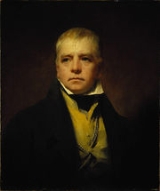
Walter Scott

Encyclopedia
Sir Walter Scott, 1st Baronet (15 August 1771 – 21 September 1832) was a Scottish historical novelist, playwright, and poet, popular throughout much of the world during his time.
Scott was the first English-language author to have a truly international career in his lifetime, with many contemporary readers in Europe, Australia, and North America. His novels and poetry are still read, and many of his works remain classics of both English-language literature and of Scottish literature
. Famous titles include Ivanhoe
, Rob Roy
, The Lady of the Lake
, Waverley
, The Heart of Midlothian
and The Bride of Lammermoor
.
 Born in College Wynd in the Old Town
of Edinburgh
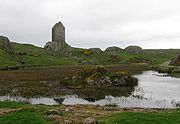
in 1771, the son of a solicitor, Scott survived a childhood bout of polio in 1773 that left him lame. To cure his lameness he was sent in 1773 to live in the rural Borders
region at his grandparents' farm at Sandyknowe, adjacent to the ruin of Smailholm Tower
, the earlier family home. Here he was taught to read by his aunt Jenny, and learned from her the speech patterns and many of the tales and legends that characterised much of his work. In January 1775 he returned to Edinburgh, and that summer went with his aunt Jenny to take spa treatment at Bath in England, where they lived at 6 South Parade
. In the winter of 1776 he went back to Sandyknowe, with another attempt at a water cure at Prestonpans
during the following summer.Edinburgh University archive, Sandyknowe
In 1778 Scott returned to Edinburgh for private education to prepare him for school, and in October 1779 he began at the Royal High School of Edinburgh
. He was now well able to walk and explore the city and the surrounding countryside. His reading included chivalric romances, poems, history and travel books. He was given private tuition by James Mitchell in arithmetic and writing, and learned from him the history of the Kirk
with emphasis on the Covenanters. After finishing school he was sent to stay for six months with his aunt Jenny in Kelso, attending the local Grammar School
where he met James and John Ballantyne who later became his business partners and printed his books.
in November 1783, at the age of only 12, a year or so younger than most of his fellow students. In March 1786 he began an apprenticeship in his father's office to become a Writer to the Signet. While at the university Scott had become a friend of Adam Ferguson, the son of Professor Adam Ferguson
who hosted literary salons. Scott met the blind poet Thomas Blacklock
who lent him books as well as introducing him to James Macpherson
's Ossian
cycle of poems. During the winter of 1786–87 the 15-year-old Scott saw Robert Burns
at one of these salons, for what was to be their only meeting. When Burns noticed a print illustrating the poem "The Justice of the Peace" and asked who had written the poem, only Scott knew that it was by John Langhorne, and was thanked by Burns. When it was decided that he would become a lawyer, he returned to the university to study law, first taking classes in Moral Philosophy and Universal History in 1789–90.
After completing his studies in law, he became a lawyer in Edinburgh. As a lawyer's clerk he made his first visit to the Scottish Highlands directing an eviction. He was admitted to the Faculty of Advocates
in 1792. He had an unsuccessful love suit with Williamina Belsches of Fettercairn, who married Scott´s friend Sir William Forbes, 6th Baronet.
in 1796. He then published an idiosyncratic three-volume set of collected ballads of his adopted home region, The Minstrelsy of the Scottish Border
. This was the first sign from a literary standpoint of his interest in Scottish history.
As a result of his early polio infection, Scott had a pronounced limp. Although a determined walker, on horseback he experienced greater freedom of movement. Unable to consider a military career, Scott enlisted as a volunteer in the 1st Lothian and Border yeomanry
. On a trip to the Lake District with old college friends he met Charlotte Genevieve Charpentier (or Carpenter), daughter of Jean Charpentier of Lyon
in France, and ward of Lord Downshire in Cumberland. After three weeks of courtship, Scott proposed and they were married on Christmas Eve 1797. They had five children, of whom only 4 survived by the time of Scott's death. In 1799 he was appointed Sheriff-Depute
of the County of Selkirk, based in the Royal Burgh
of Selkirk. In his early married days Scott had a decent living from his earnings at the law, his salary as Sheriff-Depute, his wife's income, some revenue from his writing, and his share of his father's rather meagre estate.
In 1796, Scott's friend James Ballantyne
founded a printing press in Kelso, in the Scottish Borders. Through Ballantyne, Scott was able to publish his first works and his poetry then began to bring him to public attention. In 1805, The Lay of the Last Minstrel captured wide public imagination, and his career as a writer was established in spectacular fashion. He published many other poems over the next ten years, including the popular The Lady of the Lake, printed in 1810 and set in the Trossachs
. Portions of the German translation of this work were set to music by Franz Schubert
. One of these songs, Ellens dritter Gesang
, is popularly labelled as "Schubert's Ave Maria". Marmion, published in 1808, produced some of his most memorable lines. Canto VI. Stanza 17 reads:
Yet Clare's sharp questions must I shun
Must separate Constance from the nun
Oh! what a tangled web we weave
When first we practise to deceive!
A Palmer too! No wonder why
I felt rebuked beneath his eye
In 1809, Scott persuaded James Ballantyne
and his brother to move to Edinburgh and to establish their printing press there. He became a partner in their business. As a political conservative and advocate of the Union with England, Scott helped to found the Tory
Quarterly Review
, a review journal to which he made several anonymous contributions.
In 1813 he was offered the position of Poet Laureate
. He declined, and the position went to Robert Southey
.
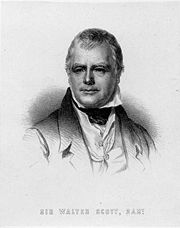 Scott's first success was his poetry. Since childhood, he had been fascinated by stories in the oral tradition of the Scottish Borders. This drew him to explore the writing of prose. Hitherto, the novel was accorded lower (and often scandalous) social value compared to the epic poetry that had brought him public acclaim. In an innovative and astute action, he wrote and published his first novel, Waverley
, under the guise of anonymity. It was a tale of the Jacobite rising
of 1745 in the Kingdom of Great Britain
. Its English protagonist was Edward Waverley, by his Tory upbringing sympathetic to the Jacobite
cause. Becoming enmeshed in events, however, he eventually chooses Hanoverian
respectability. There followed a succession of novels over the next five years, each with a Scottish historical setting. Mindful of his reputation as a poet, Scott maintained the anonymity he had begun with Waverley, always publishing the novels under the name Author of Waverley or attributed as "Tales of..." with no author. Even when it was clear that there would be no harm in coming out into the open, he maintained the façade, apparently out of a sense of fun. During this time the nickname The Wizard of the North was popularly applied to the mysterious best-selling writer. His identity as the author of the novels was widely rumoured, and in 1815 Scott was given the honour of dining with George, Prince Regent, who wanted to meet "the author of Waverley".
In 1819 Ivanhoe
, a historical romance set in 12th-century England, marked a move away from a focus on the history and society of Scotland. Ivanhoe features a sympathetic Jewish character named Rebecca, considered by many critics to be the book's real heroine. This was remarkable at a time when the struggle for the Emancipation of the Jews in England
was gathering momentum, and arguably reflects Scott's deep-seated sense of natural and humanistic justice. It too was a success, and he wrote several others along similar lines.
Scott wrote The Bride of Lammermoor
based on a true story of two lovers, in the setting of the Lammermuir Hills
. In the novel, Lucie Ashton and Edgar Ravenswood exchange vows, but Lucie's mother discovers that Edgar is an enemy of their family. She intervenes and forces her daughter to marry Sir Arthur Bucklaw, who has just inherited a large sum of money on the death of his aunt. On their wedding night, Lucie stabs the bridegroom, succumbs to insanity, and dies. Donizetti
's opera Lucia di Lammermoor
was based on Scott's novel.
His fame grew as his explorations and interpretations of Scottish history and society captured popular imagination. Impressed by this, the Prince Regent (the future George IV) gave Scott permission to search for the fabled but long-lost Honours (Crown Jewels) of Scotland, which had last been used to crown Charles II and during the years of the Protectorate under Cromwell had been squirrelled away. In 1818, Scott and a small team of military men unearthed the honours from the depths of Edinburgh Castle. A grateful Prince Regent granted Scott the title of baronet. Later, after George's accession to the throne, the city government of Edinburgh invited Scott, at the King's behest, to stage-manage the King's entry into Edinburgh. With only three weeks for planning and execution, Scott created a spectacular and comprehensive pageant, designed not only to impress the King, but also in some way to heal the rifts that had previously destabilised Scots society. He used the event to contribute to the drawing of a line under an old world that pitched his homeland into regular bouts of bloody strife. He, along with his 'production team', mounted what in modern days could be termed a PR event, in which the (rather tubby) King was dressed in tartan, and was greeted by his people, many of whom were also dressed in similar tartan ceremonial dress. This form of dress, previously proscribed after the 1745 rebellion against the English, subsequently became one of the seminal, potent and ubiquitous symbols of Scottish identity.
Much of Scott's autograph work shows an almost stream-of-consciousness approach to writing. He included little in the way of punctuation in his drafts, leaving such details to the printers to supply. He eventually acknowledged in 1827 that he was the author of the Waverley novels.
 When Scott was a boy, he sometimes travelled with his father from Selkirk to Melrose
in the Border Country
where some of his novels are set. At a certain spot the old gentleman would stop the carriage and take his son to a stone on the site of the Battle of Melrose
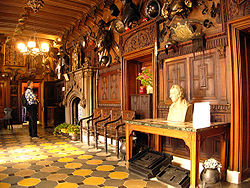
(1526). Not far away was a little farm called Cartleyhole, and this Scott eventually purchased. The farmhouse developed into a wonderful home that has been likened to a fairy palace. Through windows enriched with the insignia of heraldry the sun shone on suits of armour, trophies of the chase, a library of over 9,000 volumes, fine furniture, and still finer pictures. Panelling of oak and cedar and carved ceilings relieved by coats of arms in their correct colours added to the beauty of the house.
It is estimated that the building cost him over £25,000. More land was purchased until Scott owned nearly 1000 acres (4 km²). A neighbouring Roman road with a ford used in olden days by the abbots of Melrose suggested the name of Abbotsford. Although Scott died at Abbotsford, he was buried in Dryburgh Abbey
, where nearby there is a large statue of William Wallace
, one of Scotland's many romanticised historical figures.
(1927), where Scott was savaged as being a clumsy writer who wrote slapdash, badly plotted novels. Scott also suffered from the rising star of Jane Austen
, who was considered merely an entertaining "woman's novelist" in the 19th century. But in the 20th century, Austen began to be seen as perhaps the major English novelist of the first few decades of the 19th century. As Austen's star rose, Scott's sank, although, ironically, he had been one of the few male writers of his time to recognise Austen's genius.
Scott's ponderousness and wordiness were out of step with Modernist sensibilities. Nevertheless, he was responsible for two major trends that carry on to this day. First, he essentially invented the modern historical novel; an enormous number of imitators (and imitators of imitators) appeared in the 19th century. It is a measure of Scott's influence that Edinburgh's central railway station, opened in 1854 by the North British Railway
, is called Waverley
. Second, his Scottish novels followed on from James Macpherson
's Ossian
cycle in rehabilitating the public perception of Highland
culture after years in the shadows following southern distrust of hill bandits and the Jacobite rebellions
. As enthusiastic chairman of the Celtic Society of Edinburgh, he contributed to the reinvention of Scottish culture. It is worth noting, however, that Scott was a Lowland Scot
, and that his re-creations of the Highlands
were more than a little fanciful, in spite of his extensive travels around his native country. This suggests that his motives in romanticising the nobility of Highland ways of life, lie beyond any kind of simple depiction.
Scotland was poised to move away from an era of tribal, often sectarian and certainly socially divisive warfare, into a more contemporary diplomatic and mercantile world. Like many politically conservative thinkers in Scotland, Scott lived in mortal fear of a revolution in the French style on British soil. His organisation of the visit of King George IV to Scotland
in 1822 was a pivotal event intended to inspire a view of his home country that, in his view, accentuated the 'positive' of the past whilst allowing the age of quasi-mediaeval blood-letting to be put to rest quietly to invent a more useful, perhaps peaceful future.
After being essentially unstudied for many decades, a small revival of interest in Scott's work began in the 1970s and 1980s. Postmodern tastes favoured discontinuous narratives and the introduction of the 'first person', yet they were more favourable to Scott's work than Modernist tastes. F.R. Leavis had rubbished Scott, seeing him as a thoroughly bad novelist and a thoroughly bad influence (The Great Tradition [1948]); Marilyn Butler, however, offered a political reading of the fiction of the period that found a great deal of genuine interest in his work (Romantics, Revolutionaries, and Reactionaries [1981]). Scott is now seen as an important innovator and a key figure in the development of Scottish and world literature.
and James Eckford Lauder
.
In Edinburgh, the 61.1 metre tall Victorian Gothic spire of the Scott Monument
was designed by George Meikle Kemp
. It was completed in 1844, 12 years after Scott's death, and dominates the south side of Princes Street
. Scott is also commemorated on a stone slab in Makars' Court
, outside The Writers' Museum, Lawnmarket, Edinburgh, along with other prominent Scottish writers; quotes from his work are also visible on the Canongate
Wall of the Scottish Parliament building
in Holyrood
. There is a tower dedicated to his memory on Corstorphine Hill
in the west of the city and as mentioned previous Edinburgh Waverley railway station takes the name of one of his novels.
In Glasgow
, Walter Scott's Monument dominates the centre of George Square
, the main public square in the city. Designed by David Rhind
in 1838, the monument features a large column topped by a statue of Scott.
There is a statue of Scott in New York City
's Central Park
.
The annual Walter Scott Prize for Historical Fiction was created in 2010 by the Duke and Duchess of Buccleuch
, whose ancestors were closely linked to Sir Walter Scott. At £25,000 it is one of the largest prizes in British literature. The award has been presented at Scott's historic home Abbotsford House
.
to prevent the production of banknotes of less than five pounds. Scott wrote a series of letters to the Edinburgh Weekly Journal under the pseudonym "Malachi Malagrowther" for retaining the right of Scottish banks to issue their own banknotes. This provoked such a response that the Government was forced to relent and allow the Scottish banks to continue printing pound notes. This campaign is commemorated by his continued appearance on the front of all notes issued by the Bank of Scotland
. The image on the 2007 series of banknotes is based on the portrait by Henry Raeburn
.
Many short poems by Scott, sometimes well known as songs, are originally not separate pieces, but parts of longer poems or interspersed in his novels, tales or dramas.
Scott was the first English-language author to have a truly international career in his lifetime, with many contemporary readers in Europe, Australia, and North America. His novels and poetry are still read, and many of his works remain classics of both English-language literature and of Scottish literature
Scottish literature
Scottish literature is literature written in Scotland or by Scottish writers. It includes literature written in English, Scottish Gaelic, Scots, Brythonic, French, Latin and any other language in which a piece of literature was ever written within the boundaries of modern Scotland.The earliest...
. Famous titles include Ivanhoe
Ivanhoe
Ivanhoe is a historical fiction novel by Sir Walter Scott in 1819, and set in 12th-century England. Ivanhoe is sometimes credited for increasing interest in Romanticism and Medievalism; John Henry Newman claimed Scott "had first turned men's minds in the direction of the middle ages," while...
, Rob Roy
Rob Roy (novel)
Rob Roy is a historical novel by Walter Scott. It is narrated by Frank Osbaldistone, the son of an English merchant who travels first to the North of England, and subsequently to the Scottish Highlands to collect a debt stolen from his father. On the way he encounters the larger-than-life title...
, The Lady of the Lake
The Lady of the Lake (poem)
The Lady of the Lake is a narrative poem by Sir Walter Scott, first published in 1810. Set in the Trossachs region of Scotland, it is composed of six cantos, each of which concerns the action of a single day...
, Waverley
Waverley (novel)
Waverley is an 1814 historical novel by Sir Walter Scott. Initially published anonymously in 1814 as Scott's first venture into prose fiction, Waverley is often regarded as the first historical novel. It became so popular that Scott's later novels were advertised as being "by the author of...
, The Heart of Midlothian
The Heart of Midlothian
The Heart of Midlothian is the seventh of Sir Walter Scott’s Waverley Novels. It was originally published in four volumes on 25 July 1818, under the title of Tales of My Landlord, 2nd series, and the author was given as "Jedediah Cleishbotham, Schoolmaster and Parish-clerk of Gandercleugh"...
and The Bride of Lammermoor
The Bride of Lammermoor
The Bride of Lammermoor is a historical novel by Sir Walter Scott, set in Scotland in the reign of Queen Anne . The novel tells of a tragic love affair between Lucy Ashton and her family's enemy Edgar Ravenswood. Scott indicated the plot was based on an actual incident...
.
Early days
Old Town, Edinburgh
The Old Town of Edinburgh, the capital of Scotland, is the medieval part of the city. Together with the 18th-century New Town, it is a UNESCO World Heritage Site. It has preserved its medieval plan and many Reformation-era buildings....
of Edinburgh
Edinburgh
Edinburgh is the capital city of Scotland, the second largest city in Scotland, and the eighth most populous in the United Kingdom. The City of Edinburgh Council governs one of Scotland's 32 local government council areas. The council area includes urban Edinburgh and a rural area...
in 1771, the son of a solicitor, Scott survived a childhood bout of polio in 1773 that left him lame. To cure his lameness he was sent in 1773 to live in the rural Borders
Scottish Borders
The Scottish Borders is one of 32 local government council areas of Scotland. It is bordered by Dumfries and Galloway in the west, South Lanarkshire and West Lothian in the north west, City of Edinburgh, East Lothian, Midlothian to the north; and the non-metropolitan counties of Northumberland...
region at his grandparents' farm at Sandyknowe, adjacent to the ruin of Smailholm Tower
Smailholm Tower
Smailholm Tower is a peel tower at Smailholm, around five miles west of Kelso in the Scottish Borders. Its dramatic situation, atop a crag of Lady Hill, commands wide views over the surrounding countryside. The tower is located at grid reference , just west of Sandyknowe farm, and is now a...
, the earlier family home. Here he was taught to read by his aunt Jenny, and learned from her the speech patterns and many of the tales and legends that characterised much of his work. In January 1775 he returned to Edinburgh, and that summer went with his aunt Jenny to take spa treatment at Bath in England, where they lived at 6 South Parade
South Parade, Bath
South Parade in Bath, Somerset, England is a historic terrace built around 1743 by John Wood, the Elder. All of the houses have been designated as Grade I listed buildings....
. In the winter of 1776 he went back to Sandyknowe, with another attempt at a water cure at Prestonpans
Prestonpans
Prestonpans is a small town to the east of Edinburgh, Scotland, in the unitary council area of East Lothian. It has a population of 7,153 . It is the site of the 1745 Battle of Prestonpans, and has a history dating back to the 11th century...
during the following summer.Edinburgh University archive, Sandyknowe
In 1778 Scott returned to Edinburgh for private education to prepare him for school, and in October 1779 he began at the Royal High School of Edinburgh
Royal High School (Edinburgh)
The Royal High School of Edinburgh is a co-educational state school administered by the City of Edinburgh Council. The school was founded in 1128 and is one of the oldest schools in Scotland, and has, throughout its history, been high achieving, consistently attaining well above average exam results...
. He was now well able to walk and explore the city and the surrounding countryside. His reading included chivalric romances, poems, history and travel books. He was given private tuition by James Mitchell in arithmetic and writing, and learned from him the history of the Kirk
Church of Scotland
The Church of Scotland, known informally by its Scots language name, the Kirk, is a Presbyterian church, decisively shaped by the Scottish Reformation....
with emphasis on the Covenanters. After finishing school he was sent to stay for six months with his aunt Jenny in Kelso, attending the local Grammar School
Kelso High School (Scotland)
Kelso High School is a secondary school in Kelso, Scotland, under the control of the Scottish Borders Council. It is one of nine secondary schools in the Scottish Borders and the only one in Kelso. Pupils come to Kelso High School from the town of Kelso, the villages of Ednam, Eckford, Heiton,...
where he met James and John Ballantyne who later became his business partners and printed his books.
Scott's meeting with Blacklock and Burns
Scott began studying classics at the University of EdinburghUniversity of Edinburgh
The University of Edinburgh, founded in 1583, is a public research university located in Edinburgh, the capital of Scotland, and a UNESCO World Heritage Site. The university is deeply embedded in the fabric of the city, with many of the buildings in the historic Old Town belonging to the university...
in November 1783, at the age of only 12, a year or so younger than most of his fellow students. In March 1786 he began an apprenticeship in his father's office to become a Writer to the Signet. While at the university Scott had become a friend of Adam Ferguson, the son of Professor Adam Ferguson
Adam Ferguson
Adam Ferguson FRSE, also known as Ferguson of Raith was a Scottish philosopher, social scientist and historian of the Scottish Enlightenment...
who hosted literary salons. Scott met the blind poet Thomas Blacklock
Thomas Blacklock
Thomas Blacklock was a Scottish poet.He was born near Annan, Dumfries and Galloway, of humble parentage, and lost his sight as a result of smallpox when six months old. He began to write poetry at the age of 12, and studied for the Church...
who lent him books as well as introducing him to James Macpherson
James Macpherson
James Macpherson was a Scottish writer, poet, literary collector and politician, known as the "translator" of the Ossian cycle of poems.-Early life:...
's Ossian
Ossian
Ossian is the narrator and supposed author of a cycle of poems which the Scottish poet James Macpherson claimed to have translated from ancient sources in the Scots Gaelic. He is based on Oisín, son of Finn or Fionn mac Cumhaill, anglicised to Finn McCool, a character from Irish mythology...
cycle of poems. During the winter of 1786–87 the 15-year-old Scott saw Robert Burns
Robert Burns
Robert Burns was a Scottish poet and a lyricist. He is widely regarded as the national poet of Scotland, and is celebrated worldwide...
at one of these salons, for what was to be their only meeting. When Burns noticed a print illustrating the poem "The Justice of the Peace" and asked who had written the poem, only Scott knew that it was by John Langhorne, and was thanked by Burns. When it was decided that he would become a lawyer, he returned to the university to study law, first taking classes in Moral Philosophy and Universal History in 1789–90.
After completing his studies in law, he became a lawyer in Edinburgh. As a lawyer's clerk he made his first visit to the Scottish Highlands directing an eviction. He was admitted to the Faculty of Advocates
Faculty of Advocates
The Faculty of Advocates is an independent body of lawyers who have been admitted to practise as advocates before the courts of Scotland, especially the Court of Session and the High Court of Justiciary...
in 1792. He had an unsuccessful love suit with Williamina Belsches of Fettercairn, who married Scott´s friend Sir William Forbes, 6th Baronet.
Literary career launched
As a boy, youth and young man, Scott was fascinated by the oral traditions of the Scottish Borders. He was an obsessive collector of stories, and developed an innovative method of recording what he heard at the feet of local story-tellers using carvings on twigs, to avoid the disapproval of those who believed that such stories were neither for writing down nor for printing. At the age of 25 he began to write professionally, translating works from German, his first publication being rhymed versions of ballads by Gottfried August BürgerGottfried August Bürger
Gottfried August Bürger was a German poet. His ballads were very popular in Germany. His most noted ballad, Lenore, found an audience beyond readers of the German language in an English adaptation and a French translation.-Biography:He was born in Molmerswende , Principality of Halberstadt, where...
in 1796. He then published an idiosyncratic three-volume set of collected ballads of his adopted home region, The Minstrelsy of the Scottish Border
The Minstrelsy of the Scottish Border
The Minstrelsy of the Scottish Border is a collection of Border ballads compiled by Walter Scott. It is not to be confused with his long poem, The Lay of the Last Minstrel...
. This was the first sign from a literary standpoint of his interest in Scottish history.
As a result of his early polio infection, Scott had a pronounced limp. Although a determined walker, on horseback he experienced greater freedom of movement. Unable to consider a military career, Scott enlisted as a volunteer in the 1st Lothian and Border yeomanry
Yeomanry
Yeomanry is a designation used by a number of units or sub-units of the British Territorial Army, descended from volunteer cavalry regiments. Today, Yeomanry units may serve in a variety of different military roles.-History:...
. On a trip to the Lake District with old college friends he met Charlotte Genevieve Charpentier (or Carpenter), daughter of Jean Charpentier of Lyon
Lyon
Lyon , is a city in east-central France in the Rhône-Alpes region, situated between Paris and Marseille. Lyon is located at from Paris, from Marseille, from Geneva, from Turin, and from Barcelona. The residents of the city are called Lyonnais....
in France, and ward of Lord Downshire in Cumberland. After three weeks of courtship, Scott proposed and they were married on Christmas Eve 1797. They had five children, of whom only 4 survived by the time of Scott's death. In 1799 he was appointed Sheriff-Depute
Sheriff Court
Sheriff courts provide the local court service in Scotland, with each court serving a sheriff court district within a sheriffdom.Sheriff courts deal with a myriad of legal procedures which include:*Solemn and Summary Criminal cases...
of the County of Selkirk, based in the Royal Burgh
Royal burgh
A royal burgh was a type of Scottish burgh which had been founded by, or subsequently granted, a royal charter. Although abolished in 1975, the term is still used in many of the former burghs....
of Selkirk. In his early married days Scott had a decent living from his earnings at the law, his salary as Sheriff-Depute, his wife's income, some revenue from his writing, and his share of his father's rather meagre estate.
In 1796, Scott's friend James Ballantyne
James Ballantyne
James Ballantyne was an editor and publisher who worked for his friend Sir Walter Scott. His brother John Ballantyne was also with the publishing firm, which is noted for the publication of the Novelist's Library , and many works edited or written by Scott.Scott nicknamed both brothers after...
founded a printing press in Kelso, in the Scottish Borders. Through Ballantyne, Scott was able to publish his first works and his poetry then began to bring him to public attention. In 1805, The Lay of the Last Minstrel captured wide public imagination, and his career as a writer was established in spectacular fashion. He published many other poems over the next ten years, including the popular The Lady of the Lake, printed in 1810 and set in the Trossachs
Trossachs
The Trossachs itself is a small woodland glen in the Stirling council area of Scotland. It lies between Ben A'an to the north and Ben Venue to the south, with Loch Katrine to the west and Loch Achray to the east. However, the name is used generally to refer to the wider area of wooded glens and...
. Portions of the German translation of this work were set to music by Franz Schubert
Franz Schubert
Franz Peter Schubert was an Austrian composer.Although he died at an early age, Schubert was tremendously prolific. He wrote some 600 Lieder, nine symphonies , liturgical music, operas, some incidental music, and a large body of chamber and solo piano music...
. One of these songs, Ellens dritter Gesang
Ellens dritter Gesang
Ellens dritter Gesang , in English: "Ellen's Third Song", was composed by Franz Schubert in 1825 as part of his Opus 52, a setting of seven songs from Walter Scott's popular epic poem The Lady of the Lake, loosely translated into German.It has become one of Schubert's most popular works under the...
, is popularly labelled as "Schubert's Ave Maria". Marmion, published in 1808, produced some of his most memorable lines. Canto VI. Stanza 17 reads:
Yet Clare's sharp questions must I shun
Must separate Constance from the nun
Oh! what a tangled web we weave
When first we practise to deceive!
A Palmer too! No wonder why
I felt rebuked beneath his eye
In 1809, Scott persuaded James Ballantyne
James Ballantyne
James Ballantyne was an editor and publisher who worked for his friend Sir Walter Scott. His brother John Ballantyne was also with the publishing firm, which is noted for the publication of the Novelist's Library , and many works edited or written by Scott.Scott nicknamed both brothers after...
and his brother to move to Edinburgh and to establish their printing press there. He became a partner in their business. As a political conservative and advocate of the Union with England, Scott helped to found the Tory
Tory
Toryism is a traditionalist and conservative political philosophy which grew out of the Cavalier faction in the Wars of the Three Kingdoms. It is a prominent ideology in the politics of the United Kingdom, but also features in parts of The Commonwealth, particularly in Canada...
Quarterly Review
Quarterly Review
The Quarterly Review was a literary and political periodical founded in March 1809 by the well known London publishing house John Murray. It ceased publication in 1967.-Early years:...
, a review journal to which he made several anonymous contributions.
In 1813 he was offered the position of Poet Laureate
Poet Laureate of the United Kingdom
The Poet Laureate of the United Kingdom, also referred to as the Poet Laureate, is the Poet Laureate appointed by the monarch of the United Kingdom on the advice of the Prime Minister...
. He declined, and the position went to Robert Southey
Robert Southey
Robert Southey was an English poet of the Romantic school, one of the so-called "Lake Poets", and Poet Laureate for 30 years from 1813 to his death in 1843...
.
Novels
Waverley (novel)
Waverley is an 1814 historical novel by Sir Walter Scott. Initially published anonymously in 1814 as Scott's first venture into prose fiction, Waverley is often regarded as the first historical novel. It became so popular that Scott's later novels were advertised as being "by the author of...
, under the guise of anonymity. It was a tale of the Jacobite rising
Jacobite rising
The Jacobite Risings were a series of uprisings, rebellions, and wars in Great Britain and Ireland occurring between 1688 and 1746. The uprisings were aimed at returning James VII of Scotland and II of England, and later his descendants of the House of Stuart, to the throne after he was deposed by...
of 1745 in the Kingdom of Great Britain
Kingdom of Great Britain
The former Kingdom of Great Britain, sometimes described as the 'United Kingdom of Great Britain', That the Two Kingdoms of Scotland and England, shall upon the 1st May next ensuing the date hereof, and forever after, be United into One Kingdom by the Name of GREAT BRITAIN. was a sovereign...
. Its English protagonist was Edward Waverley, by his Tory upbringing sympathetic to the Jacobite
Jacobitism
Jacobitism was the political movement in Britain dedicated to the restoration of the Stuart kings to the thrones of England, Scotland, later the Kingdom of Great Britain, and the Kingdom of Ireland...
cause. Becoming enmeshed in events, however, he eventually chooses Hanoverian
House of Hanover
The House of Hanover is a deposed German royal dynasty which has ruled the Duchy of Brunswick-Lüneburg , the Kingdom of Hanover, the Kingdom of Great Britain, the Kingdom of Ireland and the United Kingdom of Great Britain and Ireland...
respectability. There followed a succession of novels over the next five years, each with a Scottish historical setting. Mindful of his reputation as a poet, Scott maintained the anonymity he had begun with Waverley, always publishing the novels under the name Author of Waverley or attributed as "Tales of..." with no author. Even when it was clear that there would be no harm in coming out into the open, he maintained the façade, apparently out of a sense of fun. During this time the nickname The Wizard of the North was popularly applied to the mysterious best-selling writer. His identity as the author of the novels was widely rumoured, and in 1815 Scott was given the honour of dining with George, Prince Regent, who wanted to meet "the author of Waverley".
In 1819 Ivanhoe
Ivanhoe
Ivanhoe is a historical fiction novel by Sir Walter Scott in 1819, and set in 12th-century England. Ivanhoe is sometimes credited for increasing interest in Romanticism and Medievalism; John Henry Newman claimed Scott "had first turned men's minds in the direction of the middle ages," while...
, a historical romance set in 12th-century England, marked a move away from a focus on the history and society of Scotland. Ivanhoe features a sympathetic Jewish character named Rebecca, considered by many critics to be the book's real heroine. This was remarkable at a time when the struggle for the Emancipation of the Jews in England
Emancipation of the Jews in England
The Emancipation of the Jews in England was the culmination of efforts in the 19th century over several hundred years to loosen the legal restrictions set in place on England's Jewish population...
was gathering momentum, and arguably reflects Scott's deep-seated sense of natural and humanistic justice. It too was a success, and he wrote several others along similar lines.
Scott wrote The Bride of Lammermoor
The Bride of Lammermoor
The Bride of Lammermoor is a historical novel by Sir Walter Scott, set in Scotland in the reign of Queen Anne . The novel tells of a tragic love affair between Lucy Ashton and her family's enemy Edgar Ravenswood. Scott indicated the plot was based on an actual incident...
based on a true story of two lovers, in the setting of the Lammermuir Hills
Lammermuir Hills
The Lammermuir Hills, usually simply called the Lammermuirs , in southern Scotland, form a natural boundary between Lothian and the Scottish Borders....
. In the novel, Lucie Ashton and Edgar Ravenswood exchange vows, but Lucie's mother discovers that Edgar is an enemy of their family. She intervenes and forces her daughter to marry Sir Arthur Bucklaw, who has just inherited a large sum of money on the death of his aunt. On their wedding night, Lucie stabs the bridegroom, succumbs to insanity, and dies. Donizetti
Gaetano Donizetti
Domenico Gaetano Maria Donizetti was an Italian composer from Bergamo, Lombardy. His best-known works are the operas L'elisir d'amore , Lucia di Lammermoor , and Don Pasquale , all in Italian, and the French operas La favorite and La fille du régiment...
's opera Lucia di Lammermoor
Lucia di Lammermoor
Lucia di Lammermoor is a dramma tragico in three acts by Gaetano Donizetti. Salvadore Cammarano wrote the Italian language libretto loosely based upon Sir Walter Scott's historical novel The Bride of Lammermoor....
was based on Scott's novel.
His fame grew as his explorations and interpretations of Scottish history and society captured popular imagination. Impressed by this, the Prince Regent (the future George IV) gave Scott permission to search for the fabled but long-lost Honours (Crown Jewels) of Scotland, which had last been used to crown Charles II and during the years of the Protectorate under Cromwell had been squirrelled away. In 1818, Scott and a small team of military men unearthed the honours from the depths of Edinburgh Castle. A grateful Prince Regent granted Scott the title of baronet. Later, after George's accession to the throne, the city government of Edinburgh invited Scott, at the King's behest, to stage-manage the King's entry into Edinburgh. With only three weeks for planning and execution, Scott created a spectacular and comprehensive pageant, designed not only to impress the King, but also in some way to heal the rifts that had previously destabilised Scots society. He used the event to contribute to the drawing of a line under an old world that pitched his homeland into regular bouts of bloody strife. He, along with his 'production team', mounted what in modern days could be termed a PR event, in which the (rather tubby) King was dressed in tartan, and was greeted by his people, many of whom were also dressed in similar tartan ceremonial dress. This form of dress, previously proscribed after the 1745 rebellion against the English, subsequently became one of the seminal, potent and ubiquitous symbols of Scottish identity.
Much of Scott's autograph work shows an almost stream-of-consciousness approach to writing. He included little in the way of punctuation in his drafts, leaving such details to the printers to supply. He eventually acknowledged in 1827 that he was the author of the Waverley novels.
Financial woes and death
In 1825 and 1826, a banking crisis swept the City of London and Edinburgh. The Ballantyne printing business, in which he was heavily invested, crashed, resulting in his being very publicly ruined. Rather than declare himself bankrupt, or to accept any kind of financial support from his many supporters and admirers (including the King himself), he placed his house and income in a trust belonging to his creditors, and determined to write his way out of debt. He kept up his prodigious output of fiction, as well as producing a biography of Napoleon Bonaparte, until 1831. By then his health was failing. Notwithstanding this, he undertook a grand tour of Europe, being welcomed and celebrated wherever he went. He returned to Scotland and, in September 1832 died (under unexplained circumstances) at Abbotsford, the home he had designed and had built, near Melrose in the Scottish Borders. Though he died owing money, his novels continued to sell and the debts encumbering his estate were eventually discharged.His home, Abbotsford
Melrose, Scotland
Melrose is a small town and civil parish in the Scottish Borders, historically in Roxburghshire. It is in the Eildon committee area.-Etymology:...
in the Border Country
Scottish Borders
The Scottish Borders is one of 32 local government council areas of Scotland. It is bordered by Dumfries and Galloway in the west, South Lanarkshire and West Lothian in the north west, City of Edinburgh, East Lothian, Midlothian to the north; and the non-metropolitan counties of Northumberland...
where some of his novels are set. At a certain spot the old gentleman would stop the carriage and take his son to a stone on the site of the Battle of Melrose
Melrose, Scotland
Melrose is a small town and civil parish in the Scottish Borders, historically in Roxburghshire. It is in the Eildon committee area.-Etymology:...
(1526). Not far away was a little farm called Cartleyhole, and this Scott eventually purchased. The farmhouse developed into a wonderful home that has been likened to a fairy palace. Through windows enriched with the insignia of heraldry the sun shone on suits of armour, trophies of the chase, a library of over 9,000 volumes, fine furniture, and still finer pictures. Panelling of oak and cedar and carved ceilings relieved by coats of arms in their correct colours added to the beauty of the house.
It is estimated that the building cost him over £25,000. More land was purchased until Scott owned nearly 1000 acres (4 km²). A neighbouring Roman road with a ford used in olden days by the abbots of Melrose suggested the name of Abbotsford. Although Scott died at Abbotsford, he was buried in Dryburgh Abbey
Dryburgh Abbey
Dryburgh Abbey, near Dryburgh on the banks of the River Tweed in the Scottish Borders, was nominally founded on 10 November 1150 in an agreement between Hugh de Morville, Lord of Lauderdale and Constable of Scotland, and the Premonstratensian canons regular from Alnwick Abbey in Northumberland...
, where nearby there is a large statue of William Wallace
William Wallace
Sir William Wallace was a Scottish knight and landowner who became one of the main leaders during the Wars of Scottish Independence....
, one of Scotland's many romanticised historical figures.
Later assessment
From being one of the most popular novelists of the 19th century, Scott suffered from a decline in popularity after the First World War. The tone was set in E.M. Forster's classic Aspects of the NovelAspects of the Novel
Aspects of the Novel is a book compiled from a series of lectures delivered by E. M. Forster at Trinity College, Cambridge in 1927, in which he discussed the English language novel...
(1927), where Scott was savaged as being a clumsy writer who wrote slapdash, badly plotted novels. Scott also suffered from the rising star of Jane Austen
Jane Austen
Jane Austen was an English novelist whose works of romantic fiction, set among the landed gentry, earned her a place as one of the most widely read writers in English literature, her realism and biting social commentary cementing her historical importance among scholars and critics.Austen lived...
, who was considered merely an entertaining "woman's novelist" in the 19th century. But in the 20th century, Austen began to be seen as perhaps the major English novelist of the first few decades of the 19th century. As Austen's star rose, Scott's sank, although, ironically, he had been one of the few male writers of his time to recognise Austen's genius.
Scott's ponderousness and wordiness were out of step with Modernist sensibilities. Nevertheless, he was responsible for two major trends that carry on to this day. First, he essentially invented the modern historical novel; an enormous number of imitators (and imitators of imitators) appeared in the 19th century. It is a measure of Scott's influence that Edinburgh's central railway station, opened in 1854 by the North British Railway
North British Railway
The North British Railway was a Scottish railway company that was absorbed into the London and North Eastern Railway at the Grouping in 1923.-History:...
, is called Waverley
Edinburgh Waverley railway station
Edinburgh Waverley railway station is the main railway station in the Scottish capital Edinburgh. Covering an area of over 25 acres in the centre of the city, it is the second-largest main line railway station in the United Kingdom in terms of area, the largest being...
. Second, his Scottish novels followed on from James Macpherson
James Macpherson
James Macpherson was a Scottish writer, poet, literary collector and politician, known as the "translator" of the Ossian cycle of poems.-Early life:...
's Ossian
Ossian
Ossian is the narrator and supposed author of a cycle of poems which the Scottish poet James Macpherson claimed to have translated from ancient sources in the Scots Gaelic. He is based on Oisín, son of Finn or Fionn mac Cumhaill, anglicised to Finn McCool, a character from Irish mythology...
cycle in rehabilitating the public perception of Highland
Scottish Highlands
The Highlands is an historic region of Scotland. The area is sometimes referred to as the "Scottish Highlands". It was culturally distinguishable from the Lowlands from the later Middle Ages into the modern period, when Lowland Scots replaced Scottish Gaelic throughout most of the Lowlands...
culture after years in the shadows following southern distrust of hill bandits and the Jacobite rebellions
Jacobitism
Jacobitism was the political movement in Britain dedicated to the restoration of the Stuart kings to the thrones of England, Scotland, later the Kingdom of Great Britain, and the Kingdom of Ireland...
. As enthusiastic chairman of the Celtic Society of Edinburgh, he contributed to the reinvention of Scottish culture. It is worth noting, however, that Scott was a Lowland Scot
Scottish Lowlands
The Scottish Lowlands is a name given to the Southern half of Scotland.The area is called a' Ghalldachd in Scottish Gaelic, and the Lawlands ....
, and that his re-creations of the Highlands
Scottish Highlands
The Highlands is an historic region of Scotland. The area is sometimes referred to as the "Scottish Highlands". It was culturally distinguishable from the Lowlands from the later Middle Ages into the modern period, when Lowland Scots replaced Scottish Gaelic throughout most of the Lowlands...
were more than a little fanciful, in spite of his extensive travels around his native country. This suggests that his motives in romanticising the nobility of Highland ways of life, lie beyond any kind of simple depiction.
Scotland was poised to move away from an era of tribal, often sectarian and certainly socially divisive warfare, into a more contemporary diplomatic and mercantile world. Like many politically conservative thinkers in Scotland, Scott lived in mortal fear of a revolution in the French style on British soil. His organisation of the visit of King George IV to Scotland
Visit of King George IV to Scotland
The 1822 visit of King George IV to Scotland was the first visit of a reigning monarch to Scotland since 1650. Government ministers had pressed the King to bring forward a proposed visit to Scotland, to divert him from diplomatic intrigue at the Congress of Verona.The visit increased his popularity...
in 1822 was a pivotal event intended to inspire a view of his home country that, in his view, accentuated the 'positive' of the past whilst allowing the age of quasi-mediaeval blood-letting to be put to rest quietly to invent a more useful, perhaps peaceful future.
After being essentially unstudied for many decades, a small revival of interest in Scott's work began in the 1970s and 1980s. Postmodern tastes favoured discontinuous narratives and the introduction of the 'first person', yet they were more favourable to Scott's work than Modernist tastes. F.R. Leavis had rubbished Scott, seeing him as a thoroughly bad novelist and a thoroughly bad influence (The Great Tradition [1948]); Marilyn Butler, however, offered a political reading of the fiction of the period that found a great deal of genuine interest in his work (Romantics, Revolutionaries, and Reactionaries [1981]). Scott is now seen as an important innovator and a key figure in the development of Scottish and world literature.
Memorials and commemoration
During his lifetime, Scott's portrait was painted by Sir Edwin Landseer and fellow-Scots Sir Henry RaeburnHenry Raeburn
Sir Henry Raeburn was a Scottish portrait painter, the first significant Scottish portraitist since the Act of Union 1707 to remain based in Scotland.-Biography:...
and James Eckford Lauder
James Eckford Lauder
James Eckford Lauder was a notable mid-Victorian Scottish artist, famous for both portraits and historical pictures....
.
In Edinburgh, the 61.1 metre tall Victorian Gothic spire of the Scott Monument
Scott Monument
The Scott Monument is a Victorian Gothic monument to Scottish author Sir Walter Scott . It stands in Princes Street Gardens in Edinburgh, opposite the Jenners department store on Princes Street and near to Edinburgh Waverley Railway Station.The tower is high, and has a series of viewing decks...
was designed by George Meikle Kemp
George Meikle Kemp
George Meikle Kemp was a Scottish carpenter/joiner, draughtsman, and self-taught architect. He is best known as the designer of the Scott Monument in central Edinburgh.-Biography:...
. It was completed in 1844, 12 years after Scott's death, and dominates the south side of Princes Street
Princes Street
Princes Street is one of the major thoroughfares in central Edinburgh, Scotland, UK, and its main shopping street. It is the southernmost street of Edinburgh's New Town, stretching around 1 mile from Lothian Road in the west to Leith Street in the east. The street is mostly closed to private...
. Scott is also commemorated on a stone slab in Makars' Court
Makars' Court
The Makars' Court is the paved area next to the Scottish Writers' Museum in Lady Stair's Close in Edinburgh, Scotland. The stone slabs of the court are inscribed with the names of Makars...
, outside The Writers' Museum, Lawnmarket, Edinburgh, along with other prominent Scottish writers; quotes from his work are also visible on the Canongate
Canongate
The Canongate is a small district at the heart of Edinburgh, the capital city of Scotland.The name derives from the main street running through the area: called Canongate without the definite article, "the". Canongate forms the lower, eastern half of the Royal Mile in Edinburgh's historic Old Town....
Wall of the Scottish Parliament building
Scottish Parliament Building
The Scottish Parliament Building is the home of the Scottish Parliament at Holyrood, within the UNESCO World Heritage Site in central Edinburgh. Construction of the building commenced in June 1999 and the Members of the Scottish Parliament held their first debate in the new building on 7...
in Holyrood
Holyrood, Edinburgh
Holyrood is an area in Edinburgh, the capital of Scotland. Lying east of the city centre, at the end of the Royal Mile, Holyrood was once in the separate burgh of Canongate before the expansion of Edinburgh in 1856...
. There is a tower dedicated to his memory on Corstorphine Hill
Corstorphine Hill
Corstorphine Hill is one of the hills of Edinburgh, Scotland, named for nearby Corstorphine. There are traditionally said to be seven hills in Edinburgh in reference to the Seven hills of Rome, but this figure is debatable, and as the city has expanded, even more so...
in the west of the city and as mentioned previous Edinburgh Waverley railway station takes the name of one of his novels.
In Glasgow
Glasgow
Glasgow is the largest city in Scotland and third most populous in the United Kingdom. The city is situated on the River Clyde in the country's west central lowlands...
, Walter Scott's Monument dominates the centre of George Square
George Square
George Square is the principal civic square in the city of Glasgow, Scotland. It is named after King George III.-Historical development:George Square was laid out in 1781, part of the innovative Georgian central grid plan that initially spanned from Stockwell Street east to Buchanan Street—which...
, the main public square in the city. Designed by David Rhind
David Rhind
David Rhind was a Scottish architect, born in Edinburgh in 1808 to parents John Rhind and his wife Marion Anderson. David Rhind was married twice, to Emily Shoubridge in 1840, then Mary Jane Sackville-Pearson in 1845...
in 1838, the monument features a large column topped by a statue of Scott.
There is a statue of Scott in New York City
New York City
New York is the most populous city in the United States and the center of the New York Metropolitan Area, one of the most populous metropolitan areas in the world. New York exerts a significant impact upon global commerce, finance, media, art, fashion, research, technology, education, and...
's Central Park
Central Park
Central Park is a public park in the center of Manhattan in New York City, United States. The park initially opened in 1857, on of city-owned land. In 1858, Frederick Law Olmsted and Calvert Vaux won a design competition to improve and expand the park with a plan they entitled the Greensward Plan...
.
The annual Walter Scott Prize for Historical Fiction was created in 2010 by the Duke and Duchess of Buccleuch
Duke of Buccleuch
The title Duke of Buccleuch , formerly also spelt Duke of Buccleugh, was created in the Peerage of Scotland on 20 April 1663 for the Duke of Monmouth, who was the eldest illegitimate son of Charles II of Scotland, England, and Ireland and who had married Anne Scott, 4th Countess of Buccleuch.Anne...
, whose ancestors were closely linked to Sir Walter Scott. At £25,000 it is one of the largest prizes in British literature. The award has been presented at Scott's historic home Abbotsford House
Abbotsford House
Abbotsford is a historic house in the region of the Scottish Borders in the south of Scotland, near Melrose, on the south bank of the River Tweed. It was formerly the residence of historical novelist and poet, Walter Scott...
.
Appearance on banknotes
Scott has been credited with rescuing the Scottish banknote. In 1826, there was outrage in Scotland at the attempt of ParliamentParliament of the United Kingdom
The Parliament of the United Kingdom of Great Britain and Northern Ireland is the supreme legislative body in the United Kingdom, British Crown dependencies and British overseas territories, located in London...
to prevent the production of banknotes of less than five pounds. Scott wrote a series of letters to the Edinburgh Weekly Journal under the pseudonym "Malachi Malagrowther" for retaining the right of Scottish banks to issue their own banknotes. This provoked such a response that the Government was forced to relent and allow the Scottish banks to continue printing pound notes. This campaign is commemorated by his continued appearance on the front of all notes issued by the Bank of Scotland
Bank of Scotland
The Bank of Scotland plc is a commercial and clearing bank based in Edinburgh, Scotland. With a history dating to the 17th century, it is the second oldest surviving bank in what is now the United Kingdom, and is the only commercial institution created by the Parliament of Scotland to...
. The image on the 2007 series of banknotes is based on the portrait by Henry Raeburn
Henry Raeburn
Sir Henry Raeburn was a Scottish portrait painter, the first significant Scottish portraitist since the Act of Union 1707 to remain based in Scotland.-Biography:...
.
The Waverley Novels
- WaverleyWaverley (novel)Waverley is an 1814 historical novel by Sir Walter Scott. Initially published anonymously in 1814 as Scott's first venture into prose fiction, Waverley is often regarded as the first historical novel. It became so popular that Scott's later novels were advertised as being "by the author of...
(1814) - Guy ManneringGuy ManneringGuy Mannering or The Astrologer is a novel by Sir Walter Scott, published anonymously in 1815. According to an introduction that Scott wrote in 1829, he had originally intended to write a story of the supernatural, but changed his mind soon after starting...
(1815) - The AntiquaryThe AntiquaryThe Antiquary is a novel by Sir Walter Scott about several characters including an antiquary: an amateur historian, archaeologist and collector of items of dubious antiquity. Although he is the eponymous character, he is not necessarily the hero, as many of the characters around him undergo far...
(1816) - Rob RoyRob Roy (novel)Rob Roy is a historical novel by Walter Scott. It is narrated by Frank Osbaldistone, the son of an English merchant who travels first to the North of England, and subsequently to the Scottish Highlands to collect a debt stolen from his father. On the way he encounters the larger-than-life title...
(1817) - IvanhoeIvanhoeIvanhoe is a historical fiction novel by Sir Walter Scott in 1819, and set in 12th-century England. Ivanhoe is sometimes credited for increasing interest in Romanticism and Medievalism; John Henry Newman claimed Scott "had first turned men's minds in the direction of the middle ages," while...
(1819) - KenilworthKenilworth (novel)Kenilworth. A Romance is a historical novel by Sir Walter Scott, first published on 8 January 1821.-Plot introduction:Kenilworth is apparently set in 1575, and centers on the secret marriage of Robert Dudley, 1st Earl of Leicester, and Amy Robsart, daughter of Sir Hugh Robsart...
(1821) - The PirateThe Pirate (novel)The Pirate is a novel by Walter Scott, based roughly on the life of John Gow who features as Captain Cleveland. The setting is the southern tip of the main island of Shetland , around 1700...
(1822) - The Fortunes of NigelThe Fortunes of NigelThe Fortunes of Nigel is a novel written by Sir Walter Scott. The setting is some time between 1616 and 1625.- Plot introduction :...
(1822) - Peveril of the PeakPeveril of the PeakPeveril of the Peak is the longest novel by Sir Walter Scott. Along with Ivanhoe, Woodstock and Kenilworth, this is one of Scott's English novels, with the main action taking place around 1678.-Plot introduction:...
(1822) - Quentin DurwardQuentin DurwardQuentin Durward is a historical novel by Walter Scott, first published in 1823. The story concerns a Scottish archer in the service of the French King Louis XI ....
(1823) - St. Ronan's WellSt. Ronan's WellSt. Ronan's Well is a novel by Sir Walter Scott. It is the only novel he wrote with a 19th century setting.-Plot introduction:The novel concerns the rivalry of two men: Valentine Bulmer, the Earl of Etherington, and his half-brother Francis Tyrrel. Both wish to marry Miss Clara Mowbray, who is the...
(1824) - RedgauntletRedgauntletRedgauntlet is a historical novel by Sir Walter Scott, set in Dumfries, Scotland in 1765, and described by Magnus Magnusson as "in a sense, the most autobiographical of Scott's novels." It describes the beginnings of a fictional third Jacobite Rebellion, and includes "Wandering Willie's Tale", a...
(1824) - Tales of the CrusadersTales of the CrusadersTales of the Crusaders is a series of two historical novels by Sir Walter Scott:As the title implies, they are novels of the Crusades. They form in turn part of the Waverley Novels series....
, consisting of The Betrothed and The Talisman (1825) - WoodstockWoodstock (novel)Woodstock, or The Cavalier. A Tale of the Year Sixteen Hundred and Fifty-one is a historical novel by Walter Scott. Set just after the English Civil War, it was inspired by the legend of the Good Devil of Woodstock, which in 1649 supposedly tormented parliamentary commissioners who had taken...
(1826) - Chronicles of the CanongateChronicles of the CanongateChronicles of the Canongate was a collection of stories by Sir Walter Scott, published in 1827 and 1828. They are named after the Canongate, in Edinburgh.* 1st series: **The Highland Widow**The Two Drovers...
, 2nd series, The Fair Maid of PerthThe Fair Maid of PerthThe Fair Maid of Perth is a novel by Sir Walter Scott. Inspired by the strange story of the Battle of the North Inch, it is set in Perth and other parts of Scotland around 1400....
(1828) - Anne of GeiersteinAnne of GeiersteinAnne of Geierstein, or The Maiden of the Mist is a novel by Sir Walter Scott. It is set in Central Europe, mainly in Switzerland, shortly after the Yorkist victory at the Battle of Tewkesbury...
(1829)
Tales of My Landlord
- 1st series The Black DwarfThe Black Dwarf (novel)Walter Scott's novel The Black Dwarf was part of his Tales of My Landlord, 1st series, published along with Old Mortality on 2 December 1816 by William Blackwood, Edinburgh, and John Murray, London...
and Old MortalityOld MortalityOld Mortality is a novel by Sir Walter Scott set in the period 1679–89 in south west Scotland. It forms, along with The Black Dwarf, the 1st series of Scott's Tales of My Landlord. The two novels were published together in 1816...
(1816) - 2nd series, The Heart of MidlothianThe Heart of MidlothianThe Heart of Midlothian is the seventh of Sir Walter Scott’s Waverley Novels. It was originally published in four volumes on 25 July 1818, under the title of Tales of My Landlord, 2nd series, and the author was given as "Jedediah Cleishbotham, Schoolmaster and Parish-clerk of Gandercleugh"...
(1818) - 3rd series, The Bride of LammermoorThe Bride of LammermoorThe Bride of Lammermoor is a historical novel by Sir Walter Scott, set in Scotland in the reign of Queen Anne . The novel tells of a tragic love affair between Lucy Ashton and her family's enemy Edgar Ravenswood. Scott indicated the plot was based on an actual incident...
and A Legend of MontroseA Legend of MontroseA Legend of Montrose is an historical novel by Sir Walter Scott, set in Scotland in the 1640s during the Civil War. It forms, along with The Bride of Lammermoor, the 3rd series of Scott's Tales of My Landlord...
(1819) - 4th series, Count Robert of ParisCount Robert of ParisCount Robert of Paris was the second-last novel by Walter Scott. It is part of Tales of My Landlord, 4th series.-Plot introduction:...
and Castle DangerousCastle DangerousCastle Dangerous was Walter Scott's last novel. It is part of Tales of My Landlord, 4th series.-Plot introduction:The story is set in Ayrshire and Lanarkshire around 1306, shortly after the death of William Wallace during the Wars of Scottish Independence...
(1832)
Poetry
- Translations and Imitations from German BalladsTranslations and Imitations from German Ballads by Sir Walter Scott-Overview:Throughout Scott's literary career he continued to imitate and translate poems from German sources. The resulting collection was gradually expanded over successive editions of Scott's poetry until it included seven items, which are introduced below....
(1796) - The Minstrelsy of the Scottish BorderThe Minstrelsy of the Scottish BorderThe Minstrelsy of the Scottish Border is a collection of Border ballads compiled by Walter Scott. It is not to be confused with his long poem, The Lay of the Last Minstrel...
(1802–1803) - The Lay of the Last MinstrelThe Lay of the Last Minstrel"The Lay of the Last Minstrel" is a long narrative poem by Walter Scott. -Overview:...
, including Breathes There the Man (sometimes known as My Native Land or Patriotism) as Canto Sixth I (1805) - Ballads and Lyrical Pieces (1806)
- Marmion, including Young Lochinvar (1808)
- The Lady of the LakeThe Lady of the Lake (poem)The Lady of the Lake is a narrative poem by Sir Walter Scott, first published in 1810. Set in the Trossachs region of Scotland, it is composed of six cantos, each of which concerns the action of a single day...
(1810) - The Vision of Don RoderickThe Vision of Don RoderickThe Vision of Don Roderick is a poem by Sir Walter Scott, published in 1811. It celebrated the recent victories of the Duke of Wellington during the Peninsular War, and proceeds of its sale were to raise funds for Portugal...
(1811) - The Bridal of Triermain (1813)
- Rokeby (1813)
- The Field of Waterloo (1815)
- The Lord of the IslesThe Lord of the IslesThe Lord of the Isles is a rhymed, romantic, narrative-poem by Sir Walter Scott, written in 1815.In stunning narrative poetry, the story begins during the time when Robert Bruce, Earl of Carrick has been hunted out of Scotland into exile by the English and their allies...
(1815) - Harold the DauntlessHarold the DauntlessHarold the Dauntless is a rhymed, romantic, narrative-poem by Sir Walter Scott. The last of his long verse narratives, written in 1817, it weaves together elements of popular English legends and folklore using dramatic themes....
(1817)
Many short poems by Scott, sometimes well known as songs, are originally not separate pieces, but parts of longer poems or interspersed in his novels, tales or dramas.
Short story collections
- Chronicles of the CanongateChronicles of the CanongateChronicles of the Canongate was a collection of stories by Sir Walter Scott, published in 1827 and 1828. They are named after the Canongate, in Edinburgh.* 1st series: **The Highland Widow**The Two Drovers...
, 1st series (1827). Collection of three short stories: The Highland Widow, The Two Drovers and The Surgeon's Daughter. - The Keepsake StoriesThe Keepsake StoriesThe Keepsake Stories are the short stories by Sir Walter Scott which appeared in The Keepsake for 1829, a literary annual published for Christmas 1828.They are:*My Aunt Margaret's Mirror*The Tapestried Chamber, or, The Lady in the Sacque...
(1828). Collection of three short stories: My Aunt Margaret's Mirror, The Tapestried Chamber and Death Of The Laird's Jock.
Other
- Introductory Essay to The Border Antiquities of England and Scotland (1814–1817)
- The Chase (translator) (1796)
- Goetz of Berlichingen (translator) (1799)
- Paul's Letters to his Kinsfolk (1816)
- Provincial Antiquities of Scotland (1819–1826)
- Lives of the Novelists (1821–1824)
- Essays on Chivalry, Romance, and Drama Supplement to the 1815–24 edition of the Encyclopædia BritannicaEncyclopædia BritannicaThe Encyclopædia Britannica , published by Encyclopædia Britannica, Inc., is a general knowledge English-language encyclopaedia that is available in print, as a DVD, and on the Internet. It is written and continuously updated by about 100 full-time editors and more than 4,000 expert...
- Halidon Hill (1822)
- The Letters of Malachi Malagrowther (1826)
- The Life of Napoleon Buonaparte (1827)
- Religious Discourses (1828)
- Tales of a Grandfather, 1st seriesTales of a GrandfatherTales of a Grandfather is a series of books on the history of Scotland, written by Sir Walter Scott beginning around 1827, and published by A & C Black. Scott also wrote books about French history in the same series....
(1828) - History of Scotland, 2 vols. (1829–1830)
- Tales of a Grandfather, 2nd seriesTales of a GrandfatherTales of a Grandfather is a series of books on the history of Scotland, written by Sir Walter Scott beginning around 1827, and published by A & C Black. Scott also wrote books about French history in the same series....
(1829) - The Doom of Devorgoil, including Bonnie DundeeBonnie DundeeBonnie Dundee is a poem and a song about John Graham, 7th Laird of Claverhouse, 1st Viscount Dundee who was known by this nickname. The song has been used as a regimental march by several Scottish regiments in the British Army and was adapted by Confederate troops in the American Civil...
(1830) - Essays on Ballad Poetry (1830)
- Tales of a Grandfather, 3rd series (1830)
- Letters on Demonology and Witchcraft (1830)
See also
- Jedediah CleishbothamJedediah CleishbothamJedediah Cleishbotham is an imaginary editor in Scott's Tales of My Landlord. According to Scott, he is a "Schoolmaster and Parish-clerk of Gandercleugh." Scott claimed that he had sold the stories to the publishers, and that they had been compiled by fellow schoolmaster Peter Pattieson from tales...
(fictional editor of Tales of My LandlordTales of My LandlordTales of my Landlord is a series of novels by Sir Walter Scott that form a subset of the so-called Waverley Novels. There are four series:...
, and Scott's alter ego) - Alessandro ManzoniAlessandro ManzoniAlessandro Francesco Tommaso Manzoni was an Italian poet and novelist.He is famous for the novel The Betrothed , generally ranked among the masterpieces of world literature...
- Alexandre Dumas, pèreAlexandre Dumas, pèreAlexandre Dumas, , born Dumas Davy de la Pailleterie was a French writer, best known for his historical novels of high adventure which have made him one of the most widely read French authors in the world...
- Karl MayKarl MayKarl Friedrich May was a popular German writer, noted mainly for adventure novels set in the American Old West, and similar books set in the Orient and Middle East . In addition, he wrote stories set in his native Germany, in China and in South America...
- Baroness OrczyBaroness OrczyBaroness Emma Magdolna Rozália Mária Jozefa Borbála "Emmuska" Orczy de Orczi was a British novelist, playwright and artist of Hungarian noble origin. She was most notable for her series of novels featuring the Scarlet Pimpernel...
- Rafael SabatiniRafael SabatiniRafael Sabatini was an Italian/British writer of novels of romance and adventure.-Life:Rafael Sabatini was born in Iesi, Italy, to an English mother and Italian father...
- Emilio SalgariEmilio SalgariEmilio Salgari was an Italian writer of action adventure swashbucklers and a pioneer of science fiction.For over a century, his novels were mandatory reading for generations of youth eager for exotic adventures. In Italy, his extensive body of work was more widely read than that of Dante. Today...
- Samuel ShellabargerSamuel ShellabargerSamuel Shellabarger was an American educator and author of both scholarly works and best-selling historical novels. He was born in Washington, D.C., on 18 May 1888, but his parents both died while he was a baby...
- Lawrence SchoonoverLawrence SchoonoverLawrence Schoonover was an American novelist.Born in Anamosa, Iowa, Schoonover attended the University of Wisconsin, then worked in advertising before becoming a novelist....
- Jules VerneJules VerneJules Gabriel Verne was a French author who pioneered the science fiction genre. He is best known for his novels Twenty Thousand Leagues Under the Sea , A Journey to the Center of the Earth , and Around the World in Eighty Days...
- Frank YerbyFrank YerbyFrank Garvin Yerby was an African American historical novelist. He is best known as the first African American writer to become a millionaire from his pen, and to have a book purchased by a Hollywood studio for a film adaptation.-Early life:...
- GWR Waverley ClassGWR Waverley ClassThe Great Western Railway Waverley Class were 4-4-0 broad gauge steam locomotives for express passenger train work.The class was introduced into service between February and June 1855, and withdrawn between February 1872 and November 1876...
steam locomotives - "Famous Scots Series"
Further reading
- Bautz, Annika. Reception of Jane Austen and Walter Scott: A Comparative Longitudinal Study. Continuum, 2007. ISBN 082649546X, ISBN 978-0826495464.
- Brown, David. Walter Scott and the Historical Imagination. Routledge, 1979. ISBN 0710003013.
- Buchan, John. Sir Walter Scott, Coward-McCann Inc., New York, 1932
- Duncan, Ian. Scott's Shadow: The Novel in Romantic Edinburgh. Princeton UP, 2007. ISBN 978-0-691-04383-8.
- Kelly, Stuart. Scott-Land: The Man Who Invented a Nation. Polygon, 2010. ISBN 9781846971075
- Lincoln, Andrew. Walter Scott And Modernity. Edinburgh UP, 2007.
External links
- Walter Scott Digital Archive at the University of EdinburghUniversity of EdinburghThe University of Edinburgh, founded in 1583, is a public research university located in Edinburgh, the capital of Scotland, and a UNESCO World Heritage Site. The university is deeply embedded in the fabric of the city, with many of the buildings in the historic Old Town belonging to the university...
- The Edinburgh Sir Walter Scott Club
- Sir Walter Scott, biography by Richard H. Hutton, 1878, from Project GutenbergProject GutenbergProject Gutenberg is a volunteer effort to digitize and archive cultural works, to "encourage the creation and distribution of eBooks". Founded in 1971 by Michael S. Hart, it is the oldest digital library. Most of the items in its collection are the full texts of public domain books...
- Works by or about Walter Scott at Internet ArchiveInternet ArchiveThe Internet Archive is a non-profit digital library with the stated mission of "universal access to all knowledge". It offers permanent storage and access to collections of digitized materials, including websites, music, moving images, and nearly 3 million public domain books. The Internet Archive...
(scanned books original editions color illustrated) (plain text and HTML) - University of PennsylvaniaUniversity of PennsylvaniaThe University of Pennsylvania is a private, Ivy League university located in Philadelphia, Pennsylvania, United States. Penn is the fourth-oldest institution of higher education in the United States,Penn is the fourth-oldest using the founding dates claimed by each institution...
e-texts of Walter Scott's works - Walter Scott's profile and catalogue of his library at Abbotsford on LibraryThingLibraryThingLibraryThing is a social cataloging web application for storing and sharing book catalogs and various types of book metadata. It is used by individuals, authors, libraries and publishers....
- Portraits at the National Portrait Gallery