


Motte-and-bailey

Encyclopedia
A motte-and-bailey is a form of castle
, with a wooden or stone keep
situated on a raised earthwork called a motte, accompanied by an enclosed courtyard
, or bailey, surrounded by a protective ditch and palisade
. Relatively easy to build with unskilled, often forced labour, but still militarily formidable, these castles were built across northern Europe from the 10th century onwards, spreading from Normandy
and Anjou
in France
, into the Holy Roman Empire
in the 11th century. The Normans
introduced the design into England
and Wales
following their invasion in 1066. Motte and bailey castles were adopted in Scotland
, Ireland
, the Low Countries
and Denmark
in the 12th and 13th centuries. By the end of the 13th century, the design was largely superseded by alternative forms of fortification, but the earthworks remain a prominent feature in many countries.
en or stone
structure known as a keep
; and at least one bailey, a fortified enclosure built next to the motte. The term "motte and bailey" is a relatively modern one, and is not medieval in origin. The word "motte" is the French version of the Latin mota, and in France the word motte was initially an early word for a turf
; it then became used to refer to a turf bank, and by the 12th century was used to refer to the castle design itself. The word "bailey" comes from the Norman-French baille, or basse-cour, referring to a low yard. In medieval sources, the Latin term castellum was used to describe the bailey complex within these castles.
One contemporary account of these structures comes from Jean de Colmieu around 1130, describing the Calais
region in northern France. De Colmieu described how the nobles would build "a mound of earth as high as they can and dig a ditch about it as wide and deep as possible. The space on top of the mound is enclosed by a palisade of very strong hewn logs, strengthened at intervals by as many towers as their means can provide. Inside the enclosure is a citadel, or keep, which commands the whole circuit of the defences. The entrance to the fortress is by means of a bridge, which, rising from the outer side of the moat and supported on posts as it ascends, reches to the top of the mound." At Durham Castle
, contemporaries described how the motte and bailey superstructure arose from the "tumulus of rising earth" with a keep rising "into thin air, strong within and without" with a "stalwart house...glittering with beauty in every part".
Mottes were made out of earth and flattened on top, and it can be very hard to determine whether a mound is artificial or natural without excavation. Some were also built over older artificial structures, such as Bronze Age
barrow
s. The size of mottes varied considerably, with these mounds being 3 metres to 30 metres in height (10 feet to 100 feet), and from 30 metres to 90 metres in diameter (100 feet to 300 feet). This minimum height of 3 metres (10 feet) for mottes is usually intended to exclude smaller mounds which often had non-military purposes. In England and Wales, only 7% of mottes were taller than ten metres high; 24% were between ten and five metres, and 69% were less than five metres tall. A motte was protected by a ditch around it, which would typically have also been a source of the earth and soil for constructing the mound itself.
A keep and a protective wall would usually be built on top of the motte. Some walls would be large enough to have a wall-walk around them, and the outer walls of the motte and the wall-walk could be strengthened by filling in the gap between the wooden walls with earth and stones, allowing it to carry more weight - this was called a garillum. Smaller mottes could only support simple towers with room for a few soldiers, whilst larger mottes could be equipped with a much grander building. Many wooden keeps were designed with a bretasche, a square building that overhung from the upper floors of the building, enabling better defences and a more sturdy structural design. The early 12th-century chronicler Lambert of Ardres described the wooden keep on top of the motte at the castle of Ardres
, where the "first storey was on the surface of the ground, where were cellars and granaries, and great boxes, tuns, casks, and other domestic utensils. In the storey above were the dwelling and common living-rooms of the residents in which were the larders, the rooms of the bakers and butlers, and the great chamber in which the lord and his wife slept...In the upper storey of the house were garret rooms...In this storey also the watchmen and the servants appointed to keep the house took their sleep". Wooden structures on mottes could be protected by skins and hides to prevent them being easily set alight during a siege.
The bailey was an enclosed courtyard
overlooked by the motte and surrounded by a wooden fence called a palisade
and another ditch. The bailey was often kidney-shaped to fit against a circular motte, but could be made in other shapes according to the terrain. The bailey would contain a wide number of buildings, including a hall, kitchens, a chapel, barracks, stores, stables, forges or workshops, and was the centre of the castle's economic activity. The bailey was linked to the motte either by a flying bridge stretching between the two, or, more popularly in England, by steps cut into the motte. Typically the ditch of the motte and the bailey joined, forming a figure of eight around the castle. Wherever possible, nearby streams and rivers would be dammed or diverted, creating water-filled moats, artificial lakes and other forms of water defences.
In practice, there was a wide number of variations to this common design. A castle could have more than one bailey: at Warkworth Castle
an inner and an outer bailey was constructed, or alternatively, several baileys could flank the motte, as at Windsor Castle
. Some baileys had two mottes, such as those at Lincoln
. Some mottes could be square instead of round, such as at Cabal Trump. Instead of single ditches, occasionally double-ditch defences were built, as seen at Berkhamsted
. Local geography and the intent of the builder produced many unique designs.
could produce a motte without the need to create an artificial mound, but more commonly much of the motte would have to be constructed by hand. Four methods existed for building a mound and a tower: the mound could either be built first, and a tower placed on top of it; the tower could alternatively be built on the original ground surface and then buried within the mound; the tower could potentially be built on the original ground surface and then partially buried within the mound, the buried part forming a cellar beneath; or the tower could be built first, and the mound added later.
Regardless of the sequencing, artificial mottes had to be built by piling up earth; this work was undertaken by hand, using wooden shovels and hand-barrows, possibly with picks as well in the later periods. Larger mottes took disproportionately more effort to build than their smaller equivalents, because of the volumes of earth involved. The largest mottes in England, such as Thetford
, are estimated to have required up to 24,000 man-days of work; smaller ones required perhaps as little as 1,000. Contemporary accounts talk of some mottes being built in a matter of days, although these low figures have led to suggestions by historians that either these figures were an underestimate, or that they refer to the construction of a smaller design than that later seen on the sites concerned. Taking into account estimates of the likely available manpower during the period, historians estimate that the larger mottes might have taken between four and nine months to build. This contrasted favourably with stone keeps of the period, which typically took up to ten years to build. Very little skilled labour was required to build motte and bailey castles, which made them very attractive propositions if forced peasant labour was available, as was the case after the Norman invasion of England. Where the local workforce had to be paid - such as at Clones
in Ireland, built in 1211 using imported labourers – the costs would rise quickly, in this case reaching £20.
The type of soil would make a difference to the design of the motte, as clay
soils could support a steeper motte, whilst sandier soils meant that a motte would need a more gentle incline. Where available, layers of different sorts of earth, such as clay, gravel
and chalk
, would be used alternatively to build in strength to the design. Layers of turf could also be added to stabilise the motte as it was built up, or a core of stones placed as the heart of the structure to provide strength. Similar issues applied to the defensive ditches, where designers found that the wider the ditch was dug, the deeper and steeper the sides of the scarp could be, making it more defensive. Although militarily a motte was, as Norman Pounds describes it, "almost indestructible", they required frequent maintenance. Soil wash was a problem, particularly with steeper mounds, and mottes could be clad with wood or stone slabs to protect them. Over time, some mottes suffered from subsidence
or damage from flood
ing, requiring repairs and stabilisation work.
Although motte and bailey castles are the best known castle design, they were not always the most numerous in any given area. A popular alternative was the ringwork
castle, involving a palisade being built on top of a raised earth rampart, protected by a ditch. The choice of motte and bailey or ringwork was partially driven by terrain, as mottes were typically built on low ground, and on deeper clay and alluvial soils. Another factor may have been speed, as ringworks were faster to build than mottes. Some ringwork castles were later converted into motte and bailey designs, by filling in the centre of the ringwork to produce a flat-topped motte. The reasons for why this decision was taken are unclear; motte and bailey castles may have been felt to be more prestigious, or easier to defend; another theory is that like the terpen in Netherlands, or Vorburg and Hauptburg in Lower Rhineland, raising the height of the castle was done to create a drier site.
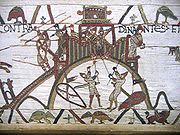 The motte and bailey castle, as historian Denys Pringle puts it, is "a particularly northern European phenomenon", most numerous in Normandy and Britain, but also seen in Denmark, Germany, Southern Italy and occasionally beyond. European castles first emerged in the 9th and 10th centuries, after the fall of the Carolingian Empire
resulted in its territory being divided among individual lords and princes and local territories became threatened by the Magyars and the Norse. Against this background, various explanations have been put forward to explain the origins and spread of the motte and bailey design across northern Europe; there is often a tension amongst the academic community between explanations that stress military and social reasons for the rise this design. One suggestion is that these castles were built particularly in order to protect against external attack - the Angevins, it is argued, began to build them to protect against the Viking raids, and the design spread to deal with the attacks along the Slav and Hungarian frontiers. Another argument is that, given the links between this style of castle and the Normans, who were of Viking descent, they were in fact originally a Viking design, transported to Normandy and Angers. The motte and bailey castle was certainly militarily highly effective: the design enabled defenders to deal with enemy cavalry and were very hard to assault, although as historian André Debord suggests, the historical and archaeological record of the actual military operation of motte and bailey castles remains relatively limited.
An alternative approach focuses on the links between this form of castle and what can be termed a feudal mode of society. The spread of motte and bailey castles is usually closely tied to the creation of local fiefdoms and feudal landowners, and areas without this method of governance rarely built these castles. Yet another theory suggests that the design emerged as a result of the pressures of space on ringworks, and that the earliest motte and baileys were converted ringworks. Finally, there may be a link between the local geography and the building of motte and bailey castles, which are usually built on low-lying areas, in many cases subject to regular flooding. Regardless of the reasons behind the initial popularity of the motte and bailey design, however, there is widespread agreement that the castles were first widely adopted in Normandy and Angevin territory in the 10th and 11th centuries.
, back to 979. The castles were built by the more powerful lords of Anjou in the late 10th and 11th centuries, in particular Fulk III and his son, Geoffrey II, who built a great number of them between 987 and 1060. Many of these earliest castles would have appeared quite crude and rustic by later standards, belying the power and prestige of their builders. William the Conqueror, as the Duke of Normandy
, is believed to have adopted the motte and bailey design from neighbouring Anjou. Duke William went on to prohibit the building of castles without his consent through the Consuetudines et Justicie, with his legal definition of castles centring on the classic motte and bailey features of ditching, banking and palisading.
By the 11th century, castles were widely built in the Holy Roman Empire
, which then spanned central Europe, but these typically took the form of enclosures on hill tops, or tall, free-standing towers, called bergfried
, on lower ground. The largest castles, called hohenburgen, had well-defined inner and outer courts, but no mottes. The motte and bailey design began to spread into Alsace
and the northern Alps
from France during the first half of the 11th century, spreading further into Bohemia and Austria in the subsequent years. This form of castle was closely associated with the colonisation of newly cultivated areas within the Empire, as new lords were granted lands by the emperor and built castles close to the local gród, or town. Motte and bailey castle building substantially enhanced the prestige of local nobles, and it has been suggested that their early adoption was because they were a cheaper way of imitating the still more prestigious hohenburgen, but this is usually regarded as unlikely. In many cases, bergfied were converted into motte and bailey designs by burying existing castle towers within the mounds.
In England, William invaded from Normandy in 1066, resulting in three phases of castle building in England, around 80% of which were in the motte-and-bailey pattern. The first of these was the establishment by the new king of a number of royal castles in key strategic locations, including many towns. These urban castles could make use of the existing towns walls and fortification, but typically required the demolition of local houses to make space for them. This could cause extensive damage: records suggest that in Lincoln 166 houses were destroyed, with 113 in Norwich
and 27 in Cambridge
. The second and third waves of castle building in the late-11th century were led by the major magnates and then the more junior knights on their new estates. Some regional patterns in castle building can be seen - relatively few castles were built in East Anglia compared to the west of England or the Marches, for example; this was probably due to the relatively settled and prosperous nature of the east of England and reflected a shortage of unfree labour for constructing mottes. In Wales, the first wave of the Norman castles were again predominantly made of wood in a mixture of motte-and-bailey and ringwork designs. The Norman invaders spread up the valleys, using this form of castle to occupy their new territories. After the Norman conquest of England and Wales, the building of motte and bailey castles in Normandy accelerated as well, resulting in a broad swath of these castles across the Norman territories, around 741 motte and bailey castles in England and Wales alone.
encouraged castle building in a number of regions from late 12th century to 14th century. In Flanders
, the first motte and bailey castles began relatively early at the end of the 11th century. The rural motte and bailey castles followed the traditional design, but the urban castles often lacked the traditional baileys, using parts of the town to fulfil this role instead. Motte and bailey castles in Flanders were particularly numerous in the south along the Lower Rhine
, a fiercely contest border. Further along the coast in Friesland
, the relatively decentralised, egalitarian society initially discouraged the building of motte and bailey castles, although terpen, raised "dwelling mounds" which lacked towers and were usually lower in height than a typical motte, were created instead. By the end of the medieval period, however, the terpen gave way to hege wieren, non-residential defensive towers, often on motte-like mounds, owned by the increasingly powerful nobles and landowners. On Zeeland
the local lords had a high degree of independence during the 12th and 13th centuries, owing to the wider conflict for power between neighbouring Flanders and Friesland. The Zeeland lords had also built terpen mounds, but these gave way to larger werven constructions - effectively mottes - which were later termed bergen. Sometimes both terpen and werven are called vliedburg, or "refuge castles". During the 12th and 13th centuries a number of terpen mounds were turned into werven mottes, and some new werven mottes were built from scratch. Around 323 known or probable motte and bailey castles of this design are believed to have built within the borders of the modern Netherlands
.
In neighbouring Denmark, motte and bailey castles appeared somewhat later in the 12th and 13th centuries and in more limited numbers than elsewhere, due to the less feudal society. Except for a handful of mote and bailey castles in Norway, built in the first half of the 11th century and including the royal residence in Oslo
, the design did not play a role further north in Scandinavia.
The Norman expansion into Wales slowed in the 12th century but remained an ongoing threat to the remaining native rulers. In response, the Welsh princes and lords began to build their own castles, frequently motte and bailey designs, usually in wood. There are indications that this may have began from 1111 onwards under Prince Cadwgan ap Bleddyn
, with the first documentary evidence of a native Welsh castle being at Cymmer in 1116. These timber castles, including Tomen y Rhodywdd, Tomen y Faerdre
, Gaer Penrhôs
, were of equivalent quality to the equivalent Norman fortifications in the area, and it can prove difficult to distinguish the builders of some sites from the archaeological evidence alone.
Motte and bailey castles in Scotland emerged as a consequence of the centralising of royal authority in the 12th century. David I
encouraged Norman and French nobles to settle in Scotland, introducing a feudal mode of landholding and the use of castles as a way of controlling the contested lowlands. The quasi-independent polity of Galloway
, which had resisted the rule of David and his predecessors, was a particular focus for this colonisation. The size of these Scottish castles, primarily wooden motte and bailey constructions, varied considerably, from larger designs such as the Bass of Inverurie
to smaller castles like Balmaclellan
.
Motte and bailey castles were introduced to Ireland following the Norman invasion of Ireland that began between 1166 and 1171 under first Richard de Clare
and then Henry II of England
, with the occupation of southern and eastern Ireland by a number of Anglo-Norman barons. The rapid Norman success depended on key economic and military advantages; their cavalry enabled Norman successes in battles, and castles enabled them to control the newly conquered territories. The new lords rapidly built castles to protect their possessions; most of these were motte and bailey constructions, many of them strongly defended. Unlike Wales, the indigenous Irish lords do not appear to have constructed their own castles in any significant number during the period. Between 350 to 450 motte and bailey castles are believed to remain today, although the identification of these earthwork remains can be contentious.
A small number of motte and bailey castles were built outside of northern Europe. In the late-12th century, the Normans invaded southern Italy and Sicily
; although they had the technology to build more modern designs, in many cases wooden motte and bailey castles were built instead for reasons of speed. The Italians came to refer to a range of different castle types as motta, however, and there may not have been as many genuine motte and bailey castles in southern Italy as was once thought on the basis of the documentary evidence alone. In addition, there is evidence of the Norman crusaders building a motte and bailey using sand and wood in Egypt in 1221 during the Fifth Crusade
.
One factor was the introduction of stone into castle building. The earliest stone castles had emerged in the 10th century, with stone keeps being built on mottes along the Catalonia
frontier and several, including Château de Langeais
, in Angers. Although wood was a more powerful defensive material than was once thought, stone became increasingly popular for military and symbolic reasons. Some existing motte and bailey castles were converted to stone, with the keep
and the gatehouse
usually the first parts to be upgraded. Shell keep
s were built on many mottes, circular stone shells running around the top of the motte, sometime protected by a further chemise
, or low protective wall, around the base. By the 14th century, a number of motte and bailey castles had been converted into powerful stone fortresses.
Newer castle designs, however, placed less emphasis on mottes. Square Norman keeps built in stone became popular following the first such construction in Langeais
in 994, the first such in Normandy. Several were built in England and Wales after the conquest; by 1216 there were around 100 in the country. These massive keeps could be either erected on top of settled, well established mottes, or could have mottes built around them - so-called "buried" keeps. The ability of mottes, especially newly-built mottes, to support the heavier stone structures, was limited, however, and many needed to be built on fresh ground. Concentric
castles, relying on several lines of baileys and defensive walls, made increasingly little use of keeps or mottes at all.
Across Europe, motte and bailey construction came to an end. At the end of the 12th century the Welsh rulers began to build castles in stone, primarily in the principality of North Wales and usually along the higher peaks where mottes were unnecessary. In Flanders, decline came in the 13th century as feudal society changed. In the Netherlands, cheap brick started to be used in castles from 13th century onwards in place of earthworks, and many mottes were levelled, to help develop the surrounding, low-lying fields; these "levelled mottes" are a particularly Dutch phenomenon. In Denmark, motte and baileys gave way in the 14th century to a castrum-curia model, where the castle was built with a fortified bailey and a fortified mound, somewhat smaller than the typical motte. By the 12th century, the castles in Western Germany began to thin in number, due to changes in land ownership, and various mottes were abandoned. In Germany and Denmark, motte and bailey castles also provided the model for the later wasserburg, or "water castle", a stronghold and bailey construction surrounded by water, and widely built in the late medieval period.
, converted for the storage of royal documents
. The landscape of northern Europe remains scattered with their earthworks, however, and many form popular tourist attractions as part of the European heritage industry.
Castle
A castle is a type of fortified structure built in Europe and the Middle East during the Middle Ages by European nobility. Scholars debate the scope of the word castle, but usually consider it to be the private fortified residence of a lord or noble...
, with a wooden or stone keep
Keep
A keep is a type of fortified tower built within castles during the Middle Ages by European nobility. Scholars have debated the scope of the word keep, but usually consider it to refer to large towers in castles that were fortified residences, used as a refuge of last resort should the rest of the...
situated on a raised earthwork called a motte, accompanied by an enclosed courtyard
Courtyard
A court or courtyard is an enclosed area, often a space enclosed by a building that is open to the sky. These areas in inns and public buildings were often the primary meeting places for some purposes, leading to the other meanings of court....
, or bailey, surrounded by a protective ditch and palisade
Palisade
A palisade is a steel or wooden fence or wall of variable height, usually used as a defensive structure.- Typical construction :Typical construction consisted of small or mid sized tree trunks aligned vertically, with no spacing in between. The trunks were sharpened or pointed at the top, and were...
. Relatively easy to build with unskilled, often forced labour, but still militarily formidable, these castles were built across northern Europe from the 10th century onwards, spreading from Normandy
Normandy
Normandy is a geographical region corresponding to the former Duchy of Normandy. It is in France.The continental territory covers 30,627 km² and forms the preponderant part of Normandy and roughly 5% of the territory of France. It is divided for administrative purposes into two régions:...
and Anjou
Anjou
Anjou is a former county , duchy and province centred on the city of Angers in the lower Loire Valley of western France. It corresponds largely to the present-day département of Maine-et-Loire...
in France
France
The French Republic , The French Republic , The French Republic , (commonly known as France , is a unitary semi-presidential republic in Western Europe with several overseas territories and islands located on other continents and in the Indian, Pacific, and Atlantic oceans. Metropolitan France...
, into the Holy Roman Empire
Holy Roman Empire
The Holy Roman Empire was a realm that existed from 962 to 1806 in Central Europe.It was ruled by the Holy Roman Emperor. Its character changed during the Middle Ages and the Early Modern period, when the power of the emperor gradually weakened in favour of the princes...
in the 11th century. The Normans
Normans
The Normans were the people who gave their name to Normandy, a region in northern France. They were descended from Norse Viking conquerors of the territory and the native population of Frankish and Gallo-Roman stock...
introduced the design into England
England
England is a country that is part of the United Kingdom. It shares land borders with Scotland to the north and Wales to the west; the Irish Sea is to the north west, the Celtic Sea to the south west, with the North Sea to the east and the English Channel to the south separating it from continental...
and Wales
Wales
Wales is a country that is part of the United Kingdom and the island of Great Britain, bordered by England to its east and the Atlantic Ocean and Irish Sea to its west. It has a population of three million, and a total area of 20,779 km²...
following their invasion in 1066. Motte and bailey castles were adopted in Scotland
Scotland
Scotland is a country that is part of the United Kingdom. Occupying the northern third of the island of Great Britain, it shares a border with England to the south and is bounded by the North Sea to the east, the Atlantic Ocean to the north and west, and the North Channel and Irish Sea to the...
, Ireland
Ireland
Ireland is an island to the northwest of continental Europe. It is the third-largest island in Europe and the twentieth-largest island on Earth...
, the Low Countries
Low Countries
The Low Countries are the historical lands around the low-lying delta of the Rhine, Scheldt, and Meuse rivers, including the modern countries of Belgium, the Netherlands, Luxembourg and parts of northern France and western Germany....
and Denmark
Denmark
Denmark is a Scandinavian country in Northern Europe. The countries of Denmark and Greenland, as well as the Faroe Islands, constitute the Kingdom of Denmark . It is the southernmost of the Nordic countries, southwest of Sweden and south of Norway, and bordered to the south by Germany. Denmark...
in the 12th and 13th centuries. By the end of the 13th century, the design was largely superseded by alternative forms of fortification, but the earthworks remain a prominent feature in many countries.
Structures
A motte and bailey castle was made up of two structures, a motte, a type of mound - often artificial - topped with a woodWood
Wood is a hard, fibrous tissue found in many trees. It has been used for hundreds of thousands of years for both fuel and as a construction material. It is an organic material, a natural composite of cellulose fibers embedded in a matrix of lignin which resists compression...
en or stone
Masonry
Masonry is the building of structures from individual units laid in and bound together by mortar; the term masonry can also refer to the units themselves. The common materials of masonry construction are brick, stone, marble, granite, travertine, limestone; concrete block, glass block, stucco, and...
structure known as a keep
Keep
A keep is a type of fortified tower built within castles during the Middle Ages by European nobility. Scholars have debated the scope of the word keep, but usually consider it to refer to large towers in castles that were fortified residences, used as a refuge of last resort should the rest of the...
; and at least one bailey, a fortified enclosure built next to the motte. The term "motte and bailey" is a relatively modern one, and is not medieval in origin. The word "motte" is the French version of the Latin mota, and in France the word motte was initially an early word for a turf
Sod
Sod or turf is grass and the part of the soil beneath it held together by the roots, or a piece of thin material.The term sod may be used to mean turf grown and cut specifically for the establishment of lawns...
; it then became used to refer to a turf bank, and by the 12th century was used to refer to the castle design itself. The word "bailey" comes from the Norman-French baille, or basse-cour, referring to a low yard. In medieval sources, the Latin term castellum was used to describe the bailey complex within these castles.
One contemporary account of these structures comes from Jean de Colmieu around 1130, describing the Calais
Calais
Calais is a town in Northern France in the department of Pas-de-Calais, of which it is a sub-prefecture. Although Calais is by far the largest city in Pas-de-Calais, the department's capital is its third-largest city of Arras....
region in northern France. De Colmieu described how the nobles would build "a mound of earth as high as they can and dig a ditch about it as wide and deep as possible. The space on top of the mound is enclosed by a palisade of very strong hewn logs, strengthened at intervals by as many towers as their means can provide. Inside the enclosure is a citadel, or keep, which commands the whole circuit of the defences. The entrance to the fortress is by means of a bridge, which, rising from the outer side of the moat and supported on posts as it ascends, reches to the top of the mound." At Durham Castle
Durham Castle
Durham Castle is a Norman castle in the city of Durham, England, which has been wholly occupied since 1840 by University College, Durham. It is open to the general public to visit, but only through guided tours, since it is in use as a working building and is home to over 100 students...
, contemporaries described how the motte and bailey superstructure arose from the "tumulus of rising earth" with a keep rising "into thin air, strong within and without" with a "stalwart house...glittering with beauty in every part".
Mottes were made out of earth and flattened on top, and it can be very hard to determine whether a mound is artificial or natural without excavation. Some were also built over older artificial structures, such as Bronze Age
Bronze Age
The Bronze Age is a period characterized by the use of copper and its alloy bronze as the chief hard materials in the manufacture of some implements and weapons. Chronologically, it stands between the Stone Age and Iron Age...
barrow
Tumulus
A tumulus is a mound of earth and stones raised over a grave or graves. Tumuli are also known as barrows, burial mounds, Hügelgrab or kurgans, and can be found throughout much of the world. A tumulus composed largely or entirely of stones is usually referred to as a cairn...
s. The size of mottes varied considerably, with these mounds being 3 metres to 30 metres in height (10 feet to 100 feet), and from 30 metres to 90 metres in diameter (100 feet to 300 feet). This minimum height of 3 metres (10 feet) for mottes is usually intended to exclude smaller mounds which often had non-military purposes. In England and Wales, only 7% of mottes were taller than ten metres high; 24% were between ten and five metres, and 69% were less than five metres tall. A motte was protected by a ditch around it, which would typically have also been a source of the earth and soil for constructing the mound itself.
A keep and a protective wall would usually be built on top of the motte. Some walls would be large enough to have a wall-walk around them, and the outer walls of the motte and the wall-walk could be strengthened by filling in the gap between the wooden walls with earth and stones, allowing it to carry more weight - this was called a garillum. Smaller mottes could only support simple towers with room for a few soldiers, whilst larger mottes could be equipped with a much grander building. Many wooden keeps were designed with a bretasche, a square building that overhung from the upper floors of the building, enabling better defences and a more sturdy structural design. The early 12th-century chronicler Lambert of Ardres described the wooden keep on top of the motte at the castle of Ardres
Ardres
Ardres is a commune in the Pas-de-Calais department in northern France.Population : 4,198 inhabitants for the commune and 17,610 inhabitants for the canton.-Geography:...
, where the "first storey was on the surface of the ground, where were cellars and granaries, and great boxes, tuns, casks, and other domestic utensils. In the storey above were the dwelling and common living-rooms of the residents in which were the larders, the rooms of the bakers and butlers, and the great chamber in which the lord and his wife slept...In the upper storey of the house were garret rooms...In this storey also the watchmen and the servants appointed to keep the house took their sleep". Wooden structures on mottes could be protected by skins and hides to prevent them being easily set alight during a siege.
The bailey was an enclosed courtyard
Courtyard
A court or courtyard is an enclosed area, often a space enclosed by a building that is open to the sky. These areas in inns and public buildings were often the primary meeting places for some purposes, leading to the other meanings of court....
overlooked by the motte and surrounded by a wooden fence called a palisade
Palisade
A palisade is a steel or wooden fence or wall of variable height, usually used as a defensive structure.- Typical construction :Typical construction consisted of small or mid sized tree trunks aligned vertically, with no spacing in between. The trunks were sharpened or pointed at the top, and were...
and another ditch. The bailey was often kidney-shaped to fit against a circular motte, but could be made in other shapes according to the terrain. The bailey would contain a wide number of buildings, including a hall, kitchens, a chapel, barracks, stores, stables, forges or workshops, and was the centre of the castle's economic activity. The bailey was linked to the motte either by a flying bridge stretching between the two, or, more popularly in England, by steps cut into the motte. Typically the ditch of the motte and the bailey joined, forming a figure of eight around the castle. Wherever possible, nearby streams and rivers would be dammed or diverted, creating water-filled moats, artificial lakes and other forms of water defences.
In practice, there was a wide number of variations to this common design. A castle could have more than one bailey: at Warkworth Castle
Warkworth Castle
Warkworth Castle is a ruined medieval building in the town of the same name in the English county of Northumberland. The town and castle occupy a loop of the River Coquet, less than a mile from England's north-east coast...
an inner and an outer bailey was constructed, or alternatively, several baileys could flank the motte, as at Windsor Castle
Windsor Castle
Windsor Castle is a medieval castle and royal residence in Windsor in the English county of Berkshire, notable for its long association with the British royal family and its architecture. The original castle was built after the Norman invasion by William the Conqueror. Since the time of Henry I it...
. Some baileys had two mottes, such as those at Lincoln
Lincoln Castle
Lincoln Castle is a major castle constructed in Lincoln, England during the late 11th century by William the Conqueror on the site of a pre-existing Roman fortress. The castle is unusual in that it has two mottes. It is only one of two such castles in the country, the other being at Lewes in Sussex...
. Some mottes could be square instead of round, such as at Cabal Trump. Instead of single ditches, occasionally double-ditch defences were built, as seen at Berkhamsted
Berkhamsted Castle
Berkhamsted Castle is a ruined Norman motte-and-bailey castle at Berkhamsted in Hertfordshire, England.The original fortification dates from Saxon times. Work on the Norman structure was started in 1066 by William the Conqueror who later passed the castle to his half-brother, Robert, Count of...
. Local geography and the intent of the builder produced many unique designs.
Construction and maintenance
Various methods were used to build mottes. Where a natural hill could be used, scarpingCounterscarp
A scarp and a counterscarp are the inner and outer sides of a ditch used in fortifications. In permanent fortifications the scarp and counterscarp may be encased in stone...
could produce a motte without the need to create an artificial mound, but more commonly much of the motte would have to be constructed by hand. Four methods existed for building a mound and a tower: the mound could either be built first, and a tower placed on top of it; the tower could alternatively be built on the original ground surface and then buried within the mound; the tower could potentially be built on the original ground surface and then partially buried within the mound, the buried part forming a cellar beneath; or the tower could be built first, and the mound added later.
Regardless of the sequencing, artificial mottes had to be built by piling up earth; this work was undertaken by hand, using wooden shovels and hand-barrows, possibly with picks as well in the later periods. Larger mottes took disproportionately more effort to build than their smaller equivalents, because of the volumes of earth involved. The largest mottes in England, such as Thetford
Thetford Castle
Thetford Castle, also known as Castle Hill and Castle Mound, usually refers to a medieval motte and bailey castle in the market town of Thetford in the Breckland area of Norfolk, England, although it can also refer to Red Castle, built in the same town...
, are estimated to have required up to 24,000 man-days of work; smaller ones required perhaps as little as 1,000. Contemporary accounts talk of some mottes being built in a matter of days, although these low figures have led to suggestions by historians that either these figures were an underestimate, or that they refer to the construction of a smaller design than that later seen on the sites concerned. Taking into account estimates of the likely available manpower during the period, historians estimate that the larger mottes might have taken between four and nine months to build. This contrasted favourably with stone keeps of the period, which typically took up to ten years to build. Very little skilled labour was required to build motte and bailey castles, which made them very attractive propositions if forced peasant labour was available, as was the case after the Norman invasion of England. Where the local workforce had to be paid - such as at Clones
Clones
Clones is a small town in western County Monaghan, in the 'border area' of the Republic of Ireland. The area is part of the Border Region, earmarked for economic development by the Irish Government due to its currently below-average economic situation...
in Ireland, built in 1211 using imported labourers – the costs would rise quickly, in this case reaching £20.
The type of soil would make a difference to the design of the motte, as clay
Clay
Clay is a general term including many combinations of one or more clay minerals with traces of metal oxides and organic matter. Geologic clay deposits are mostly composed of phyllosilicate minerals containing variable amounts of water trapped in the mineral structure.- Formation :Clay minerals...
soils could support a steeper motte, whilst sandier soils meant that a motte would need a more gentle incline. Where available, layers of different sorts of earth, such as clay, gravel
Gravel
Gravel is composed of unconsolidated rock fragments that have a general particle size range and include size classes from granule- to boulder-sized fragments. Gravel can be sub-categorized into granule and cobble...
and chalk
Chalk
Chalk is a soft, white, porous sedimentary rock, a form of limestone composed of the mineral calcite. Calcite is calcium carbonate or CaCO3. It forms under reasonably deep marine conditions from the gradual accumulation of minute calcite plates shed from micro-organisms called coccolithophores....
, would be used alternatively to build in strength to the design. Layers of turf could also be added to stabilise the motte as it was built up, or a core of stones placed as the heart of the structure to provide strength. Similar issues applied to the defensive ditches, where designers found that the wider the ditch was dug, the deeper and steeper the sides of the scarp could be, making it more defensive. Although militarily a motte was, as Norman Pounds describes it, "almost indestructible", they required frequent maintenance. Soil wash was a problem, particularly with steeper mounds, and mottes could be clad with wood or stone slabs to protect them. Over time, some mottes suffered from subsidence
Subsidence
Subsidence is the motion of a surface as it shifts downward relative to a datum such as sea-level. The opposite of subsidence is uplift, which results in an increase in elevation...
or damage from flood
Flood
A flood is an overflow of an expanse of water that submerges land. The EU Floods directive defines a flood as a temporary covering by water of land not normally covered by water...
ing, requiring repairs and stabilisation work.
Although motte and bailey castles are the best known castle design, they were not always the most numerous in any given area. A popular alternative was the ringwork
Ringwork
A ringwork is a form of fortified defensive structure, usually circular or oval in shape. Ringworks are essentially motte-and-bailey castles minus the motte...
castle, involving a palisade being built on top of a raised earth rampart, protected by a ditch. The choice of motte and bailey or ringwork was partially driven by terrain, as mottes were typically built on low ground, and on deeper clay and alluvial soils. Another factor may have been speed, as ringworks were faster to build than mottes. Some ringwork castles were later converted into motte and bailey designs, by filling in the centre of the ringwork to produce a flat-topped motte. The reasons for why this decision was taken are unclear; motte and bailey castles may have been felt to be more prestigious, or easier to defend; another theory is that like the terpen in Netherlands, or Vorburg and Hauptburg in Lower Rhineland, raising the height of the castle was done to create a drier site.
Emergence of the design
Carolingian Empire
Carolingian Empire is a historiographical term which has been used to refer to the realm of the Franks under the Carolingian dynasty in the Early Middle Ages. This dynasty is seen as the founders of France and Germany, and its beginning date is based on the crowning of Charlemagne, or Charles the...
resulted in its territory being divided among individual lords and princes and local territories became threatened by the Magyars and the Norse. Against this background, various explanations have been put forward to explain the origins and spread of the motte and bailey design across northern Europe; there is often a tension amongst the academic community between explanations that stress military and social reasons for the rise this design. One suggestion is that these castles were built particularly in order to protect against external attack - the Angevins, it is argued, began to build them to protect against the Viking raids, and the design spread to deal with the attacks along the Slav and Hungarian frontiers. Another argument is that, given the links between this style of castle and the Normans, who were of Viking descent, they were in fact originally a Viking design, transported to Normandy and Angers. The motte and bailey castle was certainly militarily highly effective: the design enabled defenders to deal with enemy cavalry and were very hard to assault, although as historian André Debord suggests, the historical and archaeological record of the actual military operation of motte and bailey castles remains relatively limited.
An alternative approach focuses on the links between this form of castle and what can be termed a feudal mode of society. The spread of motte and bailey castles is usually closely tied to the creation of local fiefdoms and feudal landowners, and areas without this method of governance rarely built these castles. Yet another theory suggests that the design emerged as a result of the pressures of space on ringworks, and that the earliest motte and baileys were converted ringworks. Finally, there may be a link between the local geography and the building of motte and bailey castles, which are usually built on low-lying areas, in many cases subject to regular flooding. Regardless of the reasons behind the initial popularity of the motte and bailey design, however, there is widespread agreement that the castles were first widely adopted in Normandy and Angevin territory in the 10th and 11th centuries.
Initial development, 10th and 11th centuries
The earliest purely documentary evidence for motte-and-bailey castles in Normandy and Angers comes from between 1020 and 1040, but a combination of documentary and archaeological evidence pushes the date for the first motte and bailey castle, at VincyLes Rues-des-Vignes
Les Rues-des-Vignes is a commune in the Nord department in northern France.Vinchy was the site of a famous battle of the then-rising Charles Martel in spring 717.-References:*...
, back to 979. The castles were built by the more powerful lords of Anjou in the late 10th and 11th centuries, in particular Fulk III and his son, Geoffrey II, who built a great number of them between 987 and 1060. Many of these earliest castles would have appeared quite crude and rustic by later standards, belying the power and prestige of their builders. William the Conqueror, as the Duke of Normandy
Duke of Normandy
The Duke of Normandy is the title of the reigning monarch of the British Crown Dependancies of the Bailiwick of Guernsey and the Bailiwick of Jersey. The title traces its roots to the Duchy of Normandy . Whether the reigning sovereign is a male or female, they are always titled as the "Duke of...
, is believed to have adopted the motte and bailey design from neighbouring Anjou. Duke William went on to prohibit the building of castles without his consent through the Consuetudines et Justicie, with his legal definition of castles centring on the classic motte and bailey features of ditching, banking and palisading.
By the 11th century, castles were widely built in the Holy Roman Empire
Holy Roman Empire
The Holy Roman Empire was a realm that existed from 962 to 1806 in Central Europe.It was ruled by the Holy Roman Emperor. Its character changed during the Middle Ages and the Early Modern period, when the power of the emperor gradually weakened in favour of the princes...
, which then spanned central Europe, but these typically took the form of enclosures on hill tops, or tall, free-standing towers, called bergfried
Bergfried
A bergfried is a tall tower typically found in medieval castles in German-speaking countries . Its defensive function is to some extent similar to that of a keep or donjon in English or French castles...
, on lower ground. The largest castles, called hohenburgen, had well-defined inner and outer courts, but no mottes. The motte and bailey design began to spread into Alsace
Alsace
Alsace is the fifth-smallest of the 27 regions of France in land area , and the smallest in metropolitan France. It is also the seventh-most densely populated region in France and third most densely populated region in metropolitan France, with ca. 220 inhabitants per km²...
and the northern Alps
Alps
The Alps is one of the great mountain range systems of Europe, stretching from Austria and Slovenia in the east through Italy, Switzerland, Liechtenstein and Germany to France in the west....
from France during the first half of the 11th century, spreading further into Bohemia and Austria in the subsequent years. This form of castle was closely associated with the colonisation of newly cultivated areas within the Empire, as new lords were granted lands by the emperor and built castles close to the local gród, or town. Motte and bailey castle building substantially enhanced the prestige of local nobles, and it has been suggested that their early adoption was because they were a cheaper way of imitating the still more prestigious hohenburgen, but this is usually regarded as unlikely. In many cases, bergfied were converted into motte and bailey designs by burying existing castle towers within the mounds.
In England, William invaded from Normandy in 1066, resulting in three phases of castle building in England, around 80% of which were in the motte-and-bailey pattern. The first of these was the establishment by the new king of a number of royal castles in key strategic locations, including many towns. These urban castles could make use of the existing towns walls and fortification, but typically required the demolition of local houses to make space for them. This could cause extensive damage: records suggest that in Lincoln 166 houses were destroyed, with 113 in Norwich
Norwich
Norwich is a city in England. It is the regional administrative centre and county town of Norfolk. During the 11th century, Norwich was the largest city in England after London, and one of the most important places in the kingdom...
and 27 in Cambridge
Cambridge
The city of Cambridge is a university town and the administrative centre of the county of Cambridgeshire, England. It lies in East Anglia about north of London. Cambridge is at the heart of the high-technology centre known as Silicon Fen – a play on Silicon Valley and the fens surrounding the...
. The second and third waves of castle building in the late-11th century were led by the major magnates and then the more junior knights on their new estates. Some regional patterns in castle building can be seen - relatively few castles were built in East Anglia compared to the west of England or the Marches, for example; this was probably due to the relatively settled and prosperous nature of the east of England and reflected a shortage of unfree labour for constructing mottes. In Wales, the first wave of the Norman castles were again predominantly made of wood in a mixture of motte-and-bailey and ringwork designs. The Norman invaders spread up the valleys, using this form of castle to occupy their new territories. After the Norman conquest of England and Wales, the building of motte and bailey castles in Normandy accelerated as well, resulting in a broad swath of these castles across the Norman territories, around 741 motte and bailey castles in England and Wales alone.
Further expansion, 12th and 13th centuries
Having become well established in Normandy, Germany and Britain, motte and bailey castles began to be adopted elsewhere, mainly in northern Europe, during the 12th and 13th centuries. Conflict through the Low CountriesLow Countries
The Low Countries are the historical lands around the low-lying delta of the Rhine, Scheldt, and Meuse rivers, including the modern countries of Belgium, the Netherlands, Luxembourg and parts of northern France and western Germany....
encouraged castle building in a number of regions from late 12th century to 14th century. In Flanders
Flanders
Flanders is the community of the Flemings but also one of the institutions in Belgium, and a geographical region located in parts of present-day Belgium, France and the Netherlands. "Flanders" can also refer to the northern part of Belgium that contains Brussels, Bruges, Ghent and Antwerp...
, the first motte and bailey castles began relatively early at the end of the 11th century. The rural motte and bailey castles followed the traditional design, but the urban castles often lacked the traditional baileys, using parts of the town to fulfil this role instead. Motte and bailey castles in Flanders were particularly numerous in the south along the Lower Rhine
Lower Rhine
The Lower Rhine flows from Bonn, Germany, to the North Sea at Hoek van Holland, Netherlands.Almost immediately after entering the Netherlands, the Rhine splits into many branches. The main branch is called the Waal which flows from Nijmegen to meet the river Meuse; after which it is called Merwede...
, a fiercely contest border. Further along the coast in Friesland
Friesland
Friesland is a province in the north of the Netherlands and part of the ancient region of Frisia.Until the end of 1996, the province bore Friesland as its official name. In 1997 this Dutch name lost its official status to the Frisian Fryslân...
, the relatively decentralised, egalitarian society initially discouraged the building of motte and bailey castles, although terpen, raised "dwelling mounds" which lacked towers and were usually lower in height than a typical motte, were created instead. By the end of the medieval period, however, the terpen gave way to hege wieren, non-residential defensive towers, often on motte-like mounds, owned by the increasingly powerful nobles and landowners. On Zeeland
Zeeland
Zeeland , also called Zealand in English, is the westernmost province of the Netherlands. The province, located in the south-west of the country, consists of a number of islands and a strip bordering Belgium. Its capital is Middelburg. With a population of about 380,000, its area is about...
the local lords had a high degree of independence during the 12th and 13th centuries, owing to the wider conflict for power between neighbouring Flanders and Friesland. The Zeeland lords had also built terpen mounds, but these gave way to larger werven constructions - effectively mottes - which were later termed bergen. Sometimes both terpen and werven are called vliedburg, or "refuge castles". During the 12th and 13th centuries a number of terpen mounds were turned into werven mottes, and some new werven mottes were built from scratch. Around 323 known or probable motte and bailey castles of this design are believed to have built within the borders of the modern Netherlands
Netherlands
The Netherlands is a constituent country of the Kingdom of the Netherlands, located mainly in North-West Europe and with several islands in the Caribbean. Mainland Netherlands borders the North Sea to the north and west, Belgium to the south, and Germany to the east, and shares maritime borders...
.
In neighbouring Denmark, motte and bailey castles appeared somewhat later in the 12th and 13th centuries and in more limited numbers than elsewhere, due to the less feudal society. Except for a handful of mote and bailey castles in Norway, built in the first half of the 11th century and including the royal residence in Oslo
Oslo
Oslo is a municipality, as well as the capital and most populous city in Norway. As a municipality , it was established on 1 January 1838. Founded around 1048 by King Harald III of Norway, the city was largely destroyed by fire in 1624. The city was moved under the reign of Denmark–Norway's King...
, the design did not play a role further north in Scandinavia.
The Norman expansion into Wales slowed in the 12th century but remained an ongoing threat to the remaining native rulers. In response, the Welsh princes and lords began to build their own castles, frequently motte and bailey designs, usually in wood. There are indications that this may have began from 1111 onwards under Prince Cadwgan ap Bleddyn
Cadwgan ap Bleddyn
Cadwgan ap Bleddyn was a prince of Powys in eastern Wales.Cadwgan was the second son of Bleddyn ap Cynfyn who was king of both Powys and Gwynedd. When Bleddyn was killed in 1075, Powys was divided between three of his sons, Cadwgan, Iorwerth and Maredudd. Cadwgan is first heard of in 1088 when he...
, with the first documentary evidence of a native Welsh castle being at Cymmer in 1116. These timber castles, including Tomen y Rhodywdd, Tomen y Faerdre
Llanarmon-yn-Ial
Llanarmon-yn-Iâl is a village, and local government community, in Denbighshire, Wales, lying in limestone country in the valley of the River Alyn.- Location :...
, Gaer Penrhôs
Gaer Penrhôs
Gaer Penrhôs, in Ceredigion, Wales, was a ringwork castle at the summit of a steep hill near the village of Llanrhystud; now all that remains are the outlines of its ringworks...
, were of equivalent quality to the equivalent Norman fortifications in the area, and it can prove difficult to distinguish the builders of some sites from the archaeological evidence alone.
Motte and bailey castles in Scotland emerged as a consequence of the centralising of royal authority in the 12th century. David I
David I of Scotland
David I or Dabíd mac Maíl Choluim was a 12th-century ruler who was Prince of the Cumbrians and later King of the Scots...
encouraged Norman and French nobles to settle in Scotland, introducing a feudal mode of landholding and the use of castles as a way of controlling the contested lowlands. The quasi-independent polity of Galloway
Galloway
Galloway is an area in southwestern Scotland. It usually refers to the former counties of Wigtownshire and Kirkcudbrightshire...
, which had resisted the rule of David and his predecessors, was a particular focus for this colonisation. The size of these Scottish castles, primarily wooden motte and bailey constructions, varied considerably, from larger designs such as the Bass of Inverurie
Inverurie
Inverurie is a Royal Burgh and town in Aberdeenshire, Scotland, approximately north west of Aberdeen on the A96 road and is served by Inverurie railway station on the Aberdeen to Inverness Line...
to smaller castles like Balmaclellan
Balmaclellan
Balmaclellan is a small hillside village of stone houses with slate roofs in a fold of the Galloway hills in south-west Scotland...
.
Motte and bailey castles were introduced to Ireland following the Norman invasion of Ireland that began between 1166 and 1171 under first Richard de Clare
Richard de Clare, 2nd Earl of Pembroke
Richard de Clare, 2nd Earl of Pembroke , Lord of Leinster, Justiciar of Ireland . Like his father, he was also commonly known as Strongbow...
and then Henry II of England
Henry II of England
Henry II ruled as King of England , Count of Anjou, Count of Maine, Duke of Normandy, Duke of Aquitaine, Duke of Gascony, Count of Nantes, Lord of Ireland and, at various times, controlled parts of Wales, Scotland and western France. Henry, the great-grandson of William the Conqueror, was the...
, with the occupation of southern and eastern Ireland by a number of Anglo-Norman barons. The rapid Norman success depended on key economic and military advantages; their cavalry enabled Norman successes in battles, and castles enabled them to control the newly conquered territories. The new lords rapidly built castles to protect their possessions; most of these were motte and bailey constructions, many of them strongly defended. Unlike Wales, the indigenous Irish lords do not appear to have constructed their own castles in any significant number during the period. Between 350 to 450 motte and bailey castles are believed to remain today, although the identification of these earthwork remains can be contentious.
A small number of motte and bailey castles were built outside of northern Europe. In the late-12th century, the Normans invaded southern Italy and Sicily
Norman conquest of southern Italy
The Norman conquest of southern Italy spanned the late eleventh and much of the twelfth centuries, involving many battles and many independent players conquering territories of their own...
; although they had the technology to build more modern designs, in many cases wooden motte and bailey castles were built instead for reasons of speed. The Italians came to refer to a range of different castle types as motta, however, and there may not have been as many genuine motte and bailey castles in southern Italy as was once thought on the basis of the documentary evidence alone. In addition, there is evidence of the Norman crusaders building a motte and bailey using sand and wood in Egypt in 1221 during the Fifth Crusade
Fifth Crusade
The Fifth Crusade was an attempt to reacquire Jerusalem and the rest of the Holy Land by first conquering the powerful Ayyubid state in Egypt....
.
Conversion and decline, 13th - 14th centuries
Motte and bailey castles became a less popular design in the mid-medieval period. In France, motte and bailey castles were not built after the start of the 12th century, and mottes ceased to be built in most of England after around 1170, although they continued to be erected in Wales and along the Marches. Many motte and bailey castles were occupied relatively briefly and in England many were being abandoned by the 12th century, and others neglected and allowed to lapse into disrepair. In the Low Countries and Germany, a similar transition occurred in the 13th and 14th centuries.One factor was the introduction of stone into castle building. The earliest stone castles had emerged in the 10th century, with stone keeps being built on mottes along the Catalonia
Catalonia
Catalonia is an autonomous community in northeastern Spain, with the official status of a "nationality" of Spain. Catalonia comprises four provinces: Barcelona, Girona, Lleida, and Tarragona. Its capital and largest city is Barcelona. Catalonia covers an area of 32,114 km² and has an...
frontier and several, including Château de Langeais
Château de Langeais
The Château de Langeais is a castle in Indre-et-Loire, France, built on a promontory created by the small valley of the Roumer River at the opening to the Val de Loire...
, in Angers. Although wood was a more powerful defensive material than was once thought, stone became increasingly popular for military and symbolic reasons. Some existing motte and bailey castles were converted to stone, with the keep
Keep
A keep is a type of fortified tower built within castles during the Middle Ages by European nobility. Scholars have debated the scope of the word keep, but usually consider it to refer to large towers in castles that were fortified residences, used as a refuge of last resort should the rest of the...
and the gatehouse
Gatehouse
A gatehouse, in architectural terminology, is a building enclosing or accompanying a gateway for a castle, manor house, fort, town or similar buildings of importance.-History:...
usually the first parts to be upgraded. Shell keep
Shell keep
A shell keep is a style of medieval fortification, best described as a stone structure circling the top of a motte.In English castle morphology, shell keeps are perceived as the successors to motte-and-bailey castles, with the wooden fence around the top of the motte replaced by a stone wall...
s were built on many mottes, circular stone shells running around the top of the motte, sometime protected by a further chemise
Chemise (wall)
In medieval castles the chemise was typically a low wall encircling the keep, protecting the base of the tower. An alternative term, more commonly used in English is mantlet wall....
, or low protective wall, around the base. By the 14th century, a number of motte and bailey castles had been converted into powerful stone fortresses.
Newer castle designs, however, placed less emphasis on mottes. Square Norman keeps built in stone became popular following the first such construction in Langeais
Château de Langeais
The Château de Langeais is a castle in Indre-et-Loire, France, built on a promontory created by the small valley of the Roumer River at the opening to the Val de Loire...
in 994, the first such in Normandy. Several were built in England and Wales after the conquest; by 1216 there were around 100 in the country. These massive keeps could be either erected on top of settled, well established mottes, or could have mottes built around them - so-called "buried" keeps. The ability of mottes, especially newly-built mottes, to support the heavier stone structures, was limited, however, and many needed to be built on fresh ground. Concentric
Concentric
Concentric objects share the same center, axis or origin with one inside the other. Circles, tubes, cylindrical shafts, disks, and spheres may be concentric to one another...
castles, relying on several lines of baileys and defensive walls, made increasingly little use of keeps or mottes at all.
Across Europe, motte and bailey construction came to an end. At the end of the 12th century the Welsh rulers began to build castles in stone, primarily in the principality of North Wales and usually along the higher peaks where mottes were unnecessary. In Flanders, decline came in the 13th century as feudal society changed. In the Netherlands, cheap brick started to be used in castles from 13th century onwards in place of earthworks, and many mottes were levelled, to help develop the surrounding, low-lying fields; these "levelled mottes" are a particularly Dutch phenomenon. In Denmark, motte and baileys gave way in the 14th century to a castrum-curia model, where the castle was built with a fortified bailey and a fortified mound, somewhat smaller than the typical motte. By the 12th century, the castles in Western Germany began to thin in number, due to changes in land ownership, and various mottes were abandoned. In Germany and Denmark, motte and bailey castles also provided the model for the later wasserburg, or "water castle", a stronghold and bailey construction surrounded by water, and widely built in the late medieval period.
Today
In England, motte and bailey earthworks were put to various uses over later years; in some cases, mottes were turned into garden features in the 18th century, or reused as military defences during the Second World War. Today, almost no motte and bailey castles remain in regular use in Europe, with one of the few exceptions being that at Windsor CastleWindsor Castle
Windsor Castle is a medieval castle and royal residence in Windsor in the English county of Berkshire, notable for its long association with the British royal family and its architecture. The original castle was built after the Norman invasion by William the Conqueror. Since the time of Henry I it...
, converted for the storage of royal documents
Royal Archives
The Royal Archives, also known as the Queen's Archives, are a division of the Royal Household of the Sovereign of the United Kingdom. It is operationally under the control of the Keeper of the Royal Archives, who is customarily the Private Secretary to the Sovereign.Although Sovereigns have kept...
. The landscape of northern Europe remains scattered with their earthworks, however, and many form popular tourist attractions as part of the European heritage industry.
See also
- List of motte-and-bailey castles
- Castles in Great Britain and Ireland
- Castles in France
- Castles in Germany
- Castles in Belgium
- Castles in the Netherlands
- Castles in Denmark