

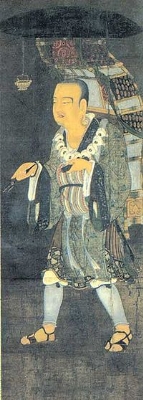
Xuanzang

Encyclopedia
Xuanzang (c. 602 – 664) was a famous Chinese
Buddhist monk
, scholar, traveler, and translator who described the interaction between China
and India
in the early Tang
period. Born in Henan
province of China in 602 or 603, from boyhood he took to reading sacred books, including the Chinese Classics and the writings of the ancient sages.
While residing in the city of Luoyang
, Xuanzang entered Buddhist monkhood at the age of thirteen. Due to the political and social unrest caused by the fall of the Sui dynasty
, he went to Chengdu
in Sichuan
(Szechuan), where he was ordained at the age of twenty. He later traveled throughout China in search of sacred books of Buddhism. At length, he came to Chang'an
, then under the peaceful rule of Emperor Taizong of Tang
. Here Xuanzang developed the desire to visit India
. He knew about Faxian
's visit to India and, like him, was concerned about the incomplete and misinterpreted nature of the Buddhist scriptures that had reached China.
He became famous for his seventeen year overland journey to India, which is recorded in detail in the classic Chinese text Great Tang Records on the Western Regions
, which in turn provided the inspiration for the popular epic novel Journey to the West
.
s of Xuanzang include Hhuen Kwan, Hiouen Thsang, Hiuen Tsiang, Hsien-tsang, Hsyan-tsang, Hsuan Chwang, Hsuan Tsiang, Hwen Thsang, Xuan Cang, Xuan Zang, Shuen Shang, Yuan Chang, Yuan Chwang, and Yuen Chwang. Hsüan, Hüan, Huan and Chuang are also found. In Korean, he is known as Hyeon Jang. In Japanese, he is known as Genjō, or Genjō-sanzō (Xuanzang-sanzang). In Vietnamese, he is known as Đường Tăng (Tang Buddhist monk), Đường Tam Tạng ("Tang Tripitaka" monk), Huyền Trang (the Han-Vietnamese name of Xuanzang)(nishant k)
Sānzàng (三藏) is the Chinese term for the Tripitaka
scriptures, and in some English-language fiction he is addressed with this title.
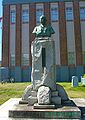 Xuanzang was born near Luoyang
, Henan
in 602 as Chén Huī or Chén Yī (陳 褘) and died 5 February 664 in Yu Hua Gong (玉華宮). Xuanzang, whose lay name was Chen Hui, was born into a family noted for its erudition for generations. He was the youngest of four children. His great-grandfather was an official serving as a prefect; his grandfather was appointed as professor in the Imperial College at the capital. His father was a conservative Confucianist who gave up office and withdrew into seclusion to escape the political turmoil that gripped China at that time. According to traditional biographies, Xuanzang displayed a superb intelligence and earnestness, amazing his father by his careful observance of the Confucian rituals at the age of eight. Along with his brothers and sister, he received an early education from his father, who instructed him in classical works on filial piety
and several other canonical treatises of orthodox Confucianism.
Although his household in Chenhe Village of Goushi Town (緱氏 gou1), Luo Prefecture (洛州), Henan
, was essentially Confucian, at a young age Xuanzang expressed interest in becoming a Buddhist monk as one of his elder brothers had done. After the death of his father in 611, he lived with his older brother Chensu (later known as Changjie) for five years at Jingtu Monastery (淨土寺) in Luoyang
, supported by the Sui Dynasty
state. During this time he studied Mahayana
Buddhism and various early Buddhist schools
, preferring Mahayana.
In 618, the Sui Dynasty collapsed and Xuanzang and his brother fled to Chang'an, which had been proclaimed as the capital of the Tang
state, and thence southward to Chengdu
, Sichuan
. Here the two brothers spent two or three years in further study in the monastery of Kong Hui, including the Abhidharmakosa-sastra (Abhidharma Storehouse Treatise). When Xuanzang requested to take Buddhist orders at the age of thirteen, the abbot Zheng Shanguo made an exception in his case because of his precocious knowledge.
Xuanzang was fully ordained as a monk in 622, at the age of twenty. The myriad contradictions and discrepancies in the texts at that time prompted Xuanzang to decide to go to India and study in the cradle of Buddhism. He subsequently left his brother and returned to Chang'an to study foreign languages and to continue his study of Buddhism. He began his mastery of Sanskrit
in 626, and probably also studied Tocharian
. During this time, Xuanzang also became interested in the metaphysical Yogacara
school of Buddhism.
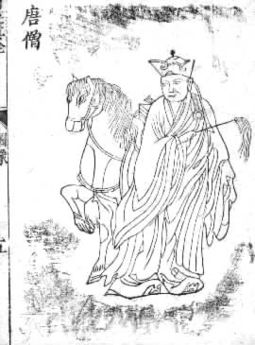 In 629, Xuanzang reportedly had a dream that convinced him to journey to India. The Tang Dynasty
and Eastern Türk Göktürks
were waging war at the time; therefore Emperor Tang Taizong
prohibited foreign travel. Xuanzang persuaded some Buddhist guards at the gates of Yumen
and slipped out of the empire via Liangzhou (Gansu
), and Qinghai
province in 629. He subsequently travelled across the Gobi Desert
to Kumul (Hami), thence following the Tian Shan
westward, arriving in Turpan in 630. Here he met the king of Turpan, a Buddhist who equipped him further for his travels with letters of introduction and valuables to serve as funds.
Moving further westward, Xuanzang escaped robbers to reach Yanqi
, then toured the non-Mahayana monasteries of Kucha
. Further west he passed Aksu before turning northwest to cross the Tian Shan's Bedal Pass into modern Kyrgyzstan
. He skirted Issyk Kul
before visiting Tokmak
on its northwest, and met the great Khan
of the Western Türk, whose relationship to the Tang
emperor was friendly at the time. After a feast, Xuanzang continued west then southwest to Tashkent
(Chach/Che-Shih), capital of modern day Uzbekistan
. From here, he crossed the desert further west to Samarkand
. In Samarkand, which was under Persian influence, the party came across some abandoned Buddhist temples and Xuanzang impressed the local king with his preaching. Setting out again to the south, Xuanzang crossed a spur of the Pamirs
and passed through the famous Iron Gates. Continuing southward, he reached the Amu Darya
and Termez
, where he encountered a community of more than a thousand Buddhist monks.
Further east he passed through Kunduz
, where he stayed for some time to witness the funeral rites of Prince Tardu, who had been poisoned. Here he met the monk Dharmasimha, and on the advice of the late Tardu made the trip westward to Balkh
(modern day Afghanistan
), to see the Buddhist sites and relics, especially the Nava Vihara
, or Nawbahar, which he described as the westernmost monastic institution in the world. Here Xuanzang also found over 3,000 non-Mahayana monks, including Prajnakara, a monk with whom Xuanzang studied early Buddhist scriptures. He acquired the important Mahāvibhāṣa
text here, which he later translated into Chinese. Prajnakara then accompanied the party southward to Bamyan, where Xuanzang met the king and saw tens of non-Mahayana monasteries, in addition to the two large Bamyan Buddhas
carved out of the rockface. The party then resumed their travel eastward, crossing the Shibar Pass
and descending to the regional capital of Kapisi
(about 60 km north of modern Kabul
), which sported over 100 monasteries and 6,000 monks, mostly Mahayana
. This was part of the fabled old land of Gandhara
. Xuanzang took part in a religious debate here, and demonstrated his knowledge of many Buddhist schools. Here he also met the first Jains
and Hindus of his journey. He pushed on to Adinapur (later named Jalalabad
) and Laghman
, where he considered himself to have reached India. The year was 630.
s and monasteries. His travels included, passing through Hunza
and the Khyber Pass
to the east, reaching the former capital of Gandhara
, Purushapura (Peshawar
), on the other side. Peshawar was nothing compared to its former glory, and Buddhism was declining in the region. Xuanzang visited a number of stupas around Peshawar, notably the Kanishka
Stupa
. This stupa was built just southeast of Peshawar, by a former king of the city. In 1908, it was rediscovered by D.B. Spooner with the help of Xuanzang's account.
Xuanzang left Peshawar and travelled northeast to the Swat Valley (the location of Oḍḍiyāna is disputed between Swat valley and Orissa
). Reaching Oḍḍiyāna
, he found 1,400 old monasteries, that had previously supported 18,000 monks. The remnant monks were of the Mahayana
school. Xuanzang continued northward and into the Buner Valley, before doubling back via Shabaz Gharni to cross the Indus river
at Hund
. Thereafter he headed to Taxila
, a Mahayana
Buddhist kingdom that was a vassal of Kashmir
, which is precisely where he headed next. Here he found 5,000 more Buddhist monks in 100 monasteries. Here he met a talented Mahayana
monk and spent his next two years (631-633) studying Mahayana alongside other schools of Buddhism. During this time, Xuanzang writes about the Fourth Buddhist council
that took place nearby, ca. 100 AD, under the order of King Kanishka
of Kushana.
He visited Chiniot
and Lahore
as well and provided the earliest writings available on the ancient cities.
In 633, Xuanzang left Kashmir
and journeyed south to Chinabhukti, thought to be modern Firozpur
, India
, where he studied for a year with the monk-prince Vinitaprabha.
In 634, he went east to Jalandhar
in eastern Punjab
, before climbing up to visit predominantly non-Mahayana monasteries in the Kulu valley and turning southward again to Bairat
and then Mathura, on the Yamuna river. Mathura had 2,000 monks of both major Buddhist branches, despite being Hindu-dominated. Xuanzang travelled up the river to Srughna before crossing eastward to Matipura, where he arrived in 635, having crossed the river Ganges
. At Matipura Monastery, Xuanzang studied under Mitrasena. From here, he headed south to Sankasya (Kapitha), said to be where Buddha
descended from heaven, then onward to the northern Indian emperor Harsha
's grand capital of Kanyakubja (Kannauj). It is believed he also visited Govishan present day Kashipur in the Harsha
era, in 636, Xuanzang encountered 100 monasteries of 10,000 monks (both Mahayana
and non-Mahayana), and was impressed by the king's patronage of both scholarship and Buddhism. Xuanzang spent time in the city studying early Buddhist scriptures, before setting off eastward again for Ayodhya (Saketa), homeland of the Yogacara
school. Xuanzang now moved south to Kausambi (Kosam), where he had a copy made from an important local image of the Buddha.
Xuanzang now returned northward to Sravasti
, travelled through Terai
in the southern part of modern Nepal
(here he found deserted Buddhist monasteries) and thence to Kapilavastu
, his last stop before Lumbini
, the birthplace of Buddha
. Reaching Lumbini, he would have seen a pillar near the old Ashoka tree that Buddha is said to have been born under. This was from the reign of emperor Ashoka
, and records that he worshipped at the spot. The pillar was rediscovered by A. Führer in 1895.
In 637, Xuanzang set out from Lumbini to Kusinagara, the site of Buddha's death, before heading southwest to the deer park at Sarnath
where Buddha gave his first sermon, and where Xuanzang found 1,500 resident monks. Travelling eastward, at first via Varanasi
, Xuanzang reached Vaisali, Pataliputra (Patna) and Bodh Gaya. He was then accompanied by local monks to Nalanda
, the great Buddhist university of Indian state of Bihar
, where he spent at least the next two years. He was in the company of several thousand scholar-monks, whom he praised. Xuanzang studied logic
, grammar
, Sanskrit
, and the Yogacara school of Buddhism during his time at Nalanda
. René Grousset
notes that it was at Nalanda (where an "azure pool winds around the monasteries, adorned with the full-blown cups of the blue lotus; the dazzling red flowers of the lovely kanaka hang here and there, and outside groves of mango
trees offer the inhabitants their dense and protective shade") that Xuanzang met the venerable Silabhadra, the monastery's superior. Silabhadra had dreamt of Xuanzang's arrival and that it would help spread far and wide the Holy Law. Grousset writes: "The Chinese pilgrim had finally found the omniscient master, the incomparable metaphysician who was to make known to him the ultimate secrets of the idealist systems...The founders of Mahayana idealism, Asanga
and Vasubandhu
...Dignaga
...Dharmapala had in turn trained Silabhadra. Siladhadra was thus in a position to make available to the Sino-Japanese world the entire heritage of Buddhist idealism, and the Siddhi Hiuan Tsang's great philosophical treatise...is none other than the Summa of this doctrine, the fruit of seven centuries of Indian [Buddhist] thought."
From Nalanda, Xuanzang travelled through several countries, including Campā, to the capital of Pundravardhana
, identified with modern Mahasthangarh
, in Bangladesh
. There Xuanzang found 20 monasteries with over 3,000 monks studying both the Hinayana and the Mahayana. One of them was the Vāśibhã Monastery (Po Shi Po), where he found over 700 Mahayana monks from all over East India. He also visited a stupa originally built by Ashoka Somapura Mahavihara
at Paharpur in the district of Naogaon,Bangladesh.
After crossing the Karatoya
, he went east to the ancient city of Pragjyotishpur (modern Guwahati
) in the kingdom of Kamarupa (modern Assam) at the invitation of its Buddhist king Kumar Bhaskaravarman. Later, the king escorted Xuanzang back to the Kannauj at the request of king Harshavardhana, who was an ally of Kumar Bhaskaravarman, to attend a great Buddhist council there which was attended by both the kings.
Xuanzang turned southward and travelled to Andhradesa to visit the famous Viharas at Amaravati
and Nagarjunakonda. He stayed at Amaravati and studied 'Abhidhammapitakam'. He observed that there were many Viharas at Amaravati and some of them were deserted. He later proceeded to Kanchi, the imperial capital of Pallavas and a strong centre of Buddhism
.
Traveling through the Khyber Pass
of the Hindu Kush
, Xuanzang passed through Kashgar
, Khotan
, and Dunhuang
on his way back to China. He arrived in the capital, Chang'an, on the seventh day of the first month of 645, and a great procession celebrated his return.
. Instead, he retired to a monastery and devoted his energy to translating Buddhist texts until his death in AD 664.
 During his travels, he studied with many famous Buddhist masters, especially at the famous center of Buddhist learning at Nālanda University
. When he returned, he brought with him some 657 Sanskrit
texts. With the emperor's support, he set up a large translation bureau in Chang'an
(present-day Xi'an
), drawing students and collaborators from all over East Asia
. He is credited with the translation of some 1,330 fascicles of scriptures into Chinese. His strongest personal interest in Buddhism was in the field of Yogācāra
(瑜伽行派) or Consciousness-only (唯識).
The force of his own study, translation and commentary of the texts of these traditions initiated the development of the Faxiang school (法相宗) in East Asia. Although the school itself did not thrive for a long time, its theories regarding perception
, consciousness
, karma
, rebirth
, etc. found their way into the doctrines of other more successful schools. Xuanzang's closest and most eminent student was Kuiji
(窺基) who became recognized as the first patriarch of the Faxiang school. Xuanzang's logic, as described by Kuiji, was often misunderstood by scholars of Chinese Buddhism because they lack the necessary background in Indian logic
. Another important disciple was the Korean monk Woncheuk.
Xuanzang was known for his extensive but careful translations of Indian Buddhist texts to Chinese, which have enabled subsequent recoveries of lost Indian Buddhist texts from the translated Chinese copies. He is credited with writing or compiling the Cheng Weishi Lun
as a commentary on these texts. His translation of the Heart Sutra
became and remains the standard in all East Asian Buddhist sects. He also founded the short-lived but influential Faxiang school of Buddhism. Additionally, he was known for recording the events of the reign of the northern Indian emperor, Harsha
.
. Xuanzang, with a team of disciple translators, commenced translating the voluminous work in 660 CE, using all three versions to ensure the integrity of the source documentation. Xuanzang was being encouraged by a number of his disciple translators to render an abridged version. After a suite of dreams quickened his decision, Xuanzang determined to render an unabridged, complete volume, faithful to the original of 600 chapters.
(大唐西域記), which has become one of the primary sources for the study of medieval
Central Asia and India. This book was first translated into French by the Sinologist Stanislas Julien
in 1857.
There was also a biography of Xuanzang written by the monk Huili (慧立). Both books were first translated into English by Samuel Beal
, in 1884 and 1911 respectively. An English translation with copious notes by Thomas Watters was edited by T.W. Rhys Davids
and S.W. Bushell
, and published posthumously in London in 1905.
His record of the places visited by him in Bengal
— mainly Raktamrittika near Karnasuvarna, Pundranagara and its environs, Samatata
and Tamralipti — have been very helpful in the recording of the archaeological history of Bengal. His account has also shed welcome light on the history of 7th century Bengal, especially the Gauda
kingdom under Shashanka
, although at times he can be quite partisan.
Xuanzang obtained and translated 657 Sanskrit Buddhist works. He received the best education on Buddhism he could find throughout India. Much of this activity is detailed in the companion volume to Xiyu Ji, the Biography of Xuanzang written by Huili, entitled the Life of Xuanzang.
His version of the Heart Sutra
is the basis for all Chinese commentaries on the sutra, and recitations throughout China, Korea and Japan. His style was, by Chinese standards, cumbersome and overly literal, and marked by scholarly innovations in terminology; usually, where another version by the earlier translator Kumārajīva
exists, Kumārajīva's is more popular.
Xuanzang's journey along the so-called Silk Road
, and the legends that grew up around it, inspired the Ming
novel Journey to the West
, one of the great classics of Chinese literature
. The Xuanzang of the novel
is the reincarnation of a disciple of Gautama Buddha
, and is protected on his journey by three powerful disciples. One of them, the monkey
, was a popular favourite and profoundly influenced Chinese culture
and contemporary Japan
ese manga
and anime, (including the popular Dragon Ball and Saiyuki series'), and became well known in the West by Arthur Waley
's translation and later the cult TV series Monkey
.
In the Yuan Dynasty
, there was also a play
by Wu Changling (吳昌齡) about Xuanzang obtaining scriptures.
, Tianjin
until 1956 when it was taken to Nalanda
- allegedly by the Dalai Lama
- and presented to India
. The relic is now in the Patna
museum. The Wenshu Monastery in Chengdu
, Sichuan
province also claims to have part of Xuanzang's skull.
Part of Xuanzang's remains were taken from Nanjing
by soldiers of the Imperial Japanese Army
in 1942, and are now enshrined at Yakushi-ji
in Nara
, Japan.
Mehmet Ölmez und Klaus Röhrborn, Die alttürkische Xuanzang-Biographie III. Nach der Handschrift von Leningrad, Paris, Peking und St. Petersburg sowie nach dem Transkript von A. v. Gabain. Hrsg., über. u. komm. Otto Harrassowitz · Wiesbaden 2001.
China
Chinese civilization may refer to:* China for more general discussion of the country.* Chinese culture* Greater China, the transnational community of ethnic Chinese.* History of China* Sinosphere, the area historically affected by Chinese culture...
Buddhist monk
Monk
A monk is a person who practices religious asceticism, living either alone or with any number of monks, while always maintaining some degree of physical separation from those not sharing the same purpose...
, scholar, traveler, and translator who described the interaction between China
History of China
Chinese civilization originated in various regional centers along both the Yellow River and the Yangtze River valleys in the Neolithic era, but the Yellow River is said to be the Cradle of Chinese Civilization. With thousands of years of continuous history, China is one of the world's oldest...
and India
History of India
The history of India begins with evidence of human activity of Homo sapiens as long as 75,000 years ago, or with earlier hominids including Homo erectus from about 500,000 years ago. The Indus Valley Civilization, which spread and flourished in the northwestern part of the Indian subcontinent from...
in the early Tang
Tang Dynasty
The Tang Dynasty was an imperial dynasty of China preceded by the Sui Dynasty and followed by the Five Dynasties and Ten Kingdoms Period. It was founded by the Li family, who seized power during the decline and collapse of the Sui Empire...
period. Born in Henan
Henan
Henan , is a province of the People's Republic of China, located in the central part of the country. Its one-character abbreviation is "豫" , named after Yuzhou , a Han Dynasty state that included parts of Henan...
province of China in 602 or 603, from boyhood he took to reading sacred books, including the Chinese Classics and the writings of the ancient sages.
While residing in the city of Luoyang
Luoyang
Luoyang is a prefecture-level city in western Henan province of Central China. It borders the provincial capital of Zhengzhou to the east, Pingdingshan to the southeast, Nanyang to the south, Sanmenxia to the west, Jiyuan to the north, and Jiaozuo to the northeast.Situated on the central plain of...
, Xuanzang entered Buddhist monkhood at the age of thirteen. Due to the political and social unrest caused by the fall of the Sui dynasty
Sui Dynasty
The Sui Dynasty was a powerful, but short-lived Imperial Chinese dynasty. Preceded by the Southern and Northern Dynasties, it ended nearly four centuries of division between rival regimes. It was followed by the Tang Dynasty....
, he went to Chengdu
Chengdu
Chengdu , formerly transliterated Chengtu, is the capital of Sichuan province in Southwest China. It holds sub-provincial administrative status...
in Sichuan
Sichuan
' , known formerly in the West by its postal map spellings of Szechwan or Szechuan is a province in Southwest China with its capital in Chengdu...
(Szechuan), where he was ordained at the age of twenty. He later traveled throughout China in search of sacred books of Buddhism. At length, he came to Chang'an
Chang'an
Chang'an is an ancient capital of more than ten dynasties in Chinese history, today known as Xi'an. Chang'an literally means "Perpetual Peace" in Classical Chinese. During the short-lived Xin Dynasty, the city was renamed "Constant Peace" ; yet after its fall in AD 23, the old name was restored...
, then under the peaceful rule of Emperor Taizong of Tang
Emperor Taizong of Tang
Emperor Taizong of Tang , personal name Lǐ Shìmín , was the second emperor of the Tang Dynasty of China, ruling from 626 to 649...
. Here Xuanzang developed the desire to visit India
India
India , officially the Republic of India , is a country in South Asia. It is the seventh-largest country by geographical area, the second-most populous country with over 1.2 billion people, and the most populous democracy in the world...
. He knew about Faxian
Faxian
Faxian was a Chinese Buddhist monk who traveled to India, Sri Lanka and Kapilavastu in today's Nepal between 399 and 412 to acquire Buddhist scriptures...
's visit to India and, like him, was concerned about the incomplete and misinterpreted nature of the Buddhist scriptures that had reached China.
He became famous for his seventeen year overland journey to India, which is recorded in detail in the classic Chinese text Great Tang Records on the Western Regions
Great Tang Records on the Western Regions
The Great Tang Records on the Western Regions is a narrative of Xuanzang's nineteen year journey through Chang'an to Central Asia and eventually South Asia between 626 and 645...
, which in turn provided the inspiration for the popular epic novel Journey to the West
Journey to the West
Journey to the West is one of the Four Great Classical Novels of Chinese literature. It was written by Wu Cheng'en in the 16th century. In English-speaking countries, the tale is also often known simply as Monkey. This was one title used for a popular, abridged translation by Arthur Waley...
.
Nomenclature, orthography and etymology
Xuanzang is also known as Táng-sānzàng (唐三藏), Xuánzàng Sānzàng (玄奘三藏), Xuánzàng Dàshī (玄奘大師), or simply as Táng Sēng (唐僧), or Tang (Dynasty) Monk in Mandarin; in Cantonese as Tong Sam Jong and in Vietnamese as Đường Tam Tạng. Less common romanizationRomanization
In linguistics, romanization or latinization is the representation of a written word or spoken speech with the Roman script, or a system for doing so, where the original word or language uses a different writing system . Methods of romanization include transliteration, for representing written...
s of Xuanzang include Hhuen Kwan, Hiouen Thsang, Hiuen Tsiang, Hsien-tsang, Hsyan-tsang, Hsuan Chwang, Hsuan Tsiang, Hwen Thsang, Xuan Cang, Xuan Zang, Shuen Shang, Yuan Chang, Yuan Chwang, and Yuen Chwang. Hsüan, Hüan, Huan and Chuang are also found. In Korean, he is known as Hyeon Jang. In Japanese, he is known as Genjō, or Genjō-sanzō (Xuanzang-sanzang). In Vietnamese, he is known as Đường Tăng (Tang Buddhist monk), Đường Tam Tạng ("Tang Tripitaka" monk), Huyền Trang (the Han-Vietnamese name of Xuanzang)(nishant k)
Sānzàng (三藏) is the Chinese term for the Tripitaka
Tripiṭaka
' is a traditional term used by various Buddhist sects to describe their various canons of scriptures. As the name suggests, a traditionally contains three "baskets" of teachings: a , a and an .-The three categories:Tripitaka is the three main categories of texts that make up the...
scriptures, and in some English-language fiction he is addressed with this title.
Early life
Luoyang
Luoyang is a prefecture-level city in western Henan province of Central China. It borders the provincial capital of Zhengzhou to the east, Pingdingshan to the southeast, Nanyang to the south, Sanmenxia to the west, Jiyuan to the north, and Jiaozuo to the northeast.Situated on the central plain of...
, Henan
Henan
Henan , is a province of the People's Republic of China, located in the central part of the country. Its one-character abbreviation is "豫" , named after Yuzhou , a Han Dynasty state that included parts of Henan...
in 602 as Chén Huī or Chén Yī (陳 褘) and died 5 February 664 in Yu Hua Gong (玉華宮). Xuanzang, whose lay name was Chen Hui, was born into a family noted for its erudition for generations. He was the youngest of four children. His great-grandfather was an official serving as a prefect; his grandfather was appointed as professor in the Imperial College at the capital. His father was a conservative Confucianist who gave up office and withdrew into seclusion to escape the political turmoil that gripped China at that time. According to traditional biographies, Xuanzang displayed a superb intelligence and earnestness, amazing his father by his careful observance of the Confucian rituals at the age of eight. Along with his brothers and sister, he received an early education from his father, who instructed him in classical works on filial piety
Filial piety
In Confucian ideals, filial piety is one of the virtues to be held above all else: a respect for the parents and ancestors. The Confucian classic Xiao Jing or Classic of Xiào, thought to be written around 470 BCE, has historically been the authoritative source on the Confucian tenet of xiào /...
and several other canonical treatises of orthodox Confucianism.
Although his household in Chenhe Village of Goushi Town (緱氏 gou1), Luo Prefecture (洛州), Henan
Henan
Henan , is a province of the People's Republic of China, located in the central part of the country. Its one-character abbreviation is "豫" , named after Yuzhou , a Han Dynasty state that included parts of Henan...
, was essentially Confucian, at a young age Xuanzang expressed interest in becoming a Buddhist monk as one of his elder brothers had done. After the death of his father in 611, he lived with his older brother Chensu (later known as Changjie) for five years at Jingtu Monastery (淨土寺) in Luoyang
Luoyang
Luoyang is a prefecture-level city in western Henan province of Central China. It borders the provincial capital of Zhengzhou to the east, Pingdingshan to the southeast, Nanyang to the south, Sanmenxia to the west, Jiyuan to the north, and Jiaozuo to the northeast.Situated on the central plain of...
, supported by the Sui Dynasty
Sui Dynasty
The Sui Dynasty was a powerful, but short-lived Imperial Chinese dynasty. Preceded by the Southern and Northern Dynasties, it ended nearly four centuries of division between rival regimes. It was followed by the Tang Dynasty....
state. During this time he studied Mahayana
Mahayana
Mahāyāna is one of the two main existing branches of Buddhism and a term for classification of Buddhist philosophies and practice...
Buddhism and various early Buddhist schools
Early Buddhist schools
The early Buddhist schools are those schools into which, according to most scholars, the Buddhist monastic saṅgha initially split, due originally to differences in vinaya, and later also due to doctrinal differences and geographical separation of groups of monks.The original saṅgha split into the...
, preferring Mahayana.
In 618, the Sui Dynasty collapsed and Xuanzang and his brother fled to Chang'an, which had been proclaimed as the capital of the Tang
Tang Dynasty
The Tang Dynasty was an imperial dynasty of China preceded by the Sui Dynasty and followed by the Five Dynasties and Ten Kingdoms Period. It was founded by the Li family, who seized power during the decline and collapse of the Sui Empire...
state, and thence southward to Chengdu
Chengdu
Chengdu , formerly transliterated Chengtu, is the capital of Sichuan province in Southwest China. It holds sub-provincial administrative status...
, Sichuan
Sichuan
' , known formerly in the West by its postal map spellings of Szechwan or Szechuan is a province in Southwest China with its capital in Chengdu...
. Here the two brothers spent two or three years in further study in the monastery of Kong Hui, including the Abhidharmakosa-sastra (Abhidharma Storehouse Treatise). When Xuanzang requested to take Buddhist orders at the age of thirteen, the abbot Zheng Shanguo made an exception in his case because of his precocious knowledge.
Xuanzang was fully ordained as a monk in 622, at the age of twenty. The myriad contradictions and discrepancies in the texts at that time prompted Xuanzang to decide to go to India and study in the cradle of Buddhism. He subsequently left his brother and returned to Chang'an to study foreign languages and to continue his study of Buddhism. He began his mastery of Sanskrit
Sanskrit
Sanskrit , is a historical Indo-Aryan language and the primary liturgical language of Hinduism, Jainism and Buddhism.Buddhism: besides Pali, see Buddhist Hybrid Sanskrit Today, it is listed as one of the 22 scheduled languages of India and is an official language of the state of Uttarakhand...
in 626, and probably also studied Tocharian
Tocharian
Tocharian may refer to:* Tocharians, an ancient people who inhabited the Tarim Basin in Central Asia* Tocharian languages, two Indo-European languages spoken by those people...
. During this time, Xuanzang also became interested in the metaphysical Yogacara
Yogacara
Yogācāra is an influential school of Buddhist philosophy and psychology emphasizing phenomenology and ontology through the interior lens of meditative and yogic practices. It developed within Indian Mahāyāna Buddhism in about the 4th century CE...
school of Buddhism.
Pilgrimage
Tang Dynasty
The Tang Dynasty was an imperial dynasty of China preceded by the Sui Dynasty and followed by the Five Dynasties and Ten Kingdoms Period. It was founded by the Li family, who seized power during the decline and collapse of the Sui Empire...
and Eastern Türk Göktürks
Göktürks
The Göktürks or Kök Türks, were a nomadic confederation of peoples in medieval Inner Asia. Known in Chinese sources as 突厥 , the Göktürks under the leadership of Bumin Qaghan The Göktürks or Kök Türks, (Old Turkic: Türük or Kök Türük or Türük; Celestial Turks) were a nomadic confederation of...
were waging war at the time; therefore Emperor Tang Taizong
Emperor Taizong of Tang
Emperor Taizong of Tang , personal name Lǐ Shìmín , was the second emperor of the Tang Dynasty of China, ruling from 626 to 649...
prohibited foreign travel. Xuanzang persuaded some Buddhist guards at the gates of Yumen
Yumen
Yumen is a city in western Gansu province in China.It is a county-level city with a population of 116,194 . Administratively, it is part of Jiuquan "prefecture-level city"...
and slipped out of the empire via Liangzhou (Gansu
Gansu
' is a province located in the northwest of the People's Republic of China.It lies between the Tibetan and Huangtu plateaus, and borders Mongolia, Inner Mongolia, and Ningxia to the north, Xinjiang and Qinghai to the west, Sichuan to the south, and Shaanxi to the east...
), and Qinghai
Qinghai
Qinghai ; Oirat Mongolian: ; ; Salar:) is a province of the People's Republic of China, named after Qinghai Lake...
province in 629. He subsequently travelled across the Gobi Desert
Gobi Desert
The Gobi is a large desert region in Asia. It covers parts of northern and northwestern China, and of southern Mongolia. The desert basins of the Gobi are bounded by the Altai Mountains and the grasslands and steppes of Mongolia on the north, by the Hexi Corridor and Tibetan Plateau to the...
to Kumul (Hami), thence following the Tian Shan
Tian Shan
The Tian Shan , also spelled Tien Shan, is a large mountain system located in Central Asia. The highest peak in the Tian Shan is Victory Peak , ....
westward, arriving in Turpan in 630. Here he met the king of Turpan, a Buddhist who equipped him further for his travels with letters of introduction and valuables to serve as funds.
Moving further westward, Xuanzang escaped robbers to reach Yanqi
Yanqi
Yanqi may refer to the following in China:Xinjiang*Karasahr , ancient kingdom*Yanqi Hui Autonomous County , in Bayin'gholin Mongol Autonomous PrefectureElsewhere*Yanqi, Beijing , area of Huairou District, Beijing...
, then toured the non-Mahayana monasteries of Kucha
Kucha
Kuchaor Kuche Uyghur , Chinese Simplified: 库车; Traditional: 庫車; pinyin Kùchē; also romanized as Qiuzi, Qiuci, Chiu-tzu, Kiu-che, Kuei-tzu from the traditional Chinese forms 屈支 屈茨; 龜玆; 龟兹, 丘玆, also Po ; Sanskrit: Kueina, Standard Tibetan: Kutsahiyui was an ancient Buddhist kingdom...
. Further west he passed Aksu before turning northwest to cross the Tian Shan's Bedal Pass into modern Kyrgyzstan
Kyrgyzstan
Kyrgyzstan , officially the Kyrgyz Republic is one of the world's six independent Turkic states . Located in Central Asia, landlocked and mountainous, Kyrgyzstan is bordered by Kazakhstan to the north, Uzbekistan to the west, Tajikistan to the southwest and China to the east...
. He skirted Issyk Kul
Issyk Kul
Issyk Kul is an endorheic lake in the northern Tian Shan mountains in eastern Kyrgyzstan. It is the tenth largest lake in the world by volume and the second largest saline lake after the Caspian Sea. Although it is surrounded by snow-capped peaks, it never freezes; hence its name, which means "hot...
before visiting Tokmak
Tokmak, Uzbekistan
Tokmak is a city in Uzbekistan located on a peninsula on the south coast of the Aral Sea. The area has a population of around 3000....
on its northwest, and met the great Khan
Khan (title)
Khan is an originally Altaic and subsequently Central Asian title for a sovereign or military ruler, widely used by medieval nomadic Turko-Mongol tribes living to the north of China. 'Khan' is also seen as a title in the Xianbei confederation for their chief between 283 and 289...
of the Western Türk, whose relationship to the Tang
Tang Dynasty
The Tang Dynasty was an imperial dynasty of China preceded by the Sui Dynasty and followed by the Five Dynasties and Ten Kingdoms Period. It was founded by the Li family, who seized power during the decline and collapse of the Sui Empire...
emperor was friendly at the time. After a feast, Xuanzang continued west then southwest to Tashkent
Tashkent
Tashkent is the capital of Uzbekistan and of the Tashkent Province. The officially registered population of the city in 2008 was about 2.2 million. Unofficial sources estimate the actual population may be as much as 4.45 million.-Early Islamic History:...
(Chach/Che-Shih), capital of modern day Uzbekistan
Uzbekistan
Uzbekistan , officially the Republic of Uzbekistan is a doubly landlocked country in Central Asia and one of the six independent Turkic states. It shares borders with Kazakhstan to the west and to the north, Kyrgyzstan and Tajikistan to the east, and Afghanistan and Turkmenistan to the south....
. From here, he crossed the desert further west to Samarkand
Samarkand
Although a Persian-speaking region, it was not united politically with Iran most of the times between the disintegration of the Seleucid Empire and the Arab conquest . In the 6th century it was within the domain of the Turkic kingdom of the Göktürks.At the start of the 8th century Samarkand came...
. In Samarkand, which was under Persian influence, the party came across some abandoned Buddhist temples and Xuanzang impressed the local king with his preaching. Setting out again to the south, Xuanzang crossed a spur of the Pamirs
Pamir Mountains
The Pamir Mountains are a mountain range in Central Asia formed by the junction or knot of the Himalayas, Tian Shan, Karakoram, Kunlun, and Hindu Kush ranges. They are among the world’s highest mountains and since Victorian times they have been known as the "Roof of the World" a probable...
and passed through the famous Iron Gates. Continuing southward, he reached the Amu Darya
Amu Darya
The Amu Darya , also called Oxus and Amu River, is a major river in Central Asia. It is formed by the junction of the Vakhsh and Panj rivers...
and Termez
Termez
Termez is a city in southern Uzbekistan near the border with Afghanistan.Some link the name of the city to thermos, "hot" in Greek, tracing its name back to Alexander the Great. Others suggest that it came from Sanskrit taramato, meaning "on the river bank". It is the hottest point of Uzbekistan...
, where he encountered a community of more than a thousand Buddhist monks.
Further east he passed through Kunduz
Kunduz
Kunduz also known as Kundûz, Qonduz, Qondûz, Konduz, Kondûz, Kondoz, or Qhunduz is a city in northern Afghanistan, the capital of Kunduz Province. It is linked by highways with Mazari Sharif to the west, Kabul to the south and Tajikistan's border to the north...
, where he stayed for some time to witness the funeral rites of Prince Tardu, who had been poisoned. Here he met the monk Dharmasimha, and on the advice of the late Tardu made the trip westward to Balkh
Balkh
Balkh , was an ancient city and centre of Zoroastrianism in what is now northern Afghanistan. Today it is a small town in the province of Balkh, about 20 kilometers northwest of the provincial capital, Mazar-e Sharif, and some south of the Amu Darya. It was one of the major cities of Khorasan...
(modern day Afghanistan
Afghanistan
Afghanistan , officially the Islamic Republic of Afghanistan, is a landlocked country located in the centre of Asia, forming South Asia, Central Asia and the Middle East. With a population of about 29 million, it has an area of , making it the 42nd most populous and 41st largest nation in the world...
), to see the Buddhist sites and relics, especially the Nava Vihara
Nava Vihara
Navbahar was a Buddhist stupa or monastery near the ancient city of Balkh in northern Afghanistan. The temple may have been an old Zoroastrian fire-temple, or it may have been converted to a Zoroastrian temple .-Rise to prominence:Navbahar, the main monastery at Balkh became the center of higher...
, or Nawbahar, which he described as the westernmost monastic institution in the world. Here Xuanzang also found over 3,000 non-Mahayana monks, including Prajnakara, a monk with whom Xuanzang studied early Buddhist scriptures. He acquired the important Mahāvibhāṣa
Mahavibhasa
The Abhidharma ' Śāstra is an ancient Buddhist text. It is thought to have been authored around 150 CE.-The Compendia: is a term meaning 'compendium', 'treatise' or simply 'explanation', derived from vi + , 'to speak' or 'to explain'...
text here, which he later translated into Chinese. Prajnakara then accompanied the party southward to Bamyan, where Xuanzang met the king and saw tens of non-Mahayana monasteries, in addition to the two large Bamyan Buddhas
Buddhas of Bamyan
The Buddhas of Bamiyan were two 6th century monumental statues of standing buddhas carved into the side of a cliff in the Bamyan valley in the Hazarajat region of central Afghanistan, situated northwest of Kabul at an altitude of 2,500 meters...
carved out of the rockface. The party then resumed their travel eastward, crossing the Shibar Pass
Shibar Pass
Shibar Pass is situated at a height of 3,000 m above sea-level and is one of the two main routes from Kabul to Bamiyan in central Afghanistan. The journey is approximately 6 and half hours long covering around ....
and descending to the regional capital of Kapisi
Kapisa Province
Kapisa is one of the 34 provinces of Afghanistan. It is in the north-east of the country. Its capital is Mahmud-i-Raqi, and other districts include Kohistan, Nijrab and Tagab. The population of Kapisa is estimated to be 364,900, although there has never been an official estimate...
(about 60 km north of modern Kabul
Kabul
Kabul , spelt Caubul in some classic literatures, is the capital and largest city of Afghanistan. It is also the capital of the Kabul Province, located in the eastern section of Afghanistan...
), which sported over 100 monasteries and 6,000 monks, mostly Mahayana
Mahayana
Mahāyāna is one of the two main existing branches of Buddhism and a term for classification of Buddhist philosophies and practice...
. This was part of the fabled old land of Gandhara
Gandhara
Gandhāra , is the name of an ancient kingdom , located in northern Pakistan and eastern Afghanistan. Gandhara was located mainly in the vale of Peshawar, the Potohar plateau and on the Kabul River...
. Xuanzang took part in a religious debate here, and demonstrated his knowledge of many Buddhist schools. Here he also met the first Jains
Jainism
Jainism is an Indian religion that prescribes a path of non-violence towards all living beings. Its philosophy and practice emphasize the necessity of self-effort to move the soul towards divine consciousness and liberation. Any soul that has conquered its own inner enemies and achieved the state...
and Hindus of his journey. He pushed on to Adinapur (later named Jalalabad
Jalalabad
Jalalabad , formerly called Adinapour, as documented by the 7th century Hsüan-tsang, is a city in eastern Afghanistan. Located at the junction of the Kabul River and Kunar River near the Laghman valley, Jalalabad is the capital of Nangarhar province. It is linked by approximately of highway with...
) and Laghman
Laghman
Laghman can refer to:* Laghman Province in Afghanistan* Laghman, a place in Jowzjan Province, Afghanistan* Lamian and variants thereof as soup...
, where he considered himself to have reached India. The year was 630.
India a memorable journey
Xuanzang left Adinapur, which had few Buddhist monks, but many stupaStupa
A stupa is a mound-like structure containing Buddhist relics, typically the remains of Buddha, used by Buddhists as a place of worship....
s and monasteries. His travels included, passing through Hunza
Hunza Valley
The Hunza Valley is a mountainous valley in the Gilgit-Baltistan region of Pakistan. The Hunza valley is situated to the north of the Hunza River, at an elevation of around . The territory of Hunza is about...
and the Khyber Pass
Khyber Pass
The Khyber Pass, is a mountain pass linking Pakistan and Afghanistan.The Pass was an integral part of the ancient Silk Road. It is mentioned in the Bible as the "Pesh Habor," and it is one of the oldest known passes in the world....
to the east, reaching the former capital of Gandhara
Gandhara
Gandhāra , is the name of an ancient kingdom , located in northern Pakistan and eastern Afghanistan. Gandhara was located mainly in the vale of Peshawar, the Potohar plateau and on the Kabul River...
, Purushapura (Peshawar
Peshawar
Peshawar is the capital of Khyber-Pakhtunkhwa and the administrative center and central economic hub for the Federally Administered Tribal Areas of Pakistan....
), on the other side. Peshawar was nothing compared to its former glory, and Buddhism was declining in the region. Xuanzang visited a number of stupas around Peshawar, notably the Kanishka
Kanishka
Kanishka ) was an emperor of the Kushan Empire, ruling an empire extending from Bactria to large parts of northern India in the 2nd century of the common era, and famous for his military, political, and spiritual achievements...
Stupa
Stupa
A stupa is a mound-like structure containing Buddhist relics, typically the remains of Buddha, used by Buddhists as a place of worship....
. This stupa was built just southeast of Peshawar, by a former king of the city. In 1908, it was rediscovered by D.B. Spooner with the help of Xuanzang's account.
Xuanzang left Peshawar and travelled northeast to the Swat Valley (the location of Oḍḍiyāna is disputed between Swat valley and Orissa
Orissa
Orissa , officially Odisha since Nov 2011, is a state of India, located on the east coast of India, by the Bay of Bengal. It is the modern name of the ancient nation of Kalinga, which was invaded by the Maurya Emperor Ashoka in 261 BC. The modern state of Orissa was established on 1 April...
). Reaching Oḍḍiyāna
Oddiyana
', a small country in early medieval India, ascribed importance in the development and dissemination of Tantric Buddhism. The physical location of is disputed and open to conjecture. Possible locations that have been identified are:...
, he found 1,400 old monasteries, that had previously supported 18,000 monks. The remnant monks were of the Mahayana
Mahayana
Mahāyāna is one of the two main existing branches of Buddhism and a term for classification of Buddhist philosophies and practice...
school. Xuanzang continued northward and into the Buner Valley, before doubling back via Shabaz Gharni to cross the Indus river
Indus River
The Indus River is a major river which flows through Pakistan. It also has courses through China and India.Originating in the Tibetan plateau of western China in the vicinity of Lake Mansarovar in Tibet Autonomous Region, the river runs a course through the Ladakh district of Jammu and Kashmir and...
at Hund
Hund
Hund is a small village in Swabi district, situated on the right bank of the Indus River about 15 km upstream of Attock Fort and at a distance of about 80 km to the east of Peshawar in the Khyber Pakhtunkhwa Province, of Pakistan...
. Thereafter he headed to Taxila
Taxila
Taxila is a Tehsil in the Rawalpindi District of Punjab province of Pakistan. It is an important archaeological site.Taxila is situated about northwest of Islamabad Capital Territory and Rawalpindi in Panjab; just off the Grand Trunk Road...
, a Mahayana
Mahayana
Mahāyāna is one of the two main existing branches of Buddhism and a term for classification of Buddhist philosophies and practice...
Buddhist kingdom that was a vassal of Kashmir
Kashmir
Kashmir is the northwestern region of the Indian subcontinent. Until the mid-19th century, the term Kashmir geographically denoted only the valley between the Great Himalayas and the Pir Panjal mountain range...
, which is precisely where he headed next. Here he found 5,000 more Buddhist monks in 100 monasteries. Here he met a talented Mahayana
Mahayana
Mahāyāna is one of the two main existing branches of Buddhism and a term for classification of Buddhist philosophies and practice...
monk and spent his next two years (631-633) studying Mahayana alongside other schools of Buddhism. During this time, Xuanzang writes about the Fourth Buddhist council
Fourth Buddhist council
Fourth Buddhist Council is the name of two separate Buddhist council meetings. The first one was held in the 1st century BC, in Sri Lanka. In this fourth Buddhist council the Theravadin Pali Canon was for the first time committed to writing, on palm leaves...
that took place nearby, ca. 100 AD, under the order of King Kanishka
Kanishka
Kanishka ) was an emperor of the Kushan Empire, ruling an empire extending from Bactria to large parts of northern India in the 2nd century of the common era, and famous for his military, political, and spiritual achievements...
of Kushana.
He visited Chiniot
Chiniot
Chiniot is a city and administration headquarter of Chiniot District, in the state of Punjab, Pakistan. Located between the heart of river Chenab with the heads of small rocky hills, it is known for its wooden furniture architecture which has a great attraction in all over the world.- Name and...
and Lahore
Lahore
Lahore is the capital of the Pakistani province of Punjab and the second largest city in the country. With a rich and fabulous history dating back to over a thousand years ago, Lahore is no doubt Pakistan's cultural capital. One of the most densely populated cities in the world, Lahore remains a...
as well and provided the earliest writings available on the ancient cities.
In 633, Xuanzang left Kashmir
Kashmir
Kashmir is the northwestern region of the Indian subcontinent. Until the mid-19th century, the term Kashmir geographically denoted only the valley between the Great Himalayas and the Pir Panjal mountain range...
and journeyed south to Chinabhukti, thought to be modern Firozpur
Firozpur
Firozpur is a city on the banks of the Sutlej River in Firozpur District, Punjab, India, founded by Sultan Firoz Shah Tughlaq , a Muslim ruler of the Tughlaq Dynasty who reigned over the Sultanate of Delhi from 1351 to 1388.The Manj Rajputs say the town was named after their chief, a Rajput of...
, India
India
India , officially the Republic of India , is a country in South Asia. It is the seventh-largest country by geographical area, the second-most populous country with over 1.2 billion people, and the most populous democracy in the world...
, where he studied for a year with the monk-prince Vinitaprabha.
In 634, he went east to Jalandhar
Jalandhar
Jalandhar is a city in Jalandhar District in the state of Punjab, India. It is located 144 km northwest of the state capital, Chandigarh...
in eastern Punjab
Punjab region
The Punjab , also spelled Panjab |water]]s"), is a geographical region straddling the border between Pakistan and India which includes Punjab province in Pakistan and the states of the Punjab, Haryana, Himachal Pradesh, Chandigarh and some northern parts of the National Capital Territory of Delhi...
, before climbing up to visit predominantly non-Mahayana monasteries in the Kulu valley and turning southward again to Bairat
Bairat
Bairat is a town in northern Jaipur district of Rajasthan, India. It is located 52 km north of Jaipur, and 66 km west of Alwar.-History:...
and then Mathura, on the Yamuna river. Mathura had 2,000 monks of both major Buddhist branches, despite being Hindu-dominated. Xuanzang travelled up the river to Srughna before crossing eastward to Matipura, where he arrived in 635, having crossed the river Ganges
Ganges River
The Ganges or Ganga, , is a trans-boundary river of India and Bangladesh. The river rises in the western Himalayas in the Indian state of Uttarakhand, and flows south and east through the Gangetic Plain of North India into Bangladesh, where it empties into the Bay of Bengal. By discharge it...
. At Matipura Monastery, Xuanzang studied under Mitrasena. From here, he headed south to Sankasya (Kapitha), said to be where Buddha
Gautama Buddha
Siddhārtha Gautama was a spiritual teacher from the Indian subcontinent, on whose teachings Buddhism was founded. In most Buddhist traditions, he is regarded as the Supreme Buddha Siddhārtha Gautama (Sanskrit: सिद्धार्थ गौतम; Pali: Siddhattha Gotama) was a spiritual teacher from the Indian...
descended from heaven, then onward to the northern Indian emperor Harsha
Harsha
Harsha or Harsha Vardhana or Harshvardhan was an Indian emperor who ruled northern India from 606 to 647 AD. He was the son of Prabhakara Vardhana and younger brother of Rajya Vardhana, a king of Thanesar, Haryana...
's grand capital of Kanyakubja (Kannauj). It is believed he also visited Govishan present day Kashipur in the Harsha
Harsha
Harsha or Harsha Vardhana or Harshvardhan was an Indian emperor who ruled northern India from 606 to 647 AD. He was the son of Prabhakara Vardhana and younger brother of Rajya Vardhana, a king of Thanesar, Haryana...
era, in 636, Xuanzang encountered 100 monasteries of 10,000 monks (both Mahayana
Mahayana
Mahāyāna is one of the two main existing branches of Buddhism and a term for classification of Buddhist philosophies and practice...
and non-Mahayana), and was impressed by the king's patronage of both scholarship and Buddhism. Xuanzang spent time in the city studying early Buddhist scriptures, before setting off eastward again for Ayodhya (Saketa), homeland of the Yogacara
Yogacara
Yogācāra is an influential school of Buddhist philosophy and psychology emphasizing phenomenology and ontology through the interior lens of meditative and yogic practices. It developed within Indian Mahāyāna Buddhism in about the 4th century CE...
school. Xuanzang now moved south to Kausambi (Kosam), where he had a copy made from an important local image of the Buddha.
Xuanzang now returned northward to Sravasti
Sravasti
Śrāvastī or Sāvatthī , a city of ancient India, was one of the six largest cities in India during Gautama Buddha's lifetime. The city was located in the fertile Gangetic plains in the present day Gonda District of Uttar Pradesh near Balrampur some 120 km north of Lucknow...
, travelled through Terai
Terai
The Terai is a belt of marshy grasslands, savannas, and forests located south of the outer foothills of the Himalaya, the Siwalik Hills, and north of the Indo-Gangetic Plain of the Ganges, Brahmaputra and their tributaries. The Terai belongs to the Terai-Duar savanna and grasslands ecoregion...
in the southern part of modern Nepal
Nepal
Nepal , officially the Federal Democratic Republic of Nepal, is a landlocked sovereign state located in South Asia. It is located in the Himalayas and bordered to the north by the People's Republic of China, and to the south, east, and west by the Republic of India...
(here he found deserted Buddhist monasteries) and thence to Kapilavastu
Kapilavastu
Kapilavastu is the name of a region of ancient Shakya kingdom that is considered a holy pilgrimage place for Buddhists. The search for the Buddha's birthplace following the accounts left by Xuanzang and Faxian involved various searches in the late 19th century...
, his last stop before Lumbini
Lumbini
Lumbinī is a Buddhist pilgrimage site in the Rupandehi district of Nepal. It is the place where Queen Mayadevi gave birth to Siddhartha Gautama, who as the Buddha Gautama founded the Buddhist tradition. The Buddha lived between roughly 563 and 483 BCE...
, the birthplace of Buddha
Gautama Buddha
Siddhārtha Gautama was a spiritual teacher from the Indian subcontinent, on whose teachings Buddhism was founded. In most Buddhist traditions, he is regarded as the Supreme Buddha Siddhārtha Gautama (Sanskrit: सिद्धार्थ गौतम; Pali: Siddhattha Gotama) was a spiritual teacher from the Indian...
. Reaching Lumbini, he would have seen a pillar near the old Ashoka tree that Buddha is said to have been born under. This was from the reign of emperor Ashoka
Ashoka
Ashok Maurya or Ashoka , popularly known as Ashoka the Great, was an Indian emperor of the Maurya Dynasty who ruled almost all of the Indian subcontinent from ca. 269 BC to 232 BC. One of India's greatest emperors, Ashoka reigned over most of present-day India after a number of military conquests...
, and records that he worshipped at the spot. The pillar was rediscovered by A. Führer in 1895.
In 637, Xuanzang set out from Lumbini to Kusinagara, the site of Buddha's death, before heading southwest to the deer park at Sarnath
Sarnath
Sarnath or Sārnātha is the deer park where Gautama Buddha first taught the Dharma, and where the Buddhist Sangha came into existence through the enlightenment of Kondanna. Sarnath is located 13 kilometres north-east of Varanasi, in Uttar Pradesh, India...
where Buddha gave his first sermon, and where Xuanzang found 1,500 resident monks. Travelling eastward, at first via Varanasi
Varanasi
-Etymology:The name Varanasi has its origin possibly from the names of the two rivers Varuna and Assi, for the old city lies in the north shores of the Ganga bounded by its two tributaries, the Varuna and the Asi, with the Ganges being to its south...
, Xuanzang reached Vaisali, Pataliputra (Patna) and Bodh Gaya. He was then accompanied by local monks to Nalanda
Nalanda
Nālandā is the name of an ancient center of higher learning in Bihar, India.The site of Nalanda is located in the Indian state of Bihar, about 55 miles south east of Patna, and was a Buddhist center of learning from the fifth or sixth century CE to 1197 CE. It has been called "one of the...
, the great Buddhist university of Indian state of Bihar
Bihar
Bihar is a state in eastern India. It is the 12th largest state in terms of geographical size at and 3rd largest by population. Almost 58% of Biharis are below the age of 25, which is the highest proportion in India....
, where he spent at least the next two years. He was in the company of several thousand scholar-monks, whom he praised. Xuanzang studied logic
Logic
In philosophy, Logic is the formal systematic study of the principles of valid inference and correct reasoning. Logic is used in most intellectual activities, but is studied primarily in the disciplines of philosophy, mathematics, semantics, and computer science...
, grammar
Grammar
In linguistics, grammar is the set of structural rules that govern the composition of clauses, phrases, and words in any given natural language. The term refers also to the study of such rules, and this field includes morphology, syntax, and phonology, often complemented by phonetics, semantics,...
, Sanskrit
Sanskrit
Sanskrit , is a historical Indo-Aryan language and the primary liturgical language of Hinduism, Jainism and Buddhism.Buddhism: besides Pali, see Buddhist Hybrid Sanskrit Today, it is listed as one of the 22 scheduled languages of India and is an official language of the state of Uttarakhand...
, and the Yogacara school of Buddhism during his time at Nalanda
Nalanda
Nālandā is the name of an ancient center of higher learning in Bihar, India.The site of Nalanda is located in the Indian state of Bihar, about 55 miles south east of Patna, and was a Buddhist center of learning from the fifth or sixth century CE to 1197 CE. It has been called "one of the...
. René Grousset
René Grousset
René Grousset was a French historian, curator of both the Cernuschi and Guimet Museums in Paris, and a member of the prestigious Académie française...
notes that it was at Nalanda (where an "azure pool winds around the monasteries, adorned with the full-blown cups of the blue lotus; the dazzling red flowers of the lovely kanaka hang here and there, and outside groves of mango
Mango
The mango is a fleshy stone fruit belonging to the genus Mangifera, consisting of numerous tropical fruiting trees in the flowering plant family Anacardiaceae. The mango is native to India from where it spread all over the world. It is also the most cultivated fruit of the tropical world. While...
trees offer the inhabitants their dense and protective shade") that Xuanzang met the venerable Silabhadra, the monastery's superior. Silabhadra had dreamt of Xuanzang's arrival and that it would help spread far and wide the Holy Law. Grousset writes: "The Chinese pilgrim had finally found the omniscient master, the incomparable metaphysician who was to make known to him the ultimate secrets of the idealist systems...The founders of Mahayana idealism, Asanga
Asanga
Asaṅga was a major exponent of the Yogācāra tradition in India, also called Vijñānavāda. Traditionally, he and his half-brother Vasubandhu are regarded as the founders of this school...
and Vasubandhu
Vasubandhu
Vasubandhu was an Indian Buddhist monk, and along with his half-brother Asanga, one of the main founders of the Indian Yogācāra school. However, some scholars consider Vasubandhu to be two distinct people. Vasubandhu is one of the most influential figures in the entire history of Buddhism...
...Dignaga
Dignaga
Dignāga was an Indian scholar and one of the Buddhist founders of Indian logic.He was born into a Brahmin family in Simhavakta near Kanchi Kanchipuram), and very little is known of his early years, except that he took as his spiritual preceptor Nagadatta of the Vatsiputriya school, before being...
...Dharmapala had in turn trained Silabhadra. Siladhadra was thus in a position to make available to the Sino-Japanese world the entire heritage of Buddhist idealism, and the Siddhi Hiuan Tsang's great philosophical treatise...is none other than the Summa of this doctrine, the fruit of seven centuries of Indian [Buddhist] thought."
From Nalanda, Xuanzang travelled through several countries, including Campā, to the capital of Pundravardhana
Pundravardhana
This article is about the historical territory. For the Mahabharata kingdom see Pundra KingdomPundravardhana , was a territory located in North Bengal in ancient times, home of the Pundra, a group of people speaking languages not of the Indo-European family.-Etymology:There are several theories...
, identified with modern Mahasthangarh
Mahasthangarh
Mahasthangarh is the earliest urban archaeological site so far discovered in Bangladesh. The village Mahasthan in Shibganj thana of Bogra District contains the remains of an ancient city which was called Pundranagara or Paundravardhanapura in the territory of Pundravardhana...
, in Bangladesh
Bangladesh
Bangladesh , officially the People's Republic of Bangladesh is a sovereign state located in South Asia. It is bordered by India on all sides except for a small border with Burma to the far southeast and by the Bay of Bengal to the south...
. There Xuanzang found 20 monasteries with over 3,000 monks studying both the Hinayana and the Mahayana. One of them was the Vāśibhã Monastery (Po Shi Po), where he found over 700 Mahayana monks from all over East India. He also visited a stupa originally built by Ashoka Somapura Mahavihara
Somapura Mahavihara
Somapura Mahavihara in Paharpur, Badalgachhi Upazila, Naogaon District, Bangladesh is among the best known Buddhist viharas in the Indian Subcontinent and is one of the most important archeological sites in the country...
at Paharpur in the district of Naogaon,Bangladesh.
After crossing the Karatoya
Karatoya River
Karatoya River , a small stream in Rajshahi Division of Bangladesh, was once a large and sacred river. A channel of it presently flows by the ancient ruins of Mahasthangarh in Bogra District. The Karatoya mahatmya bears testimony to its past greatness...
, he went east to the ancient city of Pragjyotishpur (modern Guwahati
Guwahati
Guwahati, Pragjyotishpura in ancient Assam formerly known as Gauhati is a metropolis,the largest city of Assam in India and ancient urban area in North East India, with a population of 963,429. It is also the largest metropolitan area in north-eastern India...
) in the kingdom of Kamarupa (modern Assam) at the invitation of its Buddhist king Kumar Bhaskaravarman. Later, the king escorted Xuanzang back to the Kannauj at the request of king Harshavardhana, who was an ally of Kumar Bhaskaravarman, to attend a great Buddhist council there which was attended by both the kings.
Xuanzang turned southward and travelled to Andhradesa to visit the famous Viharas at Amaravati
Amaravati, Andhra Pradesh
Amaravathi is a small town situated on the banks of the River Krishna in the Guntur District of Andhra Pradesh, India. It is famous for its Amareswara temple dedicated to Lord Shiva. The temple is one of the famous Pancharamas. Amaravati, also known as Dhanyakataka/Dharanikota was the site of a...
and Nagarjunakonda. He stayed at Amaravati and studied 'Abhidhammapitakam'. He observed that there were many Viharas at Amaravati and some of them were deserted. He later proceeded to Kanchi, the imperial capital of Pallavas and a strong centre of Buddhism
Buddhism
Buddhism is a religion and philosophy encompassing a variety of traditions, beliefs and practices, largely based on teachings attributed to Siddhartha Gautama, commonly known as the Buddha . The Buddha lived and taught in the northeastern Indian subcontinent some time between the 6th and 4th...
.
Traveling through the Khyber Pass
Khyber Pass
The Khyber Pass, is a mountain pass linking Pakistan and Afghanistan.The Pass was an integral part of the ancient Silk Road. It is mentioned in the Bible as the "Pesh Habor," and it is one of the oldest known passes in the world....
of the Hindu Kush
Hindu Kush
The Hindu Kush is an mountain range that stretches between central Afghanistan and northern Pakistan. The highest point in the Hindu Kush is Tirich Mir in the Chitral region of Khyber-Pakhtunkhwa, Pakistan.It is the westernmost extension of the Pamir Mountains, the Karakoram Range, and is a...
, Xuanzang passed through Kashgar
Kashgar
Kashgar or Kashi is an oasis city with approximately 350,000 residents in the western part of the Xinjiang Uyghur Autonomous Region of the People's Republic of China. Kashgar is the administrative centre of Kashgar Prefecture which has an area of 162,000 km² and a population of approximately...
, Khotan
Khotan
Hotan , or Hetian , also spelled Khotan, is the seat of the Hotan Prefecture in Xinjiang, China. It was previously known in Chinese as 于窴/於窴 and to 19th-century European explorers as Ilchi....
, and Dunhuang
Dunhuang
Dunhuang is a city in northwestern Gansu province, Western China. It was a major stop on the ancient Silk Road. It was also known at times as Shāzhōu , or 'City of Sands', a name still used today...
on his way back to China. He arrived in the capital, Chang'an, on the seventh day of the first month of 645, and a great procession celebrated his return.
Return to China
On his return to China in AD 645, Xuanzang was greeted with much honour but he refused all high civil appointments offered by the still-reigning emperor, Emperor Taizong of TangEmperor Taizong of Tang
Emperor Taizong of Tang , personal name Lǐ Shìmín , was the second emperor of the Tang Dynasty of China, ruling from 626 to 649...
. Instead, he retired to a monastery and devoted his energy to translating Buddhist texts until his death in AD 664.
His influence on Chinese Buddhism
Nalanda
Nālandā is the name of an ancient center of higher learning in Bihar, India.The site of Nalanda is located in the Indian state of Bihar, about 55 miles south east of Patna, and was a Buddhist center of learning from the fifth or sixth century CE to 1197 CE. It has been called "one of the...
. When he returned, he brought with him some 657 Sanskrit
Sanskrit
Sanskrit , is a historical Indo-Aryan language and the primary liturgical language of Hinduism, Jainism and Buddhism.Buddhism: besides Pali, see Buddhist Hybrid Sanskrit Today, it is listed as one of the 22 scheduled languages of India and is an official language of the state of Uttarakhand...
texts. With the emperor's support, he set up a large translation bureau in Chang'an
Chang'an
Chang'an is an ancient capital of more than ten dynasties in Chinese history, today known as Xi'an. Chang'an literally means "Perpetual Peace" in Classical Chinese. During the short-lived Xin Dynasty, the city was renamed "Constant Peace" ; yet after its fall in AD 23, the old name was restored...
(present-day Xi'an
Xi'an
Xi'an is the capital of the Shaanxi province, and a sub-provincial city in the People's Republic of China. One of the oldest cities in China, with more than 3,100 years of history, the city was known as Chang'an before the Ming Dynasty...
), drawing students and collaborators from all over East Asia
East Asia
East Asia or Eastern Asia is a subregion of Asia that can be defined in either geographical or cultural terms...
. He is credited with the translation of some 1,330 fascicles of scriptures into Chinese. His strongest personal interest in Buddhism was in the field of Yogācāra
Yogacara
Yogācāra is an influential school of Buddhist philosophy and psychology emphasizing phenomenology and ontology through the interior lens of meditative and yogic practices. It developed within Indian Mahāyāna Buddhism in about the 4th century CE...
(瑜伽行派) or Consciousness-only (唯識).
The force of his own study, translation and commentary of the texts of these traditions initiated the development of the Faxiang school (法相宗) in East Asia. Although the school itself did not thrive for a long time, its theories regarding perception
Perception
Perception is the process of attaining awareness or understanding of the environment by organizing and interpreting sensory information. All perception involves signals in the nervous system, which in turn result from physical stimulation of the sense organs...
, consciousness
Consciousness
Consciousness is a term that refers to the relationship between the mind and the world with which it interacts. It has been defined as: subjectivity, awareness, the ability to experience or to feel, wakefulness, having a sense of selfhood, and the executive control system of the mind...
, karma
Karma
Karma in Indian religions is the concept of "action" or "deed", understood as that which causes the entire cycle of cause and effect originating in ancient India and treated in Hindu, Jain, Buddhist and Sikh philosophies....
, rebirth
Reincarnation
Reincarnation best describes the concept where the soul or spirit, after the death of the body, is believed to return to live in a new human body, or, in some traditions, either as a human being, animal or plant...
, etc. found their way into the doctrines of other more successful schools. Xuanzang's closest and most eminent student was Kuiji
Kuiji
Kuiji 窺基 , an exponent of Yogācāra, was a Chinese monk and a prominent disciple of Xuanzang.Kuiji's commentaries on the Cheng weishi lun and his original treatise on Yogācāra, the Fayuan yilin chang 大乘法苑義林章 Kuiji 窺基 (632–682 CE), an exponent of Yogācāra, was a Chinese monk and a prominent disciple...
(窺基) who became recognized as the first patriarch of the Faxiang school. Xuanzang's logic, as described by Kuiji, was often misunderstood by scholars of Chinese Buddhism because they lack the necessary background in Indian logic
Indian logic
The development of Indian logic dates back to the anviksiki of Medhatithi Gautama the Sanskrit grammar rules of Pāṇini ; the Vaisheshika school's analysis of atomism ; the analysis of inference by Gotama , founder of the Nyaya school of Hindu philosophy; and the tetralemma of Nagarjuna...
. Another important disciple was the Korean monk Woncheuk.
Xuanzang was known for his extensive but careful translations of Indian Buddhist texts to Chinese, which have enabled subsequent recoveries of lost Indian Buddhist texts from the translated Chinese copies. He is credited with writing or compiling the Cheng Weishi Lun
Cheng Weishi Lun
The Cheng Weishi Lun , or Discourse on the Perfection of Consciousness-only is a comprehensive discourse on the central teachings of Yogacara, framed around Vasubandhu's seminal Yogacara work Triṃśikā-vijñaptimātratā . It was written by the Chinese monk Xuanzang in the 7th century CE...
as a commentary on these texts. His translation of the Heart Sutra
Heart Sutra
The Heart Sūtra is a Mahāyāna Buddhist sūtra. Its Sanskrit name literally translates to "Heart of the Perfection of Transcendent Wisdom." The Heart Sūtra is often cited as the best known and most popular of all Buddhist scriptures.-Introduction:The Heart Sūtra is a member of the Perfection of...
became and remains the standard in all East Asian Buddhist sects. He also founded the short-lived but influential Faxiang school of Buddhism. Additionally, he was known for recording the events of the reign of the northern Indian emperor, Harsha
Harsha
Harsha or Harsha Vardhana or Harshvardhan was an Indian emperor who ruled northern India from 606 to 647 AD. He was the son of Prabhakara Vardhana and younger brother of Rajya Vardhana, a king of Thanesar, Haryana...
.
The Perfection of Wisdom Sutra
Xuanzang returned to China with three copies of the Mahaprajnaparamita SutraMahaprajnaparamita Sutra
The Mahaprajnaparamita Sutra was an encyclopedic collection of Prajnaparamita texts, usually attributed to Nagarjuna, translated into Chinese by Xuanzang and his assistants. Alternatively, this name refers to the Large Sutra on the Perfection of Wisdom The Mahaprajnaparamita Sutra was an...
. Xuanzang, with a team of disciple translators, commenced translating the voluminous work in 660 CE, using all three versions to ensure the integrity of the source documentation. Xuanzang was being encouraged by a number of his disciple translators to render an abridged version. After a suite of dreams quickened his decision, Xuanzang determined to render an unabridged, complete volume, faithful to the original of 600 chapters.
Autobiography and biography
In 646, under the Emperor's request, Xuanzang completed his book Great Tang Records on the Western RegionsGreat Tang Records on the Western Regions
The Great Tang Records on the Western Regions is a narrative of Xuanzang's nineteen year journey through Chang'an to Central Asia and eventually South Asia between 626 and 645...
(大唐西域記), which has become one of the primary sources for the study of medieval
Middle Ages
The Middle Ages is a periodization of European history from the 5th century to the 15th century. The Middle Ages follows the fall of the Western Roman Empire in 476 and precedes the Early Modern Era. It is the middle period of a three-period division of Western history: Classic, Medieval and Modern...
Central Asia and India. This book was first translated into French by the Sinologist Stanislas Julien
Stanislas Julien
Stanislas Aignan Julien was a French sinologist.-Biography:Born at Orléans, he studied the classics at the Collège de France, and in 1821 was appointed assistant professor of Greek. In the same year he published an edition of The Rape of Helen of Coluthus, with versions in French, Latin, English,...
in 1857.
There was also a biography of Xuanzang written by the monk Huili (慧立). Both books were first translated into English by Samuel Beal
Samuel Beal
Samuel Beal was an Oriental scholar, and the first Englishman to translate direct from the Chinese the early records of Buddhism, thus throwing light upon Indian history....
, in 1884 and 1911 respectively. An English translation with copious notes by Thomas Watters was edited by T.W. Rhys Davids
Thomas William Rhys Davids
Thomas William Rhys Davids was a British scholar of the Pāli language and founder of the Pali Text Society.-Life:...
and S.W. Bushell
Stephen Wootton Bushell
Stephen Wootton Bushell CMG MD was an English physician and amateur Orientalist who made important contributions to the study of Chinese ceramics, Chinese numismatics and the decipherment of the Tangut script.-Biography:...
, and published posthumously in London in 1905.
His Legacy
Xuanzang's work, the Great Tang Records on the Western Regions, is the longest and most detailed account of the countries of Central and South Asia that has been bestowed upon posterity by a Chinese Buddhist pilgrim. While his main purpose was to obtain Buddhist books and to receive instruction on Buddhism while in India, he ended up doing much more. He has preserved the records of political and social aspects of the lands he visited.His record of the places visited by him in Bengal
Bengal
Bengal is a historical and geographical region in the northeast region of the Indian Subcontinent at the apex of the Bay of Bengal. Today, it is mainly divided between the sovereign land of People's Republic of Bangladesh and the Indian state of West Bengal, although some regions of the previous...
— mainly Raktamrittika near Karnasuvarna, Pundranagara and its environs, Samatata
Samatata
The Kingdom of Samatata was a kingdom in ancient Bengal, located at the mouth of the Brahmaputra river in the south east of Bengal. It was a vassal to the Gupta Empire....
and Tamralipti — have been very helpful in the recording of the archaeological history of Bengal. His account has also shed welcome light on the history of 7th century Bengal, especially the Gauda
Gauda
*Sanskrit ' :**Gauḍa region is a historical country in eastern India, which included Gaur in Bengal, of its eponymous capital, and of its inhabitants .**The ' , a branch of Panch-Gauda...
kingdom under Shashanka
Shashanka
Shashanka is often attributed with creating the first separate political entity in a unified Bengal called Gauda and as such is a major figure in Bengali history. He reigned in 7th century AD, and some historians place his rule approximately between 590 AD and 625 AD. He is the contemporary of...
, although at times he can be quite partisan.
Xuanzang obtained and translated 657 Sanskrit Buddhist works. He received the best education on Buddhism he could find throughout India. Much of this activity is detailed in the companion volume to Xiyu Ji, the Biography of Xuanzang written by Huili, entitled the Life of Xuanzang.
His version of the Heart Sutra
Heart Sutra
The Heart Sūtra is a Mahāyāna Buddhist sūtra. Its Sanskrit name literally translates to "Heart of the Perfection of Transcendent Wisdom." The Heart Sūtra is often cited as the best known and most popular of all Buddhist scriptures.-Introduction:The Heart Sūtra is a member of the Perfection of...
is the basis for all Chinese commentaries on the sutra, and recitations throughout China, Korea and Japan. His style was, by Chinese standards, cumbersome and overly literal, and marked by scholarly innovations in terminology; usually, where another version by the earlier translator Kumārajīva
Kumarajiva
Kumārajīva; was a Kuchean Buddhist monk, scholar, and translator. He first studied teachings of the Sarvastivada schools, later studied under Buddhasvāmin, and finally became a Mahāyāna adherent, studying the Madhyamaka doctrine of Nagarjuna. Kumārajīva settled in Chang'an, which was the imperial...
exists, Kumārajīva's is more popular.
Xuanzang's journey along the so-called Silk Road
Silk Road
The Silk Road or Silk Route refers to a historical network of interlinking trade routes across the Afro-Eurasian landmass that connected East, South, and Western Asia with the Mediterranean and European world, as well as parts of North and East Africa...
, and the legends that grew up around it, inspired the Ming
Ming Dynasty
The Ming Dynasty, also Empire of the Great Ming, was the ruling dynasty of China from 1368 to 1644, following the collapse of the Mongol-led Yuan Dynasty. The Ming, "one of the greatest eras of orderly government and social stability in human history", was the last dynasty in China ruled by ethnic...
novel Journey to the West
Journey to the West
Journey to the West is one of the Four Great Classical Novels of Chinese literature. It was written by Wu Cheng'en in the 16th century. In English-speaking countries, the tale is also often known simply as Monkey. This was one title used for a popular, abridged translation by Arthur Waley...
, one of the great classics of Chinese literature
Chinese literature
Chinese literature extends thousands of years, from the earliest recorded dynastic court archives to the mature fictional novels that arose during the Ming Dynasty to entertain the masses of literate Chinese...
. The Xuanzang of the novel
Xuanzang (fictional character)
The fictional character Xuanzang is a central character of the classic Chinese novel Journey to the West.For most of the novel he is known as Táng-sānzàng, the title Sānzàng referring to his mission to seek the Sānzàngjīng, the "Three Collections of Scriptures"...
is the reincarnation of a disciple of Gautama Buddha
Gautama Buddha
Siddhārtha Gautama was a spiritual teacher from the Indian subcontinent, on whose teachings Buddhism was founded. In most Buddhist traditions, he is regarded as the Supreme Buddha Siddhārtha Gautama (Sanskrit: सिद्धार्थ गौतम; Pali: Siddhattha Gotama) was a spiritual teacher from the Indian...
, and is protected on his journey by three powerful disciples. One of them, the monkey
Sun Wukong
Sun Wukong , also known as the Monkey King is a main character in the classical Chinese epic novel Journey to the West . In the novel, he is a monkey born from a stone who acquires supernatural powers through Taoist practices...
, was a popular favourite and profoundly influenced Chinese culture
Culture of China
Chinese culture is one of the world's oldest and most complex. The area in which the culture is dominant covers a large geographical region in eastern Asia with customs and traditions varying greatly between towns, cities and provinces...
and contemporary Japan
Japan
Japan is an island nation in East Asia. Located in the Pacific Ocean, it lies to the east of the Sea of Japan, China, North Korea, South Korea and Russia, stretching from the Sea of Okhotsk in the north to the East China Sea and Taiwan in the south...
ese manga
Manga
Manga is the Japanese word for "comics" and consists of comics and print cartoons . In the West, the term "manga" has been appropriated to refer specifically to comics created in Japan, or by Japanese authors, in the Japanese language and conforming to the style developed in Japan in the late 19th...
and anime, (including the popular Dragon Ball and Saiyuki series'), and became well known in the West by Arthur Waley
Arthur Waley
Arthur David Waley CH, CBE was an English orientalist and sinologist.-Life:Waley was born in Tunbridge Wells, Kent, England, as Arthur David Schloss, son of the economist David Frederick Schloss...
's translation and later the cult TV series Monkey
Monkey (TV series)
Monkey is the dubbed English language version of the Japanese television series , based on the classic sixteenth century Chinese novel Journey to the West by Wu Cheng'en. It was originally produced by Nippon Television and International Television Films in association with NHK.The series ran for...
.
In the Yuan Dynasty
Yuan Dynasty
The Yuan Dynasty , or Great Yuan Empire was a ruling dynasty founded by the Mongol leader Kublai Khan, who ruled most of present-day China, all of modern Mongolia and its surrounding areas, lasting officially from 1271 to 1368. It is considered both as a division of the Mongol Empire and as an...
, there was also a play
Play (theatre)
A play is a form of literature written by a playwright, usually consisting of scripted dialogue between characters, intended for theatrical performance rather than just reading. There are rare dramatists, notably George Bernard Shaw, who have had little preference whether their plays were performed...
by Wu Changling (吳昌齡) about Xuanzang obtaining scriptures.
Relics
A skull relic purported to be that of Xuanzang was held in the Temple of Great CompassionTemple of Great Compassion
The Temple of Great Compassion is a Zen Buddhist temple in Tianjin City, China...
, Tianjin
Tianjin
' is a metropolis in northern China and one of the five national central cities of the People's Republic of China. It is governed as a direct-controlled municipality, one of four such designations, and is, thus, under direct administration of the central government...
until 1956 when it was taken to Nalanda
Nalanda
Nālandā is the name of an ancient center of higher learning in Bihar, India.The site of Nalanda is located in the Indian state of Bihar, about 55 miles south east of Patna, and was a Buddhist center of learning from the fifth or sixth century CE to 1197 CE. It has been called "one of the...
- allegedly by the Dalai Lama
Dalai Lama
The Dalai Lama is a high lama in the Gelug or "Yellow Hat" branch of Tibetan Buddhism. The name is a combination of the Mongolian word далай meaning "Ocean" and the Tibetan word bla-ma meaning "teacher"...
- and presented to India
India
India , officially the Republic of India , is a country in South Asia. It is the seventh-largest country by geographical area, the second-most populous country with over 1.2 billion people, and the most populous democracy in the world...
. The relic is now in the Patna
Patna
Paṭnā , is the capital of the Indian state of Bihar and the second largest city in Eastern India . Patna is one of the oldest continuously inhabited places in the world...
museum. The Wenshu Monastery in Chengdu
Chengdu
Chengdu , formerly transliterated Chengtu, is the capital of Sichuan province in Southwest China. It holds sub-provincial administrative status...
, Sichuan
Sichuan
' , known formerly in the West by its postal map spellings of Szechwan or Szechuan is a province in Southwest China with its capital in Chengdu...
province also claims to have part of Xuanzang's skull.
Part of Xuanzang's remains were taken from Nanjing
Nanjing
' is the capital of Jiangsu province in China and has a prominent place in Chinese history and culture, having been the capital of China on several occasions...
by soldiers of the Imperial Japanese Army
Imperial Japanese Army
-Foundation:During the Meiji Restoration, the military forces loyal to the Emperor were samurai drawn primarily from the loyalist feudal domains of Satsuma and Chōshū...
in 1942, and are now enshrined at Yakushi-ji
Yakushi-ji
is one of the most famous imperial and ancient Buddhist temples in Japan, located in Nara. The temple is the headquarters of the Hossō school of Japanese Buddhism...
in Nara
Nara, Nara
is the capital city of Nara Prefecture in the Kansai region of Japan. The city occupies the northern part of Nara Prefecture, directly bordering Kyoto Prefecture...
, Japan.
External links
- Details of Xuanzang's life and works
- History of San Zang A narration of Xuan Zang's journey to India.
- Xuanzang's Journey In the footsteps of Xuanzang
- 大慈恩寺三藏法师传 (全文) Chinese text of The Life of Hiuen-Tsiang, by Shaman (monk) Hwui Li (Hui Li) (沙门慧立)
Mehmet Ölmez und Klaus Röhrborn, Die alttürkische Xuanzang-Biographie III. Nach der Handschrift von Leningrad, Paris, Peking und St. Petersburg sowie nach dem Transkript von A. v. Gabain. Hrsg., über. u. komm. Otto Harrassowitz · Wiesbaden 2001.
See also
- Buddhism in ChinaBuddhism in ChinaChinese Buddhism refers collectively to the various schools of Buddhism that have flourished in China since ancient times. Buddhism has played an enormous role in shaping the mindset of the Chinese people, affecting their aesthetics, politics, literature, philosophy and medicine.At the peak of the...
- Chinese Translation TheoryChinese Translation TheoryChinese translation theory was born out of contact with vassal states during the Zhou Dynasty. It developed through translations of Buddhist scripture into Chinese. It is a response to the universals of the experience of translation and to the specifics of the experience of translating from...
- FaxianFaxianFaxian was a Chinese Buddhist monk who traveled to India, Sri Lanka and Kapilavastu in today's Nepal between 399 and 412 to acquire Buddhist scriptures...
- Genjō-sanzō
- Great Tang Records on the Western RegionsGreat Tang Records on the Western RegionsThe Great Tang Records on the Western Regions is a narrative of Xuanzang's nineteen year journey through Chang'an to Central Asia and eventually South Asia between 626 and 645...
- HyechoHyechoHyecho , Sanskrit: Prajñāvikram; Hui Chao in Chinese Pinyin, was a Korean Buddhist monk from Silla, one the three Korean kingdoms of the period."You complain of the long way home to the west,and I sigh at the endless road to the east."...
- Ibn BattutaIbn BattutaAbu Abdullah Muhammad Ibn Battuta , or simply Ibn Battuta, also known as Shams ad–Din , was a Muslim Moroccan Berber explorer, known for his extensive travels published in the Rihla...
- Journey to the WestJourney to the WestJourney to the West is one of the Four Great Classical Novels of Chinese literature. It was written by Wu Cheng'en in the 16th century. In English-speaking countries, the tale is also often known simply as Monkey. This was one title used for a popular, abridged translation by Arthur Waley...
- Marco PoloMarco PoloMarco Polo was a Venetian merchant traveler from the Venetian Republic whose travels are recorded in Il Milione, a book which did much to introduce Europeans to Central Asia and China. He learned about trading whilst his father and uncle, Niccolò and Maffeo, travelled through Asia and apparently...
- Silk RoadSilk RoadThe Silk Road or Silk Route refers to a historical network of interlinking trade routes across the Afro-Eurasian landmass that connected East, South, and Western Asia with the Mediterranean and European world, as well as parts of North and East Africa...
- Silk Road transmission of BuddhismSilk Road transmission of BuddhismThe Silk Road transmission of Buddhism to China is most commonly thought to have started in the late 2nd or the 1st century CE.The first documented translation efforts by Buddhist monks in China were in the 2nd century CE, possibly as a consequence of the expansion of the Kushan Empire into the...
- Sino-Indian relationsSino-Indian relationsSino-Indian relations, also called Indo-China relations, refers to the bilateral relationship between the People's Republic of China and the Republic of India. China and India are the world's most populous states and also fastest growing major economies...
- Sun WukongSun WukongSun Wukong , also known as the Monkey King is a main character in the classical Chinese epic novel Journey to the West . In the novel, he is a monkey born from a stone who acquires supernatural powers through Taoist practices...
- Yi JingI Ching (monk)Yijing was a Tang Dynasty Chinese Buddhist monk, originally named Zhang Wenming . The written records of his travels contributed to the world knowledge of the ancient kingdom of Srivijaya, as well as providing information about the other kingdoms lying on the route between China and the Nālandā...
- Zhang QianZhang QianZhang Qian was an imperial envoy to the world outside of China in the 2nd century BCE, during the time of the Han Dynasty...
- NalandaNalandaNālandā is the name of an ancient center of higher learning in Bihar, India.The site of Nalanda is located in the Indian state of Bihar, about 55 miles south east of Patna, and was a Buddhist center of learning from the fifth or sixth century CE to 1197 CE. It has been called "one of the...
- Shilabhadra