

.gif)
Squash (sport)

Encyclopedia
Squash is a high-speed racquet sport
played by two players (or in doubles 4 players on court at a time) in a four-walled court with a small, hollow rubber ball. Squash is recognized by the IOC
and remains in contention for incorporation in a future Olympic
programme.
The game was formerly called squash racquets, a reference to the "squashable" soft ball used in the game (compared with the fatter ball used in its parent game racquets
(or rackets; see below).
Religious institutions in France, such as monasteries, developed a similar game. Monks used gloves that were webbed to hit balls against a fishing net strung across the middle of the courtyards of the monasteries. This developed the early “racquets” used in tennis and squash. Then in late fifteenth century, tennis was developed and spread to other European nations. The next major development of squash took place in England where the game of "racquets" was developed in Fleet Prison
, a debtor’s prison. Similar to tennis, it involved racquets and balls, but instead of hitting over a net as in tennis, players hit a non-squeezable ball against walls. A variation of rackets that also led to the formation of squash was called fives
, similar to handball
. Fives was essentially the game of racquets, without racquets. (The ball was hit with the hand.) It is played against a wall or walls.
These games gained popularity in schools, and squash itself was developed at Harrow School
in England. The first courts built at this school were rather dangerous because they were near water pipes, buttresses, chimneys, and ledges. The school soon built four outside courts. Natural rubber was the material of choice for the ball. Students modified their racquets to have a smaller reach to play in these cramped conditions.
The racquets have changed in much the same way as those used in tennis. Squash rackets used to be made out of laminated timber. In the 1980s, construction shifted to lighter, carbon-based materials (such as graphite) with small additions of such components as Kevlar, boron and titanium. Natural "gut" strings were replaced with synthetic strings.
In the 20th century the game increased in popularity with various schools, clubs and even private citizens building squash courts, but with no set dimensions. The first squash court in North America appeared at St. Paul's School in New Hampshire in 1884. In 1904 in Philadelphia, Pennsylvania, the earliest national association of squash in the world was formed as the United States Squash Racquets Association, (USSRA), now known as US-Squash. In April 1907 the Tennis, Rackets & Fives Association set up a sub committee to set standards for squash. Then the sport soon formed, combining the three sports together called “Squash”. It was not until 1923 that the Royal Automobile Club
hosted a meeting to further discuss the rules and regulations and another five years elapsed before the Squash Rackets Association was formed to set standards for squash in Great Britain.
The sport spread to America and Canada, and eventually around the globe. Players such as F.D. Amr Bey of Egypt dominated the courts in the 1930s. Heather McKay
of Australia dominated the game during the 1960s and 1970s, winning sixteen consecutive British Open titles between 1962 and 1977. Another Australian, Geoff Hunt
, won a record eight British Open male titles between 1969 and 1981. During the 1980s and 1990s Jahangir Khan
of Pakistan won the British Open a record of ten times and Jansher Khan
of Pakistan won the World Open a record of eight times. No list of squash champions is complete without referencing the legendary Pakistani Hashim Khan
, winner of 7 British Open championships, and his son, Sharif Khan, winner of 12 North American Open titles. Hashim is considered one of the best athletes of all times and is the patriarch of a sports dynasty, consisting of himself, his brother, Azam, nephews Mohibullah and Gul, sons Sharif, Gulmast, Aziz, Liaquat Ali, and Salim Khan - all of whom are squash champions in their own right. Jansher Khan, although sharing the same last name, is not considered part of the "Khan Dynasty" of squash as he is not related to Hashim Khan.
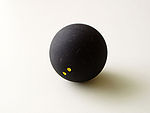
Squash balls are between 39.5 and 40.5 mm in diameter, and have a mass of 23 to 25 grams. They are made with two pieces of rubber compound, glued together to form a hollow sphere and buffed to a matte finish. Different balls are provided for varying temperature and atmospheric conditions and standards of play: more experienced players use slow balls that have less bounce than those used by less experienced players (slower balls tend to 'die' in court corners, rather than 'standing up' to allow easier shots). Depending on its specific rubber composition, a squash ball has the property that it bounces more at higher temperatures.
Small coloured dots on the ball indicate its dynamic level (bounciness), and thus the standard of play for which it is suited. The recognized speed colours indicating the degree of dynamism are:
Balls are manufactured to these standards by Prince
, Dunlop
, Pointfore, Wilson
, Black Knight and others. The "double-yellow dot" ball, introduced in 2000, is currently the competition standard, replacing the earlier "yellow-dot" ball. There is also an "orange dot" ball, which is even less bouncy than the "double-yellow dot" ball, intended for use in areas of high altitude such as Mexico City
, Calgary
, Denver, and Johannesburg
. The lower atmospheric pressure at these high altitude regions means that the ball bounces slightly higher, resulting in the need for such a ball.
Given the game's vigorousness, players wear comfortable sports clothing and robust indoor (non-marking) sports shoes. In competition, men usually wear shorts and a t-shirt, tank top or a polo shirt. Women normally wear a skirt and a t-shirt or a tank top, or a sports dress. Towelling wrist and head bands may also be required in humid climates. Polycarbonate lens goggles are recommended, as players might be struck with a fast-swinging racket or the ball, that typically reaches speeds exceeding 200 km/h (125 mph). In the 2011 U.S. Open
, Cameron Pilley
was recorded driving balls at speeds of 175 mph (280 km/h). Many squash venues mandate the use of eye protection and some association rules require that all juniors and doubles players must wear eye protection.
There are four walls to a squash court. The front wall, on which three parallel lines are marked, has the largest playing surface, whilst the back wall, which typically contains the entrance to the court, has the smallest. The out line runs along the top of the front wall, descending along the side walls to the back wall. There are no other markings on the side or back walls. Shots struck above or on the out line, on any wall, are out. The bottom line of the front wall marks the top of the 'tin', a half metre-high metal area which if struck means that the ball is out. The middle line of the front wall is the service line and is only relevant during serves.
One point is awarded to the server during the course of play if:
Where the server does any of these things, or fails to hit the serve in, then the players change roles and the receiver will serve the next point, but no points are awarded.
Games are played to either 9, 11 or 21 points (with the exception that the receiver may opt to call "set two" and play to 10 when the score first reaches 8-8). Competition matches are usually played to "best-of-five" (i.e., the player to win the most out of five games). At one time this scoring system was preferred in Britain, and also among countries with traditional British ties, e.g. Australia, Canada, Pakistan, South Africa, India, but now at competitive levels, only PARS to 11 is used (see below).
In the International game, club, doubles and recreational matches are usually played using the traditional British scoring system, but the European Squash Federation (ESF), World Squash Federation
(WSF) and several national federations are now using PARS to 11 on a trial or permanent basis. Scoring systems and rules can be adapted subtly to accommodate shorter game time or multiple players. As of April 1, 2009, WSF has declared that PARS to 11 will be the only official scoring system allowed for all levels of competitive squash.
A common strategy is to hit the ball straight up the side walls to the back corners; this is the basic squash shot, referred to as a "rail," straight drive, wall, or "length." After hitting this shot, the player will then move to the centre of the court near the "T" to be well placed to retrieve the opponent's return. Attacking with soft or "short" shots to the front corners (referred to as "drop shots") causes the opponent to cover more of the court and may result in an outright winner. Boasts or angle shots are deliberately struck off one of the side walls before the ball reaches the front. They are used for deception and again to cause the opponent to cover more of the court.
Rallies between experienced players may involve 30 or more shots and therefore a very high premium is placed on fitness, both aerobic and anaerobic. As players become more skilled and, in particular, better able to retrieve shots, points often become a war of attrition
. At higher levels of the game, the fitter player has a major advantage.
Ability to change the direction of ball at the last instant is also important to unbalance the opponent. Expert players can anticipate the opponent's shot a few tenths of a second before the average player, giving them a chance to react sooner .
Depending on the style of play, it is common to refer squash players as
When it is deemed that there has been little or no interference, or that it is impossible to say one way or the other, the rules provide that no let is to be allowed, in the interests of continuity of play and the discouraging of spurious appeals for lets. Because of the subjectivity in interpreting the nature and magnitude of interference, the awarding (or withholding) of lets and strokes is often controversial.
When a player's shot hits their opponent prior to hitting the front wall, interference has occurred. If the ball was travelling towards the side wall when it hit the opponent, or if had already hit the side wall and is now travelling directly to the front wall, it is usually a let. However, it is a stroke to the player who hit the ball if the ball was travelling straight to the front wall when the ball hit the opponent, without having first hit the side wall. Generally after a player has been hit by the ball, both players stand still, if the struck player is standing directly in front of the player who hit the ball he loses the stroke, if he is not straight in front, a let is played. If it is deemed that the player who is striking the ball is deliberately trying to hit his opponent, he will lose the stroke. An exception to all of this occurs when the player hitting the ball has "turned", i.e., let the ball pass him on one side, but then hit it on the other side as it came off the back wall. In these cases, the stroke goes to the player who was hit by the ball.
singles and doubles are played with a much harder ball and different size courts (as noted above). Hardball singles has lost much of its popularity in North America (in favour of the International version), but the hardball doubles game is still active. There is also a doubles version of squash played with the standard ball, sometimes on a wider court, and a more tennis-like variation known as squash tennis
.
The relatively small court and low-bouncing ball makes scoring points easier than in its American
cousin, racquetball
, as the ball may be played to all four corners of the court. Since every ball must strike the front wall above the tin (unlike racquetball), the ball cannot be easily "killed".
Squash provides an excellent cardiovascular workout. In one hour of squash, a player may expend approximately 600 to 1000 calorie
s (3,000 to 4,000 kJ),. The sport also provides a good upper and lower body workout by utilising both the legs to run around the court and the arms and torso to swing the racquet. In 2003, Forbes rated squash as the number one healthiest sport to play. However, some studies have implicated squash as a cause of possible fatal cardiac arrhythmia and argued that squash is an inappropriate form of exercise for older men with heart disease.
As of June 2009, there were players from nineteen countries in the top fifty of the men's world rankings, with England and Egypt leading with eleven each. The women's world rankings featured players from sixteen countries, led by England with eleven.
The men's professional squash tour and rankings are run by the Professional Squash Association
(PSA). The equivalent body for women is the Women's International Squash Players Association
(WISPA).
As well as Europe, Asia also potent a good number of World class squash players. For instance, Jansher Khan, who was at the top of the PSA world ranking for many years. He was a Pakistani legend. Mohd Azlan Iskandar is now amongst the top 10 Internationally ranked players according to PSA who is a Malaysian citizen. Not just major countries but Bangladesh, despite being still an underdeveloped country, shows a bright future in this form of sport, with a flourishing amount of tournaments arranged recently, many promising players is coming up from this country, Already the top two youngsters of Bangladesh Squash Federation, Shomokami Tamim and Habbarter Ribhu are said to be attending the 2012 World Junior Championships in Cairo. Recent measures taken by the Government as well as the efforts made by the officials of the federation have resulted in the growth of popularity of squash in Bangladesh. The Government has proposed to provide a land where the main Federation headquarters will be built. Already two back to back tournaments have taken place in Dhaka Club. On June ,2011 there was the Grameenphone open squash tournament, where Swapon Parvez of Basundhara group emerged as the champion of the premier division beating Shaheed of Gulshan Club. Another talent that was observed during the tournament was Iman from Gulshan Club who became the champion of in U-18 division. After just one month on August another tournament was held which was Digital Auto Care Open Squash. In this tournament as well Swapon Parvez rose as the champion beating Raju Ram of American Club, who is one of the rising stars of squash in Bangladesh. The secretary of Squash Rackets Federation has also promised to hold another national tournament in the coming month of September.
 The (British) Squash Rackets Association (now known as England Squash & Racketball
) conducted its first British Open
championship for men in December 1930, using a "challenge" system. Charles Read
was designated champion in 1930, but was beaten in home and away matches by Don Butcher
, who was then recorded as the champion for 1931. The championship continues to this day, but has been conducted with a "knockout" format since 1947.
Since its inception, the men's British Open has been dominated by relatively few players: F.D. Amr Bey (Egypt) in the 1930s; Mahmoud Karim
(Egypt) 1940s; brothers Hashim Khan
and Azam Khan
(Pakistan) 1950s and 1960s; Jonah Barrington (Great Britain and Ireland) and Geoff Hunt
(Australia) 1960s and 1970s; Jahangir Khan
(Pakistan) 1980s; and Jansher Khan
(Pakistan) 1990s.
The women's championship started in 1921, and has similarly been dominated by relatively few players: Joyce Cave
and Nancy Cave
(England) in the 1920s; Margot Lumb
(USA) 1930s; Janet Morgan
(England) 1950s; Heather McKay
(Australia) 1960s and 1970s; Vicki Cardwell
(Australia) and Susan Devoy
(New Zealand) 1980s; Michelle Martin
(Australia) 1990s; and Sarah Fitz-Gerald
(Australia) 1990s and 2000s.
Heather McKay
, with her lengthy and absolute dominance of the game (she remained undefeated for 18 years during the 1960s and 1970s), is arguably the greatest woman player of all time.
Because of its traditions, the British Open has been considered by many to be more prestigious than the World Open, which began in the mid-1970s. However, some have shown concern about the ability of the former to sustain its prominence, citing its failure in 2005 to attract top players, probably due in part to the disparity in prize money. In 2005 the combined men's and women's prize money for the British Open came to $71,000, compared with the 2005 World Open's prize money, estimated to be about $270,000.
Previous world number one Peter Nicol
stated that he believed squash had a "very realistic chance" of being added to the list of Olympic sports for the 2016 Olympic Games, but it ultimately lost out to golf
and rugby sevens
.
the number 1 rank is held by Nick Matthew
of England
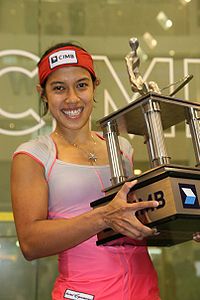
in the men's competition and Nicol David
of Malaysia in the women's competition. Currently there is no international standard method (other than for professional players) for evaluating skill levels for players.
and Asian Games
since 1998. Squash is also a regular sport at the Pan American Games
since 1995. However it is still not recognized as an Olympic sport. Squash players and associations have lobbied for many years for the sport to be accepted into the Olympic Games
, with no success to date. Squash narrowly missed being instated for the 2012 London Games. It was again up for consideration for the 2016 Summer Games along with baseball, softball, rugby sevens, karate, golf, and roller sports, but missed out again as the IOC assembly decided to add golf and rugby sevens to the Olympic programme.
Racquet sport
Racquet sports are those where players use racquets to hit a ball or other object.-List of racquet sports:* Badminton* Ball badminton* Basque pelota** Frontenis** Jai alai* Beach tennis** Matkot* Bilbocatch* Frescoball* Lacrosse...
played by two players (or in doubles 4 players on court at a time) in a four-walled court with a small, hollow rubber ball. Squash is recognized by the IOC
International Olympic Committee
The International Olympic Committee is an international corporation based in Lausanne, Switzerland, created by Pierre de Coubertin on 23 June 1894 with Demetrios Vikelas as its first president...
and remains in contention for incorporation in a future Olympic
Olympic Games
The Olympic Games is a major international event featuring summer and winter sports, in which thousands of athletes participate in a variety of competitions. The Olympic Games have come to be regarded as the world’s foremost sports competition where more than 200 nations participate...
programme.
The game was formerly called squash racquets, a reference to the "squashable" soft ball used in the game (compared with the fatter ball used in its parent game racquets
Racquets (sport)
Rackets or Racquets is an indoor racket sport played in the United Kingdom, United States, and Canada...
(or rackets; see below).
History
Squash developed from at least five other sports involving racquets, gloves, and balls having roots in the early 12th century in France. It is stated that “Squash, with its element of hitting balls against walls, was for entertainment. For example, boys and girls slapped their balls in narrow alleys and streets”.Religious institutions in France, such as monasteries, developed a similar game. Monks used gloves that were webbed to hit balls against a fishing net strung across the middle of the courtyards of the monasteries. This developed the early “racquets” used in tennis and squash. Then in late fifteenth century, tennis was developed and spread to other European nations. The next major development of squash took place in England where the game of "racquets" was developed in Fleet Prison
Fleet Prison
Fleet Prison was a notorious London prison by the side of the Fleet River in London. The prison was built in 1197 and was in use until 1844. It was demolished in 1846.- History :...
, a debtor’s prison. Similar to tennis, it involved racquets and balls, but instead of hitting over a net as in tennis, players hit a non-squeezable ball against walls. A variation of rackets that also led to the formation of squash was called fives
Fives
Fives is a British sport believed to derive from the same origins as many racquet sports. In fives, a ball is propelled against the walls of a special court using gloved or bare hands as though they were a racquet.-Background:...
, similar to handball
American handball
American handball is a sport in which players hit a small rubber ball against a wall using their hands.- History :...
. Fives was essentially the game of racquets, without racquets. (The ball was hit with the hand.) It is played against a wall or walls.
These games gained popularity in schools, and squash itself was developed at Harrow School
Harrow School
Harrow School, commonly known simply as "Harrow", is an English independent school for boys situated in the town of Harrow, in north-west London.. The school is of worldwide renown. There is some evidence that there has been a school on the site since 1243 but the Harrow School we know today was...
in England. The first courts built at this school were rather dangerous because they were near water pipes, buttresses, chimneys, and ledges. The school soon built four outside courts. Natural rubber was the material of choice for the ball. Students modified their racquets to have a smaller reach to play in these cramped conditions.
The racquets have changed in much the same way as those used in tennis. Squash rackets used to be made out of laminated timber. In the 1980s, construction shifted to lighter, carbon-based materials (such as graphite) with small additions of such components as Kevlar, boron and titanium. Natural "gut" strings were replaced with synthetic strings.
In the 20th century the game increased in popularity with various schools, clubs and even private citizens building squash courts, but with no set dimensions. The first squash court in North America appeared at St. Paul's School in New Hampshire in 1884. In 1904 in Philadelphia, Pennsylvania, the earliest national association of squash in the world was formed as the United States Squash Racquets Association, (USSRA), now known as US-Squash. In April 1907 the Tennis, Rackets & Fives Association set up a sub committee to set standards for squash. Then the sport soon formed, combining the three sports together called “Squash”. It was not until 1923 that the Royal Automobile Club
Royal Automobile Club
The Royal Automobile Club is a private club and is not to be confused with RAC plc, a motorists' organisation, which it formerly owned.It has two club houses, one in London at 89-91 Pall Mall, and the other in the countryside at Woodcote Park, Surrey, next to the City of London Freemen's School...
hosted a meeting to further discuss the rules and regulations and another five years elapsed before the Squash Rackets Association was formed to set standards for squash in Great Britain.
The sport spread to America and Canada, and eventually around the globe. Players such as F.D. Amr Bey of Egypt dominated the courts in the 1930s. Heather McKay
Heather McKay
Heather Pamela McKay AM MBE is a retired Australian squash player, who is considered by many to be the greatest female player in the history of the game, and possibly also Australia's greatest-ever sportswoman...
of Australia dominated the game during the 1960s and 1970s, winning sixteen consecutive British Open titles between 1962 and 1977. Another Australian, Geoff Hunt
Geoff Hunt
Geoffrey Brian Hunt, MBE , is a retired Australian squash player who is widely considered to be one of the greatest squash players in history....
, won a record eight British Open male titles between 1969 and 1981. During the 1980s and 1990s Jahangir Khan
Jahangir Khan
Jahangir Khan, HI, is a former World No. 1 professional squash player from Pakistan, who is considered by many to be the greatest player in the history of the game. During his career he won the World Open six times and the British Open a record ten times...
of Pakistan won the British Open a record of ten times and Jansher Khan
Jansher Khan
Jansher Khan is a former World No. 1 professional squash player from Pakistan, who is widely considered to be one of the greatest squash players of all time. During his career he won the World Open a record eight times, and the British Open six times.Jansher is of Peshwari ethnicity. He came from...
of Pakistan won the World Open a record of eight times. No list of squash champions is complete without referencing the legendary Pakistani Hashim Khan
Hashim Khan
Hashim Khan is a former squash player from Pakistan. He won the British Open seven times between 1951 and 1958.Hashim Khan was born in Nawakille , a small village near Peshawar, in British India to an ethnic Pashtun family. The year of his birth is usually reported as 1916, though this has been...
, winner of 7 British Open championships, and his son, Sharif Khan, winner of 12 North American Open titles. Hashim is considered one of the best athletes of all times and is the patriarch of a sports dynasty, consisting of himself, his brother, Azam, nephews Mohibullah and Gul, sons Sharif, Gulmast, Aziz, Liaquat Ali, and Salim Khan - all of whom are squash champions in their own right. Jansher Khan, although sharing the same last name, is not considered part of the "Khan Dynasty" of squash as he is not related to Hashim Khan.
Playing equipment
Standard rackets are governed by the rules of the game. Traditionally they were made of laminated wood (typically ash), with a small strung area using natural gut strings. After a rule change in the mid-1980s, they are now almost always made of composite materials or metals (graphite, kevlar, titanium, boron) with synthetic strings. Modern rackets have maximum dimensions of 686 mm (27.0 in) long and 215 mm (8.5 in) wide, with a maximum strung area of 500 square centimetres (90 sq in), the permitted maximum mass is 255 grams (9 oz), but most have a mass between 110 and 200 grams (4-7 oz.).Squash balls are between 39.5 and 40.5 mm in diameter, and have a mass of 23 to 25 grams. They are made with two pieces of rubber compound, glued together to form a hollow sphere and buffed to a matte finish. Different balls are provided for varying temperature and atmospheric conditions and standards of play: more experienced players use slow balls that have less bounce than those used by less experienced players (slower balls tend to 'die' in court corners, rather than 'standing up' to allow easier shots). Depending on its specific rubber composition, a squash ball has the property that it bounces more at higher temperatures.
Small coloured dots on the ball indicate its dynamic level (bounciness), and thus the standard of play for which it is suited. The recognized speed colours indicating the degree of dynamism are:
| Colour | Speed | Bounce |
|---|---|---|
| Orange | Super Slow | Super low |
| Double yellow | Slow | Very low |
| Yellow | Slow | Low |
| Green or white | Medium/slow | Average |
| Red | Medium | High |
| Blue | Fast | Very high |
Balls are manufactured to these standards by Prince
Prince Sports
Prince Sports, Inc., based in Bordentown, New Jersey, is a manufacturer of equipment for racquet sports, primarily for tennis, badminton, and squash....
, Dunlop
Dunlop Sport
Dunlop Sport is a tennis, squash, golf, badminton, clothing, travel and bicycle equipment brand, that specializes in sporting goods.After Dunlop Holdings was acquired by BTR plc in 1985, Dunlop Sport was combined with the Slazenger brand which Dunlop had acquired in 1959 to form Dunlop Slazenger...
, Pointfore, Wilson
Wilson Sporting Goods
The Wilson Sporting Goods Company is a sports equipment manufacturer based in Chicago, Illinois, and currently is a foreign subsidiary of the Finnish company Amer Sports....
, Black Knight and others. The "double-yellow dot" ball, introduced in 2000, is currently the competition standard, replacing the earlier "yellow-dot" ball. There is also an "orange dot" ball, which is even less bouncy than the "double-yellow dot" ball, intended for use in areas of high altitude such as Mexico City
Mexico City
Mexico City is the Federal District , capital of Mexico and seat of the federal powers of the Mexican Union. It is a federal entity within Mexico which is not part of any one of the 31 Mexican states but belongs to the federation as a whole...
, Calgary
Calgary
Calgary is a city in the Province of Alberta, Canada. It is located in the south of the province, in an area of foothills and prairie, approximately east of the front ranges of the Canadian Rockies...
, Denver, and Johannesburg
Johannesburg
Johannesburg also known as Jozi, Jo'burg or Egoli, is the largest city in South Africa, by population. Johannesburg is the provincial capital of Gauteng, the wealthiest province in South Africa, having the largest economy of any metropolitan region in Sub-Saharan Africa...
. The lower atmospheric pressure at these high altitude regions means that the ball bounces slightly higher, resulting in the need for such a ball.
Given the game's vigorousness, players wear comfortable sports clothing and robust indoor (non-marking) sports shoes. In competition, men usually wear shorts and a t-shirt, tank top or a polo shirt. Women normally wear a skirt and a t-shirt or a tank top, or a sports dress. Towelling wrist and head bands may also be required in humid climates. Polycarbonate lens goggles are recommended, as players might be struck with a fast-swinging racket or the ball, that typically reaches speeds exceeding 200 km/h (125 mph). In the 2011 U.S. Open
United States Open (squash)
The United States Open squash championships is an annual squash tournament sponsored by U.S. Squash. The championship was inaugurated in 1954 as an opportunity for professionals and amateurs to compete against each other...
, Cameron Pilley
Cameron Pilley
Cameron Pilley is a professional squash player from Australia.Pilley was born in Grafton, New South Wales. From 2001 to 2005, he attended the Australian Institute of Sport on a squash scholarship, where he trained under Geoff Hunt and Rodney Martin.As a junior player, Pilley won the Australian...
was recorded driving balls at speeds of 175 mph (280 km/h). Many squash venues mandate the use of eye protection and some association rules require that all juniors and doubles players must wear eye protection.
The court
The squash court is a playing surface surrounded by four walls. The court surface contains a front line separating the front and back of the court and a half court line, separating the left and right hand sides of the back portion of the court, creating three 'boxes' - the front half, the back left quarter and the back right quarter. Both the back two boxes contain smaller service boxes. All of the floor-markings on a squash court are only relevant during serves.There are four walls to a squash court. The front wall, on which three parallel lines are marked, has the largest playing surface, whilst the back wall, which typically contains the entrance to the court, has the smallest. The out line runs along the top of the front wall, descending along the side walls to the back wall. There are no other markings on the side or back walls. Shots struck above or on the out line, on any wall, are out. The bottom line of the front wall marks the top of the 'tin', a half metre-high metal area which if struck means that the ball is out. The middle line of the front wall is the service line and is only relevant during serves.
Service
Just before the match, the players spin a racket (usually up or down of logo) to decide who serves first. This player starts the first rally by electing to serve from either the left or right service box. For a legal serve, one of the server's feet must be touching the service box, not touching any part of the service box lines, as the player strikes the ball. After being struck by the racket, the ball must strike the front wall above the service line and below the out line and land in the opposite quarter court. The receiving player can choose to volley a serve after it has hit the front wall. If the server wins the point, the two players switch sides for the following point.Play
After the serve, the players take turns hitting the ball against the front wall, above the tin and below the out line. The ball may strike the side or back walls at any time, as long as it hits below the out line. It must not hit the floor after hitting the racket and before hitting the front wall. A ball landing on either the out line or the line along the top of the tin is considered to be out. After the ball hits the front wall, it is allowed to bounce once on the floor (and any number of times against the side or back walls) before a player must return it. Players may move anywhere around the court but accidental or deliberate obstruction of the other player's movements is forbidden. Players typically return to the center of the court after making a shot.Side-out (or hand-out) scoring system / English scoring
This scoring system is based on a “serving” system, in which one must gain the serve to obtain a point. Having the serve is sometimes considered to be on “offense”. The opponent (who does not have the serve) is considered to be on the defensive and must score to win the serve and then score again to gain a point.One point is awarded to the server during the course of play if:
- The receiver fails to strike the ball before it has bounced twice
- The receiver hits the ball out (either on or above the out line, or on the tin) or misses the front wall.
- The receiver obstructs the server during the point (see “Interference and Obstruction”)
Where the server does any of these things, or fails to hit the serve in, then the players change roles and the receiver will serve the next point, but no points are awarded.
Games are played to either 9, 11 or 21 points (with the exception that the receiver may opt to call "set two" and play to 10 when the score first reaches 8-8). Competition matches are usually played to "best-of-five" (i.e., the player to win the most out of five games). At one time this scoring system was preferred in Britain, and also among countries with traditional British ties, e.g. Australia, Canada, Pakistan, South Africa, India, but now at competitive levels, only PARS to 11 is used (see below).
Point a rally scoring system (PARS) / American scoring
Alternatively, in the point-a-rally scoring system (PARS), also known as American scoring, points are scored by the person who wins each rally, whether or not he or she served. The winner of the previous point will serve at the start of the next point. Traditionally, PARS scoring was up to 9 points (or the receiver calls 9 or 10 when the game reaches 8-8). However, in 2004, the PARS scoring was increased to 11 for the professional game (if the game reaches 10-10, a player must win by two points). PARS is now used on the men's Professional Tour, and the tin height has been lowered by two inches for the men's professional tournaments (these changes have been made in a hope to shorten the length of the rallies and therefore the match). The women's Professional Tour uses the original tin height, but started using the PARS to 11 scoring system as of July 2008.In the International game, club, doubles and recreational matches are usually played using the traditional British scoring system, but the European Squash Federation (ESF), World Squash Federation
World Squash Federation
The World Squash Federation is the international federation for squash, an indoor racquet sport which was formerly called "Squash rackets."It is based in Hastings in England. As of 2009 it has 147 member federations...
(WSF) and several national federations are now using PARS to 11 on a trial or permanent basis. Scoring systems and rules can be adapted subtly to accommodate shorter game time or multiple players. As of April 1, 2009, WSF has declared that PARS to 11 will be the only official scoring system allowed for all levels of competitive squash.
Referee
The referee is usually a certified position issued by the club or assigned squash league. The referee has dominant power over the squash players. Any conflict or interference is dealt with by the referee. The referee may also issue to take away points or games due to improper etiquette regarding conduct or rules. Refer to “Interference and Obstruction” for more detail.Types of shots played
There are many types of shots played that lead to interesting games and strategy.- Straight drive or 'rail': The ball is hit parallel and close to a side wall to travel deep to the back of the court (the 'basic' squash shot). Often referred to as a 'good length' shot.
- Boast (or angle): The ball is played off a side wall at an angle, or the back wall, before hitting the front wall.
- Volley: The ball is hit 'on the full' (before it touches the floor), usually directly to the front wall
- Drop shot: The ball is hit gently against the front wall, to fall softly to the floor in the front corner.
- Lob: The ball is hit softly and high on the front wall and with a high arc, so that it falls in a back corner of the court.
- Cross Court: The ball is hit to the front wall from the right side to the left (or vice versa).
- Kill: The ball is hit hard and low on the front wall so that it travels no farther than half court.
- Trickle boast: A 'short' boast where the ball is hit to the side wall at the front of the court (often disguised as a drive or drop shot).
- Squeeze boast: A more difficult shot which is hit from the front of the court when the ball is very close to the side wall. Has the same effect as the trickle boast but is more deceptive because of its difficulty.
- Skid boast: The ball is hit high to the side wall near the front wall so that it travels cross court and falls in the opposite back corner.
- Nick shot: the ball is 'volleyed' or hit off a bounce, cross court and with power to strike the front wall then the junction of the side wall and floor (the 'nick'). When hit well, the ball will have little or no bounce or roll along the floor (this is a more advanced shot that is a variation of the kill shot).
- Back wall boast: the ball is hit moderately hard and high off the back wall, so that it goes the length of the room and hits (usually low) off the front wall.
- Philadelphia (or corkscrew): A shot played diagonally upwards into the front corner hitting the front wall first and then the side wall. The ball then lobs over the court with significant spin. Ideally it hits the opposite side wall at the back and travels parallel to the rear wall making a return very difficult. This shot is a favourite in exhibition squash but is susceptible to being volleyed.
- Mizuki: This shot is hit on the backhand side of the court, as a volley. Unlike a normal backhand volley, the Mizuki is hit with the back side of the racquet. This shot is extremely hard to hit and only very few people can use it effectively in a match.
Strategy and tactics
A key strategy in squash is known as "dominating the T" (the intersection of the red lines near the centre of the court where the player is in the best position to retrieve the opponent's next shot). Skilled players will return a shot, and then move back toward the "T" before playing the next shot. From this position, the player can quickly access any part of the court to retrieve the opponent's next shot with a minimum of movement.A common strategy is to hit the ball straight up the side walls to the back corners; this is the basic squash shot, referred to as a "rail," straight drive, wall, or "length." After hitting this shot, the player will then move to the centre of the court near the "T" to be well placed to retrieve the opponent's return. Attacking with soft or "short" shots to the front corners (referred to as "drop shots") causes the opponent to cover more of the court and may result in an outright winner. Boasts or angle shots are deliberately struck off one of the side walls before the ball reaches the front. They are used for deception and again to cause the opponent to cover more of the court.
Rallies between experienced players may involve 30 or more shots and therefore a very high premium is placed on fitness, both aerobic and anaerobic. As players become more skilled and, in particular, better able to retrieve shots, points often become a war of attrition
Attrition warfare
Attrition warfare is a military strategy in which a belligerent side attempts to win a war by wearing down its enemy to the point of collapse through continuous losses in personnel and matériel....
. At higher levels of the game, the fitter player has a major advantage.
Ability to change the direction of ball at the last instant is also important to unbalance the opponent. Expert players can anticipate the opponent's shot a few tenths of a second before the average player, giving them a chance to react sooner .
Depending on the style of play, it is common to refer squash players as
- Power players: squash players who build up their game based on powerful shots. For example, John WhiteJohn White (squash player)John White is a former World No. 1 squash player.White finished runner-up at both the World Open and the British Open in 2002. He won the PSA Masters title in 2003 . He also won the British National Championships in 2004...
. - Shot makers: squash players who emphasize on shot making. For example, Jonathon PowerJonathon PowerJonathon Tyler Power is a retired professional squash player from Canada. In 1999, he became the first North American squash player to reach the World No. 1 ranking...
, Ramy AshourRamy AshourRamy Mohamed Ashour is a professional squash player from Egypt. He reached world No. 1 in January, 2010, after beating Nick Matthew in the final of the 2009 Saudi International Squash Tournament. At 22 he became the youngest player to achieve world No. 1 since the Khan era, having previously been...
, Amr ShabanaAmr ShabanaAmr Shabana is a professional squash player from Egypt. He won the World Open in 2003, 2005, 2007 and 2009, and reached the World No. 1 ranking in 2006.-Career overview:...
. - Retrievers: squash players who are excellent on court coverage and retrieving shots. For example, Peter NicolPeter NicolPeter Nicol, MBE , is a former professional squash player from the United Kingdom, who represented first Scotland and then England in international squash. In 1998, while still competing for Scotland, he became the first player from the UK to hold the World No. 1 ranking...
. - Attritional players: squash players who play tight shots and base their games on physical strength. For example, David PalmerDavid Palmer (squash player)David Palmer is a professional squash player from Australia. He won the Super Series finals in 2002, the World Open in 2002 and 2006; the British Open in 2001, 2003, 2004 and 2008; and the Australian Open in 2008. He attained World No...
, Nick MatthewNick MatthewNicholas Matthew is a professional squash player from England who won the British Open in 2006 and 2009 and is the reigning World Champion. He reached a career-high world ranking of World No. 1 in June 2010...
.
Interference and obstruction
Interference and obstruction are an inevitable aspect of this sport, since two players are confined within a shared space. Generally, the rules entitle players to a clear view of the ball after it has struck the front wall, direct straight line access to the ball, room for a reasonable swing and an unobstructed shot to any part of the front wall. When interference occurs, a player may appeal for a "let" and the referee (or the players themselves if there is no official) then interprets the extent of the interference. The referee may elect to allow a let and the players then replay the point, or award a "stroke" to the appealing player (meaning that he is declared the winner of that point) depending on the degree of interference, whether the interfering player made an adequate effort to avoid interfering, and whether the player interfered with was likely to have hit a winning shot had the interference not occurred. An exception to all of this occurs when the interfering player is directly in the path of the other player's swing, effectively preventing the swing, in which case a stroke is always awarded.When it is deemed that there has been little or no interference, or that it is impossible to say one way or the other, the rules provide that no let is to be allowed, in the interests of continuity of play and the discouraging of spurious appeals for lets. Because of the subjectivity in interpreting the nature and magnitude of interference, the awarding (or withholding) of lets and strokes is often controversial.
When a player's shot hits their opponent prior to hitting the front wall, interference has occurred. If the ball was travelling towards the side wall when it hit the opponent, or if had already hit the side wall and is now travelling directly to the front wall, it is usually a let. However, it is a stroke to the player who hit the ball if the ball was travelling straight to the front wall when the ball hit the opponent, without having first hit the side wall. Generally after a player has been hit by the ball, both players stand still, if the struck player is standing directly in front of the player who hit the ball he loses the stroke, if he is not straight in front, a let is played. If it is deemed that the player who is striking the ball is deliberately trying to hit his opponent, he will lose the stroke. An exception to all of this occurs when the player hitting the ball has "turned", i.e., let the ball pass him on one side, but then hit it on the other side as it came off the back wall. In these cases, the stroke goes to the player who was hit by the ball.
Cultural, social, and health aspects
There are several variations of squash played across the world. In the U.S. hardballHardball squash
Hardball squash is a format of the indoor racquet sport squash which was first developed in North America in the late 19h century and early 20th century. It is sometimes referred to as being the "American version" of the sport...
singles and doubles are played with a much harder ball and different size courts (as noted above). Hardball singles has lost much of its popularity in North America (in favour of the International version), but the hardball doubles game is still active. There is also a doubles version of squash played with the standard ball, sometimes on a wider court, and a more tennis-like variation known as squash tennis
Squash tennis
Squash tennis is an American variant of squash racquets, but played with a ball and racquets that are closer to the equipment used for lawn tennis, and with somewhat different rules. For younger players the game offers the complexity of squash racquets and the speed of racquetball...
.
The relatively small court and low-bouncing ball makes scoring points easier than in its American
United States
The United States of America is a federal constitutional republic comprising fifty states and a federal district...
cousin, racquetball
Racquetball
For other sports often called "paddleball", see Paddleball .Racquetball is a racquet sport played with a hollow rubber ball in an indoor or outdoor court...
, as the ball may be played to all four corners of the court. Since every ball must strike the front wall above the tin (unlike racquetball), the ball cannot be easily "killed".
Squash provides an excellent cardiovascular workout. In one hour of squash, a player may expend approximately 600 to 1000 calorie
Calorie
The calorie is a pre-SI metric unit of energy. It was first defined by Nicolas Clément in 1824 as a unit of heat, entering French and English dictionaries between 1841 and 1867. In most fields its use is archaic, having been replaced by the SI unit of energy, the joule...
s (3,000 to 4,000 kJ),. The sport also provides a good upper and lower body workout by utilising both the legs to run around the court and the arms and torso to swing the racquet. In 2003, Forbes rated squash as the number one healthiest sport to play. However, some studies have implicated squash as a cause of possible fatal cardiac arrhythmia and argued that squash is an inappropriate form of exercise for older men with heart disease.
Squash around the world
According to the World Squash Federation, as of June 2009, there were 49,908 squash courts in the world, with 188 countries and territories having at least one court. England had the greatest number at 8,500. The other countries with more than 1,000 courts, in descending order by number were Germany, Egypt, the United States of America, Australia, South Africa, Canada, Malaysia, France, the Netherlands, and Spain.As of June 2009, there were players from nineteen countries in the top fifty of the men's world rankings, with England and Egypt leading with eleven each. The women's world rankings featured players from sixteen countries, led by England with eleven.
The men's professional squash tour and rankings are run by the Professional Squash Association
Professional Squash Association
The Professional Squash Association is the governing body for the men's professional squash circuit. The body operates in a similar fashion to the ATP for tennis. The PSA World Tour involves over 100 tournaments annually all over the globe...
(PSA). The equivalent body for women is the Women's International Squash Players Association
Women's International Squash Players Association
The Women's International Squash Players Association is an organization for female squash professionals. It is responsible for running the women's professional tour and the women's world rankings...
(WISPA).
As well as Europe, Asia also potent a good number of World class squash players. For instance, Jansher Khan, who was at the top of the PSA world ranking for many years. He was a Pakistani legend. Mohd Azlan Iskandar is now amongst the top 10 Internationally ranked players according to PSA who is a Malaysian citizen. Not just major countries but Bangladesh, despite being still an underdeveloped country, shows a bright future in this form of sport, with a flourishing amount of tournaments arranged recently, many promising players is coming up from this country, Already the top two youngsters of Bangladesh Squash Federation, Shomokami Tamim and Habbarter Ribhu are said to be attending the 2012 World Junior Championships in Cairo. Recent measures taken by the Government as well as the efforts made by the officials of the federation have resulted in the growth of popularity of squash in Bangladesh. The Government has proposed to provide a land where the main Federation headquarters will be built. Already two back to back tournaments have taken place in Dhaka Club. On June ,2011 there was the Grameenphone open squash tournament, where Swapon Parvez of Basundhara group emerged as the champion of the premier division beating Shaheed of Gulshan Club. Another talent that was observed during the tournament was Iman from Gulshan Club who became the champion of in U-18 division. After just one month on August another tournament was held which was Digital Auto Care Open Squash. In this tournament as well Swapon Parvez rose as the champion beating Raju Ram of American Club, who is one of the rising stars of squash in Bangladesh. The secretary of Squash Rackets Federation has also promised to hold another national tournament in the coming month of September.
Players and records
England Squash & Racketball
England Squash & Racketball is recognised by Sport England as the English National governing body of the sports of Squash & RacketballIt aims to increase participation in both Squash & Racketball...
) conducted its first British Open
British Open Squash Championships
The British Open Squash Championships is the oldest and most established tournament in the game of squash. It is widely considered to be one of the two most prestigious tournaments in the game, alongside the World Open The British...
championship for men in December 1930, using a "challenge" system. Charles Read
Charles Read (squash player)
Charles R. Read was a professional squash player from England, where professional squash began in 1907. Read was based at the Queen's Club in London, and beat C. Bannister of the Bath Club 15-5, 15-13 at the Bath Club to win the first English professional championship title...
was designated champion in 1930, but was beaten in home and away matches by Don Butcher
Don Butcher
Donald Butcher, a squash player from England, was the first player to actually win the British Open men's title .Butcher was a professional squash player based at the Conservative Club in London when he played in the first British Open final in December 1930...
, who was then recorded as the champion for 1931. The championship continues to this day, but has been conducted with a "knockout" format since 1947.
Since its inception, the men's British Open has been dominated by relatively few players: F.D. Amr Bey (Egypt) in the 1930s; Mahmoud Karim
Mahmoud Karim
Mahmoud el Karim was a squash player from Egypt. He won the British Open men's title four consecutive times from 1947-1950.-Playing career:...
(Egypt) 1940s; brothers Hashim Khan
Hashim Khan
Hashim Khan is a former squash player from Pakistan. He won the British Open seven times between 1951 and 1958.Hashim Khan was born in Nawakille , a small village near Peshawar, in British India to an ethnic Pashtun family. The year of his birth is usually reported as 1916, though this has been...
and Azam Khan
Azam Khan (squash player)
Azam Khan is a former squash player from Pakistan who won the British Open four times between 1959 and 1962.Azam was introduced to squash by his older brother, Hashim Khan, who was also one of the world's top squash players in his time. After winning the British Open in 1951, Hashim recruited Azam...
(Pakistan) 1950s and 1960s; Jonah Barrington (Great Britain and Ireland) and Geoff Hunt
Geoff Hunt
Geoffrey Brian Hunt, MBE , is a retired Australian squash player who is widely considered to be one of the greatest squash players in history....
(Australia) 1960s and 1970s; Jahangir Khan
Jahangir Khan
Jahangir Khan, HI, is a former World No. 1 professional squash player from Pakistan, who is considered by many to be the greatest player in the history of the game. During his career he won the World Open six times and the British Open a record ten times...
(Pakistan) 1980s; and Jansher Khan
Jansher Khan
Jansher Khan is a former World No. 1 professional squash player from Pakistan, who is widely considered to be one of the greatest squash players of all time. During his career he won the World Open a record eight times, and the British Open six times.Jansher is of Peshwari ethnicity. He came from...
(Pakistan) 1990s.
The women's championship started in 1921, and has similarly been dominated by relatively few players: Joyce Cave
Joyce Cave
Joyce I. Cave was an English squash player who won the inaugural women's British Open tournament in 1922, defeating Nancy Cave in the final 11–15, 15–10, 15–9. She also won the tournament in 1925 and 1929, defeating Nancy Cave and Cecily Fenwick respectively in the final.-External links:**...
and Nancy Cave
Nancy Cave
Nancy F. Cave was an English squash player who won the British Open three times in 1924, 1929 and 1930. She was also the runner-up in the championship in 1922, 1923, 1925, 1926, 1927 and 1931.-External links:**...
(England) in the 1920s; Margot Lumb
Margot Lumb
Margot Lumb was an English squash player who won the British Open five times in a row from 1935-39. She won all five finals in straight sets. She was also the runner-up at the championshipship in 1934, when she lost to Susan Noel....
(USA) 1930s; Janet Morgan
Janet Morgan
For the artist see Janet Ellen MorganJanet Rachael Margaret Morgan was an English squash player who dominated the game in the 1950s...
(England) 1950s; Heather McKay
Heather McKay
Heather Pamela McKay AM MBE is a retired Australian squash player, who is considered by many to be the greatest female player in the history of the game, and possibly also Australia's greatest-ever sportswoman...
(Australia) 1960s and 1970s; Vicki Cardwell
Vicki Cardwell
Vicki Cardwell BEM is a former World No. 1 squash player from Australia. She was one of the leading players on the international squash circuit from the late-1970s through to the mid-1990s...
(Australia) and Susan Devoy
Susan Devoy
Dame Susan Elizabeth Anne Devoy, DNZM, CBE is a New Zealand squash player who dominated the sport in the late 1980s and early 1990s. She won the World Open on four occasions.-Playing career:...
(New Zealand) 1980s; Michelle Martin
Michelle Martin
Michelle Martin is a former professional squash player from Australia who was one of the game's leading players in the 1990s. During her career, she won three World Open titles and six British Open titles...
(Australia) 1990s; and Sarah Fitz-Gerald
Sarah Fitz-Gerald
Sarah Elizabeth Fitz-Gerald AM is an Australian women's squash player who is perhaps the greatest of the 1990s, collecting five World Open titles – 1996, 1997, 1998, 2001 and 2002. She ranks alongside Susan Devoy, Michelle Martin and Heather McKay as the sport's greatest...
(Australia) 1990s and 2000s.
Heather McKay
Heather McKay
Heather Pamela McKay AM MBE is a retired Australian squash player, who is considered by many to be the greatest female player in the history of the game, and possibly also Australia's greatest-ever sportswoman...
, with her lengthy and absolute dominance of the game (she remained undefeated for 18 years during the 1960s and 1970s), is arguably the greatest woman player of all time.
Because of its traditions, the British Open has been considered by many to be more prestigious than the World Open, which began in the mid-1970s. However, some have shown concern about the ability of the former to sustain its prominence, citing its failure in 2005 to attract top players, probably due in part to the disparity in prize money. In 2005 the combined men's and women's prize money for the British Open came to $71,000, compared with the 2005 World Open's prize money, estimated to be about $270,000.
Previous world number one Peter Nicol
Peter Nicol
Peter Nicol, MBE , is a former professional squash player from the United Kingdom, who represented first Scotland and then England in international squash. In 1998, while still competing for Scotland, he became the first player from the UK to hold the World No. 1 ranking...
stated that he believed squash had a "very realistic chance" of being added to the list of Olympic sports for the 2016 Olympic Games, but it ultimately lost out to golf
Golf
Golf is a precision club and ball sport, in which competing players use many types of clubs to hit balls into a series of holes on a golf course using the fewest number of strokes....
and rugby sevens
Rugby sevens
Rugby sevens, also known as seven-a-side or VIIs, is a variant of rugby union in which teams are made up of seven players, instead of the usual 15, with shorter matches. Rugby sevens is administered by the International Rugby Board , the body responsible for rugby union worldwide...
.
the number 1 rank is held by Nick Matthew
Nick Matthew
Nicholas Matthew is a professional squash player from England who won the British Open in 2006 and 2009 and is the reigning World Champion. He reached a career-high world ranking of World No. 1 in June 2010...
of England
England
England is a country that is part of the United Kingdom. It shares land borders with Scotland to the north and Wales to the west; the Irish Sea is to the north west, the Celtic Sea to the south west, with the North Sea to the east and the English Channel to the south separating it from continental...
in the men's competition and Nicol David
Nicol David
Datuk Nicol Ann David is a Malaysian female professional squash player. She is currently ranked world number 1 in women's squash, and is the first Asian woman to achieve this...
of Malaysia in the women's competition. Currently there is no international standard method (other than for professional players) for evaluating skill levels for players.
Wider acceptance
Squash has been featured regularly at the multi-sport events of the Commonwealth GamesCommonwealth Games
The Commonwealth Games is an international, multi-sport event involving athletes from the Commonwealth of Nations. The event was first held in 1930 and takes place every four years....
and Asian Games
Asian Games
The Asian Games, officially known as Asiad, is a multi-sport event held every four years among athletes from all over Asia. The Games were regulated by the Asian Games Federation from the first Games in New Delhi, India, until the 1978 Games. Since the 1982 Games they have been organised by the...
since 1998. Squash is also a regular sport at the Pan American Games
Pan American Games
The Pan-American or Pan American Games are a major event in the Americas featuring summer and formerly winter sports, in which thousands of athletes participate in a variety of competitions. The Pan American Games are the second largest multi-sport event after the Summer Olympics...
since 1995. However it is still not recognized as an Olympic sport. Squash players and associations have lobbied for many years for the sport to be accepted into the Olympic Games
Olympic Games
The Olympic Games is a major international event featuring summer and winter sports, in which thousands of athletes participate in a variety of competitions. The Olympic Games have come to be regarded as the world’s foremost sports competition where more than 200 nations participate...
, with no success to date. Squash narrowly missed being instated for the 2012 London Games. It was again up for consideration for the 2016 Summer Games along with baseball, softball, rugby sevens, karate, golf, and roller sports, but missed out again as the IOC assembly decided to add golf and rugby sevens to the Olympic programme.
See also
- Compare with RacquetballRacquetballFor other sports often called "paddleball", see Paddleball .Racquetball is a racquet sport played with a hollow rubber ball in an indoor or outdoor court...
- List of squash players
- World Squash FederationWorld Squash FederationThe World Squash Federation is the international federation for squash, an indoor racquet sport which was formerly called "Squash rackets."It is based in Hastings in England. As of 2009 it has 147 member federations...
- Hardball squashHardball squashHardball squash is a format of the indoor racquet sport squash which was first developed in North America in the late 19h century and early 20th century. It is sometimes referred to as being the "American version" of the sport...
- List of WISPA number 1 ranked players
- World Open
- British Open Squash ChampionshipsBritish Open Squash ChampionshipsThe British Open Squash Championships is the oldest and most established tournament in the game of squash. It is widely considered to be one of the two most prestigious tournaments in the game, alongside the World Open The British...
- World Doubles Squash ChampionshipsWorld Doubles Squash ChampionshipsThe World International Doubles Squash Championships is a squash tournament which includes Men's Doubles, Women's Doubles and Mixed Doubles events. Under the rules of the championships, double pairs must be made up of two players from the same country...
- U.S. intercollegiate squash champions
- US Junior Open squash championshipUS Junior Open squash championshipThe United States Junior Open squash championship is the largest individual junior squash tournament in the world and is considered the third most prestigious junior open squash championship after the World Junior and the British Junior Open squash championship.The 2010 US Junior Open squash...
Further reading
- Zug, James; Plimpton, GeorgeGeorge PlimptonGeorge Ames Plimpton was an American journalist, writer, editor, and actor. He is widely known for his sports writing and for helping to found The Paris Review.-Early life:...
, Squash: a history of the game, New York : Scribner, 2003. ISBN 0-7432-2990-8
External links
- World Squash Federation
- Glossary of Squash Terms - From U.S. Squash
- Squash Rules - Official & Abbreviated
- Squash for 2016
- Dutch Squash Professional website
- Indian Squash Professional website
- Italian Squash Federation website
- FREE Squash Challenge Ladder Online Application website
- Hong Kong Squash
- Spain Squash