
Encyclopedia
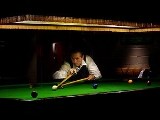
Snooker is a
billiards sport that is played on a large
baize-covered
table with pockets in each of the four corners and in the middle of each of the long side cushions. It is played using a
cue, one white ball , 15 red balls and 6 colours: a yellow , green , brown , blue , pink and black ball . A player wins a frame of snooker by scoring more points than his opponent, using the cue ball to pot the balls in the manner described below. A match consists of an agreed number of frames. Snooker is particularly popular in English-speaking and
Commonwealth countries, and the
Far East.
History
The game of billiards dates back to the 15th century but snooker is a more recent invention. In the late 19th century billiards games were popular among British army officers stationed in
India, and players used to experiment with variations on the game. Due to the fact that billiards was a two-player game, multi-player variations such as life pool and pyramid pool became popular. Black pool was a form of pyramid pool that took the black ball from a life pool set so a player could pot a red then the black for more points. The most commonly accepted story is that, at the officers' mess in Jabalpur some time in 1875, a Colonel Sir Neville Francis Fitzgerald Chamberlain suggested adding coloured balls to black pool so that the variation featured fifteen reds, a yellow, green, pink and black . The word 'snooker' was army slang for a first-year cadet. During a game a cadet missed a shot and Chamberlain said to him: "Why you're a regular snooker!" After explaining the meaning to his fellow peers, Chamberlain added that they were perhaps all snookers at this game. The term was adopted for the new variation and has been in use ever since. British billiards champion John Roberts travelled to India in 1885, where he met Chamberlain. Chamberlain explained the new game to him, and Roberts subsequently introduced it to England. Nowadays the term "snookered", meaning "thwarted", is a common expression in
English.
Snooker championships date back to 1916. In 1927,
Joe Davis helped establish the
first professional world championship, and won its prize of £6.10s . He went on to win every subsequent world championship until 1946, when he retired from tournament play. The trophy he donated all those years ago is still awarded to the world champion.
A dispute between the professionals and the Billiards Association & Control Council meant that there were only two entrants for the 'official' world championship – Horace Lindrum beat Clark McConachy . However, the professionals organised their own 'world championship' between 1952 and 1957, and the winners of this version are generally accepted as the World Champion. Nevertheless, it is Lindrum's name that is engraved on the familiar trophy.
Snooker suffered a decline in the 1950s and 1960s, so much so that no tournament was held from 1958 to 1963. In 1969, the BBC, in order to demonstrate their new colour broadcasts, launched a new snooker tournament, called
Pot Black. The multi-coloured game, many of whose players were just as colourful, caught the public interest, and the programme's success wildly exceeded expectations. Ted Lowe, the commentator famous for his whispering delivery, was the driving-force behind Pot Black, which survived until well into the 1980s.
In the early 1970s, the World Championship received little TV coverage. However, in 1976 it was featured for the first time and very quickly became a mainstream professional sport. World rankings were introduced in 1977. Money poured into the game, and a new breed of player, typified by
Steve Davis, young, serious and dedicated, started to emerge. The first maximum break of 147 in televised tournament was made by Davis against John Spencer in the Lada Classic, Oldham, in 1982. The first 147 at the World Championships was by the Canadian Cliff Thorburn. The top players became sterling millionaires. There was even a comic snooker song in the pop charts:
Snooker Loopy by Chas and Dave, featuring contributions from a host of players including Steve Davis and
Willie Thorne.
Perhaps the peak of this golden age was the
World Championship of 1985, when 18.5 million people watching
BBC2 saw
Dennis Taylor emerge victorious against Davis after a mammoth struggle. Play had started with the first session on Saturday afternoon, finishing with the potting of the last possible ball at 00:20 on Monday morning at the end of a gruelling final Sunday night session. To this day, polls rank the 1985 World Snooker Championship final amongst British television's most memorable all-time moments. With seven World Championship wins in the modern era, along with many other ranking tournament victories,
Stephen Hendry is often considered the most successful player ever.
Snooker remains immensely popular in the United Kingdom, second only to
football amongst television viewers. For highly ranked players professional snooker is a very lucrative occupation. Stephen Hendry leads the career prize money chart, with winnings of over £7.8 million as of 2005. The majority of top snooker players have always originated from the United Kingdom and Ireland. In the 1970s and 1980s some top players came from Australia, Canada and South Africa, but few successful players now come from those countries. However, there have been examples of prominent players from Malta, Hong Kong and Thailand, and since 2000 snooker has gained popularity in
mainland China. In 2005
Ding Junhui became the first Chinese player to win a ranking event.
In the United States,
snooker can also refer to a sort of miniaturized version of shuffleboard played with weighted, sliding disks, on a long table with a polished wooden surface. Though uncommon, this pastime is occasionally found in bars and pubs.
Governing body
The World Professional Billiards and Snooker Association , founded in 1968 as the Professional Billiard Players' Association, is the governing body for the professional game. Its subsidiary, World Snooker, organises the professional tour. The organisation is based in
Bristol,
England. The world governing body has been racked by in-fighting for a number of years.
The amateur game is governed by the International Billiards and Snooker Federation .
The game
The Table
Snooker is played on a rectangular table, 6 feet by 12 feet , with six pockets, one at each corner and one in the middle of each long side. At one end of the table is the so-called
baulk line, which is 29 inches from the baulk cushion . A semicircle of radius 11½ inches, called
the D, is drawn behind this line, centred on the middle of the line. The cushion on the other side of the table is known as the
top cushion.
At the beginning of a frame, the balls are set up in the arrangement shown. The six colours are placed on their own spots. On the baulk line, looking up the table from the baulk end, the yellow ball is located where the "D" meets the line on the right, the green ball where the "D" meets the line on the left, and the brown ball in the middle of the line. This order is often remembered using the
mnemonic God Bless You, the first letter of each word being the first letter of the three colours. At the exact centre of the table sits the blue ball. Further up the table is the pink ball, which sits midway between the blue spot and the top cushion, followed by the red balls, arranged in a tightly-packed triangle behind the pink . Finally, the black ball is placed on a spot 12¾ inches from the top cushion.
Because of the large size of "full sized" snooker tables, smaller tables are common in domestic situations and other situations where space is limited. These are often around 6 feet in length, and all the dimensions and markings are scaled down accordingly. The balls used are sometimes also scaled down.
Objective
The objective of the game of snooker is to strike the white
cue ball with a cue in the direction of other
object balls and to pot these object balls in one of the six pockets. This must be done according to the rules of the game, which are described below. By potting object balls points can be scored. The player who scores most points wins the frame, and the player who wins most frames wins the match.
A snooker match
A snooker match usually consists of an odd fixed number of frames. A frame begins with setting up the balls as described above. A frame ends when all balls are potted, or when one of the players concedes defeat because he is too far behind in score to equal or beat the score of the other player.
A match ends when one of the players has won the majority of the set number of frames and the other player can therefore not equal this. For example, when a match consists of 19 frames, the match ends when one of the players has reached 10 frames.
Gameplay
At the beginning of each frame the balls are set up by the referee as explained. This will be followed by a
break-off shot, on which the players take turns. At the break-off, the white cue ball can be placed anywhere inside the D, although it is common for players to start by placing the ball on the line, between the brown ball and either the green or yellow ball.
Players take turns in visiting the table. When one player is at the table, the other cannot play. A
break is the number of points scored by a player in one single visit to the table. A player's turn and break end when he fails to pot a ball, when he does something against the rules of the game, which is called a
foul, or when a frame has ended.
When a player strikes the white, it can only first hit certain object balls. If the white first hits another ball, this is considered a foul. The ball or balls that can be hit first by the white in a certain stroke are called the
ball "on" for that particular stroke. The balls "on" are the only balls that can be potted by a player. The player receives points for this. If another ball is potted, this is considered a foul.
The game of snooker generally consists of two phases. The first phase is the situation in which there are still red balls on the table. In the first phase, at the beginning of a player's turn, the balls "on" are all remaining red balls. The player must therefore attempt to first hit and pot one or more red balls. For every red ball potted, the player will receive 1 point. When a red has been potted, it will stay off the table and the player can continue his break. If no red has been potted or a foul has been made, the other player will come into play.
In case one or more red balls have been potted, the player can continue his break. This time one of the six colours is the ball "on". Only one of these can be the ball "on" and the rules of the game state that a player must nominate his desired colour to the referee, although it is often clear which ball the striker is playing and it is not necessary to nominate.
When the nominated colour is potted, the player will be awarded the correct number of points . The colour is then taken out of the pocket by the referee and placed on its original spot. If that spot is covered by another ball, the ball is placed on the highest available spot. If there is no available spot, it is placed as close to its own spot as possible in a direct line between that spot and the top cushion, without touching another ball. If there is no room this side of the spot, it will be placed as close to the spot as possible in a straight line towards the bottom cushion, without touching another ball.
Because only one of the colours is the ball "on", it is a foul to first hit multiple colours at the same time, or pot more than one colour .
If a player fails to pot a ball "on", it being a red or nominated colour, the other player will come into play and the balls "on" are always the reds, as long as there are still reds on the table.
The alternation between red balls and colours ends when all reds have been potted and the second phase begins. In this phase, all colours have to be potted in the correct order . They also become the ball "on" in that order. During this phase, when potted, the colours stay down and are not replaced on the table, unless a foul is made when potting the colour and the colour is respotted.
When all colours are potted, the frame is over and the player who has scored most points has won the frame. When only the black remains, the difference in score is more than the 7 points the black is worth, and the striker decides that the 7 points of the black are of no value to him or his break, the frame is also ended. When a foul is made on the black, the frame also ends.
Fouls
A foul is a shot or action by the striker which is against the rules of the game.
When a foul is made during a shot, the player's turn is ended and he will receive no points for the foul shot. The other player will receive penalty points.
Common fouls are:
- first hitting a ball "not-on" with the cue ball
- potting a ball "not-on"
- potting the white
- hitting another ball than the white with the cue
- making a ball land off the table
- touching a ball with something else than the tip of the cue
- playing a "push shot" - a shot where the cue, cue ball and object ball are in simultaneous contact
- playing a "jump shot", which is where the cue ball leaves the bed of the table and jumps over a ball before first hitting another ball
- playing a shot with both feet off the ground
Whereas in other games, such as pool, if the cue ball is touched with the tip of the cue when it is in baulk after being potted then a foul is committed, in snooker if the cue ball is touched with the tip after being potted and in the D, a foul is not committed as long as the referee is satisfied that the player was only positioning the ball, and not playing, or preparing to play, a shot.
When a foul is made, the other player will receive penalty points. Penalty points are at least 4 points and at most 7 points. The number of penalty points is the value of the ball "on", or any of the "foul" balls, whichever is highest. When more than one foul is made, the penalty is not the added total — only the most highly valued foul is counted.
Not hitting the ball "on" first is the most common foul. Players can make life difficult for an opponent by making sure that they cannot hit a ball "on" directly. This is called "laying a snooker" or putting the other player "in a snooker".
Since players receive points for fouls by their opponents, snookering your opponent a number of times in a row is a possible way of winning a frame when potting all the balls on the table would be insufficient for you to win.
If a player commits a foul, and his opponent considers that the position left is unattractive, he may request that the offender play again from that position.
If a foul has been committed by not hitting a ball "on" first, or at all, and the referee judges that the player has not made the best possible effort to hit a ball "on", and neither of the players are in need of snookers to win the frame, then "foul, and a miss" is called. In this instance the other player may request that all balls on the table are returned to their position before the foul, and the opponent play the shot again. It should be noted that this rule is often applied less stringently, if at all, in amateur matches.
When a player leaves an opponent unable to hit both sides of at least one ball "on" after a foul, the other player will receive a
free ball. This means any colour can be nominated and played as the ball "on". The number of points for potting the free ball is not the worth of the nominated ball but of the original ball "on". For example, if the ball "on" is a red, and the free ball is a pink, the player will receive one point for potting the pink. After potting the free ball as a red, a player can nominate and pot a colour as usual.
The end of a frame
A frame normally ends in one of four ways:
- A concession, when one player gives up due to being too far behind to have a realistic chance of winning the frame.
- When the pink is potted and the difference between the players' scores is more than 7 points. The frame is over and, while the striker may pot the black , no further shots are allowed.
- The black is potted AND the 7 points scored puts one player ahead.
- A foul on the black AND the 7-point penalty puts one player ahead.
If, however, the black is fouled and the 7-point penalty brings the scores level, the black is respotted. Play continues from in-hand, with the players tossing a coin for the choice of playing first or making the opponent play first. Potting or fouling a respotted black ends the frame.
Occasionally, but very rarely, a player will forfeit a frame due to a failure to hit a ball "on" three times in a row ; and should a player refuse to take his turn at any stage, the referee would have the right to declare the frame over. This would be a most unlikely occurrence.
Highest break
The highest break that can be made under normal circumstances is 147. To achieve that, the player must pot all 15 reds, with the black after every red, followed by potting the six remaining colours. This "maximum break" of 147 rarely occurs in match play.
If an opponent fouls before any balls are potted, and leaves the player a free ball, the player can then nominate a colour and play it as a red ball. Then, black can be nominated as the next colour. This means it is actually possible to score the value of 16 reds and blacks, which equals 155 points. This has never been done in a professional tournament. The highest break in tournament play is 149, and the highest break in professional matchplay is 148.
Tournaments
The most important event in professional snooker is the World Championship, held annually since 1927 . The tournament has been held at the Crucible Theatre in
Sheffield since 1977, and was sponsored by
Embassy from 1976 to 2005. Due to the fact that tobacco companies are no longer allowed to sponsor sporting events in the United Kingdom after 2005, the World Snooker Championship had to find a new sponsor. It was announced in January 2006 that the 2006-2010 world championships would be sponsored by online casino
888.com .
Discussion has occurred about the whereabouts of future World Championships, focusing on the possibility of moving the tournament to another city , or to a bigger venue to accommodate the high spectator demand. This was concluded in 2005 with confirmation that the event will stay in Sheffield for at least a further five years. However, there are plans still to replace the Crucible in Sheffield, by building a new, high-capacity billiards arena.
The group of tournaments that come next in importance are the ranking tournaments. Players in these tournaments score world ranking points. A high ranking ensures qualification for next year's tournaments, invitations to invitational tournaments and an advantageous draw in tournaments.
Third in line are the invitational tournaments, to which most of the highest ranked players are invited. The most important tournament in this category is The Masters, which to most players is the second or third most sought-after prize.
There are also other championships that have less importance, which don't give any world ranking points and aren't televised. These can change on a year-to-year basis depending on calendars and sponsors. The has full details.
Notable players
- Excepting Jimmy White, the following players have all won the World Snooker Championship.
Name | Country | Notes |
|---|
| Stephen Hendry | Scotland | Dominated the 1990s, much as Steve Davis dominated the 1980s, during which time he seemed able to win most frames from one visit to the table . Seven-time World Championship winner and rated by many as the greatest player to date. |
Ronnie O'Sullivan
| England | Given his nicknames due to the blisteringly fast rate at which he usually plays. Has won two World Championships and compiled the five fastest maximum 147 breaks so far recorded. The top two of these were both achieved during World Championships, making O'Sullivan the only player to date to compile more than one career maximum at the Crucible. Also noted for his ability to cue with his other hand to a high standard. Considered by many the greatest natural snooker talent yet found. |
Steve Davis
| England | Became in the 1980s the first player in the televised era to dominate the sport, raising the standard of the game and winning six World Championships. He was also one of the first players to develop a particularly strong safety game. Until his mantle was assumed by Stephen Hendry, Davis held the vast majority of snooker records and still holds the record for most professional titles won . |
Mark Williams | Wales | Twice World Champion in 2000 and 2003. When on form, widely regarded as the greatest single ball potter in the game. In the 2002/2003 season Williams achieved the rare snooker 'Grand Slam' holding all four BBC televised titles simultaneously. After a couple of relatively poor years, he won the 2006 China Open. |
John Higgins | Scotland | World Champion 1998. Holds the record for making the most centuries in consecutive frames during a match – four – and for amassing the most points without answer from an opponent during a match . These feats were achieved against Ronnie O'Sullivan in the final of the 2005 Grand Prix tournament. |
Ken Doherty
| Republic of Ireland | To date the only player to win all three World Championships: Under 21 , Amateur and Professional . |
Peter Ebdon
| England | World Champion 2002. Known for his concentration, dogged determination and occasional vocal outbursts of self-encouragement after winning matches or crucial frames. |
Graeme Dott
| Scotland | Reached the World Championship final in 2004 and won it in 2006, his first professional tournament victory. |
Jimmy White | England | The World Championship's eternal bridesmaid, runner-up no fewer than six times. He has, however, won many other tournaments. Another naturally talented and, in his heyday, fast player like Ronnie O'Sullivan, White is one of the most exciting and popular players of the game. Known for his sometimes incredible cue ball control and positioning. |
| Joe Davis | England | Generally considered the grandfather of modern snooker and largely responsible for making the game more popular than billiards in the 1930s and 40s. Dominated the World Championship during its pre-television era, winning fifteen consecutive times from 1927 to 1946. |
| Fred Davis | England | Won eight World Championships during the 1940s and 50s, once his elder brother Joe had retired. |
Alex Higgins | Northern Ireland | Brought the sport to new levels of popularity and won two World Championships, in 1972 and 1982. Another natural talent, but sometimes garnered more attention for his volatile temperament away from the snooker table. |
| John Pulman | England | Dominated the 1960s, winning eight World Championships between 1957 and 1968. |
Ray Reardon | Wales | Won six World Championships, mostly in the 1970s, straddling the pre-televised and televised eras. Earned his nickname as his dark widow's peak gives him a passing resemblance to portrayals of Bram Stoker's character. |
| John Spencer | England | Three-times World Champion during the late 1960s and 1970s. |
| Dennis Taylor | Northern Ireland | Won the famous 1985 World Championship final on the very last ball. Also became well-known for wearing glasses that appeared to have been put on upside-down; their design allowed them to be used when leaning over and looking along the cue. |
Cliff Thorburn | Canada | To date the only player from outside the British Isles to win the World Championship, in 1980. Earned his nickname due to his highly tactical style of play which often led to long matches. |
| Terry Griffiths | Wales | Remains the only player in the televised era to win the World Championship at his first attempt, in 1979. |
| Shaun Murphy | England | The surprise winner of the 2005 World Championship and the first qualifier to win since Terry Griffiths. |
| John Parrott | England | A noted amateur in the early 1980s, Parrott reached the World Championship final in 1989 and won it in 1991. He was ranked second only to Stephen Hendry for three seasons in the early 1990s, but in recent years his form has declined and currently he is no longer among the top thirty-two ranked players in the world. |
See also
- Highest snooker break
- Snooker world rankings 2005/2006
Lists
- Equipment
- Players
- Terminology
- World Snooker Champions
Results
- Snooker season 2003/2004
- Snooker season 2004/2005
- Snooker season 2005/2006
- Snooker season 2006/2007
References
External links
- - Online Snooker Coaching Resource
- - International Billiards & Snooker Federation
- - International Snooker Discussions & Forum