
All Topics  
Henna


   Email Print
   Bookmark   Link


Henna


Henna or Hina (Lawsonia inermis, syn. L. alba) is a flowering plant
Flowering plant

The flowering plants or angiosperms are the most widespread group of Embryophytes. The flowering plants and the gymnosperms are the only extant groups of Spermatophyte....
, the sole species in the genus Lawsonia in the family Lythraceae
Lythraceae

Lythraceae is a family of flowering plants. It includes 500-600 species of mostly herbs, with some shrubs and trees, in 32 genus. Lythraceae have a worldwide distribution, with most species in the tropics but ranging into temperate climate regions as well....
. It is native to tropical and subtropical regions of Africa
Africa

Africa is the world's second-largest and second most-populous continent, after Asia. At about 30.2 million km? including adjacent islands, it covers 6% of the Earth's total surface area and 20.4% of the total land area....
, southern Asia
South Asia

South Asia, also known as Southern Asia, is the southern region of the Asian continent, which comprises the sub-Himalayan countries and, for some authorities , also includes the adjoining countries on the west and the east....
, and northern Australasia
Australasia

Australasia is a region of Oceania: New Zealand, Australia, Papua New Guinea, and neighbouring islands in the Pacific Ocean. The term was coined by Charles de Brosses in Histoire des navigations aux terres australes ....
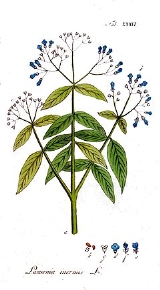
 in semi-arid zones. Henna is a tall shrub or small tree, 2–6 m high. It is glabrous, multibranched with spine tipped branchlets. Leaves are opposite, entire, glabrous, sub-sessile, elliptical, and broadly lanceolate (1.5–5.0 cm x 0.5–2 cm), acuminate, having depressed veins on the dorsal surface. During the onset of precipitation intervals, the plant grows rapidly; putting out new shoots, then growth slows.


Discussion
Ask a question about 'Henna'
Start a new discussion about 'Henna'
Answer questions from other users
Full Discussion Forum


Encyclopedia


Henna or Hina (Lawsonia inermis, syn. L. alba) is a flowering plant
Flowering plant

The flowering plants or angiosperms are the most widespread group of Embryophytes. The flowering plants and the gymnosperms are the only extant groups of Spermatophyte....
, the sole species in the genus Lawsonia in the family Lythraceae
Lythraceae

Lythraceae is a family of flowering plants. It includes 500-600 species of mostly herbs, with some shrubs and trees, in 32 genus. Lythraceae have a worldwide distribution, with most species in the tropics but ranging into temperate climate regions as well....
. It is native to tropical and subtropical regions of Africa
Africa

Africa is the world's second-largest and second most-populous continent, after Asia. At about 30.2 million km? including adjacent islands, it covers 6% of the Earth's total surface area and 20.4% of the total land area....
, southern Asia
South Asia

South Asia, also known as Southern Asia, is the southern region of the Asian continent, which comprises the sub-Himalayan countries and, for some authorities , also includes the adjoining countries on the west and the east....
, and northern Australasia
Australasia

Australasia is a region of Oceania: New Zealand, Australia, Papua New Guinea, and neighbouring islands in the Pacific Ocean. The term was coined by Charles de Brosses in Histoire des navigations aux terres australes ....
 in semi-arid zones. Henna is a tall shrub or small tree, 2–6 m high. It is glabrous, multibranched with spine tipped branchlets. Leaves are opposite, entire, glabrous, sub-sessile, elliptical, and broadly lanceolate (1.5–5.0 cm x 0.5–2 cm), acuminate, having depressed veins on the dorsal surface. During the onset of precipitation intervals, the plant grows rapidly; putting out new shoots, then growth slows. The leaves gradually yellow and fall during prolonged dry or cool intervals. Henna flowers have four sepal
Sepal

A sepal is a part of the flower of angiosperms . Sepals in a "typical" flower are green and lie under the more conspicuous petals. As a collective unit the sepals are called the Wiktionary:calyx, and the collection of petals is called the Wiktionary:corolla....
s and a 2 mm calyx tube with 3 mm spread lobes. Petals are obvate, white or red stamens inserted in pairs on the rim of the calyx tube. Ovary is four celled, style up to 5 mm long and erect. Fruits are small, brownish capsules, 4–8 mm in diameter, with 32–49 seeds per fruit, and open irregularly into four splits. Lawsone
Lawsone

Lawsone , also known as hennotannic acid, is a red-orange dye present in the leaves of the henna plant as well as jewelweed . Humans have used henna extracts containing lawsone as hair and skin pigments for more than 5000 years....
 content in leaves is negatively associated with the number of seeds in the fruits.

Cultivation and uses

Henna, Lawsonia inermis, produces a red-orange dye molecule, lawsone
Lawsone

Lawsone , also known as hennotannic acid, is a red-orange dye present in the leaves of the henna plant as well as jewelweed . Humans have used henna extracts containing lawsone as hair and skin pigments for more than 5000 years....
. This molecule has an affinity for bonding with protein, and thus has been used to dye skin, hair, fingernails, leather, silk and wool. Henna's indigenous zone is the tropical savannah and tropical arid zone, in latitudes between 15° and 25° N and S from Africa to the western Pacific rim, and produces highest dye content in temperatures between 35°C and 45°C. It does not thrive where minimum temperatures are below 11°C. Temperatures below 5°C will kill the henna plant. The dye molecule, lawsone
Lawsone

Lawsone , also known as hennotannic acid, is a red-orange dye present in the leaves of the henna plant as well as jewelweed . Humans have used henna extracts containing lawsone as hair and skin pigments for more than 5000 years....
, is primarily concentrated in the leaves, and is in the highest levels in the petioles of the leaf. Products sold as "black henna" or "neutral henna" are not made from henna, but may be derived from indigo
Indigo

Indigo is the color on the electromagnetic spectrum between about 420 and 450 nanometre in wavelength, placing it between blue and violet . Although traditionally considered one of seven divisions of the optical spectrum, modern color scientists do not usually recognize indigo as a separate division and generally classify wavelengths shorter...
 (in the plant Indigofera tinctoria
Indigofera tinctoria

Indigofera tinctoria bears the common name true indigo. The plant was one of the original sources of indigo dye. It has been naturalized to tropical and temperate Asia, as well as parts of Africa, but its native habitat is unknown since it has been in cultivation worldwide for many centuries....
) or Cassia obovata, and may contain unlisted dyes and chemicals.

Henna is commercially cultivated in western India
India

India, officially the Republic of India , is a country in South Asia. It is the List of countries and outlying territories by total area country by geographical area, the List of countries by population country, and the most populous liberal democracy in the world....
, Pakistan
Pakistan

Pakistan , officially the Islamic Republic of Pakistan, is a country located in South Asia and borders Central Asia and the Middle East. It has a 1,046 kilometre coastline along the Arabian Sea and Gulf of Oman in the south, and is bordered by Afghanistan and Iran in the west, India in the east and People's Republic of China in th...
, Morocco
Morocco

Morocco , officially the Kingdom of Morocco , is a country located in North Africa with a population of nearly 34 million and an area just under 447,000 km2....
, Yemen
Yemen

Yemen , officially the Republic of Yemen is an Arab country located on the Arabian Peninsula in Southwest Asia. Yemen has an estimated population of more than 23 million people and is bordered by Saudi Arabia to the North, the Red Sea to the West, the Arabian Sea and Gulf of Aden to the South, and Oman to the east....
, Iran
Iran

Iran , officially the Islamic Republic of Iran and formerly known internationally as Persian Empire until 1935, is a country in Central Eurasia, located on the northeastern shore of the Persian Gulf and the southern shore of the Caspian Sea....
, Afghanistan
Afghanistan

Afghanistan , officially the Islamic republic of Afghanistan, is a landlocked country that is located approximately in the center of Asia....
, Somalia
Somalia

Somalia , officially the Republic of Somalia and formerly known as the Somali Democratic Republic, is a country located in the Horn of Africa....
, Sudan
Sudan

Sudan is a country in northeastern Africa. It is the largest in the African continent and the Arab World, and List of countries and outlying territories by total area by area....
 and Libya
Libya

Libya , officially the Great Socialist People's Libyan Arab Jamahiriya , is a country located in North Africa. Bordering the Mediterranean Sea to the north, Libya lies between Egypt to the east, Sudan to the southeast, Chad and Niger to the south, and Algeria and Tunisia to the west....
. Presently the Pali district of Rajasthan is the most heavily cultivated henna production area in India, with over 100 henna processors operating in Sojat City.

Though henna has been used for body art and hair dye since the Bronze Age, henna has had a recent renaissance in body art due to improvements in cultivation, processing, and the diasporas of people from traditional henna using regions.

The word "henna" comes from the Arabic name for Lawsonia inermis, pronounced // or colloquially //.

In the Bible's Song of Songs and Song of Solomon, henna is referred to as Camphire.

In the Indian subcontinent, there are many variant words such as Mehndi
Mehndi

Mehndi is the application of Henna as a temporary form of skin decoration in South Asia, the Southwest Asia, North Africa and the Horn of Africa, as well as by expatriate communities from these areas....
 in North India
North India

Northern India is a loosely defined region in the northern part of India. The exact meaning of the term varies by usage. The dominant geographical features of northern India are the Indo-Gangetic Plain and the Himalayas, which demarcate the region from Tibet and Central Asia....
, Pakistan
Pakistan

Pakistan , officially the Islamic Republic of Pakistan, is a country located in South Asia and borders Central Asia and the Middle East. It has a 1,046 kilometre coastline along the Arabian Sea and Gulf of Oman in the south, and is bordered by Afghanistan and Iran in the west, India in the east and People's Republic of China in th...
 and Bangladesh
Bangladesh

, officially the People's Republic of Bangladesh is a country in South Asia. It is bordered by India on all sides except for a small border with Burma to the far southeast and by the Bay of Bengal to the south....
. In Telugu (India, Malaysia, USA), it is known as Gorintaaku. In Tamil (South India, Singapore, Malaysia, Sri Lanka) it is called "Marudhaani" and is used as ground fresh leaves rather than as dried powder. It is used in various festivals and celebrations and used by women and children. It is left on overnight and will last one month or more depending on the plant and how well it was ground and how long it is left on.

Henna has many traditional and commercial uses, the most common being as a dye for hair, skin and fingernails, as a dye and preservative for leather and cloth, and as an anti-fungal. Henna flowers have been used to create perfume since ancient times, and henna perfume is experiencing a resurgence on the Internet. Henna was used as a hair dye in Indian court records around 400 CE, in Rome during the Roman Empire, and in Spain during Convivienca. It was listed in the medical texts of the Ebers Papyrus
Ebers papyrus

The Ebers Papyrus of about 16th century BC is among the most important medical papyri of ancient Egypt. It is also commonly called Papyrus Ebers ....
 (16th c BCE Egypt) and by Ibn Qayyim al-Jawziyya (14th c CE (Syria and Egypt) as a medicinal herb. In Morocco, wool is dyed and ornamented with henna, as are drumheads and other leather goods. Henna will repel some insect pests and mildew.

The United States Food and Drug Administration has not approved henna for direct application to the skin. It is unconditionally approved as a hair dye, and can only be imported for that purpose. Henna imported into the USA which appears to be for use as body art is subject to seizure, and at present it is illegal to use henna for body art in the U.S., though prosecution is rare. The fast black stains of “black henna” are not made with henna, but are from p-phenylenediamine
P-Phenylenediamine

p-Phenylenediamine , also called paraphenylenediamine, 1,4-diaminobenzene or 1,4-phenylenediamine is an aromatic amine used as a component of engineering polymers and composites, aramid fibers, hair coloring, rubber chemicals, textile dyes, and pigments....
. This can cause severe allergic reactions and permanent scarring. No henna can make a black stain on a torso in ˝ hour. P-phenylenediamine can stain skin black quickly, but the FDA specifically forbids PPD to be used for that purpose.

Preparation and application of paste

Henna for Hair
Henna body art is made by applying henna paste to the skin: the lawsone in the paste migrates into the outermost layer of the skin and makes a red-brown stain.

Whole, unbroken henna leaves will not stain the skin. Henna will not stain skin until the lawsone molecules are made available (released) from the henna leaf. Fresh henna leaves will stain the skin if they are smashed with a mildly acidic liquid. This will stain skin within moments, but it is difficult to form intricate patterns from coarse crushed leaves. Dried ground, sifted henna leaves are easily worked into a paste that can be used to make intricate body art. Commercially available henna powder is made by drying the henna leaves and milling them to powder, then the powder is sifted. This powder is mixed with lemon juice, strong tea, or other mildly acidic liquids. Essential oils with high levels of "terps", monoterpene alcohols such as tea tree
Tea tree

Tea tree or Ti-tree is a popular name that has been applied to a number of different, unrelated plants:*Camellia sinensis , from which black, green, oolong and white tea are all obtained....
, eucalyptus
Eucalyptus

Eucalyptus is a diverse genus of Flowering plant trees in the Myrtus family, Myrtaceae. Members of the genus dominate the tree flora of Australia....
, cajeput, or lavender
Lavender

The Lavenders Lavandula are a genus of 39 species of flowering plants in the mint family, Lamiaceae, native to the Mediterranean region south to tropical Africa and to the southeast regions of India....
 will improve skin stain characteristics. The henna mix must rest for 6 to 12 hours so the leaf cellulose is dissolved, making the lawsone available to stain the skin. This is mixed to a toothpaste consistency and applied with a one of many traditional tools, including resist techniques, shading techniques, and thicker paste techniques, or the modern cellowrap cone.

Once applied to the skin, lawsone
Lawsone

Lawsone , also known as hennotannic acid, is a red-orange dye present in the leaves of the henna plant as well as jewelweed . Humans have used henna extracts containing lawsone as hair and skin pigments for more than 5000 years....
 molecules gradually migrate from the henna paste into the outer layer of the skin. Though henna's lawsone will stain the skin within minutes, the longer the paste is left on the skin, the more lawsone will migrate. Henna paste will yield as much dye as the skin can easily absorb in less than eight hours. Henna tends to crack and fall off the skin during these hours, so it is often sealed down by dabbing a sugar/lemon mix over the dried paste, or simply adding some form of sugar to the paste. This also adds to the colour of the end result, increasing the intensity of the shade.

When the paste has fallen off the skin or been removed by scraping, the stain will be orange, but should darken over the following three days to a reddish brown. Soles and palms have the thickest layer of skin and so take up the most lawsone, and take it to the greatest depth, so that hands and feet will have the darkest and most long-lasting stains. Steaming or warming the henna pattern will darken the stain, either during the time the paste is still on the skin, or after the paste has been removed. Chlorinated water and soaps may spoil the darkening process: alkaline may hasten the darkening process. After the stain reaches its peak color it will appear to fade. The henna stain is not actually fading, the skin is exfoliating: the lower, less stained cells, rise to the surface, until all stained cells are shed.

Traditions of henna as body art

The different words for henna in ancient languages imply that henna had more than one point of discovery and origin, and different pathways of daily and ceremonial use.

Henna has been used to adorn young women’s bodies as part of social and holiday celebrations since the late Bronze Age
Bronze Age

The Bronze Age is, with respect to a given prehistory, the period in that society when the most advanced metalworking included smelting copper and tin from naturally-occurring outcroppings of copper and tin ores, creating a bronze alloy by melting those metals together, and casting them into bronze artifact s....
 in the eastern Mediterranean. The earliest text mentioning henna in the context of marriage and fertility celebrations comes from the Ugarit
Ugarit

Ugarit was an ancient cosmopolitan port city, sited on the Mediterranean coast. Ugarit sent tribute to Ancient Egypt and maintained trade and diplomatic connections with Cyprus , documented in the archives recovered from the site and corroborated by Mycenaean Greece and Cypriot pottery found there....
ic legend of Baal
Baal

Ba'al is a Northwest Semitic title and honorific meaning "master" or "lord" that is used for various gods who were patrons of cities in the Levant, cognate to East Semitic Bel ....
 and Anath , which has references to women marking themselves with henna in preparation to meet their husbands, and Anath adorning herself with henna to celebrate a victory over the enemies of Baal. Wall paintings excavated at Akrotiri (dating prior to the eruption of Thera in 1680 BCE) show women with markings consistent with henna on their nails, palms and soles, in a tableau consistent with the henna bridal description from Ugarit Many statuettes of young women dating between 1500 and 500 BCE along the Mediterranean coastline have raised hands with markings consistent with henna. This early connection between young, fertile women and henna seems to be the origin of the Night of the Henna, which is now celebrated world-wide.

The Night of the Henna was celebrated by most groups in the areas where henna grew naturally: Jews, , Muslims, Hindus, Christians and Zoroastrians, among others, all celebrated marriages by adorning the bride, and often the groom, with henna.

Across the henna-growing region, Purim
Purim

Purim is a Jewish holiday that commemorates the deliverance of the Jewish people of the ancient Persian Empire from Haman 's plot to annihilate them, as recorded in the Hebrew Bible Book of Esther ....
 , Eid
Eid

Eid or similar may refer to:Places* Eid, Norway, a municipality of NorwayCompanies* EID, Portugal, Defence communications company...
, Diwali
Diwali

Diwali is a significant festival in Hinduism, Sikhism, Buddhism, and Jainism, and an official holiday in India. Adherents of these religions celebrate Diwali as the Festival of Lights....
, Karva Chauth, Passover
Passover

Passover is a Jewish and Samaritan holy day and festival commemorating God sparing the Israelites when He killed the first born of Egypt, and is followed by the seven day Feast of the Unleavened Bread commemorating the Exodus from Ancient Egypt and the liberation of the Israelites from Judaism and slavery....
, Nowruz, Mawlid
Mawlid

'Mawlid' is a term used to refer to the observance of the birthday of the Islamic prophet Muhammad which occurs in Rabi' al-awwal, the third month in the Islamic calendar....
, and most saints’ days were celebrated with some henna. Favorite horses, donkeys, and salukis had their hooves, paws, and tails hennaed. Battle victories, births, circumcision, birthdays, Zar, as well as weddings, usually included some henna as part of the celebration. When there was joy, there was henna, as long as henna was available.

Henna was regarded as having “Barakah”, blessings, and was applied for luck as well as joy and beauty. Brides typically had the most henna, and the most complex patterns, to support their greatest joy, and wishes for luck. Some bridal traditions were very complex, such as those in Yemen, where the Jewish bridal henna process took four or five days to complete, with multiple applications and resist work.

The fashion of "Bridal Mehndi
Mehndi

Mehndi is the application of Henna as a temporary form of skin decoration in South Asia, the Southwest Asia, North Africa and the Horn of Africa, as well as by expatriate communities from these areas....
" in Northern Libya and in North Indian diasporas is currently growing in complexity and elaboration, with new innovations in glitter, gilding, and fine-line work. Recent technological innovations in grinding, sifting, temperature control, and packaging henna, as well as government encouragement for henna cultivation, have improved dye content and artistic potential for henna.

Though traditional henna artists were Nai
Nai

Nai may refer to:*Nai, a Barber caste in India*Nai , Anna Vissi's third studio album*Nai , a wind instrument, also known as the Romanian pan flute...
 caste in India, and barbering castes in other countries (lower social classes), talented contemporary henna artists can command high fees for their work. Women in countries where women are discouraged from working outside the home can find socially acceptable, lucrative work doing henna. Morocco, Mauritania, Yemen, Libya, Somalia, Sudan, as well as India and many other countries have thriving women’s henna businesses. These businesses are often open all night for Eids, Diwali and Karva Chauth, and many women may work as a team for a large wedding where hundreds of guests will be hennaed as well as the bride and groom.

Health effects

Though user accounts cite few, if any, negative effects of natural henna paste, pre-mixed henna body art pastes may have ingredients added to darken stain, or to alter stain color. The health risks involved in pre-mixed paste can be significant. The FDA considers these to be adulterants and therefore illegal for use on skin. Some pastes have been found to include: silver nitrate
Silver nitrate

Silver nitrate, also known as lunar caustic, is a soluble chemical compound with chemical formula silverNitrogenOxygen3. This compound is a versatile precursor to many other silver compounds, such as those used in photography....
, carmine
Carmine

Carmine , also called Crimson Lake, Cochineal, Natural Red 4, C.I. 75470, or E120, is a pigment of a bright red color obtained from the carminic acid produced by some scale insects, such as the cochineal and the Polish cochineal, and is used as a general term for a particularly deep carmine ....
, pyrogallol
Pyrogallol

Pyrogallol or benzene-1,2,3-triol is a white crystalline powder and a powerful reducing agent. It was first prepared by Carl Wilhelm Scheele 1786 by heating gallic acid....
, disperse orange dye, and chromium. These have been found to cause allergic reactions, chronic inflammatory reactions, or late-onset allergic reactions to hairdressing products and textile dyes.
  • Medical report of heavy metals such as nickel, cobalt, chromium, lead and mercury found in henna tattoos


  • Allergies Associated with Body Piercing and Tattoos


  • OSHA on silver nitrate


  • CDC on silver nitrate


Black henna

“Black Henna” is a misnomer arising from imports of plant-based hair dyes into the West in the late 19th century. Partly fermented, dried indigo
Indigofera tinctoria

Indigofera tinctoria bears the common name true indigo. The plant was one of the original sources of indigo dye. It has been naturalized to tropical and temperate Asia, as well as parts of Africa, but its native habitat is unknown since it has been in cultivation worldwide for many centuries....
 was called “black henna” because it could be used in combination with henna to dye hair black. This gave rise to the belief that there was such a thing as “black henna” which could dye skin black. Indigo will not dye skin black. Pictures of indigenous people with black body art (either alkalized henna or from some other source) also fed the belief that there was such a thing as “black henna.”

In the 1990s, henna artists in Africa, India, the Arabian Peninsula and the West began to experiment with para-phenylenediamine
P-Phenylenediamine

p-Phenylenediamine , also called paraphenylenediamine, 1,4-diaminobenzene or 1,4-phenylenediamine is an aromatic amine used as a component of engineering polymers and composites, aramid fibers, hair coloring, rubber chemicals, textile dyes, and pigments....
 (PPD) based black hair dye, applying it as a thick paste as they would apply henna, in an effort to find something that would quickly make jet black temporary body art. PPD can cause severe allergic reactions, with blistering, intense itching, permanent scarring, and permanent chemical sensitivities . Estimates of allergic reactions range between 3% and 15%. Henna does not cause these injuries. Henna boosted with PPD can cause lifelong health damage.

Para-phenylenediamine is illegal for use on skin in western countries, though enforcement is lax. When used in hair dye, the PPD amount must be below 6%, and application instructions warn that the dye not touch the scalp and the dye must be quickly rinsed away. “Black henna” pastes have PPD percentages from 10% to 60%, and are left on the skin for half an hour.

Para-phenylenediamine “black henna” use is widespread, particularly in tourist areas. Because the blistering reaction appears 3 to 12 days after the application, most tourists have left and do not return to show how much damage the artist has done. This permits the artists to continue injuring others, unaware they are causing severe injuries. The high profit margins of ‘black henna” and the demand for body art that emulates “tribal tattoos” further encourage artists to ignore the dangers. It is not difficult to recognize and avoid para-phenylenediamine “black henna”:
  • if a paste stains torso skin black in less than ˝ hour, it has PPD in it, and little or no henna.
  • if the paste is mixed with peroxide, or if peroxide is wiped over the design to bring out the color, it has PPD in it, and little or no henna.


Anyone who has an itching and blistering reaction to a black body stain should go to a doctor, and report that they have had an application of para-phenylenediamine to their skin.

PPD sensitivity is lifelong, and once sensitized, the use of synthetic hair dye can be life-threatening . These injuries are not caused by henna, and a person can use henna as hair dye.

Gallery


See also

  • Mehndi
    Mehndi

    Mehndi is the application of Henna as a temporary form of skin decoration in South Asia, the Southwest Asia, North Africa and the Horn of Africa, as well as by expatriate communities from these areas....


External links