


Abdur Rahman Khan

Encyclopedia
Abdur Rahman Khan (between 1840 to 1844 – October 1, 1901) was Emir of Afghanistan from 1880 to 1901.
The third son of Mohammad Afzal Khan
, and grandson of Dost Mohammad Khan
, Abdur Rahman Khan was considered a strong ruler who re-established the writ of the Afghan government in Kabul
after the disarray that followed the second Anglo-Afghan war
.
, on June 9, 1863, Dost Mohammad Khan had nominated as his successor Sher Ali Khan
, his third son, passing over the two elder brothers, Afzal Khan
and Azam Khan
. At first, the new Amir was quietly recognized. But after a few months Afzal Khan raised an insurrection in the north of the country, where he had been governing when his father died. This began a fierce contest for power between Dost Mohammad's sons, which lasted for nearly five years.
In this war, Abdur Rahman became distinguished for ability and daring energy. Although his father, Afzal Khan, who had none of these qualities, came to terms with the Amir Sher Ali, the son's behavior in the northern province soon excited the Amir's suspicion, and Abdur Rahman, when he was summoned to Kabul, fled across the Oxus into Bukhara
. Sher Ali threw Afzal Khan into prison, and a serious revolt followed in southern Afghanistan.
The Amir had scarcely suppressed it by winning a desperate battle when Abdur Rahman's reappearance in the north was a signal for a mutiny of the troops stationed in those parts and a gathering of armed bands to his standard. After some delay and desultory fighting, he and his uncle, Azam Khan, occupied Kabul (March 1866). The Amir Sher Ali marched up against them from Kandahar
; but in the battle that ensued at Sheikhabad on May 10, he was deserted by a large body of his troops, and after his signal defeat Abdur Rahman released his father, Afzul Khan, from prison in Ghazni
, and installed him upon the throne as Amir of Afghanistan.
Notwithstanding the new Amir 's incapacity, and some jealousy between the real leaders, Abdur Rahman and his uncle, they again routed Sher Ali's forces, and occupied Kandahar in 1867. When Afzal Khan died at the end of the year, Azam Khan became the new ruler, with Abdur Rahman as his governor in the northern province. But towards the end of 1868 Sher Ali's return, and a general rising in his favour, resulted in Abdur Rahman and Azam Khan's defeat at Tinah Khan on January 3, 1869. Both sought refuge in Persia
, whence Abdur Rahman placed himself under Russia
n protection at Samarkand
. Azam died in Persia in October 1869.
, then part of Russian Turkestan
, for eleven years, until the 1879 death of Sher Ali, who had retired from Kabul when the British
armies entered Afghanistan. The Russian governor-general
at Tashkent sent for Abdur Rahman, and pressed him to try his fortunes once more across the Oxus. In March 1880, a report reached India that Abdur Rahman was in northern Afghanistan; and the governor-general, Lord Lytton
, opened communications with him to the effect that the British government were prepared to withdraw their troops, and to recognize Abdur Rahman as Amir of Afghanistan, with the exception of Kandahar and some districts adjacent to it. After some negotiations, an interview took place between him and Lepel Griffin
, the diplomatic representative at Kabul of the India
n government. Griffin described Abdur Rahman as a man of middle height, with an exceedingly intelligent face and frank and courteous manners, shrewd and able in conversation on the business in hand.
also handed over Kandahar to the new Amir.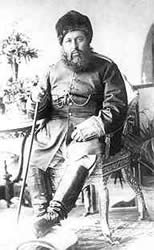 However, Ayub Khan
, one of Sher Ali Khan's sons, marched upon that city from Herat, defeated Abdur Rahman's troops, and occupied the place in July 1880. This serious reverse roused the Amir, who had not at first displayed much activity. He led a force from Kabul, met Ayub's army close to Kandahar, and the complete victory which he there won forced Ayub Khan to fly into Persia. From that time Abdur Rahman was fairly seated on the throne at Kabul, and in the course of the next few years he consolidated his dominion over all Afghanistan, suppressing insurrections by a sharp and relentless use of his despotic
authority. The powerful Ghilzai
tribe revolted against the severity of his measures several times. In that same year, Ayub Khan made a fruitless inroad from Persia. In 1888, the Amir's cousin, Ishak Khan, rebelled against him in the north; but these two enterprises came to nothing.
In 1885, at the moment when the Amir was in conference with the British viceroy
, Lord Dufferin
, in India, the news came of a skirmish between Russian and Afghan troops at Panjdeh, over a disputed point in the demarcation of the northwestern frontier of Afghanistan. Abdur Rahman's attitude at this critical juncture is a good example of his political sagacity. To one who had been a man of war from his youth, who had won and lost many fights, the rout of a detachment and the forcible seizure of some debatable frontier lands was an untoward incident; but it was not a sufficient reason
for calling upon the British, although they had guaranteed his territory's integrity, to vindicate his rights by hostilities which would certainly bring upon him a Russian invasion from the north, and would compel his British allies to throw an army into Afghanistan from the southeast.
His interest lay in keeping powerful neighbours, whether friends or foes, outside his kingdom. He knew this to be the only policy that would be supported by the Afghan nation; and although for some time a rupture with Russia seemed imminent, while the Government of India
made ready for that contingency, the Amir's reserved and circumspect tone in the consultations with him helped to turn the balance between peace and war, and substantially conduced towards a pacific solution. Abdur Rahman left on those who met him in India the impression of a clear-headed man of action, with great self-reliance and hardihood, not without indications of the implacable severity that too often marked his administration. His investment with the insignia of the highest grade of the Order of the Star of India
appeared to give him much pleasure.
From the end of 1888, the Amir spent eighteen months in his northern provinces bordering upon the Oxus, where he was engaged in pacifying the country that had been disturbed by revolts, and in punishing with a heavy hand all who were known or suspected to have taken any part in rebellion.
Shortly afterwards (in 1892) he succeeded in finally beating down the resistance of the Hazara people, who vainly attempted to defend their independence, within their highlands, of the central authority at Kabul. In the late 1880s many of the Hazara tribes revolted against Abdur Rahman, the first ruler to bring the country of Afghanistan under a centralized Afghan government. Consequent on this unsuccessful revolt, numbers of Hazaras fled to Quetta
in Balochistan
,to the area around Mashhed in northeastern Iran, Russia, Iraq, Tajikistan, Uzbekistan, Azerbaijan,China and India. Most active in the revolt were the Uruzgani, the southernmost of the Hazara tribes. Following their defeat, a considerable number of Uruzgani left the country, as did many Jaghuri, their nearest neighbors to the northeast.
In the Shikhali district an estimated 7,000 head of cattle were taken away from Hazaras and 350 men and women of the Jaghori district had been sold at Kabul markets each at the price of 20–21 Afs. Abdur Rahman's brutal suppression compelled a large number of Hazaras to seek refuge in Iran, India, and Russia. Abdur Rahman could only succeed in subjugating Hazaras and conquering their land when he effectively utilized internal differences within the Hazara community, co-opting sold-out Hazara chiefs into his bureaucratic sales of the enslaved Hazara men, women and children in 1897, the Hazaras remained de facto
slaves until King Amanullah Khan
declared Afghanistan's independence in 1919.
In 1895, the Amir found himself unable, by reason of ill-health
, to accept an invitation from Queen Victoria to visit England; but his second son Nasrullah Khan went instead. Abdur Rahman died on October 1, 1901, being succeeded by his son Habibullah Khan. He had defeated all enterprises by rivals against his throne; he had broken down the power of local chiefs, and tamed the refractory tribes; so that his orders were irresistible throughout the whole dominion. His government was a military despotism resting upon a well-appointed army; it was administered through officials absolutely subservient to an inflexible will and controlled by a widespread system of espionage
; while the exercise of his personal authority was too often stained by acts of unnecessary cruelty.
He held open courts for the receipt of petitioners and the dispensation of justice; and in the disposal of business he was indefatigable. He succeeded in imposing an organized government upon the fiercest and most unruly population in Asia
; he availed himself of Europe
an inventions for strengthening his armament, while he sternly set his face against all innovations which, like Railways and Telegraph
s, might give Europeans a foothold within his country.
His adventurous life, his forcible character, the position of his state as a barrier between the Indian and the Russian empires, and the skill with which he held the balance in dealing with them, combined to make him a prominent figure in contemporary Asian politics and will mark his reign as an epoch in the history of Afghanistan. The Amir received an annual Subsidy from the British government of 1,850,000 rupee
s. He was allowed to import munitions of war.
In 1896, he adopted the title of Zia-ul-Millat-Wa-ud Din ("Light of the nation and religion"); and his zeal for the cause of Islam
induced him to publish treatises on jihad
. Today, his descendants can be found in many places outside of Afghanistan, such as in America, France
, Germany
,and even in Scandinavian countries such as Denmark
and carry the surname of Ziyaee, which is itself a derivative of the King's title. His two eldest sons, Habibullah Khan and Nasrullah Khan, were born at Samarkand
. His youngest son, Mahomed Omar Jan, was born in 1889 of an Afghan mother, connected by descent with the Barakzai
family.
negotiated with Abdur Rahman Khan, the Durand Line Treaty for the demarcation of the frontier between Afghanistan, the FATA
, North-West Frontier Province
and Baluchistan
Provinces of Pakistan the successor state of British India. This line, the Durand Line
, is named after Mortimer Durand and which still remains as an unrecognized boundary by the Government of Afghanistan.
In 1893, Mortimer Durand was deputed to Kabul by the government of British India for this purpose of settling an exchange of territory required by the demarcation of the boundary between northeastern Afghanistan and the Russian possessions, and in order to discuss with Amir Abdur Rahman Khan other pending questions. Abdur Rahman Khan showed his usual ability in diplomatic argument, his tenacity where his own views or claims were in debate, with a sure underlying insight into the real situation.
In the agreement, the relations between the British Indian and Afghan governments, as previously arranged, were confirmed; and an understanding was reached upon the important and difficult subject of the border line of Afghanistan on the east, towards India.
In the year 1893, during rule of Amir Abdur Rahman Khan, a Royal Commission for setting up of Boundary between Afghanistan and British Governed India was set up to negotiate terms with the British, for the agreeing to the Durand line, and the two parties camped at Parachinar
, now part of FATA Pakistan, which is near Khost
, Afghanistan. From the British side the camp was attended by Mortimer Durand and Sahibzada Abdul Qayyum, Political Agent Khyber
. Afghanistan was represented by Sahibzada Abdul Latif
and the Governor Sardar Shireendil Khan
representing Amir Abdur Rahman Khan. He is to be told the worst king in afghan history, Because of Durand Line Treaty.
The third son of Mohammad Afzal Khan
Mohammad Afzal Khan
Mohammad Afzal Khan was the Emir of Afghanistan from 1865 to 1867. The oldest son of Dost Mohammed Khan, Afzal Khan seized power from his brother Sher Ali Khan three years after their father's death. Following Afzal Khan's death the following year, Mohammad Azam Khan was reinstated as Amir of...
, and grandson of Dost Mohammad Khan
Dost Mohammad Khan
Dost Mohammad Khan was the Emir of Afghanistan between 1826 and 1863. He first ruled from 1826 to 1839 and then from 1843 to 1863. He was the 11th son of Sardar Pāyendah Khan who was killed by Zaman Shah Durrani in 1799...
, Abdur Rahman Khan was considered a strong ruler who re-established the writ of the Afghan government in Kabul
Kabul
Kabul , spelt Caubul in some classic literatures, is the capital and largest city of Afghanistan. It is also the capital of the Kabul Province, located in the eastern section of Afghanistan...
after the disarray that followed the second Anglo-Afghan war
Second Anglo-Afghan War
The Second Anglo-Afghan War was fought between the United Kingdom and Afghanistan from 1878 to 1880, when the nation was ruled by Sher Ali Khan of the Barakzai dynasty, the son of former Emir Dost Mohammad Khan. This was the second time British India invaded Afghanistan. The war ended in a manner...
.
Background and early career
Before his death in HeratHerat
Herāt is the capital of Herat province in Afghanistan. It is the third largest city of Afghanistan, with a population of about 397,456 as of 2006. It is situated in the valley of the Hari River, which flows from the mountains of central Afghanistan to the Karakum Desert in Turkmenistan...
, on June 9, 1863, Dost Mohammad Khan had nominated as his successor Sher Ali Khan
Sher Ali Khan
Sher Ali Khan was Amir of Afghanistan from 1863 to 1866 and from 1868 until his death in 1879. He was the third son of Dost Mohammed Khan, founder of the Barakzai Dynasty in Afghanistan....
, his third son, passing over the two elder brothers, Afzal Khan
Mohammad Afzal Khan
Mohammad Afzal Khan was the Emir of Afghanistan from 1865 to 1867. The oldest son of Dost Mohammed Khan, Afzal Khan seized power from his brother Sher Ali Khan three years after their father's death. Following Afzal Khan's death the following year, Mohammad Azam Khan was reinstated as Amir of...
and Azam Khan
Mohammad Azam Khan
Mohammad Azam Khan was the Emir of Afghanistan from October 7, 1867 to February 21, 1868. Was the second sons of Dost Mohammed Khan, Azam Khan heir power from his brother Mohammad Afzal Khan after his death on October 7, 1867. Following Azam Khan's death the following year, Sher Ali Khan was...
. At first, the new Amir was quietly recognized. But after a few months Afzal Khan raised an insurrection in the north of the country, where he had been governing when his father died. This began a fierce contest for power between Dost Mohammad's sons, which lasted for nearly five years.
In this war, Abdur Rahman became distinguished for ability and daring energy. Although his father, Afzal Khan, who had none of these qualities, came to terms with the Amir Sher Ali, the son's behavior in the northern province soon excited the Amir's suspicion, and Abdur Rahman, when he was summoned to Kabul, fled across the Oxus into Bukhara
Bukhara
Bukhara , from the Soghdian βuxārak , is the capital of the Bukhara Province of Uzbekistan. The nation's fifth-largest city, it has a population of 263,400 . The region around Bukhara has been inhabited for at least five millennia, and the city has existed for half that time...
. Sher Ali threw Afzal Khan into prison, and a serious revolt followed in southern Afghanistan.
The Amir had scarcely suppressed it by winning a desperate battle when Abdur Rahman's reappearance in the north was a signal for a mutiny of the troops stationed in those parts and a gathering of armed bands to his standard. After some delay and desultory fighting, he and his uncle, Azam Khan, occupied Kabul (March 1866). The Amir Sher Ali marched up against them from Kandahar
Kandahar
Kandahar is the second largest city in Afghanistan, with a population of about 512,200 as of 2011. It is the capital of Kandahar Province, located in the south of the country at about 1,005 m above sea level...
; but in the battle that ensued at Sheikhabad on May 10, he was deserted by a large body of his troops, and after his signal defeat Abdur Rahman released his father, Afzul Khan, from prison in Ghazni
Ghazni
For the Province of Ghazni see Ghazni ProvinceGhazni is a city in central-east Afghanistan with a population of about 141,000 people...
, and installed him upon the throne as Amir of Afghanistan.
Notwithstanding the new Amir 's incapacity, and some jealousy between the real leaders, Abdur Rahman and his uncle, they again routed Sher Ali's forces, and occupied Kandahar in 1867. When Afzal Khan died at the end of the year, Azam Khan became the new ruler, with Abdur Rahman as his governor in the northern province. But towards the end of 1868 Sher Ali's return, and a general rising in his favour, resulted in Abdur Rahman and Azam Khan's defeat at Tinah Khan on January 3, 1869. Both sought refuge in Persia
Iran
Iran , officially the Islamic Republic of Iran , is a country in Southern and Western Asia. The name "Iran" has been in use natively since the Sassanian era and came into use internationally in 1935, before which the country was known to the Western world as Persia...
, whence Abdur Rahman placed himself under Russia
Russia
Russia or , officially known as both Russia and the Russian Federation , is a country in northern Eurasia. It is a federal semi-presidential republic, comprising 83 federal subjects...
n protection at Samarkand
Samarkand
Although a Persian-speaking region, it was not united politically with Iran most of the times between the disintegration of the Seleucid Empire and the Arab conquest . In the 6th century it was within the domain of the Turkic kingdom of the Göktürks.At the start of the 8th century Samarkand came...
. Azam died in Persia in October 1869.
Period of exile
Abdur Rahman lived in exile in TashkentTashkent
Tashkent is the capital of Uzbekistan and of the Tashkent Province. The officially registered population of the city in 2008 was about 2.2 million. Unofficial sources estimate the actual population may be as much as 4.45 million.-Early Islamic History:...
, then part of Russian Turkestan
Russian Turkestan
Russian Turkestan was the western part of Turkestan within the Russian Empire , comprising the oasis region to the south of the Kazakh steppes, but not the protectorates of the Emirate of Bukhara and the Khanate of Khiva.-History:-Establishment:Although Russia had been pushing south into the...
, for eleven years, until the 1879 death of Sher Ali, who had retired from Kabul when the British
United Kingdom
The United Kingdom of Great Britain and Northern IrelandIn the United Kingdom and Dependencies, other languages have been officially recognised as legitimate autochthonous languages under the European Charter for Regional or Minority Languages...
armies entered Afghanistan. The Russian governor-general
Governor-General
A Governor-General, is a vice-regal person of a monarch in an independent realm or a major colonial circonscription. Depending on the political arrangement of the territory, a Governor General can be a governor of high rank, or a principal governor ranking above "ordinary" governors.- Current uses...
at Tashkent sent for Abdur Rahman, and pressed him to try his fortunes once more across the Oxus. In March 1880, a report reached India that Abdur Rahman was in northern Afghanistan; and the governor-general, Lord Lytton
Robert Bulwer-Lytton, 1st Earl of Lytton
Edward Robert Lytton Bulwer-Lytton, 1st Earl of Lytton, GCB, GCSI, GCIE, PC was an English statesman and poet...
, opened communications with him to the effect that the British government were prepared to withdraw their troops, and to recognize Abdur Rahman as Amir of Afghanistan, with the exception of Kandahar and some districts adjacent to it. After some negotiations, an interview took place between him and Lepel Griffin
Lepel Griffin
Sir Lepel Henry Griffin KCSI was a British administrator and diplomat in colonial India. He was also a writer.-Career:He entered the Indian Civil Service in 1860. In 1880 he became Chief Secretary of the Punjab. He was sent as a diplomatic representative to Kabul, at the end of the Second Afghan War...
, the diplomatic representative at Kabul of the India
India
India , officially the Republic of India , is a country in South Asia. It is the seventh-largest country by geographical area, the second-most populous country with over 1.2 billion people, and the most populous democracy in the world...
n government. Griffin described Abdur Rahman as a man of middle height, with an exceedingly intelligent face and frank and courteous manners, shrewd and able in conversation on the business in hand.
Reign
At the durbar on July 22, 1880, Abdur Rahman was officially recognized as Amir, granted assistance in arms and money, and promised, in case of unprovoked foreign aggression, such further aid as might be necessary to repel it, provided that he align his foreign policy with the British. The British evacuation of Afghanistan was settled on the terms proposed, and in 1881, the British troopsBritish Army
The British Army is the land warfare branch of Her Majesty's Armed Forces in the United Kingdom. It came into being with the unification of the Kingdom of England and Scotland into the Kingdom of Great Britain in 1707. The new British Army incorporated Regiments that had already existed in England...
also handed over Kandahar to the new Amir.
Ayub Khan (Afghan commander)
Ghazi Mohammad Ayub Khan was also known as The Victor of Maiwand or The Afghan Prince Charlie and was, for a while, the governor of Herat Province in Afghanistan. He was Emir of Afghanistan from October 12, 1879 to May 31, 1880 and was also the leader of Afghans in the Second Anglo-Afghan War...
, one of Sher Ali Khan's sons, marched upon that city from Herat, defeated Abdur Rahman's troops, and occupied the place in July 1880. This serious reverse roused the Amir, who had not at first displayed much activity. He led a force from Kabul, met Ayub's army close to Kandahar, and the complete victory which he there won forced Ayub Khan to fly into Persia. From that time Abdur Rahman was fairly seated on the throne at Kabul, and in the course of the next few years he consolidated his dominion over all Afghanistan, suppressing insurrections by a sharp and relentless use of his despotic
Despotism
Despotism is a form of government in which a single entity rules with absolute power. That entity may be an individual, as in an autocracy, or it may be a group, as in an oligarchy...
authority. The powerful Ghilzai
Ghilzai
Ghilzai are the largest Pashtun tribal confederacy found in Afghanistan and Pakistan. They are also known historically as Ghilji, Khilji, Ghalji, Ghilzye, and possibly Gharzai...
tribe revolted against the severity of his measures several times. In that same year, Ayub Khan made a fruitless inroad from Persia. In 1888, the Amir's cousin, Ishak Khan, rebelled against him in the north; but these two enterprises came to nothing.
In 1885, at the moment when the Amir was in conference with the British viceroy
Viceroy
A viceroy is a royal official who runs a country, colony, or province in the name of and as representative of the monarch. The term derives from the Latin prefix vice-, meaning "in the place of" and the French word roi, meaning king. A viceroy's province or larger territory is called a viceroyalty...
, Lord Dufferin
Frederick Hamilton-Temple-Blackwood, 1st Marquess of Dufferin and Ava
Frederick Hamilton-Temple-Blackwood, 1st Marquess of Dufferin and Ava, KP, GCB, GCSI, GCMG, GCIE, PC was a British public servant and prominent member of Victorian society...
, in India, the news came of a skirmish between Russian and Afghan troops at Panjdeh, over a disputed point in the demarcation of the northwestern frontier of Afghanistan. Abdur Rahman's attitude at this critical juncture is a good example of his political sagacity. To one who had been a man of war from his youth, who had won and lost many fights, the rout of a detachment and the forcible seizure of some debatable frontier lands was an untoward incident; but it was not a sufficient reason
Principle of sufficient reason
The principle of sufficient reason states that anything that happens does so for a reason: no state of affairs can obtain, and no statement can be true unless there is sufficient reason why it should not be otherwise...
for calling upon the British, although they had guaranteed his territory's integrity, to vindicate his rights by hostilities which would certainly bring upon him a Russian invasion from the north, and would compel his British allies to throw an army into Afghanistan from the southeast.
His interest lay in keeping powerful neighbours, whether friends or foes, outside his kingdom. He knew this to be the only policy that would be supported by the Afghan nation; and although for some time a rupture with Russia seemed imminent, while the Government of India
India Office
The India Office was a British government department created in 1858 to oversee the colonial administration of India, i.e. the modern-day nations of Bangladesh, Burma, India, and Pakistan, as well as territories in South-east and Central Asia, the Middle East, and parts of the east coast of Africa...
made ready for that contingency, the Amir's reserved and circumspect tone in the consultations with him helped to turn the balance between peace and war, and substantially conduced towards a pacific solution. Abdur Rahman left on those who met him in India the impression of a clear-headed man of action, with great self-reliance and hardihood, not without indications of the implacable severity that too often marked his administration. His investment with the insignia of the highest grade of the Order of the Star of India
Order of the Star of India
The Most Exalted Order of the Star of India is an order of chivalry founded by Queen Victoria in 1861. The Order includes members of three classes:# Knight Grand Commander # Knight Commander # Companion...
appeared to give him much pleasure.
From the end of 1888, the Amir spent eighteen months in his northern provinces bordering upon the Oxus, where he was engaged in pacifying the country that had been disturbed by revolts, and in punishing with a heavy hand all who were known or suspected to have taken any part in rebellion.
Shortly afterwards (in 1892) he succeeded in finally beating down the resistance of the Hazara people, who vainly attempted to defend their independence, within their highlands, of the central authority at Kabul. In the late 1880s many of the Hazara tribes revolted against Abdur Rahman, the first ruler to bring the country of Afghanistan under a centralized Afghan government. Consequent on this unsuccessful revolt, numbers of Hazaras fled to Quetta
Quetta
is the largest city and the provincial capital of the Balochistan Province of Pakistan. Known as the "Fruit Garden of Pakistan" due to the diversity of its plant and animal wildlife, Quetta is home to the Hazarganji Chiltan National Park, which contains some of the rarest species of wildlife in the...
in Balochistan
Balochistan (Pakistan)
Balochistan is one of the four provinces or federating units of Pakistan. With an area of 134,051 mi2 or , it is the largest province of Pakistan, constituting approximately 44% of the total land mass of Pakistan. According to the 1998 population census, Balochistan had a population of...
,to the area around Mashhed in northeastern Iran, Russia, Iraq, Tajikistan, Uzbekistan, Azerbaijan,China and India. Most active in the revolt were the Uruzgani, the southernmost of the Hazara tribes. Following their defeat, a considerable number of Uruzgani left the country, as did many Jaghuri, their nearest neighbors to the northeast.
In the Shikhali district an estimated 7,000 head of cattle were taken away from Hazaras and 350 men and women of the Jaghori district had been sold at Kabul markets each at the price of 20–21 Afs. Abdur Rahman's brutal suppression compelled a large number of Hazaras to seek refuge in Iran, India, and Russia. Abdur Rahman could only succeed in subjugating Hazaras and conquering their land when he effectively utilized internal differences within the Hazara community, co-opting sold-out Hazara chiefs into his bureaucratic sales of the enslaved Hazara men, women and children in 1897, the Hazaras remained de facto
De facto
De facto is a Latin expression that means "concerning fact." In law, it often means "in practice but not necessarily ordained by law" or "in practice or actuality, but not officially established." It is commonly used in contrast to de jure when referring to matters of law, governance, or...
slaves until King Amanullah Khan
Amanullah Khan
Amanullah Khan was the King of the Emirate of Afghanistan from 1919 to 1929, first as Amir and after 1926 as Shah. He led Afghanistan to independence over its foreign affairs from the United Kingdom, and his rule was marked by dramatic political and social change...
declared Afghanistan's independence in 1919.
In 1895, the Amir found himself unable, by reason of ill-health
Illness
Illness is a state of poor health. Illness is sometimes considered another word for disease. Others maintain that fine distinctions exist...
, to accept an invitation from Queen Victoria to visit England; but his second son Nasrullah Khan went instead.
Espionage
Espionage or spying involves an individual obtaining information that is considered secret or confidential without the permission of the holder of the information. Espionage is inherently clandestine, lest the legitimate holder of the information change plans or take other countermeasures once it...
; while the exercise of his personal authority was too often stained by acts of unnecessary cruelty.
He held open courts for the receipt of petitioners and the dispensation of justice; and in the disposal of business he was indefatigable. He succeeded in imposing an organized government upon the fiercest and most unruly population in Asia
Asia
Asia is the world's largest and most populous continent, located primarily in the eastern and northern hemispheres. It covers 8.7% of the Earth's total surface area and with approximately 3.879 billion people, it hosts 60% of the world's current human population...
; he availed himself of Europe
Europe
Europe is, by convention, one of the world's seven continents. Comprising the westernmost peninsula of Eurasia, Europe is generally 'divided' from Asia to its east by the watershed divides of the Ural and Caucasus Mountains, the Ural River, the Caspian and Black Seas, and the waterways connecting...
an inventions for strengthening his armament, while he sternly set his face against all innovations which, like Railways and Telegraph
Telegraphy
Telegraphy is the long-distance transmission of messages via some form of signalling technology. Telegraphy requires messages to be converted to a code which is known to both sender and receiver...
s, might give Europeans a foothold within his country.
His adventurous life, his forcible character, the position of his state as a barrier between the Indian and the Russian empires, and the skill with which he held the balance in dealing with them, combined to make him a prominent figure in contemporary Asian politics and will mark his reign as an epoch in the history of Afghanistan. The Amir received an annual Subsidy from the British government of 1,850,000 rupee
Rupee
The rupee is the common name for the monetary unit of account in India, Sri Lanka, Nepal, Pakistan, Mauritius, Seychelles, Maldives, and formerly in Burma, and Afghanistan. Historically, the first currency called "rupee" was introduced in the 16th century...
s. He was allowed to import munitions of war.
In 1896, he adopted the title of Zia-ul-Millat-Wa-ud Din ("Light of the nation and religion"); and his zeal for the cause of Islam
Islam
Islam . The most common are and . : Arabic pronunciation varies regionally. The first vowel ranges from ~~. The second vowel ranges from ~~~...
induced him to publish treatises on jihad
Jihad
Jihad , an Islamic term, is a religious duty of Muslims. In Arabic, the word jihād translates as a noun meaning "struggle". Jihad appears 41 times in the Quran and frequently in the idiomatic expression "striving in the way of God ". A person engaged in jihad is called a mujahid; the plural is...
. Today, his descendants can be found in many places outside of Afghanistan, such as in America, France
France
The French Republic , The French Republic , The French Republic , (commonly known as France , is a unitary semi-presidential republic in Western Europe with several overseas territories and islands located on other continents and in the Indian, Pacific, and Atlantic oceans. Metropolitan France...
, Germany
Germany
Germany , officially the Federal Republic of Germany , is a federal parliamentary republic in Europe. The country consists of 16 states while the capital and largest city is Berlin. Germany covers an area of 357,021 km2 and has a largely temperate seasonal climate...
,and even in Scandinavian countries such as Denmark
Denmark
Denmark is a Scandinavian country in Northern Europe. The countries of Denmark and Greenland, as well as the Faroe Islands, constitute the Kingdom of Denmark . It is the southernmost of the Nordic countries, southwest of Sweden and south of Norway, and bordered to the south by Germany. Denmark...
and carry the surname of Ziyaee, which is itself a derivative of the King's title. His two eldest sons, Habibullah Khan and Nasrullah Khan, were born at Samarkand
Samarkand
Although a Persian-speaking region, it was not united politically with Iran most of the times between the disintegration of the Seleucid Empire and the Arab conquest . In the 6th century it was within the domain of the Turkic kingdom of the Göktürks.At the start of the 8th century Samarkand came...
. His youngest son, Mahomed Omar Jan, was born in 1889 of an Afghan mother, connected by descent with the Barakzai
Barakzai
- History :Barakzai is a common ethnic name among the Pashtuns of Afghanistan/Pakistan and it means . Barakzai is also a Pashtun tribe in Pakistan, and more predominantly, in Afghanistan...
family.
Durand Line
In 1893 Mortimer DurandMortimer Durand
Sir Henry Mortimer Durand was a British diplomat and civil servant of colonial British India.-Background:Born at Sehore, Bhopal, India, he was the son of Sir Henry Marion Durand, the Resident of Baroda and he was educated at Blackheath Proprietary School, and Tonbridge School.-Career:Durand...
negotiated with Abdur Rahman Khan, the Durand Line Treaty for the demarcation of the frontier between Afghanistan, the FATA
Fata
The FATA or FC-ATA is a type of computer hard disk drive. FATA is simply the low cost ATA or SATA disk drive equipped with a small external converter, that changes the interface to Fibre Channel...
, North-West Frontier Province
North-West Frontier Province
Khyber Pakhtunkhwa , formerly known as the North-West Frontier Province and various other names, is one of the four provinces of Pakistan, located in the north-west of the country...
and Baluchistan
Balochistan (Pakistan)
Balochistan is one of the four provinces or federating units of Pakistan. With an area of 134,051 mi2 or , it is the largest province of Pakistan, constituting approximately 44% of the total land mass of Pakistan. According to the 1998 population census, Balochistan had a population of...
Provinces of Pakistan the successor state of British India. This line, the Durand Line
Durand Line
The Durand Line refers to the porous international border between Pakistan and Afghanistan, which has divided the ethnic Pashtuns . This poorly marked line is approximately long...
, is named after Mortimer Durand and which still remains as an unrecognized boundary by the Government of Afghanistan.
In 1893, Mortimer Durand was deputed to Kabul by the government of British India for this purpose of settling an exchange of territory required by the demarcation of the boundary between northeastern Afghanistan and the Russian possessions, and in order to discuss with Amir Abdur Rahman Khan other pending questions. Abdur Rahman Khan showed his usual ability in diplomatic argument, his tenacity where his own views or claims were in debate, with a sure underlying insight into the real situation.
In the agreement, the relations between the British Indian and Afghan governments, as previously arranged, were confirmed; and an understanding was reached upon the important and difficult subject of the border line of Afghanistan on the east, towards India.
In the year 1893, during rule of Amir Abdur Rahman Khan, a Royal Commission for setting up of Boundary between Afghanistan and British Governed India was set up to negotiate terms with the British, for the agreeing to the Durand line, and the two parties camped at Parachinar
Parachinar
Parachinar is the capital of Kurram Agency, FATA of Pakistan. It is about 290 km west of the capital, Islamabad...
, now part of FATA Pakistan, which is near Khost
Khost
Khost or Khowst is a city in eastern Afghanistan. It is the capital of Khost province, which is a mountainous region near Afghanistan's border with Pakistan...
, Afghanistan. From the British side the camp was attended by Mortimer Durand and Sahibzada Abdul Qayyum, Political Agent Khyber
Khyber
The term Khyber may refer to:*The Khyber Pakhtunkhwa, a province of Pakistan*The Khyber Pass, a mountain pass that links Pakistan and Afghanistan.*The Khyber Agency, part of the Federally Administered Tribal Areas of Pakistan....
. Afghanistan was represented by Sahibzada Abdul Latif
Sahibzada Abdul Latif
Sahibzada Abdul Latif was an Afghan of Khost. He was born in Sayed Ga of Tani District in Khost Province, Afghanistan in 1853, to Sahibzada Mohmmad Shareef. He had two brothers, Sahibzada Abdul Aziz and Sahibzada Abdul Haleef...
and the Governor Sardar Shireendil Khan
Sardar Shireendil Khan
In the year 1893 during rule of Amir Abdur Rahman Khan of Afghanistan a Royal Commission for setting up of Boundary the Durand line between Afghanistan and the British governed India was set up to negotiate terms with the British, for the agreeing to the Durand line, and the two parties camped at...
representing Amir Abdur Rahman Khan. He is to be told the worst king in afghan history, Because of Durand Line Treaty.
Honours
- Knight Grand Commander of the Order of the Star of India (GCSI) - 1885
- Knight Grand Cross of the Order of the Bath (GCB)- 1893
See also
- European influence in AfghanistanEuropean influence in AfghanistanThe European influence in Afghanistan refers to political, social, and sometimes imperialistic influence several European nations have had on this historical development of Afghanistan.-Rise of Dost Mohammad Khan:...
- List of leaders of Afghanistan
- The Great GameThe Great GameThe Great Game or Tournament of Shadows in Russia, were terms for the strategic rivalry and conflict between the British Empire and the Russian Empire for supremacy in Central Asia. The classic Great Game period is generally regarded as running approximately from the Russo-Persian Treaty of 1813...