


Federally Administered Tribal Areas

Encyclopedia
The Federally Administered Tribal Areas (FATA) are a semi-autonomous tribal region in the northwest of Pakistan
, lying between the province of Khyber Pakhtunkhwa, Balochistan, and the neighboring country of Afghanistan
. The FATA comprise seven Agencies (tribal districts) and six FRs (Frontier regions
). The territory is almost exclusively inhabited by Pashtun
tribes which are predominantly Sunni Muslims by faith.
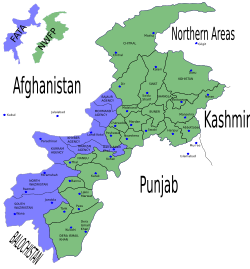
.jpg) The Federally Administered Tribal Areas consist of two types of areas i.e. Agencies (Tribal Districts) and FRs (Frontier Regions).
The Federally Administered Tribal Areas consist of two types of areas i.e. Agencies (Tribal Districts) and FRs (Frontier Regions).
In the FATA, there are seven Tribal Agencies and six FRs. These are (from North to South):
Agencies are further divided into Subdivisions, and Tehsils. According to the Election Commission of Pakistan, the FATA consist of the following divisions:
Mohmand Agency
:
Khyber Agency
:
Orakzai Agency
:
Kurram Agency:
North Waziristan Agency:
South Waziristan Agency:
Frontier Regions:
to the west with the border marked by the Durand Line
, Khyber-Pakhtunkhwa to the north and east, Punjab
and Balochistan
to the south.
The seven Tribal Areas
lie in a north-to-south strip that is adjacent to the west side of the six Frontier Regions
, which also lie in a north-to-south strip. The areas within each of those two regions are geographically arranged in a sequence from north to south.
The geographical arrangement of the seven Tribal Areas in order from north to south is:
Bajaur
, Mohmand
, Khyber
, Orakzai
, Kurram
, North Waziristan
, South Waziristan
.
The geographical arrangement of the six Frontier Regions in order from north to south is:
Peshawar, Kohat, Bannu, Lakki Marwat, Tank, Dera Ismail Khan.
The Constitution of Pakistan
governs FATA through the same rules which were framed by the British in 1901 as Frontier Crimes Regulations
(FCR). The Jurisdiction of Supreme Court and High Court of Pakistan does not extend to FATA and Provincially Administered Tribal Areas
(PATA), according to Article 247 and Article 248, of existing 1973 Constitution of Pakistan
. The Khyber-Pakhtunkhwa Provincial Assembly has no power in FATA, and can only exercise its powers in PATA that are part of Khyber-Pakhtunkhwa.
The mainly Pashtun
tribes that inhabit the areas are semi-autonomous and until fall of the Taliban in neighbouring Afghanistan
, the tribes had cordial relations with Pakistan's government.
People of FATA are represented in the Parliament of Pakistan by their elected representatives both in National Assembly of Pakistan
and the Senate of Pakistan
. FATA has 12 members in the National Assembly and 8 members in the Senate. FATA has no representation in the Provincial Assembly of Khyber-Pakhtunkhwa and most tribesmen live happily with the fact that they are directly under Federal jurisdiction except for some elements affiliated with the Awami National Party
.
Tribal political candidates do have party affiliations but can only contest elections as independents
, because the Political Parties Act of Pakistan has not been extended to the FATA. However, tribesmen were given the right to vote in the 1997 general elections despite the absence of the Political Parties Act. Previously only the Tribal Elders or Maliks (called Lungi-holders) were allowed to vote in the elections, since British times.
The administrative head of each tribal agency is the Political Agent who represents the President of Pakistan
and the appointed Governor of Khyber-Pakhtunkhwa.
According to a 2007 report by the New York Times, "the political agents are widely considered corrupt bureaucrats of Pakistan Civil Service."
Each Tribal Agency, depending on its size, has about two to three Assistant Political Agents, about three to ten Tehsildar
s and a number of Naib Tehsildars with the requisite supporting staff.
The FRs differ from the agencies only in the chain of command so that each FR is headed by the DC/DCO of the adjacent settled district (DC/DCO Peshawar heads FR Peshawar and so on). Under his supervision there is one Assistant Political Agent and a number of Tehsildars and Naib Tehsildars and support staff.
Each Tribal Agency has roughly 2–3,000 Khasadars and levies
force of irregulars and up to three to nine wings of the para-military Frontier Corps
for maintenance of law and order in the Agency and borders security. The Frontier Corps Force is headed by Pakistan's regular army officers and its soldiers are recruited mostly from the Pashtun
tribes.
According to a 2009 BBC survey, categorized as "grossly exaggerated" by the Pakistan Army
which was fighting the militants there, the Taliban were present in all FATA agencies, and in full control of Waziristan, Orakzai and Bajaur.
The situation has, however, improved after successive military operations carried out by Pakistan Army
in Bajaur, Swat, Waziristan, Orakzai and Mohmand.
of Pakistan under the "adult franchise" granted in 1996. Stephen Tierney, in Accommodating National Identity, reported that women came out to do so in the thousands for the 1997 office, possibly motivated by competition for voter numbers among the tribes. However, Ian Talbot in Pakistan, a Modern History states that elders and religious leaders attempted to prevent female participation by threatening punishment against tribesmen whose women registered, leading to under-registration in the female population. In 2008, the Taliban ordered women in the FATA regions of Bajaur, Kurram and Mohmand
not to vote under threat of "serious punishment," while Mangal Bagh
, chief of the Lashkar-e-Islam
, forbade women to vote in the Jamrud
and Bara
subdivisions of the Khyber Agency
.
The region was annexed in the 19th century during the British colonial period
, and though the British never succeeded in completely calming unrest in the region, it afforded them some protection from Afghanistan
. The British Raj attempted to control the population of the annexed tribal regions with the Frontier Crimes Regulations
(FCR), which allowed considerable power to govern to local nobles so long as these nobles were willing to meet the needs of the British. Due to the unchecked discretionary power placed into the hands of the jirga put into place by these nobles and to the human rights violations that ensued, the FCR has come to be known as the "black law." The annexed areas continued under the same governance after the Partition of India
, through the Dominion of Pakistan
in 1946 and into the Islamic Republic of Pakistan
in 1956.
According to the United States Institute of Peace
, the character of the region underwent a shift beginning in the 1980s with the entry into the region of the Mujahideen
and CIA Operation Cyclone
, against the Soviet Union
prior to the fall of the Berlin Wall
and collapse of Soviet Union.
. However, the FATA were not allowed to organize political parties. Islamist
candidates were able to campaign through mosque
s and madrassahs, as a result of which mullah
s were elected to represent the FATA in the National Assembly in 1997 and 2002. This was a departure from prior tribal politics, where power was focused in the hands of secular authorities, Malik
s.
began entering into the region. In 2003, Taliban and al-Qaeda forces sheltered in the FATA began crossing the border into Afghanistan
, attacking military and police. Shkin
, Afghanistan is a key location for these frequent battles. This heavily fortified military base has housed mostly American special operations forces since 2002 and is located just six kilometers from the Pakistani border. It is considered the most dangerous location in Afghanistan. With the encouragement of the United States
, 80,000 Pakistani troops entered the FATA in March 2004 to search for al-Qaeda operatives. They were met with fierce resistance from Pakistani Taliban. It was not the elders, but the Pakistani Taliban who negotiated a truce with the army, an indication of the extent to which the Pakistani Taliban had taken control. Troops entered the region, into South Waziristan
and North Waziristan
eight more times between 2004 and 2006 and faced further Pakistani Taliban resistance. Peace accords entered into in 2004 and 2006 set terms whereby the tribesmen in the area would stop attacking Afghanistan and the Pakistanis would halt major military actions against the FATA, release all prisoners, and permit tribesmen to carry small guns. In 2007 the Pakistani Taliban in FATA became officially known under the name Tehrik-i-Taliban Pakistan
.
" of the area. The meeting was chaired by President Pervez Musharraf and it was attended by the Chief Ministers and Governors of all four provinces. They discussed the deteriorating law and order situation and the threat posed to state security. To crush the armed militancy in the Tribal regions and Khyber-Pakhtunkhwa, the government decided to intensify and reinforce law enforcement and military activity, take action against certain madrassahs, and jam illegal FM radio stations.
 FATA is the most impoverished part of the nation. Despite being home to 2.4% of Pakistan's population, it makes up only 1.5% of Pakistan's economy. With a per capita
income of only $663 in 2010 only 34% of households managed to rise above the poverty level.
Due to the FATA's tribal organization, the economy is chiefly pastoral, with some agriculture practiced in the region's few fertile valleys. Its total irrigated
land is roughly 1,000 square kilometres. The country does not have a system of banks. The region is a major center for opium
trafficking, as well the smuggling of other contraband.
Foreign aid to the region is a difficult proposition, according to Craig Cohen, an analyst at the Center for Strategic and International Studies
in Washington, D.C.
Because security is difficult, local nongovernmental organizations are required to distribute aid, but there is a lack of trust amongst NGOs and other powers that hampers distribution. Pakistani NGOs are often targets of violent attacks by Islamist militants in the FATA. Because of the extensive hostility to any hint of foreign influence, the American branch of Save the Children
was distributing funding anonymously in the region as of July 2007.
Government's counter-terrorism and regional economic integration strategies.
they started work on the Amandara headworks to divert the Swat River
through a tunnel to irrigate the plains of Mardan and Charsadda. The aim was not to get more wheat or sugarcane, but to ‘tame the wild tribes’.
The FATA does not have a university, but seats are reserved for FATA students in Pakistani universities. There is no concrete plan to establish a full-fledged university within FATA.
The FATA's literacy
rate is 22%, which is well below the nation-wide rate of 56%. 35.8% of men, and only 7.5% of women receive education, compared to a nation-wide 44% of women.
In June 2007, a Pakistani Doctor was blown up in his car "after trying to counter the anti-vaccine propaganda of an imam in Bajaur
", Pakistani officials told the New York Times.
Pakistan
Pakistan , officially the Islamic Republic of Pakistan is a sovereign state in South Asia. It has a coastline along the Arabian Sea and the Gulf of Oman in the south and is bordered by Afghanistan and Iran in the west, India in the east and China in the far northeast. In the north, Tajikistan...
, lying between the province of Khyber Pakhtunkhwa, Balochistan, and the neighboring country of Afghanistan
Afghanistan
Afghanistan , officially the Islamic Republic of Afghanistan, is a landlocked country located in the centre of Asia, forming South Asia, Central Asia and the Middle East. With a population of about 29 million, it has an area of , making it the 42nd most populous and 41st largest nation in the world...
. The FATA comprise seven Agencies (tribal districts) and six FRs (Frontier regions
Frontier Regions
The Frontier Regions of Pakistan are a group of small administrative units in the Federally Administered Tribal Areas , lying immediately to the east of the seven main tribal agencies and west of the settled districts of Khyber Pakhtunkhwa...
). The territory is almost exclusively inhabited by Pashtun
Pashtun people
Pashtuns or Pathans , also known as ethnic Afghans , are an Eastern Iranic ethnic group with populations primarily between the Hindu Kush mountains in Afghanistan and the Indus River in Pakistan...
tribes which are predominantly Sunni Muslims by faith.
Administrative divisions
In the FATA, there are seven Tribal Agencies and six FRs. These are (from North to South):
- Bajaur Agency
- Mohmand AgencyMohmand AgencyThe Mohmand Agency is a district in the Federally Administered Tribal Areas of Pakistan created in 1951. Before that, the Mohmand Tribes were administered by the Deputy Commissioner based in Peshawar, Khyber-Pakhtunkhwa province of Pakistan. However it was not until 1973 that the headquarters of...
- Khyber AgencyKhyber agencyKhyber is a tribal area in the FATA region of Pakistan. It is one of the eight tribal areas, better known as agencies in Pakistan. It ranges from the Tirah valley down to Peshawar...
- Frontier Region PeshawarFrontier Region PeshawarThe Frontier Region Peshawar is a small administrative unit in the Federally Administered Tribal Areas of Pakistan. The region is named after Peshawar District which lies to the north and west and also borders Nowshera District to the east and the frontier region of Kohat to the south...
- Frontier Region KohatFrontier Region KohatThe Frontier Region Kohat is a small administrative unit in the Federally Administered Tribal Areas of Pakistan. The region is named after Kohat District which lies to the south and also borders Peshawar District to the north, Nowshera District to the east and Orakzai Agency to the west...
- Orakzai AgencyOrakzai AgencyOrakzai Agency is one of the Federally Administered Tribal Areas of Pakistan. It has a population of 450,000 and an area of .- History :The Orakzai tribes take their name, which literally means the lost son , from a romantic legend about their ancestor, Sikandar Shah, who was a prince from Iran,...
- Kurram Agency
- Frontier Region Bannu
- North Waziristan AgencyNorth WaziristanNorth Waziristan is the northern part of Waziristan, a mountainous region of northwest Pakistan, bordering Afghanistan and covering . Waziristan comprises the area west and south-west of Peshawar between the Tochi river to the north and the Gomal river to the south, forming part of Pakistan's...
- Frontier Region Lakki Marwat
- Frontier Region TankFrontier Region TankThe Frontier Region Tank is a small administrative unit in the Federally Administered Tribal Areas of Pakistan. The region is named after Tank District which lies to the south-east and also borders the South Waziristan Agency to the north, south and west and Lakki Marwat District to the north-east...
- South Waziristan AgencySouth WaziristanSouth Waziristan is the southern part of Waziristan, a mountainous region of northwest Pakistan, bordering Afghanistan and covering some 11,585 km² . Waziristan comprises the area west and southwest of Peshawar between the Tochi River to the north and the Gomal River to the south, forming...
- Frontier Region Dera Ismail Khan
Agencies are further divided into Subdivisions, and Tehsils. According to the Election Commission of Pakistan, the FATA consist of the following divisions:
| Agency / FR | Subdivision | Tehsil |
|---|---|---|
| Bajaur Agency | Khar | Khar |
| Utman Khel | ||
| Salarzai | ||
| Nawagai | Nawagai | |
| Mamund | ||
| Barang | ||
| Chamarkand | ||
| Mohmand Agency | Lower Mohmand | Yekka Ghund |
| Ambar | ||
| Pandyalai | ||
| Praang Ghaar | ||
| Upper Mohmand | Safi / Lakaro | |
| Khwezai / Baezai | ||
| Halimzai | ||
| Khyber Agency | Jamrud | Jamrud |
| Mulla Gori | ||
| Landi Kotal | Landi Kotal | |
| Bara | Bara | |
| Orakzai Agency | Lower Orakzai | Lower Orakzai |
| Central Orakzai | ||
| Upper Orakzai | Ismailzai | |
| Upper Orakzai | ||
| Kurram Agency | Lower Kurram | Lower Kurram / Sadda |
| Central Kurram | Central Kurram | |
| Upper Kurram | Upper Kurram / Parachinar | |
| North Waziristan Agency | Mir Ali | Mir Ali |
| Speen Wam | ||
| Shewa | ||
| Miranshah | Miranshah | |
| Datta Khel | ||
| Ghulam Khan | ||
| Razmak | Razmak | |
| Dosalli | ||
| Geriyum | ||
| Shawal | ||
| South Waziristan Agency | Ladha | Ladha |
| Makeen | ||
| Sararogha | ||
| Sarwakai | Sarwakai | |
| Tiaraza | ||
| Wana | Wana | |
| Birmal | ||
| Toi Khulla | ||
| FR Peshawar | FR Peshawar | FR Peshawar |
| FR Kohat | FR Kohat | FR Kohat |
| FR Bannu | FR Bannu | FR Bannu |
| FR Lakki Marwat | FR Lakki Marwat | FR Lakki Marwat |
| FR Tank - Jandola | FR Tank - Jandola | FR Tank - Jandola |
| FR D.I. Khan | FR D.I. Khan | FR D.I. Khan |
Frontier Regions
The Frontier Regions are named after their adjacent settled districts. The administration of the FR is carried out by the DCO / DC of the neighbouring named district. The overall administration of the frontier regions is carried out by the FATA Secretariat, based in Peshawar and reporting to the Governor of Khyber-Pakhtunkhwa. The six regions are:- Frontier Region Bannu
- Frontier Region Dera Ismail Khan
- Frontier Region KohatFrontier Region KohatThe Frontier Region Kohat is a small administrative unit in the Federally Administered Tribal Areas of Pakistan. The region is named after Kohat District which lies to the south and also borders Peshawar District to the north, Nowshera District to the east and Orakzai Agency to the west...
- Frontier Region Lakki Marwat
- Frontier Region PeshawarFrontier Region PeshawarThe Frontier Region Peshawar is a small administrative unit in the Federally Administered Tribal Areas of Pakistan. The region is named after Peshawar District which lies to the north and west and also borders Nowshera District to the east and the frontier region of Kohat to the south...
- Frontier Region TankFrontier Region TankThe Frontier Region Tank is a small administrative unit in the Federally Administered Tribal Areas of Pakistan. The region is named after Tank District which lies to the south-east and also borders the South Waziristan Agency to the north, south and west and Lakki Marwat District to the north-east...
(JandolaJandolaJandola is a town in Frontier Region Tank, Federally Administered Tribal Areas, Pakistan....
)
Main cities / Towns of FATA
Bajaur Agency:- KharKharKhar may refer to:* Khar, Punjab is a town in the Punjab Province, Pakistan* Khar, Bajaur is a town in the Bajaur Agency of the Federally Administered Tribal Areas, Pakistan...
- NawagaiNawagaiNawagai is a town in the Bajaur Agency of the Federally Administered Tribal Areas of Pakistan. It lies on the border with Afghanistan. Bajur scouts headquarters is also located in the town.civil colony is located in this town and this place is the court of bajour controlling by political agent....
- Inayat Qilla
- Pashat
Mohmand Agency
Mohmand Agency
The Mohmand Agency is a district in the Federally Administered Tribal Areas of Pakistan created in 1951. Before that, the Mohmand Tribes were administered by the Deputy Commissioner based in Peshawar, Khyber-Pakhtunkhwa province of Pakistan. However it was not until 1973 that the headquarters of...
:
- Ghallanai
- Mian Mandi - Gandhaab
- Lakaro
- Yakka Ghund
- Qandharo
Khyber Agency
Khyber agency
Khyber is a tribal area in the FATA region of Pakistan. It is one of the eight tribal areas, better known as agencies in Pakistan. It ranges from the Tirah valley down to Peshawar...
:
- BaraBâraBâra is a commune in Neamţ County, Romania. It is composed of three villages: Bâra, Negreşti and Rediu.-References:...
- JamrudJamrudJamrud , is a town located in the Khyber Agency, one of the Federally Administered Tribal Areas of Pakistan. The town is the doorway to the Khyber pass, part of the Hindu Kush range...
- Landi KotalLandi KotalLandi Kotal or Landikotal is a town of the Federally Administered Tribal Areas of Pakistan. It is located at 34°6'4N 71°8'44E and lies on the Khyber Pass in the Khyber Agency. At 1,072 metres above sea level it is the highest point on the Khyber Pass and is the route across the mountains to the...
- TorkhamTorkhamTorkham is a border crossing town in the Nangarhar province of Afghanistan and the Khyber Agency of Pakistan's Federally Administered Tribal Areas, right on the Durand Line border....
- Ali MasjidAli MasjidAli Masjid is the narrowest point of the Khyber Pass. It is located in the Khyber Agency of the Federally Administered Tribal Areas , Pakistan. It is located around east of the city of Landi Kotal and has an elevation of...
Orakzai Agency
Orakzai Agency
Orakzai Agency is one of the Federally Administered Tribal Areas of Pakistan. It has a population of 450,000 and an area of .- History :The Orakzai tribes take their name, which literally means the lost son , from a romantic legend about their ancestor, Sikandar Shah, who was a prince from Iran,...
:
- HanguHangu-Places:China*Hangu District, Tianjin, district in Tianjin, China*Hangu Pass, pass in ChinaPakistan*Hangu, Pakistan, town in Khyber Pakhtunkhwa Province*Hangu District , district in Khyber Pakhtunkhwa Province...
- Ghiljo
- Dabori
- SamanaSamana-Dominican Republic:*Samaná Province*Samaná, Dominican Republic, or Santa Bárbara de Samaná, the capital of Samaná Province*Samaná Peninsula*Cape Samana on Samaná Peninsula*Samaná Bay, a body of water in the Atlantic next to the Samaná Peninsula...
Kurram Agency:
- ParachinarParachinarParachinar is the capital of Kurram Agency, FATA of Pakistan. It is about 290 km west of the capital, Islamabad...
- SaddaSaddaSadda may refer to:* Sadda, FATA, a town in the Federally Administered Tribal Areas of north-western Pakistan* Sadda, Punjab, a town and Union Council of Kasur District in Punjab, Pakistan...
North Waziristan Agency:
- MiranshahMiranshahMiranshah is the capital or headquarters of North Waziristan in Pakistan. It is the site of a town, which has s small airfield that was built by the British for World War II. The area in which Miranshah sits is extremely dangerous mainly due to Taliban activities and U.S. Drone...
- Mir AliMir AliMir Ali is a town of North Waziristan in the Federally Administered Tribal Areas of Pakistan. It is located at 32°59'4N 70°15'24E with an altitude of 655 metres and lies close to the border with Afghanistan. In October 2007, a battle killed 175 near the town.The residents of Mir Ali are Dawar and...
- Datta KhelDatta KhelDatta Khel is town in North Waziristan, FATA, Pakistan. Datta Khel is on the border between Pakistan and Afghanistan.On Sept 25, 2008, as an indication of escalating tensions between nations, Pakistani forces fired warning shots at the American aircraft after they crossed into Pakistan’s territory...
- RazmakRazmakRazmak is one of the three sub-divisions of North Waziristan Agency in Pakistan, the other two being Miranshah and Mirali. Inhabitants are Uthmanzai Wazirs. Razmak is further sub-divided in three Tehsils. Tehsil being the lowest administrative unit in the Federally Administered Tribal Areas of...
- Ghulam KhanGhulam KhanGhulam Khan is town in North Waziristan, FATA, Pakistan. Ghulam Khan is on the border between Pakistan and Afghanistan. It is the third most important border crossing point between Pakistan and Afghanistan, after Chaman and Torkham....
South Waziristan Agency:
- WanaWanaWana is the largest town of South Waziristan Agency in Pakistan's FATA . It is the summer headquarters for the Agency's administration, Tank located in neighbouring Tank District being the winter HQ-Colonial history:...
- Azam Warsak
- Shin Warsak
- Angoor Adda
- Sararogha
- LadhaLadhaLadha is a subdivision in South Waziristan, in the Federally Administered Tribal Areas of Pakistan, located between Wanna and Razmak. Just south of Ladha is the village of Kaniguram, and to the north is the small town of Makin.- Attacks :...
- Sarwakai
- Tiarza
- Kanigurram
- Kotkai
Frontier Regions:
- Darra Adam KhelDarra Adam KhelDarra Adam Khel is a town in the North-West Frontier Province of Pakistan, located between Peshawar and Kohat, very close to the Federally Administered Tribal Areas. It is inhabited by Pashtuns of the Afridi clan, the Adam Khel. The town consists of one main street lined with shops, with some...
- Sharekera
- JandolaJandolaJandola is a town in Frontier Region Tank, Federally Administered Tribal Areas, Pakistan....
- Dara Zinda
Geography
The FATA are bordered by: AfghanistanAfghanistan
Afghanistan , officially the Islamic Republic of Afghanistan, is a landlocked country located in the centre of Asia, forming South Asia, Central Asia and the Middle East. With a population of about 29 million, it has an area of , making it the 42nd most populous and 41st largest nation in the world...
to the west with the border marked by the Durand Line
Durand Line
The Durand Line refers to the porous international border between Pakistan and Afghanistan, which has divided the ethnic Pashtuns . This poorly marked line is approximately long...
, Khyber-Pakhtunkhwa to the north and east, Punjab
Punjab (Pakistan)
Punjab is the most populous province of Pakistan, with approximately 45% of the country's total population. Forming most of the Punjab region, the province is bordered by Kashmir to the north-east, the Indian states of Punjab and Rajasthan to the east, the Pakistani province of Sindh to the...
and Balochistan
Balochistan (Pakistan)
Balochistan is one of the four provinces or federating units of Pakistan. With an area of 134,051 mi2 or , it is the largest province of Pakistan, constituting approximately 44% of the total land mass of Pakistan. According to the 1998 population census, Balochistan had a population of...
to the south.
The seven Tribal Areas
Tribal Areas
Tribal Areas can refer to:*Federally Administered Tribal Areas in Pakistan*Provincially Administered Tribal Areas also in Pakistan*Chittagong Hill Tracts in Bangladesh are considered as the Tribal areas of Bangladesh...
lie in a north-to-south strip that is adjacent to the west side of the six Frontier Regions
Frontier Regions
The Frontier Regions of Pakistan are a group of small administrative units in the Federally Administered Tribal Areas , lying immediately to the east of the seven main tribal agencies and west of the settled districts of Khyber Pakhtunkhwa...
, which also lie in a north-to-south strip. The areas within each of those two regions are geographically arranged in a sequence from north to south.
The geographical arrangement of the seven Tribal Areas in order from north to south is:
Bajaur
Bajaur
Bajaur or Bajur or Bajour is an Agency of the Federally Administered Tribal Areas of Pakistan. Smallest of the agencies in FATA, it has a hilly terrain. According to the 1998 census, the population was 595,227 but other more recent estimates it has grown to 757,000...
, Mohmand
Mohmand
The Mohmand are a clan of Sarban Pashtuns, living primarily in the FATA & Khyber-Pakhtunkhwa province of Pakistan & northeastern Afghanistan.- Demographics :...
, Khyber
Khyber
The term Khyber may refer to:*The Khyber Pakhtunkhwa, a province of Pakistan*The Khyber Pass, a mountain pass that links Pakistan and Afghanistan.*The Khyber Agency, part of the Federally Administered Tribal Areas of Pakistan....
, Orakzai
Orakzai
Orakzai is a Pashtun tribe settled in the Orakzai Agency of Pakistan. It consists of eighteen clans. Most of the members are situated in the North West Frontier Province of Pakistan.-Location:...
, Kurram
Kurram
Kurram can refer to either:*Kurram River - a river on the border between Afghanistan and Pakistan*Kurram Valley - the valley of the Kurram River which runs from Afghanistan to the Indus River....
, North Waziristan
North Waziristan
North Waziristan is the northern part of Waziristan, a mountainous region of northwest Pakistan, bordering Afghanistan and covering . Waziristan comprises the area west and south-west of Peshawar between the Tochi river to the north and the Gomal river to the south, forming part of Pakistan's...
, South Waziristan
South Waziristan
South Waziristan is the southern part of Waziristan, a mountainous region of northwest Pakistan, bordering Afghanistan and covering some 11,585 km² . Waziristan comprises the area west and southwest of Peshawar between the Tochi River to the north and the Gomal River to the south, forming...
.
The geographical arrangement of the six Frontier Regions in order from north to south is:
Peshawar, Kohat, Bannu, Lakki Marwat, Tank, Dera Ismail Khan.
Demographics
The total population of the FATA was estimated in 2000 to be about 3,341,070 people, or roughly 2% of Pakistan's population. Only 3.1% of the population resides in established townships. It is thus the most rural administrative unit in Pakistan.Federal type of governance of FATA and Frontier Regions
The region is controlled by the Federal government of Pakistan and on behalf of the President, the Governor of Khyber-Pakhtunkhwa (formerly NWFP) exercises the federal authority in the context of FATA.The Constitution of Pakistan
Constitution of Pakistan
The Constitution of the Islamic Republic of Pakistan is the supreme law of Pakistan. Known as the Constitution of 1973, it was drafted by the government of Zulfikar Ali Bhutto and, following additions by the opposition parties, was approved by the legislative assembly on April 10, 1973...
governs FATA through the same rules which were framed by the British in 1901 as Frontier Crimes Regulations
Frontier Crimes Regulations
The Frontier Crimes Regulation comprises a set of laws enforced by the British Raj in the Pashtun-inhabited tribal areas at the Northwest British India...
(FCR). The Jurisdiction of Supreme Court and High Court of Pakistan does not extend to FATA and Provincially Administered Tribal Areas
Provincially Administered Tribal Areas
The Provincially Administered Tribal Areas are Pakistani administrative subdivisions designated in the Article 246 of the Constitution of Pakistan...
(PATA), according to Article 247 and Article 248, of existing 1973 Constitution of Pakistan
Constitution of Pakistan
The Constitution of the Islamic Republic of Pakistan is the supreme law of Pakistan. Known as the Constitution of 1973, it was drafted by the government of Zulfikar Ali Bhutto and, following additions by the opposition parties, was approved by the legislative assembly on April 10, 1973...
. The Khyber-Pakhtunkhwa Provincial Assembly has no power in FATA, and can only exercise its powers in PATA that are part of Khyber-Pakhtunkhwa.
The mainly Pashtun
Pashtun people
Pashtuns or Pathans , also known as ethnic Afghans , are an Eastern Iranic ethnic group with populations primarily between the Hindu Kush mountains in Afghanistan and the Indus River in Pakistan...
tribes that inhabit the areas are semi-autonomous and until fall of the Taliban in neighbouring Afghanistan
Afghanistan
Afghanistan , officially the Islamic Republic of Afghanistan, is a landlocked country located in the centre of Asia, forming South Asia, Central Asia and the Middle East. With a population of about 29 million, it has an area of , making it the 42nd most populous and 41st largest nation in the world...
, the tribes had cordial relations with Pakistan's government.
People of FATA are represented in the Parliament of Pakistan by their elected representatives both in National Assembly of Pakistan
National Assembly of Pakistan
The National Assembly of Pakistan is the lower house of the bicameral Majlis-e-Shura, which also compromises the President of Pakistan and Senate . The National Assembly and the Senate both convene at Parliament House in Islamabad...
and the Senate of Pakistan
Senate of Pakistan
The Senate of Pakistan is the upper house of the bicameral Parliament of Pakistan. Elections are held every three years for one half of the senate and each senator has a term of six years...
. FATA has 12 members in the National Assembly and 8 members in the Senate. FATA has no representation in the Provincial Assembly of Khyber-Pakhtunkhwa and most tribesmen live happily with the fact that they are directly under Federal jurisdiction except for some elements affiliated with the Awami National Party
Awami National Party
The Awami National Party is an Pashtun nationalist, socialist, centre-left political party in Pakistan affiliated with Socialist International...
.
Tribal political candidates do have party affiliations but can only contest elections as independents
Independent (politician)
In politics, an independent or non-party politician is an individual not affiliated to any political party. Independents may hold a centrist viewpoint between those of major political parties, a viewpoint more extreme than any major party, or they may have a viewpoint based on issues that they do...
, because the Political Parties Act of Pakistan has not been extended to the FATA. However, tribesmen were given the right to vote in the 1997 general elections despite the absence of the Political Parties Act. Previously only the Tribal Elders or Maliks (called Lungi-holders) were allowed to vote in the elections, since British times.
The administrative head of each tribal agency is the Political Agent who represents the President of Pakistan
President of Pakistan
The President of Pakistan is the head of state, as well as figurehead, of the Islamic Republic of Pakistan. Recently passed an XVIII Amendment , Pakistan has a parliamentary democratic system of government. According to the Constitution, the President is chosen by the Electoral College to serve a...
and the appointed Governor of Khyber-Pakhtunkhwa.
According to a 2007 report by the New York Times, "the political agents are widely considered corrupt bureaucrats of Pakistan Civil Service."
Each Tribal Agency, depending on its size, has about two to three Assistant Political Agents, about three to ten Tehsildar
Tehsildar
A tehsildar is a revenue administrative officer in Pakistan and India in charge of obtaining taxation from a tehsil. The term is of imperial Mughal origin made of "tahsil", an Islamic administrative derived from Arabic, meaning "revenue generating; collection" and "dar", Persian for "holder of a...
s and a number of Naib Tehsildars with the requisite supporting staff.
The FRs differ from the agencies only in the chain of command so that each FR is headed by the DC/DCO of the adjacent settled district (DC/DCO Peshawar heads FR Peshawar and so on). Under his supervision there is one Assistant Political Agent and a number of Tehsildars and Naib Tehsildars and support staff.
Each Tribal Agency has roughly 2–3,000 Khasadars and levies
Conscription
Conscription is the compulsory enlistment of people in some sort of national service, most often military service. Conscription dates back to antiquity and continues in some countries to the present day under various names...
force of irregulars and up to three to nine wings of the para-military Frontier Corps
Frontier Corps
The Frontier Corps is a federally-controlled paramilitary force of Pakistan, recruited mostly from the tribal areas along the western borders and led by officers from the Pakistan Army...
for maintenance of law and order in the Agency and borders security. The Frontier Corps Force is headed by Pakistan's regular army officers and its soldiers are recruited mostly from the Pashtun
Pashtun people
Pashtuns or Pathans , also known as ethnic Afghans , are an Eastern Iranic ethnic group with populations primarily between the Hindu Kush mountains in Afghanistan and the Indus River in Pakistan...
tribes.
According to a 2009 BBC survey, categorized as "grossly exaggerated" by the Pakistan Army
Pakistan Army
The Pakistan Army is the branch of the Pakistani Armed Forces responsible for land-based military operations. The Pakistan Army came into existence after the Partition of India and the resulting independence of Pakistan in 1947. It is currently headed by General Ashfaq Parvez Kayani. The Pakistan...
which was fighting the militants there, the Taliban were present in all FATA agencies, and in full control of Waziristan, Orakzai and Bajaur.
The situation has, however, improved after successive military operations carried out by Pakistan Army
Pakistan Army
The Pakistan Army is the branch of the Pakistani Armed Forces responsible for land-based military operations. The Pakistan Army came into existence after the Partition of India and the resulting independence of Pakistan in 1947. It is currently headed by General Ashfaq Parvez Kayani. The Pakistan...
in Bajaur, Swat, Waziristan, Orakzai and Mohmand.
Women and voting
All of the FATA's adults were legally allowed to vote in the Majlis-e-ShooraMajlis-e-Shoora
The Parliament of Pakistan, officially termed the Majlis-e-Shoora ; is the federal and supreme legislative body of Pakistan. It is a bicameral federal legislature that consists of the Senate and the National Assembly, the upper and lower houses, respectively...
of Pakistan under the "adult franchise" granted in 1996. Stephen Tierney, in Accommodating National Identity, reported that women came out to do so in the thousands for the 1997 office, possibly motivated by competition for voter numbers among the tribes. However, Ian Talbot in Pakistan, a Modern History states that elders and religious leaders attempted to prevent female participation by threatening punishment against tribesmen whose women registered, leading to under-registration in the female population. In 2008, the Taliban ordered women in the FATA regions of Bajaur, Kurram and Mohmand
Mohmand Agency
The Mohmand Agency is a district in the Federally Administered Tribal Areas of Pakistan created in 1951. Before that, the Mohmand Tribes were administered by the Deputy Commissioner based in Peshawar, Khyber-Pakhtunkhwa province of Pakistan. However it was not until 1973 that the headquarters of...
not to vote under threat of "serious punishment," while Mangal Bagh
Mangal Bagh
Mangal Bagh , also known as Mangal Bagh Afridi, is the leader of Lashkar-e-Islam, a paramilitary organization operating in Khyber Agency, Pakistan. Several Pakistani newspapers have referred to him by title as Haji Amir Mangal Bagh...
, chief of the Lashkar-e-Islam
Lashkar-e-Islam
Lashkar-e-Islam , literally Army of Islam also transliterated as Lashkar-e-Islami, Lashkar-i-Islam) is a militant organization active in and around Khyber Agency, Federally Administered Tribal Areas, Pakistan. LeI was founded in 2004 by Mufti Munir Shakir...
, forbade women to vote in the Jamrud
Jamrud
Jamrud , is a town located in the Khyber Agency, one of the Federally Administered Tribal Areas of Pakistan. The town is the doorway to the Khyber pass, part of the Hindu Kush range...
and Bara
Bara, FATA
Bara is a town located is a Bara Tehsil located in Khyber Agency, Federally Administered Tribal Areas, Pakistan. To the south is Kohat district, to the north Peshawar....
subdivisions of the Khyber Agency
Khyber agency
Khyber is a tribal area in the FATA region of Pakistan. It is one of the eight tribal areas, better known as agencies in Pakistan. It ranges from the Tirah valley down to Peshawar...
.
History
| Historical populations | ||
|---|---|---|
| Census | 1951 | 1,332,005 |
| 1961 | 1,847,195 | 1.33% |
| 1972 | 2,491,230 | 0.53% |
| 1981 | 2,198,547 | |
| 1998 | 3,176,331 | 2.69% |
The region was annexed in the 19th century during the British colonial period
British Raj
British Raj was the British rule in the Indian subcontinent between 1858 and 1947; The term can also refer to the period of dominion...
, and though the British never succeeded in completely calming unrest in the region, it afforded them some protection from Afghanistan
Afghanistan
Afghanistan , officially the Islamic Republic of Afghanistan, is a landlocked country located in the centre of Asia, forming South Asia, Central Asia and the Middle East. With a population of about 29 million, it has an area of , making it the 42nd most populous and 41st largest nation in the world...
. The British Raj attempted to control the population of the annexed tribal regions with the Frontier Crimes Regulations
Frontier Crimes Regulations
The Frontier Crimes Regulation comprises a set of laws enforced by the British Raj in the Pashtun-inhabited tribal areas at the Northwest British India...
(FCR), which allowed considerable power to govern to local nobles so long as these nobles were willing to meet the needs of the British. Due to the unchecked discretionary power placed into the hands of the jirga put into place by these nobles and to the human rights violations that ensued, the FCR has come to be known as the "black law." The annexed areas continued under the same governance after the Partition of India
Partition of India
The Partition of India was the partition of British India on the basis of religious demographics that led to the creation of the sovereign states of the Dominion of Pakistan and the Union of India on 14 and 15...
, through the Dominion of Pakistan
Dominion of Pakistan
The Dominion of Pakistan was an independent federal Commonwealth realm in South Asia that was established in 1947 on the partition of British India into two sovereign dominions . The Dominion of Pakistan, which included modern-day Pakistan and Bangladesh, was intended to be a homeland for the...
in 1946 and into the Islamic Republic of Pakistan
Pakistan
Pakistan , officially the Islamic Republic of Pakistan is a sovereign state in South Asia. It has a coastline along the Arabian Sea and the Gulf of Oman in the south and is bordered by Afghanistan and Iran in the west, India in the east and China in the far northeast. In the north, Tajikistan...
in 1956.
According to the United States Institute of Peace
United States Institute of Peace
The United States Institute of Peace was created by Congress as a non-partisan, federal institution that works to prevent or end violent conflict around the world...
, the character of the region underwent a shift beginning in the 1980s with the entry into the region of the Mujahideen
Mujahideen
Mujahideen are Muslims who struggle in the path of God. The word is from the same Arabic triliteral as jihad .Mujahideen is also transliterated from Arabic as mujahedin, mujahedeen, mudžahedin, mudžahidin, mujahidīn, mujaheddīn and more.-Origin of the concept:The beginnings of Jihad are traced...
and CIA Operation Cyclone
Operation Cyclone
Operation Cyclone was the code name for the United States Central Intelligence Agency program to arm, train, and finance the Afghan mujahideen during the Soviet war in Afghanistan, 1979 to 1989...
, against the Soviet Union
Soviet Union
The Soviet Union , officially the Union of Soviet Socialist Republics , was a constitutionally socialist state that existed in Eurasia between 1922 and 1991....
prior to the fall of the Berlin Wall
Berlin Wall
The Berlin Wall was a barrier constructed by the German Democratic Republic starting on 13 August 1961, that completely cut off West Berlin from surrounding East Germany and from East Berlin...
and collapse of Soviet Union.
Voting and parliamentary representation
In 1996, the government of Pakistan finally granted the FATA the long requested "adult franchise", under which every adult would have the right to vote for their own representatives in the Majlis-e-ShooraMajlis-e-Shoora
The Parliament of Pakistan, officially termed the Majlis-e-Shoora ; is the federal and supreme legislative body of Pakistan. It is a bicameral federal legislature that consists of the Senate and the National Assembly, the upper and lower houses, respectively...
. However, the FATA were not allowed to organize political parties. Islamist
Islamism
Islamism also , lit., "Political Islam" is set of ideologies holding that Islam is not only a religion but also a political system. Islamism is a controversial term, and definitions of it sometimes vary...
candidates were able to campaign through mosque
Mosque
A mosque is a place of worship for followers of Islam. The word is likely to have entered the English language through French , from Portuguese , from Spanish , and from Berber , ultimately originating in — . The Arabic word masjid literally means a place of prostration...
s and madrassahs, as a result of which mullah
Mullah
Mullah is generally used to refer to a Muslim man, educated in Islamic theology and sacred law. The title, given to some Islamic clergy, is derived from the Arabic word مَوْلَى mawlā , meaning "vicar", "master" and "guardian"...
s were elected to represent the FATA in the National Assembly in 1997 and 2002. This was a departure from prior tribal politics, where power was focused in the hands of secular authorities, Malik
Malik
Malik is an Arabic word meaning "king, chieftain".It has been adopted in various other, mainly Islamized or Arabized, Asian languages for their ruling princes and to render kings elsewhere. It is also sometimes used in derived meanings...
s.
Rise of the Tehrik-i-Taliban Pakistan
In 2001, the Pakistani Taliban and al-QaedaAl-Qaeda
Al-Qaeda is a global broad-based militant Islamist terrorist organization founded by Osama bin Laden sometime between August 1988 and late 1989. It operates as a network comprising both a multinational, stateless army and a radical Sunni Muslim movement calling for global Jihad...
began entering into the region. In 2003, Taliban and al-Qaeda forces sheltered in the FATA began crossing the border into Afghanistan
Afghanistan
Afghanistan , officially the Islamic Republic of Afghanistan, is a landlocked country located in the centre of Asia, forming South Asia, Central Asia and the Middle East. With a population of about 29 million, it has an area of , making it the 42nd most populous and 41st largest nation in the world...
, attacking military and police. Shkin
Shkin
Shkin is a scattered village in Barmal District, Paktika Province, Afghanistan located about a kilometer west of the newer, much larger, and border-straddling village and bazaar of Angoor Adda. Angoor Adda is controlled by the Pakistan Frontier Guards...
, Afghanistan is a key location for these frequent battles. This heavily fortified military base has housed mostly American special operations forces since 2002 and is located just six kilometers from the Pakistani border. It is considered the most dangerous location in Afghanistan. With the encouragement of the United States
United States
The United States of America is a federal constitutional republic comprising fifty states and a federal district...
, 80,000 Pakistani troops entered the FATA in March 2004 to search for al-Qaeda operatives. They were met with fierce resistance from Pakistani Taliban. It was not the elders, but the Pakistani Taliban who negotiated a truce with the army, an indication of the extent to which the Pakistani Taliban had taken control. Troops entered the region, into South Waziristan
South Waziristan
South Waziristan is the southern part of Waziristan, a mountainous region of northwest Pakistan, bordering Afghanistan and covering some 11,585 km² . Waziristan comprises the area west and southwest of Peshawar between the Tochi River to the north and the Gomal River to the south, forming...
and North Waziristan
North Waziristan
North Waziristan is the northern part of Waziristan, a mountainous region of northwest Pakistan, bordering Afghanistan and covering . Waziristan comprises the area west and south-west of Peshawar between the Tochi river to the north and the Gomal river to the south, forming part of Pakistan's...
eight more times between 2004 and 2006 and faced further Pakistani Taliban resistance. Peace accords entered into in 2004 and 2006 set terms whereby the tribesmen in the area would stop attacking Afghanistan and the Pakistanis would halt major military actions against the FATA, release all prisoners, and permit tribesmen to carry small guns. In 2007 the Pakistani Taliban in FATA became officially known under the name Tehrik-i-Taliban Pakistan
Tehrik-i-Taliban Pakistan
Tehrik-i-Taliban Pakistan , alternatively referred to as the Pakistani Taliban, is an umbrella organization of various Islamist militant groups based in the Federally Administered Tribal Areas along the Afghan border in Pakistan. Most, but not all, Pakistani Taliban groups coalesce under the TTP...
.
Pakistan’s new Waziristan strategy
On June 4, 2007, the National Security Council of Pakistan met to decide the fate of Waziristan and take up a number of political and administrative decisions to control "TalibanizationTalibanization
Talibanization is a term coined following the rise of the Taliban movement in Afghanistan referring to the process where other religious groups or movements come to follow or imitate the strict practices of the Taliban....
" of the area. The meeting was chaired by President Pervez Musharraf and it was attended by the Chief Ministers and Governors of all four provinces. They discussed the deteriorating law and order situation and the threat posed to state security. To crush the armed militancy in the Tribal regions and Khyber-Pakhtunkhwa, the government decided to intensify and reinforce law enforcement and military activity, take action against certain madrassahs, and jam illegal FM radio stations.
Economy
Per capita
Per capita is a Latin prepositional phrase: per and capita . The phrase thus means "by heads" or "for each head", i.e. per individual or per person...
income of only $663 in 2010 only 34% of households managed to rise above the poverty level.
Due to the FATA's tribal organization, the economy is chiefly pastoral, with some agriculture practiced in the region's few fertile valleys. Its total irrigated
Irrigation
Irrigation may be defined as the science of artificial application of water to the land or soil. It is used to assist in the growing of agricultural crops, maintenance of landscapes, and revegetation of disturbed soils in dry areas and during periods of inadequate rainfall...
land is roughly 1,000 square kilometres. The country does not have a system of banks. The region is a major center for opium
Opium
Opium is the dried latex obtained from the opium poppy . Opium contains up to 12% morphine, an alkaloid, which is frequently processed chemically to produce heroin for the illegal drug trade. The latex also includes codeine and non-narcotic alkaloids such as papaverine, thebaine and noscapine...
trafficking, as well the smuggling of other contraband.
Foreign aid to the region is a difficult proposition, according to Craig Cohen, an analyst at the Center for Strategic and International Studies
Center for Strategic and International Studies
The Center for Strategic and International Studies is a bipartisan Washington, D.C., foreign policy think tank. The center was founded in 1962 by Admiral Arleigh Burke and Ambassador David Manker Abshire, originally as part of Georgetown University...
in Washington, D.C.
Washington, D.C.
Washington, D.C., formally the District of Columbia and commonly referred to as Washington, "the District", or simply D.C., is the capital of the United States. On July 16, 1790, the United States Congress approved the creation of a permanent national capital as permitted by the U.S. Constitution....
Because security is difficult, local nongovernmental organizations are required to distribute aid, but there is a lack of trust amongst NGOs and other powers that hampers distribution. Pakistani NGOs are often targets of violent attacks by Islamist militants in the FATA. Because of the extensive hostility to any hint of foreign influence, the American branch of Save the Children
Save the Children
Save the Children is an internationally active non-governmental organization that enforces children's rights, provides relief and helps support children in developing countries...
was distributing funding anonymously in the region as of July 2007.
Mining
The FATA contain proved commercially viable reserves of marble, copper, limestone and coal. However, in the current socio-political conditions, there is no chance of their exploitation in a profitable manner.Industrialization
Industrialization of the FATA is another route or remedy proposed for rapidly breaking up tribal barriers and promoting integration. The process of industrialization through a policy of public/private partnership would not only provide employment opportunities and economic benefits but also assist in bringing the youth of the tribal area on par with those of developed cities in the rest of the country.Reconstruction Opportunity Zones (ROZs)
The concept of setting up ROZs in FATA and Afghanistan is an element in the United StatesUnited States
The United States of America is a federal constitutional republic comprising fifty states and a federal district...
Government's counter-terrorism and regional economic integration strategies.
Irrigation projects
Water is scarce in the FATA. When the British forces occupied MalakandMalakand Agency
The Malakand Agency was one of the Tribal Areas in the North West Frontier Province of Pakistan until 1970. It included the princely states of Chitral, Dir and Swat, and an area around the Malakand Fort known as the Malakand Protected Area.In 1970, following the abolition of the princely states,...
they started work on the Amandara headworks to divert the Swat River
Swat River
The Swat River is a river in Khyber-Pakhtunkhwa Province, Pakistan. Its source is in the Hindukush Mountains, from where it flows through the Kalam Valley and Swat District...
through a tunnel to irrigate the plains of Mardan and Charsadda. The aim was not to get more wheat or sugarcane, but to ‘tame the wild tribes’.
The FATA does not have a university, but seats are reserved for FATA students in Pakistani universities. There is no concrete plan to establish a full-fledged university within FATA.
The FATA's literacy
Literacy
Literacy has traditionally been described as the ability to read for knowledge, write coherently and think critically about printed material.Literacy represents the lifelong, intellectual process of gaining meaning from print...
rate is 22%, which is well below the nation-wide rate of 56%. 35.8% of men, and only 7.5% of women receive education, compared to a nation-wide 44% of women.
| Agency | | Literacy rate 2007 | ||
|---|---|---|---|
| Male | Female | Total | |
| Khyber Khyber agency Khyber is a tribal area in the FATA region of Pakistan. It is one of the eight tribal areas, better known as agencies in Pakistan. It ranges from the Tirah valley down to Peshawar... |
57.2% | 10.1% | 34.2% |
| Kurram | 37.9% | 14.4% | 26.5% |
| South Waziristan South Waziristan South Waziristan is the southern part of Waziristan, a mountainous region of northwest Pakistan, bordering Afghanistan and covering some 11,585 km² . Waziristan comprises the area west and southwest of Peshawar between the Tochi River to the north and the Gomal River to the south, forming... |
32.3% | 4.3% | 20% |
| Orakzai Orakzai Agency Orakzai Agency is one of the Federally Administered Tribal Areas of Pakistan. It has a population of 450,000 and an area of .- History :The Orakzai tribes take their name, which literally means the lost son , from a romantic legend about their ancestor, Sikandar Shah, who was a prince from Iran,... |
29.5% | 3.4% | 17% |
| Mohmand Mohmand Agency The Mohmand Agency is a district in the Federally Administered Tribal Areas of Pakistan created in 1951. Before that, the Mohmand Tribes were administered by the Deputy Commissioner based in Peshawar, Khyber-Pakhtunkhwa province of Pakistan. However it was not until 1973 that the headquarters of... |
28.5% | 3.5% | 16.6% |
| Bajour | 27.9% | 3.1% | 16.5% |
| North Waziristan North Waziristan North Waziristan is the northern part of Waziristan, a mountainous region of northwest Pakistan, bordering Afghanistan and covering . Waziristan comprises the area west and south-west of Peshawar between the Tochi river to the north and the Gomal river to the south, forming part of Pakistan's... (1998) |
26.77% | 1.47% | 15.88% |
Health
There is one hospital bed for every 2,179 people in the FATA, compared to one in 1,341 in Pakistan as a whole. There is one doctor for every 7,670 people compared to one doctor per 1,226 people in Pakistan as a whole. 43% of FATA citizens have access to clean drinking water. Much of the population is suspicious about modern medicine, and some militant groups are openly hostile to vaccinations.In June 2007, a Pakistani Doctor was blown up in his car "after trying to counter the anti-vaccine propaganda of an imam in Bajaur
Bajaur
Bajaur or Bajur or Bajour is an Agency of the Federally Administered Tribal Areas of Pakistan. Smallest of the agencies in FATA, it has a hilly terrain. According to the 1998 census, the population was 595,227 but other more recent estimates it has grown to 757,000...
", Pakistani officials told the New York Times.
See also
- Politics of PakistanPolitics of PakistanPolitics of Pakistan have taken place in the framework of a federal republic, where the system of government has at times been parliamentary, presidential, or semi-presidential. In the current parliamentary system, the President of Pakistan is the largely ceremonial head of state, the Prime...
- Khyber-Pakhtunkhwa
- Durand lineDurand LineThe Durand Line refers to the porous international border between Pakistan and Afghanistan, which has divided the ethnic Pashtuns . This poorly marked line is approximately long...
- KakazaiKakazaiThe Kakazai , also known as Loye Mamund , are a Pashtun tribe originally from the Laghman province of Afghanistan.They came to South Asia during Afghan invasions such as those of Mahmud of Ghazni, settling in various regions....
- Waziristan War
- Frontier Crimes RegulationsFrontier Crimes RegulationsThe Frontier Crimes Regulation comprises a set of laws enforced by the British Raj in the Pashtun-inhabited tribal areas at the Northwest British India...
- American air strikes in Pakistan
External links
- Constitutional Provisions on the Tribal Areas – Chapter 3, Part XII of the Constitution of Pakistan
- FATA Secretariat Official Website
- FATA Development Authority Official Website