
All Topics  
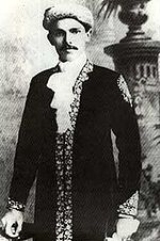
Muhammad Ali Jinnah

 
Muhammad Ali Jinnah

   Email Print
   Bookmark   Link


Muhammad Ali Jinnah


Muhammad Ali Jinnah Urdu: }} (December 25, 1876 – September 11, 1948), a 20th century politician
Politician

A politician is an individual who is involved in influencing public decision making through the influence of politics or a person who influences the way a society is governed....
 and statesman
Statesman

A statesman or stateswoman or statesperson is usually a politician or other notable figure of state who has had a long and respected career in politics at the national and international level....
, is generally regarded as the father of the state of Pakistan
Pakistan

Pakistan , officially the Islamic Republic of Pakistan, is a country located in South Asia and borders Central Asia and the Middle East. It has a 1,046 kilometre coastline along the Arabian Sea and Gulf of Oman in the south, and is bordered by Afghanistan and Iran in the west, India in the east and People's Republic of China in th...
. He served as leader of the The Muslim League
Muslim League

The Muslim League , founded at Dhaka in 1906, was a political party in British India that developed into the driving force behind the creation of Pakistan as a Islam state on the Indian subcontinent....
 and served as Pakistan's first Governor-General
Governor-General of Pakistan

The Governor-General of Pakistan was the resident representative of George VI of the United Kingdom in Pakistan from 1947 to 1952 and then Elizabeth II of the United Kingdom from 1952 until 1956 when Pakistan was proclaimed a republic....
. He is officially known in Pakistan as Quaid-e-Azam (Urdu: — "Great Leader") and Baba-e-Qaum (???? ???) ("Father of the Nation
Father of the Nation

Father ofhjkjijolkpx?gsoplqhdtrsjdewfathers]] may be used if more than one person is considered key....
"). His birthday is a national holiday in Pakistan.

Jinnah rose to prominence in the Indian National Congress
Indian National Congress

Indian National Congress-I is a major political party in India. Founded in 1885 by Dadabhai Naoroji, Dinshaw Edulji Wacha, Womesh Chandra Bonerjee, Surendranath Banerjee, Monomohun Ghose, Allan Octavian Hume, and William Wedderburn, the Indian National Congress became the leader of the Indian Independence Movement, with over 15 million memb...
 expounding ideas of Hindu
Hinduism

'Hinduism' is the predominant religion of the Indian subcontinent. Hinduism is often referred to as , a Sanskrit phrase meaning "the eternal dharma", by its practitioners....
-Muslim
Islam

Islam is a Monotheism, Abrahamic religion originating with the teachings of the Prophets of Islam Muhammad, a 7th century Arab religious and political figure....
 unity and helping shape the 1916 Lucknow Pact
Lucknow Pact

Lucknow Pact refers to an agreement between Indian National Congress and Muslim League. In 1916, Muhammed Ali Jinnah, a member of the Muslim League negotiated with the Indian National Congress to reach an agreement to pressure the British Government to have a more liberal approach to India and give Indians more authority to run their country....
 with the Muslim League; he also became a key leader in the All India Home Rule League.


Discussion
Ask a question about 'Muhammad Ali Jinnah'
Start a new discussion about 'Muhammad Ali Jinnah'
Answer questions from other users
Full Discussion Forum


Recent Posts


Quotations


I have nothing to do with this pseudo-religious approach that Gandhi is advocating.

:Jinnah speaking to Durga Das in London

Come forward as servants of Islam, organise the people economically, socially, educationally and politically and I am sure that you will be a power that will be accepted by everybody.

:Presidential Address at the All India Muslim League, Lahore :March 23, 1940

Our object should be peace within, and peace without. We want to live peacefully and maintain cordial friendly relations with our immediate neighbours and with the world at large.

:Lahore :August 15th, 1947


Encyclopedia


Muhammad Ali Jinnah Urdu: }} (December 25, 1876 – September 11, 1948), a 20th century politician
Politician

A politician is an individual who is involved in influencing public decision making through the influence of politics or a person who influences the way a society is governed....
 and statesman
Statesman

A statesman or stateswoman or statesperson is usually a politician or other notable figure of state who has had a long and respected career in politics at the national and international level....
, is generally regarded as the father of the state of Pakistan
Pakistan

Pakistan , officially the Islamic Republic of Pakistan, is a country located in South Asia and borders Central Asia and the Middle East. It has a 1,046 kilometre coastline along the Arabian Sea and Gulf of Oman in the south, and is bordered by Afghanistan and Iran in the west, India in the east and People's Republic of China in th...
. He served as leader of the The Muslim League
Muslim League

The Muslim League , founded at Dhaka in 1906, was a political party in British India that developed into the driving force behind the creation of Pakistan as a Islam state on the Indian subcontinent....
 and served as Pakistan's first Governor-General
Governor-General of Pakistan

The Governor-General of Pakistan was the resident representative of George VI of the United Kingdom in Pakistan from 1947 to 1952 and then Elizabeth II of the United Kingdom from 1952 until 1956 when Pakistan was proclaimed a republic....
. He is officially known in Pakistan as Quaid-e-Azam (Urdu: — "Great Leader") and Baba-e-Qaum (???? ???) ("Father of the Nation
Father of the Nation

Father ofhjkjijolkpx?gsoplqhdtrsjdewfathers]] may be used if more than one person is considered key....
"). His birthday is a national holiday in Pakistan.

Jinnah rose to prominence in the Indian National Congress
Indian National Congress

Indian National Congress-I is a major political party in India. Founded in 1885 by Dadabhai Naoroji, Dinshaw Edulji Wacha, Womesh Chandra Bonerjee, Surendranath Banerjee, Monomohun Ghose, Allan Octavian Hume, and William Wedderburn, the Indian National Congress became the leader of the Indian Independence Movement, with over 15 million memb...
 expounding ideas of Hindu
Hinduism

'Hinduism' is the predominant religion of the Indian subcontinent. Hinduism is often referred to as , a Sanskrit phrase meaning "the eternal dharma", by its practitioners....
-Muslim
Islam

Islam is a Monotheism, Abrahamic religion originating with the teachings of the Prophets of Islam Muhammad, a 7th century Arab religious and political figure....
 unity and helping shape the 1916 Lucknow Pact
Lucknow Pact

Lucknow Pact refers to an agreement between Indian National Congress and Muslim League. In 1916, Muhammed Ali Jinnah, a member of the Muslim League negotiated with the Indian National Congress to reach an agreement to pressure the British Government to have a more liberal approach to India and give Indians more authority to run their country....
 with the Muslim League; he also became a key leader in the All India Home Rule League. He proposed a fourteen-point constitutional reform plan
Fourteen Points of Jinnah

The Fourteen Points of Jinnah were proposed by Muhammad Ali Jinnah as a constitutional reform plan to safeguard the political rights of Muslims in a self-governing India....
 to safeguard the political rights of Muslims in a self-governing India. His proposals failed amid the League's disunity, driving a disillusioned Jinnah to live in London
London

London is the capital of both England and the United Kingdom, and the most populous municipality in the European Union. An important settlement for two millennia, History of London goes back to its founding by the Roman Empire....
 for many years.

Several Muslim leaders persuaded Jinnah to return in 1934 and re-organise the Muslim League. Jinnah embraced the goal of creating a separate state for Muslims as per the Lahore Resolution
Lahore Resolution

The Lahore Resolution , commonly known as the Pakistan Resolution , was a formal political statement adopted by the Muslim League at the occasion of its three-day general session on 22–24 March 1940 that called for greater Muslim autonomy in British Raj....
. The League won most Muslim seats in the elections of 1946, and Jinnah launched the Direct Action
Direct Action Day

Direct Action Day, also known as the Great Calcutta Riot, was on 16 August 1946?a day of widespread riot and manslaughter in the city of Calcutta in the Bengal province of British India....
 campaign movement to achieve independence of Pakistan. The strong reaction of Congress supporters resulted in communal violence across South Asia. The failure of the Congress-League coalition to govern the country prompted both parties and the British to agree to independence of Pakistan and India. As the Governor-General of Pakistan
Governor-General of Pakistan

The Governor-General of Pakistan was the resident representative of George VI of the United Kingdom in Pakistan from 1947 to 1952 and then Elizabeth II of the United Kingdom from 1952 until 1956 when Pakistan was proclaimed a republic....
, Jinnah led efforts to rehabilitate millions of refugees, and to frame national policies on foreign affairs, security and economic development.

Early life

Jinnah06
Jinnah was born Mahomedali Jinnahbhai in, some believe, Wazir Mansion, Karachi District, of lower Sindh. However, this is disputed as old textbooks mention Jhirk
Jhirk

Jhirk is a small town on the right bank of River Indus, in district Thatta, province of Sindh, Pakistan.In 19th century Jhirk was the busiest river port and centre of commercial activity in Sindh....
 as his place of birth. Sindh had earlier been conquered by the British and was subsequently grouped with other conquered territories for administrative reasons to form the Bombay Presidency
Bombay Presidency

The Bombay Presidency was a former province of British India. It was established in the 17th century as a trading post for the British East India Company, but later grew to encompass much of western and central India, as well as parts of post-partition Pakistan and the Arabian Peninsula....
 of British India. Although his earliest school records state that he was born on October 20, 1875, Sarojini Naidu
Sarojini Naidu

Sarojini Naidu or Sarojini Chattopadhyaya , also known by the sobriquet Bharatiya Kokila , was a child prodigy, freedom fighter, and poet....
, the author of Jinnah's first biography, gives the date as ”December 25, 1876”. The latter date is now officially accepted as his birthday. He was not an observing Muslim, dressed throughout his life in European-style clothes, and spoke in English more than his mother tongue, Gujarati or his adopted tongue, Sindhi
Sindhi

Sindhi may refer to more than one article:*the Sindhi people, an ethnic group from the Sindh region in South Asia.*the Sindhi language, an Indo-Aryan language spoken by the Sindhi people....
.

Jinnah was the eldest of seven children born to Mithibai and Jinnahbhai Poonja. His father, Jinnahbhai (1857–1901), was a prosperous Gujarati
Gujarati people

Gujarati people , or Gujaratis, is an umbrella term used to describe traditionally Gujarati language-speaking people who can trace their ancestry to the state of Gujarat in India....
 merchant who had moved to Sindh
Sindh

Sindh is one of the four Subdivisions of Pakistan of Pakistan and historically is home to the Sindhi people. Different cultural and ethnic groups also reside in Sindh including Urdu-speaking Muslim refugees who migrated to Pakistan from India upon independence as well as the people migrated from other provinces after independence....
 from Kathiawar
Kathiawar

Kathiawar or Kathiawad is a peninsula in western India. It is part of Gujarat state, bounded on the north by the great wetland of the Rann of Kutch, on the northwest by the Gulf of Kutch, on the west and south by the Arabian Sea, and on the southeast and east by the Gulf of Cambay....
, Gujarat
Gujarat

Gujarat is a States and territories of India in western India. Gujarat borders Pakistan to the north west and the state of Rajasthan to the north and northeast, Madhya Pradesh to the east, Maharashtra and the Union territory of Diu, Daman District, India, Dadra and Nagar Haveli to the south....
 before Jinnah's birth. His grandfather was Poonja Gokuldas Meghji, a Bhatia from Paneli village in Gondal state in Kathiawar
Kathiawar

Kathiawar or Kathiawad is a peninsula in western India. It is part of Gujarat state, bounded on the north by the great wetland of the Rann of Kutch, on the northwest by the Gulf of Kutch, on the west and south by the Arabian Sea, and on the southeast and east by the Gulf of Cambay....
. Some sources speculated that Jinnah's ancestors were Hindu Rajput
Rajput

A Rajput is a member of one of the major Hindu Kshatriya groups of Indian subcontinent. The Rajputs trace their roots to Rajputana. They enjoy a reputation as formidable soldiers and it is common to find many of them serving in the Indian Armed Forces....
s that converted to Islam
Islam

Islam is a Monotheism, Abrahamic religion originating with the teachings of the Prophets of Islam Muhammad, a 7th century Arab religious and political figure....
. Jinnah's family belonged to the Ismaili
Ismaili

Ismailism is a branch of the Islam, and is the second largest part of the Shia Islam community, after the mainstream Twelvers . The Ismaili get their name from their acceptance of Ismail bin Jafar as the divinely appointed spiritual successor to Jafar al-Sadiq, wherein they differ from the Twelvers, who accept Musa al-Kazim, younger bro...
 Khoja
Khoja

The Khwajahs or officially Khojas are an ethno-religious community that are mainly concentrated in South Asia, but due to migrations over the centuries have spread to many parts of the globe....
 branch of Shi'a Islam
Shi'a Islam

Shia Islam , is the second largest denomination of Islam, after Sunni Islam.Similiar to other branches of Islam, Shi'a Islam is based on the teachings of Islamic holy book, the Qur'an and message of the final prophet of Islam, Muhammad....
, though Jinnah later converted to mainstream Islam (Sunni), which is evident by his prayer practices. he used to pray under sunni imams the prayers of Eid etc. but yet the Shia sources under "Taqayya" belief (act differently from your belief to conceal your religion) claim he was converted to Twelver Shi'a Islam. instead, without giving any support from neutral source. Further given Jinnah's charismatic personality, we could not expect any duality in him, hence it is generally believed that he was a mainstream Muslim (Sunni).

The first born Jinnah was soon joined by six siblings, brothers Ahmad Ali, Bunde Ali, and Rahmat Ali, and sisters Maryam, Fatima
Fatima Jinnah

Fatima Jinnah was the sister of Quaid-i-Azam Muhammad Ali Jinnah, the founder of Pakistan and an active political figure in movement for independence from the British Raj....
 and Shireen. Their mother tongue was Gujarati
Gujarati language

Gujarati is an Indo-Aryan languages, and part of the greater Indo-European languages language family. It is native to the Indian state of Gujarat, and is its chief language, as well as of the adjacent union territories of Daman and Diu and Dadra and Nagar Haveli....
, however, in time they also came to speak Kutchi
Kutchi

Kutchi may refer to:* Kutchi people, an ethnic group in Sindh, Pakistan and Gujarat, India* Kutchi language, language spoken in Sindh, Pakistan and Gujarat, India...
, Sindhi
Sindhi language

Sindhi is the language of the Sindh region of Pakistan. It is spoken by approximately 41 million people in Pakistan, and is also spoken by a minority 12 million in India; it is the third most spoken language of Pakistan, and the official language of Sindh in Pakistan....
 and English
English language

English is a West Germanic language that originated in Anglo-Saxon England and has lingua franca status in many parts of the world as a result of the military, economic, scientific, political and cultural influence of the British Empire in the 18th, 19th and early 20th centuries and that of the United States from the mid 20th century onwa...
. The proper muslim names of Mr. Jinnah and his siblings, unlike those of his father and grandfather, are the consequence of the family's immigration to the muslim state of Sindh.

The young Jinnah, a restless student, studied at several schools: at the Sindh-Madrasa-tul-Islam
Sindh-Madrasa-tul-Islam

Sindh Madrasa-tul-Islam is a high school in Karachi, Sindh, Pakistan.Sindh Madrasa was founded in 1890 by Hassan Ali Effendi, a Sindhi of Turkish people origin who settled in Karachi....
 in Karachi; briefly at the Gokal Das Tej Primary School in Bombay; and finally at the Christian Missionary Society High School in Karachi, where, at age sixteen, he passed the matriculation examination of the University of Bombay.

The same year, 1892, Jinnah was offered an apprenticeship at the London
London

London is the capital of both England and the United Kingdom, and the most populous municipality in the European Union. An important settlement for two millennia, History of London goes back to its founding by the Roman Empire....
 office of Graham's Shipping and Trading Company
Graham's Shipping and Trading Company

Graham's Shipping and Trading Company was the company with which the father of Mohammed Ali Jinnah - the founder of Pakistan - did business. Mohammed Ali Jinnah in his youth went to England to work for this company....
, a business that had extensive dealings with Jinnahbhai Poonja's firm in Karachi. However, before he left for England
England

native_name =|conventional_long_name = England|common_name = England|image_flag = Flag of England.svg|image_coat = England COA.svg|symbol_type = Royal Coat of Arms...
, at his mother's urging he married his distant cousin, Emibai Jinnah
Emibai Jinnah

Emibai Jinnah , was distant cousin and the first wife of Muhammad Ali Jinnah - founder of Pakistan.Emibai?s marriage with Mohammad Ali Jinnah in 1892....
, who was two years his junior. The marriage was not to last long as Emibai died a few months later. During his sojourn in England, his mother too would pass away. In London, Jinnah soon left the apprenticeship to study law instead, by joining Lincoln's Inn
Lincoln's Inn

The Honourable Society of Lincoln's Inn is one of four Inns of Court in London to which barristers of England and Wales belong and where they are Call to the bar....
. The welcome board of the Lincoln's Inn had the names of the world's all time top ten magistrates. This list was led by the name of Muhammad, which was the sole reason of Jinnah's joining of Lincoln's Inn. He In three years, at age 19, he became the youngest Indian to be called to the bar
Call to the bar

The Call to the Bar is a legal term of art in most common law jurisdictions. Common law jurisdictions were all at one time part of the British Empire....
 in England. Around this time, Jinnah also became interested in politics. An admirer of the Indian political leaders Dadabhai Naoroji
Dadabhai Naoroji

Dadabhai Naoroji was a Parsi people intellectual, educator, cotton trader, and an early Indian political leader. His book, Poverty and Un-British Rule in India, brought into the limelight the drain of India's wealth into Britain....
 and Sir Pherozeshah Mehta, he worked, with other Indian students, on the former's successful campaign for a seat in the British Parliament. Although, by now, Jinnah had developed largely constitutionalist views on Indian self-government, he nevertheless condemned both the arrogance of British officials in India and the discrimination practised by them against Indians.
Jinnahhouse (2)
During the final period of his stay in England, Jinnah came under considerable pressure when his father's business was ruined. Settling in Bombay, he became a successful lawyer—gaining particular fame for his skilled handling of the "Caucus Case
Caucus Case

The Caucus Case was a court case handled by Muhammad Ali Jinnah at the behest of Sir Pherozeshah Mehta at the Bombay High Court in 1905. He won the case and emerged as an outstanding lawyer in India....
". Jinnah built a house in Malabar Hill
Malabar Hill

Malabar Hill , a small hillock in southern Mumbai , India is an extremely upmarket residential area, most known for the Walkeshwar Temple which houses the Banganga Tank....
, later known as Jinnah House
Jinnah House

Jinnah House was the residence of Mohammad Ali Jinnah, the founder of Pakistan; in Mumbai, India. It was built in 1936 at a then exorbitant price of 2 lakh Indian rupee when Jinnah returned to Mumbai from England to take charge of the Muslim League....
. His reputation as a skilled lawyer prompted Indian leader Bal Gangadhar Tilak
Bal Gangadhar Tilak

Bal Gangadhar Tilak –, was an Indian nationalism, social reformer and independence fighter who was the first popular leader of the Indian Independence Movement and is known as "Father of the Indian unrest"....
 to hire him as defence counsel for his sedition trial in 1905. Jinnah argued that it was not sedition for an Indian to demand freedom and self-government in his own country, but Tilak received a rigorous term of imprisonment test.

Early political career

Quaid6 Edited
In 1896, Jinnah joined the Indian National Congress
Indian National Congress

Indian National Congress-I is a major political party in India. Founded in 1885 by Dadabhai Naoroji, Dinshaw Edulji Wacha, Womesh Chandra Bonerjee, Surendranath Banerjee, Monomohun Ghose, Allan Octavian Hume, and William Wedderburn, the Indian National Congress became the leader of the Indian Independence Movement, with over 15 million memb...
, which was the largest Indian political organisation. Like most of the Congress at the time, Jinnah did not favour outright independence, considering British influences on education, law, culture and industry as beneficial to India. Jinnah became a member on the sixty-member Imperial Legislative Council
Imperial Legislative Council

The Imperial Legislative Council was a legislature for India during the middle years of the British Raj.The Government of India Act 1909 increased the number of members of the Legislative Council to sixty, of which twenty-seven were to be elected....
. The council had no real power or authority, and included a large number of un-elected pro-Raj loyalists and Europeans. Nevertheless, Jinnah was instrumental in the passing of the Child Marriages Restraint Act, the legitimization of the Muslim waqf
Waqf

A waqf is an inalienable religious endowment in Islam, typically denoting a building or plot of land for Muslim religious or Charitable trust. It is conceptually similar to the common law trust law....
 (religious endowments) and was appointed to the Sandhurst committee, which helped establish the Indian Military Academy
Indian Military Academy

The Indian Military Academy is the premier officer training school of the Indian Army....
 at Dehra Dun. During World War I
World War I

World War I, or the First World War , was a global military conflict which involved the Great powers, organized into two opposing military alliances: the Allies of World War I and the Central Powers....
, Jinnah joined other Indian moderates in supporting the British war effort, hoping that Indians would be rewarded with political freedoms.

Jinnah had initially avoided joining the All India Muslim League, founded in 1906, regarding it as too Muslim oriented. Eventually, he joined the league in 1913 and became the president at the 1916 session in Lucknow
Lucknow

Lucknow is the capital city of Uttar Pradesh, the most populous States and territories of India of India. It has a population of 4,875,858. Lucknow is also the administrative headquarters of Lucknow District and Lucknow Division....
. Jinnah was the architect of the 1916 Lucknow Pact
Lucknow Pact

Lucknow Pact refers to an agreement between Indian National Congress and Muslim League. In 1916, Muhammed Ali Jinnah, a member of the Muslim League negotiated with the Indian National Congress to reach an agreement to pressure the British Government to have a more liberal approach to India and give Indians more authority to run their country....
 between the Congress and the League, bringing them together on most issues regarding self-government and presenting a united front to the British. Jinnah also played an important role in the founding of the All India Home Rule League in 1916. Along with political leaders Annie Besant
Annie Besant

Annie Wood Besant was a prominent Theosophy, women's rights activist, writer and orator and supporter of Ireland and Indian self rule....
 and Tilak, Jinnah demanded "home rule
Home rule

Home rule refers to a demand that constituent parts of a state be given greater self-governance within the greater administrative purview of the central government....
" for India—the status of a self-governing dominion
Dominion

A dominion, often Dominion, refers to one of a group of autonomy polity that were nominally under United Kingdom sovereignty, constituting the British Empire and Commonwealth of Nations, from the late 19th century....
 in the Empire similar to Canada
Canada

Canada is a country occupying most of northern North America, extending from the Atlantic Ocean in the east to the Pacific Ocean in the west and northward into the Arctic Ocean....
, New Zealand
New Zealand

New Zealand is an island country in the south-western Pacific Ocean comprising two main landmasses , and numerous Islands of New Zealand, most notably Stewart Island/Rakiura and the Chatham Islands....
 and Australia
Australia

Australia, officially the Commonwealth of Australia, is a country in the southern hemisphere comprising the Australia of the world's smallest continent, the major island of Tasmania, and numerous list of islands of Australia in the Indian Ocean and Pacific Oceans....
. He headed the League's Bombay Presidency
Bombay Presidency

The Bombay Presidency was a former province of British India. It was established in the 17th century as a trading post for the British East India Company, but later grew to encompass much of western and central India, as well as parts of post-partition Pakistan and the Arabian Peninsula....
 chapter. In 1918, Jinnah married his second wife Rattanbai Petit
Rattanbai Petit

Rattanbai "Ruttie" Petit after marriage Maryam Jinnah , was the second wife of Muhammad Ali Jinnah - an important figure in the Indian Independence Movement and later founder of Pakistan....
 ("Ruttie"), twenty-four years his junior. She was the fashionable young daughter of his personal friend Sir Dinshaw Petit, of an elite Parsi family of Mumbai. Unexpectedly there was great opposition to the marriage from Rattanbai's family and Parsi society, as well as orthodox Muslim leaders. Rattanbai defied her family and nominally converted to Islam
Islam

Islam is a Monotheism, Abrahamic religion originating with the teachings of the Prophets of Islam Muhammad, a 7th century Arab religious and political figure....
, adopting (though never using) the name Maryam Jinnah
Rattanbai Petit

Rattanbai "Ruttie" Petit after marriage Maryam Jinnah , was the second wife of Muhammad Ali Jinnah - an important figure in the Indian Independence Movement and later founder of Pakistan....
 -resulting in a permanent estrangement from her family and Parsi society. The couple resided in Mumbai, and frequently travelled across India and Europe. In 1919 she bore Jinnah his only child, daughter Dina Jinnah
Dina Wadia

Dina Wadia is the daughter of Muhammad Ali Jinnah, founding father of Pakistan....
.

Fourteen points

Quaid5
Jinnah's problems with the Congress began with the ascent of Mohandas Gandhi in 1918, who espoused non-violent civil disobedience
Civil disobedience

Civil disobedience is the active refusal to obey certain laws, demands and commands of a government, or of an occupying power , without resorting to physical violence....
 and Hindu values as the best means to obtain Swaraj
Swaraj

Swaraj can mean generally self-governance or "home-rule" but the word usually refers to Mahatma Gandhi's concept for Indian independence movement from foreign domination....
 (independence, or self-rule) for all South Asians. Jinnah differed, saying that only constitutional struggle could lead to independence. Unlike most Congress leaders, Gandhi did not wear western-style clothes, did his best to use an Indian language
Languages of India

The languages of India belong to several major Language family, the two largest being the Indo-European languages---Indo-Aryan languages and the Dravidian languages, ....
 instead of English
English language

English is a West Germanic language that originated in Anglo-Saxon England and has lingua franca status in many parts of the world as a result of the military, economic, scientific, political and cultural influence of the British Empire in the 18th, 19th and early 20th centuries and that of the United States from the mid 20th century onwa...
, and was deeply (Hindu) religious. Gandhi's Hindu style of leadership gained great popularity with the Indian people. Jinnah criticised Gandhi's support of the Khilafat Movement
Khilafat Movement

The Khilafat movement was a political campaign launched mainly by Muslims in South Asia to influence the British government and to protect the Ottoman Empire during the Aftermath of World War I of World War I....
, which he saw as an endorsement of religious zealotry. By 1920, Jinnah resigned from the Congress, with prophetic warning that Gandhi's method of mass struggle would lead to divisions between Hindus and Muslims and within the two communities. Becoming president of the Muslim League, Jinnah was drawn into a conflict between a pro-Congress faction and a pro-British faction.

In September 1923, Jinnah was elected as Muslim member for Bombay
Mumbai

Mumbai— formerly Bombay, is the capital of the Indian state of Maharashtra. The city proper has approximately 14 million people and, along with the neighbouring suburbs of Navi Mumbai and Thane, Mumbai forms the World's largest urban agglomerations according to the United Nations World Urbanization Prospects report with around 19...
 in the new Central Legislative Assembly
Central Legislative Assembly

File:Sansad Bhavan-2.jpgThe Central Legislative Assembly was a legislature for India created by the Government of India Act 1919 from the former Imperial Legislative Council , implementing the Montagu-Chelmsford Reforms....
. He showed great gifts as a parliamentarian, organized many Indian members to work with the Swaraj Party
Swaraj Party

The Swaraj Party was a political party in India that sought greater self-government and political freedoms for the Indian people from the British Raj....
, and continued to press demands for full responsible government. He was so active on a wide range of subjects that in 1925 he was offered a knighthood by Lord Reading
Rufus Isaacs, 1st Marquess of Reading

Rufus Daniel Isaacs , 1st Marquess of Reading, Order of the Bath, Order of the Star of India, Order of the Indian Empire, Royal Victorian Order, Privy Council of the United Kingdom, King's Counsel, , was an England politician and jurist....
 when he retired as Viceroy and Governor General. Jinnah replied: "I prefer to be plain Mr. Jinnah".

In 1927, Jinnah entered negotiations with Muslim and Hindu leaders on the issue of a future constitution, during the struggle against the all-British Simon Commission
Simon Commission

The Indian Statutory Commission was a group of seven United Kingdom Members of Parliament of the United Kingdom that had been dispatched to India in 1927 to study constitutional reform in that colony....
. The League wanted separate electorates while the Nehru Report
Nehru Report

The "Nehru Report" was a memorandum outlining a proposed new Dominion constitution for India. It was prepared by a committee of the All Parties Conference chaired by Motilal Nehru with his son Pandit Jawaharlal Nehru acting as secretary....
 favoured joint electorates. Jinnah personally opposed separate electorates, but then drafted compromises and put forth demands that he thought would satisfy both. These became known as the 14 points of Mr. Jinnah
Fourteen Points of Jinnah

The Fourteen Points of Jinnah were proposed by Muhammad Ali Jinnah as a constitutional reform plan to safeguard the political rights of Muslims in a self-governing India....
. However, they were rejected by the Congress and other political parties.

Jinnah's personal life and especially his marriage suffered during this period due to his political work. Although they worked to save their marriage by travelling together to Europe when he was appointed to the Sandhurst committee, the couple separated in 1927. Jinnah was deeply saddened when Rattanbai died in 1929, after a serious illness.

At the Round Table Conferences in London, Jinnah was disillusioned by the breakdown of talks. Frustrated with the disunity of the Muslim League, he decided to quit politics and practice law in England.

Jinnah would receive personal care and support through his later life from his sister Fatima Jinnah
Fatima Jinnah

Fatima Jinnah was the sister of Quaid-i-Azam Muhammad Ali Jinnah, the founder of Pakistan and an active political figure in movement for independence from the British Raj....
, who lived and travelled with him and also became a close advisor. She helped raise his daughter, who was educated in England and India. Jinnah later became estranged from his daughter, Dina Jinnah
Dina Wadia

Dina Wadia is the daughter of Muhammad Ali Jinnah, founding father of Pakistan....
, after she decided to marry Parsi-born Christian businessman, Neville Wadia
Neville Wadia

Neville Wadia was a Parsi people-born Christian businessman in Mumbai, India, who married Dina Wadia, the daughter of Muhammad Ali Jinnah, the founder of Pakistan....
 (even though he had faced the same issues when he married Rattanbai in 1918). Jinnah continued to correspond cordially with his daughter, but their personal relationship was strained. Dina continued to live in India with her family.

Leader of the Muslim League

10 Edited
Prominent Muslim leaders like the Aga Khan, Choudhary Rahmat Ali
Choudhary Rahmat Ali

Chaudhary Rahmat Ali was an India n Muslim nationalist who was one of the earliest proponents of the creation of the state of Pakistan. He is credited with creating the name "Pakistan" for a separate Muslim homeland on the Indian subcontinent....
 and Sir Muhammad Iqbal made efforts to convince Jinnah to return to India and take charge of a now-reunited Muslim League. In 1934 Jinnah returned and began to re-organise the party, being closely assisted by Liaquat Ali Khan
Liaquat Ali Khan

For other people with the same or similar name, see Liaqat Ali Nawabzada Liaquat Ali Khan was a Pakistani politician who became the first Prime Minister of Pakistan and Defence Minister....
, who would act as his right-hand man. In the 1937 elections to the Central Legislative Assembly
Central Legislative Assembly

File:Sansad Bhavan-2.jpgThe Central Legislative Assembly was a legislature for India created by the Government of India Act 1919 from the former Imperial Legislative Council , implementing the Montagu-Chelmsford Reforms....
, the League emerged as a competent party, capturing a significant number of seats under the Muslim electorate, but lost in the Muslim-majority Punjab
Punjab (British India)

Punjab was a province of British India, it was one of the last areas of the Indian subcontinent to fall under British rule. With the end of British rule in 1947 the province was split between India and Pakistan....
, Sindh
Sindh

Sindh is one of the four Subdivisions of Pakistan of Pakistan and historically is home to the Sindhi people. Different cultural and ethnic groups also reside in Sindh including Urdu-speaking Muslim refugees who migrated to Pakistan from India upon independence as well as the people migrated from other provinces after independence....
 and the Northwest Frontier Province. Jinnah offered an alliance with the Congress - both bodies would face the British together, but the Congress had to share power, accept separate electorates and the League as the representative of India's Muslims. The latter two terms were unacceptable to the Congress, which had its own national Muslim leaders and membership and adhered to secularism. Even as Jinnah held talks with Congress president Rajendra Prasad
Rajendra Prasad

Dr. Rajendra Prasad was the Firsts in India President of India of the Republic of India .He was an Indian independence activists and, as a leader of the Congress Party, played a prominent role in the Indian Independence Movement....
, Congress leaders suspected that Jinnah would use his position as a lever for exaggerated demands and obstruct government, and demanded that the League merge with the Congress. The talks failed, and while Jinnah declared the resignation of all Congressmen from provincial and central offices in 1938 as a "Day of Deliverance
Day of Deliverance (India)

During the Indian Independence movement, Muslim League President Muhammad Ali Jinnah declared 1939-12-22 a "Day of Deliverance" for Islam in India....
" from Hindu domination, some historians assert that he remained hopeful for an agreement.
Jinnah12
In a speech to the League in 1930, Sir Muhammad Iqbal mooted an independent state for Muslims in "northwest India." Choudhary Rahmat Ali published a pamphlet in 1933 advocating a state called "Pakistan". Following the failure to work with the Congress, Jinnah, who had embraced separate electorates and the exclusive right of the League to represent Muslims, was converted to the idea that Muslims needed a separate state to protect their rights. Jinnah came to believe that Muslims and Hindus were distinct nations, with unbridgeable differences—a view later known as the Two Nation Theory. Jinnah declared that a united India would lead to the marginalization of Muslims, and eventually civil war between Hindus and Muslims. This change of view may have occurred through his correspondence with Iqbal, who was close to Jinnah. In the session in Lahore
Lahore

is the capital of the Pakistani Subdivisions of Pakistan of Punjab and is the List of most populated metropolitan areas in Pakistan city in Pakistan after Karachi....
 in 1940, the Pakistan resolution
Lahore Resolution

The Lahore Resolution , commonly known as the Pakistan Resolution , was a formal political statement adopted by the Muslim League at the occasion of its three-day general session on 22–24 March 1940 that called for greater Muslim autonomy in British Raj....
 was adopted as the main goal of the party. The resolution was rejected outright by the Congress, and criticised by many Muslim leaders like Maulana Abul Kalam Azad
Maulana Abul Kalam Azad

Maulana Abul Kalam Muhiyuddin Ahmed was a Muslim scholar and a senior political leader of the Indian independence movement. He was one of the most prominent Muslim leaders to support Hindu-Muslim unity, opposing the partition of India on communal lines....
, Khan Abdul Ghaffar Khan
Khan Abdul Ghaffar Khan

Khan Abdul Ghaffar Khan was a Pashtun political and spiritual leader known for his nonviolence opposition to British India in India. A lifelong pacifism, a devout Muslim,and a follower of Mahatma Gandhi, he was also known as Badshah Khan , and Sarhaddi Gandhi ....
, Syed Ab'ul Ala Maududi and the Jamaat-e-Islami
Jamaat-e-Islami

Jamaat-e-Islami is an Islamist political party in Pakistan. It was founded in Lahore, British Raj, by Sayyid Abul Ala Maududi on 26 August 1941, and is the oldest religious party in Pakistan....
. On July 26, 1943, Jinnah was stabbed and wounded by a member of the extremist Khaksars
Khaksars

The Khaksar Tehrik was a social movement based in Lahore, British India, established by Allama Mashriqi in 1930 to free India from foreign rule, to uplift the masses, and to revive the Muslims, who had previously ruled parts of India at different times during a period spanning nearly a thousand years....
 in an attempted assassination
Assassination

Assassination is the targeted killing of a public figure. Assassinations may be prompted by ideology, politics, or military reasons. Additionally, assassins may be motivated by contract killing, revenge, or celebrity or may be mental disorder....
.

Muhammad Ali Jinnah founded Dawn
Dawn (newspaper)

Dawn is Pakistan's oldest, and most widely-read English language newspaper. One of the country's two largest English-language dailies, it is the flagship of the Dawn Group of Newspapers, published by Pakistan Herald Publications, which also owns the The Herald , a magazine, the evening paper The Star and Spider , IT magazine....
 in 1941, a major newspaper that helped him propagate the League's point of views. During the mission
Cripps' mission

The Cripps mission was an attempt in late March of 1942 by the British government to secure Indian cooperation and support for their efforts in World War II....
 of British minister Stafford Cripps
Stafford Cripps

Sir Richard Stafford Cripps was a British Labour Party politician and Chancellor of the Exchequer from November 1947 to October 1950....
, Jinnah demanded parity between the number of Congress and League ministers, the League's exclusive right to appoint Muslims and a right for Muslim-majority provinces to secede, leading to the breakdown of talks. Jinnah supported the British effort in World War II
World War II

World War II, or the Second World War , was a global military conflict which involved a Participants in World War II, including all of the great powers, organised into two opposing military alliances: the Allies of World War II and the Axis powers....
, and opposed the Quit India movement
Quit India Movement

'Quit India Movement' was a civil disobedience movement launched in India in August 1942 in response to Mohandas Gandhi's call for immediate independence....
. During this period, the League formed provincial governments and entered the central government. The League's influence increased in the Punjab after the death of Unionist
Unionist Muslim League

The Unionist Muslim League, also known simply as the Unionist party was a political party based in the province of Punjab during British Raj in India....
 leader Sikander Hyat Khan
Sikander Hyat Khan

Sir Sikander Hayat Khan was a British Indian politician from the Punjab .Khan led the Unionist Party, an all-Punjab political party formed to represent the concerns and issues of India's Muslims, Sikhs and Hindus....
 in 1942. Gandhi held talks fourteen times with Jinnah in Bombay in 1944, about a united front—while talks failed, Gandhi's overtures to Jinnah increased the latter's standing with Muslims.

Founding Pakistan

In the 1946 elections for the Constituent Assembly of India
Constituent Assembly of India

The Constituent Assembly of India was elected to write the Constitution of India, and served as its first Parliament as an independent nation....
, the Congress won most of the elected seats, while the League won a large majority of Muslim electorate seats. The 1946 British Cabinet Mission to India
1946 Cabinet Mission to India

The United Kingdom Cabinet Mission of 1946 to India aimed to discuss and finalize plans for the transfer of power from the British Raj to Indian leadership, providing India with independence under Dominion status in the Commonwealth of Nations....
 released a plan on May 16, calling for a united Indian state comprising considerably autonomous provinces, and called for "groups" of provinces formed on the basis of religion. A second plan released on June 16, called for the separation of South Asia along religious lines, with princely states
List of Indian Princely States

Before the Partition of India in 1947, hundreds of princely state, also called Native States, existed in India which were not part of British India....
 to choose between accession to the dominion of their choice or independence. The Congress, fearing India's fragmentation, criticised the May 16 proposal and rejected the June 16 plan. Jinnah gave the League's assent to both plans, knowing that power would go only to the party that had supported a plan. After much debate and against Gandhi's advice that both plans were divisive, the Congress accepted the May 16 plan while condemning the grouping principle. Jinnah decried this acceptance as "dishonesty", accused the British negotiators of "treachery", and withdrew the League's approval of both plans. The League boycotted the assembly, leaving the Congress in charge of the government but denying it legitimacy in the eyes of many Muslims.

Jinnah issued a call for all Muslims to launch "Direct Action
Direct Action Day

Direct Action Day, also known as the Great Calcutta Riot, was on 16 August 1946?a day of widespread riot and manslaughter in the city of Calcutta in the Bengal province of British India....
" on August 16 to "achieve Pakistan". Strikes and protests were planned, but violence broke out all over South Asia, especially in Calcutta and the district of Noakhali in Bengal
Bengal

Bengal , is a historical and geographical region in the northeast of South Asia. Today it is mainly divided between the independent sovereign nation of the Bangladesh and the state of West Bengal in India, although some regions of the previous kingdoms of Bengal are now part of the neighboring Indian states of Bihar, Assam, Tripura and Oris...
, and more than 7,000 people were killed in Bihar
Bihar

Bihar is a States and territories of India in East India. Bihar is the 12th largest state in terms of geographical size 38,202 square mile and 3rd largest by population....
. Although viceroy Lord Wavell asserted that there was "no satisfactory evidence to that effect", League politicians were blamed by the Congress and the media for orchestrating the violence. Interim Government portfolios were announced on October 25, 1946. Muslim Leaguers were sworn in on October 26, 1946. The League entered the interim government, but Jinnah refrained from accepting office for himself. This was credited as a major victory for Jinnah, as the League entered government having rejected both plans, and was allowed to appoint an equal number of ministers despite being the minority party. The coalition was unable to work, resulting in a rising feeling within the Congress that independence of Pakistan was the only way of avoiding political chaos and possible civil war. The Congress agreed to the division of Punjab and Bengal along religious lines in late 1946. The new viceroy Lord Mountbatten and Indian civil servant V. P. Menon
V. P. Menon

Vappala Pangunni Menon, also known as V. P. Menon, was an Indian civil servant who played a vital role in the partition of India and the Political integration of India of independent India, during the period 1945-1950....
 proposed a plan that would create a Muslim dominion in West Punjab
Punjab (Pakistan)

The Punjab...
, East Bengal
East Bengal

East Bengal was the name used during two periods in the 20th century for a territory that roughly corresponded to the modern state of Bangladesh....
, Baluchistan
Baluchistan (Chief Commissioners Province)

The Chief Commissioners Province of Baluchistan was a former province of British India located in the northern parts of modern Balochistan province....
 and Sindh
Sindh

Sindh is one of the four Subdivisions of Pakistan of Pakistan and historically is home to the Sindhi people. Different cultural and ethnic groups also reside in Sindh including Urdu-speaking Muslim refugees who migrated to Pakistan from India upon independence as well as the people migrated from other provinces after independence....
. After heated and emotional debate, the Congress approved the plan. The North-West Frontier Province
North-West Frontier Province

File:Makra Peak by Khalid Mahmood.jpgThe North-West Frontier Province is the smallest of the Subdivisions of Pakistan of Pakistan. The NWFP is home to the majority Pashtuns as well as other smaller ethnic groups....
 voted to join Pakistan in a referendum in July 1947. Jinnah asserted in a speech in Lahore on October 30, 1947 that the League had accepted independence of Pakistan because "the consequences of any other alternative would have been too disastrous to imagine."

Jinnah's views on statehood


A controversy has raged in Pakistan about whether Jinnah wanted Pakistan to be a secular state or an Islamic state. His views as expressed in his policy speech on 11 August 1947 said:

There is no other solution. Now what shall we do? Now, if we want to make this great State of Pakistan happy and prosperous, we should wholly and solely concentrate on the well-being of the people, and especially of the masses and the poor. If you will work in co-operation, forgetting the past, burying the hatchet, you are bound to succeed. If you change your past and work together in a spirit that everyone of you, no matter to what community he belongs, no matter what relations he had with you in the past, no matter what is his colour, caste or creed, is first, second and last a citizen of this State with equal rights, privileges, and obligations, there will be no end to the progress you will make.


I cannot emphasize it too much. We should begin to work in that spirit and in course of time all these angularities of the majority and minority communities, the Hindu community and the Muslim community, because even as regards Muslims you have Pathans, Punjabis, Shias, Sunnis and so on, and among the Hindus you have Brahmins, Vashnavas, Khatris, also Bengalis, Madrasis and so on, will vanish. Indeed if you ask me, this has been the biggest hindrance in the way of India to attain the freedom and independence and but for this we would have been free people long long ago. No power can hold another nation, and specially a nation of 400 million souls in subjection; nobody could have conquered you, and even if it had happened, nobody could have continued its hold on you for any length of time, but for this. Therefore, we must learn a lesson from this. You are free; you are free to go to your temples, you are free to go to your mosques or to any other place or worship in this State of Pakistan. You may belong to any religion or caste or creed that has nothing to do with the business of the State. As you know, history shows that in England, conditions, some time ago, were much worse than those prevailing in India today. The Roman Catholics and the Protestants persecuted each other. Even now there are some States in existence where there are discriminations made and bars imposed against a particular class. Thank God, we are not starting in those days. We are starting in the days where there is no discrimination, no distinction between one community and another, no discrimination between one caste or creed and another. We are starting with this fundamental principle that we are all citizens and equal citizens of one State. The people of England in course of time had to face the realities of the situation and had to discharge the responsibilities and burdens placed upon them by the government of their country and they went through that fire step by step. Today, you might say with justice that Roman Catholics and Protestants do not exist; what exists now is that every man is a citizen, an equal citizen of Great Britain and they are all members of the Nation.


Now I think we should keep that in front of us as our ideal and you will find that in course of time Hindus would cease to be Hindus and Muslims would cease to be Muslims, not in the religious sense, because that is the personal faith of each individual, but in the political sense as citizens of the State. Jinnah, 11th August 1947 - presiding over the constituent assembly.


While this was a clear indication that Jinnah wanted a secular state
Secular state

A secular state is a state or country that is officially neutral in matters of religion, neither supporting nor opposing any particular religious beliefs or practices....
, he did on occasion refer to Islam and Islamic principles.

Pakistan not only means freedom and independce but the Muslim Ideology which has to be preserved, which has come to us as a precious gift and treasure and which, we hope other will share with us Message to Frontier Muslim Students Federation June 18, 1945.


Furthermore he also pointed out on various occasions that the counties constitution and its financial setup must be based on Islamic principles.

The constitution of Pakistan has yet to be framed by the Pakistan Constituent Assembly. I do not know what the ultimate shape of this constitution is going to be, but I am sure that it will be of a democratic type, embodying the essential principle of Islam. Today, they are as applicable in actual life as they were 1,300 years ago. Islam and its idealism have taught us democracy. It has taught equality of man, justice and fairplay to everybody. We are the inheritors of these glorious traditions and are fully alive to our responsibilities and obligations as framers of the future constitution of Pakistan. In any case Pakistan is not going to be a theocratic State to be ruled by priests with a divine mission. We have many non-Muslims --Hindus, Christians, and Parsis --but they are all Pakistanis. They will enjoy the same rights and privileges as any other citizens and will play their rightful part in the affairs of Pakistan. Broadcast talk to the people of the United States of America on Pakistan recorded February, 1948.


It has been argued by many people that in this speech Jinnah wanted to point out that Pakistan would be a secular state as mostly people think that an Islamic state is a theocratic state, this perception is however wrong and is miss interpreted, the reason is because a true Islamic state is not a theocratic state ,as rightly stated by Jinnah in his speech. Because in a theocratic state the civil leader is believed to have a direct personal connection with god, which is contrary to the principles of an Islamic state.

On the opening ceremony of the state bank of Pakistan Jinnah pointed out that the financial setup of the state should be based on Islamic economic system.

We must work our destiny in our own way and present to the world an economic system based on true Islamic concept of equality of manhood and social justice. We will thereby be fulfilling our mission as Muslims and giving to humanity the message of peace which alone can save it and secure the welfare, happiness and prosperity of mankind. Speech at the opening ceremony of State Bank of Pakistan, Karachi July 1, 1948


Governor-General

Jinnah Gandhi
Along with Liaquat Ali Khan
Liaquat Ali Khan

For other people with the same or similar name, see Liaqat Ali Nawabzada Liaquat Ali Khan was a Pakistani politician who became the first Prime Minister of Pakistan and Defence Minister....
 and Abdur Rab Nishtar
Abdur Rab Nishtar

Sardar Abdur Rab Nishtar was a Muslim League stalwart, Pakistan movement activist and later Pakistani politician.He completed his early education in mission school and later Sanatan Dharram High School in Peshawar....
, Muhammad Ali Jinnah represented the League in the Division Council to appropriately divide public assets between India and Pakistan. The assembly members from the provinces that would comprise Pakistan formed the new state's constituent assembly, and the Military of British India was divided between Muslim and non-Muslim units and officers. Indian leaders were angered at Jinnah's courting the princes of Jodhpur
Jodhpur

Jodhpur , is the second largest city in the Indian state of Rajasthan. It was formerly the seat of a princely state of the same name, also known as Marwar....
, Bhopal
Bhopal

Bhopal Historically, Bhopal was also the capital of the Bhopal . The city attracted international attention as a consequence of the Bhopal disaster, when the Union Carbide plant leaked deadly methyl isocyanate gas during the night of December 3, 1984....
 and Indore
Indore

Indore .The family retained its possessions of royalty, which included having an elephant, Nishan, Danka and Gadi even after the advent of Holkars and also retained the right of performing the first puja of Dushera before the Holkar rulers....
 to accede to Pakistan - these princely states were not geographically aligned with Pakistan, and each had a Hindu-majority population.

Jinnah became the first Governor-General of Pakistan
Governor-General of Pakistan

The Governor-General of Pakistan was the resident representative of George VI of the United Kingdom in Pakistan from 1947 to 1952 and then Elizabeth II of the United Kingdom from 1952 until 1956 when Pakistan was proclaimed a republic....
 and president of its constituent assembly. Inaugurating the assembly on August 11, 1947, Jinnah spoke of an inclusive and pluralist democracy promising equal rights for all citizens regardless of religion, caste
Caste

Castes are hereditary systems of wikt:occupation, endogamy, culture, social class, and political power, the assignment of individuals to places in the social hierarchy is determined by social group and culture....
 or creed. This address is a cause of much debate in Pakistan as, on its basis, many claim that Jinnah wanted a secular state while supporters of Islamic Pakistan assert that this speech is being taken out of context when compared to other speeches by him.

On October 11, 1947, in an address to Civil, Naval, Military and Air Force Officers of Pakistan Government, Karachi, he said:
We should have a State in which we could live and breathe as free men and which we could develop according to our own lights and culture and where principles of Islamic social justice could find free play.


On February 21, 1948, in an address to the officers and men of the 5th Heavy Ack Ack and 6th Light Ack Ack Regiments in Malir, Karachi, he said:
You have to stand guard over the development and maintenance of Islamic democracy, Islamic social justice and the equality of manhood in your own native soil. With faith, discipline and selfless devotion to duty, there is nothing worthwhile that you cannot achieve.
Jinnah Edited
The office of Governor-General was ceremonial, but Jinnah also assumed the lead of government. The first months of Pakistan's independence were absorbed in ending the intense violence that had arisen in the wake of acrimony between Hindus and Muslims. Jinnah agreed with Indian leaders to organise a swift and secure exchange of populations in the Punjab and Bengal. He visited the border regions with Indian leaders to calm people and encourage peace, and organised large-scale refugee camps. Despite these efforts, estimates on the death toll vary from around two hundred thousand, to over a million people. The estimated number of refugees in both countries exceeds 15 million. The then capital city of Karachi saw an explosive increase in its population owing to the large encampments of refugees. Jinnah was personally affected and depressed by the intense violence of the period.

Jinnah authorised force to achieve the annexation of the princely state of Kalat and suppress the insurgency in Baluchistan
Baluchistan (Chief Commissioners Province)

The Chief Commissioners Province of Baluchistan was a former province of British India located in the northern parts of modern Balochistan province....
. He controversially accepted the accession of Junagadh
Junagadh

Junagadh is a city and a municipal corporation, the headquarters of Junagadh district in the Indian States and territories of India of Gujarat. The city is located at the foot of the Girnar....
—a Hindu-majority state with a Muslim ruler located in the Saurashtra peninsula, some 400 kilometres (250 mi) southeast of Pakistan—but this was annulled by Indian intervention. It is unclear if Jinnah planned or knew of the tribal invasion
Indo-Pakistani War of 1947

The Indo-Pakistani War of 1947, sometimes known as the First Kashmir War, was fought between Union of India and Dominion of Pakistan over the region of Kashmir from 1947 to 1948....
 from Pakistan into the kingdom of Jammu and Kashmir
Jammu and Kashmir

Jammu and Kashmir is the northernmost States and territories of India of India. It is situated mostly in the Himalayas mountains. Jammu and Kashmir shares a border with the People's Republic of China to the northeast, the states of Himachal Pradesh and Punjab to the south and Pakistani-administered territories of Kashmir, namely Azad Kashm...
 in October 1947, but he did send his private secretary Khurshid Ahmed
Khurshid Ahmed

Khurshid Ahmed was the private secretary of Muhammad Ali Jinnah, the first Governor-General of Pakistan. He was sent as an observer by Jinnah to Jammu and Kashmir in 1943, and again with the tribal army during the Indo-Pakistani War of 1947....
 to observe developments in Kashmir. When informed of Kashmir's accession to India, Jinnah deemed the accession illegitimate and ordered the Pakistani army to enter Kashmir. However, Gen. Auchinleck, the supreme commander of all British officers informed Jinnah that while India had the right to send troops to Kashmir, which had acceded to it, Pakistan did not. If Jinnah persisted, Auchinleck would remove all British officers from both sides. As Pakistan had a greater proportion of Britons holding senior command, Jinnah cancelled his order, but protested to the United Nations
United Nations

The United Nations is an international organization whose stated aims are to facilitate cooperation in international law, international security, economic development, Social change, human rights and achieving world peace....
 to intercede.

Owing to his role in the state's creation, Jinnah was the most popular and influential politician. He played a pivotal role in protecting the rights of minorities, establishing colleges, military institutions and Pakistan's financial policy. In his first visit to East Pakistan
East Pakistan

East Pakistan was a former Provinces of Pakistan of Pakistan which existed between 1955 and 1971. East Pakistan was created from Bengal Province based on a plebiscite in what was then British Raj in 1947....
, under the advice of local party leaders, Jinnah stressed that Urdu
Urdu

Urdu is a Central_Indo-Aryan_languages#Central_Zone_.28Madhya_or_Hindi.29 Indo-Aryan languages of the Indo-Iranian languages, belonging to the Indo-European languages family of languages....
 alone should be the national language; a policy that was strongly opposed by the Bengali people
Bengali people

The Bengali people are the ethnic community from Bengal in South Asia with a history dating back four millennia. They speak Bengali language , a language of the eastern Indo-Aryan languages branch of the Indo-European languages....
 of East Pakistan (now Bangladesh
Bangladesh

, officially the People's Republic of Bangladesh is a country in South Asia. It is bordered by India on all sides except for a small border with Burma to the far southeast and by the Bay of Bengal to the south....
). This opposition grew after he controversially described Bengali as the language of Hindus. He also worked for an agreement with India settling disputes regarding the division of assets.

Death

Jinnah Funeral2
Through the 1940s, Jinnah suffered from tuberculosis
Tuberculosis

Tuberculosis is a common and often deadly infectious disease caused by mycobacterium, mainly Mycobacterium tuberculosis . Tuberculosis usually attacks the lungs but can also affect the central nervous system, the lymphatic system, the circulatory system, the genitourinary system, the gastrointestinal system, bones, joints, and even the...
; only his sister and a few others close to him were aware of his condition. In 1948, Jinnah's health began to falter, hindered further by the heavy workload that had fallen upon him following Pakistan's independence from British Rule
British Raj

British Raj primarily refers to the British rule in the Indian subcontinent between 1858 and 1947; it can also refer to the period of dominion, and even the region under the rule....
. Attempting to recuperate, he spent many months at his official retreat in Ziarat
Ziarat

Ziarat is the capital of Ziarat District, Balochistan , Pakistan. It is located at 30?22'47N 67?43'38E with an altitude of 2543 metres and is a famous holiday resort of Balochistan and nearly every trip from Karachi to Quetta stops at Ziarat....
, but died on September 11, 1948 (just over a year after independence) from a combination of tuberculosis and lung cancer
Lung cancer

Lung cancer is a disease of uncontrolled cell growth in tissue of the lung. This growth may lead to metastasis, which is the invasion of adjacent tissue and infiltration beyond the lungs....
. His funeral was followed by the construction of a massive mausoleum
Mausoleum

A mausoleum is an external free-standing building constructed as a monument enclosing the interment space or burial chamber of a deceased person or persons....
Mazar-e-Quaid
Mazar-e-Quaid

Mazar-e-Quaid or the National Mausoleum refers to the tomb of the founder of Pakistan, Muhammad Ali Jinnah. It is an iconic symbol of Karachi throughout the world....
—in Karachi to honour him; official and military ceremonies are hosted there on special occasions.

Funeral prayers were led by Allamah Shabbir Ahmad Usmani
Shabbir Ahmad Usmani

Hazrat Allamah Shaikhul Islam Muhaqqiqul 'Asr Moulana Shabbir Ahmad 'Uthmani was an eminent Sunni Islamic scholar who endeavoured to provide Pakistan with an Islamic system of governance after its creation in 1947....
 a renowned mainstream Muslim (Sunni) scholar and attended by masses from all over Pakistan, although this funeral was well on record and supported by pictures as well, yet the Shia minority sources claim in their books that "at Jinnah's request. Jinnah did have a private Namaz-e-Janaza at Kharadar which was attended by close relatives and people from the Shia community.". This claim is without the support of any evidence and pictures. Hence happening this private funeral is a slightest and remote possiblity given Jinnah's clear vision and strong personality, for his life long he acted without fear and died without fear, so how come he could have asked for a secret funeral?

Dina Wadia
Dina Wadia

Dina Wadia is the daughter of Muhammad Ali Jinnah, founding father of Pakistan....
 remained in India after independence, before ultimately settling in New York City
New York City

The City of New York is the List of United States cities by population in the United States, while the New York metropolitan area ranks among the List of urban areas by population....
. Jinnah's grandson, Nusli Wadia
Nusli Wadia

Nusli Wadia is an Indian Parsi people entrepreneur, and an important figure in the Indian textile industry and real-estate business....
, is a prominent industrialist residing in Mumbai. In the 1963–1964 elections, Jinnah's sister Fatima Jinnah
Fatima Jinnah

Fatima Jinnah was the sister of Quaid-i-Azam Muhammad Ali Jinnah, the founder of Pakistan and an active political figure in movement for independence from the British Raj....
, known as Madar-e-Millat ("Mother of the Nation"), became the presidential candidate of a coalition of political parties that opposed the rule of President Ayub Khan
Ayub Khan

Field Marshal Muhammad Ayub Khan , Hilal-i-Jurat, Nishan-e-Pakistan, was a Field Marshal during the mid-1960s, and the President of Pakistan from 1958 to 1969....
, but lost the election.

The Jinnah House
Jinnah House

Jinnah House was the residence of Mohammad Ali Jinnah, the founder of Pakistan; in Mumbai, India. It was built in 1936 at a then exorbitant price of 2 lakh Indian rupee when Jinnah returned to Mumbai from England to take charge of the Muslim League....
 in Malabar Hill
Malabar Hill

Malabar Hill , a small hillock in southern Mumbai , India is an extremely upmarket residential area, most known for the Walkeshwar Temple which houses the Banganga Tank....
, Bombay, is in the possession of the Government of India
Government of India

The Government of India , officially referred to as the Union Government, and also as Central Government, was established by the Constitution of India, and is the governing authority of a federal union of States and territories of India, collectively called the Republic of India....
 but the issue of its ownership has been disputed by the Government of Pakistan. Jinnah had personally requested Indian Prime Minister Jawaharlal Nehru
Jawaharlal Nehru

Jawaharlal Nehru The son of the wealthy Indian barrister and politician Motilal Nehru, Nehru became a leader of the left-wing of the Indian National Congress at a remarkably young age....
 to preserve the house and that one day he could return to Mumbai. There are proposals for the house be offered to the Government of Pakistan to establish a consulate in the city, as a goodwill gesture, but Dina Wadia
Dina Wadia

Dina Wadia is the daughter of Muhammad Ali Jinnah, founding father of Pakistan....
 has also laid claim to the property.

Legacy and criticism

‘Few individuals significantly alter the course of history. Fewer still modify the map of the world. Hardly anyone can be credited with creating a nation-state. Mohammad Ali Jinnah did all three.’ - Stanley Wolpert


In Pakistan, Jinnah is honoured with the official title Quaid-e-Azam , and he is depicted on all Pakistani rupee
Pakistani rupee

The rupee is the currency of Pakistan. The issuance of the currency is controlled by the State Bank of Pakistan, the central bank of the country....
 notes of denominations five and higher, and is the namesake
Namesake

Namesake is a term used to characterize a person, place, thing, quality, action, state, or idea that is called after, or named out of regard to, another....
 of many Pakistani public institutions. The former Quaid-e-Azam International Airport, now called the Jinnah International Airport
Jinnah International Airport

Jinnah International Airport previously Quaid-e-Azam International Airport is Pakistan's largest International airport and Domestic airport airport....
, in Karachi is Pakistan's busiest. One of the largest streets in the Turkish
Turkey

Turkey , known officially as the Republic of Turkey , is a Eurasian country that stretches across the Anatolian peninsula in southwest Asia and Thrace in the Balkans region of Southern Europe....
 capital Ankara
Ankara

Ankara is the capital city of Turkey and the country's List of largest cities and second largest cities by country List of cities in Turkey after Istanbul....
 — Cinnah Caddesi
Cinnah Caddesi

The Cinnah Caddesi is a major road located in the city of Ankara, the capital of Turkey. It is one of the most important arteries of traffic and commerce in the city....
 —is named after him. In Iran
Iran

Iran , officially the Islamic Republic of Iran and formerly known internationally as Persian Empire until 1935, is a country in Central Eurasia, located on the northeastern shore of the Persian Gulf and the southern shore of the Caspian Sea....
, one of the capital Tehran
Tehran

Tehran is the capital and largest city of Iran, and the administrative center of Tehran Province. Tehran is a sprawling city at the foot of the Alborz mountain range with an immense network of highways unparalleled in Western Asia....
's most important new highways is also named after him, while the government released a stamp commemorating the centennial of Jinnah's birthday. In Chicago
Chicago

Chicago is the largest city in the U.S. state of Illinois and the Midwestern United States, as well as the List of United States cities by population city in the United States with more than 2.8 million residents....
, a portion of Devon Avenue was named as "Mohammed Ali Jinnah Way". The Mazar-e-Quaid
Mazar-e-Quaid

Mazar-e-Quaid or the National Mausoleum refers to the tomb of the founder of Pakistan, Muhammad Ali Jinnah. It is an iconic symbol of Karachi throughout the world....
, Jinnah's mausoleum
Mausoleum

A mausoleum is an external free-standing building constructed as a monument enclosing the interment space or burial chamber of a deceased person or persons....
, is among Karachi's most imposing buildings. In media, Jinnah was portrayed by British actors Richard Lintern
Richard Lintern

Richard Lintern is a United Kingdom actor. He played a young Muhammad Ali Jinnah in the 1998 film Jinnah, and an United States cop in the TV movie Lost Souls....
 (as the young Jinnah) and Christopher Lee
Christopher Lee

Christopher Frank Carandini Lee Order of the British Empire, Venerable Order of Saint John is an award-winning England actor and singer. He initially portrayed villains and became famous for his role as Count Dracula in a string of Hammer Film Productions films....
 (as the elder Jinnah) in the 1998 film Jinnah
Jinnah (film)

Jinnah is a film about the life of the founder of Pakistan, Muhammad Ali Jinnah. It was directed by Jamil Dehlavi and written by Akbar S. Ahmed and Jamil Dehlavi....
. In Richard Attenborough
Richard Attenborough

Richard Samuel Attenborough, Baron Attenborough, Order of the British Empire, is an English people actor, film director, film producer, and entrepreneur....
's Academy Award winning film Gandhi
Gandhi (film)

Gandhi is a film about Mohandas Karamchand Gandhi, who was a leader of the nonviolent resistance movement against British Raj in India during the first half of the 20th century....
, Jinnah was portrayed by Alyque Padamsee
Alyque Padamsee

Alyque Padamsee is an Indian theater personality, both as producer and actor. He is probably best-known in the English-speaking world for playing Muhammad Ali Jinnah in the film Gandhi ....
. In the 1986 televised mini-series Lord Mountbatten: the Last Viceroy, Jinnah was played by Polish
Poland

Poland , officially the Republic of Poland , is a country in Central Europe. Poland is bordered by Germany to the west; the Czech Republic and Slovakia to the south; Ukraine, Belarus and Lithuania to the east; and the Baltic Sea and Kaliningrad Oblast, a Russian Enclave and exclave, to the north....
 actor Vladek Sheybal
Vladek Sheybal

Vladek Sheybal was a Poland born character actor, whose career lasted from the 1950s into the 1980s. He is probably best known for his portrayal of the chess grandmaster Kronsteen in the 1963 James Bond film From Russia with Love , a role for which he had been personally recommended by his good friend Sean Connery....
.

Some historians like H M Seervai
H M Seervai

Hormasji "Homi" Maneckji Seervai was an Indian jurist....
 and Ayesha Jalal
Ayesha Jalal

Ayesha Jalal is a Pakistani-American sociologist and historian. She is a professor of history at Tufts University and a MacArthur Fellows Program....
 assert that Jinnah never wanted partition of India and independence of Pakistan —it was the outcome of the Congress leaders being unwilling to share power with the Muslim League. It is asserted that Jinnah only used the Pakistan demand as a method to mobilise support to obtain significant political rights for Muslims. Jinnah has gained the admiration of major Indian nationalist politicians like Lal Krishna Advani
Lal Krishna Advani

Lal Krishna Advani , also known as Lalchand Kishenchand Advani is an Indian politician and a former president of the Bharatiya Janata Party....
—his comments praising Jinnah caused an uproar in his own Bharatiya Janata Party
Bharatiya Janata Party

The Bharatiya Janata Party , founded in 1980, is a major political party of India. Designed to represent the country's Hinduism and Centre-right in nature, the party advocates Conservatism social policies, self reliance, robust economic growth, foreign policy driven by a nationalist agenda, and strong national defense....
.

Some critics allege that Jinnah's courting the princes of Hindu states and his gambit with Junagadh is proof of ill intentions towards India, as he was the proponent of the theory that Hindus and Muslims could not live together, yet being interested in Hindu-majority states. In his book Patel: A Life, Rajmohan Gandhi
Rajmohan Gandhi

Rajmohan Gandhi is a biographer and grandson of Mahatma Gandhi. His maternal grandfather was C. Rajagopalachari Rajaji, the first Indian Governor General of independent India and one of the foremost freedom fighters....
 asserts that Jinnah sought to engage the question of Junagadh with an eye on Kashmir—he wanted India to ask for a plebiscite in Junagadh
Junagadh

Junagadh is a city and a municipal corporation, the headquarters of Junagadh district in the Indian States and territories of India of Gujarat. The city is located at the foot of the Girnar....
, knowing thus that the principle then would have to be applied to Kashmir, where the Muslim-majority would, he believed, vote for Pakistan.

According to Akbar S. Ahmed, nearly every book about Jinnah outside Pakistan mentions the fact that he drank alcohol. Several sources indicate he gave up alcohol near the end of his life.

See also


External links

ite web |title=Quaid-i-Azam Muhammad Ali Jinnah |work=Government of Pakistan Website |url=http://www.quaid.gov.pk }}