

Musical instrument

Encyclopedia
A musical instrument is a device created or adapted for the purpose of making musical sounds. In principle, any object that produces sound
can serve as a musical instrument—it is through purpose that the object becomes a musical instrument. The history of musical instruments dates back to the beginnings of human culture. The academic study of musical instruments is called organology
.
The date and origin of the first device of disputed status as a musical instrument dates back as far as 67,000 years old; artifacts commonly accepted to be early flutes date back as far as about 37,000 years old. However, most historians believe determining a specific time of musical instrument invention to be impossible due to the subjectivity of the definition.
Musical instruments developed independently in many populated regions of the world. However, contact among civilizations resulted in the rapid spread and adaptation of most instruments in places far from their origin. By the Middle Ages
, instruments from Mesopotamia
could be found in Maritime Southeast Asia
and Europeans were playing instruments from North Africa. Development in the Americas occurred at a slower pace, but cultures of North, Central, and South America shared musical instruments.
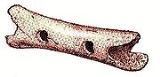
 In July 1995, Slovenian archaeologist Ivan Turk discovered a bone carving in the northwest region of Slovenia
. The carving, named the Divje Babe flute, features four holes that Canadian musicologist Bob Fink determined could have been used to play four notes of a diatonic scale
. Researchers estimate the flute's age to be between 43,400 and 67,000 years, making it the oldest known musical instrument and the only musical instrument associated with the Neanderthal
culture. However, some archaeologists question the flute's status as a musical instrument. German archaeologists have found mammoth
bone and swan
bone flutes dating back to 30,000 to 37,000 years old in the Swabian Alps. The flutes were made in the Upper Paleolithic
age, and are more commonly accepted as being the oldest known musical instruments.
Archaeological evidence of musical instruments was discovered in excavations at the Royal Cemetery in the Sumer
ian city of Ur
(see Lyres of Ur
). These instruments include nine lyre
s, two harp
s, a silver double flute
, sistra and cymbal
s. A set of reed-sounded silver pipes discovered in Ur was the likely predecessor of modern bagpipes
. The cylindrical pipes feature three side-holes that allowed players to produce whole tone scales. These excavations, carried out by Leonard Woolley
in the 1920s, uncovered non-degradable fragments of instruments and the voids left by the degraded segments which, together, have been used to reconstruct them. The graves to which these instruments were related have been carbon dated to between 2600 and 2500 BCE, providing evidence that these instruments were being used in Sumeria by this time.
Archaeologists in the Jiahu
site of central Henan province of China, has found flutes made of bones that dates back to 7,000 and 9,000 years old, and they represent some of the "earliest complete, playable, tightly-dated, multinote musical instruments" ever found.
A cuneiform
tablet
from Nippur
in Mesopotamia
dated to 2000 BCE indicates the names of strings on the lyre and represents the earliest known example of music notation.
s involved felling and hollowing out large trees; later slit drums were made by opening bamboo stalks, a much simpler task. It is likewise misleading to arrange the development of musical instruments by workmanship since all cultures advance at different levels and have access to different materials. For example, anthropologists attempting to compare musical instruments made by two cultures that existed at the same time but who differed in organization, culture, and handicraft cannot determine which instruments are more "primitive". Ordering instruments by geography is also partially unreliable, as one cannot determine when and how cultures contacted one another and shared knowledge.
German musicologist Curt Sachs
, one of the most prominent musicologists and musical ethnologists in modern times, proposed that a geographical chronology until approximately 1400 is preferable, however, due to its limited subjectivity. Beyond 1400, one can follow the overall development of musical instruments by time period.
The science of marking the order of musical instrument development relies on archaeological artifacts, artistic depictions, and literary references. Since data in one research path can be inconclusive, all three paths provide a better historical picture.
 Until the 19th century AD, European written music histories began with mythological accounts of how musical instruments were invented. Such accounts included Jubal
, descendant of Cain and "father of all such as handle the harp and the organ", Pan
, inventor of the pan pipes
, and Mercury
, who is said to have made a dried tortoise
shell into the first lyre
. Modern histories have replaced such mythology with anthropological speculation, occasionally informed by archeological evidence. Scholars agree that there was no definitive "invention" of the musical instrument since the definition of the term "musical instrument" is completely subjective to both the scholar and the would-be inventor. For example, a Homo habilis
slapping his body could be the makings of a musical instrument regardless of the being's intent.
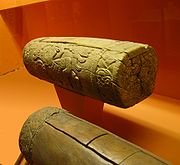
Among the first devices external to the human body considered to be instruments are rattles
, stampers, and various drum
s. These earliest instruments evolved due to the human motor impulse to add sound to emotional movements such as dancing. Eventually, some cultures assigned ritual functions to their musical instruments. Those cultures developed more complex percussion instruments and other instruments such as ribbon reeds, flutes, and trumpets. Some of these labels carry far different connotations from those used in modern day; early flutes and trumpets are so-labeled for their basic operation and function rather than any resemblance to modern instruments. Among early cultures for whom drums developed ritual, even sacred importance are the Chukchi people
of the Russian Far East
, the indigenous people of Melanesia
, and many cultures of Africa
. In fact, drums were pervasive throughout every African culture. One East African tribe, the Wahinda
, believed it was so holy that seeing a drum would be fatal to any person other than the sultan.
Humans eventually developed the concept of using musical instruments for producing a melody
. Until this time in the evolutions of musical instruments, melody was common only in singing. Similar to the process of reduplication
in language, instrument players first developed repetition and then arrangement. An early form of melody was produced by pounding two stamping tubes of slightly different sizes—one tube would produce a "clear" sound and the other would answer with a "darker" sound. Such instrument pairs also included bullroarers
, slit drums, shell trumpets, and skin drums. Cultures who used these instrument pairs associated genders with them; the "father" was the bigger or more energetic instrument, while the "mother" was the smaller or duller instrument. Musical instruments existed in this form for thousands of years before patterns of three or more tones would evolve in the form of the earliest xylophone
. Xylophones originated in the mainland and archipelago of Southeast Asia
, eventually spreading to Africa, the Americas, and Europe. Along with xylophones, which ranged from simple sets of three "leg bars" to carefully tuned sets of parallel bars, various cultures developed instruments such as the ground harp
, ground zither
, musical bow
, and jaw harp
.
ian and Babylon
ian cultures began delineating two distinct classes of musical instruments due to division of labor and the evolving class system. Popular instruments, simple and playable by anyone, evolved differently from professional instruments whose development focused on effectiveness and skill. Despite this development, very few musical instruments have been recovered in Mesopotamia
. Scholars must rely on artifacts and cuneiform
texts written in Sumerian
or Akkadian
to reconstruct the early history of musical instruments in Mesopotamia. Even the process of assigning names to these instruments is challenging since there is no clear distinction among various instruments and the words used to describe them. Although Sumerian and Babylonian artists mainly depicted ceremonial instruments, historians have been able to distinguish six idiophones used in early Mesopotamia: concussion clubs, clappers, sistra
, bells, cymbals, and rattles. Sistra are depicted prominently in a great relief of Amenhotep III, and are of particular interest because similar designs have been found in far-reaching places such as Tbilisi
, Georgia
and among the Native American Yaqui tribe. The people of Mesopotamia preferred stringed instruments to any other, as evidenced by their proliferation in Mesopotamian figurines, plaques, and seals. Innumerable varieties of harps are depicted, as well as lyres and lutes, the forerunner of modern stringed instruments such as the violin.
Musical instruments used by the Egyptian culture before 2700 BC bore striking similarity to those of Mesopotamia, leading historians to conclude that the civilizations must have been in contact with one another. Sachs notes that Egypt did not possess any instruments that the Sumerian culture did not also possess. However, by 2700 BC the cultural contacts seem to have dissipated; the lyre, a prominent ceremonial instrument in Sumer, did not appear in Egypt for another 800 years. Clappers and concussion sticks appear on Egyptian vases as early as 3000 BC. The civilization also made use of sistra, vertical flutes, double clarinets, arched and angular harps, and various drums. Little history is available in the period between 2700 BC and 1500 BC, as Egypt (and indeed, Babylon) entered a long violent period of war and destruction. This period saw the Kassites
destroy the Babylonian empire in Mesopotamia and the Hyksos
destroy the Middle Kingdom of Egypt
. When the Pharaohs of Egypt conquered Southwest Asia in around 1500 BC, the cultural ties to Mesopotamia were renewed and Egypt's musical instruments also reflected heavy influence from Asiatic cultures. Under their new cultural influences, the people of the New Kingdom
began using oboes, trumpets, lyres, lutes, castanets, and cymbals.
In contrast with Mesopotamia and Egypt, professional musicians did not exist in Israel
between 2000 and 1000 BC. While the history of musical instruments in Mesopotamia and Egypt relies on artistic representations, the culture in Israel produced few such representations. Scholars must therefore rely on information gleaned from the Bible
and the Talmud
. The Hebrew texts mention two prominent instruments associated with Jubal
, ugabs and kinnor
s. These may be translated as pan pipes and lyres, respectively. Other instruments of the period included tofs, or frame drums, small bells or jingles called pa'amon, shofar
s, and the trumpet-like hasosra. The introduction of a monarchy in Israel during the 11th century BC produced the first professional musicians and with them a drastic increase in the number and variety of musical instruments. However, identifying and classifying the instruments remains a challenge due to the lack of artistic interpretations. For example, stringed instruments of uncertain design called nevals and asors existed, but neither archaeology nor etymology can clearly define them. In her book A Survey of Musical Instruments, American musicologist Sibyl Marcuse proposes that the nevel must be similar to vertical harp due to its relation to "nabla", the Phoenician term for "harp".
In Greece
, Rome
, and Etruria
, the use and development of musical instruments stood in stark contrast to those cultures' achievements in architecture and sculpture. The instruments of the time were simple and virtually all of them were imported from other cultures. Lyres were the principal instrument, as musicians used them to honor the gods. Greeks played a variety of wind instruments they classified as aulos (reeds) or syrinx (flutes); Greek writing from that time reflects a serious study of reed production and playing technique. Romans played reed instruments named tibia featuring side-holes that could be opened or closed, allowing for greater flexibility in playing modes. Other instruments in common use in the region included vertical harps derived from those of the Orient
, lutes of Egyptian design, various pipes and organs, and clappers, which were played primarily by women.
Evidence of musical instruments in use by early civilizations of India
is almost completely lacking, making it impossible to reliably attribute instruments to the Munda
and Dravidian
language-speaking cultures that first settled the area. Rather, the history of musical instruments in the area begins with the Indus Valley Civilization
that emerged around 3000 BC. Various rattles and whistles found among excavated artifacts are the only physical evidence of musical instruments. A clay statuette indicates the use of drums, and examination of the Indus script
has also revealed representations of vertical arched harps identical in design to those depicted in Sumerian artifacts. This discovery is among many indications that the Indus Valley and Sumerian cultures maintained cultural contact. Subsequent developments in musical instruments in India occurred with the Rigveda
, or religious hymns. These songs used various drums, shell trumpets, harps, and flutes. Other prominent instruments in use during the early centuries AD were the snake charmer's
double clarinet
, bagpipes
, barrel drums, cross flutes, and short lutes. In all, India had no unique musical instruments until the Middle Ages
.
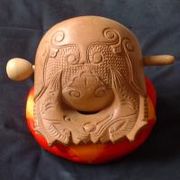 Musical instruments such as zithers appear in Chinese literature
written around 1100 BC and earlier. Early Chinese philosophers
such as Confucius
(551–479 BC), Mencius
(372–289 BC), and Laozi
shaped the development of musical instruments in China, adopting an attitude toward music similar to that of the Greeks. The Chinese believed that music was an essential part of character and community, and developed a unique system of classifying their musical instruments according to their material makeup. Idiophones were extremely important in Chinese music, hence the majority of early instruments were idiophones. Poetry of the Shang Dynasty
mentions bells, chimes, drums, and globular flutes carved from bone, the latter of which has been excavated and preserved by archaeologists. The Zhou Dynasty
introduced percussion instruments such as clappers, troughs, wooden fish, and yu
. Wind instruments such as flute, pan-pipes, pitch-pipes, and mouth organs also appeared in this time period. The short lute, a pear-shaped form of a western instrument that spread through many cultures, came into use in China during the Han Dynasty
.
Although civilizations in Central America
attained a relatively high level of sophistication by the eleventh century AD, they lagged behind other civilizations in the development of musical instruments. For example, they had no stringed instruments; all of their instruments were idiophones, drums, and wind instruments such as flutes and trumpets. Of these, only the flute was capable of producing a melody. In contrast, pre-Columbian
South America
n civilizations in areas such as modern-day Peru
, Colombia
, Ecuador
, Bolivia
, and Chile
were less advanced culturally but more advanced musically. South American cultures of the time used pan-pipes as well as varieties of flutes, idiophones, drums, and shell or wood trumpets.
, China developed a tradition of integrating musical influence obtained by either conquering foreign countries or by being conquered. The first record of this type of influence is in 384 AD, when China established an East Turkestanic orchestra in its imperial court after a conquest in Turkestan
. Influences from India, Mongolia
, and other countries followed. In fact, Chinese tradition attributes most musical instruments of the time to those countries. Cymbals and gongs gained popularity, along with more advanced trumpets, clarinets, oboes, flutes, drums, and lutes. Some of the first bowed zithers appeared in China in the 9th or 10th century, influenced by Mongolian culture.
India experienced similar development to China in the Middle Ages; however, stringed instruments developed differently to accommodate different styles of music. While stringed instruments of China were designed to produce precise tones capable of matching the tones of chimes, stringed instruments of India were considerably more flexible. This flexibility suited the slides and tremolos of Hindu music. Rhythm was of paramount importance in Indian music of the time, as evidenced by the frequent depiction of drums in reliefs dating to the Middle Ages. The emphasis on rhythm is an aspect native to Indian music. Historians divide the development of musical instruments in medieval India between pre-Islamic and Islamic periods due to the different influence each period provided. In pre-Islamic times, idiophones such hand bells, cymbals, and peculiar instruments resembling gongs came into wide use in Hindu music. The gong-like instrument was a bronze disk that was struck with a hammer instead of a mallet. Tubular drums, stick zithers named veena
, short fiddles, double and triple flutes, coiled trumpets, and curved India horns emerged in this time period. Islamic influences brought new types of drums, perfectly circular or octagonal as opposed to the irregular pre-Islamic drums. Persian influence brought oboes and sitars, although Persian sitars had three strings and Indian version had from four to seven.
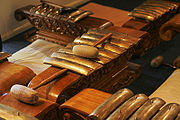 Southeast Asian musical innovations include those during a period of Indian influence that ended around 920 AD. Balinese
and Javanese music made use of xylophones and metallophones, bronze versions of the former. The most prominent and important musical instrument of Southeast Asia was the gong. While the gong likely originated in the geographical area between Tibet
and Burma, it was part of every category of human activity in Maritime Southeast Asia
including Java
.
Javanese music
The areas of Mesopotamia and the Arabian Peninsula
experiences rapid growth and sharing of musical instruments once they were united by Islamic culture in the seventh century. Frame drums and cylindrical drums of various depths were immensely important in all genres of music. Conical oboes were involved in the music that accompanied wedding and circumcision ceremonies. Persian miniatures provide information on the development of kettle drums
in Mesopotamia that spread as far as Java. Various lutes, zithers, dulcimers
, and harps spread as far as Madagascar
to the south and modern-day Sulawesi
to the east.
Despite the influences of Greece and Rome, most musical instruments in Europe during the Middles Ages came from Asia. The lyre is the only musical instrument that may have been invented in Europe until this period. Stringed instruments were prominent in Middle Age Europe. The central and northern regions used mainly lutes, stringed instruments with necks
, while the southern region used lyres, which featured a two-armed body and a crossbar. Various harps served Central and Northern Europe as far north as Ireland, where the harp eventually became a national symbol. Lyres propagated through the same areas, as far east as Estonia
. European music between 800 and 1100 became more sophisticated, more frequently requiring instruments capable of polyphony
. The Persian
geographer of the 9th century (Ibn Khordadbeh
), mentioned in his lexicographical discussion of music instruments that in the Byzantine Empire
typical instruments included the urghun (organ
), shilyani (probably a type of harp
or lyre
), salandj (probably a bagpipe) and the Byzantine lyra
(Greek: λύρα ~ lūrā) . Lyra
was a medieval
pear-shaped bowed
string instrument with three to five strings
, held upright and is an ancestor of most European bowed instruments, including the violin
. The monochord
served as a precise measure of the notes of a musical scale, allowing more accurate musical arrangements. Mechanical hurdy-gurdies
allowed single musicians to play more complicated arrangements than a fiddle would; both were prominent folk instruments in the Middle Ages. Southern Europeans played short and long lutes whose pegs extended to the sides, unlike the rear-facing pegs of Central and Northern European instruments. Idiophones such as bells and clappers served various practical purposes, such as warning of the approach of a leper
. The ninth century revealed the first bagpipes
, which spread throughout Europe and had many uses from folk instruments to military instruments. The construction of pneumatic organs
evolved in Europe starting in fifth century Spain
, spreading to England
in about 700. The resulting instruments varied in size and use from portable organs worn around the neck to large pipe organs. Literary accounts of organs being played in English Benedictine
abbeys toward the end of the tenth century are the first references to organs being connected to churches. Reed players of the Middle Ages were limited to oboes; no evidence of clarinets exists during this period.
period. Instruments took on other purposes than accompanying singing or dance, and performers used them as solo instruments. Keyboards and lutes developed as polyphonic instruments, and composers arranged increasingly complex pieces using more advanced tablature
. Composers also began designing pieces of music for specific instruments. In the latter half of the sixteenth century, orchestration
came into common practice as a method of writing music for a variety of instruments. Composers now specified orchestration where individual performers once applied their own discretion. The polyphonic style dominated popular music, and the instrument makers responded accordingly.
Beginning in about 1400, the rate of development of musical instruments increased in earnest as compositions demanded more dynamic sounds. People also began writing books about creating, playing, and cataloging musical instruments; the first such book was Sebastian Virdung's
1511 treatise Musica getuscht und angezogen (English: Music Germanized and Abstracted). Virdung's work is noted as being particularly thorough for including descriptions of "irregular" instruments such as hunters' horns and cow bells, though Virdung is critical of the same. Other books followed, including Arnolt Schlick's
Spiegel der Orgelmacher und Organisten (English: Mirror of Organ Makers and Organ Players) the same year, a treatise on organ building and organ playing. Of the instructional books and references published in the Renaissance era, one is noted for its detailed description and depiction of all wind and stringed instruments, including their relative sizes. This book, the Syntagma musicum by Michael Praetorius, is now considered an authoritative reference of sixteenth century musical instruments.
In the sixteenth century, musical instrument builders gave most instruments, such as the violin, the "classical shapes" they retain today. An emphasis on aesthetic beauty also developed—listeners were as pleased with the physical appearance of an instrument as they were with its sound. Therefore, builders paid special attention to materials and workmanship, and instruments became collectibles in homes and museums. It was during this period that makers began constructing instruments of the same type in various sizes to meet the demand of consorts, or ensembles playing works written for these groups of instruments. Instrument builders developed other features that endure today. For example, while organs with multiple keyboards and pedals already existed, the first organs with solo stops
emerged in the early fifteenth century. These stops were meant to produce a mixture of timbres, a development needed for the complexity of music of the time. Trumpets evolved into their modern form to improve portability, and players used mutes
to properly blend into chamber music
.
style better suited the emotional music and wrote musical parts for instruments that would complement the singing human voice. As a result, many instruments that were incapable of larger ranges and dynamics, and therefore were seen as unemotional, fell out of favor. One such instrument was the oboe. Bowed instruments such as the violin, viola
, baryton
, and various lutes dominated popular music. Beginning in around 1750, however, the lute disappeared from musical compositions in favor of the rising popularity of the guitar
. As the prevalence of string orchestra
s rose, wind instruments such as the flute, oboe, and bassoon began to be readmitted to counteract the monotony of hearing only strings.
In the mid-seventeenth century, what was known as a hunter's horn underwent transformation into an "art instrument" consisting of a lengthened tube, a narrower bore, a wider bell, and much wider range. The details of this transformation are unclear, but the modern horn
or, more colloquially, French horn, had emerged by 1725. The slide trumpet appeared, a variation which includes a long-throated mouthpiece that slid in and out, allowing the player infinite adjustments in pitch. This variation on the trumpet was unpopular due to the difficulty involved in playing it. Organs underwent tonal changes in the Baroque period, as manufacturers such as Abraham Jordan of London made the stops more expressive and added devices such as expressive pedals. Sachs viewed this trend as a "degeneration" of the general organ sound.
of the instrument, and the instrument's place in an orchestra
or other ensemble. Most methods are specific to a geographic area or cultural group and were developed to serve the unique classification requirements of the group. The problem with these specialized classification schemes is that they tend to break down once they are applied outside of their original area. For example, a system based on instrument use would fail if a culture invented a new use for the same instrument. Scholars recognize Hornbostel-Sachs as the only system that applies to any culture and, more important, provides only possible classification for each instrument.
, written by the sage Bharata Muni
and dating from between 200 BC and 200 AD, divides instruments into four main classification groups: instruments where the sound is produced by vibrating strings; percussion instruments with skin heads; instruments where the sound is produced by vibrating columns of air; and "solid", or non-skin, percussion instruments. In 1880, Victor-Charles Mahillon
adapted this system and assigned Greek labels to the four classifications: chordophones, membranophones, aerophones, and autophones.
and Curt Sachs
adopted Mahillon's scheme and published an extensive new scheme for classification in Zeitschrift für Ethnologie in 1914. Hornbostel and Sachs used most of Mahillon's system, but replaced the term autophone with idiophone.
The original Hornbostel-Sachs system classified instruments into four main groups:
Sachs later added a fifth category, electrophone
s, such as theremin
s, which produce sound by electronic means. Within each category are many subgroups. The system has been criticised and revised over the years, but remains widely used by ethnomusicologists
and organologists
.
, disagreed with the Hornbostel-Sachs system and developed his own system in 1932. Schaeffner believed that the pure physics of a musical instrument, rather than its specific construction or playing method, should always determine its classification. (Hornbostel-Sachs, for example, divide aerophones on the basis of sound production, but membranophones on the basis of the shape of the instrument). His system divided instruments into two categories: instruments with solid, vibrating bodies and instruments containing vibrating air.
Some instruments fall into more than one category: for example, the cello may be considered tenor, baritone or bass, depending on how its music fits into the ensemble, and the trombone may be alto, tenor, baritone, or bass and the French horn, bass, baritone, tenor, or alto, depending on which range it is played.
Many instruments have their range as part of their name: soprano saxophone
, tenor saxophone
, baritone horn
, alto flute
, bass guitar
, etc. Additional adjectives describe instruments above the soprano range or below the bass
, for example: sopranino saxophone
, contrabass clarinet
.
When used in the name of an instrument, these terms are relative, describing the instrument's range in comparison to other instruments of its family and not in comparison to the human voice range or instruments of other families. For example, a bass flute's range is from C3 to F♯6, while a bass clarinet plays about one octave lower.
makes only stringed instruments. Some make only one type of instrument such as a piano. Some builders are focused on a more artistic approach and develop experimental musical instruments, often meant for individual playing styles developed by the builder himself.
s are any instruments that are played with a musical keyboard
. Every key generates one or more sounds; most keyboard instruments have extra means (pedals for a piano, stops
for an organ) to manipulate these sounds. They may produce sound by wind being fanned (organ
) or pumped (accordion
), vibrating strings either hammered (piano
) or plucked (harpsichord
), by electronic means (synthesizer
), or in some other way. Sometimes, instruments that do not usually have a keyboard, such as the glockenspiel
, are fitted with one. Though they have no moving parts and are struck by mallets held in the player's hands, they have the same physical arrangement of keys and produce soundwaves in a similar manner.
Sound
Sound is a mechanical wave that is an oscillation of pressure transmitted through a solid, liquid, or gas, composed of frequencies within the range of hearing and of a level sufficiently strong to be heard, or the sensation stimulated in organs of hearing by such vibrations.-Propagation of...
can serve as a musical instrument—it is through purpose that the object becomes a musical instrument. The history of musical instruments dates back to the beginnings of human culture. The academic study of musical instruments is called organology
Organology
Organology is the science of musical instruments and their classification. It embraces study of instruments' history, instruments used in different cultures, technical aspects of how instruments produce sound, and musical instrument classification...
.
The date and origin of the first device of disputed status as a musical instrument dates back as far as 67,000 years old; artifacts commonly accepted to be early flutes date back as far as about 37,000 years old. However, most historians believe determining a specific time of musical instrument invention to be impossible due to the subjectivity of the definition.
Musical instruments developed independently in many populated regions of the world. However, contact among civilizations resulted in the rapid spread and adaptation of most instruments in places far from their origin. By the Middle Ages
Middle Ages
The Middle Ages is a periodization of European history from the 5th century to the 15th century. The Middle Ages follows the fall of the Western Roman Empire in 476 and precedes the Early Modern Era. It is the middle period of a three-period division of Western history: Classic, Medieval and Modern...
, instruments from Mesopotamia
Mesopotamia
Mesopotamia is a toponym for the area of the Tigris–Euphrates river system, largely corresponding to modern-day Iraq, northeastern Syria, southeastern Turkey and southwestern Iran.Widely considered to be the cradle of civilization, Bronze Age Mesopotamia included Sumer and the...
could be found in Maritime Southeast Asia
Maritime Southeast Asia
Maritime Southeast Asia refers to the maritime region of Southeast Asia as opposed to mainland Southeast Asia and includes the modern countries of Indonesia, Malaysia, the Philippines, Brunei, East Timor and Singapore....
and Europeans were playing instruments from North Africa. Development in the Americas occurred at a slower pace, but cultures of North, Central, and South America shared musical instruments.
Definition
A musical instrument can be broadly defined as any device created or adapted for the purpose of making musical sounds. Once humans moved from making sounds with their bodies—for example, by clapping—to using objects to create music from sounds, musical instruments were born.Archaeology
Researchers have discovered archaeological evidence of musical instruments in many parts of the world. Some finds are 67,000 years old, however their status as musical instruments is often in dispute. Consensus solidifies about artefacts dated back to around 37,000 years old and later. Only artefacts made from durable materials or using durable methods tend to survive. As such, the specimens found cannot be irrefutably placed as the earliest musical instruments.Slovenia
Slovenia , officially the Republic of Slovenia , is a country in Central and Southeastern Europe touching the Alps and bordering the Mediterranean. Slovenia borders Italy to the west, Croatia to the south and east, Hungary to the northeast, and Austria to the north, and also has a small portion of...
. The carving, named the Divje Babe flute, features four holes that Canadian musicologist Bob Fink determined could have been used to play four notes of a diatonic scale
Diatonic scale
In music theory, a diatonic scale is a seven note, octave-repeating musical scale comprising five whole steps and two half steps for each octave, in which the two half steps are separated from each other by either two or three whole steps...
. Researchers estimate the flute's age to be between 43,400 and 67,000 years, making it the oldest known musical instrument and the only musical instrument associated with the Neanderthal
Neanderthal
The Neanderthal is an extinct member of the Homo genus known from Pleistocene specimens found in Europe and parts of western and central Asia...
culture. However, some archaeologists question the flute's status as a musical instrument. German archaeologists have found mammoth
Mammoth
A mammoth is any species of the extinct genus Mammuthus. These proboscideans are members of Elephantidae, the family of elephants and mammoths, and close relatives of modern elephants. They were often equipped with long curved tusks and, in northern species, a covering of long hair...
bone and swan
Swan
Swans, genus Cygnus, are birds of the family Anatidae, which also includes geese and ducks. Swans are grouped with the closely related geese in the subfamily Anserinae where they form the tribe Cygnini. Sometimes, they are considered a distinct subfamily, Cygninae...
bone flutes dating back to 30,000 to 37,000 years old in the Swabian Alps. The flutes were made in the Upper Paleolithic
Upper Paleolithic
The Upper Paleolithic is the third and last subdivision of the Paleolithic or Old Stone Age as it is understood in Europe, Africa and Asia. Very broadly it dates to between 40,000 and 10,000 years ago, roughly coinciding with the appearance of behavioral modernity and before the advent of...
age, and are more commonly accepted as being the oldest known musical instruments.
Archaeological evidence of musical instruments was discovered in excavations at the Royal Cemetery in the Sumer
Sumer
Sumer was a civilization and historical region in southern Mesopotamia, modern Iraq during the Chalcolithic and Early Bronze Age....
ian city of Ur
Ur
Ur was an important city-state in ancient Sumer located at the site of modern Tell el-Muqayyar in Iraq's Dhi Qar Governorate...
(see Lyres of Ur
Lyres of Ur
The Lyres of Ur or Harps of Ur are considered to be the worlds oldest surviving stringed instruments. In 1929, archaeologists discovered pieces of three lyres and one harp in Ur, located in what was Ancient Mesopotamia and is contemporary Iraq...
). These instruments include nine lyre
Lyre
The lyre is a stringed musical instrument known for its use in Greek classical antiquity and later. The word comes from the Greek "λύρα" and the earliest reference to the word is the Mycenaean Greek ru-ra-ta-e, meaning "lyrists", written in Linear B syllabic script...
s, two harp
Harp
The harp is a multi-stringed instrument which has the plane of its strings positioned perpendicularly to the soundboard. Organologically, it is in the general category of chordophones and has its own sub category . All harps have a neck, resonator and strings...
s, a silver double flute
Flute
The flute is a musical instrument of the woodwind family. Unlike woodwind instruments with reeds, a flute is an aerophone or reedless wind instrument that produces its sound from the flow of air across an opening...
, sistra and cymbal
Cymbal
Cymbals are a common percussion instrument. Cymbals consist of thin, normally round plates of various alloys; see cymbal making for a discussion of their manufacture. The greater majority of cymbals are of indefinite pitch, although small disc-shaped cymbals based on ancient designs sound a...
s. A set of reed-sounded silver pipes discovered in Ur was the likely predecessor of modern bagpipes
Bagpipes
Bagpipes are a class of musical instrument, aerophones, using enclosed reeds fed from a constant reservoir of air in the form of a bag. Though the Scottish Great Highland Bagpipe and Irish uilleann pipes have the greatest international visibility, bagpipes of many different types come from...
. The cylindrical pipes feature three side-holes that allowed players to produce whole tone scales. These excavations, carried out by Leonard Woolley
Leonard Woolley
Sir Charles Leonard Woolley was a British archaeologist best known for his excavations at Ur in Mesopotamia...
in the 1920s, uncovered non-degradable fragments of instruments and the voids left by the degraded segments which, together, have been used to reconstruct them. The graves to which these instruments were related have been carbon dated to between 2600 and 2500 BCE, providing evidence that these instruments were being used in Sumeria by this time.
Archaeologists in the Jiahu
Jiahu
Jiahu was the site of a Neolithic Yellow River settlement based in the central plains of ancient China, modern Wuyang, Henan Province. Archaeologists consider the site to be one of the earliest examples of the Peiligang culture. Settled from 7000 to 5800 BC, the site was later flooded and abandoned...
site of central Henan province of China, has found flutes made of bones that dates back to 7,000 and 9,000 years old, and they represent some of the "earliest complete, playable, tightly-dated, multinote musical instruments" ever found.
A cuneiform
Cuneiform
Cuneiform can refer to:*Cuneiform script, an ancient writing system originating in Mesopotamia in the 4th millennium BC*Cuneiform , three bones in the human foot*Cuneiform Records, a music record label...
tablet
Tablet
A tablet is a pharmaceutical dosage form. It comprises a mixture of active substances and excipients, usually in powder form, pressed or compacted from a powder into a solid dose...
from Nippur
Nippur
Nippur was one of the most ancient of all the Sumerian cities. It was the special seat of the worship of the Sumerian god Enlil, the "Lord Wind," ruler of the cosmos subject to An alone...
in Mesopotamia
Mesopotamia
Mesopotamia is a toponym for the area of the Tigris–Euphrates river system, largely corresponding to modern-day Iraq, northeastern Syria, southeastern Turkey and southwestern Iran.Widely considered to be the cradle of civilization, Bronze Age Mesopotamia included Sumer and the...
dated to 2000 BCE indicates the names of strings on the lyre and represents the earliest known example of music notation.
History
Scholars agree that there are no completely reliable methods of determining the exact chronology of musical instruments across cultures. Comparing and organizing instruments based on their complexity is misleading, since advancements in musical instruments have sometimes reduced complexity. For example, construction of early slit drumSlit drum
A slit drum is a hollow percussion instrument, usually a log drum of bamboo or wood, that is made with one or more slits in it. Most slit drums have three slits, cut into the shape of an "H". If, as is usual, the resultant tongues are different lengths or thicknesses, the drum will produce two...
s involved felling and hollowing out large trees; later slit drums were made by opening bamboo stalks, a much simpler task. It is likewise misleading to arrange the development of musical instruments by workmanship since all cultures advance at different levels and have access to different materials. For example, anthropologists attempting to compare musical instruments made by two cultures that existed at the same time but who differed in organization, culture, and handicraft cannot determine which instruments are more "primitive". Ordering instruments by geography is also partially unreliable, as one cannot determine when and how cultures contacted one another and shared knowledge.
German musicologist Curt Sachs
Curt Sachs
Curt Sachs was a German-born but American-domiciled musicologist. He was one of the founders of modern organology , and is probably best remembered today for co-authoring the Sachs-Hornbostel scheme of musical instrument classification with his fellow scholar Erich von Hornbostel.Born in Berlin,...
, one of the most prominent musicologists and musical ethnologists in modern times, proposed that a geographical chronology until approximately 1400 is preferable, however, due to its limited subjectivity. Beyond 1400, one can follow the overall development of musical instruments by time period.
The science of marking the order of musical instrument development relies on archaeological artifacts, artistic depictions, and literary references. Since data in one research path can be inconclusive, all three paths provide a better historical picture.
Primitive and prehistoric
Jubal (Bible)
Jubal is an individual mentioned in the Hebrew Bible, in .- Family :Jubal was a descendant of Cain, the son of Lamech and Adah, and the brother of Jabal, and half-brother of Tubal-cain and Naamah...
, descendant of Cain and "father of all such as handle the harp and the organ", Pan
Pan (mythology)
Pan , in Greek religion and mythology, is the god of the wild, shepherds and flocks, nature, of mountain wilds, hunting and rustic music, as well as the companion of the nymphs. His name originates within the Greek language, from the word paein , meaning "to pasture." He has the hindquarters, legs,...
, inventor of the pan pipes
Pan flute
The pan flute or pan pipe is an ancient musical instrument based on the principle of the closed tube, consisting usually of five or more pipes of gradually increasing length...
, and Mercury
Mercury (mythology)
Mercury was a messenger who wore winged sandals, and a god of trade, the son of Maia Maiestas and Jupiter in Roman mythology. His name is related to the Latin word merx , mercari , and merces...
, who is said to have made a dried tortoise
Tortoise
Tortoises are a family of land-dwelling reptiles of the order of turtles . Like their marine cousins, the sea turtles, tortoises are shielded from predators by a shell. The top part of the shell is the carapace, the underside is the plastron, and the two are connected by the bridge. The tortoise...
shell into the first lyre
Lyre
The lyre is a stringed musical instrument known for its use in Greek classical antiquity and later. The word comes from the Greek "λύρα" and the earliest reference to the word is the Mycenaean Greek ru-ra-ta-e, meaning "lyrists", written in Linear B syllabic script...
. Modern histories have replaced such mythology with anthropological speculation, occasionally informed by archeological evidence. Scholars agree that there was no definitive "invention" of the musical instrument since the definition of the term "musical instrument" is completely subjective to both the scholar and the would-be inventor. For example, a Homo habilis
Homo habilis
Homo habilis is a species of the genus Homo, which lived from approximately at the beginning of the Pleistocene period. The discovery and description of this species is credited to both Mary and Louis Leakey, who found fossils in Tanzania, East Africa, between 1962 and 1964. Homo habilis Homo...
slapping his body could be the makings of a musical instrument regardless of the being's intent.
Among the first devices external to the human body considered to be instruments are rattles
Rattle (percussion)
A rattle is a percussion instrument. It consists of a hollow body filled with small uniform solid objects, like sand or nuts. Rhythmical shaking of this instrument produces repetitive, rather dry timbre noises. In some kinds of music, a rattle assumes the role of the metronome, as an alternative to...
, stampers, and various drum
Drum
The drum is a member of the percussion group of musical instruments, which is technically classified as the membranophones. Drums consist of at least one membrane, called a drumhead or drum skin, that is stretched over a shell and struck, either directly with the player's hands, or with a...
s. These earliest instruments evolved due to the human motor impulse to add sound to emotional movements such as dancing. Eventually, some cultures assigned ritual functions to their musical instruments. Those cultures developed more complex percussion instruments and other instruments such as ribbon reeds, flutes, and trumpets. Some of these labels carry far different connotations from those used in modern day; early flutes and trumpets are so-labeled for their basic operation and function rather than any resemblance to modern instruments. Among early cultures for whom drums developed ritual, even sacred importance are the Chukchi people
Chukchi people
The Chukchi, or Chukchee , ) are an indigenous people inhabiting the Chukchi Peninsula and the shores of the Chukchi Sea and the Bering Sea region of the Arctic Ocean within the Russian Federation. They speak the Chukchi language...
of the Russian Far East
Russian Far East
Russian Far East is a term that refers to the Russian part of the Far East, i.e., extreme east parts of Russia, between Lake Baikal in Eastern Siberia and the Pacific Ocean...
, the indigenous people of Melanesia
Melanesia
Melanesia is a subregion of Oceania extending from the western end of the Pacific Ocean to the Arafura Sea, and eastward to Fiji. The region comprises most of the islands immediately north and northeast of Australia...
, and many cultures of Africa
Africa
Africa is the world's second largest and second most populous continent, after Asia. At about 30.2 million km² including adjacent islands, it covers 6% of the Earth's total surface area and 20.4% of the total land area...
. In fact, drums were pervasive throughout every African culture. One East African tribe, the Wahinda
Wahinda
The Wahinda tribe of Eastern Africa, are mentioned in Richard Francis Burton's The Lake Regions of Central Africa: A Picture of Exploration, Vol. 2., P. 219...."Of the tribes dwelling about the Nyanaz, .....
, believed it was so holy that seeing a drum would be fatal to any person other than the sultan.
Humans eventually developed the concept of using musical instruments for producing a melody
Melody
A melody , also tune, voice, or line, is a linear succession of musical tones which is perceived as a single entity...
. Until this time in the evolutions of musical instruments, melody was common only in singing. Similar to the process of reduplication
Reduplication
Reduplication in linguistics is a morphological process in which the root or stem of a word is repeated exactly or with a slight change....
in language, instrument players first developed repetition and then arrangement. An early form of melody was produced by pounding two stamping tubes of slightly different sizes—one tube would produce a "clear" sound and the other would answer with a "darker" sound. Such instrument pairs also included bullroarers
Bullroarer (music)
The bullroarer, rhombus, or turndun, is an ancient ritual musical instrument and a device historically used for communicating over greatly-extended distances. It dates to the Paleolithic period, being found in Ukraine dating from 17,000 BC...
, slit drums, shell trumpets, and skin drums. Cultures who used these instrument pairs associated genders with them; the "father" was the bigger or more energetic instrument, while the "mother" was the smaller or duller instrument. Musical instruments existed in this form for thousands of years before patterns of three or more tones would evolve in the form of the earliest xylophone
Xylophone
The xylophone is a musical instrument in the percussion family that consists of wooden bars struck by mallets...
. Xylophones originated in the mainland and archipelago of Southeast Asia
Southeast Asia
Southeast Asia, South-East Asia, South East Asia or Southeastern Asia is a subregion of Asia, consisting of the countries that are geographically south of China, east of India, west of New Guinea and north of Australia. The region lies on the intersection of geological plates, with heavy seismic...
, eventually spreading to Africa, the Americas, and Europe. Along with xylophones, which ranged from simple sets of three "leg bars" to carefully tuned sets of parallel bars, various cultures developed instruments such as the ground harp
Harp
The harp is a multi-stringed instrument which has the plane of its strings positioned perpendicularly to the soundboard. Organologically, it is in the general category of chordophones and has its own sub category . All harps have a neck, resonator and strings...
, ground zither
Zither
The zither is a musical string instrument, most commonly found in Slovenia, Austria, Hungary citera, northwestern Croatia, the southern regions of Germany, alpine Europe and East Asian cultures, including China...
, musical bow
Musical bow
The musical bow is a simple string musical instrument most archaic cultures as well as in many in the present day. It consisting of a string supported by a flexible stick 1.5 to 10 feet long, and strung end to end with a taut cord. Usually made out of wood...
, and jaw harp
Jew's harp
The Jew's harp, jaw harp, mouth harp, Ozark harp, trump or juice harp, is thought to be one of the oldest musical instruments in the world; a musician apparently playing it can be seen in a Chinese drawing from the 4th century BC...
.
Antiquity
Images of musical instruments begin to appear in Mesopotamian artifacts in 2800 BC or earlier. Beginning around 2000 BC, SumerSumer
Sumer was a civilization and historical region in southern Mesopotamia, modern Iraq during the Chalcolithic and Early Bronze Age....
ian and Babylon
Babylon
Babylon was an Akkadian city-state of ancient Mesopotamia, the remains of which are found in present-day Al Hillah, Babil Province, Iraq, about 85 kilometers south of Baghdad...
ian cultures began delineating two distinct classes of musical instruments due to division of labor and the evolving class system. Popular instruments, simple and playable by anyone, evolved differently from professional instruments whose development focused on effectiveness and skill. Despite this development, very few musical instruments have been recovered in Mesopotamia
Mesopotamia
Mesopotamia is a toponym for the area of the Tigris–Euphrates river system, largely corresponding to modern-day Iraq, northeastern Syria, southeastern Turkey and southwestern Iran.Widely considered to be the cradle of civilization, Bronze Age Mesopotamia included Sumer and the...
. Scholars must rely on artifacts and cuneiform
Cuneiform script
Cuneiform script )) is one of the earliest known forms of written expression. Emerging in Sumer around the 30th century BC, with predecessors reaching into the late 4th millennium , cuneiform writing began as a system of pictographs...
texts written in Sumerian
Sumerian language
Sumerian is the language of ancient Sumer, which was spoken in southern Mesopotamia since at least the 4th millennium BC. During the 3rd millennium BC, there developed a very intimate cultural symbiosis between the Sumerians and the Akkadians, which included widespread bilingualism...
or Akkadian
Akkadian language
Akkadian is an extinct Semitic language that was spoken in ancient Mesopotamia. The earliest attested Semitic language, it used the cuneiform writing system derived ultimately from ancient Sumerian, an unrelated language isolate...
to reconstruct the early history of musical instruments in Mesopotamia. Even the process of assigning names to these instruments is challenging since there is no clear distinction among various instruments and the words used to describe them. Although Sumerian and Babylonian artists mainly depicted ceremonial instruments, historians have been able to distinguish six idiophones used in early Mesopotamia: concussion clubs, clappers, sistra
Sistrum
A sistrum is a musical instrument of the percussion family, chiefly associated with ancient Iraq and Egypt. It consists of a handle and a U-shaped metal frame, made of brass or bronze and between 76 and 30 cm in width...
, bells, cymbals, and rattles. Sistra are depicted prominently in a great relief of Amenhotep III, and are of particular interest because similar designs have been found in far-reaching places such as Tbilisi
Tbilisi
Tbilisi is the capital and the largest city of Georgia, lying on the banks of the Mt'k'vari River. The name is derived from an early Georgian form T'pilisi and it was officially known as Tiflis until 1936...
, Georgia
Georgia (country)
Georgia is a sovereign state in the Caucasus region of Eurasia. Located at the crossroads of Western Asia and Eastern Europe, it is bounded to the west by the Black Sea, to the north by Russia, to the southwest by Turkey, to the south by Armenia, and to the southeast by Azerbaijan. The capital of...
and among the Native American Yaqui tribe. The people of Mesopotamia preferred stringed instruments to any other, as evidenced by their proliferation in Mesopotamian figurines, plaques, and seals. Innumerable varieties of harps are depicted, as well as lyres and lutes, the forerunner of modern stringed instruments such as the violin.
Musical instruments used by the Egyptian culture before 2700 BC bore striking similarity to those of Mesopotamia, leading historians to conclude that the civilizations must have been in contact with one another. Sachs notes that Egypt did not possess any instruments that the Sumerian culture did not also possess. However, by 2700 BC the cultural contacts seem to have dissipated; the lyre, a prominent ceremonial instrument in Sumer, did not appear in Egypt for another 800 years. Clappers and concussion sticks appear on Egyptian vases as early as 3000 BC. The civilization also made use of sistra, vertical flutes, double clarinets, arched and angular harps, and various drums. Little history is available in the period between 2700 BC and 1500 BC, as Egypt (and indeed, Babylon) entered a long violent period of war and destruction. This period saw the Kassites
Kassites
The Kassites were an ancient Near Eastern people who gained control of Babylonia after the fall of the Old Babylonian Empire after ca. 1531 BC to ca. 1155 BC...
destroy the Babylonian empire in Mesopotamia and the Hyksos
Hyksos
The Hyksos were an Asiatic people who took over the eastern Nile Delta during the twelfth dynasty, initiating the Second Intermediate Period of ancient Egypt....
destroy the Middle Kingdom of Egypt
Middle Kingdom of Egypt
The Middle Kingdom of Egypt is the period in the history of ancient Egypt stretching from the establishment of the Eleventh Dynasty to the end of the Fourteenth Dynasty, between 2055 BC and 1650 BC, although some writers include the Thirteenth and Fourteenth dynasties in the Second Intermediate...
. When the Pharaohs of Egypt conquered Southwest Asia in around 1500 BC, the cultural ties to Mesopotamia were renewed and Egypt's musical instruments also reflected heavy influence from Asiatic cultures. Under their new cultural influences, the people of the New Kingdom
New Kingdom
The New Kingdom of Egypt, also referred to as the Egyptian Empire is the period in ancient Egyptian history between the 16th century BC and the 11th century BC, covering the Eighteenth, Nineteenth, and Twentieth Dynasties of Egypt....
began using oboes, trumpets, lyres, lutes, castanets, and cymbals.
In contrast with Mesopotamia and Egypt, professional musicians did not exist in Israel
Israel
The State of Israel is a parliamentary republic located in the Middle East, along the eastern shore of the Mediterranean Sea...
between 2000 and 1000 BC. While the history of musical instruments in Mesopotamia and Egypt relies on artistic representations, the culture in Israel produced few such representations. Scholars must therefore rely on information gleaned from the Bible
Bible
The Bible refers to any one of the collections of the primary religious texts of Judaism and Christianity. There is no common version of the Bible, as the individual books , their contents and their order vary among denominations...
and the Talmud
Talmud
The Talmud is a central text of mainstream Judaism. It takes the form of a record of rabbinic discussions pertaining to Jewish law, ethics, philosophy, customs and history....
. The Hebrew texts mention two prominent instruments associated with Jubal
Jubal (Bible)
Jubal is an individual mentioned in the Hebrew Bible, in .- Family :Jubal was a descendant of Cain, the son of Lamech and Adah, and the brother of Jabal, and half-brother of Tubal-cain and Naamah...
, ugabs and kinnor
Kinnor
Kinnor is the Hebrew name for an ancient Israelite lyre mentioned in the Bible and commonly translated as harp.-History:The identification of the instrument is uncertain, but a few historians of musical instruments say it is similar to the Greek cithara, Though the Kinnura is a better...
s. These may be translated as pan pipes and lyres, respectively. Other instruments of the period included tofs, or frame drums, small bells or jingles called pa'amon, shofar
Shofar
A shofar is a horn, traditionally that of a ram, used for Jewish religious purposes. Shofar-blowing is incorporated in synagogue services on Rosh Hashanah and Yom Kippur.Shofar come in a variety of sizes.- Bible and rabbinic literature :...
s, and the trumpet-like hasosra. The introduction of a monarchy in Israel during the 11th century BC produced the first professional musicians and with them a drastic increase in the number and variety of musical instruments. However, identifying and classifying the instruments remains a challenge due to the lack of artistic interpretations. For example, stringed instruments of uncertain design called nevals and asors existed, but neither archaeology nor etymology can clearly define them. In her book A Survey of Musical Instruments, American musicologist Sibyl Marcuse proposes that the nevel must be similar to vertical harp due to its relation to "nabla", the Phoenician term for "harp".
In Greece
Greece
Greece , officially the Hellenic Republic , and historically Hellas or the Republic of Greece in English, is a country in southeastern Europe....
, Rome
Rome
Rome is the capital of Italy and the country's largest and most populated city and comune, with over 2.7 million residents in . The city is located in the central-western portion of the Italian Peninsula, on the Tiber River within the Lazio region of Italy.Rome's history spans two and a half...
, and Etruria
Etruria
Etruria—usually referred to in Greek and Latin source texts as Tyrrhenia—was a region of Central Italy, an area that covered part of what now are Tuscany, Latium, Emilia-Romagna, and Umbria. A particularly noteworthy work dealing with Etruscan locations is D. H...
, the use and development of musical instruments stood in stark contrast to those cultures' achievements in architecture and sculpture. The instruments of the time were simple and virtually all of them were imported from other cultures. Lyres were the principal instrument, as musicians used them to honor the gods. Greeks played a variety of wind instruments they classified as aulos (reeds) or syrinx (flutes); Greek writing from that time reflects a serious study of reed production and playing technique. Romans played reed instruments named tibia featuring side-holes that could be opened or closed, allowing for greater flexibility in playing modes. Other instruments in common use in the region included vertical harps derived from those of the Orient
Orient
The Orient means "the East." It is a traditional designation for anything that belongs to the Eastern world or the Far East, in relation to Europe. In English it is a metonym that means various parts of Asia.- Derivation :...
, lutes of Egyptian design, various pipes and organs, and clappers, which were played primarily by women.
Evidence of musical instruments in use by early civilizations of India
India
India , officially the Republic of India , is a country in South Asia. It is the seventh-largest country by geographical area, the second-most populous country with over 1.2 billion people, and the most populous democracy in the world...
is almost completely lacking, making it impossible to reliably attribute instruments to the Munda
Munda languages
-Anderson :Gregory Anderson's 1999 proposal is as follows. Individual languages are highlighted in italics.*North Munda **Korku**Kherwarian***Santhali***Mundari*South Munda **Kharia–Juang***Juang***Kharia...
and Dravidian
Dravidian languages
The Dravidian language family includes approximately 85 genetically related languages, spoken by about 217 million people. They are mainly spoken in southern India and parts of eastern and central India as well as in northeastern Sri Lanka, Pakistan, Nepal, Bangladesh, Afghanistan, Iran, and...
language-speaking cultures that first settled the area. Rather, the history of musical instruments in the area begins with the Indus Valley Civilization
Indus Valley Civilization
The Indus Valley Civilization was a Bronze Age civilization that was located in the northwestern region of the Indian subcontinent, consisting of what is now mainly modern-day Pakistan and northwest India...
that emerged around 3000 BC. Various rattles and whistles found among excavated artifacts are the only physical evidence of musical instruments. A clay statuette indicates the use of drums, and examination of the Indus script
Indus script
The term Indus script refers to short strings of symbols associated with the Indus Valley Civilization, in use during the Early Harappan and Mature Harappan period, between the 35th and 20th centuries BC. In spite of many attempts at decipherments and claims, it is as yet undeciphered...
has also revealed representations of vertical arched harps identical in design to those depicted in Sumerian artifacts. This discovery is among many indications that the Indus Valley and Sumerian cultures maintained cultural contact. Subsequent developments in musical instruments in India occurred with the Rigveda
Rigveda
The Rigveda is an ancient Indian sacred collection of Vedic Sanskrit hymns...
, or religious hymns. These songs used various drums, shell trumpets, harps, and flutes. Other prominent instruments in use during the early centuries AD were the snake charmer's
Snake charming
Snake charming is the practice of pretending to hypnotise a snake by playing an instrument. A typical performance may also include handling the snakes or performing other seemingly dangerous acts, as well as other street performance staples, like juggling and sleight of hand...
double clarinet
Double clarinet
The term double clarinet refers to any of several woodwind instruments consisting of two parallel pipes made of cane, bird bone, or metal, played simultaneously, with a single reed for each...
, bagpipes
Bagpipes
Bagpipes are a class of musical instrument, aerophones, using enclosed reeds fed from a constant reservoir of air in the form of a bag. Though the Scottish Great Highland Bagpipe and Irish uilleann pipes have the greatest international visibility, bagpipes of many different types come from...
, barrel drums, cross flutes, and short lutes. In all, India had no unique musical instruments until the Middle Ages
Middle Ages
The Middle Ages is a periodization of European history from the 5th century to the 15th century. The Middle Ages follows the fall of the Western Roman Empire in 476 and precedes the Early Modern Era. It is the middle period of a three-period division of Western history: Classic, Medieval and Modern...
.
Chinese literature
Chinese literature extends thousands of years, from the earliest recorded dynastic court archives to the mature fictional novels that arose during the Ming Dynasty to entertain the masses of literate Chinese...
written around 1100 BC and earlier. Early Chinese philosophers
Chinese philosophy
Chinese philosophy is philosophy written in the Chinese tradition of thought. The majority of traditional Chinese philosophy originates in the Spring and Autumn and Warring States era, during a period known as the "Hundred Schools of Thought", which was characterized by significant intellectual and...
such as Confucius
Confucius
Confucius , literally "Master Kong", was a Chinese thinker and social philosopher of the Spring and Autumn Period....
(551–479 BC), Mencius
Mencius
Mencius was a Chinese philosopher who was arguably the most famous Confucian after Confucius himself.-Life:Mencius, also known by his birth name Meng Ke or Ko, was born in the State of Zou, now forming the territory of the county-level city of Zoucheng , Shandong province, only thirty kilometres ...
(372–289 BC), and Laozi
Laozi
Laozi was a mystic philosopher of ancient China, best known as the author of the Tao Te Ching . His association with the Tao Te Ching has led him to be traditionally considered the founder of Taoism...
shaped the development of musical instruments in China, adopting an attitude toward music similar to that of the Greeks. The Chinese believed that music was an essential part of character and community, and developed a unique system of classifying their musical instruments according to their material makeup. Idiophones were extremely important in Chinese music, hence the majority of early instruments were idiophones. Poetry of the Shang Dynasty
Shang Dynasty
The Shang Dynasty or Yin Dynasty was, according to traditional sources, the second Chinese dynasty, after the Xia. They ruled in the northeastern regions of the area known as "China proper" in the Yellow River valley...
mentions bells, chimes, drums, and globular flutes carved from bone, the latter of which has been excavated and preserved by archaeologists. The Zhou Dynasty
Zhou Dynasty
The Zhou Dynasty was a Chinese dynasty that followed the Shang Dynasty and preceded the Qin Dynasty. Although the Zhou Dynasty lasted longer than any other dynasty in Chinese history, the actual political and military control of China by the Ji family lasted only until 771 BC, a period known as...
introduced percussion instruments such as clappers, troughs, wooden fish, and yu
Yu (percussion instrument)
The yu was a wooden percussion instrument carved in the shape of a tiger with a serrated back comprising 27 "teeth," used since ancient times in China for Confucian court ritual music...
. Wind instruments such as flute, pan-pipes, pitch-pipes, and mouth organs also appeared in this time period. The short lute, a pear-shaped form of a western instrument that spread through many cultures, came into use in China during the Han Dynasty
Han Dynasty
The Han Dynasty was the second imperial dynasty of China, preceded by the Qin Dynasty and succeeded by the Three Kingdoms . It was founded by the rebel leader Liu Bang, known posthumously as Emperor Gaozu of Han. It was briefly interrupted by the Xin Dynasty of the former regent Wang Mang...
.
Although civilizations in Central America
Central America
Central America is the central geographic region of the Americas. It is the southernmost, isthmian portion of the North American continent, which connects with South America on the southeast. When considered part of the unified continental model, it is considered a subcontinent...
attained a relatively high level of sophistication by the eleventh century AD, they lagged behind other civilizations in the development of musical instruments. For example, they had no stringed instruments; all of their instruments were idiophones, drums, and wind instruments such as flutes and trumpets. Of these, only the flute was capable of producing a melody. In contrast, pre-Columbian
Pre-Columbian
The pre-Columbian era incorporates all period subdivisions in the history and prehistory of the Americas before the appearance of significant European influences on the American continents, spanning the time of the original settlement in the Upper Paleolithic period to European colonization during...
South America
South America
South America is a continent situated in the Western Hemisphere, mostly in the Southern Hemisphere, with a relatively small portion in the Northern Hemisphere. The continent is also considered a subcontinent of the Americas. It is bordered on the west by the Pacific Ocean and on the north and east...
n civilizations in areas such as modern-day Peru
Peru
Peru , officially the Republic of Peru , is a country in western South America. It is bordered on the north by Ecuador and Colombia, on the east by Brazil, on the southeast by Bolivia, on the south by Chile, and on the west by the Pacific Ocean....
, Colombia
Colombia
Colombia, officially the Republic of Colombia , is a unitary constitutional republic comprising thirty-two departments. The country is located in northwestern South America, bordered to the east by Venezuela and Brazil; to the south by Ecuador and Peru; to the north by the Caribbean Sea; to the...
, Ecuador
Ecuador
Ecuador , officially the Republic of Ecuador is a representative democratic republic in South America, bordered by Colombia on the north, Peru on the east and south, and by the Pacific Ocean to the west. It is one of only two countries in South America, along with Chile, that do not have a border...
, Bolivia
Bolivia
Bolivia officially known as Plurinational State of Bolivia , is a landlocked country in central South America. It is the poorest country in South America...
, and Chile
Chile
Chile ,officially the Republic of Chile , is a country in South America occupying a long, narrow coastal strip between the Andes mountains to the east and the Pacific Ocean to the west. It borders Peru to the north, Bolivia to the northeast, Argentina to the east, and the Drake Passage in the far...
were less advanced culturally but more advanced musically. South American cultures of the time used pan-pipes as well as varieties of flutes, idiophones, drums, and shell or wood trumpets.
Middle Ages
During the period of time loosely referred to as the Middle AgesMiddle Ages
The Middle Ages is a periodization of European history from the 5th century to the 15th century. The Middle Ages follows the fall of the Western Roman Empire in 476 and precedes the Early Modern Era. It is the middle period of a three-period division of Western history: Classic, Medieval and Modern...
, China developed a tradition of integrating musical influence obtained by either conquering foreign countries or by being conquered. The first record of this type of influence is in 384 AD, when China established an East Turkestanic orchestra in its imperial court after a conquest in Turkestan
Turkestan
Turkestan, spelled also as Turkistan, literally means "Land of the Turks".The term Turkestan is of Persian origin and has never been in use to denote a single nation. It was first used by Persian geographers to describe the place of Turkish peoples...
. Influences from India, Mongolia
Mongolia
Mongolia is a landlocked country in East and Central Asia. It is bordered by Russia to the north and China to the south, east and west. Although Mongolia does not share a border with Kazakhstan, its western-most point is only from Kazakhstan's eastern tip. Ulan Bator, the capital and largest...
, and other countries followed. In fact, Chinese tradition attributes most musical instruments of the time to those countries. Cymbals and gongs gained popularity, along with more advanced trumpets, clarinets, oboes, flutes, drums, and lutes. Some of the first bowed zithers appeared in China in the 9th or 10th century, influenced by Mongolian culture.
India experienced similar development to China in the Middle Ages; however, stringed instruments developed differently to accommodate different styles of music. While stringed instruments of China were designed to produce precise tones capable of matching the tones of chimes, stringed instruments of India were considerably more flexible. This flexibility suited the slides and tremolos of Hindu music. Rhythm was of paramount importance in Indian music of the time, as evidenced by the frequent depiction of drums in reliefs dating to the Middle Ages. The emphasis on rhythm is an aspect native to Indian music. Historians divide the development of musical instruments in medieval India between pre-Islamic and Islamic periods due to the different influence each period provided. In pre-Islamic times, idiophones such hand bells, cymbals, and peculiar instruments resembling gongs came into wide use in Hindu music. The gong-like instrument was a bronze disk that was struck with a hammer instead of a mallet. Tubular drums, stick zithers named veena
Veena
Veena may refer to one of several Indian plucked instruments:With frets*Rudra veena, plucked string instrument used in Hindustani music*Saraswati veena, plucked string instrument used in Carnatic musicFretless...
, short fiddles, double and triple flutes, coiled trumpets, and curved India horns emerged in this time period. Islamic influences brought new types of drums, perfectly circular or octagonal as opposed to the irregular pre-Islamic drums. Persian influence brought oboes and sitars, although Persian sitars had three strings and Indian version had from four to seven.
Balinese people
The Balinese population of 3.0 million live mostly on the island of Bali, making up 89% of the island's population. There are also significant populations on the island of Lombok, and in the eastern-most regions of Java The Balinese population of 3.0 million (1.5% of Indonesia's population) live...
and Javanese music made use of xylophones and metallophones, bronze versions of the former. The most prominent and important musical instrument of Southeast Asia was the gong. While the gong likely originated in the geographical area between Tibet
Tibet
Tibet is a plateau region in Asia, north-east of the Himalayas. It is the traditional homeland of the Tibetan people as well as some other ethnic groups such as Monpas, Qiang, and Lhobas, and is now also inhabited by considerable numbers of Han and Hui people...
and Burma, it was part of every category of human activity in Maritime Southeast Asia
Maritime Southeast Asia
Maritime Southeast Asia refers to the maritime region of Southeast Asia as opposed to mainland Southeast Asia and includes the modern countries of Indonesia, Malaysia, the Philippines, Brunei, East Timor and Singapore....
including Java
Java
Java is an island of Indonesia. With a population of 135 million , it is the world's most populous island, and one of the most densely populated regions in the world. It is home to 60% of Indonesia's population. The Indonesian capital city, Jakarta, is in west Java...
.
Javanese music
The areas of Mesopotamia and the Arabian Peninsula
Arabian Peninsula
The Arabian Peninsula is a land mass situated north-east of Africa. Also known as Arabia or the Arabian subcontinent, it is the world's largest peninsula and covers 3,237,500 km2...
experiences rapid growth and sharing of musical instruments once they were united by Islamic culture in the seventh century. Frame drums and cylindrical drums of various depths were immensely important in all genres of music. Conical oboes were involved in the music that accompanied wedding and circumcision ceremonies. Persian miniatures provide information on the development of kettle drums
Timpani
Timpani, or kettledrums, are musical instruments in the percussion family. A type of drum, they consist of a skin called a head stretched over a large bowl traditionally made of copper. They are played by striking the head with a specialized drum stick called a timpani stick or timpani mallet...
in Mesopotamia that spread as far as Java. Various lutes, zithers, dulcimers
Hammered dulcimer
The hammered dulcimer is a stringed musical instrument with the strings stretched over a trapezoidal sounding board. Typically, the hammered dulcimer is set on a stand, at an angle, before the musician, who holds small mallet hammers in each hand to strike the strings...
, and harps spread as far as Madagascar
Madagascar
The Republic of Madagascar is an island country located in the Indian Ocean off the southeastern coast of Africa...
to the south and modern-day Sulawesi
Sulawesi
Sulawesi is one of the four larger Sunda Islands of Indonesia and is situated between Borneo and the Maluku Islands. In Indonesia, only Sumatra, Borneo, and Papua are larger in territory, and only Java and Sumatra have larger Indonesian populations.- Etymology :The Portuguese were the first to...
to the east.
Despite the influences of Greece and Rome, most musical instruments in Europe during the Middles Ages came from Asia. The lyre is the only musical instrument that may have been invented in Europe until this period. Stringed instruments were prominent in Middle Age Europe. The central and northern regions used mainly lutes, stringed instruments with necks
Neck (music)
The neck is the part of certain string instruments that projects from the main body and is the base of the fingerboard, where the fingers are placed to stop the strings at different pitches. Guitars, lutes, the violin family, and the mandolin family are examples of instruments which have necks.The...
, while the southern region used lyres, which featured a two-armed body and a crossbar. Various harps served Central and Northern Europe as far north as Ireland, where the harp eventually became a national symbol. Lyres propagated through the same areas, as far east as Estonia
Estonia
Estonia , officially the Republic of Estonia , is a state in the Baltic region of Northern Europe. It is bordered to the north by the Gulf of Finland, to the west by the Baltic Sea, to the south by Latvia , and to the east by Lake Peipsi and the Russian Federation . Across the Baltic Sea lies...
. European music between 800 and 1100 became more sophisticated, more frequently requiring instruments capable of polyphony
Polyphony
In music, polyphony is a texture consisting of two or more independent melodic voices, as opposed to music with just one voice or music with one dominant melodic voice accompanied by chords ....
. The Persian
Persian people
The Persian people are part of the Iranian peoples who speak the modern Persian language and closely akin Iranian dialects and languages. The origin of the ethnic Iranian/Persian peoples are traced to the Ancient Iranian peoples, who were part of the ancient Indo-Iranians and themselves part of...
geographer of the 9th century (Ibn Khordadbeh
Ibn Khordadbeh
Abu'l Qasim Ubaid'Allah ibn Khordadbeh , author of the earliest surviving Arabic book of administrative geography, was a Persian geographer and bureaucrat of the 9th century...
), mentioned in his lexicographical discussion of music instruments that in the Byzantine Empire
Byzantine Empire
The Byzantine Empire was the Eastern Roman Empire during the periods of Late Antiquity and the Middle Ages, centred on the capital of Constantinople. Known simply as the Roman Empire or Romania to its inhabitants and neighbours, the Empire was the direct continuation of the Ancient Roman State...
typical instruments included the urghun (organ
Organ (music)
The organ , is a keyboard instrument of one or more divisions, each played with its own keyboard operated either with the hands or with the feet. The organ is a relatively old musical instrument in the Western musical tradition, dating from the time of Ctesibius of Alexandria who is credited with...
), shilyani (probably a type of harp
Harp
The harp is a multi-stringed instrument which has the plane of its strings positioned perpendicularly to the soundboard. Organologically, it is in the general category of chordophones and has its own sub category . All harps have a neck, resonator and strings...
or lyre
Lyre
The lyre is a stringed musical instrument known for its use in Greek classical antiquity and later. The word comes from the Greek "λύρα" and the earliest reference to the word is the Mycenaean Greek ru-ra-ta-e, meaning "lyrists", written in Linear B syllabic script...
), salandj (probably a bagpipe) and the Byzantine lyra
Byzantine lyra
The Byzantine lyra or lira , was a medieval bowed string musical instrument in the Byzantine Empire and is an ancestor of most European bowed instruments, including the violin. In its popular form the lyra was a pear-shaped instrument with three to five strings, held upright and played by stopping...
(Greek: λύρα ~ lūrā) . Lyra
Byzantine lyra
The Byzantine lyra or lira , was a medieval bowed string musical instrument in the Byzantine Empire and is an ancestor of most European bowed instruments, including the violin. In its popular form the lyra was a pear-shaped instrument with three to five strings, held upright and played by stopping...
was a medieval
Medieval music
Medieval music is Western music written during the Middle Ages. This era begins with the fall of the Roman Empire and ends sometime in the early fifteenth century...
pear-shaped bowed
Bow (music)
In music, a bow is moved across some part of a musical instrument, causing vibration which the instrument emits as sound. The vast majority of bows are used with string instruments, although some bows are used with musical saws and other bowed idiophones....
string instrument with three to five strings
Strings (music)
A string is the vibrating element that produces sound in string instruments, such as the guitar, harp, piano, and members of the violin family. Strings are lengths of a flexible material kept under tension so that they may vibrate freely, but controllably. Strings may be "plain"...
, held upright and is an ancestor of most European bowed instruments, including the violin
Violin
The violin is a string instrument, usually with four strings tuned in perfect fifths. It is the smallest, highest-pitched member of the violin family of string instruments, which includes the viola and cello....
. The monochord
Monochord
A monochord is an ancient musical and scientific laboratory instrument. The word "monochord" comes from the Greek and means literally "one string." A misconception of the term lies within its name. Often a monochord has more than one string, most of the time two, one open string and a second string...
served as a precise measure of the notes of a musical scale, allowing more accurate musical arrangements. Mechanical hurdy-gurdies
Hurdy gurdy
The hurdy gurdy or hurdy-gurdy is a stringed musical instrument that produces sound by a crank-turned rosined wheel rubbing against the strings. The wheel functions much like a violin bow, and single notes played on the instrument sound similar to a violin...
allowed single musicians to play more complicated arrangements than a fiddle would; both were prominent folk instruments in the Middle Ages. Southern Europeans played short and long lutes whose pegs extended to the sides, unlike the rear-facing pegs of Central and Northern European instruments. Idiophones such as bells and clappers served various practical purposes, such as warning of the approach of a leper
Leprosy
Leprosy or Hansen's disease is a chronic disease caused by the bacteria Mycobacterium leprae and Mycobacterium lepromatosis. Named after physician Gerhard Armauer Hansen, leprosy is primarily a granulomatous disease of the peripheral nerves and mucosa of the upper respiratory tract; skin lesions...
. The ninth century revealed the first bagpipes
Bagpipes
Bagpipes are a class of musical instrument, aerophones, using enclosed reeds fed from a constant reservoir of air in the form of a bag. Though the Scottish Great Highland Bagpipe and Irish uilleann pipes have the greatest international visibility, bagpipes of many different types come from...
, which spread throughout Europe and had many uses from folk instruments to military instruments. The construction of pneumatic organs
Organ (music)
The organ , is a keyboard instrument of one or more divisions, each played with its own keyboard operated either with the hands or with the feet. The organ is a relatively old musical instrument in the Western musical tradition, dating from the time of Ctesibius of Alexandria who is credited with...
evolved in Europe starting in fifth century Spain
Spain
Spain , officially the Kingdom of Spain languages]] under the European Charter for Regional or Minority Languages. In each of these, Spain's official name is as follows:;;;;;;), is a country and member state of the European Union located in southwestern Europe on the Iberian Peninsula...
, spreading to England
England
England is a country that is part of the United Kingdom. It shares land borders with Scotland to the north and Wales to the west; the Irish Sea is to the north west, the Celtic Sea to the south west, with the North Sea to the east and the English Channel to the south separating it from continental...
in about 700. The resulting instruments varied in size and use from portable organs worn around the neck to large pipe organs. Literary accounts of organs being played in English Benedictine
Benedictine
Benedictine refers to the spirituality and consecrated life in accordance with the Rule of St Benedict, written by Benedict of Nursia in the sixth century for the cenobitic communities he founded in central Italy. The most notable of these is Monte Cassino, the first monastery founded by Benedict...
abbeys toward the end of the tenth century are the first references to organs being connected to churches. Reed players of the Middle Ages were limited to oboes; no evidence of clarinets exists during this period.
Renaissance
Musical instrument development was dominated by the Western Occident from 1400 on—indeed, the most profound changes occurred during the RenaissanceRenaissance
The Renaissance was a cultural movement that spanned roughly the 14th to the 17th century, beginning in Italy in the Late Middle Ages and later spreading to the rest of Europe. The term is also used more loosely to refer to the historical era, but since the changes of the Renaissance were not...
period. Instruments took on other purposes than accompanying singing or dance, and performers used them as solo instruments. Keyboards and lutes developed as polyphonic instruments, and composers arranged increasingly complex pieces using more advanced tablature
Tablature
Tablature is a form of musical notation indicating instrument fingering rather than musical pitches....
. Composers also began designing pieces of music for specific instruments. In the latter half of the sixteenth century, orchestration
Orchestration
Orchestration is the study or practice of writing music for an orchestra or of adapting for orchestra music composed for another medium...
came into common practice as a method of writing music for a variety of instruments. Composers now specified orchestration where individual performers once applied their own discretion. The polyphonic style dominated popular music, and the instrument makers responded accordingly.
Beginning in about 1400, the rate of development of musical instruments increased in earnest as compositions demanded more dynamic sounds. People also began writing books about creating, playing, and cataloging musical instruments; the first such book was Sebastian Virdung's
Sebastian Virdung
Sebastian Virdung was a German composer and theorist on musical instruments. He is grouped among the composers known as the Colorists. He studied in Heidelberg as a scholar of Johannes von Soest at the chapel of the ducal court. After being ordained, he became chaplain at the court in Heidelberg....
1511 treatise Musica getuscht und angezogen (English: Music Germanized and Abstracted). Virdung's work is noted as being particularly thorough for including descriptions of "irregular" instruments such as hunters' horns and cow bells, though Virdung is critical of the same. Other books followed, including Arnolt Schlick's
Arnolt Schlick
Arnolt Schlick was a German organist, lutenist and composer of the Renaissance. He is grouped among the composers known as the Colorists. He was most probably born in Heidelberg and by 1482 established himself as court organist for the Electoral Palatinate...
Spiegel der Orgelmacher und Organisten (English: Mirror of Organ Makers and Organ Players) the same year, a treatise on organ building and organ playing. Of the instructional books and references published in the Renaissance era, one is noted for its detailed description and depiction of all wind and stringed instruments, including their relative sizes. This book, the Syntagma musicum by Michael Praetorius, is now considered an authoritative reference of sixteenth century musical instruments.
In the sixteenth century, musical instrument builders gave most instruments, such as the violin, the "classical shapes" they retain today. An emphasis on aesthetic beauty also developed—listeners were as pleased with the physical appearance of an instrument as they were with its sound. Therefore, builders paid special attention to materials and workmanship, and instruments became collectibles in homes and museums. It was during this period that makers began constructing instruments of the same type in various sizes to meet the demand of consorts, or ensembles playing works written for these groups of instruments. Instrument builders developed other features that endure today. For example, while organs with multiple keyboards and pedals already existed, the first organs with solo stops
Organ stop
An organ stop is a component of a pipe organ that admits pressurized air to a set of organ pipes. Its name comes from the fact that stops can be used selectively by the organist; some can be "on" , while others can be "off" .The term can also refer...
emerged in the early fifteenth century. These stops were meant to produce a mixture of timbres, a development needed for the complexity of music of the time. Trumpets evolved into their modern form to improve portability, and players used mutes
Mute (music)
A mute is a device fitted to a musical instrument to alter the sound produced: by affecting the timbre, reducing the volume, or most commonly both.- Musical directions for muting :...
to properly blend into chamber music
Chamber music
Chamber music is a form of classical music, written for a small group of instruments which traditionally could be accommodated in a palace chamber. Most broadly, it includes any art music that is performed by a small number of performers with one performer to a part...
.
Baroque
Beginning in the seventeenth century, composers began creating works of a more emotional style. They felt that a monophonicMonophony
In music, monophony is the simplest of textures, consisting of melody without accompanying harmony. This may be realized as just one note at a time, or with the same note duplicated at the octave . If the entire melody is sung by two voices or a choir with an interval between the notes or in...
style better suited the emotional music and wrote musical parts for instruments that would complement the singing human voice. As a result, many instruments that were incapable of larger ranges and dynamics, and therefore were seen as unemotional, fell out of favor. One such instrument was the oboe. Bowed instruments such as the violin, viola
Viola
The viola is a bowed string instrument. It is the middle voice of the violin family, between the violin and the cello.- Form :The viola is similar in material and construction to the violin. A full-size viola's body is between and longer than the body of a full-size violin , with an average...
, baryton
Baryton
The baryton is a bowed string instrument in the viol family, in regular use in Europe up until the end of the 18th century. In London a performance at Marylebone Gardens was announced in 1744, when Mr Ferrand was to perform on "the Pariton, an instrument never played on in publick before." It most...
, and various lutes dominated popular music. Beginning in around 1750, however, the lute disappeared from musical compositions in favor of the rising popularity of the guitar
Guitar
The guitar is a plucked string instrument, usually played with fingers or a pick. The guitar consists of a body with a rigid neck to which the strings, generally six in number, are attached. Guitars are traditionally constructed of various woods and strung with animal gut or, more recently, with...
. As the prevalence of string orchestra
String orchestra
A string orchestra is an orchestra composed solely or primarily of instruments from the string family. These instruments are the violin, the viola, the cello, the double bass , the piano, the harp, and sometimes percussion...
s rose, wind instruments such as the flute, oboe, and bassoon began to be readmitted to counteract the monotony of hearing only strings.
In the mid-seventeenth century, what was known as a hunter's horn underwent transformation into an "art instrument" consisting of a lengthened tube, a narrower bore, a wider bell, and much wider range. The details of this transformation are unclear, but the modern horn
Horn (instrument)
The horn is a brass instrument consisting of about of tubing wrapped into a coil with a flared bell. A musician who plays the horn is called a horn player ....
or, more colloquially, French horn, had emerged by 1725. The slide trumpet appeared, a variation which includes a long-throated mouthpiece that slid in and out, allowing the player infinite adjustments in pitch. This variation on the trumpet was unpopular due to the difficulty involved in playing it. Organs underwent tonal changes in the Baroque period, as manufacturers such as Abraham Jordan of London made the stops more expressive and added devices such as expressive pedals. Sachs viewed this trend as a "degeneration" of the general organ sound.
Classical
During the Classical period, lasting from roughly 1750 to 1830, a great deal of musical instruments capable of producing new timbres were developed and introduced into popular music. New instruments such as the clarinet, saxophone, and tuba became fixtures in orchestras. Instruments such as the clarinet also grew into entire "families" of instruments capable of different ranges: small clarinets, normal clarinets, bass clarinets, and so on.Classification
There are many different methods of classifying musical instruments. Various methods examine aspects such as the physical properties of the instrument (material, color, shape, etc.), the use for the instrument, the means by which music is produced with the instrument, the rangeRange (music)
In music, the range of a musical instrument is the distance from the lowest to the highest pitch it can play. For a singing voice, the equivalent is vocal range...
of the instrument, and the instrument's place in an orchestra
Orchestra
An orchestra is a sizable instrumental ensemble that contains sections of string, brass, woodwind, and percussion instruments. The term orchestra derives from the Greek ορχήστρα, the name for the area in front of an ancient Greek stage reserved for the Greek chorus...
or other ensemble. Most methods are specific to a geographic area or cultural group and were developed to serve the unique classification requirements of the group. The problem with these specialized classification schemes is that they tend to break down once they are applied outside of their original area. For example, a system based on instrument use would fail if a culture invented a new use for the same instrument. Scholars recognize Hornbostel-Sachs as the only system that applies to any culture and, more important, provides only possible classification for each instrument.
Ancient systems
An ancient system named the Natya ShastraNatya Shastra
The Natya Shastra is an ancient Indian treatise on the performing arts, encompassing theatre, dance and music. It was written during the period between 200 BC and 200 AD in classical India and is traditionally attributed to the Sage Bharata.The Natya Shastra is incredibly wide in its scope...
, written by the sage Bharata Muni
Bharata Muni
Bharata was an ancient Indian musicologist who authored the Natya Shastra, a theoretical treatise on ancient Indian dramaturgy and histrionics, dated to between roughly 400 BC and 200 BC. Indian dance and music find their root in the Natyashastra...
and dating from between 200 BC and 200 AD, divides instruments into four main classification groups: instruments where the sound is produced by vibrating strings; percussion instruments with skin heads; instruments where the sound is produced by vibrating columns of air; and "solid", or non-skin, percussion instruments. In 1880, Victor-Charles Mahillon
Victor-Charles Mahillon
Victor-Charles Mahillon was a Belgian musician and writer on musical topics. He built, collected, and described more than 1500 musical instruments....
adapted this system and assigned Greek labels to the four classifications: chordophones, membranophones, aerophones, and autophones.
Hornbostel-Sachs
Erich von HornbostelErich von Hornbostel
Erich Moritz von Hornbostel was an Austrian ethnomusicologist and scholar of music. He is remembered for his pioneering work in the field of ethnomusicology, and for the Sachs–Hornbostel system of musical instrument classification which he co-authored with Curt Sachs.-Life:Hornbostel was born in...
and Curt Sachs
Curt Sachs
Curt Sachs was a German-born but American-domiciled musicologist. He was one of the founders of modern organology , and is probably best remembered today for co-authoring the Sachs-Hornbostel scheme of musical instrument classification with his fellow scholar Erich von Hornbostel.Born in Berlin,...
adopted Mahillon's scheme and published an extensive new scheme for classification in Zeitschrift für Ethnologie in 1914. Hornbostel and Sachs used most of Mahillon's system, but replaced the term autophone with idiophone.
The original Hornbostel-Sachs system classified instruments into four main groups:
- IdiophoneIdiophoneAn idiophone is any musical instrument which creates sound primarily by way of the instrument's vibrating, without the use of strings or membranes. It is the first of the four main divisions in the original Hornbostel-Sachs scheme of musical instrument classification...
s, which produce sound by vibrating the primary body of the instrument itself; they are sorted into concussion, percussion, shaken, scraped, split, and plucked idiophones, such as clavesClavesClaves are a percussion instrument , consisting of a pair of short Claves (Anglicized pronunciation: clah-vays, IPA:[ˈklαves]) are a percussion instrument (idiophone), consisting of a pair of short Claves (Anglicized pronunciation: clah-vays, IPA:[ˈklαves]) are a percussion instrument (idiophone),...
, xylophoneXylophoneThe xylophone is a musical instrument in the percussion family that consists of wooden bars struck by mallets...
, guiroGüiroThe güiro is a Latin-American percussion instrument consisting of an open-ended, hollow gourd with parallel notches cut in one side. It is played by rubbing a stick or tines along the notches to produce a ratchet-like sound. The güiro is commonly used in Latin-American music, and plays a key role...
, slit drumSlit drumA slit drum is a hollow percussion instrument, usually a log drum of bamboo or wood, that is made with one or more slits in it. Most slit drums have three slits, cut into the shape of an "H". If, as is usual, the resultant tongues are different lengths or thicknesses, the drum will produce two...
, mbiraMbiraIn African music, the mbira is a musical instrument that consists of a wooden board to which staggered metal keys have been attached. It is often fitted into a resonator...
, and rattleRattle (percussion)A rattle is a percussion instrument. It consists of a hollow body filled with small uniform solid objects, like sand or nuts. Rhythmical shaking of this instrument produces repetitive, rather dry timbre noises. In some kinds of music, a rattle assumes the role of the metronome, as an alternative to...
. - MembranophoneMembranophoneA membranophone is any musical instrument which produces sound primarily by way of a vibrating stretched membrane. It is one of the four main divisions of instruments in the original Hornbostel-Sachs scheme of musical instrument classification....
s, which produce sound by a vibrating a stretched membrane; they may be drums (further sorted by the shape of the shell]], which are struck by hand, with a stick, or rubbed, but kazoos and other instruments which use a stretched membrane for the primary sound (not simply to modify sound produced in another way) are also considered membranophones. - ChordophoneChordophoneA chordophone is any musical instrument that makes sound by way of a vibrating string or strings stretched between two points. It is one of the four main divisions of instruments in the original Hornbostel-Sachs scheme of musical instrument classification....
s, produce sound by vibrating one or more strings; they are sorted into according to the relationship between the string(s) and the sounding board or chamber. For example, if the strings are laid out parallel to the sounding board and there is no neck, the instrument is a zitherZitherThe zither is a musical string instrument, most commonly found in Slovenia, Austria, Hungary citera, northwestern Croatia, the southern regions of Germany, alpine Europe and East Asian cultures, including China...
whether it is plucked like an autoharpAutoharpThe autoharp is a musical string instrument having a series of chord bars attached to dampers, which, when depressed, mute all of the strings other than those that form the desired chord. Despite its name, the autoharp is not a harp at all, but a chorded zither. -History:There is debate over the...
or struck with hammers like a pianoPianoThe piano is a musical instrument played by means of a keyboard. It is one of the most popular instruments in the world. Widely used in classical and jazz music for solo performances, ensemble use, chamber music and accompaniment, the piano is also very popular as an aid to composing and rehearsal...
. If the instrument has strings parallel to the sounding board or chamber and the strings extend past the board with a neck, then the instrument is a luteLuteLute can refer generally to any plucked string instrument with a neck and a deep round back, or more specifically to an instrument from the family of European lutes....
, whether the sound chamber is constructed of wood like a guitarGuitarThe guitar is a plucked string instrument, usually played with fingers or a pick. The guitar consists of a body with a rigid neck to which the strings, generally six in number, are attached. Guitars are traditionally constructed of various woods and strung with animal gut or, more recently, with...
or uses a membrane like a banjoBanjoIn the 1830s Sweeney became the first white man to play the banjo on stage. His version of the instrument replaced the gourd with a drum-like sound box and included four full-length strings alongside a short fifth-string. There is no proof, however, that Sweeney invented either innovation. This new...
. - AerophoneAerophoneAn aerophone is any musical instrument which produces sound primarily by causing a body of air to vibrate, without the use of strings or membranes, and without the vibration of the instrument itself adding considerably to the sound...
s, produce a sound by with a vibrating column of air; they are sorted into free aerophones such as a bullroarerBullroarerBullroarer may refer to the following:*Bullroarer , a ritual sound instrument and an ancient communication device used for communicating over greatly-extended distances*"Bullroarer" , a song on Midnight Oil's Diesel and Dust CD...
or whipWhipA whip is a tool traditionally used by humans to exert control over animals or other people, through pain compliance or fear of pain, although in some activities whips can be used without use of pain, such as an additional pressure aid in dressage...
, which moves freely through the air, flutes, which cause the air to pass over a sharp edge, reed instruments, which use a vibrating reed, and lip-vibrated aerophones such as trumpetTrumpetThe trumpet is the musical instrument with the highest register in the brass family. Trumpets are among the oldest musical instruments, dating back to at least 1500 BCE. They are played by blowing air through closed lips, producing a "buzzing" sound which starts a standing wave vibration in the air...
s, for which the lips themselves function as vibrating reeds.
Sachs later added a fifth category, electrophone
Electrophone
The electrophone category was added to the Hornbostel-Sachs musical instrument classification system by Sachs in 1940, to describe instruments involving electricity...
s, such as theremin
Theremin
The theremin , originally known as the aetherphone/etherophone, thereminophone or termenvox/thereminvox is an early electronic musical instrument controlled without discernible physical contact from the player. It is named after its Russian inventor, Professor Léon Theremin, who patented the device...
s, which produce sound by electronic means. Within each category are many subgroups. The system has been criticised and revised over the years, but remains widely used by ethnomusicologists
Ethnomusicology
Ethnomusicology is defined as "the study of social and cultural aspects of music and dance in local and global contexts."Coined by the musician Jaap Kunst from the Greek words ἔθνος ethnos and μουσική mousike , it is often considered the anthropology or ethnography of music...
and organologists
Organology
Organology is the science of musical instruments and their classification. It embraces study of instruments' history, instruments used in different cultures, technical aspects of how instruments produce sound, and musical instrument classification...
.
Schaeffner
Andre Schaeffner, a curator at the Musée de l'HommeMusée de l'Homme
The Musée de l'Homme was created in 1937 by Paul Rivet for the 1937 Exposition Internationale des Arts et Techniques dans la Vie Moderne. It is the descendant of the Musée d'Ethnographie du Trocadéro, founded in 1878...
, disagreed with the Hornbostel-Sachs system and developed his own system in 1932. Schaeffner believed that the pure physics of a musical instrument, rather than its specific construction or playing method, should always determine its classification. (Hornbostel-Sachs, for example, divide aerophones on the basis of sound production, but membranophones on the basis of the shape of the instrument). His system divided instruments into two categories: instruments with solid, vibrating bodies and instruments containing vibrating air.
Range
Western instruments are also often classified by their musical range in comparison with other instruments in the same family. These terms are named after singing voice classifications:- SopranoSopranoA soprano is a voice type with a vocal range from approximately middle C to "high A" in choral music, or to "soprano C" or higher in operatic music. In four-part chorale style harmony, the soprano takes the highest part, which usually encompasses the melody...
instruments: fluteFluteThe flute is a musical instrument of the woodwind family. Unlike woodwind instruments with reeds, a flute is an aerophone or reedless wind instrument that produces its sound from the flow of air across an opening...
, violinViolinThe violin is a string instrument, usually with four strings tuned in perfect fifths. It is the smallest, highest-pitched member of the violin family of string instruments, which includes the viola and cello....
, soprano saxophoneSoprano saxophoneThe soprano saxophone is a variety of the saxophone, a woodwind instrument, invented in 1840. The soprano is the third smallest member of the saxophone family, which consists of the soprillo, sopranino, soprano, alto, tenor, baritone, bass, contrabass and tubax.A transposing instrument pitched in...
, trumpetTrumpetThe trumpet is the musical instrument with the highest register in the brass family. Trumpets are among the oldest musical instruments, dating back to at least 1500 BCE. They are played by blowing air through closed lips, producing a "buzzing" sound which starts a standing wave vibration in the air...
, clarinetClarinetThe clarinet is a musical instrument of woodwind type. The name derives from adding the suffix -et to the Italian word clarino , as the first clarinets had a strident tone similar to that of a trumpet. The instrument has an approximately cylindrical bore, and uses a single reed...
, oboeOboeThe oboe is a double reed musical instrument of the woodwind family. In English, prior to 1770, the instrument was called "hautbois" , "hoboy", or "French hoboy". The spelling "oboe" was adopted into English ca...
, piccoloPiccoloThe piccolo is a half-size flute, and a member of the woodwind family of musical instruments. The piccolo has the same fingerings as its larger sibling, the standard transverse flute, but the sound it produces is an octave higher than written... - AltoAltoAlto is a musical term, derived from the Latin word altus, meaning "high" in Italian, that has several possible interpretations.When designating instruments, "alto" frequently refers to a member of an instrumental family that has the second highest range, below that of the treble or soprano. Hence,...
instruments: alto saxophoneAlto saxophoneThe alto saxophone is a member of the saxophone family of woodwind instruments invented by Belgian instrument designer Adolphe Sax in 1841. It is smaller than the tenor but larger than the soprano, and is the type most used in classical compositions...
, french horn, english horn, violaViolaThe viola is a bowed string instrument. It is the middle voice of the violin family, between the violin and the cello.- Form :The viola is similar in material and construction to the violin. A full-size viola's body is between and longer than the body of a full-size violin , with an average... - TenorTenorThe tenor is a type of male singing voice and is the highest male voice within the modal register. The typical tenor voice lies between C3, the C one octave below middle C, to the A above middle C in choral music, and up to high C in solo work. The low extreme for tenors is roughly B2...
instruments: tromboneTromboneThe trombone is a musical instrument in the brass family. Like all brass instruments, sound is produced when the player’s vibrating lips cause the air column inside the instrument to vibrate...
, tenor saxophoneTenor saxophoneThe tenor saxophone is a medium-sized member of the saxophone family, a group of instruments invented by Adolphe Sax in the 1840s. The tenor, with the alto, are the two most common types of saxophones. The tenor is pitched in the key of B, and written as a transposing instrument in the treble...
, guitarGuitarThe guitar is a plucked string instrument, usually played with fingers or a pick. The guitar consists of a body with a rigid neck to which the strings, generally six in number, are attached. Guitars are traditionally constructed of various woods and strung with animal gut or, more recently, with... - BaritoneBaritoneBaritone is a type of male singing voice that lies between the bass and tenor voices. It is the most common male voice. Originally from the Greek , meaning deep sounding, music for this voice is typically written in the range from the second F below middle C to the F above middle C Baritone (or...
instruments: bassoonBassoonThe bassoon is a woodwind instrument in the double reed family that typically plays music written in the bass and tenor registers, and occasionally higher. Appearing in its modern form in the 19th century, the bassoon figures prominently in orchestral, concert band and chamber music literature...
, baritone saxophoneBaritone saxophoneThe baritone saxophone, often called "bari sax" , is one of the largest and lowest pitched members of the saxophone family. It was invented by Adolphe Sax. The baritone is distinguished from smaller sizes of saxophone by the extra loop near its mouthpiece...
, bass clarinetBass clarinetThe bass clarinet is a musical instrument of the clarinet family. Like the more common soprano B clarinet, it is usually pitched in B , but it plays notes an octave below the soprano B clarinet...
, celloCelloThe cello is a bowed string instrument with four strings tuned in perfect fifths. It is a member of the violin family of musical instruments, which also includes the violin, viola, and double bass. Old forms of the instrument in the Baroque era are baryton and viol .A person who plays a cello is...
, baritone hornBaritone hornThe baritone horn is a member of the brass instrument family. The baritone horn has a predominantly cylindrical bore as do the trumpet and trombone. A baritone horn uses a large mouthpiece much like those of a trombone or euphonium, although it is a bit smaller. Some baritone mouthpieces will sink... - Bass instruments: double bassDouble bassThe double bass, also called the string bass, upright bass, standup bass or contrabass, is the largest and lowest-pitched bowed string instrument in the modern symphony orchestra, with strings usually tuned to E1, A1, D2 and G2...
, bass guitarBass guitarThe bass guitar is a stringed instrument played primarily with the fingers or thumb , or by using a pick....
, bass saxophoneBass saxophoneThe bass saxophone is the second largest member of the saxophone family. Its design is similar to that of the baritone saxophone, with a loop of tubing near the mouthpiece. It was the first type of saxophone presented to the public, when Adolphe Sax exhibited a bass saxophone in C at an exhibition...
, tubaTubaThe tuba is the largest and lowest-pitched brass instrument. Sound is produced by vibrating or "buzzing" the lips into a large cupped mouthpiece. It is one of the most recent additions to the modern symphony orchestra, first appearing in the mid-19th century, when it largely replaced the...
Some instruments fall into more than one category: for example, the cello may be considered tenor, baritone or bass, depending on how its music fits into the ensemble, and the trombone may be alto, tenor, baritone, or bass and the French horn, bass, baritone, tenor, or alto, depending on which range it is played.
Many instruments have their range as part of their name: soprano saxophone
Soprano saxophone
The soprano saxophone is a variety of the saxophone, a woodwind instrument, invented in 1840. The soprano is the third smallest member of the saxophone family, which consists of the soprillo, sopranino, soprano, alto, tenor, baritone, bass, contrabass and tubax.A transposing instrument pitched in...
, tenor saxophone
Tenor saxophone
The tenor saxophone is a medium-sized member of the saxophone family, a group of instruments invented by Adolphe Sax in the 1840s. The tenor, with the alto, are the two most common types of saxophones. The tenor is pitched in the key of B, and written as a transposing instrument in the treble...
, baritone horn
Baritone horn
The baritone horn is a member of the brass instrument family. The baritone horn has a predominantly cylindrical bore as do the trumpet and trombone. A baritone horn uses a large mouthpiece much like those of a trombone or euphonium, although it is a bit smaller. Some baritone mouthpieces will sink...
, alto flute
Alto flute
The alto flute is a type of Western concert flute, a musical instrument in the woodwind family. It is the next extension downward of the C flute after the flûte d'amour. It is characterized by its distinct, mellow tone in the lower portion of its range...
, bass guitar
Bass guitar
The bass guitar is a stringed instrument played primarily with the fingers or thumb , or by using a pick....
, etc. Additional adjectives describe instruments above the soprano range or below the bass
Contrabass
Contrabass refers to a musical instrument of very low pitch; generally those pitched one octave below instruments of the bass register...
, for example: sopranino saxophone
Sopranino saxophone
The sopranino saxophone is one of the smallest members of the saxophone family. A sopranino saxophone is tuned in the key of E, and sounds an octave above the alto saxophone. This saxophone has a sweet sound and although the sopranino is one of the least common of the saxophones in regular use...
, contrabass clarinet
Contrabass clarinet
The contrabass clarinet is the largest member of the clarinet family that has ever been in regular production or significant use. Modern contrabass clarinets are pitched in BB, sounding two octaves lower than the common B soprano clarinet and one octave lower than the B bass clarinet...
.
When used in the name of an instrument, these terms are relative, describing the instrument's range in comparison to other instruments of its family and not in comparison to the human voice range or instruments of other families. For example, a bass flute's range is from C3 to F♯6, while a bass clarinet plays about one octave lower.
Construction
Musical instrument construction is a specialized trade that requires years of training, practice, and sometimes an apprenticeship. Most makers of musical instruments specialize in one genre of instruments; for example, a luthierLuthier
A luthier is someone who makes or repairs lutes and other string instruments. In the United States, the term is used interchangeably with a term for the specialty of each maker, such as violinmaker, guitar maker, lute maker, etc...
makes only stringed instruments. Some make only one type of instrument such as a piano. Some builders are focused on a more artistic approach and develop experimental musical instruments, often meant for individual playing styles developed by the builder himself.
User interfaces
Regardless of how the sound in an instrument is produced, many musical instruments have a keyboard as the user-interface. Keyboard instrumentKeyboard instrument
A keyboard instrument is a musical instrument which is played using a musical keyboard. The most common of these is the piano. Other widely used keyboard instruments include organs of various types as well as other mechanical, electromechanical and electronic instruments...
s are any instruments that are played with a musical keyboard
Musical keyboard
A musical keyboard is the set of adjacent depressible levers or keys on a musical instrument, particularly the piano. Keyboards typically contain keys for playing the twelve notes of the Western musical scale, with a combination of larger, longer keys and smaller, shorter keys that repeats at the...
. Every key generates one or more sounds; most keyboard instruments have extra means (pedals for a piano, stops
Organ stop
An organ stop is a component of a pipe organ that admits pressurized air to a set of organ pipes. Its name comes from the fact that stops can be used selectively by the organist; some can be "on" , while others can be "off" .The term can also refer...
for an organ) to manipulate these sounds. They may produce sound by wind being fanned (organ
Organ (music)
The organ , is a keyboard instrument of one or more divisions, each played with its own keyboard operated either with the hands or with the feet. The organ is a relatively old musical instrument in the Western musical tradition, dating from the time of Ctesibius of Alexandria who is credited with...
) or pumped (accordion
Accordion
The accordion is a box-shaped musical instrument of the bellows-driven free-reed aerophone family, sometimes referred to as a squeezebox. A person who plays the accordion is called an accordionist....
), vibrating strings either hammered (piano
Piano
The piano is a musical instrument played by means of a keyboard. It is one of the most popular instruments in the world. Widely used in classical and jazz music for solo performances, ensemble use, chamber music and accompaniment, the piano is also very popular as an aid to composing and rehearsal...
) or plucked (harpsichord
Harpsichord
A harpsichord is a musical instrument played by means of a keyboard. It produces sound by plucking a string when a key is pressed.In the narrow sense, "harpsichord" designates only the large wing-shaped instruments in which the strings are perpendicular to the keyboard...
), by electronic means (synthesizer
Synthesizer
A synthesizer is an electronic instrument capable of producing sounds by generating electrical signals of different frequencies. These electrical signals are played through a loudspeaker or set of headphones...
), or in some other way. Sometimes, instruments that do not usually have a keyboard, such as the glockenspiel
Glockenspiel
A glockenspiel is a percussion instrument composed of a set of tuned keys arranged in the fashion of the keyboard of a piano. In this way, it is similar to the xylophone; however, the xylophone's bars are made of wood, while the glockenspiel's are metal plates or tubes, and making it a metallophone...
, are fitted with one. Though they have no moving parts and are struck by mallets held in the player's hands, they have the same physical arrangement of keys and produce soundwaves in a similar manner.
See also
- List of musical instruments
- Folk instrumentFolk instrumentA folk instrument is an instrument that developed among common people and usually doesn't have a known inventor. It can be made from wood, metal or other material. It is a part of folk music...
- Experimental musical instrument
- Music instrument technologyMusic instrument technologyMusic instrument technology refers to the construction of instruments and to the way in which they have changed over time. Such change has produced modern instruments that are considerably different from their historical antecedents....
- OrchestraOrchestraAn orchestra is a sizable instrumental ensemble that contains sections of string, brass, woodwind, and percussion instruments. The term orchestra derives from the Greek ορχήστρα, the name for the area in front of an ancient Greek stage reserved for the Greek chorus...