
All Topics  
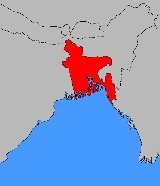
East Pakistan


   Email Print
   Bookmark   Link


East Pakistan


East Pakistan (Bengali
Bengali language

Bengali or Bangla is an Indo-European languages language of the eastern Indian subcontinent, evolved from the Magadhi Prakrit and Sanskrit languages....
: ????? ????????? Purbo Pakistan, Urdu
Urdu

Urdu is a Central_Indo-Aryan_languages#Central_Zone_.28Madhya_or_Hindi.29 Indo-Aryan languages of the Indo-Iranian languages, belonging to the Indo-European languages family of languages....
: ????? ??????? Mashriqi Pakistan) was a former province of Pakistan
Pakistan

Pakistan , officially the Islamic Republic of Pakistan, is a country located in South Asia and borders Central Asia and the Middle East. It has a 1,046 kilometre coastline along the Arabian Sea and Gulf of Oman in the south, and is bordered by Afghanistan and Iran in the west, India in the east and People's Republic of China in th...
 which existed between 1955 and 1971. East Pakistan was created from Bengal
Bengal

Bengal , is a historical and geographical region in the northeast of South Asia. Today it is mainly divided between the independent sovereign nation of the Bangladesh and the state of West Bengal in India, although some regions of the previous kingdoms of Bengal are now part of the neighboring Indian states of Bihar, Assam, Tripura and Oris...
 Province based on a plebiscite in what was then British India
British Raj

British Raj primarily refers to the British rule in the Indian subcontinent between 1858 and 1947; it can also refer to the period of dominion, and even the region under the rule....
 in 1947. Eastern Bengal chose to join the Dominion of Pakistan and became a province of Pakistan by the name East Bengal
East Bengal

East Bengal was the name used during two periods in the 20th century for a territory that roughly corresponded to the modern state of Bangladesh....
. East Bengal was renamed East Pakistan
East Pakistan

East Pakistan was a former Provinces of Pakistan of Pakistan which existed between 1955 and 1971. East Pakistan was created from Bengal Province based on a plebiscite in what was then British Raj in 1947....
 in 1956 and later became the independent country of Bangladesh
Bangladesh

, officially the People's Republic of Bangladesh is a country in South Asia. It is bordered by India on all sides except for a small border with Burma to the far southeast and by the Bay of Bengal to the south....
 after the bloody Bangladesh Liberation War
Bangladesh Liberation War

The Bangladesh Liberation WarBangladesh Liberation War/nomenclature justification was an armed conflict pitting West Pakistan against East Pakistan and India, that resulted in the secession of East Pakistan to become the independent nation of Bangladesh....
 in 1971.


Discussion
Ask a question about 'East Pakistan'
Start a new discussion about 'East Pakistan'
Answer questions from other users
Full Discussion Forum


Recent Posts


Encyclopedia


East Pakistan (Bengali
Bengali language

Bengali or Bangla is an Indo-European languages language of the eastern Indian subcontinent, evolved from the Magadhi Prakrit and Sanskrit languages....
: ????? ????????? Purbo Pakistan, Urdu
Urdu

Urdu is a Central_Indo-Aryan_languages#Central_Zone_.28Madhya_or_Hindi.29 Indo-Aryan languages of the Indo-Iranian languages, belonging to the Indo-European languages family of languages....
: ????? ??????? Mashriqi Pakistan) was a former province of Pakistan
Pakistan

Pakistan , officially the Islamic Republic of Pakistan, is a country located in South Asia and borders Central Asia and the Middle East. It has a 1,046 kilometre coastline along the Arabian Sea and Gulf of Oman in the south, and is bordered by Afghanistan and Iran in the west, India in the east and People's Republic of China in th...
 which existed between 1955 and 1971. East Pakistan was created from Bengal
Bengal

Bengal , is a historical and geographical region in the northeast of South Asia. Today it is mainly divided between the independent sovereign nation of the Bangladesh and the state of West Bengal in India, although some regions of the previous kingdoms of Bengal are now part of the neighboring Indian states of Bihar, Assam, Tripura and Oris...
 Province based on a plebiscite in what was then British India
British Raj

British Raj primarily refers to the British rule in the Indian subcontinent between 1858 and 1947; it can also refer to the period of dominion, and even the region under the rule....
 in 1947. Eastern Bengal chose to join the Dominion of Pakistan and became a province of Pakistan by the name East Bengal
East Bengal

East Bengal was the name used during two periods in the 20th century for a territory that roughly corresponded to the modern state of Bangladesh....
. East Bengal was renamed East Pakistan
East Pakistan

East Pakistan was a former Provinces of Pakistan of Pakistan which existed between 1955 and 1971. East Pakistan was created from Bengal Province based on a plebiscite in what was then British Raj in 1947....
 in 1956 and later became the independent country of Bangladesh
Bangladesh

, officially the People's Republic of Bangladesh is a country in South Asia. It is bordered by India on all sides except for a small border with Burma to the far southeast and by the Bay of Bengal to the south....
 after the bloody Bangladesh Liberation War
Bangladesh Liberation War

The Bangladesh Liberation WarBangladesh Liberation War/nomenclature justification was an armed conflict pitting West Pakistan against East Pakistan and India, that resulted in the secession of East Pakistan to become the independent nation of Bangladesh....
 in 1971. Large sections of East Pakistan's people felt that they were colonised and suppressed by the West Pakistan
West Pakistan

West Pakistan was the popular and sometimes official name of the western wing of Pakistan until 1971, when the East Pakistan became independent as Bangladesh....
is.

Post-independence


British India was partitioned
Partition of India

File:Brit IndianEmpireReligions3.jpgThe Partition of India was the Partition of British India that led to the creation, on August 14, 1947 and August 15, 1947, respectively, of the Sovereignty states of the Dominion of Pakistan and the Union of India ....
 in 1947, into the independent states of Pakistan and India
India

India, officially the Republic of India , is a country in South Asia. It is the List of countries and outlying territories by total area country by geographical area, the List of countries by population country, and the most populous liberal democracy in the world....
. The Province of Bengal was split
Partition of Bengal (1947)

The Partition of Bengal in 1947, part of the Partition of India, was a Partition that divided Bengal into the two separate entities of West Bengal belonging to India, and East Bengal belonging to Pakistan....
 between them. The western part of the province became the West Bengal
West Bengal

West Bengal is a States and territories of India in eastern India. With Bangladesh, which lies on its eastern border, the state forms the ethno-linguistic region of Bengal....
 state of India and the eastern part became the East Bengal province of the Dominion of Pakistan, with an overwhelming Muslim majority and a large Hindu minority and much smaller minorities of Buddhists and Animists. East Bengal formed one of the five provinces of unified Pakistan. The other four Pakistani provinces (West Punjab
West Punjab

West Punjab was a former province of Pakistan which existed from 1947 to 1955. The province covered an area of 160,622 km?, including much of the current Punjab province and the Islamabad Capital Territory, but excluding the former Princely States of State of Bahawalpur....
, Sindh
Sindh

Sindh is one of the four Subdivisions of Pakistan of Pakistan and historically is home to the Sindhi people. Different cultural and ethnic groups also reside in Sindh including Urdu-speaking Muslim refugees who migrated to Pakistan from India upon independence as well as the people migrated from other provinces after independence....
, Baluchistan
Baluchistan (Chief Commissioners Province)

The Chief Commissioners Province of Baluchistan was a former province of British India located in the northern parts of modern Balochistan province....
, and the North-West Frontier Province
North-West Frontier Province

File:Makra Peak by Khalid Mahmood.jpgThe North-West Frontier Province is the smallest of the Subdivisions of Pakistan of Pakistan. The NWFP is home to the majority Pashtuns as well as other smaller ethnic groups....
) were positioned on the other side of India, forming West Pakistan
West Pakistan

West Pakistan was the popular and sometimes official name of the western wing of Pakistan until 1971, when the East Pakistan became independent as Bangladesh....
.

After independence from British rule, East Bengal was neglected by the central government based in the Western wing, which was at times under military or martial law. A major cause of resentment among the Bengalis was economic exploitation. For example, between 1948 and 1960, East Pakistan's export earnings had been 70% of national total, while it only received 25% of the earnings. Between 1950 and 1970, only 34% of the development expenditure was spent in East Bengal despite having more than half the population. Growing tensions led to the One Unit
One Unit

One-Unit was the title of a scheme launched by the federal government of Pakistan to merge the four Former subdivisions of Pakistan of West Pakistan into one homogenous unit, as a counterbalance against the numerical domination of the ethnic Bengalis of East Pakistan ....
 Policy, implemented in 1955, which abolished the provinces. Under this policy, West Punjab, Balochistan, Sindh, and the Northwest Frontier were merged under the nominal designation of West Pakistan
West Pakistan

West Pakistan was the popular and sometimes official name of the western wing of Pakistan until 1971, when the East Pakistan became independent as Bangladesh....
 and East Bengal became East Pakistan.

Tensions peaked in 1971, following the cancellation by Pakistani President Yahya Khan
Yahya Khan

Agha Muhammad Yahya Khan was the President of Pakistan from 1969 to 1971, following the resignation of Ayub Khan. He has one son, Ali Yahya and one daughter, Yasmeen Khan....
 of election results that gave the Awami League a majority in the parliament. The Awami League won almost all the seats in East Pakistan, but none in West Pakistan. East Pakistan had more than half the parliamentary seats because it was home to more than half the population. Although the Awami League was in a position to form a government without any coalition partner, it was forced to start negotiations with the Pakistan Peoples Party
Pakistan Peoples Party

The Pakistan Peoples Party : is a centre-left political party in Pakistan affiliated with Socialist International. To date, its leader has always been a member of the Bhutto family....
 which had won most of the seats in West Pakistan. The negotiations failed and a 'military government' cancelled the results of the elections in East Pakistan. Under the leadership of Sheikh Mujibur Rahman
Sheikh Mujibur Rahman

Sheikh Mujibur Rahman was a Bengali people politician and the founding leader of Bangladesh, considered the Pater Patriae. He headed the Awami League, served as the first President of Bangladesh and later became its Prime Minister of Bangladesh....
, Bangladesh began its struggle for independence. The official onset followed a harsh repression carried out by the Pakistan army on Bengali civilians on 25 March 1971. The Bangladeshi government of Sheikh Mujibur Rahman
Sheikh Mujibur Rahman

Sheikh Mujibur Rahman was a Bengali people politician and the founding leader of Bangladesh, considered the Pater Patriae. He headed the Awami League, served as the first President of Bangladesh and later became its Prime Minister of Bangladesh....
 claimed that an estimated 1-3 million Bengalis died during the war between March and December 1971, while the Pakistani sources maintained that the total number of people from East and West Pakistan who were killed was less than 100,000.

Independence of East Pakistan (Bangladesh)


The tension between East and West Pakistan reached a climax when in 1970 the Awami League, the largest East Pakistani political party, led by Sheikh Mujibur Rahman
Sheikh Mujibur Rahman

Sheikh Mujibur Rahman was a Bengali people politician and the founding leader of Bangladesh, considered the Pater Patriae. He headed the Awami League, served as the first President of Bangladesh and later became its Prime Minister of Bangladesh....
, won a landslide victory in the national elections in East Pakistan. The party won 167 of the 169 seats allotted to East Pakistan, and thus a majority of the 300 seats in the National Assembly. This gave the Awami League the constitutional right to form a government. However, Yahya Khan
Yahya Khan

Agha Muhammad Yahya Khan was the President of Pakistan from 1969 to 1971, following the resignation of Ayub Khan. He has one son, Ali Yahya and one daughter, Yasmeen Khan....
, the leader of the Pakistan, refused to allow Rahman to become the Prime Minister of Pakistan. This increased agitation for greater autonomy in the East.

On 26 March 1971, the day after the military crackdown on civilians in East Pakistan, Major Ziaur Rahman
Ziaur Rahman

Lieutenant-General Ziaur Rahman, Bir Uttam, Hilal-i-Jurat was a charismatic Bangladeshi war hero, politician and statesman. He was the President of Bangladesh from 1976 uptill 1981 and founded the Bangladesh Nationalist Party , one of the two largest political parties in the country....
 declared the independence of Bangladesh on behalf of Sheikh Mujibur Rahman. This started the Bangladesh Liberation War
Bangladesh Liberation War

The Bangladesh Liberation WarBangladesh Liberation War/nomenclature justification was an armed conflict pitting West Pakistan against East Pakistan and India, that resulted in the secession of East Pakistan to become the independent nation of Bangladesh....
 in which the Mukti Bahini
Mukti Bahini

Mukti Bahini , also termed as the "Freedom Fighters" or FFs, collectively refers to the armed organizations who fought against the Pakistan Army during the Bangladesh Liberation War....
, joined in December 1971 by 400,000 Indian soldiers
Indian Armed Forces

The Indian Armed Forces is the overall unified military of the Republic of India encompassing the Indian Army, the Indian Air Force, the Indian Navy, and various other inter-service institutions....
, faced the Pakistani Army of 65,000 including the paramilitary forces. An additional approximately 25,000 ill-equipped civilian volunteers and police forces also sided with the Pakistan army. On 16 December 1971, the Pakistani Army was over-numbered by the Indians and had almost no Air Force to back it. The Pakistan forces surrendered to the Indian Armed forces Headed by Lt. Gen Jagjit Singh Aurora
Jagjit Singh Aurora

Lieutenant General Jagjit Singh Arora was the commander of the Indian army in the Eastern front in the Indo-Pakistani War of 1971 which led to the creation of Bangladesh....
. Bangladesh quickly gained recognition from most countries and with the signing of the Shimla Accord, most of the countries accepted the new state. Bangladesh joined the United Nations
United Nations

The United Nations is an international organization whose stated aims are to facilitate cooperation in international law, international security, economic development, Social change, human rights and achieving world peace....
 in 1974.

Government of East Pakistan

On 14 October 1955, the last governor of East Bengal (Amiruddin Ahmad) became the first Governor of East Pakistan. At the same time the last Chief Minister of East Bengal became the first Chief Minister of East Pakistan. This system lasted until the military coup of 1958 when the post of Chief Minister was abolished in both East Pakistan and West Pakistan. From 1958 to 1971 the administration was largely in the hands of the President of Pakistan and the Governor of East Pakistan who at times held the title of Martial Law Administrator
Martial law

Martial law is the system of rules that takes effect when the military takes control of the normal administration of justice.Martial law is sometimes imposed during wars or occupied territory in the absence of any other civil government....
.

TenureGovernor of East Pakistan
14 October 1955 - March 1956Amiruddin Ahmad
March 1956 - 13 April 1958A. K. Fazlul Huq
A. K. Fazlul Huq

Sher-e-Bangla redirects here. For other uses of the term, see Sher-e-Bangla .Abul Kashem Fazlul Huq , often referred to as Sher-e-Bangla was a well-known Bengali statesman in the first half of the 20th century....
13 April 1958 - 3 May 1958Hamid Ali (acting)
3 May 1958 - 10 October 1958Sultanuddin Ahmad
10 October 1958 - 11 April 1960Gov Zakir Husain
11 April 1960 - 11 May 1962Lt Gen Azam Khan
Azam Khan (general)

Lieutenant General Azam Khan was a senior general of the Pakistan army who served under General Ayub Khan, the first military ruler of Pakistan....
11 May 1962 - 25 October 1962Ghulam Faruque
Ghulam Faruque

Khan Bahadur Ghulam Faruque Khan was a politician and industrialist of Pakistan. He belonged to the village Shaidu in Nowshera District. Nowshera is the home of the famous Pashtun Tribe the Khattaks of the NWFP Province in Pakistan....
25 October 1962 - 23 March 1969Abdul Monem Khan
Abdul Monem Khan

Abdul Monem Khan was the governor of the former East Pakistan?current-day Bangladesh? from 28 October 1962 to 23 March 1969....
23 March 1969 - 25 March 1969Mirza Nurul Huda
25 March 1969 - 23 August 1969Major General Muzaffaruddin (acting martial law administrator as he was the GOC 14th Infantry Division)
23 August 1969 - 1 September 1969Lt General Sahabzada Yaqub Khan
Sahabzada Yaqub Khan

Lieutenant General Sahabzada Yaqub Ali Khan was the international face of Pakistan for as many as three decades. He served as Foreign Minister of Pakistan of Pakistan from 1982 to 1991 during the dying days of Cold War and then caretaker Foreign Minister from 1996 to 1997....
 (martial law administrator)
1 September 1969 - 7 March 1971Vice Admiral Syed Mohammad Ahsan (governor)
7 March 1971 - 31 August 1971Lt General Tikka Khan
Tikka Khan

General Tikka Khan, HJ, HQA, SPk, was Pakistan's Chief of Military of Pakistan Staff from March 1972–March 1976).Raja Tikka Khan was born in a Narma Rajput family in the village of Jochha Mamdot in Kahuta Tehsil near Rawalpindi, in 1915 ....
 (martial law administrator and governor)
31 August 1971 - 14 December 1971Abdul Motaleb Malik (governor)
14 December 1971 - 16 December 1971Lt General Amir Abdullah Khan Niazi (martial law administrator)
16 December 1971Province of East Pakistan dissolved


TenureChief Minister of East PakistanPolitical Party
August 1955 - September 1956Abu Hussain SarkarKrishan Sramik Party
September 1956 - March 1958Ata-ur-Rahman KhanAwami League
March 1958Abu Hussain SarkarKrishan Sramik Party
March 1958 - 18 June 1958Ata-ur-Rahman KhanAwami League
18 June 1958 - 22 June 1958Abu Hussain SarkarKrishan Sramik Party
22 June 1958 - 25 August 1958Governor's Rule 
25 August 1958 - 7 October 1958Ata-ur-Rahman KhanAwami League
7 October 1958Post abolished 
16 December 1971Province of East Pakistan dissolved 


See also

  • Partition of India
    Partition of India

    File:Brit IndianEmpireReligions3.jpgThe Partition of India was the Partition of British India that led to the creation, on August 14, 1947 and August 15, 1947, respectively, of the Sovereignty states of the Dominion of Pakistan and the Union of India ....
  • East Bengal
    East Bengal

    East Bengal was the name used during two periods in the 20th century for a territory that roughly corresponded to the modern state of Bangladesh....
  • West Pakistan
    West Pakistan

    West Pakistan was the popular and sometimes official name of the western wing of Pakistan until 1971, when the East Pakistan became independent as Bangladesh....
  • Bangladesh Liberation War
    Bangladesh Liberation War

    The Bangladesh Liberation WarBangladesh Liberation War/nomenclature justification was an armed conflict pitting West Pakistan against East Pakistan and India, that resulted in the secession of East Pakistan to become the independent nation of Bangladesh....
  • Biharis
  • Indo-Pakistani War of 1971
    Indo-Pakistani War of 1971

    The Indo-Pakistani War of 1971 was a major military conflict between India and Pakistan. The war is closely associated with the Bangladesh Liberation War ....
  • The Blood telegram
    Archer Blood

    Archer Kent Blood was an USA diplomat in Bangladesh. He served as the last American Consul General to Dhaka, East Pakistan. He is famous for sending the strongly-worded Blood telegram protesting against the atrocities committed in the Bangladesh Liberation War....


External links