


Mountaineering

Encyclopedia
Mountaineering or mountain climbing is the sport
, hobby
or profession
of hiking
, skiing
, and climbing
mountain
s. While mountaineering began as attempts to reach the highest point of unclimbed mountains it has branched into specialisations that address different aspects of the mountain and consists of three areas: rock-craft, snow-craft and skiing, depending on whether the route chosen is over rock
, snow
or ice
. All require experience, athletic ability, and technical knowledge to maintain safety.
The UIAA or Union Internationale des Associations d'Alpinisme is the world governing body in mountaineering and climbing, addressing issues like access, medical, mountain protection, safety, youth and ice climbing.
are required to travel efficiently over snow and ice. Crampons have 8-14 spikes and are attached to a mountaineer's boots. They are used on hard snow (neve) and ice to provide additional traction. Using various techniques from alpine skiing and mountaineering to ascend/descend a mountain is a form of the sport by itself, called ski mountaineering
. Ascending and descending a snow slope safely requires the use of an ice axe
and many different footwork techniques that have been developed over the past century, mainly in Europe. The progression of footwork from the lowest angle slopes to the steepest terrain is first to splay the feet to a rising traverse, to kicking steps, to front pointing the crampons. The progression of ice axe technique from the lowest angle slopes to the steepest terrain is to use the ice axe first as a walking stick, then a stake, then to use the front pick as a dagger below the shoulders or above, and finally to swing the pick into the slope over the head. These various techniques may involve questions of differing ice-axe design depending on terrain, and even whether a mountaineer uses one or two ice axes. Anchors for the rope in snow are sometimes unreliable, and include snow stakes, called pickets, deadman devices called flukes which are fashioned from aluminium, or devised from buried objects that might include an ice axe, skis, rocks or other objects. Bollards, which are simply carved out of consolidated snow or ice, also sometimes serve as anchors.
s, crevasse
s pose a grave danger. These giant cracks in the ice are not always visible as snow can be blown and freeze over the top to make a snowbridge. At times snowbridges can be as thin as a few inches. Climbers use a system of ropes to protect themselves from such hazards. Basic gear for glacier travel includes crampons
and ice axe
s. Teams of two to five climbers tie into a rope equally spaced. If a climber begins to fall the other members of the team perform a self-arrest
to stop the fall. The other members of the team enact a crevasse rescue
to pull the fallen climber from the crevasse.
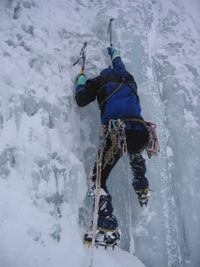 Multiple methods are used to safely travel over ice. If the terrain is steep but not vertical, then the lead climber can place ice screw
s in the ice and attach the rope for protection. Each climber on the team must clip past the anchor, and the last climber picks up the anchor itself. Occasionally, slinged icicles or bollards are also used. This allows for safety should the entire team be taken off their feet. This technique is known as Simul-climbing and is sometimes also used on steep snow and easy rock.
If the terrain becomes too steep, standard ice climbing
techniques are used in which each climber is belayed, moving one at a time.
Climbers use a few different forms of shelter depending on the situation and conditions. Shelter is a very important aspect of safety for the climber as the weather in the mountains may be very unpredictable. Tall mountains may require many days of camping on the mountain.
plus (normally) camps I through IV.
and Club alpin français
). The manager of the hut, termed a guardian or warden in Europe, will usually also sell refreshments and meals; both to those visiting only for the day and to those staying overnight. The offering is surprisingly wide; given that most supplies, often including fresh water, must be flown in by helicopter, and may include glucose-based snacks (such as Mars and Snickers bars) on which climbers and walkers wish to stock up, cakes and pastries made at the hut, a variety of hot and cold drinks (including beer and wine), and high carbohydrate dinners in the evenings. Not all huts offer a catered service, though, and visitors may need to provide for themselves. Some huts offer facilities for both, enabling visitors wishing to keep costs down to bring their own food and cooking equipment and to cater using the facilities provided. Booking for overnight stays at huts is deemed obligatory, and in many cases is essential as some popular huts; even with more than 100 bed spaces may be full during good weather and at weekends. Once made, the cancellation of a reservation is advised as a matter of courtesy – and, indeed, potentially of safety, as many huts keep a record of where climbers and walkers state they planned to walk to next. Most huts may be contacted by telephone and most take credit cards as a means of payment.
/bivvy bag and lying down to sleep. Typically bivvy bags are made from breathable waterproof membranes which stop the user sweating too much, which in sub zero environments can be very dangerous. Many times small partially sheltered areas such as a bergschrund
, cracks in rocks or a trench dug in the snow are used to provide additional shelter from wind. These techniques were originally used only in emergency; however some climbers steadfastly committed to alpine style
climbing specifically plan for bivouacs in order to save the weight of a tent when suitable snow conditions or time is unavailable for construction of a snow cave. The principal hazard associated with bivouacs is the greater level of exposure to cold and the elements.
s are the most common form of shelter used on the mountain. These may vary from simple tarps to much heavier designs intended to withstand harsh mountain conditions. In exposed positions, windbreaks of snow or rock may be required to shelter the tent. One of the downsides to tenting is that high winds and snow loads can be dangerous and may ultimately lead to the tent's failure and collapse. In addition, the constant flapping of the tent fabric can hinder sleep and raise doubts about the security of the shelter. When choosing a tent, alpinists tend to rely on specialised mountaineering tents that are specifically designed for high winds and moderate to heavy snow loads. Tent stakes can be buried in the snow ("deadman") for extra security.
s are another way to shelter high on the mountain. Some climbers do not use tents at high altitudes unless the snow conditions do not allow for snow caving, since snow caves are silent and much warmer than tents. They can be built relatively easily, given sufficient time, using a snow shovel. A correctly made snow cave will hover around freezing, which relative to outside temperatures can be very warm. They can be dug anywhere where there is at least four feet of snow. The addition of a good quality bivvy bag and closed cell foam sleeping mat will also increase the warmth of the snow cave. Another shelter that works well is a quinzee, which is excavated from a pile of snow that has been work hardened or sintered (typically by stomping). Igloo
s are used by some climbers, but are deceptively difficult to build and require specific snow conditions.
In all, mountaineers must concern themselves with dangers: falling rocks, falling ice, snow-avalanches, the climber falling, falls from ice slopes, falls down snow slopes, falls into crevasses and the dangers from altitude and weather. To select and follow a route using one's skills and experience to mitigate these dangers is to exercise the climber's craft.
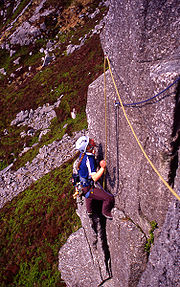 Every rock mountain is slowly disintegrating due to erosion
, the process being especially rapid above the snow-line. Rock faces are constantly swept by falling stones, which may be possible to dodge. Falling rocks tend to form furrows in a mountain face, and these furrows (couloirs) have to be ascended with caution, their sides often being safe when the middle is stoneswept. Rocks fall more frequently on some days than on others, according to the recent weather. Ice formed during the night may temporarily bind rocks to the face but warmth of the day or lubricating water from melting snow or rain may easily dislodge these rocks. Local experience is a valuable help on determining typical rock fall on such routes.
The direction of the dip of rock strata sometimes determines the degree of danger on a particular face; the character of the rock must also be considered. Where stones fall frequently debris will be found below, whilst on snow slopes falling stones cut furrows visible from a great distance. In planning an ascent of a new peak or an unfamiliar route, mountaineers must look for such traces. When falling stones get mixed in considerable quantity with slushy snow or water a mud avalanche is formed (common in the Himalayas
). It is vital to avoid camping
in their possible line of fall.
s are slow in formation, and slow in arriving (by glacier motion) at a condition of unstable equilibrium. They generally fall in or just after the hottest part of the day. A skillful and experienced ice-man will usually devise a safe route through a most intricate ice-fall, but such places should be avoided in the afternoon of a hot day. Hanging glaciers (i.e. glaciers perched on steep slopes) often discharge themselves over steep rock-faces, the snout breaking off at intervals. They can always be detected by their debris below. Their track should be avoided.
skill is shown by their choice of handhold and foothold, and their adhesion to the holds once chosen. Much depends on the ability to estimate the capability of the rock to support the weight placed on it. Many loose rocks are quite firm enough to bear a person's weight, but experience is needed to know which can be trusted, and skill is required in transferring the weight to them without jerking. On rotten rocks the rope must be handled with special care, lest it should dislodge loose stones on to those below. Similar care must be given to handholds and footholds, for the same reason. When a horizontal traverse has to be made across very difficult rocks, a dangerous situation may arise unless at both ends of the traverse there are firm positions. Mutual assistance on hard rocks takes all manner of forms: two, or even three, people climbing on one another's shoulders, or using an ice axe
propped up by others for a foothold. The great principle is that of co-operation, all the members of the party climbing with reference to the others, and not as independent units; each when moving must know what the climber in front and the one behind are doing. After bad weather steep rocks are often found covered with a veneer of ice (verglas), which may even render them inaccessible. Crampons
are useful on such occasions.
There are many types of avalanche, but two types are of the most concern:
Dangerous slides are most likely to occur on the same slopes preferred by many skiers: long and wide open, few trees or large rocks, 30 to 45 degrees of angle, large load of fresh snow, soon after a big storm, on a slope "lee to the storm". Solar radiation can trigger slides as well. These will typically be a point release or wet slough type of avalanche. The added weight of the wet slide can trigger a slab avalanche. Ninety percent of reported victims are caught in avalanches triggered by themselves or others in their group.
When going off-piste or travelling in alpine terrain, parties are advised to always carry:
They are also advised to have had avalanche training. Ironically, expert skiers who have avalanche training make up a large percentage of avalanche fatalities; perhaps because they are the ones more likely to ski in areas prone to avalanches, and certainly because most people do not practice enough with their equipment to be truly fast and efficient rescuers.
Even with proper rescue equipment and training, there is a one-in-five chance of dying if caught in a significant avalanche, and only a 50/50 chance of being found alive if buried more than a few minutes. The best solution is to learn how to avoid risky conditions.
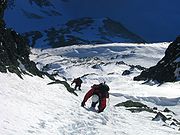 For travel on slopes consisting of ice or hard snow, crampons
are a standard part of a mountaineer's equipment. While step-cutting can sometimes be used on snow slopes of moderate angle, this can be a slow and tiring process, which does not provide the higher security of crampons. However, in soft snow or powder, crampons are easily hampered by balling of snow, which reduces their effectiveness. In either case, an ice axe
not only assists with balance but provides the climber with the possibility of self-arrest in case of a slip or fall. On a true ice slope however, an ice axe is rarely able to effect a self-arrest. As an additional safety precaution on steep ice slopes, the climbing rope is attached to ice screws buried into the ice.
 Snow slopes are very common, and usually easy to ascend. At the foot of a snow or ice slope is generally a big crevasse, called a bergschrund
, where the final slope of the mountain rises from a snow-field or glacier. Such bergschrunds are generally too wide to be stepped across, and must be crossed by a snow bridge
, which needs careful testing and a painstaking use of the rope. A steep snow slope in bad condition may be dangerous, as the whole body of snow may start as an avalanche. Such slopes are less dangerous if ascended directly, rather than obliquely, for an oblique or horizontal track cuts them across and facilitates movement of the mass. New snow lying on ice is especially dangerous. Experience is needed for determining the feasibility of advancement over snow in doubtful condition. Snow on rocks is usually rotten unless it is thick; snow on snow is likely to be sound. A day or two of fine weather will usually bring new snow into sound condition. Snow cannot lie at a very steep angle, though it often deceives the eye as to its slope. Snow slopes seldom exceed 40°. Ice slopes may be much steeper. Snow slopes in early morning are usually hard and safe, but the same in the afternoon are quite soft and possibly dangerous; hence the advantage of an early start.
s are the slits or deep chasms formed in the substance of a glacier as it passes over an uneven bed. They may be open or hidden. In the lower part of a glacier the crevasses are open. Above the snow-line they are frequently hidden by arched-over accumulations of winter snow. The detection of hidden crevasses requires care and experience. After a fresh fall of snow they can only be detected by sounding with the pole of the ice axe, or by looking to right and left where the open extension of a partially hidden crevasse may be obvious. The safeguard against accident is the rope, and no one should ever cross a snow-covered glacier unless roped to one, or even better to two companions. Anyone venturing onto crevasses should be trained in crevasse rescue
.
s make it difficult to retrace a route while rain may prevent taking the easiest line only determined as such under dry conditions. In a storm the mountaineer who uses a compass
for guidance has a great advantage over a merely empirical observer. In large snow-fields it is, of course, easier to go wrong than on rocks, but intelligence and experience are the best guides in safely navigating objective hazards.
Summer thunderstorm
s may produce intense lightning
. If a climber happens to be standing on or near the summit, they risk being struck. There are many cases where people have been struck by lightning while climbing mountains. In most mountainous regions, local storms develop by late morning and early afternoon. Many climbers will get an "alpine start"; that is before or by first light so as to be on the way down when storms are intensifying in activity and lightning and other weather hazards are a distinct threat to safety. High wind
s can speed the onset of hypothermia
, as well as damage equipment such as tents used for shelter. Under certain conditions, storms can also create waterfalls which can slow or stop climbing progress. A notable example is the Fohn wind
acting upon the Eiger.
. The best treatment is to descend immediately. The climber's motto at high altitude is "climb high, sleep low", referring to the regimen of climbing higher to acclimatise but returning to lower elevation to sleep. In the South American Andes, the chewing of coca leaves
has been traditionally used to treat altitude sickness symptoms.
Common symptoms of altitude sickness include severe headache, sleep problems, nausea, lack of appetite, lethargy and body ache. Mountain sickness may progress to HACE (High Altitude Cerebral Edema
) and HAPE (High Altitude Pulmonary Edema
), both of which can be fatal within 24 hours.
In high mountains, atmospheric pressure is lower and this means that less oxygen is available to breathe. This is the underlying cause of altitude sickness. Everyone needs to acclimatise, even exceptional mountaineers that have been to high altitude before. Generally speaking, mountaineers start using bottled oxygen when they climb above 7,000 m. Exceptional mountaineers have climbed 8000-metre peaks
(including Everest
) without oxygen, almost always with a carefully planned program of acclimatisation.
gets thinner with increasing altitude thereby absorbing less ultraviolet radiation. Snow cover reflecting the radiation can amplify the effects by up to 75% increasing the risks and damage from sunburn
and snow blindness
.
In 2005, researcher and mountaineer John Semple established that above-average ozone concentrations on the Tibetan plateau
may pose an additional risk to climbers.
es that form the highest peaks in island arcs and in parts of the Andes. Some of these volcanic mountains may cause several hazards if they erupt, such as lahar
s, pyroclastic flows, rockfalls, lava flows, heavy tephra
fall, volcanic bomb ejections and toxic gases.
In Europe alpine climbing is referred to as alpinism. In the Americas this term refers to a particular style of mountain climbing that involves a mixture of ice climbing, rock climbing
, and mixed climbing where climbers carry all their loads with them at all times. The term alpinism as used in the Americas contrasts with expedition style climbing (as commonly undertaken in the Himalayan region or other large ranges of the world) where climbers may use porters, pack animals, cooks, etc. to carry their loads and cook meals. The prevalence of expedition style climbing in the Himalaya is largely a function of the nature of the mountains in the region. Because Himalayan base camps can take days or weeks to trek to, and Himalayan mountains can take weeks or perhaps even months to climb, a large number of personnel and amount of supplies are necessary. This is why expedition style climbing is frequently used on large and isolated peaks in the Himalaya. In Europe and North America there is less of a need for the expedition style climbing on moderate sized mountains. These mountains can often be easily accessed by car or air, are at a lower altitude and can be climbed in a day or two. Expedition style mountaineering can be found in the larger North American ranges such as The Alaska Range
or The Icefield Ranges of the St. Elias Mountains. These remote mountaineering destinations require a 1 to 2 week trek by foot, just to make it to base camp. Most expeditions in these regions choose a glacier flight to basecamp. Routes from basecamp can vary in these regions from 10 days to 1 month typically during the climbing season. Winter mountaineering on major peaks in these ranges can generally consume between 29 to 66 days depending on the route, and can only be tackled via expedition style mountaineering during this season.
The differences between, and advantages and disadvantages of, the two kinds of climbing are as follows:
, and is still immensely popular there. Other notable mountain ranges frequented by climbers include the Caucasus
, the Pyrenees
, Rila mountains
, the Tatra mountains
and Carpathian Mountains
. In North America climbers frequent the Rocky Mountains
, the Sierra Nevada of California
, the Cascades of the Pacific Northwest
, the high peaks of The Alaska Range
and Saint Elias Mountains
.
There has been a long tradition of climbers going on expeditions to the Greater Ranges
, a term generally used for the Andes
and the high peaks of Asia including the Himalaya, Karakoram
, Pamirs and Tien Shan. In the past this was often on exploratory trips or to make first ascents. With the advent of cheaper, long-haul air travel, mountaineering holidays in the Greater Ranges are now undertaken much more frequently and ascents of even Everest and Vinson Massif
(the highest mountain in Antarctica) are offered as a "package holiday
".
Other mountaineering areas of interest include the Southern Alps
of New Zealand
, the Japanese Alps
, the South Korean mountains, the Coast Mountains
of British Columbia
, the Scottish Highlands
, and the mountains of Scandinavia
, especially Norway
.
Sport
A Sport is all forms of physical activity which, through casual or organised participation, aim to use, maintain or improve physical fitness and provide entertainment to participants. Sport may be competitive, where a winner or winners can be identified by objective means, and may require a degree...
, hobby
Hobby
A hobby is a regular activity or interest that is undertaken for pleasure, typically done during one's leisure time.- Etymology :A hobby horse is a wooden or wickerwork toy made to be ridden just like a real horse...
or profession
Profession
A profession is a vocation founded upon specialized educational training, the purpose of which is to supply disinterested counsel and service to others, for a direct and definite compensation, wholly apart from expectation of other business gain....
of hiking
Hiking
Hiking is an outdoor activity which consists of walking in natural environments, often in mountainous or other scenic terrain. People often hike on hiking trails. It is such a popular activity that there are numerous hiking organizations worldwide. The health benefits of different types of hiking...
, skiing
Skiing
Skiing is a recreational activity using skis as equipment for traveling over snow. Skis are used in conjunction with boots that connect to the ski with use of a binding....
, and climbing
Climbing
Climbing is the activity of using one's hands and feet to ascend a steep object. It is done both for recreation and professionally, as part of activities such as maintenance of a structure, or military operations.Climbing activities include:* Bouldering: Ascending boulders or small...
mountain
Mountain
Image:Himalaya_annotated.jpg|thumb|right|The Himalayan mountain range with Mount Everestrect 58 14 160 49 Chomo Lonzorect 200 28 335 52 Makalurect 378 24 566 45 Mount Everestrect 188 581 920 656 Tibetan Plateaurect 250 406 340 427 Rong River...
s. While mountaineering began as attempts to reach the highest point of unclimbed mountains it has branched into specialisations that address different aspects of the mountain and consists of three areas: rock-craft, snow-craft and skiing, depending on whether the route chosen is over rock
Rock (geology)
In geology, rock or stone is a naturally occurring solid aggregate of minerals and/or mineraloids.The Earth's outer solid layer, the lithosphere, is made of rock. In general rocks are of three types, namely, igneous, sedimentary, and metamorphic...
, snow
Snow
Snow is a form of precipitation within the Earth's atmosphere in the form of crystalline water ice, consisting of a multitude of snowflakes that fall from clouds. Since snow is composed of small ice particles, it is a granular material. It has an open and therefore soft structure, unless packed by...
or ice
Ice
Ice is water frozen into the solid state. Usually ice is the phase known as ice Ih, which is the most abundant of the varying solid phases on the Earth's surface. It can appear transparent or opaque bluish-white color, depending on the presence of impurities or air inclusions...
. All require experience, athletic ability, and technical knowledge to maintain safety.
The UIAA or Union Internationale des Associations d'Alpinisme is the world governing body in mountaineering and climbing, addressing issues like access, medical, mountain protection, safety, youth and ice climbing.
Technique
Snow
Compacted snow conditions allow mountaineers to progress on foot. Frequently cramponsCrampons
Crampons are traction devices used to improve mobility on snow and ice. There are three main attachment systems for footwear: step-in, hybrid, and strap bindings. The first two require boots with welts, the last adapt to any type....
are required to travel efficiently over snow and ice. Crampons have 8-14 spikes and are attached to a mountaineer's boots. They are used on hard snow (neve) and ice to provide additional traction. Using various techniques from alpine skiing and mountaineering to ascend/descend a mountain is a form of the sport by itself, called ski mountaineering
Ski mountaineering
Ski mountaineering is form of ski touring that variously combines the sports of Telemark, Alpine, and backcountry skiing with that of mountaineering...
. Ascending and descending a snow slope safely requires the use of an ice axe
Ice axe
An ice axe, is a multi-purpose ice and snow tool used by mountaineers both in the ascent and descent of routes which involve frozen conditions. It can be held and employed in a number of different ways, depending on the terrain encountered...
and many different footwork techniques that have been developed over the past century, mainly in Europe. The progression of footwork from the lowest angle slopes to the steepest terrain is first to splay the feet to a rising traverse, to kicking steps, to front pointing the crampons. The progression of ice axe technique from the lowest angle slopes to the steepest terrain is to use the ice axe first as a walking stick, then a stake, then to use the front pick as a dagger below the shoulders or above, and finally to swing the pick into the slope over the head. These various techniques may involve questions of differing ice-axe design depending on terrain, and even whether a mountaineer uses one or two ice axes. Anchors for the rope in snow are sometimes unreliable, and include snow stakes, called pickets, deadman devices called flukes which are fashioned from aluminium, or devised from buried objects that might include an ice axe, skis, rocks or other objects. Bollards, which are simply carved out of consolidated snow or ice, also sometimes serve as anchors.
Glaciers
When travelling over glacierGlacier
A glacier is a large persistent body of ice that forms where the accumulation of snow exceeds its ablation over many years, often centuries. At least 0.1 km² in area and 50 m thick, but often much larger, a glacier slowly deforms and flows due to stresses induced by its weight...
s, crevasse
Crevasse
A crevasse is a deep crack in an ice sheet rhys glacier . Crevasses form as a result of the movement and resulting stress associated with the sheer stress generated when two semi-rigid pieces above a plastic substrate have different rates of movement...
s pose a grave danger. These giant cracks in the ice are not always visible as snow can be blown and freeze over the top to make a snowbridge. At times snowbridges can be as thin as a few inches. Climbers use a system of ropes to protect themselves from such hazards. Basic gear for glacier travel includes crampons
Crampons
Crampons are traction devices used to improve mobility on snow and ice. There are three main attachment systems for footwear: step-in, hybrid, and strap bindings. The first two require boots with welts, the last adapt to any type....
and ice axe
Ice axe
An ice axe, is a multi-purpose ice and snow tool used by mountaineers both in the ascent and descent of routes which involve frozen conditions. It can be held and employed in a number of different ways, depending on the terrain encountered...
s. Teams of two to five climbers tie into a rope equally spaced. If a climber begins to fall the other members of the team perform a self-arrest
Self-arrest
Self-arrest is a mountaineering related maneuver in which a climber who has fallen and is sliding down a snow or ice slope arrests the slide by himself or herself without recourse to a rope or other belay system....
to stop the fall. The other members of the team enact a crevasse rescue
Crevasse rescue
Crevasse rescue is the process of retrieving a climber from a crevasse in a glacier. Because of the frequency with which climbers break through the snow over a crevasse and fall in, crevasse rescue technique is a standard part of climbing education....
to pull the fallen climber from the crevasse.
Ice
Ice screw
An ice screw is a threaded tubular screw used as a running belay or anchor by climbers on steep ice surface such as steep waterfall ice or alpine ice during ice climbing or crevasse rescue, to hold the climber in the event of a fall, and at belays as anchor points. Ice screws are made by...
s in the ice and attach the rope for protection. Each climber on the team must clip past the anchor, and the last climber picks up the anchor itself. Occasionally, slinged icicles or bollards are also used. This allows for safety should the entire team be taken off their feet. This technique is known as Simul-climbing and is sometimes also used on steep snow and easy rock.
If the terrain becomes too steep, standard ice climbing
Ice climbing
Ice climbing, as the term indicates, is the activity of ascending inclined ice formations. Usually, ice climbing refers to roped and protected climbing of features such as icefalls, frozen waterfalls, and cliffs and rock slabs covered with ice refrozen from flows of water. For the purposes of...
techniques are used in which each climber is belayed, moving one at a time.
Shelter
Climbers use a few different forms of shelter depending on the situation and conditions. Shelter is a very important aspect of safety for the climber as the weather in the mountains may be very unpredictable. Tall mountains may require many days of camping on the mountain.
Base Camp
The "Base Camp" of a mountain is an area used for staging an attempt at the summit. Base camps are positioned to be safe from the harsher conditions above. There are base camps on many popular or dangerous mountains. Where the summit cannot be reached from base camp in a single day, a mountain will have additional camps above base camp. For example, the southeast ridge route on Mount Everest has Base CampEverest Base Camp
There are two base camps on opposite sides of Mount Everest. South Base Camp is in Nepal at an altitude of , and North Base Camp is in Tibet at ). These camps are rudimentary campsites on Mount Everest that are used by mountain climbers during their ascent and descent...
plus (normally) camps I through IV.
Hut
The European alpine regions, in particular, have a network of mountain huts (called "refuges" in France, "rifugi" in Italy, "cabanes" in Switzerland, "Hütten" in Germany and Austria, "koča" in Slovenia, "refugios" in Spain and "hytte" in Norway). Such huts exist at many different heights, including in the high mountains themselves – in extremely remote areas, more rudimentary shelters may exist. The mountain huts are of varying size and quality, but each is typically centred on a communal dining room and have dormitories equipped with mattresses, blankets or duvets, and pillows; guests are expected to bring and to use their own sleeping bag liner. The facilities are usually rudimentary but, given their locations, huts offer vital shelter, make routes more widely accessible (by allowing journeys to be broken and reducing the weight of equipment needing to be carried), and offer good value. In Europe, all huts are staffed during the summer (mid-June to mid-September) and some are staffed in the spring (mid-March to mid-May). Elsewhere, huts may also be open in the fall. Huts also may have a part that is always open, but unmanned, a so-called winter hut. When open and manned, the huts are generally run by full-time employees, but some are staffed on a voluntary basis by members of Alpine clubs (such as Swiss Alpine ClubSwiss Alpine Club
The Swiss Alpine Club is the largest mountaineering club in Switzerland. It was founded in 1863 in Olten and it is now composed of 111 sections with 110,000 members...
and Club alpin français
Club alpin français
The Club alpin français, usually referred to as the CAF, is a federation of club promoting mountain sports. It offers multiple training and courses to help people understand mountains....
). The manager of the hut, termed a guardian or warden in Europe, will usually also sell refreshments and meals; both to those visiting only for the day and to those staying overnight. The offering is surprisingly wide; given that most supplies, often including fresh water, must be flown in by helicopter, and may include glucose-based snacks (such as Mars and Snickers bars) on which climbers and walkers wish to stock up, cakes and pastries made at the hut, a variety of hot and cold drinks (including beer and wine), and high carbohydrate dinners in the evenings. Not all huts offer a catered service, though, and visitors may need to provide for themselves. Some huts offer facilities for both, enabling visitors wishing to keep costs down to bring their own food and cooking equipment and to cater using the facilities provided. Booking for overnight stays at huts is deemed obligatory, and in many cases is essential as some popular huts; even with more than 100 bed spaces may be full during good weather and at weekends. Once made, the cancellation of a reservation is advised as a matter of courtesy – and, indeed, potentially of safety, as many huts keep a record of where climbers and walkers state they planned to walk to next. Most huts may be contacted by telephone and most take credit cards as a means of payment.
Bivouac (bivy or bivvy)
In the mountaineering context, a bivouac or "biv(v)y" is a makeshift resting or sleeping arrangement in which the climber has less than the full complement of shelter, food and equipment that would normally be present at a conventional campsite. This may involve simply getting a sleeping bag and Bivouac sackBivouac sack
A bivouac sack is an extremely small, lightweight, waterproof shelter, and an alternative to traditional tent systems. It is used by climbers, mountaineers, hikers, ultralight backpackers, soldiers and minimalist campers...
/bivvy bag and lying down to sleep. Typically bivvy bags are made from breathable waterproof membranes which stop the user sweating too much, which in sub zero environments can be very dangerous. Many times small partially sheltered areas such as a bergschrund
Bergschrund
A bergschrund is a crevasse that forms where the moving glacier ice separates from the stagnant ice above. It is often a serious obstacle for mountaineers, who sometimes abbreviate "bergschrund" to "schrund"....
, cracks in rocks or a trench dug in the snow are used to provide additional shelter from wind. These techniques were originally used only in emergency; however some climbers steadfastly committed to alpine style
Alpine style
Alpine style refers to mountaineering in a self-sufficient manner, thereby carrying all of one's food, shelter, equipment etc. as one climbs, as opposed to expedition style mountaineering which involves setting up a fixed line of stocked camps on the mountain which can be accessed at one's leisure...
climbing specifically plan for bivouacs in order to save the weight of a tent when suitable snow conditions or time is unavailable for construction of a snow cave. The principal hazard associated with bivouacs is the greater level of exposure to cold and the elements.
Tent
TentTent
A tent is a shelter consisting of sheets of fabric or other material draped over or attached to a frame of poles or attached to a supporting rope. While smaller tents may be free-standing or attached to the ground, large tents are usually anchored using guy ropes tied to stakes or tent pegs...
s are the most common form of shelter used on the mountain. These may vary from simple tarps to much heavier designs intended to withstand harsh mountain conditions. In exposed positions, windbreaks of snow or rock may be required to shelter the tent. One of the downsides to tenting is that high winds and snow loads can be dangerous and may ultimately lead to the tent's failure and collapse. In addition, the constant flapping of the tent fabric can hinder sleep and raise doubts about the security of the shelter. When choosing a tent, alpinists tend to rely on specialised mountaineering tents that are specifically designed for high winds and moderate to heavy snow loads. Tent stakes can be buried in the snow ("deadman") for extra security.
Snow cave
Where conditions permit snow caveSnow cave
A snow cave is a shelter constructed in snow by certain animals in the wild, human mountain climbers, winter recreational enthusiasts, and winter survivalists. It has thermal properties similar to an Igloo and is particularly effective at providing protection from wind as well as low temperatures...
s are another way to shelter high on the mountain. Some climbers do not use tents at high altitudes unless the snow conditions do not allow for snow caving, since snow caves are silent and much warmer than tents. They can be built relatively easily, given sufficient time, using a snow shovel. A correctly made snow cave will hover around freezing, which relative to outside temperatures can be very warm. They can be dug anywhere where there is at least four feet of snow. The addition of a good quality bivvy bag and closed cell foam sleeping mat will also increase the warmth of the snow cave. Another shelter that works well is a quinzee, which is excavated from a pile of snow that has been work hardened or sintered (typically by stomping). Igloo
Igloo
An igloo or snowhouse is a type of shelter built of snow, originally built by the Inuit....
s are used by some climbers, but are deceptively difficult to build and require specific snow conditions.
Hazards
Mountaineering is believed by many mountaineers to be one of the most dangerous activities in the world. Loss of life is not uncommon on most major extreme altitude mountaineering destinations every year. Dangers in mountaineering are sometimes divided into two categories: objective hazards that exist without regard to the climber's presence, like rockfall, avalanches and inclement weather, and subjective hazards that relate only to factors introduced by the climber. Equipment failure and falls due to inattention, fatigue or inadequate technique are examples of subjective hazards. A route continually swept by avalanches and storms is said to have a high level of objective danger, whereas a technically far more difficult route that is relatively safe from these dangers may be regarded as objectively safer.In all, mountaineers must concern themselves with dangers: falling rocks, falling ice, snow-avalanches, the climber falling, falls from ice slopes, falls down snow slopes, falls into crevasses and the dangers from altitude and weather. To select and follow a route using one's skills and experience to mitigate these dangers is to exercise the climber's craft.
Falling rocks
Erosion
Erosion is when materials are removed from the surface and changed into something else. It only works by hydraulic actions and transport of solids in the natural environment, and leads to the deposition of these materials elsewhere...
, the process being especially rapid above the snow-line. Rock faces are constantly swept by falling stones, which may be possible to dodge. Falling rocks tend to form furrows in a mountain face, and these furrows (couloirs) have to be ascended with caution, their sides often being safe when the middle is stoneswept. Rocks fall more frequently on some days than on others, according to the recent weather. Ice formed during the night may temporarily bind rocks to the face but warmth of the day or lubricating water from melting snow or rain may easily dislodge these rocks. Local experience is a valuable help on determining typical rock fall on such routes.
The direction of the dip of rock strata sometimes determines the degree of danger on a particular face; the character of the rock must also be considered. Where stones fall frequently debris will be found below, whilst on snow slopes falling stones cut furrows visible from a great distance. In planning an ascent of a new peak or an unfamiliar route, mountaineers must look for such traces. When falling stones get mixed in considerable quantity with slushy snow or water a mud avalanche is formed (common in the Himalayas
Himalayas
The Himalaya Range or Himalaya Mountains Sanskrit: Devanagari: हिमालय, literally "abode of snow"), usually called the Himalayas or Himalaya for short, is a mountain range in Asia, separating the Indian subcontinent from the Tibetan Plateau...
). It is vital to avoid camping
Camping
Camping is an outdoor recreational activity. The participants leave urban areas, their home region, or civilization and enjoy nature while spending one or several nights outdoors, usually at a campsite. Camping may involve the use of a tent, caravan, motorhome, cabin, a primitive structure, or no...
in their possible line of fall.
Falling ice
The places where ice may fall can always be determined beforehand. It falls in the broken parts of glaciers (seracs) and from overhanging cornices formed on the crests of narrow ridges. Large icicles are often formed on steep rock faces, and these fall frequently in fine weather following cold and stormy days. They have to be avoided like falling stones. SeracSerac
A serac is a block or column of ice formed by intersecting crevasses on a glacier. Often house-sized or larger, they are dangerous to mountaineers since they may topple with little warning...
s are slow in formation, and slow in arriving (by glacier motion) at a condition of unstable equilibrium. They generally fall in or just after the hottest part of the day. A skillful and experienced ice-man will usually devise a safe route through a most intricate ice-fall, but such places should be avoided in the afternoon of a hot day. Hanging glaciers (i.e. glaciers perched on steep slopes) often discharge themselves over steep rock-faces, the snout breaking off at intervals. They can always be detected by their debris below. Their track should be avoided.
Falls from rocks
A rock climber'sRock climbing
Rock climbing also lightly called 'The Gravity Game', is a sport in which participants climb up, down or across natural rock formations or artificial rock walls. The goal is to reach the summit of a formation or the endpoint of a pre-defined route without falling...
skill is shown by their choice of handhold and foothold, and their adhesion to the holds once chosen. Much depends on the ability to estimate the capability of the rock to support the weight placed on it. Many loose rocks are quite firm enough to bear a person's weight, but experience is needed to know which can be trusted, and skill is required in transferring the weight to them without jerking. On rotten rocks the rope must be handled with special care, lest it should dislodge loose stones on to those below. Similar care must be given to handholds and footholds, for the same reason. When a horizontal traverse has to be made across very difficult rocks, a dangerous situation may arise unless at both ends of the traverse there are firm positions. Mutual assistance on hard rocks takes all manner of forms: two, or even three, people climbing on one another's shoulders, or using an ice axe
Ice axe
An ice axe, is a multi-purpose ice and snow tool used by mountaineers both in the ascent and descent of routes which involve frozen conditions. It can be held and employed in a number of different ways, depending on the terrain encountered...
propped up by others for a foothold. The great principle is that of co-operation, all the members of the party climbing with reference to the others, and not as independent units; each when moving must know what the climber in front and the one behind are doing. After bad weather steep rocks are often found covered with a veneer of ice (verglas), which may even render them inaccessible. Crampons
Crampons
Crampons are traction devices used to improve mobility on snow and ice. There are three main attachment systems for footwear: step-in, hybrid, and strap bindings. The first two require boots with welts, the last adapt to any type....
are useful on such occasions.
Avalanches
Every year, 120 to 150 people die in small avalanches in the Alps alone. The vast majority are reasonably experienced male skiers aged 20–35 but also include ski instructors and guides. There is always a lot of pressure to risk a snow crossing. Turning back takes a lot of extra time and effort, supreme leadership, and most importantly there is seldom an avalanche that proves the right decision was made. Making the decision to turn around is especially hard if others are crossing the slope, but any next person could become the trigger.There are many types of avalanche, but two types are of the most concern:
- Slab avalanche
- This type of avalanche occurs when a plate of snow breaks loose and starts sliding downhill; these are the largest and most dangerous.
- Hard slab avalanche
-
- This type of avalanche is formed by hard-packed snow in a cohesive slab. The slab will not break up easily as it slides down the hill, resulting in large blocks tumbling down the mountain.
- Soft slab avalanche
-
- This type of avalanche is formed again by a cohesive layer of snow bonded together, the slab tends to break up more easily.
- Loose snow avalanche
- This type of avalanche is triggered by a small amount of moving snow that accumulates into a big slide. Also known as a "wet slide or point release" avalanche. This type of avalanche is deceptively dangerous as it can still knock a climber or skier off their feet and bury them, or sweep them over a cliff into a terrain trap.
Dangerous slides are most likely to occur on the same slopes preferred by many skiers: long and wide open, few trees or large rocks, 30 to 45 degrees of angle, large load of fresh snow, soon after a big storm, on a slope "lee to the storm". Solar radiation can trigger slides as well. These will typically be a point release or wet slough type of avalanche. The added weight of the wet slide can trigger a slab avalanche. Ninety percent of reported victims are caught in avalanches triggered by themselves or others in their group.
When going off-piste or travelling in alpine terrain, parties are advised to always carry:
- avalanche beacon
- probe
- shovel (retrieving victims with a shovel instead of hands is five times faster)
They are also advised to have had avalanche training. Ironically, expert skiers who have avalanche training make up a large percentage of avalanche fatalities; perhaps because they are the ones more likely to ski in areas prone to avalanches, and certainly because most people do not practice enough with their equipment to be truly fast and efficient rescuers.
Even with proper rescue equipment and training, there is a one-in-five chance of dying if caught in a significant avalanche, and only a 50/50 chance of being found alive if buried more than a few minutes. The best solution is to learn how to avoid risky conditions.
Ice slopes
Crampons
Crampons are traction devices used to improve mobility on snow and ice. There are three main attachment systems for footwear: step-in, hybrid, and strap bindings. The first two require boots with welts, the last adapt to any type....
are a standard part of a mountaineer's equipment. While step-cutting can sometimes be used on snow slopes of moderate angle, this can be a slow and tiring process, which does not provide the higher security of crampons. However, in soft snow or powder, crampons are easily hampered by balling of snow, which reduces their effectiveness. In either case, an ice axe
Ice axe
An ice axe, is a multi-purpose ice and snow tool used by mountaineers both in the ascent and descent of routes which involve frozen conditions. It can be held and employed in a number of different ways, depending on the terrain encountered...
not only assists with balance but provides the climber with the possibility of self-arrest in case of a slip or fall. On a true ice slope however, an ice axe is rarely able to effect a self-arrest. As an additional safety precaution on steep ice slopes, the climbing rope is attached to ice screws buried into the ice.
Snow slopes
Bergschrund
A bergschrund is a crevasse that forms where the moving glacier ice separates from the stagnant ice above. It is often a serious obstacle for mountaineers, who sometimes abbreviate "bergschrund" to "schrund"....
, where the final slope of the mountain rises from a snow-field or glacier. Such bergschrunds are generally too wide to be stepped across, and must be crossed by a snow bridge
Snow bridge
Snow bridge is an arc across a crevasse, a crack in rock, a creek, or some other opening in terrain. It is typically formed by snow drift, which first creates a cornice, which may gradually grow to reach the other side of the opening.-Dangers:...
, which needs careful testing and a painstaking use of the rope. A steep snow slope in bad condition may be dangerous, as the whole body of snow may start as an avalanche. Such slopes are less dangerous if ascended directly, rather than obliquely, for an oblique or horizontal track cuts them across and facilitates movement of the mass. New snow lying on ice is especially dangerous. Experience is needed for determining the feasibility of advancement over snow in doubtful condition. Snow on rocks is usually rotten unless it is thick; snow on snow is likely to be sound. A day or two of fine weather will usually bring new snow into sound condition. Snow cannot lie at a very steep angle, though it often deceives the eye as to its slope. Snow slopes seldom exceed 40°. Ice slopes may be much steeper. Snow slopes in early morning are usually hard and safe, but the same in the afternoon are quite soft and possibly dangerous; hence the advantage of an early start.
Crevasses
CrevasseCrevasse
A crevasse is a deep crack in an ice sheet rhys glacier . Crevasses form as a result of the movement and resulting stress associated with the sheer stress generated when two semi-rigid pieces above a plastic substrate have different rates of movement...
s are the slits or deep chasms formed in the substance of a glacier as it passes over an uneven bed. They may be open or hidden. In the lower part of a glacier the crevasses are open. Above the snow-line they are frequently hidden by arched-over accumulations of winter snow. The detection of hidden crevasses requires care and experience. After a fresh fall of snow they can only be detected by sounding with the pole of the ice axe, or by looking to right and left where the open extension of a partially hidden crevasse may be obvious. The safeguard against accident is the rope, and no one should ever cross a snow-covered glacier unless roped to one, or even better to two companions. Anyone venturing onto crevasses should be trained in crevasse rescue
Crevasse rescue
Crevasse rescue is the process of retrieving a climber from a crevasse in a glacier. Because of the frequency with which climbers break through the snow over a crevasse and fall in, crevasse rescue technique is a standard part of climbing education....
.
Weather
The primary dangers caused by bad weather centre around the changes it causes in snow and rock conditions, making movement suddenly much more arduous and hazardous than under normal circumstances. WhiteoutWhiteout (weather)
Whiteout is a weather condition in which visibility and contrast are severely reduced by snow or sand. The horizon disappears completely and there are no reference points at all, leaving the individual with a distorted orientation...
s make it difficult to retrace a route while rain may prevent taking the easiest line only determined as such under dry conditions. In a storm the mountaineer who uses a compass
Compass
A compass is a navigational instrument that shows directions in a frame of reference that is stationary relative to the surface of the earth. The frame of reference defines the four cardinal directions – north, south, east, and west. Intermediate directions are also defined...
for guidance has a great advantage over a merely empirical observer. In large snow-fields it is, of course, easier to go wrong than on rocks, but intelligence and experience are the best guides in safely navigating objective hazards.
Summer thunderstorm
Thunderstorm
A thunderstorm, also known as an electrical storm, a lightning storm, thundershower or simply a storm is a form of weather characterized by the presence of lightning and its acoustic effect on the Earth's atmosphere known as thunder. The meteorologically assigned cloud type associated with the...
s may produce intense lightning
Lightning
Lightning is an atmospheric electrostatic discharge accompanied by thunder, which typically occurs during thunderstorms, and sometimes during volcanic eruptions or dust storms...
. If a climber happens to be standing on or near the summit, they risk being struck. There are many cases where people have been struck by lightning while climbing mountains. In most mountainous regions, local storms develop by late morning and early afternoon. Many climbers will get an "alpine start"; that is before or by first light so as to be on the way down when storms are intensifying in activity and lightning and other weather hazards are a distinct threat to safety. High wind
Wind
Wind is the flow of gases on a large scale. On Earth, wind consists of the bulk movement of air. In outer space, solar wind is the movement of gases or charged particles from the sun through space, while planetary wind is the outgassing of light chemical elements from a planet's atmosphere into space...
s can speed the onset of hypothermia
Hypothermia
Hypothermia is a condition in which core temperature drops below the required temperature for normal metabolism and body functions which is defined as . Body temperature is usually maintained near a constant level of through biologic homeostasis or thermoregulation...
, as well as damage equipment such as tents used for shelter. Under certain conditions, storms can also create waterfalls which can slow or stop climbing progress. A notable example is the Fohn wind
Föhn wind
A föhn wind or foehn wind is a type of dry down-slope wind that occurs in the lee of a mountain range. It is a rain shadow wind that results from the subsequent adiabatic warming of air that has dropped most of its moisture on windward slopes...
acting upon the Eiger.
Altitude
Rapid ascent can lead to altitude sicknessAltitude sickness
Altitude sickness—also known as acute mountain sickness , altitude illness, hypobaropathy, or soroche—is a pathological effect of high altitude on humans, caused by acute exposure to low partial pressure of oxygen at high altitude...
. The best treatment is to descend immediately. The climber's motto at high altitude is "climb high, sleep low", referring to the regimen of climbing higher to acclimatise but returning to lower elevation to sleep. In the South American Andes, the chewing of coca leaves
Coca
Coca, Erythroxylum coca, is a plant in the family Erythroxylaceae, native to western South America. The plant plays a significant role in many traditional Andean cultures...
has been traditionally used to treat altitude sickness symptoms.
Common symptoms of altitude sickness include severe headache, sleep problems, nausea, lack of appetite, lethargy and body ache. Mountain sickness may progress to HACE (High Altitude Cerebral Edema
High altitude cerebral edema
High altitude cerebral edema is a severe form of altitude sickness. HACE is the result of swelling of brain tissue from fluid leakage and almost always begins as acute mountain sickness...
) and HAPE (High Altitude Pulmonary Edema
High Altitude Pulmonary Edema
High altitude pulmonary edema is a life-threatening form of non-cardiogenic pulmonary edema that occurs in otherwise healthy mountaineers at altitudes typically above ....
), both of which can be fatal within 24 hours.
In high mountains, atmospheric pressure is lower and this means that less oxygen is available to breathe. This is the underlying cause of altitude sickness. Everyone needs to acclimatise, even exceptional mountaineers that have been to high altitude before. Generally speaking, mountaineers start using bottled oxygen when they climb above 7,000 m. Exceptional mountaineers have climbed 8000-metre peaks
Eight-thousander
The eight-thousanders are the fourteen independent mountains on Earth that are more than high above sea level. They are all located in the Himalayan and Karakoram mountain ranges in Asia....
(including Everest
Mount Everest
Mount Everest is the world's highest mountain, with a peak at above sea level. It is located in the Mahalangur section of the Himalayas. The international boundary runs across the precise summit point...
) without oxygen, almost always with a carefully planned program of acclimatisation.
Solar radiation
Solar radiation increases significantly as the atmosphereEarth's atmosphere
The atmosphere of Earth is a layer of gases surrounding the planet Earth that is retained by Earth's gravity. The atmosphere protects life on Earth by absorbing ultraviolet solar radiation, warming the surface through heat retention , and reducing temperature extremes between day and night...
gets thinner with increasing altitude thereby absorbing less ultraviolet radiation. Snow cover reflecting the radiation can amplify the effects by up to 75% increasing the risks and damage from sunburn
Sunburn
A sunburn is a burn to living tissue, such as skin, which is produced by overexposure to ultraviolet radiation, commonly from the sun's rays. Usual mild symptoms in humans and other animals include red or reddish skin that is hot to the touch, general fatigue, and mild dizziness. An excess of UV...
and snow blindness
Snow blindness
Photokeratitis or ultraviolet keratitis is a painful eye condition caused by exposure of insufficiently protected eyes to the ultraviolet rays from either natural or artificial sources. Photokeratitis is akin to a sunburn of the cornea and conjunctiva, and is not usually noticed until several...
.
In 2005, researcher and mountaineer John Semple established that above-average ozone concentrations on the Tibetan plateau
Tibetan Plateau
The Tibetan Plateau , also known as the Qinghai–Tibetan Plateau is a vast, elevated plateau in Central Asia covering most of the Tibet Autonomous Region and Qinghai, in addition to smaller portions of western Sichuan, southwestern Gansu, and northern Yunnan in Western China and Ladakh in...
may pose an additional risk to climbers.
Volcanic activity
Some mountains are active volcanoes as in the case of the many stratovolcanoStratovolcano
A stratovolcano, also known as a composite volcano, is a tall, conical volcano built up by many layers of hardened lava, tephra, pumice, and volcanic ash. Unlike shield volcanoes, stratovolcanoes are characterized by a steep profile and periodic, explosive eruptions...
es that form the highest peaks in island arcs and in parts of the Andes. Some of these volcanic mountains may cause several hazards if they erupt, such as lahar
Lahar
A lahar is a type of mudflow or debris flow composed of a slurry of pyroclastic material, rocky debris, and water. The material flows down from a volcano, typically along a river valley. The term is a shortened version of "berlahar" which originated in the Javanese language of...
s, pyroclastic flows, rockfalls, lava flows, heavy tephra
Tephra
200px|thumb|right|Tephra horizons in south-central [[Iceland]]. The thick and light coloured layer at center of the photo is [[rhyolitic]] tephra from [[Hekla]]....
fall, volcanic bomb ejections and toxic gases.
Styles of mountaineering
There are two main styles of mountaineering: expedition climbing and alpine climbing.In Europe alpine climbing is referred to as alpinism. In the Americas this term refers to a particular style of mountain climbing that involves a mixture of ice climbing, rock climbing
Rock climbing
Rock climbing also lightly called 'The Gravity Game', is a sport in which participants climb up, down or across natural rock formations or artificial rock walls. The goal is to reach the summit of a formation or the endpoint of a pre-defined route without falling...
, and mixed climbing where climbers carry all their loads with them at all times. The term alpinism as used in the Americas contrasts with expedition style climbing (as commonly undertaken in the Himalayan region or other large ranges of the world) where climbers may use porters, pack animals, cooks, etc. to carry their loads and cook meals. The prevalence of expedition style climbing in the Himalaya is largely a function of the nature of the mountains in the region. Because Himalayan base camps can take days or weeks to trek to, and Himalayan mountains can take weeks or perhaps even months to climb, a large number of personnel and amount of supplies are necessary. This is why expedition style climbing is frequently used on large and isolated peaks in the Himalaya. In Europe and North America there is less of a need for the expedition style climbing on moderate sized mountains. These mountains can often be easily accessed by car or air, are at a lower altitude and can be climbed in a day or two. Expedition style mountaineering can be found in the larger North American ranges such as The Alaska Range
Alaska Range
The Alaska Range is a relatively narrow, 650-km-long mountain range in the southcentral region of the U.S. state of Alaska, from Lake Clark at its southwest end to the White River in Canada's Yukon Territory in the southeast...
or The Icefield Ranges of the St. Elias Mountains. These remote mountaineering destinations require a 1 to 2 week trek by foot, just to make it to base camp. Most expeditions in these regions choose a glacier flight to basecamp. Routes from basecamp can vary in these regions from 10 days to 1 month typically during the climbing season. Winter mountaineering on major peaks in these ranges can generally consume between 29 to 66 days depending on the route, and can only be tackled via expedition style mountaineering during this season.
The differences between, and advantages and disadvantages of, the two kinds of climbing are as follows:
Expedition climbing
- uses multiple trips between camps to carry supplies up to higher camps
- group sizes are larger than alpine style climbs because more supplies are carried between camps
- fixed lines are often used to minimize the danger involved in continually moving between camps
- supplemental oxygen is frequently used
- higher margin of safety in relation to equipment, food, time, and ability to wait out storms at high camps
- avoidance of being trapped in storms at high altitudes and being forced to descend in treacherous avalanche conditions
- possible higher exposure to objective hazards such as avalanches or rockfall, due to slower travel times between camps
Alpinism
- climbers only climb the route once because they do not continually climb up and down between camps with supplies
- fewer supplies are used on the climb therefore fewer personnel are needed
- alpinism does not leave the climber exposed to objective hazards as long as an expedition style climb does; however, because of the speed of the ascent relative to an expedition style climb there is less time for acclimatization
- supplemental oxygen is not used
- danger of being trapped at high altitude due to storms, potentially being exposed to HAPE or HACE
Locations
Mountaineering has become a popular sport throughout the world. In Europe the sport largely originated in the AlpsAlps
The Alps is one of the great mountain range systems of Europe, stretching from Austria and Slovenia in the east through Italy, Switzerland, Liechtenstein and Germany to France in the west....
, and is still immensely popular there. Other notable mountain ranges frequented by climbers include the Caucasus
Caucasus
The Caucasus, also Caucas or Caucasia , is a geopolitical region at the border of Europe and Asia, and situated between the Black and the Caspian sea...
, the Pyrenees
Pyrenees
The Pyrenees is a range of mountains in southwest Europe that forms a natural border between France and Spain...
, Rila mountains
Rila
Rila is a mountain range in southwestern Bulgaria and the highest mountain range of Bulgaria and the Balkans, with its highest peak being Musala at 2,925 m...
, the Tatra mountains
Tatra Mountains
The Tatra Mountains, Tatras or Tatra , are a mountain range which forms a natural border between Slovakia and Poland, and are the highest mountain range in the Carpathian Mountains...
and Carpathian Mountains
Carpathian Mountains
The Carpathian Mountains or Carpathians are a range of mountains forming an arc roughly long across Central and Eastern Europe, making them the second-longest mountain range in Europe...
. In North America climbers frequent the Rocky Mountains
Rocky Mountains
The Rocky Mountains are a major mountain range in western North America. The Rocky Mountains stretch more than from the northernmost part of British Columbia, in western Canada, to New Mexico, in the southwestern United States...
, the Sierra Nevada of California
California
California is a state located on the West Coast of the United States. It is by far the most populous U.S. state, and the third-largest by land area...
, the Cascades of the Pacific Northwest
Pacific Northwest
The Pacific Northwest is a region in northwestern North America, bounded by the Pacific Ocean to the west and, loosely, by the Rocky Mountains on the east. Definitions of the region vary and there is no commonly agreed upon boundary, even among Pacific Northwesterners. A common concept of the...
, the high peaks of The Alaska Range
Alaska Range
The Alaska Range is a relatively narrow, 650-km-long mountain range in the southcentral region of the U.S. state of Alaska, from Lake Clark at its southwest end to the White River in Canada's Yukon Territory in the southeast...
and Saint Elias Mountains
Saint Elias Mountains
The Saint Elias Mountains are a subgroup of the Pacific Coast Ranges, located in southeastern Alaska in the United States, southwestern Yukon and the very far northwestern part of British Columbia in Canada. The range spans Wrangell-St. Elias National Park and Preserve in the USA and Kluane...
.
There has been a long tradition of climbers going on expeditions to the Greater Ranges
Greater Ranges
The Greater Ranges comprise the high mountain ranges of Asia:*the Himalayas,*the Karakoram,*the Hindu Kush and Hindu Raj,*the Pamir Mountains,*the Tien Shan,*the Kunlun Shan,...
, a term generally used for the Andes
Andes
The Andes is the world's longest continental mountain range. It is a continual range of highlands along the western coast of South America. This range is about long, about to wide , and of an average height of about .Along its length, the Andes is split into several ranges, which are separated...
and the high peaks of Asia including the Himalaya, Karakoram
Karakoram
The Karakoram, or Karakorum , is a large mountain range spanning the borders between Pakistan, India and China, located in the regions of Gilgit-Baltistan , Ladakh , and Xinjiang region,...
, Pamirs and Tien Shan. In the past this was often on exploratory trips or to make first ascents. With the advent of cheaper, long-haul air travel, mountaineering holidays in the Greater Ranges are now undertaken much more frequently and ascents of even Everest and Vinson Massif
Vinson Massif
Vinson Massif is the highest mountain of Antarctica, lying in the Sentinel Range of the Ellsworth Mountains, which stand above the Ronne Ice Shelf near the base of the Antarctic Peninsula. The massif is located about from the South Pole and is about long and wide. At the highest point is Mount...
(the highest mountain in Antarctica) are offered as a "package holiday
Package holiday
A package holiday or package tour consists of transport and accommodation advertised and sold together by a vendor known as a tour operator. Other services may be provided like a rental car, activities or outings during the holiday. Transport can be via charter airline to a foreign country...
".
Other mountaineering areas of interest include the Southern Alps
Southern Alps
The Southern Alps is a mountain range extending along much of the length of New Zealand's South Island, reaching its greatest elevations near the island's western side...
of New Zealand
New Zealand
New Zealand is an island country in the south-western Pacific Ocean comprising two main landmasses and numerous smaller islands. The country is situated some east of Australia across the Tasman Sea, and roughly south of the Pacific island nations of New Caledonia, Fiji, and Tonga...
, the Japanese Alps
Japanese Alps
The is a series of mountain ranges in Japan that bisect the main island of Honshū. The name was coined by William Gowland, the "Father of Japanese Archaeology," and later popularized by Reverend Walter Weston , an English missionary for whom a memorial plaque is located at Kamikochi, a tourist...
, the South Korean mountains, the Coast Mountains
Coast Mountains
The Coast Mountains are a major mountain range, in the Pacific Coast Ranges, of western North America, extending from southwestern Yukon through the Alaska Panhandle and virtually all of the Coast of British Columbia. They are so-named because of their proximity to the sea coast, and are often...
of British Columbia
British Columbia
British Columbia is the westernmost of Canada's provinces and is known for its natural beauty, as reflected in its Latin motto, Splendor sine occasu . Its name was chosen by Queen Victoria in 1858...
, the Scottish Highlands
Scottish Highlands
The Highlands is an historic region of Scotland. The area is sometimes referred to as the "Scottish Highlands". It was culturally distinguishable from the Lowlands from the later Middle Ages into the modern period, when Lowland Scots replaced Scottish Gaelic throughout most of the Lowlands...
, and the mountains of Scandinavia
Scandinavia
Scandinavia is a cultural, historical and ethno-linguistic region in northern Europe that includes the three kingdoms of Denmark, Norway and Sweden, characterized by their common ethno-cultural heritage and language. Modern Norway and Sweden proper are situated on the Scandinavian Peninsula,...
, especially Norway
Norway
Norway , officially the Kingdom of Norway, is a Nordic unitary constitutional monarchy whose territory comprises the western portion of the Scandinavian Peninsula, Jan Mayen, and the Arctic archipelago of Svalbard and Bouvet Island. Norway has a total area of and a population of about 4.9 million...
.
History
- Though it is unknown whether his intention was to reach a summit, "Ötzi" ascended at least 3000 metres (9,842.5 ft) in the Alps about 5,300 years ago. His remains were found at that altitude, preserved in a glacier.
- The first recorded mountain ascent in the Common EraCommon EraCommon Era ,abbreviated as CE, is an alternative designation for the calendar era originally introduced by Dionysius Exiguus in the 6th century, traditionally identified with Anno Domini .Dates before the year 1 CE are indicated by the usage of BCE, short for Before the Common Era Common Era...
is Roman Emperor HadrianHadrianHadrian , was Roman Emperor from 117 to 138. He is best known for building Hadrian's Wall, which marked the northern limit of Roman Britain. In Rome, he re-built the Pantheon and constructed the Temple of Venus and Roma. In addition to being emperor, Hadrian was a humanist and was philhellene in...
's ascent of EtnaMount EtnaMount Etna is an active stratovolcano on the east coast of Sicily, close to Messina and Catania. It is the tallest active volcano in Europe, currently standing high, though this varies with summit eruptions; the mountain is 21 m higher than it was in 1981.. It is the highest mountain in...
(3,350 m) to see the sun rise in 121. - Peter III of AragonPeter III of AragonPeter the Great was the King of Aragon of Valencia , and Count of Barcelona from 1276 to his death. He conquered Sicily and became its king in 1282. He was one of the greatest of medieval Aragonese monarchs.-Youth and succession:Peter was the eldest son of James I of Aragon and his second wife...
climbed CanigouCanigouThe Canigou is a mountain located in the Catalan Pyrenees of southern France.Due to its sharp flanks and its dramatic location close to the coast, until the 18th century the Canigou was believed to be the highest mountain in the Pyrenees.-Trekking and sightseeing:Spectacular jeep tracks on the...
in the PyreneesPyreneesThe Pyrenees is a range of mountains in southwest Europe that forms a natural border between France and Spain...
in the last quarter of the 13th century. - The first ascentFirst ascentIn climbing, a first ascent is the first successful, documented attainment of the top of a mountain, or the first to follow a particular climbing route...
of the PopocatépetlPopocatépetlPopocatépetl also known as "Popochowa" by the local population is an active volcano and, at , the second highest peak in Mexico after the Pico de Orizaba...
(5,426 m in MexicoMexicoThe United Mexican States , commonly known as Mexico , is a federal constitutional republic in North America. It is bordered on the north by the United States; on the south and west by the Pacific Ocean; on the southeast by Guatemala, Belize, and the Caribbean Sea; and on the east by the Gulf of...
) was reported in 1289 by members of a local tribeTribeA tribe, viewed historically or developmentally, consists of a social group existing before the development of, or outside of, states.Many anthropologists use the term tribal society to refer to societies organized largely on the basis of kinship, especially corporate descent groups .Some theorists...
(Tecanuapas) - Jean BuridanJean BuridanJean Buridan was a French priest who sowed the seeds of the Copernican revolution in Europe. Although he was one of the most famous and influential philosophers of the late Middle Ages, he is today among the least well known...
climbed Mont VentouxMont VentouxMont Ventoux is a mountain in the Provence region of southern France, located some 20 km northeast of Carpentras, Vaucluse. On the north side, the mountain borders the Drôme département. It is the largest mountain in the region and has been nicknamed the "Giant of Provence", or "The Bald...
around 1316. - The Italian poet PetrarchPetrarchFrancesco Petrarca , known in English as Petrarch, was an Italian scholar, poet and one of the earliest humanists. Petrarch is often called the "Father of Humanism"...
wrote that on April 26, 1336 he, together with his brother and two servants, climbed to the top of Mont VentouxMont VentouxMont Ventoux is a mountain in the Provence region of southern France, located some 20 km northeast of Carpentras, Vaucluse. On the north side, the mountain borders the Drôme département. It is the largest mountain in the region and has been nicknamed the "Giant of Provence", or "The Bald...
(1,909 m). His account of the tripAscent of Mont VentouxThe Italian poet Petrarch wrote about his Ascent of Mount Ventoux on April 26, 1336 in a well-known letter published as one of his Epistolae familiares . In this letter, written around 1350, Petrarch claimed to be the first since antiquity to have climbed a mountain for the view...
was composed later as a letter to his friend Dionigi di Borgo San SepolcroDionigi di Borgo San SepolcroDionigi di Borgo San Sepolcro was an Augustinian monk who was at one time Petrarch's confessor, and who taught Boccaccio at the beginning of his education in the humanities. He was Bishop of Monopoli in Apulia. He was surnamed, not uncommonly for the trecento, for the town in which he was born,...
. - The Rocciamelone (3,538 m) in the Italian AlpsAlpsThe Alps is one of the great mountain range systems of Europe, stretching from Austria and Slovenia in the east through Italy, Switzerland, Liechtenstein and Germany to France in the west....
was climbed in 1358. - In the late 15th and early 16th centuries, ascents were made of numerous high peaks in the AndesAndesThe Andes is the world's longest continental mountain range. It is a continual range of highlands along the western coast of South America. This range is about long, about to wide , and of an average height of about .Along its length, the Andes is split into several ranges, which are separated...
, for religious purposes by the citizens of the Inca EmpireInca EmpireThe Inca Empire, or Inka Empire , was the largest empire in pre-Columbian America. The administrative, political and military center of the empire was located in Cusco in modern-day Peru. The Inca civilization arose from the highlands of Peru sometime in the early 13th century...
and their subjects. They constructed platforms, houses and altars on many summits and carried out sacrifices, including human sacrifices. The highest peak they are known for certain to have climbed is LlullaillacoLlullaillacoLlullaillaco is a stratovolcano at the border of Argentina and Chile. It lies in the Puna de Atacama, a region of very high volcanic peaks on a high plateau within the Atacama Desert, one of the driest places in the world...
(6,739 m). They may also have ascended the highest peak in the Andes, AconcaguaAconcaguaAconcagua is the highest mountain in the Americas at . It is located in the Andes mountain range, in the Argentine province of Mendoza and it lies west by north of its capital, the city of Mendoza. The summit is also located about 5 kilometres from San Juan Province and 15 kilometres from the...
(6,962 m) as a sacrifice victim has been found at over 5,000 m on this peak. - In 1492 the ascent of Mont AiguilleMont AiguilleMont Aiguille is a mountain in the Vercors Plateau of the French Prealps, located south of Grenoble. It has a flat top, on which a small plane once landed, but is surrounded by steep cliffs on all sides. The mountain is most noted for its first ascent in 1492...
was made by order of Charles VIII of FranceCharles VIII of FranceCharles VIII, called the Affable, , was King of France from 1483 to his death in 1498. Charles was a member of the House of Valois...
. The HumanistsHumanismHumanism is an approach in study, philosophy, world view or practice that focuses on human values and concerns. In philosophy and social science, humanism is a perspective which affirms some notion of human nature, and is contrasted with anti-humanism....
of the 16th century adopted a new attitude towards mountains, but the disturbed state of Europe nipped in the bud the nascent mountaineering of the Zurich school. - Leonardo da VinciLeonardo da VinciLeonardo di ser Piero da Vinci was an Italian Renaissance polymath: painter, sculptor, architect, musician, scientist, mathematician, engineer, inventor, anatomist, geologist, cartographer, botanist and writer whose genius, perhaps more than that of any other figure, epitomized the Renaissance...
climbed to a snow-field in the neighborhood of Monte RosaMonte RosaThe Monte Rosa Massif is a mountain massif located in the eastern part of the Pennine Alps. It is located between Switzerland and Italy...
and made scientific observations. - in 1573, Francesco De Marchi reached the summit of Gran SassoGran SassoGran Sasso d'Italia is a mountain located in the Abruzzo region of central Italy. The Gran Sasso forms the centerpiece of the Gran Sasso e Monti della Laga National Park which was established in 1993 and holds the highest mountains in continental Italy south of the Alps and is part of the...
(2912m) in central Italy. - In 1642 Darby FieldDarby FieldDarby Field was the first European to climb Mount Washington in New Hampshire. Of Irish ancestry, if not born in Ireland, he was in Boston, Massachusetts, by 1636 and settled in Durham, New Hampshire, by 1638, where he ran a ferry from what is now called Durham Point to the town of Newington,...
made the first recorded ascent of Mount WashingtonMount Washington (New Hampshire)Mount Washington is the highest peak in the Northeastern United States at , famous for dangerously erratic weather. For 76 years, a weather observatory on the summit held the record for the highest wind gust directly measured at the Earth's surface, , on the afternoon of April 12, 1934...
, then known as Agiocochook, in New HampshireNew HampshireNew Hampshire is a state in the New England region of the northeastern United States of America. The state was named after the southern English county of Hampshire. It is bordered by Massachusetts to the south, Vermont to the west, Maine and the Atlantic Ocean to the east, and the Canadian...
. - Konrad Gesner and Josias Simler of ZurichZürichZurich is the largest city in Switzerland and the capital of the canton of Zurich. It is located in central Switzerland at the northwestern tip of Lake Zurich...
visited and described mountains, and made regular ascents. The use of ice axeIce axeAn ice axe, is a multi-purpose ice and snow tool used by mountaineers both in the ascent and descent of routes which involve frozen conditions. It can be held and employed in a number of different ways, depending on the terrain encountered...
and rope were locally invented at this time. No mountain expeditions of note are recorded in the 17th century. - Richard PocockeRichard PocockeRichard Pococke was an English prelate and anthropologist. He was Protestant Bishop of Ossory and Meath , both dioceses of the Church of Ireland...
and William Windham's historic visit to ChamonixChamonixChamonix-Mont-Blanc or, more commonly, Chamonix is a commune in the Haute-Savoie département in the Rhône-Alpes region in south-eastern France. It was the site of the 1924 Winter Olympics, the first Winter Olympics...
was made in 1741, and set the trend for visiting glacierGlacierA glacier is a large persistent body of ice that forms where the accumulation of snow exceeds its ablation over many years, often centuries. At least 0.1 km² in area and 50 m thick, but often much larger, a glacier slowly deforms and flows due to stresses induced by its weight...
s. - The first attempt to ascend Mont BlancMont BlancMont Blanc or Monte Bianco , meaning "White Mountain", is the highest mountain in the Alps, Western Europe and the European Union. It rises above sea level and is ranked 11th in the world in topographic prominence...
was made in 1775 by a party of natives. In 1786 Dr Michel Paccard and Jacques BalmatJacques BalmatJacques Balmat, called le Mont Blanc was a mountaineer, a Savoyard mountain guide, and born a citizen of the Kingdom of Sardinia....
gained the summit for the first time. Horace-Bénédict de SaussureHorace-Bénédict de Saussure200px|thumb|Portrait of Horace-Bénédict de Saussure Horace-Bénédict de Saussure was a Genevan aristocrat, physicist and Alpine traveller, often considered the founder of alpinism, and considered to be the first person to build a successful solar oven.-Life and work:Saussure was born in Conches,...
, the initiator of the first ascent followed next year. - The NorwegianNorwayNorway , officially the Kingdom of Norway, is a Nordic unitary constitutional monarchy whose territory comprises the western portion of the Scandinavian Peninsula, Jan Mayen, and the Arctic archipelago of Svalbard and Bouvet Island. Norway has a total area of and a population of about 4.9 million...
mountain climber, Jens EsmarkJens EsmarkJens Esmark was a Danish-Norwegian professor of mineralogy who contributed to many of the initial discoveries and conceptual analyses of glaciers, specifically the concept that glaciers had covered larger areas in the past....
was the first person to ascend SnøhettaSnøhettaSnøhetta is an international architecture, landscape architecture, and interior design office based in Oslo, Norway and New York City. Craig Dykers and Kjetil Trædal Thorsen are the two principals of the company. In addition there are four partners, architect Robert Greenwood, architect Ole...
in 1798, part of the Dovrefjell rangeDovrefjellDovrefjell is a mountain range in central Norway that forms a natural barrier between Eastern Norway and Trøndelag, the area around Trondheim. As a result, it has been heavily trafficked during and probably preceding historical times...
in Southern NorwayNorwayNorway , officially the Kingdom of Norway, is a Nordic unitary constitutional monarchy whose territory comprises the western portion of the Scandinavian Peninsula, Jan Mayen, and the Arctic archipelago of Svalbard and Bouvet Island. Norway has a total area of and a population of about 4.9 million...
. The same year he led the first expedition to BitihornBitihornBitihorn is a mountain in the southernmost outskirts of Jotunheimen, Norway. It is situated due west of national route 51, and is therefore a landmark for tourists following that popular route.- Geology :...
, a small mountain in the southernmost outskirts of JotunheimenJotunheimenJotunheimen is a mountainous area of roughly 3,500 km² in Southern Norway and is part of the long range known as the Scandinavian Mountains. The 29 highest mountains in Norway are all in Jotunheimen, including the very highest - Galdhøpiggen...
, Norway. In 1810 he was the first person to ascend Mount GaustatoppenGaustatoppenGaustatoppen is the highest mountain in the county Telemark in Norway. The view from the summit is impressive, as one can see an area of approximately 60,000 km², one sixth of Norways mainland. There is an elevator system inside the mountain, built for military purposes, that lately has become...
in TelemarkTelemarkis a county in Norway, bordering Vestfold, Buskerud, Hordaland, Rogaland and Aust-Agder. The county administration is in Skien. Until 1919 the county was known as Bratsberg amt.-Location:...
, Norway. - The Grossglockner was climbed in 1800, the OrtlerOrtlerOrtler is, at above sea level, the highest mountain in the Eastern Alps outside the Bernina Range. It is the main peak of the Ortler Range. It is the highest point of the Southern Limestone Alps, of the Italian province of South Tyrol, of Tyrol overall, and, until 1919, of the Austrian-Hungarian...
in 1804, the JungfrauJungfrauThe Jungfrau is one of the main summits in the Bernese Alps, situated between the cantons of Valais and Bern in Switzerland...
in 1811, the FinsteraarhornFinsteraarhornThe Finsteraarhorn is the highest mountain in the Bernese Alps and the highest mountain in the canton of Berne. It is also the highest summit in the Alps lying outside the main chain, or watershed. The Finsteraarhorn is the ninth highest and third most prominent peak in the Alps...
in 1812, and the BreithornBreithornThe Breithorn is a mountain in the Pennine Alps, located close to the Matterhorn. It is considered the most easily climbed 4,000 m Alpine peak. This is due to the Klein Matterhorn cable car which takes climbers to over 3,820 m for a starting point. The standard route continues over a glacial...
in 1813. Thereafter, tourists showed a tendency to climb, and the body of Alpine guides began to come into existence as a consequence. - The British scientist, Sir John Herschel, makes an ascent in 1824 where on July 23 he carries out a barometric determination of the height of Mount Etna.
- Aconcagua (22,831 feet), the highest peak of the Andes was first climbed in 1897 and the Grand Teton (13,747 feet)in North America's Rocky Mountains was ascended in 1898.
- The Italian Duke of the Abruzzi in 1897 made the first ascent on Mount St.Elias (18,009 feet) which stands at the boundary of Alaska and Canada and in 1906 successfully climbed Margherita in the Ruwenzori group (16,795 feet) in East Africa. In 1913, an American,Hudson Stuck ascended Mount Mckinley (20,320 feet) in Alaska, the highest peak in North America.
- Citlaltépetl (5720 m in MexicoMexicoThe United Mexican States , commonly known as Mexico , is a federal constitutional republic in North America. It is bordered on the north by the United States; on the south and west by the Pacific Ocean; on the southeast by Guatemala, Belize, and the Caribbean Sea; and on the east by the Gulf of...
) was first climbed in 1848 by F. Maynard & G. Reynolds.
- Systematic mountaineering, as a sport, is usually dated from Sir Alfred WillsAlfred WillsSir Alfred Wills PC was a British High Court judge and a well-known mountaineer. He was the third President of the Alpine Club from 1863 to 1865.-Early life:...
's ascent of the WetterhornWetterhornThe Wetterhorn is a mountain in the Swiss Alps close to the village of Grindelwald. First climbed in 1844, the 1854 ascent by Alfred Wills and party is more celebrated and is generally regarded to have marked the beginning of the golden age of alpinism.The mountain is composed of three distinct...
in 1854. The first ascent of Monte RosaMonte RosaThe Monte Rosa Massif is a mountain massif located in the eastern part of the Pennine Alps. It is located between Switzerland and Italy...
was made in 1855. - The Alpine ClubAlpine Club (UK)The Alpine Club was founded in London in 1857 and was probably the world's first mountaineering club. It is UK mountaineering's acknowledged 'senior club'.-History:...
was founded in London in 1857, and was soon imitated in most European countries. Edward WhymperEdward WhymperEdward Whymper , was an English illustrator, climber and explorer best known for the first ascent of the Matterhorn in 1865. On the descent four members of the party were killed.-Early life:...
's ascent of the MatterhornMatterhornThe Matterhorn , Monte Cervino or Mont Cervin , is a mountain in the Pennine Alps on the border between Switzerland and Italy. Its summit is 4,478 metres high, making it one of the highest peaks in the Alps. The four steep faces, rising above the surrounding glaciers, face the four compass points...
in 1865 marked the close of the main period of Alpine conquest, the Golden age of alpinismGolden age of alpinismThe golden age of alpinism was the period between Alfred Wills's ascent of the Wetterhorn in 1854 and Edward Whymper's ascent of the Matterhorn in 1865, during which many major peaks in the Alps saw their first ascents....
, during which the craft of climbing was invented and "perfected", the body of professional guides formed and their traditions fixed. - Passing to other ranges, the exploration of the PyreneesPyreneesThe Pyrenees is a range of mountains in southwest Europe that forms a natural border between France and Spain...
was concurrent with that of the Alps. The CaucasusCaucasusThe Caucasus, also Caucas or Caucasia , is a geopolitical region at the border of Europe and Asia, and situated between the Black and the Caspian sea...
followed, mainly owing to the initiative of D. W. Freshfield; it was first visited by exploring climbers in 1868, and most of its great peaks were climbed by 1888. - The Edelweiss Club Salzburg was founded in Salzburg in 1881, and had 3 members make the first ascent on two Eight-thousanders, Broad PeakBroad PeakBroad Peak , is the 12th highest mountain on Earth, with an elevation of 8,051 meters . The literal translation of "Broad Peak" to Faichan Kangri is not accepted among the Balti people.- Geography :...
(1957) and DhaulagiriDhaulagiriDhaulagiri is Earth's seventh highest mountain at ; one of fourteen over eight thousand metres. Dhaulagiri was first climbed May 13, 1960 by a Swiss/Austrian expedition....
(1960). - Trained climbers turned their attention to the mountains of North AmericaNorth AmericaNorth America is a continent wholly within the Northern Hemisphere and almost wholly within the Western Hemisphere. It is also considered a northern subcontinent of the Americas...
in 1888, when the Rev. W. S. Green made an expedition to the Selkirk MountainsSelkirk MountainsThe Selkirk Mountains are a mountain range spanning the northern portion of the Idaho Panhandle, eastern Washington, and southeastern British Columbia. They begin at Mica Peak near Coeur d'Alene, Idaho and extend approximately 320 km north from the border. The range is bounded on its west,...
. From that time exploration has gone on apace, and many English and American climbing parties have surveyed most of the highest peaks; Pikes PeakPikes PeakPikes Peak is a mountain in the Front Range of the Rocky Mountains, west of Colorado Springs, Colorado, in El Paso County in the United States of America....
(14,110 ft) having been climbed by Mr. E. James and party in 1820, and Mt. Saint EliasMount Saint EliasMount Saint Elias, also designated Boundary Peak 186, is the second highest mountain in both Canada and the United States, being situated on the Yukon and Alaska border. It lies about southwest of Mount Logan, the highest mountain in Canada. The Canadian side is part of Kluane National Park,...
(18,008 ft) by the Duke of the Abruzzi and party in 1897. The exploration of the highest AndesAndesThe Andes is the world's longest continental mountain range. It is a continual range of highlands along the western coast of South America. This range is about long, about to wide , and of an average height of about .Along its length, the Andes is split into several ranges, which are separated...
was begun in 1879-1880, when Whymper climbed ChimborazoChimborazo (volcano)Chimborazo is a currently inactive stratovolcano located in the Cordillera Occidental range of the Andes. Its last known eruption is believed to have occurred around 550 AD....
and explored the mountains of EcuadorEcuadorEcuador , officially the Republic of Ecuador is a representative democratic republic in South America, bordered by Colombia on the north, Peru on the east and south, and by the Pacific Ocean to the west. It is one of only two countries in South America, along with Chile, that do not have a border...
. The CordilleraAmerican cordilleraThe American Cordillera is a cordillera that consists of an essentially continuous sequence of mountain ranges that form the western "backbone" of North America, Central America, South America and Antarctica. From north to south, this sequence of overlapping and parallel ranges begins with the...
between Chile and Argentina was visited by Dr. GussfeldtPaul GüssfeldtDr Paul Güssfeldt was a German geologist, mountaineer and explorer.-Biography:Güssfeldt was born in Berlin, where he also died almost 80 years later...
in 1883, who ascended MaipoMaipo (volcano)Maipo is a stratovolcano in the Andes, lying on the border between Argentina and Chile. It is located south of Tupungato and about southeast of Santiago....
(17,270 ft) and attempted AconcaguaAconcaguaAconcagua is the highest mountain in the Americas at . It is located in the Andes mountain range, in the Argentine province of Mendoza and it lies west by north of its capital, the city of Mendoza. The summit is also located about 5 kilometres from San Juan Province and 15 kilometres from the...
(22,841 ft). That peak was first climbed by the Fitzgerald expedition in 1897. - The AndesAndesThe Andes is the world's longest continental mountain range. It is a continual range of highlands along the western coast of South America. This range is about long, about to wide , and of an average height of about .Along its length, the Andes is split into several ranges, which are separated...
of BoliviaBoliviaBolivia officially known as Plurinational State of Bolivia , is a landlocked country in central South America. It is the poorest country in South America...
were first explored by Sir William Martin Conway in 1898. Chilean and Argentine expeditions revealed the structure of the southern Cordillera in the years 1885-1898. Conway visited the mountains of Tierra del FuegoTierra del FuegoTierra del Fuego is an archipelago off the southernmost tip of the South American mainland, across the Strait of Magellan. The archipelago consists of a main island Isla Grande de Tierra del Fuego divided between Chile and Argentina with an area of , and a group of smaller islands including Cape...
. - New ZealandNew ZealandNew Zealand is an island country in the south-western Pacific Ocean comprising two main landmasses and numerous smaller islands. The country is situated some east of Australia across the Tasman Sea, and roughly south of the Pacific island nations of New Caledonia, Fiji, and Tonga...
's Southern AlpsSouthern AlpsThe Southern Alps is a mountain range extending along much of the length of New Zealand's South Island, reaching its greatest elevations near the island's western side...
were first visited in 1882 by the Rev. W. S. Green, and shortly afterwards a New Zealand Alpine Club was founded, and by their activities the exploration of the range was pushed forward. In 1895, Major Edward Arthur Fitzgerald, made an important journey in this range. Tom Fyfe and party climbed Aoraki/Mount CookAoraki/Mount CookAoraki / Mount Cook is the highest mountain in New Zealand, reaching .It lies in the Southern Alps, the mountain range which runs the length of the South Island. A popular tourist destination, it is also a favourite challenge for mountain climbers...
on Christmas Day 1894, denying Fitzgerald the first ascent. Fitzgerald was en route from Britain with Swiss guide Matthias ZurbriggenMatthias ZurbriggenMatthias Zurbriggen was one of the great 19th-century alpinists and mountain guides. He climbed throughout the Alps, and also in South America, the Himalayas and New Zealand...
to claim the peak. So piqued at being beaten to the top of Mount Cook, he refused to climb it and concentrated on other peaks in the area. Later in the trip Zubriggen soloed Mount Cook up a ridge that now bears his name. - The first mountains of the arcticArcticThe Arctic is a region located at the northern-most part of the Earth. The Arctic consists of the Arctic Ocean and parts of Canada, Russia, Greenland, the United States, Norway, Sweden, Finland, and Iceland. The Arctic region consists of a vast, ice-covered ocean, surrounded by treeless permafrost...
region explored were those of SpitsbergenSpitsbergenSpitsbergen is the largest and only permanently populated island of the Svalbard archipelago in Norway. Constituting the western-most bulk of the archipelago, it borders the Arctic Ocean, the Norwegian Sea and the Greenland Sea...
by Sir W. M. Conway's expeditions in 1896 and 1897. - Of the high African peaks, Kilimanjaro was climbed in 1889 by Dr. Hans MeyerHans MeyerHans Meyer may refer to:*Hans Meyer , a South African actor, see Red Sonja *Hans Meyer , German geologist*Hans Meyer , German football manager and former player...
, Mt. KenyaMount KenyaMount Kenya is the highest mountain in Kenya and the second-highest in Africa, after Kilimanjaro. The highest peaks of the mountain are Batian , Nelion and Point Lenana . Mount Kenya is located in central Kenya, just south of the equator, around north-northeast of the capital Nairobi...
in 1899 by Halford John MackinderHalford John MackinderSir Halford John Mackinder PC was an English geographer and is considered one of the founding fathers of both geopolitics and geostrategy.-Early life and education:...
, and a peak of Ruwenzori by H. J. Moore in 1900. - The Asiatic mountains were initially surveyed on orders of the British EmpireBritish EmpireThe British Empire comprised the dominions, colonies, protectorates, mandates and other territories ruled or administered by the United Kingdom. It originated with the overseas colonies and trading posts established by England in the late 16th and early 17th centuries. At its height, it was the...
. In 1892 Sir William Martin Conway explored the KarakoramKarakoramThe Karakoram, or Karakorum , is a large mountain range spanning the borders between Pakistan, India and China, located in the regions of Gilgit-Baltistan , Ladakh , and Xinjiang region,...
Himalaya, and climbed a peak of 23000 ft (7,010.4 m) In 1895 Albert F. MummeryAlbert F. MummeryAlbert Frederick Mummery , was an English mountaineer and author. Although most notable for his many and varied first ascents put up in the Alps, Mummery, along with J...
died while attempting Nanga ParbatNanga ParbatNanga Parbat is the ninth highest mountain on Earth, the second highest mountain in Pakistan and among the eight-thousanders with a summit elevation of 8,126 meters...
, while in 1899 D. W. Freshfield took an expedition to the snowy regions of SikkimSikkimSikkim is a landlocked Indian state nestled in the Himalayan mountains...
. In 1899, 1903, 1906 and 1908 Mrs Fannie Bullock Workman made ascents in the Himalayas, including one of the Nun KunNun KunThe Nun Kun mountain massif comprises a pair of Himalayan peaks: Nun, 7,135 m and its neighbor peak Kun, 7,077 m . Nun is the highest peak in the part of the Himalayan range lying on the Indian side of the Line of Control in Jammu and Kashmir...
peaks (23,300 ft). A number of GurkhaGurkhaGurkha are people from Nepal who take their name from the Gorkha District. Gurkhas are best known for their history in the Indian Army's Gorkha regiments, the British Army's Brigade of Gurkhas and the Nepalese Army. Gurkha units are closely associated with the kukri, a forward-curving Nepalese knife...
sepoys were trained as expert mountaineers by Major the Hon. C. G. Bruce, and a good deal of exploration was accomplished by them. - The Sierra ClubSierra ClubThe Sierra Club is the oldest, largest, and most influential grassroots environmental organization in the United States. It was founded on May 28, 1892, in San Francisco, California, by the conservationist and preservationist John Muir, who became its first president...
was founded by John MuirJohn MuirJohn Muir was a Scottish-born American naturalist, author, and early advocate of preservation of wilderness in the United States. His letters, essays, and books telling of his adventures in nature, especially in the Sierra Nevada mountains of California, have been read by millions...
in San Francisco, CaliforniaCaliforniaCalifornia is a state located on the West Coast of the United States. It is by far the most populous U.S. state, and the third-largest by land area...
in 1892. - The Rucksack ClubThe Rucksack ClubThe Rucksack Club was founded in Manchester in 1902 and has a current membership of well over 400 men and women. According to the Rules, "The objects of the Club are to facilitate walking tours, cave explorations and mountaineering in the British Isles and elsewhere, and bring into fellowship men...
was founded in ManchesterManchesterManchester is a city and metropolitan borough in Greater Manchester, England. According to the Office for National Statistics, the 2010 mid-year population estimate for Manchester was 498,800. Manchester lies within one of the UK's largest metropolitan areas, the metropolitan county of Greater...
, England in 1902. - The American Alpine ClubAmerican Alpine ClubThe American Alpine Club, or AAC, was founded in 1902 by Charles Ernest Fay, and is the leading national organization in the United States devoted to mountaineering, climbing, and the multitude of issues facing climbers...
was founded in 1902. - In 1902, the Eckenstein-Crowley Expedition, led by mountaineer Oscar EckensteinOscar EckensteinOscar Johannes Ludwig Eckenstein was an English rock climber and mountaineer, and a pioneer in the sport of bouldering...
and author and occultist Aleister CrowleyAleister CrowleyAleister Crowley , born Edward Alexander Crowley, and also known as both Frater Perdurabo and The Great Beast, was an influential English occultist, astrologer, mystic and ceremonial magician, responsible for founding the religious philosophy of Thelema. He was also successful in various other...
, was the first to attempt to scale Chogo Ri (now known as K2K2K2 is the second-highest mountain on Earth, after Mount Everest...
in the west). They reached 22000 feet (6,705.6 m) before turning back due to weather and other mishaps. - In 1905, Aleister Crowley led the first expedition to KangchenjungaKangchenjungaKangchenjunga is the third highest mountain of the world with an elevation of and located along the India-Nepal border in the Himalayas.Kangchenjunga is also the name of the section of the Himalayas and means "The Five Treasures of Snows", as it contains five peaks, four of them over...
, the third highest mountain in the world. Four members of that party were killed in an avalanche. Some claims say they reached around 21300 feet (6,492.2 m) before turning back, however Crowley's autobiography claims they reached about 25000 feet (7,620 m). - A few OlympicsSummer Olympic GamesThe Summer Olympic Games or the Games of the Olympiad are an international multi-sport event, occurring every four years, organized by the International Olympic Committee. Medals are awarded in each event, with gold medals for first place, silver for second and bronze for third, a tradition that...
in the 1920s included prizes for alpinism, but these were discontinued after World War II. - The British made several attempts in the 1920s to climb Mount EverestMount EverestMount Everest is the world's highest mountain, with a peak at above sea level. It is located in the Mahalangur section of the Himalayas. The international boundary runs across the precise summit point...
. The first in 1921 was more of an exploratory expedition but the 1922 expeditionBritish Mount Everest Expedition 1922The 1922 British Mount Everest Expedition was the first mountaineering expedition with the express aim of making the first ascent of Mount Everest. This was also the first expedition that attempted to climb Everest using bottled oxygen. The expedition would attempt to climb Everest from the...
reached 8320 metres (27,296.6 ft) before being aborted on the third summit attempt after seven porters were killed in an avalanche. The 1924 expeditionBritish Mount Everest Expedition 1922The 1922 British Mount Everest Expedition was the first mountaineering expedition with the express aim of making the first ascent of Mount Everest. This was also the first expedition that attempted to climb Everest using bottled oxygen. The expedition would attempt to climb Everest from the...
saw another height record achieved but still failed to reach the summit when George MalloryGeorge MalloryGeorge Herbert Leigh Mallory was an English mountaineer who took part in the first three British expeditions to Mount Everest in the early 1920s....
and Andrew IrvineAndrew Irvine (mountaineer)Andrew "Sandy" Comyn Irvine was an English mountaineer who took part in 1924 British Everest Expedition, the third British expedition to the world's highest mountain, Mount Everest....
disappeared on the final attempt. - 1938 saw the first ascent of the North Face of the EigerEigerThe Eiger is a mountain in the Bernese Alps in Switzerland. It is the easternmost peak of a ridge crest that extends across the Mönch to the Jungfrau at 4,158 m...
by Andreas Heckmair, Wiggerl Vorg, Fritz Kasparek and Heinrich Harrer. This route was feted as the "last great problem of the Alps" (one of several). - The 1950s saw the first ascents of all the eight-thousanderEight-thousanderThe eight-thousanders are the fourteen independent mountains on Earth that are more than high above sea level. They are all located in the Himalayan and Karakoram mountain ranges in Asia....
s but two, starting with AnnapurnaAnnapurnaAnnapurna is a section of the Himalayas in north-central Nepal that includes Annapurna I, thirteen additional peaks over and 16 more over ....
in 1950 by Maurice HerzogMaurice HerzogMaurice Herzog is a French mountaineer and sports administrator who was born in Lyon, France. He led the expedition that first climbed a peak over 8000m, Annapurna, in 1950, and reached the summit with Louis Lachenal. Upon his return, he wrote a best-selling book about the expedition...
and Louis LachenalLouis LachenalLouis Lachenal , a French climber born in Annecy, Haute-Savoie, was one of the first two mountaineers to climb a summit of more than 8,000 meters. On 3 June 1950, along with Maurice Herzog, he reached the summit of Annapurna I in Nepal at a height of 8,091 m...
. The world's highest mountain (above mean sea level), Mount EverestMount EverestMount Everest is the world's highest mountain, with a peak at above sea level. It is located in the Mahalangur section of the Himalayas. The international boundary runs across the precise summit point...
(8,848 m) was first climbed on May 29, 1953 by Sir Edmund HillaryEdmund HillarySir Edmund Percival Hillary, KG, ONZ, KBE , was a New Zealand mountaineer, explorer and philanthropist. On 29 May 1953 at the age of 33, he and Sherpa mountaineer Tenzing Norgay became the first climbers known to have reached the summit of Mount Everest – see Timeline of climbing Mount Everest...
and Tenzing NorgayTenzing NorgayPadma Bhushan, Supradipta-Manyabara-Nepal-Tara Tenzing Norgay, GM born Namgyal Wangdi and often referred to as Sherpa Tenzing, was a Nepalese Sherpa mountaineer...
from the south side in NepalNepalNepal , officially the Federal Democratic Republic of Nepal, is a landlocked sovereign state located in South Asia. It is located in the Himalayas and bordered to the north by the People's Republic of China, and to the south, east, and west by the Republic of India...
. Just a few months later, Hermann BuhlHermann BuhlHermann Buhl is considered one of the best climbers of all time. He was particularly innovative in applying alpine style to Himalayan climbing...
made the first ascent of Nanga ParbatNanga ParbatNanga Parbat is the ninth highest mountain on Earth, the second highest mountain in Pakistan and among the eight-thousanders with a summit elevation of 8,126 meters...
(8,125 m), a siege style expedition culminating in a remarkable solo push for the summit, it's the only eight-thousander to be summited solo on the first ascent. K2K2K2 is the second-highest mountain on Earth, after Mount Everest...
(8,611 m), the second highest peak in the world was first scaled in 1954 by Lino LacedelliLino LacedelliLino Lacedelli was an Italian mountaineer.-Early life:Lacedelli was born in Cortina d'Ampezzo ....
and Achille CompagnoniAchille CompagnoniAchille Compagnoni was an Italian mountaineer. Together with Lino Lacedelli, on 31 July 1954 he was the first man to reach the summit of K2.-Biography:...
. In 1964, the final eight-thousander to be climbed was ShishapangmaShishapangmaXixabangma, frequently spelled Shishapangma or Shisha Pangma , also called Gosainthān , is the fourteenth-highest mountain in the world and, at 8,013 m , the lowest of the eight-thousanders...
(8,013 m), the lowest of all the 8,000 metre peaks.
See also
- List of climbers
- List of climbing topics
- List of mountaineering equipments brands
- Ski mountaineeringSki mountaineeringSki mountaineering is form of ski touring that variously combines the sports of Telemark, Alpine, and backcountry skiing with that of mountaineering...
- Glossary of climbing termsGlossary of climbing termsThis page describes terms and jargon related to climbing and mountaineering.-A:American death triangle : An anchor which is created by connecting a closed loop of cord or webbing between two points of protection, and then suspending the rope from a carabiner clipped to only one strand of said anchor...
- Mountain rescueMountain rescueMountain rescue refers to search and rescue activities that occur in a mountainous environment, although the term is sometimes also used to apply to search and rescue in other wilderness environments. The difficult and remote nature of the terrain in which mountain rescue often occurs has resulted...
- Peak baggingPeak baggingPeak bagging is an activity in which hillwalkers and mountaineers attempt to reach the summit of some collection of peaks, usually those above some height in a particular region, or having a particular feature.Peak bagging can be distinguished from highpointing...
- Highest unclimbed mountainHighest unclimbed mountainThe highest unclimbed mountain in a particular region or in the world is often a matter of controversy. In some parts of the world surveying and mapping are still not reliable, and there are not comprehensive records of the routes of explorers, mountaineers and local inhabitants.However, a major...
- Mountain hut
- The Mountaineers (Pacific NW)The Mountaineers (Pacific NW)The Mountaineers is an outdoor recreation, education, and conservation group based in Seattle, Washington and is the third largest group of its kind in the country. Its central Program Center located in Seattle's Magnuson Park is complete with education facilities for all aspects of the alpine...
- Outdoor educationOutdoor educationOutdoor education usually refers to organized learning that takes place in the outdoors. Outdoor education programs sometimes involve residential or journey-based experiences in which students participate in a variety of adventurous challenges in the form of outdoor activities such as hiking,...
- Lead climbingLead climbingLead climbing is a climbing technique used to ascend a route. This technique is predominantly used in rock climbing and involves a lead climber attaching themselves to a length of dynamic climbing rope and ascending a route while periodically attaching protection to the face of the route and...
- Rope accessRope accessRope access is a form of work positioning, initially developed from techniques used in climbing and caving, which applies practical ropework to allow workers to access difficult-to-reach locations without the use of scaffolding, cradles or mobile elevated work platforms MEWPs...
- UIAA - International Federation of Mountaineering and Climbing
- Mountain filmMountain filmA mountain film is a film genre that focuses on mountaineering and especially the battle of man against nature. In addition to mere adventure, the protagonists who return from the mountain come back changed, usually gaining wisdom and enlightenment....
- Golden age of alpinismGolden age of alpinismThe golden age of alpinism was the period between Alfred Wills's ascent of the Wetterhorn in 1854 and Edward Whymper's ascent of the Matterhorn in 1865, during which many major peaks in the Alps saw their first ascents....
External links
- A Climber's Glossary
- International Mountaineering and Climbing Federation (UIAA) - official organisation of mountaineering and climbing recognised by International Olympic Committee - IOC
- British Mountaineering Council
- Mountaineering Council of Scotland