


Quetta

Encyclopedia
is the largest city and the provincial
capital of the Balochistan
Province of Pakistan
. Known as the "Fruit Garden of Pakistan" due to the diversity of its plant and animal wildlife, Quetta is home to the Hazarganji Chiltan National Park
, which contains some of the rarest species of wildlife in the world.
The city is situated at an average elevation of 1,654 metres (5,429 ft) above sea level, making it Pakistan's only high-altitude major city. The city is in a seismically active area , and was levelled by the 1935 Balochistan earthquake
. The city is home to the Geological Survey of Pakistan
on account of the city's seismic activity.
Quetta sits near the Durand Line
border with Afghanistan
and is an important trade and communications centre between the two countries as well as an important military location occupying a vital strategic position for the Pakistani Armed Forces. The city lies on the Bolan Pass
route which was once the only gateway to and from South Asia. Due to its proximity to Afghanistan and Central Asia, the city is a major stronghold along the western frontier of the country.
word meaning "fortress." It is believed the city's name is derived from the four imposing hills (Chiltan
, Takatu
, Zarghoon
and Murdaar
) that surround the city and form a natural bulwark.
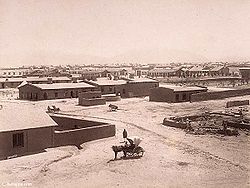 The area was originally inhabited by Kasi Tribe
Pashtun
, the first detailed account of Quetta is from the 11th century when it was captured by Sultan Mahmud Ghaznavi
during one of his invasions of the South Asia. In 1543, the Mughal
emperor Humayun
rested in Quetta on his retreat to Safavid
Persia, leaving his one-year-old son Akbar in the city until his return two years later. The Khan of Kalat
ruled Quetta until 1556, when the Persians conquered the city only to have it retaken by Akbar in 1595. In 1828 the first westerner to visit Quetta described it as a mud-walled fort surrounded by three hundred mud houses. Although the city was occupied briefly in 1839 by the British during the First Afghan War, it was not until 1876 that Quetta became part of the British colonial empire
, with Robert Sandeman
being made the political leader for Balochistan
. The arrival of British troops led to the establishment of road and rail links and the introduction of schools, mainly for strategic purposes.
The British made the largely Pashtun
area part of British Balochistan. In April 1883 it was combined with Pishin
into a single administrative unit.
By the time of the earthquake on 31 May 1935
Quetta had developed into a bustling city with a number of multistory buildings. The epicentre of the earthquake was close to the city and destroyed most of the city's infrastructure and killed an estimated 40,000 people. After many years the city has been rebuilt mainly with local funds. Structures are now generally earthquake resistant, being mainly single story structures with bricks and re-inforced concrete. However multi-story buildings are also built, while the number of buildings of three to five floors are being constructed in the city.
On joining Pakistan
, Quetta was made the capital city of the newly created province of Balochistan
before it was combined with other Balochi
princely states (Kalat, Makran, Lasbela and Kharan) to form the Baloch province
. Quetta remained the capital of the province until 1971 when the provincial system was abolished under Zulfiqar Bhutto. After Bhutto was overthrown by General Zia ul Haq, the provincial system was re-instated, and Quetta was once again made capital of Balochistan
.
(Köppen
BWk) with a significant variation between summer and winter temperatures. Summer starts in late May and goes on until early September with average temperatures ranging from 24–26 °C (75–78 °F).The highest temperature in Quetta is 42 °C (107.6 °F) which was recorded on 10 July 1998. Autumn starts in late September and continues until mid-November with average temperatures in the 12–18 °C (55–65 °F) range. Winter starts in late November and ends in late March, with average temperatures near 4–5 °C (39–41 °F).The lowest temperature in Quetta is -18.3 C which was recorded on 8 January 1970. Spring starts in early April and ends in late May, with average temperatures close to 15 °C (60 °F). Unlike most of Pakistan, Quetta does not have a monsoon season of sustained, heavy rainfall. Highest rainfall during 24 hours in Quetta is 113 millimetres (4.4 in) which was recorded on 17 December 2000., Highest monthly rainfall is 232.4 millimetres (9.1 in) which was recorded in March, 1982. and the highest annual rainfall is 949.8 millimetres (37.4 in) recorded in 1982. In the winter snow is the principle mode of precipitation with snow falling mostly in the months of December, January and February.
The city saw a severe drought from 1999 to 2001, during the drought the city didn't received snowfall and received below normal rains. While in 2003 the city received snowfall after a long period of five years. In 2004, and 2005 the city received normal rains after three years with snowfall while in 2006, 2007 and 2009 the city doesn't revived any snow, except 2008 when Quetta received snowfall of four inches in four hours on 29 January 2008. While on 2 February 2008 Quetta received ten inches of snow in just 10 hours. These are the heaviest snowfall for the city in the last ten years. During the winter of 2010 it doesn't received any snowfall and saw below normal rains due to the presence of El-Nino
over Pakistan.
Quetta comprises of approximately 2653 km² (1,024.3 sq mi) and consists of series of valleys which act as a natural fort surrounded on all sides by a number of imposing hills named Chiltan, Takatoo, Murdar and Zarghun. There are no natural boundaries between Quetta and its adjoining districts of Dera Ismail Khan
to the northeast, Dera Ghazi Khan
and Sibi
to the east, Sukkur
and Jacobabad
to the southeast, Karachi
and Gawadar to the south and Ziarat
to the southwest. The closest major city is Kandahar
in Afghanistan which is located to the west of the Quetta.
, and divided into two towns Each town in turn consists of a group of union councils (U.C.'s).:
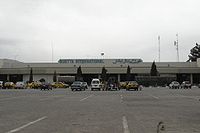 At an altitude of 1,605 metres (5,260 ft) above sea level, Quetta Airport is the second highest airport in Pakistan. Pakistan International Airlines
, Shaheen Air International and Airblue
all have regular flights between Quetta and the other major cities of Pakistan including Islamabad
, Gwadar
, Karachi
, Lahore
and Peshawar
while Pakistan International Airlines operates direct flights to Manchester
, Dubai
, New York and other major international airports.
Quetta Railway Station
is one of the highest railway station in Pakistan at 1,676 metres (5,495 ft) above sea level. The railway track was laid in 1890's during the British era to link Quetta with rest of the country. The extensive network of Pakistan Railways
connects Quetta to Karachi in south, by a 863 km (536.2 mi) track, Lahore
in northeast (1,170 km or 727 miles) and Peshawar
further northeast (1,587 km or 986 miles). A metalled road runs alongside the railway that connects Quetta to Karachi via Sibi
, Jacobabad
and Rohri
. A track from the Iran
ian city of Zahedan
links to Quetta via Taftan, Balochistan. Service was temporarily discontinued in 2006 due to unrest in Balochistan
. Since 2008 railway service has come under attack by the Balochs, especially in the Bolan Pass area resulting in the bomb blast on the railway tracks and firing on trains, creating a sense of insecurity amongst the travelling public.
 Recently there has been a proposal to construct a railway track that will link Gawadar to China and Gawadar with Quetta via Kalat. Although the distance from Quetta to Lahore is only 700 km (435 mi), there is no direct track on this route because of the Sulaiman Range that lies in the east of Quetta. All northeast-bound trains for Punjab or the North-West Frontier Province
must first go over 350 km (217.5 mi) south to Rohri
, Sindh (near Sukkur
) before continuing north to Punjab and North-West Frontier Province
.
Quetta is connected by metalled roads to the rest of the country. A recently built road connects it with Karachi through Mastung
, Kalat, Khuzdar
and Lasbela
. Other major roads are Quetta to Karachi following the Sibi
, Jacobabad
, Sukkur
and Hyderabad
route and two roads from Quetta to Lahore
one (the older) via Sibi
, Sukkur
, Rahim Yar Khan, Bahawalpur
and Multan
the other route via Khanozai, Muslimbagh Loralai
, Fort Mondro, Dera Ghazi Khan
and Multan. Quetta is also connected with Afghanistan through Chaman
and to Iran through Mastung
, Nushki
, Dalbandin
and Taftan
.
, which was founded by the British. The city is home to the University of Balochistan
which was established in 1974, the Balochistan University of Information Technology, Engineering and Management Sciences
,[Bolan Medical College] Sardar Bahadur Khan Women's University, the Geological Survey of Pakistan
, the Sandeman Library and two government colleges affiliated with the University of Peshawar
.
(wild sheep), leopards, wolves, hyena
, rabbits, wild cats and porcupines are to be found in the Quetta region. Local birds species include partridge
, warblers, shikra
, the blue rock pigeon, rock nuthatch, golden eagle, sparrows, hawks, falcon
s and bearded vultures. Flora in Quetta is both numerous and rare. A total of 225 species have been identified in the area including pistachios, juniper
, wild olives, wild ash and wild almonds. Also found are a wide range of shrubs including wild fig,barbery
, wild cherry
, makhi and herbs such as ephedra intermadia and gerardiana.
 Quetta is a tourist attraction for foreigners to whom it is advertised as a "thrilling location, full of adventure and enjoyment".
Among the attractions of Quetta are the bazaars located on the Shahrah-e-Liaquat (Liaquat Bazaar and Suraj Gang Bazaar and Shahrah-e-Iqbal (Kandahari Bazaar). In bazaars the colourful handicrafts, particularly Balochi mirror work and Pashtun embroidery
both of which are admired world-wide. Afghan rug
s, fur coats, embroidered jackets, waist-coats, sandals and other traditional Pashtun items are also famous.
Balochi carpets are made by the nomadic tribes of the area. They are generally not nearly as fine or expensive as either the Persian city products or even the Turkoman tribal rugs from further north, but they are generally more authentic than the copies of Turkoman and Persian designs often found in the major cities of Pakistan. The rugs range in price and size, from lower priced crude examples to fine and valuable pieces. Many are small enough to be portable.
For those interested in local cuisine, there are many dishes to try. The famous Balochi Saji and other Balochi Trible delicious dishes are locally available at various spots of city especially at Prince Road, Jinnah Road, Serena Hotles. The famous Pashtun tribal cuisine “Roash” which non-locals call “Namkin” is to be found in both city restaurants as well as in the outlying areas. Some of the finest mutton in the country is raised around Quetta and is a mainstay of local cuisine. The Pashtun tribal dish, “Landhi”, is made of a whole lamb which is dried and kept fresh during the cold winters. "Khadi Kebab" is a lamb barbecue while "Sajji" (leg of lamb) and "Pulao" are other local dishes. The best restaurants are Usmania, Tabaq, Green Hotel, Gulab Hotel, Lal Kabab, and the Abasin Hotel all of which serve both Pakistani and western food while the Cafe China is one of the oldest and most reputable Chinese restaurants. A number of small hotels located along Alamdar road provide accommodation for tourists.
Hanna Lake
, which nestles in the hills ten kilometres (six miles) east of the city, is a startling turquoise pool which contrasts markedly with its bare brown surroundings. An attraction for holidaymakers, with facilities for boat hire and a lakeside restaurant it is crowded by hikers and campers in holiday periods. At one end there is an irrigation dam while on the eastern shore line there is Hayat Durrani Water Sports Academy, the only water sports training center in Balochistan Province. The Hana Lake Development Authority, the Hayat Durrani Water Sports Academy and Merck Marker (Pvt.) Ltd have planted a range of trees in the Hanna Lake Mountains both for beautification and the protection of the environment.
The Hazarganji Chiltan National Park
, 20 km (12.4 mi) south-west of Quetta, Markhors is a protected park area. The name of the park, "Hazarganji" literally means "Of a thousand treasures" is spread over 32500 acres (131.5 km²) at an altitude ranging from 2,021 to 3,264 metres (5,625 to 10,700 feet). In the folds of the mountains, according to legend, there are over a thousand treasures buried, reminders of the passage over the ages of great armies including the Bactria
ns, the Scythians, the Muslims, and the Mongols. Pir Ghaib is a waterfall and picnic point located 70 km from the Quetta City in hisotric Bolan valley. Kharkhasa is located 10 km (6.2 mi) west of Quetta in a 16 km (9.9 mi) long narrow valley which contains a variety of flora and fauna species. The Chiltan Hill Viewpoint in the park provides a panoramic view over the city. A visit to the nearby cities of Kirani
and Ziarat
are popular scenic places for tourists travelling to and from Quetta.
The Quetta Geological Museum, located on Sariab Road has a collection of rocks and fossils found in Balochistan. The Command and Staff College Museum is a museum dedicated to British military history. It is housed in the former bungalow of Field Marshal Bernard Montgomery. The Quetta Archaeological Museum, located on Fifa Road has a collection of rare antique guns, swords, manuscripts and a display of Stone Age tools, prehistoric pottery and articles found in Mehrgarh. There are also coins, manuscripts and photos of Quetta before the 1935 earthquake. The Balochistan Arts Council Library is a newly opened facility which houses a variety of arts and crafts from Balochistan province.
A number of cultural and religious festivals are held in the city every year. The two Eid festivals which mark the end of fasting and the end of the Hajj allow the majority Muslim community to put on musical shows, distribute sweets and presents. Buzkashi
is a peculiar festival celebrated by Pashtuns in which two teams on horse-back attempt to snatch a goat from each other.
in mid of 19th century. The city in general is dominated by Pashtun
People followed by Baloch
with Hazaras, Punjabi
and others as the minority groups.There are many Hindkowans in Quette and there number is estimated about 5,000. Balochistan Education Minsiter Mr. Tahir Ahmed Khan belongs to Hindko community his Shaheed brother Shafiq Ahmed Khan wwho was also education minister was killed by miscreants and now this responsibility is being shared by tahir Ahmed Khan.Prominent Businessman and preacher Late Peer Ali Shah was also from Hindko community, he was brother in law of Dr.Syed Mehboob, prominent Urdu,English and Hindko writer.
Pashto
is the main language spoken throughout the city. Other languages include Brahui, Balochi
, Urdu
, Hazaragi, Sindhi
, and Punjabi
. The city has expanded from a population of just 11,000 in 1891 to a total of between 565,137 to 676,941 according to the 1998 census which makes it the ninth biggest city in Pakistan. After the invasion of Afghanistan by the Soviet Red Army, approximately ten million Afghans migrated to Pakistan, out of which almost four million still reside in Quetta Kuchlak, Killa Abdullah, Chaman, Pishin, Noshki, Zhob, Loarali, Muslibagh and Ziarat. According to an UNHCR survey, some Afghans returned to Afghanistan through the UNHCR
,, but the following season returned back as they had unlawfully obtained Pakistani National Identity Cards, owned the properties even himself merging to local Pashtun tribes, which will be very harmful to the respective areas in long way as the local Pashtun community were already facing difficulties with other migrants, who arrived before the recent surge of Afghan refugees, as local Pashtun society had not yet accepted them, referring to them as Afghani Khorasani.
About 99% of the people are Muslims, that includes the majority Sunni
sect and the minority Hazaras Shias . Christian, Hindu
, and Sikh
population are the other people living in the city.
, Afghan Football, Hazara Green Football, Baluch Football and Quetta Bazigars Club. In cricket
, Quetta is home to the Quetta Bears
.
In field hockey
, Quetta has produced Zeeshan Ashraf
and Shakeel Abbasi
, who are current members of the Pakistan national field hockey team. In mountain climbing and caving
, Hayatullah Khan Durrani
(Pride of Performance
), the chief executive of Hayat Durrani Water Sports Academy at Hanna Lake. In Kayaking
, Muhammad Abubakar Durrani, National Junior Champion was selected for the world Junior Canoeing Championship in 2009 in Moscow. In Boxing
Olympians from Quetta include: Shaheed Syed Agha Ibrar Hazara killed by LeJ, Abdul Salam Khan Kakar, Asghar Ali Changezi and Haider Ali Changezi. Weight lifting Dilawar Khan Khilji, Mohammad Rafiq Khan Khilji and Mohammad Alam Khan Kakar were the famous weightlifters.
In squash
, Hiddy Jahan Khan was ranked among the top-6 players in the world from 1970 through to 1986. British Open champion Qamer Zaman also hails from Quetta. Other famous squash players include: Zarak Jahan Khan, Abdul Wali Khan Khilji, Hamayoon Khan Khilji, Zubair Jahan Khan, Shams ul Islam Khan Kakar, Tariq Rahim Khan Kakar and Shaied Zaman Khan. The Shaheed Nauoroz Stadium is the largest stadium in the city and the site of international cricket and football matches. The city also has Ayub National Stadium
, a multipurpose stadium used for football and cricket.
Subdivisions of Pakistan
The administrative units of Pakistan consist of four provinces, one federal capital territory, and a group of federally-administered tribal areas...
capital of the Balochistan
Balochistan (Pakistan)
Balochistan is one of the four provinces or federating units of Pakistan. With an area of 134,051 mi2 or , it is the largest province of Pakistan, constituting approximately 44% of the total land mass of Pakistan. According to the 1998 population census, Balochistan had a population of...
Province of Pakistan
Pakistan
Pakistan , officially the Islamic Republic of Pakistan is a sovereign state in South Asia. It has a coastline along the Arabian Sea and the Gulf of Oman in the south and is bordered by Afghanistan and Iran in the west, India in the east and China in the far northeast. In the north, Tajikistan...
. Known as the "Fruit Garden of Pakistan" due to the diversity of its plant and animal wildlife, Quetta is home to the Hazarganji Chiltan National Park
Hazarganji-Chiltan National Park
Hazarganji Chiltan National Park, is a national park of Balochistan, Pakistan. -External links:* کوہ چلتن* *...
, which contains some of the rarest species of wildlife in the world.
The city is situated at an average elevation of 1,654 metres (5,429 ft) above sea level, making it Pakistan's only high-altitude major city. The city is in a seismically active area , and was levelled by the 1935 Balochistan earthquake
1935 Balochistan earthquake
The 1935 Balochistan Earthquake occurred on May 31, 1935 at 3:02am at Quetta, Balochistan, British India . The earthquake had a magnitude of 7.7 Mw and anywhere between 30,000 and 60,000 people died from the impact. This ranks as one of the deadliest earthquakes that hit South Asia...
. The city is home to the Geological Survey of Pakistan
Geological Survey of Pakistan
The Geological Survey of Pakistan is Pakistan's central engineering agency in charge of mapping and surveying. It was established in 1947 in Quetta, Balochistan, is one of the research institutes of Pakistan. It is the organizational successor to the UK Ordnance Survey in that part of the world...
on account of the city's seismic activity.
Quetta sits near the Durand Line
Durand Line
The Durand Line refers to the porous international border between Pakistan and Afghanistan, which has divided the ethnic Pashtuns . This poorly marked line is approximately long...
border with Afghanistan
Afghanistan
Afghanistan , officially the Islamic Republic of Afghanistan, is a landlocked country located in the centre of Asia, forming South Asia, Central Asia and the Middle East. With a population of about 29 million, it has an area of , making it the 42nd most populous and 41st largest nation in the world...
and is an important trade and communications centre between the two countries as well as an important military location occupying a vital strategic position for the Pakistani Armed Forces. The city lies on the Bolan Pass
Bolan Pass
The Bolan Pass is a mountain pass through the Toba Kakar Range of Balochistan province in western Pakistan, 120 kilometres from the Afghanistan border....
route which was once the only gateway to and from South Asia. Due to its proximity to Afghanistan and Central Asia, the city is a major stronghold along the western frontier of the country.
Etymology
Quetta is also spelled Kuwatah which is a variation of Kot, a PashtoPashto language
Pashto , known as Afghani in Persian and Pathani in Punjabi , is the native language of the indigenous Pashtun people or Afghan people who are found primarily between an area south of the Amu Darya in Afghanistan and...
word meaning "fortress." It is believed the city's name is derived from the four imposing hills (Chiltan
Koh-i-Chiltan
Koh-i-Chiltan is a peak located in Quetta, Balochistan, Pakistan. Lwarrh Saar is the highest peak of Chiltan range at , it is the third highest peak of Quetta after Zarghoon Ghar and Koh-i-Takatu and fifth highest peak of Balochistan.- Chiltan Mount :...
, Takatu
Koh-i-Takatu
Koh-i-Takatu is a peak located in Quetta, Balochistan, Pakistan. The highest peak of the range is Loai Saar at , it is the second highest peak of Quetta and third highest peak of Balochistan.-External links:* *...
, Zarghoon
Koh-i-Zarghoon
Zarghoon Ghar is a peak located in Quetta, Balochistan, Pakistan. The zarghoon range's highest peak is Loy Saar Naikan, at 3,578 meters while the second highest peak is Kuchnai Saar, at 3,404 meters . At , Zarghoon Ghar is the highest peak of Baluchistan and Quetta.-External links:* *...
and Murdaar
Koh-i-Murdaar
Koh-i-Murdaar is a peak located in Quetta, Balochistan, Pakistan. Salore Ghasha is the highest peak of Murdaar range. At , it is the fourth highest peak of Quetta and sixth highest peak of Balochistan.-External links:* *...
) that surround the city and form a natural bulwark.
History
Kasi tribe
The Kasi are a Pashtun tribe, primarily found in the Pakistani city of Quetta, as well as in Iran, Palestine, Iraq and Afghanistan.-The Pashtun family tree:...
Pashtun
Pashtun people
Pashtuns or Pathans , also known as ethnic Afghans , are an Eastern Iranic ethnic group with populations primarily between the Hindu Kush mountains in Afghanistan and the Indus River in Pakistan...
, the first detailed account of Quetta is from the 11th century when it was captured by Sultan Mahmud Ghaznavi
Mahmud of Ghazni
Mahmud of Ghazni , actually ', was the most prominent ruler of the Ghaznavid dynasty who ruled from 997 until his death in 1030 in the eastern Iranian lands. Mahmud turned the former provincial city of Ghazni into the wealthy capital of an extensive empire which covered most of today's Iran,...
during one of his invasions of the South Asia. In 1543, the Mughal
Mughal Empire
The Mughal Empire , or Mogul Empire in traditional English usage, was an imperial power from the Indian Subcontinent. The Mughal emperors were descendants of the Timurids...
emperor Humayun
Humayun
Nasir ud-din Muhammad Humayun was the second Mughal Emperor who ruled present day Afghanistan, Pakistan, and parts of northern India from 1530–1540 and again from 1555–1556. Like his father, Babur, he lost his kingdom early, but with Persian aid, he eventually regained an even larger one...
rested in Quetta on his retreat to Safavid
Safavid dynasty
The Safavid dynasty was one of the most significant ruling dynasties of Iran. They ruled one of the greatest Persian empires since the Muslim conquest of Persia and established the Twelver school of Shi'a Islam as the official religion of their empire, marking one of the most important turning...
Persia, leaving his one-year-old son Akbar in the city until his return two years later. The Khan of Kalat
Khan of Kalat
Khan of Kalat or Khan-e-Qalat is the title of former rulers of State of Kalat. Kalat state is now part of Balochistan, Pakistan. The rulers in Kalat were always subject to the political authority of a larger state, after the Mongol invasion they were subject to the Mughal emperors in Delhi, then...
ruled Quetta until 1556, when the Persians conquered the city only to have it retaken by Akbar in 1595. In 1828 the first westerner to visit Quetta described it as a mud-walled fort surrounded by three hundred mud houses. Although the city was occupied briefly in 1839 by the British during the First Afghan War, it was not until 1876 that Quetta became part of the British colonial empire
British Empire
The British Empire comprised the dominions, colonies, protectorates, mandates and other territories ruled or administered by the United Kingdom. It originated with the overseas colonies and trading posts established by England in the late 16th and early 17th centuries. At its height, it was the...
, with Robert Sandeman
Robert Sandeman
Robert Sandeman may refer to:*Robert Sandeman , whose teachings became known as Sandemanianism*Robert Groves Sandeman , Indian officer and administrator...
being made the political leader for Balochistan
Balochistan (Pakistan)
Balochistan is one of the four provinces or federating units of Pakistan. With an area of 134,051 mi2 or , it is the largest province of Pakistan, constituting approximately 44% of the total land mass of Pakistan. According to the 1998 population census, Balochistan had a population of...
. The arrival of British troops led to the establishment of road and rail links and the introduction of schools, mainly for strategic purposes.
The British made the largely Pashtun
Pashtun people
Pashtuns or Pathans , also known as ethnic Afghans , are an Eastern Iranic ethnic group with populations primarily between the Hindu Kush mountains in Afghanistan and the Indus River in Pakistan...
area part of British Balochistan. In April 1883 it was combined with Pishin
Pishin
Pishin is a small town located in the Pishin District of Balochistan province, Pakistan. It is the capital of the district, and is located in the east of the province at 30°35'0N 67°0'0E near the border with Afghanistan with an altitude of 1555 metres . Tremors from the 2008 Pakistan earthquake...
into a single administrative unit.
By the time of the earthquake on 31 May 1935
1935 Balochistan earthquake
The 1935 Balochistan Earthquake occurred on May 31, 1935 at 3:02am at Quetta, Balochistan, British India . The earthquake had a magnitude of 7.7 Mw and anywhere between 30,000 and 60,000 people died from the impact. This ranks as one of the deadliest earthquakes that hit South Asia...
Quetta had developed into a bustling city with a number of multistory buildings. The epicentre of the earthquake was close to the city and destroyed most of the city's infrastructure and killed an estimated 40,000 people. After many years the city has been rebuilt mainly with local funds. Structures are now generally earthquake resistant, being mainly single story structures with bricks and re-inforced concrete. However multi-story buildings are also built, while the number of buildings of three to five floors are being constructed in the city.
On joining Pakistan
Pakistan
Pakistan , officially the Islamic Republic of Pakistan is a sovereign state in South Asia. It has a coastline along the Arabian Sea and the Gulf of Oman in the south and is bordered by Afghanistan and Iran in the west, India in the east and China in the far northeast. In the north, Tajikistan...
, Quetta was made the capital city of the newly created province of Balochistan
Balochistan (Pakistan)
Balochistan is one of the four provinces or federating units of Pakistan. With an area of 134,051 mi2 or , it is the largest province of Pakistan, constituting approximately 44% of the total land mass of Pakistan. According to the 1998 population census, Balochistan had a population of...
before it was combined with other Balochi
Baloch people
The Baloch or Baluch are an ethnic group that belong to the larger Iranian peoples. Baluch people mainly inhabit the Balochistan region and Sistan and Baluchestan Province in the southeast corner of the Iranian plateau in Western Asia....
princely states (Kalat, Makran, Lasbela and Kharan) to form the Baloch province
Balochistan (Pakistan)
Balochistan is one of the four provinces or federating units of Pakistan. With an area of 134,051 mi2 or , it is the largest province of Pakistan, constituting approximately 44% of the total land mass of Pakistan. According to the 1998 population census, Balochistan had a population of...
. Quetta remained the capital of the province until 1971 when the provincial system was abolished under Zulfiqar Bhutto. After Bhutto was overthrown by General Zia ul Haq, the provincial system was re-instated, and Quetta was once again made capital of Balochistan
Balochistan (Pakistan)
Balochistan is one of the four provinces or federating units of Pakistan. With an area of 134,051 mi2 or , it is the largest province of Pakistan, constituting approximately 44% of the total land mass of Pakistan. According to the 1998 population census, Balochistan had a population of...
.
Geography and climate
Quetta has a desert climateDesert climate
A desert climate , also known as an arid climate, is a climate that does not meet the criteria to be classified as a polar climate, and in which precipitation is too low to sustain any vegetation at all, or at most a very scanty scrub.An area that features this climate usually experiences less than...
(Köppen
Köppen climate classification
The Köppen climate classification is one of the most widely used climate classification systems. It was first published by Crimea German climatologist Wladimir Köppen in 1884, with several later modifications by Köppen himself, notably in 1918 and 1936...
BWk) with a significant variation between summer and winter temperatures. Summer starts in late May and goes on until early September with average temperatures ranging from 24–26 °C (75–78 °F).The highest temperature in Quetta is 42 °C (107.6 °F) which was recorded on 10 July 1998. Autumn starts in late September and continues until mid-November with average temperatures in the 12–18 °C (55–65 °F) range. Winter starts in late November and ends in late March, with average temperatures near 4–5 °C (39–41 °F).The lowest temperature in Quetta is -18.3 C which was recorded on 8 January 1970. Spring starts in early April and ends in late May, with average temperatures close to 15 °C (60 °F). Unlike most of Pakistan, Quetta does not have a monsoon season of sustained, heavy rainfall. Highest rainfall during 24 hours in Quetta is 113 millimetres (4.4 in) which was recorded on 17 December 2000., Highest monthly rainfall is 232.4 millimetres (9.1 in) which was recorded in March, 1982. and the highest annual rainfall is 949.8 millimetres (37.4 in) recorded in 1982. In the winter snow is the principle mode of precipitation with snow falling mostly in the months of December, January and February.
The city saw a severe drought from 1999 to 2001, during the drought the city didn't received snowfall and received below normal rains. While in 2003 the city received snowfall after a long period of five years. In 2004, and 2005 the city received normal rains after three years with snowfall while in 2006, 2007 and 2009 the city doesn't revived any snow, except 2008 when Quetta received snowfall of four inches in four hours on 29 January 2008. While on 2 February 2008 Quetta received ten inches of snow in just 10 hours. These are the heaviest snowfall for the city in the last ten years. During the winter of 2010 it doesn't received any snowfall and saw below normal rains due to the presence of El-Nino
El Niño-Southern Oscillation
El Niño/La Niña-Southern Oscillation, or ENSO, is a quasiperiodic climate pattern that occurs across the tropical Pacific Ocean roughly every five years...
over Pakistan.
Quetta comprises of approximately 2653 km² (1,024.3 sq mi) and consists of series of valleys which act as a natural fort surrounded on all sides by a number of imposing hills named Chiltan, Takatoo, Murdar and Zarghun. There are no natural boundaries between Quetta and its adjoining districts of Dera Ismail Khan
Dera Ismail Khan
Dera Ismail Khan is a city in Khyber-Pakhtunkhwa Province, Pakistan. It is situated on the west bank of the Indus River, west of Lahore and northwest of Multan. The city is the capital of the district and tehsil of the same name. In Pakistan, its name is often abbreviated to D. I...
to the northeast, Dera Ghazi Khan
Dera Ghazi Khan
Dera Ghazi Khan is a city located in Dera Ghazi Khan District, Punjab, Pakistan. Dera Ghazi Khan is one of the most populous cities in Southern Punjab, and it is the largest district in Punjab in terms of area, being approximately in extent....
and Sibi
Sibi
Sibi is a city of Balochistan province of Pakistan. The city is located at 29°33'0N 67°52'60E at an altitude of 130 metres and is headquarters of the district and tehsil of the same name.. According to the 2001 census of Pakistan the population of Sibi is 52,100...
to the east, Sukkur
Sukkur
Sukkur, or Sakharu , formerly Aror and Bakar, is the third largest city of Sindh province, situated on the west bank of Indus River in Pakistan in Sukkur District. However, the word Sakharu in Sindhi means "superior", which the spelling of the city's name in Sindhi suggests is the origin of the...
and Jacobabad
Jacobabad
Jacobabad or Yaqubabad is the capital city of Jacobabad District, Sindh, Pakistan. The city is also the administrative centre of Jacobabad Taluka, an administrative subdivision of the district, the city is subdivided into 8 Union Councils...
to the southeast, Karachi
Karachi
Karachi is the largest city, main seaport and the main financial centre of Pakistan, as well as the capital of the province of Sindh. The city has an estimated population of 13 to 15 million, while the total metropolitan area has a population of over 18 million...
and Gawadar to the south and Ziarat
Ziarat
Ziarat is the capital of Ziarat District, Balochistan, Pakistan. It is located at 30°22'47N 67°43'38E with an altitude of 2543 metres and is a famous holiday resort of Balochistan and nearly every trip from Karachi to Quetta stops at Ziarat...
to the southwest. The closest major city is Kandahar
Kandahar
Kandahar is the second largest city in Afghanistan, with a population of about 512,200 as of 2011. It is the capital of Kandahar Province, located in the south of the country at about 1,005 m above sea level...
in Afghanistan which is located to the west of the Quetta.
Government and Politics
Under the latest revision of Pakistan's administrative structure, promulgated in 2001, Quetta was restructured as a City DistrictCity Districts of Pakistan
A City District in Pakistan is a district that consists primarily or entirely of a major city or large metropolitan area. While there are 117 Districts, there are only ten City Districts...
, and divided into two towns Each town in turn consists of a group of union councils (U.C.'s).:
Transport
Quetta is on the western edge of Pakistan and is well connected to the rest of the country by a network of roads, railways and airways.Pakistan International Airlines
Pakistan International Airlines Corporation commonly known as PIA, is the flag carrier airline of Pakistan. The airline has its head office on the grounds of Jinnah International Airport in Karachi. and operates scheduled services to 24 domestic destinations and 38 international destinations in 27...
, Shaheen Air International and Airblue
Airblue
Airblue Limited is a private airline with its head office on the 12th floor of the Islamabad Stock Exchange Towers in Islamabad, Pakistan. It is Pakistan's second largest airline with over 20% share of the domestic market...
all have regular flights between Quetta and the other major cities of Pakistan including Islamabad
Islamabad
Islamabad is the capital of Pakistan and the tenth largest city in the country. Located within the Islamabad Capital Territory , the population of the city has grown from 100,000 in 1951 to 1.7 million in 2011...
, Gwadar
Gwadar
Gwadar also known as Godar is a developing port city on the southwestern Arabian Sea coast of Pakistan. It is the district headquarters of Gwadar District in Balochistan province and has a population of approximately 50,000.Gwadar is strategically located at the apex of the Arabian Sea and at the...
, Karachi
Karachi
Karachi is the largest city, main seaport and the main financial centre of Pakistan, as well as the capital of the province of Sindh. The city has an estimated population of 13 to 15 million, while the total metropolitan area has a population of over 18 million...
, Lahore
Lahore
Lahore is the capital of the Pakistani province of Punjab and the second largest city in the country. With a rich and fabulous history dating back to over a thousand years ago, Lahore is no doubt Pakistan's cultural capital. One of the most densely populated cities in the world, Lahore remains a...
and Peshawar
Peshawar
Peshawar is the capital of Khyber-Pakhtunkhwa and the administrative center and central economic hub for the Federally Administered Tribal Areas of Pakistan....
while Pakistan International Airlines operates direct flights to Manchester
Manchester
Manchester is a city and metropolitan borough in Greater Manchester, England. According to the Office for National Statistics, the 2010 mid-year population estimate for Manchester was 498,800. Manchester lies within one of the UK's largest metropolitan areas, the metropolitan county of Greater...
, Dubai
Dubai
Dubai is a city and emirate in the United Arab Emirates . The emirate is located south of the Persian Gulf on the Arabian Peninsula and has the largest population with the second-largest land territory by area of all the emirates, after Abu Dhabi...
, New York and other major international airports.
Quetta Railway Station
Quetta Railway Station
Quetta Railway Station is located in middle of the Quetta, Balochistan, Pakistan. Quetta is connected to Lahore by a 727 miles long railway line. Similarly, it is also connected by rail with Peshawar and Karachi...
is one of the highest railway station in Pakistan at 1,676 metres (5,495 ft) above sea level. The railway track was laid in 1890's during the British era to link Quetta with rest of the country. The extensive network of Pakistan Railways
Pakistan Railways
This article is about the rail company in Pakistan. For technical details and operations see: Transport in Pakistan.Pakistan Railways is a national state-owned rail transport service of Pakistan, head-quartered in Lahore. It is administered by the federal government under the Ministry of Railways....
connects Quetta to Karachi in south, by a 863 km (536.2 mi) track, Lahore
Lahore
Lahore is the capital of the Pakistani province of Punjab and the second largest city in the country. With a rich and fabulous history dating back to over a thousand years ago, Lahore is no doubt Pakistan's cultural capital. One of the most densely populated cities in the world, Lahore remains a...
in northeast (1,170 km or 727 miles) and Peshawar
Peshawar
Peshawar is the capital of Khyber-Pakhtunkhwa and the administrative center and central economic hub for the Federally Administered Tribal Areas of Pakistan....
further northeast (1,587 km or 986 miles). A metalled road runs alongside the railway that connects Quetta to Karachi via Sibi
Sibi
Sibi is a city of Balochistan province of Pakistan. The city is located at 29°33'0N 67°52'60E at an altitude of 130 metres and is headquarters of the district and tehsil of the same name.. According to the 2001 census of Pakistan the population of Sibi is 52,100...
, Jacobabad
Jacobabad
Jacobabad or Yaqubabad is the capital city of Jacobabad District, Sindh, Pakistan. The city is also the administrative centre of Jacobabad Taluka, an administrative subdivision of the district, the city is subdivided into 8 Union Councils...
and Rohri
Rohri
Rohri is a town of Sukkur District, Sindh province, Pakistan. It is located at 27°40'60N 68°54'0E, on the east bank of the Indus River. Rohri town is the administrative headquarters of Rohri Taluka, a tehsil of Sukkur District with which it forms a metropolitan area...
. A track from the Iran
Iran
Iran , officially the Islamic Republic of Iran , is a country in Southern and Western Asia. The name "Iran" has been in use natively since the Sassanian era and came into use internationally in 1935, before which the country was known to the Western world as Persia...
ian city of Zahedan
Zahedan
Zahedan is a city in and the capital of Sistan and Baluchestan Province, Iran. At the 2006 census, its population was 552,706, in 109,488 families.-Geography:...
links to Quetta via Taftan, Balochistan. Service was temporarily discontinued in 2006 due to unrest in Balochistan
Balochistan (Pakistan)
Balochistan is one of the four provinces or federating units of Pakistan. With an area of 134,051 mi2 or , it is the largest province of Pakistan, constituting approximately 44% of the total land mass of Pakistan. According to the 1998 population census, Balochistan had a population of...
. Since 2008 railway service has come under attack by the Balochs, especially in the Bolan Pass area resulting in the bomb blast on the railway tracks and firing on trains, creating a sense of insecurity amongst the travelling public.
North-West Frontier Province
Khyber Pakhtunkhwa , formerly known as the North-West Frontier Province and various other names, is one of the four provinces of Pakistan, located in the north-west of the country...
must first go over 350 km (217.5 mi) south to Rohri
Rohri
Rohri is a town of Sukkur District, Sindh province, Pakistan. It is located at 27°40'60N 68°54'0E, on the east bank of the Indus River. Rohri town is the administrative headquarters of Rohri Taluka, a tehsil of Sukkur District with which it forms a metropolitan area...
, Sindh (near Sukkur
Sukkur
Sukkur, or Sakharu , formerly Aror and Bakar, is the third largest city of Sindh province, situated on the west bank of Indus River in Pakistan in Sukkur District. However, the word Sakharu in Sindhi means "superior", which the spelling of the city's name in Sindhi suggests is the origin of the...
) before continuing north to Punjab and North-West Frontier Province
North-West Frontier Province
Khyber Pakhtunkhwa , formerly known as the North-West Frontier Province and various other names, is one of the four provinces of Pakistan, located in the north-west of the country...
.
Quetta is connected by metalled roads to the rest of the country. A recently built road connects it with Karachi through Mastung
Mastung
Mastung may refer to:* Mastung District* Mastung Valley* Mastung, Pakistan...
, Kalat, Khuzdar
Khuzdar
Khuzdar or Khozdar is a town located in Khuzdar District in Balochistan, Pakistan. Khuzdar is the capital of Khuzdar District, which was created on 1 March 1974...
and Lasbela
Lasbela (Karachi)
Lasbela neighborhood is located in Jamsheed Town, Karachi, Sindh, Pakistan. The Lasbela bridge is over Lyari River and one of the most important bridges in Karachi.sabri Hotel, Chishti Bakery, Aone Cloth House, Naseem Cloth Market...
. Other major roads are Quetta to Karachi following the Sibi
Sibi
Sibi is a city of Balochistan province of Pakistan. The city is located at 29°33'0N 67°52'60E at an altitude of 130 metres and is headquarters of the district and tehsil of the same name.. According to the 2001 census of Pakistan the population of Sibi is 52,100...
, Jacobabad
Jacobabad
Jacobabad or Yaqubabad is the capital city of Jacobabad District, Sindh, Pakistan. The city is also the administrative centre of Jacobabad Taluka, an administrative subdivision of the district, the city is subdivided into 8 Union Councils...
, Sukkur
Sukkur
Sukkur, or Sakharu , formerly Aror and Bakar, is the third largest city of Sindh province, situated on the west bank of Indus River in Pakistan in Sukkur District. However, the word Sakharu in Sindhi means "superior", which the spelling of the city's name in Sindhi suggests is the origin of the...
and Hyderabad
Hyderabad, Sindh
is the second largest city in the Sindh province of Pakistan. It is the seventh largest city in the country. The city was founded in 1768 by Mian Ghulam Shah Kalhoro upon the ruins of a Mauryan fishing village along the bank of the Indus known as Neroon Kot...
route and two roads from Quetta to Lahore
Lahore
Lahore is the capital of the Pakistani province of Punjab and the second largest city in the country. With a rich and fabulous history dating back to over a thousand years ago, Lahore is no doubt Pakistan's cultural capital. One of the most densely populated cities in the world, Lahore remains a...
one (the older) via Sibi
Sibi
Sibi is a city of Balochistan province of Pakistan. The city is located at 29°33'0N 67°52'60E at an altitude of 130 metres and is headquarters of the district and tehsil of the same name.. According to the 2001 census of Pakistan the population of Sibi is 52,100...
, Sukkur
Sukkur
Sukkur, or Sakharu , formerly Aror and Bakar, is the third largest city of Sindh province, situated on the west bank of Indus River in Pakistan in Sukkur District. However, the word Sakharu in Sindhi means "superior", which the spelling of the city's name in Sindhi suggests is the origin of the...
, Rahim Yar Khan, Bahawalpur
Bahawalpur
Bahawalpur , located in the province of Punjab, is the twelfth largest city in Pakistan. The city was once the capital of the former princely state of Bahawalpur. The city was home to various Nawabs and counted as part of the Rajputana states...
and Multan
Multan
Multan , is a city in the Punjab Province of Pakistan and capital of Multan District. It is located in the southern part of the province on the east bank of the Chenab River, more or less in the geographic centre of the country and about from Islamabad, from Lahore and from Karachi...
the other route via Khanozai, Muslimbagh Loralai
Loralai
Loralai is the principal city of Loralai District in the northeast of the Balochistan Province of Pakistan. It was formerly known as Bori. It is four thousand seven hundred feet above the sea level....
, Fort Mondro, Dera Ghazi Khan
Dera Ghazi Khan
Dera Ghazi Khan is a city located in Dera Ghazi Khan District, Punjab, Pakistan. Dera Ghazi Khan is one of the most populous cities in Southern Punjab, and it is the largest district in Punjab in terms of area, being approximately in extent....
and Multan. Quetta is also connected with Afghanistan through Chaman
Chaman
Chaman is the capital of Qilla Abdullah District, Balochistan, Pakistan. It is situated just south of the border with Afghanistan. Across the border in Afghanistan is the neighbouring town of Spin Boldak, in Kandahar Province...
and to Iran through Mastung
Mastung
Mastung may refer to:* Mastung District* Mastung Valley* Mastung, Pakistan...
, Nushki
Nushki
Nushki , is a town in Balochistan, Pakistan. The town lies southwest of Quetta, and is situated in a plain at the base of the Quetta plateau, 2900 ft above sea level...
, Dalbandin
Dalbandin
Dalbandin is a town and Union council of Balochistan, Pakistan. Dalbandin is famous for fruit orchards.On 19th January, 2011, it was struck by a 7.2 magnitude earthquake. At that time it was a sparsely populated area with a population of 15,000. It is located at 28°52'60N 64°25'0E at an altitude...
and Taftan
Taftan
Taftan may refer to:* Taftan volcano is located in Sistan and Baluchestan province of Iran.* Taftan, Balochistan is a town in Balochistan province of Pakistan.* Taftan is a leavened flour bread from Persian cuisine....
.
Educational institutions
Quetta has a number of institutions of higher education. The prestigious military Command and Staff CollegeCommand and Staff College
The Command and Staff College was established in 1907 at Quetta, Balochistan, British Raj, now in Pakistan, and is the oldest and the most prestigious institution of the Pakistan Army. It was established in 1905 in Deolali and moved to its present location at Quetta in 1907 under the name of Quetta...
, which was founded by the British. The city is home to the University of Balochistan
University of Balochistan
The University of Balochistan was established in 1971 in Quetta, Balochistan, Pakistan. It has more than 6,000 students in one campus, 35 different fields of studies and 5 faculties. according to the Higher Education Commission of Pakistan, the university is 11th best general category university in...
which was established in 1974, the Balochistan University of Information Technology, Engineering and Management Sciences
Balochistan University of Information Technology Engineering and Management Sciences
The Balochistan University of Information Technology, Engineering and Management Sciences is located in Quetta, Balochistan, Pakistan. The government of Balochistan chartered the university on 18 July 2002. The University is intended to be a leading educator in Systems Sciences and in Management...
,[Bolan Medical College] Sardar Bahadur Khan Women's University, the Geological Survey of Pakistan
Geological Survey of Pakistan
The Geological Survey of Pakistan is Pakistan's central engineering agency in charge of mapping and surveying. It was established in 1947 in Quetta, Balochistan, is one of the research institutes of Pakistan. It is the organizational successor to the UK Ordnance Survey in that part of the world...
, the Sandeman Library and two government colleges affiliated with the University of Peshawar
University of Peshawar
The University of Peshawar is a public sector university in the city of Peshawar, Pakistan. The university was established in October 1950 by Mr...
.
Flora and fauna
A wide variety of mammals such as MarkhorMarkhor
The Markhor is a large species of wild goat that is found in northeastern Afghanistan, Pakistan , India, southern Tajikistan and southern Uzbekistan...
(wild sheep), leopards, wolves, hyena
Hyena
Hyenas or Hyaenas are the animals of the family Hyaenidae of suborder feliforms of the Carnivora. It is the fourth smallest biological family in the Carnivora , and one of the smallest in the mammalia...
, rabbits, wild cats and porcupines are to be found in the Quetta region. Local birds species include partridge
Partridge
Partridges are birds in the pheasant family, Phasianidae. They are a non-migratory Old World group.These are medium-sized birds, intermediate between the larger pheasants and the smaller quails. Partridges are native to Europe, Asia, Africa, and the Middle East...
, warblers, shikra
Shikra
The Shikra is a small bird of prey in the family Accipitridae found widely distributed in Asia and Africa where it is also called the Little Banded Goshawk. The African forms may represent a separate species but have usually been considered as subspecies of the Shikra...
, the blue rock pigeon, rock nuthatch, golden eagle, sparrows, hawks, falcon
Falcon
A falcon is any species of raptor in the genus Falco. The genus contains 37 species, widely distributed throughout Europe, Asia, and North America....
s and bearded vultures. Flora in Quetta is both numerous and rare. A total of 225 species have been identified in the area including pistachios, juniper
Juniper
Junipers are coniferous plants in the genus Juniperus of the cypress family Cupressaceae. Depending on taxonomic viewpoint, there are between 50-67 species of juniper, widely distributed throughout the northern hemisphere, from the Arctic, south to tropical Africa in the Old World, and to the...
, wild olives, wild ash and wild almonds. Also found are a wide range of shrubs including wild fig,barbery
Barbery
Barbery may refer to:* Muriel Barbery, French novelist* Barbery, Calvados, France* Barbery, Oise, France...
, wild cherry
Cherry
The cherry is the fruit of many plants of the genus Prunus, and is a fleshy stone fruit. The cherry fruits of commerce are usually obtained from a limited number of species, including especially cultivars of the wild cherry, Prunus avium....
, makhi and herbs such as ephedra intermadia and gerardiana.
Culture
Among the attractions of Quetta are the bazaars located on the Shahrah-e-Liaquat (Liaquat Bazaar and Suraj Gang Bazaar and Shahrah-e-Iqbal (Kandahari Bazaar). In bazaars the colourful handicrafts, particularly Balochi mirror work and Pashtun embroidery
Embroidery
Embroidery is the art or handicraft of decorating fabric or other materials with needle and thread or yarn. Embroidery may also incorporate other materials such as metal strips, pearls, beads, quills, and sequins....
both of which are admired world-wide. Afghan rug
Afghan rug
An Afghan rug is a type of handwoven floor-covering textile traditionally made in Afghanistan. Many of the Afghan rugs are also woven by Afghan refugees who reside in Pakistan and Iran. In any case, Afghan rugs are genuine, often charming — and usually phenomenally inexpensive...
s, fur coats, embroidered jackets, waist-coats, sandals and other traditional Pashtun items are also famous.
Balochi carpets are made by the nomadic tribes of the area. They are generally not nearly as fine or expensive as either the Persian city products or even the Turkoman tribal rugs from further north, but they are generally more authentic than the copies of Turkoman and Persian designs often found in the major cities of Pakistan. The rugs range in price and size, from lower priced crude examples to fine and valuable pieces. Many are small enough to be portable.
For those interested in local cuisine, there are many dishes to try. The famous Balochi Saji and other Balochi Trible delicious dishes are locally available at various spots of city especially at Prince Road, Jinnah Road, Serena Hotles. The famous Pashtun tribal cuisine “Roash” which non-locals call “Namkin” is to be found in both city restaurants as well as in the outlying areas. Some of the finest mutton in the country is raised around Quetta and is a mainstay of local cuisine. The Pashtun tribal dish, “Landhi”, is made of a whole lamb which is dried and kept fresh during the cold winters. "Khadi Kebab" is a lamb barbecue while "Sajji" (leg of lamb) and "Pulao" are other local dishes. The best restaurants are Usmania, Tabaq, Green Hotel, Gulab Hotel, Lal Kabab, and the Abasin Hotel all of which serve both Pakistani and western food while the Cafe China is one of the oldest and most reputable Chinese restaurants. A number of small hotels located along Alamdar road provide accommodation for tourists.
Hanna Lake
Hanna Lake
Hanna Lake is a lake near Quetta city in Pakistan and is one of the main attractions in the city and a reservoir was Constructed by the British Empire....
, which nestles in the hills ten kilometres (six miles) east of the city, is a startling turquoise pool which contrasts markedly with its bare brown surroundings. An attraction for holidaymakers, with facilities for boat hire and a lakeside restaurant it is crowded by hikers and campers in holiday periods. At one end there is an irrigation dam while on the eastern shore line there is Hayat Durrani Water Sports Academy, the only water sports training center in Balochistan Province. The Hana Lake Development Authority, the Hayat Durrani Water Sports Academy and Merck Marker (Pvt.) Ltd have planted a range of trees in the Hanna Lake Mountains both for beautification and the protection of the environment.
The Hazarganji Chiltan National Park
Hazarganji-Chiltan National Park
Hazarganji Chiltan National Park, is a national park of Balochistan, Pakistan. -External links:* کوہ چلتن* *...
, 20 km (12.4 mi) south-west of Quetta, Markhors is a protected park area. The name of the park, "Hazarganji" literally means "Of a thousand treasures" is spread over 32500 acres (131.5 km²) at an altitude ranging from 2,021 to 3,264 metres (5,625 to 10,700 feet). In the folds of the mountains, according to legend, there are over a thousand treasures buried, reminders of the passage over the ages of great armies including the Bactria
Bactria
Bactria and also appears in the Zend Avesta as Bukhdi. It is the ancient name of a historical region located between south of the Amu Darya and west of the Indus River...
ns, the Scythians, the Muslims, and the Mongols. Pir Ghaib is a waterfall and picnic point located 70 km from the Quetta City in hisotric Bolan valley. Kharkhasa is located 10 km (6.2 mi) west of Quetta in a 16 km (9.9 mi) long narrow valley which contains a variety of flora and fauna species. The Chiltan Hill Viewpoint in the park provides a panoramic view over the city. A visit to the nearby cities of Kirani
Kirani
Kirani is an historical village lying five miles west of Quetta city, capital of Baluchistan province of Pakistan on the outskirts of the Chiltan range and is set to derive its name from a defile lying near the village known as Giran Nai, or Kran Tangi...
and Ziarat
Ziarat
Ziarat is the capital of Ziarat District, Balochistan, Pakistan. It is located at 30°22'47N 67°43'38E with an altitude of 2543 metres and is a famous holiday resort of Balochistan and nearly every trip from Karachi to Quetta stops at Ziarat...
are popular scenic places for tourists travelling to and from Quetta.
The Quetta Geological Museum, located on Sariab Road has a collection of rocks and fossils found in Balochistan. The Command and Staff College Museum is a museum dedicated to British military history. It is housed in the former bungalow of Field Marshal Bernard Montgomery. The Quetta Archaeological Museum, located on Fifa Road has a collection of rare antique guns, swords, manuscripts and a display of Stone Age tools, prehistoric pottery and articles found in Mehrgarh. There are also coins, manuscripts and photos of Quetta before the 1935 earthquake. The Balochistan Arts Council Library is a newly opened facility which houses a variety of arts and crafts from Balochistan province.
A number of cultural and religious festivals are held in the city every year. The two Eid festivals which mark the end of fasting and the end of the Hajj allow the majority Muslim community to put on musical shows, distribute sweets and presents. Buzkashi
Buzkashi
Buzkashi or Kok-boru or Oglak Tartis or Ulak Tartysh is a traditional Central Asian...
is a peculiar festival celebrated by Pashtuns in which two teams on horse-back attempt to snatch a goat from each other.
Demography
Quetta was historically part of the Pashtun-dominated later that ( Khan Kalat Empire ) until it was leased to British Empire through a treaty in between Khan of Kalat and British RajBritish Raj
British Raj was the British rule in the Indian subcontinent between 1858 and 1947; The term can also refer to the period of dominion...
in mid of 19th century. The city in general is dominated by Pashtun
Pashtun people
Pashtuns or Pathans , also known as ethnic Afghans , are an Eastern Iranic ethnic group with populations primarily between the Hindu Kush mountains in Afghanistan and the Indus River in Pakistan...
People followed by Baloch
Baloch people
The Baloch or Baluch are an ethnic group that belong to the larger Iranian peoples. Baluch people mainly inhabit the Balochistan region and Sistan and Baluchestan Province in the southeast corner of the Iranian plateau in Western Asia....
with Hazaras, Punjabi
Punjabi people
The Punjabi people , ਪੰਜਾਬੀ ), also Panjabi people, are an Indo-Aryan group from South Asia. They are the second largest of the many ethnic groups in South Asia. They originate in the Punjab region, which has been been the location of some of the oldest civilizations in the world including, the...
and others as the minority groups.There are many Hindkowans in Quette and there number is estimated about 5,000. Balochistan Education Minsiter Mr. Tahir Ahmed Khan belongs to Hindko community his Shaheed brother Shafiq Ahmed Khan wwho was also education minister was killed by miscreants and now this responsibility is being shared by tahir Ahmed Khan.Prominent Businessman and preacher Late Peer Ali Shah was also from Hindko community, he was brother in law of Dr.Syed Mehboob, prominent Urdu,English and Hindko writer.
Pashto
Pashto language
Pashto , known as Afghani in Persian and Pathani in Punjabi , is the native language of the indigenous Pashtun people or Afghan people who are found primarily between an area south of the Amu Darya in Afghanistan and...
is the main language spoken throughout the city. Other languages include Brahui, Balochi
Balochi language
Balochi is a Northwestern Iranian language. It is the principal language of the Baloch of Balochistan, Pakistan, eastern Iran and southern Afghanistan. It is also spoken as a second language by some Brahui. It is designated as one of nine official languages of Pakistan.-Vowels:The Balochi vowel...
, Urdu
Urdu
Urdu is a register of the Hindustani language that is identified with Muslims in South Asia. It belongs to the Indo-European family. Urdu is the national language and lingua franca of Pakistan. It is also widely spoken in some regions of India, where it is one of the 22 scheduled languages and an...
, Hazaragi, Sindhi
Sindhi language
Sindhi is the language of the Sindh region of Pakistan that is spoken by the Sindhi people. In India, it is among 22 constitutionally recognized languages, where Sindhis are a sizeable minority. It is spoken by 53,410,910 people in Pakistan, according to the national government's Statistics Division...
, and Punjabi
Punjabi language
Punjabi is an Indo-Aryan language spoken by inhabitants of the historical Punjab region . For Sikhs, the Punjabi language stands as the official language in which all ceremonies take place. In Pakistan, Punjabi is the most widely spoken language...
. The city has expanded from a population of just 11,000 in 1891 to a total of between 565,137 to 676,941 according to the 1998 census which makes it the ninth biggest city in Pakistan. After the invasion of Afghanistan by the Soviet Red Army, approximately ten million Afghans migrated to Pakistan, out of which almost four million still reside in Quetta Kuchlak, Killa Abdullah, Chaman, Pishin, Noshki, Zhob, Loarali, Muslibagh and Ziarat. According to an UNHCR survey, some Afghans returned to Afghanistan through the UNHCR
United Nations High Commissioner for Refugees
The Office of the United Nations High Commissioner for Refugees , also known as The UN Refugee Agency is a United Nations agency mandated to protect and support refugees at the request of a government or the UN itself and assists in their voluntary repatriation, local integration or resettlement to...
,, but the following season returned back as they had unlawfully obtained Pakistani National Identity Cards, owned the properties even himself merging to local Pashtun tribes, which will be very harmful to the respective areas in long way as the local Pashtun community were already facing difficulties with other migrants, who arrived before the recent surge of Afghan refugees, as local Pashtun society had not yet accepted them, referring to them as Afghani Khorasani.
About 99% of the people are Muslims, that includes the majority Sunni
Sunni Islam
Sunni Islam is the largest branch of Islam. Sunni Muslims are referred to in Arabic as ʾAhl ūs-Sunnah wa āl-Ǧamāʿah or ʾAhl ūs-Sunnah for short; in English, they are known as Sunni Muslims, Sunnis or Sunnites....
sect and the minority Hazaras Shias . Christian, Hindu
Hindu
Hindu refers to an identity associated with the philosophical, religious and cultural systems that are indigenous to the Indian subcontinent. As used in the Constitution of India, the word "Hindu" is also attributed to all persons professing any Indian religion...
, and Sikh
Sikh
A Sikh is a follower of Sikhism. It primarily originated in the 15th century in the Punjab region of South Asia. The term "Sikh" has its origin in Sanskrit term शिष्य , meaning "disciple, student" or शिक्ष , meaning "instruction"...
population are the other people living in the city.
Sports
In Quetta, unlike most of Pakistan, football rather than cricket is the most popular sport. Football teams from Quetta include Quetta ZorawarQuetta Zorawar
Quetta Zorawar is a Football team in Pakistan, Quetta, and they play in the Geo Super Football League. The club is a founding member of the SFL.-2007:...
, Afghan Football, Hazara Green Football, Baluch Football and Quetta Bazigars Club. In cricket
Cricket
Cricket is a bat-and-ball game played between two teams of 11 players on an oval-shaped field, at the centre of which is a rectangular 22-yard long pitch. One team bats, trying to score as many runs as possible while the other team bowls and fields, trying to dismiss the batsmen and thus limit the...
, Quetta is home to the Quetta Bears
Quetta Bears
The Quetta Bears are a Pakistan Super League team, based in Quetta, Balochistan, Pakistan. The team was established in 2006 and its home ground is Ayub National Stadium. The team is one of several proposed franchises for the Pakistan Super League...
.
In field hockey
Field hockey
Field Hockey, or Hockey, is a team sport in which a team of players attempts to score goals by hitting, pushing or flicking a ball into an opposing team's goal using sticks...
, Quetta has produced Zeeshan Ashraf
Zeeshan Ashraf
Zeeshan Ashraf is a field hockey player. He plays full back. He made his international debut for Pakistan in 2001, and competed in the 2006 Commonwealth Games.-Career:...
and Shakeel Abbasi
Shakeel Abbasi
Shakeel Abbasi is an international field hockey player from Pakistan. He plays Centre Forward. He made his international debut for Pakistan in 2003.-2006:...
, who are current members of the Pakistan national field hockey team. In mountain climbing and caving
Caving
Caving—also occasionally known as spelunking in the United States and potholing in the United Kingdom—is the recreational pastime of exploring wild cave systems...
, Hayatullah Khan Durrani
Hayatullah Khan Durrani
Hayatullah Khan Durrani is a Pakistani cave explorer, mountaineer, environmentalist, organizer, and a rescuer. He is also a part-time sports anchor actor in Pakistani Television shows. He played a significant role in the promotion of mountaineering and caving adventure sports in Pakistan,...
(Pride of Performance
Pride of Performance
Pride of Performance , is one of the highest civil award given and conferred by the Pakistan Government to Pakistan's citizens in recognition of distinguished merit in the fields of Literature, Arts, Sports, Medicines, and Science for civilians in most particular cases.The announcement of civil...
), the chief executive of Hayat Durrani Water Sports Academy at Hanna Lake. In Kayaking
Kayaking
Kayaking is the use of a kayak for moving across water. Kayaking and canoeing are also known as paddling. Kayaking is distinguished from canoeing by the sitting position of the paddler and the number of blades on the paddle...
, Muhammad Abubakar Durrani, National Junior Champion was selected for the world Junior Canoeing Championship in 2009 in Moscow. In Boxing
Boxing
Boxing, also called pugilism, is a combat sport in which two people fight each other using their fists. Boxing is supervised by a referee over a series of between one to three minute intervals called rounds...
Olympians from Quetta include: Shaheed Syed Agha Ibrar Hazara killed by LeJ, Abdul Salam Khan Kakar, Asghar Ali Changezi and Haider Ali Changezi. Weight lifting Dilawar Khan Khilji, Mohammad Rafiq Khan Khilji and Mohammad Alam Khan Kakar were the famous weightlifters.
In squash
Squash (sport)
Squash is a high-speed racquet sport played by two players in a four-walled court with a small, hollow rubber ball...
, Hiddy Jahan Khan was ranked among the top-6 players in the world from 1970 through to 1986. British Open champion Qamer Zaman also hails from Quetta. Other famous squash players include: Zarak Jahan Khan, Abdul Wali Khan Khilji, Hamayoon Khan Khilji, Zubair Jahan Khan, Shams ul Islam Khan Kakar, Tariq Rahim Khan Kakar and Shaied Zaman Khan. The Shaheed Nauoroz Stadium is the largest stadium in the city and the site of international cricket and football matches. The city also has Ayub National Stadium
Ayub National Stadium
Ayub National Stadium is a multi-purpose stadium in Quetta, Pakistan. It is used for football and Cricket games. The stadium holds 20,000 people.Most of the friendly matches are hosted in this stadium as it is superior to many other football grounds in Pakistan....
, a multipurpose stadium used for football and cricket.
See also
- 1935 Balochistan earthquake1935 Balochistan earthquakeThe 1935 Balochistan Earthquake occurred on May 31, 1935 at 3:02am at Quetta, Balochistan, British India . The earthquake had a magnitude of 7.7 Mw and anywhere between 30,000 and 60,000 people died from the impact. This ranks as one of the deadliest earthquakes that hit South Asia...
- 2008 Ziarat earthquake2008 Pakistan earthquakeThe 2008 Pakistan earthquake was a magnitude Mw 6.4 earthquake that hit the Pakistani province of Balochistan on October 29, 2008. The US Geological Survey reported that the quake occurred north of Quetta and southeast of the Afghanistan city of Kandahar at 04:09 local time at a depth of , at...
- KiraniKiraniKirani is an historical village lying five miles west of Quetta city, capital of Baluchistan province of Pakistan on the outskirts of the Chiltan range and is set to derive its name from a defile lying near the village known as Giran Nai, or Kran Tangi...
- ZhobZhob-Roads:Zhob is 333 kilometers from Quetta, 225 kilometers from Dera Ismail Khan. However, the road linking with Dera Ismail Khan is for most part fair nowadays track passing through water streams and almost complete road is metalloid....
- ZiaratZiaratZiarat is the capital of Ziarat District, Balochistan, Pakistan. It is located at 30°22'47N 67°43'38E with an altitude of 2543 metres and is a famous holiday resort of Balochistan and nearly every trip from Karachi to Quetta stops at Ziarat...
- Hazara townHazara townHazara Town is a lower- to middle-income area on the west of Quetta city with a population of up to 70,000, of which an approximately one-third are Hazara with minority Baloch and Pathan tribe on south of Hazara town. Hazara Town begins from Brewery Road near Bolan Medical College and continue to...
- Mehrabad Alamdar RoadMehrabad Alamdar RoadMehr Abad is an inner eastern suburb of Quetta, Balochistan, located next to City. The majority of the population is Hazara people...
- Quetta ShuraQuetta ShuraThe Quetta Shura is a militant organization composed of top leadership of the Afghan Taliban, that is believed to be based since about 2001 in the city of Quetta in the Balochistan province of Pakistan. The Shura was formed after the Islamic Emirate of Afghanistan was toppled in late 2001 and the...