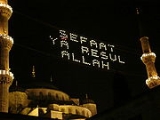
|
|
|
|
Ramadan
|
| |
|
| |
Rama?an (also written Ramazan, Ramzan, Ramadhan, Ramdan, Ramadaan) is an Islamic religious observance that takes place during the ninth month of the Islamic calendar; the month in which the Qur'an was revealed to the Prophet Muhammad. It is the Islamic month of fasting, in which participating Muslims do not eat or drink anything from true dawn until sunset. Fasting is meant to teach the person patience, sacrifice and humility.

Discussion
Ask a question about 'Ramadan'
Start a new discussion about 'Ramadan'
Answer questions from other users
|
Recent Posts

Encyclopedia
Rama?an (also written Ramazan, Ramzan, Ramadhan, Ramdan, Ramadaan) is an Islamic religious observance that takes place during the ninth month of the Islamic calendar; the month in which the Qur'an was revealed to the Prophet Muhammad. It is the Islamic month of fasting, in which participating Muslims do not eat or drink anything from true dawn until sunset. Fasting is meant to teach the person patience, sacrifice and humility. Rama?an is a time to fast for the sake of God, and to offer more prayer than usual. During Rama?an, Muslims ask forgiveness for past sins, pray for guidance and help in refraining from everyday evils, and try to purify themselves through self-restraint and good deeds.
Name origin
The name "Rama?an" is the name of the ninth month; the word itself derived from an Arabic root , as in words like "" or "" denoting intense heat, scorched ground and shortness of rations. It is the most venerated month of the Islamic year. Prayers, fasting, charity and self-accountability are especially stressed at this time; religious observances associated with Rama?an are kept throughout the month.
Laylat al-Qadr, considered the most holy night of the year, is the night in which the Qur'an was revealed to Muhammed, the Night of the Power. Muslims believe it to have occurred on an odd-numbered night during the last 10 days of Rama?an, either the night of the 21st, 23rd, 25th, 27th or 29th (in Sunni thought) or the 19th, 21st or 23rd (in Shi'a thought). Rama?an ends with Eid ul-Fitr, with much celebration and feasts. During the month following Rama?an, called Shawwal, Muslims are encouraged to fast for a further six days, known as as-Sitta al-Bay?, or "the white six."
Practices during Rama?an
Fasting
The most prominent event of this month is fasting. Every day during the month of Ramadan, Muslims around the world get up before dawn to eat Suhoor, the pre-dawn meal, and perform the fajr prayer. They have to stop eating and drinking before the call for prayer starts until the fourth prayer of the day, Maghrib. Muslims may continue to eat and drink after the sun has set until the next morning's fajr prayer call. Then the process starts all over.
Ramadan is a time of reflecting and worshiping god. Muslims are expected to put more effort into following the teachings of Islam and to avoid obscene and irreligious sights and sounds. Sexual thoughts and activities during fasting hours are also forbidden. Purity of both thought and action is important. The fast is intended to be an exacting act of deep personal worship in which Muslims seek a raised level of closeness to god.
The act of fasting is said to redirect the heart away from worldly activities, its purpose being to cleanse the inner soul and free it from harm. Properly observing the fast is supposed to induce a comfortable feeling of peace and calm. It also allows Muslims to practice self-discipline, self-control, sacrifice, and sympathy for those who are less fortunate. It is also intended to make Muslims more generous and charitable. A certain level of self-control can be lost by those who suffer from eating disorders.
The elderly, the chronically ill and the insane are exempt from fasting, although the first two groups must endeavor to feed one poor person each day in place of their missed fasting. Also exempt are pregnant women, women during the period of their menstruation, and women nursing their newborns, all of whom must make up the days they miss at a later date. While fasting is not considered compulsory in childhood, many children endeavor to complete as many fasts as possible as practice for later life. Lastly, those traveling are exempt, but must make up the days they miss. More specifically, Twelver Shi‘ah define those who travel more than 14 miles in a day as exempt.
When Ramadan came to overshadow Ashura in importance, it took on some characteristics of the latter. According to the well known hadith, the person who observes Ramadan properly will have all it's past sins forgiven. According to another, "When Ramadan arrives, Heaven's gates are opened, Hell's gates are closed, and the demons are chained up". Moreover, the Jews believe that God is closer to them on the day of Atonement than on any other day.
Prayer and reading of the Qur'an
In addition to fasting, Muslims are encouraged to read the entire Qur'an. Some Muslims perform the recitation of the entire Qur'an by means of special prayers, called Tarawih, which are held in the mosques every night of the month, during which a whole section of the Qur'an (juz, which is 1/30 of the Qur'an) is recited. Therefore the entire Qur'an would be completed at the end of the month.Tarawih is an Arabic phrase referring
Ramadan is also a time when Muslims are to slow down from worldly affairs and focus on self-reformation, spiritual cleansing and enlightenment, establishing a link between themselves and god through prayer, supplication, charity, good deeds, kindness and helping others.Since it is a festival of giving and sharing, Muslims prepare special foods and buy gifts for their family and friends and for giving to the poor and needy who cannot afford it; this can involve buying new clothes, shoes and other items of need. There is also a social aspect involved the preparing of special foods and inviting people for the Iftar meal (the meal to open the fast).
In many Muslim and non Muslim countries with large Muslim populations, markets close down in the evening to enable people to perform prayers and consume the Iftar meal – these markets then re-open and stay open for a good part of the night. Muslims can be seen shopping, eating, spending time with their friends and family during the evening hours. Failing to fast or openly flaunting such behavior during Ramadan is considered a crime and is prosecuted as such. For instance, in Algeria, in October 2008 the court of Biskra condemned six people to 4 years in prison and heavy fines. .
Eid al-Fitr
The Islamic holiday of Eid ul-Fitr marks the end of the fasting period of Ramadan and the first day of the following month, after another new moon has been sighted. The Eid falls after 29 or 30 days of fasting, as per the lunar sighting. Eid ul-Fitr means the Festival of Breaking the Fast; a special celebration is made. Food is donated to the poor (‘Zakat al-Fitr’), everyone puts on their best, usually new, clothes, and communal prayers are held in the early morning, followed by feasting and visiting relatives and friends. The prayer is two rakaahs only, and it is an optional prayer as opposed to the compulsory five daily prayers.
External links
- -
- The Muslims Holy Month of Fasting – Official Website.
- . Comprehensive website about Ramadan. Articles, audio, video, children games, downloads and much more.
-
- Frost G, Pirani S. Meal frequency and nutritional intake during Ramadan: A pilot study. Human nutrition: Applied nutrition, 1997, 41(A):47–50
-
-
- . Ramadan Timetable UK online for all Muslims living here in the UK and Ireland.
-
-
- - In-depth basics from the BBC
- . Comprehensive blog about Ramadan.
Articles, audio, video, Links, downloads,Questions and Answers and much more.
- . The experience of a Canadian English Teacher during the Holy Month – Compiled by Glimpse Magazine
- – Special Report
|
| |
|
|
