

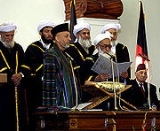
Politics of Afghanistan

Encyclopedia
The politics of Afghanistan consists of the Council of Ministers
and the National Assembly
, with a president
serving as the head of state
and commander-in-chief
of the military
. The nation is currently led by the Karzai administration under President
Hamid Karzai
who is backed by two vice president
s, Mohammed Fahim
and Karim Khalili
. In the last decade the politics of Afghanistan
have been heavily influenced by NATO countries, especially by the United States
, in an effort to stabilise and democratise
the country. In 2004, the nation's new constitution
was adopted and an executive
was president elected. The following year a general election
to choose parliamentarian
s took place.
The current president Hamid Karzai was declared the first ever democratically elected head of state in Afghanistan in 2004, winning a second five-year term in 2009
. The National Assembly is Afghanistan's national legislature
. It is a bicameral body, composed of the House of the People
and the House of Elders
. The first legislature was elected in 2005
and the current one in 2010
. Members of the Supreme Court
were appointed by the president to form the judiciary
. Together, this new system is to provide a new set of checks and balances that was unheard of in the country.
, republic
, theocracy
, dictatorship
, and a pro-communist state
.
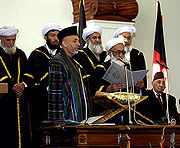 Afghanistan is an Islamic republic
consisting of three branches of power (executive
, legislative, and judiciary
) overseen by checks and balances. It is currently led by the Karzai administration under President Hamid Karzai, who was elected in 2004 and re-elected in 2009
. Before the election of 2004, Karzai led the country after being chosen by delegates of the Bonn Conference
in December 2001 to head an interim government after the removal of the Taliban Emirate
. While supporters have praised Karzai's efforts to promote national reconciliation and a growing economy
, critics charge him with failing to stem corruption and the drug trade, and the slow pace of reconstruction.
The current parliament
was elected in 2005 and then in 2010. Among the elected officials are former mujahideen
, Islamic fundamentalists, reformists, communists, and sveral Taliban members. About 28% of the delegates elected were women, 3% more than the 25% minimum guaranteed under the constitution. This made Afghanistan, long known under the Taliban for its oppression of women, one of the leading countries in terms of female representation.
The Supreme Court of Afghanistan
is led by Chief Justice Abdul Salam Azimi
. Dominated by fundamentalist religious figures, it has tried to ban a candidate in the 2004 presidential election for questioning polygamy
laws, and limited the rights of women, as well as overstepped its constitutional authority by issuing rulings on subjects not yet brought before the court.
under Burhanuddin Rabbani
were displaced by forces of the Taliban. The United Nations refused to recognize the Taliban government
, instead it recognized the Islamic State as the official government government in exile
. The Organisation of the Islamic Conference left the Afghan seat vacant until the question of legitimacy could be resolved through negotiations among the warring factions. The Taliban occupied 95% of the territory by 2001 and only Pakistan, Saudi Arabia
, and the United Arab Emirates
recognized them as a government. The remaining 5% belonged to the rebel forces called the Northern Alliance
(or United Front).
to U.S. authorities
for his suspected involvement in the 11 September 2001 attacks in New York City
and Washington, D.C.
, a US-led international coalition was formed; after several weeks of aerial bombardment by coalition forces and military action on the ground, including Afghan opposition forces, the Taliban was officially ousted from power on November 17, 2001.
to decide on a plan for governing the country. As a result, the Afghan Interim Administration
(AIA) - made up of 30 members, headed by a chairman - was inaugurated on December 22, 2001, with a six-month mandate to be followed by a two-year Afghan Transitional Administration
(ATA), after which elections are to be held. Some provisions in the agreement have expired, due to the creation of the constitution. Still, the agreement paved the way for the creation of a democratic Afghanistan.
authorized the creation of the International Security Assistance Force
(ISAF) to help provide basic security for Afghanistan. Members of the United States armed forces
and NATO countries began sending troops to Afghanistan since late 2001 to early 2011, at a time when the total number of foreign soldiers reached about 150,000. In the meantime the newly-trained Afghan National Army
and Afghan National Police
reached over 200,000 by 2011.
(grand assembly) convened establishing the Transitional Islamic State of Afghanistan (TISA), which had 18 months to hold a constitutional loya jirga
to adopt a constitution and 24 months to hold nationwide elections. The loya jirga was replaced by the National Assembly.
Under the Bonn Agreement
the Afghan Constitution Commission
was established to consult with the public and formulate a draft constitution. The meeting of a constitutional loya jirga was held in December 2003, when a new constitution was adopted creating a presidential form of government with a bicameral legislature: the House of Elders
(Meshrano Jirga) and the House of the People
(Wolesi Jirga).
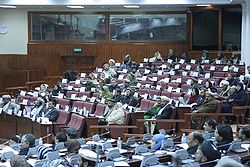 The 2004 presidential election was held on October 9, with over 10 million Afghans being registered to vote. Many of the candidates running against Hamid Karzai tried to boycott the election because they feared irregularities. However, Karzai made this statement to the media: An independent commission found evidence of fraud, but ruled that it did not affect the outcome of the poll and Karzai won with 55.4% of the vote. He was inaugurated as President on December 7 of that year. It was the country's first national election since 1969, when parliamentary elections were last held.
On September 18, 2005, parliamentary elections
were held; the parliament opened after the results were announced. On December 20 Karzai's close ally and president of the first mujahideen
government, Sibghatullah Mojadeddi, was picked to head the 102-seat upper house. On December 21, Yunus Qanuni
, Afghan opposition leader and Karzai's main opponent was chosen to lead the 249-seat lower house of parliament with 122 votes against 117 for his closest challenge.
creates a strong presidency. A president is elected with two Vice-presidents. The president appoints cabinet ministers
and governors.
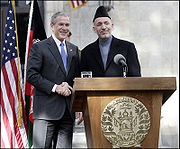 The United States
is the leading nation in the rebuilding and democratization of Afghanistan. United States-Afghanistan relations have improved since late 2001, especially after the Karzai administration was formed. Foreign relations of Afghanistan
with other NATO members and neighboring or regional countries have also improved under the Karzai adiministration.
After winning the 2004 election and removing many of the former Northern Alliance
warlords from his cabinet, it was thought that Karzai would pursue a more aggressively reformist path in 2005 but he proved to be more cautious. Ever since Karzai's new administration took over in 2004, the economy of Afghanistan
has been growing rapidly for the first time in many years. Government revenue is increasing every year, although it is still heavily dependent on foreign aid. During the Karzai administration, public discontent grew about corruption and the civilian casualties in the fight against the Taliban insurgency.
, Karzai was officially declared the winner. The Obama administration
urged Karzai to exclude ineffective or corrupt officials from the new government, while powerful Afghans who helped deliver his re-election were demanding positions. According to political analysts, the list of ministers Karzai presented to the Parliament was "not encouraging", but it reflected realpolitik
. Slightly more than half were ministers who would stay in their current positions or who had served previously in Karzai’s government. On January 2, 2009, the Afghan Parliament rejected 17 of President Karzai's 24 cabinet nominees, approving only seven.
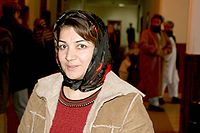 The 2005 parliamentary election
for the Wolesi Jirga
(House of the People
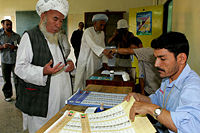
) were conducted on September 18, 2005. This was the first parliamentary election in Afghanistan since 1969. Approximately 2,707 candidates, including 328 women, competed for 249 seats. The election was conducted with multiple seat electoral constituencies. Each province is a constituency and has a varying number of seats, depending on population. Voters have a single non-transferable vote.
The Meshrano Jirga
(House of Elders
) consists of 102 members. One-third of the members were appointed by the president, while another third was elected by the provincial councils. Elections for the provincial councils were held simultaneously with those for the Wolesi Jirga. The remaining third is supposed to be elected by district councils. However, elections for the district councils have been postponed, meaning that one-third of the seats in the Meshrano Jirga will be vacant when it assembles. Despite Taliban and other anti-government forces stating they intended to disrupt the elections, the polling day went by with minimal violence.
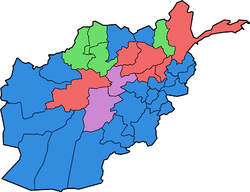
 Afghanistan held parliamentary elections on 18 September 2005. First results were announced on 9 October and final results on 12 November 2005. Since all candidates were not listed by party and elected as non-partisans, a breakdown by party was not possible. Turnout was estimated at about 50 percent.
, intimidation, and other electoral fraud.
The vote, along with elections for 420 provincial council
seats, took place on August 20, 2009, but remained unresolved during a lengthy period of vote counting and fraud investigation.
Two months later, under heavy U.S. and ally pressure, a second round run-off vote between incumbent President Hamid Karzai and his main rival Abdullah Abdullah
was announced for November 7, 2009. On November 1, however, Abdullah announced that he would no longer be participating in the run-off because his demands for changes in the electoral commission had not been met, and a "transparent election is not possible." A day later, on November 2, 2009, officials of the election commission cancelled the run-off and declared Hamid Karzai as President of Afghanistan for another 5 year term.
mandates a Supreme Court
. The Supreme Court is the highest judicial authority in Afghanistan, and is he court of last resort. Judges are appointed by the President, and confirmed by the Afghan National Assembly. Lower courts included magistrate courts, Courts of First Instance, and Intermediate Court of Appeals. Intermediate court of Appeals review decisions of lower courts, before appeals are sent to the Supreme Court. If an appeal loses, they can be sent to the Supreme Court. Courts of First Instance exist in every city. They have several branches which tries all major cases. The branches include Criminal, Civil, Religious, Administrative, Labor, and Family divisions. Also in the first instance include military courts, which try military personals. Magistrate Courts are at the lowest level, which try minor civil and criminal cases.
Main parties seem to be:
Other minor parties are:
, Colombo Plan
, the Economic Cooperation Organization
, the United Nations Economic and Social Commission for Asia and the Pacific
, the Food and Agriculture Organization of the United Nations, the Group of 77
, the International Atomic Energy Agency
, the International Civil Aviation Organization
, the International Criminal Court
, ICRM
, the International Centre for Settlement of Investment Disputes
, the Islamic Development Bank
, the International Fund for Agricultural Development
, the International Finance Corporation
, IFRCS, ILO
, International Monetary FundIMF, Interpol
, IOC (suspended), IOM
(observer), ITU
, NAM
, OIC, OPCW (signatory), UN, UNCTAD, UNESCO
, UNIDO
, UPU
, WFTU
, WHO
, WMO, WToO
(ADB) at its founding in 1966 and is ADB’s 17th largest borrower. ADB suspended its operations in Afghanistan from 1992 to 2002. Significant international engagement with Afghanistan resumed in 2001 following the ouster of the Taliban regime. In 2001 and 2002, ADB, the World Bank
, and the United Nations assessed the country's critical rehabilitation and development needs: at the 2002 Tokyo Conference, ADB pledged loan and grant assistance of some $500 million over 2.5 years, beginning with a $167.18 million Postconflict Multisector Program loan, the first loan by an
international financial institution to the country in more than 23 years.
In 2004, ADB pledged up to $800 million in Asian Development Fund (ADF) loans and grants for 2005–2008, while at the 2006 London Conference indicated its intention to provide up to $200 million per year in ADF funding through 2010. ADB’s support has focused on building national capacity, establishing policy and institutional frameworks, and rehabilitating infrastructure. At the request of the Afghan authorities, ADB loan and grant-financed projects and programs and related technical assistance are focused on the road [transport, energy, agriculture and natural resource management, and governance and financial sectors. Private sector support has focused on loans and investments in the telecommunications and banking sectors.
in 1955. Shortly after the Soviet invasion in 1979, World Bank operations were suspended, and the resident mission in Kabul
was closed, although the Bank continued to provide assistance to Afghans through its office in neighboring Pakistan. The Bank resumed operations in Afghanistan in May 2002 to help meet the immediate needs of the poorest people while assisting the government in developing the administrative systems required for longer-term nationwide development.
Prior to 1979, the World Bank had provided 21 no-interest loans, known as "credits" to Afghanistan across a wide range of areas including education, roads, and agriculture. Of the original $230 million in credits approved under IDA, $83 million was disbursed and $147 million was subsequently canceled. Afghanistan had repaid $9.2 million to IDA and was up to date on debt service payments until June 1992, when it stopped making payments.
In 2003, Afghanistan was able to clear its debt to the World Bank, in part with the help of Japan
, the UK, Sweden
, Norway
, and Italy
, who contributed to a trust fund for this purpose. Additional funds from the multi-donors, which is administered by the World Bank, helped to clear the remaining arrears, allowing Afghanistan to become eligible for loans for projects designed to help meet the country's longer-term development needs.
The ARTF has emerged as one of the main instruments for financing the country’s recurrent budget and investment support for Afghanistan. To date, more than $1.37 billion has been contributed to the ARTF by 24 donors.
Since 2002, the bank has financed 21 projects, committing around $1.13 billion, of which $696.8 million is in grants and $436.4 in interest-free credits. Two budget support operations and an emergency public works project have been completed so far. commitments of approximately $26 million for the fiscal year 2007 (July 2006 - June 2007) will be entirely in grants. The Bank-funded projects mostly support rural livelihoods by providing job opportunities, rebuilding infrastructure, education and basic health services.
Council of Ministers (Afghanistan)
The Council of Ministers was the governmental organ in the Democratic Republic of Afghanistan and later the Republic of Afghanistan. The leader of the Council of Ministers choose ministers for the different ministeral posts in the country. Under the leadership of Nur Mohammad Taraki, Hafizullah...
and the National Assembly
National Assembly of Afghanistan
The National Assembly is Afghanistan's national legislature. It is a bicameral body, comprising two chambers:*Wolesi Jirga or the House of the People: the 250-member lower house.*Meshrano Jirga ) or the House of Elders: an upper house with 102 seats....
, with a president
President
A president is a leader of an organization, company, trade union, university, or country.Etymologically, a president is one who presides, who sits in leadership...
serving as the head of state
Head of State
A head of state is the individual that serves as the chief public representative of a monarchy, republic, federation, commonwealth or other kind of state. His or her role generally includes legitimizing the state and exercising the political powers, functions, and duties granted to the head of...
and commander-in-chief
Commander-in-Chief
A commander-in-chief is the commander of a nation's military forces or significant element of those forces. In the latter case, the force element may be defined as those forces within a particular region or those forces which are associated by function. As a practical term it refers to the military...
of the military
Military of Afghanistan
The military of Afghanistan is composed of the Afghan National Army and the Afghan National Army Air Force . Being a landlocked country, Afghanistan has no navy, and the private security forces who are sometimes seen wearing military uniforms are not part of Afghanistan's military...
. The nation is currently led by the Karzai administration under President
President of Afghanistan
Afghanistan has only been a republic between 1973 and 1992 and from 2001 onwards. Before 1973, it was a monarchy that was governed by a variety of kings, emirs or shahs...
Hamid Karzai
Hamid Karzai
Hamid Karzai, GCMG is the 12th and current President of Afghanistan, taking office on 7 December 2004. He became a dominant political figure after the removal of the Taliban regime in late 2001...
who is backed by two vice president
Vice president
A vice president is an officer in government or business who is below a president in rank. The name comes from the Latin vice meaning 'in place of'. In some countries, the vice president is called the deputy president...
s, Mohammed Fahim
Mohammed Fahim
Mohammad Qasim Fahim is an Afghan military commander, politician and the First Vice President since November 2009. He was the Defense Minister of the Afghan Transitional Administration, beginning in 2002 and also served as Vice President from June 2002 to December 2004...
and Karim Khalili
Karim Khalili
Abdul Karim Khalili is the current second Vice President of Afghanistan in the administration of President Hamid Karzai. Khalili was appointed first time as Vice President in 2002 and was elected as running mate of Hamid Karzai in 2004...
. In the last decade the politics of Afghanistan
Afghanistan
Afghanistan , officially the Islamic Republic of Afghanistan, is a landlocked country located in the centre of Asia, forming South Asia, Central Asia and the Middle East. With a population of about 29 million, it has an area of , making it the 42nd most populous and 41st largest nation in the world...
have been heavily influenced by NATO countries, especially by the United States
United States
The United States of America is a federal constitutional republic comprising fifty states and a federal district...
, in an effort to stabilise and democratise
Democratization
Democratization is the transition to a more democratic political regime. It may be the transition from an authoritarian regime to a full democracy, a transition from an authoritarian political system to a semi-democracy or transition from a semi-authoritarian political system to a democratic...
the country. In 2004, the nation's new constitution
Constitution of Afghanistan
The Constitution of Afghanistan is the supreme law of the state Afghanistan, which serves as the legal framework between the Afghan government and the Afghan citizens...
was adopted and an executive
Executive (government)
Executive branch of Government is the part of government that has sole authority and responsibility for the daily administration of the state bureaucracy. The division of power into separate branches of government is central to the idea of the separation of powers.In many countries, the term...
was president elected. The following year a general election
General election
In a parliamentary political system, a general election is an election in which all or most members of a given political body are chosen. The term is usually used to refer to elections held for a nation's primary legislative body, as distinguished from by-elections and local elections.The term...
to choose parliamentarian
Member of Parliament
A Member of Parliament is a representative of the voters to a :parliament. In many countries with bicameral parliaments, the term applies specifically to members of the lower house, as upper houses often have a different title, such as senate, and thus also have different titles for its members,...
s took place.
The current president Hamid Karzai was declared the first ever democratically elected head of state in Afghanistan in 2004, winning a second five-year term in 2009
Afghan presidential election, 2009
The 2009 presidential election in Afghanistan was characterized by lack of security, low voter turnout and widespread ballot stuffing, intimidation, and other electoral fraud....
. The National Assembly is Afghanistan's national legislature
Legislature
A legislature is a kind of deliberative assembly with the power to pass, amend, and repeal laws. The law created by a legislature is called legislation or statutory law. In addition to enacting laws, legislatures usually have exclusive authority to raise or lower taxes and adopt the budget and...
. It is a bicameral body, composed of the House of the People
House of the People (Afghanistan)
The House of the People or Wolesi Jirga , abbreviated WJ, is the lower house of the bicameral National Assembly of Afghanistan, alongside the House of Elders....
and the House of Elders
House of Elders
Mesherano Jirga or the House of Elders, is the upper house of the bicameral National Assembly of Afghanistan, alongside the Wolesi Jirga .It has 102 members...
. The first legislature was elected in 2005
Afghan parliamentary election, 2005
Afghanistan held parliamentary and provincial council elections on 18 September 2005. The first results were declared on 9 October, with final results being delayed by accusations of fraud, and were finally announced on 12 November.-Results:...
and the current one in 2010
Afghan parliamentary election, 2010
The Afghan parliamentary election, 2010 to elect members of the Wolesi Jirga took place on 18 September 2010. The Afghan Independent Election Commission - established in accordance with the article 156 of the Constitution of Afghanistan for the purpose of organizing and supervising all elections in...
. Members of the Supreme Court
Afghan Supreme Court
Stera Mahkama or the Afghan Supreme Court is the court of last resort in Afghanistan. It was created by the Constitution of Afghanistan, which was approved on January 4, 2004...
were appointed by the president to form the judiciary
Judiciary
The judiciary is the system of courts that interprets and applies the law in the name of the state. The judiciary also provides a mechanism for the resolution of disputes...
. Together, this new system is to provide a new set of checks and balances that was unheard of in the country.
Brief timeline of Afghan politics
Government operation in Afghanistan historically has consisted of power struggles, bloody coups and unstable transfers of power. The country has been governed by many systems of government, including a monarchyMonarchy
A monarchy is a form of government in which the office of head of state is usually held until death or abdication and is often hereditary and includes a royal house. In some cases, the monarch is elected...
, republic
Republic
A republic is a form of government in which the people, or some significant portion of them, have supreme control over the government and where offices of state are elected or chosen by elected people. In modern times, a common simplified definition of a republic is a government where the head of...
, theocracy
Theocracy
Theocracy is a form of organization in which the official policy is to be governed by immediate divine guidance or by officials who are regarded as divinely guided, or simply pursuant to the doctrine of a particular religious sect or religion....
, dictatorship
Dictatorship
A dictatorship is defined as an autocratic form of government in which the government is ruled by an individual, the dictator. It has three possible meanings:...
, and a pro-communist state
Communist state
A communist state is a state with a form of government characterized by single-party rule or dominant-party rule of a communist party and a professed allegiance to a Leninist or Marxist-Leninist communist ideology as the guiding principle of the state...
.
- 1709 - Mirwais Hotak declares Afghanistan (land of the Afghans) an independent state and establishes the Hotaki dynasty at KandaharKandaharKandahar is the second largest city in Afghanistan, with a population of about 512,200 as of 2011. It is the capital of Kandahar Province, located in the south of the country at about 1,005 m above sea level...
. - 1747 - Ahmad Shah DurraniAhmad Shah DurraniAhmad Shah Durrani , also known as Ahmad Shāh Abdālī and born as Ahmad Khān, was the founder of the Durrani Empire in 1747 and is regarded by many to be the founder of the modern state of Afghanistan.Ahmad Khan enlisted as a young soldier in the military of the Afsharid kingdom and quickly rose...
expands Afghanistan and establishes the Durrani EmpireDurrani EmpireThe Durrani Empire was a Pashtun dynasty centered in Afghanistan and included northeastern Iran, the Kashmir region, the modern state of Pakistan, and northwestern India. It was established at Kandahar in 1747 by Ahmad Shah Durrani, an Afghan military commander under Nader Shah of Persia and chief...
. - 1838 - British IndiaCompany rule in IndiaCompany rule in India refers to the rule or dominion of the British East India Company on the Indian subcontinent...
invades the land during the First Anglo-Afghan WarFirst Anglo-Afghan WarThe First Anglo-Afghan War was fought between British India and Afghanistan from 1839 to 1842. It was one of the first major conflicts during the Great Game, the 19th century competition for power and influence in Central Asia between the United Kingdom and Russia, and also marked one of the worst...
and begins to influence the politics of AfghanistanEuropean influence in AfghanistanThe European influence in Afghanistan refers to political, social, and sometimes imperialistic influence several European nations have had on this historical development of Afghanistan.-Rise of Dost Mohammad Khan:...
. - 1919 - King Amanullah KhanAmanullah KhanAmanullah Khan was the King of the Emirate of Afghanistan from 1919 to 1929, first as Amir and after 1926 as Shah. He led Afghanistan to independence over its foreign affairs from the United Kingdom, and his rule was marked by dramatic political and social change...
takes the throne after the Third Anglo-Afghan WarThird Anglo-Afghan WarThe Third Anglo-Afghan War began on 6 May 1919 and ended with an armistice on 8 August 1919. It was a minor tactical victory for the British. For the British, the Durand Line was reaffirmed as the political boundary between the Emirate of Afghanistan and British India and the Afghans agreed not to...
, British influence ends. - 1973 - Mohammed Daoud KhanMohammed Daoud KhanSardar Mohammed Daoud Khan or Daud Khan was Prime Minister of Afghanistan from 1953 to 1963 and later becoming the President of Afghanistan...
, Prime Minister and a member of the royal family, seizes power while King Mohammad Zahir Shah is in Italy. - 1978 – The leftist People's Democratic Party of AfghanistanPeople's Democratic Party of AfghanistanThe People's Democratic Party of Afghanistan was a communist party established on the 1 January 1965. While a minority, the party helped former president of Afghanistan, Mohammed Daoud Khan, to overthrow his cousin, Mohammed Zahir Shah, and established Daoud's Republic of Afghanistan...
(PDPA) seizes power during the Saur RevolutionSaur RevolutionThe Saur Revolution is the name given to the Communist People's Democratic Party of Afghanistan takeover of political power from the government of Afghanistan on 28 April 1978. The word 'Saur', i.e...
. Daoud Khan is assassinated along with his family and supporters. - 1979 – President Nur Muhammad TarakiNur Muhammad TarakiNur Muhammad Taraki was an Afghan politician and statesman during the Cold War. Taraki was born near Kabul and educated at Kabul University, after which he started his political career as a journalist...
, leader of PDPA, is assassinated and replaced by Hafizullah AminHafizullah AminHafizullah Amin was the second President of Afghanistan during the period of the communist Democratic Republic of Afghanistan....
. Amin is then assassinated and the Soviet UnionSoviet UnionThe Soviet Union , officially the Union of Soviet Socialist Republics , was a constitutionally socialist state that existed in Eurasia between 1922 and 1991....
invades. Babrak KarmalBabrak KarmalBabrak Karmal was the third President of Afghanistan during the period of the communist Democratic Republic of Afghanistan. He is the best known of the Marxist leadership....
is installed as president. - 1987 - Mohammad NajibullahMohammad NajibullahMohammad Najibullah Ahmadzai , originally merely Najibullah, was the fourth and last President of the Soviet-backed Democratic Republic of Afghanistan. He is also considered the second President of the Republic of Afghanistan.-Early years:Najibullah was born in August 1947 to the Ahmadzai...
replaces Babrak Karmal as president. - 1989 – Soviet army withdraws all troops from the country, and the United States also abandons Afghanistan.
- 1992 – KabulKabulKabul , spelt Caubul in some classic literatures, is the capital and largest city of Afghanistan. It is also the capital of the Kabul Province, located in the eastern section of Afghanistan...
falls to mujahideenMujahideenMujahideen are Muslims who struggle in the path of God. The word is from the same Arabic triliteral as jihad .Mujahideen is also transliterated from Arabic as mujahedin, mujahedeen, mudžahedin, mudžahidin, mujahidīn, mujaheddīn and more.-Origin of the concept:The beginnings of Jihad are traced...
factions. Burhanuddin RabbaniBurhanuddin RabbaniProfessor Burhanuddin Rabbani was President of the Islamic State of Afghanistan from 1992 to 1996. After the Taliban government was toppled during Operation Enduring Freedom, Rabbani returned to Kabul and served as a temporary President from November to December 20, 2001, when Hamid Karzai was...
becomes president of the new Islamic State of AfghanistanIslamic State of AfghanistanThe Islamic State of Afghanistan was the name of the state of Afghanistan after the collapse of the communist regime, the Democratic Republic of Afghanistan, in 1992. In 1996, the country was renamed the Islamic Emirate of Afghanistan by the Taliban, after seizing control of the majority of the...
and a civil warCivil war in AfghanistanThe Afghan civil war began when the communist People's Democratic Party of Afghanistan took power in a military coup, known as the Saur Revolution, on 27 April 1978. Most of Afghanistan subsequently experienced uprisings against the unpopular Marxist-Leninist PDPA government. The Soviet Union...
starts. - 1996 – Kabul along with most part of the country falls to the Taliban.
- 2001 – United States and coalition forces invade Afghanistan. Hamid KarzaiHamid KarzaiHamid Karzai, GCMG is the 12th and current President of Afghanistan, taking office on 7 December 2004. He became a dominant political figure after the removal of the Taliban regime in late 2001...
is appointed leader of the nation at the International Conference on Afghanistan in Germany. - 2003 - Loya Jirga2003 Loya jirgaA 502-delegate loya jirga convened in Kabul, Afghanistan, on December 14, 2003, to consider the proposed Afghan Constitution. Originally planned to last ten days, the assembly did not endorse the charter until January 4, 2004. As has been generally the case with these assemblies, the endorsement...
adopts new constitutionConstitution of AfghanistanThe Constitution of Afghanistan is the supreme law of the state Afghanistan, which serves as the legal framework between the Afghan government and the Afghan citizens...
, restructuring the government as an Islamic republicIslamic republicIslamic republic is the name given to several states in the Muslim world including the Islamic Republics of Pakistan, Iran, Afghanistan, and Mauritania. Pakistan adopted the title under the constitution of 1956. Mauritania adopted it on 28 November 1958. Iran adopted it after the 1979 Iranian...
. - 2004 - Hamid Karzai is elected President of Afghanistan.
Background
Islamic republic
Islamic republic is the name given to several states in the Muslim world including the Islamic Republics of Pakistan, Iran, Afghanistan, and Mauritania. Pakistan adopted the title under the constitution of 1956. Mauritania adopted it on 28 November 1958. Iran adopted it after the 1979 Iranian...
consisting of three branches of power (executive
Executive (government)
Executive branch of Government is the part of government that has sole authority and responsibility for the daily administration of the state bureaucracy. The division of power into separate branches of government is central to the idea of the separation of powers.In many countries, the term...
, legislative, and judiciary
Judiciary
The judiciary is the system of courts that interprets and applies the law in the name of the state. The judiciary also provides a mechanism for the resolution of disputes...
) overseen by checks and balances. It is currently led by the Karzai administration under President Hamid Karzai, who was elected in 2004 and re-elected in 2009
Afghan presidential election, 2009
The 2009 presidential election in Afghanistan was characterized by lack of security, low voter turnout and widespread ballot stuffing, intimidation, and other electoral fraud....
. Before the election of 2004, Karzai led the country after being chosen by delegates of the Bonn Conference
Bonn Agreement (Afghanistan)
Officially the Agreement on Provisional Arrangements in Afghanistan Pending the Re-Establishment of Permanent Government Institutions, the Bonn Agreement was the initial series of agreements intended to re-create the State of Afghanistan following the U.S. invasion of Afghanistan in response to the...
in December 2001 to head an interim government after the removal of the Taliban Emirate
Islamic Emirate of Afghanistan
The Islamic Emirate of Afghanistan was founded in 1996 when the Taliban began their rule of Afghanistan and ended with their fall from power in 2001...
. While supporters have praised Karzai's efforts to promote national reconciliation and a growing economy
Economy of Afghanistan
The economy of Afghanistan has improved significantly since 2002 due to the infusion of multi-billion dollars in international assistance and investments, as well as remittances from Afghan expats. It is also due to dramatic improvements in agricultural production and the end of a four-year drought...
, critics charge him with failing to stem corruption and the drug trade, and the slow pace of reconstruction.
The current parliament
National Assembly of Afghanistan
The National Assembly is Afghanistan's national legislature. It is a bicameral body, comprising two chambers:*Wolesi Jirga or the House of the People: the 250-member lower house.*Meshrano Jirga ) or the House of Elders: an upper house with 102 seats....
was elected in 2005 and then in 2010. Among the elected officials are former mujahideen
Mujahideen
Mujahideen are Muslims who struggle in the path of God. The word is from the same Arabic triliteral as jihad .Mujahideen is also transliterated from Arabic as mujahedin, mujahedeen, mudžahedin, mudžahidin, mujahidīn, mujaheddīn and more.-Origin of the concept:The beginnings of Jihad are traced...
, Islamic fundamentalists, reformists, communists, and sveral Taliban members. About 28% of the delegates elected were women, 3% more than the 25% minimum guaranteed under the constitution. This made Afghanistan, long known under the Taliban for its oppression of women, one of the leading countries in terms of female representation.
The Supreme Court of Afghanistan
Afghan Supreme Court
Stera Mahkama or the Afghan Supreme Court is the court of last resort in Afghanistan. It was created by the Constitution of Afghanistan, which was approved on January 4, 2004...
is led by Chief Justice Abdul Salam Azimi
Abdul Salam Azimi
Abdul Salam Azimi Abdul Salam Azimi Abdul Salam Azimi (Pashtu:عبدالسلام عظیمی (born: 1936, in Farah Province) is the Chief Justice of Afghanistan and, as such, the head of the Afghan Supreme Court since May 2006....
. Dominated by fundamentalist religious figures, it has tried to ban a candidate in the 2004 presidential election for questioning polygamy
Polygamy
Polygamy is a marriage which includes more than two partners...
laws, and limited the rights of women, as well as overstepped its constitutional authority by issuing rulings on subjects not yet brought before the court.
Taliban Emirate and Northern Alliance
In September 1996, government officials of the Islamic State of AfghanistanIslamic State of Afghanistan
The Islamic State of Afghanistan was the name of the state of Afghanistan after the collapse of the communist regime, the Democratic Republic of Afghanistan, in 1992. In 1996, the country was renamed the Islamic Emirate of Afghanistan by the Taliban, after seizing control of the majority of the...
under Burhanuddin Rabbani
Burhanuddin Rabbani
Professor Burhanuddin Rabbani was President of the Islamic State of Afghanistan from 1992 to 1996. After the Taliban government was toppled during Operation Enduring Freedom, Rabbani returned to Kabul and served as a temporary President from November to December 20, 2001, when Hamid Karzai was...
were displaced by forces of the Taliban. The United Nations refused to recognize the Taliban government
Islamic Emirate of Afghanistan
The Islamic Emirate of Afghanistan was founded in 1996 when the Taliban began their rule of Afghanistan and ended with their fall from power in 2001...
, instead it recognized the Islamic State as the official government government in exile
Government in exile
A government in exile is a political group that claims to be a country's legitimate government, but for various reasons is unable to exercise its legal power, and instead resides in a foreign country. Governments in exile usually operate under the assumption that they will one day return to their...
. The Organisation of the Islamic Conference left the Afghan seat vacant until the question of legitimacy could be resolved through negotiations among the warring factions. The Taliban occupied 95% of the territory by 2001 and only Pakistan, Saudi Arabia
Saudi Arabia
The Kingdom of Saudi Arabia , commonly known in British English as Saudi Arabia and in Arabic as as-Sa‘ūdiyyah , is the largest state in Western Asia by land area, constituting the bulk of the Arabian Peninsula, and the second-largest in the Arab World...
, and the United Arab Emirates
United Arab Emirates
The United Arab Emirates, abbreviated as the UAE, or shortened to "the Emirates", is a state situated in the southeast of the Arabian Peninsula in Western Asia on the Persian Gulf, bordering Oman, and Saudi Arabia, and sharing sea borders with Iraq, Kuwait, Bahrain, Qatar, and Iran.The UAE is a...
recognized them as a government. The remaining 5% belonged to the rebel forces called the Northern Alliance
Northern Alliance
The Afghan Northern Alliance is a military-political umbrella organization created by the Islamic State of Afghanistan in 1996.Northern Alliance may also refer to:*Northern Alliance , a Canadian white supremacist group...
(or United Front).
Military action by the United States and allies
After the Taliban's refusal to hand over Osama bin LadenOsama bin Laden
Osama bin Mohammed bin Awad bin Laden was the founder of the militant Islamist organization Al-Qaeda, the jihadist organization responsible for the September 11 attacks on the United States and numerous other mass-casualty attacks against civilian and military targets...
to U.S. authorities
Federal government of the United States
The federal government of the United States is the national government of the constitutional republic of fifty states that is the United States of America. The federal government comprises three distinct branches of government: a legislative, an executive and a judiciary. These branches and...
for his suspected involvement in the 11 September 2001 attacks in New York City
New York City
New York is the most populous city in the United States and the center of the New York Metropolitan Area, one of the most populous metropolitan areas in the world. New York exerts a significant impact upon global commerce, finance, media, art, fashion, research, technology, education, and...
and Washington, D.C.
Washington, D.C.
Washington, D.C., formally the District of Columbia and commonly referred to as Washington, "the District", or simply D.C., is the capital of the United States. On July 16, 1790, the United States Congress approved the creation of a permanent national capital as permitted by the U.S. Constitution....
, a US-led international coalition was formed; after several weeks of aerial bombardment by coalition forces and military action on the ground, including Afghan opposition forces, the Taliban was officially ousted from power on November 17, 2001.
Bonn Agreement
In December 2001, a number of prominent Afghans met under the United Nations auspices in GermanyGermany
Germany , officially the Federal Republic of Germany , is a federal parliamentary republic in Europe. The country consists of 16 states while the capital and largest city is Berlin. Germany covers an area of 357,021 km2 and has a largely temperate seasonal climate...
to decide on a plan for governing the country. As a result, the Afghan Interim Administration
Afghan Interim Administration
The Afghan Interim Administration was the first administration of Afghanistan after the fall of the Taliban regime and was the highest authority of the country from 22 December 2001 until 13 July 2003.-Background:...
(AIA) - made up of 30 members, headed by a chairman - was inaugurated on December 22, 2001, with a six-month mandate to be followed by a two-year Afghan Transitional Administration
Afghan Transitional Administration
The Afghan Transitional Administration was the name of a temporary administration of Afghanistan put in place by the 2002 Loya Jirga and followed the Afghan Interim Administration which was installed after the Bonn Conference.-Background:Following the US Invasion in Afghanistan, a UN sponsored...
(ATA), after which elections are to be held. Some provisions in the agreement have expired, due to the creation of the constitution. Still, the agreement paved the way for the creation of a democratic Afghanistan.
ISAF and Afghan security forces
The United Nations Security CouncilUnited Nations Security Council
The United Nations Security Council is one of the principal organs of the United Nations and is charged with the maintenance of international peace and security. Its powers, outlined in the United Nations Charter, include the establishment of peacekeeping operations, the establishment of...
authorized the creation of the International Security Assistance Force
International Security Assistance Force
The International Security Assistance Force is a NATO-led security mission in Afghanistan established by the United Nations Security Council on 20 December 2001 by Resolution 1386 as envisaged by the Bonn Agreement...
(ISAF) to help provide basic security for Afghanistan. Members of the United States armed forces
United States armed forces
The United States Armed Forces are the military forces of the United States. They consist of the Army, Navy, Marine Corps, Air Force, and Coast Guard.The United States has a strong tradition of civilian control of the military...
and NATO countries began sending troops to Afghanistan since late 2001 to early 2011, at a time when the total number of foreign soldiers reached about 150,000. In the meantime the newly-trained Afghan National Army
Afghan National Army
The Afghan National Army is a service branch of the military of Afghanistan, which is currently trained by the coalition forces to ultimately take the role in land-based military operations in Afghanistan. , the Afghan National Army is divided into seven regional Corps. The strength of the Afghan...
and Afghan National Police
Afghan National Police
The Afghan National Police - ANP - is the primary national police force in Afghanistan. It serves as a single law enforcement agency all across the country. The Afghan police force was first created with the establishment of the Afghan nation in the early 18th century...
reached over 200,000 by 2011.
New constitution and national elections
The structure of the Transitional Authority was announced on June 10, 2002, when an emergency loya jirgaLoya jirga
A loya jirga is a type of jirga regarded as "grand assembly," a phrase in the Pashto language meaning "grand council." A loya jirga is a mass meeting usually prepared for major events such as choosing a new king, adopting a constitution, or discussing important national political or emergency...
(grand assembly) convened establishing the Transitional Islamic State of Afghanistan (TISA), which had 18 months to hold a constitutional loya jirga
2003 Loya jirga
A 502-delegate loya jirga convened in Kabul, Afghanistan, on December 14, 2003, to consider the proposed Afghan Constitution. Originally planned to last ten days, the assembly did not endorse the charter until January 4, 2004. As has been generally the case with these assemblies, the endorsement...
to adopt a constitution and 24 months to hold nationwide elections. The loya jirga was replaced by the National Assembly.
Under the Bonn Agreement
Bonn Agreement (Afghanistan)
Officially the Agreement on Provisional Arrangements in Afghanistan Pending the Re-Establishment of Permanent Government Institutions, the Bonn Agreement was the initial series of agreements intended to re-create the State of Afghanistan following the U.S. invasion of Afghanistan in response to the...
the Afghan Constitution Commission
Afghan Constitution Commission
The Afghan Constitution Commission was established October 5, 2002 as required by the Bonn Agreement, which stipulated that a new Afghan constitution be adopted by a loya jirga...
was established to consult with the public and formulate a draft constitution. The meeting of a constitutional loya jirga was held in December 2003, when a new constitution was adopted creating a presidential form of government with a bicameral legislature: the House of Elders
House of Elders
Mesherano Jirga or the House of Elders, is the upper house of the bicameral National Assembly of Afghanistan, alongside the Wolesi Jirga .It has 102 members...
(Meshrano Jirga) and the House of the People
House of the People (Afghanistan)
The House of the People or Wolesi Jirga , abbreviated WJ, is the lower house of the bicameral National Assembly of Afghanistan, alongside the House of Elders....
(Wolesi Jirga).
On September 18, 2005, parliamentary elections
Afghan parliamentary election, 2005
Afghanistan held parliamentary and provincial council elections on 18 September 2005. The first results were declared on 9 October, with final results being delayed by accusations of fraud, and were finally announced on 12 November.-Results:...
were held; the parliament opened after the results were announced. On December 20 Karzai's close ally and president of the first mujahideen
Mujahideen
Mujahideen are Muslims who struggle in the path of God. The word is from the same Arabic triliteral as jihad .Mujahideen is also transliterated from Arabic as mujahedin, mujahedeen, mudžahedin, mudžahidin, mujahidīn, mujaheddīn and more.-Origin of the concept:The beginnings of Jihad are traced...
government, Sibghatullah Mojadeddi, was picked to head the 102-seat upper house. On December 21, Yunus Qanuni
Yunus Qanuni
Yunus Qanuni is a politician in Afghanistan. An ethnic Tajik from the Panjshir Valley in Afghanistan, Qanuni is the leader of the Afghanistan e Naween political party and former Speaker of the House of the People .-Pre Election...
, Afghan opposition leader and Karzai's main opponent was chosen to lead the 249-seat lower house of parliament with 122 votes against 117 for his closest challenge.
Executive branch
The constitution of AfghanistanConstitution of Afghanistan
The Constitution of Afghanistan is the supreme law of the state Afghanistan, which serves as the legal framework between the Afghan government and the Afghan citizens...
creates a strong presidency. A president is elected with two Vice-presidents. The president appoints cabinet ministers
Afghan Cabinet of Ministers
The Cabinet of Afghanistan is made of the heads of all the government ministries. The president selects the members of cabinet with the approval of the National Assembly of the country.-Current cabinet of ministers:...
and governors.
First term
United States
The United States of America is a federal constitutional republic comprising fifty states and a federal district...
is the leading nation in the rebuilding and democratization of Afghanistan. United States-Afghanistan relations have improved since late 2001, especially after the Karzai administration was formed. Foreign relations of Afghanistan
Foreign relations of Afghanistan
The foreign relations of Afghanistan, like those of any country, have changed along with the political, sociological, and economic state of the various parts of Afghanistan.-Overview:...
with other NATO members and neighboring or regional countries have also improved under the Karzai adiministration.
After winning the 2004 election and removing many of the former Northern Alliance
Northern Alliance
The Afghan Northern Alliance is a military-political umbrella organization created by the Islamic State of Afghanistan in 1996.Northern Alliance may also refer to:*Northern Alliance , a Canadian white supremacist group...
warlords from his cabinet, it was thought that Karzai would pursue a more aggressively reformist path in 2005 but he proved to be more cautious. Ever since Karzai's new administration took over in 2004, the economy of Afghanistan
Economy of Afghanistan
The economy of Afghanistan has improved significantly since 2002 due to the infusion of multi-billion dollars in international assistance and investments, as well as remittances from Afghan expats. It is also due to dramatic improvements in agricultural production and the end of a four-year drought...
has been growing rapidly for the first time in many years. Government revenue is increasing every year, although it is still heavily dependent on foreign aid. During the Karzai administration, public discontent grew about corruption and the civilian casualties in the fight against the Taliban insurgency.
Second term
Two months after the 2009 electionAfghan presidential election, 2009
The 2009 presidential election in Afghanistan was characterized by lack of security, low voter turnout and widespread ballot stuffing, intimidation, and other electoral fraud....
, Karzai was officially declared the winner. The Obama administration
Presidency of Barack Obama
The Presidency of Barack Obama began at noon EST on January 20, 2009 when he became the 44th President of the United States. Obama was a United States Senator from Illinois at the time of his victory over Arizona Senator John McCain in the 2008 presidential election...
urged Karzai to exclude ineffective or corrupt officials from the new government, while powerful Afghans who helped deliver his re-election were demanding positions. According to political analysts, the list of ministers Karzai presented to the Parliament was "not encouraging", but it reflected realpolitik
Realpolitik
Realpolitik refers to politics or diplomacy based primarily on power and on practical and material factors and considerations, rather than ideological notions or moralistic or ethical premises...
. Slightly more than half were ministers who would stay in their current positions or who had served previously in Karzai’s government. On January 2, 2009, the Afghan Parliament rejected 17 of President Karzai's 24 cabinet nominees, approving only seven.
Legislative branch
Afghan parliamentary election, 2005
Afghanistan held parliamentary and provincial council elections on 18 September 2005. The first results were declared on 9 October, with final results being delayed by accusations of fraud, and were finally announced on 12 November.-Results:...
for the Wolesi Jirga
House of the People (Afghanistan)
The House of the People or Wolesi Jirga , abbreviated WJ, is the lower house of the bicameral National Assembly of Afghanistan, alongside the House of Elders....
(House of the People
House of the People (Afghanistan)
The House of the People or Wolesi Jirga , abbreviated WJ, is the lower house of the bicameral National Assembly of Afghanistan, alongside the House of Elders....
) were conducted on September 18, 2005. This was the first parliamentary election in Afghanistan since 1969. Approximately 2,707 candidates, including 328 women, competed for 249 seats. The election was conducted with multiple seat electoral constituencies. Each province is a constituency and has a varying number of seats, depending on population. Voters have a single non-transferable vote.
The Meshrano Jirga
House of Elders
Mesherano Jirga or the House of Elders, is the upper house of the bicameral National Assembly of Afghanistan, alongside the Wolesi Jirga .It has 102 members...
(House of Elders
House of Elders
Mesherano Jirga or the House of Elders, is the upper house of the bicameral National Assembly of Afghanistan, alongside the Wolesi Jirga .It has 102 members...
) consists of 102 members. One-third of the members were appointed by the president, while another third was elected by the provincial councils. Elections for the provincial councils were held simultaneously with those for the Wolesi Jirga. The remaining third is supposed to be elected by district councils. However, elections for the district councils have been postponed, meaning that one-third of the seats in the Meshrano Jirga will be vacant when it assembles. Despite Taliban and other anti-government forces stating they intended to disrupt the elections, the polling day went by with minimal violence.
2004 Presidential election
The first presidential election under the new constitution was held on October 9, 2004. Interim-president Karzai had enough votes to avoid a run-off.2005 Parliamentary election
2009 Presidential election
The 2009 presidential election was characterized by lack of security, low voter turnout and widespread ballot stuffingBallot stuffing
Ballot stuffing is the illegal act of one person submitting multiple ballots during a vote in which only one ballot per person is permitted. The name originates from the earliest days of this practice in which people literally did stuff more than one ballot in a ballot box at the same time...
, intimidation, and other electoral fraud.
The vote, along with elections for 420 provincial council
Provinces of Afghanistan
The provinces of Afghanistan are the primary administrative divisions of Afghanistan. As of 2004, there are thirty-four provinces in the country. Each province is further divided into smaller districts....
seats, took place on August 20, 2009, but remained unresolved during a lengthy period of vote counting and fraud investigation.
Two months later, under heavy U.S. and ally pressure, a second round run-off vote between incumbent President Hamid Karzai and his main rival Abdullah Abdullah
Abdullah Abdullah
Abdullah Abdullah is an Afghan politician and a doctor of medicine. He was an adviser and friend to Ahmad Shah Massoud, legendary anti-Taliban leader and commander known as the "Lion of Panjshir". After the fall of the Taliban regime, Dr. Abdullah served as Afghanistan's Foreign Minister from 2001...
was announced for November 7, 2009. On November 1, however, Abdullah announced that he would no longer be participating in the run-off because his demands for changes in the electoral commission had not been met, and a "transparent election is not possible." A day later, on November 2, 2009, officials of the election commission cancelled the run-off and declared Hamid Karzai as President of Afghanistan for another 5 year term.
Judicial branch
The constitution of AfghanistanConstitution of Afghanistan
The Constitution of Afghanistan is the supreme law of the state Afghanistan, which serves as the legal framework between the Afghan government and the Afghan citizens...
mandates a Supreme Court
Afghan Supreme Court
Stera Mahkama or the Afghan Supreme Court is the court of last resort in Afghanistan. It was created by the Constitution of Afghanistan, which was approved on January 4, 2004...
. The Supreme Court is the highest judicial authority in Afghanistan, and is he court of last resort. Judges are appointed by the President, and confirmed by the Afghan National Assembly. Lower courts included magistrate courts, Courts of First Instance, and Intermediate Court of Appeals. Intermediate court of Appeals review decisions of lower courts, before appeals are sent to the Supreme Court. If an appeal loses, they can be sent to the Supreme Court. Courts of First Instance exist in every city. They have several branches which tries all major cases. The branches include Criminal, Civil, Religious, Administrative, Labor, and Family divisions. Also in the first instance include military courts, which try military personals. Magistrate Courts are at the lowest level, which try minor civil and criminal cases.
Political parties
Political parties in Afghanistan are in flux and many prominent players have plans to create new ones. As of the 2005 Parliamentary Election, political parties are not legally recognised and candidates must run as independents, although parties can support candidates who are members.Main parties seem to be:
- United National FrontUnited National Front (Afghanistan)The Afghanistan National Front is a coalition of various political parties in Afghanistan.The group is as a broad coalition of former and current strongmen, commanders from the anti-Soviet resistance, ex-Communist leaders, and various social and ethnic groups....
(Shuray-e Mottahed-e Melli) - New Afghanistan PartyNew Afghanistan PartyNew Afghanistan Party , a political party in Afghanistan led by Yunus Qanuni. The party was founded in 2004, as Qanuni moved away from the National Movement of Afghanistan....
(Hezb-e-Afghanistan-e-Naween) - National Islamic Movement of Afghanistan (Jumbish-i-Milli Islami Afghanistan)
- Islamic SocietyJamiat-e IslamiJamiat-e Islami , is an Islamic political party in Afghanistan along the line of the Muslim Brotherhood of Egypt. Jamiat-e Islami means "Islamic society" in the Persian language and is also known as just Jamiat for short. Jamiat is the oldest Islamic political party in Afghanistan...
(Jamiat-e Islami) - Islamic Unity Party of AfghanistanHezbe WahdatHizb-e Wahdat-e Islami Afghanistan has been an important political and military player in Afghanistan since its founding in 1989. Like most contemporary major political parties in Afghanistan, Hizb-e Wahdat is rooted in the turbulent period of the anti-Soviet resistance movements in Afghanistan in...
(Hezb-e Wahdat) - Islamic PartyHezbi IslamiHezbi Islami , meaning Islamic Party is an Islamist organization commonly known for fighting in the Marxist Government of Afghanistan and their close ally the Soviet Union. Founded and led by Gulbuddin Hekmatyar, it was established in Pakistan in 1975...
(Hezb-e Islami) - Islamic United Party of Afghanistan (Hezeb Wahdat Islami Afghanistan )
- Afghan Mellat (Afghan Social Democratic Party)
Other minor parties are:
- National Islamic FrontNational Islamic Front (Afghanistan)The National Islamic Front of Afghanistan or NIFA is an Afghan party led by Sufi leader Pir Sayed Ahmed Gailani...
(Hezb-e-Mahaz-e-Mili Islami) - Islamic Dawah Organization (Tanzim Dawat-e-Islami)
- National Movement of AfghanistanNational Movement of AfghanistanThe National Movement of Afghanistan is a political party in Afghanistan.The size of the party is not available yet, since parliamentary elections were held on a non-partisan basis....
(Hezb-e-Nuhzhat-e-Mili Afghanistan) - National Sovereignty Party (Hezb-e-Eqtedar-e-Mili)
- National Solidarity MovementNational Solidarity Movement of AfghanistanThe party known as National Solidarity Movement of Afghanistan is led by Sayed Ishaq Gailani. It supported Hamid Karzai in the 2004 presidential election despite its previous support for the former King Zahir Shah. It is connected with powerful conservative families in the Pashtun region.The NSMA...
(Hezb-e-Nahzat-e-Hambastagee Mili) - People's Islamic Movement (Harakat-e Islami-yi)
- National Islamic Unity Party (Hezb-e-Wahdat-e-Mili Islami)
- National Solidarity Party (Hezb-e-Paiwand Mili)
- Islamic Movement of AfghanistanIslamic Movement of AfghanistanIslamic Movement of Afghanistan is a political party and former faction of the Afghan Northern Alliance in Afghanistan. The movement is registered as a political party with the Ministry of Justice. From its foundation to 2005, the movement was led by Ayatollah Muhammad Asif Muhsini. The movement...
(Harakat-e Islami-yi Afghanistan) - Youth Solidarity Party of Afghanistan (Hezb-e-Hambastagee Mili Jawanan)
- National Congress PartyNational Congress Party of AfghanistanThe National Congress Party of Afghanistan is a liberal, secular, and multi-ethnic political party in Afghanistan. The party was formed in 2004 and is the only major opposition party that is not linked to an armed group. The leader of this party is Latīf Pedrām who is an opponent of the...
(Hezb-e-Congra-e-Mili Afghanistan)
International organization participation
Afghanistan is a member of the South Asian Association for Regional Cooperation (SAARC)South Asian Association for Regional Cooperation
The South Asian Association for Regional Cooperation is an organisation of South Asian nations, founded in December 1985 by Ziaur Rahman and dedicated to economic, technological, social, and cultural development emphasising collective self-reliance. Its seven founding members are Bangladesh,...
, Colombo Plan
Colombo Plan
The Colombo Plan is a regional organization that embodies the concept of collective inter-governmental effort to strengthen economic and social development of member countries in the Asia-Pacific Region...
, the Economic Cooperation Organization
Economic Cooperation Organization
The Economic Cooperation Organization is an intergovernmental organization involving seven Asian and three Eurasian nations, part of the South-central Asian Union. It provides a platform to discuss ways to improve development and promote trade, and investment opportunities. The ECO is an ad hoc...
, the United Nations Economic and Social Commission for Asia and the Pacific
United Nations Economic and Social Commission for Asia and the Pacific
The Economic and Social Commission for Asia and the Pacific , located in Bangkok, Thailand, is the regional arm of the United Nations Secretariat for the Asian and Pacific region. It was established in 1947 to encourage economic cooperation among its member states...
, the Food and Agriculture Organization of the United Nations, the Group of 77
Group of 77
The Group of 77 at the United Nations is a loose coalition of developing nations, designed to promote its members' collective economic interests and create an enhanced joint negotiating capacity in the United Nations. There were 77 founding members of the organization, but the organization has...
, the International Atomic Energy Agency
International Atomic Energy Agency
The International Atomic Energy Agency is an international organization that seeks to promote the peaceful use of nuclear energy, and to inhibit its use for any military purpose, including nuclear weapons. The IAEA was established as an autonomous organization on 29 July 1957...
, the International Civil Aviation Organization
International Civil Aviation Organization
The International Civil Aviation Organization , pronounced , , is a specialized agency of the United Nations. It codifies the principles and techniques of international air navigation and fosters the planning and development of international air transport to ensure safe and orderly growth...
, the International Criminal Court
International Criminal Court
The International Criminal Court is a permanent tribunal to prosecute individuals for genocide, crimes against humanity, war crimes, and the crime of aggression .It came into being on 1 July 2002—the date its founding treaty, the Rome Statute of the...
, ICRM
International Red Cross and Red Crescent Movement
The International Red Cross and Red Crescent Movement is an international humanitarian movement with approximately 97 million volunteers, members and staff worldwide which was founded to protect human life and health, to ensure respect for all human beings, and to prevent and alleviate human...
, the International Centre for Settlement of Investment Disputes
International Centre for Settlement of Investment Disputes
The International Centre for Settlement of Investment Disputes , an institution of the World Bank Group based in Washington, D.C., was established in 1966 pursuant to the Convention on the Settlement of Investment Disputes between States and Nationals of Other States...
, the Islamic Development Bank
Islamic Development Bank
The Islamic Development Bank is a multilateral development financing institution located in Jeddah, Saudi Arabia. It was founded by the first conference of Finance Ministers of the Organisation of the Islamic Conference , convened 23 Dhu'l Qa'dah 1393 AH.The bank officially began its activities on...
, the International Fund for Agricultural Development
International Fund for Agricultural Development
The International Fund for Agricultural Development , a specialized agency of the United Nations, was established as an international financial institution in 1977 as one of the major outcomes of the 1974 World Food Conference. IFAD is dedicated to eradicating rural poverty in developing countries...
, the International Finance Corporation
International Finance Corporation
The International Finance Corporation promotes sustainable private sector investment in developing countries.IFC is a member of the World Bank Group and is headquartered in Washington, D.C., United States....
, IFRCS, ILO
International Labour Organization
The International Labour Organization is a specialized agency of the United Nations that deals with labour issues pertaining to international labour standards. Its headquarters are in Geneva, Switzerland. Its secretariat — the people who are employed by it throughout the world — is known as the...
, International Monetary FundIMF, Interpol
Interpol
Interpol, whose full name is the International Criminal Police Organization – INTERPOL, is an organization facilitating international police cooperation...
, IOC (suspended), IOM
International Organization for Migration
The International Organization for Migration is an intergovernmental organization. It was initially established in 1951 as the Intergovernmental Committee for European Migration to help resettle people displaced by World War II....
(observer), ITU
International Telecommunication Union
The International Telecommunication Union is the specialized agency of the United Nations which is responsible for information and communication technologies...
, NAM
Non-Aligned Movement
The Non-Aligned Movement is a group of states considering themselves not aligned formally with or against any major power bloc. As of 2011, the movement had 120 members and 17 observer countries...
, OIC, OPCW (signatory), UN, UNCTAD, UNESCO
UNESCO
The United Nations Educational, Scientific and Cultural Organization is a specialized agency of the United Nations...
, UNIDO
United Nations Industrial Development Organization
The United Nations Industrial Development Organization , French/Spanish acronym ONUDI, is a specialized agency in the United Nations system, headquartered in Vienna, Austria...
, UPU
Upu
Upu, also called Apu , was the region surrounding Damascus of the 1350 BC Amarna letters. Damascus was named Dimašqu/Dimasqu/ etc. Upu, also called Apu (and Ubi or Upi by some authors), was the region surrounding Damascus of the 1350 BC Amarna letters. Damascus was named Dimašqu/Dimasqu/ etc. Upu,...
, WFTU
World Federation of Trade Unions
The World Federation of Trade Unions was established in 1945 to replace the International Federation of Trade Unions. Its mission was to bring together trade unions across the world in a single international organization, much like the United Nations...
, WHO
World Health Organization
The World Health Organization is a specialized agency of the United Nations that acts as a coordinating authority on international public health. Established on 7 April 1948, with headquarters in Geneva, Switzerland, the agency inherited the mandate and resources of its predecessor, the Health...
, WMO, WToO
Asian Development Bank
Afghanistan has received $892.28 million in lending since joining the Asian Development BankAsian Development Bank
The Asian Development Bank is a regional development bank established on 22 August 1966 to facilitate economic development of countries in Asia...
(ADB) at its founding in 1966 and is ADB’s 17th largest borrower. ADB suspended its operations in Afghanistan from 1992 to 2002. Significant international engagement with Afghanistan resumed in 2001 following the ouster of the Taliban regime. In 2001 and 2002, ADB, the World Bank
World Bank
The World Bank is an international financial institution that provides loans to developing countries for capital programmes.The World Bank's official goal is the reduction of poverty...
, and the United Nations assessed the country's critical rehabilitation and development needs: at the 2002 Tokyo Conference, ADB pledged loan and grant assistance of some $500 million over 2.5 years, beginning with a $167.18 million Postconflict Multisector Program loan, the first loan by an
international financial institution to the country in more than 23 years.
In 2004, ADB pledged up to $800 million in Asian Development Fund (ADF) loans and grants for 2005–2008, while at the 2006 London Conference indicated its intention to provide up to $200 million per year in ADF funding through 2010. ADB’s support has focused on building national capacity, establishing policy and institutional frameworks, and rehabilitating infrastructure. At the request of the Afghan authorities, ADB loan and grant-financed projects and programs and related technical assistance are focused on the road [transport, energy, agriculture and natural resource management, and governance and financial sectors. Private sector support has focused on loans and investments in the telecommunications and banking sectors.
The World Bank
Afghanistan became a member of the World BankWorld Bank
The World Bank is an international financial institution that provides loans to developing countries for capital programmes.The World Bank's official goal is the reduction of poverty...
in 1955. Shortly after the Soviet invasion in 1979, World Bank operations were suspended, and the resident mission in Kabul
Kabul
Kabul , spelt Caubul in some classic literatures, is the capital and largest city of Afghanistan. It is also the capital of the Kabul Province, located in the eastern section of Afghanistan...
was closed, although the Bank continued to provide assistance to Afghans through its office in neighboring Pakistan. The Bank resumed operations in Afghanistan in May 2002 to help meet the immediate needs of the poorest people while assisting the government in developing the administrative systems required for longer-term nationwide development.
Prior to 1979, the World Bank had provided 21 no-interest loans, known as "credits" to Afghanistan across a wide range of areas including education, roads, and agriculture. Of the original $230 million in credits approved under IDA, $83 million was disbursed and $147 million was subsequently canceled. Afghanistan had repaid $9.2 million to IDA and was up to date on debt service payments until June 1992, when it stopped making payments.
In 2003, Afghanistan was able to clear its debt to the World Bank, in part with the help of Japan
Japan
Japan is an island nation in East Asia. Located in the Pacific Ocean, it lies to the east of the Sea of Japan, China, North Korea, South Korea and Russia, stretching from the Sea of Okhotsk in the north to the East China Sea and Taiwan in the south...
, the UK, Sweden
Sweden
Sweden , officially the Kingdom of Sweden , is a Nordic country on the Scandinavian Peninsula in Northern Europe. Sweden borders with Norway and Finland and is connected to Denmark by a bridge-tunnel across the Öresund....
, Norway
Norway
Norway , officially the Kingdom of Norway, is a Nordic unitary constitutional monarchy whose territory comprises the western portion of the Scandinavian Peninsula, Jan Mayen, and the Arctic archipelago of Svalbard and Bouvet Island. Norway has a total area of and a population of about 4.9 million...
, and Italy
Italy
Italy , officially the Italian Republic languages]] under the European Charter for Regional or Minority Languages. In each of these, Italy's official name is as follows:;;;;;;;;), is a unitary parliamentary republic in South-Central Europe. To the north it borders France, Switzerland, Austria and...
, who contributed to a trust fund for this purpose. Additional funds from the multi-donors, which is administered by the World Bank, helped to clear the remaining arrears, allowing Afghanistan to become eligible for loans for projects designed to help meet the country's longer-term development needs.
The ARTF has emerged as one of the main instruments for financing the country’s recurrent budget and investment support for Afghanistan. To date, more than $1.37 billion has been contributed to the ARTF by 24 donors.
Since 2002, the bank has financed 21 projects, committing around $1.13 billion, of which $696.8 million is in grants and $436.4 in interest-free credits. Two budget support operations and an emergency public works project have been completed so far. commitments of approximately $26 million for the fiscal year 2007 (July 2006 - June 2007) will be entirely in grants. The Bank-funded projects mostly support rural livelihoods by providing job opportunities, rebuilding infrastructure, education and basic health services.
External links
- president.gov.af is the official site for the President of Afghanistan's office, from which links to other parts of the government can be found.
- Government & Politics - Afghanistan Online
- Afghanistan Electoral Complaints Commission (ECC)
- United Nations Assistance Mission in Afghanistan
- Information from the U.S. State Department