


Mediterranean race

Encyclopedia
Caucasian race
The term Caucasian race has been used to denote the general physical type of some or all of the populations of Europe, North Africa, the Horn of Africa, Western Asia , Central Asia and South Asia...
and the people of Europe
Europe
Europe is, by convention, one of the world's seven continents. Comprising the westernmost peninsula of Eurasia, Europe is generally 'divided' from Asia to its east by the watershed divides of the Ural and Caucasus Mountains, the Ural River, the Caspian and Black Seas, and the waterways connecting...
were divided by anthropologists in the late nineteenth and early twentieth centuries, following the publication of William Z. Ripley
William Z. Ripley
William Zebina Ripley was an American economist, lecturer at Columbia University, professor of economics at MIT, professor of political economics at Harvard University, and racial theorist...
's book The Races of Europe
The Races of Europe (Ripley)
William Z. Ripley published The Races of Europe: A Sociological Study in 1899, which grew out of a series of lectures he gave at the Lowell Institute at Columbia in 1896. Ripley believed that race was critical to understanding human history, though his work afforded environmental and non-biological...
(1899). The others were Nordic and Alpine
Alpine race
The Alpine race is an historical racial classification or sub-race of humans, considered a branch of the Caucasian race. The term is not commonly used today, but was popular in the early 20th century.-History:...
.
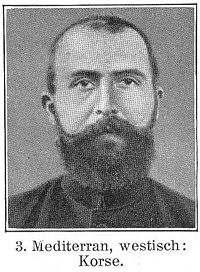
The Mediterranean race was thought to be prevalent in southern Europe
Southern Europe
The term Southern Europe, at its most general definition, is used to mean "all countries in the south of Europe". However, the concept, at different times, has had different meanings, providing additional political, linguistic and cultural context to the definition in addition to the typical...
, parts of Eastern Europe
Eastern Europe
Eastern Europe is the eastern part of Europe. The term has widely disparate geopolitical, geographical, cultural and socioeconomic readings, which makes it highly context-dependent and even volatile, and there are "almost as many definitions of Eastern Europe as there are scholars of the region"...
, most of North Africa
North Africa
North Africa or Northern Africa is the northernmost region of the African continent, linked by the Sahara to Sub-Saharan Africa. Geopolitically, the United Nations definition of Northern Africa includes eight countries or territories; Algeria, Egypt, Libya, Morocco, South Sudan, Sudan, Tunisia, and...
, Northeast Africa
Horn of Africa
The Horn of Africa is a peninsula in East Africa that juts hundreds of kilometers into the Arabian Sea and lies along the southern side of the Gulf of Aden. It is the easternmost projection of the African continent...
, West Asia and parts of South Asia
South Asia
South Asia, also known as Southern Asia, is the southern region of the Asian continent, which comprises the sub-Himalayan countries and, for some authorities , also includes the adjoining countries to the west and the east...
, as well as parts of southwestern Ireland
Ireland
Ireland is an island to the northwest of continental Europe. It is the third-largest island in Europe and the twentieth-largest island on Earth...
and western Great Britain
Great Britain
Great Britain or Britain is an island situated to the northwest of Continental Europe. It is the ninth largest island in the world, and the largest European island, as well as the largest of the British Isles...
, and was characterized by moderate to short stature, long (dolichocephalic) or moderate (mesocephalic) skull, aquiline nose, dark hair, dark eyes and olive complexion
Olive skin
Olive skin describes a skin color range of some indigenous individuals who are from the Mediterranean and some other parts of Europe, Middle East and regions of South Asia, Southeast Asia and Central Asia. It may often be skin type 3 and 4 on the Fitzpatrick scale. However, this scale measures...
.
Early debates
These differentiations occurred following long-standing claims about the alleged differences between the Nordic and the Mediterranean people. Such debates arose from responses to ancient writers who had commented on differences between northern and southern Europeans. For the Greeks and Romans, GermanicGermanic peoples
The Germanic peoples are an Indo-European ethno-linguistic group of Northern European origin, identified by their use of the Indo-European Germanic languages which diversified out of Proto-Germanic during the Pre-Roman Iron Age.Originating about 1800 BCE from the Corded Ware Culture on the North...
and Celt
Celt
The Celts were a diverse group of tribal societies in Iron Age and Roman-era Europe who spoke Celtic languages.The earliest archaeological culture commonly accepted as Celtic, or rather Proto-Celtic, was the central European Hallstatt culture , named for the rich grave finds in Hallstatt, Austria....
ic peoples were often stereotyped as wild red hair
Red hair
Red hair occurs on approximately 1–2% of the human population. It occurs more frequently in people of northern or western European ancestry, and less frequently in other populations...
ed barbarians. Pseudo-Aristotle
Pseudo-Aristotle
Pseudo-Aristotle is a general cognomen for authors of philosophical or medical treatises who attributed their work to the Greek philosopher Aristotle, or whose work was later attributed to him by others....
argued that the Greeks were an ideal race because they possessed a medium skin-tone, in contrast to pale northerners and dark southerners. By the nineteenth century long-standing cultural and religious differences between Protestant northern Europe and the Catholic south were being reinterpreted in racial terms.
Racial theories
Thomas Huxley
Thomas Henry Huxley PC FRS was an English biologist, known as "Darwin's Bulldog" for his advocacy of Charles Darwin's theory of evolution....
argued that there were four basic racial categories (Xanthocroic, Mongoloid, Australioid
Australoid
The Australoid race is a broad racial classification. The concept originated with a typological method of racial classification. They were described as having dark skin with wavy hair, in the case of Veddoids from South Asia and Aboriginal Australians, or hair ranging from straight to kinky in the...
and Negroid). The Xanthocroic race were the "fair whites" of north and Central Europe. According to Huxley,
On the south and west this type comes into contact and mixes with the "Melanochroi," or "dark whites"...In these regions are found, more or less mixed with Xanthochroi and Mongoloids, and extending to a greater or less distance into the conterminous Xanthochroic, Mongoloid, Negroid, and Australioid areas, the men whom I have termed Melanochroi, or dark whites. Under its best form this type is exhibited by many Irishmen, Welshmen, and Bretons, by Spaniards, South Italians, GreeksGreeksThe Greeks, also known as the Hellenes , are a nation and ethnic group native to Greece, Cyprus and neighboring regions. They also form a significant diaspora, with Greek communities established around the world....
, South Slavs, ArmeniansArmeniansArmenian people or Armenians are a nation and ethnic group native to the Armenian Highland.The largest concentration is in Armenia having a nearly-homogeneous population with 97.9% or 3,145,354 being ethnic Armenian....
, LebaneseLebanese peopleThe Lebanese people are a nation and ethnic group of Levantine people originating in what is today the country of Lebanon, including those who had inhabited Mount Lebanon prior to the creation of the modern Lebanese state....
, Arabs, and high-caste Brahmins...I am much disposed to think that the Melanochroi are the result of an intermixture between the Xanthochroi and the Australioids. It is to the Xanthochroi and Melanochroi, taken together, that the absurd denomination of "Caucasian" is usually applied.
By the late nineteenth century Huxley's Xanthocroic group had been redefined as the "Nordic" race, while his Melanochroi became the Mediterranean race.
William Z. Ripley
William Z. Ripley
William Zebina Ripley was an American economist, lecturer at Columbia University, professor of economics at MIT, professor of political economics at Harvard University, and racial theorist...
The Races of Europe
The Races of Europe
The Races of Europe is the title of two anthropological publications*The Races of Europe by William Z. Ripley*The Races of Europe by Carleton S. Coon...
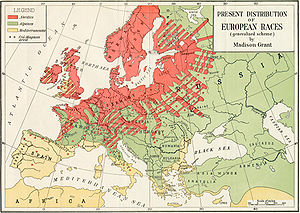
(1899) created a tripartite model that was later popularised by Madison Grant
Madison Grant
Madison Grant was an American lawyer, historian and physical anthropologist, known primarily for his work as a eugenicist and conservationist...
. It divided European
European ethnic groups
The ethnic groups in Europe are the various ethnic groups that reside in the nations of Europe. European ethnology is the field of anthropology focusing on Europe....
s into three main subcategories: Teutonic, Alpine
Alpine race
The Alpine race is an historical racial classification or sub-race of humans, considered a branch of the Caucasian race. The term is not commonly used today, but was popular in the early 20th century.-History:...
and Mediterranean.
| Head Cephalic index Cephalic index is the ratio of the maximum width of the head multiplied by 100 divided by its maximum length .... |
Face | Hair | Eyes Eye color Eye color is a polygenic phenotypic character and is determined by two distinct factors: the pigmentation of the eye's iris and the frequency-dependence of the scattering of light by the turbid medium in the stroma of the iris.... |
Stature | Nose | Synonyms | |
|---|---|---|---|---|---|---|---|
| Alpine (Celtic) Alpine race The Alpine race is an historical racial classification or sub-race of humans, considered a branch of the Caucasian race. The term is not commonly used today, but was popular in the early 20th century.-History:... |
Round | Broad | Light chestnut | Hazelgray | Medium, stocky | Variable; rather broad; heavy | Occidental (Deniker), Homo Alpinus (Lapouge) |
| Mediterranean | Long | Long | Dark brown or black | Dark | Medium, slender | Rather broad | |
| Teutonic | Long | Long | Very light | Blue | Tall | Narrow; aquiline | Nordic (Deniker), Homo Europaeus (Lapouge) |
In Germany, Britain and the USA, it became common for white supremacists to promote the merits of the blond
Blond
Blond or blonde or fair-hair is a hair color characterized by low levels of the dark pigment eumelanin. The resultant visible hue depends on various factors, but always has some sort of yellowish color...
, blue-eyed Nordic race as the most advanced of human population groups: the "master race
Master race
Master race was a phrase and concept originating in the slave-holding Southern US. The later phrase Herrenvolk , interpreted as 'master race', was a concept in Nazi ideology in which the Nordic peoples, one of the branches of what in the late-19th and early-20th century was called the Aryan race,...
". Southern/Eastern Europeans were deemed to be inferior, an argument that dated back to Arthur de Gobineau
Arthur de Gobineau
Joseph Arthur Comte de Gobineau was a French aristocrat, novelist and man of letters who became famous for developing the theory of the Aryan master race in his book An Essay on the Inequality of the Human Races...
's Nordicist claims that racial mixing was responsible for the decline of the Roman Empire
Roman Empire
The Roman Empire was the post-Republican period of the ancient Roman civilization, characterised by an autocratic form of government and large territorial holdings in Europe and around the Mediterranean....
. However, in southern Europe itself alternative models were developed which stressed the merits of Mediterranean peoples, drawing on established traditions dating from ancient and Renaissance
Renaissance
The Renaissance was a cultural movement that spanned roughly the 14th to the 17th century, beginning in Italy in the Late Middle Ages and later spreading to the rest of Europe. The term is also used more loosely to refer to the historical era, but since the changes of the Renaissance were not...
claims about the superiority of civilization in the south. Some of these arguments were taken up by African-American writers to counter the arguments of Nordicists who considered any deviation from "pure" whiteness to be a taint.
The fact that Mediterranean peoples were responsible for the most important of ancient western civilizations was a problem for the promoters of Nordic superiority. Giuseppe Sergi
Giuseppè Sergi
Giuseppe Sergi was an influential Italian anthropologist of the early twentieth century, best known for his opposition to Nordicism in his books on the racial identity of ancient Mediterranean peoples...
's much-debated book The Mediterranean Race (1901) argued that the Mediterranean race had in fact originated in Africa, probably in the Sahara
Sahara
The Sahara is the world's second largest desert, after Antarctica. At over , it covers most of Northern Africa, making it almost as large as Europe or the United States. The Sahara stretches from the Red Sea, including parts of the Mediterranean coasts, to the outskirts of the Atlantic Ocean...
region, and that it also included a number of dark-skinned peoples from the African continent, such as Ethiopians and Somalis
Somali people
Somalis are an ethnic group located in the Horn of Africa, also known as the Somali Peninsula. The overwhelming majority of Somalis speak the Somali language, which is part of the Cushitic branch of the Afro-Asiatic language family...
. Sergi added that the Mediterranean race "in its external characters is a brown human variety, neither white nor negroid, but pure in its elements, that is to say not a product of the mixture of Whites with Negroes or negroid peoples." In his book The Mediterranean Race, Sergi also hypothesized that the Mediterranean, the African and the Nordic races all originated from an original Eurafrican species
Species
In biology, a species is one of the basic units of biological classification and a taxonomic rank. A species is often defined as a group of organisms capable of interbreeding and producing fertile offspring. While in many cases this definition is adequate, more precise or differing measures are...
. According to Sergi, the Mediterranean race was the "greatest race of the world" and was singularly responsible for the most accomplished civilizations of ancient times, including those of Mesopotamia
Mesopotamia
Mesopotamia is a toponym for the area of the Tigris–Euphrates river system, largely corresponding to modern-day Iraq, northeastern Syria, southeastern Turkey and southwestern Iran.Widely considered to be the cradle of civilization, Bronze Age Mesopotamia included Sumer and the...
, Persia, Egypt
Ancient Egypt
Ancient Egypt was an ancient civilization of Northeastern Africa, concentrated along the lower reaches of the Nile River in what is now the modern country of Egypt. Egyptian civilization coalesced around 3150 BC with the political unification of Upper and Lower Egypt under the first pharaoh...
, India
Ancient India
Ancient India may refer to:* The ancient history of India, which generally includes the ancient history of the Asian Subcontinent, including:*Science and technology in ancient India**Indian mathematics**Astronomy**List of Indian inventions...
, Carthage
Carthage
Carthage , implying it was a 'new Tyre') is a major urban centre that has existed for nearly 3,000 years on the Gulf of Tunis, developing from a Phoenician colony of the 1st millennium BC...
, Greece
Ancient Greece
Ancient Greece is a civilization belonging to a period of Greek history that lasted from the Archaic period of the 8th to 6th centuries BC to the end of antiquity. Immediately following this period was the beginning of the Early Middle Ages and the Byzantine era. Included in Ancient Greece is the...
and Rome
Ancient Rome
Ancient Rome was a thriving civilization that grew on the Italian Peninsula as early as the 8th century BC. Located along the Mediterranean Sea and centered on the city of Rome, it expanded to one of the largest empires in the ancient world....
. To Sergi, the Semites were a branch of the Eurafricans who were closely related to the Mediterraneans.
C. G. Seligman also stated that "it must, I think, be recognized that the Mediterranean race has actually more achievement to its credit than any other, since it is responsible for by far the greater part of Mediterranean civilization, certainly before 1000 B.C. (and probably much later), and so shaped not only the Aegean cultures, but those of Western as well as the greater part of Eastern Mediterranean lands, while the culture of their near relatives, the Hamitic pre-dynastic Egyptians
Egyptians
Egyptians are nation an ethnic group made up of Mediterranean North Africans, the indigenous people of Egypt.Egyptian identity is closely tied to geography. The population of Egypt is concentrated in the lower Nile Valley, the small strip of cultivable land stretching from the First Cataract to...
, formed the basis of that of Egypt."
In the USA, the idea that the Mediterranean race included certain populations on the African continent was taken up in the early twentieth century by African-American writers such as W. E. B. Du Bois, who used it to attack white supremacist ideas about racial "purity". Such publications as the Journal of Negro History stressed the cross-fertilization of cultures between Africa and Europe, and adopted Sergi's view that the "civilizing" race had originated in Africa itself.
H.G. Wells referred to the Mediterranean race as the Iberian race.
Physical traits
According to C. S. Coon, typically marked Mediterranean features include skin color ranging "from pink or peaches-and-cream to a light brown", a relatively prominent and aquiline nose, considerable body hair, and dark brown to black hair.According to Renato Biasutti: "Skin color 'matte'-white or brunet-white, chestnut or dark chestnut eyes and hair
Brown hair
Brown hair is the second most common human hair color.Brown hair varies from light brown to almost black hair. It is characterized by higher levels of the dark pigment eumelanin and lower levels of the pale pigment pheomelanin. Its strands are thicker than those of fair hair but not as much as...
, not excessive pilosity; medium-low stature (162), body of moderately longilinear forms; dolichomorphic skull (78) with rounded occiput; oval face; leptorrhine nose (68) with straight spine, horizontal or inclined downwards base of the septum; large open eyes."
Subtypes
The Mediterranean race was divided into various subtypes by different authors, such as "Mediterranean proper"/Gracile Mediterranean"/"Ibero-Insular", "West Mediterranean", "Atlantid"/"Atlanto-Mediterranean", "Pontic"/"East Mediterranean", "Berberid", and sometimes the "Orientalid" race was included too, which referred to the Arabid and Iranid races.Later 20th century
Later in the 20th century the concept of a distinctive Mediterranean race was still considered useful by theorists such as Earnest HootonEarnest Hooton
Earnest Albert Hooton was a U.S. physical anthropologist known for his work on racial classification and his popular writings such as the book Up From The Ape...
in Up From the Ape (1931) and Carleton S. Coon
Carleton S. Coon
Carleton Stevens Coon, was an American physical anthropologist, Professor of Anthropology at the University of Pennsylvania, lecturer and professor at Harvard, and president of the American Association of Physical Anthropologists.-Biography:Carleton Coon was born in Wakefield, Massachusetts to a...
in his revised edition of Ripley's Races of Europe (1939). These writers thought the Nordic race was the northern variety of Mediterraneans that lost pigmentation through natural selection
Natural selection
Natural selection is the nonrandom process by which biologic traits become either more or less common in a population as a function of differential reproduction of their bearers. It is a key mechanism of evolution....
due to the environment.
Hooton argued that even a skilled anthropologist would have a difficult time separating a Nordic from Mediterranean skeleton. He thought a destabilized blend of the two existed mostly in Britain that he labeled "Nordic-Mediterranean", with hazel eyes (rather than pure brown), dark hair color (mainly dark brown) and dolichocephalic skull.
According to Carleton Coon the "homeland and cradle" of the Mediterranean race is in North Africa
North Africa
North Africa or Northern Africa is the northernmost region of the African continent, linked by the Sahara to Sub-Saharan Africa. Geopolitically, the United Nations definition of Northern Africa includes eight countries or territories; Algeria, Egypt, Libya, Morocco, South Sudan, Sudan, Tunisia, and...
and Southwest Asia
Southwest Asia
Western Asia, West Asia, Southwest Asia or Southwestern Asia are terms that describe the westernmost portion of Asia. The terms are partly coterminous with the Middle East, which describes a geographical position in relation to Western Europe rather than its location within Asia...
, in the area from Morocco
Morocco
Morocco , officially the Kingdom of Morocco , is a country located in North Africa. It has a population of more than 32 million and an area of 710,850 km², and also primarily administers the disputed region of the Western Sahara...
to Afghanistan
Afghanistan
Afghanistan , officially the Islamic Republic of Afghanistan, is a landlocked country located in the centre of Asia, forming South Asia, Central Asia and the Middle East. With a population of about 29 million, it has an area of , making it the 42nd most populous and 41st largest nation in the world...
. Coon argued that smaller Mediterraneans traveled by land from the Mediterranean basin north into Europe in the Mesolithic
Mesolithic
The Mesolithic is an archaeological concept used to refer to certain groups of archaeological cultures defined as falling between the Paleolithic and the Neolithic....
era. Taller Mediterraneans (Atlanto-Mediterraneans) were Neolithic seafarers who sailed in reed-type boats and colonized the Mediterranean basin from a Near East
Near East
The Near East is a geographical term that covers different countries for geographers, archeologists, and historians, on the one hand, and for political scientists, economists, and journalists, on the other...
ern origin. He argued that they also colonized Britain
British Isles
The British Isles are a group of islands off the northwest coast of continental Europe that include the islands of Great Britain and Ireland and over six thousand smaller isles. There are two sovereign states located on the islands: the United Kingdom of Great Britain and Northern Ireland and...
where their descendants may be seen today, characterized by dark brown hair, dark eyes and robust features. He stressed the central role of the Mediterraneans in his works, claiming "The Mediterraneans occupy the center of the stage; their areas of greatest concentration are precisely those where civilization is the oldest. This is to be expected, since it was they who produced it and it, in a sense, that produced them".
After the 1960s the concept of an exact Mediterranean race fell out of favor, though the distinctive features of Mediterranean populations continued to be recognized.
See also
- Race (classification of human beings)
- Genetic history of EuropeGenetic history of EuropeThe genetic history of Europe can be inferred from the patterns of genetic diversity across continents and time. The primary data to develop historical scenarios coming from sequences of mitochondrial, Y-chromosome and autosomal DNA from modern populations and if available from ancient DNA...
- History of the Mediterranean regionHistory of the Mediterranean regionThe history of the Mediterranean region is the history of the interaction of the cultures and people of the lands surrounding the Mediterranean Sea —the central superhighway of transport, trade and cultural exchange between diverse peoples...
- Mediterranean sea (oceanography)Mediterranean sea (oceanography)In oceanography, a mediterranean sea is a mostly enclosed sea that has limited exchange of water with outer oceans and where the water circulation is dominated by salinity and temperature differences rather than winds....
- AnthropologyAnthropologyAnthropology is the study of humanity. It has origins in the humanities, the natural sciences, and the social sciences. The term "anthropology" is from the Greek anthrōpos , "man", understood to mean mankind or humanity, and -logia , "discourse" or "study", and was first used in 1501 by German...