


Burgundian Netherlands

Encyclopedia
In the history of the Low Countries
, the Burgundian Netherlands refers to a number of Imperial
and French
fiefs ruled in personal union
by the House of Valois-Burgundy
and their Habsburg heirs in the period from 1384 to 1482 . The area comprised large parts of present-day Belgium
and the Netherlands
, as well as Luxembourg
and parts of northern France
.
dukes, a younger branch of the French royal House of Valois in 1384, upon the death of Count Louis II of Flanders. His heiress, Margaret III of Flanders
in 1369 had married Philip the Bold
, youngest son of King John II of France
and the first of the Valois dukes of Burgundy at Dijon
, who thus inherited the County of Flanders
. The Flemish comital House of Dampierre
had been French vassals, who held territory around the affluent cities of Bruges
and Ghent
, but also adjacent lands in former Lower Lorraine
east of the Scheldt
river ("Imperial Flanders") including the exclave of Mechelen
, which were a fief of the Holy Roman Empire, and furthermore the neighbouring French County of Artois
. Together they initiated an era of Burgundian governance in the Low Countries.
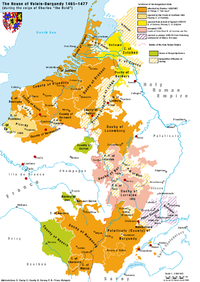 The Dampierre legacy further comprised the French counties of Rethel
in northern Champagne
and Nevers
west of Burgundy proper, both held by Philip's younger son Philip II
from 1407, as well as the County of Burgundy
(Franche-Comté) east of it, an Imperial fief which had been part of the former Kingdom of Arles
.
In the following decades, the Burgundian dukes expanded their territories in the Low Countries by the acquisition of several Imperial State
s: Duke Philip the Good purchased the County of Namur in 1421, inherited the Duchies of Brabant
and Limburg
in 1430, and seized the Counties of Hainaut
, Holland
and Zeeland
in 1432, and the Duchy of Luxembourg
in 1441. His son, the last Burgundian duke Charles the Bold, in 1473 annexed the Duchy of Guelders
, which had been pawned by late Arnold of Egmond
.
The Valois era would last until 1477, when Duke Charles the Bold died at the Battle of Nancy
leaving no male heir. The territorial Duchy of Burgundy reverted to the French crown according to Salic law
, and King Louis XI of France
also seized the French portion of the Burgundian possessions in the Low Countries. The Imperial fiefs passed to the Austrian
House of Habsburg through Charles' daughter Mary of Burgundy
and her husband Archduke Maximilian of Habsburg
, son of Emperor Frederick III
. Maximilian however regarded the Burgundian Netherlands including Flanders and Artois as the undivided domains of his wife and himself and marched against the French. The conflict culminated at the Battle of Guinegate
in 1479. Though Maximilian was victorious, he was only able to gain the County of Flanders according to the 1482 Treaty of Arras
after his wife Mary had suddenly died, while France retained Artois.
In her testament, Mary of Burgundy had bequested the Burgundian heritage to her and Maximilian's son, Philip the Handsome
. His father, dissatisfied with the terms of the Arras agreement, continued to campaign the seized French territories. In 1493, King Charles VIII of France
according to the Treaty of Senlis
finally renounced Artois, which together with Flanders was incorporated into the Imperial Seventeen Provinces
under the rule of Philip.
House of Valois, territorial Dukes of Burgundy
House of Valois, titular Duchess of Burgundy
House of Habsburg, titular Dukes of Burgundy (see Habsburg Netherlands
)
, and consolidating of the region's economy.
The Estates-General met for the first time in the City Hall of Bruges
on 9 January 1464. It consisted of delegates of the Estates of Brabant
, Flanders
, Lille
, Douai
, Orchies
, Artois
, Hainaut
, Holland
, Zeeland
, Namur, Mechelen
and Boulonnais
. Up to 1464, the Duke only maintained ties with each of the provincial States separately. In principle, the provincial Estates were composed of representatives of the three traditional estates
: clergy
, nobility
and the Third Estate, but the exact composition and influence of each estate (within the provincial Estates) could differ. Convening an Estates-General in which all provincial Estates were represented was part of Philip the Good's policy of centralisation.
was the center of commerce, though by the 1480s the inevitable silting of its harbor was bringing its economic hegemony to a close. Philip was a great patron of illuminated manuscript
s and court painting reached new highs: Robert Campin
, the van Eyck
brothers, and Rogier van der Weyden
Low Countries
The Low Countries are the historical lands around the low-lying delta of the Rhine, Scheldt, and Meuse rivers, including the modern countries of Belgium, the Netherlands, Luxembourg and parts of northern France and western Germany....
, the Burgundian Netherlands refers to a number of Imperial
Holy Roman Empire
The Holy Roman Empire was a realm that existed from 962 to 1806 in Central Europe.It was ruled by the Holy Roman Emperor. Its character changed during the Middle Ages and the Early Modern period, when the power of the emperor gradually weakened in favour of the princes...
and French
France in the Middle Ages
France in the Middle Ages covers an area roughly corresponding to modern day France, from the death of Louis the Pious in 840 to the middle of the 15th century...
fiefs ruled in personal union
Personal union
A personal union is the combination by which two or more different states have the same monarch while their boundaries, their laws and their interests remain distinct. It should not be confused with a federation which is internationally considered a single state...
by the House of Valois-Burgundy
House of Valois-Burgundy
The term "Valois Dukes of Burgundy" is employed to refer to the dynasty which began after John II of France granted the Duchy of Burgundy to his youngest son, Philip the Bold...
and their Habsburg heirs in the period from 1384 to 1482 . The area comprised large parts of present-day Belgium
Belgium
Belgium , officially the Kingdom of Belgium, is a federal state in Western Europe. It is a founding member of the European Union and hosts the EU's headquarters, and those of several other major international organisations such as NATO.Belgium is also a member of, or affiliated to, many...
and the Netherlands
Netherlands
The Netherlands is a constituent country of the Kingdom of the Netherlands, located mainly in North-West Europe and with several islands in the Caribbean. Mainland Netherlands borders the North Sea to the north and west, Belgium to the south, and Germany to the east, and shares maritime borders...
, as well as Luxembourg
Luxembourg
Luxembourg , officially the Grand Duchy of Luxembourg , is a landlocked country in western Europe, bordered by Belgium, France, and Germany. It has two principal regions: the Oesling in the North as part of the Ardennes massif, and the Gutland in the south...
and parts of northern France
France
The French Republic , The French Republic , The French Republic , (commonly known as France , is a unitary semi-presidential republic in Western Europe with several overseas territories and islands located on other continents and in the Indian, Pacific, and Atlantic oceans. Metropolitan France...
.
Dynastic
A fair share (but not most) of these territories were inherited by the BurgundianDuchy of Burgundy
The Duchy of Burgundy , was heir to an ancient and prestigious reputation and a large division of the lands of the Second Kingdom of Burgundy and in its own right was one of the geographically larger ducal territories in the emergence of Early Modern Europe from Medieval Europe.Even in that...
dukes, a younger branch of the French royal House of Valois in 1384, upon the death of Count Louis II of Flanders. His heiress, Margaret III of Flanders
Margaret III, Countess of Flanders
Margaret of Dampierre was Countess of Flanders , Countess of Artois and Countess Palatine of Burgundy and twice Duchess consort of Burgundy...
in 1369 had married Philip the Bold
Philip the Bold
Philip the Bold , also Philip II, Duke of Burgundy , was the fourth and youngest son of King John II of France and his wife, Bonne of Luxembourg. By his marriage to Margaret III, Countess of Flanders, he also became Count Philip II of Flanders, Count Philip IV of Artois and Count-Palatine Philip IV...
, youngest son of King John II of France
John II of France
John II , called John the Good , was the King of France from 1350 until his death. He was the second sovereign of the House of Valois and is perhaps best remembered as the king who was vanquished at the Battle of Poitiers and taken as a captive to England.The son of Philip VI and Joan the Lame,...
and the first of the Valois dukes of Burgundy at Dijon
Dijon
Dijon is a city in eastern France, the capital of the Côte-d'Or département and of the Burgundy region.Dijon is the historical capital of the region of Burgundy. Population : 151,576 within the city limits; 250,516 for the greater Dijon area....
, who thus inherited the County of Flanders
County of Flanders
The County of Flanders was one of the territories constituting the Low Countries. The county existed from 862 to 1795. It was one of the original secular fiefs of France and for centuries was one of the most affluent regions in Europe....
. The Flemish comital House of Dampierre
House of Dampierre
The Dampierre family played an important role during the Middle Ages. They were Count of Flanders and later also Count of Nevers, Rethel, Artois and Franche-Comté. The senior line of the House died out with Margaret III...
had been French vassals, who held territory around the affluent cities of Bruges
Bruges
Bruges is the capital and largest city of the province of West Flanders in the Flemish Region of Belgium. It is located in the northwest of the country....
and Ghent
Ghent
Ghent is a city and a municipality located in the Flemish region of Belgium. It is the capital and biggest city of the East Flanders province. The city started as a settlement at the confluence of the Rivers Scheldt and Lys and in the Middle Ages became one of the largest and richest cities of...
, but also adjacent lands in former Lower Lorraine
Lower Lorraine
The Duchy of Lower Lorraine or Lower Lotharingia , established in 959 was a stem duchy of the medieval German kingdom, which encompassed part of modern-day Belgium, the Netherlands, the northern part of the German Rhineland and a part of northern France east of the Schelde river.It was created out...
east of the Scheldt
Scheldt
The Scheldt is a 350 km long river in northern France, western Belgium and the southwestern part of the Netherlands...
river ("Imperial Flanders") including the exclave of Mechelen
Mechelen
Mechelen Footnote: Mechelen became known in English as 'Mechlin' from which the adjective 'Mechlinian' is derived...
, which were a fief of the Holy Roman Empire, and furthermore the neighbouring French County of Artois
County of Artois
The County of Artois was an historic province of the Kingdom of France, held by the Dukes of Burgundy from 1384 until 1477/82, and a state of the Holy Roman Empire from 1493 until 1659....
. Together they initiated an era of Burgundian governance in the Low Countries.
Counts and dukes of Rethel
This is a list of counts and dukes of Rethel. The first counts of Rethel ruled independently, before the county passed first to the Counts of Nevers, then to the Counts of Flanders, and finally to the Dukes of Burgundy. In 1405 the County became part of the Peerage of France, and in 1581 it was...
in northern Champagne
Champagne, France
Champagne is a historic province in the northeast of France, now best known for the sparkling white wine that bears its name.Formerly ruled by the counts of Champagne, its western edge is about 100 miles east of Paris. The cities of Troyes, Reims, and Épernay are the commercial centers of the area...
and Nevers
County of Nevers
The County of Nevers is a historic county of Burgundy in central France. It is the location of the town, Nevers. It roughly corresponds to the later province of Nivernais and the modern of department of Nièvre.- History :...
west of Burgundy proper, both held by Philip's younger son Philip II
Philip II, Count of Nevers
Phillip II, Count of Nevers was the youngest son of Philip the Bold and Margaret III of Flanders....
from 1407, as well as the County of Burgundy
County of Burgundy
The Free County of Burgundy , was a medieval county , within the traditional province and modern French region Franche-Comté, whose very French name is still reminiscent of the unusual title of its count: Freigraf...
(Franche-Comté) east of it, an Imperial fief which had been part of the former Kingdom of Arles
Kingdom of Arles
The Kingdom of Arles or Second Kingdom of Burgundy of the High Middle Ages was a Frankish dominion established in 933 from lands of the early medieval Kingdom of Burgundy at Arles...
.
In the following decades, the Burgundian dukes expanded their territories in the Low Countries by the acquisition of several Imperial State
Imperial State
An Imperial State or Imperial Estate was an entity in the Holy Roman Empire with a vote in the Imperial Diet assemblies. Several territories of the Empire were not represented, while some officials were non-voting members; neither qualified as Imperial States.Rulers of Imperial States were...
s: Duke Philip the Good purchased the County of Namur in 1421, inherited the Duchies of Brabant
Duchy of Brabant
The Duchy of Brabant was a historical region in the Low Countries. Its territory consisted essentially of the three modern-day Belgian provinces of Flemish Brabant, Walloon Brabant and Antwerp, the Brussels-Capital Region and most of the present-day Dutch province of North Brabant.The Flag of...
and Limburg
Duchy of Limburg
The Duchy of Limburg, situated in the Low Countries between the river Meuse and the city of Aachen, was a state of the Holy Roman Empire. Its territory is now divided between the Belgian provinces of Liège and Limburg , the Dutch province of Limburg , and a small part of North Rhine-Westphalia in...
in 1430, and seized the Counties of Hainaut
County of Hainaut
The County of Hainaut was a historical region in the Low Countries with its capital at Mons . In English sources it is often given the archaic spelling Hainault....
, Holland
County of Holland
The County of Holland was a county in the Holy Roman Empire and from 1482 part of the Habsburg Netherlands in what is now the Netherlands. It covered an area roughly corresponding to the current Dutch provinces of North-Holland and South-Holland, as well as the islands of Terschelling, Vlieland,...
and Zeeland
County of Zeeland
The County of Zeeland was a county of the Holy Roman Empire in what is now the Netherlands. It covered an area in the Scheldt and Meuse delta roughly corresponding to the current Dutch province of Zeeland, though it did not include the region of Zeeuws-Vlaanderen which was part of...
in 1432, and the Duchy of Luxembourg
County, Duchy and Grand Duchy of Luxembourg
The County, later Duchy of Luxembourg was a state of the Holy Roman Empire, the ancestral homeland of the noble House of Luxembourg.-History:...
in 1441. His son, the last Burgundian duke Charles the Bold, in 1473 annexed the Duchy of Guelders
Guelders
Guelders or Gueldres is the name of a historical county, later duchy of the Holy Roman Empire, located in the Low Countries.-Geography:...
, which had been pawned by late Arnold of Egmond
Arnold, Duke of Guelders
Arnold of Egmond was Duke of Guelders, Count of Zutphen. He was son of John II of Egmond and Maria van Arkel....
.
The Valois era would last until 1477, when Duke Charles the Bold died at the Battle of Nancy
Battle of Nancy
The Battle of Nancy was the final and decisive battle of the Burgundian Wars, fought outside the walls of Nancy on 5 January 1477 between Charles the Bold, Duke of Burgundy, and René II, Duke of Lorraine...
leaving no male heir. The territorial Duchy of Burgundy reverted to the French crown according to Salic law
Salic law
Salic law was a body of traditional law codified for governing the Salian Franks in the early Middle Ages during the reign of King Clovis I in the 6th century...
, and King Louis XI of France
Louis XI of France
Louis XI , called the Prudent , was the King of France from 1461 to 1483. He was the son of Charles VII of France and Mary of Anjou, a member of the House of Valois....
also seized the French portion of the Burgundian possessions in the Low Countries. The Imperial fiefs passed to the Austrian
Archduchy of Austria
The Archduchy of Austria , one of the most important states within the Holy Roman Empire, was the nucleus of the Habsburg Monarchy and the predecessor of the Austrian Empire...
House of Habsburg through Charles' daughter Mary of Burgundy
Mary of Burgundy
Mary of Burgundy ruled the Burgundian territories in Low Countries and was suo jure Duchess of Burgundy from 1477 until her death...
and her husband Archduke Maximilian of Habsburg
Maximilian I, Holy Roman Emperor
Maximilian I , the son of Frederick III, Holy Roman Emperor and Eleanor of Portugal, was King of the Romans from 1486 and Holy Roman Emperor from 1493 until his death, though he was never in fact crowned by the Pope, the journey to Rome always being too risky...
, son of Emperor Frederick III
Frederick III, Holy Roman Emperor
Frederick the Peaceful KG was Duke of Austria as Frederick V from 1424, the successor of Albert II as German King as Frederick IV from 1440, and Holy Roman Emperor as Frederick III from 1452...
. Maximilian however regarded the Burgundian Netherlands including Flanders and Artois as the undivided domains of his wife and himself and marched against the French. The conflict culminated at the Battle of Guinegate
Battle of Guinegate (1479)
The First Battle of Guinegate took place on August 7, 1479. French troops of King Louis XI were defeated by the Burgundians led by Archduke Maximilian of Habsburg...
in 1479. Though Maximilian was victorious, he was only able to gain the County of Flanders according to the 1482 Treaty of Arras
Treaty of Arras (1482)
The Treaty of Arras was signed at Arras on 23 December 1482 by King Louis XI of France and Archduke Maximilian I of Habsburg as heir of the Burgundian Netherlands in the course of the Burgundian succession crisis....
after his wife Mary had suddenly died, while France retained Artois.
In her testament, Mary of Burgundy had bequested the Burgundian heritage to her and Maximilian's son, Philip the Handsome
Philip I of Castile
Philip I , known as Philip the Handsome or the Fair, was the first Habsburg King of Castile...
. His father, dissatisfied with the terms of the Arras agreement, continued to campaign the seized French territories. In 1493, King Charles VIII of France
Charles VIII of France
Charles VIII, called the Affable, , was King of France from 1483 to his death in 1498. Charles was a member of the House of Valois...
according to the Treaty of Senlis
Treaty of Senlis
The Treaty of Senlis concerning the Burgundian succession was signed at Senlis, Oise in May of 1493 between Maximilian I, Holy Roman Emperor and King Charles VIII of France....
finally renounced Artois, which together with Flanders was incorporated into the Imperial Seventeen Provinces
Seventeen Provinces
The Seventeen Provinces were a personal union of states in the Low Countries in the 15th century and 16th century, roughly covering the current Netherlands, Belgium, Luxembourg, a good part of the North of France , and a small part of Western Germany.The Seventeen Provinces were originally held by...
under the rule of Philip.
Rulers
The Burgundian dukes who ruled the Netherlandish territories were:House of Valois, territorial Dukes of Burgundy
- Philip the BoldPhilip the BoldPhilip the Bold , also Philip II, Duke of Burgundy , was the fourth and youngest son of King John II of France and his wife, Bonne of Luxembourg. By his marriage to Margaret III, Countess of Flanders, he also became Count Philip II of Flanders, Count Philip IV of Artois and Count-Palatine Philip IV...
(1384–1405), son of King John II of FranceJohn II of FranceJohn II , called John the Good , was the King of France from 1350 until his death. He was the second sovereign of the House of Valois and is perhaps best remembered as the king who was vanquished at the Battle of Poitiers and taken as a captive to England.The son of Philip VI and Joan the Lame,...
, by his wife Margaret III of FlandersMargaret III, Countess of FlandersMargaret of Dampierre was Countess of Flanders , Countess of Artois and Countess Palatine of Burgundy and twice Duchess consort of Burgundy... - John the Fearless (1405–1419), son
- Philip the Good (1419–1467), son
- Charles the Bold (1467–1477), son
House of Valois, titular Duchess of Burgundy
- Mary of BurgundyMary of BurgundyMary of Burgundy ruled the Burgundian territories in Low Countries and was suo jure Duchess of Burgundy from 1477 until her death...
(1477–1482), Charles' daughter, married Maximilian I of HabsburgMaximilian I, Holy Roman EmperorMaximilian I , the son of Frederick III, Holy Roman Emperor and Eleanor of Portugal, was King of the Romans from 1486 and Holy Roman Emperor from 1493 until his death, though he was never in fact crowned by the Pope, the journey to Rome always being too risky...
in 1477
House of Habsburg, titular Dukes of Burgundy (see Habsburg Netherlands
Habsburg Netherlands
The Habsburg Netherlands was a geo-political entity covering the whole of the Low Countries from 1482 to 1556/1581 and solely the Southern Netherlands from 1581 to 1794...
)
- Philip the Handsome (1482–1506), Mary's son; Maximilian I, his father, as regent (1482–1493)
- Charles VCharles V, Holy Roman EmperorCharles V was ruler of the Holy Roman Empire from 1519 and, as Charles I, of the Spanish Empire from 1516 until his voluntary retirement and abdication in favor of his younger brother Ferdinand I and his son Philip II in 1556.As...
(1506–1555), Phlip's son; Margaret of Austria, regent (1507–1515) and (1519–1530)
Political
The sheer burden of variety of bishoprics and independent cities, the intensely local partisanship, the various taxation systems, weights and measures, internal customs barriers, fiercely defended local rights were all hindrances to a "good Valois". Attempts at enlarging personal control by the dukes resulted in revolts among the independent towns (sometimes supported by independent local nobles) and bloody military suppression in response. An increasingly modernized central government, with a bureaucracy of clerks, allowed the dukes to become celebrated art patrons and establish a glamorous court life that gave rise to conventions of behavior that lasted for centuries. Philip the Good (1419–1467) extended his personal control to the southeast; bringing Brussels, Namur, and Liège under his control. He channeled the traditional independence of the cities through such mechanisms as the first Estates-GeneralStates-General of the Netherlands
The States-General of the Netherlands is the bicameral legislature of the Netherlands, consisting of the Senate and the House of Representatives. The parliament meets in at the Binnenhof in The Hague. The archaic Dutch word "staten" originally related to the feudal classes in which medieval...
, and consolidating of the region's economy.
The Estates-General met for the first time in the City Hall of Bruges
Bruges
Bruges is the capital and largest city of the province of West Flanders in the Flemish Region of Belgium. It is located in the northwest of the country....
on 9 January 1464. It consisted of delegates of the Estates of Brabant
Duchy of Brabant
The Duchy of Brabant was a historical region in the Low Countries. Its territory consisted essentially of the three modern-day Belgian provinces of Flemish Brabant, Walloon Brabant and Antwerp, the Brussels-Capital Region and most of the present-day Dutch province of North Brabant.The Flag of...
, Flanders
County of Flanders
The County of Flanders was one of the territories constituting the Low Countries. The county existed from 862 to 1795. It was one of the original secular fiefs of France and for centuries was one of the most affluent regions in Europe....
, Lille
Lille
Lille is a city in northern France . It is the principal city of the Lille Métropole, the fourth-largest metropolitan area in the country behind those of Paris, Lyon and Marseille. Lille is situated on the Deûle River, near France's border with Belgium...
, Douai
Douai
-Main sights:Douai's ornate Gothic style belfry was begun in 1380, on the site of an earlier tower. The 80 m high structure includes an impressive carillon, consisting of 62 bells spanning 5 octaves. The originals, some dating from 1391 were removed in 1917 during World War I by the occupying...
, Orchies
Orchies
-References:* -External links:*...
, Artois
County of Artois
The County of Artois was an historic province of the Kingdom of France, held by the Dukes of Burgundy from 1384 until 1477/82, and a state of the Holy Roman Empire from 1493 until 1659....
, Hainaut
County of Hainaut
The County of Hainaut was a historical region in the Low Countries with its capital at Mons . In English sources it is often given the archaic spelling Hainault....
, Holland
County of Holland
The County of Holland was a county in the Holy Roman Empire and from 1482 part of the Habsburg Netherlands in what is now the Netherlands. It covered an area roughly corresponding to the current Dutch provinces of North-Holland and South-Holland, as well as the islands of Terschelling, Vlieland,...
, Zeeland
County of Zeeland
The County of Zeeland was a county of the Holy Roman Empire in what is now the Netherlands. It covered an area in the Scheldt and Meuse delta roughly corresponding to the current Dutch province of Zeeland, though it did not include the region of Zeeuws-Vlaanderen which was part of...
, Namur, Mechelen
Mechelen
Mechelen Footnote: Mechelen became known in English as 'Mechlin' from which the adjective 'Mechlinian' is derived...
and Boulonnais
Boulonnais (land area)
The Boulonnais is a coastal area of northern France, around Calais and Boulogne-sur-Mer. It has a curved belt of chalk downs which run into the sea at both ends, and geologically is the east end of the Weald-Artois Anticline.- Administration :...
. Up to 1464, the Duke only maintained ties with each of the provincial States separately. In principle, the provincial Estates were composed of representatives of the three traditional estates
Estates of the realm
The Estates of the realm were the broad social orders of the hierarchically conceived society, recognized in the Middle Ages and Early Modern period in Christian Europe; they are sometimes distinguished as the three estates: the clergy, the nobility, and commoners, and are often referred to by...
: clergy
Clergy
Clergy is the generic term used to describe the formal religious leadership within a given religion. A clergyman, churchman or cleric is a member of the clergy, especially one who is a priest, preacher, pastor, or other religious professional....
, nobility
Nobility
Nobility is a social class which possesses more acknowledged privileges or eminence than members of most other classes in a society, membership therein typically being hereditary. The privileges associated with nobility may constitute substantial advantages over or relative to non-nobles, or may be...
and the Third Estate, but the exact composition and influence of each estate (within the provincial Estates) could differ. Convening an Estates-General in which all provincial Estates were represented was part of Philip the Good's policy of centralisation.
Ducal patronage
From 1441, Philip based his ducal court in Brussels, but BrugesBruges
Bruges is the capital and largest city of the province of West Flanders in the Flemish Region of Belgium. It is located in the northwest of the country....
was the center of commerce, though by the 1480s the inevitable silting of its harbor was bringing its economic hegemony to a close. Philip was a great patron of illuminated manuscript
Illuminated manuscript
An illuminated manuscript is a manuscript in which the text is supplemented by the addition of decoration, such as decorated initials, borders and miniature illustrations...
s and court painting reached new highs: Robert Campin
Robert Campin
Robert Campin , now usually identified as the artist known as the Master of Flémalle, is usually considered the first great master of Early Netherlandish painting...
, the van Eyck
Van Eyck
Van Eyck , also Van Eijk is a Dutch surname meaning "of Eyck" or "of Eijk"...
brothers, and Rogier van der Weyden
Social and economic
In 1491 and 1492, the Netherlands was afflicted by revolts by the Dutch peasantry. These revolts were suppressed by an army under the command of Duke Albert III of Saxony at the Battle of Heemskerk.External links
- Metropolitan Museum: "Burgundian Netherlands: Court Life
- Metropolitan Museum: "Burgundian Netherlands: Private Life