

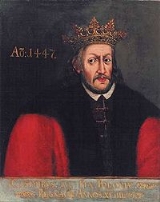
Casimir IV Jagiellon

Encyclopedia
Order of the Garter
The Most Noble Order of the Garter, founded in 1348, is the highest order of chivalry, or knighthood, existing in England. The order is dedicated to the image and arms of St...
( kaˈʑimi̯ɛʒ jaɡi̯ɛlˈlɔɲt͡ʃɨk; ; 30 November 1427 – 7 June 1492) of the House of Jagiellon
Jagiellon dynasty
The Jagiellonian dynasty was a royal dynasty originating from the Lithuanian House of Gediminas dynasty that reigned in Central European countries between the 14th and 16th century...
was Grand Duke of Lithuania from 1440, and King of Poland from 1447, until his death.
Casimir was the second son of King Władysław II Jagiełło (Jogaila)
Jogaila
Jogaila, later 'He is known under a number of names: ; ; . See also: Jogaila : names and titles. was Grand Duke of Lithuania , king consort of Kingdom of Poland , and sole King of Poland . He ruled in Lithuania from 1377, at first with his uncle Kęstutis...
, and the younger brother of Władysław III of Varna.
Grand Duke of Lithuania
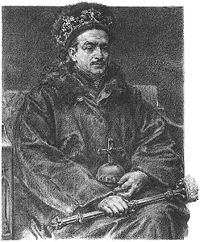
Sigismund Kestutaitis
Sigismund Kęstutaitis was the Grand Duke of Lithuania from 1432 to 1440. Sigismund was his baptismal name; Sigismund's pagan Lithuanian birth name is unknown. He was son of the Grand Duke of Lithuania Kęstutis and his wife Birutė....
left the office of the Grand Duchy of Lithuania
Grand Duchy of Lithuania
The Grand Duchy of Lithuania was a European state from the 12th /13th century until 1569 and then as a constituent part of Polish-Lithuanian Commonwealth until 1791 when Constitution of May 3, 1791 abolished it in favor of unitary state. It was founded by the Lithuanians, one of the polytheistic...
empty. The Voivode of Trakai, Jonas Goštautas
Jonas Goštautas
Jonas Gostautas or Goštautas was a Lithuanian nobleman from the Grand Duchy of Lithuania of the Goštautai noble family, a politician and skillful land owner...
, and other magnates of Lithuania, supported Casimir as a pretender to the throne. However many Polish noblemen hoped that the thirteen year old boy would become a Vice-regent
Vice-regent
A Vice-regent is a person who acts in the name of another, notably:*a person who acts for a Regent.*as a synonym of Viceroy*as a common misuse for Vicegerent...
for the Polish King in Lithuania. Casimir was invited by the Lithuanian magnates to Lithuania, and when Casimir arrived in Vilnius
Vilnius
Vilnius is the capital of Lithuania, and its largest city, with a population of 560,190 as of 2010. It is the seat of the Vilnius city municipality and of the Vilnius district municipality. It is also the capital of Vilnius County...
in 1440, he was proclaimed as the Grand Duke of Lithuania on 29 June 1440 by the Council of Lords, contrary to the wishes of the Polish noble lords—an act supported and coordinated by Jonas Goštautas. This act could have been understood as dissolution of the fragile personal union between the Grand Duchy of Lithuania and the Kingdom of Poland. When the news arrived in the Kingdom of Poland concerning the proclamation of Casimir as the Grand Duke of Lithuania, it was met with hostility, even to the point of military threats against Lithuania. Since the young Grand Duke was underaged, the supreme control over the Grand Duchy of Lithuania was in the hands of the Council of Lords, presided by Jonas Goštautas. Casimir had been taught the language and customs of Lithuania by appointed court officials.
During Casimir's rule the rights of the Lithuanian nobility—dukes, magnates and boyar
Boyar
A boyar, or bolyar , was a member of the highest rank of the feudal Moscovian, Kievan Rus'ian, Bulgarian, Wallachian, and Moldavian aristocracies, second only to the ruling princes , from the 10th century through the 17th century....
s (lesser nobles), irrespective of their religion and ethnicity—were put on an equal footing to those of the Polish szlachta
Szlachta
The szlachta was a legally privileged noble class with origins in the Kingdom of Poland. It gained considerable institutional privileges during the 1333-1370 reign of Casimir the Great. In 1413, following a series of tentative personal unions between the Grand Duchy of Lithuania and the Kingdom of...
. Additionally, Casimir promised to protect the Grand Duchy's borders and not to appoint persons from the Polish Kingdom
Kingdom of Poland (1385–1569)
The Kingdom of Poland of the Jagiellons was the Polish state created by the accession of Jogaila , Grand Duke of Lithuania, to the Polish throne in 1386. The Union of Krewo or Krėva Act, united Poland and Lithuania under the rule of a single monarch...
to the offices of the Grand Duchy. He accepted that decisions on matters concerning the Grand Duchy would not be made without the Council of Lords' consent. He also granted the subject region of Samogitia
Eldership of Samogitia
The Duchy of Samogitia had been the administrative unit of the Grand Duchy of Lithuania from 1422 . Between 1422 to 1441 it was known as the Eldership of Samogitia...
the right to elect its own elder
Elder (administrative title)
The term Elder is used in several different countries and organizations to indicate a position of authority...
. Casimir was the first ruler of Lithuania baptised at birth, becoming the first natively Roman Catholic Grand Duke.
King of Poland
Casimir succeeded his brother Władysław III (killed at the Battle of VarnaBattle of Varna
The Battle of Varna took place on November 10, 1444 near Varna in eastern Bulgaria. In this battle the Ottoman Empire under Sultan Murad II defeated the Polish and Hungarian armies under Władysław III of Poland and János Hunyadi...
in 1444) as King of Poland after a three-year interregnum on 25 June 1447. In 1454, he married Elisabeth of Austria
Elisabeth of Austria (d. 1505)
Elisabeth of Austria , , was a Polish-Lithuanian queen...
, daughter of the late King of the Romans
King of the Romans
King of the Romans was the title used by the ruler of the Holy Roman Empire following his election to the office by the princes of the Kingdom of Germany...
Albert II of Habsburg by his late wife Elisabeth of Bohemia. Her distant relative Frederick of Habsburg
Frederick III, Holy Roman Emperor
Frederick the Peaceful KG was Duke of Austria as Frederick V from 1424, the successor of Albert II as German King as Frederick IV from 1440, and Holy Roman Emperor as Frederick III from 1452...
became Holy Roman Emperor and reigned as Frederick III until after Casimir's own death. The marriage strengthened the ties between the house of Jagiello and the sovereigns of Hungary-Bohemia and put Casimir at odds with the Holy Roman Emperor
Holy Roman Emperor
The Holy Roman Emperor is a term used by historians to denote a medieval ruler who, as German King, had also received the title of "Emperor of the Romans" from the Pope...
through internal Habsburg rivalry.
That same year, Casimir was approached by the Prussian Confederation
Prussian Confederation
The Prussian Confederation was an organization formed in 1440 by a group of 53 gentry and clergy and 19 cities in Prussia to oppose the monastic state of the Teutonic Knights. It was based on the basis of an earlier similar organization, the Lizard Union...
for aid against the Teutonic Order, which he promised, by making the separatist Prussian
Prussia (region)
Prussia is a historical region in Central Europe extending from the south-eastern coast of the Baltic Sea to the Masurian Lake District. It is now divided between Poland, Russia, and Lithuania...
regions a protectorate of the Polish Kingdom. However, when the insurgent cities of the Teutonic Monastic State of Prussia
Monastic State of the Teutonic Knights
The State of the Teutonic Order, , also Monastic State of the Teutonic Knights or Ordensstaat , was formed in 1224 during the Northern Crusades, the Teutonic Knights' conquest of the pagan West-Baltic Old Prussians in the 13th century....
rebelled against the Order, it resisted with greater strength than expected, and the Thirteen Years' War (1454–1466) ensued. Casimir and the Prussian Confederation defeated the Teutonic Order, taking over its capital at Marienburg (Malbork Castle
Malbork Castle
The Marienburg Castle in Malbork is by area the largest castle in the world. It was built in Prussia by the Teutonic Knights, a German Roman Catholic religious order of crusaders, in a form of an Ordensburg fortress. The Order named it Marienburg...
). In the Second Peace of Thorn (1466), the Order recognized Polish sovereignty over the seceded western Prussian regions, therefore then called Royal Prussia
Royal Prussia
Royal Prussia was a Region of the Kingdom of Poland and of the Polish-Lithuanian Commonwealth . Polish Prussia included Pomerelia, Chełmno Land , Malbork Voivodeship , Gdańsk , Toruń , and Elbląg . It is distinguished from Ducal Prussia...
, and the Polish crown's overlordship over the remaining Teutonic Monastic State of Prussia
Monastic State of the Teutonic Knights
The State of the Teutonic Order, , also Monastic State of the Teutonic Knights or Ordensstaat , was formed in 1224 during the Northern Crusades, the Teutonic Knights' conquest of the pagan West-Baltic Old Prussians in the 13th century....
, transformed in 1525 into a duchy, thus consistently called Ducal Prussia.
Elisabeth's only brother Ladislas, king of Bohemia and Hungary
Ladislas the Posthumous
Ladislaus the Posthumous was Duke of Austria from 1440, King of Hungary from 1444 and King of Bohemia from 1453.- Biography :...
, died in 1457, and after that Casimir and Elisabeth's dynastic interests were directed also towards her brother's former kingdoms.
Children
- Hedwig Jagiellon married George the RichGeorge of BavariaGeorge of Bavaria referred to as the Rich , was the last Duke of Bavaria-Landshut...
, of the WittelsbachWittelsbachThe Wittelsbach family is a European royal family and a German dynasty from Bavaria.Members of the family served as Dukes, Electors and Kings of Bavaria , Counts Palatine of the Rhine , Margraves of Brandenburg , Counts of Holland, Hainaut and Zeeland , Elector-Archbishops of Cologne , Dukes of...
dynasty of BavariaBavariaBavaria, formally the Free State of Bavaria is a state of Germany, located in the southeast of Germany. With an area of , it is the largest state by area, forming almost 20% of the total land area of Germany...
. Delegates had gone to KrakówKrakówKraków also Krakow, or Cracow , is the second largest and one of the oldest cities in Poland. Situated on the Vistula River in the Lesser Poland region, the city dates back to the 7th century. Kraków has traditionally been one of the leading centres of Polish academic, cultural, and artistic life...
to negotiate the marriage, and their "Landshut WeddingLandshuter hochzeitThe Landshut Wedding is one of the largest historical pageants in Europe. Countless visitors from all over the world have taken part, or have been spectators of the "Landshuter Hochzeit 1475", a pageant held in Landshut, Bavaria . More than 2,000 participants in mediaeval costumes bring the...
" took place in BavariaBavariaBavaria, formally the Free State of Bavaria is a state of Germany, located in the southeast of Germany. With an area of , it is the largest state by area, forming almost 20% of the total land area of Germany...
with much pomp and celebration in 1475, starting a tradition which continues to this day. - Saint CasimirSaint CasimirSaint Casimir Jagiellon was a royal prince of the Kingdom of Poland and of the Grand Duchy of Lithuania who became a patron saint of Lithuania, Poland, and the young.-Biography:...
was to have married the daughter of Emperor Frederick IIIFrederick III, Holy Roman EmperorFrederick the Peaceful KG was Duke of Austria as Frederick V from 1424, the successor of Albert II as German King as Frederick IV from 1440, and Holy Roman Emperor as Frederick III from 1452...
, but instead chose a religious life, eventually being canonized as St. Casimir. - Vladislaus II of Bohemia and HungaryVladislaus II of Bohemia and HungaryVladislaus II, also known as Ladislaus Jagiellon ; was King of Bohemia from 1471 and King of Hungary from 1490 until his death in 1516...
combined the thrones of Hungary and BohemiaBohemiaBohemia is a historical region in central Europe, occupying the western two-thirds of the traditional Czech Lands. It is located in the contemporary Czech Republic with its capital in Prague...
. - SophieSophia of PolandSophia of Poland was a Polish and Lithuanian princess by birth and Margravine of Brandenburg-Ansbach and Brandenburg-Kulmbach by her marriage to Frederick I, Margrave of Brandenburg-Ansbach.-Early life and family :...
, married to Margrave Frederick V of Brandenburg-Ansbach - John I of Poland (27 December 1459 – 17 June 1501) succeeded him as the king of Poland (1492–1501)
- Alexander JagiellonAlexander JagiellonAlexander of the House of Jagiellon was the Grand Duke of Lithuania and later also King of Poland. He was the fourth son of Casimir IV Jagiellon...
(5 August 1461 – 19 August 1506) Kinf of Poland (12 December 1501 – 19 August 1506) - Sigismund I the OldSigismund I the OldSigismund I of Poland , of the Jagiellon dynasty, reigned as King of Poland and also as the Grand Duke of Lithuania from 1506 until 1548...
(1 January 1467 – 1 April 1548) King of Poland (1506 - 1548) - Friedrich JagiellonFryderyk JagiellończykCardinal Fryderyk Jagiellończyk was a Polish Prince and Duke of Lithuania, Archbishop of Gniezno, Bishop of Kraków, and Primate of Poland. He was the 6th son and 9th child of Casimir IV Jagiellon, King of Poland and Grand Duke of Lithuania, and his wife Elizabeth Habsburg of Hungary.Frederick...
(April 27, 1468 – March 14, 1503) Archbishop of Gniezno, Bishop of Kraków, and Primate of Poland. - Anna married to Duke Bogislaw X of Pomerania; they had eight children, including Sophie of PomeraniaSophie of PomeraniaSophie of Pomerania was a Queen consort of Denmark and Norway as the spouse of King Frederick I of Denmark...
, who became queen of Denmark - Barbara married to Duke Georg dem BärtigenGeorge, Duke of SaxonyGeorge the Bearded, Duke of Saxony , was duke of Saxony from 1500 to 1539.Duke George was a member of the Order of the Golden Fleece.-Early life:...
of SaxonyElectorate of SaxonyThe Electorate of Saxony , sometimes referred to as Upper Saxony, was a State of the Holy Roman Empire. It was established when Emperor Charles IV raised the Ascanian duchy of Saxe-Wittenberg to the status of an Electorate by the Golden Bull of 1356... - Elizabeth Jagiellon (November 13, 1482 - February 16, 1517) who married Frederick II of LegnicaFrederick II of LegnicaFrederick II of Legnica , also known as the Great of Legnica , was a Duke of Legnica from 1488 , of Brzeg from 1521...
- Two additional daughters named Elizabeth