


International trade

Encyclopedia
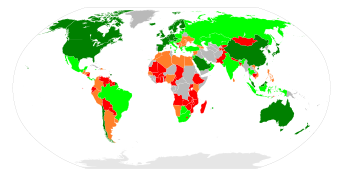
Capital (economics)
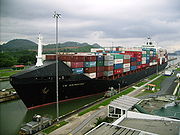
In economics, capital, capital goods, or real capital refers to already-produced durable goods used in production of goods or services. The capital goods are not significantly consumed, though they may depreciate in the production process...
, goods, and services across international borders or territories. In most countries, such trade represents a significant share of gross domestic product
Gross domestic product
Gross domestic product refers to the market value of all final goods and services produced within a country in a given period. GDP per capita is often considered an indicator of a country's standard of living....
(GDP). While international trade
Trade
Trade is the transfer of ownership of goods and services from one person or entity to another. Trade is sometimes loosely called commerce or financial transaction or barter. A network that allows trade is called a market. The original form of trade was barter, the direct exchange of goods and...
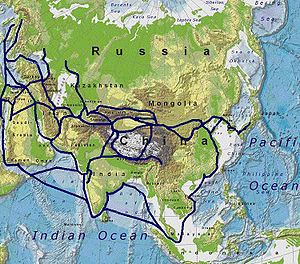
has been present throughout much of history (see Silk Road
Silk Road
The Silk Road or Silk Route refers to a historical network of interlinking trade routes across the Afro-Eurasian landmass that connected East, South, and Western Asia with the Mediterranean and European world, as well as parts of North and East Africa...
, Amber Road
Amber Road
The Amber Road was an ancient trade route for the transfer of amber. As one of the waterways and ancient highways, for centuries the road led from Europe to Asia and back, and from northern Africa to the Baltic Sea....
), its economic, social, and political importance has been on the rise in recent centuries.
Industrialization, advanced transport
Transport
Transport or transportation is the movement of people, cattle, animals and goods from one location to another. Modes of transport include air, rail, road, water, cable, pipeline, and space. The field can be divided into infrastructure, vehicles, and operations...
ation, globalization
Globalization
Globalization refers to the increasingly global relationships of culture, people and economic activity. Most often, it refers to economics: the global distribution of the production of goods and services, through reduction of barriers to international trade such as tariffs, export fees, and import...
, multinational corporation
Multinational corporation
A multi national corporation or enterprise , is a corporation or an enterprise that manages production or delivers services in more than one country. It can also be referred to as an international corporation...
s, and outsourcing
Outsourcing
Outsourcing is the process of contracting a business function to someone else.-Overview:The term outsourcing is used inconsistently but usually involves the contracting out of a business function - commonly one previously performed in-house - to an external provider...
are all having a major impact on the international trade system. Increasing international trade is crucial to the continuance of globalization
Globalization
Globalization refers to the increasingly global relationships of culture, people and economic activity. Most often, it refers to economics: the global distribution of the production of goods and services, through reduction of barriers to international trade such as tariffs, export fees, and import...
. Without international trade, nations would be limited to the goods and services produced within their own borders.
International trade is, in principle, not different from domestic trade
Domestic trade
Domestic trade, also known as internal trade or home trade, is the exchange of domestic goods within the boundaries of a country. This may be sub-divided into two categories, wholesale and retail. Wholesale trade is concerned with buying goods from manufacturers or dealers in large quantities and...
as the motivation and the behavior of parties involved in a trade do not change fundamentally regardless of whether trade is across a border or not. The main difference is that international trade is typically more costly than domestic trade. The reason is that a border typically imposes additional costs such as tariff
Tariff
A tariff may be either tax on imports or exports , or a list or schedule of prices for such things as rail service, bus routes, and electrical usage ....
s, time costs due to border delays and costs associated with country differences such as language, the legal system or culture.
Another difference between domestic and international trade is that factors of production
Factors of production
In economics, factors of production means inputs and finished goods means output. Input determines the quantity of output i.e. output depends upon input. Input is the starting point and output is the end point of production process and such input-output relationship is called a production function...
such as capital and labor are typically more mobile within a country than across countries. Thus international trade is mostly restricted to trade in goods and services, and only to a lesser extent to trade in capital, labor or other factors of production. Trade in goods and services can serve as a substitute for trade in factors of production.
Instead of importing a factor of production, a country can import goods that make intensive use of that factor of production and thus embody it. An example is the import of labor-intensive goods by the United States from China. Instead of importing Chinese labor, the United States imports goods that were produced with Chinese labor. One report in 2010 suggested that international trade was increased when a country hosted a network of immigrants, but the trade effect was weakened when the immigrants became assimilated into their new country.
International trade is also a branch of economics
Economics
Economics is the social science that analyzes the production, distribution, and consumption of goods and services. The term economics comes from the Ancient Greek from + , hence "rules of the house"...
, which, together with international finance
International finance
International finance is the branch of economics that studies the dynamics of exchange rates, foreign investment, global financial system, and how these affect international trade. It also studies international projects, international investments and capital flows, and trade deficits. It includes...
, forms the larger branch of international economics
International economics
International economics is concerned with the effects upon economic activity of international differences in productive resources and consumer preferences and the institutions that affect them...
.
Models
Several models have been proposed to predict patterns of trade and to analyze the effects of trade policiesCommercial policy
A commercial policy is a governmental policy governing trade with third countries...
such as tariff
Tariff
A tariff may be either tax on imports or exports , or a list or schedule of prices for such things as rail service, bus routes, and electrical usage ....
s.
Ricardian model
Comparative advantage
In economics, the law of comparative advantage says that two countries will both gain from trade if, in the absence of trade, they have different relative costs for producing the same goods...
, perhaps the most important concept in international trade theory. In a Ricardian model, countries specialize in producing what they produce best, and trade occurs due to technological differences between countries. Unlike other models, the Ricardian framework predicts that countries will fully specialize instead of producing a broad array of goods.
Also, the Ricardian model does not directly consider factor endowment
Factor endowment
In economics a country's factor endowment is commonly understood as the amount of land, labor, capital, and entrepreneurship that a country possesses and can exploit for manufacturing. Countries with a large endowment of resources tend to be more prosperous than those with a small endowment, all...
s, such as the relative amounts of labor and capital within a country. The main merit of Ricardian model is that it assumes technological differences between countries. Technological gap is easily included in the Ricardian and Ricardo-Sraffa model (See the Ricardian theory (modern development)).
The Ricardian model makes the following assumptions:
- Labor is the only primary input to production (labor is considered to be the ultimate source of value).
- Constant Marginal Product of Labor (MPL) (Labor productivity is constant, constant returns to scale, and simple technology.)
- Limited amount of labor in the economy
- Labor is perfectly mobile among sectors but not internationally.
- Perfect competition (price-takers).
The Ricardian model applies in the short run, so that technology may vary internationally. This supports the fact that countries follow their comparative advantage and allows for specialization.
For the modern development of Ricardian model, see the subsection below: Ricardian theory of international trade.
Heckscher-Ohlin model
In the early 1900s an international trade theory called factor proportions theory was developed by two Swedish economists, Eli HeckscherEli Heckscher
Eli Filip Heckscher was a Swedish political economist and economic historian.-Biography:...
and Bertil Ohlin
Bertil Ohlin
Bertil Gotthard Ohlin was a Swedish economist and politician. He was a professor of economics at the Stockholm School of Economics from 1929 to 1965. He was also leader of the People's Party, a social-liberal party which at the time was the largest party in opposition to the governing Social...
. This theory is therefore called the Heckscher-Ohlin theory (H-O theory). The H-O theory stresses that countries should produce and export goods that require resources (factors) that are abundant and import goods that require resources in short supply. It differs from the theories of comparative advantage and absolute advantage since those theories focus on the productivity of the production process for a particular good. On the contrary, the Heckscher-Ohlin theory states that a country should specialize in producing and exporting products that use the factors that are most abundant, and thus are the cheapest to produce.
The Heckscher-Ohlin model was produced as an alternative to the Ricardian model of basic comparative advantage. Despite its greater complexity it did not prove much more accurate in its predictions. However from a theoretical point of view it did provide an elegant method of incorporating the neoclassical price mechanism into international trade theory.
The theory argues that the pattern of international trade is determined by differences in factor endowments. It predicts that countries will export
Export
The term export is derived from the conceptual meaning as to ship the goods and services out of the port of a country. The seller of such goods and services is referred to as an "exporter" who is based in the country of export whereas the overseas based buyer is referred to as an "importer"...
those goods that make intensive use of locally abundant factors and will import goods that make intensive use of factors that are locally scarce. Empirical problems with the H-O model, such as the Leontief paradox
Leontief paradox
Leontief's paradox in economics is that the country with the world's highest capital-per worker has a lower capital/labor ratio in exports than in imports....
, were exposed in empirical tests by Wassily Leontief
Wassily Leontief
Wassily Wassilyovich Leontief , was a Russian-American economist notable for his research on how changes in one economic sector may have an effect on other sectors. Leontief won the Nobel Committee's Nobel Memorial Prize in Economic Sciences in 1973, and three of his doctoral students have also...
who found that the United States tended to export labor-intensive goods despite having an abundance of capital.
The H-O model makes the following core assumptions:
- Labor and capital flow freely between sectors
- The amount of labor and capital in two countries differ (difference in endowments)
- Free tradeFree tradeUnder a free trade policy, prices emerge from supply and demand, and are the sole determinant of resource allocation. 'Free' trade differs from other forms of trade policy where the allocation of goods and services among trading countries are determined by price strategies that may differ from...
- Technology is the same among countries (a long-term assumption)
- TastesTaste (sociology)Taste as an aesthetic, sociological, economic and anthropological concept refers to a cultural patterns of choice and preference. While taste is often understood as a biological concept, it can also be reasonably studied as a social or cultural phenomenon. Taste is about drawing distinctions...
are the same.
The problem with the H-O theory is that it excludes the trade of capital goods (including materials and fuels). In the H-O theory, labor and capital are fixed entities endowed to each country. In a modern economy, capital goods are traded internationally. Gains from trade of intermediate goods are considerable, as emphasized by Samuelson (2001).
Reality and Applicability of the Heckscher-Ohlin Model
Many economists prefer the Heckscher-Ohlin theory to the Ricardian theory, because H-O makes fewer simplifying assumptions. In 1953, Wassily Leontief published a study in which he tested the validity of the Heckscher-Ohlin theory. The study showed that the U.S was more abundant in capital compared to other countries, therefore the U.S would export capital-intensive goods and import labor-intensive goods. Leontief found out that the U.S's exports were less capital intensive than its imports.After the appearance of Leontief's paradox, many researchers tried to save the Heckscher-Ohlin theory, either by new methods of measurement, or either by new interpretations. Leamer emphasized that Leontief did not interpret H-O theory properly and claimed that with a right interpretation, the paradox did not occur. Brecher and Choudri found that, if Leamer was right, the American workers' consumption per head should be lower than the workers' world average consumption.
Many other trials followed but most of them failed. Many textbook writers, including Krugman and Obstfeld and Bowen, Hollander and Viane, are negative about the validity of H-O model. After examining the long history of empirical research, Bowen, Hollander and Viane concluded: "Recent tests of the factor abundance theory [H-O theory and its developed form into many-commodity and many-factor case] that directly examine the H-O-V equations also indicate the rejection of the theory."
Heckscher-Ohlin theory is not well adapted to the analyze South-North trade problems. The assumptions of H-O are less realistic with respect to N-S than N-N (or S-S) trade. Income differences between North and South is the assumption that third world cares about most. There is not much evidence of factor price equalization [a consequence of H-O theory. The H-O model assumes identical production functions among countries, although this is highly unrealistic. Technological gaps between developed and developing countries are the main reason why the latter are poor.
Specific factors model
In the specific factors model, labor mobility among industries is possible while capital is assumed to be immobile in the short run. Thus, this model can be interpreted as a short-run version of the Heckscher-Ohlin model. The "specific factors" name refers to the assumption that in the short run, specific factors of production such as physical capital are not easily transferable between industries. The theory suggests that if there is an increase in the price of a good, the owners of the factor of production specific to that good will profit in real terms.Additionally, owners of opposing specific factors of production (i.e., labor and capital) are likely to have opposing agendas when lobbying for controls over immigration of labor. Conversely, both owners of capital and labor profit in real terms from an increase in the capital endowment. This model is ideal for understanding income distribution but awkward for discussing the pattern of trade.
New Trade Theory
New Trade Theory tries to explain empirical elements of trade that comparative advantage-based models above have difficulty with. These include the fact that most trade is between countries with similar factor endowment and productivity levels, and the large amount of multinational production (i.e. foreign direct investment) that exists. New Trade theories are often based on assumptions such as monopolistic competitionMonopolistic competition
Monopolistic competition is imperfect competition where many competing producers sell products that are differentiated from one another...
and increasing returns to scale
Returns to scale
In economics, returns to scale and economies of scale are related terms that describe what happens as the scale of production increases in the long run, when all input levels including physical capital usage are variable...
. One result of these theories is the home-market effect
Home-market effect
The home market effect is a hypothesized concentration of certain industries in large markets. The home market effect became part of New Trade Theory. Through trade theory, the home market effect is derived from models with returns to scale and transportation costs...
, which asserts that, if an industry tends to cluster in one location because of returns to scale and if that industry faces high transportation costs, the industry will be located in the country with most of its demand, in order to minimize cost.
Gravity model
The Gravity model of trade presents a more empirical analysis of trading patterns. The gravity model, in its basic form, predicts trade based on the distance between countries and the interaction of the countries' economic sizes. The model mimics the Newtonian law of gravityLaw of Gravity
"Law of Gravity" is the fifteenth episode of the seventh season of the television series CSI: Crime Scene Investigation.-Plot:Before the start of his shift, Keppler eats dinner at a diner where he runs into an older man named Frank McCarty...
which also considers distance and physical size between two objects. The model has been proven to be empirically strong through econometric analysis.
Ricardian theory of international trade (modern development)
The Ricardian theory of comparative advantage became a basic constituent of neoclassical trade theory. Any undergraduate course in trade theory includes a presentation of Ricardo's example of a two-commodity, two-country model.This model has been expanded to many-country and many-commodity cases. Major general results were obtained by McKenzie and Jones, including his famous formula. It is a theorem about the possible trade pattern for N-country N-commodity cases.
Contemporary theories
Ricardo's idea was even expanded to the case of continuum of goods by Dornbusch, Fischer, and Samuelson This formulation is employed for example by Matsuyama and others. Thesetheories uses a special property that is applicable only for the two-country case.
Neo-Ricardian trade theory
Inspired by Piero SraffaPiero Sraffa
Piero Sraffa was an influential Italian economist whose book Production of Commodities by Means of Commodities is taken as founding the Neo-Ricardian school of Economics.- Early life :...
, a new strand of trade theory emerged and was named neo-Ricardian trade theory. The main contributors include Ian Steedman (1941-) and Stanley Metcalfe (1946-). They have criticized neoclassical international trade theory, namely the Heckscher-Ohlin model
Heckscher-Ohlin model
The Heckscher–Ohlin model is a general equilibrium mathematical model of international trade, developed by Eli Heckscher and Bertil Ohlin at the Stockholm School of Economics. It builds on David Ricardo's theory of comparative advantage by predicting patterns of commerce and production based...
on the basis that the notion of capital as primary factor has no method of measuring it before the determination of profit rate (thus trapped in a logical vicious circle). This was a second round of the Cambridge capital controversy
Cambridge capital controversy
The Cambridge capital controversy – sometimes simply called "the capital controversy" – refers to a theoretical and mathematical debate during the 1960s among economists concerning the nature and role of capital goods and the critique of the dominant neoclassical vision of aggregate...
, this time in the field of international trade.
The merit of neo-Ricardian trade theory is that input goods are explicitly included. This is in accordance with Sraffa's idea that any commodity is a product made by means of commodities. The limitation of their theory is that the analysis is restricted to small-country cases.
Traded intermediate goods
Ricardian trade theory ordinarily assumes that the labor is the unique input. This is a great deficiency as trade theory, for intermediate goods occupy the major part of the world international trade. Yeats found that 30% of world trade in manufacturing involves intermediate inputs. Bardhan and Jafee found that intermediate inputs occupy 37 to 38% of U.S. imports for the years 1992 and 1997, whereas the percentage of intrafirm trade grew from 43% in 1992 to 52% in 1997.McKenzie and Jones emphasized the necessity to expand the Ricardian theory to the cases of traded inputs. In a famous comment McKenzie (1954, p. 179) pointed that "A moment's consideration will convince one that Lancashire would be unlikely to produce cotton cloth if the cotton had to be grown in England."
Paul Samuelson
Paul Samuelson
Paul Anthony Samuelson was an American economist, and the first American to win the Nobel Memorial Prize in Economic Sciences. The Swedish Royal Academies stated, when awarding the prize, that he "has done more than any other contemporary economist to raise the level of scientific analysis in...
coined a term Sraffa bonus to name the gains from trade of inputs.
Ricardo-Sraffa trade theory
John ChipmanJohn Chipman
John Chipman may refer to:*John Chipman , judge and politician in Nova Scotia*John Smith Chipman , lawyer and U.S. Representative from Michigan...
observed in his survey that McKenzie stumbled upon the questions of intermediate products and discovered that "introduction of trade in intermediate product necessitates a fundamental alteration in classical analysis." It took many years until Y. Shiozawa succeeded in removing this deficiency. The Ricardian trade theory was now constructed in a form to include intermediate input trade for the most general case of many countries and many goods. This new theory is called Ricardo-Sraffa trade theory.
The Ricardian trade theory now provides a general theory that includes trade of intermediates such as fuel, machine tools, machinery parts and processed materials. The traded intermediate goods are then used as inputs to production in the importing country. Capital goods are nothing other than inputs to the production. Thus, in the Ricardo-Sraffa trade theory, capital goods move freely from country to country. Labor is the unique factor of production that remains immobile in its country of origin.
In a blog post of April 28, 2007, Gregory Mankiw compared Ricardian theory and Heckscher-Ohlin
Heckscher-Ohlin model
The Heckscher–Ohlin model is a general equilibrium mathematical model of international trade, developed by Eli Heckscher and Bertil Ohlin at the Stockholm School of Economics. It builds on David Ricardo's theory of comparative advantage by predicting patterns of commerce and production based...
theory and stood by the Ricardian side. Mankiw argued that Ricardian theory is more realistic than the Heckscher-Ohlin theory as the latter assumes that capital does not move from country to country. Mankiw's argument contains a logical slip, for the traditional Ricardian trade theory does not admit any inputs. Shiozawa's result saves Mankiw from his slip.
The neoclassical Heckscher-Ohlin-Samuelson theory only assumes productive factors and finished goods. It has no concept of intermediate goods. Therefore, it is the Ricardo-Sraffa trade theory that provides theoretical bases for ideas such as outsourcing, fragmentation and intra-firm trade.
Largest countries by total international trade
| Rank | Country | Total International Trade (Billions of USD) | Date of information |
|---|---|---|---|
| - | World | 27,567.0 | 2010 est. |
| - |  European Union (Extra-EU27) European Union (Extra-EU27) |
3,764.0 | 2010 est. |
| 1 |  United States United States |
3,225.0 | 2010 est. |
| 2 |  Mainland China Mainland China |
2,908.0 | 2010 est. |
| 3 |  Germany Germany |
2,402.0 | 2010 est. |
| 4 |  Japan Japan |
1,404.3 | 2010 est. |
| 5 |  Early Modern France Early Modern France |
1,107.8 | 2010 est. |
| 6 |  United Kingdom United Kingdom |
971.9 | 2010 est. |
| 7 |  Italy Italy |
921.5 | 2010 est. |
| 8 |  Netherlands Netherlands |
914.9 | 2010 est. |
| 9 |  South Korea South Korea |
886.7 | 2010 est. |
| - |  Hong Kong Hong Kong |
825.6 | 2010 est. |
| 10 |  Canada Canada |
793.7 | 2010 est. |
| 11 |  Singapore Singapore |
668.8 | 2010 est. |
| 12 |  Russia Russia |
648.8 | 2010 est. |
| 13 |  India India |
606.7 | 2010 est. |
| 14 |  Mexico Mexico |
604.5 | 2010 est. |
| 15 |  Belgium Belgium |
569.3 | 2010 est. |
| 16 |  Spain Spain |
568.3 | 2010 est. |
| 17 |  Republic of China Republic of China |
525.8 | 2010 est. |
| 18 |  Switzerland Switzerland |
458.9 | 2010 est. |
| 19 |  Australia Australia |
406.1 | 2010 est. |
| 20 |  Brazil Brazil |
383.6 | 2010 est. |
Source : Exports. Imports. The World Factbook
The World Factbook
The World Factbook is a reference resource produced by the Central Intelligence Agency of the United States with almanac-style information about the countries of the world. The official paper copy version is available from the National Technical Information Service and the Government Printing Office...
.
Top traded commodities (exports)
| Rank | Commodity | Value in US$('000) | Date of information |
|---|---|---|---|
| 1 | Mineral fuels, oils, distillation products, etc. | $2,183,079,941 | 2010 |
| 2 | Electrical, electronic equipment | $1,833,534,414 | 2010 |
| 3 | Machinery, nuclear reactors, boilers, etc. | $1,763,371,813 | 2010 |
| 4 | Vehicles other than railway, tramway | $1,076,830,856 | 2010 |
| 5 | Plastics and articles thereof | $470,226,676 | 2010 |
| 6 | Optical, photo, technical, medical, etc. apparatus | $465,101,524 | 2010 |
| 7 | Pharmaceutical products | $443,596,577 | 2010 |
| 8 | Iron and steel | $379,113,147 | 2010 |
| 9 | Organic chemicals | $377,462,088 | 2010 |
| 10 | Pearls, precious stones, metals, coins, etc. | $348,155,369 | 2010 |
Source: International Trade Centre
International Trade Centre
The International Trade Centre is the joint agency of the World Trade Organization and the United Nations.The following statement about the ITC is taken verbatim from its website, and reflects the ITC's official view of its own functions:...
Regulation of international trade
Mercantilism
Mercantilism is the economic doctrine in which government control of foreign trade is of paramount importance for ensuring the prosperity and security of the state. In particular, it demands a positive balance of trade. Mercantilism dominated Western European economic policy and discourse from...
most nations had high tariff
Tariff
A tariff may be either tax on imports or exports , or a list or schedule of prices for such things as rail service, bus routes, and electrical usage ....
s and many restrictions on international trade. In the 19th century, especially in the United Kingdom
United Kingdom
The United Kingdom of Great Britain and Northern IrelandIn the United Kingdom and Dependencies, other languages have been officially recognised as legitimate autochthonous languages under the European Charter for Regional or Minority Languages...
, a belief in free trade
Free trade
Under a free trade policy, prices emerge from supply and demand, and are the sole determinant of resource allocation. 'Free' trade differs from other forms of trade policy where the allocation of goods and services among trading countries are determined by price strategies that may differ from...
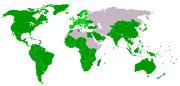
became paramount. This belief became the dominant thinking among western nations since then. In the years since the Second World War, controversial multilateral treaties like the General Agreement on Tariffs and Trade
General Agreement on Tariffs and Trade
The General Agreement on Tariffs and Trade was negotiated during the UN Conference on Trade and Employment and was the outcome of the failure of negotiating governments to create the International Trade Organization . GATT was signed in 1947 and lasted until 1993, when it was replaced by the World...
(GATT) and World Trade Organization
World Trade Organization
The World Trade Organization is an organization that intends to supervise and liberalize international trade. The organization officially commenced on January 1, 1995 under the Marrakech Agreement, replacing the General Agreement on Tariffs and Trade , which commenced in 1948...
have attempted to promote free trade
Free trade
Under a free trade policy, prices emerge from supply and demand, and are the sole determinant of resource allocation. 'Free' trade differs from other forms of trade policy where the allocation of goods and services among trading countries are determined by price strategies that may differ from...
while creating a globally regulated trade structure. These trade agreements have often resulted in discontent and protest with claims of unfair trade that is not beneficial to developing countries.
Free trade is usually most strongly supported by the most economically powerful nations, though they often engage in selective protectionism
Protectionism
Protectionism is the economic policy of restraining trade between states through methods such as tariffs on imported goods, restrictive quotas, and a variety of other government regulations designed to allow "fair competition" between imports and goods and services produced domestically.This...
for those industries which are strategically important such as the protective tariffs applied to agriculture by the United States
United States
The United States of America is a federal constitutional republic comprising fifty states and a federal district...
and Europe
Europe
Europe is, by convention, one of the world's seven continents. Comprising the westernmost peninsula of Eurasia, Europe is generally 'divided' from Asia to its east by the watershed divides of the Ural and Caucasus Mountains, the Ural River, the Caspian and Black Seas, and the waterways connecting...
. The Netherlands
Netherlands
The Netherlands is a constituent country of the Kingdom of the Netherlands, located mainly in North-West Europe and with several islands in the Caribbean. Mainland Netherlands borders the North Sea to the north and west, Belgium to the south, and Germany to the east, and shares maritime borders...
and the United Kingdom were both strong advocates of free trade when they were economically dominant, today the United States, the United Kingdom, Australia
Australia
Australia , officially the Commonwealth of Australia, is a country in the Southern Hemisphere comprising the mainland of the Australian continent, the island of Tasmania, and numerous smaller islands in the Indian and Pacific Oceans. It is the world's sixth-largest country by total area...
and Japan
Japan
Japan is an island nation in East Asia. Located in the Pacific Ocean, it lies to the east of the Sea of Japan, China, North Korea, South Korea and Russia, stretching from the Sea of Okhotsk in the north to the East China Sea and Taiwan in the south...
are its greatest proponents. However, many other countries (such as India, China and Russia) are increasingly becoming advocates of free trade as they become more economically powerful themselves. As tariff levels fall there is also an increasing willingness to negotiate non tariff measures, including foreign direct investment, procurement and trade facilitation
Trade facilitation
Trade facilitation looks at how procedures and controls governing the movement of goods across national borders can be improved to reduce associated cost burdens and maximise efficiency while safeguarding legitimate regulatory objectives...
. The latter looks at the transaction cost
Transaction cost
In economics and related disciplines, a transaction cost is a cost incurred in making an economic exchange . For example, most people, when buying or selling a stock, must pay a commission to their broker; that commission is a transaction cost of doing the stock deal...
associated with meeting trade and customs
Customs
Customs is an authority or agency in a country responsible for collecting and safeguarding customs duties and for controlling the flow of goods including animals, transports, personal effects and hazardous items in and out of a country...
procedures.
Traditionally agricultural interests are usually in favour of free trade while manufacturing sectors often support protectionism. This has changed somewhat in recent years, however. In fact, agricultural lobbies, particularly in the United States, Europe and Japan, are chiefly responsible for particular rules in the major international trade treaties which allow for more protectionist measures in agriculture than for most other goods and services.
During recession
Recession
In economics, a recession is a business cycle contraction, a general slowdown in economic activity. During recessions, many macroeconomic indicators vary in a similar way...
s there is often strong domestic pressure to increase tariffs to protect domestic industries. This occurred around the world during the Great Depression
Great Depression
The Great Depression was a severe worldwide economic depression in the decade preceding World War II. The timing of the Great Depression varied across nations, but in most countries it started in about 1929 and lasted until the late 1930s or early 1940s...
. Many economists have attempted to portray tariffs as the underlining reason behind the collapse in world trade that many believe seriously deepened the depression.
The regulation of international trade is done through the World Trade Organization at the global level, and through several other regional arrangements such as MERCOSUR
Mercosur
Mercosur or Mercosul is an economic and political agreement among Argentina, Brazil, Paraguay and Uruguay. Founded in 1991 by the Treaty of Asunción, which was later amended and updated by the 1994 Treaty of Ouro Preto. Its purpose is to promote free trade and the fluid movement of goods, people,...
in South America, the North American Free Trade Agreement
North American Free Trade Agreement
The North American Free Trade Agreement or NAFTA is an agreement signed by the governments of Canada, Mexico, and the United States, creating a trilateral trade bloc in North America. The agreement came into force on January 1, 1994. It superseded the Canada – United States Free Trade Agreement...
(NAFTA) between the United States, Canada and Mexico, and the European Union
European Union
The European Union is an economic and political union of 27 independent member states which are located primarily in Europe. The EU traces its origins from the European Coal and Steel Community and the European Economic Community , formed by six countries in 1958...
between 27 independent states. The 2005 Buenos Aires talks on the planned establishment of the Free Trade Area of the Americas
Free Trade Area of the Americas
The Free Trade Area of the Americas , , ) was a proposed agreement to eliminate or reduce the trade barriers among all countries in the Americas but Cuba. In the last round of negotiations, trade ministers from 34 countries met in Miami, United States, in November 2003 to discuss the proposal...
(FTAA) failed largely because of opposition from the populations of Latin American nations. Similar agreements such as the Multilateral Agreement on Investment
Multilateral Agreement on Investment
The Multilateral Agreement on Investment was a draft agreement negotiated between members of the Organisation for Economic Co-operation and Development in 1995–1998. Its ostensible purpose was to develop multilateral rules that would ensure international investment was governed in a more...
(MAI) have also failed in recent years.
Risk in international trade
Companies doing business across international borders face many of the same risks as would normally be evident in strictly domestic transactions. For example,- Buyer insolvency (purchaser cannot pay);
- Non-acceptance (buyer rejects goods as different from the agreed upon specifications);
- Credit risk (allowing the buyer to take possession of goods prior to payment);
- Regulatory risk (e.g., a change in rules that prevents the transaction);
- Intervention (governmental action to prevent a transaction being completed);
- Political risk (change in leadership interfering with transactions or prices); and
- War, piracy and civil unrest or turmoil;
- Natural catastrophes, freak weather and other uncontrollable and unpredictable events,
In addition, international trade also faces the risk of unfavorable exchange rate movements (and, the potential benefit of favorable movements).
See also
- Absolute advantageAbsolute advantageIn economics, principle of absolute advantage refers to the ability of a party to produce more of a good or service than competitors, using the same amount of resources...
- Balance of tradeBalance of tradeThe balance of trade is the difference between the monetary value of exports and imports of output in an economy over a certain period. It is the relationship between a nation's imports and exports...
- Borderless sellingBorderless SellingBorderless selling is the process of selling services to clients outside the country of origin of services through modern methods which eliminate the actions specifically designed to hinder international trade...
- Columbian ExchangeColumbian ExchangeThe Columbian Exchange was a dramatically widespread exchange of animals, plants, culture, human populations , communicable disease, and ideas between the Eastern and Western hemispheres . It was one of the most significant events concerning ecology, agriculture, and culture in all of human history...
- Commercial RevolutionCommercial RevolutionThe Commercial Revolution was a period of European economic expansion, colonialism, and mercantilism which lasted from approximately the 16th century until the early 18th century. It was succeeded in the mid-18th century by the Industrial Revolution. Beginning with the Crusades, Europeans...
- Commissions of the Danube RiverCommissions of the Danube RiverSee Internationalization of the Danube River for events before 1856.The Commissions of the Danube River were authorized by the Treaty of Paris after the close of the Crimean War...
- Comparative advantageComparative advantageIn economics, the law of comparative advantage says that two countries will both gain from trade if, in the absence of trade, they have different relative costs for producing the same goods...
- Customs unionCustoms unionA customs union is a type of trade bloc which is composed of a free trade area with a common external tariff. The participant countries set up common external trade policy, but in some cases they use different import quotas...
- Ecological EconomicsEcological economicsImage:Sustainable development.svg|right|The three pillars of sustainability. Clickable.|275px|thumbpoly 138 194 148 219 164 240 182 257 219 277 263 291 261 311 264 331 272 351 283 366 300 383 316 394 287 408 261 417 224 424 182 426 154 423 119 415 87 403 58 385 40 368 24 347 17 328 13 309 16 286 26...
- EconomicsEconomicsEconomics is the social science that analyzes the production, distribution, and consumption of goods and services. The term economics comes from the Ancient Greek from + , hence "rules of the house"...
- ExportExportThe term export is derived from the conceptual meaning as to ship the goods and services out of the port of a country. The seller of such goods and services is referred to as an "exporter" who is based in the country of export whereas the overseas based buyer is referred to as an "importer"...
- Free tradeFree tradeUnder a free trade policy, prices emerge from supply and demand, and are the sole determinant of resource allocation. 'Free' trade differs from other forms of trade policy where the allocation of goods and services among trading countries are determined by price strategies that may differ from...
- Free trade areaFree trade areaA free trade area is a trade bloc whose member countries have signed a free trade agreement , which eliminates tariffs, import quotas, and preferences on most goods and services traded between them. If people are also free to move between the countries, in addition to FTA, it would also be...
- Gravity model of tradeGravity model of tradeThe gravity model of trade in international economics, similar to other gravity models in social science, predicts bilateral trade flows based on the economic sizes of and distance between two units. The model was first used by Tinbergen in 1962...
- Import (international trade)
- International businessInternational BusinessInternational business is a term used to collectively describe all commercial transactions that take place between two or more regions, countries and nations beyond their political boundary...
- International trade lawInternational trade lawInternational trade law includes the appropriate rules and customs for handling trade between countries. However, it is also used in legal writings as trade between private sectors, which is not right. This branch of law is now an independent field of study as most governments has become part of...
- InternationalizationInternationalizationIn economics, internationalization has been viewed as a process of increasing involvement of enterprises in international markets, although there is no agreed definition of internationalization or international entrepreneurship...
- Market Segmentation IndexMarket Segmentation IndexMarket Segmentation Index or Celli Index of Market Segmentation, named after the Italian economist Celli G. GianLuca, is a measure of market segmentation. This Index, is a comparative measure of the degree of monopoly power in two distinctive markets for products that have the same marginal costs...
- MercantilismMercantilismMercantilism is the economic doctrine in which government control of foreign trade is of paramount importance for ensuring the prosperity and security of the state. In particular, it demands a positive balance of trade. Mercantilism dominated Western European economic policy and discourse from...
- Monopolistic competition in international tradeMonopolistic competition in international tradeMonopolistic competition models are used under the rubric of imperfect competition in International Economics. This model is a derivative of the monopolistic competition model that is part of basic economics...
- Most favoured nation clause
- OPECOPECOPEC is an intergovernmental organization of twelve developing countries made up of Algeria, Angola, Ecuador, Iran, Iraq, Kuwait, Libya, Nigeria, Qatar, Saudi Arabia, the United Arab Emirates, and Venezuela. OPEC has maintained its headquarters in Vienna since 1965, and hosts regular meetings...
- Political riskPolitical riskPolitical risk is a type of risk faced by investors, corporations, and governments. It is a risk that can be understood and managed with reasoned foresight and investment....
- ProtectionismProtectionismProtectionism is the economic policy of restraining trade between states through methods such as tariffs on imported goods, restrictive quotas, and a variety of other government regulations designed to allow "fair competition" between imports and goods and services produced domestically.This...
- Single Window SystemSingle Window SystemThe single-window system is a trade facilitation idea. As such, the implementation of a single window system enables international traders to submit regulatory documents at a single location and/or single entity...
- Trade blocTrade blocA trade bloc is a type of intergovernmental agreement, often part of a regional intergovernmental organization, where regional barriers to trade, are reduced or eliminated among the participating states.-Description:...
- Trade facilitationTrade facilitationTrade facilitation looks at how procedures and controls governing the movement of goods across national borders can be improved to reduce associated cost burdens and maximise efficiency while safeguarding legitimate regulatory objectives...
- Trade financeTrade financeTrade finance is related to international trade.While a seller can require the purchaser to prepay for goods shipped, the purchaser may wish to reduce risk by requiring the seller to document the goods that have been shipped. Banks may assist by providing various forms of support...
- TradeRootsTradeRootsTradeRoots is a division of the United States Chamber of Commerce . TradeRoots is a grassroots national trade education program. Its focus is on small businesses and trade.- History :...
- United Nations Conference on Trade and DevelopmentUnited Nations Conference on Trade and DevelopmentThe United Nations Conference on Trade and Development was established in 1964 as a permanent intergovernmental body. It is the principal organ of the United Nations General Assembly dealing with trade, investment, and development issues....
(UNCTAD) - Vermeer's Hat: The Seventeenth Century and the Dawn of the Global WorldVermeer's Hat: The Seventeenth Century and the Dawn of the Global WorldVermeer's Hat: The Seventeenth Century and the Dawn of the Global World is a book by the historian Professor Timothy Brook in which he explores the roots of world trade in the 17th century, through six paintings by the Dutch Golden Age painter Johannes Vermeer...
Lists:
- List of countries by current account balance
- List of countries by imports
- List of countries by exports
- List of international trade topics
- List of economists
Official statistics
Data on the value of exports and imports and their quantities often broken down by detailed lists of products are available in statistical collections on international trade published by the statistical services of intergovernmental and supranational organisations and national statistical institutes:- United Nations Commodity Trade Database
- WTO Statistics Portal
- Statistical Portal: OECD
- European Union International Trade in Goods Data
- European Union International Trade in Services Data (sub-collection of the Balance of payment statistics)
- European Union Exports and Imports (sub-collection of the National accountsNational accountsNational accounts or national account systems are the implementation of complete and consistent accounting techniques for measuring the economic activity of a nation. These include detailed underlying measures that rely on double-entry accounting...
statistics) - Food and Agricultural Trade Data by FAOFãoFão is a town in Esposende Municipality in Portugal....
- Brazilian Trade Data
The definitions and methdological concepts applied for the various statistical collections on international trade often differ in terms of definition (e.g. special trade vs. general trade) and coverage (reporting thresholds, inclusion of trade in services, estimates for smuggled goods and cross-border provision of illegal services). Metadata providing information on definitions and methods are often published along with the data.
Other data sources
- Resources for data on trade, including the gravity model
- Asia-Pacific Trade Agreements Database (APTIAD)
- Asia-Pacific Research and Training Network on Trade (ARTNeT)
- International Trade Resources
- World Integrated Trade Solution (WITS)
Other external links
- The Expected Benefits of Trade Liberalization for World Income and Development: Opening the "Black Box" of Global Trade Modeling by Antoine Bouët (2008)
- The McGill Faculty of Law runs a Regional Trade Agreements Database that contains the text of almost all preferential and regional trade agreements in the world. ptas.mcgill.ca
- Interactive Ricardian Model Simulator
- Consumers for World Trade Education Fund electronic trade library
- International trade, Encyclopædia Britannica
- Benefits of International Trade
- Should trade be considered a human right?
- Penn Program on Regulation's Import Safety Page
- Articles on EU international trade in Statistics explained.