

Nijmegen

Encyclopedia
Nijmegen (ˈnɛiˌmeːɣə) is a municipality
and a city
in the east of the Netherlands
, near the German
border. It is considered to be the oldest city in the Netherlands and celebrated its 2000th year of existence in 2005. The municipality is part of the "Stadsregio Arnhem-Nijmegen", a metropolitan area with 736,107 inhabitants (January 2011).
built a military camp on the place where Nijmegen was to appear; the location had great strategic value because of the surrounding hills, which gave (and continues to give) a good view over the Waal and Rhine valley.
By 69, when the Batavians
, the original inhabitants of the Rhine and Maas delta, revolted, a village called Oppidum Batavorum had formed near the Roman camp. This village was destroyed in the revolt, but when the revolt had ended the Romans built another, bigger camp where the Legio X Gemina
was stationed. Soon after, another village formed around this camp.
In 98 Nijmegen was the first of two settlements in what is now the Kingdom of the Netherlands to receive Roman city rights
.
In 103 the X Gemina was restationed to Vienna
, which may have been a major blow to the economy of the village around the camp. In 104 Emperor Trajan
renamed the town, which now became known as Ulpia Noviomagus Batavorum, Noviomagus for short (the origin of the current name Nijmegen).
In the 4th century, Roman power decreased and Nijmegen became part of the Frankish kingdom. It has been contended that in the 8th century Emperor Charlemagne
maintained his palatium in Nijmegen on at least four occasions. During his brief deposition of 830, the emperor Louis the Pious
was sent to Nijmegen by his son Lothar I. Thanks to the Waal river, trade flourished.
The powerful Henry VI, Holy Roman Emperor
was born at Nijmegen in 1165. In 1230 his son Frederick II, Holy Roman Emperor
granted Nijmegen city rights. In 1247, the city was ceded to the count of Guelders
as collateral
for a loan. The loan was never repaid, and Nijmegen has been a part of Gelderland ever since. This did not hamper trade; Nijmegen even became part of the Hanseatic League
in 1364.
The arts also flourished in this period. Famous medieval painters like the Limbourg brothers
were born and educated in Nijmegen.
During the Dutch Revolt
, trade came to a halt and even though Nijmegen became a part of the Republic of United Provinces in 1585, it remained a border town and had to endure multiple sieges.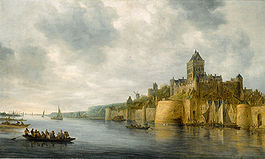 In 1678 Nijmegen was host to the negotiations between the European powers that aimed to put an end to the constant warfare that had ravaged the continent for years. The result was the Treaty of Nijmegen that, unfortunately, failed to provide for a lasting peace.
In the second half of the 19th century, the fortifications around the city became a major problem. There were too many inhabitants inside the walls, but the fortifications could not be demolished because Nijmegen was deemed as being of vital importance to the defence of the Netherlands. When events in the Franco-Prussian war
proved that old-fashioned fortifications were no more of use, this policy was changed and the fortifications were dismantled in 1874. The old castle had already been demolished in 1797, so that its bricks could be sold.
Through the second half of the 19th century and the first half of the 20th century, Nijmegen grew steadily. The Waal was bridged in 1878 by a rail bridge
and in 1936 by a car bridge, which was claimed to be Europe's biggest bridge at the time. In 1923 the current Radboud University Nijmegen
was founded and in 1927 a channel was dug between the Waal and Maas rivers.
In 1940, the Netherlands were invaded by Germany
with Nijmegen being the first Dutch city to fall into German hands. On February 22, 1944, Nijmegen was heavily bombed by American
planes, causing great damage to the city centre. The American pilots thought they were bombing the German city of Kleve
. Alleged by the Germans to have been a deliberate act, the NIOD announced in January 2005 that its study of the incident confirmed that it was an accident caused by poor communications and chaos in the airspace. Over 750 people died in the incident.
During September 1944, the city saw heavy fighting during Operation Market Garden
. The objective in Nijmegen was mainly to prevent the Germans from destroying the bridges. Capturing the road bridge allowed the British Army
XXX Corps to attempt to reach the 1st British Airborne Division in Arnhem
. The bridge was heavily defended by over 300 German troops on both the north and south sides with close to 20 anti-tank guns and two anti-aircraft guns, supported with artillery.
The Germans' late attempt to blow the road bridge was probably foiled by a local Dutch resistance hero, Jan van Hoof
, who is said to have cut the wires to the bridge.
The Germans made repeated attacks on the bridge using bombs attached to driftwood, midget submarines and later resorted to shelling the bridge with 88mm barrages. Troops were positioned on the bridge giving an excellent arc of fire in case of attack. Troops that couldn't fit onto the bridge were positioned in a bombed out house slightly upstream of the bridge. During the shelling, the house was hit, killing six soldiers and wounding one more.
Nijmegen was liberated from German captivity by the British Grenadier Guards
of the Guards Armoured Division, as well as elements of the American 82nd Airborne Division in September 1944. This city would later be used as a springboard for Operation Veritable
, the invasion across the Rhine River by Allied Troops.
More recently, on February 23, 1981, the Nijmegen Police Department and the Dutch Army
stormed the Piersonstraat and Zeigelhof, a squatted housing block in the city centre of Nijmegen. Using two hundred riot vans, three Leopard MBTs, three armoured personnel carrier
s, a helicopter
, twelve hundred policemen, and seven hundred fifty members of the armed forces
, they evicted the squatters and demolished the block, while clouding the entire area in teargas and CS gas
. This had an enormous backlash in local politics. While the city government wanted the squatters out to build a parking garage, most of the population wanted affordable housing to be built in the area.
As of this date, Nijmegen is still known as Havana
on the Waal among some Right-wingers. The Socialist Party
, the Green Party
and Labour
have a solid two-third majority in City Council
, making Nijmegen the only major city in the Netherlands
with a solely Left-wing government. The current mayor is Thom de Graaf
.
Nijmegen celebrated its 2000th year of existence in 2005. It is considered the oldest city in the Netherlands. In gaining this qualification, it has competed with the city of Maastricht
.
In November 2005, the city centre of Nijmegen was the site of the assassination of political activist Louis Sévèke
by a former activist (Marcel T.). Marcel T. was arrested in 2007 in Spain and extradited to the Netherlands. Marcel T. was also accused of bank robbery. Marcel T. committed his acts out of revenge for a forcible eviction from the squatter scene by Louis Sévèke.
There are also translations available in French, German and Italian.
http://www.huisvandenijmeegsegeschiedenis.nl/info/Nim%C3%A8gue_%C3%A0_travers_les_si%C3%A8cles
http://www.huisvandenijmeegsegeschiedenis.nl/info/Historischer_Kanon_von_Nimwegen
http://www.huisvandenijmeegsegeschiedenis.nl/info/Nimega_attraverso_i_secoli
and the foundations of the amphitheatre
are traced in the paving of the present-day Rembrandtstraat. The Valkhof museum
, on the Valkhof, has a permanent display of the history of Nijmegen, including artifacts from the Roman era. Additionally, they usually have temporary exhibitions of more and less famous artists. Unfortunately not a whole lot of very old buildings are left in town: first the Americans carpet bombed it in February 1944, later the Germans shelled it for about five months after the liberation in September 1944, and finally there were a lot of very rigorous city planners in the 1950s, 60's and 70's who finished what the Americans and Germans started.
There are still a few noteworthy sights, however. Valkhof hill downtown features a Carolingian chapel (eight, ninth century AD) and a small remainder of an imperial castle that was demolished in 1798. From Valkhof hill walk west through the Burchtstraat. Here you will see, on your left hand, the fifteenth century town hall. If you've finished admiring its exterior (there's nothing of note inside) continue walking west to the Grote Markt (Great Market) on the north side is a sixteenth-century weighing hall that now serves as a restaurant. On the west side you will see the entrance to the St. Stevenskerk courtyard. On the left is a fifteenth-century Latin school. On the right stands the thirteenth century St. Stevenskerk, the interior of which was destroyed during the Dutch revolution of the sixteenth century. To the north of the church is a series of small seventeenth-century houses that now serve as trinket shops
Some of the northernmost wineries in the world are found just outside of Nijmegen, around Groesbeek
, a suburban village south-east of Nijmegen.
During the 2006 European heat wave
, Kalkar reached a high of 38.6°C (101.5°F) on July 19, and a Weather Underground station in Nijmegen-Dukenburg reached a high of 38.7°C (101.7°F), which, if accepted by the KNMI, would have been a record high for the Netherlands. The KNMI does not consider data from stations operated by others, however.
The heat wave coincided with that year's Four Day Marches, which were cancelled after the first day, when two people died of hyperthermia
-related causes. Temperatures on that day, the 18th of July, reached around 36°C (97°F).
On the night of January 6, 2009, an all-time record low of −17.5°C was reached at Weeze airport, and many other stations around Nijmegen reached record or near-record low temperatures, as low as −21°C (−5°F) at some places. Raeren in Belgium recorded −25.9°C (−15°F), making this cold spell the coldest in at least 60 years.
Nijmegen is in USDA Hardiness zone
8 and AHS
Heat zone 3.
. Founded in 1923 as the first Catholic
university in the Netherlands. It used to be called (Catholic) University of Nijmegen until 2004, when it took its current name. As of 2006 it had 17,627 students 4,336 staff. Radboud University runs the High Field Magnetic Laboratory which is able to achieve some of the highest fields available in Europe at 33 teslas
(continuous) and 60 teslas (pulsed). The facility is available to outside users, primarily for research purposes.
The education and social work departments of the Hogeschool van Arnhem en Nijmegen
school for higher level vocational training are also located in Nijmegen, as are that school's medical departments.
In addition to these institutions, there is also an intermediate level vocational school (ROC Nijmegen) and a number of secondary schools: Groenschool Nijmegen, Kandinsky College, Nijmeegse Scholengemeenschap Groenewoud (NSG), Citadel College, Stedelijke Scholengemeenschap Nijmegen (SSGN), Canisius College, St. Jorisschool, Lindenholt College, the Stedelijk Gymnasium (formally the "Latijnse school", founded in the 16th century), the Karel de Grote College, Montessori College and the Dominicus College. Of note is also Leefwerkschool Eigenwijs, which caters to students from all over the Netherlands who have been repeatedly expelled from "regular" high schools. Leefwerkschool Eigenwijs has its roots in the local activist movement of the early 1980s and is the only school of its kind recognised in the Netherlands.
Nijmegen is also an important centre of Psycholinguistics
, home to the Max Planck Institute of Psycholinguistics and the Donders Institute for Brain, Cognition and Behaviour.
The Nobel Prize
for Physics in 2010 awarded to Andre Geim
and Konstantin Novoselov
while at Radboud University "for groundbreaking experiments regarding the two-dimensional material graphene."
, Nijmegen Dukenburg
, Nijmegen Heyendaal
and Nijmegen Lent
. The central station is connected to the national Intercity network. The bus company Breng (a subsidiary of Connexxion) operates the city buses in the Arnhem-Nijmegen metropolitan area.
Like most Dutch cities, bicycles are an important mode of transport. The city is connected to Arnhem, 18 km (11 mi) to the north, by a "fietssnelweg" (fast cycle highway) which crosses the Snelbinder bridge in the city. During 2010-2012 the cycle highway is receiving upgrades to further encourage the use of bicycles for transport between Nijmegen and Arnhem.
The river is a busy freight transport route, with barges to the city as well as passing through on the way between the industrial regions of Germany and the docks at Amsterdam, Rotterdam and Hook of Holland. The Maas-Waal Canal
also carries freight through the city.
 Nijmegen is famous for the International Four Day March Nijmegen , an annual event starting on the third Tuesday in July, comprising four days of walking
(distances ranging from 30 to 50 km a day), and the accompanying festivities (the Vierdaagsefeesten including rock festival de-Affaire), which have been drawing the largest crowds for any Dutch event in the past few years.
The event invites WWII allied veterans to help celebrate their participation in the liberation of the Netherlands from German occupation. Participants from Britain, Canada, the USA, Australia and New Zealand have attended the event. Nowadays, the event is international, inviting teams from all countries to attention.
During the Vierdaagse of 2006 two people died due to the extreme hot weather (note that the deceased had other health issues that added up to the death cause).
It caused the organisation to cancel the rest of the walk. This resulted in extra safety measures during the 2007 Vierdaagse; for instance, a professional weatherman was added to the organisation staff, more free water refill stations were added along the route and an extensive research program was developed to monitor the effects of hiking long distances on the human body.
 In 1968 prominent liberal theologians in the Roman Catholic Church issued what is now known as the Nijmegen Statement, demanding sweeping reforms in the Vatican's Holy Office, previously known as The Inquisition, and calling for greater scope for theological inquiry. Among its signatories was the then progressive theologian Fr. Joseph Ratzinger, then a member of the faculty at the University of Tübingen but later a much more conservative figure as the head of the successor to the Holy Office, the Congregation for the Doctrine of the Faith
, and later still Pope Benedict XVI
.
The Nijmegen Statement said: "Any form of Inquisition however subtle, not only harms the development of sound theology, it also causes irreparable damage to the credibility of the church". The signatories, a group of predominantly German-speaking theologians asserted that "the freedom of theologians, and theology in the service of the church, regained by Vatican II, must not be jeopardized again." The signatories pledged their loyalty to the pope, but argued that the teaching office of pope and bishops "cannot and must not supersede, hamper and impede the teaching task of theologians as scholars."
There are several English spoken Religious meetings in Nijmegen. See the external link for a list of Church services in English (link from the official site is obsolete and not being updated for long).
, Hees and Neerbosch, as well as the urban expansion project of Waalsprong, situated north of the river Waal and including the village of Lent
and the hamlet of 't Zand
, as well as the new suburbs of Nijmegen-Oosterhout and Nijmegen-Ressen.
The city council has 39 seats. After the 2002 municipal elections, the three major parties, GroenLinks (9 seats), PvdA (8 seats) and SP
(6 seats) formed a coalition. Because these are all left-wing parties, Nijmegen received the nickname 'Havana
on the Waal'. Although such majorities are no exception (compare Amsterdam
) and sometimes also form coalitions (see Muntendam
), this is unusual for a city this size. Since such a left-wing coalition might be possible at a national level after the 2006 general election, the achievements of this council are often scrutinised. After the 2006 municipal election such a coalition became possible in many more municipalities, making the example even more interesting.
The municipal elections of 7 March 2006 saw an increase of 4,6% of the votes for these three parties taken together, which could be seen as increased support for the coalition. However, nationally these parties scored much better, recovering from an electoral blow of the 2002 elections. Then again, the Leefbaar parties that caused the loss then and lost most of their votes this time have no branch in Nijmegen, which makes this comparison less valid. Among the three big parties, there was a shift from GroenLinks, who lost 6.5%, to PvdA, who won 6.4% and SP, who won 2.3%. As a result it is no longer the biggest party. The seat assignment is now as shown in the table. The three-party coalition was returned to office.
After the 2010 Dutch municipal election, the PvdA lost three of its eleven seats. Short before the elections, there were problems with the SP. Therefore, GroenLinks and the PvdA formed a coalition with the social-liberal D66.
, and qualified for the 2008-9 UEFA Cup
.
Bandy Vereniging Nijmegen is the biggest bandy
club in the country.
The city is also home to one of the country's oldest cricket
clubs, Quick 1888
, a current member of the KNCB
. Formed in 1888, the club is the largest cricket club in the east of the country and was formed 13 years after the first club, Utile Dulci from Deventer
. Moreover the Nijmegen Devils
, is an Ice hockey
club from Nijmegen.
.jpg)
with: Gaziantep
, Turkey
Pskov
, Russia
Masaya
, Nicaragua
Albany
, New York
, United States
Suzhou
, China
Higashimatsushima, Japan
Municipality
A municipality is essentially an urban administrative division having corporate status and usually powers of self-government. It can also be used to mean the governing body of a municipality. A municipality is a general-purpose administrative subdivision, as opposed to a special-purpose district...
and a city
City
A city is a relatively large and permanent settlement. Although there is no agreement on how a city is distinguished from a town within general English language meanings, many cities have a particular administrative, legal, or historical status based on local law.For example, in the U.S...
in the east of the Netherlands
Netherlands
The Netherlands is a constituent country of the Kingdom of the Netherlands, located mainly in North-West Europe and with several islands in the Caribbean. Mainland Netherlands borders the North Sea to the north and west, Belgium to the south, and Germany to the east, and shares maritime borders...
, near the German
Germany
Germany , officially the Federal Republic of Germany , is a federal parliamentary republic in Europe. The country consists of 16 states while the capital and largest city is Berlin. Germany covers an area of 357,021 km2 and has a largely temperate seasonal climate...
border. It is considered to be the oldest city in the Netherlands and celebrated its 2000th year of existence in 2005. The municipality is part of the "Stadsregio Arnhem-Nijmegen", a metropolitan area with 736,107 inhabitants (January 2011).
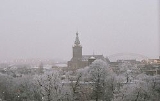
The city of Nijmegen
History
The first mention of Nijmegen in history is in the 1st century BCE, when the RomansRoman Empire
The Roman Empire was the post-Republican period of the ancient Roman civilization, characterised by an autocratic form of government and large territorial holdings in Europe and around the Mediterranean....
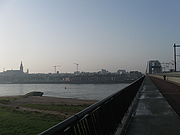
built a military camp on the place where Nijmegen was to appear; the location had great strategic value because of the surrounding hills, which gave (and continues to give) a good view over the Waal and Rhine valley.
By 69, when the Batavians
Batavians
The Batavi were an ancient Germanic tribe, originally part of the Chatti, reported by Tacitus to have lived around the Rhine delta, in the area that is currently the Netherlands, "an uninhabited district on the extremity of the coast of Gaul, and also of a neighbouring island, surrounded by the...
, the original inhabitants of the Rhine and Maas delta, revolted, a village called Oppidum Batavorum had formed near the Roman camp. This village was destroyed in the revolt, but when the revolt had ended the Romans built another, bigger camp where the Legio X Gemina
Legio X Gemina
Legio decima Gemina , was one of the four legions used by Julius Caesar in 58 BC, for his invasion of Gaul. There are still records of the X Gemina in Vienna in the beginning of the 5th century. The legion symbol was a bull...
was stationed. Soon after, another village formed around this camp.
In 98 Nijmegen was the first of two settlements in what is now the Kingdom of the Netherlands to receive Roman city rights
Municipium
Municipium , the prototype of English municipality, was the Latin term for a town or city. Etymologically the municipium was a social contract between municipes, the "duty holders," or citizens of the town. The duties, or munera, were a communal obligation assumed by the municipes in exchange for...
.
In 103 the X Gemina was restationed to Vienna
Vienna
Vienna is the capital and largest city of the Republic of Austria and one of the nine states of Austria. Vienna is Austria's primary city, with a population of about 1.723 million , and is by far the largest city in Austria, as well as its cultural, economic, and political centre...
, which may have been a major blow to the economy of the village around the camp. In 104 Emperor Trajan
Trajan
Trajan , was Roman Emperor from 98 to 117 AD. Born into a non-patrician family in the province of Hispania Baetica, in Spain Trajan rose to prominence during the reign of emperor Domitian. Serving as a legatus legionis in Hispania Tarraconensis, in Spain, in 89 Trajan supported the emperor against...
renamed the town, which now became known as Ulpia Noviomagus Batavorum, Noviomagus for short (the origin of the current name Nijmegen).
In the 4th century, Roman power decreased and Nijmegen became part of the Frankish kingdom. It has been contended that in the 8th century Emperor Charlemagne
Charlemagne
Charlemagne was King of the Franks from 768 and Emperor of the Romans from 800 to his death in 814. He expanded the Frankish kingdom into an empire that incorporated much of Western and Central Europe. During his reign, he conquered Italy and was crowned by Pope Leo III on 25 December 800...
maintained his palatium in Nijmegen on at least four occasions. During his brief deposition of 830, the emperor Louis the Pious
Louis the Pious
Louis the Pious , also called the Fair, and the Debonaire, was the King of Aquitaine from 781. He was also King of the Franks and co-Emperor with his father, Charlemagne, from 813...
was sent to Nijmegen by his son Lothar I. Thanks to the Waal river, trade flourished.
The powerful Henry VI, Holy Roman Emperor
Henry VI, Holy Roman Emperor
Henry VI was King of Germany from 1190 to 1197, Holy Roman Emperor from 1191 to 1197 and King of Sicily from 1194 to 1197.-Early years:Born in Nijmegen,...
was born at Nijmegen in 1165. In 1230 his son Frederick II, Holy Roman Emperor
Frederick II, Holy Roman Emperor
Frederick II , was one of the most powerful Holy Roman Emperors of the Middle Ages and head of the House of Hohenstaufen. His political and cultural ambitions, based in Sicily and stretching through Italy to Germany, and even to Jerusalem, were enormous...
granted Nijmegen city rights. In 1247, the city was ceded to the count of Guelders
Guelders
Guelders or Gueldres is the name of a historical county, later duchy of the Holy Roman Empire, located in the Low Countries.-Geography:...
as collateral
Collateral (finance)
In lending agreements, collateral is a borrower's pledge of specific property to a lender, to secure repayment of a loan.The collateral serves as protection for a lender against a borrower's default - that is, any borrower failing to pay the principal and interest under the terms of a loan obligation...
for a loan. The loan was never repaid, and Nijmegen has been a part of Gelderland ever since. This did not hamper trade; Nijmegen even became part of the Hanseatic League
Hanseatic League
The Hanseatic League was an economic alliance of trading cities and their merchant guilds that dominated trade along the coast of Northern Europe...
in 1364.
The arts also flourished in this period. Famous medieval painters like the Limbourg brothers
Limbourg brothers
The Limbourg brothers, or in Dutch Gebroeders van Limburg , were famous Dutch miniature painters from the city of Nijmegen. They were active in the early 15th century in France and Burgundy, working in the style known as International Gothic...
were born and educated in Nijmegen.
During the Dutch Revolt
Dutch Revolt
The Dutch Revolt or the Revolt of the Netherlands This article adopts 1568 as the starting date of the war, as this was the year of the first battles between armies. However, since there is a long period of Protestant vs...
, trade came to a halt and even though Nijmegen became a part of the Republic of United Provinces in 1585, it remained a border town and had to endure multiple sieges.
In the second half of the 19th century, the fortifications around the city became a major problem. There were too many inhabitants inside the walls, but the fortifications could not be demolished because Nijmegen was deemed as being of vital importance to the defence of the Netherlands. When events in the Franco-Prussian war
Franco-Prussian War
The Franco-Prussian War or Franco-German War, often referred to in France as the 1870 War was a conflict between the Second French Empire and the Kingdom of Prussia. Prussia was aided by the North German Confederation, of which it was a member, and the South German states of Baden, Württemberg and...
proved that old-fashioned fortifications were no more of use, this policy was changed and the fortifications were dismantled in 1874. The old castle had already been demolished in 1797, so that its bricks could be sold.
Through the second half of the 19th century and the first half of the 20th century, Nijmegen grew steadily. The Waal was bridged in 1878 by a rail bridge
Nijmegen railway bridge
The Nijmegen railway bridge is a Truss bridge spanning the River Waal, connecting the city of Nijmegen to the town of Lent in the Netherlands.-Construction:...
and in 1936 by a car bridge, which was claimed to be Europe's biggest bridge at the time. In 1923 the current Radboud University Nijmegen
Radboud University Nijmegen
Radboud University Nijmegen is a public university with a strong focus on research in Nijmegen, the Netherlands...
was founded and in 1927 a channel was dug between the Waal and Maas rivers.
In 1940, the Netherlands were invaded by Germany
Germany
Germany , officially the Federal Republic of Germany , is a federal parliamentary republic in Europe. The country consists of 16 states while the capital and largest city is Berlin. Germany covers an area of 357,021 km2 and has a largely temperate seasonal climate...
with Nijmegen being the first Dutch city to fall into German hands. On February 22, 1944, Nijmegen was heavily bombed by American
United States
The United States of America is a federal constitutional republic comprising fifty states and a federal district...
planes, causing great damage to the city centre. The American pilots thought they were bombing the German city of Kleve
Kleve
Kleve , is a town in the Lower Rhine region of northwestern Germany near the Dutch border and the River Rhine. From the 11th century onwards, Kleve was capital of a county and later a duchy...
. Alleged by the Germans to have been a deliberate act, the NIOD announced in January 2005 that its study of the incident confirmed that it was an accident caused by poor communications and chaos in the airspace. Over 750 people died in the incident.
During September 1944, the city saw heavy fighting during Operation Market Garden
Operation Market Garden
Operation Market Garden was an unsuccessful Allied military operation, fought in the Netherlands and Germany in the Second World War. It was the largest airborne operation up to that time....
. The objective in Nijmegen was mainly to prevent the Germans from destroying the bridges. Capturing the road bridge allowed the British Army
British Army
The British Army is the land warfare branch of Her Majesty's Armed Forces in the United Kingdom. It came into being with the unification of the Kingdom of England and Scotland into the Kingdom of Great Britain in 1707. The new British Army incorporated Regiments that had already existed in England...
XXX Corps to attempt to reach the 1st British Airborne Division in Arnhem
Arnhem
Arnhem is a city and municipality, situated in the eastern part of the Netherlands. It is the capital of the province of Gelderland and located near the river Nederrijn as well as near the St. Jansbeek, which was the source of the city's development. Arnhem has 146,095 residents as one of the...
. The bridge was heavily defended by over 300 German troops on both the north and south sides with close to 20 anti-tank guns and two anti-aircraft guns, supported with artillery.
The Germans' late attempt to blow the road bridge was probably foiled by a local Dutch resistance hero, Jan van Hoof
Jan van Hoof
Jan Jozef Lambert van Hoof was a member of the Dutch resistance in World War II, where he cooperated with Allied Forces during Operation Market Garden, and was executed in action. Before and during the war, Van Hoof was a Rover Scout, and the scouting medal the Nationale Padvindersraad was named...
, who is said to have cut the wires to the bridge.
The Germans made repeated attacks on the bridge using bombs attached to driftwood, midget submarines and later resorted to shelling the bridge with 88mm barrages. Troops were positioned on the bridge giving an excellent arc of fire in case of attack. Troops that couldn't fit onto the bridge were positioned in a bombed out house slightly upstream of the bridge. During the shelling, the house was hit, killing six soldiers and wounding one more.
Nijmegen was liberated from German captivity by the British Grenadier Guards
Grenadier Guards
The Grenadier Guards is an infantry regiment of the British Army. It is the most senior regiment of the Guards Division and, as such, is the most senior regiment of infantry. It is not, however, the most senior regiment of the Army, this position being attributed to the Life Guards...
of the Guards Armoured Division, as well as elements of the American 82nd Airborne Division in September 1944. This city would later be used as a springboard for Operation Veritable
Operation Veritable
Operation Veritable was a Second World War pincer movement conducted by Field Marshal Bernard Montgomery's 21st Army Group to clear and occupy the land between the Rhine and Maas rivers. It took place between 8 February and 11 March 1945. It was a part of General Dwight Eisenhower's "broad front"...
, the invasion across the Rhine River by Allied Troops.
More recently, on February 23, 1981, the Nijmegen Police Department and the Dutch Army
Army
An army An army An army (from Latin arma "arms, weapons" via Old French armée, "armed" (feminine), in the broadest sense, is the land-based military of a nation or state. It may also include other branches of the military such as the air force via means of aviation corps...
stormed the Piersonstraat and Zeigelhof, a squatted housing block in the city centre of Nijmegen. Using two hundred riot vans, three Leopard MBTs, three armoured personnel carrier
Armoured personnel carrier
An armoured personnel carrier is an armoured fighting vehicle designed to transport infantry to the battlefield.APCs are usually armed with only a machine gun although variants carry recoilless rifles, anti-tank guided missiles , or mortars...
s, a helicopter
Helicopter
A helicopter is a type of rotorcraft in which lift and thrust are supplied by one or more engine-driven rotors. This allows the helicopter to take off and land vertically, to hover, and to fly forwards, backwards, and laterally...
, twelve hundred policemen, and seven hundred fifty members of the armed forces
Armed forces
The armed forces of a country are its government-sponsored defense, fighting forces, and organizations. They exist to further the foreign and domestic policies of their governing body, and to defend that body and the nation it represents from external aggressors. In some countries paramilitary...
, they evicted the squatters and demolished the block, while clouding the entire area in teargas and CS gas
CS gas
2-chlorobenzalmalononitrile is the defining component of a "tear gas" commonly referred to as CS gas, which is used as a riot control agent...
. This had an enormous backlash in local politics. While the city government wanted the squatters out to build a parking garage, most of the population wanted affordable housing to be built in the area.
As of this date, Nijmegen is still known as Havana
Havana
Havana is the capital city, province, major port, and leading commercial centre of Cuba. The city proper has a population of 2.1 million inhabitants, and it spans a total of — making it the largest city in the Caribbean region, and the most populous...
on the Waal among some Right-wingers. The Socialist Party
Socialist Party (Netherlands)
The Socialist Party is a democratic socialist political party in the Netherlands. After the 2006 general election, the Socialist Party became one of the major parties of the Netherlands with 25 seats of 150, an increase of 16 seats. The party was in opposition against the fourth Balkenende cabinet...
, the Green Party
GreenLeft
GreenLeft is a green political party operating in the Netherlands.GreenLeft was formed on 1 March 1989 as a merger of four left-wing political parties: the Communist Party of the Netherlands, Pacifist Socialist Party, the Political Party of Radicals and the Evangelical People's Party...
and Labour
Labour Party (Netherlands)
The Labour Party , is a social-democratic political party in the Netherlands. Since the 2003 Dutch General Election, the PvdA has been the second largest political party in the Netherlands. The PvdA was a coalition member in the fourth Balkenende cabinet following 22 February 2007...
have a solid two-third majority in City Council
City council
A city council or town council is the legislative body that governs a city, town, municipality or local government area.-Australia & NZ:Because of the differences in legislation between the States, the exact definition of a City Council varies...
, making Nijmegen the only major city in the Netherlands
Netherlands
The Netherlands is a constituent country of the Kingdom of the Netherlands, located mainly in North-West Europe and with several islands in the Caribbean. Mainland Netherlands borders the North Sea to the north and west, Belgium to the south, and Germany to the east, and shares maritime borders...
with a solely Left-wing government. The current mayor is Thom de Graaf
Thom de Graaf
Thomas Carolus de Graaf is a Dutch jurist and politician. He is a member of social liberal party Democrats 66 . Since January 2007 he has been mayor of the city of Nijmegen and since 7 June 2011 also a member of the Senate...
.
Nijmegen celebrated its 2000th year of existence in 2005. It is considered the oldest city in the Netherlands. In gaining this qualification, it has competed with the city of Maastricht
Maastricht
Maastricht is situated on both sides of the Meuse river in the south-eastern part of the Netherlands, on the Belgian border and near the German border...
.
In November 2005, the city centre of Nijmegen was the site of the assassination of political activist Louis Sévèke
Louis Sévèke
Jean Louis Bernhard Sévèke was a Dutch radical left activist, journalist and writer. He was known for his legal action against the Police and the Dutch intelligence service....
by a former activist (Marcel T.). Marcel T. was arrested in 2007 in Spain and extradited to the Netherlands. Marcel T. was also accused of bank robbery. Marcel T. committed his acts out of revenge for a forcible eviction from the squatter scene by Louis Sévèke.
Canon of Nijmegen
Read more about the history of Nijmegen in the Canon of Nijmegen, a concise history of Nijmegen. http://www.huisvandenijmeegsegeschiedenis.nl/info/Concise_history_of_NijmegenThere are also translations available in French, German and Italian.
http://www.huisvandenijmeegsegeschiedenis.nl/info/Nim%C3%A8gue_%C3%A0_travers_les_si%C3%A8cles
http://www.huisvandenijmeegsegeschiedenis.nl/info/Historischer_Kanon_von_Nimwegen
http://www.huisvandenijmeegsegeschiedenis.nl/info/Nimega_attraverso_i_secoli
Historical remains
Few Roman remains are visible today; a fragment of the old city wall can be seen near the casinoCasino
In modern English, a casino is a facility which houses and accommodates certain types of gambling activities. Casinos are most commonly built near or combined with hotels, restaurants, retail shopping, cruise ships or other tourist attractions...
and the foundations of the amphitheatre
Amphitheatre
An amphitheatre is an open-air venue used for entertainment and performances.There are two similar, but distinct, types of structure for which the word "amphitheatre" is used: Ancient Roman amphitheatres were large central performance spaces surrounded by ascending seating, and were commonly used...
are traced in the paving of the present-day Rembrandtstraat. The Valkhof museum
Valkhof museum
The Valkhof museum is an archaeology and art museum in Nijmegen, Netherlands.The museum has existed since 1999, created as a merger between the G.M. Kam museum of archaeology and the Commanderie van St. Jan museum of classical and modern art...
, on the Valkhof, has a permanent display of the history of Nijmegen, including artifacts from the Roman era. Additionally, they usually have temporary exhibitions of more and less famous artists. Unfortunately not a whole lot of very old buildings are left in town: first the Americans carpet bombed it in February 1944, later the Germans shelled it for about five months after the liberation in September 1944, and finally there were a lot of very rigorous city planners in the 1950s, 60's and 70's who finished what the Americans and Germans started.
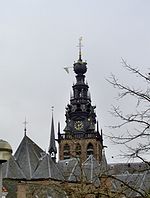
There are still a few noteworthy sights, however. Valkhof hill downtown features a Carolingian chapel (eight, ninth century AD) and a small remainder of an imperial castle that was demolished in 1798. From Valkhof hill walk west through the Burchtstraat. Here you will see, on your left hand, the fifteenth century town hall. If you've finished admiring its exterior (there's nothing of note inside) continue walking west to the Grote Markt (Great Market) on the north side is a sixteenth-century weighing hall that now serves as a restaurant. On the west side you will see the entrance to the St. Stevenskerk courtyard. On the left is a fifteenth-century Latin school. On the right stands the thirteenth century St. Stevenskerk, the interior of which was destroyed during the Dutch revolution of the sixteenth century. To the north of the church is a series of small seventeenth-century houses that now serve as trinket shops
Climate
Nijmegen is one of the warmest cities of the Netherlands, especially during summer, when the highest temperatures in the country are usually measured in the triangle Roermond – Nijmegen – Eindhoven. The lack of north-south oriented mountain ranges in Europe make this area prone to sudden shifts in weather, giving the region a semi-continental climate.Some of the northernmost wineries in the world are found just outside of Nijmegen, around Groesbeek
Groesbeek
Groesbeek is a municipality and a town in the eastern Netherlands.-Description:Groesbeek is named after a small stream called the Groesbeek, which in its original form doesn't exist anymore...
, a suburban village south-east of Nijmegen.
During the 2006 European heat wave
2006 European heat wave
The 2006 European heat wave was a period of exceptionally hot weather that arrived at the end of June 2006 in certain European countries. The United Kingdom, France, Belgium, Netherlands, Luxembourg, Italy, Poland, the Czech Republic, Hungary, Germany and western part of Russia were most affected....
, Kalkar reached a high of 38.6°C (101.5°F) on July 19, and a Weather Underground station in Nijmegen-Dukenburg reached a high of 38.7°C (101.7°F), which, if accepted by the KNMI, would have been a record high for the Netherlands. The KNMI does not consider data from stations operated by others, however.
The heat wave coincided with that year's Four Day Marches, which were cancelled after the first day, when two people died of hyperthermia
Hyperthermia
Hyperthermia is an elevated body temperature due to failed thermoregulation. Hyperthermia occurs when the body produces or absorbs more heat than it can dissipate...
-related causes. Temperatures on that day, the 18th of July, reached around 36°C (97°F).
On the night of January 6, 2009, an all-time record low of −17.5°C was reached at Weeze airport, and many other stations around Nijmegen reached record or near-record low temperatures, as low as −21°C (−5°F) at some places. Raeren in Belgium recorded −25.9°C (−15°F), making this cold spell the coldest in at least 60 years.
Nijmegen is in USDA Hardiness zone
Hardiness zone
A hardiness zone is a geographically defined area in which a specific category of plant life is capable of growing, as defined by climatic conditions, including its ability to withstand the minimum temperatures of the zone...
8 and AHS
American Horticultural Society
The American Horticultural Society is a nonprofit, membership-based organization that promotes excellence in American horticulture. It is headquartered in Alexandria, Virginia....
Heat zone 3.
Education
Nijmegen is host to Radboud University NijmegenRadboud University Nijmegen
Radboud University Nijmegen is a public university with a strong focus on research in Nijmegen, the Netherlands...
. Founded in 1923 as the first Catholic
Catholicism
Catholicism is a broad term for the body of the Catholic faith, its theologies and doctrines, its liturgical, ethical, spiritual, and behavioral characteristics, as well as a religious people as a whole....
university in the Netherlands. It used to be called (Catholic) University of Nijmegen until 2004, when it took its current name. As of 2006 it had 17,627 students 4,336 staff. Radboud University runs the High Field Magnetic Laboratory which is able to achieve some of the highest fields available in Europe at 33 teslas
Tesla (unit)
The tesla is the SI derived unit of magnetic field B . One tesla is equal to one weber per square meter, and it was defined in 1960 in honour of the inventor, physicist, and electrical engineer Nikola Tesla...
(continuous) and 60 teslas (pulsed). The facility is available to outside users, primarily for research purposes.
The education and social work departments of the Hogeschool van Arnhem en Nijmegen
Hogeschool van Arnhem en Nijmegen
The HAN University of Applied Sciences , often abbreviated as HAN, is a university of applied sciences with campuses in Arnhem and Nijmegen in the Netherlands. It offers Bachelor and Master degrees in a wide range of subjects. Arnhem Business School is the international department of HAN University...
school for higher level vocational training are also located in Nijmegen, as are that school's medical departments.
In addition to these institutions, there is also an intermediate level vocational school (ROC Nijmegen) and a number of secondary schools: Groenschool Nijmegen, Kandinsky College, Nijmeegse Scholengemeenschap Groenewoud (NSG), Citadel College, Stedelijke Scholengemeenschap Nijmegen (SSGN), Canisius College, St. Jorisschool, Lindenholt College, the Stedelijk Gymnasium (formally the "Latijnse school", founded in the 16th century), the Karel de Grote College, Montessori College and the Dominicus College. Of note is also Leefwerkschool Eigenwijs, which caters to students from all over the Netherlands who have been repeatedly expelled from "regular" high schools. Leefwerkschool Eigenwijs has its roots in the local activist movement of the early 1980s and is the only school of its kind recognised in the Netherlands.
Nijmegen is also an important centre of Psycholinguistics
Psycholinguistics
Psycholinguistics or psychology of language is the study of the psychological and neurobiological factors that enable humans to acquire, use, comprehend and produce language. Initial forays into psycholinguistics were largely philosophical ventures, due mainly to a lack of cohesive data on how the...
, home to the Max Planck Institute of Psycholinguistics and the Donders Institute for Brain, Cognition and Behaviour.
The Nobel Prize
Nobel Prize
The Nobel Prizes are annual international awards bestowed by Scandinavian committees in recognition of cultural and scientific advances. The will of the Swedish chemist Alfred Nobel, the inventor of dynamite, established the prizes in 1895...
for Physics in 2010 awarded to Andre Geim
Andre Geim
Andre Konstantin Geim, FRS is a Dutch-Russian-British physicist working at the University of Manchester. Geim was awarded the 2010 Nobel Prize in Physics jointly with Konstantin Novoselov for his work on graphene...
and Konstantin Novoselov
Konstantin Novoselov
Konstantin Sergeevich Novoselov FRS is a Russo-British physicist, most notably known for his works on graphene together with Andre Geim, which earned them the Nobel Prize in Physics in 2010. Novoselov is currently a member of the mesoscopic physics research group at the University of Manchester as...
while at Radboud University "for groundbreaking experiments regarding the two-dimensional material graphene."
Transportation
Nijmegen has four train stations: NijmegenNijmegen railway station
Nijmegen is a railway station located in Nijmegen, the Netherlands. The station was opened on 9 August 1865 and is located on the Tilburg–Nijmegen railway, Nijmegen–Venlo railway and the Arnhem–Nijmegen railway...
, Nijmegen Dukenburg
Nijmegen Dukenburg railway station
Nijmegen Dukenburg is a railway station located in the south west of Nijmegen, The Netherlands. The station was opened on 2 June 1973 and is located on the Tilburg–Nijmegen railway. The train services are operated by Nederlandse Spoorwegen...
, Nijmegen Heyendaal
Nijmegen Heyendaal railway station
Nijmegen Heyendaal is a railway station located in Nijmegen, The Netherlands. The station was opened on 28 May 1972 and is located on the Maaslijn . The train services are operated by Veolia. The main station of Nijmegen is Nijmegen railway station.Up until 1991 there was a line into Germany from...
and Nijmegen Lent
Nijmegen Lent railway station
Nijmegen Lent is a railway station located in Lent, just north of Nijmegen, The Netherlands. The station was opened on 1 June 2002 and is located on the Arnhem - Nijmegen railway line. The train services are operated by Nederlandse Spoorwegen...
. The central station is connected to the national Intercity network. The bus company Breng (a subsidiary of Connexxion) operates the city buses in the Arnhem-Nijmegen metropolitan area.
Like most Dutch cities, bicycles are an important mode of transport. The city is connected to Arnhem, 18 km (11 mi) to the north, by a "fietssnelweg" (fast cycle highway) which crosses the Snelbinder bridge in the city. During 2010-2012 the cycle highway is receiving upgrades to further encourage the use of bicycles for transport between Nijmegen and Arnhem.
The river is a busy freight transport route, with barges to the city as well as passing through on the way between the industrial regions of Germany and the docks at Amsterdam, Rotterdam and Hook of Holland. The Maas-Waal Canal
Maas-Waal Canal
The Maas-Waal canal is a canal in the Netherlands that connects the Meuse to the Waal. The channel is about 13.5 kilometers long and runs from Weurt to the south and ends at Heumen...
also carries freight through the city.
Museums in and around Nijmegen
- Africa Museum (African art and culture)
- Museum Park Orientalis (ancient middle eastern buildings)
- Valkhof museumValkhof museumThe Valkhof museum is an archaeology and art museum in Nijmegen, Netherlands.The museum has existed since 1999, created as a merger between the G.M. Kam museum of archaeology and the Commanderie van St. Jan museum of classical and modern art...
(Roman and mediaeval history and modern art) - VeloramaVeloramaThe Velorama is the only bicycle museum in the Netherlands. It is located at the Waalkade in the city of Nijmegen.The museum was founded in 1981 from the private collection of G.F. Moed. In three storeys it shows about 250 exhibits from nearly two centuries...
(bicycle museum) - Bevrijdingsmuseum (about World War II and the airlandings at Nijmegen)
- House of the History of Nijmegen information centre about the history of Nijmegen; free entrance; expositions about a theme of the town's history; touch screen which leads you to the 50 highlights of the towns'history: 'Canon of Nijmegen'; reading table. The House of the Nijmegen History is situated in a unique mediaeval chapel 'de Mariënburgkapel'; its mission is to let enjoy people of the history of the town and to be a guide for everybody who wants to visit the oldest city of the Netherlands. There is also a digital House NijmegenWiki)
International Four Day March Nijmegen
Walking
Walking is one of the main gaits of locomotion among legged animals, and is typically slower than running and other gaits. Walking is defined by an 'inverted pendulum' gait in which the body vaults over the stiff limb or limbs with each step...
(distances ranging from 30 to 50 km a day), and the accompanying festivities (the Vierdaagsefeesten including rock festival de-Affaire), which have been drawing the largest crowds for any Dutch event in the past few years.
The event invites WWII allied veterans to help celebrate their participation in the liberation of the Netherlands from German occupation. Participants from Britain, Canada, the USA, Australia and New Zealand have attended the event. Nowadays, the event is international, inviting teams from all countries to attention.
During the Vierdaagse of 2006 two people died due to the extreme hot weather (note that the deceased had other health issues that added up to the death cause).
It caused the organisation to cancel the rest of the walk. This resulted in extra safety measures during the 2007 Vierdaagse; for instance, a professional weatherman was added to the organisation staff, more free water refill stations were added along the route and an extensive research program was developed to monitor the effects of hiking long distances on the human body.
Religion
Congregation for the Doctrine of the Faith
The Congregation for the Doctrine of the Faith , previously known as the Supreme Sacred Congregation of the Roman and Universal Inquisition , and after 1904 called the Supreme...
, and later still Pope Benedict XVI
Pope Benedict XVI
Benedict XVI is the 265th and current Pope, by virtue of his office of Bishop of Rome, the Sovereign of the Vatican City State and the leader of the Catholic Church as well as the other 22 sui iuris Eastern Catholic Churches in full communion with the Holy See...
.
The Nijmegen Statement said: "Any form of Inquisition however subtle, not only harms the development of sound theology, it also causes irreparable damage to the credibility of the church". The signatories, a group of predominantly German-speaking theologians asserted that "the freedom of theologians, and theology in the service of the church, regained by Vatican II, must not be jeopardized again." The signatories pledged their loyalty to the pope, but argued that the teaching office of pope and bishops "cannot and must not supersede, hamper and impede the teaching task of theologians as scholars."
There are several English spoken Religious meetings in Nijmegen. See the external link for a list of Church services in English (link from the official site is obsolete and not being updated for long).
Population centres
The municipality is formed by the city of Nijmegen, incorporating the former villages of HatertHatert
Hatert is a suburb in the south of Nijmegen, in the Netherlands. It is situated between the centre of Nijmegen and the suburb of Dukenburg. It is renowned for its big shopping centre and the market every Wednesday attracts a lot of visitors from all over the town. It is a relatively new suburb...
, Hees and Neerbosch, as well as the urban expansion project of Waalsprong, situated north of the river Waal and including the village of Lent
Lent, Netherlands
Lent is a village in the Dutch province of Gelderland. It is located in the municipality ofNijmegen, about 2 km north of that city, on the north bank of the Waal river.Lent was a separate municipality until 1818, when it was merged with Elst....
and the hamlet of 't Zand
't Zand (Nijmegen)
't Zand is a hamlet in the Dutch province of Gelderland, in the municipality of Nijmegen....
, as well as the new suburbs of Nijmegen-Oosterhout and Nijmegen-Ressen.
Politics
| Party | seats | change from 2006 |
|---|---|---|
| GroenLinks (Greens) | 8 | |
| PvdA (Labor) | 8 | |
| D66 Democrats 66 Democrats 66 is a progressive and social-liberal political party in the Netherlands. D66 was formed in 1966 by a group of politically unaligned, young intellectuals, led by journalist Hans van Mierlo. The party's main objective was to democratise the political system; it proposed to create an... (Liberal Democrats) |
6 | |
| SP Socialistische Partij Socialistische Partij may refer toNetherlands parties:* Socialist Party * Socialist Party Belgian parties:* Socialist Party - Different* Socialist Party... (Socialists) |
5 | |
| VVD (Liberals) | 4 | |
| CDA Christian Democratic Appeal The Christian Democratic Appeal is a centre-right Dutch Christian democratic political party. It suffered severe losses in the 2010 elections and fell from the first to the fourth place... (Christian-Democrats) |
3 | |
| VSP | 2 | |
| Gewoon Nijmegen | 2 | |
| Nijmegen Nu | 1 | |
| Stadspartij | 0 | |
The city council has 39 seats. After the 2002 municipal elections, the three major parties, GroenLinks (9 seats), PvdA (8 seats) and SP
Socialistische Partij
Socialistische Partij may refer toNetherlands parties:* Socialist Party * Socialist Party Belgian parties:* Socialist Party - Different* Socialist Party...
(6 seats) formed a coalition. Because these are all left-wing parties, Nijmegen received the nickname 'Havana
Havana
Havana is the capital city, province, major port, and leading commercial centre of Cuba. The city proper has a population of 2.1 million inhabitants, and it spans a total of — making it the largest city in the Caribbean region, and the most populous...
on the Waal'. Although such majorities are no exception (compare Amsterdam
Amsterdam (municipality)
The Government of Amsterdam is the government of the municipality and city of Amsterdam in the Netherlands. Most of the inhabitants live in the city of Amsterdam, but the municipality also covers a number of small villages, and other parts of the local government, such as the Waterschap or the...
) and sometimes also form coalitions (see Muntendam
Muntendam
Muntendam is a town in the Dutch province of Groningen, municipality Menterwolde.Until 1990 it was a separate municipality, which boasted the title 'reddest municipality in the Netherlands', with a council of 11 containing 7 PvdA members and 2 CPN members...
), this is unusual for a city this size. Since such a left-wing coalition might be possible at a national level after the 2006 general election, the achievements of this council are often scrutinised. After the 2006 municipal election such a coalition became possible in many more municipalities, making the example even more interesting.
The municipal elections of 7 March 2006 saw an increase of 4,6% of the votes for these three parties taken together, which could be seen as increased support for the coalition. However, nationally these parties scored much better, recovering from an electoral blow of the 2002 elections. Then again, the Leefbaar parties that caused the loss then and lost most of their votes this time have no branch in Nijmegen, which makes this comparison less valid. Among the three big parties, there was a shift from GroenLinks, who lost 6.5%, to PvdA, who won 6.4% and SP, who won 2.3%. As a result it is no longer the biggest party. The seat assignment is now as shown in the table. The three-party coalition was returned to office.
After the 2010 Dutch municipal election, the PvdA lost three of its eleven seats. Short before the elections, there were problems with the SP. Therefore, GroenLinks and the PvdA formed a coalition with the social-liberal D66.
Sport
Sport in the city is principally focussed on its football club N.E.C. Nijmegen or just NEC, short for Nijmegen Eendracht Combinatie, who play at the 12,500 seat McDOS Goffertstadion. The club is in the top division, the EredivisieEredivisie
The Eredivisie is the highest football league in the Netherlands. The league was founded in 1956 two years after the start of professional football in the Netherlands. It is currently ranked the ninth best league in Europe by UEFA....
, and qualified for the 2008-9 UEFA Cup
UEFA Cup
The UEFA Europa League is an annual association football cup competition organised by UEFA since 1971 for eligible European football clubs. It is the second most prestigious European club football contest after the UEFA Champions League...
.
Bandy Vereniging Nijmegen is the biggest bandy
Bandy
Bandy is a team winter sport played on ice, in which skaters use sticks to direct a ball into the opposing team's goal.The rules of the game have many similarities to those of association football: the game is played on a rectangle of ice the same size as a football field. Each team has 11 players,...
club in the country.
The city is also home to one of the country's oldest cricket
Cricket
Cricket is a bat-and-ball game played between two teams of 11 players on an oval-shaped field, at the centre of which is a rectangular 22-yard long pitch. One team bats, trying to score as many runs as possible while the other team bowls and fields, trying to dismiss the batsmen and thus limit the...
clubs, Quick 1888
Quick 1888
Quick 1888 is an amateur sporting club from Nijmegen, The Netherlands. It was founded in 1888 as a cricket club and currently plays football in the third amateur level....
, a current member of the KNCB
Koninklijke Nederlandse Cricket Bond
The Koninklijke Nederlandse Cricket Bond is the governing body of cricket in the Netherlands. It was formed in 1883 and received a Royal charter in 1958.-See also:*Dutch cricket team*Dutch women's cricket team...
. Formed in 1888, the club is the largest cricket club in the east of the country and was formed 13 years after the first club, Utile Dulci from Deventer
Deventer
Deventer is a municipality and city in the Salland region of the Dutch province of Overijssel. Deventer is largely situated on the east bank of the river IJssel, but also has a small part of its territory on the west bank. In 2005 the municipality of Bathmen Deventer is a municipality and city in...
. Moreover the Nijmegen Devils
Nijmegen Devils
Romijnders Dar Devils Nijmegen is the professional ice hockey team of Nijmegen, The Netherlands. They play in the Dutch Eredivisie, the highest-level hockey division in the Netherlands, where they were the national champions most recently in 2009-2010...
, is an Ice hockey
Ice hockey
Ice hockey, often referred to as hockey, is a team sport played on ice, in which skaters use wooden or composite sticks to shoot a hard rubber puck into their opponent's net. The game is played between two teams of six players each. Five members of each team skate up and down the ice trying to take...
club from Nijmegen.
Natives and residents
- See also People from Nijmegen
Natives
- Petrus CanisiusPetrus CanisiusSaint Petrus Canisius was an important Jesuit who fought against the spread of Protestantism in Germany, Austria, Bohemia, Moravia, , and Switzerland...
, saint - Alex Van HalenAlex Van HalenAlexander Arthur "Alex" Van Halen is a Dutch-born American musician, best known as the drummer and co-founder of the hard rock band Van Halen. Originally, his brother Eddie had taken lessons for drums, while Alex practiced guitar...
, rock musician - Eddie Van HalenEddie Van HalenEdward Lodewijk "Eddie" Van Halen is a Dutch-American guitarist, keyboardist, songwriter and producer, best known as the lead guitarist and co-founder of the hard rock band Van Halen, inducted into the Rock and Roll Hall of Fame...
, rock musician - Jos HermensJos HermensJosephus Maria Melchior Hermens is a former Dutch long-distance runner, also known for his latter career as a sports manager....
(1950) – Athlete - Henry VI, Holy Roman EmperorHenry VI, Holy Roman EmperorHenry VI was King of Germany from 1190 to 1197, Holy Roman Emperor from 1191 to 1197 and King of Sicily from 1194 to 1197.-Early years:Born in Nijmegen,...
- Saadia HimiSaadia HimiSaadia Himi is a model and a beautyqueen from The Netherlands.Himi won the Miss Netherlands Earth 2004 beauty pageant and went on to represent the Netherlands in the Miss Earth 2004 pageant held in Quezon City, The Philippines.-External links:*...
, Miss Netherlands Earth 2004 - Joris IvensJoris IvensJoris Ivens was a Dutch documentary filmmaker and committed communist.-Early life and career:...
, filmmaker - Godfrey Greene,
- Ricardo Diggin,
- Limbourg brothersLimbourg brothersThe Limbourg brothers, or in Dutch Gebroeders van Limburg , were famous Dutch miniature painters from the city of Nijmegen. They were active in the early 15th century in France and Burgundy, working in the style known as International Gothic...
, medieval painters - Frank BoeijenFrank BoeijenFrank Boeijen is a Dutch singer and guitarist. His best known songs are Kronenburg Park about a prostitute, Zwart Wit about the racial murder of Kerwin Duinmeijer in Amsterdam and Twee gezichten about a split personality...
, pop singer - Pie GeelenPie GeelenPieke Geelen is a former freestyle swimmer from the Netherlands, who competed for his native country at the 1996 Summer Olympics in Atlanta, Georgia. There he finished in fifth position with the Men's Relay Team in the 4x100m Freestyle, alongside Mark Veens, Martin van der Spoel, and Pieter van...
, Olympic swimmer - Ron de Groot, football (soccer) player
- Harrie van HeumenHarrie van HeumenHarrie van Heumen is a former ice hockey forward from the Netherlands. He participated in the 1980 Winter Olympics in Lake Placid, New York.-External links:*...
, ice hockey forward - Henrietta Pressburg, mother of Karl MarxKarl MarxKarl Heinrich Marx was a German philosopher, economist, sociologist, historian, journalist, and revolutionary socialist. His ideas played a significant role in the development of social science and the socialist political movement...
- Frank DemougeFrank DemougeFrank Demouge is a Dutch footballer who currently plays for Eredivisie club FC Utrecht.- Biography :Demouge started his professional career at NEC, where he played for four seasons. Out of these, his first season was his best, when he scored 7 times in 25 matches...
, football (soccer) player - Anne QuistAnne QuistJohanne Marie Quist is a former international rower from the Netherlands, who won the bronze medal in the Women's Eights at the 1984 Summer Olympics in Los Angeles, California...
, Olympic rower - Princess Irene of the NetherlandsPrincess Irene of the NetherlandsPrincess Irene of the Netherlands is the second child of the late Queen Juliana and Prince Bernhard of the Netherlands.-Childhood and ancestry:thumb|left|215px|Princesses Margriet, Irene, and Beatrix in 1944...
, sister of Beatrix of the NetherlandsBeatrix of the NetherlandsBeatrix is the Queen regnant of the Kingdom of the Netherlands comprising the Netherlands, Curaçao, Sint Maarten, and Aruba. She is the first daughter of Queen Juliana of the Netherlands and Prince Bernhard of Lippe-Biesterfeld. She studied law at Leiden University... - Nacer BaraziteNacer BaraziteNacer Barazite is a Dutch footballer of Moroccan descent who plays for Austria Wien. Barazite can play as either an attacking midfielder or striker.-Club career:...
, football (soccer) player - Frans de Waard, experimental noise musician, known for his work as Kapotte MuziekKapotte MuziekKapotte Muziek is the musical improvisation project of Frans de Waard, Peter Duimelinks and Roel Meelkop. Active since 1984, it is one of the most internationally visible improvisation and experimental project hailing from the Netherlands. The group began as the solo noise music project of Frans de...
Residents
- Titus BrandsmaTitus BrandsmaBlessed Titus Brandsma was a Dutch Carmelite priest and professor of philosophy. Brandsma was vehemently opposed to Nazi ideology and spoke out against it many times before the Second World War....
, philosopher and resistance member - Edward Ka-SpelEdward Ka-SpelEdward Ka-Spel is an expatriate English singer, songwriter and musician residing in the Netherlands.-Biography:...
, vocalist of The Legendary Pink DotsThe Legendary Pink DotsThe Legendary Pink Dots are an Anglo-Dutch experimental rock band formed in London in August 1980. Although far outside the mainstream , LPD have released more than 40 albums, have a devoted worldwide following, and tour frequently.-Overview:The Legendary Pink Dots formed in August 1980 in London... - Dries van AgtDries van AgtAndreas Antonius Maria "Dries" van Agt is a retired Dutch politician of the Christian Democratic Appeal . He served as Prime Minister of the Netherlands from December 19, 1977, until November 4, 1982....
– politician - Nina SimoneNina SimoneEunice Kathleen Waymon , better known by her stage name Nina Simone , was an American singer, songwriter, pianist, arranger, and civil rights activist widely associated with jazz music...
– Jazz musician
Twin towns — sister cities
Nijmegen is twinnedTown twinning
Twin towns and sister cities are two of many terms used to describe the cooperative agreements between towns, cities, and even counties in geographically and politically distinct areas to promote cultural and commercial ties.- Terminology :...
with: Gaziantep
Gaziantep
Gaziantep , Ottoman Turkish: Ayintab) previously and still informally called Antep; ʻayn tāb is a city in southeast Turkey and amongst the oldest continually inhabited cities in the world. The city is located 185 kilometres northeast of Adana and 127 kilometres by road north of Aleppo, Syria...
, Turkey
Turkey
Turkey , known officially as the Republic of Turkey , is a Eurasian country located in Western Asia and in East Thrace in Southeastern Europe...
Pskov
Pskov
Pskov is an ancient city and the administrative center of Pskov Oblast, Russia, located in the northwest of Russia about east from the Estonian border, on the Velikaya River. Population: -Early history:...
, Russia
Russia
Russia or , officially known as both Russia and the Russian Federation , is a country in northern Eurasia. It is a federal semi-presidential republic, comprising 83 federal subjects...
Masaya
Masaya
Masaya, culturally known as the City of Flowers, is the capital city of Masaya department. It is situated approximately 14 km west of Granada and 31 km southeast from Managua. The town of Masaya is situated just East of Masaya Volcano , an active volcano from which the city takes its name...
, Nicaragua
Nicaragua
Nicaragua is the largest country in the Central American American isthmus, bordered by Honduras to the north and Costa Rica to the south. The country is situated between 11 and 14 degrees north of the Equator in the Northern Hemisphere, which places it entirely within the tropics. The Pacific Ocean...
Albany
Albany, New York
Albany is the capital city of the U.S. state of New York, the seat of Albany County, and the central city of New York's Capital District. Roughly north of New York City, Albany sits on the west bank of the Hudson River, about south of its confluence with the Mohawk River...
, New York
New York
New York is a state in the Northeastern region of the United States. It is the nation's third most populous state. New York is bordered by New Jersey and Pennsylvania to the south, and by Connecticut, Massachusetts and Vermont to the east...
, United States
United States
The United States of America is a federal constitutional republic comprising fifty states and a federal district...
Suzhou
Suzhou
Suzhou , previously transliterated as Su-chou, Suchow, and Soochow, is a major city located in the southeast of Jiangsu Province in Eastern China, located adjacent to Shanghai Municipality. The city is situated on the lower reaches of the Yangtze River and on the shores of Taihu Lake and is a part...
, China
China
Chinese civilization may refer to:* China for more general discussion of the country.* Chinese culture* Greater China, the transnational community of ethnic Chinese.* History of China* Sinosphere, the area historically affected by Chinese culture...
Higashimatsushima, Japan
Japan
Japan is an island nation in East Asia. Located in the Pacific Ocean, it lies to the east of the Sea of Japan, China, North Korea, South Korea and Russia, stretching from the Sea of Okhotsk in the north to the East China Sea and Taiwan in the south...