

Seventeen Provinces

Encyclopedia
The Seventeen Provinces were a personal union
of states in the Low Countries
in the 15th century and 16th century, roughly covering the current Netherlands
, Belgium
, Luxembourg
, a good part of the North of France
(Artois
, French Flanders
), and a small part of Western Germany
.
The Seventeen Provinces were originally held by the Dukes of Burgundy of the House of Valois and later by the Habsburgs, first by the Austrian and then by the Spanish
line. From 1512 the Provinces formed the major part of the Burgundian Circle
.
It was not always the same Seventeen Provinces represented at the Estates-General of the Netherlands. Sometimes one delegation was included in another.
In later years the county of Zutphen became a part of the Duchy of Guelders, and the Duchy of Limburg was dependent on the Duchy of Brabant. On the other hand the French-speaking cities of Flanders were sometimes recognised as a separate province.
There were a number of fiefdom
s in the Low Countries that were not part of the Seventeen Provinces, mainly because they did not belong to the Burgundian Circle
but to the Lower Rhenish-Westphalian Circle
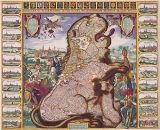
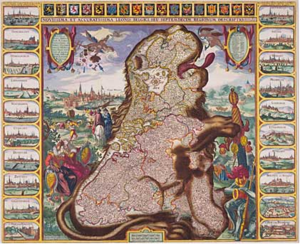
. The largest of these was the Prince-Bishopric of Liège, the green area on the map, including the County of Horne. The ethnically and culturally Netherlandish duchies of Cleves
and Julich
did not join either.
In the north, there were also a few smaller entities like the island of Ameland
that would retain their own lords until the French Revolution
.
Historians came up with different variations of the list. The number could have been chosen because of its Christian connotation.
 The Seventeen Provinces originated from the Burgundian Netherlands
. The dukes of Burgundy
systematically became the lord of different provinces. Mary I of Valois, Duchess of Burgundy
was the last of the House of Burgundy
.
When she married Maximilian I of Habsburg, Emperor of the Holy Roman Empire
, the provinces were acquired by the House of Habsburg in 1482, with the exception of the Duchy of Burgundy itself, which, with an appeal to Salic law
, had been reabsorbed into France upon the death of Mary's father, Charles the Bold. Maximilian's grandson, Charles V of Habsburg, Emperor of the Holy Roman Empire and King of Spain
, eventually united all seventeen provinces under his rule, the last one being the Duchy of Guelders, in 1543.
Most of these provinces were fiefs of the Holy Roman Empire
. Two provinces, the County of Flanders and County of Artois, were originally French fiefs, but sovereignty was ceded to the Empire in the Treaty of Cambrai in 1529.
The Pragmatic Sanction of 1549
determined that the Provinces should remain united in the future and inherited by the same monarch. Therefore, Charles V introduced the title of Heer der Nederlanden ("Lord of the Netherlands"). Only he and his son could ever use this title.
After Charles V's abdication in 1556, his realms were divided between his son, Philip II of Habsburg, King of Spain
, and his brother, Ferdinand I, Holy Roman Emperor
. The Seventeen Provinces went to his son, the king of Spain.
Conflicts between Philip II and his Dutch subjects led to the Eighty Years' War, which started in 1568. The seven northern provinces gained their independence as a republic called the Seven United Provinces
. They were:
The southern provinces, Flanders, Brabant, Namur, Hainaut, Luxembourg and the others, were restored to Spanish rule due to the military and political talent of the Duke of Parma
, especially at the Siege of Antwerp (1584–1585). Hence, these provinces became known as the Spanish Netherlands or Southern Netherlands
.
The northern Seven United Provinces kept parts of Limburg, Brabant, and Flanders during the Eighty Years' War (see Generality Lands
), which ended with the Treaty of Westphalia in 1648.
Artois and parts of Flanders and Hainaut were ceded to France
in the course of the 17th and 18th century.
.
Bruges
(County of Flanders) had already lost its prominent position as economic powerhouse of northern Europe. And Holland was gradually gaining importance in the 15th and 16th centuries.
However after the revolt
of the seven northern provinces
(1568), the Sack of Antwerp
(1576), the Fall of Antwerp (1584-1585), and the resulting closure of the Scheldt
river to navigation, a large number of people from the southern provinces emigrated north to the new republic. The center of prosperity moved from cities in the south such as Bruges
, Antwerp, Ghent
, and Brussels
to cities in the north, mostly Holland, including Amsterdam
, The Hague
, and Rotterdam
.
In other languages, this has not been adopted, though the larger area is sometimes known as the Low Countries
in English.
The fact that the term Netherlands has such different historical meanings can sometimes lead to difficulties in expressing oneself correctly. For example, composer
s from the 16th century are often said to belong to the Dutch School
(Nederlandse School). Although they themselves would not have objected to that term at that time, today it may wrongly create the impression that they were from the current Netherlands. In fact, they were almost exclusively from current Belgium.
Personal union
A personal union is the combination by which two or more different states have the same monarch while their boundaries, their laws and their interests remain distinct. It should not be confused with a federation which is internationally considered a single state...
of states in the Low Countries
Low Countries
The Low Countries are the historical lands around the low-lying delta of the Rhine, Scheldt, and Meuse rivers, including the modern countries of Belgium, the Netherlands, Luxembourg and parts of northern France and western Germany....
in the 15th century and 16th century, roughly covering the current Netherlands
Netherlands
The Netherlands is a constituent country of the Kingdom of the Netherlands, located mainly in North-West Europe and with several islands in the Caribbean. Mainland Netherlands borders the North Sea to the north and west, Belgium to the south, and Germany to the east, and shares maritime borders...
, Belgium
Belgium
Belgium , officially the Kingdom of Belgium, is a federal state in Western Europe. It is a founding member of the European Union and hosts the EU's headquarters, and those of several other major international organisations such as NATO.Belgium is also a member of, or affiliated to, many...
, Luxembourg
Luxembourg
Luxembourg , officially the Grand Duchy of Luxembourg , is a landlocked country in western Europe, bordered by Belgium, France, and Germany. It has two principal regions: the Oesling in the North as part of the Ardennes massif, and the Gutland in the south...
, a good part of the North of France
France
The French Republic , The French Republic , The French Republic , (commonly known as France , is a unitary semi-presidential republic in Western Europe with several overseas territories and islands located on other continents and in the Indian, Pacific, and Atlantic oceans. Metropolitan France...
(Artois
Artois
Artois is a former province of northern France. Its territory has an area of around 4000 km² and a population of about one million. Its principal cities are Arras , Saint-Omer, Lens and Béthune.-Location:...
, French Flanders
French Flanders
French Flanders is a part of the historical County of Flanders in present-day France. The region today lies in the modern-day region of Nord-Pas de Calais, the department of Nord, and roughly corresponds to the arrondissements of Lille, Douai and Dunkirk on the Belgian border.-Geography:French...
), and a small part of Western Germany
Germany
Germany , officially the Federal Republic of Germany , is a federal parliamentary republic in Europe. The country consists of 16 states while the capital and largest city is Berlin. Germany covers an area of 357,021 km2 and has a largely temperate seasonal climate...
.
The Seventeen Provinces were originally held by the Dukes of Burgundy of the House of Valois and later by the Habsburgs, first by the Austrian and then by the Spanish
Spanish Empire
The Spanish Empire comprised territories and colonies administered directly by Spain in Europe, in America, Africa, Asia and Oceania. It originated during the Age of Exploration and was therefore one of the first global empires. At the time of Habsburgs, Spain reached the peak of its world power....
line. From 1512 the Provinces formed the major part of the Burgundian Circle
Burgundian Circle
The Burgundian Circle was an Imperial Circle of the Holy Roman Empire created in 1512 and significantly enlarged in 1548. In addition to the Free County of Burgundy , the circle roughly covered the Low Countries, i.e...
.
Composition
The map corresponds to the following provinces:- the County of ArtoisCounty of ArtoisThe County of Artois was an historic province of the Kingdom of France, held by the Dukes of Burgundy from 1384 until 1477/82, and a state of the Holy Roman Empire from 1493 until 1659....
- the County of FlandersCounty of FlandersThe County of Flanders was one of the territories constituting the Low Countries. The county existed from 862 to 1795. It was one of the original secular fiefs of France and for centuries was one of the most affluent regions in Europe....
, including the burgraviatesBurgraveA burgrave is literally the count of a castle or fortified town. The English form is derived through the French from the German Burggraf and Dutch burg- or burch-graeve .* The title is originally equivalent to that of castellan or châtelain, meaning keeper of a castle and/or fortified town...
of LilleLilleLille is a city in northern France . It is the principal city of the Lille Métropole, the fourth-largest metropolitan area in the country behind those of Paris, Lyon and Marseille. Lille is situated on the Deûle River, near France's border with Belgium...
, DouaiDouai-Main sights:Douai's ornate Gothic style belfry was begun in 1380, on the site of an earlier tower. The 80 m high structure includes an impressive carillon, consisting of 62 bells spanning 5 octaves. The originals, some dating from 1391 were removed in 1917 during World War I by the occupying...
, OrchiesOrchies-References:* -External links:*...
, the Lordship of TournaiTournaiTournai is a Walloon city and municipality of Belgium located 85 kilometres southwest of Brussels, on the river Scheldt, in the province of Hainaut....
and the Tournaisis - the Lordship of MechelenMechelenMechelen Footnote: Mechelen became known in English as 'Mechlin' from which the adjective 'Mechlinian' is derived...
- the County of Namur
- the County of HainautCounty of HainautThe County of Hainaut was a historical region in the Low Countries with its capital at Mons . In English sources it is often given the archaic spelling Hainault....
- the County of ZeelandCounty of ZeelandThe County of Zeeland was a county of the Holy Roman Empire in what is now the Netherlands. It covered an area in the Scheldt and Meuse delta roughly corresponding to the current Dutch province of Zeeland, though it did not include the region of Zeeuws-Vlaanderen which was part of...
- the County of HollandCounty of HollandThe County of Holland was a county in the Holy Roman Empire and from 1482 part of the Habsburg Netherlands in what is now the Netherlands. It covered an area roughly corresponding to the current Dutch provinces of North-Holland and South-Holland, as well as the islands of Terschelling, Vlieland,...
- the Duchy of BrabantDuchy of BrabantThe Duchy of Brabant was a historical region in the Low Countries. Its territory consisted essentially of the three modern-day Belgian provinces of Flemish Brabant, Walloon Brabant and Antwerp, the Brussels-Capital Region and most of the present-day Dutch province of North Brabant.The Flag of...
, including the Margraviate of Antwerp, the counties of LeuvenLeuvenLeuven is the capital of the province of Flemish Brabant in the Flemish Region, Belgium...
and of BrusselsBrusselsBrussels , officially the Brussels Region or Brussels-Capital Region , is the capital of Belgium and the de facto capital of the European Union...
, and the advocacy of the Abbey of NivellesNivellesNivelles is a Walloon city and municipality located in the Belgian province of Walloon Brabant. The Nivelles municipality includes the old communes of Baulers, Bornival, Thines, and Monstreux....
and of GemblouxGemblouxGembloux is a Walloon municipality located in the Belgian province of Namur, on the axis Brussels-NamurOn 1 January 2006 the municipality had 21,964 inhabitants... - the Duchy of LimburgDuchy of LimburgThe Duchy of Limburg, situated in the Low Countries between the river Meuse and the city of Aachen, was a state of the Holy Roman Empire. Its territory is now divided between the Belgian provinces of Liège and Limburg , the Dutch province of Limburg , and a small part of North Rhine-Westphalia in...
, including the counties of DalhemDalhemDalhem is a Walloon municipality located in the Belgian province of Liège. On January 1, 2006 Dalhem had a total population of 6,486. The total area is 36.06 km² which gives a population density of 180 inhabitants per km²....
and ValkenburgValkenburg aan de GeulValkenburg aan de Geul is a municipality in the southeastern Netherlands.-History:Siege and conquest were characteristic of the history of Valkenburg. Each event is withheld, followed by subsequent restorations. This most definitely holds for the castle perched atop of a hill in the middle of the...
and the Lordship of HerzogenrathHerzogenrathHerzogenrath is a municipality in the district of Aachen in the German state of North Rhine-Westphalia. It borders the Dutch town of Kerkrade, the national border in one section running along the middle of a main road.-History:... - the Duchy of Luxembourg
- the Prince-Bishopric, later Lordship of Utrecht
- the Lordship of FrisiaFrieslandFriesland is a province in the north of the Netherlands and part of the ancient region of Frisia.Until the end of 1996, the province bore Friesland as its official name. In 1997 this Dutch name lost its official status to the Frisian Fryslân...
- the Duchy of GueldersGueldersGuelders or Gueldres is the name of a historical county, later duchy of the Holy Roman Empire, located in the Low Countries.-Geography:...
and the County of ZutphenZutphen CountyZutphen county, in the province of Gelderland in the Netherlands, was formed in the eleventh century as a fief of the Bishop of Utrecht. It has been in personal union with Guelders since the 1130s. Later, it became one of the 4 quarters of Guelders... - the Lordships of Groningen
- the OmmelandenOmmelandenThe Ommelanden are the parts of Groningen province that surround Groningen city. Usually mentioned as synonym for the province in the expression Stad en Ommeland ....
- the Lordship of DrentheDrentheDrenthe is a province of the Netherlands, located in the north-east of the country. The capital city is Assen. It is bordered by Overijssel to the south, Friesland to the west, Groningen to the north, and Germany to the east.-History:Drenthe, unlike many other parts of the Netherlands, has been a...
, LingenLingenLingen is a town in Lower Saxony, Germany. In 2008 the population was 52,353, and in addition there are about 5,000 people who have registered the city as their secondary residence...
, WeddeWeddeWedde is a village in the Dutch province of Groningen. It is located in the municipality of Bellingwedde, about 9 km southeast of Winschoten.Wedde was a separate municipality until 1968, when it was merged with Bellingwolde to form Bellingwedde...
, and WesterwoldeWesterwoldeWesterwolde is a region in the province Groningen in the north of the Netherlands. The region is located in the most eastern part of the Netherlands, alongside the German border. It is situated around the rivers Mussel Aa, Ruiten Aa, and Westerwoldse Aa, and it contains the villages Bellingwolde,... - the Lordship of OverijsselOverijsselOverijssel is a province of the Netherlands in the central eastern part of the country. The region has a NUTS classification of NL21. The province's name means "Lands across river IJssel". The capital city of Overijssel is Zwolle and the largest city is Enschede...
It was not always the same Seventeen Provinces represented at the Estates-General of the Netherlands. Sometimes one delegation was included in another.
In later years the county of Zutphen became a part of the Duchy of Guelders, and the Duchy of Limburg was dependent on the Duchy of Brabant. On the other hand the French-speaking cities of Flanders were sometimes recognised as a separate province.
There were a number of fiefdom
Fiefdom
A fee was the central element of feudalism and consisted of heritable lands granted under one of several varieties of feudal tenure by an overlord to a vassal who held it in fealty in return for a form of feudal allegiance and service, usually given by the...
s in the Low Countries that were not part of the Seventeen Provinces, mainly because they did not belong to the Burgundian Circle
Burgundian Circle
The Burgundian Circle was an Imperial Circle of the Holy Roman Empire created in 1512 and significantly enlarged in 1548. In addition to the Free County of Burgundy , the circle roughly covered the Low Countries, i.e...
but to the Lower Rhenish-Westphalian Circle
Lower Rhenish-Westphalian Circle
The Lower Rhenish–Westphalian Circle was an Imperial Circle of the Holy Roman Empire. It comprised territories of the former Duchy of Lower Lorraine, Frisia and the Westphalian part of the former Duchy of Saxony....
. The largest of these was the Prince-Bishopric of Liège, the green area on the map, including the County of Horne. The ethnically and culturally Netherlandish duchies of Cleves
Duchy of Cleves
The Duchy of Cleves was a State of the Holy Roman Empire. It was situated in the northern Rhineland on both sides of the Lower Rhine, around its capital Cleves and the town of Wesel, bordering the lands of the Prince-Bishopric of Münster in the east and the Duchy of Brabant in the west...
and Julich
Duchy of Jülich
The Duchy of Jülich comprised a state within the Holy Roman Empire from the 11th to the 18th centuries. The duchy lay left of the Rhine river between the Electorate of Cologne in the east and the Duchy of Limburg in the west. It had territories on both sides of the river Rur, around its capital...
did not join either.
In the north, there were also a few smaller entities like the island of Ameland
Ameland
Ameland is a municipality and one of the West Frisian Islands off the north coast of the Netherlands. It consists mostly of sand dunes. It is the third major island of the West Frisians. It neighbours islands Terschelling to the West and Schiermonnikoog to the East...
that would retain their own lords until the French Revolution
French Revolution
The French Revolution , sometimes distinguished as the 'Great French Revolution' , was a period of radical social and political upheaval in France and Europe. The absolute monarchy that had ruled France for centuries collapsed in three years...
.
Historians came up with different variations of the list. The number could have been chosen because of its Christian connotation.
History
Burgundian Netherlands
In the history of the Low Countries, the Burgundian Netherlands refers to a number of Imperial and French fiefs ruled in personal union by the House of Valois-Burgundy and their Habsburg heirs in the period from 1384 to 1482...
. The dukes of Burgundy
Duke of Burgundy
Duke of Burgundy was a title borne by the rulers of the Duchy of Burgundy, a small portion of traditional lands of Burgundians west of river Saône which in 843 was allotted to Charles the Bald's kingdom of West Franks...
systematically became the lord of different provinces. Mary I of Valois, Duchess of Burgundy
Mary of Burgundy
Mary of Burgundy ruled the Burgundian territories in Low Countries and was suo jure Duchess of Burgundy from 1477 until her death...
was the last of the House of Burgundy
House of Burgundy
The House of Burgundy was a cadet branch of the Capetian dynasty, descending from Robert I, Duke of Burgundy, a younger son of Robert II of France....
.
When she married Maximilian I of Habsburg, Emperor of the Holy Roman Empire
Maximilian I, Holy Roman Emperor
Maximilian I , the son of Frederick III, Holy Roman Emperor and Eleanor of Portugal, was King of the Romans from 1486 and Holy Roman Emperor from 1493 until his death, though he was never in fact crowned by the Pope, the journey to Rome always being too risky...
, the provinces were acquired by the House of Habsburg in 1482, with the exception of the Duchy of Burgundy itself, which, with an appeal to Salic law
Salic law
Salic law was a body of traditional law codified for governing the Salian Franks in the early Middle Ages during the reign of King Clovis I in the 6th century...
, had been reabsorbed into France upon the death of Mary's father, Charles the Bold. Maximilian's grandson, Charles V of Habsburg, Emperor of the Holy Roman Empire and King of Spain
Charles V, Holy Roman Emperor
Charles V was ruler of the Holy Roman Empire from 1519 and, as Charles I, of the Spanish Empire from 1516 until his voluntary retirement and abdication in favor of his younger brother Ferdinand I and his son Philip II in 1556.As...
, eventually united all seventeen provinces under his rule, the last one being the Duchy of Guelders, in 1543.
Most of these provinces were fiefs of the Holy Roman Empire
Holy Roman Empire
The Holy Roman Empire was a realm that existed from 962 to 1806 in Central Europe.It was ruled by the Holy Roman Emperor. Its character changed during the Middle Ages and the Early Modern period, when the power of the emperor gradually weakened in favour of the princes...
. Two provinces, the County of Flanders and County of Artois, were originally French fiefs, but sovereignty was ceded to the Empire in the Treaty of Cambrai in 1529.
The Pragmatic Sanction of 1549
Pragmatic Sanction of 1549
The Pragmatic Sanction of 1549 was an edict, promulgated by Charles V, Holy Roman Emperor, reorganizing the Seventeen Provinces.It was his plan to centralize the administrative units of Holy Roman Empire. The Pragmatic Sanction transformed this agglomeration of lands into a unified entity, of which...
determined that the Provinces should remain united in the future and inherited by the same monarch. Therefore, Charles V introduced the title of Heer der Nederlanden ("Lord of the Netherlands"). Only he and his son could ever use this title.
After Charles V's abdication in 1556, his realms were divided between his son, Philip II of Habsburg, King of Spain
Philip II of Spain
Philip II was King of Spain, Portugal, Naples, Sicily, and, while married to Mary I, King of England and Ireland. He was lord of the Seventeen Provinces from 1556 until 1581, holding various titles for the individual territories such as duke or count....
, and his brother, Ferdinand I, Holy Roman Emperor
Ferdinand I, Holy Roman Emperor
Ferdinand I was Holy Roman Emperor from 1558 and king of Bohemia and Hungary from 1526 until his death. Before his accession, he ruled the Austrian hereditary lands of the Habsburgs in the name of his elder brother, Charles V, Holy Roman Emperor.The key events during his reign were the contest...
. The Seventeen Provinces went to his son, the king of Spain.
Conflicts between Philip II and his Dutch subjects led to the Eighty Years' War, which started in 1568. The seven northern provinces gained their independence as a republic called the Seven United Provinces
Dutch Republic
The Dutch Republic — officially known as the Republic of the Seven United Netherlands , the Republic of the United Netherlands, or the Republic of the Seven United Provinces — was a republic in Europe existing from 1581 to 1795, preceding the Batavian Republic and ultimately...
. They were:
- the Lordship of Groningen and of the Ommelanden
- the Lordship of Friesland
- the Lordship of Overijssel
- the Duchy of Guelders (except its upper quarterUpper GueldersUpper Guelders or Spanish Guelders was one of the four quarters in the Imperial Duchy of Guelders. In the Dutch Revolt, it was the only quarter that did not secede from the Habsburg Monarchy to become part of the Seven United Netherlands, but remained under Spanish rule during the Eighty Years'...
) and the County of Zutphen - the Prince-Bishopric, later Lordship of Utrecht
- the County of Holland
- the County of Zeeland
The southern provinces, Flanders, Brabant, Namur, Hainaut, Luxembourg and the others, were restored to Spanish rule due to the military and political talent of the Duke of Parma
Alexander Farnese, Duke of Parma
Alexander Farnese was Duke of Parma and Piacenza from 1586 to 1592, and Governor of the Spanish Netherlands from 1578 to 1592.-Biography:...
, especially at the Siege of Antwerp (1584–1585). Hence, these provinces became known as the Spanish Netherlands or Southern Netherlands
Southern Netherlands
Southern Netherlands were a part of the Low Countries controlled by Spain , Austria and annexed by France...
.
The northern Seven United Provinces kept parts of Limburg, Brabant, and Flanders during the Eighty Years' War (see Generality Lands
Generality Lands
The Generality Lands, Lands of the Generality or Common Lands were about one fifth of the territories of the United Provinces of the Netherlands, that were directly governed by the States-General...
), which ended with the Treaty of Westphalia in 1648.
Artois and parts of Flanders and Hainaut were ceded to France
France
The French Republic , The French Republic , The French Republic , (commonly known as France , is a unitary semi-presidential republic in Western Europe with several overseas territories and islands located on other continents and in the Indian, Pacific, and Atlantic oceans. Metropolitan France...
in the course of the 17th and 18th century.
Economy
By the mid-16th century, the Margraviate of Antwerp (Duchy of Brabant) had become the economic, political, and cultural center of the Netherlands after its capital had shifted from the nearby Lordship of Mechelen to the city of BrusselsBrussels
Brussels , officially the Brussels Region or Brussels-Capital Region , is the capital of Belgium and the de facto capital of the European Union...
.
Bruges
Bruges
Bruges is the capital and largest city of the province of West Flanders in the Flemish Region of Belgium. It is located in the northwest of the country....
(County of Flanders) had already lost its prominent position as economic powerhouse of northern Europe. And Holland was gradually gaining importance in the 15th and 16th centuries.
However after the revolt
Dutch Revolt
The Dutch Revolt or the Revolt of the Netherlands This article adopts 1568 as the starting date of the war, as this was the year of the first battles between armies. However, since there is a long period of Protestant vs...
of the seven northern provinces
Dutch Republic
The Dutch Republic — officially known as the Republic of the Seven United Netherlands , the Republic of the United Netherlands, or the Republic of the Seven United Provinces — was a republic in Europe existing from 1581 to 1795, preceding the Batavian Republic and ultimately...
(1568), the Sack of Antwerp
Sack of Antwerp
The sack of Antwerp or the Spanish Fury at Antwerp was an episode of the Eighty Years' War.On 4 November 1576, Spanish tercios began the sack of Antwerp, leading to three days of horror among the population of the city, which was the cultural, economic and financial center of the Netherlands. The...
(1576), the Fall of Antwerp (1584-1585), and the resulting closure of the Scheldt
Scheldt
The Scheldt is a 350 km long river in northern France, western Belgium and the southwestern part of the Netherlands...
river to navigation, a large number of people from the southern provinces emigrated north to the new republic. The center of prosperity moved from cities in the south such as Bruges
Bruges
Bruges is the capital and largest city of the province of West Flanders in the Flemish Region of Belgium. It is located in the northwest of the country....
, Antwerp, Ghent
Ghent
Ghent is a city and a municipality located in the Flemish region of Belgium. It is the capital and biggest city of the East Flanders province. The city started as a settlement at the confluence of the Rivers Scheldt and Lys and in the Middle Ages became one of the largest and richest cities of...
, and Brussels
Brussels
Brussels , officially the Brussels Region or Brussels-Capital Region , is the capital of Belgium and the de facto capital of the European Union...
to cities in the north, mostly Holland, including Amsterdam
Amsterdam
Amsterdam is the largest city and the capital of the Netherlands. The current position of Amsterdam as capital city of the Kingdom of the Netherlands is governed by the constitution of August 24, 1815 and its successors. Amsterdam has a population of 783,364 within city limits, an urban population...
, The Hague
The Hague
The Hague is the capital city of the province of South Holland in the Netherlands. With a population of 500,000 inhabitants , it is the third largest city of the Netherlands, after Amsterdam and Rotterdam...
, and Rotterdam
Rotterdam
Rotterdam is the second-largest city in the Netherlands and one of the largest ports in the world. Starting as a dam on the Rotte river, Rotterdam has grown into a major international commercial centre...
.
Netherlands
To distinguish between the older and larger Low Countries of the Netherlands from the current country of the Netherlands, Dutch speakers usually drop the plural for the latter. They speak of Nederland in singular for the current country and of de Nederlanden in plural for the integral domains of Charles V.In other languages, this has not been adopted, though the larger area is sometimes known as the Low Countries
Low Countries
The Low Countries are the historical lands around the low-lying delta of the Rhine, Scheldt, and Meuse rivers, including the modern countries of Belgium, the Netherlands, Luxembourg and parts of northern France and western Germany....
in English.
The fact that the term Netherlands has such different historical meanings can sometimes lead to difficulties in expressing oneself correctly. For example, composer
Composer
A composer is a person who creates music, either by musical notation or oral tradition, for interpretation and performance, or through direct manipulation of sonic material through electronic media...
s from the 16th century are often said to belong to the Dutch School
Franco-Flemish School
In music, the Franco-Flemish School or more precisely the Netherlandish School refers, somewhat imprecisely, to the style of polyphonic vocal music composition in Europe in the 15th and 16th centuries, and to the composers who wrote it...
(Nederlandse School). Although they themselves would not have objected to that term at that time, today it may wrongly create the impression that they were from the current Netherlands. In fact, they were almost exclusively from current Belgium.
Coats of arms
See also
- Governors of the Habsburg NetherlandsGovernors of the Habsburg NetherlandsThe Governor of the Habsburg Netherlands ruled the Habsburg Netherlands as a representative of the Duke of Burgundy .- Habsburg Netherlands :...
- The Netherlands (disambiguation)
- Burgundian NetherlandsBurgundian NetherlandsIn the history of the Low Countries, the Burgundian Netherlands refers to a number of Imperial and French fiefs ruled in personal union by the House of Valois-Burgundy and their Habsburg heirs in the period from 1384 to 1482...
- Greater Netherlands
- French Flemish
- BeneluxBeneluxThe Benelux is an economic union in Western Europe comprising three neighbouring countries, Belgium, the Netherlands, and Luxembourg. These countries are located in northwestern Europe between France and Germany...