
|
|
|
|
Edward I of England
|
| |
|
| |
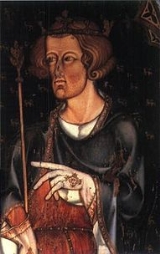
Edward I (17 June 1239 – 7 July 1307), popularly known as Longshanks, the English Justinian, and the Hammer of the Scots (Scottorum malleus), was a Plantagenet King of England who achieved historical fame by conquering large parts of Wales and almost succeeding in doing the same to Scotland. However, his death led to his son Edward II taking the throne and ultimately failing in his attempt to subjugate Scotland.

Discussion
Ask a question about 'Edward I of England'
Start a new discussion about 'Edward I of England'
Answer questions from other users
|
Recent Posts

Timeline
|
|
1239 Born
1254 Edward Plantagenet marries Eleanor of Castile. His father Henry III had demanded the marriage in exchange of ending the war with her brother Alfonso X of Castile
1264 The Battle of Lewes of the Second Barons' War is fought between Simon de Montfort, 6th Earl of Leicester and King Henry III of England in Sussex. By the end of the battle, de Montfort's forces capture both King Henry and his brother, future King Edward I, making de Montfort the "uncrowned king of England" for 15 months before Edward escapes captivity and recaptures the throne.
1265 Future King Edward I of England escapes captivity in the hands of Simon de Montfort, 6th Earl of Leicester.
1271 Edward I of England and Charles of Anjou arrive in Acre, starting the Ninth Crusade against Baibars; however, they are unable to capture any territory and a peace is quickly negotiated.
1272 King Edward I of England departs for England from the failed Ninth Crusade and becomes King when his father, King Henry III, dies.
1272 Edward becomes King of England.
1274 King Edward I of England finally returns from the Ninth Crusade to England to be crowned king, two years after his father King Henry III's death.
1275 Eleanor de Montfort is captured by pirates in the employ of Edward I of England to prevent her marriage to Llywelyn the Last, prince of Wales; she is used as a bargaining chip over the coming years in Edward's attempts to subjugate Llywelyn and Wales.
1277 Llywelyn ap Gruffyd is subdued by King Edward I of England in the First Welsh War.
|

Encyclopedia
Edward I (17 June 1239 – 7 July 1307), popularly known as Longshanks, the English Justinian, and the Hammer of the Scots (Scottorum malleus), was a Plantagenet King of England who achieved historical fame by conquering large parts of Wales and almost succeeding in doing the same to Scotland. However, his death led to his son Edward II taking the throne and ultimately failing in his attempt to subjugate Scotland. Longshanks reigned from 1272 to 1307, ascending the throne of England on 16 November, 1272 after the death of his father, King Henry III. His mother was queen consort Eleanor of Provence.
As regnal post-nominal numbers were a Norman (as opposed to Anglo-Saxon) custom, Edward Longshanks is known as Edward I, even though he was England's fourth King Edward, following Edward the Elder, Edward the Martyr, and Edward the Confessor.
Childhood and marriages
Edward was born at the Palace of Westminster on the night of 17/18 June 1239, to King Henry III and Eleanor of Provence. Henry was devoted to the cult of Edward the Confessor, and for this reason decided to name his firstborn son Edward not a common name among the English aristocracy at the time. Edward was in the care of Hugh Giffard father of the future Chancellor Godfrey Giffard until Bartholomew Pecche took over at Giffard's death in 1246. Among his childhood companions was his cousin Henry of Almain, son of King Henry’s brother Richard of Cornwall.
In 1254 there were fears that Castile might invade the English province of Gascony. As a preventive measure, it was agreed that Edward should marry Eleanor, half-sister of King Alfonso X of Castile. As part of the marriage agreement, Alfonso insisted that grants of land worth 15,000 marks a year be made to the young prince, not yet fifteen years of age. Though the endowments King Henry made were sizeable, the independence they provided for Edward was limited. He had already received Gascony as early as 1249, but Simon de Montfort, 6th Earl of Leicester had been appointed to serve as royal lieutenant there the year before, so in practice Edward derived neither authority nor revenue from this province. The grant he received in 1254 included most of Ireland, and much land in Wales and England, including the earldom of Chester. The king maintained much control of the land in question, however, and particularly in Ireland was Edward’s power limited.
Eleanor and Edward were married on 1 November 1254 in the monastery of Las Huelgas in Castile. They would go on to have at least fifteen (possibly sixteen) children, and her death in 1290 affected Edward deeply. He displayed his grief by erecting the Eleanor crosses, one at each place where her funeral cortège stopped for the night. His second marriage (at the age of 60) at Canterbury on 10 September 1299, to Marguerite of France (aged 17 and known as the "Pearl of France" by her husband's English subjects), the daughter of King Philip III of France (Phillip the Bold) and Maria of Brabant, produced three children.
In the years from 1254 to 1257, Edward was under the influence of the court faction known as the Savoyards, relatives of his mother, Eleanor of Provence. The most notable of this group was Peter of Savoy, the queen’s uncle. From 1257 onwards, he increasingly fell in with the Poitevin, or Lusignan faction the king's half-brothers led by men such as William de Valence. Both these groups were considered privileged foreigners, and were deeply resented by the established English aristocracy.
Early ambitions
Edward had shown independence in political matters as early as 1255 when he took sides in a local conflict in Gascony, contrary to his father’s policy of mediation. In May 1258 a group of magnates drew up a document for reform of the king’s government the so-called Provisions of Oxford largely directed against the Lusignans. Edward stood by his political allies, and strongly opposed the Provisions. The reform movement had success, however, and gradually Edward’s attitude started to change. In March 1259 he entered into a formal alliance with one of the main reformers Richard de Clare, earl of Gloucester. Then, on 15 October, 1259 he announced that he supported the barons' goals, and their leader, Simon de Montfort.
The motive behind Edward’s change of heart could have been purely pragmatic; Montfort was in a good position to support his cause in Gascony. When the king left for France in November, Edward's behaviour turned into pure insubordination, as he made several appointments to advance the cause of the reformers. King Henry started believing that his son was plotting to depose him. When the king returned he initially refused to see his son, but through the mediation of the Earl of Cornwall and the archbishop of Canterbury the two were eventually reconciled. Edward was sent abroad, and in November 1260 he once more united with the Lusignans, who had been exiled to France.
Back in England, early in 1262, Edward fell out with some of his former allies over financial matters. A year later he led a campaign in Wales against Llywelyn ap Gruffudd, with limited results. Around the same time Simon de Montfort, who had been out of the country since 1261, returned to England and reignited the baronial reform movement. The king gave in to the barons’ demands, but Edward who was now firmly on the side of his father held out. He reunited with some of the men he had alienated the year before among them Henry of Almain and John de Warenne, Earl of Surrey and retook Windsor Castle from the rebels. Through the arbitration of the King Louis IX of France, an agreement was made between the two parties. This so-called Mise of Amiens was largely favourable to the royalist side, and laid the seeds for further conflict.
Civil war
The years 1264–1267 saw the conflict known as the Barons' War, where baronial forces led by Simon de Montfort fought against those who remained loyal to the king. The first scene of battle was the city of Gloucester, which Edward managed to retake from the enemy. When Robert de Ferrers, earl of Derby, came to the assistance of the rebels, Edward negotiated a truce with the earl, the terms of which he later broke. Edward then proceeded to capture Northampton from Montfort's son Simon, before embarking on a retaliatory campaign against Derby's lands. The baronial and royalist forces finally met at the Battle of Lewes, on 14 May 1264. Edward's forces performed well, but the king's army nevertheless lost the battle. Edward, along with his cousin Henry of Almein, was given up as prisoners to Montfort.
Edward remained in captivity until March, and even after his release he was kept under strict surveillance. Then, on 28 May, he managed to escape his custodians, and joined up with the earl of Gloucester, who had recently defected to the king's side. Montfort's support was now dwindling, and Edward retook Worcester and Gloucester with relative little effort. In the meanwhile, Montfort had made an alliance with Llywelyn, and started moving east to join forces with his son Simon. Edward managed to make a surprise attack at Kenilworth Castle, where the younger Montfort was quartered, before moving on to cut off the earl of Leicester. The two forces then met at the second great encounter of the Barons' War the Battle of Evesham, on 4 August 1265. Montfort stood little chance against the superior royal forces, and after his defeat he was killed and mutilated in the field.
's mutilated body at the field of Evesham.]]
The war was not over with Montfort's death, and Edward participated in the continued campaigning. At Christmas he came to terms with the younger Simon de Montfort and his associates in the Isle of Axholme in Lincolnshire, and in March he led a successful assault on the Cinque Ports. A contingent of rebels held out in the virtually impregnable Kenilworth Castle, and did not surrender until the drafting of the conciliatory Dictum of Kenilworth. In April it seemed as if Gloucester would take up the cause of the reform movement, and civil war would return, but after a renegotiation of the terms of the Dictum of Kenilworth the parties came to an agreement. Edward, however, was little involved in the settlement negotiations following the wars; at this point his main focus was on planning his upcoming crusade.
Crusade and accession
Edward took the cross in an elaborate ceremony on 24 June 1268, along with his brother Edmund and cousin Henry of Almain. Among others who committed themselves to the cause were former adversaries like the earl of Gloucester, though the earl did not end up going. With the country pacified, the greatest impediment to the project was providing sufficient finances. King Louis IX of France, who was the leader of the crusade, provided a loan of about £17,500. This, however, was not enough; the rest had to be raised through a lay tax, something which had not happened since 1237. In May 1270, parliament granted a tax of a twentieth, in exchange for which the king agreed to reconfirm Magna Carta, and to impose restrictions on Jewish money lending. On 20 August Edward sailed from Dover for France. It is impossible to determine the size of the force with any certainty, but Edward probably brought with him around 225 knights and all together less than 1000 men.
The original goal of the crusade was to relieve the beleaguered Christian stronghold of Acre, but Louis had been diverted to Tunis. The French king and his brother Charles of Anjou, who had made himself king of Sicily, decided to attack the emirate in order to establish a stronghold in North Africa. The plans failed when the French forces were struck by an epidemic which, on 25 August, took the life of King Louis himself. By the time Edward arrived at Tunis, Charles had already signed a treaty with the emir, and there was little else to do than to return to Sicily. The crusade was postponed until next spring, but a devastating storm off the coast of Sicily dissuaded Charles of Anjou and Louis's successor Philip III from any further campaigning. Edward decided to continue alone, and on 9 May 1271 he finally landed at Acre.
The situation in the Holy Land at the time of Edward's arrival was a precarious one. Jerusalem had fallen in 1187, and Acre was now the centre of the Christian state. The Muslim states were on the offensive under the Mamluk leadership of Baibars, and were now threatening Acre itself. Though Edward's men were an important addition to the garrison, they stood little chance against Baibars' superior forces, and an initial raid at nearby St Georges-de-Lebeyne in June was largely futile. An embassy to the Mongols helped bring about an attack on Aleppo in the north, allowing the crusading armies a distraction. In November, Edward led a raid on Qaqun, which could have served as a bridgehead to Jerusalem, but both the Mongol invasion and the attack on Qaqun failed. Things now seemed increasingly desperate, and in May 1272 Hugh III of Cyprus, who was the nominal king of Jerusalem, signed a ten-year truce with Baibars. Edward was initially defiant, but an attack by a Muslim assassin in June forced him to abandon any further campaigning. Even though he managed to kill the assassin, he was struck in the arm by a poisoned dagger, and became strongly reduced physically over the next months.
It was not until 24 September that Edward left Acre. Arriving in Sicily, he was met with the news that Henry III had died on 16 November. Edward was deeply saddened by these news, but rather than hurrying home at once, he made a leisurely journey northwards. This was partly due to his health still being poor, but also due to a lack of urgency. The political situation in England was stable after the mid-century upheavals, and Edward was proclaimed king at his father's death, rather than at his own coronation, as had up until then been customary. The new king embarked on an overland journey through Italy and France, where among other things he visited the pope in Rome and suppressed a rebellion in Gascony. Only on 2 August 1274 did he return to England, and was crowned on 19 August.
Administration and the law
of Edward I (4 pence)]]
Upon returning home, Edward immediately embarked on the administrative business of the nation, and his major concern was restoring order and re-establishing royal authority after the disastrous reign of his father. In order to accomplish this he immediately ordered an extensive change of administrative personnel. The most important of these was the appointment of Robert Burnell as chancellor; a man who would remain in the post until 1292, as one of the king's closest associates. Edward then proceeded to replace most local officials, such as the escheators and sheriffs. This last measure was done in preparation for an extensive inquest covering all of England, that would hear complaints about abuse of power by royal officers. The inquest produced the so-called Hundred Rolls, from the administrative sub-division of the hundred.
The second purpose of the inquest was to establish what land and rights the crown had lost during the reign of Henry III. The Hundred Rolls formed the basis for the later legal inquiries called the Quo warranto proceedings. The purpose of these inquiries was to establish by what warrant (Latin: Quo warranto) various liberties were held. If the defendant could not produce a royal licence to prove the grant of the liberty, then it was the crown's opinion based on the writings of Bracton that the liberty should revert to the king. This caused great consternation among the aristocracy, who insisted that long use in itself constituted license. A compromise was eventually reached in 1290, whereby a liberty was considered legitimate as long as it could be shown to have been exercised since the coronation of King Richard I, in 1189. Royal gains from the Quo warranto proceedings were insignificant; few liberties were returned to the king. Edward had nevertheless won a significant victory, in clearly establishing the principle that all liberties essentially emanated from the king.
The 1290 Statute of Quo warranto was only one part of a wider legislative effort, which was one of the most important contributions of Edward I's reign. This era of legislative action had started already at the time of the baronial reform movement; the Statute of Marlborough (1267) contained elements both of the Provisions of Oxford and the Dictum of Kenilworth. The compilation of the Hundred Rolls was followed shortly after by the issue of Westminster I (1275), which asserted the royal prerogative and outlined restrictions on liberties. In Mortmain (1279), the issue was grants of land to the church. The first clause of Westminster II (1285), known as De donis conditionalibus, dealt with family settlement of land, and entails. Merchants (1285) established firm rules for the recovery of debts, while Winchester (1285) dealt with peacekeeping on a local level. Quia emptores (1290) issued along with Quo warranto set out to remedy land ownership disputes resulting from alienation of land by subinfeudation. The age of the great statutes largely ended with the death of Robert Burnell in 1292.
Welsh wars
Llywelyn ap Gruffydd enjoyed an advantageous situation in the aftermath of the Barons' War. Through the 1267 Treaty of Montgomery he obtained much land in the Marches, and was recognised in his title of Prince of Wales. Armed conflicts nevertheless continued, in particular with certain dissatisfied Marcher Lords, such as the earl of Gloucester, Roger Mortimer and Humphrey de Bohun, Earl of Hereford. Problems were exacerbated when his younger brother Dafydd and Gruffydd ap Gwenwynwyn of Powys, after a failed assassination attempt against Llywelyn, defected to the English in 1274. Citing ongoing hostilities and the English king harbouring his enemies, Llywelyn refused to do homage to Edward. For Edward, a further provocation came in the form of Llywelyn's planned marriage to Eleanor, daughter of Simon de Montfort. In November 1276 war was declared. Initial operations were launched under the captaincy of Mortimer, Lancaster (Edward's brother Edmund) and William de Beauchamp, Earl of Warwick. Support for Llywelyn was weak among his own countrymen. In July 1277 Edward invaded with a force of 15,500 of whom 9,000 were Welshmen. The campaign never came to a major battle, and Llywelyn soon realised he had no choice but to surrender. By the Treaty of Aberconwy in November 1277, he was left only with the land of Gwynedd, though he was allowed to retain the title of Prince of Wales.
When war broke out again in 1282, it was an entirely different undertaking. For the Welsh this was a war of national independence with wide support, provoked particularly by attempts to impose English law on Welsh subjects. For Edward it became a war of conquest rather than simply a punitive expedition, like the former campaign. The war started with a rebellion by Dafydd, who was discontent with the reward his had received from Edward in 1277. Llywelyn and other Welsh chieftains soon joined in, and initially the Welsh experienced military success. In June, Gloucester was defeated at the Battle of Llandeilo Fawr. On 6 November, while John Peckham, archbishop of Canterbury, was conducting peace negotiations, Edward's commander of Anglesey, Luke de Tany, decided to carry out a surprise attack. A pontoon bridge had been built to the mainland, but shortly after Tany and his men crossed over, they were ambushed by the Welsh, and suffered heavy losses at the Battle of Moel-y-don. The Welsh advances ended on December 11, however, when Llywelyn was lured into a trap and killed at the Battle of Orewin Bridge. The submission of Wales was complete with the capture in April 1283 of Dafydd, who was taken to Shrewsbury and executed as a traitor.
, one of the most imposing of Edward's Welsh castles.]]
Further rebellions occurred in 1287 and more seriously in 1294 under Madog ap Llywelyn. This last conflict demanded the king's own attention, but in both cases the rebellions were put down. By the 1284 Statute of Rhuddlan, the Principality of Wales was incorporated into England, and Wales was given an administrative system like the English, with counties policed by sheriffs. English law was introduced in criminal cases, though the Welsh were allowed to maintain their own customary laws in some cases of property disputes. After 1277, and increasingly after 1283, Edward embarked on a full-scale project of English settlement of Wales, creating new towns like Flint, Aberystwyth, and Rhuddlan. An extensive project of castle-building was also initiated. The assignment was given to Master James of Saint George, a prestigious architect whom Edward had met in Savoy on his return from crusade. Among the major buildings were the castles of Beaumaris, Caernarfon, Conwy and Harlech. In 1284, King Edward's son Edward the later Edward II was born at Caernarfon Castle, and it was also here, in 1301, that the young Edward was the first English prince to be invested with the title of Prince of Wales.
Scottish wars
In 1289, after his return from a lengthy stay in his Duchy of Gascony, Edward turned his attentions to Scotland. He had planned to marry his son and heir Edward, to the heiress Margaret, the Maid of Norway, but when Margaret died with no clear successor, the Scottish Guardians invited Edward's arbitration, to prevent the country from descending into civil war. Before the process got underway, and to the surprise and consternation of many of Scots, Edward insisted that he must be recognised as overlord of Scotland. Eventually, after weeks of English machination and intimidation, this precondition was accepted, with the proviso that Edward's overlordship would only be temporary.
His overlordship acknowledged, Edward proceeded to hear the great case (or 'The Great Cause', a term first recorded in the 18th century) to decide who had the best right to be the new Scottish king. Proceedings took place at Berwick upon Tweed. After lengthy debates and adjournments, Edward ruled in favour of John Balliol in November 1292. Balliol was enthroned at Scone on 30 November, 1292.
In the weeks after this decision, however, Edward revealed that he had no intention of dropping his claim to be Scotland's superior lord. Balliol was forced to seal documents freeing Edward from his earlier promises. Soon the new Scottish king found himself being overruled from Westminster, and even summoned there on the appeal of his own Scottish subjects.
When, in 1294, Edward also demanded Scottish military service against France, it was the final straw. In 1295 the Scots concluded a treaty with France and readied themselves for war with England.
The war began in March 1296 when the Scots crossed the border and tried, unsuccessfully, to take Carlisle. Days later Edward's massive army struck into Scotland and demanded the surrender of Berwick. When this was refused the English attacked, killing most of the citizens-although the extent of the massacre is a source of contention; with postulated civilian death figures ranging from 7,000 to 60,000, dependent on the source.
After Berwick, and the defeat of the Scots by an English army at the Battle of Dunbar (1296), Edward proceeded north, taking Edinburgh and travelling as far north as Elgin - farther, as one contemporary noted, than any earlier English king. On his return south he confiscated the Stone of Destiny and carted it from Perth to Westminster Abbey. Balliol, deprived of his crown, the royal regalia ripped from his tabard (hence his nickname, Toom Tabard) was imprisoned in the Tower of London for three years (later he was transferred to papal custody, and at length allowed to return to his ancestral estates in France). All freeholders in Scotland were required to swear an oath of homage to Edward, and he ruled Scotland like a province through English viceroys.
Opposition sprang up (see Wars of Scottish Independence), and Edward executed the focus of discontent, William Wallace, on 23 August, 1305, having earlier defeated him at the Battle of Falkirk (1298). Although he won the battle, Edward lost many men in the battle and was forced to retreat back to England.
The capitulation of the Scottish political community in 1304 must have seemed to Edward to settle the Scottish question in his favour. Although he began to make arrangements for the governance of the newly-defeated realm, all of his efforts were invalidated by Robert Bruce's murder of John 'the Red' Comyn of Badenoch and his subsequent seizure of the Scottish crown. The king appears to have been greatly angered by the latest Scottish rebellion and ordered rebels to be shown no quarter. Many of Bruce's closest supporters were hanged when they were captured by Edward's men. Although Bruce was initially forced from Scotland, by 1307 he had returned to Scotland. Edward, apparently frustrated by his men's inability to crush Bruce, made arrangements to lead a campaign personally against the rebel-king. Edward was too old and too weak to undertake such a task and died before he could reach Scotland.
Later reign and death
Edward's later life was fraught with difficulty, as he lost his beloved first wife Eleanor and his heir failed to develop the expected kingly character.
Edward's plan to conquer Scotland ultimately failed. In 1307 he died at Burgh-by-Sands, Cumberland on the Scottish border, while on his way to wage another campaign against the Scots under the leadership of Robert the Bruce. According to a later chronicler tradition, Edward asked to have his bones carried on future military campaigns in Scotland. More credible and contemporary writers reported that the king's last request was to have his heart taken to the Holy Land. All that is certain is that Edward was buried in Westminster Abbey in a plain black marble tomb, which in later years was painted with the words Edwardus Primus Scottorum malleus hic est, pactum serva, (Here is Edward I, Hammer of the Scots. Keep Troth)..
On 2 January, 1774, the Society of Antiquaries opened the coffin and discovered that his body had been perfectly preserved for 467 years. His body was measured to be 6 feet 2 inches (188 cm) hence the nickname "Longshanks" meaning long legs.
Government and law under Edward I
- See also List of Parliaments of Edward I
Unlike his father, Henry III, Edward I took great interest in the workings of his government and undertook a number of reforms to regain royal control in government and administration. It was during Edward's reign that parliament began to meet regularly. And though still extremely limited to matters of taxation, it enabled Edward I to obtain a number of taxation grants which had been impossible for Henry III.
Edward's personal treasure, valued at over a year's worth of the kingdom's tax revenue, was stolen by Richard of Pudlicott in 1306, leading to one of the largest criminal trials of the period.
Persecution of the Jews
As Edward exercised greater control over the barons, his popularity waned. To combat his falling popularity and to drum up support for his campaigns against Wales and Scotland, Edward united the country by attacking the practice of usury which had impoverished many of his subjects. In 1275, Edward issued the Statute of the Jewry, which imposed various restrictions upon the Jews of England; most notably, outlawing usury and introducing to England the practice of requiring Jews to wear a yellow badge on their outer garments. In 1279, in the context of a crack-down on coin-clippers, he arrested all the heads of Jewish households in England, and had around 300 of them executed in the Tower of London. Others were executed in their homes. Edward became a national hero and won the support he needed.
Expulsion of the Jews By the Edict of Expulsion of 1290, Edward formally expelled all Jews from England. The motive for this expulsion was first and foremost financial - in almost every case, all their money and property was confiscated. They did not return until the 17th century, when Oliver Cromwell invited them to come back.
Edward, after his return from a three year stay on the Continent, was around £100,000 in debt. Such a large sum - around four times his normal annual income - could only come from a grant of parliamentary taxation. It seems that parliament was persuaded to vote for this tax, as had been the case on several earlier occasions in Edward's reign.
Portrayal in fiction
Edward's life was dramatized in a Renaissance play by George Peele, the Famous Chronicle of King Edward the First.
Edward is unflatteringly depicted in several novels with a contemporary setting, including:
- Edith Pargeter - The Brothers of Gwynedd quartet;
- Sharon Penman - The Reckoning and Falls the Shadow;
- Nigel Tranter:
- The Wallace: The Compelling 13th Century Story of William Wallace. McArthur & Co., 1997. ISBN 0-3402-1237-3:
- The Bruce Trilogy - "Robert the Bruce: The Steps to the Empty Throne", "Robert the Bruce: The Path of the Hero King" and "Robert the Bruce: The Price of the King's Peace". London: Hodder & Stoughton. 1969-1971. ISBN 0-3403-7186-2;
- Robyn Young - The Brethren trilogy;
The subjection of Wales and its people and their staunch resistance was commemorated in a poem, "The Bards of Wales", by the Hungarian poet János Arany in 1857 as a way of encoded resistance to the suppressive politics of the time.
Edward is portrayed by Patrick McGoohan as a hard-hearted tyrant in the 1995 film Braveheart. He was also played by Brian Blessed in the 1996 film The Bruce, as an idealist seeking to unite Norman and Saxon in his kingdom by Michael Rennie in the 1950 film The Black Rose, based on the novel by Thomas B. Costain, and by Donald Sumpter in Heist (2008).
Titles, styles, honours and arms Edward I's full style in Latin was Edwardus Dei Gratia Rex Angliae Dominus Hibernie et Dux Aquitanie.
Arms
Until his accession to the throne in 1272, Edward bore the arms of the kingdom, differenced by a label azure of three points. With the throne, he inherited the arms of the kingdom, being gules, three lions passant guardant in pale Or armed and langued azure
Issue Children of Edward and Eleanor:
- Daughter, stillborn in May 1255 in Bordeaux, France.
- Katherine, (before 17 June 1264 – 5 September 1264) and buried at Westminster Abbey.
- Joan, born January 1265, buried at Westminster Abbey before 7 September 1265.
- John, (13 July 1266 – 3 August 1271) at Wallingford, in the custody of his granduncle, Richard, Earl of Cornwall. Buried at Westminster Abbey.
- Henry of England, (before 6 May 1268 – 16 October 1274).
- Eleanor, (18 June 1269 – 29 August 1298). Buried 12 October 1298. She was long betrothed to Alfonso III of Aragon, who died in 1291 before the marriage could take place, and in 1293 she married Count Henry III of Bar, by whom she had one son and one daughter.
- Daughter, (28 May 1271 Palestine – 5 September 1271). Some sources call her Juliana, but there is no contemporary evidence for her name.
- Joan of Acre. (April 1272 – 7 April 1307). She married (1) in 1290 Gilbert de Clare, 7th Earl of Hertford, who died in 1295, and (2) in 1297 Ralph de Monthermer, 1st Baron Monthermer. She had four children by each marriage.
- Alphonso, born 24 November 1273, died 19 August 1284, buried in Westminster Abbey. He is sometimes accorded the title "Earl of Chester" by modern popular writers, but there is no contemporary evidence that that title, or any other, was ever conferred upon him.
- Margaret Plantagenet, (15 March 1275 – after 1333). In 1290 she married John II of Brabant, who died in 1318. They had one son.
- Berengaria, (1 May 1276 – before 27 June 1278), buried in Westminster Abbey.
- Daughter, died shortly after birth at Westminster, on or about 3 January 1278. There is no contemporary evidence for her name.
- Mary, (11 March 1279 – 29 May 1332), a Benedictine nun in Amesbury, Wiltshire (England), where she was probably buried.
- A son, born in 1280 or 1281 who died very shortly after birth. There is no contemporary evidence for his name.
- Elizabeth of Rhuddlan, (7 August 1282 – 5 May 1316). She married (1)in 1297 John I, Count of Holland, (2) in 1302 Humphrey de Bohun, 4th Earl of Hereford & 3rd Earl of Essex. The first marriage was childless; by Bohun, Elizabeth had ten children.
- Edward II of England, also known as Edward of Caernarvon, (25 April 1284 – 21 September 1327). In 1308 he married Isabella of France.
Children of Edward and Marguerite:
- Thomas of Brotherton, later Earl of Norfolk, born 1 June 1300 at Brotherton, Yorkshire, died between 4 August and 20 September 1338, was buried in the abbey of Bury St Edmunds, married (1) Alice Hayles, with issue; (2) Mary Brewes, no issue.
- Edmund of Woodstock, 5 August 1301 at Woodstock Palace, Oxfordshire, married Margaret Wake, 3rd Baroness Wake of Liddell with issue. Executed by Isabella of France and Roger Mortimer on 19 March 1330 following the overthrow of Edward II.
- Eleanor, born on 4 May 1306, she was Edward and Margeurite's youngest child. Named after Eleanor of Castile, she died in 1311.
External links
|
| |
|
|