
All Topics  
Ivan III of Russia

 
Ivan III of Russia

   Email Print
   Bookmark   Link


Ivan III of Russia


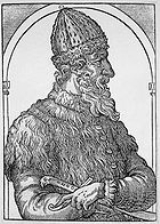
Ivan III Vasilevich (22 January 1440, Moscow – 27 October 1505, Moscow), also known as Ivan the Great, was a Grand Prince of Moscow
Grand Duchy of Moscow

The Grand Duchy of Moscow was a medieval Russian polity centered on Moscow between 1340 and 1547. The Grand Duchy of Moscow, as the state is known in Russian records, has been referred to by many Western world sources as Muscovy....
 and "Grand Prince of all Russia" (??????? ????? ???? ????) Sometimes referred to as the "gatherer of the Russian lands", he tripled the territory of his state, renovated the Moscow Kremlin
Moscow Kremlin

The Moscow Kremlin usually referred to as simply The Kremlin, is a historic fortified complex at the heart of Moscow, overlooking the Moskva River , Saint Basil's Cathedral and Red Square and the Alexander Garden ....
, and laid the foundations of the Russian state
State

A state is a political Social contract with effective sovereignty over a geographic area and representing a population. These may be nation states, State or multinational states....
. He was one of the longest-reigning Russia
Russia

Russia , or the Russian Federation , is a list of countries spanning more than one continent country extending over much of northern Eurasia....
n rulers in history.

's parents were Vasily II and Maria of Borovsk
Borovsk

Borovsk is a types of inhabited localities in Russia in Kaluga Oblast, Russia, located just south from its border with the Moscow Oblast. It is situated on the Protva River, about south-west of Moscow....
.


Discussion
Ask a question about 'Ivan III of Russia'
Start a new discussion about 'Ivan III of Russia'
Answer questions from other users
Full Discussion Forum


Recent Posts


Encyclopedia


Ivan III Vasilevich (22 January 1440, Moscow – 27 October 1505, Moscow), also known as Ivan the Great, was a Grand Prince of Moscow
Grand Duchy of Moscow

The Grand Duchy of Moscow was a medieval Russian polity centered on Moscow between 1340 and 1547. The Grand Duchy of Moscow, as the state is known in Russian records, has been referred to by many Western world sources as Muscovy....
 and "Grand Prince of all Russia" (??????? ????? ???? ????) Sometimes referred to as the "gatherer of the Russian lands", he tripled the territory of his state, renovated the Moscow Kremlin
Moscow Kremlin

The Moscow Kremlin usually referred to as simply The Kremlin, is a historic fortified complex at the heart of Moscow, overlooking the Moskva River , Saint Basil's Cathedral and Red Square and the Alexander Garden ....
, and laid the foundations of the Russian state
State

A state is a political Social contract with effective sovereignty over a geographic area and representing a population. These may be nation states, State or multinational states....
. He was one of the longest-reigning Russia
Russia

Russia , or the Russian Federation , is a list of countries spanning more than one continent country extending over much of northern Eurasia....
n rulers in history.

Background

Ivan's parents were Vasily II and Maria of Borovsk
Borovsk

Borovsk is a types of inhabited localities in Russia in Kaluga Oblast, Russia, located just south from its border with the Moscow Oblast. It is situated on the Protva River, about south-west of Moscow....
. He was co-regent with his father during the later years of his life and succeeded him in 1462. Ivan tenaciously pursued the unifying policy of his predecessors. Nevertheless, he was cautious to the point of timidity. He avoided as far as possible any violent collision with his neighbors until all the circumstances were exceptionally favorable, always preferring to attain his ends gradually and circuitously. The Grand Duchy of Moscow
Grand Duchy of Moscow

The Grand Duchy of Moscow was a medieval Russian polity centered on Moscow between 1340 and 1547. The Grand Duchy of Moscow, as the state is known in Russian records, has been referred to by many Western world sources as Muscovy....
 had by this time become a compact and powerful state, whilst her rivals had grown weaker, a state of affairs very favorable to the speculative activity of a statesman of Ivan III's peculiar character.

Gathering of Russian lands

His first enterprise was a war with the Republic of Novgorod, which had fought a series of wars stretching back to at least the reign of Dmitry Donskoi over Moscow's religious and political sovereignty more generally and over Moscow's efforts to seize land in the Northern Dvina
Northern Dvina

The Northern Dvina is a river in Northern Russia flowing through the Vologda Oblast and Arkhangelsk Oblast into the Dvina Bay of the White Sea....
 region more specifically. Alarmed at Moscow's growing power, Novgorod had negotiated with Lithuania in hopes of placing itself under the protection of Casimir IV
Casimir IV

Casimir IV may refer to:*Polish king Casimir IV Jagiellon*Casimir IV, Duke of Pomerania...
, King of Poland and Grand Prince of Lithuania, a would-be alliance regarded at Moscow as an act of apostasy
Apostasy

Apostasy is the formal religious disaffiliation or abandonment or renunciation of one's religion, especially if the motive is deemed unworthy. In a technical sense, as used sometimes by sociology without the pejorative connotations of the word, the term refers to renunciation and criticism of, or opposition to, one's former religion....
 from orthodoxy
Orthodoxy

The word orthodox, from Greek language orthodoxos "having the right opinion," from orthos + Doxa , is typically used to mean adhering to the accepted or traditional and established faith, especially in religion....
. Ivan took the field against Novgorod in 1470, and after his generals had twice defeated the forces of the republic, at The Battle of Shelon River and on the Northern Dvina, both in the summer of 1471, the Novgorodians were forced to sue for peace, agreeing to abandon their overtures to Lithuania and ceding a considerable portion of their northern territories, and paying a war indemnity of 15,500 roubles. Ivan visited Novgorod Central several times in the next several years, arresting a number of pro-Lithuanian boyars and confiscating their lands. In 1477, two Novgorodian envoys, claiming to have been sent by the archbishops and the entire city, addressed Ivan in public audience as Gosudar (sovereign) instead of the usual Gospodin (sir). Ivan at once seized upon this as a recognition of his sovereignty, and when the Novgorodians repudiated the envoys (indeed, one was killed at the veche and several other of the pro-Moscow faction were killed with him) and swore openly in front of the Moscow ambassadors that they would turn to Lithuania again, he marched against them. Deserted by Casimir IV and surrounded on every side by the Moscow armies that occupied the major monasteries around the city the Novgorod recognized Ivan's direct rule over the city and its vast hinderland in a document signed and sealed by Archbishop Feofil of Novgorod (1470-1480) on January 15, 1478.

Subsequent revolts (1479-1488) were punished by the removal en masse of the richest and most ancient families of Novgorod to Moscow, Vyatka and other central Russian cities. Archbishop Feofil, too, was removed to Moscow for plotting against the grand prince. The rival republic of Pskov
Pskov Republic

Pskov Republic was a Russian medieval state between the second half of the 13th century and early 16th century....
 owed the continuance of its own political existence to the readiness with which it assisted Ivan against its ancient enemy. The other principalities were virtually absorbed, by conquest, purchase or marriage contract: Yaroslavl
Yaroslavl

Yaroslavl is a types of inhabited localities in Russia in Russia, the administrative center of Yaroslavl Oblast, located north-east of Moscow....
 in 1463, Rostov
Rostov

Rostov is one of the oldest types of inhabited localities in Russia in Russia and an important tourist centre of the so called Golden ring. It is located on the shores of Lake Nero in Yaroslavl Oblast....
 in 1474, and Tver
Tver

Tver is a types of inhabited localities in Russia in Russia, the administrative center of Tver Oblast. Population: 405,500 ; 408,903 . Tver was formerly the capital of a powerful medieval state and a model provincial town in Imperial Russia with population of 60,000 on...
 in 1485.

Ivan's refusal to share his conquests with his brothers, and his subsequent interference with the internal politics of their inherited principalities, involved him in several wars with them, from which, though the princes were assisted by Lithuania
Lithuania

Lithuania , officially the Republic of Lithuania is a country in Northern Europe, the southernmost of the three Baltic states. Situated along the southeastern shore of the Baltic Sea, it shares borders with Latvia to the north, Belarus to the southeast, Poland, and the Russian exclave of Kaliningrad Oblast to the southwest....
, he emerged victorious. Finally, Ivan's new rule of government, formally set forth in his last will to the effect that the domains of all his kinsfolk, after their deaths, should pass directly to the reigning grand duke instead of reverting, as hitherto, to the princes' heirs, put an end once and for all to these semi-independent princelings.

Domestic policy

Ivan Iii of Russia 3
The character of the government
Government

Government is the body within any organization that has the authority to make and the power to enforce laws, regulations, or rules. Typically, the government refers to a civil government -- local, provincial, or national -- but commercial, academic, religious, or other formal organizations are also administered by governing bodies....
 of Moscow under Ivan III changed essentially and took on a new autocratic
Autocracy

An autocracy is a form of government in which the political power is held by a single, self-appointed ruler. The term autocrat is derived from the Greek language word 'a?t????t?? ....
 form. This was due not merely to the natural consequence of the hegemony
Hegemony

Hegemony first denoted the dominance of a Greek city-state over other city-states, then denoted the dominance of one nation over others. The political scientist Antonio Gramsci developed the former conceptions to identify the dominance of one social class over the other social classes in a society by means of cultural hegemony....
 of Moscow over the other Russian lands but to new imperial pretensions. After the fall of Constantinople
Fall of Constantinople

The Fall of Constantinople was a siege in which the Ottoman Empire under the command of Sultan Mehmed II attempted to capture the capital of the Byzantine Empire, Constantinople which was defended by the army of Emperor Constantine XI....
, orthodox
Eastern Orthodox Church

The Eastern Orthodox Church is the second largest single Christian communion in the world with an estimated 225 million members worldwide. It is considered by its adherents to be the Four Marks of the Church established by Jesus Christ and his Apostles nearly 2000 years ago....
 canonists were inclined to regard the Grand Princes of Moscow
Grand Duchy of Moscow

The Grand Duchy of Moscow was a medieval Russian polity centered on Moscow between 1340 and 1547. The Grand Duchy of Moscow, as the state is known in Russian records, has been referred to by many Western world sources as Muscovy....
 as the successors by the Byzantine emperors. Ivan himself appeared to welcome the idea, and he began to style himself tsar
Tsar

Tsar or czar , occasionally spelled csar or tzar in English language, is a slavs term designating certain monarchs.Originally, the title Czar meant Emperor in the European medieval sense of the term, that is, a ruler who has the same rank as a Ancient Rome or Byzantine emperor due to recognition by another emperor or...
 in foreign correspondence.

This movement coincided with a change in the family circumstances of Ivan III. After the death of his first consort, Maria of Tver (1467), at the suggestion of Pope Paul II (1469), who hoped thereby to bind Russia to the holy see
Holy See

The Holy See is the episcopal jurisdiction of the Bishop of Rome, commonly known as the Pope, and is the preeminent episcopal see of the Roman Catholic Church, forming the central government of the Church....
, Ivan III wedded Sophia Paleologue
Sophia Paleologue

Zoe Palaiologina , Grand Duchess of Moscow, was a niece of the last Byzantine emperor Constantine XI and second wife of Ivan III of Russia.Her father was Thomas Palaeologus, the Despotate of Morea....
 (also known under her original Greek and Orthodox name of Zoe), daughter of Thomas Palaeologus , despot of Morea
Morea

Morea was the name of the Peloponnese peninsula in southern Greece during the Middle Ages and the early modern period. It also referred to a Byzantine province in the region, known as the Despotate of Morea....
, who claimed the throne of Constantinople as the brother of Constantine XI
Constantine XI

Constantine XI Palaiologos or Palaeologus was the last reigning Roman Emperor. A member of the Palaiologos, he ruled the Byzantine Empire from 1449 to his death....
, last Byzantine emperor. Frustrating the Pope's hopes of re-uniting the two faiths, the princess endorsed Orthodoxy. Due to her family traditions, she encouraged imperial ideas in the mind of her consort. It was through her influence that the ceremonious etiquette
Etiquette

Etiquette is a code that influences expectations for social behavior according to contemporary Convention Norm s within a society, social class, or Group ....
 of Constantinople (along with the imperial double-headed eagle and all that it implied) was adopted by the court of Moscow.

Ivan's son with Maria of Tver
Maria of Tver

Maria Borisovna of Tver was the first wife of Grand Prince Ivan III and daughter of Boris Alexandrovich of Tver.When Vasili II of Russia was getting ready to attack Dmitry Shemyaka, he found an ally in the person of Boris of Tver....
, Ivan the Young
Ivan the Young

Ivan Ivanovich was the eldest son and heir of Ivan III from his first marriage to Maria of Tver.Ivan's father empowered him to deal with most administrative and military affairs of the state in order to make ordinary Russian people think of him as their future ruler....
, died in 1490, leaving from his marriage with Helen of Moldavia an only child, Dmitry the Grandson. The latter was crowned as successor by his grandfather in 1497, but later Ivan reverted his decision in favour of Sophia's elder son Vasily
Vasili III of Russia

Vasili III Ivanovich was the Grand Duchy of Moscow from 1505 to 1533. He was the son of Ivan III Vasiliyevich and Sophia Paleologue and was christened with the name Gavriil ....
 who was ultimately crowned co-regent with his father (April 14, 1502). The decision was dictated by the crisis connected with the Sect of Skhariya the Jew
Sect of Skhariya the Jew

Skariya the Jew is also the name used by Ivan III of Muscovy to refer to Zacharias de Ghisolfi.The Sect of Skhariya the Jew, much more commonly known as the Heresy of the Judaizers or Zhidovstvuyushchiye, was a sect that appeared in Novgorod the Great and Moscow in the second half of the 15th century and marked the beginning o...
 as well as by the imperial prestige of Sophia's descendants. Dmitry the Grandson was put into prison where he died, unmarried and childless, in 1509, already under the rule of his uncle.

The grand duke increasingly held aloof from his boyars. The old patriarchal systems of government vanished. The boyars were no longer consulted on affairs of state. The sovereign became sacrosanct
Sacrosanct

Sacrosanctity was a right of tribunes in Ancient Rome to not be harmed physically. Plebeian took an oath to regard anyone who laid hands on a tribune as an outlaw liable to be killed without penalty....
, while the boyars were reduced to dependency on the will of the sovereign. The boyars naturally resented this revolution and struggled against it, at first with some success.

It was in the reign of Ivan III that the new Russian Sudebnik
Sudebnik

Sudebnik of 1497 , a collection of laws, which was introduced by Ivan III and played a big part in the centralization of the Russian state, creation of the nationwide Russian Law and elimination of feudal division....
, or law code, was compiled by the scribe Vladimir Gusev. Ivan did his utmost to make his capital a worthy successor to Constantinople
Constantinople

Constantinople was the empire capital of the Roman Empire , the Byzantine Empire , the Latin Empire , and the Ottoman Empire . Strategically located between the Golden Horn and the Sea of Marmara at the point where Europe meets Asia, Byzantine Constantinople had been the capital of a Christendom empire, successor to ancient ancient Greece...
, and with that object invited many foreign masters and artificers to settle in Moscow. The most noted of these was the Italian Ridolfo di Fioravante, nicknamed Aristotle because of his extraordinary knowledge, who built several cathedrals and palaces in the Kremlin
Moscow Kremlin

The Moscow Kremlin usually referred to as simply The Kremlin, is a historic fortified complex at the heart of Moscow, overlooking the Moskva River , Saint Basil's Cathedral and Red Square and the Alexander Garden ....
. This extraordinary monument of the Moscow art remains a lasting symbol of the power and glory of Ivan III.

Foreign policy

It was in the reign of Ivan III that Russia rejected the Tatar yoke. In 1480 Ivan refused to pay the customary tribute to the grand Khan Ahmed
Akhmat Khan

Akhmat Khan was a Khan of the Great Horde between 1465 and 1481.In 1465, Akhmat seized power in the Horde by rising against his brother Mahmud Khan, who had been its ruler since 1459....
. When, however, the grand khan marched against him, Ivan's courage began to fail, and only the stern exhortations of the high-spirited bishop of Rostov
Rostov

Rostov is one of the oldest types of inhabited localities in Russia in Russia and an important tourist centre of the so called Golden ring. It is located on the shores of Lake Nero in Yaroslavl Oblast....
, Vassian
Vassian Patrikeyev

Vassian Patrikeyev, also known as Vassian Kosoy was a Russian ecclesiastic and political figure and writer. Patrikeyev traced his male-line descent to Grand Duke of Lithuania Gediminas....
, could induce him to take the field. All through the autumn the Russian and Tatar hosts confronted each other on opposite sides of the Ugra
Great standing on the Ugra river

The Great Standoff on the Ugra River . This would allow Akhmat Khan to unite his army with Casimir's. Akhmat Khan's forces approached the Ugra river....
, till the 11th of November, when Ahmed retired into the steppe
Steppe

In physical geography, a steppe , pronounced , is a grassland plain without trees . The prairie can be considered a steppe. It may be semi-desert, or covered with Poaceae or shrubs or both, depending on the season and latitude....
.
Ivan Vs Khan
In the following year the grand khan, while preparing a second expedition against Moscow, was suddenly attacked, routed and slain by Ivak, the khan of the Nogay Horde, whereupon the Golden Horde suddenly fell to pieces. In 1487 Ivan reduced the khanate of Kazan one of the offshoots of the Horde to the condition of a vassal-state, though in his later years it broke away from his suzerainty
Russo-Kazan Wars

The Russo-Kazan Wars was a series of wars fought between the Khanate of Kazan and Muscovite Russia in the 15th and 16th centuries, until Kazan was finally captured by Ivan IV of Russia and absorbed into Russia in 1552....
. With the other Muslim powers, the khan of the Crimean Khanate and the sultans of Ottoman Empire, Ivan's relations were pacific and even amicable. The Crimean khan, Meńli I Giray, helped him against the Grand Duchy of Lithuania and facilitated the opening of diplomatic intercourse between Moscow and Istanbul
Istanbul

Istanbul is the largest city in Turkey, List of metropolitan areas in Europe by population, and List of cities proper by population in the world with a population of 12.6 million....
, where the first Russian embassy appeared in 1495.

It was in Ivan’s reign that the Christian rulers in the Caucasus began to see the Russian monarchs as their natural allies against the Muslim regional powers. The first attempt at forging an alliance was made by Alexander I
Alexander I of Kakheti

Alexander I , of the Bagrationi Dynasty, was a List of sovereigns of Kakheti of Kingdom of Kakheti in eastern Georgia from 1476 to 1511. Alexander's pliancy and flexible diplomacy earned him security from the neighboring powers, only to be murdered by his own son George II of Kakheti....
, king of a small Georgian
Georgia (country)

Georgia is a transcontinental country in the Caucasus region, located at the dividing line between Europe and Asia. It is bordered by the Russia to the north, Azerbaijan to the east, Armenia to the south, and Turkey to the southwest....
 kingdom of Kakheti
Kingdom of Kakheti

The Kingdom of Kakheti was a late medieval/early modern monarchy in Eastern Georgia Georgia , centered at the mkhare of Kakheti, with its capital first at Gremi and then at Telavi....
, who dispatched two embassies, in 1483 and 1491, to Moscow. However, as the Russians were still too far from the Caucasus, neither of these missions had any effect on the course of events in the region.

From Matthias Corvinus of Hungary
Matthias Corvinus of Hungary

Matthias I was Kings of Hungary of Kingdom of Hungary ....
, gun-founders, gold- and silversmiths and (Italian) master builders were requested by Ivan.

In Nordic affairs, Ivan III concluded an offensive alliance with Hans of Denmark and maintained a regular correspondence with Emperor Maximilian I, who called him a "brother". He built a strong citadel in Ingria named Ivangorod
Ivangorod fortress

Ivangorod Fortress is a Russian medieval castle established by Ivan III in 1492 and since then grown into the town of Ivangorod.The fortress overlooks the Narva River opposite the Hermann Castle and the Estonian city of Narva....
 after himself, which proved of great consequence to Russians in Russo-Swedish War, 1496-1499 the war with Sweden, which had been preceded by Ivan's detention of the Hanseatic merchants trading in Novgorod.

The further extension of the Moscow dominion was facilitated by the death of Casimir IV in 1492, when Poland and Lithuania once more parted company. The throne of Lithuania was now occupied by Casimir's son Alexander, a weak and lethargic prince so incapable of defending his possessions against the persistent attacks of the Russians that he attempted to save them by a matrimonial compact, and wedded Helena
Helena of Moscow

Helena Ivanovna of Moscow was a Grand Duchy of Lithuania and List of Polish consorts as a wife of king of Poland Alexander Jagiellon....
, Ivan's daughter. But the clear determination of Ivan to appropriate as much of Lithuania as possible at last compelled Alexander in 1499 to take up arms against his father-in-law. The Lithuanians were routed at Vedrosha
Battle of Vedrosha

Battle of Vedrosha was one of the greatest battles in the medieval history of Russia. It was fought as part of the Russo-Lithuanian Wars on July 14, 1500, some 50 km to the west of Kaluga, between joint forces of the Grand Duchy of Lithuania and Kingdom of Poland under command of Prince Konstanty Ostrogski and the Russian army under Prince D...
 (July 14, 1500), and in 1503 Alexander was glad to purchase peace by ceding to Ivan Chernigov,Starodub
Starodub

Starodub is a types of settlements in Russia in Bryansk Oblast, Russia. It is located on the Babinets River , 169 km southwest of Bryansk....
, Novgorod-Seversky and sixteen other towns.

Further reading

  • Much information on Ivan III and his court is contained in Sigismund von Herberstein
    Sigismund von Herberstein

    Siegmund Freiherr von Herberstein, , was an Carniolan diplomat, writer, historian and member of the Holy Roman Empire Imperial Council. He was most noted for his extensive writing on the geography, history and customs of Russia and contributed greatly to early Western European knowledge of that area....
    's Rerum Moscoviticarum Commentarii (1549).


See also

  • Rulers of Russia family tree
    Rulers of Russia family tree

    These images show family trees for the different royal houses that ruled Vladimir, Moscow and Russia from A.D. 1157 to A.D. 1917.Rurik dynasty...


External links