


Peterhof

Encyclopedia
Petergof or Peterhof (Dutch
/German
for "Peter's Court"), known as Petrodvorets from 1944 to 1997, is a municipal town
in Petrodvortsovy District
of the federal city
of St. Petersburg
, located on the southern shore of the Gulf of Finland
. Population:
The town hosts one of two campuses of Saint Petersburg State University
and the Petrodvorets Watch Factory
, one of the leading Russian watch manufactures. A series of palaces and gardens
, laid out on the orders of Peter the Great
, and sometimes called the "Russian Versailles
", is also situated there. The palace-ensemble along with the city center
is recognized as a UNESCO World Heritage Site
.
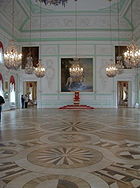 In the time of Peter the Great, the sea floor just north of the Petergof site and to the east toward St. Petersburg was too shallow for either commercial ships or warships. However, to the west of Petergof, the sea floor dropped off to be deep enough for sea vessels. Accordingly, when Peter the Great decided to build St. Petersburg at the eastern end of the Gulf of Finland
, he first captured the Kotlin Island
clearly visible from the Petergof site just to the northeast in the middle of the Gulf. At Kotlin Island he would build the commercial harbor for St. Petersburg as well as the Kronshtadt fortifications across the 20 kilometres (12.4 mi) of shallow sea to provision and defend the Navy that he would build.
Peter the Great first mentions the Petergof site in his journal in 1705, during the Great Northern War
, as a good place to construct a landing for use in traveling to and from the island fortress of Kronshtadt. In 1714, Peter began construction of the Monplaisir ("my pleasure") Palace based on his own sketches of the palace that he wanted close to the shoreline. This was Peter's Summer Palace that he would use on his way coming and going from Europe through the harbor at Kronshtadt. On the walls of this seacoast palace hung hundreds of paintings that Peter brought from Europe and allowed to weather Russian winters without heat together with the dampness of being so close to the sea. And in the seaward corner of his Monplaisir Palace, Peter made his Maritime Study from which he could see Kronshtadt Island to the left and St. Petersburg to the right. Later, he expanded his plans to include a vaster royal château
of palaces and gardens further inland, on the model of Versailles
. Each of the Tsar
s after Peter expanded on the inland palaces and gardens of Peterhof, but the major contributions by Peter the Great were completed by 1725. Peter had also entertained plans of a similar palace at Strelna
, a short way to the east, but these plans were abandoned.
Peterhof originally appeared quite differently than it does today. Many of the fountains had not yet been installed. The entire Alexandrine Park and Upper Gardens did not exist—the latter was used to grow vegetables, and its ponds, then numbering only three, were used for growing fish. The Samson Fountain and its massive pedestal had not yet been installed in the Sea Channel, and the channel itself was used as a grand marine entrance into the complex.
Perhaps the most important change augmenting Peter's design was the elevation of the Grand Palace to central status and prominence. The Grand Palace was originally called simply 'Upper', and was hardly larger than any of the other structures of the complex. The addition of wings, undertaken between 1745 and 1755, was one of the many projects commissioned from the Italian architect Bartolomeo Rastrelli
by Elizabeth of Russia. Likewise, the Grand Cascade was more sparsely decorated when initially built.
The augmentation of Peterhof's original fountains and the addition of new ones continued well into the 19th century.
Peterhof, like Tsarskoye Selo
, was captured by German
troops in 1941 and held until 1944. In the few months that elapsed between the outbreak of war in the west and the appearance of the German Army, employees were only able to save a portion of the treasures of the palaces and fountains. An attempt was made to dismantle and bury the fountain sculptures, but three-quarters, including all of the largest ones, remained in place. The occupying forces of the German Army largely destroyed the palace grounds. Many of the fountains were destroyed, and the palace was partially exploded and left to burn. Restoration work began almost immediately after the end of the war and continues to this day. It progressed remarkably quickly, and is still being carried out.
The name the city was changed to Petrodvorets ("Peter's Palace") in 1944 as a result of wartime anti-German sentiment and propaganda, but the original name was restored in 1997 when Petrodvorets was split into Petergof and Strelna. This renaming, however, was not finalized until 2009.
In 2003, St. Petersburg celebrated its 300th anniversary. As a result, much of the building and statuary in Petergof has been restored and new gilt-work
abounds.
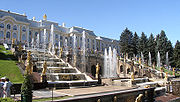 The dominant natural feature of Peterhof Grand Palace
is a sixteen-meter-high bluff
lying less than a hundred meters from the shore. The so-called Lower Gardens (Nizhny Sad), at 1.02 square kilometre (0.393824201764386 sq mi) comprising the better part of the palace complex land area, are confined between this bluff and the shore, stretching east and west for roughly 200 metres (656.2 ft). The majority of Peterhof's fountains are contained here, as are several small palaces and outbuildings. East of the Lower Gardens lies the Alexandria Park with 19th-century Gothic Revival structures such as the Kapella.
Atop the bluff, near the middle of the Lower Gardens, stands the Grand Palace (Bolshoy Dvorets). To the south of it are the comparatively small Upper Gardens (Verhny Sad). Upon the bluff's face below the Palace is the Grand Cascade (Bolshoy Kaskad). This and the Grand Palace are the centerpiece of the entire complex. At its foot begins the Sea Channel (Morskoy Kanal), one of the most extensive waterworks of the Baroque
period, which bisects the Lower Gardens.
's schools and departments are located in Petergof:
The Petrodvorets Complex dates back to 1960s when it was decided to copy best international practices and create a brand-new suburban campus for the University that experienced crucial need for new premises. Yet, the idea was said to be widely opposed by the faculty who did not want to commute two hours a day, and as few as four faculties were relocated to Petergof. In 1990s, the number of students from other regions fell significantly, and the University sold many of its downtown dormitories. When the trend reversed, the need for housing made the University administration accommodate most students in Petergof, even those from downtown faculties, which has created certain tensions. Yet, the idea of a suburban campus seems to be persistent, as the Government of the Russian Federation has decided to hand over the Mikhailovka estate to the University to reconstruct it and house the Graduate School of Management's campus.
Due to the extensive presence of research facilities, mainly belonging to St. Petersburg State University, Petergof was named naukograd
in 2005.
plant to help in the construction of the Peterhof Palaces but also other Palaces in St. Petersburg. It started producing equipment and parts for the watch industry in the 1920s. After World War II
, the factory started to fully produce watches under the brand name Pobeda and from 1962 under the brand Raketa
. in 1985 the factory had 7500 employees and was producing 5 millions mechanical watches per year. As of today it is the last watch factory in Russia producing its own movements from A to Z, though the production is much smaller than it used to be.
The Upper Gardens are freely accessible, but entry to the Lower Gardens requires the purchase of tickets (not included in the boat fee for visitors arriving by hydrofoil). The palaces and grotto are accessible only as part of guided tours.
Le Blanc-Mesnil
, France
Sopot
, Poland
Dutch language
Dutch is a West Germanic language and the native language of the majority of the population of the Netherlands, Belgium, and Suriname, the three member states of the Dutch Language Union. Most speakers live in the European Union, where it is a first language for about 23 million and a second...
/German
German language
German is a West Germanic language, related to and classified alongside English and Dutch. With an estimated 90 – 98 million native speakers, German is one of the world's major languages and is the most widely-spoken first language in the European Union....
for "Peter's Court"), known as Petrodvorets from 1944 to 1997, is a municipal town
Administrative divisions of Saint Petersburg
The federal city of Saint Petersburg, Russia, is divided into eighteen city districts , which are in turn subdivided into municipal okrugs, municipal towns, and municipal settlements.-Admiralteysky District:...
in Petrodvortsovy District
Petrodvortsovy District
Petrodvortsovy District is an administrative and municipal district , one of the 18 in Saint Petersburg, Russia....
of the federal city
Federal cities of Russia
The Russian Federation is divided into 83 federal subjects, two of which are federal cities....
of St. Petersburg
Saint Petersburg
Saint Petersburg is a city and a federal subject of Russia located on the Neva River at the head of the Gulf of Finland on the Baltic Sea...
, located on the southern shore of the Gulf of Finland
Gulf of Finland
The Gulf of Finland is the easternmost arm of the Baltic Sea. It extends between Finland and Estonia all the way to Saint Petersburg in Russia, where the river Neva drains into it. Other major cities around the gulf include Helsinki and Tallinn...
. Population:
The town hosts one of two campuses of Saint Petersburg State University
Saint Petersburg State University
Saint Petersburg State University is a Russian federal state-owned higher education institution based in Saint Petersburg and one of the oldest and largest universities in Russia....
and the Petrodvorets Watch Factory
Petrodvorets Watch Factory
The Petrodvorets Watch Factory is the oldest factory in Russia. Founded by Peter the Great in 1721 as the Peterhof Lapidary Works, to make hardstone carvings, since 1962 it has manufactured the Soviet Raketa watches. In almost 300 years of history, the factory has changed name several times...
, one of the leading Russian watch manufactures. A series of palaces and gardens
Peterhof Palace
The Peterhof Palace in Russian, so German is transliterated as "Петергoф" Petergof into Russian) for "Peter's Court") is actually a series of palaces and gardens located in Saint Petersburg, Russia, laid out on the orders of Peter the Great. These Palaces and gardens are sometimes referred as the...
, laid out on the orders of Peter the Great
Peter I of Russia
Peter the Great, Peter I or Pyotr Alexeyevich Romanov Dates indicated by the letters "O.S." are Old Style. All other dates in this article are New Style. ruled the Tsardom of Russia and later the Russian Empire from until his death, jointly ruling before 1696 with his half-brother, Ivan V...
, and sometimes called the "Russian Versailles
Palace of Versailles
The Palace of Versailles , or simply Versailles, is a royal château in Versailles in the Île-de-France region of France. In French it is the Château de Versailles....
", is also situated there. The palace-ensemble along with the city center
Historic Centre of Saint Petersburg and Related Groups of Monuments
Historic Centre of Saint Petersburg and Related Groups of Monuments is the name used by UNESCO when it collectively designated the historic core of the Russian city of St...
is recognized as a UNESCO World Heritage Site
World Heritage Site
A UNESCO World Heritage Site is a place that is listed by the UNESCO as of special cultural or physical significance...
.
History
Gulf of Finland
The Gulf of Finland is the easternmost arm of the Baltic Sea. It extends between Finland and Estonia all the way to Saint Petersburg in Russia, where the river Neva drains into it. Other major cities around the gulf include Helsinki and Tallinn...
, he first captured the Kotlin Island
Kotlin Island
Kotlin is a Russian island, located near the head of the Gulf of Finland, west of Saint Petersburg in the Baltic Sea. Kotlin separates the Neva Bay from the rest of the gulf...
clearly visible from the Petergof site just to the northeast in the middle of the Gulf. At Kotlin Island he would build the commercial harbor for St. Petersburg as well as the Kronshtadt fortifications across the 20 kilometres (12.4 mi) of shallow sea to provision and defend the Navy that he would build.
Peter the Great first mentions the Petergof site in his journal in 1705, during the Great Northern War
Great Northern War
The Great Northern War was a conflict in which a coalition led by the Tsardom of Russia successfully contested the supremacy of the Swedish Empire in northern Central Europe and Eastern Europe. The initial leaders of the anti-Swedish alliance were Peter I the Great of Russia, Frederick IV of...
, as a good place to construct a landing for use in traveling to and from the island fortress of Kronshtadt. In 1714, Peter began construction of the Monplaisir ("my pleasure") Palace based on his own sketches of the palace that he wanted close to the shoreline. This was Peter's Summer Palace that he would use on his way coming and going from Europe through the harbor at Kronshtadt. On the walls of this seacoast palace hung hundreds of paintings that Peter brought from Europe and allowed to weather Russian winters without heat together with the dampness of being so close to the sea. And in the seaward corner of his Monplaisir Palace, Peter made his Maritime Study from which he could see Kronshtadt Island to the left and St. Petersburg to the right. Later, he expanded his plans to include a vaster royal château
Château
A château is a manor house or residence of the lord of the manor or a country house of nobility or gentry, with or without fortifications, originally—and still most frequently—in French-speaking regions...
of palaces and gardens further inland, on the model of Versailles
Versailles
Versailles , a city renowned for its château, the Palace of Versailles, was the de facto capital of the kingdom of France for over a century, from 1682 to 1789. It is now a wealthy suburb of Paris and remains an important administrative and judicial centre...
. Each of the Tsar
Tsar
Tsar is a title used to designate certain European Slavic monarchs or supreme rulers. As a system of government in the Tsardom of Russia and Russian Empire, it is known as Tsarist autocracy, or Tsarism...
s after Peter expanded on the inland palaces and gardens of Peterhof, but the major contributions by Peter the Great were completed by 1725. Peter had also entertained plans of a similar palace at Strelna
Strelna
Strelna is a municipal settlement in Petrodvortsovy District of the federal city of St. Petersburg, Russia, situated about halfway between St. Petersburg proper and Petergof and overlooking the shore of the Gulf of Finland...
, a short way to the east, but these plans were abandoned.
Peterhof originally appeared quite differently than it does today. Many of the fountains had not yet been installed. The entire Alexandrine Park and Upper Gardens did not exist—the latter was used to grow vegetables, and its ponds, then numbering only three, were used for growing fish. The Samson Fountain and its massive pedestal had not yet been installed in the Sea Channel, and the channel itself was used as a grand marine entrance into the complex.
Perhaps the most important change augmenting Peter's design was the elevation of the Grand Palace to central status and prominence. The Grand Palace was originally called simply 'Upper', and was hardly larger than any of the other structures of the complex. The addition of wings, undertaken between 1745 and 1755, was one of the many projects commissioned from the Italian architect Bartolomeo Rastrelli
Bartolomeo Rastrelli
Francesco Bartolomeo Rastrelli was an Italian architect naturalized Russian. He developed an easily recognizable style of Late Baroque, both sumptuous and majestic...
by Elizabeth of Russia. Likewise, the Grand Cascade was more sparsely decorated when initially built.
The augmentation of Peterhof's original fountains and the addition of new ones continued well into the 19th century.
Peterhof, like Tsarskoye Selo
Tsarskoye Selo
Tsarskoye Selo is the town containing a former Russian residence of the imperial family and visiting nobility, located south from the center of St. Petersburg. It is now part of the town of Pushkin and of the World Heritage Site Saint Petersburg and Related Groups of Monuments.-History:In...
, was captured by German
Germany
Germany , officially the Federal Republic of Germany , is a federal parliamentary republic in Europe. The country consists of 16 states while the capital and largest city is Berlin. Germany covers an area of 357,021 km2 and has a largely temperate seasonal climate...
troops in 1941 and held until 1944. In the few months that elapsed between the outbreak of war in the west and the appearance of the German Army, employees were only able to save a portion of the treasures of the palaces and fountains. An attempt was made to dismantle and bury the fountain sculptures, but three-quarters, including all of the largest ones, remained in place. The occupying forces of the German Army largely destroyed the palace grounds. Many of the fountains were destroyed, and the palace was partially exploded and left to burn. Restoration work began almost immediately after the end of the war and continues to this day. It progressed remarkably quickly, and is still being carried out.
The name the city was changed to Petrodvorets ("Peter's Palace") in 1944 as a result of wartime anti-German sentiment and propaganda, but the original name was restored in 1997 when Petrodvorets was split into Petergof and Strelna. This renaming, however, was not finalized until 2009.
In 2003, St. Petersburg celebrated its 300th anniversary. As a result, much of the building and statuary in Petergof has been restored and new gilt-work
Gilding
The term gilding covers a number of decorative techniques for applying fine gold leaf or powder to solid surfaces such as wood, stone, or metal to give a thin coating of gold. A gilded object is described as "gilt"...
abounds.
Palaces, fountains, and gardens
Peterhof Grand Palace
The Peterhof Grand Palace The largest of Peterhof's palaces looks truly imposing when seen from the Lower or Upper Gardens, but in fact it is quite narrow and not overly large...
is a sixteen-meter-high bluff
Cliff
In geography and geology, a cliff is a significant vertical, or near vertical, rock exposure. Cliffs are formed as erosion landforms due to the processes of erosion and weathering that produce them. Cliffs are common on coasts, in mountainous areas, escarpments and along rivers. Cliffs are usually...
lying less than a hundred meters from the shore. The so-called Lower Gardens (Nizhny Sad), at 1.02 square kilometre (0.393824201764386 sq mi) comprising the better part of the palace complex land area, are confined between this bluff and the shore, stretching east and west for roughly 200 metres (656.2 ft). The majority of Peterhof's fountains are contained here, as are several small palaces and outbuildings. East of the Lower Gardens lies the Alexandria Park with 19th-century Gothic Revival structures such as the Kapella.
Atop the bluff, near the middle of the Lower Gardens, stands the Grand Palace (Bolshoy Dvorets). To the south of it are the comparatively small Upper Gardens (Verhny Sad). Upon the bluff's face below the Palace is the Grand Cascade (Bolshoy Kaskad). This and the Grand Palace are the centerpiece of the entire complex. At its foot begins the Sea Channel (Morskoy Kanal), one of the most extensive waterworks of the Baroque
Baroque
The Baroque is a period and the style that used exaggerated motion and clear, easily interpreted detail to produce drama, tension, exuberance, and grandeur in sculpture, painting, literature, dance, and music...
period, which bisects the Lower Gardens.
St. Petersburg State University
Besides the downtown campus, certain Saint Petersburg State UniversitySaint Petersburg State University
Saint Petersburg State University is a Russian federal state-owned higher education institution based in Saint Petersburg and one of the oldest and largest universities in Russia....
's schools and departments are located in Petergof:
- Graduate School of ManagementGraduate School of Management (St. Petersburg State University)The Graduate School of Management, GSOM is one of the 22 schools of Saint Petersburg State University. It was founded in 1993 as School of Management later renamed to preserve consistency into Faculty of Management...
's campus in Mikhailovka (under reconstruction); - Faculty of Biology and Soil Studies' research center in Sergievka (Leuchtenberg Palace);
- Petrodvorets Complex that includes four faculties:
- Applied Mathematics and Control Processes,
- ChemistrySaint Petersburg State University Department of ChemistryThe Faculty of Chemistry at Saint Petersburg State University is one of the leading chemistry faculties in Russia.-History:Formally, the Department of Chemistry has been created as a separate entity of Saint Petersburg State University in 1929. However, the history of chemistry at Saint Petersburg...
, - Mathematics and Mechanics,
- Physics;
- seven R&D institutes:
- Astronomy,
- Chemistry,
- Computational Mathematics and Control Processes,
- Laser Research,
- Mathematics and Mechanics,
- Radiophysics,
- Physics;
- as well as 12 dormitories and a number of infrastructure objects.
The Petrodvorets Complex dates back to 1960s when it was decided to copy best international practices and create a brand-new suburban campus for the University that experienced crucial need for new premises. Yet, the idea was said to be widely opposed by the faculty who did not want to commute two hours a day, and as few as four faculties were relocated to Petergof. In 1990s, the number of students from other regions fell significantly, and the University sold many of its downtown dormitories. When the trend reversed, the need for housing made the University administration accommodate most students in Petergof, even those from downtown faculties, which has created certain tensions. Yet, the idea of a suburban campus seems to be persistent, as the Government of the Russian Federation has decided to hand over the Mikhailovka estate to the University to reconstruct it and house the Graduate School of Management's campus.
Due to the extensive presence of research facilities, mainly belonging to St. Petersburg State University, Petergof was named naukograd
Naukograd
A naukograd , meaning "science city", is a formal term for towns with high concentration of research and development facilities in Russia and the Soviet Union, some specifically built by the Soviet Union for these purposes. Some of the towns were secret, and were part of a larger system of closed...
in 2005.
Petrodvorets Watch Factory
Russia's oldest factory was founded by Peter the Great in 1721 first as a lapidaryLapidary
A lapidary is an artist or artisan who forms stone, mineral, gemstones, and other suitably durable materials into decorative items such as engraved gems, including cameos, or cabochons, and faceted designs...
plant to help in the construction of the Peterhof Palaces but also other Palaces in St. Petersburg. It started producing equipment and parts for the watch industry in the 1920s. After World War II
World War II
World War II, or the Second World War , was a global conflict lasting from 1939 to 1945, involving most of the world's nations—including all of the great powers—eventually forming two opposing military alliances: the Allies and the Axis...
, the factory started to fully produce watches under the brand name Pobeda and from 1962 under the brand Raketa
Raketa
Raketa watches have been manufactured since 1962 by the Petrodvorets Watch Factory in Saint Petersburg. The Petrodvorets Watch Factory is Russia's oldest factory, it was founded by Peter the Great in 1721 as the Peterhof Lapidary Works to make hardstone carvings...
. in 1985 the factory had 7500 employees and was producing 5 millions mechanical watches per year. As of today it is the last watch factory in Russia producing its own movements from A to Z, though the production is much smaller than it used to be.
Transportation
The town is served by three railway stations (Novy Petergof, Stary Petergof, and Universitet). The palaces of Peterhof are accessible by sea via hydrofoils based near the Winter Palace in St. Petersburg. The palace is also easily accessed by road. Public transit and private van services make regular trips from Saint Petersburg.The Upper Gardens are freely accessible, but entry to the Lower Gardens requires the purchase of tickets (not included in the boat fee for visitors arriving by hydrofoil). The palaces and grotto are accessible only as part of guided tours.
Sister cities
Bad Homburg vor der Höhe, GermanyGermany
Germany , officially the Federal Republic of Germany , is a federal parliamentary republic in Europe. The country consists of 16 states while the capital and largest city is Berlin. Germany covers an area of 357,021 km2 and has a largely temperate seasonal climate...
Le Blanc-Mesnil
Le Blanc-Mesnil
Le Blanc-Mesnil is a commune in the northeastern suburbs of Paris, France. It is located from the center of Paris, between Charles de Gaulle International Airport and le Bourget Airport.-Name:...
, France
France
The French Republic , The French Republic , The French Republic , (commonly known as France , is a unitary semi-presidential republic in Western Europe with several overseas territories and islands located on other continents and in the Indian, Pacific, and Atlantic oceans. Metropolitan France...
Sopot
Sopot
Sopot is a seaside town in Eastern Pomerania on the southern coast of the Baltic Sea in northern Poland, with a population of approximately 40,000....
, Poland
Poland
Poland , officially the Republic of Poland , is a country in Central Europe bordered by Germany to the west; the Czech Republic and Slovakia to the south; Ukraine, Belarus and Lithuania to the east; and the Baltic Sea and Kaliningrad Oblast, a Russian exclave, to the north...
External links
- The Petrodvorets Watch Factory - Raketa
- Institute of Physics
- Map of Petergof
- Official website of the museum
- Peterhof (Petrodvorets) – a Gardens Guide review
- Peterhof: history of gardens and town
- Russian TV program about the 300 years of the Petrodvorets Factory (In Rus with Eng subtitles)
