
Encyclopedia
| City of Newcastle upon Tyne |
|---|
|
| Geography |
|---|
| Status: | Metropolitan borough, City |
| Region: | North East England |
| Ceremonial County: | Tyne and Wear |
| Traditional County: | Northumberland |
Area: - Total | Ranked 229th 113.44 km² |
| Admin. HQ: | Newcastle upon Tyne |
| ONS code: | 00CJ |
| Demographics |
|---|
Population: - Total - Density | Ranked
/ km² |
| Ethnicity: | 93.1% White 4.4% S.Asian |
| Politics |
|---|
Newcastle upon Tyne City Council http://www.newcastle.gov.uk/ |
| Leadership: | Leader & Cabinet |
| Executive: | |
| MPs: | Nick Brown, David Clelland, Jim Cousins, Doug Henderson |
- For other places named "Newcastle" or "New Castle", see Newcastle .
Newcastle upon Tyne, often shortened to
Newcastle, is a
city and metropolitan borough of
Tyne and Wear situated on the north bank of the
River Tyne, in
North East England. The city was founded in
Roman times under the name
Pons Aelius, with the current name being adopted from 1080 onwards. Historically it has been the county town of
Northumberland.
The city is the 20th most populous in England and the Tyneside conurbation is the 5th most populous conurbation in England, and as such Newcastle is one of England's core cities.
Technically, people from Newcastle are
Novocastrians , although the term Geordie is now more commonly used.
History
Early development
Newcastle, known at the time as "Pons Aelius" was founded by the
Roman Emperor Hadrian, whose
Wall is still visible in parts of Newcastle, particularly along the West Road. The course of the "Roman Wall" can also be traced eastwards to Wallsend .
After the Roman withdrawal from Britain, Newcastle became part of the powerful Anglo-Saxon kingdom of
Northumbria and was known throughout this period as
Monkchester. After a series of conflicts with the
Danes and the devastation north of the
River Tyne inflicted by
Odo after the 1080 rebellion against the
Normans, Monkchester was all but destroyed. Because of its strategic position,
Robert Curthose, son of the
Conqueror, erected a wooden castle there in 1080 and the town was henceforth known as
Novum Castellum or Newcastle.
Throughout the
Middle Ages, Newcastle was England's northern fortress. A 25 foot high stone wall was built around the town to defend it from invaders during the Border war against
Scotland. The Scots king
William the Lion was imprisoned in Newcastle in 1174, and
Edward I brought the
Stone of Scone and
William Wallace south through the town. Newcastle was successfully defended against the Scots three times during the 14th century and around this time became a county corporate.
King
Charles bestowed upon Newcastle the East of England coal trading rights. This monopoly helped Newcastle prosper, but it had its impact on the growth of near-neighbours
Gateshead and
Sunderland, causing a North of Tyne/South of Tyne and a
Tyne-Wear rivalry that still exists. During the
English Civil War, Newcastle supported the king and in 1644 was stormed by
Cromwell's Scots allies, based in pro-Parliament Sunderland. The grateful King bestowed the motto
"Fortiter Defendit Triumphans" upon the town. Ironically, Charles was imprisoned in Newcastle by the Scots in 1646-7.
For a short time in the 17th century, Newcastle exported large quantities of urine down the coast to Ravenscar, North Yorkshire, to be used in the production of
alum for the
textile industry . The urine was collected from public
urinals or barrels in the city and it has been suggested that this may be the origin of the popular English phrase .
In the 18th century, Newcastle was the country's largest print centre after London, Oxford and Cambridge, and the Literary and Philosophical Society of 1793, with its erudite debates and large stock of books in several languages predated the London Library by half a century. Newcastle also became the greatest glass producer in the world. Newcastle's development as a major city, however, owed most to its central role in the export of
coal.The phrase
taking coals to Newcastle was first recorded in 1538. In the nineteenth century,
shipbuilding and heavy engineering were central to the city's prosperity; and the city was a powerhouse of the
Industrial Revolution. Innovation in Newcastle and surrounding areas included the development of
Safety lamps,
Stephenson's Rocket,
Lord Armstrong's artillery,
Joseph Swan's electric light bulbs, and
Charles Parsons' invention of the
steam turbine, which led to the revolution of marine propulsion and the production of
cheap electricity.
Heavy industries in Newcastle declined in the second half of the
twentieth century; office and retail employment are now the city's staples.
Urban development
Notable architecture
The city has an extensive
neoclassical centre, largely developed in the 1830s by Richard Grainger and John Dobson, and recently extensively restored. Grey Street, which curves down from
Grey's Monument towards the valley of the
River Tyne, is often cited as England's finest street. A portion of Grainger Town was demolished in the 1960s to make way for the
Eldon Square shopping centre. The erroneous image of Newcastle as a grey, aesthetically displeasing city of the
Industrial Revolution is finally disappearing. Visitors to Newcastle are often surprised by the wealth of beautiful architecture and history to be discovered in the 2000-year-old city.
Parks and open space
Immediately to the northwest of the city centre is Leazes Park, established in 1873 after a petition by 3,000 working men of the city for "ready access to some open ground for the purpose of health and recreation". Just outside one corner of this is
St James' Park, the stadium home of
Newcastle United F.C. which dominates the view of the city from the south.
Another green space in Newcastle is the vast Town Moor, lying immediately north of the city centre. It is larger than
Hyde Park and
Hampstead Heath put together and the
freemen of the city have the right to graze cattle on it. Unlike other cities where similar rights exist, they often take advantage of this, leading to the somewhat bizarre sight of cattle grazing within yards of the city's town hall or "Civic Centre". The right incidentally extends to the pitch of St James' Park, Newcastle United Football Club's ground, though this is not exercised. Honorary freemen include
Bob Geldof,
Nelson Mandela,
Alan Shearer and the
Royal Shakespeare Company. The Hoppings
funfair, said to be the largest travelling
fair in Europe, is held here annually in June.
The wooded gorge of the Ouseburn in the east of the city is known as
Jesmond Dene and forms another popular recreation area, linked by Armstrong Park and Heaton Park to the Ouseburn Valley, where the river finally reaches the
River Tyne.
Recent developments
The development of the city in the 1960s and 1970s saw the demoliton of part of Graingertown as a prelude to the modernist rebuilding initiatives of
T. Dan Smith, the leader of Newcastle City Council. A corruption scandal was uncovered involving Smith and
John Poulson, a property developer, and both were jailed. Echoes of the scandal were revisited in the late 1990s in the BBC TV mini-series,
Our Friends in the North is a British [i] television [i] drama serial [i], produced b ...
.
The Tyne gorge between Newcastle and
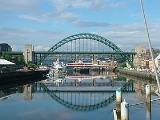
Gateshead on the south, is famous for a series of dramatic bridges, including the
Tyne Bridge of 1928 and
Robert Stephenson's
High Level Bridge of 1849, the first road/rail bridge in the world. Large-scale
regeneration has replaced former shipping premises with imposing new office developments; an innovative tilting bridge, the
Gateshead Millennium Bridge was commissioned by
Gateshead and has integrated the older Newcastle
Quayside more closely with major cultural developments in Gateshead, including the
BALTIC Centre for Contemporary Art and the
Norman Foster-designed
Sage music centre. NewcastleGateshead Quayside is now a thriving, cosmopolitan area with an abundance of bars, restaurants and public spaces. As a tourist promotion, Newcastle and Gateshead have linked together under the banner "NewcastleGateshead", but otherwise remain separate.
Notable Newcastle housing developments include Ralph Erskine's the Byker Wall designed in the 1960s and now
Grade II-listed. It is on
UNESCO's list of outstanding 20th century buildings.
Newcastle's thriving
Chinatown lies in the northwest of Grainger Town, centered on Stowell Street. A new Chinese Arch, or
paifang, providing a landmark entrance, was handed over to the City with a ceremony in 2005.
Science city
The UK's first Biotechnology Village, the "
Centre for Life" is located in the City Centre close to the
Central Station. The village is the first step in the City Council's plans to transform Newcastle into a
Science city .
Geography
Newcastle is situated in the
North East of
England, in the ceremonial county of
Tyne and Wear. The city itself is located on the northern bank of the
Tyne Valley at a
latitude of 54.97°N and a longitude of 1.62°W.
The
geology of the area is most famous for its large deposits of
coal. Whilst the local bedrock consists mainly of carboniferous rocks,
millstone grit and
oolite are also present.
Climate
The climate in Newcastle is temperate, although significantly warmer than some other locations at a similar latitude due to the warming influence of the
Gulf Stream . Being in the
rain shadow of the
North Pennines, it is among the driest cities in the UK. The prevailing winds are south-westerly due to the North Atlantic Current.
Law and government
Newcastle is governed using the leader and cabinet system, and the executive is currently
Liberal Democrat, as they have 48 councillors against the Labour Party's 30. No other parties hold
seats on the city's council.
Administrative districts
Newcastle has 26 electoral wards.
- Benwell and Scotswood
- Blakelaw
- Byker
- Castle
- Dene
- Denton
- Gosforth
- Elswick
- Fawdon
- Fenham
- Heaton
- Jesmond
| Kenton Lemington Newburn Ouseburn Parklands Walker Walkergate Westerhope Westgate Wingrove Woolsington |
Demographics
Population
According to the
UK Government's
2001 census , the unitary authority of Newcastle has a population of around 259,500. However, the metropolitan boroughs of
North Tyneside ,
South Tyneside and
Gateshead are also part of Newcastle's conurbation, giving the Newcastle-Gateshead metropolitan area a population of 799,000. According to the same statistics, the average age of people living in Newcastle is 37.8 . 93.1% of the population are of White ethnic background . Other ethnic groups in Newcastle, in order of population size, are
Pakistani at 1.9% and
Indians at 1.2%. There are also small but significant Chinese and Jewish populations.
Religion
The city is largely Christian at 70.6%, with
Islam the only other significantly practised
religion. A large number have no religion.
Christianity
Diocese of Hexham and NewcastleNewcastle has two
cathedrals, the
Anglican St. Nicholas, with its elegant lantern tower of 1474, and the
Roman Catholic St. Mary's, designed by Augustus Welby Pugin. Both cathedrals began their lives as parish churches. St Mary's became a cathedral in 1850 and St Nicholas' in 1882. Cardinal
Basil Hume,
Archbishop of Westminster was born in the city in 1923. A statue of the Cardinal, , stands outside St Mary's Cathedral in a memorial garden dedicated to the religious leader.
Judaism
No records exist of
Jews being resident in Newcastle before 1830 although there is a tradition that the community dates from 1775. It is thought, however, that over 500 years prior to this Jews resided in Silver Street . Sir Israel Brodie, the first Chief Rabbi to be knighted, was born in Newcastle in 1895.
Health
Of the population, 11.8% described themselves as "not healthy" in the 12 months before the 2001 census, compared to a national average of 9.2%. Additionally, 21.6% of the inhabitants said they had a long-term illness, as against 18.2% nationally.
Newcastle Hospitals Trust One has one of the lowest mortality rates in the country and is ranked second in the country for confidence in doctors. Staffing levels are high - in the top 70 in England for doctors and the top ten for nurses. Newcastle has three large teaching hospitals: the Royal Victoria Infirmary, whose organ donor system has been featured on television; the Newcastle General Hospital and the Freeman Hospital, which is Britain's best transplant centre .
Transport and infrastructure
Air
Located on the northern outskirts of the city, near Ponteland, is Newcastle Airport, which has recently been rebranded as
Newcastle International. The airport currently handles over five million passengers per year, and is the one of the fastest growing airports in the UK. As of 2006, more than 80 destinations are available world-wide. It is currently the UK's ninth biggest airport. A large scale development in unused land near the edge of the city close to the airport should help growth further. The development is called Newcastle Great Park. If Newcastle's super casino bid is a success then that should also contribute to growth.
Bus
Newcastle and the surrounding area has an extensive bus network that is coordinated by , the
Tyne and Wear Passenger Transport Executive. Buses are operated mainly by
Go North East,
Arriva and
Stagecoach North East.
Quayside Transit, a £5m bus scheme using ultra low emission
hybrid diesel-electric vehicles was launched in July 2005. Transport planners have been disappointed by slow take-up of the service.
Metro
In 1904, the North Eastern Railway built an electric suburban railway serving both banks of the Tyne, and the northern suburbs. The system was transformed into the
Tyne and Wear Metro which opened in 1980, and extends as far as
Newcastle Airport,
Tynemouth and South Hylton in
Sunderland. The system is one of only four
underground systems in the
United Kingdom.
The Metro is usually described as Britain's first modern
light rail system. It carries approximately 40 million passenger journeys per year, and is co-ordinated by the
Tyne and Wear Passenger Transport Executive. It is the second biggest metropolitan train system in the UK.
Rail
Newcastle is a principal stop on the
East Coast Main Line and Cross Country Route.
The
central station was the first covered railway station in the world and was much copied across the UK. It has a fine neoclassical frontage originally designed by the architect John Dobson and was constructed in collaboration with
Robert Stephenson. The station was opened in 1850 by
Queen Victoria, with the first services being operated by the North Eastern Railway company.
Today, train operator
GNER provides a half-hourly frequency of trains to
London, with a journey time of a little less than three hours.
Virgin Trains, Northern Rail and
Transpennine Express operate regular services to many other destinations including
Birmingham,
Bristol,
Cardiff,
Carlisle,
Edinburgh,
Glasgow,
Leeds,
Liverpool and
Sheffield.
The city's other mainline station, Manors, is situated to the north east of the city centre.
Road
Major roads in the area include:
...
to
York and
DoncasterSea
Newcastle also has access to an international
Ferry Terminal, located at nearby North Shields, offering services to destinations including
Amsterdam,
Kristiansand,
Gothenburg,
Stavanger,
Haugesund and
Bergen.
The ferry to Gothenburg,
Sweden , will cease at the end of October 2006. The company cited high
fuel prices and new
competition from
low-cost air services, especially
Ryanair , as being the cause. DFDS Seaways' sister company, DFDS Tor Line, will continue to run scheduled freight ships between Gothenburg and several English ports, including Newcastle, and these have limited capacity for passengers, but not private vehicles. It is unclear if the Newcastle-Kristiansand route will continue.
Sport
The City has a strong sporting tradition, being home to
Premiership football team
Newcastle United, and Guinness Premiership
rugby union side
Newcastle Falcons, for whom England player
Jonny Wilkinson features.
The city's Metro Radio Arena is home to Newcastle Vipers
ice hockey team, and Newcastle Eagles
basketball team. The City's
Speedway team Newcastle Diamonds are based at Brough Park in Byker, a venue that is also home to
greyhound racing. The greatest Speedway rider of all time, Ivan Mauger, who hailed from New Zealand was World Champion six times and rode for the Diamonds in the 1960's. Newcastle Racecourse at High Gosforth Park holds regular meets, including the prestigious race for the Northumberland Plate, first run in 1838, which takes place in June each year.
Newcastle also hosts the start of the annual
BUPA Great North Run, the world's largest half-
marathon in which participants famously race over the Tyne Bridge into
Gateshead and then towards the finish line 13.1 miles away on the coast at neighbouring
South Shields. Another famous athletic event is the 10k Blaydon Race, which has taken place annually in nearby Blaydon, since 1981, on June 9 to commemorate the celebrated Blaydon Races horse races.
Education
The city has two universities,
Newcastle University which earned the coveted Sunday Times University of the Year award in 2000 and the newer
Northumbria University that was established in 1992 and was voted 'Best New University' by the Times Good University Guide 2005.
There are eleven LEA-funded 11 to 18 schools and seven independent schools with sixth forms in Newcastle. The largest independent school is the
Royal Grammar School located in Jesmond. There are a number of successful state schools, including Gosforth High School, Heaton Manor, St Cuthbert's, Kenton School and Sacred Heart. Newcastle College is the largest general further education college in the North East, and there are two smaller colleges in the Newcastle area. Newcastle College is also one of the select few beacon colleges in the United Kingdom.
Some 45% of Newcastle's school pupils live in wards which are amongst the 10% most deprived in England.
Culture
Dialect
The local Geordie dialect is a rich, living dialect that reflects the city's virtues and vices. The Geordie dialect is more than an alternative pronunciation of
English. There is a large amount of vocabulary that does not exist in other parts of
England, and words often have different meanings. Much of the dialect can be traced back to the
Old Norse and
Old English languages and certain words are very similar to their equivalents in modern Swedish.
Entertainment
Bars and clubs
Newcastle has a reputation for being a fun-loving city with many bars, restaurants and
nightclubs. More recently, Newcastle has become popular as a destination for Stag and
Hen parties. Newcastle was also given 7th place in the 'Worldwide best places for a Night-Out', in 2000. Also 'The Rough Guide to Britain' has placed the nightlife in Newcastle upon Tyne as the top attraction in Great Britain for tourists
The majority of drinking venues in Newcastle are located in one of three main areas. The oldest of these is the Bigg Market, long-established as a favourite haunt for locals, followed by the trendy
Quayside area, a spectacular mix of modern and traditional architecture which creates a fantastic backdrop for a sometimes frantic Saturday night. However over recent years these have become the haunts of
Charvers and the visiting Stag and Hen parties. Many locals now prefer the bars along Collingwood Street, Neville Street and the
Central Station area as well as the bars and restaurants of Osborne Road in the Jesmond area of the city.
Another new area is "The Gate", which is a new indoor complex consisting of bars, upmarket clubs, restaurants and a 12-screen
Empire multiplex
cinema.
The city also boasts a vibrant and growing gay 'scene' located around the Centre for Life area west of
Central Station.
Outdoor pursuits
The Hoppings, reputedly the largest t