

County of Flanders

Encyclopedia
The County of Flanders was one of the territories constituting the Low Countries
. The county existed from 862 to 1795. It was one of the original secular fiefs of France
and for centuries was one of the most affluent regions in Europe
.
The area under the French crown was located completely west of the Scheldt river and was called "Royal Flanders" (Kroon-Vlaanderen). This fief was finally removed from French control after the Peace of Madrid in 1526 and the Peace of Ladies in 1529. Aside from this the count of Flanders also held land east of the Scheldt river from the 11th century on, as a fief of the Holy Roman Empire
; this area was called "Imperial Flanders" (Rijks-Vlaanderen). Except for French Flanders
, Flanders is the only part of the medieval French kingdom that is not part of modern day France.
*flāndra and *flāmisk (in Old Frisian
flamsk), the roots of which are Germanic
*flaumaz meaning "overflow, flooding". The coastal area of Flanders was flooded twice per day from the 3rd century to the 8th century by the North Sea
at the time when the coast was frequently visited by Frisian (catle) traders and probably partly inhabited by Frisians.
The Flemish people are first mentioned in the biography of Saint Eligius
(ca. 590-660), the Vita sancti Eligii. This work was written before 684, but only known since 725. This work mentions the "Flanderenses", who lived in "Flandris".
. The land covered by the county is spread out over:
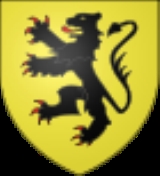
were allegedly created by Philip of Alsace, count of Flanders from 1168 to 1191; a climbing or rampant black lion on a gold field. In the story about the Guldensporenslag, the arms and its corresponding battlecry Vlaendr'n den leeuw ("Flanders, the Lion!") plays a crucial role in the forming of a Flemish consciousness, which was popularised in recent times by the book De Leeuw van Vlaanderen by Hendrik Conscience
. As a result, the arms of the county live on as arms of the Flemish Community
.
It is said that Philip of Alsace brought the lion flag with him from the Holy land
, where in 1177 he supposedly conquered it from a Saracen knight, but this is a myth. The simple fact that the lion appeared on his personal seal since 1163, when he had not yet set one step in the Levant
, disproves it. In reality Philip was following a West-European trend. In the same period lions also appeared in the arms of Brabant
, Luxembourg
, Holland
, Limburg
and other territories. It is curious that the lion as a heraldic symbol was mostly used in border territories and neighbouring countries of the Holy Roman Empire
. It was in all likelihood a way of showing independence from the emperor, who used an eagle
in his personal arms. In Europe the lion had been a well known figure since Roman times, through works such as the fables of Aesop
.
formed an important Celtic settlement. During the times of Julius Caesar, the inhabitants were part of the Belgae
, a collective name for all Celtic and Germanic tribes in the north of Gallia
. For Flanders in specific these were the Menapii
, the Morini
, the Nervii
and the Atrebates
.
Julius Caesar
conquered the area around 54 b.c. and the population was partially romanised from the 1st to the 3rd century. The roman road
that connected Cologne
with Boulogne-sur-Mer
was used as a defense perimeter. In the south the Gallo-Romanic population was able to maintain itself, while the north became a no-mans land that also suffered from regular floods from the North sea
.
In the coastal and Scheldt
areas Saxon tribes gradually appeared. Saxon was a general term for the Romans, and included Angles
, Saxons
, Jutes
and Erules. The coastal defense around Boulogne and Oudenburg
, the 'Litus Saxonicum', remained functional until about 420. These forts were manned by Saxon soldiers.
From their base land Toxandria
the Salic Franks further expanded into the Roman empire. The first incursion into the lands of the Atrebates was turned away in 448 at Vicus Helena. But after the murder of the roman general Flavius Aëtius
in 454 and roman emperor Valentinianus III in 455, the Salic Franks encounterd hardly any resistance. From Duisburg
, king Chlodio conquered Cambrai
and Tournai
, and he reached the Somme
. After his death two Salic kingdoms emerged. Childeric
is recorded in 463 as king of Tournay and ally of the Romans against the Visigoths. He was also administrator of the province of Belgica Secunda. His son Clovis I
conquered from 486 on all of Northern France.
and language. In the 5th century Salic Franks settled in present day Northern-France and Wallonia, primarily around the cities of Courtrai, Tournai
and Bavay
. They adapted to the local Gallo-Romanic population. From the 6th century on the no-mans-land farther north was filled by Franks
from the Rhinelands and other Germanic groups from the Netherlands and Germany.
The first wave of immigration in the present day Flemish territory was accompanied by limited Christianisation. In the wake of the immigrants, missionaries tried to convert the heathen population, but they had little success. The bishoprics were reinstated, usually with the same natural borders of the Late-Roman era; the Silva Carbonaria
separated the Bishopric of Cambrai from the Bishopric of Tongeren, while the Scheldt again became the border between the bishoprics of Cambrai and Tournai
. Vedastus and Eleutherius of Tournai
were assigned to reinstate the bishoprics of Arras
and Tournai. However, these bishoprics failed to survive independently. In the late 6th century the bishopric of Atrecht was connected to that of Courtrai, and at the start of the 7th century the same was done to the bishoprics of Tournai and Noyon
.
At the end of the 6th century the duchy of Dentelinus was created in the north of what would later constitute Neustria
. This duchy presumably included the bishoprics Boulogne, Terwaan, Atrecht, Tournai, Courtrai and Noyon, thus the northwestern region between the North Sea and the Silva Carbonaria, an area whose outlines were very similar to the later Flanders. The duchy of Dentelinus was primarily meant as a military and strategical deterrent against Frisian and Saxon invasions. It was a cornerstone in the military defense of the Merovingian Empire
. In 600 Chlotar II (584-628) was forced to temporarily cede the duchy of Dentelinus to Austrasia
, but after restoration of Austrasian dual-monarchy in 622/623 the duchy was returned.
and Franks
had settled in future Flanders and the Duchy of Brabant
. New groups of germanic settlers also came in from the Netherlands
and Germany
. Their new settlements often received the name of their germanic leader, with '-inga haim' added. -Inga haim meant 'the settlement of the tribe of X'. For example: Petegem comes from Petta-inga-haim, which meant 'the settlement of the tribe of Petta'.
The colonisation and germanisation of Flanders took place primarily in the 6th and 7th centuries. In the 7th century the population-level had risen sufficiently to start rebuilding the religious, military and administrative infrastructure. In the area of linguistics, the situation stabilised so that a large, bilingual region with a linear language border
could emerge in the 8th century. In Pas-de-Calais, which had been densely populated a long time, a language barrier had emerged in the 6th-7th century, but in the 9th century a romanisation-movement started that has continued until the present day.
The Christianisation attempts in the 6th century by bishops like Eleutherius
and Vedastus had largely failed. Thus, in the 8th century a different strategy was chosen. A new Christianisation attempt was made under influence from king Dagobert I
. He appointed several devoted missionaries from the southern parts of his kingdom to his royal domains in the northern parts of his kingdom. The missionaries were tasked with founding monasteries and abbeys there, that were to serve as centers of Christianity
in a pagan region. From these centers, the conversion of the local populace could be started.
In 649 Audomar founded an abbey at Sithiu
(the Abbey of Saint Bertinus) and in 680 Aubertus founded the Abbey of St. Vaast near Arras
. The Christianisation of the population was mainly the work of missionaries like Amandus (St. Bavo's Abbey and St. Peter's Abbey in Ghent) and Eligius
(coastal region and Antwerp). In his 'vita', Eligius makes the first mention of the word 'Flanders', when he toured the area around 650.
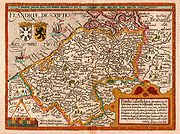
During the 7th century the first Gaue or pagi were created in the Flemish territories. Gaue were administrative subdivisions of the civitates. The Gaue from the 7th and 8th century would form the basis of the county of Flanders. The pagus Tornacensis dates from ca. 580, and from the 7th century we know of the 'pagus Cambracinsis' in 663, the pagus Taroanensis from 649 and the pagus Bracbatensis at the end of the century. From the 8th century we know of the pagus Rodaninsis from 707, the pagus Gandao from the first quarter of the 8th century, the pagus Mempiscus from 723 and the pagus Flandrensis from around 745. Lastly, the pagus Austrebatensis and the pagus Curtracensis are also counted as Merovingian gaue.
 In 751 the Carolingian
Mayors of the Palace
succeeded in removing the Merovingians from power and obtaining the throne for themselves. The last Merovingian king, Childeric III
, was placed in captivity at the later Abbey of Saint Bertinus in St. Omer, and his long hair, a symbol of royal power, was cut off.
Charlemagne
succeeded his father Pippin the Short in Neustria and Austrasia, and after the death of his brother Karloman he was able to reunite the entire Frankish Empire. Though he resided in Aachen
, he spent much time travelling through his territories. In 811 he inspected the fleet that he had ordered built in Boulogne and Ghent, to protect against Viking
invasions.
The region comprising future Flanders was, from an economic point of view, a flourishing region, with a series of ports along the Scheldt river: Ghent
, Tournai
, Valenciennes
, Cambrai
and Lambres
at Douai
on the Scarpe and a number of seaports: Quentovic, Boulogne and Isère portus, a port at the mouth of the Yser
. Moreover, the region included a number of rich abbeys, such as Abbey of St. Bertin, St. Bavo's Abbey, Saint-Amand Abbey
and the Abbey of St. Vaast.
Charlemagne was succeeded by his son Louis the Pious
. Even during Louis' life his three sons started fighting over his heritage. They eventually concluded multiple treaties, of which the Treaty of Verdun
, signed in 843, would be the definitive treaty. These treaties created East Francia, Middle Francia
and West Francia. West Francia, inherited by Charles the Bald
, included the original county of Flanders, that spanned roughly between Oudenburg
, Aardenburg
and Torhout
.
After the Middle-Frankish kings died out, the rulers of the West and East-Frankish Kingdoms divided the Middle-Frankish kingdom amongst themselves in the treaty of Meerssen
in 870. Now Western Europe had been divided into two sides: the solid West Francia (the later France
) and the loose confederation of principalities of East Francia, that would become the Holy Roman Empire
.
In the north these two powers were separated by the Scheldt river, which had previously separated West Francia from Middle Francia
. This separation remained unchanged until the times of Charles V, Holy Roman Emperor
.
.
The county of Flanders originated from the Gau of Pagus Flandrensis, led by the Forestiers dynasty, who had been appointed by Charlemagne, who had made a small contribution by uniting small feudal territories in the higher parts of the Flemish Valley. The forestiers dynasty also strengthened the hold of the church on the relatively desolate area.
The first Count of Flanders was Baldwin I of Flanders, who became count in 862, and a romantic anecdote is connected to this: Baldwin eloped with the daughter of the Frankish king Charles the Bald
, Judith of West Francia. Judith, who had previously been married to two English kings, refused her father's command to return to him. After mediation by the pope, the Frankish king reconciled with his son-in-law, and gave him the title of count, and the corresponding feudal territories as dowry.
Initially the French kings meant to secure the safety of the northern French border from Viking invasions with this act. The counts, however, made good use of the crisis situation by incorporating the surrounding plundered territories into the county. The counts expanded the influence of the original Flemish pagus over the years over all territories south and west of the Scheldt river, including presentday the lordship of the Four Amts, Zeelandic Flanders, the burgraviate of Aalst to the east and the County of Artois
to the south, which remained part of Flanders until it became a separate county in 1237. After that date, the county of Artois at various times still came under the dominion of the count of Flanders as a separate title, until it was absorbed by the French crown.
of Normandy (1127 to 1128), the county went to Thierry of Alsace of the House of Alsace. Under Thierry (1128–1168) and his successor Philip of Alsace, Flanders' importance and power increased.
In the second half of the 12th century, the county went through a period of great prosperity when Philip of Alsace managed to incorporate the County of Vermandois into Flanders through the inheritance of his wife. The territories he controlled now came to within 25 kilometers of Paris
, and were larger than the territories his Feudal Lord, the French King, directly controlled.
During the rule of the House of Alsace, cities developed and new institutions were formed. The ports of Gravelines
, Nieuwpoort
, Damme
, Biervliet
, Dunkirk, and Mardijk were founded, as well as Calais
by Philip's brother Matthew of Alsace
. Aside for colonisation, the ports also functioned to reduce the silting of the Aa, Yser
and Zwin
rivers, which were endangering the accessibility of Saint-Omer
, Ieper and Brugge
. Biervliet also served as a counter to Hollandic influence.
Trade partners included England
, the Baltic countries
and France
over sea, and the Rhineland
and Italy
over land. The wool trade with England was of special importance to the rising cloth industry in Flanders. The wealth of many Flemish cities (as their Belltowers and cloth hall
s testify) came from the drapery industry. Aside from this, the grain trade with England and through Holland with Hamburg were also important. Saint-Omer
became the most important transit-port for French wine in the 12th century. These were the centuries of the breakthrough of the Flemish merchants, with their trade with England, the Baltic area and South-West France, as well as the landrouters to the Rhineland
and Italy, though later only the yearly fairs of Champagne. Flanders' flourishing trading towns made it one of the most urbanised parts of Europe.
In 1194, Baldwin I of Constantinople
of the House of Hainaut, succeeded the House of Alsace.
, of the House of Dampierre
, became count of Flanders. The king of France wanted to definitively conquer Flanders, and started the Franco-Flemish War (1297-1305)
. Increasingly powerful in the 12th century, the territory's autonomous urban centres were instrumental in defeating the French invasion attempt, defeating the French at the Guldensporenslag in 1302.
Flemish prosperity waned in the following century, however, owing to widespread European population decline following the Black Death
of 1348, the disruption of trade during the Anglo-French Hundred Years' War
(1338–1453), and increased English
cloth production. Flemish weavers had gone over to Worstead
and North Walsham
in Norfolk
in the 12th century and established the wool industry.
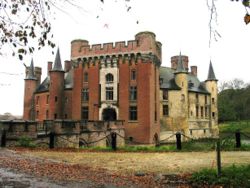 Through his marriage with Margaret of Dampierre in 1369, Philip the Bold
, duke of Burgundy, made an end to the independence of Flanders. Flanders became the possession of the House of Valois-Burgundy
, that ruled over the Duchy of Burgundy
. In 1449 the city of Ghent
Revolted
against duke Philip the Good. In 1453 Philip crushed the rebels at the battle of Gavere
, ending the revolt.
In 1482 the last Burgundian ruler Mary of Burgundy
died, making her young son Philip I of Castile
of the House of Habsburg the new count, and her husband Maximilian I of Austria
the regent.
, Flanders became officially part of the Habsburg Empire in 1506, becoming a member of the Burgundian Circle
. The county was later involved in the Guelderian Wars
.
Through the Pragmatic Sanction of 1549
, the County of Flanders was officially detached from France. It became an independent territory of the Holy Roman Empire
. This constitutional act made Flanders part of the Seventeen Provinces
, that constituted the Low Countries
and from then on would be inherited as a whole.
The Low Countries held an important place in the Empire. For Charles personally, they were the region where he spent his childhood. Because of trade and industry and the rich cities, they were also important for the treasury. Lordship transferred to the Spanish branch of the House of Habsburg with Philip II of Spain
, and after 1556 belonged to the Kings of Spain.
It was in Steenvoorde
(In French Flanders
) in 1566 that the Beeldenstorm
broke loose. The Beeldenstorm spread through all of the Low Countries
and eventually led to the outbreak of the Eighty Years' war and the secession of the Republic of the Seven United Netherlands. Originally Flanders cooperated with the northern provinces as a member of the Union of Utrecht
, but from 1579-1585 it was reconquered by the Spanish army.
. This situation was formalised in 1678 at the Treaty of Nijmegen.
, the Austrian Netherlands flourished.
. In 1790 the county of Flanders and a separate province called West-Flanders (1713), which constituted the territories given back by France to the Emperor, were two of the founding members of the United States of Belgium
. Just like the other parts of the Austrian Netherlands, the county of Flanders declared its independence. This took place on the Friday-market at Ghent on 4 January 1790. The "Manifest van Vlaenderen" was drawn up by Charles-Joseph de Graeve and Jan Jozelf Raepsaet.
The county of Flanders officially ceased to exist in 1795, when it was annexed by France, and divided into two departments: Lys (present day West Flanders) and Escaut
(present day East Flanders
and Zeelandic Flanders).
After the French Revolution
the county was not restored, and instead the two departments continued their existence as the provinces of East- and West-Flanders in the Unitarian
United Kingdom of the Netherlands
, and later after the Belgian Revolution
in Belgium
.
was annexed by the Belgian Kings and continued to formally exist. As a rule it was given to the second in line of succession to the Belgian throne. The title of count of Flanders was abolished by royal decision on 16 October 2001.
In the present day, the term Flanders
is understood as the northern part of Belgium.
Low Countries
The Low Countries are the historical lands around the low-lying delta of the Rhine, Scheldt, and Meuse rivers, including the modern countries of Belgium, the Netherlands, Luxembourg and parts of northern France and western Germany....
. The county existed from 862 to 1795. It was one of the original secular fiefs of France
France in the Middle Ages
France in the Middle Ages covers an area roughly corresponding to modern day France, from the death of Louis the Pious in 840 to the middle of the 15th century...
and for centuries was one of the most affluent regions in Europe
Europe
Europe is, by convention, one of the world's seven continents. Comprising the westernmost peninsula of Eurasia, Europe is generally 'divided' from Asia to its east by the watershed divides of the Ural and Caucasus Mountains, the Ural River, the Caspian and Black Seas, and the waterways connecting...
.
The area under the French crown was located completely west of the Scheldt river and was called "Royal Flanders" (Kroon-Vlaanderen). This fief was finally removed from French control after the Peace of Madrid in 1526 and the Peace of Ladies in 1529. Aside from this the count of Flanders also held land east of the Scheldt river from the 11th century on, as a fief of the Holy Roman Empire
Holy Roman Empire
The Holy Roman Empire was a realm that existed from 962 to 1806 in Central Europe.It was ruled by the Holy Roman Emperor. Its character changed during the Middle Ages and the Early Modern period, when the power of the emperor gradually weakened in favour of the princes...
; this area was called "Imperial Flanders" (Rijks-Vlaanderen). Except for French Flanders
French Flanders
French Flanders is a part of the historical County of Flanders in present-day France. The region today lies in the modern-day region of Nord-Pas de Calais, the department of Nord, and roughly corresponds to the arrondissements of Lille, Douai and Dunkirk on the Belgian border.-Geography:French...
, Flanders is the only part of the medieval French kingdom that is not part of modern day France.
Etymology
Flanders and Flemish (Dutch: Vlaanderen , Vlaams) are likely derived from the FrisianIngvaeonic
Ingvaeonic , also known as North Sea Germanic, is a postulated grouping of the West Germanic languages that comprises Old Frisian, Old English and Old Saxon....
*flāndra and *flāmisk (in Old Frisian
Old Frisian
Old Frisian is a West Germanic language spoken between the 8th and 16th centuries in the area between the Rhine and Weser on the European North Sea coast. The Frisian settlers on the coast of South Jutland also spoke Old Frisian but no medieval texts of this area are known...
flamsk), the roots of which are Germanic
Germanic languages
The Germanic languages constitute a sub-branch of the Indo-European language family. The common ancestor of all of the languages in this branch is called Proto-Germanic , which was spoken in approximately the mid-1st millennium BC in Iron Age northern Europe...
*flaumaz meaning "overflow, flooding". The coastal area of Flanders was flooded twice per day from the 3rd century to the 8th century by the North Sea
North Sea
In the southwest, beyond the Straits of Dover, the North Sea becomes the English Channel connecting to the Atlantic Ocean. In the east, it connects to the Baltic Sea via the Skagerrak and Kattegat, narrow straits that separate Denmark from Norway and Sweden respectively...
at the time when the coast was frequently visited by Frisian (catle) traders and probably partly inhabited by Frisians.
The Flemish people are first mentioned in the biography of Saint Eligius
Saint Eligius
Saint Eligius is the patron saint of goldsmiths, other metalworkers, and coin collectors. He is also the patron saint of the Royal Electrical and Mechanical Engineers , a corps of the British Army, but he is best known for being the patron saint of horses and those who work with them...
(ca. 590-660), the Vita sancti Eligii. This work was written before 684, but only known since 725. This work mentions the "Flanderenses", who lived in "Flandris".
Geography
The geography of the historic County of Flanders only partially overlaps with present-day FlandersFlanders
Flanders is the community of the Flemings but also one of the institutions in Belgium, and a geographical region located in parts of present-day Belgium, France and the Netherlands. "Flanders" can also refer to the northern part of Belgium that contains Brussels, Bruges, Ghent and Antwerp...
. The land covered by the county is spread out over:
- BelgiumBelgiumBelgium , officially the Kingdom of Belgium, is a federal state in Western Europe. It is a founding member of the European Union and hosts the EU's headquarters, and those of several other major international organisations such as NATO.Belgium is also a member of, or affiliated to, many...
:- two of the five Flemish provinces: West-Flanders and East-Flanders
- part of the Flemish province AntwerpAntwerp (province)Antwerp is the northernmost province both of the Flemish Region, also called Flanders, and of Belgium. It borders on the Netherlands and the Belgian provinces of Limburg, Flemish Brabant and East Flanders. Its capital is Antwerp which comprises the Port of Antwerp...
: the land of Bornem - part of the Walloon province Hainaut: TournaiTournaiTournai is a Walloon city and municipality of Belgium located 85 kilometres southwest of Brussels, on the river Scheldt, in the province of Hainaut....
and the region around Moeskroen (that belonged to West-Flanders until 1962)
- FranceFranceThe French Republic , The French Republic , The French Republic , (commonly known as France , is a unitary semi-presidential republic in Western Europe with several overseas territories and islands located on other continents and in the Indian, Pacific, and Atlantic oceans. Metropolitan France...
:- French FlandersFrench FlandersFrench Flanders is a part of the historical County of Flanders in present-day France. The region today lies in the modern-day region of Nord-Pas de Calais, the department of Nord, and roughly corresponds to the arrondissements of Lille, Douai and Dunkirk on the Belgian border.-Geography:French...
(in the Nord departement)- the French westcorner: the region around Dunkirk, BerguesBerguesBergues is a commune in the Nord department in northern France.It is situated to the south of Dunkirk and from the Belgian border. Locally it is referred to as "the other Bruges in Flanders"...
and BailleulBailleul, NordBailleul is a commune in the Nord department in northern France.It is located in French Flanders near Lille.-Heraldry:-Media:...
, an area where DutchDutch languageDutch is a West Germanic language and the native language of the majority of the population of the Netherlands, Belgium, and Suriname, the three member states of the Dutch Language Union. Most speakers live in the European Union, where it is a first language for about 23 million and a second...
used to be the main language
- the French westcorner: the region around Dunkirk, Bergues
- ArtoisCounty of ArtoisThe County of Artois was an historic province of the Kingdom of France, held by the Dukes of Burgundy from 1384 until 1477/82, and a state of the Holy Roman Empire from 1493 until 1659....
(in the Pas-de-Calais department): removed from Flanders in 1191 and created as independent county in 1237
- French Flanders
- NetherlandsNetherlandsThe Netherlands is a constituent country of the Kingdom of the Netherlands, located mainly in North-West Europe and with several islands in the Caribbean. Mainland Netherlands borders the North Sea to the north and west, Belgium to the south, and Germany to the east, and shares maritime borders...
: Zeelandic Flanders, a region between Belgium and the Western ScheldtWestern ScheldtThe Western Scheldt in the province Zeeland in the southwestern Netherlands, is the estuary of the Scheldt river. This river once had several estuaries, but the others are disconnected from the Scheldt, leaving the Westerschelde as its only direct way to the sea. It is an important shipping route...
, in the southern part of the province of ZeelandZeelandZeeland , also called Zealand in English, is the westernmost province of the Netherlands. The province, located in the south-west of the country, consists of a number of islands and a strip bordering Belgium. Its capital is Middelburg. With a population of about 380,000, its area is about...
Flag and Arms
The arms of the County of FlandersCoat of arms of Flanders
The official arms of the Flemish Community are: Or, a lion rampant sable, armed and langued gules. Although the lion has been in use for about a century as symbol of the Flemish movement, it only became the official symbol of the Flemish Community in 1973...
were allegedly created by Philip of Alsace, count of Flanders from 1168 to 1191; a climbing or rampant black lion on a gold field. In the story about the Guldensporenslag, the arms and its corresponding battlecry Vlaendr'n den leeuw ("Flanders, the Lion!") plays a crucial role in the forming of a Flemish consciousness, which was popularised in recent times by the book De Leeuw van Vlaanderen by Hendrik Conscience
Hendrik Conscience
Henri "Hendrik" Conscience was a Belgian writer. He was a pioneer in writing in Dutch after the secession from the Netherlands in 1830 left Belgium a mostly French speaking country....
. As a result, the arms of the county live on as arms of the Flemish Community
Coat of arms of Flanders
The official arms of the Flemish Community are: Or, a lion rampant sable, armed and langued gules. Although the lion has been in use for about a century as symbol of the Flemish movement, it only became the official symbol of the Flemish Community in 1973...
.
It is said that Philip of Alsace brought the lion flag with him from the Holy land
Holy Land
The Holy Land is a term which in Judaism refers to the Kingdom of Israel as defined in the Tanakh. For Jews, the Land's identifiction of being Holy is defined in Judaism by its differentiation from other lands by virtue of the practice of Judaism often possible only in the Land of Israel...
, where in 1177 he supposedly conquered it from a Saracen knight, but this is a myth. The simple fact that the lion appeared on his personal seal since 1163, when he had not yet set one step in the Levant
Levant
The Levant or ) is the geographic region and culture zone of the "eastern Mediterranean littoral between Anatolia and Egypt" . The Levant includes most of modern Lebanon, Syria, Jordan, Israel, the Palestinian territories, and sometimes parts of Turkey and Iraq, and corresponds roughly to the...
, disproves it. In reality Philip was following a West-European trend. In the same period lions also appeared in the arms of Brabant
Duchy of Brabant
The Duchy of Brabant was a historical region in the Low Countries. Its territory consisted essentially of the three modern-day Belgian provinces of Flemish Brabant, Walloon Brabant and Antwerp, the Brussels-Capital Region and most of the present-day Dutch province of North Brabant.The Flag of...
, Luxembourg
County, Duchy and Grand Duchy of Luxembourg
The County, later Duchy of Luxembourg was a state of the Holy Roman Empire, the ancestral homeland of the noble House of Luxembourg.-History:...
, Holland
County of Holland
The County of Holland was a county in the Holy Roman Empire and from 1482 part of the Habsburg Netherlands in what is now the Netherlands. It covered an area roughly corresponding to the current Dutch provinces of North-Holland and South-Holland, as well as the islands of Terschelling, Vlieland,...
, Limburg
Duchy of Limburg
The Duchy of Limburg, situated in the Low Countries between the river Meuse and the city of Aachen, was a state of the Holy Roman Empire. Its territory is now divided between the Belgian provinces of Liège and Limburg , the Dutch province of Limburg , and a small part of North Rhine-Westphalia in...
and other territories. It is curious that the lion as a heraldic symbol was mostly used in border territories and neighbouring countries of the Holy Roman Empire
Holy Roman Empire
The Holy Roman Empire was a realm that existed from 962 to 1806 in Central Europe.It was ruled by the Holy Roman Emperor. Its character changed during the Middle Ages and the Early Modern period, when the power of the emperor gradually weakened in favour of the princes...
. It was in all likelihood a way of showing independence from the emperor, who used an eagle
Reichsadler
The Reichsadler was the heraldic eagle, derived from the Roman eagle standard, used by the Holy Roman Emperors and in modern coats of arms of Germany, including those of the German Empire, the Weimar Republic and Nazi Germany...
in his personal arms. In Europe the lion had been a well known figure since Roman times, through works such as the fables of Aesop
Aesop
Aesop was a Greek writer credited with a number of popular fables. Older spellings of his name have included Esop and Isope. Although his existence remains uncertain and no writings by him survive, numerous tales credited to him were gathered across the centuries and in many languages in a...
.
Ancient and Roman times
The future county of Flanders had been inhabited since prehistory. During the Iron Age the KemmelbergKemmelberg
The Kemmelberg, also known as Kemmel Hill or Mont Kemmel, is a 156m high hill near Kemmel in the municipality of Heuvelland in West Flanders, Belgium....
formed an important Celtic settlement. During the times of Julius Caesar, the inhabitants were part of the Belgae
Belgae
The Belgae were a group of tribes living in northern Gaul, on the west bank of the Rhine, in the 3rd century BC, and later also in Britain, and possibly even Ireland...
, a collective name for all Celtic and Germanic tribes in the north of Gallia
Gallia
Gallia may refer to:*Gaul , the region of Western Europe occupied by present-day France, Belgium and other neighbouring countries...
. For Flanders in specific these were the Menapii
Menapii
The Menapii were a Belgic tribe of northern Gaul in pre-Roman and Roman times. Their territory according to Strabo, Caesar and Ptolemy stretched from the mouth of the Rhine in the north, and southwards along the west of the Schelde. Their civitas under the Roman empire was Cassel , near Thérouanne...
, the Morini
Morini
The Morini were a Belgic tribe in the time of the Roman Empire. We know little about their language but one of their cities, Boulogne-sur-Mer was called Bononia by Zosimus and Bonen in the Middle Ages. Zosimus mentioned the Low Germanic character of the city...
, the Nervii
Nervii
The Nervii were an ancient Germanic tribe, and one of the most powerful Belgic tribes; living in the northeastern hinterlands of Gaul, they were known to trek long distances to engage in various wars and functions...
and the Atrebates
Atrebates
The Atrebates were a Belgic tribe of Gaul and Britain before the Roman conquests.- Name of the tribe :Cognate with Old Irish aittrebaid meaning 'inhabitant', Atrebates comes from proto-Celtic *ad-treb-a-t-es, 'inhabitants'. The Celtic root is treb- 'building', 'home' The Atrebates (singular...
.
Julius Caesar
Julius Caesar
Gaius Julius Caesar was a Roman general and statesman and a distinguished writer of Latin prose. He played a critical role in the gradual transformation of the Roman Republic into the Roman Empire....
conquered the area around 54 b.c. and the population was partially romanised from the 1st to the 3rd century. The roman road
Roman road
The Roman roads were a vital part of the development of the Roman state, from about 500 BC through the expansion during the Roman Republic and the Roman Empire. Roman roads enabled the Romans to move armies and trade goods and to communicate. The Roman road system spanned more than 400,000 km...
that connected Cologne
Cologne
Cologne is Germany's fourth-largest city , and is the largest city both in the Germany Federal State of North Rhine-Westphalia and within the Rhine-Ruhr Metropolitan Area, one of the major European metropolitan areas with more than ten million inhabitants.Cologne is located on both sides of the...
with Boulogne-sur-Mer
Boulogne-sur-Mer
-Road:* Metropolitan bus services are operated by the TCRB* Coach services to Calais and Dunkerque* A16 motorway-Rail:* The main railway station is Gare de Boulogne-Ville and located in the south of the city....
was used as a defense perimeter. In the south the Gallo-Romanic population was able to maintain itself, while the north became a no-mans land that also suffered from regular floods from the North sea
North Sea
In the southwest, beyond the Straits of Dover, the North Sea becomes the English Channel connecting to the Atlantic Ocean. In the east, it connects to the Baltic Sea via the Skagerrak and Kattegat, narrow straits that separate Denmark from Norway and Sweden respectively...
.
In the coastal and Scheldt
Scheldt
The Scheldt is a 350 km long river in northern France, western Belgium and the southwestern part of the Netherlands...
areas Saxon tribes gradually appeared. Saxon was a general term for the Romans, and included Angles
Angles
The Angles is a modern English term for a Germanic people who took their name from the ancestral cultural region of Angeln, a district located in Schleswig-Holstein, Germany...
, Saxons
Saxons
The Saxons were a confederation of Germanic tribes originating on the North German plain. The Saxons earliest known area of settlement is Northern Albingia, an area approximately that of modern Holstein...
, Jutes
Jutes
The Jutes, Iuti, or Iutæ were a Germanic people who, according to Bede, were one of the three most powerful Germanic peoples of their time, the other two being the Saxons and the Angles...
and Erules. The coastal defense around Boulogne and Oudenburg
Oudenburg
Oudenburg Latin: Aldenburgensis is a municipality located in the Belgian province of West Flanders. The municipality comprises the city of Oudenburg itself and the towns of Ettelgem, Roksem and Westkerke. On January 1, 2006 Oudenburg had a total population of 8,929...
, the 'Litus Saxonicum', remained functional until about 420. These forts were manned by Saxon soldiers.
From their base land Toxandria
Toxandria
Toxandria is the classical name for a region between the Meuse and the Scheldt rivers in the Netherlands and Belgium. The name is also spelled Taxandria...
the Salic Franks further expanded into the Roman empire. The first incursion into the lands of the Atrebates was turned away in 448 at Vicus Helena. But after the murder of the roman general Flavius Aëtius
Flavius Aëtius
Flavius Aëtius , dux et patricius, was a Roman general of the closing period of the Western Roman Empire. He was an able military commander and the most influential man in the Western Roman Empire for two decades . He managed policy in regard to the attacks of barbarian peoples pressing on the Empire...
in 454 and roman emperor Valentinianus III in 455, the Salic Franks encounterd hardly any resistance. From Duisburg
Duisburg
- History :A legend recorded by Johannes Aventinus holds that Duisburg, was built by the eponymous Tuisto, mythical progenitor of Germans, ca. 2395 BC...
, king Chlodio conquered Cambrai
Cambrai
Cambrai is a commune in the Nord department in northern France. It is a sub-prefecture of the department.Cambrai is the seat of an archdiocese whose jurisdiction was immense during the Middle Ages. The territory of the Bishopric of Cambrai, roughly coinciding with the shire of Brabant, included...
and Tournai
Tournai
Tournai is a Walloon city and municipality of Belgium located 85 kilometres southwest of Brussels, on the river Scheldt, in the province of Hainaut....
, and he reached the Somme
Somme
Somme is a department of France, located in the north of the country and named after the Somme river. It is part of the Picardy region of France....
. After his death two Salic kingdoms emerged. Childeric
Childeric I
Childeric I was a Merovingian king of the Salian Franks and the father of Clovis.He succeeded his father Merovech as king, traditionally in 457 or 458...
is recorded in 463 as king of Tournay and ally of the Romans against the Visigoths. He was also administrator of the province of Belgica Secunda. His son Clovis I
Clovis I
Clovis Leuthwig was the first King of the Franks to unite all the Frankish tribes under one ruler, changing the leadership from a group of royal chieftains, to rule by kings, ensuring that the kingship was held by his heirs. He was also the first Catholic King to rule over Gaul . He was the son...
conquered from 486 on all of Northern France.
6th century
The abandoned coast and Scheldt region had been partially repopulated since the 4th century by Saxonian groups that retained their Germanic cultureGermanic culture
Historical culture of the Germanic peoples:*Migration period art**Animal style**Anglo-Saxon cultureContemporary culture of Germanic Europe:*Dutch culture *English culture*Flemish culture*Frisian culture*Culture of German-speaking Europe...
and language. In the 5th century Salic Franks settled in present day Northern-France and Wallonia, primarily around the cities of Courtrai, Tournai
Tournai
Tournai is a Walloon city and municipality of Belgium located 85 kilometres southwest of Brussels, on the river Scheldt, in the province of Hainaut....
and Bavay
Bavay
Bavay is a commune in the Nord department in northern France.It lies 15 m. ESE of Valenciennes by railway.-History:Under the name of Bagacum or Bavacum, the town was the capital of the Nervii and, under the Roman Empire, an important center of roads, the meeting-place of which was marked by a...
. They adapted to the local Gallo-Romanic population. From the 6th century on the no-mans-land farther north was filled by Franks
Franks
The Franks were a confederation of Germanic tribes first attested in the third century AD as living north and east of the Lower Rhine River. From the third to fifth centuries some Franks raided Roman territory while other Franks joined the Roman troops in Gaul. Only the Salian Franks formed a...
from the Rhinelands and other Germanic groups from the Netherlands and Germany.
The first wave of immigration in the present day Flemish territory was accompanied by limited Christianisation. In the wake of the immigrants, missionaries tried to convert the heathen population, but they had little success. The bishoprics were reinstated, usually with the same natural borders of the Late-Roman era; the Silva Carbonaria
Silva Carbonaria
Silva Carbonaria, the "charcoal forest", was the dense old-growth forest of beech and oak that formed a natural boundary during the Late Iron Age through Roman times into the Early Middle Ages across what is now Belgium. The forest naturally thinned out in the open sandy stretches to the north and...
separated the Bishopric of Cambrai from the Bishopric of Tongeren, while the Scheldt again became the border between the bishoprics of Cambrai and Tournai
Roman Catholic Diocese of Tournai
The Roman Catholic Diocese of Tournai, also called , is a diocese of the Latin Rite of the Roman Catholic church in Belgium. The diocese was formed in 1146, by the splitting of the diocese of Noyon and Tournai that had existed since the 7th century. It is now suffragan of the archdiocese of...
. Vedastus and Eleutherius of Tournai
Eleutherius of Tournai
Saint Eleutherius of Tournai is venerated as a saint and considered the first bishop of Tournai. The Catholic Encyclopedia writes that "historically there is very little known about St. Eleutherius, but he was without doubt the first Bishop of Tournai." Tradition makes him a lifelong friend of St...
were assigned to reinstate the bishoprics of Arras
Roman Catholic Diocese of Arras
The Roman Catholic Diocese of Arras, is a diocese of the Latin Rite of the Roman Catholic church, in France. The episcopal see is the Arras Cathedral, in the city of Arras. The diocese encompasses all of the Department of Pas-de-Calais, in the Region of Nord-Pas-de-Calais...
and Tournai. However, these bishoprics failed to survive independently. In the late 6th century the bishopric of Atrecht was connected to that of Courtrai, and at the start of the 7th century the same was done to the bishoprics of Tournai and Noyon
Noyon
Noyon is a commune in the Oise department in northern France.It lies on the Oise Canal, 100 km north of Paris.-History:...
.
At the end of the 6th century the duchy of Dentelinus was created in the north of what would later constitute Neustria
Neustria
The territory of Neustria or Neustrasia, meaning "new [western] land", originated in 511, made up of the regions from Aquitaine to the English Channel, approximating most of the north of present-day France, with Paris and Soissons as its main cities...
. This duchy presumably included the bishoprics Boulogne, Terwaan, Atrecht, Tournai, Courtrai and Noyon, thus the northwestern region between the North Sea and the Silva Carbonaria, an area whose outlines were very similar to the later Flanders. The duchy of Dentelinus was primarily meant as a military and strategical deterrent against Frisian and Saxon invasions. It was a cornerstone in the military defense of the Merovingian Empire
Merovingian dynasty
The Merovingians were a Salian Frankish dynasty that came to rule the Franks in a region largely corresponding to ancient Gaul from the middle of the 5th century. Their politics involved frequent civil warfare among branches of the family...
. In 600 Chlotar II (584-628) was forced to temporarily cede the duchy of Dentelinus to Austrasia
Austrasia
Austrasia formed the northeastern portion of the Kingdom of the Merovingian Franks, comprising parts of the territory of present-day eastern France, western Germany, Belgium, Luxembourg and the Netherlands. Metz served as its capital, although some Austrasian kings ruled from Rheims, Trier, and...
, but after restoration of Austrasian dual-monarchy in 622/623 the duchy was returned.
7th century
At the end of the 6th and the 7th century a new inflow emerged from the western Pas-de-Calais. This area had been germanised in the 5th century and descendants of the SaxonsSaxons
The Saxons were a confederation of Germanic tribes originating on the North German plain. The Saxons earliest known area of settlement is Northern Albingia, an area approximately that of modern Holstein...
and Franks
Franks
The Franks were a confederation of Germanic tribes first attested in the third century AD as living north and east of the Lower Rhine River. From the third to fifth centuries some Franks raided Roman territory while other Franks joined the Roman troops in Gaul. Only the Salian Franks formed a...
had settled in future Flanders and the Duchy of Brabant
Duchy of Brabant
The Duchy of Brabant was a historical region in the Low Countries. Its territory consisted essentially of the three modern-day Belgian provinces of Flemish Brabant, Walloon Brabant and Antwerp, the Brussels-Capital Region and most of the present-day Dutch province of North Brabant.The Flag of...
. New groups of germanic settlers also came in from the Netherlands
Netherlands
The Netherlands is a constituent country of the Kingdom of the Netherlands, located mainly in North-West Europe and with several islands in the Caribbean. Mainland Netherlands borders the North Sea to the north and west, Belgium to the south, and Germany to the east, and shares maritime borders...
and Germany
Germany
Germany , officially the Federal Republic of Germany , is a federal parliamentary republic in Europe. The country consists of 16 states while the capital and largest city is Berlin. Germany covers an area of 357,021 km2 and has a largely temperate seasonal climate...
. Their new settlements often received the name of their germanic leader, with '-inga haim' added. -Inga haim meant 'the settlement of the tribe of X'. For example: Petegem comes from Petta-inga-haim, which meant 'the settlement of the tribe of Petta'.
The colonisation and germanisation of Flanders took place primarily in the 6th and 7th centuries. In the 7th century the population-level had risen sufficiently to start rebuilding the religious, military and administrative infrastructure. In the area of linguistics, the situation stabilised so that a large, bilingual region with a linear language border
Language border
A language border or language boundary is the line separating two language areas. The term is generally meant to imply a lack of mutual intelligibility between the two languages...
could emerge in the 8th century. In Pas-de-Calais, which had been densely populated a long time, a language barrier had emerged in the 6th-7th century, but in the 9th century a romanisation-movement started that has continued until the present day.
The Christianisation attempts in the 6th century by bishops like Eleutherius
Eleutherius of Tournai
Saint Eleutherius of Tournai is venerated as a saint and considered the first bishop of Tournai. The Catholic Encyclopedia writes that "historically there is very little known about St. Eleutherius, but he was without doubt the first Bishop of Tournai." Tradition makes him a lifelong friend of St...
and Vedastus had largely failed. Thus, in the 8th century a different strategy was chosen. A new Christianisation attempt was made under influence from king Dagobert I
Dagobert I
Dagobert I was the king of Austrasia , king of all the Franks , and king of Neustria and Burgundy . He was the last Merovingian dynast to wield any real royal power...
. He appointed several devoted missionaries from the southern parts of his kingdom to his royal domains in the northern parts of his kingdom. The missionaries were tasked with founding monasteries and abbeys there, that were to serve as centers of Christianity
Christianity
Christianity is a monotheistic religion based on the life and teachings of Jesus as presented in canonical gospels and other New Testament writings...
in a pagan region. From these centers, the conversion of the local populace could be started.
In 649 Audomar founded an abbey at Sithiu
Saint-Omer
Saint-Omer , a commune and sub-prefecture of the Pas-de-Calais department west-northwest of Lille on the railway to Calais. The town is named after Saint Audomar, who brought Christianity to the area....
(the Abbey of Saint Bertinus) and in 680 Aubertus founded the Abbey of St. Vaast near Arras
Arras
Arras is the capital of the Pas-de-Calais department in northern France. The historic centre of the Artois region, its local speech is characterized as a Picard dialect...
. The Christianisation of the population was mainly the work of missionaries like Amandus (St. Bavo's Abbey and St. Peter's Abbey in Ghent) and Eligius
Eligius
Eligius may refer to:* Eligius Franz Joseph von Münch-Bellinghausen , known als Friedrich Halm, Austrian dramatist, poet and short-story writer* Eligius Fromentin , American politician...
(coastal region and Antwerp). In his 'vita', Eligius makes the first mention of the word 'Flanders', when he toured the area around 650.
During the 7th century the first Gaue or pagi were created in the Flemish territories. Gaue were administrative subdivisions of the civitates. The Gaue from the 7th and 8th century would form the basis of the county of Flanders. The pagus Tornacensis dates from ca. 580, and from the 7th century we know of the 'pagus Cambracinsis' in 663, the pagus Taroanensis from 649 and the pagus Bracbatensis at the end of the century. From the 8th century we know of the pagus Rodaninsis from 707, the pagus Gandao from the first quarter of the 8th century, the pagus Mempiscus from 723 and the pagus Flandrensis from around 745. Lastly, the pagus Austrebatensis and the pagus Curtracensis are also counted as Merovingian gaue.
The Carolingians
Carolingian
The Carolingian dynasty was a Frankish noble family with origins in the Arnulfing and Pippinid clans of the 7th century AD. The name "Carolingian", Medieval Latin karolingi, an altered form of an unattested Old High German *karling, kerling The Carolingian dynasty (known variously as the...
Mayors of the Palace
Mayor of the Palace
Mayor of the Palace was an early medieval title and office, also called majordomo, from the Latin title maior domus , used most notably in the Frankish kingdoms in the 7th and 8th centuries....
succeeded in removing the Merovingians from power and obtaining the throne for themselves. The last Merovingian king, Childeric III
Childeric III
Childeric III was the last King of the Franks in the Merovingian dynasty from 743 to his deposition by Pope Zachary in March 752...
, was placed in captivity at the later Abbey of Saint Bertinus in St. Omer, and his long hair, a symbol of royal power, was cut off.
Charlemagne
Charlemagne
Charlemagne was King of the Franks from 768 and Emperor of the Romans from 800 to his death in 814. He expanded the Frankish kingdom into an empire that incorporated much of Western and Central Europe. During his reign, he conquered Italy and was crowned by Pope Leo III on 25 December 800...
succeeded his father Pippin the Short in Neustria and Austrasia, and after the death of his brother Karloman he was able to reunite the entire Frankish Empire. Though he resided in Aachen
Aachen
Aachen has historically been a spa town in North Rhine-Westphalia, Germany. Aachen was a favoured residence of Charlemagne, and the place of coronation of the Kings of Germany. Geographically, Aachen is the westernmost town of Germany, located along its borders with Belgium and the Netherlands, ...
, he spent much time travelling through his territories. In 811 he inspected the fleet that he had ordered built in Boulogne and Ghent, to protect against Viking
Viking
The term Viking is customarily used to refer to the Norse explorers, warriors, merchants, and pirates who raided, traded, explored and settled in wide areas of Europe, Asia and the North Atlantic islands from the late 8th to the mid-11th century.These Norsemen used their famed longships to...
invasions.
The region comprising future Flanders was, from an economic point of view, a flourishing region, with a series of ports along the Scheldt river: Ghent
Ghent
Ghent is a city and a municipality located in the Flemish region of Belgium. It is the capital and biggest city of the East Flanders province. The city started as a settlement at the confluence of the Rivers Scheldt and Lys and in the Middle Ages became one of the largest and richest cities of...
, Tournai
Tournai
Tournai is a Walloon city and municipality of Belgium located 85 kilometres southwest of Brussels, on the river Scheldt, in the province of Hainaut....
, Valenciennes
Valenciennes
Valenciennes is a commune in the Nord department in northern France.It lies on the Scheldt river. Although the city and region had seen a steady decline between 1975 and 1990, it has since rebounded...
, Cambrai
Cambrai
Cambrai is a commune in the Nord department in northern France. It is a sub-prefecture of the department.Cambrai is the seat of an archdiocese whose jurisdiction was immense during the Middle Ages. The territory of the Bishopric of Cambrai, roughly coinciding with the shire of Brabant, included...
and Lambres
Lambres
Lambres is a commune in the Pas-de-Calais department in the Nord-Pas-de-Calais region of France.-Geography:A farming village, situated some northwest of Béthune and west of Lille at the junction of the D90 and the N43.-Population:-Places of interest:...
at Douai
Douai
-Main sights:Douai's ornate Gothic style belfry was begun in 1380, on the site of an earlier tower. The 80 m high structure includes an impressive carillon, consisting of 62 bells spanning 5 octaves. The originals, some dating from 1391 were removed in 1917 during World War I by the occupying...
on the Scarpe and a number of seaports: Quentovic, Boulogne and Isère portus, a port at the mouth of the Yser
Yser
The Yser is a river that finds its origin in the north of France, enters Belgium and flows into the North Sea at the town of Nieuwpoort.-In France:The source of the Yser is in Buysscheure, in the Nord département of northern France...
. Moreover, the region included a number of rich abbeys, such as Abbey of St. Bertin, St. Bavo's Abbey, Saint-Amand Abbey
Saint-Amand Abbey
Saint-Amand Abbey , once known as Elnon or Elnone Abbey, is a former Benedictine abbey in Saint-Amand-les-Eaux, Nord, France.-History:...
and the Abbey of St. Vaast.
Charlemagne was succeeded by his son Louis the Pious
Louis the Pious
Louis the Pious , also called the Fair, and the Debonaire, was the King of Aquitaine from 781. He was also King of the Franks and co-Emperor with his father, Charlemagne, from 813...
. Even during Louis' life his three sons started fighting over his heritage. They eventually concluded multiple treaties, of which the Treaty of Verdun
Treaty of Verdun
The Treaty of Verdun was a treaty between the three surviving sons of Louis the Pious, the son and successor of Charlemagne, which divided the Carolingian Empire into three kingdoms...
, signed in 843, would be the definitive treaty. These treaties created East Francia, Middle Francia
Middle Francia
Middle Francia was an ephemeral Frankish kingdom created by the Treaty of Verdun in 843, which divided the Carolingian Empire among the sons of Louis the Pious...
and West Francia. West Francia, inherited by Charles the Bald
Charles the Bald
Charles the Bald , Holy Roman Emperor and King of West Francia , was the youngest son of the Emperor Louis the Pious by his second wife Judith.-Struggle against his brothers:He was born on 13 June 823 in Frankfurt, when his elder...
, included the original county of Flanders, that spanned roughly between Oudenburg
Oudenburg
Oudenburg Latin: Aldenburgensis is a municipality located in the Belgian province of West Flanders. The municipality comprises the city of Oudenburg itself and the towns of Ettelgem, Roksem and Westkerke. On January 1, 2006 Oudenburg had a total population of 8,929...
, Aardenburg
Aardenburg
Aardenburg is a small city close to the Dutch border with Belgium. It is part of the Sluis Municipality, located in the province of Zeeland in the Netherlands...
and Torhout
Torhout
Torhout is a municipality located in the Belgian province of West Flanders. The municipality only comprises the city of Torhout proper. On January 1, 2008 Torhout had a total population of 19,755...
.
After the Middle-Frankish kings died out, the rulers of the West and East-Frankish Kingdoms divided the Middle-Frankish kingdom amongst themselves in the treaty of Meerssen
Treaty of Meerssen
The Treaty of Meerssen or Mersen was a partition treaty of the Carolingian Empire concluded on 8 August 870 by the two surviving sons of Emperor Louis the Pious, King Charles the Bald of West Francia and Louis the German of East Francia, at Meerssen north of Maastricht, in the present-day...
in 870. Now Western Europe had been divided into two sides: the solid West Francia (the later France
France
The French Republic , The French Republic , The French Republic , (commonly known as France , is a unitary semi-presidential republic in Western Europe with several overseas territories and islands located on other continents and in the Indian, Pacific, and Atlantic oceans. Metropolitan France...
) and the loose confederation of principalities of East Francia, that would become the Holy Roman Empire
Holy Roman Empire
The Holy Roman Empire was a realm that existed from 962 to 1806 in Central Europe.It was ruled by the Holy Roman Emperor. Its character changed during the Middle Ages and the Early Modern period, when the power of the emperor gradually weakened in favour of the princes...
.
In the north these two powers were separated by the Scheldt river, which had previously separated West Francia from Middle Francia
Middle Francia
Middle Francia was an ephemeral Frankish kingdom created by the Treaty of Verdun in 843, which divided the Carolingian Empire among the sons of Louis the Pious...
. This separation remained unchanged until the times of Charles V, Holy Roman Emperor
Charles V, Holy Roman Emperor
Charles V was ruler of the Holy Roman Empire from 1519 and, as Charles I, of the Spanish Empire from 1516 until his voluntary retirement and abdication in favor of his younger brother Ferdinand I and his son Philip II in 1556.As...
.
Growth in the 9th, 10th and 11th centuries (864-1071)
Militarily, economically and politically, Europe went through a deep crisis. The Vikings invaded from the north, the Magyar from the east and the Saracens from the south. All left trails of destruction. The central authorities of the two Frankish kingdoms were unable to organise an effective defensive, causing the population to lose faith and trust in their far-removed rulers. In the wake of this power vacuum, local powerful individuals saw their chance. Often these individuals were the descendants of people associated with CharlemagneCharlemagne
Charlemagne was King of the Franks from 768 and Emperor of the Romans from 800 to his death in 814. He expanded the Frankish kingdom into an empire that incorporated much of Western and Central Europe. During his reign, he conquered Italy and was crowned by Pope Leo III on 25 December 800...
.
The county of Flanders originated from the Gau of Pagus Flandrensis, led by the Forestiers dynasty, who had been appointed by Charlemagne, who had made a small contribution by uniting small feudal territories in the higher parts of the Flemish Valley. The forestiers dynasty also strengthened the hold of the church on the relatively desolate area.
The first Count of Flanders was Baldwin I of Flanders, who became count in 862, and a romantic anecdote is connected to this: Baldwin eloped with the daughter of the Frankish king Charles the Bald
Charles the Bald
Charles the Bald , Holy Roman Emperor and King of West Francia , was the youngest son of the Emperor Louis the Pious by his second wife Judith.-Struggle against his brothers:He was born on 13 June 823 in Frankfurt, when his elder...
, Judith of West Francia. Judith, who had previously been married to two English kings, refused her father's command to return to him. After mediation by the pope, the Frankish king reconciled with his son-in-law, and gave him the title of count, and the corresponding feudal territories as dowry.
Initially the French kings meant to secure the safety of the northern French border from Viking invasions with this act. The counts, however, made good use of the crisis situation by incorporating the surrounding plundered territories into the county. The counts expanded the influence of the original Flemish pagus over the years over all territories south and west of the Scheldt river, including presentday the lordship of the Four Amts, Zeelandic Flanders, the burgraviate of Aalst to the east and the County of Artois
County of Artois
The County of Artois was an historic province of the Kingdom of France, held by the Dukes of Burgundy from 1384 until 1477/82, and a state of the Holy Roman Empire from 1493 until 1659....
to the south, which remained part of Flanders until it became a separate county in 1237. After that date, the county of Artois at various times still came under the dominion of the count of Flanders as a separate title, until it was absorbed by the French crown.
Prosperity in the 12th and 13th century (1071-1278)
The House of Flanders stayed in power until 1119, when Baldwin VII of Flanders died heirless, and the county was inherited by Charles the Good, of the House of Denmark. After a short interlude under William ClitoWilliam Clito
William Clito was the son of Robert Curthose, Duke of Normandy, by his marriage with Sibylla of Conversano...
of Normandy (1127 to 1128), the county went to Thierry of Alsace of the House of Alsace. Under Thierry (1128–1168) and his successor Philip of Alsace, Flanders' importance and power increased.
In the second half of the 12th century, the county went through a period of great prosperity when Philip of Alsace managed to incorporate the County of Vermandois into Flanders through the inheritance of his wife. The territories he controlled now came to within 25 kilometers of Paris
Paris
Paris is the capital and largest city in France, situated on the river Seine, in northern France, at the heart of the Île-de-France region...
, and were larger than the territories his Feudal Lord, the French King, directly controlled.
During the rule of the House of Alsace, cities developed and new institutions were formed. The ports of Gravelines
Gravelines
Gravelines is a commune in the Nord department in northern France.It lies at the mouth of the river Aa 15 miles southwest of Dunkirk. There is a market in the town square on Saturdays. The "Arsenal" approached from the town square is home to an extensive and carefully displayed art collection....
, Nieuwpoort
Nieuwpoort, Belgium
Nieuwpoort is a municipality located in Flanders, one of the three regions of Belgium, and in the Flemish province of West Flanders. The municipality comprises the city of Nieuwpoort proper and the towns of Ramskapelle and Sint-Joris. On January 1, 2008 Nieuwpoort had a total population of 11,062....
, Damme
Damme
Damme is a municipality located in the Belgian province of West Flanders, six kilometres northeast of Brugge . The municipality comprises the city of Damme proper and the towns of Hoeke, Lapscheure, Moerkerke, Oostkerke, Sijsele, Vivenkapelle, and Sint-Rita. On 1 January 2006, the municipality had...
, Biervliet
Biervliet
Biervliet is a town in the Dutch province of Zeeland. It is a part of the municipality of Terneuzen, and lies about 16 km South of Vlissingen.Biervliet received city rights in 1183. It is originally a fishing village...
, Dunkirk, and Mardijk were founded, as well as Calais
Calais
Calais is a town in Northern France in the department of Pas-de-Calais, of which it is a sub-prefecture. Although Calais is by far the largest city in Pas-de-Calais, the department's capital is its third-largest city of Arras....
by Philip's brother Matthew of Alsace
Matthew of Alsace
Matthew of Alsace was the second son of Thierry, Count of Flanders and Sibylla of Anjou. By marriage to Marie de Boulogne, he became Count of Boulogne, in 1160. They were divorced in 1170, but he continued as Count until his death....
. Aside for colonisation, the ports also functioned to reduce the silting of the Aa, Yser
Yser
The Yser is a river that finds its origin in the north of France, enters Belgium and flows into the North Sea at the town of Nieuwpoort.-In France:The source of the Yser is in Buysscheure, in the Nord département of northern France...
and Zwin
Zwin
The Zwin is a nature reserve at the North Sea coast, on the Belgian-Dutch border. It consists of the entrace area of a former tidal inlet which during the Middle Ages connected the North Sea with the ports of Sluis and Bruges inland....
rivers, which were endangering the accessibility of Saint-Omer
Saint-Omer
Saint-Omer , a commune and sub-prefecture of the Pas-de-Calais department west-northwest of Lille on the railway to Calais. The town is named after Saint Audomar, who brought Christianity to the area....
, Ieper and Brugge
Brügge
Brügge is a municipality in the district of Rendsburg-Eckernförde, in Schleswig-Holstein, Germany.Its small church and market square are noted for their beauty....
. Biervliet also served as a counter to Hollandic influence.
Trade partners included England
England
England is a country that is part of the United Kingdom. It shares land borders with Scotland to the north and Wales to the west; the Irish Sea is to the north west, the Celtic Sea to the south west, with the North Sea to the east and the English Channel to the south separating it from continental...
, the Baltic countries
Baltic countries
The term Baltic states refers to the Baltic territories which gained independence from the Russian Empire in the wake of World War I: primarily the contiguous trio of Estonia, Latvia, Lithuania ; Finland also fell within the scope of the term after initially gaining independence in the 1920s.The...
and France
France
The French Republic , The French Republic , The French Republic , (commonly known as France , is a unitary semi-presidential republic in Western Europe with several overseas territories and islands located on other continents and in the Indian, Pacific, and Atlantic oceans. Metropolitan France...
over sea, and the Rhineland
Rhineland
Historically, the Rhinelands refers to a loosely-defined region embracing the land on either bank of the River Rhine in central Europe....
and Italy
Italy
Italy , officially the Italian Republic languages]] under the European Charter for Regional or Minority Languages. In each of these, Italy's official name is as follows:;;;;;;;;), is a unitary parliamentary republic in South-Central Europe. To the north it borders France, Switzerland, Austria and...
over land. The wool trade with England was of special importance to the rising cloth industry in Flanders. The wealth of many Flemish cities (as their Belltowers and cloth hall
Cloth hall
A cloth hall or linen hall is a historic building located in the centre of main marketplaces of European towns. They contained trading stalls, particularly for the selling of cloth as well as leather, wax and salt, including exotic imports such as spices and silk...
s testify) came from the drapery industry. Aside from this, the grain trade with England and through Holland with Hamburg were also important. Saint-Omer
Saint-Omer
Saint-Omer , a commune and sub-prefecture of the Pas-de-Calais department west-northwest of Lille on the railway to Calais. The town is named after Saint Audomar, who brought Christianity to the area....
became the most important transit-port for French wine in the 12th century. These were the centuries of the breakthrough of the Flemish merchants, with their trade with England, the Baltic area and South-West France, as well as the landrouters to the Rhineland
Rhineland
Historically, the Rhinelands refers to a loosely-defined region embracing the land on either bank of the River Rhine in central Europe....
and Italy, though later only the yearly fairs of Champagne. Flanders' flourishing trading towns made it one of the most urbanised parts of Europe.
In 1194, Baldwin I of Constantinople
Baldwin I of Constantinople
Baldwin I , the first emperor of the Latin Empire of Constantinople, as Baldwin IX Count of Flanders and as Baldwin VI Count of Hainaut, was one of the most prominent leaders of the Fourth Crusade, which resulted in the capture of Constantinople, the conquest of the greater part of the Byzantine...
of the House of Hainaut, succeeded the House of Alsace.
The crisis of the 14th century (1278-1384)
In 1278 Guy of DampierreGuy of Dampierre
Guy of Dampierre was the count of Flanders during the Battle of the Golden Spurs in 1302.Guy was the second son of William II of Dampierre and Margaret II of Flanders. The death of his elder brother William in a tournament made him joint Count of Flanders with his mother...
, of the House of Dampierre
House of Dampierre
The Dampierre family played an important role during the Middle Ages. They were Count of Flanders and later also Count of Nevers, Rethel, Artois and Franche-Comté. The senior line of the House died out with Margaret III...
, became count of Flanders. The king of France wanted to definitively conquer Flanders, and started the Franco-Flemish War (1297-1305)
Franco-Flemish War (1297-1305)
The Franco-Flemish War was an armed conflict between the Kingdom of France and the County of Flanders from 1297 until 1305.- Cause :Philip IV of France became King in 1285, and was determined to strengthen the French monarchy at any cost...
. Increasingly powerful in the 12th century, the territory's autonomous urban centres were instrumental in defeating the French invasion attempt, defeating the French at the Guldensporenslag in 1302.
Flemish prosperity waned in the following century, however, owing to widespread European population decline following the Black Death
Black Death
The Black Death was one of the most devastating pandemics in human history, peaking in Europe between 1348 and 1350. Of several competing theories, the dominant explanation for the Black Death is the plague theory, which attributes the outbreak to the bacterium Yersinia pestis. Thought to have...
of 1348, the disruption of trade during the Anglo-French Hundred Years' War
Hundred Years' War
The Hundred Years' War was a series of separate wars waged from 1337 to 1453 by the House of Valois and the House of Plantagenet, also known as the House of Anjou, for the French throne, which had become vacant upon the extinction of the senior Capetian line of French kings...
(1338–1453), and increased English
England
England is a country that is part of the United Kingdom. It shares land borders with Scotland to the north and Wales to the west; the Irish Sea is to the north west, the Celtic Sea to the south west, with the North Sea to the east and the English Channel to the south separating it from continental...
cloth production. Flemish weavers had gone over to Worstead
Worstead
Worstead is a village and civil parish in the English county of Norfolk. It lies 5 km south of North Walsham, 9 km north of Wroxham, and 20 km north of Norwich. The village is served by Worstead railway station on the Bittern Line....
and North Walsham
North Walsham
North Walsham is a market town and civil parish in Norfolk, England in the North Norfolk district.-Demographics:The civil parish has an area of and in the 2001 census had a population of 11,998. For the purposes of local government, the parish falls within the district of North...
in Norfolk
Norfolk
Norfolk is a low-lying county in the East of England. It has borders with Lincolnshire to the west, Cambridgeshire to the west and southwest and Suffolk to the south. Its northern and eastern boundaries are the North Sea coast and to the north-west the county is bordered by The Wash. The county...
in the 12th century and established the wool industry.
The Burgundian 15th century (1384-1506)
Philip the Bold
Philip the Bold , also Philip II, Duke of Burgundy , was the fourth and youngest son of King John II of France and his wife, Bonne of Luxembourg. By his marriage to Margaret III, Countess of Flanders, he also became Count Philip II of Flanders, Count Philip IV of Artois and Count-Palatine Philip IV...
, duke of Burgundy, made an end to the independence of Flanders. Flanders became the possession of the House of Valois-Burgundy
House of Valois-Burgundy
The term "Valois Dukes of Burgundy" is employed to refer to the dynasty which began after John II of France granted the Duchy of Burgundy to his youngest son, Philip the Bold...
, that ruled over the Duchy of Burgundy
Duchy of Burgundy
The Duchy of Burgundy , was heir to an ancient and prestigious reputation and a large division of the lands of the Second Kingdom of Burgundy and in its own right was one of the geographically larger ducal territories in the emergence of Early Modern Europe from Medieval Europe.Even in that...
. In 1449 the city of Ghent
Ghent
Ghent is a city and a municipality located in the Flemish region of Belgium. It is the capital and biggest city of the East Flanders province. The city started as a settlement at the confluence of the Rivers Scheldt and Lys and in the Middle Ages became one of the largest and richest cities of...
Revolted
Revolt of Ghent (1449-1453)
The revolt of Ghent was a rebellion of the city of Ghent against the Burgundian Duke, Philip the Good and his officials. It lasted from 1449 to 1453...
against duke Philip the Good. In 1453 Philip crushed the rebels at the battle of Gavere
Battle of Gavere
The Battle of Gavere was fought near Semmerzake in Belgium on July 23, 1453 between an army under the Philip III, Duke of Burgundy and the rebelling city of Ghent. The army of the duke came out victorious and around 16,000 citizens of Ghent died...
, ending the revolt.
In 1482 the last Burgundian ruler Mary of Burgundy
Mary of Burgundy
Mary of Burgundy ruled the Burgundian territories in Low Countries and was suo jure Duchess of Burgundy from 1477 until her death...
died, making her young son Philip I of Castile
Philip I of Castile
Philip I , known as Philip the Handsome or the Fair, was the first Habsburg King of Castile...
of the House of Habsburg the new count, and her husband Maximilian I of Austria
Maximilian I, Holy Roman Emperor
Maximilian I , the son of Frederick III, Holy Roman Emperor and Eleanor of Portugal, was King of the Romans from 1486 and Holy Roman Emperor from 1493 until his death, though he was never in fact crowned by the Pope, the journey to Rome always being too risky...
the regent.
The seventeen provinces in the 16th century (1506-1598)
Under Charles V, Holy Roman EmperorCharles V, Holy Roman Emperor
Charles V was ruler of the Holy Roman Empire from 1519 and, as Charles I, of the Spanish Empire from 1516 until his voluntary retirement and abdication in favor of his younger brother Ferdinand I and his son Philip II in 1556.As...
, Flanders became officially part of the Habsburg Empire in 1506, becoming a member of the Burgundian Circle
Burgundian Circle
The Burgundian Circle was an Imperial Circle of the Holy Roman Empire created in 1512 and significantly enlarged in 1548. In addition to the Free County of Burgundy , the circle roughly covered the Low Countries, i.e...
. The county was later involved in the Guelderian Wars
Guelderian Wars
The Guelderian Wars were a series of conflicts in the Low Countries between the Duke of Burgundy, who controlled Holland, Flanders, Brabant and Hainaut, and Charles, Duke of Guelders, who controlled Guelders, Groningen and Frisia....
.
Through the Pragmatic Sanction of 1549
Pragmatic Sanction of 1549
The Pragmatic Sanction of 1549 was an edict, promulgated by Charles V, Holy Roman Emperor, reorganizing the Seventeen Provinces.It was his plan to centralize the administrative units of Holy Roman Empire. The Pragmatic Sanction transformed this agglomeration of lands into a unified entity, of which...
, the County of Flanders was officially detached from France. It became an independent territory of the Holy Roman Empire
Holy Roman Empire
The Holy Roman Empire was a realm that existed from 962 to 1806 in Central Europe.It was ruled by the Holy Roman Emperor. Its character changed during the Middle Ages and the Early Modern period, when the power of the emperor gradually weakened in favour of the princes...
. This constitutional act made Flanders part of the Seventeen Provinces
Seventeen Provinces
The Seventeen Provinces were a personal union of states in the Low Countries in the 15th century and 16th century, roughly covering the current Netherlands, Belgium, Luxembourg, a good part of the North of France , and a small part of Western Germany.The Seventeen Provinces were originally held by...
, that constituted the Low Countries
Low Countries
The Low Countries are the historical lands around the low-lying delta of the Rhine, Scheldt, and Meuse rivers, including the modern countries of Belgium, the Netherlands, Luxembourg and parts of northern France and western Germany....
and from then on would be inherited as a whole.
The Low Countries held an important place in the Empire. For Charles personally, they were the region where he spent his childhood. Because of trade and industry and the rich cities, they were also important for the treasury. Lordship transferred to the Spanish branch of the House of Habsburg with Philip II of Spain
Philip II of Spain
Philip II was King of Spain, Portugal, Naples, Sicily, and, while married to Mary I, King of England and Ireland. He was lord of the Seventeen Provinces from 1556 until 1581, holding various titles for the individual territories such as duke or count....
, and after 1556 belonged to the Kings of Spain.
It was in Steenvoorde
Steenvoorde
Steenvoorde is a commune in the Nord department in northern France. The Beeldenstorm iconoclasm started in Steenvoorde. Steenvoorde is a city of the giants -Heraldry:-References:* -External links:*...
(In French Flanders
French Flanders
French Flanders is a part of the historical County of Flanders in present-day France. The region today lies in the modern-day region of Nord-Pas de Calais, the department of Nord, and roughly corresponds to the arrondissements of Lille, Douai and Dunkirk on the Belgian border.-Geography:French...
) in 1566 that the Beeldenstorm
Beeldenstorm
Beeldenstorm in Dutch, roughly translatable to "statue storm", or Bildersturm in German , also the Iconoclastic Fury, is a term used for outbreaks of destruction of religious images that occurred in Europe in the 16th century...
broke loose. The Beeldenstorm spread through all of the Low Countries
Low Countries
The Low Countries are the historical lands around the low-lying delta of the Rhine, Scheldt, and Meuse rivers, including the modern countries of Belgium, the Netherlands, Luxembourg and parts of northern France and western Germany....
and eventually led to the outbreak of the Eighty Years' war and the secession of the Republic of the Seven United Netherlands. Originally Flanders cooperated with the northern provinces as a member of the Union of Utrecht
Union of Utrecht
The Union of Utrecht was a treaty signed on 23 January 1579 in Utrecht, the Netherlands, unifying the northern provinces of the Netherlands, until then under the control of Habsburg Spain....
, but from 1579-1585 it was reconquered by the Spanish army.
The Spanish 17th century (1598-1713)
Flanders stayed under Spanish control. Through the efforts of the French king Louis XIV, the entire southern part of Flanders was annexed by France, and became known as South-Flanders or French FlandersFrench Flanders
French Flanders is a part of the historical County of Flanders in present-day France. The region today lies in the modern-day region of Nord-Pas de Calais, the department of Nord, and roughly corresponds to the arrondissements of Lille, Douai and Dunkirk on the Belgian border.-Geography:French...
. This situation was formalised in 1678 at the Treaty of Nijmegen.
The Austrian 18th century (1713-1789)
After the extinction of the Spanish branch of the Habsburgs, the Austrian branch of the Habsburgs became counts of Flanders. Under Maria Theresa of AustriaMaria Theresa of Austria
Maria Theresa Walburga Amalia Christina was the only female ruler of the Habsburg dominions and the last of the House of Habsburg. She was the sovereign of Austria, Hungary, Croatia, Bohemia, Mantua, Milan, Lodomeria and Galicia, the Austrian Netherlands and Parma...
, the Austrian Netherlands flourished.
Half a century of Revolutions (1789-1830)
In 1789 a revolution broke out against emperor Joseph IIJoseph II, Holy Roman Emperor
Joseph II was Holy Roman Emperor from 1765 to 1790 and ruler of the Habsburg lands from 1780 to 1790. He was the eldest son of Empress Maria Theresa and her husband, Francis I...
. In 1790 the county of Flanders and a separate province called West-Flanders (1713), which constituted the territories given back by France to the Emperor, were two of the founding members of the United States of Belgium
United States of Belgium
The United States of Belgium, part of Brabant.In October, he invaded Brabant and captured Turnhout, defeating the Austrians in the Battle of Turnhout on October 27. Ghent was taken on November 13, and on November 17 the imperial regents Albert of Saxony and Archduchess Maria Christina fled Brussels...
. Just like the other parts of the Austrian Netherlands, the county of Flanders declared its independence. This took place on the Friday-market at Ghent on 4 January 1790. The "Manifest van Vlaenderen" was drawn up by Charles-Joseph de Graeve and Jan Jozelf Raepsaet.
The county of Flanders officially ceased to exist in 1795, when it was annexed by France, and divided into two departments: Lys (present day West Flanders) and Escaut
Escaut (département)
Escaut is a département of the First French Empire in present Belgium and Netherlands. It is named after the river Scheldt . It was formed in 1795, when the Southern Netherlands were annexed by France. Before the occupation, the territory was part of the county of Flanders and the United Provinces...
(present day East Flanders
East Flanders
East Flanders is a province of Flanders, one of the three regions of Belgium. It borders on the Netherlands and in Belgium on the provinces of Antwerp, Flemish Brabant , of Hainaut and of West Flanders...
and Zeelandic Flanders).
After the French Revolution
French Revolution
The French Revolution , sometimes distinguished as the 'Great French Revolution' , was a period of radical social and political upheaval in France and Europe. The absolute monarchy that had ruled France for centuries collapsed in three years...
the county was not restored, and instead the two departments continued their existence as the provinces of East- and West-Flanders in the Unitarian
Centralized government
A centralized or centralised government is one in which power or legal authority is exerted or coordinated by a de facto political executive to which federal states, local authorities, and smaller units are considered subject...
United Kingdom of the Netherlands
United Kingdom of the Netherlands
United Kingdom of the Netherlands is the unofficial name used to refer to Kingdom of the Netherlands during the period after it was first created from part of the First French Empire and before the new kingdom of Belgium split out in 1830...
, and later after the Belgian Revolution
Belgian Revolution
The Belgian Revolution was the conflict which led to the secession of the Southern provinces from the United Kingdom of the Netherlands and established an independent Kingdom of Belgium....
in Belgium
Belgium
Belgium , officially the Kingdom of Belgium, is a federal state in Western Europe. It is a founding member of the European Union and hosts the EU's headquarters, and those of several other major international organisations such as NATO.Belgium is also a member of, or affiliated to, many...
.
The Kingdom of Belgium (1830)
The title Count of FlandersCount of Flanders
The Count of Flanders was the ruler or sub-ruler of the county of Flanders from the 9th century until the abolition of the position by the French revolutionaries in 1790....
was annexed by the Belgian Kings and continued to formally exist. As a rule it was given to the second in line of succession to the Belgian throne. The title of count of Flanders was abolished by royal decision on 16 October 2001.
In the present day, the term Flanders
Flanders
Flanders is the community of the Flemings but also one of the institutions in Belgium, and a geographical region located in parts of present-day Belgium, France and the Netherlands. "Flanders" can also refer to the northern part of Belgium that contains Brussels, Bruges, Ghent and Antwerp...
is understood as the northern part of Belgium.
Important treaties and battles which involved the County of Flanders
- Battle of CasselBattle of Cassel (1071)The Battle of Cassel was fought on 22 February 1071 between Robert I of Flanders and his nephew, Arnulf III . The battle was a victory for Robert I of Flanders, Arnulf III was killed in the battle....
(1071) - Battle of Axpoele in 1128
- Peace of Peronne in 1199
- Battle of BouvinesBattle of BouvinesThe Battle of Bouvines, 27 July 1214, was a conclusive medieval battle ending the twelve year old Angevin-Flanders War that was important to the early development of both the French state by confirming the French crown's sovereignty over the Angevin lands of Brittany and Normandy.Philip Augustus of...
in 1214 - Peace of Melun in 1226
- Battle of West-Kapelle in 1253
- Guldensporenslag in 1302
- Battle of Arke in 1303
- Battle of ZierikzeeBattle of ZierikzeeThe battle of Zierikzee was a naval battle between a Flemish fleet and an allied Franco-Hollandic fleet which took place on 10 and 11 August 1304. The battle, fought near the town of Zierikzee, ended in a Franco-Holland victory...
in 1304 - Battle of Mons-en-PeveleBattle of Mons-en-PévèleThe Battle of Mons-en-Pévèle was fought on 18 August 1304 between the French and the Flemish. The French were led by King Philip IV the Fair in person.- Prelude :...
in 1304 - Treaty of Athis-sur-OrgeTreaty of Athis-sur-OrgeThe Treaty of Athis-sur-Orge was a peace treaty signed on June 23, 1305 between King Philip IV of France and Robert III of Flanders. The treaty was signed at Athis-sur-Orge after the Battle of Mons-en-Pévèle and concluded the Franco-Flemish War ....
in 1305 - Battle of CasselBattle of Cassel (1328)The Battle of Cassel was fought on 23 August 1328 by Philip VI, the King of France, and first ruler of House of Valois , against the peasant revolt in Flanders, led by Nicolaas Zannekin. The battle took place near the city of Cassel, 30 km south of Dunkirk in present-day France...
(1328) - Battle of Westrozebeke in 1382
- Eighty Years' War from 1568 to 1648
- Pacification of GhentPacification of GhentThe Pacification of Ghent, signed on November 8, 1576, was an alliance of the provinces of the Habsburg Netherlands for the purpose of driving mutinying Spanish mercenary troops from the country, and at the same time a peace treaty with the rebelling provinces Holland and Zeeland.-Background:In...
in 1576 - Union of UtrechtUnion of UtrechtThe Union of Utrecht was a treaty signed on 23 January 1579 in Utrecht, the Netherlands, unifying the northern provinces of the Netherlands, until then under the control of Habsburg Spain....
in 1579 - Act of Abjuration in 1581