

Smolensk

Encyclopedia
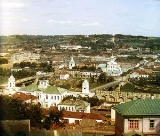
Smolensk is a city and the administrative center of Smolensk Oblast
, Russia
, located on the Dnieper River
. Situated 360 kilometres (223.7 mi) west-southwest of Moscow
, this walled city was destroyed several times throughout its long history since it was on the invasion routes of both Napoleon
and Hitler
. Today, Smolensk is noted for electronics
, textile
s, food processing and diamond
s facetting. Population:
is less clear. One possibility is the old Slavic word "смоль" (smol) for black soil
, which might have coloured the waters of the long-derelict Smolnya. An alternative origin could be the Russian
word смола smola, which means resin
, tar
, or pitch
. Pine trees
grow in the area, and city was once a center of resin processing and trade.
Another possibility is that it is named after the Swedish region of Småland
, where it is theorized that a large number of the Norse Rus (Varangian) travellers most likely originated from in the 9th and 10th centuries ie: Småländsk
(modern Swedish) - Smolensk.
The Byzantine
emperor Constantine VII
recorded its name as Μιλινισκα.
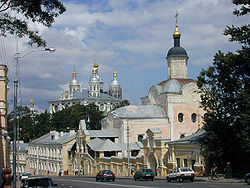
.png) Smolensk is among the oldest of Russian cities. The first recorded mention of the city was 863 AD, two years after the founding of ancient Rus. According to Russian Primary Chronicle
Smolensk is among the oldest of Russian cities. The first recorded mention of the city was 863 AD, two years after the founding of ancient Rus. According to Russian Primary Chronicle
, Smolensk (probably located slightly downstream, at the archaeological site of Gnezdovo
) was the capital of the Slavic Krivich
i tribe in 882 when Oleg of Novgorod
took it in passing from Novgorod
to Kiev
. The town was first attested two decades earlier, when the Varangian
chieftains Askold and Dir
, while on their way to Kiev, decided against challenging Smolensk on account of its large size and population.
The first foreign writer to mention the city was the Emperor Constantine Porphyrogenitus
. In De Administrando Imperio
(c. 950) he described Smolensk as a key station on the Trade route from the Varangians to the Greeks
. The Rus
sailed from the Baltics up the Western Dvina as far as they could then they pulled their boats
out onto the ground and dragged them along to the upper Dnieper
. It was in Smolensk that they supposedly mended any leaks and small holes that might have appeared in their boats from being dragged on the ground and they used tar
to do that, hence the city name.
The Principality of Smolensk
was founded in 1054. Due to its central position amid Russian lands, the city developed rapidly. By the end of the 12th century, the princedom was one of the strongest in Eastern Europe
, so that Smolensk dynasty frequently controlled the Kievan
throne. Numerous churches were built in the city at that time, including the church of Sts Peter and Paul (1146, reconstructed to its presumed original appearance after World War II
) and church of St John the Baptist
(1180, also partly rebuilt). The most remarkable church in the city is called Svirskaya (1197, still standing); it was admired by contemporaries as the most beautiful structure to the east of Kiev
.
Smolensk had its own veche
since the very beginning of its history. Its power increased after the disintegration of Kievan Rus, and although it was not as strong as the veche in Novgorod
the princes had to take its opinion into consideration, a few times in 12th-13th centuries there was an open conflict between them.
, gradually becoming a pawn in the long struggle between Lithuania
and Grand Duchy of Moscow
. The last sovereign monarch of Smolensk was Yury of Smolensk
; during his reign the city was taken by Vytautas the Great
of Lithuania on three occasions, in 1395, 1404 and 1408. After the city's incorporation into the Grand Duchy of Lithuania
, some of Smolensk's boyar
s(e.g., the Sapiehas) moved to Vilnius
; descendants of the ruling princes (e.g., the Tatishchevs, Kropotkin
s, Mussorgsky
s, Viazemskis) fled to Moscow
.
With tens of thousands of people living there, Smolensk was probably the largest city in 15th-century Lithuania. Three Smolensk regiments proved decisive during the Battle of Grunwald
against the Teutonic Knights
. It was a severe blow to Lithuania when the city was taken by Vasili III of Russia
in 1514. To commemorate this event, the tsar
founded the Novodevichy Convent
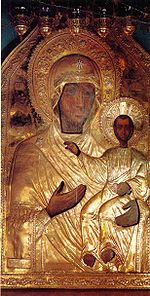
in Moscow and dedicated it to the icon
of Our Lady of Smolensk
.
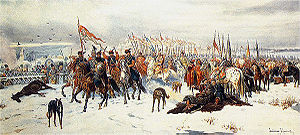 In order to repel future Polish–Lithuanian attacks, Boris Godunov
made it his priority to heavily fortify the city. The stone kremlin
constructed in 1597–1602 is the largest in Russia. It features thick walls and numerous watchtowers. Heavy fortifications did not prevent the fortress from being taken by the Polish–Lithuanian Commonwealth in 1611 after a long 20-month siege, during the Time of Troubles
and Dimitriads. Weakened Muscovy temporarily ceded Smolensk land to the Commonwealth in the Truce of Deulino
and for the next forty-three years it was the capital of the Smolensk Voivodeship
.
To recapture the city, the Tsardom of Russia
launched the so-called "Smolensk War
" against the Commonwealth in 1632. After a defeat at the hands of king Wladislaw IV
, the city remained in Polish–Lithuanian hands. In 1632, the Uniate bishop Lew Kreuza built his apartments in Smolensk; they were later converted into the Orthodox Church of Saint Barbara
. The hostilities resumed
in 1654 when the Commonwealth was being affected by the Khmelnytsky Uprising
and the Swedish invasion. After another siege, on September 23, 1654 Smolensk was recaptured by Russia. In the 1667 Truce of Andrusovo, the Polish–Lithuanian Commonwealth finally renounced its claims to Smolensk.
 Smolensk has been a special place to Russians for many reasons, not least for the fact that the local cathedral
housed one of the most venerated Orthodox icons, attributed to St Luke
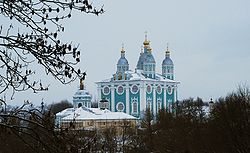
. Building the new Cathedral of the Assumption was a great project which took more than a century to complete. Despite slowly sinking into economic backwater, Smolensk was still valued by tsars as a key fortress defending the route to Moscow
. It was made the capital of Guberniya
in 1708.
In August 1812, two of the largest armies ever assembled clashed in Smolensk. During the hard-fought battle
, described by Leo Tolstoy
in War and Peace
, Napoleon
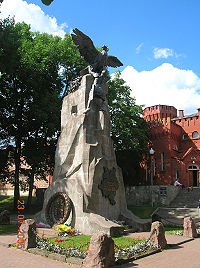
entered the city. Total losses were estimated at 30,000 men. Apart from other military monuments, downtown Smolensk features the Eagles monument, unveiled in 1912 to mark the centenary of Napoleon's Russian campaign
.
In March 1918, while the city remained a part of Russia, Belarusian People’s Republic, proclaimed in Minsk under the German occupation, declared Smolensk a part of it. In February–December 1918, Smolensk was home to the headquarters of the Western Front, North-West Oblast Bolshevik Committee and Western Oblast Executive Committee. On January 1, 1919, the Byelorussian Soviet Socialist Republic was proclaimed in Smolensk, but its government moved to Minsk
as soon as the German forces had been driven out of Minsk several days later.
During World War II
, Smolensk once again saw wide-scale fighting during the first Battle of Smolensk
when the city was captured by the Germans on July 16, 1941. The first Soviet
counteroffensive against the German army was launched in August 1941 but failed. However, the limited Soviet victories outside the city halted the German advance for a crucial two months, granting time to Moscow's defenders to prepare in earnest. Camp 126 was situated close to Smolensk and at this time Boris Menshagin was mayor of Smolensk, with his deputy Boris Bazilevsky. Both of them would be key witnesses in the Nuremberg Trials
over the Katyn massacre.
Over 93% of the city was destroyed during the fighting; the ancient icon of Our Lady of Smolensk was lost. The city was liberated on September 25, 1943. The rare title of Hero City
was bestowed on Smolensk after the war.
After the Germans captured the city in 1941, they found the intact archives of Smolensk Oblast Committee of the Communist Party, the so-called Smolensk Archive
. The archive was moved to Germany
, and a significant part of it eventually ended up in the United States, providing Western scholars and intelligence specialists with unique information on the local workings of the Soviet government during its first two decades. The archives were returned to Russia by the U.S. in 2002.
On 10 April 2010, a Tu-154 military jet carrying Polish president Lech Kaczyński
, his wife, and many notable political and military figures crashed in a wooded area near Smolensk while approaching the local military airport. All 96 passengers were killed immediately on impact. The purpose of the visit was to commemorate the 70th anniversary of the Katyn massacre
, in which some 22,000 Polish POWs were murdered by the NKVD.
 Smolensk has several factories including the Smolensk Aviation Plant and several electronics and agricultural machinery factories.
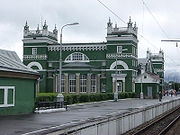 Smolensk is located on the M1 main highway
and main railway between Moscow and Minsk. Local public transport includes buses and trolleybuses.
Buses, trolleybuses, tram and marshrutka
s (passenger van) are the safest and cheapest way to travel around the city. The cost is 9-12 roubles for a 1-way ticket.
There are two airports located in the outskirts of the city; Smolensk South (civilian) and Smolensk North (military), however, there are no regular flights scheduled to Smolensk South Airport.
Smolensk Oblast
Smolensk Oblast is a federal subject of Russia . Its area is . Population: -Geography:The administrative center of Smolensk Oblast is the city of Smolensk. Other ancient towns include Vyazma and Dorogobuzh....
, Russia
Russia
Russia or , officially known as both Russia and the Russian Federation , is a country in northern Eurasia. It is a federal semi-presidential republic, comprising 83 federal subjects...
, located on the Dnieper River
Dnieper River
The Dnieper River is one of the major rivers of Europe that flows from Russia, through Belarus and Ukraine, to the Black Sea.The total length is and has a drainage basin of .The river is noted for its dams and hydroelectric stations...
. Situated 360 kilometres (223.7 mi) west-southwest of Moscow
Moscow
Moscow is the capital, the most populous city, and the most populous federal subject of Russia. The city is a major political, economic, cultural, scientific, religious, financial, educational, and transportation centre of Russia and the continent...
, this walled city was destroyed several times throughout its long history since it was on the invasion routes of both Napoleon
Napoleon I
Napoleon Bonaparte was a French military and political leader during the latter stages of the French Revolution.As Napoleon I, he was Emperor of the French from 1804 to 1815...
and Hitler
Adolf Hitler
Adolf Hitler was an Austrian-born German politician and the leader of the National Socialist German Workers Party , commonly referred to as the Nazi Party). He was Chancellor of Germany from 1933 to 1945, and head of state from 1934 to 1945...
. Today, Smolensk is noted for electronics
Electronics
Electronics is the branch of science, engineering and technology that deals with electrical circuits involving active electrical components such as vacuum tubes, transistors, diodes and integrated circuits, and associated passive interconnection technologies...
, textile
Textile
A textile or cloth is a flexible woven material consisting of a network of natural or artificial fibres often referred to as thread or yarn. Yarn is produced by spinning raw fibres of wool, flax, cotton, or other material to produce long strands...
s, food processing and diamond
Diamond
In mineralogy, diamond is an allotrope of carbon, where the carbon atoms are arranged in a variation of the face-centered cubic crystal structure called a diamond lattice. Diamond is less stable than graphite, but the conversion rate from diamond to graphite is negligible at ambient conditions...
s facetting. Population:
Origins of the name
The name of the city is derived from the name of the Smolnya Rivulet. The origin of the hydronymHydronym
A hydronym is a proper name of a body of water. Hydronymy is the study of hydronyms and of how bodies of water receive their names and how they are transmitted through history...
is less clear. One possibility is the old Slavic word "смоль" (smol) for black soil
Chernozem
Chernozem , also known as "black land" or "black earth", is a black-coloured soil containing a high percentage of humus 7% to 15%, and high percentages of phosphoric acids, phosphorus and ammonia...
, which might have coloured the waters of the long-derelict Smolnya. An alternative origin could be the Russian
Russian language
Russian is a Slavic language used primarily in Russia, Belarus, Uzbekistan, Kazakhstan, Tajikistan and Kyrgyzstan. It is an unofficial but widely spoken language in Ukraine, Moldova, Latvia, Turkmenistan and Estonia and, to a lesser extent, the other countries that were once constituent republics...
word смола smola, which means resin
Resin
Resin in the most specific use of the term is a hydrocarbon secretion of many plants, particularly coniferous trees. Resins are valued for their chemical properties and associated uses, such as the production of varnishes, adhesives, and food glazing agents; as an important source of raw materials...
, tar
Tar
Tar is modified pitch produced primarily from the wood and roots of pine by destructive distillation under pyrolysis. Production and trade in tar was a major contributor in the economies of Northern Europe and Colonial America. Its main use was in preserving wooden vessels against rot. The largest...
, or pitch
Pitch (resin)
Pitch is the name for any of a number of viscoelastic, solid polymers. Pitch can be made from petroleum products or plants. Petroleum-derived pitch is also called bitumen. Pitch produced from plants is also known as resin. Products made from plant resin are also known as rosin.Pitch was...
. Pine trees
Pine
Pines are trees in the genus Pinus ,in the family Pinaceae. They make up the monotypic subfamily Pinoideae. There are about 115 species of pine, although different authorities accept between 105 and 125 species.-Etymology:...
grow in the area, and city was once a center of resin processing and trade.
Another possibility is that it is named after the Swedish region of Småland
Småland
' is a historical province in southern Sweden.Småland borders Blekinge, Scania or Skåne, Halland, Västergötland, Östergötland and the island Öland in the Baltic Sea. The name Småland literally means Small Lands. . The latinized form Smolandia has been used in other languages...
, where it is theorized that a large number of the Norse Rus (Varangian) travellers most likely originated from in the 9th and 10th centuries ie: Småländsk
Småländska
Småländska is a general term for the accents of Swedish spoken in the historical province of Småland in southern Sweden. The northeastern accents are mainly influenced by the Central Swedish accents while the southwest has been more influenced by Southern Swedish accents, like that of Halland and...
(modern Swedish) - Smolensk.
The Byzantine
Byzantine
Byzantine usually refers to the Roman Empire during the Middle Ages.Byzantine may also refer to:* A citizen of the Byzantine Empire, or native Greek during the Middle Ages...
emperor Constantine VII
Constantine VII
Constantine VII Porphyrogennetos or Porphyrogenitus, "the Purple-born" was the fourth Emperor of the Macedonian dynasty of the Byzantine Empire, reigning from 913 to 959...
recorded its name as Μιλινισκα.
Medieval origins
Primary Chronicle
The Primary Chronicle , Ruthenian Primary Chronicle or Russian Primary Chronicle, is a history of Kievan Rus' from about 850 to 1110, originally compiled in Kiev about 1113.- Three editions :...
, Smolensk (probably located slightly downstream, at the archaeological site of Gnezdovo
Gnezdovo
Gnezdovo or Gnyozdovo is an archeological site located near the village of Gnyozdovo in Smolensk Oblast, Russia. The site contains extensive remains of a Slavic-Varangian settlement that flourished in the 10th century as a major trade station on the trade route from the Varangians to the...
) was the capital of the Slavic Krivich
Krivich
The Krivichi was one of the tribal unions of Early East Slavs between the 6th and the 12th centuries. They migrated to the mostly Finnic areas in the upper reaches of the Volga, Dnieper, Western Dvina, areas south of the lower reaches of river Velikaya and parts of the Neman basin.-Etymology:Many...
i tribe in 882 when Oleg of Novgorod
Oleg of Novgorod
Oleg of Novgorod was a Varangian prince who ruled all or part of the Rus' people during the early 10th century....
took it in passing from Novgorod
Veliky Novgorod
Veliky Novgorod is one of Russia's most historic cities and the administrative center of Novgorod Oblast. It is situated on the M10 federal highway connecting Moscow and St. Petersburg. The city lies along the Volkhov River just below its outflow from Lake Ilmen...
to Kiev
Kiev
Kiev or Kyiv is the capital and the largest city of Ukraine, located in the north central part of the country on the Dnieper River. The population as of the 2001 census was 2,611,300. However, higher numbers have been cited in the press....
. The town was first attested two decades earlier, when the Varangian
Varangians
The Varangians or Varyags , sometimes referred to as Variagians, were people from the Baltic region, most often associated with Vikings, who from the 9th to 11th centuries ventured eastwards and southwards along the rivers of Eastern Europe, through what is now Russia, Belarus and Ukraine.According...
chieftains Askold and Dir
Askold and Dir
Askold and Dir are semi-legendary rulers of Kiev who, according to the Primary Chronicle, were two of Rurik's voivodes in 870s...
, while on their way to Kiev, decided against challenging Smolensk on account of its large size and population.
The first foreign writer to mention the city was the Emperor Constantine Porphyrogenitus
Constantine VII
Constantine VII Porphyrogennetos or Porphyrogenitus, "the Purple-born" was the fourth Emperor of the Macedonian dynasty of the Byzantine Empire, reigning from 913 to 959...
. In De Administrando Imperio
De Administrando Imperio
De Administrando Imperio is the Latin title of a Greek work written by the 10th-century Eastern Roman Emperor Constantine VII. The Greek title of the work is...
(c. 950) he described Smolensk as a key station on the Trade route from the Varangians to the Greeks
Trade route from the Varangians to the Greeks
The trade route from the Varangians to the Greeks was a trade route that connected Scandinavia, Kievan Rus' and the Byzantine Empire. The route allowed traders along the route to establish a direct prosperous trade with Byzantium, and prompted some of them to settle in the territories of...
. The Rus
Rus' (people)
The Rus' were a group of Varangians . According to the Primary Chronicle of Rus, compiled in about 1113 AD, the Rus had relocated from the Baltic region , first to Northeastern Europe, creating an early polity which finally came under the leadership of Rurik...
sailed from the Baltics up the Western Dvina as far as they could then they pulled their boats
Portage
Portage or portaging refers to the practice of carrying watercraft or cargo over land to avoid river obstacles, or between two bodies of water. A place where this carrying occurs is also called a portage; a person doing the carrying is called a porter.The English word portage is derived from the...
out onto the ground and dragged them along to the upper Dnieper
Dnieper River
The Dnieper River is one of the major rivers of Europe that flows from Russia, through Belarus and Ukraine, to the Black Sea.The total length is and has a drainage basin of .The river is noted for its dams and hydroelectric stations...
. It was in Smolensk that they supposedly mended any leaks and small holes that might have appeared in their boats from being dragged on the ground and they used tar
Tar
Tar is modified pitch produced primarily from the wood and roots of pine by destructive distillation under pyrolysis. Production and trade in tar was a major contributor in the economies of Northern Europe and Colonial America. Its main use was in preserving wooden vessels against rot. The largest...
to do that, hence the city name.
The Principality of Smolensk
Principality of Smolensk
The Principality of Smolensk was a Kievan Rus' lordship from the eleventh to the fifteenth century...
was founded in 1054. Due to its central position amid Russian lands, the city developed rapidly. By the end of the 12th century, the princedom was one of the strongest in Eastern Europe
Eastern Europe
Eastern Europe is the eastern part of Europe. The term has widely disparate geopolitical, geographical, cultural and socioeconomic readings, which makes it highly context-dependent and even volatile, and there are "almost as many definitions of Eastern Europe as there are scholars of the region"...
, so that Smolensk dynasty frequently controlled the Kievan
Kievan Rus'
Kievan Rus was a medieval polity in Eastern Europe, from the late 9th to the mid 13th century, when it disintegrated under the pressure of the Mongol invasion of 1237–1240....
throne. Numerous churches were built in the city at that time, including the church of Sts Peter and Paul (1146, reconstructed to its presumed original appearance after World War II
World War II
World War II, or the Second World War , was a global conflict lasting from 1939 to 1945, involving most of the world's nations—including all of the great powers—eventually forming two opposing military alliances: the Allies and the Axis...
) and church of St John the Baptist
John the Baptist
John the Baptist was an itinerant preacher and a major religious figure mentioned in the Canonical gospels. He is described in the Gospel of Luke as a relative of Jesus, who led a movement of baptism at the Jordan River...
(1180, also partly rebuilt). The most remarkable church in the city is called Svirskaya (1197, still standing); it was admired by contemporaries as the most beautiful structure to the east of Kiev
Kiev
Kiev or Kyiv is the capital and the largest city of Ukraine, located in the north central part of the country on the Dnieper River. The population as of the 2001 census was 2,611,300. However, higher numbers have been cited in the press....
.
Smolensk had its own veche
Veche
Veche was a popular assembly in medieval Slavic countries.In Novgorod, where the veche acquired the greatest prominence, the veche was broadly similar to the Norse thing or the Swiss Landsgemeinde.-Etymology:...
since the very beginning of its history. Its power increased after the disintegration of Kievan Rus, and although it was not as strong as the veche in Novgorod
Novgorod veche
According to the traditional scholarship, the veche was the highest legislature and judicial authority in the Republic of Novgorod until 1478, when Novgorod the Great was brought under the direct control of Grand Prince Ivan III ....
the princes had to take its opinion into consideration, a few times in 12th-13th centuries there was an open conflict between them.
Between Russia, Lithuania, and Poland
Although spared the Mongol armies in 1240, Smolensk paid tribute to the Golden HordeGolden Horde
The Golden Horde was a Mongol and later Turkicized khanate that formed the north-western sector of the Mongol Empire...
, gradually becoming a pawn in the long struggle between Lithuania
Lithuania
Lithuania , officially the Republic of Lithuania is a country in Northern Europe, the biggest of the three Baltic states. It is situated along the southeastern shore of the Baltic Sea, whereby to the west lie Sweden and Denmark...
and Grand Duchy of Moscow
Grand Duchy of Moscow
The Grand Duchy of Moscow or Grand Principality of Moscow, also known in English simply as Muscovy , was a late medieval Rus' principality centered on Moscow, and the predecessor state of the early modern Tsardom of Russia....
. The last sovereign monarch of Smolensk was Yury of Smolensk
Yury of Smolensk
Yury Svyatoslavich or Georgy Svyatoslavovich was the last sovereign ruler of Smolensk and Bryansk whose life was spent in vain attempts to fend off aggression by the Grand Duchy of Lithuania.- Biography :...
; during his reign the city was taken by Vytautas the Great
Vytautas the Great
Vytautas ; styled "the Great" from the 15th century onwards; c. 1350 October 27, 1430) was one of the most famous rulers of medieval Lithuania. Vytautas was the ruler of the Grand Duchy of Lithuania which chiefly encompassed the Lithuanians and Ruthenians...
of Lithuania on three occasions, in 1395, 1404 and 1408. After the city's incorporation into the Grand Duchy of Lithuania
Grand Duchy of Lithuania
The Grand Duchy of Lithuania was a European state from the 12th /13th century until 1569 and then as a constituent part of Polish-Lithuanian Commonwealth until 1791 when Constitution of May 3, 1791 abolished it in favor of unitary state. It was founded by the Lithuanians, one of the polytheistic...
, some of Smolensk's boyar
Boyar
A boyar, or bolyar , was a member of the highest rank of the feudal Moscovian, Kievan Rus'ian, Bulgarian, Wallachian, and Moldavian aristocracies, second only to the ruling princes , from the 10th century through the 17th century....
s(e.g., the Sapiehas) moved to Vilnius
Vilnius
Vilnius is the capital of Lithuania, and its largest city, with a population of 560,190 as of 2010. It is the seat of the Vilnius city municipality and of the Vilnius district municipality. It is also the capital of Vilnius County...
; descendants of the ruling princes (e.g., the Tatishchevs, Kropotkin
Kropotkin
Peter Kropotkin was a Russian prince and anarchist.Kropotkin may also refer to:*Pyotr Nikolayevich Kropotkin , Soviet/Russian geologist, tectonician, and geophysicist*Mount Kropotkin, a peak in Antarctica...
s, Mussorgsky
Mussorgsky family
Mussorgsky , the name of an old Russian noble family, which is one of the branches of rich boyar family of Monastyrev, descendants of princes of Smolensk from Rurikid stock. The family traces its name to Roman Vasilyevich Monastyrev, nicknamed Mussorga . Peter Ivanovich Mussorgsky governed Staritsa...
s, Viazemskis) fled to Moscow
Moscow
Moscow is the capital, the most populous city, and the most populous federal subject of Russia. The city is a major political, economic, cultural, scientific, religious, financial, educational, and transportation centre of Russia and the continent...
.
With tens of thousands of people living there, Smolensk was probably the largest city in 15th-century Lithuania. Three Smolensk regiments proved decisive during the Battle of Grunwald
Battle of Grunwald
The Battle of Grunwald or 1st Battle of Tannenberg was fought on 15 July 1410, during the Polish–Lithuanian–Teutonic War. The alliance of the Kingdom of Poland and the Grand Duchy of Lithuania, led respectively by King Jogaila and Grand Duke Vytautas , decisively defeated the Teutonic Knights, led...
against the Teutonic Knights
Teutonic Knights
The Order of Brothers of the German House of Saint Mary in Jerusalem , commonly the Teutonic Order , is a German medieval military order, in modern times a purely religious Catholic order...
. It was a severe blow to Lithuania when the city was taken by Vasili III of Russia
Vasili III of Russia
Vasili III Ivanovich was the Grand Prince of Moscow from 1505 to 1533. He was the son of Ivan III Vasiliyevich and Sophia Paleologue and was christened with the name Gavriil...
in 1514. To commemorate this event, the tsar
Tsar
Tsar is a title used to designate certain European Slavic monarchs or supreme rulers. As a system of government in the Tsardom of Russia and Russian Empire, it is known as Tsarist autocracy, or Tsarism...
founded the Novodevichy Convent
Novodevichy Convent
Novodevichy Convent, also known as Bogoroditse-Smolensky Monastery is probably the best-known cloister of Moscow. Its name, sometimes translated as the New Maidens' Monastery, was devised to differ from an ancient maidens' convent within the Moscow Kremlin. Unlike other Moscow cloisters, it has...
in Moscow and dedicated it to the icon
Icon
An icon is a religious work of art, most commonly a painting, from Eastern Christianity and in certain Eastern Catholic churches...
of Our Lady of Smolensk
Hodegetria
A Hodegetria — or Virgin Hodegetria — is an iconographic depiction of the Theotokos holding the Child Jesus at her side while pointing to Him as the source of salvation for mankind...
.
Boris Godunov
Boris Fyodorovich Godunov was de facto regent of Russia from c. 1585 to 1598 and then the first non-Rurikid tsar from 1598 to 1605. The end of his reign saw Russia descend into the Time of Troubles.-Early years:...
made it his priority to heavily fortify the city. The stone kremlin
Kremlin
A kremlin , same root as in kremen is a major fortified central complex found in historic Russian cities. This word is often used to refer to the best-known one, the Moscow Kremlin, or metonymically to the government that is based there...
constructed in 1597–1602 is the largest in Russia. It features thick walls and numerous watchtowers. Heavy fortifications did not prevent the fortress from being taken by the Polish–Lithuanian Commonwealth in 1611 after a long 20-month siege, during the Time of Troubles
Time of Troubles
The Time of Troubles was a period of Russian history comprising the years of interregnum between the death of the last Russian Tsar of the Rurik Dynasty, Feodor Ivanovich, in 1598, and the establishment of the Romanov Dynasty in 1613. In 1601-1603, Russia suffered a famine that killed one-third...
and Dimitriads. Weakened Muscovy temporarily ceded Smolensk land to the Commonwealth in the Truce of Deulino
Truce of Deulino
Truce of Deulino was signed on 11 December 1618 and took effect on 4 January 1619. It concluded the Polish–Muscovite War between the Polish–Lithuanian Commonwealth and the Tsardom of Russia....
and for the next forty-three years it was the capital of the Smolensk Voivodeship
Smolensk Voivodeship
Smolensk Voivodeship was a unit of administrative division and local government in the Grand Duchy of Lithuania and later the Polish–Lithuanian Commonwealth....
.
To recapture the city, the Tsardom of Russia
Tsardom of Russia
The Tsardom of Russia was the name of the centralized Russian state from Ivan IV's assumption of the title of Tsar in 1547 till Peter the Great's foundation of the Russian Empire in 1721.From 1550 to 1700, Russia grew 35,000 km2 a year...
launched the so-called "Smolensk War
Smolensk War
The Smolensk War was a conflict fought between the Polish-Lithuanian Commonwealth and Russia.Hostilities began in October 1632 when Tsar forces tried to recapture the city of Smolensk, a former Russian possession. Small military engagements produced mixed results for both sides, but the surrender...
" against the Commonwealth in 1632. After a defeat at the hands of king Wladislaw IV
Władysław IV Vasa
Władysław IV Vasa was a Polish and Swedish prince from the House of Vasa. He reigned as King of the Polish–Lithuanian Commonwealth from 8 November 1632 to his death in 1648....
, the city remained in Polish–Lithuanian hands. In 1632, the Uniate bishop Lew Kreuza built his apartments in Smolensk; they were later converted into the Orthodox Church of Saint Barbara
Saint Barbara
Saint Barbara, , Feast Day December 4, known in the Eastern Orthodox Church as the Great Martyr Barbara, was an early Christian saint and martyr....
. The hostilities resumed
Russo-Polish War (1654–1667)
The Russo-Polish War of 1654–1667, also called Thirteen Years' War, First Northern War, War for Ukraine was the last major conflict between Tsardom of Russia and the Polish-Lithuanian Commonwealth. Between 1655 and 1660, the Second Northern War was also fought in the Polish-Lithuanian Commonwealth,...
in 1654 when the Commonwealth was being affected by the Khmelnytsky Uprising
Khmelnytsky Uprising
The Khmelnytsky Uprising, was a Cossack rebellion in the Ukraine between the years 1648–1657 which turned into a Ukrainian war of liberation from Poland...
and the Swedish invasion. After another siege, on September 23, 1654 Smolensk was recaptured by Russia. In the 1667 Truce of Andrusovo, the Polish–Lithuanian Commonwealth finally renounced its claims to Smolensk.
Modern history
Assumption Cathedral in Smolensk
The Cathedral Church of the Assumption, dominating the city of Smolensk from the lofty Cathedral Hill, has been the principal church of the Smolensk bishopric for 800 years.- Monomakh Cathedral :...
housed one of the most venerated Orthodox icons, attributed to St Luke
Luke the Evangelist
Luke the Evangelist was an Early Christian writer whom Church Fathers such as Jerome and Eusebius said was the author of the Gospel of Luke and the Acts of the Apostles...
. Building the new Cathedral of the Assumption was a great project which took more than a century to complete. Despite slowly sinking into economic backwater, Smolensk was still valued by tsars as a key fortress defending the route to Moscow
Moscow
Moscow is the capital, the most populous city, and the most populous federal subject of Russia. The city is a major political, economic, cultural, scientific, religious, financial, educational, and transportation centre of Russia and the continent...
. It was made the capital of Guberniya
Guberniya
A guberniya was a major administrative subdivision of the Russian Empire usually translated as government, governorate, or province. Such administrative division was preserved for sometime upon the collapse of the empire in 1917. A guberniya was ruled by a governor , a word borrowed from Latin ,...
in 1708.
In August 1812, two of the largest armies ever assembled clashed in Smolensk. During the hard-fought battle
Battle of Smolensk (1812)
The Battle of Smolensk, the first major battle of the French invasion of Russia took place on August 16–18, 1812, between 175,000 men of the Grande Armée under Napoleon Bonaparte and 130,000 Russians under Barclay de Tolly, though only about 50,000 and 60,000 respectively were actually engaged...
, described by Leo Tolstoy
Leo Tolstoy
Lev Nikolayevich Tolstoy was a Russian writer who primarily wrote novels and short stories. Later in life, he also wrote plays and essays. His two most famous works, the novels War and Peace and Anna Karenina, are acknowledged as two of the greatest novels of all time and a pinnacle of realist...
in War and Peace
War and Peace
War and Peace is a novel by the Russian author Leo Tolstoy, first published in 1869. The work is epic in scale and is regarded as one of the most important works of world literature...
, Napoleon
Napoleon I
Napoleon Bonaparte was a French military and political leader during the latter stages of the French Revolution.As Napoleon I, he was Emperor of the French from 1804 to 1815...
entered the city. Total losses were estimated at 30,000 men. Apart from other military monuments, downtown Smolensk features the Eagles monument, unveiled in 1912 to mark the centenary of Napoleon's Russian campaign
French invasion of Russia
The French invasion of Russia of 1812 was a turning point in the Napoleonic Wars. It reduced the French and allied invasion forces to a tiny fraction of their initial strength and triggered a major shift in European politics as it dramatically weakened French hegemony in Europe...
.
In March 1918, while the city remained a part of Russia, Belarusian People’s Republic, proclaimed in Minsk under the German occupation, declared Smolensk a part of it. In February–December 1918, Smolensk was home to the headquarters of the Western Front, North-West Oblast Bolshevik Committee and Western Oblast Executive Committee. On January 1, 1919, the Byelorussian Soviet Socialist Republic was proclaimed in Smolensk, but its government moved to Minsk
Minsk
- Ecological situation :The ecological situation is monitored by Republican Center of Radioactive and Environmental Control .During 2003–2008 the overall weight of contaminants increased from 186,000 to 247,400 tons. The change of gas as industrial fuel to mazut for financial reasons has worsened...
as soon as the German forces had been driven out of Minsk several days later.
During World War II
World War II
World War II, or the Second World War , was a global conflict lasting from 1939 to 1945, involving most of the world's nations—including all of the great powers—eventually forming two opposing military alliances: the Allies and the Axis...
, Smolensk once again saw wide-scale fighting during the first Battle of Smolensk
Battle of Smolensk (1941)
The Battle of Smolensk was a largely successful encirclement operation by the German Army Group Centre's 2nd Panzer Group led by Heinz Guderian and the 3rd Panzer Group led by Hermann Hoth against parts of four Soviet Fronts during World War II...
when the city was captured by the Germans on July 16, 1941. The first Soviet
Red Army
The Workers' and Peasants' Red Army started out as the Soviet Union's revolutionary communist combat groups during the Russian Civil War of 1918-1922. It grew into the national army of the Soviet Union. By the 1930s the Red Army was among the largest armies in history.The "Red Army" name refers to...
counteroffensive against the German army was launched in August 1941 but failed. However, the limited Soviet victories outside the city halted the German advance for a crucial two months, granting time to Moscow's defenders to prepare in earnest. Camp 126 was situated close to Smolensk and at this time Boris Menshagin was mayor of Smolensk, with his deputy Boris Bazilevsky. Both of them would be key witnesses in the Nuremberg Trials
Nuremberg Trials
The Nuremberg Trials were a series of military tribunals, held by the victorious Allied forces of World War II, most notable for the prosecution of prominent members of the political, military, and economic leadership of the defeated Nazi Germany....
over the Katyn massacre.
Over 93% of the city was destroyed during the fighting; the ancient icon of Our Lady of Smolensk was lost. The city was liberated on September 25, 1943. The rare title of Hero City
Hero City
Hero City is a Soviet honorary title awarded for outstanding heroism during the German-Soviet War of 1941 to 1945. It was awarded to twelve cities of the Soviet Union. In addition the Brest Fortress was awarded an equivalent title of Hero-Fortress...
was bestowed on Smolensk after the war.
After the Germans captured the city in 1941, they found the intact archives of Smolensk Oblast Committee of the Communist Party, the so-called Smolensk Archive
Smolensk Archive
The Smolensk Archive is the name given to the archives of Smolensk Oblast Committee of the Communist Party of the Soviet Union, which were captured intact by the army of Nazi Germany when it conquered the city of Smolensk in 1941...
. The archive was moved to Germany
Germany
Germany , officially the Federal Republic of Germany , is a federal parliamentary republic in Europe. The country consists of 16 states while the capital and largest city is Berlin. Germany covers an area of 357,021 km2 and has a largely temperate seasonal climate...
, and a significant part of it eventually ended up in the United States, providing Western scholars and intelligence specialists with unique information on the local workings of the Soviet government during its first two decades. The archives were returned to Russia by the U.S. in 2002.
On 10 April 2010, a Tu-154 military jet carrying Polish president Lech Kaczyński
2010 Polish Air Force Tu-154 crash
The 2010 Polish Air Force Tu-154 crash occurred on 10 April 2010, when a Tupolev Tu-154M aircraft of the Polish Air Force crashed near the city of Smolensk, Russia, killing all 96 people on board...
, his wife, and many notable political and military figures crashed in a wooded area near Smolensk while approaching the local military airport. All 96 passengers were killed immediately on impact. The purpose of the visit was to commemorate the 70th anniversary of the Katyn massacre
Katyn massacre
The Katyn massacre, also known as the Katyn Forest massacre , was a mass execution of Polish nationals carried out by the People's Commissariat for Internal Affairs , the Soviet secret police, in April and May 1940. The massacre was prompted by Lavrentiy Beria's proposal to execute all members of...
, in which some 22,000 Polish POWs were murdered by the NKVD.
Economy
Transport
M1 highway (Russia)
The Russian route M1 is a major trunk road that runs from Moscow through Smolensk before reaching the border with Belarus. The length is . The highway runs south of Odintsovo, Kubinka, Mozhaysk, Gagarin, north of Vyazma, through Safonovo and Yartsevo...
and main railway between Moscow and Minsk. Local public transport includes buses and trolleybuses.
Buses, trolleybuses, tram and marshrutka
Marshrutka
Marshrutka , from marshrutnoye taksi is a share taxi in the CIS countries, the Baltic states, and Bulgaria. Marshrutnoye taksi literally means routed taxicab...
s (passenger van) are the safest and cheapest way to travel around the city. The cost is 9-12 roubles for a 1-way ticket.
There are two airports located in the outskirts of the city; Smolensk South (civilian) and Smolensk North (military), however, there are no regular flights scheduled to Smolensk South Airport.
Education
Smolensk is home to the Smolensk State University (SMOLGU) and the Smolensk State Medical Academy (SSMA); together with colleges of further education and other educational institutes.Twin towns/sister cities
Smolensk is twinned with:- 1981
 TulleTulleTulle is a commune and capital of the Corrèze department in the Limousin region in central France. It is also the episcopal see of the Roman Catholic Diocese of Tulle...
, LimousinLimousin (région)Limousin is one of the 27 regions of France. It is composed of three départements: Corrèze, Creuse and the Haute-Vienne.Situated largely in the Massif Central, as of January 1st 2008, the Limousin comprised 740,743 inhabitants on nearly 17 000 km2, making it the second least populated region of...
FranceFranceThe French Republic , The French Republic , The French Republic , (commonly known as France , is a unitary semi-presidential republic in Western Europe with several overseas territories and islands located on other continents and in the Indian, Pacific, and Atlantic oceans. Metropolitan France... - 1985
 HagenHagenHagen is the 39th-largest city in Germany, located in the federal state of North Rhine-Westphalia. It is located on the eastern edge of the Ruhr area, 15 km south of Dortmund, where the rivers Lenne, Volme and Ennepe meet the river Ruhr...
, North Rhine-WestphaliaNorth Rhine-WestphaliaNorth Rhine-Westphalia is the most populous state of Germany, with four of the country's ten largest cities. The state was formed in 1946 as a merger of the northern Rhineland and Westphalia, both formerly part of Prussia. Its capital is Düsseldorf. The state is currently run by a coalition of the...
, GermanyGermanyGermany , officially the Federal Republic of Germany , is a federal parliamentary republic in Europe. The country consists of 16 states while the capital and largest city is Berlin. Germany covers an area of 357,021 km2 and has a largely temperate seasonal climate... - 1993
 Colorado SpringsColorado Springs, ColoradoColorado Springs is a Home Rule Municipality that is the county seat and most populous city of El Paso County, Colorado, United States. Colorado Springs is located in South-Central Colorado, in the southern portion of the state. It is situated on Fountain Creek and is located south of the Colorado...
, ColoradoColoradoColorado is a U.S. state that encompasses much of the Rocky Mountains as well as the northeastern portion of the Colorado Plateau and the western edge of the Great Plains...
, United StatesUnited StatesThe United States of America is a federal constitutional republic comprising fifty states and a federal district... - 1998
 KerchKerchKerch is a city on the Kerch Peninsula of eastern Crimea, an important industrial, transport and tourist centre of Ukraine. Kerch, founded 2600 years ago, is considered as one of the most ancient cities in Ukraine.-Ancient times:...
, CrimeaCrimeaCrimea , or the Autonomous Republic of Crimea , is a sub-national unit, an autonomous republic, of Ukraine. It is located on the northern coast of the Black Sea, occupying a peninsula of the same name...
, UkraineUkraineUkraine is a country in Eastern Europe. It has an area of 603,628 km², making it the second largest contiguous country on the European continent, after Russia...
People from Smolensk
- Alexander Belyayev, Soviet SF writer
- Natalia Ischenko, Russian synchro swimmer
- Mikhail GlinkaMikhail GlinkaMikhail Ivanovich Glinka , was the first Russian composer to gain wide recognition within his own country, and is often regarded as the father of Russian classical music...
, composer - Maria Leontyavna ItkinaMaria Leontyavna ItkinaMaria Leontyavna Itkina is a former Soviet runner and world record holder.-Personal life:Itkina is Jewish, and was born in Roslavl, Smolensk, Russia, and later lived in Minsk.-Running career:...
(born 1932), runner - Sergey KonenkovSergey KonenkovSergey Timofeyevich Konenkov was a famous Russian and Soviet sculptor. He was often called "the Russian Rodin".-Early life:...
, sculptor - Semyon LavochkinSemyon LavochkinSemyon Alekseyevich Lavochkin , a Soviet aerospace engineer, Soviet aircraft designer who founded the Lavochkin aircraft design bureau. Many of his fighter designs were produced in large numbers for Soviet forces during World War II.-Biography:...
, aircraft designer - Anatoly LukyanovAnatoly LukyanovAnatoly Ivanovich Lukyanov is a Russian Communist politician who was the Chairman of the Supreme Soviet of the USSR between 15 March 1990 and 22 August 1991. One of the founders of the Communist Party of the Russian Federation in 1993, he is described by its leader Gennady Zyuganov as the "Deng...
, politician - Gregori MaximoffGregori MaximoffGrigori Petrovitch Maximoff was a Russian-born anarcho-syndicalist who was involved in Nabat, a Ukrainian anarcho-syndicalist movement. Along with several other anarchists, he was imprisoned on 8 March 1921 following a Cheka sweep of anarchists in the area...
, politician - Grigory Potyomkin, statesman
- Aleksandr TvardovskyAleksandr TvardovskyAleksandr Trifonovich Tvardovsky was a Soviet poet, chief editor of Novy Mir literary magazine from 1950 to 1954 and 1958 to 1970...
, writer - Eduard KhilEduard KhilEduard Anatolyevich Khil , sometimes anglicised as Edward Hill, is a Russian baritone singer and a recipient of the People's Artist Award of the RSFSR.- Early life :...
, singer