

Evolutionary history of life

Encyclopedia
The evolutionary history of life on Earth
traces the processes by which living and fossil organisms have evolved since life on Earth first originated
until the present day. Earth formed about 4.5 Ga (billion years ago) and life appeared on its surface within one billion years. The similarities between all present day organisms indicate the presence of a common ancestor
from which all known species have diverged through the process of evolution
.
Microbial mat
s of coexisting bacteria
and archaea
were the dominant form of life in the early Archean
and many of the major steps in early evolution are thought to have taken place within them. The evolution of oxygenic photosynthesis, around 3.5 Ga, eventually led to the oxygenation of the atmosphere
, beginning around 2.4 Ga. The earliest evidence of eukaryotes (complex cells with organelle
s), dates from 1.85 Ga, and while they may have been present earlier, their diversification accelerated when they started using oxygen in their metabolism
. Later, around 1.7 Ga, multicellular organisms began to appear, with differentiated cells performing specialised functions.
The earliest land plants date back to around 450 Ma (million years ago), although evidence suggests that algal scum
formed on the land as early as 1.2 Ga. Land plants were so successful that they are thought to have contributed to the late Devonian extinction
event. Invertebrate
animals appear during the Vendian period, while vertebrates originated about during the Cambrian explosion
. During the Permian
period, synapsid
s, including the ancestors of mammal
s, dominated the land, but the Permian–Triassic extinction event came close to wiping out all complex life. During the recovery from this catastrophe, archosaur
s became the most abundant land vertebrates, displacing therapsids in the mid-Triassic
. One archosaur group, the dinosaur
s, dominated the Jurassic
and Cretaceous
periods, with the ancestors of mammals surviving only as small insectivore
s. After the Cretaceous–Tertiary extinction event killed off the non-avian dinosaurs mammals increased rapidly in size and diversity
. Such mass extinctions may have accelerated evolution by providing opportunities for new groups of organisms to diversify.
Fossil evidence indicates that flowering plant
s appeared and rapidly diversified in the Early Cretaceous
probably helped by coevolution with pollinating insects. Flowering plants and marine phytoplankton
are still the dominant producers of organic matter
. Social insects appeared around the same time as flowering plants. Although they occupy only small parts of the insect "family tree", they now form over half the total mass of insects. Humans evolved from a lineage of upright-walking ape
s whose earliest fossils date from over 6 Ma. Although early members of this lineage had chimpanzee
-sized brain
s, there are signs of a steady increase in brain size after about 3 Ma.
fragments found on Earth
are about 4.54 Ga; this, coupled primarily with the dating of ancient lead deposits, has put the estimated age of Earth at around that time. The Moon
has the same composition as Earth's crust
but does not contain an iron
-rich core
like the Earth's. Many scientists think that about 40 Ma later a planetoid struck the Earth, throwing into orbit crust material that formed the Moon. Another hypothesis is that the Earth and Moon started to coalesce at the same time but the Earth, having much stronger gravity, attracted almost all the iron particles in the area.
Until recently the oldest rocks found on Earth were about 3.8 Ga, leading scientists to believe for decades that Earth's surface had been molten until then. Accordingly, they named this part of Earth's history the Hadean
eon, whose name means "hellish". However analysis of zircon
s formed 4.4 Ga indicates that Earth's crust
solidified about 100 Ma after the planet's formation and that the planet quickly acquired oceans and an atmosphere, which may have been capable of supporting life.
Evidence from the Moon indicates that from 4 Ga to 3.8 Ga it suffered a Late Heavy Bombardment
by debris that was left over from the formation of the Solar system
, and the Earth should have experienced an even heavier bombardment due to its stronger gravity. While there is no direct evidence of conditions on Earth 4 Ga to 3.8 Ga, there is no reason to think that the Earth was not also affected by this late heavy bombardment. This event may well have stripped away any previous atmosphere and oceans; in this case gases and water from comet
impacts may have contributed to their replacement, although volcanic
outgassing
on Earth would have contributed at least half.
ized bacteria
, dates to 3 Ga. Other finds in rocks dated to about 3.5 Ga have been interpreted as bacteria, with geochemical evidence also seeming to show the presence of life 3.8 Ga. However these analyses were closely scrutinized, and non-biological processes were found which could produce all of the "signatures of life" that had been reported. While this does not prove that the structures found had a non-biological origin, they cannot be taken as clear evidence for the presence of life. Geochemical signatures from rocks deposited 3.4 Ga have been interpreted as evidence for life, although these statements have not been thoroughly examined by critics.
, because it would be virtually impossible that two or more separate lineages could have independently developed the many complex biochemical mechanisms common to all living organisms. As previously mentioned the earliest organisms for which fossil evidence is available are bacteria
, cells far too complex to have arisen directly from non-living materials. The lack of fossil or geochemical evidence for earlier organisms has left plenty of scope for hypotheses, which fall into two main groups: 1) that life arose spontaneously on Earth or 2) that it was "seeded" from elsewhere in the universe.
. In the twentieth century it was proposed by the physical chemist
Svante Arrhenius
, by the astronomer
s Fred Hoyle
and Chandra Wickramasinghe
, and by molecular biologist Francis Crick
and chemist Leslie Orgel
. There are three main versions of the "seeded from elsewhere" hypothesis: from elsewhere in our Solar system
via fragments knocked into space by a large meteor
impact, in which case the only credible source is Mars
; by alien visitors, possibly as a result of accidental contamination
by micro-organisms that they brought with them; and from outside the Solar system but by natural means. Experiments suggest that some micro-organisms can survive the shock of being catapulted into space and some can survive exposure to radiation for several days, but there is no proof that they can survive in space for much longer periods. Scientists are divided over the likelihood of life arising independently on Mars, or on other planets in our galaxy
.
and water
. Carbon provides stable frameworks for complex chemicals and can be easily extracted from the environment, especially from carbon dioxide
. The only other element with similar chemical properties, silicon
, forms much less stable structures and, because most of its compounds are solids, would be more difficult for organisms to extract. Water is an excellent solvent
and has two other useful properties: the fact that ice floats enables aquatic organisms to survive beneath it in winter; and its molecules have electrically negative
and positive ends, which enables it to form a wider range of compounds than other solvents can. Other good solvents, such as ammonia
, are liquid only at such low temperatures that chemical reactions may be too slow to sustain life, and lack water's other advantages. Organisms based on alternative biochemistry
may however be possible on other planets.
Research on how life might have emerged unaided from non-living chemicals focuses on three possible starting points: self-replication
, an organism's ability to produce offspring that are very similar to itself; metabolism
, its ability to feed and repair itself; and external cell membrane
s, which allow food to enter and waste products to leave, but exclude unwanted substances. Research on abiogenesis still has a long way to go, since theoretical and empirical
approaches are only beginning to make contact with each other.
to record their "recipes
" and a complex array of RNA
and protein
molecules to "read" these instructions and use them for growth, maintenance and self-replication. This system is far too complex to have emerged directly from non-living materials. The discovery that some RNA molecules can catalyze both their own replication and the construction of proteins led to the hypothesis of earlier life-forms based entirely on RNA. These ribozymes could have formed an RNA world in which there were individuals but no species
, as mutation
s and horizontal gene transfer
s would have meant that the offspring in each generation were quite likely to have different genomes from those that their parents started with. RNA would later have been replaced by DNA, which is more stable and therefore can build longer genomes, expanding the range of capabilities a single organism can have.
Ribozymes remain as the main components of ribosome
s, modern cells' "protein factories".
Although short self-replicating RNA molecules have been artificially produced in laboratories, doubts have been raised about where natural non-biological synthesis of RNA is possible. The earliest "ribozymes" may have been formed of simpler nucleic acid
s such as PNA, TNA or GNA, which would have been replaced later by RNA.
In 2003 it was proposed that porous metal sulfide precipitates would assist RNA synthesis at about 100 °C (212 °F) and ocean-bottom pressures near hydrothermal vent
s. In this hypothesis lipid membranes would be the last major cell components to appear and until then the proto-cells would be confined to the pores.
s from inorganic materials including carbon monoxide
and hydrogen sulfide
could be achieved by using iron sulfide
and nickel sulfide as catalysts. Most of the steps required temperatures of about 100 °C (212 °F) and moderate pressures, although one stage required 250 °C (482 °F) and a pressure equivalent to that found under 7 kilometres (4.3 mi) of rock. Hence it was suggested that self-sustaining synthesis of protein
s could have occurred near hydrothermal vent
s.
s like those that form the external membranes of cells may have been an essential first step. Experiments that simulated the conditions of the early Earth have reported the formation of lipids, and these can spontaneously form liposome
s, double-walled "bubbles", and then reproduce themselves. Although they are not intrinsically information-carriers as nucleic acid
s are, they would be subject to natural selection
for longevity and reproduction. Nucleic acids such as RNA might then have formed more easily within the liposomes than they would have outside.
is complex and there are doubts about whether it can be produced non-biologically in the wild. Some clay
s, notably montmorillonite
, have properties that make them plausible accelerators for the emergence of an RNA world: they grow by self-replication of their crystal
line pattern; they are subject to an analog of natural
selection, as the clay "species" that grows fastest in a particular environment rapidly becomes dominant; and they can catalyze the formation of RNA molecules. Although this idea has not become the scientific consensus, it still has active supporters.
Research in 2003 reported that montmorillonite could also accelerate the conversion of fatty acid
s into "bubbles", and that the "bubbles" could encapsulate RNA attached to the clay. These "bubbles" can then grow by absorbing additional lipids and then divide. The formation of the earliest cells
may have been aided by similar processes.
A similar hypothesis presents self-replicating iron-rich clays as the progenitors of nucleotide
s, lipid
s and amino acid
s.
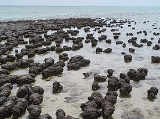
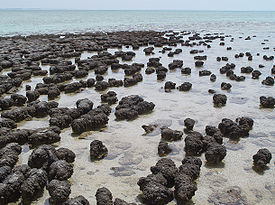 Microbial mats are multi-layered, multi-species
colonies of bacteria
and other organisms that are generally only a few millimeters thick, but still contain a wide range of chemical environments, each of which favors a different set of micro-organisms. To some extent each mat forms its own food chain
, as the by-products of each group of micro-organisms generally serve as "food" for adjacent groups.
Stromatolite
s are stubby pillars built as microbes in mats slowly migrate upwards to avoid being smothered by sediment deposited on them by water. There has been vigorous debate about the validity of alleged fossil
s from before 3 Ga, with critics arguing that so-called stromatolites could have been formed by non-biological processes. In 2006 another find of stromatolites was reported from the same part of Australia as previous ones, in rocks dated to 3.5 Ga.
In modern underwater mats the top layer often consists of photosynthesizing
cyanobacteria which create an oxygen
-rich environment, while the bottom layer is oxygen-free and often dominated by hydrogen sulfide
emitted by the organisms living there. It is estimated that the appearance of oxygenic photosynthesis by bacteria in mats increased biological productivity by a factor of between 100 and 1,000. The reducing agent
used by oxygenic photosynthesis is water
, which is much more plentiful than the geologically-produced reducing agents required by the earlier non-oxygenic photosynthesis. From this point onwards life itself produced significantly more of the resources it needed than did geochemical processes. Oxygen is toxic to organisms that are not adapted to it, but greatly increases the metabolic
efficiency of oxygen-adapted organisms. Oxygen became a significant component of Earth's atmosphere about 2.4 Ga. Although eukaryote
s may have been present much earlier, the oxygenation of the atmosphere was a prerequisite for the evolution of the most complex eukaryotic cells, from which all multicellular organisms are built. The boundary between oxygen-rich and oxygen-free layers in microbial mats would have moved upwards when photosynthesis shut down overnight, and then downwards as it resumed on the next day. This would have created selection pressure for organisms in this intermediate zone to acquire the ability to tolerate and then to use oxygen, possibly via endosymbiosis, where one organism lives inside another and both of them benefit from their association.
Cyanobacteria have the most complete biochemical "toolkits" of all the mat-forming organisms. Hence they are the most self-sufficient of the mat organisms and were well-adapted to strike out on their own both as floating mats and as the first of the phytoplankton
, providing the basis of most marine food chain
s.
s may have been present long before the oxygenation of the atmosphere, but most modern eukaryotes require oxygen, which their mitochondria use to fuel the production of ATP
, the internal energy supply of all known cells. In the 1970s it was proposed and, after much debate, widely accepted that eukaryotes emerged as a result of a sequence of endosymbioses between "procaryotes". For example: a predatory micro-organism invaded a large procaryote, probably an archaea
n, but the attack was neutralized, and the attacker took up residence and evolved into the first of the mitochondria; one of these chimeras
later tried to swallow a photosynthesizing
cyanobacterium, but the victim survived inside the attacker and the new combination became the ancestor of plant
s; and so on. After each endosymbiosis began, the partners would have eliminated unproductive duplication of genetic functions by re-arranging their genome
s, a process which sometimes involved transfer of genes between them. Another hypothesis proposes that mitochondria were originally sulfur
- or hydrogen
-metabolising endosymbionts, and became oxygen-consumers later. On the other hand mitochondria might have been part of eukaryotes' original equipment.
There is a debate about when eukaryotes first appeared: the presence of sterane
s in Australia
n shale
s may indicate that eukaryotes were present 2.7 Ga; however an analysis in 2008 concluded that these chemicals infiltrated the rocks less than 2.2 Ga and prove nothing about the origins of eukaryotes. Fossils of the alga Grypania
have been reported in 1.85 Ga rocks (originally dated to 2.1 Ga but later revised), and indicates that eukaryotes with organelle
s had already evolved. A diverse collection of fossil algae were found in rocks dated between 1.5 and 1.4 Ga. The earliest known fossils of fungi date from 1.43 Ga.
cyanobacteria like Nostoc
. Even a professional biologist's definition such as "having the same genome
but different types of cell" would still include some genera
of the green alga Volvox
, which have cells that specialize in reproduction. Multicellularity evolved independently in organisms as diverse as sponges and other animal
s, fungi, plant
s, brown algae
, cyanobacteria, slime mould
s and myxobacteria
. For the sake of brevity this article focuses on the organisms that show the greatest specialization of cells and variety of cell types, although this approach to the evolution of complexity
could be regarded as "rather anthropocentric".
 The initial advantages of multicellularity may have included: increased resistance to predators, many of which attacked by engulfing; the ability to resist currents by attaching to a firm surface; the ability to reach upwards to filter-feed or to obtain sunlight for photosynthesis; the ability to create an internal environment that gives protection against the external one; and even the opportunity for a group of cells to behave "intelligently" by sharing information. These features would also have provided opportunities for other organisms to diversify, by creating more varied environments than flat microbial mat
s could.
Multicellularity with differentiated cells is beneficial to the organism as a whole but disadvantageous from the point of view of individual cells, most of which lose the opportunity to reproduce themselves. In an asexual multicellular organism, rogue cells which retain the ability to reproduce may take over and reduce the organism to a mass of undifferentiated cells. Sexual reproduction eliminates such rogue cells from the next generation and therefore appears to be a prerequisite for complex multicellularity.
The available evidence indicates that eukaryotes evolved much earlier but remained inconspicuous until a rapid diversification around 1 Ga. The only respect in which eukaryotes clearly surpass bacteria
and archaea
is their capacity for variety of forms, and sexual reproduction enabled eukaryotes to exploit that advantage by producing organisms with multiple cells that differed in form and function.
is recombination
, in which each of the offspring receives 50% of its genetic inheritance from each of the parents. Bacteria
also exchange DNA
by bacterial conjugation
, the benefits of which include resistance to antibiotics
and other toxin
s, and the ability to utilize new metabolite
s. However conjugation is not a means of reproduction, and is not limited to members of the same species – there are cases where bacteria transfer DNA to plants and animals.
The disadvantages of sexual reproduction are well-known: the genetic reshuffle of recombination may break up favorable combinations of genes; and since males do not directly increase the number of offspring in the next generation, an asexual population can out-breed and displace in as little as 50 generations a sexual population that is equal in every other respect. Nevertheless the great majority of animals, plants, fungi and protist
s reproduce sexually. There is strong evidence that sexual reproduction arose early in the history of eukaryote
s and that the genes controlling it have changed very little since then. How sexual reproduction evolved and survived is an unsolved puzzle.
The Red Queen Hypothesis suggests that sexual reproduction provides protection against parasites, because it is easier for parasites to evolve means of overcoming the defenses of genetically identical clones
than those of sexual species that present moving targets, and there is some experimental evidence for this. However there is still doubt about whether it would explain the survival of sexual species if multiple similar clone species were present, as one of the clones may survive the attacks of parasites for long enough to out-breed the sexual species.
The Mutation Deterministic Hypothesis assumes that each organism has more than one harmful mutation
and the combined effects of these mutations are more harmful than the sum of the harm done by each individual mutation. If so, sexual recombination of genes will reduce the harm that bad mutations do to offspring and at the same time eliminate some bad mutations from the gene pool
by isolating them in individuals that perish quickly because they have an above-average number of bad mutations. However the evidence suggests that the MDH's assumptions are shaky, because many species have on average less than one harmful mutation per individual and no species that has been investigated shows evidence of synergy
between harmful mutations.
 The random nature of recombination causes the relative abundance of alternative traits to vary from one generation to another. This genetic drift
is insufficient on its own to make sexual reproduction advantageous, but a combination of genetic drift and natural selection
may be sufficient. When chance produces combinations of good traits, natural selection gives a large advantage to lineages in which these traits become genetically linked. On the other hand the benefits of good traits are neutralized if they appear along with bad traits. Sexual recombination gives good traits the opportunities to become linked with other good traits, and mathematical models suggest this may be more than enough to offset the disadvantages of sexual reproduction. Other combinations of hypotheses that are inadequate on their own are also being examined.
, dated to 2.1 Ga, is the earliest known fossil organism that is clearly multicellular. This may have had differentiated cells. Another early multicellular fossil, Qingshania,Name given as in Butterfield's paper "Bangiomorpha pubescens ..." (2000). A fossil fish, also from China, has also been named Qingshania. The name of one of these will have to change. dated to 1.7 Ga, appears to consist of virtually identical cells. The red alga called Bangiomorpha
, dated at 1.2 Ga, is the earliest known organism which certainly has differentiated, specialized cells, and is also the oldest known sexually-reproducing organism. The 1.43 billion-year-old fossils interpreted as fungi appear to have been multicellular with differentiated cells. The "string of beads" organism Horodyskia
, found in rocks dated from 1.5 Ga to 900 Ma, may have been an early metazoan; however it has also been interpreted as a colonial
foraminifera
n.
s,Myxozoa
were thought to be an exception, but are now thought to be heavily modified members of the Cnidaria
: and are distinguished from plants, algae, and fungi
by lacking cell wall
s. All animals are motile, if only at certain life stages. All animals except sponges have bodies differentiated into separate tissues
, including muscle
s, which move parts of the animal by contracting, and nerve tissue
, which transmits and processes signals.
The earliest widely-accepted animal fossils are rather modern-looking cnidaria
ns (the group that includes jellyfish
, sea anemone
s and hydras
), possibly from around , although fossils from the Doushantuo Formation
can only be dated approximately. Their presence implies that the cnidarian and bilateria
n lineages had already diverged.
The Ediacara biota
, which flourished for the last 40 Ma before the start of the Cambrian
, were the first animals more than a very few centimeters long. Many were flat and had a "quilted" appearance, and seemed so strange that there was a proposal to classify them as a separate kingdom
, Vendozoa. Others, however, been interpreted as early molluscs (Kimberella
), echinoderm
s (Arkarua
), and arthropod
s (Spriggina
, Parvancorina
). There is still debate about the classification of these specimens, mainly because the diagnostic features which allow taxonomists to classify more recent organisms, such as similarities to living organisms, are generally absent in the Ediacarans. However there seems little doubt that Kimberella was at least a triploblastic bilateria
n animal, in other words significantly more complex than cnidarians.
The small shelly fauna
are a very mixed collection of fossils found between the Late Ediacaran and Mid Cambrian periods. The earliest, Cloudina, shows signs of successful defense against predation and may indicate the start of an evolutionary arms race
. Some tiny Early Cambrian shells almost certainly belonged to molluscs, while the owners of some "armor plates", Halkieria
and Microdictyon
, were eventually identified when more complete specimens were found in Cambrian lagerstätte
n that preserved soft-bodied animals.
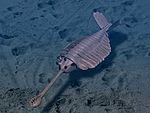 In the 1970s there was already a debate about whether the emergence of the modern phyla
was "explosive" or gradual but hidden by the shortage of Pre-Cambrian animal fossils. A re-analysis of fossils from the Burgess Shale
lagerstätte increased interest in the issue when it revealed animals, such as Opabinia
, which did not fit into any known phylum
. At the time these were interpreted as evidence that the modern phyla had evolved very rapidly in the "Cambrian explosion
" and that the Burgess Shale's "weird wonders" showed that the Early Cambrian was a uniquely experimental period of animal evolution. Later discoveries of similar animals and the development of new theoretical approaches led to the conclusion that many of the "weird wonders" were evolutionary "aunts" or "cousins" of modern groups – for example that Opabinia was a member of the lobopods, a group which includes the ancestors of the arthropod
s, and that it may have been closely related to the modern tardigrade
s. Nevertheless there is still much debate about whether the Cambrian explosion was really explosive and, if so, how and why it happened and why it appears unique in the history of animals.
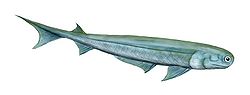 Most of the animals at the heart of the Cambrian explosion debate are protostome
s, one of the two main groups of complex animals. One deuterostome
group, the echinoderm
s, many of which have hard calcite
"shells", are fairly common from the Early Cambrian small shelly fauna onwards. Other deuterostome groups are soft-bodied, and most of the significant Cambrian deuterostome fossils come from the Chengjiang fauna, a lagerstätte in China. The Chengjiang fossils Haikouichthys
and Myllokunmingia
appear to be true vertebrates, and Haikouichthys had distinct vertebrae, which may have been slightly mineralized. Vertebrates with jaws, such as the Acanthodians, first appeared in the Late Ordovician.
and gas exchange
systems have to change; reproductive systems cannot depend on water to carry eggs and sperm towards each other. Although the earliest good evidence of land plants and animals dates back to the Ordovician
period , and a number of microorganism lineages made it onto land much earlier, modern land ecosystem
s only appeared in the late Devonian
, about .
is a potent oxidant whose accumulation in terrestrial atmosphere resulted from the development of photosynthesis
over 3 Ga, in blue-green algae (Cyanobacteria), which were the most primitive oxygenic photosynthetic organisms. Brown algae
(seaweeds) accumulate inorganic mineral antioxidants as Rubidium, Vanadium, Zinc
, Iron
, Cuprum, Molybdenum, Selenium
and Iodine
which is concentrated more than 30,000 times the concentration of this element in seawater. Protective endogenous antioxidant enzymes and exogenous dietary antioxidants helped to prevent oxidative damage.
Most marine mineral antioxidants act in the cells as essential trace-elements in redox and antioxidant metallo-enzymes.
When about 500 Ma ago plants and animals began to transfer from the sea to rivers and land, environmental deficiency of these marine mineral antioxidants and iodine, was a challenge to the evolution of terrestrial life. Terrestrial plants slowly optimized the production of “new” endogenous antioxidants such as ascorbic acid
, polyphenols, flavonoids, tocopherols etc. A few of these appeared more recently, in last 200-50 Ma ago, in fruits and flowers of angiosperm plants.
In fact Angiosperms (the dominant type of plant today) and most of their antioxidant pigments evolved during the late Jurassic
period. Plants employ antioxidants to defend their structures against reactive oxygen species produced during photosynthesis. Animal and human body is exposed to the same oxidants, and it has also evolved endogenous enzymatic antioxidant systems. Plant-based, antioxidant-rich foods traditionally formed the major part of the human diet, and plant-based dietary antioxidants are hypothesized to have an important role in maintaining human health . Iodine
is the most primitive and abundant electron-rich essential element in the diet of marine and terrestrial organisms, and as iodide acts as an electron-donor and has this ancestral antioxidant function in all iodide-concentrating cells from primitive marine algae to more recent terrestrial vertebrates.
, a combination of mineral particles and decomposed organic matter
, did not exist. Land surfaces would have been either bare rock or unstable sand produced by weathering
. Water and any nutrients in it would have drained away very quickly.
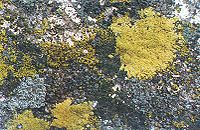 Films of cyanobacteria, which are not plants but use the same photosynthesis
mechanisms, have been found in modern deserts, and only in areas that are unsuitable for vascular plant
s. This suggests that microbial mat
s may have been the first organisms to colonize dry land, possibly in the Precambrian
. Mat-forming cyanobacteria could have gradually evolved resistance to desiccation as they spread from the seas to tidal zones and then to land. Lichen
s, which are symbiotic
combinations of a fungus (almost always an ascomycete) and one or more photosynthesizers (green algae
or cyanobacteria), are also important colonizers of lifeless environments, and their ability to break down rocks contributes to soil formation in situations where plants cannot survive. The earliest known ascomycete fossils date from in the Silurian
.
Soil formation would have been very slow until the appearance of burrowing animals, which mix the mineral and organic components of soil and whose feces
are a major source of the organic components. Burrows have been found in Ordovician
sediments, and are attributed to annelid
s ("worms") or arthropods.
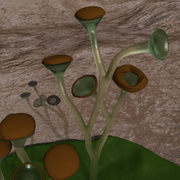
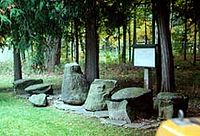 In aquatic algae, almost all cells are capable of photosynthesies and are nearly independent. Life on land required plants to become internally more complex and specialized: photosynthesis was most efficient at the top; roots were required in order to extract water from the ground; the parts in between became supports and transport systems for water and nutrients.
Spore
s of land plants, possibly rather like liverworts
, have been found in Mid Ordovician
rocks dated to about . In Mid Silurian
rocks there are fossils of actual plants including clubmosses such as Baragwanathia
; most were under 10 centimetres (3.9 in) high, and some appear closely related to vascular plant
s, the group that includes trees.
By the Late Devonian
, tree
s such as Archaeopteris
were so abundant that they changed river systems from mostly braided
to mostly meandering, because their roots bound the soil firmly. In fact they caused a "Late Devonian wood crisis", because:
of their eggs. The difference in refractive index
between water and air required changes in their eyes. On the other hand in some ways movement and breathing became easier, and the better transmission of high-frequency sounds in air encouraged the development of hearing
.
Some trace fossil
s from the Cambrian
-Ordovician
boundary about are interpreted as the tracks of large amphibious
arthropod
s on coastal sand dunes, and may have been made by euthycarcinoid
s, which are thought to be evolutionary "aunts" of myriapods. Other trace fossils from the Late Ordovician
a little over probably represent land invertebrates, and there is clear evidence of numerous arthropods on coasts and alluvial plain
s shortly before the Silurian
-Devonian
boundary, about , including signs that some arthropods ate plants. Arthropods were well pre-adapted
to colonise land, because their existing jointed exoskeletons provided protection against desiccation, support against gravity and a means of locomotion that was not dependent on water.
The fossil record of other major invertebrate groups on land is poor: none at all for non-parasitic flatworm
s, nematode
s or nemerteans; some parasitic nematodes have been fossilized in amber
; annelid
worm fossils are known from the Carboniferous, but they may still have been aquatic animals; the earliest fossils of gastropods on land date from the Late Carboniferous, and this group may have had to wait until leaf litter became abundant enough to provide the moist conditions they need.
The earliest confirmed fossils of flying insect
s date from the Late Carboniferous, but it is thought that insect
s developed the ability to fly in the Early Carboniferous or even Late Devonian. This gave them a wider range of ecological niche
s for feeding and breeding, and a means of escape from predators and from unfavorable changes in the environment. About 99% of modern insect species fly or are descendants of flying species.
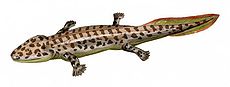 Tetrapod
s, vertebrates with four limbs, evolved from other rhipidistia
n fish over a relatively short timespan during the Late Devonian
. The early groups are grouped together as Labyrinthodontia
. They retained aquatic, fry-like tadpole
s, a system still seen in modern amphibians
. From the 1950s to the early 1980s it was thought that tetrapods evolved from fish that had already acquired the ability to crawl on land, possibly in order to go from a pool that was drying out to one that was deeper. However in 1987 nearly-complete fossils of Acanthostega
from about showed that this Late Devonian transitional
animal had legs and both lungs and gills, but could never have survived on land: its limbs and its wrist and ankle joints were too weak to bear its weight; its ribs were too short to prevent its lungs from being squeezed flat by its weight; its fish-like tail fin would have been damaged by dragging on the ground. The current hypothesis is that Acanthostega, which was about 1 metres (3.3 ft) long, was a wholly aquatic predator that hunted in shallow water. Its skeleton differed from that of most fish, in ways that enabled it to raise its head to breathe air while its body remained submerged, including: its jaws show modifications that would have enabled it to gulp air; the bones at the back of its skull are locked together, providing strong attachment points for muscles that raised its head; the head is not joined to the shoulder girdle and it has a distinct neck.
The Devonian proliferation of land plants may help to explain why air-breathing would have been an advantage: leaves falling into streams and rivers would have encouraged the growth of aquatic vegetation; this would have attracted grazing invertebrates and small fish that preyed on them; they would have been attractive prey but the environment was unsuitable for the big marine predatory fish; air-breathing would have been necessary because these waters would have been short of oxygen, since warm water holds less dissolved oxygen than cooler marine water and since the decomposition of vegetation would have used some of the oxygen.
Later discoveries revealed earlier transitional forms between Acanthostega and completely fish-like animals. Unfortunately there is then a gap (Romer's gap
) of about 30 Ma between the fossils of ancestral tetrapods and Mid Carboniferous
fossils of vertebrates that look well-adapted for life on land. Some of these look like early relatives of modern amphibians, most of which need to keep their skins moist and to lay their eggs in water, while others are accepted as early relatives of the amniote
s, whose water-proof skin enable them to live and breed far from water.
}}
|label2=
|2=Ornithischia
ns (extinct)
}}
}}
}}
}}
}}
}}
}}
}}
}}
}}
Possible family tree of dinosaurs, birds and mammalsEarth
Earth is the third planet from the Sun, and the densest and fifth-largest of the eight planets in the Solar System. It is also the largest of the Solar System's four terrestrial planets...
traces the processes by which living and fossil organisms have evolved since life on Earth first originated
Abiogenesis
Abiogenesis or biopoesis is the study of how biological life arises from inorganic matter through natural processes, and the method by which life on Earth arose...
until the present day. Earth formed about 4.5 Ga (billion years ago) and life appeared on its surface within one billion years. The similarities between all present day organisms indicate the presence of a common ancestor
Common descent
In evolutionary biology, a group of organisms share common descent if they have a common ancestor. There is strong quantitative support for the theory that all living organisms on Earth are descended from a common ancestor....
from which all known species have diverged through the process of evolution
Evolution
Evolution is any change across successive generations in the heritable characteristics of biological populations. Evolutionary processes give rise to diversity at every level of biological organisation, including species, individual organisms and molecules such as DNA and proteins.Life on Earth...
.
Microbial mat
Microbial mat
A microbial mat is a multi-layered sheet of micro-organisms, mainly bacteria and archaea. Microbial mats grow at interfaces between different types of material, mostly on submerged or moist surfaces but a few survive in deserts. They colonize environments ranging in temperature from –40°C to +120°C...
s of coexisting bacteria
Bacteria
Bacteria are a large domain of prokaryotic microorganisms. Typically a few micrometres in length, bacteria have a wide range of shapes, ranging from spheres to rods and spirals...
and archaea
Archaea
The Archaea are a group of single-celled microorganisms. A single individual or species from this domain is called an archaeon...
were the dominant form of life in the early Archean
Archean
The Archean , also spelled Archeozoic or Archæozoic) is a geologic eon before the Paleoproterozoic Era of the Proterozoic Eon, before 2.5 Ga ago. Instead of being based on stratigraphy, this date is defined chronometrically...
and many of the major steps in early evolution are thought to have taken place within them. The evolution of oxygenic photosynthesis, around 3.5 Ga, eventually led to the oxygenation of the atmosphere
Oxygen Catastrophe
The Great Oxygenation Event , also called the Oxygen Catastrophe or Oxygen Crisis or Great Oxidation, was the biologically induced appearance of free oxygen in Earth's atmosphere. This major environmental change happened around 2.4 billion years ago.Photosynthesis was producing oxygen both before...
, beginning around 2.4 Ga. The earliest evidence of eukaryotes (complex cells with organelle
Organelle
In cell biology, an organelle is a specialized subunit within a cell that has a specific function, and is usually separately enclosed within its own lipid bilayer....
s), dates from 1.85 Ga, and while they may have been present earlier, their diversification accelerated when they started using oxygen in their metabolism
Metabolism
Metabolism is the set of chemical reactions that happen in the cells of living organisms to sustain life. These processes allow organisms to grow and reproduce, maintain their structures, and respond to their environments. Metabolism is usually divided into two categories...
. Later, around 1.7 Ga, multicellular organisms began to appear, with differentiated cells performing specialised functions.
The earliest land plants date back to around 450 Ma (million years ago), although evidence suggests that algal scum
Algae
Algae are a large and diverse group of simple, typically autotrophic organisms, ranging from unicellular to multicellular forms, such as the giant kelps that grow to 65 meters in length. They are photosynthetic like plants, and "simple" because their tissues are not organized into the many...
formed on the land as early as 1.2 Ga. Land plants were so successful that they are thought to have contributed to the late Devonian extinction
Late Devonian extinction
The Late Devonian extinction was one of five major extinction events in the history of the Earth's biota. A major extinction, the Kellwasser Event, occurred at the boundary that marks the beginning of the last phase of the Devonian period, the Famennian faunal stage, , about 374 million years ago...
event. Invertebrate
Invertebrate
An invertebrate is an animal without a backbone. The group includes 97% of all animal species – all animals except those in the chordate subphylum Vertebrata .Invertebrates form a paraphyletic group...
animals appear during the Vendian period, while vertebrates originated about during the Cambrian explosion
Cambrian explosion
The Cambrian explosion or Cambrian radiation was the relatively rapid appearance, around , of most major phyla, as demonstrated in the fossil record, accompanied by major diversification of other organisms, including animals, phytoplankton, and calcimicrobes...
. During the Permian
Permian
The PermianThe term "Permian" was introduced into geology in 1841 by Sir Sir R. I. Murchison, president of the Geological Society of London, who identified typical strata in extensive Russian explorations undertaken with Edouard de Verneuil; Murchison asserted in 1841 that he named his "Permian...
period, synapsid
Synapsid
Synapsids are a group of animals that includes mammals and everything more closely related to mammals than to other living amniotes. They are easily separated from other amniotes by having an opening low in the skull roof behind each eye, leaving a bony arch beneath each, accounting for their name...
s, including the ancestors of mammal
Mammal
Mammals are members of a class of air-breathing vertebrate animals characterised by the possession of endothermy, hair, three middle ear bones, and mammary glands functional in mothers with young...
s, dominated the land, but the Permian–Triassic extinction event came close to wiping out all complex life. During the recovery from this catastrophe, archosaur
Archosaur
Archosaurs are a group of diapsid amniotes whose living representatives consist of modern birds and crocodilians. This group also includes all extinct non-avian dinosaurs, many extinct crocodilian relatives, and pterosaurs. Archosauria, the archosaur clade, is a crown group that includes the most...
s became the most abundant land vertebrates, displacing therapsids in the mid-Triassic
Triassic
The Triassic is a geologic period and system that extends from about 250 to 200 Mya . As the first period of the Mesozoic Era, the Triassic follows the Permian and is followed by the Jurassic. Both the start and end of the Triassic are marked by major extinction events...
. One archosaur group, the dinosaur
Dinosaur
Dinosaurs are a diverse group of animals of the clade and superorder Dinosauria. They were the dominant terrestrial vertebrates for over 160 million years, from the late Triassic period until the end of the Cretaceous , when the Cretaceous–Paleogene extinction event led to the extinction of...
s, dominated the Jurassic
Jurassic
The Jurassic is a geologic period and system that extends from about Mya to Mya, that is, from the end of the Triassic to the beginning of the Cretaceous. The Jurassic constitutes the middle period of the Mesozoic era, also known as the age of reptiles. The start of the period is marked by...
and Cretaceous
Cretaceous
The Cretaceous , derived from the Latin "creta" , usually abbreviated K for its German translation Kreide , is a geologic period and system from circa to million years ago. In the geologic timescale, the Cretaceous follows the Jurassic period and is followed by the Paleogene period of the...
periods, with the ancestors of mammals surviving only as small insectivore
Insectivore
An insectivore is a type of carnivore with a diet that consists chiefly of insects and similar small creatures. An alternate term is entomophage, which also refers to the human practice of eating insects....
s. After the Cretaceous–Tertiary extinction event killed off the non-avian dinosaurs mammals increased rapidly in size and diversity
Adaptive radiation
In evolutionary biology, adaptive radiation is the evolution of ecological and phenotypic diversity within a rapidly multiplying lineage. Starting with a recent single ancestor, this process results in the speciation and phenotypic adaptation of an array of species exhibiting different...
. Such mass extinctions may have accelerated evolution by providing opportunities for new groups of organisms to diversify.
Fossil evidence indicates that flowering plant
Flowering plant
The flowering plants , also known as Angiospermae or Magnoliophyta, are the most diverse group of land plants. Angiosperms are seed-producing plants like the gymnosperms and can be distinguished from the gymnosperms by a series of synapomorphies...
s appeared and rapidly diversified in the Early Cretaceous
Cretaceous
The Cretaceous , derived from the Latin "creta" , usually abbreviated K for its German translation Kreide , is a geologic period and system from circa to million years ago. In the geologic timescale, the Cretaceous follows the Jurassic period and is followed by the Paleogene period of the...
probably helped by coevolution with pollinating insects. Flowering plants and marine phytoplankton
Phytoplankton
Phytoplankton are the autotrophic component of the plankton community. The name comes from the Greek words φυτόν , meaning "plant", and πλαγκτός , meaning "wanderer" or "drifter". Most phytoplankton are too small to be individually seen with the unaided eye...
are still the dominant producers of organic matter
Primary production
400px|thumb|Global oceanic and terrestrial photoautotroph abundance, from September [[1997]] to August 2000. As an estimate of autotroph biomass, it is only a rough indicator of primary production potential, and not an actual estimate of it...
. Social insects appeared around the same time as flowering plants. Although they occupy only small parts of the insect "family tree", they now form over half the total mass of insects. Humans evolved from a lineage of upright-walking ape
Ape
Apes are Old World anthropoid mammals, more specifically a clade of tailless catarrhine primates, belonging to the biological superfamily Hominoidea. The apes are native to Africa and South-east Asia, although in relatively recent times humans have spread all over the world...
s whose earliest fossils date from over 6 Ma. Although early members of this lineage had chimpanzee
Chimpanzee
Chimpanzee, sometimes colloquially chimp, is the common name for the two extant species of ape in the genus Pan. The Congo River forms the boundary between the native habitat of the two species:...
-sized brain
Brain
The brain is the center of the nervous system in all vertebrate and most invertebrate animals—only a few primitive invertebrates such as sponges, jellyfish, sea squirts and starfishes do not have one. It is located in the head, usually close to primary sensory apparatus such as vision, hearing,...
s, there are signs of a steady increase in brain size after about 3 Ma.
Earliest history of Earth
The oldest meteoriteMeteorite
A meteorite is a natural object originating in outer space that survives impact with the Earth's surface. Meteorites can be big or small. Most meteorites derive from small astronomical objects called meteoroids, but they are also sometimes produced by impacts of asteroids...
fragments found on Earth
Earth
Earth is the third planet from the Sun, and the densest and fifth-largest of the eight planets in the Solar System. It is also the largest of the Solar System's four terrestrial planets...
are about 4.54 Ga; this, coupled primarily with the dating of ancient lead deposits, has put the estimated age of Earth at around that time. The Moon
Moon
The Moon is Earth's only known natural satellite,There are a number of near-Earth asteroids including 3753 Cruithne that are co-orbital with Earth: their orbits bring them close to Earth for periods of time but then alter in the long term . These are quasi-satellites and not true moons. For more...
has the same composition as Earth's crust
Crust
Crust may refer to:* Crust * The Crust, television seriesPhysical sciences:* Crust , at least continent-wide structure* Soil crust, local biology-sensitive structureFood:* Crust, dense surface layer of bread...
but does not contain an iron
Iron
Iron is a chemical element with the symbol Fe and atomic number 26. It is a metal in the first transition series. It is the most common element forming the planet Earth as a whole, forming much of Earth's outer and inner core. It is the fourth most common element in the Earth's crust...
-rich core
Planetary core
The planetary core consists of the innermost layer of a planet.The core may be composed of solid and liquid layers, while the cores of Mars and Venus are thought to be completely solid as they lack an internally generated magnetic field. In our solar system, core size can range from about 20% to...
like the Earth's. Many scientists think that about 40 Ma later a planetoid struck the Earth, throwing into orbit crust material that formed the Moon. Another hypothesis is that the Earth and Moon started to coalesce at the same time but the Earth, having much stronger gravity, attracted almost all the iron particles in the area.
Until recently the oldest rocks found on Earth were about 3.8 Ga, leading scientists to believe for decades that Earth's surface had been molten until then. Accordingly, they named this part of Earth's history the Hadean
Hadean
The Hadean is the geologic eon before the Archean. It started with the formation of the Earth about 4.7 Ga and ended roughly 3.8 Ga, though the latter date varies according to different sources. The name "Hadean" derives from Hades, Greek for "Underworld", referring to the "hellish"...
eon, whose name means "hellish". However analysis of zircon
Zircon
Zircon is a mineral belonging to the group of nesosilicates. Its chemical name is zirconium silicate and its corresponding chemical formula is ZrSiO4. A common empirical formula showing some of the range of substitution in zircon is 1–x4x–y...
s formed 4.4 Ga indicates that Earth's crust
Crust (geology)
In geology, the crust is the outermost solid shell of a rocky planet or natural satellite, which is chemically distinct from the underlying mantle...
solidified about 100 Ma after the planet's formation and that the planet quickly acquired oceans and an atmosphere, which may have been capable of supporting life.
Evidence from the Moon indicates that from 4 Ga to 3.8 Ga it suffered a Late Heavy Bombardment
Late Heavy Bombardment
The Late Heavy Bombardment is a period of time approximately 4.1 to 3.8 billion years ago during which a large number of impact craters are believed to have formed on the Moon, and by inference on Earth, Mercury, Venus, and Mars as well...
by debris that was left over from the formation of the Solar system
Solar System
The Solar System consists of the Sun and the astronomical objects gravitationally bound in orbit around it, all of which formed from the collapse of a giant molecular cloud approximately 4.6 billion years ago. The vast majority of the system's mass is in the Sun...
, and the Earth should have experienced an even heavier bombardment due to its stronger gravity. While there is no direct evidence of conditions on Earth 4 Ga to 3.8 Ga, there is no reason to think that the Earth was not also affected by this late heavy bombardment. This event may well have stripped away any previous atmosphere and oceans; in this case gases and water from comet
Comet
A comet is an icy small Solar System body that, when close enough to the Sun, displays a visible coma and sometimes also a tail. These phenomena are both due to the effects of solar radiation and the solar wind upon the nucleus of the comet...
impacts may have contributed to their replacement, although volcanic
Volcano
2. Bedrock3. Conduit 4. Base5. Sill6. Dike7. Layers of ash emitted by the volcano8. Flank| 9. Layers of lava emitted by the volcano10. Throat11. Parasitic cone12. Lava flow13. Vent14. Crater15...
outgassing
Outgassing
Outgassing is the release of a gas that was dissolved, trapped, frozen or absorbed in some material. As an example, research has shown how the concentration of carbon dioxide in the Earth's atmosphere has sometimes been linked to ocean outgassing...
on Earth would have contributed at least half.
Earliest evidence for life on Earth
The earliest identified organisms were minute and relatively featureless, and their fossils look like small rods, which are very difficult to tell apart from structures that arise through abiotic physical processes. The oldest undisputed evidence of life on Earth, interpreted as fossilFossil
Fossils are the preserved remains or traces of animals , plants, and other organisms from the remote past...
ized bacteria
Bacteria
Bacteria are a large domain of prokaryotic microorganisms. Typically a few micrometres in length, bacteria have a wide range of shapes, ranging from spheres to rods and spirals...
, dates to 3 Ga. Other finds in rocks dated to about 3.5 Ga have been interpreted as bacteria, with geochemical evidence also seeming to show the presence of life 3.8 Ga. However these analyses were closely scrutinized, and non-biological processes were found which could produce all of the "signatures of life" that had been reported. While this does not prove that the structures found had a non-biological origin, they cannot be taken as clear evidence for the presence of life. Geochemical signatures from rocks deposited 3.4 Ga have been interpreted as evidence for life, although these statements have not been thoroughly examined by critics.
Origins of life on Earth
Biologists reason that all living organisms on Earth must share a single last universal ancestorLast universal ancestor
The last universal ancestor , also called the last universal common ancestor , or the cenancestor, is the most recent organism from which all organisms now living on Earth descend. Thus it is the most recent common ancestor of all current life on Earth...
, because it would be virtually impossible that two or more separate lineages could have independently developed the many complex biochemical mechanisms common to all living organisms. As previously mentioned the earliest organisms for which fossil evidence is available are bacteria
Bacteria
Bacteria are a large domain of prokaryotic microorganisms. Typically a few micrometres in length, bacteria have a wide range of shapes, ranging from spheres to rods and spirals...
, cells far too complex to have arisen directly from non-living materials. The lack of fossil or geochemical evidence for earlier organisms has left plenty of scope for hypotheses, which fall into two main groups: 1) that life arose spontaneously on Earth or 2) that it was "seeded" from elsewhere in the universe.
Life "seeded" from elsewhere
The idea that life on Earth was "seeded" from elsewhere in the universe dates back at least to the fifth century BCECommon Era
Common Era ,abbreviated as CE, is an alternative designation for the calendar era originally introduced by Dionysius Exiguus in the 6th century, traditionally identified with Anno Domini .Dates before the year 1 CE are indicated by the usage of BCE, short for Before the Common Era Common Era...
. In the twentieth century it was proposed by the physical chemist
Physical chemistry
Physical chemistry is the study of macroscopic, atomic, subatomic, and particulate phenomena in chemical systems in terms of physical laws and concepts...
Svante Arrhenius
Svante Arrhenius
Svante August Arrhenius was a Swedish scientist, originally a physicist, but often referred to as a chemist, and one of the founders of the science of physical chemistry...
, by the astronomer
Astronomer
An astronomer is a scientist who studies celestial bodies such as planets, stars and galaxies.Historically, astronomy was more concerned with the classification and description of phenomena in the sky, while astrophysics attempted to explain these phenomena and the differences between them using...
s Fred Hoyle
Fred Hoyle
Sir Fred Hoyle FRS was an English astronomer and mathematician noted primarily for his contribution to the theory of stellar nucleosynthesis and his often controversial stance on other cosmological and scientific matters—in particular his rejection of the "Big Bang" theory, a term originally...
and Chandra Wickramasinghe
Chandra Wickramasinghe
Vidya Jothi Nalin Chandra Wickramasinghe , FIMA, FRAS, FRSA is Professor at Cardiff University and Honorary Professor at the University of Buckingham. He is the Director of the Buckingham Centre for Astrobiology...
, and by molecular biologist Francis Crick
Francis Crick
Francis Harry Compton Crick OM FRS was an English molecular biologist, biophysicist, and neuroscientist, and most noted for being one of two co-discoverers of the structure of the DNA molecule in 1953, together with James D. Watson...
and chemist Leslie Orgel
Leslie Orgel
Leslie Eleazer Orgel FRS was a British chemist.Born in London, England, Orgel received his B.A. in chemistry with first class honours from Oxford University in 1949...
. There are three main versions of the "seeded from elsewhere" hypothesis: from elsewhere in our Solar system
Solar System
The Solar System consists of the Sun and the astronomical objects gravitationally bound in orbit around it, all of which formed from the collapse of a giant molecular cloud approximately 4.6 billion years ago. The vast majority of the system's mass is in the Sun...
via fragments knocked into space by a large meteor
METEOR
METEOR is a metric for the evaluation of machine translation output. The metric is based on the harmonic mean of unigram precision and recall, with recall weighted higher than precision...
impact, in which case the only credible source is Mars
Mars
Mars is the fourth planet from the Sun in the Solar System. The planet is named after the Roman god of war, Mars. It is often described as the "Red Planet", as the iron oxide prevalent on its surface gives it a reddish appearance...
; by alien visitors, possibly as a result of accidental contamination
Contamination
Contamination is the presence of a minor and unwanted constituent in material, physical body, natural environment, at a workplace, etc.-Specifics:"Contamination" also has more specific meanings in science:...
by micro-organisms that they brought with them; and from outside the Solar system but by natural means. Experiments suggest that some micro-organisms can survive the shock of being catapulted into space and some can survive exposure to radiation for several days, but there is no proof that they can survive in space for much longer periods. Scientists are divided over the likelihood of life arising independently on Mars, or on other planets in our galaxy
Galaxy
A galaxy is a massive, gravitationally bound system that consists of stars and stellar remnants, an interstellar medium of gas and dust, and an important but poorly understood component tentatively dubbed dark matter. The word galaxy is derived from the Greek galaxias , literally "milky", a...
.
Independent emergence on Earth
Life on Earth is based on carbonCarbon
Carbon is the chemical element with symbol C and atomic number 6. As a member of group 14 on the periodic table, it is nonmetallic and tetravalent—making four electrons available to form covalent chemical bonds...
and water
Water
Water is a chemical substance with the chemical formula H2O. A water molecule contains one oxygen and two hydrogen atoms connected by covalent bonds. Water is a liquid at ambient conditions, but it often co-exists on Earth with its solid state, ice, and gaseous state . Water also exists in a...
. Carbon provides stable frameworks for complex chemicals and can be easily extracted from the environment, especially from carbon dioxide
Carbon dioxide
Carbon dioxide is a naturally occurring chemical compound composed of two oxygen atoms covalently bonded to a single carbon atom...
. The only other element with similar chemical properties, silicon
Silicon
Silicon is a chemical element with the symbol Si and atomic number 14. A tetravalent metalloid, it is less reactive than its chemical analog carbon, the nonmetal directly above it in the periodic table, but more reactive than germanium, the metalloid directly below it in the table...
, forms much less stable structures and, because most of its compounds are solids, would be more difficult for organisms to extract. Water is an excellent solvent
Solvent
A solvent is a liquid, solid, or gas that dissolves another solid, liquid, or gaseous solute, resulting in a solution that is soluble in a certain volume of solvent at a specified temperature...
and has two other useful properties: the fact that ice floats enables aquatic organisms to survive beneath it in winter; and its molecules have electrically negative
Electric charge
Electric charge is a physical property of matter that causes it to experience a force when near other electrically charged matter. Electric charge comes in two types, called positive and negative. Two positively charged substances, or objects, experience a mutual repulsive force, as do two...
and positive ends, which enables it to form a wider range of compounds than other solvents can. Other good solvents, such as ammonia
Ammonia
Ammonia is a compound of nitrogen and hydrogen with the formula . It is a colourless gas with a characteristic pungent odour. Ammonia contributes significantly to the nutritional needs of terrestrial organisms by serving as a precursor to food and fertilizers. Ammonia, either directly or...
, are liquid only at such low temperatures that chemical reactions may be too slow to sustain life, and lack water's other advantages. Organisms based on alternative biochemistry
Alternative biochemistry
Hypothetical types of biochemistry are forms of biochemistry speculated to be scientifically viable but not proven to exist at this time. While the kinds of living beings we know on earth commonly use carbon for basic structural and metabolic functions, water as a solvent and DNA or RNA to define...
may however be possible on other planets.
Research on how life might have emerged unaided from non-living chemicals focuses on three possible starting points: self-replication
Self-replication
Self-replication is any behavior of a dynamical system that yields construction of an identical copy of that dynamical system. Biological cells, given suitable environments, reproduce by cell division. During cell division, DNA is replicated and can be transmitted to offspring during reproduction...
, an organism's ability to produce offspring that are very similar to itself; metabolism
Metabolism
Metabolism is the set of chemical reactions that happen in the cells of living organisms to sustain life. These processes allow organisms to grow and reproduce, maintain their structures, and respond to their environments. Metabolism is usually divided into two categories...
, its ability to feed and repair itself; and external cell membrane
Cell membrane
The cell membrane or plasma membrane is a biological membrane that separates the interior of all cells from the outside environment. The cell membrane is selectively permeable to ions and organic molecules and controls the movement of substances in and out of cells. It basically protects the cell...
s, which allow food to enter and waste products to leave, but exclude unwanted substances. Research on abiogenesis still has a long way to go, since theoretical and empirical
Empirical
The word empirical denotes information gained by means of observation or experimentation. Empirical data are data produced by an experiment or observation....
approaches are only beginning to make contact with each other.
Replication first: RNA world
Even the simplest members of the three modern domains of life use DNADNA
Deoxyribonucleic acid is a nucleic acid that contains the genetic instructions used in the development and functioning of all known living organisms . The DNA segments that carry this genetic information are called genes, but other DNA sequences have structural purposes, or are involved in...
to record their "recipes
Genetic memory (biology)
In biology, memory is present if the state of a biological system depends on its past history in addition to present conditions. If this memory is recorded in the genetic material and stably inherited through cell division , it is genetic....
" and a complex array of RNA
RNA
Ribonucleic acid , or RNA, is one of the three major macromolecules that are essential for all known forms of life....
and protein
Protein
Proteins are biochemical compounds consisting of one or more polypeptides typically folded into a globular or fibrous form, facilitating a biological function. A polypeptide is a single linear polymer chain of amino acids bonded together by peptide bonds between the carboxyl and amino groups of...
molecules to "read" these instructions and use them for growth, maintenance and self-replication. This system is far too complex to have emerged directly from non-living materials. The discovery that some RNA molecules can catalyze both their own replication and the construction of proteins led to the hypothesis of earlier life-forms based entirely on RNA. These ribozymes could have formed an RNA world in which there were individuals but no species
Species
In biology, a species is one of the basic units of biological classification and a taxonomic rank. A species is often defined as a group of organisms capable of interbreeding and producing fertile offspring. While in many cases this definition is adequate, more precise or differing measures are...
, as mutation
Mutation
In molecular biology and genetics, mutations are changes in a genomic sequence: the DNA sequence of a cell's genome or the DNA or RNA sequence of a virus. They can be defined as sudden and spontaneous changes in the cell. Mutations are caused by radiation, viruses, transposons and mutagenic...
s and horizontal gene transfer
Horizontal gene transfer
Horizontal gene transfer , also lateral gene transfer , is any process in which an organism incorporates genetic material from another organism without being the offspring of that organism...
s would have meant that the offspring in each generation were quite likely to have different genomes from those that their parents started with. RNA would later have been replaced by DNA, which is more stable and therefore can build longer genomes, expanding the range of capabilities a single organism can have.
Ribozymes remain as the main components of ribosome
Ribosome
A ribosome is a component of cells that assembles the twenty specific amino acid molecules to form the particular protein molecule determined by the nucleotide sequence of an RNA molecule....
s, modern cells' "protein factories".
Although short self-replicating RNA molecules have been artificially produced in laboratories, doubts have been raised about where natural non-biological synthesis of RNA is possible. The earliest "ribozymes" may have been formed of simpler nucleic acid
Nucleic acid
Nucleic acids are biological molecules essential for life, and include DNA and RNA . Together with proteins, nucleic acids make up the most important macromolecules; each is found in abundance in all living things, where they function in encoding, transmitting and expressing genetic information...
s such as PNA, TNA or GNA, which would have been replaced later by RNA.
In 2003 it was proposed that porous metal sulfide precipitates would assist RNA synthesis at about 100 °C (212 °F) and ocean-bottom pressures near hydrothermal vent
Hydrothermal vent
A hydrothermal vent is a fissure in a planet's surface from which geothermally heated water issues. Hydrothermal vents are commonly found near volcanically active places, areas where tectonic plates are moving apart, ocean basins, and hotspots. Hydrothermal vents exist because the earth is both...
s. In this hypothesis lipid membranes would be the last major cell components to appear and until then the proto-cells would be confined to the pores.
Metabolism first: Iron-sulfur world
A series of experiments starting in 1997 showed that early stages in the formation of proteinProtein
Proteins are biochemical compounds consisting of one or more polypeptides typically folded into a globular or fibrous form, facilitating a biological function. A polypeptide is a single linear polymer chain of amino acids bonded together by peptide bonds between the carboxyl and amino groups of...
s from inorganic materials including carbon monoxide
Carbon monoxide
Carbon monoxide , also called carbonous oxide, is a colorless, odorless, and tasteless gas that is slightly lighter than air. It is highly toxic to humans and animals in higher quantities, although it is also produced in normal animal metabolism in low quantities, and is thought to have some normal...
and hydrogen sulfide
Hydrogen sulfide
Hydrogen sulfide is the chemical compound with the formula . It is a colorless, very poisonous, flammable gas with the characteristic foul odor of expired eggs perceptible at concentrations as low as 0.00047 parts per million...
could be achieved by using iron sulfide
Iron(II) sulfide
Iron sulfide or ferrous sulfide is a chemical compound with the formula . In practice, iron sulfides are often non-stoichiometric. Powdered iron sulfide is pyrophoric Iron(II) sulfide or ferrous sulfide (Br.E. sulphide) is a chemical compound with the formula . In practice, iron sulfides are...
and nickel sulfide as catalysts. Most of the steps required temperatures of about 100 °C (212 °F) and moderate pressures, although one stage required 250 °C (482 °F) and a pressure equivalent to that found under 7 kilometres (4.3 mi) of rock. Hence it was suggested that self-sustaining synthesis of protein
Protein
Proteins are biochemical compounds consisting of one or more polypeptides typically folded into a globular or fibrous form, facilitating a biological function. A polypeptide is a single linear polymer chain of amino acids bonded together by peptide bonds between the carboxyl and amino groups of...
s could have occurred near hydrothermal vent
Hydrothermal vent
A hydrothermal vent is a fissure in a planet's surface from which geothermally heated water issues. Hydrothermal vents are commonly found near volcanically active places, areas where tectonic plates are moving apart, ocean basins, and hotspots. Hydrothermal vents exist because the earth is both...
s.
Membranes first: Lipid world
It has been suggested that double-walled "bubbles" of lipidLipid
Lipids constitute a broad group of naturally occurring molecules that include fats, waxes, sterols, fat-soluble vitamins , monoglycerides, diglycerides, triglycerides, phospholipids, and others...
s like those that form the external membranes of cells may have been an essential first step. Experiments that simulated the conditions of the early Earth have reported the formation of lipids, and these can spontaneously form liposome
Liposome
Liposomes are artificially prepared vesicles made of lipid bilayer. Liposomes can be filled with drugs, and used to deliver drugs for cancer and other diseases. Liposomes are composite structures made of phospholipids and may contain small amounts of other molecules...
s, double-walled "bubbles", and then reproduce themselves. Although they are not intrinsically information-carriers as nucleic acid
Nucleic acid
Nucleic acids are biological molecules essential for life, and include DNA and RNA . Together with proteins, nucleic acids make up the most important macromolecules; each is found in abundance in all living things, where they function in encoding, transmitting and expressing genetic information...
s are, they would be subject to natural selection
Natural selection
Natural selection is the nonrandom process by which biologic traits become either more or less common in a population as a function of differential reproduction of their bearers. It is a key mechanism of evolution....
for longevity and reproduction. Nucleic acids such as RNA might then have formed more easily within the liposomes than they would have outside.
The clay theory
RNARNA
Ribonucleic acid , or RNA, is one of the three major macromolecules that are essential for all known forms of life....
is complex and there are doubts about whether it can be produced non-biologically in the wild. Some clay
Clay
Clay is a general term including many combinations of one or more clay minerals with traces of metal oxides and organic matter. Geologic clay deposits are mostly composed of phyllosilicate minerals containing variable amounts of water trapped in the mineral structure.- Formation :Clay minerals...
s, notably montmorillonite
Montmorillonite
Montmorillonite is a very soft phyllosilicate group of minerals that typically form in microscopic crystals, forming a clay. It is named after Montmorillon in France. Montmorillonite, a member of the smectite family, is a 2:1 clay, meaning that it has 2 tetrahedral sheets sandwiching a central...
, have properties that make them plausible accelerators for the emergence of an RNA world: they grow by self-replication of their crystal
Crystal
A crystal or crystalline solid is a solid material whose constituent atoms, molecules, or ions are arranged in an orderly repeating pattern extending in all three spatial dimensions. The scientific study of crystals and crystal formation is known as crystallography...
line pattern; they are subject to an analog of natural
Natural
Natural is an adjective that refers to Nature.Natural may refer too:In science and mathematics:* Natural transformation, category theory in mathematics* Natural foods...
selection, as the clay "species" that grows fastest in a particular environment rapidly becomes dominant; and they can catalyze the formation of RNA molecules. Although this idea has not become the scientific consensus, it still has active supporters.
Research in 2003 reported that montmorillonite could also accelerate the conversion of fatty acid
Fatty acid
In chemistry, especially biochemistry, a fatty acid is a carboxylic acid with a long unbranched aliphatic tail , which is either saturated or unsaturated. Most naturally occurring fatty acids have a chain of an even number of carbon atoms, from 4 to 28. Fatty acids are usually derived from...
s into "bubbles", and that the "bubbles" could encapsulate RNA attached to the clay. These "bubbles" can then grow by absorbing additional lipids and then divide. The formation of the earliest cells
Cell (biology)
The cell is the basic structural and functional unit of all known living organisms. It is the smallest unit of life that is classified as a living thing, and is often called the building block of life. The Alberts text discusses how the "cellular building blocks" move to shape developing embryos....
may have been aided by similar processes.
A similar hypothesis presents self-replicating iron-rich clays as the progenitors of nucleotide
Nucleotide
Nucleotides are molecules that, when joined together, make up the structural units of RNA and DNA. In addition, nucleotides participate in cellular signaling , and are incorporated into important cofactors of enzymatic reactions...
s, lipid
Lipid
Lipids constitute a broad group of naturally occurring molecules that include fats, waxes, sterols, fat-soluble vitamins , monoglycerides, diglycerides, triglycerides, phospholipids, and others...
s and amino acid
Amino acid
Amino acids are molecules containing an amine group, a carboxylic acid group and a side-chain that varies between different amino acids. The key elements of an amino acid are carbon, hydrogen, oxygen, and nitrogen...
s.
Environmental and evolutionary impact of microbial mats
Species
In biology, a species is one of the basic units of biological classification and a taxonomic rank. A species is often defined as a group of organisms capable of interbreeding and producing fertile offspring. While in many cases this definition is adequate, more precise or differing measures are...
colonies of bacteria
Bacteria
Bacteria are a large domain of prokaryotic microorganisms. Typically a few micrometres in length, bacteria have a wide range of shapes, ranging from spheres to rods and spirals...
and other organisms that are generally only a few millimeters thick, but still contain a wide range of chemical environments, each of which favors a different set of micro-organisms. To some extent each mat forms its own food chain
Food chain
A food web depicts feeding connections in an ecological community. Ecologists can broadly lump all life forms into one of two categories called trophic levels: 1) the autotrophs, and 2) the heterotrophs...
, as the by-products of each group of micro-organisms generally serve as "food" for adjacent groups.
Stromatolite
Stromatolite
Stromatolites or stromatoliths are layered accretionary structures formed in shallow water by the trapping, binding and cementation of sedimentary grains by biofilms of microorganisms, especially cyanobacteria ....
s are stubby pillars built as microbes in mats slowly migrate upwards to avoid being smothered by sediment deposited on them by water. There has been vigorous debate about the validity of alleged fossil
Fossil
Fossils are the preserved remains or traces of animals , plants, and other organisms from the remote past...
s from before 3 Ga, with critics arguing that so-called stromatolites could have been formed by non-biological processes. In 2006 another find of stromatolites was reported from the same part of Australia as previous ones, in rocks dated to 3.5 Ga.
In modern underwater mats the top layer often consists of photosynthesizing
Photosynthesis
Photosynthesis is a chemical process that converts carbon dioxide into organic compounds, especially sugars, using the energy from sunlight. Photosynthesis occurs in plants, algae, and many species of bacteria, but not in archaea. Photosynthetic organisms are called photoautotrophs, since they can...
cyanobacteria which create an oxygen
Oxygen
Oxygen is the element with atomic number 8 and represented by the symbol O. Its name derives from the Greek roots ὀξύς and -γενής , because at the time of naming, it was mistakenly thought that all acids required oxygen in their composition...
-rich environment, while the bottom layer is oxygen-free and often dominated by hydrogen sulfide
Hydrogen sulfide
Hydrogen sulfide is the chemical compound with the formula . It is a colorless, very poisonous, flammable gas with the characteristic foul odor of expired eggs perceptible at concentrations as low as 0.00047 parts per million...
emitted by the organisms living there. It is estimated that the appearance of oxygenic photosynthesis by bacteria in mats increased biological productivity by a factor of between 100 and 1,000. The reducing agent
Reducing agent
A reducing agent is the element or compound in a reduction-oxidation reaction that donates an electron to another species; however, since the reducer loses an electron we say it is "oxidized"...
used by oxygenic photosynthesis is water
Water
Water is a chemical substance with the chemical formula H2O. A water molecule contains one oxygen and two hydrogen atoms connected by covalent bonds. Water is a liquid at ambient conditions, but it often co-exists on Earth with its solid state, ice, and gaseous state . Water also exists in a...
, which is much more plentiful than the geologically-produced reducing agents required by the earlier non-oxygenic photosynthesis. From this point onwards life itself produced significantly more of the resources it needed than did geochemical processes. Oxygen is toxic to organisms that are not adapted to it, but greatly increases the metabolic
Metabolism
Metabolism is the set of chemical reactions that happen in the cells of living organisms to sustain life. These processes allow organisms to grow and reproduce, maintain their structures, and respond to their environments. Metabolism is usually divided into two categories...
efficiency of oxygen-adapted organisms. Oxygen became a significant component of Earth's atmosphere about 2.4 Ga. Although eukaryote
Eukaryote
A eukaryote is an organism whose cells contain complex structures enclosed within membranes. Eukaryotes may more formally be referred to as the taxon Eukarya or Eukaryota. The defining membrane-bound structure that sets eukaryotic cells apart from prokaryotic cells is the nucleus, or nuclear...
s may have been present much earlier, the oxygenation of the atmosphere was a prerequisite for the evolution of the most complex eukaryotic cells, from which all multicellular organisms are built. The boundary between oxygen-rich and oxygen-free layers in microbial mats would have moved upwards when photosynthesis shut down overnight, and then downwards as it resumed on the next day. This would have created selection pressure for organisms in this intermediate zone to acquire the ability to tolerate and then to use oxygen, possibly via endosymbiosis, where one organism lives inside another and both of them benefit from their association.
Cyanobacteria have the most complete biochemical "toolkits" of all the mat-forming organisms. Hence they are the most self-sufficient of the mat organisms and were well-adapted to strike out on their own both as floating mats and as the first of the phytoplankton
Phytoplankton
Phytoplankton are the autotrophic component of the plankton community. The name comes from the Greek words φυτόν , meaning "plant", and πλαγκτός , meaning "wanderer" or "drifter". Most phytoplankton are too small to be individually seen with the unaided eye...
, providing the basis of most marine food chain
Food chain
A food web depicts feeding connections in an ecological community. Ecologists can broadly lump all life forms into one of two categories called trophic levels: 1) the autotrophs, and 2) the heterotrophs...
s.
Diversification of eukaryotes
EukaryoteEukaryote
A eukaryote is an organism whose cells contain complex structures enclosed within membranes. Eukaryotes may more formally be referred to as the taxon Eukarya or Eukaryota. The defining membrane-bound structure that sets eukaryotic cells apart from prokaryotic cells is the nucleus, or nuclear...
s may have been present long before the oxygenation of the atmosphere, but most modern eukaryotes require oxygen, which their mitochondria use to fuel the production of ATP
Adenosine triphosphate
Adenosine-5'-triphosphate is a multifunctional nucleoside triphosphate used in cells as a coenzyme. It is often called the "molecular unit of currency" of intracellular energy transfer. ATP transports chemical energy within cells for metabolism...
, the internal energy supply of all known cells. In the 1970s it was proposed and, after much debate, widely accepted that eukaryotes emerged as a result of a sequence of endosymbioses between "procaryotes". For example: a predatory micro-organism invaded a large procaryote, probably an archaea
Archaea
The Archaea are a group of single-celled microorganisms. A single individual or species from this domain is called an archaeon...
n, but the attack was neutralized, and the attacker took up residence and evolved into the first of the mitochondria; one of these chimeras
Chimera (genetics)
A chimera or chimaera is a single organism that is composed of two or more different populations of genetically distinct cells that originated from different zygotes involved in sexual reproduction. If the different cells have emerged from the same zygote, the organism is called a mosaic...
later tried to swallow a photosynthesizing
Photosynthesis
Photosynthesis is a chemical process that converts carbon dioxide into organic compounds, especially sugars, using the energy from sunlight. Photosynthesis occurs in plants, algae, and many species of bacteria, but not in archaea. Photosynthetic organisms are called photoautotrophs, since they can...
cyanobacterium, but the victim survived inside the attacker and the new combination became the ancestor of plant
Plant
Plants are living organisms belonging to the kingdom Plantae. Precise definitions of the kingdom vary, but as the term is used here, plants include familiar organisms such as trees, flowers, herbs, bushes, grasses, vines, ferns, mosses, and green algae. The group is also called green plants or...
s; and so on. After each endosymbiosis began, the partners would have eliminated unproductive duplication of genetic functions by re-arranging their genome
Genome
In modern molecular biology and genetics, the genome is the entirety of an organism's hereditary information. It is encoded either in DNA or, for many types of virus, in RNA. The genome includes both the genes and the non-coding sequences of the DNA/RNA....
s, a process which sometimes involved transfer of genes between them. Another hypothesis proposes that mitochondria were originally sulfur
Sulfur
Sulfur or sulphur is the chemical element with atomic number 16. In the periodic table it is represented by the symbol S. It is an abundant, multivalent non-metal. Under normal conditions, sulfur atoms form cyclic octatomic molecules with chemical formula S8. Elemental sulfur is a bright yellow...
- or hydrogen
Hydrogen
Hydrogen is the chemical element with atomic number 1. It is represented by the symbol H. With an average atomic weight of , hydrogen is the lightest and most abundant chemical element, constituting roughly 75% of the Universe's chemical elemental mass. Stars in the main sequence are mainly...
-metabolising endosymbionts, and became oxygen-consumers later. On the other hand mitochondria might have been part of eukaryotes' original equipment.
There is a debate about when eukaryotes first appeared: the presence of sterane
Sterane
Steranes are a class of 4-cyclic compounds derived from steroids or sterols via diagenetic and catagenetic degradation and saturation. Steranes have an androstane skeleton with a side chain at carbon C-17. The sterane structure constitutes the core of all sterols. Steranes are sometimes used as...
s in Australia
Australia
Australia , officially the Commonwealth of Australia, is a country in the Southern Hemisphere comprising the mainland of the Australian continent, the island of Tasmania, and numerous smaller islands in the Indian and Pacific Oceans. It is the world's sixth-largest country by total area...
n shale
Shale
Shale is a fine-grained, clastic sedimentary rock composed of mud that is a mix of flakes of clay minerals and tiny fragments of other minerals, especially quartz and calcite. The ratio of clay to other minerals is variable. Shale is characterized by breaks along thin laminae or parallel layering...
s may indicate that eukaryotes were present 2.7 Ga; however an analysis in 2008 concluded that these chemicals infiltrated the rocks less than 2.2 Ga and prove nothing about the origins of eukaryotes. Fossils of the alga Grypania
Grypania
Grypania is an early, tube-shaped fossil from the Proterozoic Eon. The organism could have been a giant bacterium or bacterial colony, but because of its size and consistent form, is more likely to have been a eukaryotic alga. The oldest probable Grypania fossils date to about 2.1 billion years...
have been reported in 1.85 Ga rocks (originally dated to 2.1 Ga but later revised), and indicates that eukaryotes with organelle
Organelle
In cell biology, an organelle is a specialized subunit within a cell that has a specific function, and is usually separately enclosed within its own lipid bilayer....
s had already evolved. A diverse collection of fossil algae were found in rocks dated between 1.5 and 1.4 Ga. The earliest known fossils of fungi date from 1.43 Ga.
Multicellularity
The simplest definitions of "multicellular", for example "having multiple cells", could include colonialColony (biology)
In biology, a colony reference to several individual organisms of the same species living closely together, usually for mutual benefit, such as stronger defense or the ability to attack bigger prey. Some insects live only in colonies...
cyanobacteria like Nostoc
Nostoc
Nostoc is a genus of cyanobacteria found in a variety of environmental niches that forms colonies composed of filaments of moniliform cells in a gelatinous sheath.The name "Nostoc" was invented by Paracelsus...
. Even a professional biologist's definition such as "having the same genome
Genome
In modern molecular biology and genetics, the genome is the entirety of an organism's hereditary information. It is encoded either in DNA or, for many types of virus, in RNA. The genome includes both the genes and the non-coding sequences of the DNA/RNA....
but different types of cell" would still include some genera
Genus
In biology, a genus is a low-level taxonomic rank used in the biological classification of living and fossil organisms, which is an example of definition by genus and differentia...
of the green alga Volvox
Volvox
Volvox is a genus of chlorophytes, a type of green algae. It forms spherical colonies of up to 50,000 cells. They live in a variety of freshwater habitats, and were first reported by Antonie van Leeuwenhoek in 1700. Volvox developed its colonial lifestyle .-Description:Volvox is the most developed...
, which have cells that specialize in reproduction. Multicellularity evolved independently in organisms as diverse as sponges and other animal
Animal
Animals are a major group of multicellular, eukaryotic organisms of the kingdom Animalia or Metazoa. Their body plan eventually becomes fixed as they develop, although some undergo a process of metamorphosis later on in their life. Most animals are motile, meaning they can move spontaneously and...
s, fungi, plant
Plant
Plants are living organisms belonging to the kingdom Plantae. Precise definitions of the kingdom vary, but as the term is used here, plants include familiar organisms such as trees, flowers, herbs, bushes, grasses, vines, ferns, mosses, and green algae. The group is also called green plants or...
s, brown algae
Brown algae
The Phaeophyceae or brown algae , is a large group of mostly marine multicellular algae, including many seaweeds of colder Northern Hemisphere waters. They play an important role in marine environments, both as food and for the habitats they form...
, cyanobacteria, slime mould
Slime mould
Slime mold or mould is a broad term describing protists that use spores to reproduce. Slime molds were formerly classified as fungi, but are no longer considered part of this kingdom....
s and myxobacteria
Myxobacteria
The myxobacteria are a group of bacteria that predominantly live in the soil. The myxobacteria have very large genomes, relative to other bacteria, e.g. 9-10 million nucleotides. Sorangium cellulosum has the largest known bacterial genome, at 13.0 million nucleotides...
. For the sake of brevity this article focuses on the organisms that show the greatest specialization of cells and variety of cell types, although this approach to the evolution of complexity
Evolution of complexity
The evolution of biological complexity is an important outcome of the process of evolution. Evolution has produced some remarkably complex organisms - although the actual level of complexity is very hard to define or measure accurately in biology, with properties such as gene content, the number of...
could be regarded as "rather anthropocentric".
Microbial mat
A microbial mat is a multi-layered sheet of micro-organisms, mainly bacteria and archaea. Microbial mats grow at interfaces between different types of material, mostly on submerged or moist surfaces but a few survive in deserts. They colonize environments ranging in temperature from –40°C to +120°C...
s could.
Multicellularity with differentiated cells is beneficial to the organism as a whole but disadvantageous from the point of view of individual cells, most of which lose the opportunity to reproduce themselves. In an asexual multicellular organism, rogue cells which retain the ability to reproduce may take over and reduce the organism to a mass of undifferentiated cells. Sexual reproduction eliminates such rogue cells from the next generation and therefore appears to be a prerequisite for complex multicellularity.
The available evidence indicates that eukaryotes evolved much earlier but remained inconspicuous until a rapid diversification around 1 Ga. The only respect in which eukaryotes clearly surpass bacteria
Bacteria
Bacteria are a large domain of prokaryotic microorganisms. Typically a few micrometres in length, bacteria have a wide range of shapes, ranging from spheres to rods and spirals...
and archaea
Archaea
The Archaea are a group of single-celled microorganisms. A single individual or species from this domain is called an archaeon...
is their capacity for variety of forms, and sexual reproduction enabled eukaryotes to exploit that advantage by producing organisms with multiple cells that differed in form and function.
Evolution of sexual reproduction
The defining characteristic of sexual reproductionSexual reproduction
Sexual reproduction is the creation of a new organism by combining the genetic material of two organisms. There are two main processes during sexual reproduction; they are: meiosis, involving the halving of the number of chromosomes; and fertilization, involving the fusion of two gametes and the...
is recombination
Genetic recombination
Genetic recombination is a process by which a molecule of nucleic acid is broken and then joined to a different one. Recombination can occur between similar molecules of DNA, as in homologous recombination, or dissimilar molecules, as in non-homologous end joining. Recombination is a common method...
, in which each of the offspring receives 50% of its genetic inheritance from each of the parents. Bacteria
Bacteria
Bacteria are a large domain of prokaryotic microorganisms. Typically a few micrometres in length, bacteria have a wide range of shapes, ranging from spheres to rods and spirals...
also exchange DNA
DNA
Deoxyribonucleic acid is a nucleic acid that contains the genetic instructions used in the development and functioning of all known living organisms . The DNA segments that carry this genetic information are called genes, but other DNA sequences have structural purposes, or are involved in...
by bacterial conjugation
Bacterial conjugation
Bacterial conjugation is the transfer of genetic material between bacterial cells by direct cell-to-cell contact or by a bridge-like connection between two cells...
, the benefits of which include resistance to antibiotics
Antibiotic resistance
Antibiotic resistance is a type of drug resistance where a microorganism is able to survive exposure to an antibiotic. While a spontaneous or induced genetic mutation in bacteria may confer resistance to antimicrobial drugs, genes that confer resistance can be transferred between bacteria in a...
and other toxin
Toxin
A toxin is a poisonous substance produced within living cells or organisms; man-made substances created by artificial processes are thus excluded...
s, and the ability to utilize new metabolite
Metabolite
Metabolites are the intermediates and products of metabolism. The term metabolite is usually restricted to small molecules. A primary metabolite is directly involved in normal growth, development, and reproduction. Alcohol is an example of a primary metabolite produced in large-scale by industrial...
s. However conjugation is not a means of reproduction, and is not limited to members of the same species – there are cases where bacteria transfer DNA to plants and animals.
The disadvantages of sexual reproduction are well-known: the genetic reshuffle of recombination may break up favorable combinations of genes; and since males do not directly increase the number of offspring in the next generation, an asexual population can out-breed and displace in as little as 50 generations a sexual population that is equal in every other respect. Nevertheless the great majority of animals, plants, fungi and protist
Protist
Protists are a diverse group of eukaryotic microorganisms. Historically, protists were treated as the kingdom Protista, which includes mostly unicellular organisms that do not fit into the other kingdoms, but this group is contested in modern taxonomy...
s reproduce sexually. There is strong evidence that sexual reproduction arose early in the history of eukaryote
Eukaryote
A eukaryote is an organism whose cells contain complex structures enclosed within membranes. Eukaryotes may more formally be referred to as the taxon Eukarya or Eukaryota. The defining membrane-bound structure that sets eukaryotic cells apart from prokaryotic cells is the nucleus, or nuclear...
s and that the genes controlling it have changed very little since then. How sexual reproduction evolved and survived is an unsolved puzzle.
The Red Queen Hypothesis suggests that sexual reproduction provides protection against parasites, because it is easier for parasites to evolve means of overcoming the defenses of genetically identical clones
Cloning
Cloning in biology is the process of producing similar populations of genetically identical individuals that occurs in nature when organisms such as bacteria, insects or plants reproduce asexually. Cloning in biotechnology refers to processes used to create copies of DNA fragments , cells , or...
than those of sexual species that present moving targets, and there is some experimental evidence for this. However there is still doubt about whether it would explain the survival of sexual species if multiple similar clone species were present, as one of the clones may survive the attacks of parasites for long enough to out-breed the sexual species.
The Mutation Deterministic Hypothesis assumes that each organism has more than one harmful mutation
Mutation
In molecular biology and genetics, mutations are changes in a genomic sequence: the DNA sequence of a cell's genome or the DNA or RNA sequence of a virus. They can be defined as sudden and spontaneous changes in the cell. Mutations are caused by radiation, viruses, transposons and mutagenic...
and the combined effects of these mutations are more harmful than the sum of the harm done by each individual mutation. If so, sexual recombination of genes will reduce the harm that bad mutations do to offspring and at the same time eliminate some bad mutations from the gene pool
Gene pool
In population genetics, a gene pool is the complete set of unique alleles in a species or population.- Description :A large gene pool indicates extensive genetic diversity, which is associated with robust populations that can survive bouts of intense selection...
by isolating them in individuals that perish quickly because they have an above-average number of bad mutations. However the evidence suggests that the MDH's assumptions are shaky, because many species have on average less than one harmful mutation per individual and no species that has been investigated shows evidence of synergy
Synergy
Synergy may be defined as two or more things functioning together to produce a result not independently obtainable.The term synergy comes from the Greek word from , , meaning "working together".-Definitions and usages:...
between harmful mutations.
Genetic drift
Genetic drift or allelic drift is the change in the frequency of a gene variant in a population due to random sampling.The alleles in the offspring are a sample of those in the parents, and chance has a role in determining whether a given individual survives and reproduces...
is insufficient on its own to make sexual reproduction advantageous, but a combination of genetic drift and natural selection
Natural selection
Natural selection is the nonrandom process by which biologic traits become either more or less common in a population as a function of differential reproduction of their bearers. It is a key mechanism of evolution....
may be sufficient. When chance produces combinations of good traits, natural selection gives a large advantage to lineages in which these traits become genetically linked. On the other hand the benefits of good traits are neutralized if they appear along with bad traits. Sexual recombination gives good traits the opportunities to become linked with other good traits, and mathematical models suggest this may be more than enough to offset the disadvantages of sexual reproduction. Other combinations of hypotheses that are inadequate on their own are also being examined.
Fossil evidence for multicellularity and sexual reproduction
The Francevillian Group FossilFrancevillian Group Fossil
The Francevillian Group Fossil is an early, macroscopic organism. They were centimeter-sized highly organized, spatially discrete colonial organisms. Their fossils are found in the west-African country of Gabon in the Palaeoproterozoic Francevillian B Formation, a 2.1-Gyr-old black shale...
, dated to 2.1 Ga, is the earliest known fossil organism that is clearly multicellular. This may have had differentiated cells. Another early multicellular fossil, Qingshania,Name given as in Butterfield's paper "Bangiomorpha pubescens ..." (2000). A fossil fish, also from China, has also been named Qingshania. The name of one of these will have to change. dated to 1.7 Ga, appears to consist of virtually identical cells. The red alga called Bangiomorpha
Bangiomorpha
Bangiomorpha pubescens is a red alga. It is the first known sexually reproducing organism. A multicellular fossil of Bangiomorpha pubescens was recovered from Arctic Canada that strongly resembles the modern red alga Bangia despite occurring in rocks dating to ....
, dated at 1.2 Ga, is the earliest known organism which certainly has differentiated, specialized cells, and is also the oldest known sexually-reproducing organism. The 1.43 billion-year-old fossils interpreted as fungi appear to have been multicellular with differentiated cells. The "string of beads" organism Horodyskia
Horodyskia
Horodyskia is a fossilised organism found in rocks dated from to . Its shape has been described as a "string of beads" connected by a very fine thread...
, found in rocks dated from 1.5 Ga to 900 Ma, may have been an early metazoan; however it has also been interpreted as a colonial
Colony (biology)
In biology, a colony reference to several individual organisms of the same species living closely together, usually for mutual benefit, such as stronger defense or the ability to attack bigger prey. Some insects live only in colonies...
foraminifera
Foraminifera
The Foraminifera , or forams for short, are a large group of amoeboid protists which are among the commonest plankton species. They have reticulating pseudopods, fine strands of cytoplasm that branch and merge to form a dynamic net...
n.
Emergence of animals
Animals are multicellular eukaryoteEukaryote
A eukaryote is an organism whose cells contain complex structures enclosed within membranes. Eukaryotes may more formally be referred to as the taxon Eukarya or Eukaryota. The defining membrane-bound structure that sets eukaryotic cells apart from prokaryotic cells is the nucleus, or nuclear...
s,Myxozoa
Myxozoa
The Myxozoa are a group of parasitic animals of aquatic environments. Over 1300 species have been described and many have a two-host lifecycle, involving a fish and an annelid worm or bryozoan. The average size of a Myxosporea spore usually ranges from 10 μm to 20 μm and Malacosporea up...
were thought to be an exception, but are now thought to be heavily modified members of the Cnidaria
Cnidaria
Cnidaria is a phylum containing over 9,000 species of animals found exclusively in aquatic and mostly marine environments. Their distinguishing feature is cnidocytes, specialized cells that they use mainly for capturing prey. Their bodies consist of mesoglea, a non-living jelly-like substance,...
: and are distinguished from plants, algae, and fungi
Fungus
A fungus is a member of a large group of eukaryotic organisms that includes microorganisms such as yeasts and molds , as well as the more familiar mushrooms. These organisms are classified as a kingdom, Fungi, which is separate from plants, animals, and bacteria...
by lacking cell wall
Cell wall
The cell wall is the tough, usually flexible but sometimes fairly rigid layer that surrounds some types of cells. It is located outside the cell membrane and provides these cells with structural support and protection, and also acts as a filtering mechanism. A major function of the cell wall is to...
s. All animals are motile, if only at certain life stages. All animals except sponges have bodies differentiated into separate tissues
Biological tissue
Tissue is a cellular organizational level intermediate between cells and a complete organism. A tissue is an ensemble of cells, not necessarily identical, but from the same origin, that together carry out a specific function. These are called tissues because of their identical functioning...
, including muscle
Muscle
Muscle is a contractile tissue of animals and is derived from the mesodermal layer of embryonic germ cells. Muscle cells contain contractile filaments that move past each other and change the size of the cell. They are classified as skeletal, cardiac, or smooth muscles. Their function is to...
s, which move parts of the animal by contracting, and nerve tissue
Nervous system
The nervous system is an organ system containing a network of specialized cells called neurons that coordinate the actions of an animal and transmit signals between different parts of its body. In most animals the nervous system consists of two parts, central and peripheral. The central nervous...
, which transmits and processes signals.
The earliest widely-accepted animal fossils are rather modern-looking cnidaria
Cnidaria
Cnidaria is a phylum containing over 9,000 species of animals found exclusively in aquatic and mostly marine environments. Their distinguishing feature is cnidocytes, specialized cells that they use mainly for capturing prey. Their bodies consist of mesoglea, a non-living jelly-like substance,...
ns (the group that includes jellyfish
Jellyfish
Jellyfish are free-swimming members of the phylum Cnidaria. Medusa is another word for jellyfish, and refers to any free-swimming jellyfish stages in the phylum Cnidaria...
, sea anemone
Sea anemone
Sea anemones are a group of water-dwelling, predatory animals of the order Actiniaria; they are named after the anemone, a terrestrial flower. Sea anemones are classified in the phylum Cnidaria, class Anthozoa, subclass Zoantharia. Anthozoa often have large polyps that allow for digestion of larger...
s and hydras
Hydra (genus)
Hydra is a genus of simple fresh-water animal possessing radial symmetry. Hydras are predatory animals belonging to the phylum Cnidaria and the class Hydrozoa. They can be found in most unpolluted fresh-water ponds, lakes, and streams in the temperate and tropical regions and can be found by...
), possibly from around , although fossils from the Doushantuo Formation
Doushantuo Formation
The Doushantuo Formation is a Lagerstätte in Guizhou Province, China that is notable for being one of the oldest fossil beds to contain highly preserved fossils...
can only be dated approximately. Their presence implies that the cnidarian and bilateria
Bilateria
The bilateria are all animals having a bilateral symmetry, i.e. they have a front and a back end, as well as an upside and downside. Radially symmetrical animals like jellyfish have a topside and downside, but no front and back...
n lineages had already diverged.
The Ediacara biota
Ediacara biota
The Ediacara biota consisted of enigmatic tubular and frond-shaped, mostly sessile organisms which lived during the Ediacaran Period . Trace fossils of these organisms have been found worldwide, and represent the earliest known complex multicellular organisms.Simple multicellular organisms such as...
, which flourished for the last 40 Ma before the start of the Cambrian
Cambrian
The Cambrian is the first geological period of the Paleozoic Era, lasting from Mya ; it is succeeded by the Ordovician. Its subdivisions, and indeed its base, are somewhat in flux. The period was established by Adam Sedgwick, who named it after Cambria, the Latin name for Wales, where Britain's...
, were the first animals more than a very few centimeters long. Many were flat and had a "quilted" appearance, and seemed so strange that there was a proposal to classify them as a separate kingdom
Kingdom (biology)
In biology, kingdom is a taxonomic rank, which is either the highest rank or in the more recent three-domain system, the rank below domain. Kingdoms are divided into smaller groups called phyla or divisions in botany...
, Vendozoa. Others, however, been interpreted as early molluscs (Kimberella
Kimberella
Kimberella is a monospecific genus of bilaterian known only from rocks of the Ediacaran period. The slug-like organism fed by scratching the microbial surface on which it dwelt in a manner similar to the molluscs, although its affinity with this group is contentious.Specimens were first found in...
), echinoderm
Echinoderm
Echinoderms are a phylum of marine animals. Echinoderms are found at every ocean depth, from the intertidal zone to the abyssal zone....
s (Arkarua
Arkarua
Arkarua is a small, Precambrian disk-like fossil with a raised center, a number of radial ridges on the rim, and a five-pointed central depression marked with radial lines of 5 small dots from the middle of the disk center...
), and arthropod
Arthropod
An arthropod is an invertebrate animal having an exoskeleton , a segmented body, and jointed appendages. Arthropods are members of the phylum Arthropoda , and include the insects, arachnids, crustaceans, and others...
s (Spriggina
Spriggina
Fossils of Spriggina are known from the Ediacaran period, around . The segmented organism reached about 3 cm in length and may have been predatory...
, Parvancorina
Parvancorina
Parvancorina is a genus of shield-shaped Ediacaran fossils. It has a raised ridge down the central axis of symmetry. This ridge can be high in unflattened fossils. At the 'head' end of the ridge there are two quarter circle shaped raised arcs attached. In front of this are two nested...
). There is still debate about the classification of these specimens, mainly because the diagnostic features which allow taxonomists to classify more recent organisms, such as similarities to living organisms, are generally absent in the Ediacarans. However there seems little doubt that Kimberella was at least a triploblastic bilateria
Bilateria
The bilateria are all animals having a bilateral symmetry, i.e. they have a front and a back end, as well as an upside and downside. Radially symmetrical animals like jellyfish have a topside and downside, but no front and back...
n animal, in other words significantly more complex than cnidarians.
The small shelly fauna
Small shelly fauna
The small shelly fauna or small shelly fossils, abbreviated to SSF, are mineralized fossils, many only a few millimetres long, with a nearly continuous record from the latest stages of the Ediacaran to the end of the Early Cambrian period. They are very diverse, and there is no formal definition of...
are a very mixed collection of fossils found between the Late Ediacaran and Mid Cambrian periods. The earliest, Cloudina, shows signs of successful defense against predation and may indicate the start of an evolutionary arms race
Evolutionary arms race
In evolutionary biology, an evolutionary arms race is an evolutionary struggle between competing sets of co-evolving genes that develop adaptations and counter-adaptations against each other, resembling an arms race, which are also examples of positive feedback...
. Some tiny Early Cambrian shells almost certainly belonged to molluscs, while the owners of some "armor plates", Halkieria
Halkieria
Halkieria is a genus of fossil organisms from the Lower to Middle Cambrian. It has been found on almost every continent in Lower to Mid Cambrian deposits, forming a large component of the small shelly fossil assemblages...
and Microdictyon
Microdictyon
Microdictyon is an extinct "armored worm" coated with dot-likescleritic scales, known from the Early CambrianMaotianshan shale of Yunnan China. Microdictyon is sometimes included...
, were eventually identified when more complete specimens were found in Cambrian lagerstätte
Lagerstätte
A Lagerstätte is a sedimentary deposit that exhibits extraordinary fossil richness or completeness.Palaeontologists distinguish two kinds....
n that preserved soft-bodied animals.
Phylum
In biology, a phylum The term was coined by Georges Cuvier from Greek φῦλον phylon, "race, stock," related to φυλή phyle, "tribe, clan." is a taxonomic rank below kingdom and above class. "Phylum" is equivalent to the botanical term division....
was "explosive" or gradual but hidden by the shortage of Pre-Cambrian animal fossils. A re-analysis of fossils from the Burgess Shale
Burgess Shale
The Burgess Shale Formation, located in the Canadian Rockies of British Columbia, is one of the world's most celebrated fossil fields, and the best of its kind. It is famous for the exceptional preservation of the soft parts of its fossils...
lagerstätte increased interest in the issue when it revealed animals, such as Opabinia
Opabinia
Opabinia is an animal genus found in Cambrian fossil deposits. Its sole species, Opabinia regalis, is known from the Middle Cambrian Burgess Shale of British Columbia, Canada. Fewer than twenty good specimens have been described; 3 specimens of Opabinia are known from the Greater Phyllopod bed,...
, which did not fit into any known phylum
Phylum
In biology, a phylum The term was coined by Georges Cuvier from Greek φῦλον phylon, "race, stock," related to φυλή phyle, "tribe, clan." is a taxonomic rank below kingdom and above class. "Phylum" is equivalent to the botanical term division....
. At the time these were interpreted as evidence that the modern phyla had evolved very rapidly in the "Cambrian explosion
Cambrian explosion
The Cambrian explosion or Cambrian radiation was the relatively rapid appearance, around , of most major phyla, as demonstrated in the fossil record, accompanied by major diversification of other organisms, including animals, phytoplankton, and calcimicrobes...
" and that the Burgess Shale's "weird wonders" showed that the Early Cambrian was a uniquely experimental period of animal evolution. Later discoveries of similar animals and the development of new theoretical approaches led to the conclusion that many of the "weird wonders" were evolutionary "aunts" or "cousins" of modern groups – for example that Opabinia was a member of the lobopods, a group which includes the ancestors of the arthropod
Arthropod
An arthropod is an invertebrate animal having an exoskeleton , a segmented body, and jointed appendages. Arthropods are members of the phylum Arthropoda , and include the insects, arachnids, crustaceans, and others...
s, and that it may have been closely related to the modern tardigrade
Tardigrade
Tardigrades form the phylum Tardigrada, part of the superphylum Ecdysozoa. They are microscopic, water-dwelling, segmented animals with eight legs. Tardigrades were first described by Johann August Ephraim Goeze in 1773...
s. Nevertheless there is still much debate about whether the Cambrian explosion was really explosive and, if so, how and why it happened and why it appears unique in the history of animals.
Protostome
Protostomia are a clade of animals. Together with the deuterostomes and a few smaller phyla, they make up the Bilateria, mostly comprising animals with bilateral symmetry and three germ layers...
s, one of the two main groups of complex animals. One deuterostome
Deuterostome
Deuterostomes are a superphylum of animals. They are a subtaxon of the Bilateria branch of the subregnum Eumetazoa, and are opposed to the protostomes...
group, the echinoderm
Echinoderm
Echinoderms are a phylum of marine animals. Echinoderms are found at every ocean depth, from the intertidal zone to the abyssal zone....
s, many of which have hard calcite
Calcite
Calcite is a carbonate mineral and the most stable polymorph of calcium carbonate . The other polymorphs are the minerals aragonite and vaterite. Aragonite will change to calcite at 380-470°C, and vaterite is even less stable.-Properties:...
"shells", are fairly common from the Early Cambrian small shelly fauna onwards. Other deuterostome groups are soft-bodied, and most of the significant Cambrian deuterostome fossils come from the Chengjiang fauna, a lagerstätte in China. The Chengjiang fossils Haikouichthys
Haikouichthys
Haikouichthys is an extinct genus of craniate believed to have lived c. 530 million years ago, during the Cambrian explosion of multicellular life...
and Myllokunmingia
Myllokunmingia
Myllokunmingia is a chordate from the Lower Cambrian Maotianshan shales of China, thought to be a vertebrate, although this is not conclusively proven. It is 28 mm long and 6 mm high....
appear to be true vertebrates, and Haikouichthys had distinct vertebrae, which may have been slightly mineralized. Vertebrates with jaws, such as the Acanthodians, first appeared in the Late Ordovician.
Colonization of land
Adaptation to life on land is a major challenge: all land organisms need to avoid drying-out and all those above microscopic size have to resist gravity; respirationRespiration (physiology)
'In physiology, respiration is defined as the transport of oxygen from the outside air to the cells within tissues, and the transport of carbon dioxide in the opposite direction...
and gas exchange
Gas exchange
Gas exchange is a process in biology where gases contained in an organism and atmosphere transfer or exchange. In human gas-exchange, gases contained in the blood of human bodies exchange with gases contained in the atmosphere. Human gas-exchange occurs in the lungs...
systems have to change; reproductive systems cannot depend on water to carry eggs and sperm towards each other. Although the earliest good evidence of land plants and animals dates back to the Ordovician
Ordovician
The Ordovician is a geologic period and system, the second of six of the Paleozoic Era, and covers the time between 488.3±1.7 to 443.7±1.5 million years ago . It follows the Cambrian Period and is followed by the Silurian Period...
period , and a number of microorganism lineages made it onto land much earlier, modern land ecosystem
Ecosystem
An ecosystem is a biological environment consisting of all the organisms living in a particular area, as well as all the nonliving , physical components of the environment with which the organisms interact, such as air, soil, water and sunlight....
s only appeared in the late Devonian
Devonian
The Devonian is a geologic period and system of the Paleozoic Era spanning from the end of the Silurian Period, about 416.0 ± 2.8 Mya , to the beginning of the Carboniferous Period, about 359.2 ± 2.5 Mya...
, about .
Evolution of terrestrial antioxidants
OxygenOxygen
Oxygen is the element with atomic number 8 and represented by the symbol O. Its name derives from the Greek roots ὀξύς and -γενής , because at the time of naming, it was mistakenly thought that all acids required oxygen in their composition...
is a potent oxidant whose accumulation in terrestrial atmosphere resulted from the development of photosynthesis
Photosynthesis
Photosynthesis is a chemical process that converts carbon dioxide into organic compounds, especially sugars, using the energy from sunlight. Photosynthesis occurs in plants, algae, and many species of bacteria, but not in archaea. Photosynthetic organisms are called photoautotrophs, since they can...
over 3 Ga, in blue-green algae (Cyanobacteria), which were the most primitive oxygenic photosynthetic organisms. Brown algae
Algae
Algae are a large and diverse group of simple, typically autotrophic organisms, ranging from unicellular to multicellular forms, such as the giant kelps that grow to 65 meters in length. They are photosynthetic like plants, and "simple" because their tissues are not organized into the many...
(seaweeds) accumulate inorganic mineral antioxidants as Rubidium, Vanadium, Zinc
Zinc
Zinc , or spelter , is a metallic chemical element; it has the symbol Zn and atomic number 30. It is the first element in group 12 of the periodic table. Zinc is, in some respects, chemically similar to magnesium, because its ion is of similar size and its only common oxidation state is +2...
, Iron
Iron
Iron is a chemical element with the symbol Fe and atomic number 26. It is a metal in the first transition series. It is the most common element forming the planet Earth as a whole, forming much of Earth's outer and inner core. It is the fourth most common element in the Earth's crust...
, Cuprum, Molybdenum, Selenium
Selenium
Selenium is a chemical element with atomic number 34, chemical symbol Se, and an atomic mass of 78.96. It is a nonmetal, whose properties are intermediate between those of adjacent chalcogen elements sulfur and tellurium...
and Iodine
Iodine
Iodine is a chemical element with the symbol I and atomic number 53. The name is pronounced , , or . The name is from the , meaning violet or purple, due to the color of elemental iodine vapor....
which is concentrated more than 30,000 times the concentration of this element in seawater. Protective endogenous antioxidant enzymes and exogenous dietary antioxidants helped to prevent oxidative damage.
Most marine mineral antioxidants act in the cells as essential trace-elements in redox and antioxidant metallo-enzymes.
When about 500 Ma ago plants and animals began to transfer from the sea to rivers and land, environmental deficiency of these marine mineral antioxidants and iodine, was a challenge to the evolution of terrestrial life. Terrestrial plants slowly optimized the production of “new” endogenous antioxidants such as ascorbic acid
Ascorbic acid
Ascorbic acid is a naturally occurring organic compound with antioxidant properties. It is a white solid, but impure samples can appear yellowish. It dissolves well in water to give mildly acidic solutions. Ascorbic acid is one form of vitamin C. The name is derived from a- and scorbutus , the...
, polyphenols, flavonoids, tocopherols etc. A few of these appeared more recently, in last 200-50 Ma ago, in fruits and flowers of angiosperm plants.
In fact Angiosperms (the dominant type of plant today) and most of their antioxidant pigments evolved during the late Jurassic
Jurassic
The Jurassic is a geologic period and system that extends from about Mya to Mya, that is, from the end of the Triassic to the beginning of the Cretaceous. The Jurassic constitutes the middle period of the Mesozoic era, also known as the age of reptiles. The start of the period is marked by...
period. Plants employ antioxidants to defend their structures against reactive oxygen species produced during photosynthesis. Animal and human body is exposed to the same oxidants, and it has also evolved endogenous enzymatic antioxidant systems. Plant-based, antioxidant-rich foods traditionally formed the major part of the human diet, and plant-based dietary antioxidants are hypothesized to have an important role in maintaining human health . Iodine
Iodine
Iodine is a chemical element with the symbol I and atomic number 53. The name is pronounced , , or . The name is from the , meaning violet or purple, due to the color of elemental iodine vapor....
is the most primitive and abundant electron-rich essential element in the diet of marine and terrestrial organisms, and as iodide acts as an electron-donor and has this ancestral antioxidant function in all iodide-concentrating cells from primitive marine algae to more recent terrestrial vertebrates.
Evolution of soil
Before the colonization of land, soilSoil
Soil is a natural body consisting of layers of mineral constituents of variable thicknesses, which differ from the parent materials in their morphological, physical, chemical, and mineralogical characteristics...
, a combination of mineral particles and decomposed organic matter
Organic matter
Organic matter is matter that has come from a once-living organism; is capable of decay, or the product of decay; or is composed of organic compounds...
, did not exist. Land surfaces would have been either bare rock or unstable sand produced by weathering
Weathering
Weathering is the breaking down of rocks, soils and minerals as well as artificial materials through contact with the Earth's atmosphere, biota and waters...
. Water and any nutrients in it would have drained away very quickly.
Photosynthesis
Photosynthesis is a chemical process that converts carbon dioxide into organic compounds, especially sugars, using the energy from sunlight. Photosynthesis occurs in plants, algae, and many species of bacteria, but not in archaea. Photosynthetic organisms are called photoautotrophs, since they can...
mechanisms, have been found in modern deserts, and only in areas that are unsuitable for vascular plant
Vascular plant
Vascular plants are those plants that have lignified tissues for conducting water, minerals, and photosynthetic products through the plant. Vascular plants include the clubmosses, Equisetum, ferns, gymnosperms and angiosperms...
s. This suggests that microbial mat
Microbial mat
A microbial mat is a multi-layered sheet of micro-organisms, mainly bacteria and archaea. Microbial mats grow at interfaces between different types of material, mostly on submerged or moist surfaces but a few survive in deserts. They colonize environments ranging in temperature from –40°C to +120°C...
s may have been the first organisms to colonize dry land, possibly in the Precambrian
Precambrian
The Precambrian is the name which describes the large span of time in Earth's history before the current Phanerozoic Eon, and is a Supereon divided into several eons of the geologic time scale...
. Mat-forming cyanobacteria could have gradually evolved resistance to desiccation as they spread from the seas to tidal zones and then to land. Lichen
Lichen
Lichens are composite organisms consisting of a symbiotic organism composed of a fungus with a photosynthetic partner , usually either a green alga or cyanobacterium...
s, which are symbiotic
Symbiosis
Symbiosis is close and often long-term interaction between different biological species. In 1877 Bennett used the word symbiosis to describe the mutualistic relationship in lichens...
combinations of a fungus (almost always an ascomycete) and one or more photosynthesizers (green algae
Green algae
The green algae are the large group of algae from which the embryophytes emerged. As such, they form a paraphyletic group, although the group including both green algae and embryophytes is monophyletic...
or cyanobacteria), are also important colonizers of lifeless environments, and their ability to break down rocks contributes to soil formation in situations where plants cannot survive. The earliest known ascomycete fossils date from in the Silurian
Silurian
The Silurian is a geologic period and system that extends from the end of the Ordovician Period, about 443.7 ± 1.5 Mya , to the beginning of the Devonian Period, about 416.0 ± 2.8 Mya . As with other geologic periods, the rock beds that define the period's start and end are well identified, but the...
.
Soil formation would have been very slow until the appearance of burrowing animals, which mix the mineral and organic components of soil and whose feces
Feces
Feces, faeces, or fæces is a waste product from an animal's digestive tract expelled through the anus or cloaca during defecation.-Etymology:...
are a major source of the organic components. Burrows have been found in Ordovician
Ordovician
The Ordovician is a geologic period and system, the second of six of the Paleozoic Era, and covers the time between 488.3±1.7 to 443.7±1.5 million years ago . It follows the Cambrian Period and is followed by the Silurian Period...
sediments, and are attributed to annelid
Annelid
The annelids , formally called Annelida , are a large phylum of segmented worms, with over 17,000 modern species including ragworms, earthworms and leeches...
s ("worms") or arthropods.
Plants and the Late Devonian wood crisis
Spore
Spore
In biology, a spore is a reproductive structure that is adapted for dispersal and surviving for extended periods of time in unfavorable conditions. Spores form part of the life cycles of many bacteria, plants, algae, fungi and some protozoa. According to scientist Dr...
s of land plants, possibly rather like liverworts
Marchantiophyta
The Marchantiophyta are a division of bryophyte plants commonly referred to as hepatics or liverworts. Like other bryophytes, they have a gametophyte-dominant life cycle, in which cells of the plant carry only a single set of genetic information....
, have been found in Mid Ordovician
Ordovician
The Ordovician is a geologic period and system, the second of six of the Paleozoic Era, and covers the time between 488.3±1.7 to 443.7±1.5 million years ago . It follows the Cambrian Period and is followed by the Silurian Period...
rocks dated to about . In Mid Silurian
Silurian
The Silurian is a geologic period and system that extends from the end of the Ordovician Period, about 443.7 ± 1.5 Mya , to the beginning of the Devonian Period, about 416.0 ± 2.8 Mya . As with other geologic periods, the rock beds that define the period's start and end are well identified, but the...
rocks there are fossils of actual plants including clubmosses such as Baragwanathia
Baragwanathia
Baragwanathia is a genus of extinct plants of the division Lycopodiophyta of Late Silurian to Early Devonian age , fossils of which have been found in Australia, Canada and China.-Description:...
; most were under 10 centimetres (3.9 in) high, and some appear closely related to vascular plant
Vascular plant
Vascular plants are those plants that have lignified tissues for conducting water, minerals, and photosynthetic products through the plant. Vascular plants include the clubmosses, Equisetum, ferns, gymnosperms and angiosperms...
s, the group that includes trees.
By the Late Devonian
Devonian
The Devonian is a geologic period and system of the Paleozoic Era spanning from the end of the Silurian Period, about 416.0 ± 2.8 Mya , to the beginning of the Carboniferous Period, about 359.2 ± 2.5 Mya...
, tree
Tree
A tree is a perennial woody plant. It is most often defined as a woody plant that has many secondary branches supported clear of the ground on a single main stem or trunk with clear apical dominance. A minimum height specification at maturity is cited by some authors, varying from 3 m to...
s such as Archaeopteris
Archaeopteris
Archaeopteris is an extinct genus of tree-like plants with fern-like leaves. A useful index fossil, this tree is found in strata dating from the Upper Devonian to Lower Carboniferous , and has a global distribution....
were so abundant that they changed river systems from mostly braided
Braided river
A braided river is one of a number of channel types and has a channel that consists of a network of small channels separated by small and often temporary islands called braid bars or, in British usage, aits or eyots. Braided streams occur in rivers with high slope and/or large sediment load...
to mostly meandering, because their roots bound the soil firmly. In fact they caused a "Late Devonian wood crisis", because:
- They removed more carbon dioxideCarbon dioxideCarbon dioxide is a naturally occurring chemical compound composed of two oxygen atoms covalently bonded to a single carbon atom...
from the atmosphere, reducing the greenhouse effectGreenhouse effectThe greenhouse effect is a process by which thermal radiation from a planetary surface is absorbed by atmospheric greenhouse gases, and is re-radiated in all directions. Since part of this re-radiation is back towards the surface, energy is transferred to the surface and the lower atmosphere...
and thus causing an ice ageIce ageAn ice age or, more precisely, glacial age, is a generic geological period of long-term reduction in the temperature of the Earth's surface and atmosphere, resulting in the presence or expansion of continental ice sheets, polar ice sheets and alpine glaciers...
in the CarboniferousCarboniferousThe Carboniferous is a geologic period and system that extends from the end of the Devonian Period, about 359.2 ± 2.5 Mya , to the beginning of the Permian Period, about 299.0 ± 0.8 Mya . The name is derived from the Latin word for coal, carbo. Carboniferous means "coal-bearing"...
period. In later ecosystems the carbon dioxide "locked up" in wood is returned to the atmosphere by decomposition of dead wood. However the earliest fossil evidence of fungi that can decompose wood also comes from the Late Devonian. - The increasing depth of plants' roots led to more washing of nutrients into rivers and seas by rain. This caused algal bloomAlgal bloomAn algal bloom is a rapid increase or accumulation in the population of algae in an aquatic system. Algal blooms may occur in freshwater as well as marine environments. Typically, only one or a small number of phytoplankton species are involved, and some blooms may be recognized by discoloration...
s whose high consumption of oxygen caused anoxic eventAnoxic eventOceanic anoxic events or anoxic events occur when the Earth's oceans become completely depleted of oxygen below the surface levels. Although anoxic events have not happened for millions of years, the geological record shows that they happened many times in the past. Anoxic events may have caused...
s in deeper waters, increasing the extinction rate among deep-water animals.
Land invertebrates
Animals had to change their feeding and excretory systems, and most land animals developed internal fertilizationInternal fertilization
In mammals, internal fertilization is done through copulation, which involves the insertion of the penis into the vagina. Some other higher vertebrate animals reproduce internally, but their fertilization is cloacal.The union of spermatozoa of the parent organism. At some point, the growing egg or...
of their eggs. The difference in refractive index
Refractive index
In optics the refractive index or index of refraction of a substance or medium is a measure of the speed of light in that medium. It is expressed as a ratio of the speed of light in vacuum relative to that in the considered medium....
between water and air required changes in their eyes. On the other hand in some ways movement and breathing became easier, and the better transmission of high-frequency sounds in air encouraged the development of hearing
Hearing (sense)
Hearing is the ability to perceive sound by detecting vibrations through an organ such as the ear. It is one of the traditional five senses...
.
Some trace fossil
Trace fossil
Trace fossils, also called ichnofossils , are geological records of biological activity. Trace fossils may be impressions made on the substrate by an organism: for example, burrows, borings , urolites , footprints and feeding marks, and root cavities...
s from the Cambrian
Cambrian
The Cambrian is the first geological period of the Paleozoic Era, lasting from Mya ; it is succeeded by the Ordovician. Its subdivisions, and indeed its base, are somewhat in flux. The period was established by Adam Sedgwick, who named it after Cambria, the Latin name for Wales, where Britain's...
-Ordovician
Ordovician
The Ordovician is a geologic period and system, the second of six of the Paleozoic Era, and covers the time between 488.3±1.7 to 443.7±1.5 million years ago . It follows the Cambrian Period and is followed by the Silurian Period...
boundary about are interpreted as the tracks of large amphibious
Amphibian
Amphibians , are a class of vertebrate animals including animals such as toads, frogs, caecilians, and salamanders. They are characterized as non-amniote ectothermic tetrapods...
arthropod
Arthropod
An arthropod is an invertebrate animal having an exoskeleton , a segmented body, and jointed appendages. Arthropods are members of the phylum Arthropoda , and include the insects, arachnids, crustaceans, and others...
s on coastal sand dunes, and may have been made by euthycarcinoid
Euthycarcinoid
Euthycarcinoida is a group of amphibious freshwater arthropods that until recently were only known from the Carboniferous onwards. A single Ordovician/Silurian individual was identified in the Tumblagooda sandstone in 1993; a Devonian example was added from the Rhynie chert in 2003, and most...
s, which are thought to be evolutionary "aunts" of myriapods. Other trace fossils from the Late Ordovician
Ordovician
The Ordovician is a geologic period and system, the second of six of the Paleozoic Era, and covers the time between 488.3±1.7 to 443.7±1.5 million years ago . It follows the Cambrian Period and is followed by the Silurian Period...
a little over probably represent land invertebrates, and there is clear evidence of numerous arthropods on coasts and alluvial plain
Alluvial plain
An alluvial plain is a relatively flat landform created by the deposition of sediment over a long period of time by one or more rivers coming from highland regions, from which alluvial soil forms...
s shortly before the Silurian
Silurian
The Silurian is a geologic period and system that extends from the end of the Ordovician Period, about 443.7 ± 1.5 Mya , to the beginning of the Devonian Period, about 416.0 ± 2.8 Mya . As with other geologic periods, the rock beds that define the period's start and end are well identified, but the...
-Devonian
Devonian
The Devonian is a geologic period and system of the Paleozoic Era spanning from the end of the Silurian Period, about 416.0 ± 2.8 Mya , to the beginning of the Carboniferous Period, about 359.2 ± 2.5 Mya...
boundary, about , including signs that some arthropods ate plants. Arthropods were well pre-adapted
Preadaptation
In evolutionary biology, preadaptation describes a situation where a species evolves to use a preexisting structure or trait inherited from an ancestor for a potentially unrelated function...
to colonise land, because their existing jointed exoskeletons provided protection against desiccation, support against gravity and a means of locomotion that was not dependent on water.
The fossil record of other major invertebrate groups on land is poor: none at all for non-parasitic flatworm
Flatworm
The flatworms, known in scientific literature as Platyhelminthes or Plathelminthes are a phylum of relatively simple bilaterian, unsegmented, soft-bodied invertebrate animals...
s, nematode
Nematode
The nematodes or roundworms are the most diverse phylum of pseudocoelomates, and one of the most diverse of all animals. Nematode species are very difficult to distinguish; over 28,000 have been described, of which over 16,000 are parasitic. It has been estimated that the total number of nematode...
s or nemerteans; some parasitic nematodes have been fossilized in amber
Amber
Amber is fossilized tree resin , which has been appreciated for its color and natural beauty since Neolithic times. Amber is used as an ingredient in perfumes, as a healing agent in folk medicine, and as jewelry. There are five classes of amber, defined on the basis of their chemical constituents...
; annelid
Annelid
The annelids , formally called Annelida , are a large phylum of segmented worms, with over 17,000 modern species including ragworms, earthworms and leeches...
worm fossils are known from the Carboniferous, but they may still have been aquatic animals; the earliest fossils of gastropods on land date from the Late Carboniferous, and this group may have had to wait until leaf litter became abundant enough to provide the moist conditions they need.
The earliest confirmed fossils of flying insect
Insect
Insects are a class of living creatures within the arthropods that have a chitinous exoskeleton, a three-part body , three pairs of jointed legs, compound eyes, and two antennae...
s date from the Late Carboniferous, but it is thought that insect
Insect
Insects are a class of living creatures within the arthropods that have a chitinous exoskeleton, a three-part body , three pairs of jointed legs, compound eyes, and two antennae...
s developed the ability to fly in the Early Carboniferous or even Late Devonian. This gave them a wider range of ecological niche
Ecological niche
In ecology, a niche is a term describing the relational position of a species or population in its ecosystem to each other; e.g. a dolphin could potentially be in another ecological niche from one that travels in a different pod if the members of these pods utilize significantly different food...
s for feeding and breeding, and a means of escape from predators and from unfavorable changes in the environment. About 99% of modern insect species fly or are descendants of flying species.
Early land vertebrates
Tetrapod
Tetrapods are vertebrate animals having four limbs. Amphibians, reptiles, birds and mammals are all tetrapods; even snakes and other limbless reptiles and amphibians are tetrapods by descent. The earliest tetrapods evolved from the lobe-finned fishes in the Devonian...
s, vertebrates with four limbs, evolved from other rhipidistia
Rhipidistia
The Rhipidistia were lobe-finned fishes that are the ancestors of the tetrapods. Taxonomists traditionally considered the Rhipidistia a subgroup of Crossopterygii that described a group of fish that lived during the Devonian consisting of the Porolepiformes and Osteolepiformes...
n fish over a relatively short timespan during the Late Devonian
Devonian
The Devonian is a geologic period and system of the Paleozoic Era spanning from the end of the Silurian Period, about 416.0 ± 2.8 Mya , to the beginning of the Carboniferous Period, about 359.2 ± 2.5 Mya...
. The early groups are grouped together as Labyrinthodontia
Labyrinthodontia
Labyrinthodontia is an older term for any member of the extinct subclass of amphibians, which constituted some of the dominant animals of Late Paleozoic and Early Mesozoic times . The group is ancestral to all extant landliving vertebrates, and as such constitutes an evolutionary grade rather...
. They retained aquatic, fry-like tadpole
Tadpole
A tadpole or polliwog is the wholly aquatic larval stage in the life cycle of an amphibian, particularly that of a frog or toad.- Appellation :...
s, a system still seen in modern amphibians
Lissamphibia
The subclass Lissamphibia includes all recent amphibians and means smooth amphibia.Extant amphibians fall into one of three orders — the Anura , the Caudata or Urodela , and the Gymnophiona or Apoda .Although the ancestry of each group is still unclear, all share certain common characteristics,...
. From the 1950s to the early 1980s it was thought that tetrapods evolved from fish that had already acquired the ability to crawl on land, possibly in order to go from a pool that was drying out to one that was deeper. However in 1987 nearly-complete fossils of Acanthostega
Acanthostega
Acanthostega is an extinct labyrinthodont genus, among the first vertebrate animals to have recognizable limbs. It appeared in the Upper Devonian about 365 million years ago, and was anatomically intermediate between lobe-finned fishes and the first tetrapods fully capable of coming onto...
from about showed that this Late Devonian transitional
Transitional fossil
A transitional fossil is any fossilized remains of a lifeform that exhibits characteristics of two distinct taxonomic groups. A transitional fossil is the fossil of an organism near the branching point where major individual lineages diverge...
animal had legs and both lungs and gills, but could never have survived on land: its limbs and its wrist and ankle joints were too weak to bear its weight; its ribs were too short to prevent its lungs from being squeezed flat by its weight; its fish-like tail fin would have been damaged by dragging on the ground. The current hypothesis is that Acanthostega, which was about 1 metres (3.3 ft) long, was a wholly aquatic predator that hunted in shallow water. Its skeleton differed from that of most fish, in ways that enabled it to raise its head to breathe air while its body remained submerged, including: its jaws show modifications that would have enabled it to gulp air; the bones at the back of its skull are locked together, providing strong attachment points for muscles that raised its head; the head is not joined to the shoulder girdle and it has a distinct neck.
The Devonian proliferation of land plants may help to explain why air-breathing would have been an advantage: leaves falling into streams and rivers would have encouraged the growth of aquatic vegetation; this would have attracted grazing invertebrates and small fish that preyed on them; they would have been attractive prey but the environment was unsuitable for the big marine predatory fish; air-breathing would have been necessary because these waters would have been short of oxygen, since warm water holds less dissolved oxygen than cooler marine water and since the decomposition of vegetation would have used some of the oxygen.
Later discoveries revealed earlier transitional forms between Acanthostega and completely fish-like animals. Unfortunately there is then a gap (Romer's gap
Romer's gap
Romer's Gap is an example of a gap in the fossil record used in the study of evolution. Such gaps represent a period from which excavators have found no or very few fossils. Romer's gap is named after paleontologist Dr...
) of about 30 Ma between the fossils of ancestral tetrapods and Mid Carboniferous
Carboniferous
The Carboniferous is a geologic period and system that extends from the end of the Devonian Period, about 359.2 ± 2.5 Mya , to the beginning of the Permian Period, about 299.0 ± 0.8 Mya . The name is derived from the Latin word for coal, carbo. Carboniferous means "coal-bearing"...
fossils of vertebrates that look well-adapted for life on land. Some of these look like early relatives of modern amphibians, most of which need to keep their skins moist and to lay their eggs in water, while others are accepted as early relatives of the amniote
Amniote
The amniotes are a group of tetrapods that have a terrestrially adapted egg. They include synapsids and sauropsids , as well as their fossil ancestors. Amniote embryos, whether laid as eggs or carried by the female, are protected and aided by several extensive membranes...
s, whose water-proof skin enable them to live and breed far from water.
Dinosaurs, birds and mammals
(extinct)}}
|label2=
|2=Ornithischia
Ornithischia
Ornithischia or Predentata is an extinct order of beaked, herbivorous dinosaurs. The name ornithischia is derived from the Greek ornitheos meaning 'of a bird' and ischion meaning 'hip joint'...
ns (extinct)
}}
}}
}}
}}
}}
}}
}}
}}
}}
}}
Amniotes, whose eggs can survive in dry environments, probably evolved in the Late Carboniferous period . The earliest fossils of the two surviving amniote groups, synapsid
Synapsid
Synapsids are a group of animals that includes mammals and everything more closely related to mammals than to other living amniotes. They are easily separated from other amniotes by having an opening low in the skull roof behind each eye, leaving a bony arch beneath each, accounting for their name...
s and sauropsids, date from around . The synapsid pelycosaur
Pelycosaur
The pelycosaurs are an informal grouping composed of basal or primitive Late Paleozoic synapsid amniotes. Some species were quite large and could grow up to 3 meters or more, although most species were much smaller...
s and their descendants the therapsids are the most common land vertebrates in the best-known Permian
Permian
The PermianThe term "Permian" was introduced into geology in 1841 by Sir Sir R. I. Murchison, president of the Geological Society of London, who identified typical strata in extensive Russian explorations undertaken with Edouard de Verneuil; Murchison asserted in 1841 that he named his "Permian...
fossil beds. However at the time these were all in temperate
Temperate
In geography, temperate or tepid latitudes of the globe lie between the tropics and the polar circles. The changes in these regions between summer and winter are generally relatively moderate, rather than extreme hot or cold...
zones at middle latitude
Latitude
In geography, the latitude of a location on the Earth is the angular distance of that location south or north of the Equator. The latitude is an angle, and is usually measured in degrees . The equator has a latitude of 0°, the North pole has a latitude of 90° north , and the South pole has a...
s, and there is evidence that hotter, drier environments nearer the Equator were dominated by sauropsids and amphibians.
The Permian-Triassic extinction wiped out almost all land vertebrates, as well as the great majority of other life. During the slow recovery from this catastrophe, estimated to have taken 30 million years, a previously obscure sauropsid group became the most abundant and diverse terrestrial vertebrates: a few fossils of archosauriformes
Archosauriformes
Archosauriformes is a clade of diapsid reptiles that developed from archosauromorph ancestors some time in the Late Permian...
("ruling lizard forms") have been found in Late Permian rocks, but by the Mid Triassic
Triassic
The Triassic is a geologic period and system that extends from about 250 to 200 Mya . As the first period of the Mesozoic Era, the Triassic follows the Permian and is followed by the Jurassic. Both the start and end of the Triassic are marked by major extinction events...
archosaurs were the dominant land vertebrates. Dinosaur
Dinosaur
Dinosaurs are a diverse group of animals of the clade and superorder Dinosauria. They were the dominant terrestrial vertebrates for over 160 million years, from the late Triassic period until the end of the Cretaceous , when the Cretaceous–Paleogene extinction event led to the extinction of...
s distinguished themselves from other archosaurs in the Late Triassic, and became the dominant land vertebrates of the Jurassic
Jurassic
The Jurassic is a geologic period and system that extends from about Mya to Mya, that is, from the end of the Triassic to the beginning of the Cretaceous. The Jurassic constitutes the middle period of the Mesozoic era, also known as the age of reptiles. The start of the period is marked by...
and Cretaceous
Cretaceous
The Cretaceous , derived from the Latin "creta" , usually abbreviated K for its German translation Kreide , is a geologic period and system from circa to million years ago. In the geologic timescale, the Cretaceous follows the Jurassic period and is followed by the Paleogene period of the...
periods .
During the Late Jurassic, bird
Bird
Birds are feathered, winged, bipedal, endothermic , egg-laying, vertebrate animals. Around 10,000 living species and 188 families makes them the most speciose class of tetrapod vertebrates. They inhabit ecosystems across the globe, from the Arctic to the Antarctic. Extant birds range in size from...
s evolved from small, predatory theropod dinosaurs. The first birds inherited teeth and long, bony tails from their dinosaur ancestors, but some had developed horny, toothless beak
Beak
The beak, bill or rostrum is an external anatomical structure of birds which is used for eating and for grooming, manipulating objects, killing prey, fighting, probing for food, courtship and feeding young...
s by the very Late Jurassic and short pygostyle
Pygostyle
Pygostyle refers to a number of the final few caudal vertebrae fused into a single ossification, supporting the tail feathers and musculature. In modern birds, the rectrices attach to these....
tails by the Early Cretaceous.
While the archosaurs and dinosaurs were becoming more dominant in the Triassic, the mammaliform successors of the therapsids could only survive as small, mainly nocturnal insectivores. This apparent set-back may actually have promoted the evolution of mammals, for example nocturnal life may have accelerated the development of endothermy ("warm-bloodedness") and hair or fur. By in the Early Jurassic there were animals that were very nearly mammals. Unfortunately there is a gap in the fossil record throughout the Mid Jurassic. However fossil teeth discovered in Madagascar
Madagascar
The Republic of Madagascar is an island country located in the Indian Ocean off the southeastern coast of Africa...
indicate that true mammals existed at least . After dominating land vertebrate niches for about 150 Ma, the dinosaurs perished in the Cretaceous–Tertiary extinction along with many other groups of organisms. Mammals throughout the time of the dinosaurs had been restricted to a narrow range of taxa, sizes and shapes, but increased rapidly in size and diversity after the extinction, with bat
Bat
Bats are mammals of the order Chiroptera "hand" and pteron "wing") whose forelimbs form webbed wings, making them the only mammals naturally capable of true and sustained flight. By contrast, other mammals said to fly, such as flying squirrels, gliding possums, and colugos, glide rather than fly,...
s taking to the air within 13 Ma,
and cetaceans to the sea within 15 Ma.
Flowering plants
| }} | >2=Bennettitales |
The 250,000 to 400,000 species of flowering plants outnumber all other ground plants combined, and are the dominant vegetation in most terrestrial ecosystem
Ecosystem
An ecosystem is a biological environment consisting of all the organisms living in a particular area, as well as all the nonliving , physical components of the environment with which the organisms interact, such as air, soil, water and sunlight....
s. There is fossil evidence that flowering plants diversified rapidly in the Early Cretaceous, from , and that their rise was associated with that of pollinating insects. Among modern flowering plants Magnolias are thought to be close to the common ancestor of the group. However paleontologists have not succeeded in identifying the earliest stages in the evolution of flowering plants.
Social insects
The social insects are remarkable because the great majority of individuals in each colony are sterile. This appears contrary to basic concepts of evolution such as natural selection
Natural selection
Natural selection is the nonrandom process by which biologic traits become either more or less common in a population as a function of differential reproduction of their bearers. It is a key mechanism of evolution....
and the selfish gene
Gene-centered view of evolution
The gene-centered view of evolution, gene selection theory or selfish gene theory holds that evolution occurs through the differential survival of competing genes, increasing the frequency of those alleles whose phenotypic effects successfully promote their own propagation, with gene defined as...
. In fact there are very few eusocial insect species: only 15 out of approximately 2,600 living families
Family (biology)
In biological classification, family is* a taxonomic rank. Other well-known ranks are life, domain, kingdom, phylum, class, order, genus, and species, with family fitting between order and genus. As for the other well-known ranks, there is the option of an immediately lower rank, indicated by the...
of insects contain eusocial species, and it seems that eusociality has evolved independently only 12 times among arthropod
Arthropod
An arthropod is an invertebrate animal having an exoskeleton , a segmented body, and jointed appendages. Arthropods are members of the phylum Arthropoda , and include the insects, arachnids, crustaceans, and others...
s, although some eusocial lineages have diversified into several families. Nevertheless social insects have been spectacularly successful; for example although ant
Ant
Ants are social insects of the family Formicidae and, along with the related wasps and bees, belong to the order Hymenoptera. Ants evolved from wasp-like ancestors in the mid-Cretaceous period between 110 and 130 million years ago and diversified after the rise of flowering plants. More than...
s and termite
Termite
Termites are a group of eusocial insects that, until recently, were classified at the taxonomic rank of order Isoptera , but are now accepted as the epifamily Termitoidae, of the cockroach order Blattodea...
s account for only about 2% of known insect species, they form over 50% of the total mass of insects. Their ability to control a territory appears to be the foundation of their success.
The sacrifice of breeding opportunities by most individuals has long been explained as a consequence of these species' unusual haplodiploid method of sex determination, which has the paradoxical consequence that two sterile worker daughters of the same queen share more genes with each other than they would with their offspring if they could breed. However Wilson and Hölldobler
Bert Hölldobler
Bert Hölldobler is a German behavioral biologist and Sociobiologist whose primary study subjects are social insects and in particular ants. He is a co-winner of the Pulitzer Prize for his work on The Ants with Edward O. Wilson...
argue that this explanation is faulty: for example, it is based on kin selection
Kin selection
Kin selection refers to apparent strategies in evolution that favor the reproductive success of an organism's relatives, even at a cost to the organism's own survival and reproduction. Charles Darwin was the first to discuss the concept of group/kin selection...
, but there is no evidence of nepotism
Nepotism
Nepotism is favoritism granted to relatives regardless of merit. The word nepotism is from the Latin word nepos, nepotis , from which modern Romanian nepot and Italian nipote, "nephew" or "grandchild" are also descended....
in colonies that have multiple queens. Instead, they write, eusociality evolves only in species that are under strong pressure from predators and competitors, but in environments where it is possible to build "fortresses"; after colonies have established this security, they gain other advantages through co-operative foraging. In support of this explanation they cite the appearance of eusociality in bathyergid mole rats, which are not haplodiploid.
The earliest fossils of insects have been found in Early Devonian rocks from about , which preserve only a few varieties of flightless insect. The Mazon Creek lagerstätten
Mazon Creek fossils
The Mazon Creek fossil beds are a conservation found near Morris, in Grundy County, Illinois. The fossil beds are located in ironstone concretions, formed approximately in the mid-Pennsylvanian epoch of the Carboniferous period...
from the Late Carboniferous
Carboniferous
The Carboniferous is a geologic period and system that extends from the end of the Devonian Period, about 359.2 ± 2.5 Mya , to the beginning of the Permian Period, about 299.0 ± 0.8 Mya . The name is derived from the Latin word for coal, carbo. Carboniferous means "coal-bearing"...
, about , include about 200 species, some gigantic by modern standards, and indicate that insects had occupied their main modern ecological niche
Ecological niche
In ecology, a niche is a term describing the relational position of a species or population in its ecosystem to each other; e.g. a dolphin could potentially be in another ecological niche from one that travels in a different pod if the members of these pods utilize significantly different food...
s as herbivore
Herbivore
Herbivores are organisms that are anatomically and physiologically adapted to eat plant-based foods. Herbivory is a form of consumption in which an organism principally eats autotrophs such as plants, algae and photosynthesizing bacteria. More generally, organisms that feed on autotrophs in...
s, detritivore
Detritivore
Detritivores, also known as detritophages or detritus feeders or detritus eaters or saprophages, are heterotrophs that obtain nutrients by consuming detritus . By doing so, they contribute to decomposition and the nutrient cycles...
s and insectivore
Insectivore
An insectivore is a type of carnivore with a diet that consists chiefly of insects and similar small creatures. An alternate term is entomophage, which also refers to the human practice of eating insects....
s. Social termites and ants first appear in the Early Cretaceous
Cretaceous
The Cretaceous , derived from the Latin "creta" , usually abbreviated K for its German translation Kreide , is a geologic period and system from circa to million years ago. In the geologic timescale, the Cretaceous follows the Jurassic period and is followed by the Paleogene period of the...
, and advanced social bees have been found in Late Cretaceous rocks but did not become abundant until the Mid Cenozoic
Cenozoic
The Cenozoic era is the current and most recent of the three Phanerozoic geological eras and covers the period from 65.5 mya to the present. The era began in the wake of the Cretaceous–Tertiary extinction event at the end of the Cretaceous that saw the demise of the last non-avian dinosaurs and...
.
Humans
Modern humans evolved from a lineage of upright-walking apeApe
Apes are Old World anthropoid mammals, more specifically a clade of tailless catarrhine primates, belonging to the biological superfamily Hominoidea. The apes are native to Africa and South-east Asia, although in relatively recent times humans have spread all over the world...
s that has been traced back over to Sahelanthropus. The first known stone tool
Stone tool
A stone tool is, in the most general sense, any tool made either partially or entirely out of stone. Although stone tool-dependent societies and cultures still exist today, most stone tools are associated with prehistoric, particularly Stone Age cultures that have become extinct...
s were made about , apparently by Australopithecus garhi
Australopithecus garhi
Australopithecus garhi is a gracile australopithecine species whose fossils were discovered in 1996 by a research team led by Ethiopian paleontologist Berhane Asfaw and Tim White, an American paleontologist. The hominin remains are believed to be a human ancestor species and the final missing link...
, and were found near animal bones that bear scratches made by these tools. The earliest hominines had chimp-sized brains, but there has been a fourfold increase in the last 3 Ma; a statistical analysis suggests that hominine brain sizes depend almost completely on the date of the fossils, while the species to which they are assigned has only slight influence. There is a long-running debate about whether modern humans evolved all over the world
Multiregional origin of modern humans
The multiregional hypothesis is a scientific model that provides an explanation for the pattern of human evolution. The hypothesis holds that humans first arose near the beginning of the Pleistocene two million years ago and subsequent human evolution has been within a single, continuous human...
simultaneously from existing advanced hominines or are descendants of a single small population in Africa
Recent African origin of modern humans
In paleoanthropology, the recent African origin of modern humans is the most widely accepted model describing the origin and early dispersal of anatomically modern humans...
, which then migrated all over the world less than 200,000 years ago and replaced previous hominine species. There is also debate about whether anatomically-modern humans had an intellectual, cultural and technological "Great Leap Forward"
Behavioral modernity
Behavioral modernity is a term used in anthropology, archeology and sociology to refer to a set of traits that distinguish present day humans and their recent ancestors from both living primates and other extinct hominid lineages. It is the point at which Homo sapiens began to demonstrate a...
under 100,000 years ago and, if so, whether this was due to neurological changes that are not visible in fossils.
Mass extinctions
Life on Earth has suffered occasional mass extinctions at least since . Although they are disasters at the time, mass extinctions have sometimes accelerated the evolution of life on EarthLife on Earth
Life on Earth: A Natural History by David Attenborough is a television natural history series made by the BBC in association with Warner Bros. and Reiner Moritz Productions...
. When dominance of particular ecological niche
Ecological niche
In ecology, a niche is a term describing the relational position of a species or population in its ecosystem to each other; e.g. a dolphin could potentially be in another ecological niche from one that travels in a different pod if the members of these pods utilize significantly different food...
s passes from one group of organisms to another, it is rarely because the new dominant group is "superior" to the old and usually because an extinction event eliminates the old dominant group and makes way for the new one.
The fossil record appears to show that the gaps between mass extinctions are becoming longer and the average and background rates of extinction are decreasing. Both of these phenomena could be explained in one or more ways:
- The oceans may have become more hospitable to life over the last 500 Ma and less vulnerable to mass extinctions: dissolved oxygen became more widespread and penetrated to greater depths; the development of life on land reduced the run-off of nutrients and hence the risk of eutrophicationEutrophicationEutrophication or more precisely hypertrophication, is the movement of a body of water′s trophic status in the direction of increasing plant biomass, by the addition of artificial or natural substances, such as nitrates and phosphates, through fertilizers or sewage, to an aquatic system...
and anoxic eventAnoxic eventOceanic anoxic events or anoxic events occur when the Earth's oceans become completely depleted of oxygen below the surface levels. Although anoxic events have not happened for millions of years, the geological record shows that they happened many times in the past. Anoxic events may have caused...
s; and marine ecosystems became more diversified so that food chainFood chainA food web depicts feeding connections in an ecological community. Ecologists can broadly lump all life forms into one of two categories called trophic levels: 1) the autotrophs, and 2) the heterotrophs...
s were less likely to be disrupted. - Reasonably complete fossilFossilFossils are the preserved remains or traces of animals , plants, and other organisms from the remote past...
s are very rare, most extinct organisms are represented only by partial fossils, and complete fossils are rarest in the oldest rocks. So paleontologists have mistakenly assigned parts of the same organism to different generaGenusIn biology, a genus is a low-level taxonomic rank used in the biological classification of living and fossil organisms, which is an example of definition by genus and differentia...
which were often defined solely to accommodate these finds – the story of AnomalocarisAnomalocarisAnomalocaris is an extinct genus of anomalocaridid, which are, in turn, thought to be closely related to the arthropods. The first fossils of Anomalocaris were discovered in the Ogygopsis Shale by Joseph Frederick Whiteaves, with more examples found by Charles Doolittle Walcott in the famed...
is an example of this. The risk of this mistake is higher for older fossils because these are often unlike parts of any living organism. Many of the "superfluous" genera are represented by fragments which are not found again and the "superfluous" genera appear to become extinct very quickly.
Biodiversity
Biodiversity
Biodiversity is the degree of variation of life forms within a given ecosystem, biome, or an entire planet. Biodiversity is a measure of the health of ecosystems. Biodiversity is in part a function of climate. In terrestrial habitats, tropical regions are typically rich whereas polar regions...
in the fossil record, which is
-
- "the number of distinct genera alive at any given time; that is, those whose first occurrence predates and whose last occurrence postdates that time"
shows a different trend: a fairly swift rise from ; a slight decline from , in which the devastating Permian–Triassic extinction event is an important factor; and a swift rise from to the present.
The present
Oxygenic photosynthesis accounts for virtually all of the production of organic matter from non-organic ingredients. Production is split about evenly between land and marine plants, and phytoplanktonPhytoplankton
Phytoplankton are the autotrophic component of the plankton community. The name comes from the Greek words φυτόν , meaning "plant", and πλαγκτός , meaning "wanderer" or "drifter". Most phytoplankton are too small to be individually seen with the unaided eye...
are the dominant marine producers.
The processes that drive evolution are still operating. Well-known examples include the changes in coloration of the peppered moth
Peppered moth
The peppered moth is a temperate species of night-flying moth. Peppered moth evolution is often used by educators as an example of natural selection.- Distribution :...
over the last 200 years and the more recent appearance of pathogen
Pathogen
A pathogen gignomai "I give birth to") or infectious agent — colloquially, a germ — is a microbe or microorganism such as a virus, bacterium, prion, or fungus that causes disease in its animal or plant host...
s that are resistant
Antibiotic resistance
Antibiotic resistance is a type of drug resistance where a microorganism is able to survive exposure to an antibiotic. While a spontaneous or induced genetic mutation in bacteria may confer resistance to antimicrobial drugs, genes that confer resistance can be transferred between bacteria in a...
to antibiotic
Antibiotic
An antibacterial is a compound or substance that kills or slows down the growth of bacteria.The term is often used synonymously with the term antibiotic; today, however, with increased knowledge of the causative agents of various infectious diseases, antibiotic has come to denote a broader range of...
s. There is even evidence that humans are still evolving, and possibly at an accelerating rate over the last 40,000 years.
See also
- EvolutionEvolutionEvolution is any change across successive generations in the heritable characteristics of biological populations. Evolutionary processes give rise to diversity at every level of biological organisation, including species, individual organisms and molecules such as DNA and proteins.Life on Earth...
- Evolution of mammalsEvolution of mammals__FORCETOC__The evolution of mammals within the synapsid lineage was a gradual process that took approximately 70 million years, beginning in the mid-Permian. By the mid-Triassic, there were many species that looked like mammals, and the first true mammals appeared in the early Jurassic...
- Evolutionary history of plantsEvolutionary history of plantsThe evolution of plants has resulted in increasing levels of complexity, from the earliest algal mats, through bryophytes, lycopods, ferns to the complex gymnosperms and angiosperms of today...
- History of evolutionary thoughtHistory of evolutionary thoughtEvolutionary thought, the conception that species change over time, has roots in antiquity, in the ideas of the ancient Greeks, Romans, and Chinese as well as in medieval Islamic science...
- Taxonomy of commonly fossilised invertebratesTaxonomy of commonly fossilised invertebratesAlthough the phylogenetic classification of sub-vertebrate animals remains a work-in-progress, the following taxonomy attempts to be useful by combining both traditional and new paleozoological terminology....
- Timeline of evolutionTimeline of evolutionThis timeline of evolution of life outlines the major events in the development of life on planet Earth since it first originated until the present day. In biology, evolution is any change across successive generations in the heritable characteristics of biological populations...
- Treatise on Invertebrate PaleontologyTreatise on Invertebrate PaleontologyThe Treatise on Invertebrate Paleontology published by the Geological Society of America and the University of Kansas Press, is a definitive multi-authored work of some 50 volumes, written by more than 300 paleontologists, and covering every phylum, class, order, family, and genus of fossil and...
External links
General information- General information on evolution- Fossil Museum nav.
- Understanding Evolution from University of California, Berkeley
- National Academies Evolution Resources
- Evolution poster- PDF format "tree of life"
- Everything you wanted to know about evolution by New Scientist
- Howstuffworks.com — How Evolution Works
- Synthetic Theory Of Evolution: An Introduction to Modern Evolutionary Concepts and Theories
History of evolutionary thought